Posted
by Big Gav
in
atlantis,
ocean energy,
renewable energy,
tidal power
The Independent has an update on Atlantis' 400MW Maygen tidal power project in Scotland - Scottish mainland gets electricity from tidal power for first time.
Scotland's mainland has received electricity from tidal power for the first time ever. A 1.5MW tidal stream turbine off the Caithness coast started operating last week, sending power back to the shore. Atlantis, the company behind project MayGen, hopes to eventually deploy up to 269 turbines, which will generate around 400MW of electricity.
Posted
by Big Gav
in
atlantis,
australia,
ocean energy,
renewable energy,
tidal power
Bloomberg has a report on continuing interest in developing tidal power projects in Western Australia - Atlantis Joins RusHydro on Australian Tidal Power Plan.
Atlantis Resources Corp., a Morgan Stanley-backed maker of tidal turbines, and a unit of Russia’s RusHydro JSC will work together to develop tidal power plants in Australia.
Under the agreement, the companies will identify potential sites in Western Australia to build facilities that will use RusHydro’s tidal range “orthogonal” turbines, Singapore-based Atlantis said today in an e-mailed statement. Atlantis will this year apply for funding for the project to the Clean Energy Finance Corporation in Australia.
Posted
by Big Gav
in
atlantis,
ocean energy,
tidal power
ReNew Economy has an update on tidal power company Atlantis - Atlantis buys out 398MW tidal project as it aims for Asia market.
The Australian-founded and managed tidal energy company Atlantis Resources Corp has bought 100 per cent of the 398MW tidal wave energy project in Scotland, the largest in Europe.
Atlantis, a marine turbine company which was formed in Australia but moved to Singapore to better access finance, bought the outstanding shares from GDF Suez and Morgan Stanley, the investment bank which owns a majority stake in Atlantis. ... MeyGen recently received offshore planning consents from the Scottish government, which aims to be 100 per cent renewable by 2020. The first turbines are expected to be installed in 2015.
Posted
by Big Gav
in
atlantis,
ocean energy,
pelamis,
renewable energy,
scotland,
tidal power,
uk
Business Green has a report on tidal power developments in Scotland's Pentland Firth - Europe's largest tidal power array surges forward.
The UK’s fledgling tidal power sector is set to take a major step forward today, as the Scottish government awards planning consent to the Europe's largest tidal array, located in the Pentland Firth. Meygen, a group led by Morgan Stanley, International Power and tidal technology provider Atlantis, is planning to deploy up to 400 tidal turbines in the Inner Sound, which is known as the “crown jewel” of the Pentland Firth for its fast flowing waters.
Today, Scottish Energy Minister Fergus Ewing will confirm planning permission for the first 86MW phase of the project. Meygen is expected to install the tidal array in stages, starting with a 9MW demonstration project of up to six turbines.
The news will make Maygen the first tidal project in the Pentland Firth and the largest tidal power array in Europe to receive planning consent, marking a major boost for the industry. “This exciting development in the waters around Orkney is just the first phase for a site that could eventually yield up 398MW,” Ewing will say.

Posted
by Big Gav
in
atlantis,
humber estuary,
ocean energy,
scotland,
tidal power,
uk
Forbes reports that tidal power company Atlantis has launched its first project in Scotland - Scotland Plugs Tidal Power into Electricity Grid.
Scotland plugged the first commercial scale tidal-power turbine into the central power grid earlier this week.
Atlantis Resources, a Singapore-based marine renewables developer, installed the 1-megawatt tidal-power turbine at the European Marine Energy Centre in Orkney, Scotland.
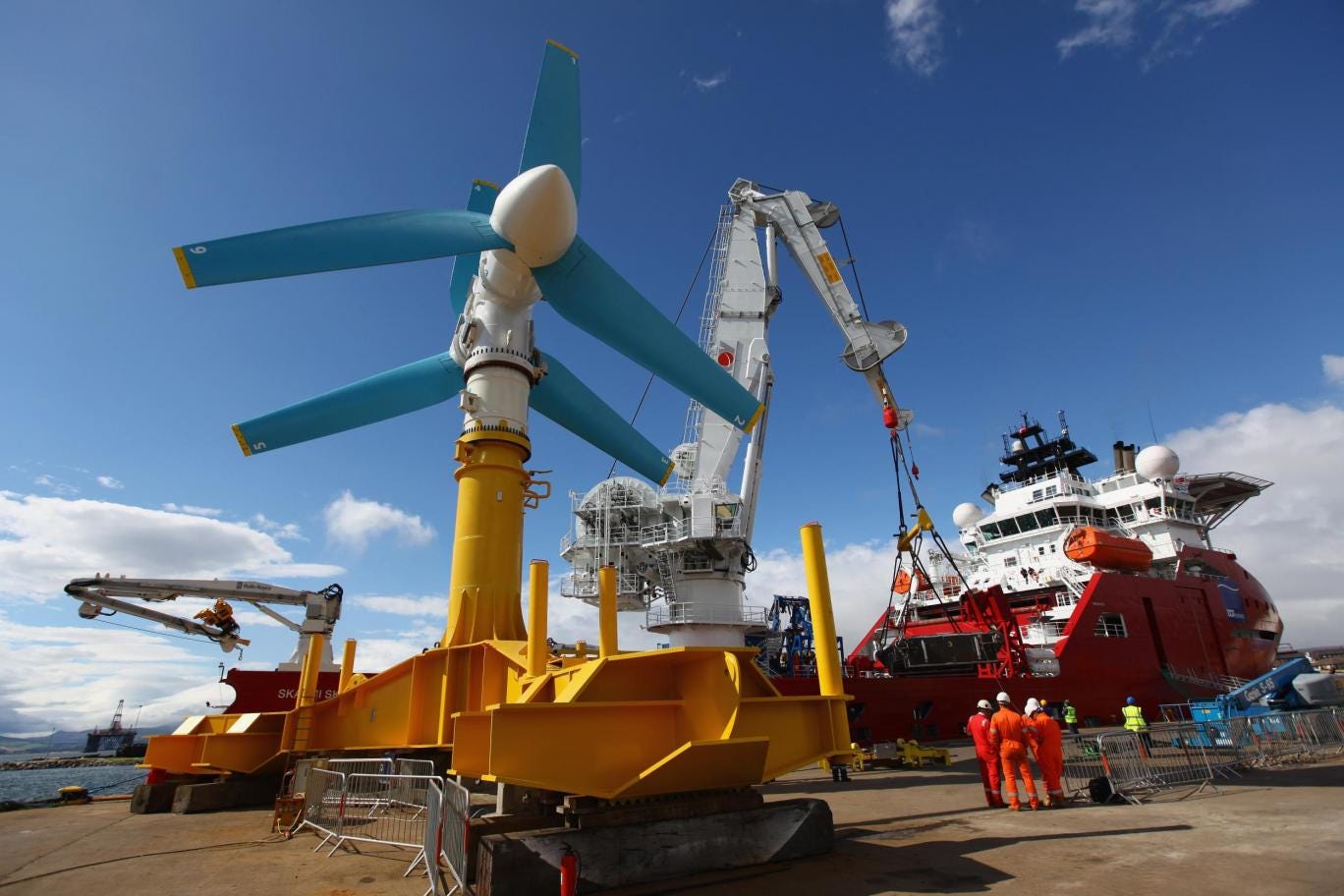
Equipped with a rotor measuring roughly 60 feet in diameter, the three-bladed horizontal-axis AR1000 aims to be among the world’s most powerful single-rotor tidal turbine, delivering 1 MW of power from tidal resources moving at speeds of about eight feet per second.
The system weighs 1,500 tons and stands about 75 feet tall on a seabed-mounted tripod foundation.
The BBC reports that tidal power is forging ahead in the north east of the UK as well -
Humber tidal project given Parliamentary approval.
Plans for a tidal power vessel in the Humber to generate electricity for a Hull aquarium have been approved.
The Neptune Proteus device will use the tides of the estuary to power The Deep.
The 150-tonne generator is expected to be deployed in the autumn. It is hoped five additional units will be installed in the future to generate energy for 5,000 homes.
Colin Brown, chief executive of The Deep, said the Humber had "massive" potential as a power source.
Mr Brown said: "Because of the nature of the aquarium, pumps are running 24/7 - we have a requirement for power all the time - and this one installation is anticipated to provide perhaps 30 or 40 percent of our entire electricity load."
Posted
by Big Gav
in
atlantis,
ocean energy,
tidal power
The Climate Spectator has an article on tidal power hopeful Atlantis resources - Is tide turning for marine energy?.
Tidal energy costs are generally thought to be prohibitive, a belief reinforced by the UK government’s decision to drop plans for a £30 billion tidal barrage across the Severn Estuary. But the Australian head of one the leading tidal energy developers in the world believes the technology could match the costs of land-based wind farms – sometime soon.
Tim Cornelius, the head of Atlantis Resources Corp, a company founded in Australia but which moved to Singapore in 2006 for want of a supportive policy framework and financial backing in its home country, says the proof of this will be found out quickly enough, as a range of large-scale projects are deployed in coming years.
Cornelius says tidal energy costs are already competitive with offshore wind (which some estimates at around $220/MWh) but he expects tidal to be able to piggyback on that industry’s rapid deployment to achieve greater cost efficiencies of its own.
Indeed, Cornelius says tidal and offshore wind are likely to work in tandem – sharing infrastructure such as offshore transformer platforms – to make a compelling energy offering from anticipated “mega projects” that can combine the massive-scale of offshore wind farms with the predictability of tidal energy. He says it is a particularly attractive propostion for countries such as the UK, Ireland and India, which have limited alternative sources of renewable energy and/or a limited amount of available land.
“Tidal is a complementary technology to offshore wind,” he says. “But the challenge is to get from offshore wind costs down to onshore wind costs. If it can match those costs and also offer predictability, then that’s a compelling proposition. It’s the killer punch.”
Atlantis has recently signed a contract to build up to 250MW of tidal energy installations in the Gulf of Kutch, in the Indian state of Gujarat, adding to a 378MW project in Scotland. A third major deal is expected to be announced in coming weeks.
The impending transformation from an early-stage development firm to a full commercial operation has forced Atlantis to hit the funding trail – assessing options that might include a private equity offering and/or strategic partnerships in the regions where it expects to operate. Cornelius is coy about the amount of money being sought, but at least $50 million is required to meet the first stage of the Indian project. Other press reports suggest the initial fund raising could be as high as $150 million.
Atlantis is using its largest shareholder, Morgan Stanley (49 per cent) as its financial advisor. The next biggest shareholder is the Norwegian energy group Statkraft, while private investors and management make up the rest.
Although Atlantis launched its first prototype at its test facilities in San Remo, near Phillip Island in Victoria, its subsequent development and project pipelines have emerged elsewhere because of the lack of support in Australia. Both the Indian and the Scotland projects will benefit from feed-in tariffs from the local authorities – in India it will be comparable to that offered to large-scale solar, and in Scotland it will be comparable to offshore wind.
“Tariffs are essential,” Cornelius says, “because it provides certainty to create financial models. The world is still run by men with calculators. They need to work out where the revenue is coming from.”
But why should utlities or governments pay higher tariffs for such technologies? Cornelius says that overseas it is seen as part of an essential investment to create a new industry. “The economic stimulus that new industries can provide is a huge part of every bid,” he says. “We’re never asked that in Australia. We are only ever asked if we can compete with coal. I can’t and I don’t pretend to.”
Cornelius says marine energy is now attracting the attention of major utlities and the principal power supply groups. The MeyGen project in Scotland is partnered with International Power and Morgan Stanley, and Rolls Royce will test 10MW of its newly developed turbines as part of the consortium. Seiems, Alstom, ABB, are also entering the market.
The interest of the energy and engineering giants is putting pressure on Atlantis to make sure it gets it right when it rolls out its first commercial deployment. Last August, Atlantis deployed the first of its 1MW turbines – the world’s largest, but has since been forced to find a new blades manufacturer after the failure of its blades. “It’s all about credibility and execution. If we get the first arrays right, then it is about critical mass,” Cornelius says.
“We are just at the start of the development of supply chain. Wind has quadrupled in output and halved in price in recent years, the same thing is happening in offshore, and we can leverage off that.
Cornelius is still hopeful of doing business in Australia, and is encouraged by the huge developments taking place in the Pilbara, which is creating huge energy demands – and higher energy costs. Atlantis had planned to install a turbine at Koolan Island north of Derby, but pulled out because of the lack of grid connection.
Posted
by Big Gav
in
atlantis,
india,
ocean energy,
tidal power
The Business Standard reports that Atlantis Resources is looking to build a 250 MW tidal power plant in India - India set to get Asia's first tidal power plant.
With the proposed commissioning of a 50-Mw tidal power project off the coast of Gujarat in 2013, India is ready to place its first “seamark” that will be a first for Asia as well.
London-based marine energy developer Atlantis Resources Corporation, along with Gujarat Power Corporation Ltd, has signed a memorandum of understanding (MoU) with the Gujarat government to start this project.
The cost for the plant is expected to be in the vicinity of Rs 750 crore. This plant is also is expected to be scaled up to 250 Mw.
Timothy Cornelius, CEO, Atlantis Resources Corporation, said with just about 2 giga watt of tidal power installations in the world today, this is a completely new and uncharted power sources with immense potential. “Tidal power today is what wind energy was 10 years back,” he said.
Due to the high investment in setting up the project, a typical tidal power project is expected to break even between 8 and 12 years after commissioning. Despite the long gestation period to make it commercially viable, tidal power has unparalleled environmental advantages.
“Tidal current power uses turbines to harness the energy contained in the flow of ocean tides. It is unique as like tidal movements, power output is highly predictable and sustainable with zero visual impact and the turbines are completely submerged. Tidal power is like putting a wind turbine subsea and the turbine rotors rotate slowly, causing very little environmental impact to marine flora and fauna,” said Cornelius.
The power offtaker would be Gujarat Power Corporation. The final cost of power per unit will be determined at the completion of front-end engineering and design (FEED) phase, but was expected to be competitive when compared to the large solar power projects planned for development in Gujarat, the company said.
The project is currently owned by Atlantis and GPCL and project equity participants will be sought at the completion of FEED phase.
Late last year, Atlantis became the turbine supplier to the largest planned marine power project in the world, MeyGen, a 378-Mw tidal power project in the Pentland Firth in Northern Scotland.
Current estimates suggest 15 per cent of the world’s power demands can be met by tidal current power sources, while the estimates for India are currently around 5 per cent of its annual demand for power.

Posted
by Big Gav
in
atlantis,
china,
india,
morgan stanley,
ocean energy,
tidal power
Bloomberg has a report on the ambitions of one time Australian tidal power company Atlantis - Morgan Stanley-Backed Atlantis Targets India, China for Tidal Power Plants.
Atlantis Resources Corp., an ocean- current turbine maker backed by Morgan Stanley, plans to expand in China, India and South Korea after winning a bid in the U.K. to build the world’s largest tidal-power project.
Atlantis Resources may start building a 50 megawatt tidal farm by 2012 in Gujarat, a western Indian state, and conduct commercial-scale trials in South Korea, Timothy Cornelius, the chief executive officer, said an interview today.
“China’s the next big market for tidal energy,” Cornelius, 34, said in Singapore at the Clean Energy conference. “It has the most natural tidal resources in the world and can be home to more than 1,000 megawatts of tidal energy.”
Global production of electricity harnessing the ocean waves may climb ten-fold to as much as 300 megawatts in the next couple of years, said Cornelius, a former submersible engineer who splits his time between Singapore and London. The potential to produce marine power economically is about 24,000 megawatts, he said. It costs 2.5 million pounds ($4.01 million) per megawatt for a minimum 200 megawatt-tidal project, he said.
Posted
by Big Gav
in
atlantis,
ocean energy,
pentland firth,
severn estuary,
tidal power,
uk
The future for tidal power projects in the UK wasn't looking so good last week when the government announced the severn barrage project would not go ahead (but that they would support 8 new nuclear power plants - on existing sites, with no public subsidy involved, which will probably make getting them actually built rather tricky).
The BBC reports that things have turned around this week though, with a 400 MW tidal power project getting the go ahead for Pentland Firth in Scotland - Pentland Firth tidal project set for development.
A huge tidal project is set to be developed in the Pentland Firth after the rights to the site were awarded to a consortium by the Crown Estate.
It has described the Inner Sound, which lies between the Caithness coast and island of Stroma, as one of the Firth's "most energetic" tidal areas.
The scheme could involve up to 400 submerged turbines, generating enough energy to power 400,000 homes.
A 25-year operational lease for the site was awarded to MeyGen. It is a joint venture between tidal technology provider Atlantis Resources Corporation, International Power and investment bank Morgan Stanley.
The award of the lease comes after two years of feasibility work in the waters of the Pentland Firth.
Subject to planning consent, the consortium plans to install hundreds of turbines in the Inner Sound area. Construction is expected to take place on a phased basis until 2020.
The project will be one of the biggest in the world, with the potential to generate up to 400MW of power.
The scheme is part of efforts to develop the Pentland Firth and waters surrounding the Orkney Islands in the largest planned wave and tidal generating programme in the world.
Earlier this year, areas in the Pentland Firth and around Orkney were leased to seven companies, which aim to generate enough electricity to supply 750,000 homes by 2020 from a range of wave and tidal devices.
Posted
by Big Gav
in
atlantis,
ocean energy,
scotland,
tidal power
The BBC has a report on a massive new tidal power turbine destined for a Scottish test site - Largest tidal power device unveiled.
A device thought to be the largest tidal energy turbine to be built in the world has been described by its developer as "simple and robust". Atlantis Resources unveiled its AK-1000 at Invergordon ahead of it being shipped to a European Marine Energy Centre test site off Eday, Orkney.
Chief executive Tim Cornelius said it was designed to survive in a harsh marine environment. The device stands 22.5m (73ft) tall and weighs 130 tonnes. It has two sets of blades to harness ebb and flood tides and could provide electricity for about 1,000 homes.
Mr Cornelius told BBC Scotland that the focus of the marine industry at the moment was making the Pentland Firth a huge success in terms of generating electricity from renewable energy devices. Mr Cornelius said: "It is one of the harshest environments on the planet. In order to get a robust turbine we have had to make what we call ultimately the dumbest, simple but most robust turbine you could possibly put in such a harsh environment."
The AK-1000's two sets of blades have also been designed to move slowly underwater and Atlantis said they would not pose a threat to sea life.
Mr Cornelius said: "The turbines turn at six to eight revolutions per minute so are incredibly slow turning and will have zero impact on the surrounding environment."

Posted
by Big Gav
in
atlantis,
india,
ocean energy,
tidal power
Ocean Power Magazine has an article on Indian interest in tidal power - India Studies Feasibility of Over 100 MW Of Tidal Energy Projects.
A small British-based tidal energy company has won a landmark contract to attempt to harness the power of the sea around India for the first time. Atlantis Resources has forged a deal with the western state of Gujarat, under which the privately owned company will establish the feasibility of developing tidal power projects capable of generating more than 100 megawatts of power — enough to supply about 40,000 households.
Of particular interest are the Gulf of Kutch and the Gulf of Khambhat in the Arabian Sea: two sites renowned for extreme daily tides. The project could lead to hundreds of millions of pounds worth of investment in tidal energy if the results of the study are positive.
India has more than 4,500 miles of coastline and is scrambling to tackle a gaping power deficit but has yet to establish a single tidal power project. The move to explore the untapped resource comes ahead of the United Nations Climate Change Conference in Copenhagen, an event where India will strive to demonstrate that it isdoing its utmost to limit emissions while refusing to cap economic growth.
India, which imports 70 per cent of its oil and relies on modest coal reserves to generate most of its electricity, is on course to become the third-largest user of energy by 2030, behind the US and China.
Atlantis’s backers include Morgan Stanley and Statkraft, the Norweigan state utility. The company, which is run by Tim Cornelius, an Australian former pilot of manned submersibles, is also hoping to establish a £400 million project to build one of the world’s biggest tidal power plants in the Pentland Firth, off the Scottish coast.
Posted
by Big Gav
in
atlantis,
australia,
koolan island,
ocean energy,
tidal power
Greentech Media has an article on a new tidal project planned for an iron ore mine off north west WA - Atlantis Plans 1MW Tidal Power Project off Australian Coast.
Fresh on the heels of landing a $14 million investment, Atlantis Resources now has a deal to install a 1-megawatt tidal power turbine off the Australian coast, according to The Australian.
Singapore-based Atlantis plans to provide the power to iron ore producer Mount Gibson Iron (no relation to Australia’s most famous Hollywood export) for its operations on Koolan Island in western Australia.
Just last month, Atlantis got a $14 million boost from Norwegian renewable energy provider Statkraft, which said it would work with Atlantis to install tidal power devices in Scotland’s Pentland Firth (see Ocean-Power-Meets-Bike-Chain Company Gets $14M). ...
That £300 million ($697 million) project is aimed at producing 150 megawatts of power for a Scottish data center. Atlantis also has a memorandum of understanding to build projects with China Light & Power, which brings its total pipeline of projects to 800 megawatts.
Atlantis offers a deep-water tidal turbine called the Solon, as well as a shallow-water device called the Nereus. The company’s other big investor is Morgan Stanley, which became its largest shareholder in September when Atlantis acquired Morgan Stanley-owned tidal power company Current Resources.
One interesting note about tidal power is that, unlike wind and solar power, the ebb and flow of the tides is eminently predictable. That can make it useful for providing baseload power for industrial uses that can be scheduled in advance.
It and its cousin, wave power, could grow from less than 10 megawatts last year to a $500 million, 1 gigawatt market by 2014, according to an October report by Greentech Media and the Prometheus Institute (see Trawling for $500M in Ocean Power and Tide Turning for Ocean Power?)
Posted
by Big Gav
in
atlantis,
data centres,
pentland firth,
tidal power
Business Green reports that plans to build a tidal powered data centre in Scotland continue to progress - Plans for tidal-powered "Blue Data Centre" flow forward.
Innovative plans for what promises to be the world's first tidal-powered datacentre moved a step closer to reality today with the news that the company behind the tidal turbine technology, Atlantis Resources Corporation, has signed a development partnership with datacentre developer Internet Villages International (IVI).
Under the terms of the alliance, IVI is expected to build an energy-efficient "Blue Data Centre" that will be connected to Atlantis' planned tidal power arrays in the Pentland Firth off the north coast of Scotland.
Atlantis plans to install two 10MW tidal current turbines and will also seek to exploit a planning loophole that allows fast connection of demonstration tidal turbines generating 10MW or less to the grid by inviting a third-party tidal energy firm to also install another 10MW system at the site.
"This project is so exciting because it allows us to sidestep the GB queue for connection to the grid; something which has traditionally held back remote renewable energy projects", explained Dr James Mitchell, head of business development at Atlantis.
IVI, which describes itself as a sustainable property company specialising in energy-efficient datacentres, is to build a datacentre requiring 150MW with the three turbine systems initially expected to provide 30MW of power. Should they prove successful, Atlantis hopes to gain planning permission for further tidal arrays that would not only allow all the energy needs of the datacentre to be met using tidal power, but also enable unused energy to be sold to the grid.
Posted
by Big Gav
in
atlantis,
ocean energy,
pentland firth,
tidal power
The SMH has a report on Australian tidal power company Atlantis and their ambition to be part of developments in Pentland Firth - Tide turns for ocean energy.
AN AUSTRALIAN company, using technology that a young Queensland engineer designed, is expected this week to announce a string of international contracts.
Atlantis Resources Corporation has developed turbines that can generate electricity from the sea's movement. It has begun trials at San Remo in Victoria. The company is confident it will win a contract to build 500 underwater turbines in the sea off Scotland. The tidal farm will have capacity to power a million homes.
"This is a story of a group of young Australians doing wonderful things on a global scale," Atlantis chief executive Timothy Cornelius said. He said the deep-water Solon turbine that 28-year-old Dr John Keir had designed was considered the world's most efficient underwater generator.
"This young guy from Townsville, in 12 months, has gone from concept to building this turbine," Mr Cornelius said. "The company is hopefully about to make some significant announcements on new projects with the potential to generate hundreds of megawatts of power in the United States, Canadian and Asian markets."
Mr Cornelius said the area that the company hoped to develop in Scotland - the Pentland Firth in the country's north - had been described as the Saudi Arabia of marine power. ...
Mr Cornelius said: "The tides are completely reliable, so much so that you can predict them 20 years in advance. That is exactly the kind of information energy companies are looking for. We can be highly accurate on our outputs to the electricity grid."
He said the Solon turbine worked best when submerged more than 40 metres and could generate two megawatts of power. "When you consider water covers 75 per cent of the world's surface, it is a wonderful opportunity because so much of that power is underdeveloped."
The company began in northern NSW, developing the shallow-water Nereus turbine, which can generate power from rivers. It has since moved to Singapore, nearer its Asian markets.
Mr Cornelius said the company was lobbying state governments in Australia for support to build fields of underwater turbines off the coast of Western Australia and Victoria.
Posted
by Big Gav
in
atlantis,
australia,
ocean power,
scotland,
tidal power
I mentioned ocean energy company Atlantis recently, who are doing some trials in Victoria's Corio Bay - both the Geelong Advertiser and The Age have reports on developments.
A SINGAPORE-BASED company is set to install two tidal turbines in The Rip off Queenscliff in a world first. The Solon turbine, a deep-water turbine suitable for installation in fast flowing currents, has not been installed anywhere in the world. It has the potential to power about 1000 houses.
Atlantis Power Resources has been testing the unit in Corio Bay and initial tests have proved successful. Chief executive officer Tim Cornelius said the company had spent two years developing the top secret project and had begun talks with authorities on applying for a permit. "Queenscliff has an excellent concentration of tidal flow so it is an ideal spot," he said.
When placed in ocean and river currents, the turbine transforms the kinetic energy from the moving water, and converts it into commercial quantities of AC or DC electricity. The power can then be fed directly into the grid.
The "tidal farms" have a 20-year life span and if approved, can be installed and operational within 30 days.

Another location that seems destined to be a large user of tidal power is Scotland, with the Scotsman looking forward to a green collar jobs bonanza -
Green-collar jobs are the biggest prize.
WITH Europe aiming to generate a fifth of its energy from renewable technologies by 2020, and the UK hoping to contribute a tenfold increase in energy it generates this way, to 15 per cent, a green vision has been set for the next decade.
The government is consulting industry and planners, and the Renewable Energy Strategy (RES), due for publication next year, will set out the route-map for this green transformation.
There are three energy types to consider – electricity, heat and transport – each with different technologies and demand. For example, renewable electricity is relatively established, but, renewable heat and transport has almost no installed capacity.
To meet our 15 per cent target, we need to ensure each sector grows considerably. The RES suggests increases of 32 per cent of electricity (from less than 5 per cent today), 14 per cent in heat (1 per cent today) and 10 per cent transport (under 1 per cent today)If we do not meet one sector target, we will need to exceed in another, or trade carbon with other countries.
"Whilst we were burning North Sea oil, Germany were building the wind turbines, and Scandinavian countries were building biofuel wood burners," explains Jason Ormiston, the chief executive of trade association Scottish Renewables,
But he is positive about Scottish renewables industries: "With the certainty of renewable energy targets in the RES, businesses will plan the finance, resources, and production they need," he says.
"This will be good news for Scotland, which is a leader in manufacturing wave and tidal technologies, and offshore engineering. Based on the evidence of the government's support of wind-generated electricity, I believe we could transform the way we generate heat and power transport."
Posted
by Big Gav
in
atlantis,
morgan stanley,
ocean power,
tidal power
Finance Asia has a report on Asian tidal / ocean current power company Atlantis - Tidal power company moves to the next level.
Atlantis Resources, a developer and manufacturer of electricity-generating tidal current turbines, has moved a step closer to a commercial-scale deployment of its technology with the acquisition of Current Resources, an energy origination and project development business owned by Morgan Stanley. ...
Power generation using tidal currents is the latest renewable energy source to emerge as a viable alternative to fossil fuels. The technology has yet to be deployed commercially, but the unparalleled predictability of the movement and intensity of tides suggests it has clear advantages for the power industry, versus some of the other renewable energy sources such as wind or solar power.
According to an Atlantis press release, ocean power, which includes tidal current power, wave power and ocean thermal energy conversion, represents a vast source of energy estimated at between 2,000 and 4,000 terawatt hours per year. The US and the UK combined have sufficient ocean power potential to meet around 15% of their power needs.
Having spent 10 years developing its turbines, Cornelius says Atlantis is now ready to become the first tidal power developer to establish mini-arrays (essentially farms or fields of multiple subsea turbines of 1 or 2 megawatts each). This will allow it to aggregate the necessary data about environmental and turbine performance before it moves on to apply for permits for projects of a much more significant scale.
“We are entering into an exciting phase where we will focus on the necessary steps to build up to meaningful commercial quantities of tidal generation projects,” he says. “The first step will be to deploy lots of between 5 and 10 turbines to allow governments and the regulators to get comfortable with the technology and the performance before we apply to scale-up. We hope to start deploying turbines by June next year, and building up to 2011 when we plan to enter the commercial side of deployment with projects that have a capacity of 150-500MW.”
These commercial projects should see the company turn cash flow positive in 2011, he adds.
The company has had a 150KW turbine installed and connected to the grid in Australia since 2006 and is hoping to build up its generation capacity there, but it is also actively looking for several other sites both in Asia and Europe where it can set up trail arrays. It is currently evaluating potential installation opportunities in the Pentland Firth off Northern Scotland, in the Bay of Fundy and in British Columbia off the east and west costs of North America and off the coast of South Korea.
China also has the potential to become a “huge” market, according to Cornelius, since the company’s Nereus turbine that is suitable for shallow-water can be deployed not just in tidal oceans, but in rivers too – and that is a resource that China has a plenty of. Atlantis also has a second type of turbine, the Solon, which is a deep-water turbine that can be installed in some of the fastest flowing currents in the world.
“China will be a key market. South Korea has some of the best tidal resources in the world, Japan has tidal resources as well and the Philippines has fantastic tidal flow. So, Asia is a hugely exciting place for us, because there is so much resource and so much need for clean power.”



 Posts
Posts