Showing posts with label coal seam gas. Show all posts

Malcolm Turnbull - Energy Magician  

Posted by Big Gav in , , ,

Ross Gittins at the SMH has a look at the natural gas market and the bizarre spectacle of Prime Minister Malcolm Turnbull trying to promote coal fired power, backflipping from his earlier enthusiasm for 100% renewable energy - Malcolm Turnbull wants us to think he's an energy magician.

As the feds understood full well, once you can liquefy natural gas you can ship it overseas. And once you do that you've taken the relatively tiny, closed eastern Australian gas market and opened it up to the huge East Asian gas market, where prices are much higher. The inevitable consequence was a leap in the price of gas on the eastern seaboard – plus a huge windfall gain to our eastern gas producers.

Now do you see why the gas industry and federal politicians of both stripes keep repeating the economic lie that the problem has been caused by the states' bans on fracking, and could be solved by lifting them? No amount of increased gas supply on our part would be sufficient to lower the East Asian price of gas, which means no new producer of coal seam gas would be prepared to sell it to local consumers and manufacturers for anything less than they could get by selling it to Japan or China. Unless, of course, the federal government obliged them to.

I don't object to the policy of export-parity pricing but, like its predecessors, the Turnbull government wants to keep the policy a deep, dark secret because it's so much harder to defend a super-rational policy in these days of populist indulgence than it was when Malcolm Fraser did something similar to petrol prices. Turnbull wants to keep the super-rational policy, but shift the blame for its economic and political consequences to others. Had he the courage, he could oblige the gas industry to use its windfall profits to compensate the household and business losers for losses arising from an implicit government policy change.

Turnbull blames South Australia's blackouts on its excessive enthusiasm for renewable energy which, pending the development of storage arrangements, has a problem with intermittent production. He doesn't admit his parity-pricing policy is contributing. It was expected that gas-fired power generation would ease the transition from coal-fired to renewable generation. That's because gas-fired power stations emit far less carbon dioxide and can be turned on and off as required to counter renewable energy's intermittency.

Guess what? South Australia has a new and big gas-fired generator at Pelican Point, near Adelaide, but it's been mothballed. Why? Because the operator had a long-term contract for the supply of gas at a price set at the pre-export-parity level, and decided it was more lucrative to sell the gas into the East Asian market.

Last week Turnbull had the effrontery to argue that now gas-fired power had become uneconomic, we needed to fill the gap by subsidising new-generation "clean" coal-fired power stations. Small problem. They're hugely expensive, only a bit less emissions-intensive than existing coal-fired stations, can't easily be turned on and off, and would supposedly still be operating 60 years later.

If there's a case for subsidising any fossil fuel-powered generators the obvious candidate is the gas-fired plants the feds' export-parity pricing policy has rendered uneconomic. So great is the coal industry's hold over the Coalition that, not content with subsidising increased supply of coal from Adani and others at a time when coal is a sunset industry, Turnbull is now making up excuses to subsidise increased demand for coal by local electricity producers.

Economists are always telling politicians not to try picking industry winners. In reality, the politicians are far more inclined to back known losers.

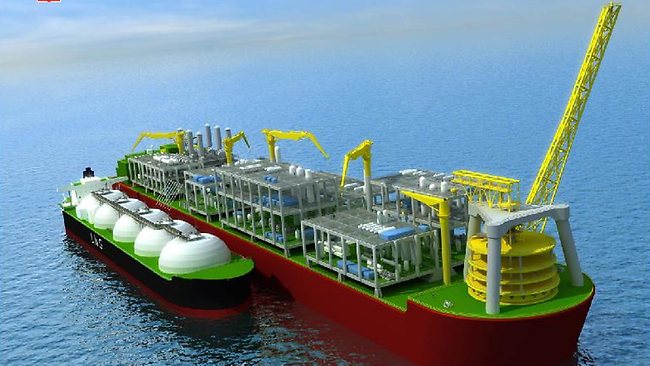
LNG: Having spent $200bn to export gas, is Australia about to import it?  

Posted by Big Gav in , , ,

Now the Australian building boom for LNG plants (exporting natural gas from the north west and coal seam gas from the north east) is over, local utility AGL is wondering if the easiest source of gas in future may be LNG imports from elsewhere - LNG: Having spent $200bn to export gas, is Australia about to import it?.

In a 21st century variant of "selling coals to Newcastle", energy supplier AGL has flagged it may need to spend up to $300 million to build an LNG import depot to shield itself from soaring gas prices and increasing difficulty in finding reliable local supplies.

Setting the Condamine River on fire  

Posted by Big Gav in , , , ,

One of the more striking videos I've seen on Facebook in recent weeks is this video of Greens MP Jeremy Buckingham setting the Condamine river in Queensland on fire by igniting leaking gas. He blames fracking in the area - the CSIRO aren't entirely convinced but it's a good way of bringing attention to coal seam gas extraction either way.

Alarmingly, with various forms of unconventional gas extraction on the rise, Harvard researchers published a paper in Geophysical Research Letters a few months ago where they concluded that between 2002 and 2014, US methane emissions increased by more than 30 percent - accounting for 30 to 60 percent of a spike in methane in the atmosphere.

A conspiracy to stiff gas consumers ?  

Posted by Big Gav in , , , ,

Michael West has an article in the SMH posing the question "are rising Australian domestic gas prices the result of a conspiracy" - A conspiracy to stiff gas consumers.

Coal prices have crashed, the carbon tax has gone, yet the cost of electricity continues to rise. Oil prices have halved, yet the price of gas, which is linked to oil, is going up 17 per cent.

This used to be a country which thrived on an abundance of low-cost energy. Now virtually every consumer and every business is shackled by spiralling energy prices. ...

About 34,000 homes had their electricity cut off and there were more than 24,000 who had their gas cut off. There is a vicious circle in this, because the fewer people there are on the grid the more the networks charge each customer to recoup their costs.

And charge they do. Even as inflation has ebbed in recent years, and even as actual demand has receded too, the networks have kept pushing regulators for their 10 per cent returns. ...

The gas lobby has been running the line, talking about a "cliff" in gas supply. Unless new coal seam gas projects were urgently bought on the east coast would literally run out of gas. This scare campaign has been the impetus for the dramatic rise in gas prices.

Yet there is no hard evidence for it, because the gas cartel does not reveal even to the government how much there is in the way of gas reserves or what is actually contracted and at what price.

It is no secret though that, despite Australia's enormous reserves, prices have been driven up by the rush to export the stuff to Asia. Local consumers are being forced to pay international prices and the producers have diverted supply to the Gladstone plants to be turned into LNG and shipped offshore.

That, too, is now unravelling. Credit Suisse sallied forth with a report this week which pointed out gas prices had halved, in line with plunging oil, and that the Gladstone LNG projects were in financial disarray.

Personally I'd find it ard to blame rising gas prices on anything other than the linkage of domestic prices to the international export market - as long as Asian prices are higher than domestic prices once were, we'll have to pay out more. The only real solution to this, as a coalition of manufacturers have argued, is reserving a percentage of gas production for the domestic market and regulating the price (then ignoring the howls from the gas producers about missing profit opportunities). In the longer run solar power will make the issue largely irrelevant, other than for industries that need gas as a feedstock.

The SMH had an earlier article talking about the effect of exports on local prices - Local gas prices set to soar as exports to Asia get under way.

In late December, British energy giant BG Group sent the first ever shipment of liquefied natural gas from Australia's east coast, using gas from the state's booming coal seam gas industry. Granted, it sounds far removed from everyday life for most of us. But this cargo load is the start of a trend that will dramatically increase how much households pay for gas used for hot water, cooking, or heating.

It is predicted to push up many households' utility bills by a similar amount to the carbon tax, but there are no plans for compensation. And as you'd expect with a jump in the cost of living of this size, this one is producing some seriously flimsy economics.

First though, back to that shipment. Not only was it the first time that CSG has been converted into LNG, the exportable form of gas. More importantly for consumers, it was the first time gas has been exported from the east coast of Australia at all, and there is much more to come. Origin Energy and Santos this year also hope to start pumping cargo loads full of the stuff, to be sold to buyers across China, Japan, Korea, Malaysia and other Asian nations.

Economists are keeping an eye on these projects – and others in WA – as there are predictions they could make Australia the world's biggest exporter of LNG by 2018, overtaking Qatar. LNG looks set to become our second biggest export behind iron ore. But what will affect households directly is how this massive new industry transforms the domestic gas market.

Now that the east coast is able to export gas (WA has been doing it since 1989) producers have the option of selling to buyers in Asia, who are willing to pay much, much more for it than we have been.

Historically, the east coast gas market was insulated from the rest of the world, and the domestic wholesale price was stable at about $3 to $4 a gigajoule. Now, there are buyers across Asia prepared to pay $12 or $13, even when energy markets are in turmoil as they are at the moment.

ReNew Economy has an article on the dismal future for natural gas fired power generation - Record low solar prices heralds power shift from fossil fuels.

It should be a little ironic – given the dramatic plunge in the oil price that is said to have been driven by Saudi Arabian supply tactics – that a Saudi company should set two global records for cheap solar power in the past two weeks.

But to energy analysts it is yet another sign of the energy transition taking place across the world, and one that could be accelerated, rather than slowed, by the collapse in the oil price because of the cancellation and deferral of tens of billions of dollars in uneconomic fossil fuel reserves.

ACWA Power, a water and power developer based in the Saudi capital Riyadh, last week won the world’s largest ever solar tender with the cheapest ever price for a large scale solar project.

It will build – with the help of Spanish group TSK and technology from US-based First Solar – a 260MWp solar PV plant at the Mohammed Rashid Al Maktoum Solar Park in Dubai, at a cost of just $US0.058/kwh, of $US58.4/MWh.

That’s how much it will receive as a fixed tariff over 25 years for what will be – for the moment – the largest solar plant in Middle East. The price it bid is 20 per cent cheaper than the previous benchmark for solar tenders. What’s more, it is 30 per cent cheaper than the price of gas that is currently used for nearly all of the electricity generation in the United Arab Emirates.

How important is gas to China's energy mix?  

Posted by Big Gav in , , , , , ,

The Climate Spectator has a pair of article on EIA research into China's appetite for natural gas. The first looks at where China currently gets its gas from - How important is gas to China's energy mix?.

China more than tripled natural gas production since 2003, producing 3.8 trillion cubic feet in 2012, and the government is targeting production to reach about 5.5 Tcf of natural gas per year by the end of 2015. Most of the anticipated production growth is from large onshore fields in the western and north central regions of China as well as from the offshore deepwater regions in the South China Sea. China's natural gas consumption has outstripped domestic supply since 2007, triggering rising imports of both liquefied natural gas and pipeline gas. China's natural gas consumption rose at an average annual rate of 17 per cent from 2003 through 2013, reaching nearly 5.7 Tcf in 2013.

In 2013, China imported nearly 1.8 Tcf of LNG and pipeline gas to fill the growing gap between supply and demand. Imported natural gas met 32 per cent of China's demand in 2013, up from 2 per cent in 2006. China is swiftly developing its LNG import capacity in the urban coastal areas and currently has 10 major regasification terminals with 1.7 Tcf/y of capacity. In 2012, China rose to become the third-largest LNG importer in the world, after Japan and South Korea, and in 2013, the country imported 870 billion cubic feet of LNG. Estimates for the first half of 2014 show LNG imports growing at faster levels than in previous years.

The second article looks at the supply situation from Russia - China's gas equation, post-Gazprom.

Russia's largest natural gas company, Gazprom, finalised a deal with the Chinese National Petroleum Corporation in May. New natural gas production in Russia will mainly come from fields in eastern Siberia, which currently lack export infrastructure. The planned Power of Siberia pipeline will export gas south to China and east to a liquefied natural gas plant on Russia's east coast.

This contract is Gazprom's largest to date. Gazprom has a monopoly on pipeline natural gas export contracts made by Russia. The situation differs from that in LNG markets, where other companies such as Rosneft and Novatek may participate.

China's northern and eastern provinces have growing natural gas demand that cannot be met by existing pipelines or LNG, and the new Russian natural gas will mostly go to meet demand in these regions. China has also committed to purchasing 38 bcm (1.3 Tcf) per year of natural gas from Turkmenistan by 2016, increasing to 65 bcm (2.2Tcf) per year by 2020.

As a footnote, Technology Review has an article on China's problems trying to develop shale gas - China’s Shale Gas Bust.

In 2013 China became the third biggest user of natural gas behind the United States and Russia, consuming 166 billion cubic meters (bcm). By 2019, the International Energy Agency expects China’s annual natural gas consumption to grow 90 percent, to 315 bcm. Half of that increase is expected to be supplied by domestic gas production, which would come from multiple sources, including shale reserves.

That IEA estimate for gas consumption is much lower than the production target China had set for itself: 420 bcm of natural gas annually by 2020, with hydrofracturing, or fracking, being used to get 60 to 80 bcm from shale.

China is estimated to hold the largest technically recoverable reserves of shale gas in the world—nearly twice as much as the U.S. But the shale industry in China has struggled to get off the ground. Most projects are still in the exploration phase. In many cases the formations that hold gas are deeper than in North America and more expensive to reach. Further, Chinese shale tends to have more clay in it, which is an obstacle to extraction (see “China Has Plenty of Shale Gas, But It Will Be Hard to Mine”). These challenges led the government last week to reduce the 2020 shale-gas target to 30 bcm.

Even that would represent a huge increase. Of the 117 bcm of natural gas that China produced in 2013, only 0.2 bcm came from shale.

The high price of gas exports  

Posted by Big Gav in , , ,

The impact of LNG exports, particularly of coal seam gas, on Australian industry continues to be the topic of debate, with one recent report warning that there it will further destroy the local manufacturing industry (already reeling from Dutch disease) - High gas prices threaten thousands of jobs, billions of dollars: industry.

A new report warns the riches promised by exporting Australian gas may have a devastating impact on local industries, particularly manufacturing. A coalition of half-a-dozen industry groups commissioned the report by Deloitte Access Economics.

The report says domestic gas prices are rapidly rising as the market links in with international prices. It warns that, if the rise goes unchecked, the manufacturing sector alone will contract by as much as $118 billion by 2021, with nearly 15,000 jobs lost. The report also finds that mining might contract by $34 billion and agriculture by $4.5 billion.

The ABC has a background piece - The price of gas.

Australians pay close to the highest electricity prices in the world, and we’re about to start paying some of the world’s highest gas prices, too. That’s because we’re about to start exporting gas for the first time from the east coast, and there’s no limit to the amount of gas that can be sent overseas.

That means Australians have to compete with energy-hungry customers in Asia, who are prepared to pay top dollar for our gas. The message from the government is that if we want to use gas, we’re going to have to get used to paying top dollar, too.

‘Gas is now being sold in Australia at an international price. That’s the reality of a world market,’ says the federal minister for industry, Ian Macfarlane. ‘To protect one section of the Australian market to the detriment of those people who want to take the risk, and invest the billions of dollars it takes to develop a CSG (coal seam gas) project simply doesn’t make economic sense, and we’ll just see that investment go somewhere else.’

Australia is about to become the first country in the world to export coal seam gas—without the CSG boom in Queensland, exports on the east coast simply wouldn’t be viable. Equally, coal seam gas mining wouldn’t be feasible in Australia at the old price of $3-4 per gigajoule, because it costs a lot more to extract than conventional gas.

Customers in Asia are prepared to pay up to $18 per gigajoule for our gas. Since there’s no policy to disconnect Australia from these prices, our gas prices are now rising to meet what’s called the ‘netback’ price—the Asian price, minus the cost of processing and shipping.

For big industrial users, this is particularly bad news. ‘We're seeing prices leap from historical averages of sort of $3 to $4 a gigajoule to $9 to $12 a gigajoule or more,’ says Ben Eade, executive director of Manufacturing Australia. He says the impact of rising gas prices will ‘dwarf the impact of the carbon tax’.

A new report commissioned by industry groups and prepared by Deloitte Access Economics says skyrocketing gas prices will damage the Australian manufacturing sector to the tune of $118 billion over the next seven years, and lead to a loss of more than 14,000 jobs. ‘The fact is, high energy costs are killing industry in Australia,’ says Eade, ‘and high gas costs in particular.’

Even the companies who are willing to pay top dollar for gas are having a hard time finding it. That’s because around 80 per cent of Australia’s gas is now controlled by companies who are selling that gas to Asia. In fact, the big gas exporters have overcommitted to customers; according to Citigroup all three LNG hubs are having to buy gas from third parties in order to meet demand.

Swanbank shut-down a swan song for gas fired power in Australia  

Posted by Big Gav in , , ,

Tristan Edis at the BS has a look at how LNG exports from Queensland are killing gas fired power generation - Swanbank shut-down a swan song for gas.

Queensland government-owned Stanwell has announced it will be mothballing its gas-fired 385 megawatt Swanbank E power station in October for up to three years. Meanwhile, it will restart one of its two mothballed units at the coal-fired Tarong Power station instead but, critically, is yet to give a firm indication on timing.

This announcement marks a pivotal point in the east coast National Electricity Market – the end of gas’ rise and the beginning of a major fall as a source of power generation. According to Stanwell’s chief executive officer Richard Van Breda, “With subdued market conditions and increasing gas prices expected to continue, Stanwell can earn more revenue from selling our gas rather than using it in electricity generation.” ...

As the chart below, from Pitt & Sherry’s Hugh Saddler, shows gas has experienced a steady rise in output from June 2006 to December 2013 while black coal and, more recently, brown coal have suffered.

Back around 2006 it all looked very bright for gas as the low carbon bridging fuel to renewables. It was thought that gas would steadily increase its share of power generation while coal declined on the back of policies to reduce Australia’s greenhouse gas emissions.

Lots of new gas had been discovered within Queensland coal seams that meant there was little risk of the east coast running short. Gas prices at around $3.50 per gigajoule plus power plant construction that was quicker and lower cost meant that there was only a relatively small difference in the economics of a new coal versus a gas power plant. A relatively moderate carbon price of around $20 to $30 was all that was needed for coal to lose out to gas in baseload operation, not to mention coal’s inferior flexibility and larger minimum size that increased its risk profile.

The Queensland 13% Gas Target and NSW’s Greenhouse Gas Abatement Scheme were already in place, providing a clear precedent for what many saw as an inevitable national emissions trading scheme. A dash for gas, like what had been seen in Europe and the US, seemed to be on the horizon. But then Santos announced it planned to build a plant to liquefy Queensland coal seam gas and export it overseas. It changed everything, although at the time the consequences were not entirely clear.

Now they are. Gas contracts are now being struck at prices of $9 per gigajoule rather than the $3.50 price of the past. There is also talk of gas shortages because of a huge surge in demand from a range of LNG plants coming online within short succession.

The true reason for tripling gas prices  

Posted by Big Gav in , ,

Ross Gittins at the SMH has an article on the Australian government's plumbing of new moral depths, including a look at the dishonest debate about natural gas exports - Under Tony Abbott, political principles reach an all-time low.

Declining standards at federal level have been matched by bad behaviour at state level. For an example of state politicians willing to blatantly mislead their electorates, look no further than the Victorian and NSW governments' dishonest explanation for the looming jump of about 25 per cent in the price of household gas.

The true reason for the rise is that the building of natural gas liquefaction plants in Gladstone will soon allow gas producers on Australia's east coast to export their gas and obtain the much higher prices paid on the world market. The east coast will go from being outside the world market to inside it.

The price rise is thus inevitable unless governments were to prohibit the companies from exporting their gas, forcing them to continue accepting below-world prices. There has been no suggestion of penalising the gas producers in this way. Rather, state politicians have taken up the dishonest claim of the gas companies that permitting them to build new and controversial coal seam gas plants would somehow prevent gas prices from rising or force them back down. But as any student of economics could tell you, there's no way NSW and Victoria could ever produce enough natural gas to significantly affect the world price of gas.

The price of gas in NSW and Victoria would stay below the world price only if the new producers were compelled to sell their gas to local users at below the world price. Again, there's been no suggestion of this.

Last week the gas companies' illogical argument was taken up by the new NSW Minister for Energy and Resources, Anthony Roberts. I'm prepared to believe Roberts may be economically illiterate, but I don't believe his advisers are - nor that they don't read the papers, where the scam has been exposed.

Although Roberts has replaced a minister who left the cabinet under a cloud, he seems uninhibited in his efforts to mislead the electorate. It's hard to know whether he is simply seeking to advance the gas industry's vested interests or is setting up an alibi which allows the government to blame the inevitable jump in gas prices on those terrible people opposed to fracking.

Either way, his only crime is seeking to deceive voters. And these days that's the way everyone plays the political game, isn't it?

What Gas shortage? Tapping the bubbling wells of spin and self-interest  

Posted by Big Gav in , , ,

Crikey has a look at the lobbying being done on behalf of the natural gas (particularly coal seam gas) industry to try to demolish opposition to expanded drilling programs - Gas shortage? Tapping the bubbling wells of spin and self-interest. One benefit of Labor losing office is Martin Ferguson no longer being in Parliament - its a shame he didn't retire to obscurity instead of getting paid to do what he was doing before as energy minister - lobbying on behalf of the fossil fuel industry.

New South Wales is about to run out of gas, so says the scare campaign. It’s bully-boy tactics by Australia’s powerful oil and gas industry, designed to pressure the state government into quickly approving contentious coal seam gas projects proposed by Santos at Narrabri and AGL at Gloucester.

Federal Industry Minister Ian Macfarlane is on board, warning last year NSW would “run short of gas by 2016” and moving to knock heads together on the issue straight after the election. For months we have been hearing the same lines trotted out: how NSW is “running on empty”, suddenly needs “energy security”, and how developing its own “indigenous” gas supplies will ease prices.

Former John Howard industrial relations minister Peter Reith — whose recommendation to lift fracking bans was ignored by the Victorian government last year — used his column in Fairfax papers yesterday to accuse the O’Farrell government of abandoning the CSG debate, warning “there is a real prospect Sydney could suffer gas shortages”. Reith failed to disclose his consultancy with construction giant Bechtel, a major contractor to the CSG industry.

Former federal energy minister Martin Ferguson was appointed chair of new advisory group APPEA (“the voice of Australia’s oil and gas industry”) in October, barely six months after he stepped down from his cabinet post and only weeks after retiring from Parliament — flouting the 18-month cooling-off period required of ex-ministers under the lobbying code of conduct. Ferguson had a dig at his erstwhile NSW Labor colleagues for “parroting the lines of the Greens and showing itself to be completely irrelevant to the debate”, urging Premier Barry O’Farrell to break “the impasse preventing the development of the state’s abundant gas resources to put downward pressure on rising prices”.

The ABC’s fact checkers concluded Macfarlane’s alarming claims about a NSW gas shortage were “unverifiable”. They were way too generous. The claims are rubbish, designed to confuse the public. Here’s what they’re not telling you:

* No one is going to run out of gas; * Developing CSG in NSW won’t lower rising gas prices; * It’s too late anyway for NSW CSG to ease the current uncertainty affecting gas markets; and * There are plenty of alternative sources of supply for NSW.

Australia has an incredible amount of gas; we’re about to overtake Qatar to become the world’s largest exporter of liquefied natural gas. Between Western Australia, the Northern Territory and Queensland, seven LNG projects worth more than $200 billion are on the go.

The chart above shows three seriously big gas resources that supply the southern and eastern states: the massive coal seam gas in Queensland’s Bowen and Surat basins (41620PJ), plus conventional gas in the Gippsland Basin (3890PJ) and the Cooper Basin (1835PJ). Not shown but certainly exercising the mind of investors is a vast potential resource of tight and shale gas in the Cooper Basin — which may turn out to be bigger than CSG in Queensland, and which oil majors like Chevron and BG Group are scrambling to invest in. By comparison, the coal seam gas discovered in NSW is significant, but no game-changer: Santos has 1426PJ in the Gunnedah Basin, which accounts for half the state’s known reserves.

Overall, there is no doubt Australia has enough gas in the ground to supply both the domestic and export markets. As a country we can afford to think strategically, pick and choose which gas fields we develop, and in what order.

As the Australian Energy Market Operator found last year, if there’s one place in Australia susceptible to shortage it’s Gladstone in Queensland. That’s where three massive LNG export projects operated by BG, Santos and Origin Energy are about to treble gas demand in eastern Australia — ultimately representing some 80% of total gas demand in the eastern market — once they begin to come online later this year. By exposing the domestic market to higher international LNG prices of around $14-15 a gigajoule (which are geared to the oil price), the LNG projects are going to double domestic wholesale gas prices, from around $3-4/GJ to $8-10/GJ and higher, inevitably pushing up retail prices (as NSW saw last week).

The three big projects in Gladstone were approved quickly in 2010 and 2011 — without any strategic consideration of the impact on the domestic gas market — in a rush to sign lucrative contracts with buyers in Asia. It’s a bold experiment; the world’s first attempt to convert coal seam gas into LNG for export. Nobody knows yet if the thousands of CSG wells required to feed the six big LNG liquefaction units (or “trains”) under construction — each one consuming roughly as much gas each year as say Queensland or Victoria, so adding six new states’ worth of demand to the network — can be drilled fast enough, and will flow enough gas for long enough, to fulfil those contractual commitments.

Exxon pushing for floating LNG for Scarborough field  

Posted by Big Gav in , , , , , , ,

The SMH reports that Exxon is pushing for a floating LNG platform for the Scarborough gas field offshore from Western Australia - Exxon for floating gas.

ExxonMobil insists a floating liquefied natural gas processor is the preferred way to develop the big Scarborough offshore gas project in Western Australia, despite its partner BHP Billiton talking up an alternative model.

ExxonMobil has approval from the government to develop the project using a floating processor, but that did not stop BHP's petroleum chief Tim Cutt suggesting last month that connection to an existing gas processing plant may be preferable. ''Developed capacity … is typically a more cost-effective and value-accretive way to go,'' Mr Cutt said.

The North West Shelf, which is partly owned by BHP, looms as the logical place to process Scarborough gas if the floating option is abandoned, given its proximity and the fact gas production at the shelf will soon plateau.

On the other side of the country it looks unlikely that the Arrow Energy coal seam gas LNG plant will go ahead - Struggling Shell defers Arrow LNG project again.

Royal Dutch Shell has ruled out any commitment this year to the development of its Arrow liquefied natural gas venture in Queensland and signalled a more rigorous approach to other new projects in Australia, where it is also considering big asset sales. ...

Speaking after Shell reported a 70 per cent slump in fourth-quarter profit, the company's new global head named the $20-billion-plus Arrow LNG venture with PetroChina among the next potential wave of LNG investments for the oil giant, alongside the Browse floating venture and others. But he said Shell had deferred the project, deterred by ''the economics and inflation risks''. The delay is the second for the struggling Arrow venture, where at least 250 jobs were cut in January.

Speculation is increasing that Shell and PetroChina will sell their gas to one of the three LNG plants being built in Queensland, either for an expansion, or to supplement initial inadequate supplies.

Doubts raised over CSG well capacity to feed Curtis Island LNG plants  

Posted by Big Gav in , ,

Mining News has an article quoting an American drilling services company that claims there are poor results for coal seam gas drilling to support Queensland LNG plants - Doubts raised over CSG well capacity to feed Curtis Island LNG plants. Santos and Origin are rejecting the claims.

Doubts have been raised over whether Queensland’s coal seam gas fields can produce enough to feed Curtis Island’s LNG export plants, with claims that many wells are not meeting production expectations. Houston-based drilling suppler, Superior Energy Services, said it is forecasting growth in the sunshine state on the back of poor well performance. The company, which employs more than 14,000 people worldwide and boasts a turnover of $US4bn says its eastern Australian business is set for a growth spurt, The Australian reported.

"When we are talking to the operators in Queensland, we hear from them that the coal-seam gas (wells) that currently have been drilled are actually not meeting the production expectations," SES head of Asia Pacific, Ruud Boendermaker, told investors last week. "So what they have to do is to drill a lot more CSG wells in the next few years because of the commitments to the LNG trains that they are currently building in the north of Queensland."

Boendermaker said the coal seams are not as homogeneous or permeable as expected, claiming this has led to poor well performance. SES did not say which projects needed more wells, or which areas in the state were experiencing issues, however the company’s Toowoomba office contracts to drillers rather than to the LNG proponents directly.

The calls comes as a former executive for one of the projects told The Australian that the gas fields’ "sweet spots" had not been as large as anticipated.

Australia's LNG nuclear bomb  

Posted by Big Gav in , ,

The BS's Alan Kohler has an article on the repeal of the carbon tax - Australia's LNG nuclear bomb.

The LNG export boom will make it virtually impossible for Australia to meet the government’s carbon emissions reduction target. The high price of gas in Australia has made replacing coal-fired power stations with gas uneconomic and “fugitive emissions” from the LNG plants mean that reducing overall emissions within Australia by 5 per cent by 2020, as government policy states, will require much bigger cuts in other industries.

Tony Abbott will have to either drop the promise to cut emissions by 5 per cent or the promise to repeal the carbon tax – both together will be impossible without massive government spending under the proposed “direct action” policy of paying companies to reduce emissions.

Actually previous government policy was for a 15 per cent reduction in emissions if the rest of the developed world also took action on climate change. That’s happening, so the 15 per cent would have applied. The Coalition said it would match Labor’s emissions reduction target, but the figure of 15 per cent doesn’t seem to appear in its policy – only 5 per cent.

Anyway, not trying to reduce carbon emissions at all would put Australia at odds with the rest of the world, including China and the US, and endanger trade agreements, so the prime minister and Treasurer Joe Hockey will be, or at least should be, desperately hoping that the Senate never allows the repeal of the emission trading scheme legislation, so it’s not exactly a broken promise – at least they tried. ...

The emissions trading scheme currently in place would eventually produce revenues to the government of up to $10 billion a year. It’s understood Treasury has estimated the eventual cost of the Coalition’s direct action plan at $10 billion.

That’s a $20 billion turnaround and makes climate change a “nuclear bomb” in the federal budget, as Professor Ross Garnaut says and as he puts in his book Dog Days, it would end up “distracting the government and the polity from the great economic challenges facing Australia”.

Like Australia, the United States has enjoyed a huge boom in gas supplies by exploiting smaller and tighter reservoirs – in their case in shale, in ours coal seams.

However the US banned LNG exports and is now allowing them on a case-by-case basis, resulting in a collapse in the domestic gas price to about a third of what it was. The result is wholesale replacement of coal-fired power stations – new and existing -- with lower carbon emitting gas.

In Australia, export pricing has led to a huge increase in the domestic gas price despite the big lift in available supply, with the result that gas is still uneconomic as a replacement electricity fuel for coal.

Arrow LNG project put on notice  

Posted by Big Gav in , , ,

The BS has an article about the possibility of one one Queensland's coal seam gas LNG projects being cancelled - Arrow LNG project put on notice. I guess this could help limit gas price rises on the east coast for a time, with the excess supply needing to be soaked up somewhere.

The owners of the Arrow coal-seam gas project in Queensland have ordered the project's team to tighten its costs or Arrow will not go ahead, according to The Australian. The ultimatum from Royal Dutch Shell and PetroChina to the project's team casts further uncertainty on the outlook for Australia's liquefied natural gas (LNG) outlook.

East Coast Gas prices to spike: AGL  

Posted by Big Gav in , , ,

The Business Spectator reports that AGL's CEO is predicting east coast gas prices will triple once the coal seam gas LNG plants in Queensland come online in 2015 - Gas prices to spike: AGL.

Mr Fraser said as power generators and industrial users absorb the effects of $70 billion worth of LNG plants being constructed at Gladstone, domestic demand would come under pressure and push gas prices higher. "Everybody talked about there being a surplus of ramp-up gas, now people talk about the wedge gas -- the shortfall in the gas they have in the early years of the project," Mr Fraser said. "Deals are being done at $9-$10 and who knows where it will go when it starts up."

Chinese oil companies attempt to slash shale gas drilling costs  

Posted by Big Gav in , , , ,

Platts has an article on Chinese progress in extracting shale gas (Chinese wells still take 3 times as long to drill as US ones and cost around 4 times as much) - Chinese oil companies attempt to slash shale gas drilling costs.

Chinese companies are aiming to cut costs and enhance efficiencies as they become more familiar with shale gas development in the country, delegates at an unconventional gas conference said in Beijing this week.

State-owned Sinopec has been focused on the gas-rich Sichuan Basin, where it already has experience working on complex fields with high sulfur in tight reservoirs, particularly with its Puguang and Yuanba projects. Its main shale development is the Fuling project in the Sichuan Basin in Chongqing covering up to 500 sq km. Sinopec said in March that it hoped to reach 1 billion cubic meters/year of production capacity at the project by 2015.

Ma Yongsheng, the company's chief geologist, told delegates at the Global Unconventional Gas Summit on Tuesday that Fuling has produced more than 20 million cu m since late last year from an ongoing trial production, and daily output has hit 60,000 cu m of gas. There are now five wells with stable output. Working on the project has already yielded some efficiencies, Ma said, with the drilling time for each well cut by half to about three months. Ma added that the cost of one shale gas well is now around Yuan 90 million ($14.7 million), including costs for drilling, fracturing and procurement of services from technical service companies.

Gas still is the subject of much debate in Australia, with The Age recently running an article on opposition to natural gas export projects pushing up the price of domestic gas - Gas companies 'hoarding' for export projects.

Gas companies have been accused of leaving gas in the ground that could be profitably sold today, so they can sell the gas more expensively in the future. The claim comes as gas prices along the east coast are forecast to rise to international levels after the development of a string of export gas projects in Queensland. This has already driven the price of gas for some large industrial users to $9 a gigajoule from 2016, up 50 per cent.

''An oil company that expects to sell … LNG [liquefied natural gas] at a price of $14.85 ma unit in 20 years' time would be better off if it secured $3 for that same unit of gas in the domestic market today,'' Mike Lauer, director of Gas Trading Australia, told the Australian Pipeline Industry Association on Monday. ''The overwhelming focus of our oil and gas producers on big, exciting and sexy LNG developments has come at a substantial cost to resource allocation in Australia. This focus has seen oil company executives decline to profitably sell gas in domestic markets today so that the gas can be reserved for sale in 15 or 20 years as LNG.''

An example is the Northern Territory, where more than 150 petajoules of gas is brought into Darwin each year and exported to Japan. ''Apparently, there was not 12 PJ to 20 PJ of gas per annum available to supply Channel Island, 12 kilometres away from the LNG plant, because the gas was needed to supply LNG in the plant's 17th contract year,'' he said. ''It beggars belief that there was no price at which such small volumes of gas could be liberated from the LNG project. ...

His comments came as pipeline owner and operator Jemena said government must be prepared to intervene to prevent ''demand destruction'' among some gas users when the gas price spikes, which would put trade-exposed industries that use large volumes of gas at risk. ''Temporary, targeted government assistance for trade-exposed industries would be justified to ease transitional pressures,'' said Shaun Reardon, Jemena's executive director.

The Daily Reckoning reckons this is all as it should be (I'm not sure your average punter would be swayed by these arguments but they are preaching to the choir) - Should Australia Have a Shortage of Natural Gas or Cash ?.

If you can buy something for $3.15 in America and sell it for $16.40 in Mexico, should you? Not if you're a patriotic Australian, as you'll discover below.

Oddly enough, Australia is at the centre of the story the image is trying to tell, but we don't even get a price label. Maybe that's because there are some foul smelling goings on within our borders. We're talking about the natural gas industry, of course.

'Rip and reap, baby' is for the wimpy resource cowboys of the past, reports The Age. 'Rip, reap, hoard and flog overseas' is the new motto of the Australian gas industry. And they're infuriating the greenies, industry, politicians and every other busybody in the country. So, as a matter of principle, let's give the scroungedrels some support.

Why are they 'scroungedrels'? Well, instead of providing much needed cheap natural gas to Australian homes and industry, the scoundrels are scrounging around for higher prices overseas. Despite having one of the largest gas production booms in the country, Australia could end up with a shortage of natural gas!

That's a bit misleading. The correct way of putting it is that local consumers of gas are being outbid by foreigners. We're not willing to pay the international market price. But for the sake of the journalists who have to write about this stuff, let's call it a gas 'shortage'.

More and more gas export terminals are coming online, but not fast enough for the natural gas producers. Now the villains have gone one worse than just selling Australia's valuable and needed resources overseas for a higher price. [Gasp!] They're hoarding and storing natural gas in anticipation of being able to sell it overseas at a higher price. [Outraged gasp!] And that's driving up the price of natural gas here in the meantime. [Bang fist on table.] There's nothing worse than a hoarding scroungedrel, is there? [Shake head.]

Actually, things are just as they should be. For now anyway. Politicians and lobbyists are already on the move to 'fix' the 'problem'. As always, they're being egged on by big business trying to get some protection from international competition. BlueScope Chief Paul O'Malley pointed out that Australia is the only country in the world that exports gas without having a national gas policy.

Maybe it's not a coincidence we're in the middle of a gas boom then. But try substituting 'gas' for something else like 'cabbage'. 'Australia is the only country in the world that exports cabbage without having a national cabbage policy.' Ridiculous, right? ...

First of all, hoarding in anticipation of future use is a signal to the economy that a lot of gas will be needed soon, so production needs to be ramped up. Nothing ramps up production like higher prices, and that's just what hoarding causes. So hoarders are actually quite helpful. They also stabilise prices when they sell their amassed holdings. And prepare the rest of the economy for the coming higher prices.

Secondly, selling your exports overseas for multiple times their local price generates a greater benefit than cheap natural gas would here. It's just that the dollars flow into different hands. So the real question should be how Aussie investors can get their hands on the Aussie companies that will be making a mint.

One widely touted answer to natural gas availability in Australia is (naturally) shale gas, with the ABC's Landline program recently having a look at action in the Cooper Basin - It's a Gas.

Australia is on the cusp of a new resource industry, one based on extracting gas from shale rock.

Like coal seam gas, this new industry raises questions about how gas extraction will interfere with underground aquifers, an issue that's troubled some farming communities.

Although shale gas reserves are found throughout Australia, the initial exploration and drilling is being done in a remote part of the Cooper Basin. ...

MIKE SEXTON, REPORTER: This is well number 191 in the Moomba gas field at the Cooper Basin. It isn't the most impressive piece of infrastructure, a 2m high wellhead with a length of 20mm pipe. But it's the closest you'll ever see to an iceberg in the desert, because it's what's hidden that counts.

JAMES BAULDERSTONE, SANTOS: Quite rightly say it doesn't look overly impressive. What you don't see is what happens under the ground. So here you have a well that's some 3.5km deep and is extracting a resource from that one single well that provides the energy for 40,000 homes in Adelaide and Sydney.

MIKE SEXTON: It's Australia's first production well for shale gas, which is often referred to as unconventional gas. And the company operating it, Santos, believes it's a game-changing resource.

JAMES BAULDERSTONE: In the Moomba field and surrounding fields we have some 700 producing gas wells. This is one of those 700 and we're hopeful we can drill many wells like this that can really take the production from central Australia that's been producing, supplying half of the gas of the eastern seaboard for 40 years, and provide that for another 40 years.

MIKE SEXTON: Geologists have long known about the shale deposits. The reason they're now being exploited is because of Asia's continuing demand for energy.

In 2010 Santos signed enormous contracts to supply gas from the Cooper Basin via its joint venture LNG plant at Gladstone in North Queensland. Leaving themselves five years to find enough gas.

The Cooper Basin was slowly being turned off. Now the dynamic has dramatically changed.

The Australian also has an article promoting shale gas production - Shale gas will transform energy market, says experts (sic).
Santos last year became the first company to begin commercial production of shale gas in Australia, after developing a well near its conventional gas activities in the Cooper Basin, which straddles South Australia's border with Queensland.

Chatham House energy expert Paul Stevens said a strong shale-gas industry in Australia could be expected in the medium-to-long term, and a more attractive tax regime should be implemented to ensure it happens. Professor Stevens said the shale gas revolution in the US had developed while companies were receiving a US$0.50 tax credit for producing unconventional gas until 2002. "Government's can't change geology, but they can change the commercially of the geology,'' Professor Stevens told The Australian after the event. "Tweaking the fiscal terms is quite a good way of doing it.''

Australia has about 396 trillion cubic feet (TCF) in potential shale-gas reserves. Proven conventional gas reserves which do no require "fracking'' - a process in which fluids and sand are injected into rocks to split them in order release gas trapped inside - are about 133 TCF.

Can Australia become the world's leading LNG exporter ?  

Posted by Big Gav in , , ,

The ABC's "Fact Check" has a look at claims from the new energy minister that Australia could be the world's leading exporter of LNG from natural gas and coal seam gas - Can Australia become the world's leading LNG exporter ?.

The LNG industry claims to be Australia's fastest growing export sector.

Industry Minister Ian Macfarlane shares the rosy outlook. "Australia will shortly become the second largest - or optimistically, the largest - exporter of LNG and that is nothing short of amazing," Mr Macfarlane said during the Australian National Conference on Resource and Energy on October 3.

Is that a reasonable prediction?

Mr Macfarlane's office told ABC Fact Check he based his comments on advice from the Department of Industry and research by the Bureau of Resources and Energy Economics, the national energy forecaster. The bureau says Australia will produce 83.0 million tonnes of LNG by 2017. How does this compare with the rest of the world?

According to statistics from the International Energy Agency, whose 28 member countries from the developed world are large users of energy, Australia is currently the third largest LNG producer in the world, behind Qatar and Malaysia.

The agency says Australia has the capacity to produce 33 billion cubic metres of LNG a year. In tonnes, the measurement used commonly in Australia, that converts to 24.4 million tonnes.

While Australia is in third place, the agency says Australia has more new LNG plants under construction than any other country.

On completion, the new projects will add a further 61.4 million tonnes of LNG capacity, bringing Australia's total to 85.8 million tonnes. These are due to be completed by June 2018.

Not many other LNG exporting countries have new projects underway, according to the agency. The closest is the United States, constructing plants capable of producing 17.8 million tonnes.

When plants under construction are added to current capacity, Australia will lead the way with 85.8 million tonnes. Qatar, the current leader in LNG exports, will be next at 77.7 million tonnes and Indonesia third at 36.3 million tonnes.

Manufacturing a gas crisis  

Posted by Big Gav in , ,

Tristan Edis at The Climate Spectator has an article on the strange maneuverings of the coal seam gas industry in NSW as they try to create an illusion of gas scarcity to try and overturn moratoriums on drilling - Manufacturing a gas crisis.

NSW sources its gas from natural gas developments in the Cooper Basin of Central Australia (which had been thought to have peaked a decade ago but have now expanded again and reached a 20 year high) supplemented by and shale gas from the Cooper Basin (reckoned to be significant in some quarters) along with gas from the Bass Strait (which has also seen a rebound in production in recent years).

While the LNG export plants for coal seam gas being built in Queensland are looking to try and use some of the gas from the Cooper Basin, Tristan thinks that their is sufficient supply to support this for some time, with NSW gas consumption flat and a likely shrinking of demand from gas fired power plants as gas prices rise to equalise with those being paid by Asian customers (minus liquefaction and transport costs).

It’s important to note that gas demand in NSW is not growing noticeably, so this isn’t the thing driving any kind of shortage. Also, the traditional gas fields that have supplied the gas to NSW - South Australia's Cooper Basin and Victoria’s Bass Strait, aren’t about to dry up within the next few years. So, we aren’t actually about to run out of gas in the ground. But there are limits on supply in terms of how much equipment is in place to process the gas and transport it via pipelines into NSW, however this can be changed with a few years lead-time for construction.

The fear centres on the fact that Moomba also has a substantial pipeline into Queensland. Over the 2014-17 period as the LNG plants ramp up, they will suck so much supply from South Australia into Queensland that without development of NSW gas fields, manufacturers and households in NSW will be left short of gas.

King points out that, in reality, such a shortage for industry and households won’t eventuate and this is really just a matter of price. If NSW consumers were in desperate need of additional gas then, without doubt, prices would rise (and they are already rising). Now the interesting thing that King points out is that there is one particularly large consumer of gas that has ready substitutes – power generation. King explains:

“...what’s actually going to happen is that the first source of supply will be the withdrawal of use of gas for power generation. Okay. So, that’s actually where the first source of gas is going to come from, not a gas field. It’s going to come out of power generation. It’s not going to come out of industry. And, you know, in my view the suggestion that industry is the one that gets sort of shorted by this is not right because it will be power generation that will be shorted by that increase in demand for gas.” This doesn't mean we'll be doing without power, though. What King acknowledged is that the Renewable Energy Target by inducing extra renewable power capacity into the market, it is taking gas out of power generation and also freeing up NSW black coal generating capacity.

The major oversupply of power generation will ensure NSW has no fear of running out of gas or power.

Now, of course, a big rise in the gas price is hardly welcome news for manufacturers. So will freeing up coal seam gas development in NSW help?

It certainly wouldn’t hurt, but the extent of the difference it makes is highly dependent on circumstances. King points out that due to pipeline constraints from Moomba into Queensland its possible for additional supply from NSW to reduce gas prices.

However it needs to be a lot of a supply, which is conceivable but will take time. Just like in any other market, NSW CSG producers will price their product at the competing alternative supplier. If the marginal supplier is still gas from Moomba then NSW CSG will make no difference to price. For it to make a difference it needs to bring forward enough supply over 2014-2017 to more than offset any drop-off in supply from Moomba.

Those suggesting NSW faces an imminent gas crisis are yet to thoroughly explain whether this could be done. NSW manufacturers aren’t likely to find themselves without gas, but they will be paying much higher prices. Extra gas from NSW CSG could help, but it will take several years to make a major difference.

Plus it's worth noting if you look closely in the map above there is a dotted blue line running out of Narrabri into Queensland. That's a proposed new pipeline that would then allow NSW CSG to be exported into the LNG-linked Queensland market. If there really is a major shortage of gas to supply LNG plants and it turns out that NSW CSG is plentiful, then it probably wouldn't depress NSW prices for too long before that pipeline gets built.

Losing friends with an expanding natural gas export sector  

Posted by Big Gav in , , ,

The Business Spectator has a look at the downside of Australia's expanding natural gas / coal seam gas export sector - Losing friends with an expanding gas export sector. When exports of shale gas start from the US I imagine a similar debate will start up there - cheap gas only lasts as long as you aren't exposed to global markets.

The export gas multinationals are no friend of Australian manufacturing. There is only one reason that the gas prices are set to at least double over the next few years – gas export companies will force Australian consumers to compete with the Asian market for gas.

That’s the true cost of opening up coal seam gas mining and allowing gas from eastern Australia to be exported. And no amount of drilling for more CSG will either secure the gas for domestic users or keep the price down. The simple reason for this is that no matter how much gas is found, it can all be exported.

The gas export terminals currently under construction will have a massive capacity of 1637 petajoules. That’s more than double all the gas we use in Australia at the moment. But according to analysis done by Core Energy for the Australian Energy Market Operator, there are over 6000 petajoules of additional proposed LNG export facilities, enough to quadruple the export capacity currently under construction. These include several additional liquefied natural gas 'trains' at the existing Curtis Island facilities in Gladstone and new facilities at existing ports in Queensland and New South Wales.

The Australia Institute recently used AEMO gas demand and price projections to calculate the increased cost of gas to the manufacturing industry in the Gladstone region as a result of CSG exports. It found a massive cost of $2.9 billion over the next 10 years, to be paid by just a handful of manufacturers.

This is threatening the viability of these industries. We are effectively allowing multinational gas exporters to displace our manufacturing sector. And it’s not just as a result of the gas price. The gas expansion is also displacing manufacturing by keeping the Australian dollar higher than it would otherwise be, and creating a severe skills shortage.

A Convergence Of Interests ?  

Posted by Big Gav in , , ,

SP at TOD ANZ has an interesting conspiracy hypothesis about the Chinese purchase of Cubbie Station cotton farm and the massive need for water the booming coal seam gas industry has (invoking the ghost of Russ Hinze along the way) - Sinogetically stuffing the basins?.

Pulling a few strands months apart together, is there a link between Paul Sheehans story (below) about how the expansion of Coal Seam Gas production is going to impact water availability for downstream food producers with last years agreement to sell Cubbie station to a Chinese consortium (now completed).

Gas industry rattled by findings of triple normal levels of methane emissions  

Posted by Big Gav in , ,

ReNew Economy has a report on research that may result in a massive tax bill for the coal seam gas industry - Gas industry rattled by findings of triple normal levels of methane.

LEVELS of the potent greenhouse gas methane have been recorded at more than three times their normal background levels at coal seam gas fields in Australia, raising questions about the true climate change impact of the booming industry.

The findings, which have been submitted both for peer review and to the Federal Department of Climate Change, also raise doubts about how much the export-driven coal seam gas (CSG) industry should pay under the country’s carbon price laws.

Southern Cross University (SCU) researchers Dr Isaac Santos and Dr Damien Maher used a hi-tech measuring device attached to a vehicle to compare levels of methane in the air at different locations in southern Queensland and northern New South Wales. The gas industry was quick to attack their findings and the scientists themselves.

The Queensland government has already approved several major multi-billion dollar CSG projects worth more than $60 billion, all of which are focussed on converting the gas to export-friendly liquefied natural gas (LNG).

More than 30,000 gas wells will be drilled in the state in the coming decades and the industry has estimated between 10 per cent and 40 per cent of the wells will undergo hydraulic fracturing.

The industry and state and federal ministers have claimed that electricity derived from coal seam gas will help slow growth in carbon emissions but, so far, no comprehensive independent lifecycle assessment of emissions has been carried out.

Last August, a Right to Information request submitted by me and reported in the Brisbane Times revealed that the state’s government was prepared to rely on industry-funded research when it came to understanding the industry’s carbon footprint.

A later report from the Australian Petroleum Production and Exploration Association, which looked at emissions from CSG when burned for electricity in China, was produced by Worley Parsons, a company which had won a $580 million contract to work on a major CSG-to-LNG project in the state.

The Federal Energy Minister Martin Ferguson has also waved away suggestions that the government should commission its own independent research into CSG emissions, and was reported as saying such a study was “unnecessary”.

The work at Southern Cross University is arguably the first attempt to independently measure levels of methane coming from gasfield areas.

Dr Santos said in a university release: “The current discussions on CSG are often based on anecdotal evidence, old observations not designed to assess CSG or data obtained overseas. We believe universities are independent institutions that should provide hard data to inform this discussion. The lack of site-specific baseline data is staggering.”

In an interview with the Australian Broadcasting Corporation, Dr Maher said while it was not possible yet to say “definitively” that the raised levels of methane were due to leaks from the CSG facilities, “we have multiple lines of evidence to suggest that that is what is causing it”. He said the initial findings pointed to the CSG operations as a likely source of the raised methane levels – in particular, from “fugitive emissions.

Statistics

Locations of visitors to this page

blogspot visitor
Stat Counter

Total Pageviews

Ads

Books

Followers

Blog Archive

Labels

australia (619) global warming (423) solar power (397) peak oil (355) renewable energy (302) electric vehicles (250) wind power (194) ocean energy (165) csp (159) solar thermal power (145) geothermal energy (144) energy storage (142) smart grids (140) oil (139) solar pv (138) tidal power (137) coal seam gas (131) nuclear power (129) china (120) lng (117) iraq (113) geothermal power (112) green buildings (110) natural gas (110) agriculture (91) oil price (80) biofuel (78) wave power (73) smart meters (72) coal (70) uk (69) electricity grid (67) energy efficiency (64) google (58) internet (50) surveillance (50) bicycle (49) big brother (49) shale gas (49) food prices (48) tesla (46) thin film solar (42) biomimicry (40) canada (40) scotland (38) ocean power (37) politics (37) shale oil (37) new zealand (35) air transport (34) algae (34) water (34) arctic ice (33) concentrating solar power (33) saudi arabia (33) queensland (32) california (31) credit crunch (31) bioplastic (30) offshore wind power (30) population (30) cogeneration (28) geoengineering (28) batteries (26) drought (26) resource wars (26) woodside (26) censorship (25) cleantech (25) bruce sterling (24) ctl (23) limits to growth (23) carbon tax (22) economics (22) exxon (22) lithium (22) buckminster fuller (21) distributed manufacturing (21) iraq oil law (21) coal to liquids (20) indonesia (20) origin energy (20) brightsource (19) rail transport (19) ultracapacitor (19) santos (18) ausra (17) collapse (17) electric bikes (17) michael klare (17) atlantis (16) cellulosic ethanol (16) iceland (16) lithium ion batteries (16) mapping (16) ucg (16) bees (15) concentrating solar thermal power (15) ethanol (15) geodynamics (15) psychology (15) al gore (14) brazil (14) bucky fuller (14) carbon emissions (14) fertiliser (14) matthew simmons (14) ambient energy (13) biodiesel (13) investment (13) kenya (13) public transport (13) big oil (12) biochar (12) chile (12) cities (12) desertec (12) internet of things (12) otec (12) texas (12) victoria (12) antarctica (11) cradle to cradle (11) energy policy (11) hybrid car (11) terra preta (11) tinfoil (11) toyota (11) amory lovins (10) fabber (10) gazprom (10) goldman sachs (10) gtl (10) severn estuary (10) volt (10) afghanistan (9) alaska (9) biomass (9) carbon trading (9) distributed generation (9) esolar (9) four day week (9) fuel cells (9) jeremy leggett (9) methane hydrates (9) pge (9) sweden (9) arrow energy (8) bolivia (8) eroei (8) fish (8) floating offshore wind power (8) guerilla gardening (8) linc energy (8) methane (8) nanosolar (8) natural gas pipelines (8) pentland firth (8) saul griffith (8) stirling engine (8) us elections (8) western australia (8) airborne wind turbines (7) bloom energy (7) boeing (7) chp (7) climategate (7) copenhagen (7) scenario planning (7) vinod khosla (7) apocaphilia (6) ceramic fuel cells (6) cigs (6) futurism (6) jatropha (6) nigeria (6) ocean acidification (6) relocalisation (6) somalia (6) t boone pickens (6) local currencies (5) space based solar power (5) varanus island (5) garbage (4) global energy grid (4) kevin kelly (4) low temperature geothermal power (4) oled (4) tim flannery (4) v2g (4) club of rome (3) norman borlaug (2) peak oil portfolio (1)