Shell's massive floating LNG factory off the Kimberley coast has been in shutdown since February and industry analysts are divided on whether the $12-17 billion facility has a future.
With five times the steel of the Sydney Harbour Bridge and half a kilometre long, it certainly is big. But as it sits idle 400 kilometres north of Broome, it risks becoming the world's biggest white elephant.
The article notes that the Abadi project in Indonesia has also given up on floating LNG technology for now.
Woodside's reasoning seems to have been based more on the sliding price for LNG and a lack of buyers willing to make long term commitments rather than any perceived problems with the technology.
The article also noted that other FLNG projects are proceeding, such as ENI's Coral venture in Mozambique and Golar LNG's projects in west Africa for Ophir Energy and Perenco.
Shell's Prelude FLNG project in northern Australia is still going ahead as well.
French energy giant GDF Suez says it is reconsidering a huge project for a floating gas liquefaction factory off northern Australia and might opt to build an undersea pipeline to Darwin. The gas fields concerned continue to have "material value", the company said on Thursday. But using a floating liquefaction plant to process the gas does not satisfy business criteria, the group said, in an important announcement for the Australian energy sector.
The overall project, called Bonaparte, involves an ambitious scheme using advanced technology to generate liquefied natural gas from resources off northern Australia. The development of floating liquefaction plants is at the forefront of efforts to turn Australia into a leading supplier of LNG in Asia.
The SMH reports that Exxon is pushing for a floating LNG platform for the Scarborough gas field offshore from Western Australia - Exxon for floating gas.
ExxonMobil insists a floating liquefied natural gas processor is the preferred way to develop the big Scarborough offshore gas project in Western Australia, despite its partner BHP Billiton talking up an alternative model.
ExxonMobil has approval from the government to develop the project using a floating processor, but that did not stop BHP's petroleum chief Tim Cutt suggesting last month that connection to an existing gas processing plant may be preferable. ''Developed capacity … is typically a more cost-effective and value-accretive way to go,'' Mr Cutt said.
The North West Shelf, which is partly owned by BHP, looms as the logical place to process Scarborough gas if the floating option is abandoned, given its proximity and the fact gas production at the shelf will soon plateau.
Royal Dutch Shell has ruled out any commitment this year to the development of its Arrow liquefied natural gas venture in Queensland and signalled a more rigorous approach to other new projects in Australia, where it is also considering big asset sales. ...
Speaking after Shell reported a 70 per cent slump in fourth-quarter profit, the company's new global head named the $20-billion-plus Arrow LNG venture with PetroChina among the next potential wave of LNG investments for the oil giant, alongside the Browse floating venture and others. But he said Shell had deferred the project, deterred by ''the economics and inflation risks''. The delay is the second for the struggling Arrow venture, where at least 250 jobs were cut in January.
Speculation is increasing that Shell and PetroChina will sell their gas to one of the three LNG plants being built in Queensland, either for an expansion, or to supplement initial inadequate supplies.
If West Australian Premier Colin Barnett is looking for someone to blame for crushing his dreams to develop a massive gas processing hub near Broome he needs to go to The Hague. The seeds were sown in 1996, when a senior engineer at Shell’s headquarters jotted down an idea in an internal staff suggestion box. Why not liquify gas offshore rather than develop pipelines and convert gas into liquified natural gas onshore?
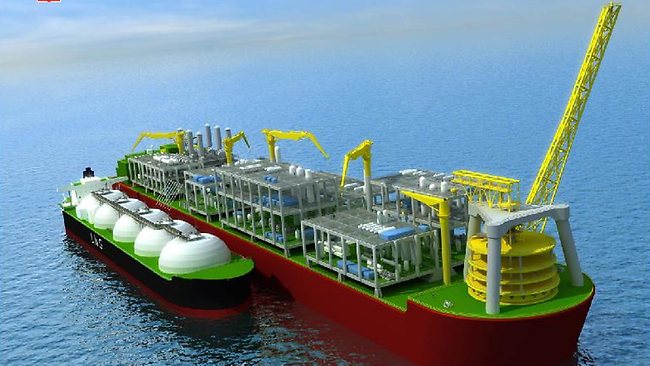
Nearly 20 years and 1.6 million man-hours later Shell is recruiting the first wave of workers for a massive vessel about 200 kilometres off the Kimberley coast, processing gas from its Prelude gas field. It will be the first vessel in the world that will be able to take gas from the reservoir below, liquify it and transfer the gas to cargo ships that will moor alongside the processing facility in the middle of the ocean.
It wasn’t that long ago that the technology, known as floating LNG, was viewed as an expensive option only to be used to unlock small or stranded gas fields like Prelude. This week the game changed. Woodside, Australia’s biggest oil and gas company, has thrown its support behind the technology, declaring it wants to be a world-leading floating LNG operator as it decided to unleash not just one, but three floating LNG ships to develop its Browse gas resources.
The Business Spectator has an interview with Woodside CEO Peter Coleman about Brows, Israel's Leviathan field and the possibility of shale gas exports from the US (something the Japanese seem keen to encourage). The BS's Robert Gottliebsen continuing his incessant anti-union / government diatribe (Coleman deftly ignored him thankfully) - KGB Interview: Woodside's Peter Coleman.
SB: Peter, looking at your presentation this week, you don’t seem particularly concerned about the potential impact of US shale-fed LNG hitting your markets. Could it have a material impact on prices or more particularly could it have an impact on the way LNG is priced?
PC: Well, there are probably two impacts of that. Firstly, the impact of US shale gas is quite clearly improving productivity in the US and making the US actually a more attractive place to invest, particularly for some industries around chemicals and plastics. And so, those energy intensive industries are actually moving back into the US and will soak up some of that excess supply. The supply that may get into LNG , and remember there’s not very much that has actually gone to FID yet …
AK: Sorry Peter, we’re getting some static.
PC: Yeah, so I was saying, the shale gas industry and the surge in gas available and into the US has really made the US attractive as an investment destination for those industries that are very energy intensive or turn gas into something else, being the chemicals and the plastic industry. The gas that’s left over and, you know, the gas that will be exported, you know, there are a couple of things there to consider. Firstly, there are a lot of projects at the moment on the drawing board. Not many have gone to a final investment decision. When you look at the total cost structure, the landed priced into Asia will be competitive but it won’t be low cost by any means. So, the headline price of $4 gas hitting Asia is just simply untrue. Now, the price is going to be in the low to mid-teens and it doesn’t really take very much of a rise in gas prices in the US to in fact make it marginal to uneconomic. So, I think that we a balance will occur, and an equilibrium point will occur, within industry within the next five to 10 years. What does that mean? There’s going to be an evolution in the market. The market is already evolving to become a more fungible commodity. I see trading hubs will be established. True training hubs will be established. Will that be in Singapore, Shanghai, Hong Kong? I can’t say, but Woodside is preparing ourselves for the advent of trading hubs. So, all of those sorts of things will come into play. The consumer is starting to see. You’re starting to see a proliferation now of regasification terminals being put into Asia. As many terminals that as currently exist are now being built in Asia, so there are 40 currently underway. So, clearly the buyers can see that the market is changing. It’s becoming more commoditised. Henry Hub gas just simply puts another gas stream into that. I wouldn’t see Henry Hub any differently from gas that’s going to come out of East Africa or other parts of the world. It’s just another gas stream that’s going to come in.
Gottliebsen has been banging this drum forever it seems, though the BS getting sold to Rupert Murdoch last year hasn't helped matters. Crikey's Guy Rundle has some thoughts about Rupert's malign influence on the Australian election (I liked the Gus Fring comparison) - In Murdoch-land, sans-public sphere, it all sounds the same.
Getting out and about in Brisbane of a morning, you’re greeted with something you’ve forgotten: this is a one-owner town, newspaper wise. Looking at a news rack and seeing The Australian and The Courier-Mail side-by-side — and nothing else — it’s a sort of parody of pluralism. Yeah, I know it’s newspapers, and having a monopoly on them is a little like cornering the spats market, no one under 30, blah blah, etc, but it’s still the way a city talks to itself, the public face of its dialogue. And yes, there’s other TV networks — supposing that they differ in any significant fashion — and the ABC, etc, but still.
There’s a pseudo-pluralism at play that still rankles — would you like the broadsheet which does Kevin Rudd slowly, or the tabloid that sinks the slipper? The Courier-Mail runs with a “Does this man ever shut up?” cover while The Daily Telegraph has a “Mr Rude”, Mr Man parody, using allegations by a make-up artist from a debate run by Sky News — a broadcaster Rupert Murdoch owns a stake in — that Rudd was a bit of a grump. Such “front pages” are nothing of the sort. They’re propaganda posters which happen to be attached to the front of a newspaper, their purpose political as much as commercial. Knowing that people don’t buy newspapers, but still see them around, they go for the microsecond hit, the fast meme. Which may be enough, when aggregated for a Coalition win, without anything else whatsoever.
Really, to talk about the election without mentioning this — the framework of information within which people will make their decision — is really to aid and abet the process. The whole country has become a leagues club owned by a monolithic media corporation; pokies in the main room, a debate going on in the entertainment lounge, the ownership and core business a series of windfalls and rents — mining, sports rights — with the ultimate ownership arrangements a matter of mystery. But to mention this every time is the pathway to madness. So the debate cannot help but be skewed, every time we tap out a line about costings or paid parental leave or whatever. That’s really the genius of Murdoch taking to Twitter — he now hides in plain sight. When he was a mysterious presence behind the scenes, speculation on his motives and power were endless. Now he simply tells us in his weird telegrammatic/spoken-word style that he wants Rudd turfed — and pretty much nothing more can be said about it.
Thus, as soon as the campaign started, the Tele was off and running with its front-page propaganda campaign (even though some of the news within is played — or delivered — straight). Two weeks later, in its major market of western Sydney — perhaps the latest place with a large, old-style working class and literate tabloid readers, out of the social media/The Project/etc carnivale loop — Labor is suddenly tanking, its numbers running well below the national average. What a surprise! What could possibly have created this sudden shift, this bifurcation in the numbers, we go. Is it the boats? Is it the negativity? Is it being mean to TV crew? We know what it is, but we can’t talk about it because that would be the politics of how we do politics, of who controls the information on which we make our decisions. Rudd quite sensibly put his marker down on Murdochracy quite early — and then left it alone, also quite sensible. Because you either run on that, and nothing else, suggest an all-encompassing undemocratic process, and risk the charge that you are sledging the umpire, or you leave it alone — and try and deal with it by a series of guerrilla tactics.
The rising cost of building liquefied natural gas plants in Australia, where energy workers earn the highest salaries in the world, is forcing developers out to sea in search of billions of dollars in savings.
Exxon Mobil plans to use the world's largest ship to turn gas into liquid at an offshore field, eliminating the need for investment in pipelines and port facilities. Woodside Petroleum is studying sea-based technology since ditching plans this month for an onshore plant for its Browse project off Western Australia.
After starting work on $175 billion in LNG terminals on land, developers are considering more than $80 billion in floating projects to keep Australia competitive with suppliers in North America and East Africa.
''A lot of people have been saying Australian LNG is now over, it's going to be priced out of the market by US LNG exports and competition from Canada and East Africa,'' said Citigroup analyst Mark Greenwood. ''In our view, we are going to see continued investment in Australia, just a different sort.''
The engineering challenges are massive. Shell's Prelude vessel, vying to be the first floating LNG facility in the world, will be as long as the Empire State Building and six times the weight of the largest aircraft carrier. Exxon proposes a vessel spanning 495 metres, or seven metres longer than the Shell plant.
Australian oil and gas workers earn about $160,000 a year on average, 35 per cent more than employees in the US and almost double the global average, according to a survey this year by recruiting company Hays and Oil and Gas Job Search.
Floating LNG may be almost 20 per cent cheaper than building a project on land for Woodside and its partners in the Browse project, including Shell. Using three offshore vessels to produce the gas would cost an estimated $35 billion, compared with a cost of $43 billion for a new development on land, John Hirjee, an analyst for Deutsche Bank, wrote in an April 12 report. That's a cost of $2.92 billion per million metric tonnes of output for a floating LNG project producing 12 million tonnes a year, compared with a $3.58 billion cost for a conventional plant.
Of the 90 million tonnes a year of new projects that need to be approved globally in the next three years to satisfy LNG demand by the end of the decade, as much as a third may come from proposed floating LNG plants and expansions of onshore developments in Australia, he said.
AUSTRALIA is set to supply millions of tonnes of liquefied natural gas to South Korea over the next 20 years under an historic deal worth billions of dollars.
South Korea's government last night approved two deals worth $US84 billion sought by the country's state-run Korea Gas Corporation to import more than five million metric tonnes per year of LNG, the bulk of which will come from Australia.
The deals, the biggest in South Korea's history, are with Royal Dutch Shell Plc and Total SA.
The state-run utility will buy 3.64 million metric tons of LNG a year from Shell's Prelude gas project in Australia for 26 years starting 2014, the Ministry of Knowledge Economy said in a statement. It will also buy 2 million tons of the fuel a year from Total's Ichthys field gas projects in Australia and other fields in Nigeria, Norway and Egypt for 18 years starting 2014.
The shipments are valued at $US84 billion and are equivalent to 17 percent of Korea's gas consumption in 2010, according to the statement.
Prelude is expected to produce 3.6 million tonnes per annum of LNG, as well as 1.3 million tonnes of condensate and 400,000 tonnes of LPG.
The facility is scheduled to begin production in 2016. The gas will be cooled by cold water pumped from about 150m below the ocean’s surface - allowing around 50,000 m3 of cold seawater each hour to cool the gas.
The project will be the world’s floating LNG development and the facility will be the largest floating structure ever built. The vessel will be built by South Korea's Samsung Heavy Industries. At 488 metres long, 74 metres wide and 600,000-tonne in weight it will be longer than four soccer fields laid end-to-end and will be six times heavier than the world's largest aircraft carrier.
The vessel will be permanently moored about 200km off the coast for its 25 years of production and is designed to withstand severe category 5 cyclones (or a “one-in-10,000-year" tropical cyclone, as Shell executive director Malcolm Brinded put it).
Shell has self-insured the project, so its not clear what the view of maritime insurers is of the likelihood of the project suffering significant damage during its lifetime is.
In Australia we’ve seen onshore natural gas largely depleted, near offshore natural gas well developed (the north west shelf LNG operation has now been in operation for decades and long-stalled projects like Gorgon are now well underway), a boom in coal seam gas and emerging interest in exploiting shale gas (local producers seem to view speculation that US shale gas production will undermine Australian LNG export markets in Asia as unfounded, notwithstanding the strong Australian dollar) and biogas.
Research by the CSIRO in 2008 found that up to half Australia's natural gas resources (140 trillion cubic feet) could not be developed because they were too remote to be connected to onshore processing plants.
Floating LNG platforms remove this barrier and would seem to be the final stage of our entry into what has been dubbed by some (including the IEA [pdf]) as "The Gas Age" (I guess you could view the fossil fuel era as an act in 3 parts, similar to the era of the dinosaurs, with the coal age being analagous to the Triassic period, the oil age to the Jurassic and the gas age echoing the Cretaceous, with the end of the era approaching).
By adopting the offshore floating LNG solution Shell hopes to also substantially reduce the time and cost of the project development phase.
Global LNG demand is expected to double this decade and the introduction of floating storage and regasification vessels in recent years has enabled fast entry of new buyers such as Argentina, Brazil, Kuwait and Dubai in recent years, with Thailand and Singapore soon to join the club and Indonesia, Malaysia, Pakistan, Sri Lanka and possibly the Philippines following along behind them.
Shell is already looking at a number of other locations for floating LNG projects, including the Greater Sunrise project in East Timor, and projects in Indonesia, Cyprus, East Africa and South America. Other companies are also interested in floating LNG with the BBC claiming Flex LNG and Hoegh LNG hoping to make final investment decisions shortly on projects in Papua New Guinea.
Jarand Rystad, founder of a Norway-based research consultancy for the oil industry says there are up to 160 gas fields where floating LNG could be applicable worldwide over the next decade.
The 10 platforms figure may have emerged from a statement from Samsung Heavy Industries estimating the size of the market last year.
Besides the PNG projects mentioned earlier, Woodside have been pushing for a floating LNG development for the Sunrise development between Australia and East Timor, and there has been some speculation that Woodside's Browse development could avoid opposition to plans to build an onshore LNG plant in the Kimberly region. There has also been speculation that Inpex's Abadi and Ichthys projects could be candidates.
The Australian reports that Shell's plan for a floating LNG platform for the Prelude field in Australia's Browse Basin has passed another project milestone - $12bn Prelude floating plant has Shell fired for LNG.
ROYAL Dutch Shell has approved its world-first Prelude floating LNG project off Western Australia at an estimated capital cost of up to $US12.6 billion ($11.8bn), in a move that will allow it to access major gas deposits stranded hundreds of kilometres from the coast.
The Anglo-Dutch giant said in Perth yesterday that it had given final invesment approval for the revolutionary project, which will mark the first time a floating LNG vessel has been deployed to produce gas and liquefy it on board by cooling.
More than $200bn worth of LNG projects are on the drawing board in Australia, which is expected to become the world's second-biggest global exporter of the cleaner burning fuel by 2020.
Approval for the Prelude project comes as the LNG sector faces an investment boom.
US energy giant Chevron, Japan's Inpex and Perth-based Woodside Petroleum are all close to signing off on multi-billion-dollar developments in Australia.
The investments come in response to strong demand for LNG, including that from China and Japan.
Shell upstream international executive director Malcolm Brinded described the Prelude project in the Browse Basin as as a "game changer" and a colossal undertaking.
The floating facility will be 488m long -- longer than four soccer fields laid end to end.
It will be the largest floating structure ever built and will be permanently moored about 200km from the coast during its 25 years of production.
The vessel, to be built by South Korea's Samsung Heavy Industries, will be six times heavier than the world's biggest aircraft carrier and designed to withstand severe category 5 cyclones.
Prelude is expected to produce 3.6 million tonnes per annum of LNG, as well as volumes of condensate and liquefied petroleum gas.




 Posts
Posts