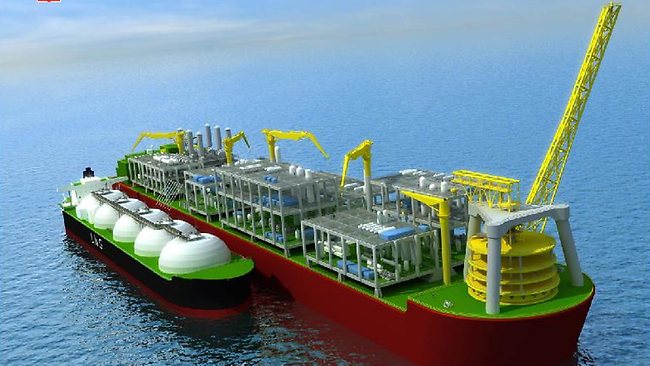
Shell's massive floating LNG factory off the Kimberley coast has been in shutdown since February and industry analysts are divided on whether the $12-17 billion facility has a future.
With five times the steel of the Sydney Harbour Bridge and half a kilometre long, it certainly is big. But as it sits idle 400 kilometres north of Broome, it risks becoming the world's biggest white elephant.
If West Australian Premier Colin Barnett is looking for someone to blame for crushing his dreams to develop a massive gas processing hub near Broome he needs to go to The Hague. The seeds were sown in 1996, when a senior engineer at Shell’s headquarters jotted down an idea in an internal staff suggestion box. Why not liquify gas offshore rather than develop pipelines and convert gas into liquified natural gas onshore?
Nearly 20 years and 1.6 million man-hours later Shell is recruiting the first wave of workers for a massive vessel about 200 kilometres off the Kimberley coast, processing gas from its Prelude gas field. It will be the first vessel in the world that will be able to take gas from the reservoir below, liquify it and transfer the gas to cargo ships that will moor alongside the processing facility in the middle of the ocean.
It wasn’t that long ago that the technology, known as floating LNG, was viewed as an expensive option only to be used to unlock small or stranded gas fields like Prelude. This week the game changed. Woodside, Australia’s biggest oil and gas company, has thrown its support behind the technology, declaring it wants to be a world-leading floating LNG operator as it decided to unleash not just one, but three floating LNG ships to develop its Browse gas resources.
The Business Spectator has an interview with Woodside CEO Peter Coleman about Brows, Israel's Leviathan field and the possibility of shale gas exports from the US (something the Japanese seem keen to encourage). The BS's Robert Gottliebsen continuing his incessant anti-union / government diatribe (Coleman deftly ignored him thankfully) - KGB Interview: Woodside's Peter Coleman.
SB: Peter, looking at your presentation this week, you don’t seem particularly concerned about the potential impact of US shale-fed LNG hitting your markets. Could it have a material impact on prices or more particularly could it have an impact on the way LNG is priced?
PC: Well, there are probably two impacts of that. Firstly, the impact of US shale gas is quite clearly improving productivity in the US and making the US actually a more attractive place to invest, particularly for some industries around chemicals and plastics. And so, those energy intensive industries are actually moving back into the US and will soak up some of that excess supply. The supply that may get into LNG , and remember there’s not very much that has actually gone to FID yet …
AK: Sorry Peter, we’re getting some static.
PC: Yeah, so I was saying, the shale gas industry and the surge in gas available and into the US has really made the US attractive as an investment destination for those industries that are very energy intensive or turn gas into something else, being the chemicals and the plastic industry. The gas that’s left over and, you know, the gas that will be exported, you know, there are a couple of things there to consider. Firstly, there are a lot of projects at the moment on the drawing board. Not many have gone to a final investment decision. When you look at the total cost structure, the landed priced into Asia will be competitive but it won’t be low cost by any means. So, the headline price of $4 gas hitting Asia is just simply untrue. Now, the price is going to be in the low to mid-teens and it doesn’t really take very much of a rise in gas prices in the US to in fact make it marginal to uneconomic. So, I think that we a balance will occur, and an equilibrium point will occur, within industry within the next five to 10 years. What does that mean? There’s going to be an evolution in the market. The market is already evolving to become a more fungible commodity. I see trading hubs will be established. True training hubs will be established. Will that be in Singapore, Shanghai, Hong Kong? I can’t say, but Woodside is preparing ourselves for the advent of trading hubs. So, all of those sorts of things will come into play. The consumer is starting to see. You’re starting to see a proliferation now of regasification terminals being put into Asia. As many terminals that as currently exist are now being built in Asia, so there are 40 currently underway. So, clearly the buyers can see that the market is changing. It’s becoming more commoditised. Henry Hub gas just simply puts another gas stream into that. I wouldn’t see Henry Hub any differently from gas that’s going to come out of East Africa or other parts of the world. It’s just another gas stream that’s going to come in.
Gottliebsen has been banging this drum forever it seems, though the BS getting sold to Rupert Murdoch last year hasn't helped matters. Crikey's Guy Rundle has some thoughts about Rupert's malign influence on the Australian election (I liked the Gus Fring comparison) - In Murdoch-land, sans-public sphere, it all sounds the same.
Getting out and about in Brisbane of a morning, you’re greeted with something you’ve forgotten: this is a one-owner town, newspaper wise. Looking at a news rack and seeing The Australian and The Courier-Mail side-by-side — and nothing else — it’s a sort of parody of pluralism. Yeah, I know it’s newspapers, and having a monopoly on them is a little like cornering the spats market, no one under 30, blah blah, etc, but it’s still the way a city talks to itself, the public face of its dialogue. And yes, there’s other TV networks — supposing that they differ in any significant fashion — and the ABC, etc, but still.
There’s a pseudo-pluralism at play that still rankles — would you like the broadsheet which does Kevin Rudd slowly, or the tabloid that sinks the slipper? The Courier-Mail runs with a “Does this man ever shut up?” cover while The Daily Telegraph has a “Mr Rude”, Mr Man parody, using allegations by a make-up artist from a debate run by Sky News — a broadcaster Rupert Murdoch owns a stake in — that Rudd was a bit of a grump. Such “front pages” are nothing of the sort. They’re propaganda posters which happen to be attached to the front of a newspaper, their purpose political as much as commercial. Knowing that people don’t buy newspapers, but still see them around, they go for the microsecond hit, the fast meme. Which may be enough, when aggregated for a Coalition win, without anything else whatsoever.
Really, to talk about the election without mentioning this — the framework of information within which people will make their decision — is really to aid and abet the process. The whole country has become a leagues club owned by a monolithic media corporation; pokies in the main room, a debate going on in the entertainment lounge, the ownership and core business a series of windfalls and rents — mining, sports rights — with the ultimate ownership arrangements a matter of mystery. But to mention this every time is the pathway to madness. So the debate cannot help but be skewed, every time we tap out a line about costings or paid parental leave or whatever. That’s really the genius of Murdoch taking to Twitter — he now hides in plain sight. When he was a mysterious presence behind the scenes, speculation on his motives and power were endless. Now he simply tells us in his weird telegrammatic/spoken-word style that he wants Rudd turfed — and pretty much nothing more can be said about it.
Thus, as soon as the campaign started, the Tele was off and running with its front-page propaganda campaign (even though some of the news within is played — or delivered — straight). Two weeks later, in its major market of western Sydney — perhaps the latest place with a large, old-style working class and literate tabloid readers, out of the social media/The Project/etc carnivale loop — Labor is suddenly tanking, its numbers running well below the national average. What a surprise! What could possibly have created this sudden shift, this bifurcation in the numbers, we go. Is it the boats? Is it the negativity? Is it being mean to TV crew? We know what it is, but we can’t talk about it because that would be the politics of how we do politics, of who controls the information on which we make our decisions. Rudd quite sensibly put his marker down on Murdochracy quite early — and then left it alone, also quite sensible. Because you either run on that, and nothing else, suggest an all-encompassing undemocratic process, and risk the charge that you are sledging the umpire, or you leave it alone — and try and deal with it by a series of guerrilla tactics.
The Australian has a report on the unfolding gas age with Woodside now being tipped to process natural gas from the Browse field at the North West Shelf LNG plant to replace declining gas reserves rather than a new LNG development at James Price Point in the Kimberly - Woodside's $30bn Browse LNG plant in doubt . There is also more speculation about LNG exports of shale gas from North America to Asia.
Woodside Petroleum's plans to build the $30 billion-plus Browse liquefied natural gas plant near Broome appear to have become less appealing against the alternative of piping the gas 1000km for processing at the North West Shelf plant near Karratha when reserves there run low. After recent industry developments here and in the US, analysts now put a greater probability on the Browse project's offshore gas fields being turned into LNG at the North West Shelf and say this would give the project a greater value. ...
Credit Suisse analyst Sandra McCullagh said she was now using a North West Shelf option as a base-case scenario. "Woodside maintains a preference for James Price Point, but we expect that competition for skilled labour and recent LNG sales from the US at prices linked to Henry Hub (domestic US gas prices) could see a shift in the company," Ms McCullagh said.
On top of this, development cost pressure, competition for scarce labour from eight other regional LNG plants under construction, no certain gas to extend the life of the Woodside-operated North West Shelf and LNG buyers' preference for expanding existing plants rather than building new ones make a James Price Point plant less likely, according to Credit Suisse.
Credit Suisse has boosted its expected Browse development cost to $US36bn, compared to a development cost of $US26bn to use the gas to backfill the North West Shelf. …
One of the game changers in Credit Suisse's analysis has been a plan to export US shale gas. Even at US domestic gas prices of $US7 a gigajoule, which is double current prices, it would be profitable to export to Asia at current Asian spot LNG prices.
"Less than 12 months ago, most commentators didn't see much of a threat from North America, but within the space of one month, 7 million tonnes of LNG a year has been sold from Louisiana, earmarked for Asian and European markets," Ms McCullagh said. "We expect unsanctioned Australian LNG projects will struggle to stack up against North American imports."
The ABC reports that the government has given the go-ahead to Inpex's Ichthys LNG project off the north west coast of Australia - Government approves $12b Inpex gas project.
The Federal Government has given the green light for a multi-billion-dollar gas plant to be built in Darwin.
Japanese company Inpex will now be able to press ahead with building a gas field facility about 800 kilometres from Darwin, and a pipeline from there to a processing facility in the NT capital, after Federal Environment Minister Tony Burke gave approval for the project.
Mr Burke says there will be significant economic benefits from the $12 billion project, but says he has only given his approval under strict environmental conditions. Mr Burke says that includes conditions on dredging to ensure dolphins, dugongs and turtles are protected.
Inpex will be able to produce liquefied natural and petroleum gas through offshore processing, and build an 850-kilometre pipeline and an onshore processing facility in Darwin Harbour. But the company will be required to protect and manage about 2,000 hectares of vegetation and a marine habitat.
Mr Burke says it is now up to the company to decide whether to invest in the plant.
The Ichthys project is considered more robust than most other proposed LNG export projects in Australia because its gas will come to the surface with a rich stream of condensate (light oil) and other petroleum liquids. The condensate and other liquids will be stripped from the gas stream at Ichthys's offshore location, with the gas then piped to the LNG plant in Darwin for eventual export, mainly to Japan.
On an annual basis, the project is expected to produce 8.4 million tonnes of LNG and 1.6 million tonnes of liquefied petroleum gas (propane). The project sweetener is the 100,000 barrels-a-day of condensate that the project is forecast to produce at its peak.
Prelude is expected to produce 3.6 million tonnes per annum of LNG, as well as 1.3 million tonnes of condensate and 400,000 tonnes of LPG.
The facility is scheduled to begin production in 2016. The gas will be cooled by cold water pumped from about 150m below the ocean’s surface - allowing around 50,000 m3 of cold seawater each hour to cool the gas.
The project will be the world’s floating LNG development and the facility will be the largest floating structure ever built. The vessel will be built by South Korea's Samsung Heavy Industries. At 488 metres long, 74 metres wide and 600,000-tonne in weight it will be longer than four soccer fields laid end-to-end and will be six times heavier than the world's largest aircraft carrier.
The vessel will be permanently moored about 200km off the coast for its 25 years of production and is designed to withstand severe category 5 cyclones (or a “one-in-10,000-year" tropical cyclone, as Shell executive director Malcolm Brinded put it).
Shell has self-insured the project, so its not clear what the view of maritime insurers is of the likelihood of the project suffering significant damage during its lifetime is.
In Australia we’ve seen onshore natural gas largely depleted, near offshore natural gas well developed (the north west shelf LNG operation has now been in operation for decades and long-stalled projects like Gorgon are now well underway), a boom in coal seam gas and emerging interest in exploiting shale gas (local producers seem to view speculation that US shale gas production will undermine Australian LNG export markets in Asia as unfounded, notwithstanding the strong Australian dollar) and biogas.
Research by the CSIRO in 2008 found that up to half Australia's natural gas resources (140 trillion cubic feet) could not be developed because they were too remote to be connected to onshore processing plants.
Floating LNG platforms remove this barrier and would seem to be the final stage of our entry into what has been dubbed by some (including the IEA [pdf]) as "The Gas Age" (I guess you could view the fossil fuel era as an act in 3 parts, similar to the era of the dinosaurs, with the coal age being analagous to the Triassic period, the oil age to the Jurassic and the gas age echoing the Cretaceous, with the end of the era approaching).
By adopting the offshore floating LNG solution Shell hopes to also substantially reduce the time and cost of the project development phase.
Global LNG demand is expected to double this decade and the introduction of floating storage and regasification vessels in recent years has enabled fast entry of new buyers such as Argentina, Brazil, Kuwait and Dubai in recent years, with Thailand and Singapore soon to join the club and Indonesia, Malaysia, Pakistan, Sri Lanka and possibly the Philippines following along behind them.
Shell is already looking at a number of other locations for floating LNG projects, including the Greater Sunrise project in East Timor, and projects in Indonesia, Cyprus, East Africa and South America. Other companies are also interested in floating LNG with the BBC claiming Flex LNG and Hoegh LNG hoping to make final investment decisions shortly on projects in Papua New Guinea.
Jarand Rystad, founder of a Norway-based research consultancy for the oil industry says there are up to 160 gas fields where floating LNG could be applicable worldwide over the next decade.
The 10 platforms figure may have emerged from a statement from Samsung Heavy Industries estimating the size of the market last year.
Besides the PNG projects mentioned earlier, Woodside have been pushing for a floating LNG development for the Sunrise development between Australia and East Timor, and there has been some speculation that Woodside's Browse development could avoid opposition to plans to build an onshore LNG plant in the Kimberly region. There has also been speculation that Inpex's Abadi and Ichthys projects could be candidates.
THE resources boom is gathering strength as companies commit to new mega-projects in Queensland and Western Australia and gear up for a massive surge in investment over the next year. In the past six months, resource companies have given firm commitments to 33 new projects worth a combined $43.9 billion, led by investments in coal-seam gas, iron ore and new coalmines.
The government's resource industry adviser, ABARE, now has 94 projects worth $173.5bn on its books, a 31 per cent increase since last October. … The biggest new project announced in the past six months was the $16bn coal-seam gas venture in Gladstone, which is being led by Santos. Gas and oil projects account for $101bn, or 60 per cent of the total number of projects under construction.
CHEVRON says it is close to signing contracts to supply gas to industrial users from its $43 billion Gorgon project in Western Australia after it reached a crucial access agreement with the Dampier-Bunbury Pipeline to transport the fuel. The US energy giant's Australian operations head, Roy Krzywosinski, said yesterday the access agreement meant all the infrastructure contract arrangements were in place to supply the energy-hungry WA market by 2015. …
Major industrial users have complained for several years about a lack of cheap gas supplies for mines, alumina plants, fertiliser operations and power stations. The Woodside Petroleum-operated North West Shelf Venture and Apache's Varanus Island are the only suppliers to the domestic gas market.
But Apache's $US1bn Devil Creek project is expected to become the next major domestic gas supplier later this year. The project will inject up to 220 terajoules of extra gas into the state's domestic system every day.
A parliamentary inquiry into gas pricing in WA found that prices were double those in other states, and recommended domestic gas reservation requirements should remain. The producers have strongly opposed the reservation policy, which stipulates that 15 per cent of a project's output may have to be set aside for domestic needs.
Mr Krzywosinski said work on Chevron's estimated $30bn Wheatstone project would begin before the end of the year, generating 6500 direct jobs at peak construction and $21bn in government revenue.
WA Today reports that the gas industry continues to generate a lot of protest, with the latest round complaining about the proposed Kimberly gas hub - John Butler stands up to Woodside.
WA musician John Butler has led a lunchtime musical protest outside mining giant Woodside's city offices in protest against its proposed Kimberley gas hub. The multiple ARIA award-winning musician performed on the steps of Woodside’s St George’s Terrace skyscraper as part of a nationwide stance against industrialisation of the Kimberley. Rock stars including Jimmy Barnes and Midnight Oil's Rob Hirst entertained crowds in Sydney while musician Shane Howard hit Melbourne’s Swanston Street.
Woodside, with joint-venture partners Chevron, BP, Shell and BHP, plan to build a multi-million dollar gas processing hub at James Price Point on the Dampier Peninsula, north of Broome. The move has sparked outrage from environmentalists as the area is frequented by migrating humpback whales, untouched beauty and gardens of unique coral.
The Australian reports the WA government is trying to force Kimberley locals to accept a new LNG plant for the Browse basin to be built on their land - Barnett could ignite local opposition to Woodside gas project . I saw John Butler play at the Hordern on Friday night - it was a good gig and he was actively promoting the cause of the locals.
Their support may be withdrawn not so much because of agitation from the likes of musician John Butler -- but thanks to one of its biggest supporters -- West Australian Premier Colin Barnett.
The KLC, which had strongly supported the project as a way of bringing jobs, health, housing and education services to the remote region, last night declared itself at a crossroads. "There's going to be a big meeting next week and I kind of think we're on the knife edge of splitting either way," KLC chief Wayne Bergmann told The Weekend Australian.
With anger growing over the Barnett government's decision to forcibly acquire 2500 hectares of unallocated Crown land -- which is subject to two native title claims -- at James Price Point in a bid to kickstart the project, former federal court judge Murray Wilcox again entered the debate, calling for a public inquiry into the matter.
Butler, who is touring the country agitating against the project north of Broome, yesterday warned of a major community backlash over the Barnett announcement. He revealed that Kimberley law man Joseph Roe, whose divisive court action against the KLC sparked the breakdown with the government, has been appearing at his concerts.
The award-winning blues and roots musician said Aboriginal people should not have to give up their land to get the services and opportunities other Australians were given.
Mr Bergmann said the dynamic could change if traditional owners withdrew their support for the project. "The risk is that my instructions might start to be changed to now oppose the project. I've had phone calls from traditional owners very upset," he said.
The KLC signed an in-principle agreement on behalf of the traditional owners with Woodside and the government last year. The process stalled when Mr Roe, on advice from Mr Wilcox, took the KLC to the federal court, claiming the body had no right to sign the agreement on behalf of the traditional owners. Yesterday Mr Roe promised to fight Mr Barnett "with every breath".
WOODSIDE Petroleum said the joint venture partners in the Browse project have agreed to develop a liquefied natural gas plant at James Price Point in the north west of Western Australia.
There had been disagreement between the project partners on the best site for the plant, so the decision to choose James Price Point is a positive development for Woodside and the project.
The federal and Western Australian state governments had imposed a deadline for the partners to select a development concept within 120 days of December 2 as a condition of retaining leases associated with the project.
The SMH reports the government is pressuring oil and gas companies to develop long held gas reserves - Warning on gas leases.
THE Federal Government has thrown down the gauntlet to a group of multinational oil companies to approve the development of the $30 billion Browse liquefied natural gas project off Western Australia soon or risk losing their leases.
Woodside Petroleum, backed by the West Australian Government, has been attempting to commercialise the Browse field as quickly as possible but had faced an uphill battle against the other joint venture partners.
But the case for a new LNG hub in the Kimberley region was bolstered significantly yesterday when the federal and state governments issued a ''use it or lose it'' notice over nine leases held by the Browse joint venture partners, including Woodside (48 per cent), Chevron (16.7 per cent), BP (16.7 per cent), BHP Billiton (9 per cent) and Shell (9 per cent).
They have until April to decide on the preferred option for commercialising the huge gas resource, which has not yet been developed despite having been discovered by Woodside more than 40 years ago.
The joint venture parties have been squabbling over whether to progress a greenfields development at James Price Point in the Kimberley - the preferred option of Woodside and the WA Government - or a brownfields tie-back to the North-West Shelf plant at Karratha that would better protect against gas production decline expected by about 2020.
In granting the renewal of Browse leases for a further 120 days, the federal Resources Minister, Martin Ferguson, said the governments had ''an obligation to unlock the wealth of Australia's vast petroleum resources for the benefit of all Australians''.
The company plans to process gas from its Prelude and Concerto fields in the Browse Basin off the Kimberley coast using floating LNG technology.
Federal Resources Minister Martin Ferguson says the technology will allow remote gas fields, which may otherwise have been not viable, to be unlocked. "Obviously historically we have had LNG hubs on the mainland. On this occasion it's a choice between having gas reserves stranded or looking at a new technology," he said.
A labor shortage is set to push up costs and drive consolidation among proposed coal-seam gas ventures in Australia’s Queensland state, a Fitch Ratings analyst said. ...
Projects that have secured large gas resources, such as the one proposed by ConocoPhillips and Origin Energy Ltd., are in the best position to fulfill their plans to convert gas from coal seams into liquefied natural gas, Madson said after his presentation. Confirmed resources are more significant than signing supply contracts, he said.
At least five proposed Queensland ventures, concentrated around the city of Gladstone, are intending to turn coal-seam gas into LNG for export to Asia, targeting increased demand for cleaner-burning alternatives to coal.
Of the approximately 17 liquefied natural gas projects he counts across Australia and Papua New Guinea, only six may ultimately survive and follow through on their plans. “There will be losers” among the companies intending natural-gas developments in Queensland and throughout Australia, he said.
The Australian reports that Conoco is looking to offload a lot of assets, thou it is unclear if Queensland LNG projects will be part of the sale - Conoco in $11bn asset sell-off in Qld and NT.
US OIL giant ConocoPhillips, which has liquefied natural gas export assets and prospects in Queensland, the Northern Territory and off the coast of Western Australia, plans to sell $US10 billion ($11bn) worth of assets and slash spending in the next two years in an effort to pay down a heavy debt burden.
The move marks a reversal in strategy for the Houston-based major, which has spent a lot on acquisitions in recent years, including the $7bn purchase of half of Origin Energy's Queensland coal-seam gas reserves and associated Gladstone LNG ambitions.
Conoco would not say if Australian assets would be put up for sale, but it remained committed to its Queensland LNG plans.
ConocoPhillips’ announcement that it plans to sell $US10 billion of assets over the next two years has sparked immediate speculation over the future of its share of the Australian Pacific LNG joint venture with Origin Energy.
It is unclear at this point which assets ConocoPhillips is contemplating selling as part of a program to reduce its $US30.4 billion of borrowings, a plan that also includes cuts to capital spending. However, the fact that it has announced itself as a seller of assets could have implications of the shape of the emerging Queensland coal seam gas-fed export LNG sector. ...
The need to sell assets flows from the late 2005 acquisition of gas producer Burlington Resources for $US35.6 billion even as gas price were hitting record levels, which loaded ConocoPhillips up with debt. While its earnings tumble, its cash reserves are also dwindling – it has less than $US1 billion of cash in a sector where the big oil companies traditionally have hoards of cash.
Woodside has managed to get their Pluto LNG project kicked off in record time, with development costs already looking much higher than originally anticipated due to labour and equipment shortages. The LNG train(s) will be at the Burrup (presumably close to the North West Shelf facility) and there is speculation that both the Gorgon and Browse developments may end up linking into this plant (though the Gorgon people are still resisting the idea).
WOODSIDE Petroleum has committed itself to building one of the most expensive developments in the history of the Australian resources sector after its board gave the go-ahead for its $12 billion Pluto liquefied natural gas project on Friday. The final capital cost figure - on par with the original North-West Shelf development in the 1980s - was significantly higher than Woodside's earlier estimate of $6 billion to $10 million. "The costs are an eye-opener," Woodside chief executive Don Voelte admitted.
Woodside will initially build one production train based on a resource of 5 trillion cubic feet of gas in its Pluto and Xena fields. But it eventually plans to build up to two more trains and possibly a domestic gas facility to help improve the project's returns.
Some analysts questioned whether the first train would deliver a high return on the huge investment, but Mr Voelte said: "I don't spend $11 billion unless I get a damn good return on it." He was referring to the $11.2 billion investment announced on Friday in addition to $800 million that has already been spent on the project. Mr Voelte attributed the capital cost rise to a shortage of skilled labour and the rising cost of offshore equipment.
The first train will produce 4.3 million tonnes a year starting in late 2010, although it has a capacity to produce up to 4.8 million tonnes. Up to 3.75 million tonnes a year have already been contracted to Tokyo Gas and Kansai Electric on 15-year sales agreements. Mr Voelte said the remaining gas might be sold on the spot market. "We're already getting people knocking on our doors," he said. "Although we don't plan to sell [the uncontracted gas] beforehand, you never know what happens in this crazy world."
Woodside noted the proximity of other uncommercialised gasfields in the same region offshore Western Australia. The company plans to operate its onshore plant as an open-access facility for Woodside and third-party gas.
IAG Asset Management portfolio manager Alan Martin said Pluto could be another North-West Shelf in the making. "They're not going to stop with just this one phase," he said. "You can be assured of that. There's a lot of gas in adjacent blocks that needs a processing centre."
Mr Voelte said there was also potential for Woodside to make more discoveries on its own exploration blocks adjacent to the Pluto and Xena fields. "Pluto opens up a whole suite of opportunities out there," he said. He added Woodside was still conducting earlier-stage work on its other LNG projects, including Browse and Sunrise.
TreeHugger has a post on a huge new magnetic levitation wind turbine being touted by an Arizona company that can potentially generate one gigawatt of power at low cost.
It's a vision of a magnetically levitated wind turbine that can generate one gigawatt of energy (enough to power 750,000 homes). This is the device proposed by a new Arizona-based company, MagLev Wind Turbine Technologies. The company claims that it can deliver clean power for less than cent per kilowatt hour using this wind turbine.
Magnetic levitation is a very efficient method of capturing wind energy. The blades of the turbine are suspended on a cushion of air, and the energy is directed to linear generators with minimal fiction losses. But the big advantage with maglev is that it reduces maintenance costs, and increases the lifespan of the generator.
The company also points out that building a single huge turbine like this reduces construction and maintenance costs, and it requires less land space than hundreds of conventional turbines. The company is headed by Ed Mazur, a researcher of variable renewable energy sources since 1981 and inventor of the magnetic levitation wind turbine.
This article by WorldChanging goes into the technical details of using maglev in wind turbines.
Over at TOD, commenter Step Back made an interesting comment about my review of Children Of Men, noting that the movie had a Christmas release and there is a religious aspect I'd overlooked - which is blindingly obvious in retrospect, although I guess its unsurprising an atheist like me watching well out of the Christmas season wouldn't notice it. COM is a nativity tale...
The Guardian has a post on some very low impact English hobbit style dwellings called "The green green grass of home".
Nearly 10 years ago, Tony Wrench stretched a rubber pond lining over a circle of timber posts and made himself a round home. By a field full of meadowsweet in a peaceful Welsh valley, Wrench and his partner, Jane Faith, live as unobtrusively as humanly possible. Were it not for a lazy trail of wood smoke, you could walk past the Roundhouse and not realise it was there.
And, as luck would have it, the 30ft diameter hobbit-style home has found itself in the midst of a radical experiment: last year Pembrokeshire county council and the Pembrokeshire Coast national park authority agreed to grant planning permission for low-impact developments (LIDs) in the council area - and even in the national park - if they met stringent criteria. It is an unusual policy that could encourage other planning authorities across Britain to rethink sustainable development: after all, these homes are affordable, carbon-neutral and can be built on green fields without environmental degradation.
But the pioneers of zero-carbon living have long been derided as hippies and denied legitimacy by the planning system, from the celebrated Tinker's Bubble in Somerset to Steward Wood in Devon. Wrench is typical, forced to fight his eviction from the moment council officers spotted the glint of his bus-window skylight during an aerial inspection. "An unsightly and incongruous appearance," sniffed the first inspector to clap eyes on the Roundhouse. And to Wrench's dismay, in the new policy's first test, his retrospective application for the Roundhouse was rejected last week.
Grapes are trained over the eaves of the green roof of his home, built on neglected farmland owned by a friend at Brithdir Mawr. Freshly dug potatoes sit in a bucket by the door and, after nearly 10 years, the bracken still sprouts through the kitchen's earth floor every spring. Three small solar panels and a tiny wind turbine provide power. Sometimes Wrench has to choose between his laptop or a lightbulb, but it is not a life of deprivation. ...
The CSM has a "smart grids" style story about the need to introduce smart metering to help reduce (and shift) power consumption - "Juicing down for global warming".
Many power utilities are gearing up to install "smart" meters in kitchens or living rooms to show customers the cost of their electricity use – per minute and perhaps per appliance. During times of peak usage, utilities may even remotely adjust your home thermostat.
Having an instant electric bill on the wall, with dollar signs rolling like a gasoline pump, is designed to create sticker shock – and then, perhaps, a conservation ethic to help curb climate change. People might cut back their use of power-hungry devices, from clothes dryers to the TV "sleep mode." They might, for instance, turn on dishwashers only after 10 p.m.
Some utilities hope to install "intelligent sockets" that communicate between appliances and the electricity provider. On hot summer days, when electric rates would be raised through "dynamic pricing," those customers who voluntarily give up control of their usage – and it would have be voluntary – would be given rebates.
But can such watt-saving steps help save the planet? Yes, if they keep utilities from building more carbon-spewing power plants – especially the expensive kind that rev up only during peak hours. By many estimates, fossil-fuel power plants are likely to be the preferred source of electricity for years to come.
As it is, utilities can't keep up with rising demand. One projection shows a 19 percent rise in peak-time electricity usage over the next decade while only a 6 percent growth in power capacity.
Something's got to give. And it may be consumer lifestyles.
A three-year experiment in California with 2,500 customers showed they reduced their average electricity demand by 13 percent during peak summer hours when they had to pay five times the normal cost. Users with the kind of "smart" thermostats that adjust appliance use cut back by 27 percent. ...




 Posts
Posts