Showing posts with label
concentrating solar thermal power.
Show all posts
Showing posts with label
concentrating solar thermal power.
Show all posts
Posted
by Big Gav
in
concentrating solar thermal power,
csp,
masdar,
renewable energy,
shams,
solar power
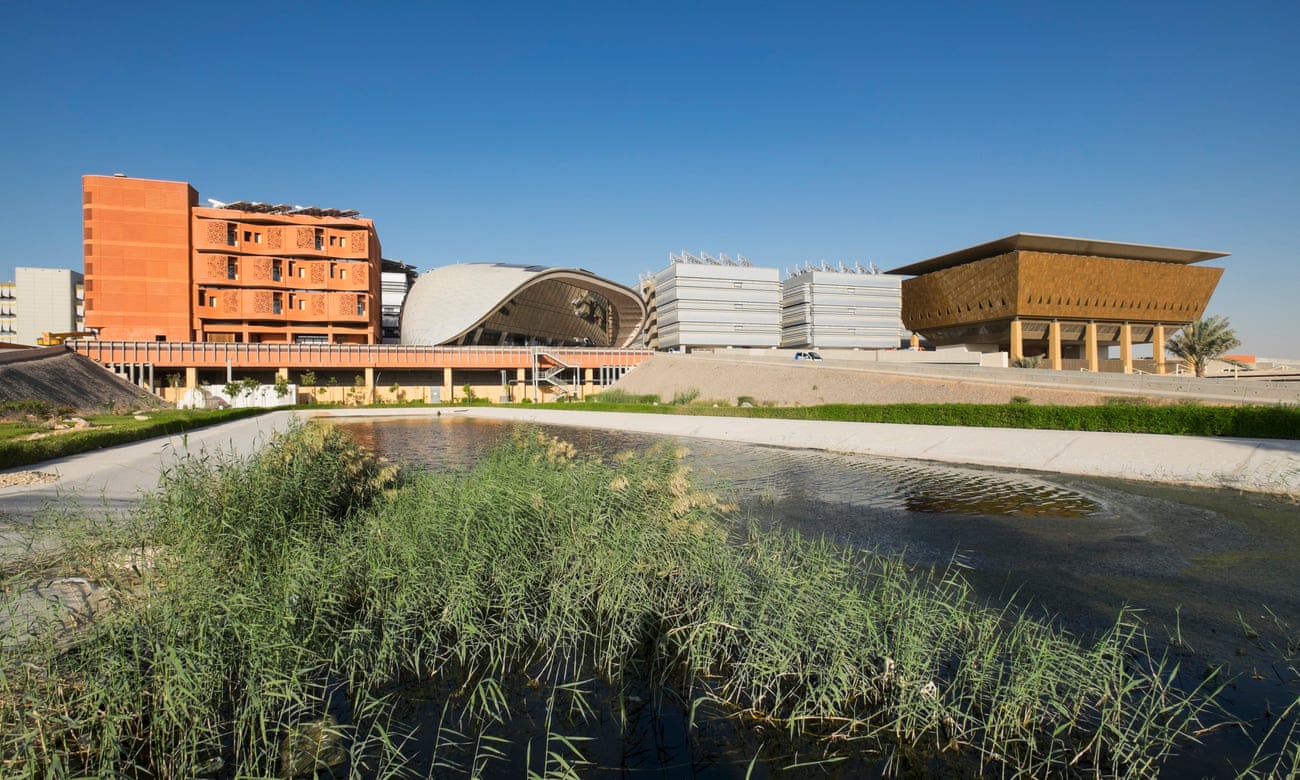
The Guardian has an update on the Masdar experiment in the gulf state of Abu Dhabi - Masdar's zero-carbon dream could become world’s first green ghost town.
the rationale for Masdar City – demonstrating a model of green living – has been abandoned. “The original aim was to be net zero, yes, but that was when we were looking at the city in isolation,” Wan said. He maintained it was important to look at Masdar City within the context of the other renewable energy holdings of the parent company. Among Mubadala’s other holdings, Masdar Clean Energy is developing the Shams solar farm. “Masdar as a family company is supply[ing] much, much more clean energy than what is being consumed in the city, for sure,” Wan said. ...
With the downward pressure from oil prices, the UAE has stepped up its efforts to wean itself off oil, lifting fossil fuel subsidies and billing Emiratis – not just expatriates – for water and electricity.
But delivering on the original dream of Masdar has been elusive. Crews broke ground in 2008, but plans withered in the global economic recession which soon followed when investors put their green dreams on hold. “A lot of the people who were considering investing in Masdar City decided to take a breather,” Wan said.
Meanwhile, the jet-set transport system was overtaken by technological developments in the auto sector. The expensive purpose-built system no longer made sense in an era when zero-emission electric cars were widely available. “Five years ago it’s true that we did not perceive the speed with which the electric vehicle would be developed,” Wan said.
The National reports that the Shams 1 solar thermal power plant recently celebrated its third anniversary, however at this point CSP still isn't cost competitive with solar PV - Abu Dhabi weighs more cost-effective solar technologies.
CSP was anticipated to take the region by storm when Shams 1 was being developed, with projects also cropping up in Morocco. As a result, Shams was expected to have two additional projects added. Mr Al Obaidli said the land was originally reserved for three CSP plants, but times have changed and more cost-competitive options are now availab .
Although he declined to give exact figures, Mr Al Obaidli said that the Shams 1 costs more than the average price of CSP. According to Abu Dhabi-based International Renewable Energy Agency (Irena), production costs for the technology range between 20 and 25 US cents per kilowatt-hour.
But Mr Al Obaidli pointed to the fact that Shams was one of the first CSP projects in the region. “It’s not at today’s electricity prices because when we built Shams, there was only one supplier in the world for mirrors. Now there are at least seven bankable mirror suppliers in the market." In comparison, Dubai’s Mohammed bin Rashid Al Maktoum Solar Park, which uses PV technology, was awarded at a tender of 5.84 cents per kilowatt-hour.

Cleantechnica reports that the Shams 1 plant has been generating more power than expected so far - Solar Power Plant In Oil-Rich Abu Dhabi Beats Expectations — Again.
Shams 1 is a 100 megawatt facility with 258,048 mirrors arranged in parabolic troughs covering 2.5 square kilometers. It’s the only plant of its kind in the world completely surrounded by a solid wall - and that’s a critical difference between Shams 1 and other concentrating solar power (CSP) plants. As explained by Al Obaidli, the wall provides a significant measure of protection from desert wind and sandstorms. Storm-grade winds can take out large sections of equipment in a conventional CSP plant, but according to Al Obaidli, one of the strongest storms in recent memory passed through last year and it only damaged 20 out of the 258,048 mirrors.
The parabolic troughs themselves also include design features that prevent wind damage. On just a few minutes’ notice they can be rotated into a “safety” position, and then locked in place.
Posted
by Big Gav
in
concentrating solar thermal power,
csp,
solar power,
solar thermal power
Low Tech Magazine has a look at the use of solar thermal energy in industrial applications - The bright future of solar powered factories.
A large share of energy consumed worldwide is by heat. Cooking, space heating and water heating dominate domestic energy consumption. In the UK, these activities account for 85 percent of domestic energy use, in Europe for 89 percent and in the USA for 61 percent (excluding cooking).
Heat also dominates industrial energy consumption. In the UK, 76 percent of industrial energy consumption is heat. In Europe, this is 67 percent. I could not find figures for the US and for the world as a whole, but these percentages must be similar (and probably even higher on a worldwide scale because many energy-intensive industries have been outsourced to developing countries). Few things can be manufactured without heat. ...
The missing element in our sustainable energy strategy is a renewable source of thermal energy. Geothermal energy produces heat, but its potential is limited to regions that have volcanoes. Biomass is another option, but it faces many problems. If we were to try to provide an important share of heat demand by burning biomass, we would quickly come up against the limits of what the planet can produce. There is only one source of heat energy left, and it is a powerful and inexhaustible one: solar energy.
We tend to see solar energy as yet another way to generate electricity, using photovoltaic panels or solar thermal power plants. But solar energy can also be applied directly, without the intermediate step of generating electricity. Basically, harvesting direct solar energy can happen in two ways: by means of water-based flat plate collectors or evacuated tube collectors, which collect solar radiation from all directions and can reach temperatures of 120 °C (248 °F), and by means of solar concentrator collectors, which track the sun, concentrate its radiation, and can generate much higher temperatures. These can be parabolic trough systems, linear concentrating Fresnel collectors, parabolic dish systems or solar power towers. Almost all of these technologies were developed at the turn of the 20th century.
Solar thermal power versus solar thermal heat
Solar power tower The problem is that we mostly use this technology for the wrong purpose. In today's solar thermal plants, solar energy is converted into steam (via a steam boiler), which is then converted into electricity (via a steam turbine that drives an electric generator).
This process is just as inefficient as converting electricity into heat: two-thirds of energy gets lost when converted from steam to electricity. This is one of the main reasons why the use of solar thermal energy to produce electricity is only cost-effective in deserts. ...
If we were to use solar thermal plants to generate heat instead of converting this heat into electricity, the technology could deliver energy 3 times cheaper than it does today and become cost-effective also in less sunny regions. The crucial difference between solar thermal electricity and other renewables producing electricity is that solar thermal actually starts with heat energy. Thus, contrary to other renewables, the cost of heat energy using the technology is far lower than the cost of electricity, and so it can compete with burning fossil fuels at the thermal level. ...
Without a doubt, solar heat for domestic purposes should continue to be encouraged and a lot of potential remains. But it does not stop there. According to a 2008 report (pdf), which analyses the situation in Europe, the potential for solar heat in industrial processes is even larger than in the domestic market. About 30 percent of industrial heat demand in Europe is below 100 °C (212 °F), which could be delivered by commercially available flat plate collectors (< 80 °C) and evacuated tube collectors (< 120 °C) currently used for domestic purposes.
Another 27 percent of industrial heat demand requires medium temperatures (100 to 400 °C or 212 to 752 °F), which could be reached by improved versions of these collectors (up to 160 °C, see this document) and by commercially available solar concentrator technologies now mostly used for electricity production: parabolic troughs, parabolic dishes and linear concentrating Fresnel collectors.

Posted
by Big Gav
in
brightsource,
california,
concentrating solar power,
concentrating solar thermal power,
ivanpah
The Economist has an article on Brightsource's solar thermal power power project(which recently received a US$168 million investment from Google) at Ivanpah in the Mojave desert - Solar Power: Desert Dawn.
IT LOOKS like a planetary tattoo designed to be seen from space, a vast set of concentric circles inscribed in the skin of southern California’s desert. Ground was broken on the Ivanpah power plant, which is to be one of the biggest solar installations in the world, last October. Already, some of the rings of mirrors which will eventually concentrate acres-worth of desert sunshine on to collectors perched atop 140-metre-high towers are in place. And as of this week, so is the financing.
BrightSource, based in Oakland, California, announced on April 11th that it had finalised $1.6 billion in loans for Ivanpah from America’s government. At the same time it announced that Google had taken a $168m stake in the project.
Ivanpah needs all this money because BrightSource’s technology requires it to be vast compared with other types of solar installation. Most solar power comes from photovoltaic cells that turn sunlight directly into electricity: installations of this type can be any size. BrightSource’s system, like other “solar thermal” technologies, concentrates the sun’s heat to drive turbines; and the high-performance steam turbines it relies on are big. The three to be installed at Ivanpah will together have a greater capacity than all the “utility scale” photovoltaic plants yet built in America.
It was once thought that photovoltaic installations might attain a similar size as they spread across America’s West (a prospect viewed with alarm by some environmentalists). There are now indications that this won’t happen. Nathaniel Bullard of Bloomberg New Energy Finance has been looking at photovoltaic projects registered with California ISO, the state’s grid operator, since 2007. Their median size started off close to 100MW; now it is around 20MW. Not all these projects will be completed—but it seems a reasonable assumption that bigger ones may be more likely to fall by the wayside. If so, the average size will drop even more dramatically.
Mr Bullard thinks the photovoltaic business is learning that small, if not exactly beautiful, is easier to get past environmental controls and planning consents, and handier if you want to feed into existing grids. “Brownfield” industrial sites near towns beat desert skies.
This is not to say that big photovoltaic projects are finished. The day after the Department of Energy bestowed its beneficence on Ivanpah, it offered a conditional loan of $1.2 billion to SunPower, a maker of high-efficiency photovoltaic cells, for a 250MW project, the California Valley Solar Ranch near San Luis Obispo. SunPower will build and operate the plant; NRG Solar, a subsidiary of NRG Energy of New Jersey, will own it. (NRG Solar is also investing up to $300m in Ivanpah.)
Such big projects make sense for large solar-cell producers like SunPower and Arizona-based First Solar, since they provide reliable demand with which to keep their manufacturing plants running at peak efficiency. Tom Werner, SunPower’s chief executive, says that although the Solar Ranch project is “on the large side”, there is a role for photovoltaic plants of all sizes, and his company has plenty more of similar scale in the pipeline. As experience grows, he hopes to find banks, rather than governments, to finance them.
Whereas being extremely big remains optional for photovoltaics, for thermal-solar companies such as BrightSource it is a must. BrightSource hopes that in time its technology will prove sufficiently efficient and reliable to overcome the disadvantage of having to raise so much capital. If so, Ivanpah will be the ground on which it makes its case.

Posted
by Big Gav
in
china,
concentrating solar thermal power,
csp,
dahan,
solar thermal power
TreeHugger has a post on an experimental solar thermal power plant being built in China - China Experiments With Centralized Thermal-Solar Power.
Construction is due to start next month on an experimental solar–thermal power plant located near China’s Great Wall (as pictured in artist's sketch). The prototype is designed to supply power to 30,000 households by 2010. Built on the outskirts of Beijing, the 1.5 MW Dahan plant "will serve as a platform for experiments on different solar-power technologies."
The design is of Chinese origin and will represent the first such large scale solar thermal project in Asia.
Posted
by Big Gav
in
concentrating solar thermal power,
csp,
esolar
Grist has an article from Todd Woody on the progress of solar thermal power company eSolar - For eSolar, clean energy starts with computing power.
I’m sitting in the back of a black Lincoln Continental with eSolar CEO Bill Gross on the downward glide into Antelope Valley, a sun-blasted stretch of semi-suburbanized desert northeast of Los Angeles. We’re on our way to take a look at an alternative future called Sierra, the Google-backed startup’s first solar power plant and the prototype for what might be called Solar 2.0—green energy that’s as much a product of software and computing firepower as steel and glass.
California has become an epicenter of green tech innovation, and I’ve written endlessly about the stream of Big Solar deals utilities have signed to carpet the Golden State with solar farms. Most, however, exist only as futuristic artist renderings (and some undoubtedly will remain frozen in PowerPoint). But steel is starting to go to ground and a shakeout is inevitable—the winners will be those solar technologies that produce the most carbon-free electricity at the cheapest prices.
“Two years ago when we were developing this design we looked at all the resources that go into making a solar plant and the cost of virtually all those commodities—steel, copper, aluminum—was going up,” says Gross, a laptop balanced on his knees. “The only thing going down was the cost of processing power. So we consciously decided to trade a design that needed much more computational power in return for using less materials.”
In an industry populated by engineers and scientists, Gross is a software guy with some serious smarts. Some of the dot-com era companies hatched by his Idealab tech incubator might ring a bell - eToys, CitySearch, GoTo.com. That last one pioneered search advertising, an idea later embraced by a little startup called Google. Yahoo subsequently bought GoTo for $1.6 billion. Gross walked away from the crash of ‘01 with a lot of cash to play with, and he went on to start a series of alt-energy companies. (The roof of Idealab’s Pasadena headquarters is a Mr. Wizard’s workshop of solar, with prototypes of various photovoltaic technologies silently working away under the sun.)
Gross’ solar dreams began as a teenager during the 1973 oil crisis. “I started making little parabolic dishes out of cardboard and tinfoil and then started making them out of metal in metal shop,” he says. The 15-year-old started his first company, Solar Devices, and began selling plans for solar dishes in the back of Popular Science magazine for $4 a pop. Ten thousand sales later he had his tuition to Cal Tech in the bank.
Like his rivals at other solar startups, Gross is determined that the current solar boom won’t be a repeat of that ‘70s show—when solar farms blossomed in the Mojave Desert but their builders went bankrupt when oil prices dropped and interest in (and tax breaks for) alternative energy became as fashionable as Farah Fawcett.
“The only way you’re going to make a big enough impact is if you can compete with fossil fuels with no subsidies, and the only way to do that is at a very large scale,” Gross says as the foreclosed subdivisions of the blue-collar exurb of Palmdale give way to open desert pockmarked by abandoned trailer homes and burnt-out pickups.
Two thin white towers appear on the horizon and we pull off the highway, heading to the construction site of the five-megawatt Sierra demonstration plant. The towers, framed by the snow-capped San Gabriel Mountains, appear to be surrounded by a shimmering lake, an effect created by 24,000 mirrors turned toward the sun. A standard 46-megawatt eSolar farm will have 176,000(!) mirrors.
There’s nothing particularly new about “power tower” solar thermal plants. Arrays of mirrors called heliostats track the sun and focus its rays onto a water-filled boiler that sits atop a tower. The intense heat vaporizes the water and the resulting high-pressure steam drives an electricity-generating turbine like those found in conventional power plants.
eSolar’s innovation is to rely on software and imaging technology rather than complex hardware to concentrate the sun’s energy. The difference becomes apparent as Gross and I don hard hats and walk along the perimeter of the plant, which is swarming with workers installing a giant turbine in the unfinished power block. In other power tower designs, each heliostat is picture window-sized or larger and slightly curved to create a parabola to focus the sun’s rays. That means each mirror must be precisely placed, spaced and calibrated in the field.
These eSolar mirrors, in contrast, are flat and about the size of an LCD television screen, packed tightly together in long rows. They sit seven to a platform that rolls off an assembly line in China with the motors and circuitry built-in. The makes it possible for just two workers to install the “sticks” on concrete ballasts and attach the mirrors. Since the heliostats are small and flat, far less steel is needed to hold them in place.
“The new thing is distributing 176,000 mirrors around a field and pointing them to one spot without requiring a human to calibrate every one of them,” says Gross, who happily bops around Sierra like a boy in a very big toy store - at 50 he still seems like the Doogie Howser of solar. “That’s our key breakthrough.”
It’s all about the algorithm. Flat mirrors won’t focus the sun, so eSolar’s software creates a “dynamic parabola” out of the entire heliostat field to concentrate the sunlight on the power tower. He points to one of the 100-foot cell phone towers that ring the site. Each tower sports several 10 megapixel sensors that constantly scan the solar field, pinpointing the location of each mirror and the sun’s reflection. With the precise position of the sunbeam on each mirror known, eSolar’s software sends messages to the microprocessor in each seven-mirror stick so that the arrays align themselves to form a long sweeping curve across the solar field. That saves the company from doing extensive and expensive surveys to lay out the solar field; if the rows are crooked the software corrects for it.
Not too ago, it would have cost $1,000 for each of the 25,000 microprocessors used in the solar field; today the price is 50 cents. “We use Moore’s law rather than more steel,” Gross likes to quip, referring to Intel co-founder Gordon Moore’s maxim that computing power doubles every two years.
Posted
by Big Gav
in
air,
concentrating solar thermal power,
csp,
energy storage,
solar nuclear,
solar thermal power
REW has an article on energy storage for solar thermal power using air - Salt-Free Solar: CSP Tower Using Air
In December 2008, a 1.5 MWe solar thermal central receiver system was declared operational by plant construction company Kraftanlagen Munchen. Although solar tower technology had been built as early as the 1970s and a second commercial tower is now close to completion (see REW magazine July/August 2008) the so-called Test and Demonstration Power Plant Julich, in Germany, is the world's first solar thermal power plant erected which uses air as the medium for heat transport.
The biggest rise in efficiency, however, will be due to scaling up the plants to power levels where steam cycles can operate more efficiently. With big industry and foreign governments standing in line for the construction of the next plant, the step in this direction seems to be at hand.
In all previous plants liquid media such as molten salt or oil have been used for the obvious reason of their high specific heat capacity, which in turn results in low volume flow rates and low pumping losses.
The great disadvantage of these concepts is that the solar radiation concentrated by the heliostat field to fluxes of 500 to 1000 suns is in air and that to transfer the heat it has to pass through a wall. This results in exchanger surface temperatures substantially higher than the fluid temperatures within. And, as the absorber surface faces the ambient environment it suffers thermal losses due to convection and – increasingly important for high temperatures according to the Stefan-Boltzmann law – re-radiation.
In contrast, the Jülich power tower uses the so-called volumetric effect to increase efficiency. Ambient air is sucked through a blackened porous structure on which the solar radiation is focused. The air cools the outer parts of the receiver and is heated up gradually to the design temperature level at the inner surface. Under ideal conditions, the temperature of the radiating outer surface can even be below that of the working fluid. Air also has the additional obvious advantages of being both environmentally benign and free.
The hot air is then fed into a state-of-the-art heat recovery steam cycle, conventionally used for the exhaust heat of gas turbines in combined cycle plants.
Professor Bernhard Hoffschmidt, Head of the Solar-Institute Jülich (SIJ) – part of the Aachen University of Applied Sciences – and initiator of the project, points out this implies another potentially big advantage, saying: ‘Gas turbines driven by fossil or biogenous fuels are easily integrated into the solar system and can supply power at times of no solar radiation, allowing for 24 hour operation.’ The SIJ is currently investigating different modes of hybridisation for various power levels and environmental conditions.
Alternatively, heat storage may be used to align supply and demand and the Jülich plant features a storage system consisting of honeycomb-type ceramic blocks, through which air passes in one direction for charging, and in the other for discharging. As the discharged air has the same temperature as when charging, no energy is lost, making the system highly efficient.
Posted
by Big Gav
in
concentrating solar power,
concentrating solar thermal power,
csp,
deserts of gold
The Times has a story in the "deserts of gold" genre, confusing solar PV (panels) with concentrating solar thermal power - Solar panels in the Sahara 'could power the whole of Europe'. There is a new twist to the story now though, with North Africa's wind power potential also being touted.
All of Europe’s energy needs could be supplied by building an array of solar panels in the Sahara, the climate change conference has been told.
Technological advances combined with falling costs have made it realistic to consider North Africa as Europe’s main source of imported energy. By harnessing the power of the Sun, possibly in tandem with wind farms along the North African coastline, Europe could easily meet its 2020 target of generating at least 20 per cent of its energy from renewable sources.
“It [North Africa] could supply Europe with all the energy it needs,” Anthony Patt, of the International Institute for Applied Systems Analysis, in Austria, told scientists. “The Sun is very strong there and it is very reliable.
“There is a growing number of cost estimates of both wind and concentrated solar power for North Africa that start to compare favourably with alternative technologies. The cost of moving \ long distances has really come down.”
Dr Patt said only a fraction of the Sahara, probably the size of a small country, needed to be covered to extract enough energy to supply the whole of Europe. He told the conference that calculations show that a £50 billion investment by governments over the next ten years would be enough to make Saharan solar power an attractive and viable prospect for private investors.
Solar power uses mirrors to focus the Sun’s rays at a thin pipe containing either water or salt. The rays boil the water or turn the salt molten and the energy is extracted by using the heat to power turbines.
Trials of concentrated solar power are being planned for Egypt, Morocco, Algeria and Dubai. Libya and Tunisia could also be considered as sources of European electricity.
Receiving energy from North Africa would, the conference heard, reduce dependence on fossil fuels, which drive climate change by emitting carbon dioxide. The renewable source of energy would also mean that Europe relied less on Russia and the Middle East for fuel.
Attractive as Saharan solar power is, Dr Patt said, there remained the challenge of overcoming political hurdles, such as opposition from residents across Europe to having transmission cables installed near their homes. Piecemeal transmission networks were a further problem.
However, he was enthusiastic about the “fantastic wind resource” and the potential of putting wind farms along the North African coast. Winds created by the Sun heating the air are especially strong during the summer, when European wind turbines, including those in Britain, are at their least productive.
Posted
by Big Gav
in
concentrating solar power,
concentrating solar thermal power,
csp,
solar thermal power
Technology Review reports that the idea of hybrid gas-solar thermal power plants is being considered for coal fired plants now - Cutting Coal Use with Sunshine.
Feeding heat from the sun into coal-fired power stations could turn out to be the cheapest way to simultaneously expand the use of solar energy and trim coal plants' oversize carbon footprints.
At least that's what the Electric Power Research Institute (EPRI), a nonprofit organization backed by the electricity industry, is hoping. Last week, the institute launched a nine-month, $640,000 study to pin down the scale of the opportunity and the engineering challenges involved with making these seemingly disparate technologies work together. The study will examine the potential use of solar-thermal technology at a pair of coal-fired power stations, in New Mexico and North Carolina.
Combining solar power with fossil fuels is not a wholly new idea: over half a dozen new and existing natural-gas power stations are being designed or adapted to incorporate solar-thermal technology, which involves capturing heat generated using fields of mirrors and heat-collection tubes.
Retrofitting existing power plants is a low-cost option for solar-thermal projects because the steam turbines that are needed come for free. Such is the case at a giant natural-gas- and oil-fired power plant operated by the utility Florida Power and Light (FPL) in Martin County, FL, where construction of a solar-thermal collector field of 180,000 mirrors covering roughly 500 acres began in December 2008. Steam turbines can comprise 30 percent of the cost of a stand-alone solar-thermal plant.
FPL's solar field will provide up to 75 megawatts of the Martin County plant's 3,705-megawatt capacity by feeding solar-generated steam into the plant's steam turbines. This solar energy is just sufficient to replace the steam currently generated using relatively inefficient "duct" burners that employ extra gas to increase the heat fed into the steam turbines during spikes in power demand.
Purpose-built hybrid solar/natural-gas power plants, such as those being constructed by Flagsol GmbH in Egypt and by Spanish solar-power developer Abengoa in Morocco and Algeria, should boost efficiency even more. Heat from the solar collector fields will be blended with heat from the gas turbines to produce hotter steam. At retrofitted gas plants or stand-alone solar-thermal plants, steam generated directly from solar collectors tops out at 400 °C. At a purpose-built hybrid plant, this heat can generate 500 to 550 °C steam when combined with the heat already used to power the steam generator, meaning more efficient operation.
But the overall efficiency of retrofitted hybrid solar-gas plants is still limited. That's because a gas steam turbine that has been modified to accommodate waste heat plus solar heat will suffer an efficiency penalty from running at partial load whenever the sun goes down. This is part of the reason why none of the solar-gas hybrid plants under construction rely on solar for more than 15 percent of their power.
In contrast, coal-fired power plants do not suffer from this efficiency cap because they already produce electricity primarily using a steam turbine. As the sun waxes and wanes, the coal feed to the boilers can be adjusted to keep heat production steady and the steam turbine running at full tilt.
Posted
by Big Gav
in
brightsource,
california,
concentrating solar power,
concentrating solar thermal power,
csp,
solar power
Large scale solar thermal power is a subject dear to my heart, so I was glad to see this report from Wired that Brightsource have signed another deal for a huge new plant in California - Biggest Solar Deal Ever Announced — We're Talking Gigawatts.
The largest series of solar installations in history, more than 1,300 megawatts, is planned for the desert outside Los Angeles, according to a new deal between the utility Southern California Edison and solar power plant maker, BrightSource.
The momentous deal will deliver more electricity than even the largest nuclear plant [BG: this isn't true, though its getting up there], spread out among seven facilities, the first of which will start up in 2013. When fully operational, the companies say the facility will provide enough electricity to power 845,000 homes — more than exist in San Francisco — though estimates like that are notoriously squirrely.
The technology isn't the familiar photovoltaics — the direct conversion of sunlight into electricity — but solar thermal power, which concentrates the sun's rays to create steam in a boiler and spin a turbine.
"We do see solar as the large untapped resource, particularly in Southern California," said Stuart Hemphill, vice president of renewable energy and power at Southern California Edison. "It's barely tapped and we're eager to see it expand in our portfolio."
BrightSource is the reincarnation of Luz International, which built the only currently operating solar thermal facility during the 1980s in the Mojave Desert. After natural gas and energy prices plunged in 1985, that operation became unprofitable. The group's engineers and founders moved the business to Israel, where they continued to work on their technology.
The new deal breaks the company's own record for the largest ever solar deal. The new installations, when completed, will produce 3.7 billion kilowatt hours of electricity per year. Previously, they'd cut a deal to deliver 900 megawatts of power to the Northern California utility, PG&E.
"Coupled with our earlier partnership with PG&E, this agreement proves that the energy industry recognizes the important role that solar thermal will play in the energy future," John Woolard, CEO of BrightSource, said in a press conference with reporters.
While Brightsource is a leader in the field, a variety of other companies compete in the solar thermal space. Google.org and other investors have backed eSolar's with $130 million funding. Abu Dhabi's clean-tech fund, Masdar, has funded a $1.2 billion solar thermal company called Torresol. Yet another player, Abengoa, recently signed a $4 billion deal with Arizona Public Utilities, and Stirling Energy Systems, a company that has adapted the Stirling Engine, a 200-year-old invention, for concentrated solar power, even pulled in a $100 million investment.
Posted
by Big Gav
in
ausra,
concentrating solar thermal power,
csp,
solar power
Cleantech.com reports that Ausra is refocusing and downsizing as financing large scale solar thermal power projects becomes more difficult - Ausra shaves staff as it chases immediate revenue.
Palo Alto, Calif.-based Ausra released a statement today, saying it plans to focus on being a technology and equipment supplier instead of independent power producer to begin immediately generating revenue. The solar thermal power developer laid off about 10 percent of its staff this week.
Ausra CEO Bob Fishman said the new strategy means the company will sell Ausra-manufactured equipment to utilities and industrial companies wanting to generate power. Ausra plans to begin selling 50-megawatt solar-steam generating systems to food processors, enhanced oil recovery firms, and utilities. "Ausra can quickly ramp up and install these low-cost projects as early as 2009 or 2010, while large power projects can take three to four years," Fishman said in a release. "This will allow the company to deploy its technology and generate revenue immediately, while the larger projects are obtaining permits and getting transmission access."
The credit crunch has dried up sources of funding for many large-scale projects.
Fishman said Ausra is focused in the long term on providing solar thermal technology and equipment for large-scale power and industrial steam projects. "While Ausra’s direct steam for industrial customers is creating major near-term opportunities, building large projects, like the 177-megawatt project for PG&E in California, remains a long term focus in the U.S., Australia, and the Middle East," Fishman said. "The company intends to thrive not just survive in the current economic environment and beyond."
More at REW -
Ausra's Utility-scale CSP Plans Change.
It has been rumored in recent weeks that Ausra was dropping its near-term plans to build utility-scale solar thermal plants in the California desert. Now, Bob Fishman, the company's CEO, has said that while the company will still move forward with development of a 177-megawatt project with Pacific Gas & Electric, it will be scaling back plans for other, similar sized projects in the near future.
Fishman said that the company still has confidence in solar thermal technologies and their applications and will continue to operate in that space. ... Ausra will also be expanding it's product line to include building medium-sized (50-MW equivalent) solar steam generating systems for food processors and enhanced oil recovery firms, and utilities for power augmentation.
The company said that it still has plans to move into building large, utility-scale projects in the U.S. Australia and the Middle East. This plans however are now in the long-term rather than short- to medium-term
Not all news from the CSP sector is bleak, however - Cleantech.com reports on an Israeli startup that is concentrating on smaller scale, distributed solar thermal projects -
Israeli startup grabs $5M for distributed solar thermal.
Yavne, Israel-based AORA said it raised $5 million from solar investors EZKlein Partners and L&Q Solar, coming out of stealth mode to reveal its proprietary solar thermal technology.
AORA plans to use the funds to build its first commercial solar thermal gas-turbine power station at Kibbutz Samar in Israel's southern Arava region by the end of March. Work has already started on the half-acre site, which is expected to have the capacity to produce 100 kilowatts of electricity and 170 kilowatts of heat, said Shimon Klein, managing partner of EZKlein.
AORA is pursuing a model of decentralized power using a hybrid solar thermal technology that can produce electricity around the clock.
COO Yuval Susskind told the Cleantech Group that the company is targeting an untapped market that's less impacted by the current credit crunch than massive installations, such as those planned by BrightSource Energy or Ausra.
"The solar industry is segmented into two themes: there's the photovoltaics that you put on homes, and on the other hand there are the huge solar companies out in the desert," Susskind said. "In the middle there's nobody working on providing 100 kilowatts to 5 megawatts of solar thermal and doing it close to people's homes."
Posted
by Big Gav
in
concentrating solar thermal power,
csp,
nevada,
solar power
EcoGeek reports that the land rush for prime solar thermal power sites in the US southwest is continuing - Energy Companies Competing for Desert Land.
Not since the Gold Rush has there been such a stampede to stake out land in California and surrounding states, except this time, solar energy is the prize. The Bureau of Land Management has been swamped with applications for solar projects across millions of acres of desert since July.
The bureau has seen a 78% increase in applications, now totaling 223. The applicants are all looking to capitalize on desert land in California, Arizona, Nevada, New Mexico, Utah and Colorado, with California leading with 107 applications alone. All of the projects are 10 MW or larger, with many proposing hundreds of megawatts. All together the projects would take up 2.3 million acres of land and would generate many, many gigawatts (the 75 projects listed on the BLM website total 51.6 GW and that's only a third of the applicants).
Out of the 223 applications, only 2 projects have progressed to the stage of environmental reviews, the real "make or break" when it comes to issuing permits (one is a 400 MW solar-thermal plant proposed by BrightSource, the other a 750 MW solar-thermal plant proposed by Stirling Energy). This is partly because many projects don't ever get past the application, but largely because the BLM is understaffed for this kind of demand and the bureau can't keep up. The BLM is looking to the new administration to increase their budget so more employees can be hired to process these requests.
This is a great example of where the new administration could back up their "green jobs" agenda. Not only would the BLM be hiring, but imagine the jobs created by these large solar projects that would likely take years to get up and running. If even a few of these projects end up getting approved, this could mean lots of jobs and lots of new solar energy.
Posted
by Big Gav
in
brightsource,
concentrating solar thermal power,
csp,
siemens,
solar thermal power
Earth2Tech has a report on progress on Brightsource's large CSP plant in California - Siemens to Build 123MW Solar Turbine Generator for BrightSource.
BrightSource Energy has contracted Siemens(s SIE) to build a 123-megawatt solar-powered turbine generator for its massive Mojave Desert solar-thermal projects, the Oakland, Calif.-based startup announced today. Having raised more than $160 million (including$115 million from Google.org, BP, and other big investors in Series C financing last May) and snagged a deal to sell California utility PG&E up to 900 megawatts of solar power, BrightSource apparently decided not to let delays in the state approval process slow it down.
Building a steam turbine generator — which converts hot steam into mechanical work — takes years. So while BrightSource plans to begin construction on its Ivanpah Solar Power Complex in 2009 if California regulators give the green light, the company does not expect the Siemens generator (the companies say it will be the largest of its kind ever built) to arrive until 2011 — mere months before the company plans to begin supplying electricity to utilities. That leaves very little room for error if the company is to meet its deadlines.
“It takes time and patience and a lot of planning ahead to make all of this work well,” John Woolard, BrightSource CEO and a partner at VantagePoint Venture Partners, the startup’s lead investor, told the San Francisco Business Times in August. That’s when the Bureau of Land Management ushered BrightSource to the front of the line for approval of applications to build utility-scale solar projects in the federally-managed desert. “Fortunately,” he said, “this is something we’re not bad at.”
Posted
by Big Gav
in
concentrating solar thermal power,
csp,
solar power
While large scale solar thermal power will probably remain out of the developing world's price range for some time, the guys at the Factor E Farm Weblog are experimenting with do it yourself CSP power generation - Solar Turbine Convergence Breakthroughs.
n a historic convergence of December, 2008 - Solar Turbine work of OSE merged with a UK linear concentrator development team. Both teams have arrived at essentially the identical design, down to critical details - for a breakthrough, low cost solar concentrator system. Two versions will be field tested - one with steam power, and another with PV power. As it stands, Factor e Farm will adapt and replicate the exsiting prototype. Any necessary sourcing adjustments will be made. We will be building upon 6 years of past work of the UK team, in the true spirit of open source collaboration.
The UK team, led by Ph.D.’s who consulted to leading solar concentrator companies, has verified the OSE prediction that low complexity, flat mirror arrays - which are low to the ground and eliminate costly wind load-bearing structures - are the most cost effective solar concentrator option. The UK team is making similar price predictions and several contributions:
* Low-cost mirror mounting mechanism has been refined
* Electronics and mechanical drive has been worked out for controlling individual mirror slats instead of gangs of slats (the latter is also protected by patent) at a cost of about $5 per drive unit.
* Closed-loop (feedback) controls have been worked out for solar tracking at a cost of $15 for a tracking detector
* Control software has been written
Field testing will be performed in the south of France in 2009, as a joint project between OSE and the UK team. This will mark a historical, side-by-side comparison of two systems - steam engine and PV systems. Both are calculated to be cheaper than coal power. Breakthroughs are expected in both systems, and the OSE team predicts approximately 30% lower system cost for the steam engine version, on a small, 3 kW prototype. Scaling is expected to be favorable for steam power in larger systems. The PV system offers the advantage of being more economical on a small scale (1 kW and under). Modularity is expected in 1-10 kW units.
Posted
by Big Gav
in
concentrating solar thermal power,
csp,
solar thermal power,
spain
The Guardian has progress report on the solar thermal power juggernaut in Spain - Power in the desert: solar towers will harness sunshine of southern Spain.
In the desert of southern Spain, 20 miles outside Seville, more than 1,000 mirrors are being carefully positioned. Each is about half the size of a tennis court, so the adjustments will take time. But when they are complete in a few weeks, it will mark a major moment in the quest for renewable energy.
The mirrors are part of the world's biggest solar tower plant, a technology that reflects sunlight to superheat water at a central tower. Once this €80m (£67m) plant is inaugurated in January, it will generate 20MW of electricity, enough to power 11,000 Spanish homes.
Concentrated solar power (CSP) technology, as it is known, is seen by many as a simpler, cheaper and more efficient way to harness the sun's energy than other methods such as photovoltaic (PV) panels. But CSP only works in places with clear skies and strong sunshine.
The Andalucian deserts are an ideal location, and Spain hopes the PS20 plant will enable it to take advantage of its huge solar resource and lead the field in CSP technology.
"The radiation hitting the earth is 10,000 times the consumption of energy," said José Domíngues Abascal, chief technology officer at Abengoa, the Spanish energy company behind the plant. "There is great potential in solar energy."
Abengoa has already built a smaller version of the tower technology to test that the idea works. The 11MW PS10 system has been generating electricity for almost two years. Its new design uses an area larger than 100 football pitches, with 1,255 mirrors, called heliostats, each with a collecting area of 120 sq m. These track the sun as it moves through the day and reflect the energy to the top of a 160-metre tower at the centre of the field. Here, the concentrated light is used to heat water to more than 1000C, producing steam that can turn an electricity generating turbine.
When switched on, the new plant will be the world's largest commercial CSP plant feeding electricity into a national grid. It will be also be a significant step for tower technology, seen as a candidate for the large-scale solar plants of the future.
Spanish firms are charging ahead with CSP: more than 50 solar projects around Spain have been approved for construction by the government and, by 2015, the country will generate more than 2GW of power from CSP, comfortably exceeding current national targets. The companies are also exporting their technology to Morocco, Algeria and the US.
"CSP is at the very beginning of a big boom," said José Luis García, at Greenpeace in Spain. "Spain is in a good position to develop and implement the technology. We have the sun so we are in the best position to lead in this field."
The country's clean energy targets are in line with the EU's plan to source 20% of primary energy from renewables by 2020, which means that 30% of electricity would have to come from carbon-free sources. A new EU renewables directive would increase that electricity target to 40%, but García said Spain could easily reach for more, up to 50%.

Posted
by Big Gav
in
ausra,
concentrating solar thermal power,
csp,
solar power,
solar thermal power
Expatriate Australian solar power company Ausra was one of the companies that featured heavily in my post on concentrating solar thermal power earlier in the year.
California Governor Arnold Schwarzenegger has opened Ausra's first plant, a 5 MW plant at Kimberlina in central California (the first to open in 20 years) which will generate enough electricity during peak hours to power 3,500 homes. Ausra's next plant will be a 177 MW plant nearby in San Luis Obispo County.
The SMH quoted Schwarzenegger as saying "This next generation solar power plant is further evidence that reliable, renewable and pollution-free technology is here to stay, and it will lead to more California homes and businesses powered by sunshine. Not only will this large-scale solar facility generate power to help us meet our renewable energy goals, it will also generate new jobs as California continues to pioneer clean-tech industry".
Competitor Brightsource (backed by Google, Chevron and Goldman Sachs) is building a number of similar installations that will total of 900MW, leading the way in a real estate boom in the Mojave desert.
VentureBeat points out that not all new plants will be in the larger size ranges, noting that companies like eSolar and Sopogy are looking at (relatively) small-scale solar thermal plants to generate steam for industrial processes. VentureBeat also notes the financial situation hasn't impacted existing plans for new CSP plants.
For the moment, it doesn’t look like the credit crunch is delaying plans for larger, utility-scale deployments of 50MW and upward, at least according to what company execs have told me. Most plants haven’t yet begun construction, and can spend time locating funding sources during permitting, while others have already secured debt or equity money to build. However, an extended recession could trim the number of plants that go online over the next four to five years.
The Australian reports that Ausra is lobbying the Australian government to introduce a feed in tariff which would allow the company to compete in the local electricity market.
Ausra Australia CEO Bob Matthews said the cost of the company's technology was on par with gas-powered electricity generation in the US, where tariff incentives made renewable energy power production attractive. Mr Matthews has been lobbying government in Australia to introduce a feed-in tariff for renewable energy operators where they are given a guaranteed premium over the market rate for electricity.
"I have inquiries for projects equal to thousands of megawatts around Australia,' said Mr Matthews. "But other than the coal-fired projects and some off-grid applications I can't compete right now with black energy and there's no incentives in the system to level the playing field." While Ausra is based in the US and received first-round funding from US venture capitalists, its founder is expat solar energy pioneer David Mills. Part of the firm's $US60.6 million second-round funding package comes from local venture capitalist Starfish Ventures.


 Posts
Posts