Showing posts with label nuclear power. Show all posts

Hinkley Point: the ‘dreadful deal’ behind the world’s most expensive power plant  

Posted by Big Gav in

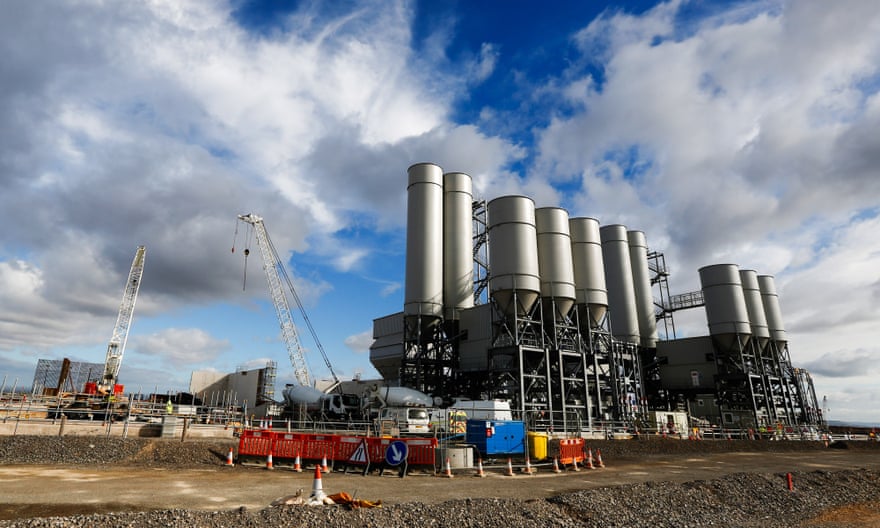
The Guardian has a look at the UK's disastrous Hinkley Point nuclear power project - Hinkley Point: the ‘dreadful deal’ behind the world’s most expensive power plant.

Hinkley Point, on the Somerset coast, is the biggest building site in Europe. Here, on 430 acres of muddy fields scattered with towering cranes and bright yellow diggers, the first new nuclear power station in the UK since 1995 is slowly taking shape. When it is finally completed, Hinkley Point C will be the most expensive power station in the world. But to reach that stage, it will need to overcome an extraordinary tangle of financial, political and technical difficulties. The project was first proposed almost four decades ago, and its progress has been glacial, having faced relentless opposition from politicians, academics and economists every step of the way.

Some critics of the project have questioned whether Hinkley Point C’s nuclear reactor will even work. It is a new and controversial design, which has been dogged by construction problems and has yet to start functioning anywhere in the world. Some experts believe it could actually prove impossible to build. “It’s three times over cost and three times over time where it’s been built in Finland and France,” says Paul Dorfman, from the UCL Energy Institute. “This is a failed and failing reactor.”
Fukushima cleanup to cost $72 billion  

Posted by Big Gav in

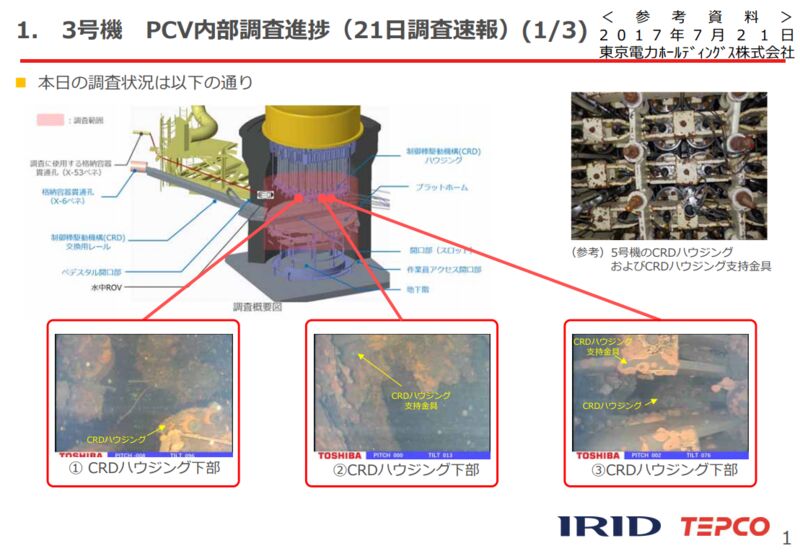
Bloomberg has a report on robots exploring the ruins of the Fukushima reactor complex - Japan Pictures Likely Show Melted Fukushima Fuel for First Time.

Because of the high radioactivity levels inside the reactor, only specially designed robots can probe the unit. And the unprecedented nature of the Fukushima disaster means that Tepco, as the utility is known, is pinning its efforts on technology not yet invented to get the melted fuel out of the reactors.

The company aims to decide on the procedure to remove the melted fuel from each unit as soon as this summer. And it will confirm the procedure for the first reactor during the fiscal year ending March 2019, with fuel removal slated to begin in 2021.

Decommissioning the reactors will cost 8 trillion yen ($72 billion), according to an estimate in December from the Ministry of Economy, Trade and Industry. Removing the fuel is one of the most important steps in a cleanup that may take as long as 40 years.

Nuclear industry in crisis  

Posted by Big Gav in

Alas, poor nuclear renaissance, I knew it well - Nuclear industry in crisis.

Problems with Generation III projects ‒ which largely explain Toshiba’s crisis ‒ are summarised in a recent Bloomberg piece: “Costly delays, growing complexity and new safety requirements in the wake of the triple meltdown at Fukushima are conspiring to thwart a new age of nuclear reactor construction. So-called generation III+ reactors were supposed to have simpler designs and safety features to avoid the kind of disaster seen in Japan almost six years ago. “With their development, the industry heralded the dawn of a new era of cheaper, easier-to-build atomic plants. Instead, the new reactors are running afoul of tighter regulations and unfamiliar designs, delaying completions and raising questions on whether the breakthroughs are too complex and expensive to be realized without state aid.”

Other nuclear utilities around the world are also in deep trouble. Their problems were summarised in the July 2016 World Nuclear Industry Status Report: “Many of the traditional nuclear and fossil fuel based utilities are struggling with a dramatic plunge in wholesale power prices, a shrinking client base, declining power consumption, high debt loads, increasing production costs at aging facilities, and stiff competition, especially from renewables.

Swiss try to give away nuclear plants, but find no takers  

Posted by Big Gav in

RNE reports that you can't even give away a nuclear power plant in Switzerland these days - Swiss try to give away nuclear plants, but find no takers.

On the weekend, Swiss media reported (in German and in French) that Swiss reactor operator Alpiq could find no buyer for its two nuclear plants and is therefore hoping to give them to the Swiss state. The firm’s CEO is quoted saying that France’s EDF was not interested even at no cost because it “has its own problems pertaining to nuclear power at present.”

World’s largest solar power plant planned for Chernobyl nuclear wasteland  

Posted by Big Gav in , , , ,

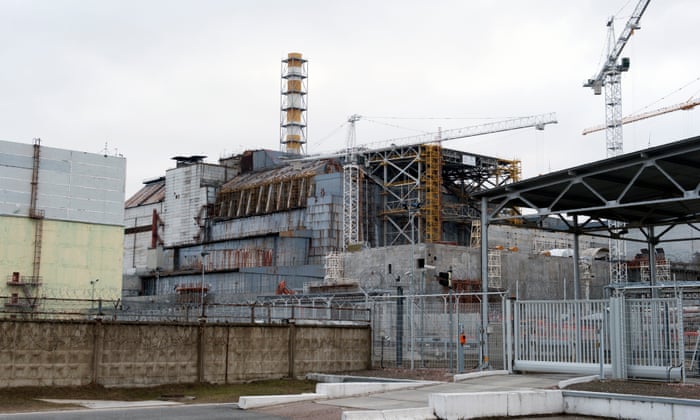
Electrek has a post on a plan to build a solar power plant at Chernobyl - World’s largest solar power plant planned for Chernobyl nuclear wasteland.

The proposed 1GW solar plant, if built today, would be the world’s largest. There are several plans for 1GW solar plants in development (Egypt, India, UAE, China, etc) – but none of them have been completed yet. One financial benefit of the site is that transmission lines for Chernobyl’s 4GW nuclear reactor are still in place.

Chernobyl, 30 years on  

Posted by Big Gav in , ,

To mark the 30th anniversary of the Chernobyl disaster, The Guardian has a photo journey through the ruined city of Pripyat, part of the involuntary park created by the reactor meltdown - Inside the abandoned city of Pripyat, 30 years after Chernobyl – in pictures.

Europe faces €253bn nuclear waste bill  

Posted by Big Gav in ,

The Guardian has a report on a new estimate of the cost to clean up the waste generated by Europe's nuclear power industry - Europe faces €253bn nuclear waste bill - noting there is a rather large funding gap between the amount of money allocated for clean up and the amount required.

Britain's nuclear clean-up bill to soar by billions  

Posted by Big Gav in

The Independent has an article on the UK's ever increasing bill for cleaning up old nuclear power sites - Britain's nuclear clean-up bill to soar by billions 'because of Government incompetence'.

The estimated cost for decommissioning over the next century went up from a £63.8bn estimate in 2011-12 to £69.8bn in 2012-13, with more increases expected in the coming years. This hike is nearly all down to the troubled clean-up of the Sellafield nuclear facility in Cumbria, one of the world's most hazardous and fiendishly complicated decontamination sites. NMP had been accused of chronic mismanagement after a series of delays and budget overruns on Sellafield projects, including problems involved in the construction of a storage facility for radioactive sludge.

The nuclear renaissance is stone cold dead  

Posted by Big Gav in

The Climate Spectator has a look at the collapse of the "nuclear renaissance" - The nuclear renaissance is stone cold dead.

The figures are in: 2013 was an annus horribilis for the nuclear power industry − its third in a row − and the nuclear renaissance can now be pronounced stone cold dead.

The most that could be said for the 2013 figures − four reactors connected to grids, four permanently shut down − is that they weren't as bad as the previous year. Nuclear power suffered its biggest ever one-year fall in 2012 − nuclear generation fell 7 per cent from the 2011 figure.

Nuclear generation fell in no less than 17 countries, including all of the top five nuclear-generating countries. Nuclear power accounted for 17 per cent of global electricity generation in 1993 and it has steadily declined to 10 per cent now.

The International Atomic Energy Agency has downwardly revised its projections, and now anticipates nuclear capacity growth of 23 per cent to 100 per cent by 2030. Historically, the IAEA's upper projections have been fanciful, while its low projections also tend to be too high (by 13 per cent on average) but provide a reasonable guide nonetheless. So growth of 23 per cent by 2030 − annual growth of a little over 1 per cent − is about as much as the industry can realistically hope for.

The IAEA will further reduce its projections when it factors in last year's annus horribilis. Perhaps the most striking developments were in the United States, where the industry is finding it increasingly difficult to profitably operate existing reactors − especially ageing reactors requiring refurbishments − let alone build new ones. Almost half of the world's reactors have operated for 30 years or more, so the problem of ageing reactors is starting to come into sharp focus.

Peter Bradford, a former member of the US Nuclear Regulatory Commission, notes that by 2009, applications for 31 new reactors in the US were pending. "The 31 proposed reactors are down to four actually being built and a few others lingering on in search of a licence, which is good for 20 years," Bradford writes. "Those four are hopelessly uneconomic but proceed because their state legislatures have committed to finish them as long as a dollar remains to be taken from any electric customer's pocket. Operating reactors are being closed as uneconomic for the first time in 15 years."

Is time up for Australia's uranium industry ?  

Posted by Big Gav in

Following the latest spill of radioactive material at ERA's Ranger uranium mine he ABC has an opinion piece wondering if it is time to decommission the industry - Is time up for Australia's uranium industry ?.

IN THE EARLY HOURS of December 7, a crack appeared in a large leach tank in the processing area of the Ranger uranium mine in Kakadu National Park. The area was evacuated, the tank completely failed, the containment system was inadequate and one million litres of highly acidic uranium slurry went sliding downhill — taking Energy Resources of Australia's credibility with it.

The spill has left traditional owners who live and rely on creeks only kilometres downstream angry and "sick with worry" and raised profound concerns about the management culture and integrity of infrastructure at the mine.

Operations at Ranger are now halted. The mine operates inside Kakadu National Park — Australia's largest park and a dual World Heritage listed region. It, and its people, deserve the highest standards of protection, but sadly Ranger is a long way short of this.

The Australian uranium industry has long been a source of trouble. Now it is increasingly in trouble. The commodity price has collapsed, projects across the country have been stalled, deferred or scrapped and the recent Kakadu spill has again raised community attention and concern.

At least the absence of a nuclear power industry in Australia means we don't have stories emerging like this one from the US - U.S. Dumped Tens of Thousands of Steel Drums Containing Atomic Waste Off Coastlines .

More than four decades after the U.S. halted a controversial ocean dumping program, the country is facing a mostly forgotten Cold War legacy in its waters: tens of thousands of steel drums of atomic waste.

From 1946 to 1970, federal records show, 55-gallon drums and other containers of nuclear waste were pitched into the Atlantic and Pacific at dozens of sites off California, Massachusetts and a handful of other states. Much of the trash came from government-related work, ranging from mildly contaminated lab coats to waste from the country’s effort to build nuclear weapons.

Federal officials have long maintained that, despite some leakage from containers, there isn’t evidence of damage to the wider ocean environment or threats to public health through contamination of seafood. But a Wall Street Journal review of decades of federal and other records found unanswered questions about a dumping program once labeled “seriously substandard” by a senior Environmental Protection Agency official…

The Answer to Climate Change Is Renewable Energy, Not Nuclear Power  

Posted by Big Gav in ,

The Huffington Post has an article on the pros and cons of nuclear power vs renewable energy - The Answer to Climate Change Is Renewable Energy, Not Nuclear Power.

There are a number of reasons that nuclear power is a bad solution to the climate crisis. The first is that the technology is really not available. Nuclear power plants are capital-intensive, technologically complex to manage, and difficult, if not impossible, to site. These are not minor issues. Investors would rather put their money elsewhere and communities intensely resist siting a plant in their backyard.

This means that even though we know how to generate electricity this way, and we have many decades of experience doing it, in the U.S. these plants will never be built in sufficient quantity to reduce global warming. In other parts of the world, we might pay attention to the lessons we should be learning in Iran. There is a thin line between the technology of nuclear power generation and the technology of nuclear bomb development. While it's too late to put the nuclear genie back in the bottle, let's stop pretending that human political systems or organizational processes can manage the risks of this technology.

There are other issues associated with current nuclear technologies that render them problematic as well. The toxicity of its fuel and waste, for example, should not be ignored. Catastrophic accidents may be rare, but when they occur, their impact is intense and long-lasting. While a well-managed plant poses little real danger, it is difficult to judge the danger posed by a poorly managed one. One also cannot dismiss the possibility of sabotage. Terrorists taking over a plant and threatening to allow an accident to occur could hold a city hostage.

Electric utilities, like water and sewage utilities, are natural monopolies that require government regulation. The investment in infrastructure to generate and transmit electricity is so massive that it makes little sense to allow more than one system per city. This investment in infrastructure and equipment reinforces the tendency of electric utilities to be highly centralized, vertically integrated organizations. These utilities tend to be rigid, unimaginative and monopolistic. While most other elements of our economy have moved into decentralized networks of organizations, the energy sector remains highly centralized. This is true of oil companies as well as electric utilities. These organizations outsource, but they are far less network-dependent than many other private organizations. It should not surprise us if the energy sector is insular and resists innovation. Instead of embracing renewable energy, many, though not all, are fighting it.

Renewable energy could change the energy business. While some large-scale organizations will always be part of the energy industry, we are seeing the start of decentralized, distributed generation of energy. Although the conventional wisdom tells us that solar power, battery technology, and smart grids are far in the future, we are only a breakthrough or two away from a new age of decentralized energy technology. While none of us can predict the future, and technological breakthroughs cannot be assumed, the risk of nuclear power is not difficult to predict.

The price of solar energy continues to come down, as the number of solar cells continues to grow. Breakthroughs in nanotechnology have the potential to shrink the size of these cells, making it possible to imagine smaller, more inexpensive installations of solar arrays. While some of the discussion of solar technology imagines utility-scale centralized power stations, my own view is that improved solar cells coupled with improved battery technology makes it possible to imagine a far more decentralized approach to energy generation

Ex Japanese PM Koizumi Speaks Out Against Restarting Nuclear Power  

Posted by Big Gav in ,

Bloomberg reports that ex-LDP leader Koizumi in Japan is advocating against restarting the country's closed nuclear reactors - Abe Mentor Koizumi Reignites Post-Fukushima Nuclear Debate.

Prime Minister Shinzo Abe faces another prominent opponent to his plans to return to nuclear power after the Fukushima disaster, as a former political mentor called for Japan to immediately abandon its reactors. Former Liberal Democratic Party Premier Junichiro Koizumi spoke out against atomic power today in his highest profile speech since retiring from politics in 2009. He joins three other former leaders who have turned against the industry that once provided more than a quarter of Japan’s electricity, with all of Japan’s 50 nuclear reactors now off-line.

Graph of the Day: Nuclear prices itself out of market  

Posted by Big Gav in

ReNew Economy has an article on the accelerating slide towards irrelevance of nuclear power - Graph of the Day: Nuclear prices itself out of market.

The extent to which nuclear is being priced out of electricity markets has finally been revealed by the pricing mechanism unveiled by the British government in the deal to subsidise the Hinkley C nuclear.

The UK government will pay £92.5 for each megawatt hour produced from hinkley ($A154/MWh), around double the prevailing market price. This is after the UK supplied a loan guarantee for 65 per cent of the estimated $24 billion capital cost. The “strike price” – a fancy name for a feed in tariff – also has an escalator to take into account the impact of inflation, so the cost will rise in coming years.

So how does this compare with rival clean energy technologies? Pretty badly as it turns out.

This graph below, published by Craig Morris in Renewable Energy World reveals that the rates that will be offered for new nuclear from 2023 in the UK are far above what solar and wind currently cost. And, as Morris points out, the rates for solar and wind will go down by then, not up! Even offshore wind is getting £95/MWh from 2018 in the UK, but only for 15 years and without any loan guarantees.

The French Energy Transition Away From Nuclear Power  

Posted by Big Gav in

The Business Spectator has an article on French plans to wind down nuclear power in favour of renewables - French carbon tax, feed-in tariff reform and CCS on horizon.

Germany’s neighbour France is also looking to shake up how it supports renewables as the country begins its “energy transition” away from nuclear.

France will introduce a carbon tax and a law to cap nuclear-power capacity as part of a new energy bill next year to boost renewable generation, President Francois Hollande told an environment conference last week. Hollande has vowed to reduce reliance on nuclear to half of total output by about 2025 while also keeping down consumers’ bills.

Among other things, the energy law in 2014 will define how renewables are financed. Hollande said last week that the above-market guaranteed prices currently paid to green energy producers “can lead to a waste of public funds, profit-taking and speculative behaviour.” Bloomberg New Energy Finance expects the shift in renewable support may move towards a greater use of tenders to keep costs low.

Fukushima Update  

Posted by Big Gav in , , , ,

It’s been over 2 years since the nuclear disaster at Fukushima and it still seems to be making headlines (I'm sure officials were assuring us a few weeks after the disaster occurred that all was well and it couldn't possibly melt down) so I thought I'd do a little survey of recent news.

A few weeks ago I started noticing reports that there was something of a push to restart the Japanese nuclear industry (against the wishes of Japanese voters), which had been shutdown in the wake of the reactor meltdowns. The reports soon prompted speculation of a jump in uranium prices as yet another mini-nuclear renaissance was forecast.

Since then TEPCO has admitted that the plant was leaking 300 tons of radioactive water per day into the Pacific Ocean after denying the leak for months (as per their standard approach of denying any problem exists until doing so was no longer tenable).

The Japanese authorities have now raised the threat level for the plant to a level three "serious incident". It was this leak that led the the widely pilloried "ice wall" approach to be proposed as a solution.

The precise location of the leak has not yet been determined and may not be repaired for years. Besides the "ice wall" idea construction of a concrete seawall around the whole site is also being mooted (another leak has since been reported within the site).

In the aftermath of the disaster, alternative energy solutions have been gaining in popularity. Japan and China have been recording record demand for solar PV (forecast to reach 9GW in the second half of 2013) with a 100% increase on the first half of the year, and a 70% jump over the previous year. Japan's growth alone has been 150 per cent compared to 2012 and is forecast to be over 5GW mid-2014.

The Japanese are also experimenting with energy storage to supplement the expansion of wind and solar on Japan's electric grid with two large-scale battery systems being constructed in the north. A 60 MWh redox-flow battery will be installed on the island of Hokkaido along with a 20 MWh lithium-ion battery in the Tōhoku region.

Japan considers mile-long ice wall to stop radiation leaks from Fukushima  

Posted by Big Gav in ,

The Verge has an article about a plan to freeze the ground around Fukushima to try to reduce radiation leakage - Japan considers mile-long ice wall to stop radiation leaks.

In the wake of the Fukushima nuclear plant disaster, Japan has struggled to stem the flow of radioactive material from the site. As Bloomberg reports, a new idea would see pipes installed around the failed plant, through which coolant would be pushed from on-site refrigeration units. The pipes would be installed between 20 and 40 meters (66 and 132 feet) below the ground, turning a mile-long stretch of earth into a frozen wall. The Japanese government wants to keep the ground frozen for six years, starting in July 2015.

The idea isn't new: the concept of freezing soil was first used in the 1860s to "shore up" coal mines, and more recently ice walls have been used to support the building of subway tunnels. The US also experimented with the idea that frozen earth could protect against nuclear radiation at a laboratory that produced plutonium for atomic weapons. Tokyo Electric Power, the company in charge of maintaining the plant, recently raised the status of the radioactive leaks at Fukushima to "emergency," a stance that's echoed by Japan's Priime Minister Shinzo Abe who now describes the leaks as an "urgent problem."

Big nuclear power company decides renewables are a better bet in the U.S.  

Posted by Big Gav in

Grist reports that french nuclear power company EDF has decided that it is better to pursue renewable energy in the US rather than bating a dead horse - Big nuke company decides renewables are a better bet in the U.S..

The world’s largest operator of nuclear power plants is dumping its stake in American reactors, turning its focus instead to wind and solar power. French utility company EDF announced this week that it will sell its stake in Constellation Energy Nuclear Group (CENG), which operates five nuclear reactors in New York and Maryland.

EDF cited cheap power produced by fracked natural gas as the big reason why it’s abandoning its American nuclear facilities. But the company said it will now focus its American business strategy not on fossil fuels but on renewable energy.

Duke Energy shelves major nuclear project in Florida  

Posted by Big Gav in

Reuters reports that another nuclear power project has been halted - Duke Energy shelves major nuclear project in Florida.

Duke Energy Corp said on Thursday it will not proceed with a $24 billion nuclear power project in central Florida because of licensing delays and doubts about cost recovery ... The announcement was the latest blow to nuclear power investment in the Sunshine State and reflected the boom in natural gas development nationwide.

Fukushima Decontamination and Cleanup Will Cost $50 Billion  

Posted by Big Gav in ,

The Diplomat has a look at the cost of cleaning up the Fukushima nuclear disaster - Fukushima Decontamination and Cleanup Will Cost $50 Billion. Presumably this isn't included in most levelised cost of energy numbers disseminated by nuclear power promoters...

In another blow to recovery efforts in the prefecture hit hardest by the 3/11 tsunami and nuclear meltdown, Japan’s National Institute of Advanced Industrial Science and Technology have estimated the cost of decontamination and cleanup to be more than $50 billion. The central Japanese government has earmarked only $11 billion in aid to the struggling region.

“The group has estimated that the decontamination in the no-entry zones will be at around $20 billion, while the other surrounding areas will cost another $31 billion,” said the Japan Daily Press. “The estimates are based on the unit costs that the government provided as well as information collected from the affected municipalities. It also includes the expenses that will be incurred in the removal, transportation and storage of radioactive waste like the contaminated soil and water.”

RIP Masao Yoshida  

Posted by Big Gav in

The NYT reports that one of the key staff involved in the Fukushima disaster and cleanup has died of cancer - no doubt one of many over time - Masao Yoshida, Nuclear Engineer and Chief at Fukushima Plant, Dies at 58.

Masao Yoshida, a nuclear engineer who took charge of the Fukushima Daiichi power plant two years ago as multiple reactors spiraled out of control after a tsunami, but who ultimately failed to prevent the world’s worst nuclear disaster since Chernobyl, died here on Tuesday. He was 58. The cause was cancer, said the Fukushima plant’s operator, Tokyo Electric Power.

Mr. Yoshida had been chief manager at Fukushima Daiichi for just nine months when a 42-foot tsunami inundated the site on March 11, 2011, knocking out vital cooling systems to the plant’s six reactors. Eventually hydrogen explosions and fuel meltdowns occurred at three reactors, releasing vast amounts of radioactive matter into the environment.

Although the company was widely criticized for its handling of the disaster, which forced more than 100,000 people from their homes, Mr. Yoshida won praise for his effort to minimize the damage. He has been faulted, however, for failing to invest in adequate tsunami walls at the company’s nuclear power plants when he was head of nuclear facilities. Mr. Yoshida later apologized to reporters, saying he had been “too lax” in his assumptions of how big a tsunami might hit the coastal plant.

Statistics

Locations of visitors to this page

blogspot visitor
Stat Counter

Total Pageviews

Ads

Books

Followers

Blog Archive

Labels

australia (619) global warming (423) solar power (397) peak oil (355) renewable energy (302) electric vehicles (250) wind power (194) ocean energy (165) csp (159) solar thermal power (145) geothermal energy (144) energy storage (142) smart grids (140) oil (139) solar pv (138) tidal power (137) coal seam gas (131) nuclear power (129) china (120) lng (117) iraq (113) geothermal power (112) green buildings (110) natural gas (110) agriculture (91) oil price (80) biofuel (78) wave power (73) smart meters (72) coal (70) uk (69) electricity grid (67) energy efficiency (64) google (58) internet (50) surveillance (50) bicycle (49) big brother (49) shale gas (49) food prices (48) tesla (46) thin film solar (42) biomimicry (40) canada (40) scotland (38) ocean power (37) politics (37) shale oil (37) new zealand (35) air transport (34) algae (34) water (34) arctic ice (33) concentrating solar power (33) saudi arabia (33) queensland (32) california (31) credit crunch (31) bioplastic (30) offshore wind power (30) population (30) cogeneration (28) geoengineering (28) batteries (26) drought (26) resource wars (26) woodside (26) censorship (25) cleantech (25) bruce sterling (24) ctl (23) limits to growth (23) carbon tax (22) economics (22) exxon (22) lithium (22) buckminster fuller (21) distributed manufacturing (21) iraq oil law (21) coal to liquids (20) indonesia (20) origin energy (20) brightsource (19) rail transport (19) ultracapacitor (19) santos (18) ausra (17) collapse (17) electric bikes (17) michael klare (17) atlantis (16) cellulosic ethanol (16) iceland (16) lithium ion batteries (16) mapping (16) ucg (16) bees (15) concentrating solar thermal power (15) ethanol (15) geodynamics (15) psychology (15) al gore (14) brazil (14) bucky fuller (14) carbon emissions (14) fertiliser (14) matthew simmons (14) ambient energy (13) biodiesel (13) investment (13) kenya (13) public transport (13) big oil (12) biochar (12) chile (12) cities (12) desertec (12) internet of things (12) otec (12) texas (12) victoria (12) antarctica (11) cradle to cradle (11) energy policy (11) hybrid car (11) terra preta (11) tinfoil (11) toyota (11) amory lovins (10) fabber (10) gazprom (10) goldman sachs (10) gtl (10) severn estuary (10) volt (10) afghanistan (9) alaska (9) biomass (9) carbon trading (9) distributed generation (9) esolar (9) four day week (9) fuel cells (9) jeremy leggett (9) methane hydrates (9) pge (9) sweden (9) arrow energy (8) bolivia (8) eroei (8) fish (8) floating offshore wind power (8) guerilla gardening (8) linc energy (8) methane (8) nanosolar (8) natural gas pipelines (8) pentland firth (8) saul griffith (8) stirling engine (8) us elections (8) western australia (8) airborne wind turbines (7) bloom energy (7) boeing (7) chp (7) climategate (7) copenhagen (7) scenario planning (7) vinod khosla (7) apocaphilia (6) ceramic fuel cells (6) cigs (6) futurism (6) jatropha (6) nigeria (6) ocean acidification (6) relocalisation (6) somalia (6) t boone pickens (6) local currencies (5) space based solar power (5) varanus island (5) garbage (4) global energy grid (4) kevin kelly (4) low temperature geothermal power (4) oled (4) tim flannery (4) v2g (4) club of rome (3) norman borlaug (2) peak oil portfolio (1)