Posted
by Big Gav
in
europe,
nuclear power
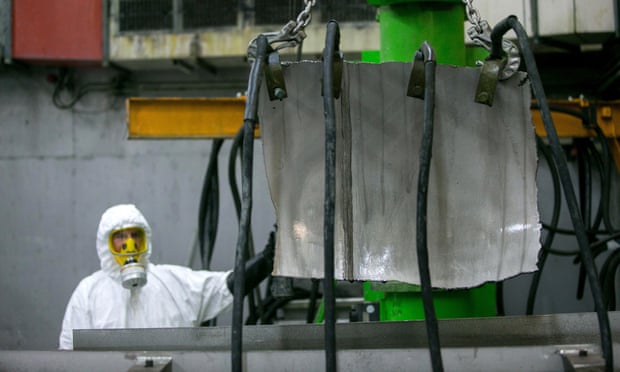
The Guardian has a report on a new estimate of the cost to clean up the waste generated by Europe's nuclear power industry - Europe faces €253bn nuclear waste bill - noting there is a rather large funding gap between the amount of money allocated for clean up and the amount required.
Posted
by Big Gav
in
europe,
greece,
jeremy rifkin
Bloomberg has an interesting angle on the European debt fiasco - if only Jeremy Rifkin would give up the hydrogen thing and focus on more practical energy solutions - Merkel Won’t Let Euro Split, May Cause Dark Age, Rifkin Says.
Angela Merkel won’t allow the euro region to split because she understands that could cause “a dark age" by wrecking the bloc’s energy markets as oil supplies dwindle, said an adviser to the German chancellor.
Europe’s 500 million residents, the wealthiest market on Earth, have led the development of technologies in clean energy, transport and communications that can drive global growth that doesn’t rely on oil, said Jeremy Rifkin, a Wharton Business School professor who has advised Merkel for six years.
“I hope they pull this off, there’s no one else," he said yesterday in Madrid of Merkel’s struggle to boost growth as part of Europe’s rescue strategy and preserve the single currency area. “If it splits up, we’re into a dark age."
Rifkin argues that record oil prices in 2008 pushing up the costs of everything from food to clothing rather than the collapse of Lehman Brothers Holdings Inc. was the main cause of the financial crisis. The global economy won’t return to its pre-crisis growth until it moves away from fossil fuels because rising oil prices will continually hold down expansion, he said.
The global economy sputtered again this year after oil prices surged. The European Central Bank started buying Italian and Spanish government bonds to control the sovereign debt crisis on Aug. 8, three months after oil prices reached their highest since 2008. Stock markets slumped this summer, with the S&P 500 losing 17 percent from July 22 to Aug. 8.
Germany’s deployment of renewable energy, intelligent power grids and electric vehicles leaves it best-placed to lead the world economy beyond its reliance on fossil fuels, Rifkin said. His vision involves creating an “energy Internet."
The EU has led the global battle to limit the greenhouse gas emissions that scientists say are almost certainly the cause of global warming, establishing the world’s biggest market for carbon-dioxide emission permits in 2005. That infrastructure, as well as the bloc’s targets for transforming its energy networks over the next 30 years, would likely be wrecked if the single currency area split, Rifkin said …
Global crude output likely peaked in 2006, the International Energy Agency says. Oil companies will have to spend trillions of dollars drilling in increasingly hostile environments such as deep waters in the Gulf of Mexico or the Arctic to meet demand, it said in its 2011 World Energy Outlook.
Rifkin, in the Spanish capital to speak today at a Rafael del Pino Foundation conference, has advised Merkel, French Premier Nicolas Sarkozy and Spain’s Jose Luis Rodriguez Zapatero that the global economy’s fundamental problem stems from the end of a growth model based on fossil fuels.
Sustainable expansion will only return when officials and executives can produce “the third industrial revolution," the University of Pennsylvania’s Wharton School professor argues in a book of the same title due to be published next month.
Posted
by Big Gav
in
electricity grid,
europe,
geothermal energy,
geothermal power,
iceland,
super grid
Bloomberg has an article on exporting geothermal and hydro power from Iceland to Europe via a new undersea transmission cable - Iceland Channels Volcanoes to Win Europe's Energy-Supply Race.
Europeans left stranded at airports last year as an Icelandic volcano spewed ash across the continent may soon benefit from the power that seethes beneath the remote north Atlantic island.
Iceland is doing a feasibility study into building a 1,170- kilometer (727-mile) power cable to Scotland to send some of its untapped potential of 18 terawatt-hours of geothermal and hydropower -- that’s enough for 5 million European homes. The project has the backing of the government, Industry Minister Katrin Juliusdottir said in an interview.
“Icelanders live with earthquakes and volcanic activity but the benefits are that now we can monetize these powers,” said Valdimar Armann, an economist at Reykjavik-based asset manager GAMMA, who estimates annual clean-energy exports could reach about a tenth of the island’s $12 billion economy.
The island is trying to emerge from Europe’s biggest banking meltdown this century to restyle itself as one of the European Union’s main sources of renewable energy. The power cable, which would be the longest of its kind ever built, would come as the EU strives to reach its target of 20 percent clean energy by 2020. In about 20 years, Iceland’s energy revenue per capita may rival that of Norway, where oil income has made its $540 billion sovereign wealth fund the world’s second-biggest, Armann said.
The U.K. day-ahead spot price values 18 terawatt hours at 828 million pounds ($1.33 billion), according to data available on Bloomberg. Landsvirkjun, a state-owned utility that produces 75 percent of Iceland’s electricity, is driving the feasibility study for the $2.1 billion power-cable project, which would send as much as 5 terawatt-hours a year

Posted
by Big Gav
in
europe,
smart grids
The Guardian has a European view of progress in developing smart grids - The Race For Smart Grids.
The electricity market is in the throes of change due to significant regulatory, societal and environmental developments, as well as technological progress. The guiding principle for this will be the transformation of traditional passive electricity networks into smart grids – and Europe needs to act fast or it will be overtaken by the US.
Every millionth of a second, the electricity grid has to balance out production and consumption. Now with the increasing share of renewable energies in the energy mix, changes in consumption patterns, a likely increase in consumption and the difficulty in constructing power lines, intelligent grid management has become a necessity.
Intelligent grids function bidirectionally, unlike the present unidirectional systems, and would cater to the growing demand on the part of users to become "consumers" in managing energy more efficiently and reducing CO2 emissions.
Moreover, flow management is vital for integrating scattered and decentralised renewable energy (wind and solar) production to the grid. With smart grids, electricity would no longer flow from large central plants to passive consumers, but in directions adapted to the more complex flows of the future.
Smart grids are digital. Computers speed the exchange of information, and gather a greater amount of data and act on it, to improve grid management and customer service. More accurate network management is vital for handling the rising, but unpredictable, proportion of renewable energy. Computing systems will have to be adapted to the increase in amount of data gathered, and define protocols to allow numerous plants and equipment to communicate.
The first step to an intelligent distribution network is usually the installation of smart electricity meters. In 2003, the Swedish government made smart metering obligatory. By July 2009, approximately 6m were installed, providing households with better control of their consumption and accurate monthly billing.
A study by Capgemini in the 15 EU countries showed that if smart meters were installed on a voluntary basis they would save some 200 terawatt hours per month by 2020 – the residential consumption of Spain and Germany – and approximately 100m tons of CO2 emissions.
However, the conditions for deploying smart grids have yet to be met. First, political courage is required to impose the inevitable increase in electricity prices to cover return on investment. Next, further research is needed, for instance in electricity storage and the technological and economic innovations necessary to minimise load. Lastly, standardised communications protocols are vital upstream and downstream for exchanging data between types of equipment on the network – for instance, enabling end-users' domestic appliances to communicate. The only possible scale for such action, especially for standardisation, would be at EU level. European countries must share financial and technological resources and work with regulators. The EU has mobilised considerable sums of money to this end but funds are managed in different EU programmes and on different national scales.
Posted
by Big Gav
in
europe,
renewable energy
Technology Review has an article on rapid growth in the European renewable energy market - Europe's Renewables Unfazed by Recession.
European renewable energy installations hit record levels last year and are likely to grow strongly over the next decade, despite European governments' budget woes. That's the view of a report released last week by the European Commission's Joint Research Centre in Brussels. The report suggests that the growth won't be slowed by the German parliament's approval on Friday of a reduction in price supports for solar power, or by a similar reduction in solar incentives by Spain last year.
Solar companies in Germany had warned that the proposed reductions in incentives would hurt the solar industry there, but the lead author of the new report, Arnulf Jäger-Waldau, a Joint Research Centre senior scientist, downplays their warnings. "The solar lobby was very efficient in drawing a dramatic picture that's clearly overstated," he says. While German solar panel manufacturers could face challenges, he says, installers will still make a decent profit.
The European Commission review estimates that European utilities and developers installed 10.2 gigawatts of new wind farms and 5.8 gigawatts of photovoltaic panels and solar thermal power in 2009, with such renewable power installations accounting for 62 percent of all new electricity generation capacity. And plans submitted to Brussels last month by European Union member states affirm their intention to install plenty more to meet targets set last year under the E.U.'s Renewable Energy Directive, which would boost Europe's use of renewables from 8.5 percent of total energy consumption to 20 percent by 2020.
European states will deliver on their targets to avoid heavy fines from the European Court of Justice in Luxembourg, according to Hélène Pelosse, who helped negotiate the Renewables Directive and is now interim director general for the Abu Dhabi-based International Renewable Energy Agency. "A binding target is really a binding target. It's not something you can ignore," says Pelosse.
Posted
by Big Gav
in
csp,
desertec,
europe,
solar thermal power
Reuters has a report claiming the first solar thermal power from North Africa may be flowing into Europe within 5 years (as part of the implementation of the DESERTEC proposal) - EU sees solar power imported from Sahara in 5 yrs.
Europe will import its first solar-generated electricity from North Africa within the next five years, European Energy Commissioner Guenther Oettinger said in an interview on Sunday.
The European Union is backing projects to turn the plentiful sunlight in the Sahara desert into electricity for power-hungry Europe, a scheme it hopes will help meet its target of deriving 20 percent of its energy from renewable sources in 2020.
"I think some models starting in the next 5 years will bring some hundreds of megawatts to the European market," Oettinger told Reuters after a meeting with energy ministers from Algeria, Morocco and Tunisia.
He said those initial volumes would come from small pilot projects, but the amount of electricity would go up into the thousands of megawatts as projects including the 400 billion euro Desertec solar scheme come on stream.
"Desertec as a whole is a vision for the next 20 to 40 years with investment of hundreds of billions of euros," said Oettinger. "To integrate a bigger percentage of renewables, solar and wind, needs time."
The EU is backing the construction of new electricity cables, known as inter-connectors, under the Mediterranean Sea to carry this renewable energy from North Africa to Europe.

Posted
by Big Gav
in
electricity grid,
europe,
hvdc,
super grid
REW has an article on a new proposal for a north sea supergrid - Stakeholders Team Up To Expand Europe's Super-Grid.
Europe has plenty of grid initiatives to help meets its ambitious goals for reducing greenhouse gas emissions with the help of renewable energies, such as wind and solar. Now it just needs an action plan. All the talk over the years about building new long-distance high-voltage transmission infrastructure to span national territories has, for the most part, remained just that.
But experts say the talk has now advanced to a new level, especially in the area of offshore infrastructure in northern Europe where around 100 gigawatts (GW) of offshore wind power are planned.
Indicative of the growing momentum, yet another initiative recently entered the fray: the Friends of the Super-Grid. The group consists of established players in the energy logistics chain, including Areva of France, Prysmian of Italy, and Mainstream Renewable Power of Ireland as well as Germany’s Siemens and Hochtief. It has proposed a “phase one” project to connect England, Scotland, Germany and Norway at a cost estimated of around €34 billion.
That amount is close to the €30 billion projected by the North Sea Countries Offshore Grid Initiative. That group, which launched at the end of last year, consists of the European Union member states Germany, France, Belgium, Luxembourg, the Netherlands, Sweden, Denmark, Ireland and the United Kingdom as well as Norway, which is not part of the EU. Its goal is to spur construction of an offshore grid in the North Sea with connecting installations on the mainland. The countries hope to sign a memorandum of Understanding (MoU) later this year and lay the foundation for action. ...
Greenpeace has looked at the costs of building high-voltage, long-distance onshore and offshore grids across Europe. The organization estimates that 34 existing high-voltage alternating current (HVAC) interconnections will need to be upgraded between neighboring countries at a cost of about €3 billion. At least another 17 high-voltage direct current (HVDC) interconnections will need to be installed for about €16 billion. And up to 11 new long-distance HVDC super-grid connections will be required for around €100 billion. The International Energy Agency (IEA), looking at only an upgrade of existing transmission assets in Europe, estimates investment of about € 200 billion through 2030
Posted
by Big Gav
in
electricity grid,
europe,
offshore wind power
Renewable Energy World has an article on the need to expand transmission capacity to handle increased generation from offshore wind farms in Europe - Transmission Stalls European Offshore Wind Power.
Germany's first offshore wind farm has been built and is now generating electricity. Dozens more wind farms are slated for construction over the next few years – as part of the German government's push to install 10,000 megawatts (MW) offshore wind capacity by 2020. But all of them will need to plug into powerful grids, both offshore and onshore, to transport the thousands of MW of additional renewable energy across the country and possibly beyond, and these may be slow in coming.
Germany’s first offshore wind farm has been online since the end of last year. The twelfth and last wind turbine in the Alpha Ventus park, off the North Sea island of Borkum, was built in November. The park is the first to employ a dozen 5-MW-class wind turbines, located 45 kilometers (34 miles) offshore in waters 30 meters (33 yards) deep. It will provide enough electricity to power 50,000 homes.
Alpha Ventus is the first of many planned wind parks in Germany. The government has approved plans to dedicate special zones off its northern coast to house up to 40 offshore wind parks that could provide electricity to more than 8 million households. The plan calls for setting aside zones between 12 and 200 kilometers of the northern shores. Of the 40 wind farms, 30 will be in the North Sea and 10 in the Baltic Sea. More than 25 of the planned farms have already received approval, with the bulk of them in the North Sea.
In total there will be more than 12,000 MW of offshore wind electricity by 2030, the equivalent of 12 medium-size nuclear plants, according to the German Federal Transport Ministry. The government’s plan is to double the current amount of energy supplied by wind in the country to 12 percent by 2020. Indeed, wind plays a big role in the energy plans of German policymakers to satisfy 30 percent of the country’s energy needs with renewable energy resources by 2030.
Posted
by Big Gav
in
europe,
iberdrola,
offshore wind power,
wind power
REW has an article on some large scale offshore win power developments in Europe - Iberdrola To Build 400-MW Baltic Offshore Wind Farm.
Iberdrola Renovables has bought 100% of the rights to build the Ventotec Ost 2 offshore wind complex in the German zone of the Baltic Sea. The rights were purchased from a German joint venture comprising Deutsche Erneuerbare Energien GmbH and Ventotec GmbH. They were awarded the permit in 2007.
The Ventotec Ost 2 offshore wind complex is far along in the permitting process and is expected to be commissioned by 2014. The wind farm’s 80 wind turbines, each with a capacity of of 5 megawatts (MW), are expected to generate a total of 1,200 gigawatt-hours (GWh).
The project is located in the northern part of the priority wind area known as Westlich Adlergrund, and will be built approximately 40 kilometers from shore. The average depth of the water is approximately 39 meters.
The German government has set a target of installing at least 10,000 MW of offshore wind capacity by 2020 and Iberdrola recently created an Offshore Wind Division designed to channel the development of this significant volume of offshore wind power.
Recently, Iberdrola and Vattenfall were awarded the construction rights to build one of the largest offshore wind farms in the world in the United Kingdom. The North Sea zone, known as East Anglia Array, has the potential to develop up to 7,200 MW, with construction is expected to begin in 2015.
The company is also involved in the development of several further offshore projects in Germany and has a pipeline of 2,300 MW in the United Kingdom, including the 500-MW West of Duddon Sands facilities, which it will start construction onin 2012, and Argyll Array, which will have an installed capacity of up to 1800 MW.

Posted
by Big Gav
in
desertec,
europe,
super grid
Business Green has an article on a new group promoting the creation of a European super grid - European energy giants unveil Supergrid vision.
Ten of Europe's largest energy and engineering firms today joined forces to launch a new lobby group committed to advancing plans for a pan-European Supergrid capable of supporting new renewable energy capacity.
The Friends of the Supergrid (FOSG) group brings together renewable energy developers, producers of advanced transmission cables, engineering firms and grid operators.
The founding members include 3E, AREVA T&D, DEME Blue Energy, Elia, Hochtief Construction AG, Mainstream Renewable Power, Parsons Brinckerhoff, Prysmian Cables & Systems, Siemens and Visser & Smit Marine Contracting.
Speaking at the launch of the new group, Mainstream Renewable Power's chief executive Dr Eddie O'Connor said the coalition of companies could play a key role in promoting an idea that will be essential to the long-term decarbonisation of Europe's economies.
"The UK government has recently shown its commitment to large-scale offshore wind by announcing the development of up to 50GW by 2020," he said. "We now need to integrate this huge resource into Europe to enable the open trade of electricity between member states. The FOSG is uniquely placed to influence policy-makers towards creating the Supergrid and, ultimately, change how we generate, transmit and consume electricity for generations to come."
Experts have long argued that the development of a Supergrid will make it far easier for grid operators to manage intermittent energy supplies from renewable resources such as offshore wind farms, allowing them to export excess power when winds are good and import energy from other regions when poor winds result in less power.
The concept is now climbing up the political agenda after nine EU member states, including the UK and Germany, signed up to the N orth Seas Countries Offshore Grid Initiative (NSCOGI) late last year, agreeing to co-operate on the development of a grid that will allow them to share energy produced by new offshore wind farms.
Meanwhile, in Germany the Destertec consortium of firms is working on plans for a similar supergrid designed to import power from solar farms in North Africa to much of continental Europe.
Posted
by Big Gav
in
europe,
supergrid
The Guardian reports that north sea countries are planning a "vast clean energy project" - Sun, wind and wave-powered: Europe unites to build renewable energy 'supergrid'.
It would connect turbines off the wind-lashed north coast of Scotland with Germany's vast arrays of solar panels, and join the power of waves crashing on to the Belgian and Danish coasts with the hydro-electric dams nestled in Norway's fjords: Europe's first electricity grid dedicated to renewable power will become a political reality this month, as nine countries formally draw up plans to link their clean energy projects around the North Sea.
The network, made up of thousands of kilometres of highly efficient undersea cables that could cost up to €30bn (£26.5bn), would solve one of the biggest criticisms faced by renewable power – that unpredictable weather means it is unreliable.
With a renewables supergrid, electricity can be supplied across the continent from wherever the wind is blowing, the sun is shining or the waves are crashing.
Connected to Norway's many hydro-electric power stations, it could act as a giant 30GW battery for Europe's clean energy, storing electricity when demand is low and be a major step towards a continent-wide supergrid that could link into the vast potential of solar power farms in North Africa.
By autumn, the nine governments involved – Germany, France, Belgium, the Netherlands, Luxembourg, Denmark, Sweden and Ireland and the UK – hope to have a plan to begin building a high-voltage direct current network within the next decade. It will be an important step in achieving the European Union's pledge that, by 2020, 20% of its energy will come from renewable sources.
"We recognise that the North Sea has huge resources, we are exploiting those in the UK quite intensively at the moment," said the UK's energy and climate change minister, Lord Hunt. "But there are projects where it might make sense to join up with other countries, so this comes at a very good time for us."
More than 100GW of offshore wind projects are under development in Europe, around 10% of the EU's electricity demand, and equivalent to about 100 large coal-fired plants. The surge in wind power means the continent's grid needs to be adapted, according to Justin Wilkes of the European Wind Energy Association (EWEA). An EWEA study last year outlined where these cables might be built and this is likely to be a starting point for the discussions by the nine countries.

Posted
by Big Gav
in
energy efficiency,
europe,
road train
The BBC has a report on European plants to improve car fuel economy by assembling "road trains" of cars on long distance trips - 'Road trains' get ready to roll.
Road trains that link vehicles together using wireless sensors could soon be on European roads. An EU-financed research project is looking at inexpensive ways of getting vehicles to travel in a 'platoon' on Europe's motorways.
Each road train could include up to eight separate vehicles - cars, buses and trucks will be mixed in each one. The EU hopes to cut fuel consumption, journey times and congestion by linking vehicles together.
Early work on the idea suggests that fuel consumption could be cut by 20% among those cars and trucks travelling behind the lead vehicle.
The lead vehicle would be handled by a professional driver who would monitor the status of the road train. Those in following vehicles could take their hands off the wheel, read a book or watch TV, while they travel along the motorway. Their vehicle would be controlled by the lead vehicle.
Funded under the European Commission's Framework 7 research plan, Sartre (Safe Road Trains for the Environment) is aimed at commuters in cars who travel long distances to work every day but will also look at ways to involve commercial vehicles.
Tom Robinson, project co-ordinator at engineering firm Ricardo, said the idea was to use off-the-shelf components to make it possible for cars, buses and trucks to join the road train. "The goal is to try and introduce a step change in transport methods," he said. "We're looking at what it would take to get platooning on public highways without making big changes to the public highways themselves," said Mr Robinson.

Posted
by Big Gav
in
europe,
wind power
Renewable Energy World has an article on wind power potential in Europe - Wind Could Power Europe Many Times Over.
A new report from the European Environment Agency has concluded that wind power's potential in 2020 is as much as three times greater than Europe's expected electricity demand, rising to a factor of up to seven times demand by 2030.
This study confirms that wind energy can play a major role in achieving the European renewable energy targets and that the extent of wind energy resources in Europe is very considerable. The report, ‘Europe's onshore and offshore wind energy potential,' highlights that the wind energy potential is huge, equivalent to almost 20 times energy demand in 2020. Onshore wind energy potential is concentrated in agricultural and industrial areas of north-western Europe. Likewise, the largest offshore potential can be found in low depth areas in the North Sea, the Baltic Seas and the Atlantic Ocean, with some local opportunities in areas of the Mediterranean and Black Seas.
The deep offshore potential is even larger but costs mean that it is unlikely to contribute in any significant way to the energy mix within the time horizon of the study. Using only 4 % of the offshore area within 10 km from the coast and accounting for the restrictions imposed by shipping lane, gas and oil platforms, military areas, reduces the potential by more than 90 % to 2800 TWh in 2020 and 3500 TWh in 2030.
When production costs are compared to baseline average electricity generation costs, the onshore potential for wind decreases to 9600 TWh in 2020, whereas offshore wind potential decreases to 2600 TWh. Despite being a small proportion of the total technical potential, the economically competitive wind energy potential still amounts to more than three times projected demand in 2020.
However, high penetration levels of wind power will require major changes to the grid system at higher penetration levels, with additional extensions or upgrades both for the transmission and the distribution grid possibly required to avoid congestion.
The conclusions were welcomed by the European Wind Energy Association (EWEA), with CEO Christian Kjaer observing: “The EEA clearly recognizes that wind power will be key to Europe's energy future. Now that oil prices are again on the rise, the EEA report sends a reminder to Europe's policy makers that wind power is a clean and proven energy technology and Europe is the world leader."

Posted
by Big Gav
in
europe,
super grid
Technology Review has an article on efforts to expand and modernise the European energy grid, easing the way for large scale renewables, particularly offshore -Europe Backs Supergrids.
Last month, the European Commission (EC) called for construction of regional electric transmission connections across the North Sea, around the Baltic region, and around the Mediterranean Sea, to distribute solar and wind power to and across Europe. It's all part of a plan to boost renewable energy from 8.5 percent of European energy consumption to 20 percent by 2020--and even more thereafter.
But the EC, the European Union's executive body, acknowledges that getting these so-called supergrids built will mean forging new agreements between European countries for transmission planning and investment--much as the United States needs more cooperation between states to, for example, move wind power from the Midwest to major cities. "The wind power which consumers demand cannot be delivered without new networks," the EC report says, and "there is little strategic planning" between nations to build the required connections.
However, several recent developments suggest that progress on transmission between European nations is possible. This summer, for example, a negotiator appointed by the EC convinced France to accept a new transmission connection with Spain, breaking a 15-year impasse over expanding power exchanges between the countries. Use of high-voltage DC (HVDC) technology will enable planners to bury the new line and thereby overcome local opposition to conventional overhead AC transmission lines.
The French-Spanish connection will help both countries balance power supply and consumption--especially Spain, which struggles at times to accommodate its installations of highly variable wind power, the largest in Europe. EC negotiator Mario Monti estimated that the link, called an interconnection, would reduce reliance on the countries' least efficient power plants, thus avoiding 1.5 million tons per year of carbon-dioxide emissions (roughly the annual emissions of 600,000 cars).
Christian Kjaer, CEO of the European Wind Energy Association, a Brussels-based trade group, calls it a "major breakthrough" that shows how Europe can overcome entrenched opposition to such interconnections. "It's a good example of why we need more than a national approach," says Kjaer.
Meanwhile, proposals for HVDC grids to deliver clean power from offshore wind farms to European consumers are getting more detailed. In September, for example, Brussels-based environmental consulting firm 3E mapped out a blueprint for what a North Sea offshore wind-power grid might look like. In 3E's design, 3,500 miles of underwater HVDC cables crisscross the North Sea, forming a network capable of hooking up 68,000 megawatts' worth of new offshore wind farms--enough generating capacity to meet 13 percent of the region's power consumption.
Posted
by Big Gav
in
europe,
global energy grid,
north sea,
scotland,
super grid
Earth2Tech reports that England may be left out of Scottish plans to join a European supergrid crossing the north sea - Scotland Snubbing England in Supergrid Plans?.
The Scottish government believes the North Sea could become host to an underwater renewable energy grid, supplying power from wind, wave and tidal power across Europe, but England could be left out in the cold. A new study from Scotland looks at the possibility of a supergrid between Scotland, Norway, Sweden, Denmark, Germany and the Netherlands, but doesn’t mention Scotland’s big neighbor to the south.
Yes, Scotland is still part of the UK, and most of England’s east coast is also on the North Sea, but the word “England” doesn’t even show up once in the 21-page study and “UK” is only used in a couple of footnotes. It might just be an oversight, but the possible snub comes during the same week in which the UK government made a filing with the Commission on Scottish Devolution questioning the Scottish government’s powers covering energy.
Political wrangling aside, there’s a big push for wind and marine power in the UK, not just in Scotland, so the area could become a hub for renewable energy in the region. In October, the UK government said it surpassed Denmark to take the top spot in offshore wind power in the world, boasting 590 megawatts of offshore wind vs. Denmark’s 423 megawatts.
Sweden’s Vattenfall just announced plans to invest in wind power in the UK, teaming up with ScottishPower Renewables to make joint bids on offshore wind development, including areas in the North Sea. The two plan to build 6,000 megawatts of installed wind power capacity.
ScottishPower, part of Spain’s Iberdrola, is also looking at marine power, releasing plans in September to build up to 60 megawatts of tidal power capacity in Scotland and Northern Ireland. The UK’s Crown Estate, which owns the seabed around the country, recently opened up the Pentland Firth off of northern Scotland for commercial wave and tidal projects, aiming to generate more than 700 MW of power by 2020.
There are already big projects going on in England and if there was Scottish-only supergrid, it would lose out on connecting to the planned 1-gigawatt London Array offshore wind farm as well as the Wave Hub project.
A recent plan from Greenpeace for a €20 billion ($25.032 billion) renewable energy grid in the area was much more inclusive, with both England and Scotland making the list, as well as France. However, the environmental group did neglect Sweden, which only has access to the North Sea through the Skagerrak strait.
The Scottish government is still working on its plans for a North Sea supergrid and estimated that it would need £409,200 ($606,475) and about 17 months to do a full study on the project.
Posted
by Big Gav
in
concentrating solar power,
csp,
desertec,
europe,
north africa,
solar thermal
The Guardian had a good article a couple of years ago about CSP in North Africa supplying power to Europe which I dubbed "Deserts of Gold".
Obviously this institutional knowledge hasn't been passed down as the latest version of this story is far weaker and confuses solar thermal power with solar PV. Still, good to see the idea is gaining momentum - £37bn plan to power EU with the Saharan sun.
Vast farms of solar panels in the Sahara could provide clean electricity for the whole of Europe, according to EU scientists working on a plan to pool the region's renewable energy.
Harnessing the power of the desert sun is at the centre of an ambitious scheme to build a €45bn (£35.7bn) European supergrid that would allow countries across the continent to share electricity from abundant green sources such as wind energy in the UK and Denmark, and geothermal energy from Iceland and Italy.
The idea is gaining political support in Europe, with Gordon Brown and Nicolas Sarkozy, the French president, recently backing the north African solar plan.
Because the sunlight is more intense, solar photovoltaic panels in north Africa could generate up to three times the electricity compared with similar panels in northern Europe.
Arnulf Jaeger-Walden of the European commission's Institute for Energy explained how electricity produced in solar farms in Africa, each generating around 50-200 megawatts of power, could be fed thousands of miles to European countries. The proposed grid would use high-voltage direct current (DC) transmission lines, which lose less energy over distance than conventional alternating current (AC) lines.
The idea of developing solar farms in the Mediterranean region and north Africa was given a boost by Sarkozy earlier this month when he highlighted solar farms in north Africa as central to the work of his newly formed Mediterranean Union.
Depending on the size of the grid, building the necessary high-voltage lines across Europe could cost up to €1bn a year every year till 2050, but Jaeger-Walden pointed out that the figure was small when compared to a recent prediction by the International Energy Agency that the world needs to invest more than $45tn (£22.5tn) in energy systems over the next 30 years.

Posted
by Big Gav
in
aerosols,
climate science,
europe,
global warming
There was a bit of a flap in flat-earther circles recently about aerosol levels over Europe and their importance to climate science - RealClimate has the usual comprehensive debunking - Aerosols, Chemistry and Climate.
Everyone can probably agree that the climate system is complex. Not only do the vagaries of weather patterns and ocean currents make it hard to see climate changes, but the variability in what are often termed the Earth System components complicates the picture enormously. These components - specifically aerosols (particulates in the air - dust, soot, sulphates, nitrates, pollen etc.) and atmospheric chemistry (ozone, methane) - are both affected by climate and affect climate, since aerosols and ozone can interact, absorb, reflect or scatter solar and thermal radiation. This makes for a rich research environment, but can befuddle the unwary.
I occasionally marvel at the amount of nonsense that is written about climate change in the more excitable parts of web, and most of the time, I don't bother to comment. But in relation to the issue of aerosols, chemistry and climate, I read yesterday probably the most boneheaded article that I have seen in ages (and that's saying a lot).
The hook for this piece of foolishness were two interesting articles published this week by Ruckstuhl and colleagues and a draft EPA report on the impacts of climate on air quality. First, Ruckstuhl et al found that as aerosols have decreased in Europe over the last few decades (as a result of environmental standards legislation), the amount of solar radiation at the ground has increased while the amount reflected to space has decreased. They hypothesize that this may have helped Europe warm faster in the last few decades than it would have otherwise done. Or equivalently, since the aerosols are anthropogenic, that European temperatures had been subdued due to the cooling effects of the aerosols - and since they are now decreasing, the full effects of the greenhouse gases are starting to be felt. This is just an update to the 'global brightening' story we have touched on before. The EPA report is concerned with the impacts that climate change can have on atmospheric chemistry, and in particular the summertime peaks in urban ground-level ozone which are a well-known and serious health hazard. These are affected by local temperatures, cloudiness, temperature sensitive biogenic emissions and patterns of weather variability. Again, it is a story we have discussed before.
But the NewsBusters article succeeded in getting almost every aspect of these stories wrong. How do I correct thee? Let me count the ways. ...
What should we make of this? Unfortunately one must conclude that no mistake is too dumb for someone, somewhere to make if they think they can spin it into supporting their anti-science agenda. For them complexity is something to be abused rather than a challenge to be understood, underlining quite clearly (again) the difference between science and propaganda.

Posted
by Big Gav
in
europe,
rail transport,
transport,
walkable cities
Laurence at PedShed has a post on a European prize for "best urban neighborhood built in Europe in the last 25 years" - Three Prix Rotthier Winners.
The winners of the Prix Rotthier pour la Reconstruction de La Ville 2008 have been announced, and they are gems. The Prix Rotthier prizes are given once each three years, and the theme of this year’s competition was “the best urban neighborhood built in Europe in the last 25 years.”
Not only are the winners beautiful and functional, they were judged to have been conceived and designed according to many of the principles of sustainable development and the EU Green Paper for the Urban Environment. These include revitalization of existing cities and suburbs with compact, mixed use development; integrating land use and transportation for more walking, biking, public transit and fewer motor vehicles; harmonious small and medium industry; energy efficiency and green building; waste reduction and recycling; parkland and integrated soil and water management; and not least, to “defend the architectural heritage against the uniform banality of the international style, respecting rather than imitating the old.”
The competition has done a service by providing tearsheets with site plans, photos and statistics on each of the ten winners. However, descriptive material is lacking (until the catalog is published in late 2008), so this post will give capsule descriptions of three neighborhood-scale projects, along with links to more information.

Pedshed also has a (slightly older) post noting
British Train Ridership Hits Peacetime Record.
A story about record train ridership in the UK includes this impressive graphic. The chart is based on the Association of Train Operating Companies (Atoc) booklet The Billion Passenger Railway. The booklet features several articles — including one that forecasts that the competitiveness of 21st century cities will depend on their high speed rail links.
Andrew Curry reports from September 2083:
With the internet long hamstrung by crime and fraud, and air travel the preserve of the hyper-rich, the cities which keep their place at the table are those which have solved four problems, according to Vienna Mayor, Kristal Stangl, the host of this year’s event.
“We must make sure that our cities have enough energy to function, to be sure, and that resources like water are secure. There must be enough food. They need to be good places to live. A lot of cities can make these things happen, even in our present conditions of scarcity. But the economic part is about getting the best brains to work on the complex problems which need to be solved to build new knowledge and value. That needs good transport links, and the cities which invested in high speed rail in the first part of the century are the best placed to compete.”
Some cities have slipped off the map as the European periphery has grown and the core shrunk. Most of the ‘Euro-30′ come from the ‘Golden Diamond’ between London, Hamburg, Krakow, and Marseilles. Some long-standing rivalries have been settled; Madrid is no longer a member, while Barcelona holds on to its Convention status. Rome plays second fiddle to Milan. Manchester’s high speed link to the tunnel has helped it stay in the club, while Glasgow’s failure to gain one has exiled it to the fringes.

The Guardian reports that
Europe's rail renaissance is on track as well.
The rail renaissance in Europe is racing ahead like a 320kph TGV yet Guillaume Pepy, head of SNCF, sees risks as well as opportunities as he celebrates the centenary of the reborn Mont Blanc Express aboard one of its six new electric traction trains.
Last weekend saw the start of the French summer holiday season and 1.3 million people thronged Paris's stations as they headed for the mountains and sea. The elongated twin-set TGVs pulling out of the Gare de Lyon virtually every five minutes are packed with up to 1,000 passengers. The concourse and platforms are so crammed with anxious families and international backpackers it's surprising they all get on board on time.
Even in the driving rain sweeping through the French Alps, accompanied by thunder and lightning, drenched walkers and climbers rush to join the "express" linking St Gervais with Vallorcine on the Franco-Swiss border and offering stunning views of the Mer de Glace.
Pepy, SNCF chairman and chief executive (PDG) since February, says that, unlike his predecessors who had to manage a railway recession, he is presiding over an accelerating boom. The state-owned SNCF delivered a net €1.1bn (£875m) profit last year and first-half figures, due next week, are said to be sparkling. Pepy envisages up to 80m extra passenger trips this year or an increase of around 8%.
"This change will speed up because we are facing a twin energy and environment crisis," he says, pointing to surging fuel costs and growing personal worries about carbon footprints. "People want sustainable mobility and, in France, more trains and more SNCF."
Carlos Ghosn, head of Renault-Nissan, he adds, has spoken of the demise of the petrol-driven car and drivers are shifting to trains which are four times more energy-efficient than cars – and six times more than planes. "People are looking for new answers," Pepy says. "They are waiting for SNCF solutions."

The Times notes that air traffic's loss is rail's gain -
High-speed trains seize short-haul market as fuel cost cripples the airlines.
The airline industry has been crushed by the price of kerosene and deserted by passengers fed up with delays. After decades of disappointment, false dawns and virtually bankrupt Channel Tunnels, we have finally arrived at the age of the train and the evidence is in the crowd at St Pancras.
Only eight months after opening its doors in November, the new station is choc-a-bloc at peak hours, an exciting but slightly nerve-wracking development for Eurostar and its biggest shareholder, SNCF, the French state railway.
Traffic growth on Eurostar is accelerating like an Alstom locomotive, increasing by 21 per cent in the first quarter, compared with the same period in 2007, and revenues are up by a quarter. Those figures were no flash in the pan, a boost from all the hooplah at last year's opening of St Pancras. Traffic in the second quarter has grown at similar rates, insiders say.
It would not be unfair to say that squeezing the London-Paris journey time by just 20 minutes has boosted Eurostar's income by 25 per cent.
While Eurostar thunders through Kent, the competing service to Paris and Brussels is lost on a never-ending building site west of London. The Terminal 5 fiasco has not helped British Airways's short-haul European business, but by next year (assuming no new operational disaster) it should have ironed out the wrinkles.
Then, BA is left with the awful question of whether short-haul air traffic has any future in Europe. The answer has to be a resounding “no”.
When did you last hear of a service business where the fuel bill represented more than a third of the operating cost, substantially higher than the cost of the staff?
Posted
by Big Gav
in
europe,
gas,
iraq,
nabucco
While I usually view the Iraq occupation as an American grab for Iraq's enormous reserves of cheap-to-extract, high quality oil, one little watched aspect is the potential for Iraqi gas to meet European gas needs, via the Nabucco pipeline, as indigenous production falls - especially as the only real alternative is to become a captive market for Tsar Vladimir.
There is some background here at The Asia Times from last year. This recent presentation from BG asking "Are we facing peak gas" (pdf) shows (at poor resolution) the USGS expects there to be rather a lot of gas through Iraq, though lagging that found in Russia, Iran and the gulf states.
EU Energy Commissioner Andris Piebalgs and External Relations Commissioner Benita Ferrero- Waldner met representatives of the Mashreq countries (Egypt, Jordan, Lebanon and Syria), Iraq and Turkey on May 5 in Brussels to discuss the finalisation of the Trans-Arab gas pipeline, promote its role as a future supplier of the EUbacked Nabucco project and encourage the full participation of Iraq in regional energy activities, including as a partner in the Trans-Arab project.
The Trans-Arab pipeline, which currently runs from Egypt through Jordan to Syria, has a capacity of 10 billion cubic metres per year. The pipeline, which will be interconnected with Turkey and Iraq by 2009, will provide a new transport route for gas resources from the Mashreq region to the EU.
Brussels also hopes that, in the future, the pipeline will be connected with the Nabucco pipeline which will traverse Turkey en route to Europe. During the meetings, discussions focused on prospects for reinforcing the existing cooperation through the Euro- Arab Mashreq gas centre in Damascus, which benefits from technical assistance provided by the European Commission. ...
The European Commission has finalised a Memorandum of Understanding on Energy Partnership with Egypt and another is under discussion with Iraq. A Joint Declaration on energy cooperation between the Commission and Jordan was signed in October 2007 and is now being implemented. “The Arab Gas Pipeline is set to be finalised by the end of the year, opening important possibilities as a new transport route for gas to the EU, particularly for the Nabucco project,” Ferrero-Waldner said.
Piebalgs said the Mashreq countries and the European Union are facing similar energy challenges. “We should seek common solutions to common problems like high oil prices for consumers, climate change or security of supply. A common response is necessary with new pipelines like the Arab gas Pipeline, but also with energy efficiency measures, the spearheading renewable energy in both sides of the Mediterranean,” the EU energy commissioner said.
Piebalgs said that the EU has agreed gas deliveries of seven billion cubic metres annually with Egypt and Iraq. Iraq is to supply around five billion cubic metres of natural gas from 2011 when the Akkas gas field in the western part of the country is producing sufficient amounts. Egypt has also agreed to supply the EU with two billion cubic metres of gas when the Trans-Arab gas pipeline is completed in 2009.
The European Commission has strongly supported Nabucco, which is supposed to supply the bloc with gas from the Caspian Sea region by 2012- 2013 while bypassing Russia. After a meeting with Russian Energy Minister Viktor Khristenko, Piebalgs told reporters Russia is working with its own project, South Stream, and excluded the possibility of linking Russia with the Nabucco network. “We should not ask Russia to join a project which they have never shown interest to join,” he said.

Posted
by Big Gav
in
cigs,
europe,
solar power,
super grid,
wind power
Global Public Media has an interview with Mark Ennis of Airtricity, talking about the European supergrid idea.
A high voltage electricity grid connecting countries from the North Sea to the Bay of Biscay could provide almost a third of Europe's power by 2030, according to the company behind the idea. The system would improve energy security, cut emissions, and even reduce the price of power at times of peak demand.
The supergrid is the brainchild of Irish wind generator Airtricity - recently acquired by Scottish and Southern Energy for €1.1 billion - and would connect countries as far apart as Norway and Spain to each other's offshore wind farms. When the wind blows in one country but not in others, power would be directed through the high voltage direct current (HVDC) network to wherever it is needed most.
According to Mark Ennis, Airtricity's Executive Director for Strategy and Public Policy, the system will solve the Achilles heel of wind generation. In an interview with lastoilshock.com and Global Public Media, Ennis said "By having a very large grid over several thousand kilometers you take the variability out, you almost come out with base load energy"
Speaking on the sidelines of the World Future Energy Summit in Abu Dhabi last week, Ennis went on to say that the HVDC technology is proven, that existing financial incentives are already sufficient to make the idea viable, and that a regulatory agreement between countries is close: "I think we are nearly there". If work starts soon, Ennis claimed, the supergrid could supply 30% of Europe's power by 2030.
The initial investment would be huge, but would be spread between grid operators, such as the National Grid in Britain, and Eon Netzt in Germany, and wind farm operators. However, by directing electricity to where demand - and prices - are highest, according to Ennis the system should reduce peak demand for fossil fuels and therefore bring costs down.
On the solar front, Cleantech.com reports that
Global Solar has achieved 10% efficiency from its CIGS thin film solar cells.
Tuscon, Ariz.-based Global Solar Energy announced today that its thin-film solar cells hit a milestone, reaching an average of 10 percent efficiency. The company said its copper indium gallium diselenide cells achieved the efficiency over several production runs.
"This is the culmination of three full years of being in production and evolving our proprietary production techniques to continuously improve the efficiency and output of our production," said Jeffrey Britt, VP of technology at Global Solar.
Global Solar said it hit the milestone in December, capping off a year in which it said it also manufactured and shipped 4 megawatts of photovoltaic material for commercial, government, military and consumer products.


 Posts
Posts