Shell's massive floating LNG factory off the Kimberley coast has been in shutdown since February and industry analysts are divided on whether the $12-17 billion facility has a future.
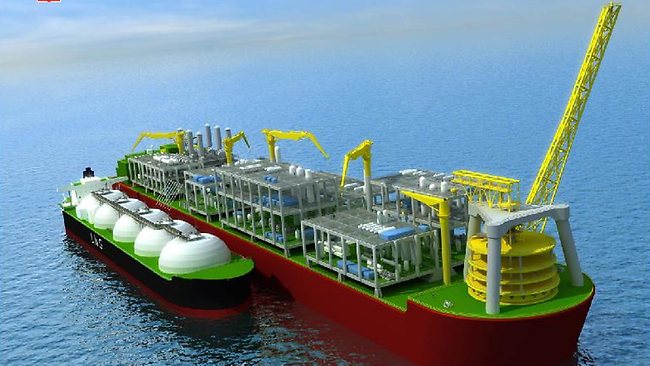
With five times the steel of the Sydney Harbour Bridge and half a kilometre long, it certainly is big. But as it sits idle 400 kilometres north of Broome, it risks becoming the world's biggest white elephant.
AUSTRALIA is set to supply millions of tonnes of liquefied natural gas to South Korea over the next 20 years under an historic deal worth billions of dollars.
South Korea's government last night approved two deals worth $US84 billion sought by the country's state-run Korea Gas Corporation to import more than five million metric tonnes per year of LNG, the bulk of which will come from Australia.
The deals, the biggest in South Korea's history, are with Royal Dutch Shell Plc and Total SA.
The state-run utility will buy 3.64 million metric tons of LNG a year from Shell's Prelude gas project in Australia for 26 years starting 2014, the Ministry of Knowledge Economy said in a statement. It will also buy 2 million tons of the fuel a year from Total's Ichthys field gas projects in Australia and other fields in Nigeria, Norway and Egypt for 18 years starting 2014.
The shipments are valued at $US84 billion and are equivalent to 17 percent of Korea's gas consumption in 2010, according to the statement.
Prelude is expected to produce 3.6 million tonnes per annum of LNG, as well as 1.3 million tonnes of condensate and 400,000 tonnes of LPG.
The facility is scheduled to begin production in 2016. The gas will be cooled by cold water pumped from about 150m below the ocean’s surface - allowing around 50,000 m3 of cold seawater each hour to cool the gas.
The project will be the world’s floating LNG development and the facility will be the largest floating structure ever built. The vessel will be built by South Korea's Samsung Heavy Industries. At 488 metres long, 74 metres wide and 600,000-tonne in weight it will be longer than four soccer fields laid end-to-end and will be six times heavier than the world's largest aircraft carrier.
The vessel will be permanently moored about 200km off the coast for its 25 years of production and is designed to withstand severe category 5 cyclones (or a “one-in-10,000-year" tropical cyclone, as Shell executive director Malcolm Brinded put it).
Shell has self-insured the project, so its not clear what the view of maritime insurers is of the likelihood of the project suffering significant damage during its lifetime is.
In Australia we’ve seen onshore natural gas largely depleted, near offshore natural gas well developed (the north west shelf LNG operation has now been in operation for decades and long-stalled projects like Gorgon are now well underway), a boom in coal seam gas and emerging interest in exploiting shale gas (local producers seem to view speculation that US shale gas production will undermine Australian LNG export markets in Asia as unfounded, notwithstanding the strong Australian dollar) and biogas.
Research by the CSIRO in 2008 found that up to half Australia's natural gas resources (140 trillion cubic feet) could not be developed because they were too remote to be connected to onshore processing plants.
Floating LNG platforms remove this barrier and would seem to be the final stage of our entry into what has been dubbed by some (including the IEA [pdf]) as "The Gas Age" (I guess you could view the fossil fuel era as an act in 3 parts, similar to the era of the dinosaurs, with the coal age being analagous to the Triassic period, the oil age to the Jurassic and the gas age echoing the Cretaceous, with the end of the era approaching).
By adopting the offshore floating LNG solution Shell hopes to also substantially reduce the time and cost of the project development phase.
Global LNG demand is expected to double this decade and the introduction of floating storage and regasification vessels in recent years has enabled fast entry of new buyers such as Argentina, Brazil, Kuwait and Dubai in recent years, with Thailand and Singapore soon to join the club and Indonesia, Malaysia, Pakistan, Sri Lanka and possibly the Philippines following along behind them.
Shell is already looking at a number of other locations for floating LNG projects, including the Greater Sunrise project in East Timor, and projects in Indonesia, Cyprus, East Africa and South America. Other companies are also interested in floating LNG with the BBC claiming Flex LNG and Hoegh LNG hoping to make final investment decisions shortly on projects in Papua New Guinea.
Jarand Rystad, founder of a Norway-based research consultancy for the oil industry says there are up to 160 gas fields where floating LNG could be applicable worldwide over the next decade.
The 10 platforms figure may have emerged from a statement from Samsung Heavy Industries estimating the size of the market last year.
Besides the PNG projects mentioned earlier, Woodside have been pushing for a floating LNG development for the Sunrise development between Australia and East Timor, and there has been some speculation that Woodside's Browse development could avoid opposition to plans to build an onshore LNG plant in the Kimberly region. There has also been speculation that Inpex's Abadi and Ichthys projects could be candidates.
The Australian reports that Shell's plan for a floating LNG platform for the Prelude field in Australia's Browse Basin has passed another project milestone - $12bn Prelude floating plant has Shell fired for LNG.
ROYAL Dutch Shell has approved its world-first Prelude floating LNG project off Western Australia at an estimated capital cost of up to $US12.6 billion ($11.8bn), in a move that will allow it to access major gas deposits stranded hundreds of kilometres from the coast.
The Anglo-Dutch giant said in Perth yesterday that it had given final invesment approval for the revolutionary project, which will mark the first time a floating LNG vessel has been deployed to produce gas and liquefy it on board by cooling.
More than $200bn worth of LNG projects are on the drawing board in Australia, which is expected to become the world's second-biggest global exporter of the cleaner burning fuel by 2020.
Approval for the Prelude project comes as the LNG sector faces an investment boom.
US energy giant Chevron, Japan's Inpex and Perth-based Woodside Petroleum are all close to signing off on multi-billion-dollar developments in Australia.
The investments come in response to strong demand for LNG, including that from China and Japan.
Shell upstream international executive director Malcolm Brinded described the Prelude project in the Browse Basin as as a "game changer" and a colossal undertaking.
The floating facility will be 488m long -- longer than four soccer fields laid end to end.
It will be the largest floating structure ever built and will be permanently moored about 200km from the coast during its 25 years of production.
The vessel, to be built by South Korea's Samsung Heavy Industries, will be six times heavier than the world's biggest aircraft carrier and designed to withstand severe category 5 cyclones.
Prelude is expected to produce 3.6 million tonnes per annum of LNG, as well as volumes of condensate and liquefied petroleum gas.




 Posts
Posts