Showing posts with label media. Show all posts

RIP Edward Herman  

Posted by Big Gav in ,

Matt Taibbi at Rolling Stone has a farewell to "Manufacturing Consent" co-author Edward Herman - RIP Edward Herman, Who Co-Wrote a Book That's Now More Important Than Ever.

Edward Herman, the co-author (with Noam Chomsky) of Manufacturing Consent, has died. He was 92. His work has never been more relevant.

Manufacturing Consent was a kind of bible of media criticism for a generation of dissident thinkers. The book described with great clarity how the system of private commercial media in America cooperates with state power to generate propaganda.

Herman's work was difficult for many to understand because the nature of the American media, then and now, seemed at best to be at an arm's length from, say, the CIA or the State Department. Here is how the book put it:

"It is much more difficult to see a propaganda system at work where the media are private and formal censorship is absent."

The basic thesis of Manufacturing Consent was that propaganda in America is generated through a few key idiosyncrasies of our (mostly private) system.

One is that getting the whole population to buy in to a narrative requires the sustained attention of the greater part of the commercial media, for at least a news cycle or two.

We don't censor the truth in America, mostly. What we do instead is ignore it. If a lone reporter wants to keep banging a drum about something taboo, like contracting corruption in the military, or atrocities abroad, he or she will a) tend not advance in the business, and b) not be picked up by other media.

Therefore the only stories that tended to reach mass audiences were ones in which the basic gist was agreed upon by the editors and news directors of all or most of the major media companies.

In virtually all cases this little mini-oligarchy of media overlords kept the news closely in sync with the official pronouncements of the U.S. government.

The appearance of dissent was permitted in op-ed pages, where Democrats and Republicans "debated" things. But what readers encountered in these places was a highly ritualized, artificially narrow form of argument kept strictly within a range of acceptable opinions.

Herman's last article had a look at the long history of "fake news" published by The New York Times - Fake News on Russia and Other Official Enemies (though they are from from the only ones guilty of this).

It has been amusing to watch the New York Times and other mainstream media outlets express their dismay over the rise and spread of “fake news.” These publications take it as an obvious truth that what they provide is straightforward, unbiased, fact-based reporting. They do offer such news, but they also provide a steady flow of their own varied forms of fake news, often by disseminating false or misleading information supplied to them by the national security state, other branches of government, and sites of corporate power.

An important form of mainstream media fake news is that which is presented while suppressing information that calls the preferred news into question. This was the case with “The Lie That Wasn’t Shot Down,” the title of a January 18, 1988, Times editorial referring to a propaganda claim of five years earlier that the editors had swallowed and never looked into any further. The lie—that the Soviets knew that Korean airliner 007, which they shot down on August 31, 1983, was a civilian plane—was eventually uncovered by congressman Lee Hamilton, not by the Times.

Mainstream media fake news is especially likely where a party line is quickly formed on a topic, with any deviations therefore immediately dismissed as naïve, unpatriotic, or simply wrong. In a dramatic illustration, for a book chapter entitled “Worthy and Unworthy Victims,” Noam Chomsky and I showed that coverage by Time, Newsweek, CBS News, and the New York Times of the 1984 murder of the priest Jerzy Popieluzko in Communist Poland, a dramatic and politically useful event for the politicized Western mainstream media, exceeded all their coverage of the murders of a hundred religious figures killed in Latin America by U.S. client states in the post-Second World War years taken together. It was cheap and safe to focus heavily on the “worthy” victim, whereas looking closely at the deaths of those hundred would have required an expensive and sometimes dangerous research effort that would have upset the State Department. But it was in effect a form of fake news to so selectively devote coverage (and indignation) to a politically useful victim, while ignoring large numbers whose murder the political establishment sought to downplay or completely suppress.

Roger Ailes Was One of the Worst Americans Ever  

Posted by Big Gav in

Matt Taibbi at Rolling Stone has an obituary for the monster that invented Fox News - Roger Ailes Was One of the Worst Americans Ever.

We are a hate-filled, paranoid, untrusting, book-dumb and bilious people whose chief source of recreation is slinging insults and threats at each other online, and we're that way in large part because of the hyper-divisive media environment he discovered.

Ailes was the Christopher Columbus of hate. When the former daytime TV executive and political strategist looked across the American continent, he saw money laying around in giant piles. He knew all that was needed to pick it up was a) the total abandonment of any sense of decency or civic duty in the news business, and b) the factory-like production of news stories that spoke to Americans' worst fantasies about each other.

The onetime Nixon operative has created the most profitable propaganda machine in history. Inside America's Unfair and Imbalanced Network Like many con artists, he reflexively targeted the elderly – "I created a TV network for people from 55 to dead," he told Joan Walsh – where he saw billions could be made mining terrifying storylines about the collapse of the simpler America such viewers remembered, correctly or (more often) incorrectly, from their childhoods.

Trump's War On Facts  

Posted by Big Gav in , ,

I figured The Borowitz Report may have been a little premature claiming that George W Bush was very relieved he would no longer be the worst US president in history once Donald Trump was inaugurated, however after 5 days in the job I think Trump is getting close to taking the honour (unlike Bush he hasn't invaded any other countries yet so it's still line ball, though apparently he is threatening to invade Chicago).

Listing all of Trump's violations of decency and common sense would be tedious but one unpleasant aspect of this American experiment with authoritarianism which stands out already is his continual war on the truth, starting with the bizarre attempts to deny that the attendance at his inauguration ceremony was far lower than that of previous presidents (not to mention the massive anti-Trump protests the following day) and the creation of the phrase "alternative facts" to describe Trump administration lies.

While it is common for dictators to lie about topics which reflect poorly upon them (they also like to declare weird national holidays like Trump's "National Day of Patriotic Devotion, which I initially thought was satire - apparently Trump is following Kim Jong Il's playbook as much as he is Vladimir Putin's) the speed at which the Trump administration is moving to push scientific facts down the memory hole (one of the many apropros concepts from George Orwell's 1984 which will come in handy during the Trump era) is staggering.

After starting with a purge of the White House web site (eliminating all mention of climate change and clean energy, along with other annoyances like civil rights and the Spanish language version of the site), the administration has quickly moved on to removing references to climate change from the EPA web site and telling government employees they cannot release information to the media or the public without having it vetted for political correctness first. The functions of the EPA seem to have been pretty much suspended as well, no doubt as the first step towards dismantling federal environmental protection programs completely (as they are an obstacle to keeping US consumers hooked on fossil fuels for as long as they last).

On the plus side, the fear of Trumpist censorship led to a carnival of climate data archiving over the past month, and the administration's heavy handed censorship of official Twitter accounts has sparked a boom in rogue government Tweeters that are now far more popular than the official accounts (with special mention going to the folks at the Badlands National Park).

The science community is now organising it's own protest marches against Trump, with a march on Washington planned in the coming weeks.

Whether or not Trump is still in office at that point can't be certain, with his recent performance in a TV interview prompting a lot of pundits to wonder if he'll be bounced out of office by his own cabinet under the 25th amendment section covering situations where the president is no longer fit for office. That's if the CIA (allegedly unimpressed with his cheer squad disrespecting their hallowed ground) don't assassinate him first of course...

Moneyball Politics  

Posted by Big Gav in , ,

Forbes has an interesting profile of Donald Trump's son-in-law Jared Kushner (of 666 Fifth Avenue) and his "moneyball" tactics for targeting Facebook ads at vulnerable voters in swing states helped Trump win the election (along with some help from the Russians and aggressive vote suppression techniques being applies by state Republican governments of course) - How Jared Kushner Won Trump The White House.

“It’s hard to overstate and hard to summarize Jared’s role in the campaign,” says billionaire Peter Thiel, the only significant Silicon Valley figure to publicly back Trump. “If Trump was the CEO, Jared was effectively the chief operating officer.”

“Jared Kushner is the biggest surprise of the 2016 election,” adds Eric Schmidt, the former CEO of Google, who helped design the Clinton campaign’s technology system. “Best I can tell, he actually ran the campaign and did it with essentially no resources.”

No resources at the beginning, perhaps. Underfunded throughout, for sure. But by running the Trump campaign–notably, its secret data operation–like a Silicon Valley startup, Kushner eventually tipped the states that swung the election. And he did so in manner that will change the way future elections will be won and lost. President Obama had unprecedented success in targeting, organizing and motivating voters. But a lot has changed in eight years. Specifically social media. Clinton did borrow from Obama’s playbook but also leaned on traditional media. The Trump campaign, meanwhile, delved into message tailoring, sentiment manipulation and machine learning. The traditional campaign is dead, another victim of the unfiltered democracy of the Web–and Kushner, more than anyone not named Donald Trump, killed it.

This wasn’t a completely raw startup. Kushner’s crew was able to tap into the Republican National Committee’s data machine, and it hired targeting partners like Cambridge Analytica to map voter universes and identify which parts of the Trump platform mattered most: trade, immigration or change. Tools like Deep Root drove the scaled-back TV ad spending by identifying shows popular with specific voter blocks in specific regions–say, NCIS for anti-ObamaCare voters or The Walking Dead for people worried about immigration. Kushner built a custom geo-location tool that plotted the location density of about 20 voter types over a live Google Maps interface.

Soon the data operation dictated every campaign decision: travel, fundraising, advertising, rally locations–even the topics of the speeches. “He put all the different pieces together,” Parscale says. “And what’s funny is the outside world was so obsessed about this little piece or that, they didn’t pick up that it was all being orchestrated so well.”

For fundraising they turned to machine learning, installing digital marketing companies on a trading floor to make them compete for business. Ineffective ads were killed in minutes, while successful ones scaled. The campaign was sending more than 100,000 uniquely tweaked ads to targeted voters each day. In the end, the richest person ever elected president, whose fundraising effort was rightly ridiculed at the beginning of the year, raised more than $250 million in four months–mostly from small donors.

The Observer has a look at the right wing propaganda and analytics machine that enabled Kushner's tactics to be so effective - Google, democracy and the truth about internet search.

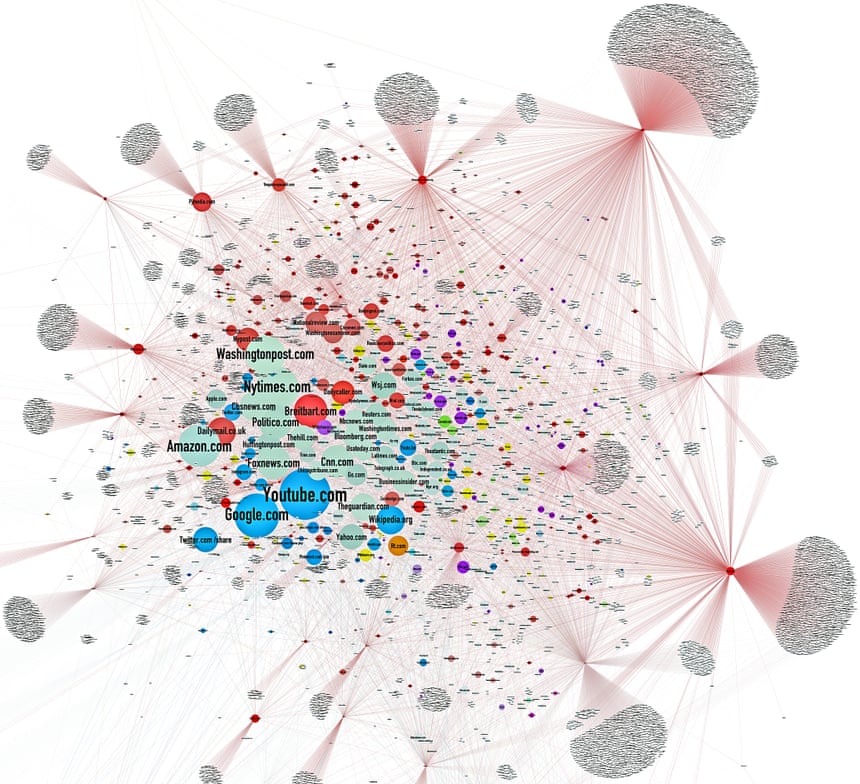
The constellation of websites that Albright found – a sort of shadow internet – has another function. More than just spreading rightwing ideology, they are being used to track and monitor and influence anyone who comes across their content. “I scraped the trackers on these sites and I was absolutely dumbfounded. Every time someone likes one of these posts on Facebook or visits one of these websites, the scripts are then following you around the web. And this enables data-mining and influencing companies like Cambridge Analytica to precisely target individuals, to follow them around the web, and to send them highly personalised political messages. This is a propaganda machine. It’s targeting people individually to recruit them to an idea. It’s a level of social engineering that I’ve never seen before. They’re capturing people and then keeping them on an emotional leash and never letting them go.”

Cambridge Analytica, an American-owned company based in London, was employed by both the Vote Leave campaign and the Trump campaign. Dominic Cummings, the campaign director of Vote Leave, has made few public announcements since the Brexit referendum but he did say this: “If you want to make big improvements in communication, my advice is – hire physicists.”

Steve Bannon, founder of Breitbart News and the newly appointed chief strategist to Trump, is on Cambridge Analytica’s board and it has emerged that the company is in talks to undertake political messaging work for the Trump administration. It claims to have built psychological profiles using 5,000 separate pieces of data on 220 million American voters. It knows their quirks and nuances and daily habits and can target them individually.

“They were using 40-50,000 different variants of ad every day that were continuously measuring responses and then adapting and evolving based on that response,” says Martin Moore of Kings College. Because they have so much data on individuals and they use such phenomenally powerful distribution networks, they allow campaigns to bypass a lot of existing laws.

“It’s all done completely opaquely and they can spend as much money as they like on particular locations because you can focus on a five-mile radius or even a single demographic. Fake news is important but it’s only one part of it. These companies have found a way of transgressing 150 years of legislation that we’ve developed to make elections fair and open.” ...

We don’t understand it. It is not bound by terrestrial laws. And it’s in the hands of two massive, all-powerful corporations. It’s their experiment, not ours. The technology that was supposed to set us free may well have helped Trump to power, or covertly helped swing votes for Brexit. It has created a vast network of propaganda that has encroached like a cancer across the entire internet. This is a technology that has enabled the likes of Cambridge Analytica to create political messages uniquely tailored to you. They understand your emotional responses and how to trigger them. They know your likes, dislikes, where you live, what you eat, what makes you laugh, what makes you cry. ...

For the nearly 20 years that Google has been in existence, our view of the company has been inflected by the youth and liberal outlook of its founders. Ditto Facebook, whose mission, Zuckberg said, was not to be “a company. It was built to accomplish a social mission to make the world more open and connected.”

It would be interesting to know how he thinks that’s working out. Donald Trump is connecting through exactly the same technology platforms that supposedly helped fuel the Arab spring; connecting to racists and xenophobes. And Facebook and Google are amplifying and spreading that message. And us too – the mainstream media. Our outrage is just another node on Jonathan Albright’s data map.

Fake News !  

Posted by Big Gav in ,

With all the recent kerfuffle about "fake news" contributing to Trump's election I found this story about the old "Mockingbird" / Watergate days of official fake news entertaining - The CIA and the Press: When the Washington Post Ran the CIA’s Propaganda Network.

Last week, the Washington Post published a scurrilous piece by a heretofore obscure technology reporter named Craig Timberg, alleging without the faintest evidence that Russian intelligence was using more than 200 independent news sites to pump out pro-Putin and anti-Clinton propaganda during the election campaign.

Under the breathless headline, “Russian propaganda effort helped spread ‘fake news’ during election, experts say,” Timberg concocted his story based on allegations from a vaporous group called ProporNot, run by nameless individuals of unknown origin, whom Timberg (cribbing from the Bob Woodward stylesheet) agreed to quote as anonymous sources. ...

In the meantime, here is a brief historical note on how at the height of the Cold War the CIA developed it’s very own stable of writers, editors and publishers (swelling to as many as 3000 individuals) that it paid to scribble Agency propaganda under a program called Operation Mockingbird. The disinformation network was supervised by the late Philip Graham, former publisher of Timberg’s very own paper, the Washington Post.

Bitter Lake  

Posted by Big Gav in , ,

I have enjoyed watching Adam Curtis' work ever since I came across "The Power of Nightmares" back during the Iraq war days.

His most recent film is Bitter Lake, going back for further exploration of what has been going on in Afghanistan over the past 70 odd years.

Curtis has an interview with Jon Ronson on the film, which the snippet below is taken from.

The problem is how that material is then used, when it's processed through broadcast central. It is taken and fitted into increasingly rigid formats in TV that tend to remove the very thing that has been captured so well in the original rushes: the emotional truth of the situation. What it felt like to be there. And what you would think if you yourself were there.

It's part of a much bigger problem. I'm not just talking about news, but about all factual reporting on television. The way they tell stories about the world feels increasingly thin—and more and more detached from the way all of us think and feel. Journalism used to open up reality to tell us new stuff. But now it is helping to keep us all inside the bubble by playing back stuff we already know in slightly altered forms.

So I've taken all that unedited material from Afghanistan and tried to use it in a new way. My aim is both to show the complex reality that we didn't see in Afghanistan, but also to try and do it in a way that's more emotional and involving. Some of it is quite radical, but I think you have to try and do that if you want to puncture the bubble.

Our age is a highly emotional one. It's a time where what people feel as individuals is really important. I'm not saying that journalism should just become a wash of feeling and simply pander to that emotionalism. Journalism's job should always be to explain things to you. But in our age it should do that with real emotional power.

But it doesn't. It has become rigid and full of cliches, and in response people turn away and immerse themselves in the stories of themselves and their friends' lives. Which is exciting—and a new kind of world—but it leaves large parts of the public world completely unexamined, which means that people in power can do more and more what they like.

Floating an LNG revolution in Western Australia  

Posted by Big Gav in , , , , , ,

The AFR has an article on Woodside's decision to opt for a floating LNG plant for the Browse Basin off north-west WA - Floating an LNG revolution in Western Australia.

If West Australian Premier Colin Barnett is looking for someone to blame for crushing his dreams to develop a massive gas processing hub near Broome he needs to go to The Hague. The seeds were sown in 1996, when a ­senior engineer at Shell’s headquarters ­jotted down an idea in an internal staff ­suggestion box. Why not liquify gas offshore rather than develop pipelines and convert gas into liquified natural gas onshore?

Nearly 20 years and 1.6 million man-hours later Shell is recruiting the first wave of workers for a massive vessel about 200 kilometres off the Kimberley coast, processing gas from its Prelude gas field. It will be the first vessel in the world that will be able to take gas from the reservoir below, liquify it and transfer the gas to cargo ships that will moor alongside the processing facility in the middle of the ocean.

It wasn’t that long ago that the technology, known as floating LNG, was viewed as an expensive option only to be used to unlock small or stranded gas fields like ­Prelude. This week the game changed. Woodside, Australia’s biggest oil and gas company, has thrown its support behind the technology, declaring it wants to be a world-leading floating LNG operator as it decided to unleash not just one, but three floating LNG ships to develop its Browse gas resources.

The Business Spectator has an interview with Woodside CEO Peter Coleman about Brows, Israel's Leviathan field and the possibility of shale gas exports from the US (something the Japanese seem keen to encourage). The BS's Robert Gottliebsen continuing his incessant anti-union / government diatribe (Coleman deftly ignored him thankfully) - KGB Interview: Woodside's Peter Coleman.

SB: Peter, looking at your presentation this week, you don’t seem particularly concerned about the potential impact of US shale-fed LNG hitting your markets. Could it have a material impact on prices or more particularly could it have an impact on the way LNG is priced?

PC: Well, there are probably two impacts of that. Firstly, the impact of US shale gas is quite clearly improving productivity in the US and making the US actually a more attractive place to invest, particularly for some industries around chemicals and plastics. And so, those energy intensive industries are actually moving back into the US and will soak up some of that excess supply. The supply that may get into LNG , and remember there’s not very much that has actually gone to FID yet …

AK: Sorry Peter, we’re getting some static.

PC: Yeah, so I was saying, the shale gas industry and the surge in gas available and into the US has really made the US attractive as an investment destination for those industries that are very energy intensive or turn gas into something else, being the chemicals and the plastic industry. The gas that’s left over and, you know, the gas that will be exported, you know, there are a couple of things there to consider. Firstly, there are a lot of projects at the moment on the drawing board. Not many have gone to a final investment decision. When you look at the total cost structure, the landed priced into Asia will be competitive but it won’t be low cost by any means. So, the headline price of $4 gas hitting Asia is just simply untrue. Now, the price is going to be in the low to mid-teens and it doesn’t really take very much of a rise in gas prices in the US to in fact make it marginal to uneconomic. So, I think that we a balance will occur, and an equilibrium point will occur, within industry within the next five to 10 years. What does that mean? There’s going to be an evolution in the market. The market is already evolving to become a more fungible commodity. I see trading hubs will be established. True training hubs will be established. Will that be in Singapore, Shanghai, Hong Kong? I can’t say, but Woodside is preparing ourselves for the advent of trading hubs. So, all of those sorts of things will come into play. The consumer is starting to see. You’re starting to see a proliferation now of regasification terminals being put into Asia. As many terminals that as currently exist are now being built in Asia, so there are 40 currently underway. So, clearly the buyers can see that the market is changing. It’s becoming more commoditised. Henry Hub gas just simply puts another gas stream into that. I wouldn’t see Henry Hub any differently from gas that’s going to come out of East Africa or other parts of the world. It’s just another gas stream that’s going to come in.

Gottliebsen has been banging this drum forever it seems, though the BS getting sold to Rupert Murdoch last year hasn't helped matters. Crikey's Guy Rundle has some thoughts about Rupert's malign influence on the Australian election (I liked the Gus Fring comparison) - In Murdoch-land, sans-public sphere, it all sounds the same.
Getting out and about in Brisbane of a morning, you’re greeted with something you’ve forgotten: this is a one-owner town, newspaper wise. Looking at a news rack and seeing The Australian and The Courier-Mail side-by-side — and nothing else — it’s a sort of parody of pluralism. Yeah, I know it’s newspapers, and having a monopoly on them is a little like cornering the spats market, no one under 30, blah blah, etc, but it’s still the way a city talks to itself, the public face of its dialogue. And yes, there’s other TV networks — supposing that they differ in any significant fashion — and the ABC, etc, but still.

There’s a pseudo-pluralism at play that still rankles — would you like the broadsheet which does Kevin Rudd slowly, or the tabloid that sinks the slipper? The Courier-Mail runs with a “Does this man ever shut up?” cover while The Daily Telegraph has a “Mr Rude”, Mr Man parody, using allegations by a make-up artist from a debate run by Sky News — a broadcaster Rupert Murdoch owns a stake in — that Rudd was a bit of a grump. Such “front pages” are nothing of the sort. They’re propaganda posters which happen to be attached to the front of a newspaper, their purpose political as much as commercial. Knowing that people don’t buy newspapers, but still see them around, they go for the microsecond hit, the fast meme. Which may be enough, when aggregated for a Coalition win, without anything else whatsoever.

Really, to talk about the election without mentioning this — the framework of information within which people will make their decision — is really to aid and abet the process. The whole country has become a leagues club owned by a monolithic media corporation; pokies in the main room, a debate going on in the entertainment lounge, the ownership and core business a series of windfalls and rents — mining, sports rights — with the ultimate ownership arrangements a matter of mystery. But to mention this every time is the pathway to madness. So the debate cannot help but be skewed, every time we tap out a line about costings or paid parental leave or whatever. That’s really the genius of Murdoch taking to Twitter — he now hides in plain sight. When he was a mysterious presence behind the scenes, speculation on his motives and power were endless. Now he simply tells us in his weird telegrammatic/spoken-word style that he wants Rudd turfed — and pretty much nothing more can be said about it.

Thus, as soon as the campaign started, the Tele was off and running with its front-page propaganda campaign (even though some of the news within is played — or delivered — straight). Two weeks later, in its major market of western Sydney — perhaps the latest place with a large, old-style working class and literate tabloid readers, out of the social media/The Project/etc carnivale loop — Labor is suddenly tanking, its numbers running well below the national average. What a surprise! What could possibly have created this sudden shift, this bifurcation in the numbers, we go. Is it the boats? Is it the negativity? Is it being mean to TV crew? We know what it is, but we can’t talk about it because that would be the politics of how we do politics, of who controls the information on which we make our decisions. Rudd quite sensibly put his marker down on Murdochracy quite early — and then left it alone, also quite sensible. Because you either run on that, and nothing else, suggest an all-encompassing undemocratic process, and risk the charge that you are sledging the umpire, or you leave it alone — and try and deal with it by a series of guerrilla tactics.

News is bad for you ?  

Posted by Big Gav in

The Guardian has an essay arguing (unusually for something printed in a newspaper) that reading news is bad for you - News is bad for you – and giving up reading it will make you happier. Up to a point I'd agree - though I'd say it depends where you get your news from and how your interpret it....

In the past few decades, the fortunate among us have recognised the hazards of living with an overabundance of food (obesity, diabetes) and have started to change our diets. But most of us do not yet understand that news is to the mind what sugar is to the body. News is easy to digest. The media feeds us small bites of trivial matter, tidbits that don't really concern our lives and don't require thinking. That's why we experience almost no saturation. Unlike reading books and long magazine articles (which require thinking), we can swallow limitless quantities of news flashes, which are bright-coloured candies for the mind. Today, we have reached the same point in relation to information that we faced 20 years ago in regard to food. We are beginning to recognise how toxic news can be.

RIP Alan Jones ?  

Posted by Big Gav in , ,

Its been an interesting week watching conservative radio bully boy Alan Jones getting a thorough trashing at the hands of normal Australians who have had enough of the bile he spews out every day (I'd always hoped the cash for comment affair could have done this, or even better the London loo incident, but sadly not).

This time round Jones' comments about the death of the Prime Minister's father managed to annoy enough people that there was a concerted effort led by various Facebook and Twitter users (in particular Sack Alan Jones and Destroy The Joint) to tell advertisers to either cease supporting his program or find themselves doing a lot of damage to their brands, with most of them promptly abandoning Jones to his fate and the program subsequently going advertisement free.

Alan Kohler at the BS has a good summary - Alan Jones: it’s about disintermediation.

Corporate leaders everywhere would be watching the predicament of Russell Tate and Robert Loewenthal, chairman and CEO of Macquarie Radio Network, with a mixture of fascination and horror.

A social media campaign against one their products, the Alan Jones breakfast programme, and directed at their business customers as well as their own company, has forced them to cancel all advertising on that show.

For those who have recently flown in from Mars, it started with a speech by broadcaster Alan Jones to the Sydney University Liberal Club dinner on September 22nd, eventually reported in the Sunday Telegraph, in which he said: “They [Labor] are indeterminate and compulsive liars. They’ll lie and lie and lie. Every person in the caucus of the Labor party knows that Julia Gillard is a liar. Everybody, I’ll come to that in a moment. The old man recently died a few weeks ago of shame. To think that he had a daughter who told lies every time she stood for parliament.”

The suggestion that John Gillard died of shame has been widely and appropriately condemned, and Jones himself called a press conference last week to (sort of) apologise. Meanwhile 70 companies withdrew their advertising from his programme, either because they didn’t like what he said or because their social media monitoring services had picked up that their own customers didn’t like it.

Yesterday Russell Tate issued a long statement in which he announced the temporary suspension of all advertising in its Breakfast Show, blaming “21st century censorship, via cyber bullying”.

Also, the MC for the evening on September 22nd, Simon Berger lost his job as public relations and government relations manager at Woolworths, having apparently worn a chaff bag onstage to introduce Alan Jones (a reference to Jones’ frequent calls for Julia Gillard to be put in a chaff bag and thrown out to sea).

The “Sack Alan Jones” Facebook page has 15,486 “likes”, which doesn’t seem that many to have caused such carnage, but there has been a lot more to it than that.

There’s a petition on change.org with 109,962 signatories, another Facebook community called “Destroy The Joint”, after a statement by Alan Jones that women are “destroying the joint”, plus an uncountable number of tweets and hashtags on Twitter.

Russell Tate was both right and wrong in the statement that I quoted above: it is, indeed, 21st century censorship, but to call it bullying misses the point.

The digital revolution is only just getting going, and the social platforms, Twitter and Facebook, which has just passed a billion users, are only just starting to flex their muscle. There is a long way to go with this. Censorship up to the end of the 20th century involved community representatives – the church and then politicians – imposing limits on free speech. With social media, the community does it more directly and much more uncontrollably. ...

The essence of change that occurred between the 20th and 21st centuries is disintermediation. It is happening much more broadly than in censorship, but in that field of human endeavour, as it is everywhere, social media and the digital revolution generally, is simply and powerfully removing the intermediaries.

The organisation and expression of community disapproval has become incredibly powerful because it is spontaneous, immediate and clearly authentic.

That’s the difference between a social media campaign and a rap on the knuckles by the Australian Communication and Media Authority, the media regulator: you can argue about whether ACMA truly represents community opinion; with Facebook and Twitter you can actually see and feel it.

The SMH reports that Tony Abbott's replacement in waiting Malcolm Turnbull was happy to see Jones get a taste of his own medicine - Jones has not been bullied - Turnbull.
ALAN JONES has been ''given a dose of his own medicine'' with the online campaign that has stripped his station of sponsors, and is not the victim of ''cyberbullying'' as he has claimed, the Coalition communication spokesman, Malcolm Turnbull, has said. ...

''Mr Jones has sought to lead 'people's revolts' for many years. But this was indeed a popular revolt against vicious and destructive public discourse … It is difficult not to believe that he is getting a dose of his own medicine …

''Mr Jones has complained that he has been the victim of social media bullying, saying that if it happened anywhere else in society, this kind of bullying or harassment or intimidation or threatening conduct, the police would be called in …

''But Mr Jones believes his association with certain products will encourage people to buy them … If other people take the view that an association with Mr Jones will lead them not to buy those products, why are they not able to tell the advertiser of their view and encourage others to do the same?''

The SMH had an earlier article from Peter Fitzsimmons describing the origin of the boycott campaign - Alan Jones has no shame.
Every time you think 2GB broadcaster Alan Jones has gone as low as he can go, he sets a new benchmark ever deeper in his now obviously bottomless barrel.

Not enough that he has already talked of putting the Prime Minister “into a chaff bag and hoisting her into the Tasman Sea,” or that he has said that the country needs to “bring back the guillotine,” to deal with her, and that across the country “women are wrecking the joint". Now, before an audience of Sydney University Young Liberals last weekend at the Watermark Restaurant at Balmoral he has referred to the grieving PM's late father, John Gillard – a man who was obviously very close to, and extremely proud, of his daughter – and said that he, “died a few weeks ago of shame".

The unspeakably vicious nastiness of it, the sheer bully-boy misogyny of saying such a thing, simply takes the breath away, even for those of us who spent fair chunks of time around the unvarnished Jones.

Your E-Book Is Reading You  

Posted by Big Gav in , ,

The WSJ has an article on the data mining possibilities created by ebooks - Your E-Book Is Reading You.

In the past, publishers and authors had no way of knowing what happens when a reader sits down with a book. Does the reader quit after three pages, or finish it in a single sitting? Do most readers skip over the introduction, or read it closely, underlining passages and scrawling notes in the margins? Now, e-books are providing a glimpse into the story behind the sales figures, revealing not only how many people buy particular books, but how intensely they read them.

For centuries, reading has largely been a solitary and private act, an intimate exchange between the reader and the words on the page. But the rise of digital books has prompted a profound shift in the way we read, transforming the activity into something measurable and quasi-public.

The major new players in e-book publishing—Amazon, Apple and Google—can easily track how far readers are getting in books, how long they spend reading them and which search terms they use to find books. Book apps for tablets like the iPad, Kindle Fire and Nook record how many times readers open the app and how much time they spend reading. Retailers and some publishers are beginning to sift through the data, gaining unprecedented insight into how people engage with books.

Mining Magnate Gina Rinehart Bids For Editorial Control Of Australia's Fairfax Newspapers  

Posted by Big Gav in , ,

Australia's print media is slowly collapsing under pressure from the internet (holding out a little longer than their peers in the US) - unfortunately this means deep-pocketed mining magnates / conservative fruit loops like Gina Reinhart can take over the remnant liberal sections of the media and convert them into yet another arm of the right wing noise machine. DeSmogBlog has a look at the fate of Fairfax - Mining Magnate Gina Rinehart Bids For Editorial Control Of Australia's Fairfax Newspapers.

When you think the news stories just aren’t going your way – when parts of the media just refuse to tow your particular ideological line – what are your options?

For most people, the choices are limited. You could perhaps write a letter to the editor or maybe even pen an opinion piece or start your own blog.

But if you’re the world’s richest woman with a penchant for climate science denial and a coal and iron ore empire to maintain, then your options are considerably broader.

This week, the Australian oligarch Gina Rinehart took the logical step for someone with a personal fortune approaching $30 billion and bought the opposition.

The mining magnate now holds 19 per cent of all the shares in Fairfax – the Australian media organisation which owns the country’s most respected newspapers the Sydney Morning Herald, The Age (Melbourne) and the Australian Financial Review.

Rinehart has been increasingly vocal in her opposition to taxes on mining and the Labor Government’s carbon price legislation, while backing and promoting climate science doubt mongerers – even going as far as to appoint one to the board of two of her companies.

Beyond the publicly-funded ABC, in Australia Fairfax provides the only mainstream centre-left balance to much of the anti-environmental, climate sceptic rhetoric offered by the columnists in the Rupert Murdoch-owned News Ltd papers.

Rinehart is understood to be asking for three seats on the Fairfax board, one of which would likely be taken by her Canadian-born advisor Jack Cowin, the owner of the Hungry Jacks burger franchise who has said that Rinehart should be allowed to help set the group’s news agenda. Cowin is also a board member of Channel Ten alongside Rinehart, who owns a near 13 per cent stake in the television network.

Her tilt at Fairfax has prompted a flurry of outrage. Journalists at Fairfax revealed they had written a letter to Rinehart to ask for her assurance that she would sign the company’s 20-year-old “Charter of Editorial Independence” which ensures the company’s directors don’t dictate the news agenda. They have heard nothing back.

The “Charter of Editorial Independence” is signed by the company board and declares journalists should be free to go about their work “fairly, fully and regardless of any commercial, political or personal interests, including those of any proprietors, shareholders or board members.”

Senior Fairfax writer David Marr was under no illusions when he told reporters the charter and its principles were under threat. “It has protected readers, the community and it’s also protected the journalists,” he said, “and that is now what is under direct challenge by Ms Rinehart”. Sydney Morning Herald economics editor Ross Gittins hinted he could quit if Rinehart refused to sign the charter.

Former conservative Prime Minister Malcolm Fraser wrote in The Conversation that if politicians still regarded the print media as having an influence on public policy and opinion, then Rinehart’s bid would represent “policies sold to the highest bidder”.

So “what can we expect”, asked Fraser, rhetorically. “Policies that will support unbridled profits of great mining enterprises, perhaps policies not far short of those supported by the Tea Party and the Republican right in the United States. If this comes to pass, Australia will be effectively without independent print media.”

Blackout Wednesday: The Time Has Come  

Posted by Big Gav in , ,

There is plenty of protest on the web about US congress plans to censor the internet (they aren’t the only control freaks who want to do this of course - the Australian government has been every bit as bad on this issue, as have many others, from China to Iran). The Daily Reckoning has but one example of the torrent of complaint about this (pardon the pun) - Blackout Wednesday: The Time Has Come.

The blackout is a choice, and a brilliant one, made by founder Jimmy Wales in consultation with the whole Wikipedia community. It is a protest, a statement, a symbolic warning to the world of what can happen if governments attack the free flow of information.

The online protest is directed, in particular, against two bills roiling around Congress right now, called SOPA in the House and PIPA in the Senate. Early versions have been tabled. The Obama administration has said that it opposes the current versions, but the opposition was weak and suspiciously nuanced.

People who are digitally aware and politically savvy know that this is only round one. The attempt by governments to block information flows on the Web will continue in new and different bills and regulations. No new laws are even necessary; government possesses the power now to crush the information age on a bureaucratic whim.

In fact, this goes on every day. That's because governments everywhere, in all times and places, want to control information and will use all their power to do it. It is also because the legal framework that rules how information is produced and distributed is fundamentally corrupted by the fraudulent notion of "intellectual property," which, if consistently enforced, would put an end to the Internet as we know it...

- Just this past week, a judge ruled that a 23-year-old British college student can be extradited to the US for a 10-year prison sentence, all for linking to other servers that illicitly host copyrighted content;

- Late last year, US officials shut down 150 domains without hearings or trials on grounds that they were suspected of selling goods that violate trademark law. It was done on "Cyber Monday" for a reason: It was an announcement to the digital world that government is in charge;

- In the spring of last year, the FBI arbitrarily shut down every online poker domain they could find and seized the bank accounts of some of the largest and smartest people who play online poker - and all of this happened before the recent announcement that online poker is being re-legalised;

- Earlier in the year, the Department of Homeland Security seized 84,000 domains and put up an announcement that each was trafficking in child porn. Problem: It was all a mistake. Not one was actually guilty. To date, there has been no explanation of how this could have happened

- In 2010, the feds seized some 73,000 domains for the crime of linking to content that was said to be distributed illegally in violation of copyright.

Already, the damage of this sort of thing is enormous. Ten years ago, the Internet represented liberation, a new frontier of innovation, commerce, opinion sharing and spontaneous organising. Today, more and more people are consumed by fear. Bloggers are unclear about what existing law does or does not allow. No one knows for sure how to define "fair use." The deepest pockets are winning case after case. Faced with this uncertainty, many are choosing less over more content - which is exactly what the government and private monopolists want.

The Wikipedia protest is a way of saying: If this kind of thing continues and ends up institutionalised in new legislation, there will be no more Wikipedia, which is the No. 1 content-rich site on the Web and the main way people learn today (how far we've come from the debunking that was common only five years ago).

And this is just one example. Individual blogs would only contain government-approved content. Search engines would only produce only government-approved sites. Digital entrepreneurship would be suffocated by fears of threats, confiscations and jails. It is hard to see how even Facebook and Twitter could survive.

It is just marvellous that Wikipedia has taken this bold direction, and it is only possible because of the unique nature of the media in question. Many large businesses during the 1930s tried their best to protest New Deal price controls. But they could hardly shut down their giant stores. The revenue loss would have been devastating, and the victims would have been the employees. So in the end, the private sector was forced to submit to the controls. It was the same in the 1970s with wage and price controls. How could the merchants resist?

But digital enterprises are in a different position entirely. They can vanish with a few clicks, giving the world a conjectural look at what happens when the state attacks the lifeblood of innovation and progress. Small changes in the law can have a gigantic effect. Just as one click can shut down this site, one law can do the same.

It is not only Wikipedia. Others are doing the same. WordPress, the open-source platform that powers nearly a quarter of new websites and has the most-popular content management system on the Web, has also stepped out in front with a call for action: "Normally, we stay away from... politics here at the official WordPress project...Today, I'm breaking our no-politics rule...How would you feel if the Web stopped being so free and independent? I'm concerned - freaked right the heck out about the bills that threaten to do this, and as a participant in one of the biggest changes in modern history, you should be, too."

There are many such examples. And even if successful, it is not enough. With or without SOPA, digital freedom is under attack. For example, ICANN, the gateway for all domain registration, is now requiring a verified official identity, supplied by government, for domain ownership. This change sets the stage for continuing shutdowns and strangulation.

The struggle is intensifying, and the sides are very clear: It is the government and old-line media companies that depend on the state's laws versus everyone else. Everyone else consists of the independently active, privately owned global society that lives and thrives in the digital age. The astonishing innovations of this age have taught an entire generation about the miraculous power of information generation and delivery, about the capabilities embedded in the spontaneous actions of individuals, about the capacity of people around the world to generate order and progress through cooperation and exchange.

News Deserts  

Posted by Big Gav in

The Nieman Journalism Lab has an articling explaining the spreading phenomenon of "news deserts" - Tom Stites: Layoffs and cutbacks lead to a new world of news deserts.

Here’s a challenge: Name a straightforward two-word phrase related to journalism that you can enter in Google and get only one result.

Stumped? Try “news desert” — one, and only one, direct hit.1

Now check Wikipedia. “News desert” comes up entirely empty — but “food desert” gets 3,400 words. Any why not? Hunger is a crucial issue, and “food desert” provides a vivid frame that elicits a mental movie of hungry people crawling over arid dunes in search of an oasis for sustenance.

Frames matter. They determine how an issue is understood, driving this understanding into the language and thus into people’s thinking about what actions to take. One proof of the power of “food desert” as a frame is that a Google search yields thousands of direct hits — including links to serious actions people have taken, including the Agriculture Department’s food desert locator and to Food Desert Awareness Month.

But isn’t it also a crucial issue that a huge part of the American people, the less-than-affluent majority, is civically malnourished due to the sad state of U.S. journalism — and that the nation’s broad electorate is thus all but certainly ill informed? It has long troubled me, and many others, that an issue so central to democracy has such a peripheral role in the discourse about journalism’s future, which tends to focus more on crowdsourcing, Twitter and Facebook, aggregation vs. original reporting, how AOL is faring with Patch, and search engine optimization. These are important topics, but perhaps an energizing frame like “news desert” can widen the aperture of thinking about journalism’s future and sharpen the focus on people’s and democracy’s needs — on journalism as public good.

Elites and the affluent are awash in information designed to serve them, but everyday people, who often grapple with significantly different concerns, are hungry for credible information they need to make their best life and citizenship decisions. Sadly, in many communities there’s just no oasis, no sustenance to be found — communities where the “new news ecosystem” is not a cliché but a desert.

Why energy journalism is so bad  

Posted by Big Gav in

Chris Nelder has a post at Smart Planet pondering the woeful state of most mainstream energy journalism - Why energy journalism is so bad.

One of the questions that plagues me constantly is, “Why is energy journalism so bad?” Most mainstream articles about energy will leave you horribly confused at best, or horribly misled at worst. Today I will try to teach you how to read reports on energy without getting lost.

The topic came up again last week when my colleague Christopher Mims pointed up a sharp discrepancy between three recent stories by Reuters, published between November 21 and 24.

The first reported Saudi Aramco’s CEO Khalid al-Falih as saying that unconventional oil (heavy oil, synthetic oil from shale and tar sands, coal-to-liquids and so on) had eliminated global supply concerns, and would rise from 2.3 million barrels per day (mbpd) today to 8.4 mbpd by 2035. This would shift the global balance of power, he said, and reduce U.S. dependence on oil imports. Further, he expected conventional oil supply from Brazil and Iraq to rise. All of this was by way of explaining why Saudi Arabia had recently halted its ongoing $100 billion program to expand production capacity beyond its claimed 12.5 mbpd current capacity, and would not seek to expand it to 15 mbpd (a fact that was already widely assumed by most who follow the energy markets, but apparently was still considered newsworthy).

The second said that oil prices should remain high because global demand had remained strong, and would reach more than 89 mbpd this year according to the IEA. (The International Energy Agency, or IEA, based in Paris and serving at the pleasure of the 28 industrialized countries in the OECD, currently shows 88.7 mbpd for Q3 2011 under a liberal definition of “oil” which includes biofuels and certain types of natural gas liquids. The Energy Information Administration, or EIA, based in Washington D.C. and serving under the U.S. Department of Energy, shows 86.7 mbpd under a more restrictive definition, which excludes biofuels, non-associated natural gas liquids, and other components.) But while demand has been strong, the article noted that supply has been “inconsistent,” citing the loss of 1.6 mbpd from Libya, and various “hiccups in production in Russia, Britain, Norway and Nigeria.”

The third suggested that high oil prices “could strangle economic hopes,” and quoted the IEA’s chief economist Fatih Birol: “I hope that colleagues from the producing countries are also looking at the market indicators carefully, including the diminishing OECD stocks levels and the fragility of the global economic situation.” In his view, too little worldwide investment in oil supply would keep prices high enough to stifle the recovery of the global economy.

So which is it? How can three stories from a single source, published over a five-day span, simultaneously claim that supply is adequate and inadequate; and that prices would remain high due to strong demand, but would be so high that they would destroy demand?

Even worse, how can the IEA simultaneously claim in its new World Energy Outlook 2011 report that by 2035, the world needs to invest $20 trillion in oil and gas supply and infrastructure to add 47 mpbd of new capacity (equivalent to about five times Saudi Arabia’s production, or twice the production of all OPEC countries in the Middle East) to compensate for the decline of mature fields, or else risk “far-reaching consequences for global energy markets”. . . while at the same time asserting that the world must slash subsidies for oil and gas development and transition to renewables quickly in order to arrest climate change, starting now?

Welcome to my hell.

Let’s review a few of the common errors in energy journalism.

Uncritical acceptance of authority

Citing subject matter authorities is a necessary element of journalism, but so is casting a critical eye on what they say. Unfortunately, most journalists repeat what their selected authorities say verbatim, and rarely mention contrary views.

The main authority cited in nearly all articles about energy is Daniel Yergin, the Pulitzer-winning author of The Prize and an economist with the oil industry consultancy IHS CERA. Journalists love to quote Yergin. He always has an optimistic outlook on the future of oil, forecasting abundant supply and low prices. Editors love him too, and regularly grant him high-profile space in their publications (like this recent Wall Street Journal op-ed) to offer sunny pronouncements and spew invective on those who believe peak oil is a serious issue. The fact that his predictions have been continuously and badly wrong for the last decade straight doesn’t seem to phase them in the least, nor does his cozy (and well-paid) business relationship with oil companies. Hey, he won a Pulitzer, and is regularly described as “one of the world’s foremost energy authorities.” Good enough!

Other authorities often cited are active traders and portfolio managers in the oil market, but it’s a rare day indeed when the authors bother to ask whether those authorities might just be “talking their books.”

The authority problem leaks downstream, too. When a reputable publication makes errors, it often leads to a series of repetitions by even less skilled journalists who cite the original as fact.

The problem isn’t just authority, though. Dozens of serious petroleum geologists and analysts with real bona fides in petroleum forecasted the current oil supply plateau and the price volatility of oil beautifully over the last decade, while economist Yergin missed it. So why don’t journalists consult their views? This brings us to the next problem.

Optimism bias

Consider this recent example in the Financial Times. The author elatedly painted a picture of an impending era of energy independence as unconventional oil from gas shales caused a “U-turn in US oil supply,” even suggesting that, “in the coming decade the US will leapfrog Saudi Arabia and Russia to become the world’s largest producer of liquid hydrocarbons.”

The article went on to cite a jumble of relevant and irrelevant data, along with highly speculative forecasts represented as near-certainties. After sorting it all out, I found that the cited numbers didn’t add up: 10 mbpd currently produced by the U.S. and Canada (including about 1.5 mbpd from Canadian tar sands), plus a projected 2 mbpd of new “tight oil” production from U.S. shales, plus another 1.5 mbpd of projected new production from the tar sands gives me 13.5 mbpd, but the author slid directly from that data to a forecast by the National Petroleum Council (NPC), an oil industry group, projecting that the two countries would produce a whopping 22 mbpd by 2035!

Further sleuthing revealed the problem: the author had uncritically reported the best-case “2035 High Potential” scenario offered in the NPC’s latest report, in which production from tar sands rises to 6 mbpd; offshore Gulf of Mexico rises to 3 mbpd; “tight shale” (not to be confused with “tight oil”) rises from zero today to 1 mbpd; enhanced oil recovery technology adds another 0.6 mbpd, and Arctic production rises to over 2 mbpd.

The author did not mention that the NPC report also included an alternative, “2035 Limited” scenario, in which North American production actually falls about 1 mbpd from 2010 levels. ...

But a simple reality check should give any author pause before suggesting that some magical array of technologies will somehow double North American oil production over the next two decades, or that within the next decade unconventional supply in the U.S. and Canada, with a production cost in the range of $80 to $90 a barrel, will exceed supply in Saudi Arabia or Russia, where their production costs are half of that or less. And it doesn’t seem too much to ask that journalists bring a modicum of skepticism to their coverage of oil industry propaganda.

Let’s have another look at the chart of historical U.S. oil production, freely available on the EIA’s web site for anyone who cares to look at it:


That little bump at the end is what all the fuss over unconventional oil in the U.S. is about. I suppose if one ignores the production costs and flow rates and takes plenty of antidepressants, one could imagine that bump is a U-turn that could eventually send U.S. production back up and over its 1970 peak. But I assure you that once you spend a few thousand hours gaining literacy in the subject, such that you can read and understand these scenarios, such optimistic visions begin to sound more like whistling past the graveyard than serious forecasting.

Just remember this: In the eyes of most editors, an optimistic take on future supply is just good energy journalism. And a balanced, nuanced article with indeterminate conclusions doesn’t sell papers. But a pessimistic take (no matter how true, or buttressed by facts) is editorializing, which is bad.

Orwell, 9/11, Emmanuel Goldstein and WikiLeaks  

Posted by Big Gav in ,

I wish Glenn Greenwald would read some old Billmon posts and learn the value of brevity - however, you work with what you can get, so here’s his latest missive on Wikileaks - Orwell, 9/11, Emmanuel Goldstein and WikiLeaks.

A strikingly good piece of investigative journalism from Associated Press finds that accusations about the damage done by WikiLeaks' latest release are -- yet again -- wildly overstated and without any factual basis. These most recent warnings have centered on WikiLeaks' exposure of diplomatic sources whom the released cables indicated should be "strictly protected." While unable to examine all of the names in the cables, AP focused on the ones "the State Department seemed to categorize as most risky." It found that many of them are "comfortable with their names in the open and no one fearing death."

In particular, many of these super-secret sources were "already dead, their names cited as sensitive in the context of long-resolved conflicts or situations" while "some have publicly written or testified at hearings about the supposedly confidential information they provided the U.S. government." Like the Pentagon before them, even the State Department -- which has "been scouring the documents since last year to find examples where sources are exposed and inform them that they may be 'outed'" -- is unable to provide any substantiation for its shrill, public denunciations of WikiLeaks and its "dire" warnings about the "grave danger" caused by publication of these cables:
The total damage appears limited and the State Department has steadfastly refused to describe any situation in which they've felt a source's life was in danger. They say a handful of people had to be relocated away from danger but won't provide any details on those few cases.

… The point here is that, yet again, the fear-mongering frenzy issued by the U.S. Government against one of its Enemies Du Jour was blindly ingested and then disseminated by the standard cadre of government-loyal "journalists" and the authority-revering pundits who listen to them. No matter how many times that happens, the lesson is never learned, because there is no desire to learn it.

For three reasons, AP's findings are anything but surprising. First, that the U.S. Government declares something Very Secret hardly means it is; this is a secrecy-obsessed government that reflexively declares even the most banal matters to be "sensitive" and off-limits to the public, as proven by the release of hundreds of thousands of "secret" documents that reveal nothing.

Second, there is an established history of extremely exaggerated government and media claims about the harm done by WikiLeaks releases; that's why, when examining the events last week that prompted the release of the unredacted cables, I wrote: "Serious caution is warranted in making claims about the damage caused by publication of these cables."

Third, and most important for present purposes, this is what the U.S. government and its media-servants do; it's their modus operandi. Whomever the government wants to demonize at any given moment is subjected to this same process. On a moment's notice, the full propaganda system is activated against the New Enemy, indiscriminate accusations are unleashed, personal foibles are exposed, collective hatred among all Decent People is mandated, and it then instantly becomes heretical to question the caricature of evil that has been manufactured.

That's how dictators and other assorted miscreants with whom the U.S. was tightly allied for years or even decades are overnight converted into The Root of All Evil, The Supreme Villain who Must be Vanquished (Saddam, Osama bin Laden, Gadaffi, Mubarak). Americans who were perfectly content to have their government in bed with these individuals suddenly stand up and demand, on cue, that no expense be spared to eradicate them. Often, the demonization campaign contains some truth -- the nation's long-time-friends-converted-overnight-into-Enemies really have committed atrocious acts or, as a new innovation of Nixonian tactics aimed at Daniel Ellsberg, even harbored some creepy porn (!) -- but the ritual of collective hatred renders any facts a mere accident. Once everyone's contempt is successfully directed toward the Chosen Enemy, it matters little what they actually did or did not do: such a profound menace are they to all that is Good that exaggerations or even lies about their bad acts are ennobled, in service of a Good Cause; conversely, to question the demonization or object to what is done to them is, by definition, to side with Evil.

Directing all this passionate hatred toward the state's identified Enemy and their Evil Acts has an added benefit: the resulting mass contempt, by design, distracts all attention away from of the evil committed by those stirring that passion. Thus do we all stomp our feet in righteous fury over the potential, speculative harm caused by WikiLeaks while steadfastly ignoring the actual, massive death and destruction on the part of our own leaders which WikiLeaks reveals (just as dramatic tales and anniversary rituals about bin Laden's act a full decade ago still cause us to overlook and acquiesce to the massive amount of violence, aggression and bloodshed our own leaders continue to bring to the world). Just yell Saddam's rape rooms or display the iconic photograph of Khalid Sheikh Mohammed or claim that WikiLeaks has endangered hundreds of innocents and made "diplomacy" impossible or suddenly feign outrage over Mubarak's internal repression and everything -- the past, our own actions, facts -- all fade away in a cloud of righteous collective hatred, directed outward, away from ourselves and our government.

This is nothing more than a slightly less raucous rendition of Orwell's Emmanuel Goldstein/Two-Minute-Hate ritual. In Orwell's 1984, Goldstein is the shadowy, possibly-fictitious-but-possibly-real former Party official whose betrayals of the State, ongoing treason, and array of other incomprehensibly evil acts make him, in the lore of State propaganda, the Prime Villain, the Root of all Evil, whom Good Citizens blame for all societal evils and on whom they exclusively focus their rage. His image is regularly paraded before the citizenry during a Two Minute Hate Session, accompanied by an authoritative narration of his evil, and mass, inebriating rage results (see the video version here). The ultimate benefit of this ritual is it enables the citizenry to ignore their own plight and the violence and oppression of their own government (political parties use a similar process -- endless focus on marginal, hated figures in the other party -- to keep fear levels high and party loyalty strong). Thus can the debate over whether Julian Assange should be executed or merely imprisoned for life resume among all good people.

Speaking of Emmanuel Goldstein, he was the putative "author" of the Party manual published at length in 1984 that describes the Party's means of control and manipulation, entitled "The Theory and Practice of Oligarchical Collectivism." In the chapter entitled "War Is Peace," one finds what is easily the best essay for the 10-year-anniversary religious observance of 9/11 upon which we are about to embark:
In one combination or another, these three super-states are permanently at war, and have been so for the past twenty-five years. War, however, is no longer the desperate, annihilating struggle that it was in the early decades of the twentieth century. . . .

This is not to say that either the conduct of war, or the prevailing attitude towards it, has become less bloodthirsty or more chivalrous. On the contrary, war hysteria is continuous and universal in all countries, and such acts as raping, looting, the slaughter of children, the reduction of whole populations to slavery, and reprisals against prisoners which extend even to boiling and burying alive, are looked upon as normal, and, when they are committed by one's own side and not by the enemy, meritorious.

But in a physical sense war involves very small numbers of people, mostly highly-trained specialists, and causes comparatively few casualties. The fighting, when there is any, takes place on the vague frontiers whose whereabouts the average man can only guess at, or round the Floating Fortresses which guard strategic spots on the sea lanes. . . .

To understand the nature of the present war -- for in spite of the regrouping which occurs every few years, it is always the same war -- one must realize in the first place that it is impossible for it to be decisive. . . . The primary aim of modern warfare (in accordance with the principles of doublethink, this aim is simultaneously recognized and not recognized by the directing brains of the Inner Party) is to use up the products of the machine without raising the general standard of living.

What is concerned here is not the morale of masses, whose attitude is unimportant so long as they are kept steadily at work, but the morale of the Party itself. Even the humblest Party member is expected to be competent, industrious, and even intelligent within narrow limits, but it is also necessary that he should be a credulous and ignorant fanatic whose prevailing moods are fear, hatred, adulation, and orgiastic triumph. In other words it is necessary that he should have the mentality appropriate to a state of war. It does not matter whether the war is actually happening, and, since no decisive victory is possible, it does not matter whether the war is going well or badly. All that is needed is that a state of war should exist.

The splitting of the intelligence which the Party requires of its members, and which is more easily achieved in an atmosphere of war, is now almost universal, but the higher up the ranks one goes, the more marked it becomes. It is precisely in the Inner Party that war hysteria and hatred of the enemy are strongest. In his capacity as an administrator, it is often necessary for a member of the Inner Party to know that this or that item of war news is untruthful, and he may often be aware that the entire war is spurious and is either not happening or is being waged for purposes quite other than the declared ones: but such knowledge is easily neutralized by the technique of doublethink. Meanwhile no Inner Party member wavers for an instant in his mystical belief that the war is real, and that it is bound to end victoriously, with Oceania the undisputed master of the entire world. . . .

War prisoners apart, the average citizen of Oceania never sets eyes on a citizen of either Eurasia or Eastasia, and he is forbidden the knowledge of foreign languages. If he were allowed contact with foreigners he would discover that they are creatures similar to himself and that most of what he has been told about them is lies. The sealed world in which he lives would be broken, and the fear, hatred, and self-righteousness on which his morale depends might evaporate. . .

The war, therefore, if we judge it by the standards of previous wars, is merely an imposture. It is like the battles between certain ruminant animals whose horns are set at such an angle that they are incapable of hurting one another. But though it is unreal it is not meaningless. It eats up the surplus of consumable goods, and it helps to preserve the special mental atmosphere that a hierarchical society needs. War, it will be seen, is now a purely internal affair. . . .

In the past, the ruling groups of all countries, although they might recognize their common interest and therefore limit the destructiveness of war, did fight against one another, and the victor always plundered the vanquished. In our own day they are not fighting against one another at all. The war is waged by each ruling group against its own subjects, and the object of the war is not to make or prevent conquests of territory, but to keep the structure of society intact.

Reality as a failed state  

Posted by Big Gav in , , , ,

Bruce Sterling points to this interesting screed on the impossibility of getting everyone to agree on a set of facts in the modern media / psychological landscape - Reality as failed state.

So maybe what we have today are not problems, but meta-problems.

It is very useful to confirm our understanding with others, to meet with fellow humans – preferably face-to-face – strength flows from this.

However, disquiet remains - no pre-catastrophic change of course seems in any way likely. What we might call ‘Fabian’ environmentalism has failed.

Occasionally a scientist will be so overcome with horror that he will make a radical public pronouncement – like the drunken uncle at a wedding, he may well be saying what everyone knows to be true, pulling the skeletons out of the family closet for all to see, but, well, it just doesn’t do to say that sort of thing out loud at a formal function.

This is all a little bit strange.
We understand the problems. We also, pretty much, understand the solutions. But their real-world application is a whole unpickable, integrated clusterfuck.

I believe part of the meta-problem is this: people no longer inhabit a single reality.

Collectively, there is no longer a single cultural arena of dialogue.

What many techno-scientists fail to understand - and thus find most frustrating - about dealing with climate change deniers is that the denier has no real interest in engaging at the scientist’s level of reality.

The point, for the climate denier, is not that the truth should be sought with open-minded sincerity – it is that he has declared the independence of his corner of reality from control by the overarching, techno-scientific consensus reality. He has withdrawn from the reality forced upon him and has retreated to a more comfortable, human-sized bubble.

In these terms, the denier’s retreat from consensus reality approximates the role of the cellular insurgents in Afghanistan vis-a-vis the American occupying force: this overarching behemoth I rebel against may well represent something larger, more free, more wealthy, more democratic, or more in touch with objective reality, but it has been imposed upon me (or I feel it has), so I am going to withdraw from it into illogic, emotion and superstition and from there I am going to declare war upon it.

So, from this point of view, we can meaningfully refer to deniers, birthers, Tea Partiers and so forth as “reality insurgents”, and thus usefully apply the principles of 4GW to their activities – notably, they are clearly operating on a faster OODA loop than the defenders of mainstream reality, and thus able to respond more quickly, with greater innovation, than the sclerotic bureaucracy of institutionalised reality. [Open source bazaars – media-effective denial memes spread virally through community far quicker than effective strategies of rebuttal do.]

(n.b. There is a problematic tendency with a certain type of intellect – the scientist, the technocrat – which assumes that, because it is prepared to organise and change on the basis of dry statistics and data, then, if only everyone else could be exposed to the same data, there would be instant consensus for change. In fact, of course, the majority of human beings do not work like this.

Indeed, there is a positive, indeed, cognitively vital, aspect to intuitive thinking, and the realm of myths, narratives, paradigms of meaning, purpose and significance underlies even the worldview of the technocrat-scientist. Without an ability to engage with and understand the deep psyche, the techno-scientist is doomed to repeat his statistics into the ether without meaningful effect.)

The deniers are operating from a different ontological platform – an emotional reading of reality where there are forces wishing to control them and restrict their personal power and agency, and there are the forces of freedom, which is the side they believe they are on.

They are wrong, of course, but it is important to demonstrate to them that they are wrong on the level they are operating from – not by citing more climate statistics at them, but by demonstrating that the forces they are serving are actually the most vicious extant representatives of the control they profess to hate.

And all this is but one example of the ways in which the traditional ideological blocs of the Cold War have fragmented into complex multipartite civil reality wars.

Reality, you might say, as failed state; its interior collapsing into permanent conflict under the convergent pressures of deviant globalisation, its coasts predated upon by new mutant forms of memetic pirates.

Cane toads of the air thrive on stupidity  

Posted by Big Gav in , , ,

The SMH has an article on the ugly pustule on the face of modern day media - the conservative radio shock jock - Cane toads of the air thrive on stupidity.

I'm always amazed by how readily we let our buttons be pushed. It's almost as though we want them to manipulate us. As though we like it. "Them", here, obviously includes politicians, advertisers and spin merchants, but the worst offenders, partly because they're the least explicit, are "shock jocks".

They are the cane toads of contemporary culture: ugly, ubiquitous, toxic to most other life forms and adept at using their peculiar behaviour to force change in ours.

It's not so much that they're rude, lowbrow or just plain wrong, although these, too, are often the case. The most destructive effect of the shock-jockariat is the poisoning of the logic-well itself; followed by the incremental death of the argument tree that is root and branch of intelligent civilisation. ...

Take Alan Jones. Though it pains me to say it, he is forcing me to change my mind. Not on climate change, or cycling, or the right to public protest, all of which he opposes, but on censorship.

Foucault argued that unreason died with the enlightenment. But the shock-jock phenomenon proves repeatedly that if you make an argument sufficiently idiotic, the sheer scale of stupidity makes it hard to defeat. It was highlighted for me this week by a letter that argued, as Jones does, that anything so small as 0.04 per cent - the proportion of CO2 in the atmosphere - couldn't possibly matter. "Please let me know," concluded my correspondent, "how anyone could believe that CO2 is responsible for climate change?"

It's like arguing that a virus is too small to give you AIDS. Or that a lethal dose of heroin, at about 0.0007 per cent of your body weight, couldn't possibly kill.

Never mind that applying the same logic to asylum seekers would make you wonder what all the fuss was about (our total asylum applications - 8150 last year, including dependants - being a mere 0.04 per cent of the population.)

These climate-change rants deliberately ignore everything about eco-balance, homeostasis, the greenhouse effect and tipping points we've all been taught since primary school and instead raucously promote a red herring.

Why do politicians tolerate it? Why do we? My theory is this. Most shock jocks, and their audiences, are pretty long in the tooth. Perhaps there's just a certain kind of person who, as the hormones start to recede, needs this pseudo-emotion to feel alive.

Bring me the head of Osama Bin Laden !  

Posted by Big Gav in ,

Cripes - a Royal Wedding on the weekend and now the Americans are claiming they've killed Osama Bin Laden (and then flown his body 500 miles to dump it in the ocean quick smart !) - is there no end to the media madness ? I wonder what happened to his dialysis machine ?

Its times like these I really wish Billmon or Jeff Wells were still blogging - either would have a field day with the nonsense being spouted.

Instead I'll have to settle with Cryptogon's brief but cynical take (Billmon's fanclub at Moon Of Alabama simply noted "Obama announced that Osama is still dead. The search for a new bogeyman continues. Carry on.") - And Now… Bin Laden Is Dead.

No, Really: Bin Laden Buried at Sea

Via: AP:
A U.S. official says Osama bin Laden has been buried at sea.

After bin Laden was killed in a raid by U.S. forces in Pakistan, senior administration officials said the body would be handled according to Islamic practice and tradition. That practice calls for the body to be buried within 24 hours, the official said. Finding a country willing to accept the remains of the world’s most wanted terrorist would have been difficult, the official said. So the U.S. decided to bury him at sea.

The official, who spoke Monday on condition of anonymity to discuss sensitive national security matters, did not immediately say where that occurred.

—End Update—

I’m away from home, so, I’ll just quickly open this thread in case anyone wants to unburden themselves.

I don’t have a lot to say on this, other than:

‘Use it if you got it, boys, this is it.’

and…

Osama bin Laden: A dead nemesis perpetuated by the US government

Now, enjoy the Two Minutes Hate!

On a more mainstream note, Robert Fisk says "There is a lot of meaningless breast beating about a 'middle aged man being killed in Pakistan'" - Death of Osama Bin Laden 'pretty irrelevant'.
wVeteran journalist Robert Fisk, who interviewed Osama Bin Laden on three occasions, says news of Bin Laden's death is much less important than the popular uprisings happening in the Arab world.

"I've been saying for some time that I think whether he's dead or not is pretty irrelevent," says the Middle East correspondent for British newspaper The Independent.

"As far as he's concerned he founded Al Qaeda and that was in his eyes his achievement."

The award winning journalist says Osama Bin Laden was not in a position to actually direct Al Qaeda's operations.

"He didn't sit in a cave with computer knobs saying press button b, it's operation 52," says Robert Fisk.

Fisk, who most recently has been reporting on events in Syria, says the world has changed in more ways than one since 9-11.

"Over the last few months you've seen an Arab awakening in which millions of Arab muslims have overthown their own leaderships," he says.

"Bin Laden always wanted to get rid of Mubarek and Ben Ali and Gaddafi and so on claiming that they were all infidels working for America and in fact it was millions of ordinary people who peacefully, more or less - certainly in the case of Tunisia and Egypt - got rid of them."

"Bin Laden didn't, he failed to do that."

"You've got to remember these regimes have always been telling the Americans 'keep on supporting us because if you don't Al Qaeda will take over' - and in fact Al Qaeda did not take over."

Latest dump from Wikileaks looks at Guantanamo Bay  

Posted by Big Gav in , ,

The Wikileaks Twitter feed notes that their latest set of cables is being interpreted rather differently by CNN than it is by other, more impartial, media outlets. The CNN spin - WikiLeaks reveals details about Guantanamo detainees.

The documents shed light on the way detainees behaved while at Guantanamo, and on how they were assessed in terms of their danger to the United States. They are intelligence assessments of nearly every one of the 779 individuals who have been held at Guantanamo since 2002, according to the Post.

The classified files described some of the detainees as being compliant while others threatened violence against guards. One stated he would fly planes into houses. They also paint in great detail a portrait of al Qaeda as it grew stronger in Afghanistan in the 1990s, prepared for the 9/11 attacks and scattered in their aftermath.

Versus the BBC's - Wikileaks: Many at Guantanamo 'not dangerous'.
Files obtained by the website Wikileaks have revealed that the US believed many of those held at Guantanamo Bay were innocent or only low-level operatives.

The files, published in US and European newspapers, are assessments of all 780 people ever held at the facility. They show that about 220 were classed as dangerous terrorists, but 150 were innocent Afghans and Pakistanis.

Glenn Greenwald has a post noting Obama has already decided the supposed source of the Wikileaks cables is guilty, before he even goes in front of a military court - What Obama's Reckless Treatment of Bradley Manning Reveals About Our "Nation of Laws".
Protesters Thursday interrupted President's Obama speech at a $5,000/ticket San Francisco fundraiser to demand improved treatment for Bradley Manning. After the speech, one of the protesters, Logan Price, approached Obama and questioned him. Obama's responses are revealing on multiple levels. First, Obama said this when justifying Manning's treatment (video and transcript are here):
We're a nation of laws. We don't let individuals make their own decisions about how the laws operate. He broke the law.

The impropriety of Obama's public pre-trial declaration of Manning's guilt ("He broke the law") is both gross and manifest. How can Manning possibly expect to receive a fair hearing from military officers when their Commander-in-Chief has already decreed his guilt? Numerous commentators have noted how egregiously wrong was Obama's condemnation. Michael Whitney wrote: "the President of the United States of America and a self-described Constitutional scholar does not care that Manning has yet to be tried or convicted for any crime." BoingBoing's Rob Beschizza interpreted Obama's declaration of guilt this way: "Just so you know, subordinate judging officers!" And Politico quoted legal experts explaining why Obama's remarks are so obviously inappropriate. ....

But even more fascinating is Obama's invocation of America's status as a "nation of laws" to justify why Manning must be punished. That would be a very moving homage to the sanctity of the rule of law -- if not for the fact that the person invoking it is the same one who has repeatedly engaged in the most extraordinary efforts to shield Bush officials from judicial scrutiny, investigation, and prosecution of every kind for their war crimes and surveillance felonies. Indeed, the Orwellian platitude used by Obama to justify that immunity -- Look Forward, Not Backward -- is one of the greatest expressions of presidential lawlessness since Richard Nixon told David Frost that "it's not illegal if the President does it."

But it's long been clear that this is Obama's understanding of "a nation of laws": the most powerful political and financial elites who commit the most egregious crimes are to be shielded from the consequences of their lawbreaking -- see his vote in favor of retroactive telecom immunity, his protection of Bush war criminals, and the way in which Wall Street executives were permitted to plunder with impunity -- while the most powerless figures (such as a 23-year-old Army Private and a slew of other low-level whistleblowers) who expose the corruption and criminality of those elites are to be mercilessly punished. And, of course, our nation's lowest persona non grata group -- accused Muslim Terrorists -- are simply to be encaged for life without any charges. Merciless, due-process-free punishment is for the powerless; full-scale immunity is for the powerful. "Nation of laws" indeed.

Statistics

Locations of visitors to this page

blogspot visitor
Stat Counter

Total Pageviews

Ads

Books

Followers

Blog Archive

Labels

australia (619) global warming (423) solar power (397) peak oil (355) renewable energy (302) electric vehicles (250) wind power (194) ocean energy (165) csp (159) solar thermal power (145) geothermal energy (144) energy storage (142) smart grids (140) oil (139) solar pv (138) tidal power (137) coal seam gas (131) nuclear power (129) china (120) lng (117) iraq (113) geothermal power (112) green buildings (110) natural gas (110) agriculture (91) oil price (80) biofuel (78) wave power (73) smart meters (72) coal (70) uk (69) electricity grid (67) energy efficiency (64) google (58) internet (50) surveillance (50) bicycle (49) big brother (49) shale gas (49) food prices (48) tesla (46) thin film solar (42) biomimicry (40) canada (40) scotland (38) ocean power (37) politics (37) shale oil (37) new zealand (35) air transport (34) algae (34) water (34) arctic ice (33) concentrating solar power (33) saudi arabia (33) queensland (32) california (31) credit crunch (31) bioplastic (30) offshore wind power (30) population (30) cogeneration (28) geoengineering (28) batteries (26) drought (26) resource wars (26) woodside (26) censorship (25) cleantech (25) bruce sterling (24) ctl (23) limits to growth (23) carbon tax (22) economics (22) exxon (22) lithium (22) buckminster fuller (21) distributed manufacturing (21) iraq oil law (21) coal to liquids (20) indonesia (20) origin energy (20) brightsource (19) rail transport (19) ultracapacitor (19) santos (18) ausra (17) collapse (17) electric bikes (17) michael klare (17) atlantis (16) cellulosic ethanol (16) iceland (16) lithium ion batteries (16) mapping (16) ucg (16) bees (15) concentrating solar thermal power (15) ethanol (15) geodynamics (15) psychology (15) al gore (14) brazil (14) bucky fuller (14) carbon emissions (14) fertiliser (14) matthew simmons (14) ambient energy (13) biodiesel (13) investment (13) kenya (13) public transport (13) big oil (12) biochar (12) chile (12) cities (12) desertec (12) internet of things (12) otec (12) texas (12) victoria (12) antarctica (11) cradle to cradle (11) energy policy (11) hybrid car (11) terra preta (11) tinfoil (11) toyota (11) amory lovins (10) fabber (10) gazprom (10) goldman sachs (10) gtl (10) severn estuary (10) volt (10) afghanistan (9) alaska (9) biomass (9) carbon trading (9) distributed generation (9) esolar (9) four day week (9) fuel cells (9) jeremy leggett (9) methane hydrates (9) pge (9) sweden (9) arrow energy (8) bolivia (8) eroei (8) fish (8) floating offshore wind power (8) guerilla gardening (8) linc energy (8) methane (8) nanosolar (8) natural gas pipelines (8) pentland firth (8) saul griffith (8) stirling engine (8) us elections (8) western australia (8) airborne wind turbines (7) bloom energy (7) boeing (7) chp (7) climategate (7) copenhagen (7) scenario planning (7) vinod khosla (7) apocaphilia (6) ceramic fuel cells (6) cigs (6) futurism (6) jatropha (6) nigeria (6) ocean acidification (6) relocalisation (6) somalia (6) t boone pickens (6) local currencies (5) space based solar power (5) varanus island (5) garbage (4) global energy grid (4) kevin kelly (4) low temperature geothermal power (4) oled (4) tim flannery (4) v2g (4) club of rome (3) norman borlaug (2) peak oil portfolio (1)