Showing posts with label malcolm turnbull. Show all posts

The simple truth: Coal-fired generators have no future in Australia  

Posted by Big Gav in , , , ,

After last week's blackouts, record heat and bizarre coal worshipping rituals in parliament, Ross Gittins has sarcastically concluded it as just as well we don't need to worry about global warming - Don't worry, climate change is just imaginary.

Malcolm Turnbull, the man who lost his job as party leader because was so keen to see action he supported the Labor government's emissions trading scheme, is now keen to ensure it never happens again. The squeakiest wheels in the party want him to demonise renewable energy, blaming it for all the blackouts and price rises? Introduce new government subsidies for coal while making the future for power generation so uncertain no one's game to invest in anything?

Sure. Whatever it takes. (Don't worry, Malcolm, I'm sure all the people inside and outside the Liberal fold who were so pleased when you became Prime Minister – me included – will learn to accept your need to abandon everything we know you believe and start doing Tony Abbott impressions.)

It's the easiest thing in the world for people to imagine that whatever's been happening lately is much bigger and more terrible than ever before.

Trouble is, the scientists keep confirming our casual impressions. A report this month prepared by top climate scientists for the independent Climate Council, is all bad news. They say all extreme weather events in Australia are now occurring in an atmosphere that's warmer and wetter than it was in the 1950s. "Heatwaves are becoming hotter, lasting longer and occurring more often," they say. "Extreme fire weather and the length of the fire season is increasing, leading to an increase in bushfire risk." ...

Of course, none of this is having any effect on agriculture. It must be a great comfort to our farmers to know that, by order of Barnaby Joyce and the National Party, climate change is a figment of the climate scientists' imagination. This is good news, since I read that reliable rainfall and predictable temperature ranges are critical to agricultural production, and these are the very factors affected by a changing climate – if it was changing, which it isn't.

A new CSIRO study, led by Dr Zvi Hochman, has found that Australia's average yields from wheat-growing more than tripled between 1900 and 1990 thanks to advances in technology, but have stalled in the years since then. The study found that, since 1990, our wheat-growing zone had experienced an average rainfall decline of 2.8 millimetres, or 28 per cent per cropping season, and a maximum daily temperature increase of about 1 degree.

Australia's "yield potential" – determined by climate and soil type – which is always much higher than farmers' actual yields, has fallen by 27 per cent since 1990. So all the efforts farmers have made to improve their yields with better technology and methods have served only to offset the effects of climate change, leaving them no better off. "Assuming the climate trends we have observed over the past 26 years continue at the same rate, even if farmers continue to improve their practices, it is likely that the national wheat yield will fall," Hochman says.

It also emerged that Prime Minister Turnbull has his own solar power and energy storage setup at home, which might explain his lack of concern at our ageing energy infrastructure.

Meanwhile the local press is full of stories like "Prime Minister Malcolm Turnbull and ministers were told wind not to blame for South Australia blackout" (explaining the government deliberately lied when they tried to blame wind power for SA grid outages), EnergyAustralia boss says shift to renewables “a reality”, need for plan “urgent” and this excellent article from Ian Verrender, concluding "carbon pricing is inevitable" - The simple truth: Coal-fired generators have no future in Australia.

As the finger-pointing over higher prices nationally, blackouts in South Australia and threatened disruptions across the eastern states escalates, any notion over rational debate on how best to address the nation's long-term energy challenges has evaporated.

Put aside the irony that the recent run of misfortune on the national electricity grid is the direct result of a savage uptick in extreme weather conditions, a trend the vast bulk of climate scientists have been warning of for decades.

The simple truth is that, despite the entertaining theatre of insults in the national capital, Australia's future power needs overwhelmingly will be provided by renewables and gas. Coal-fired generators have no future in Australia. That is a trend driven by energy generators and consumers, both of which have abandoned hope of policy leadership from Parliament.

Generators jettisoned the idea of coal years ago, at least when it comes to building new power stations, because they carry too much risk. You're looking at upwards of $1 billion for a large-scale coal-fired generator that would be expected to last around 50 years.

No rational businessperson is willing to commit that kind of funding over that period, in an electoral cycle that lasts just three years. And that's just the equity side. An investment of that magnitude also requires huge amounts of project debt and, faced with the prospect of stranded assets and non-performing loans, financiers have wiped their hands of the idea of coal-fired electricity.

Consumers, meanwhile, have plunged into renewables, with Australians among the world's fastest adopters of rooftop solar.

Big business now seems to be abandoning the conservatives to their collective delusion, with the country's largest utility, Energy Australia, declaring we need a national plan for shifting to renewable energy - EnergyAustralia boss says shift to renewables “a reality”, need for plan “urgent”.

One of Australia’s largest operators of coal-fired power plants has weighed into the national energy debate, calling for a non-partisan push to clean energy and reminding policy makers that the shift to renewables is “a reality” that must be addressed.

In a full page advertisement published in major national newspapers on Tuesday, Energy Australia managing director Catherine Tanna (pictured below) said the way the country generated energy “had to change”, and that her company – owner of the Yallourn coal power plant, among others – was prepared to do its bit to make this happen.

“We believe all Australians should have reliable, affordable energy,” Tanna said in the letter, mirroring one of Malcolm Turnbull’s favourite energy sound-bites. “However, the way we generate, deliver and use energy has to change and I’m determined EnergyAustralia will live up to its responsibility.”

Send In The Coal Clowns  

Posted by Big Gav in , , ,

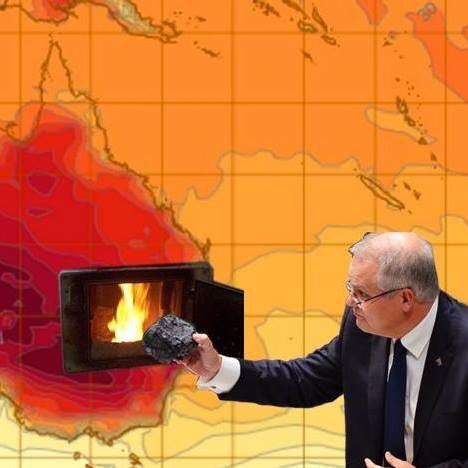
It's taken a long time but Australian climate politics are now as bizarre as the sad state of affairs in Washington, with the government's new infatuation with coal turning into some sort of pantomime for morons with Treasurer Scott Morrison waving a lump of coal around in parliament last week.

I'm staggered these fools could embark on this black comedy during Australia's hottest summer ever, in the midst of a huge heatwave and with fires burning across the most populous state and with blackouts happening or being threatened across half of the states in the country.

The Guardian has a good roundup of the latest state of play in Australian energy politics, noting renewables have now been clearly proven to be cheaper and no more prone to grid problems than coal - and have the added benefit that companies are actually willing to invest in them to provide new generation capacity - Hard facts unmask the fiction behind Coalition's 'coal comeback'.

Before we untether from reality entirely and drift off into a Trump-like universe where truth belongs to whoever delivers the best poll-driven lines or brings the dumbest prop to question time, let’s hammer down a few facts. Because we aren’t reviewing bad theatre here and when some commentators opine about whether Turnbull’s lines will “work”, or how funny the whole thing was, what they are really assessing is whether the prime minister can successfully, and in broad daylight, shift the blame for a monumental stuff-up, while apparently proposing solutions that will make it substantially worse in every regard.

Since it’s our job to point out things like that, here are a few facts that undermine the “coal comeback” PR strategy that started rolling out sometime last year:

* Renewable energy is not “causing” blackouts. They’re primarily due to the (incredibly complicated) energy market that wasn’t designed or isn’t being run to cope with a higher proportion of renewables, and is throwing up perverse incentives that mean South Australia can have a blackout while generators are sitting idle. It would seem obvious that the answer to this problem is not to abandon all incentives for renewable energy but rather to fix the market and the rules. Cars probably got bogged when they started driving on roads designed for horses and buggies too, but it wouldn’t have been wise to respond by trying to stop the roll-out of automobiles. And New South Wales – a state that gets a very small proportion of its energy from renewables, was also facing the prospect of blackouts on Friday, which sometimes happen during peak demand but also undermine the Coalition’s simplistic arguments.

* Renewables cannot take the blame for the recent rise in prices. Queensland, which also has a tiny proportion of renewable energy, has had price spikes that added an astounding $1bn to wholesale power prices just since the beginning of this year. South Australia, cited by the federal Coalition as the terrible case study of what Labor’s renewable energy policies might do, has had just a few. The

Queensland price spikes are also vastly higher than those felt in South Australia last July, which were described as an emergency, according to an analysis by Dylan McConnell from Melbourne University. Weirdly, no federal ministers have been berating the Queensland government over its (fossil fuel) choice of energy source.

* New coal-fired power stations are not going to be built. You don’t have to go to greenies for that assessment – it is also coming from the AI Group, which represents Australia’s manufacturers, and from the Australian Energy Council, which represents the big electricity and gas businesses that generate and supply most of our energy, as well as from the head of the Clean Energy Finance Corporation – who has expert knowledge of lending to the energy sector. Business knows climate change is a thing, and that locking in emissions from a new coal-fired power station for 50 years, no matter how efficient it is and how lovingly the current ministry can carry around lumps of coal, is incompatible with our long-term climate commitment and therefore an unacceptable investment risk. When really pressed, the only way experts can imagine the construction of a new coal-fired power station is if the government pays for it, or signs a contract indemnifying the company paying for it from the impact of future climate policy. And no sane government would do that. You’d only do that if you suspected the world was about to decide climate change was a hoax or at least not so much a problem, which might explain where some of the Coalition’s coal boosters are coming from.

* Even if they were built, power from new highly-efficient coal-fired power stations would not be cheaper. In fact, Bloomberg New Energy Finance has calculated that they would be the most expensive, and dirtiest, form of power available, costing more than solar, wind and gas-fired power.

* Governments could always reduce the strain on the system and help avoid blackouts by reducing energy demand but schemes to reduce demand at times of peak power usage (such as, say, heatwaves) were shelved after the Abbott government was elected, while programs for minimum energy performance standards seem to have been burned in Tony Abbott’s bonfire of red tape.

* And finally, as business and industry and environmentalists and pretty much everyone who looks at the evidence (including, a while back, Turnbull) have been saying for years, the very best thing governments could do to encourage investment and a sensible low-cost transition to cleaner generation is come up with a bipartisan policy, such as the energy-intensity carbon scheme that had bipartisan political support, the backing of industry and could have reduced power prices while also bringing emissions down. But the Turnbull government jettisoned any consideration of that in less than 24 hours, apparently fearing the response of right wingers such as Cory Bernardi. He’s now left the Coalition anyway, and it still has no climate policy.

We’ve been enduring this climate war nonsense for more than a decade and now we’re wearing the consequences – rising prices, unreliable power supply and increasing emissions. Responding with a parliamentary pantomime to try to shift the blame to a fictitious renewable industry bad guy is true ideological idiocy and also negligent, because it puts the shallowest, shortest-term and most opportunistic strategy for political survival ahead of households, investors and future generations.

Malcolm Turnbull - Energy Magician  

Posted by Big Gav in , , ,

Ross Gittins at the SMH has a look at the natural gas market and the bizarre spectacle of Prime Minister Malcolm Turnbull trying to promote coal fired power, backflipping from his earlier enthusiasm for 100% renewable energy - Malcolm Turnbull wants us to think he's an energy magician.

As the feds understood full well, once you can liquefy natural gas you can ship it overseas. And once you do that you've taken the relatively tiny, closed eastern Australian gas market and opened it up to the huge East Asian gas market, where prices are much higher. The inevitable consequence was a leap in the price of gas on the eastern seaboard – plus a huge windfall gain to our eastern gas producers.

Now do you see why the gas industry and federal politicians of both stripes keep repeating the economic lie that the problem has been caused by the states' bans on fracking, and could be solved by lifting them? No amount of increased gas supply on our part would be sufficient to lower the East Asian price of gas, which means no new producer of coal seam gas would be prepared to sell it to local consumers and manufacturers for anything less than they could get by selling it to Japan or China. Unless, of course, the federal government obliged them to.

I don't object to the policy of export-parity pricing but, like its predecessors, the Turnbull government wants to keep the policy a deep, dark secret because it's so much harder to defend a super-rational policy in these days of populist indulgence than it was when Malcolm Fraser did something similar to petrol prices. Turnbull wants to keep the super-rational policy, but shift the blame for its economic and political consequences to others. Had he the courage, he could oblige the gas industry to use its windfall profits to compensate the household and business losers for losses arising from an implicit government policy change.

Turnbull blames South Australia's blackouts on its excessive enthusiasm for renewable energy which, pending the development of storage arrangements, has a problem with intermittent production. He doesn't admit his parity-pricing policy is contributing. It was expected that gas-fired power generation would ease the transition from coal-fired to renewable generation. That's because gas-fired power stations emit far less carbon dioxide and can be turned on and off as required to counter renewable energy's intermittency.

Guess what? South Australia has a new and big gas-fired generator at Pelican Point, near Adelaide, but it's been mothballed. Why? Because the operator had a long-term contract for the supply of gas at a price set at the pre-export-parity level, and decided it was more lucrative to sell the gas into the East Asian market.

Last week Turnbull had the effrontery to argue that now gas-fired power had become uneconomic, we needed to fill the gap by subsidising new-generation "clean" coal-fired power stations. Small problem. They're hugely expensive, only a bit less emissions-intensive than existing coal-fired stations, can't easily be turned on and off, and would supposedly still be operating 60 years later.

If there's a case for subsidising any fossil fuel-powered generators the obvious candidate is the gas-fired plants the feds' export-parity pricing policy has rendered uneconomic. So great is the coal industry's hold over the Coalition that, not content with subsidising increased supply of coal from Adani and others at a time when coal is a sunset industry, Turnbull is now making up excuses to subsidise increased demand for coal by local electricity producers.

Economists are always telling politicians not to try picking industry winners. In reality, the politicians are far more inclined to back known losers.

Standing Up To The Bully  

Posted by Big Gav in , ,

Malcolm Turnbull really isn't having a good year. While he's been a great disappointment as PM (backsliding from promoting 100% renewable energy in his pre-Prime Minster days to now bowing down to the coal industry and promoting expensive and unscalable clean coal) I did feel some sympathy for him yesterday as he had to put Trump on the spot to honour an earlier deal for the US to take some refugees that had fallen afoul of Australia's harsh seaborne refugee blocking regime and ended up stranded in South Pacific holding camps.

The resulting Trump tantrum seemed to be the talk of the media yesterday (no doubt distracting everyone from the many other outrages being committed by the Trump team) with the local press quickly dubbing Trump a bully who doesn't like people standing up to him.

Trump already looks to be trying to back down and blame everything on Obama for making the original deal, so no doubt this will all have blown over tomorrow and everyone will be wailing about the latest offences Trump has committed (while still ignoring the endless stream of corrupt acts being performed as the Trump inner circle scoops up bribes and other favours - follow this guy on Twitter for a rolling list).

How Things Change When You Really Want To Be Prime Minister...  

Posted by Big Gav in ,

Double Trouble  

Posted by Big Gav in , , ,

It seems this is the year we need to endure the tedium of 2 elections, with Australian PM Malcolm Turnbull engineering a double dissolution election for the middle of the year as a predecessor to the awful spectacle unfolding in the United States.

I did have high hopes for Malcolm, as whenever he isn't in charge of the party he acts and talks like an intelligent, decent man. And I must admit I did greatly enjoy his revenge on his utterly incompetent predecessor Tony Abbott last year (Abbott having stabbed Turnbull in the back over the carbon tax several years earlier).

However Turnbull seems to have squandered all of his political capital trying to avoid any conflict with the far right of his own party, thereby dashing the hopes of the moderate centre of the country who provided him the poll support he needed to topple Abbott, and now trails in the polls after having a massive lead 6 months ago.

Climate is starting to figure in the election campaign, with Labor's support for a new emissions trading scheme and renewed funding for renewable energy institutions, provoking another hysterical campaign from the government (egged on by the morons at The Daily Terror).

ReNew Economy notes the government's policy on renewables is one step forwards, two steps back and quotes some interesting comments from Ray Kurzweil (good to see someone understands exponential growth - I've been baffled at how many "experts" still seem to think fossil fuels will be important in 20 years time).

Ray Kurzweil, the futurist who has made a host of noteworthy predictions, including the uptake of the internet, says he expects solar to become the dominant energy source within 12 years, pointing to the repeated doubling of solar’s share of energy production every two years.

“In 2012 solar panels were producing 0.5% of the world’s energy supply. Some people dismissed it, saying it’s a nice thing to do but at a half percent is a fringe player. That’s not going to solve the problem,’” Kurzweil said at a recent forum. “They were ignoring the exponential growth — just as they ignored the exponential growth of the internet and human genome project. Half a per cent is only 8 doublings away from 100%.

“Now, four years later solar has doubled twice again. Now solar panels produce 2 per cent of the world’s energy, right on schedule. People dismiss it saying ‘2 per cent is nice, but a fringe player. That ignores the exponential growth, which means it is only 6 doublings or 12 years from 100 per cent.”

Not everyone is ignoring it. Oil major Total last week announced it was creating a new division focusing on renewables and “electricity” rather than transport fuels, with a goal to be one of world’s top three solar producers.

As usual, this journal recommends voting for a Green or a feisty independent - neither of the big parties ever do anything meaningful about climate or renewable energy unless they are forced to.

The Clive Palmer and Al Gore show  

Posted by Big Gav in , , , ,

When I read the first news report on this I immediately dismissed it as satire and ignored it - it was only after seeing it appear on a few news outlets that I realised that they were serious and the combination of populism and spite for Tony Abbott had led the colossus of the crossbench, coal baron Clive Palmer to join forces with climate crusader Al Gore in the most unlikely alliance I could possibly think of. As a result it seems the Renewable Energy Target, Clean Energy Finance Corporation and Australian Renewable Energy Authority may all survive the government's attempts to kill them off (Clive didn't go so far as to promise to keep the carbon tax though even that looks like outliving the 1 week Tony Abbott promised it would be abolished within) - Al Gore and Clive Palmer: behind the scenes of an unlikely bromance. I also found the conspiracy theory that Malcolm Turnbull engineered this during his dinner with Clive shortly beforehand kind of interesting.

The extraordinary Gore-Palmer drama began about 10 weeks ago when the quietly spoken but very effective former Australian Conservation Foundation head, Don Henry, approached a former adviser to Tony Windsor, John Clements, to ask whether he could open a line of communication with Clive Palmer.

Henry is an international board member of Gore’s “climate reality project”. Clements and Windsor had struck up a friendly relationship with Palmer during the last parliament. Palmer’s three senators held the key to the future of most of Australia’s existing climate change legislation. It was an unusual, but potentially powerful, mix.

Clements was sceptical – was the conservationist just lining up to have a go at Palmer? He was persuaded the dialogue would be serious.

Phone calls began, between Henry and Palmer and between Palmer and Gore. Would the Palmer United party (PUP) keep the clean energy finance corporation, the climate change authority, even the emissions trading scheme in a kind of hibernating state in preparation for tougher international action?

Just over two weeks ago Ben Oquist, now strategy director at the Australia Institute but previously chief of staff to Greens leaders Bob Brown and Christine Milne and a canny political and parliamentary operator, flew to Brisbane to share a Japanese lunch with Palmer and his media adviser Andrew Crook. Should he meet Gore, Palmer asked, as the three discussed the details of climate policy.

The talks with Henry culminated in a meeting last Thursday at the Hyatt Hotel in Canberra, down the road from parliament house, between Henry, Palmer, Clements and Crook, where the broad outline of Wednesday’s PUP announcements were discussed, as well as the idea of a joint press conference with Gore, who was already in Australia for a “climate reality” workshop. ...

Gore then wavered about the idea of standing at a podium beside the leader of a party that was promising to repeal the world-class carbon pricing scheme. At the last minute he was convinced to go ahead because PUP was promising to reintroduce the scheme in a different form in the near future and had also agreed to retain the renewable energy target, which it had previously intended to try to abolish, and which the government has been preparing to dramatically wind back.

And so it came about that Gore and Palmer, an unlikely duo, stood at a podium to announce the certain repeal of Australia's carbon pricing scheme and the very uncertain possibility that an emissions trading scheme would be reintroduced sometime in the future. ...

The carbon price will almost certainly be repealed. Direct Action is likely to go down as well. But some parts of the current climate change laws will be retained: the CEFC, the independent climate change authority and the RET.

RIP Alan Jones ?  

Posted by Big Gav in , ,

Its been an interesting week watching conservative radio bully boy Alan Jones getting a thorough trashing at the hands of normal Australians who have had enough of the bile he spews out every day (I'd always hoped the cash for comment affair could have done this, or even better the London loo incident, but sadly not).

This time round Jones' comments about the death of the Prime Minister's father managed to annoy enough people that there was a concerted effort led by various Facebook and Twitter users (in particular Sack Alan Jones and Destroy The Joint) to tell advertisers to either cease supporting his program or find themselves doing a lot of damage to their brands, with most of them promptly abandoning Jones to his fate and the program subsequently going advertisement free.

Alan Kohler at the BS has a good summary - Alan Jones: it’s about disintermediation.

Corporate leaders everywhere would be watching the predicament of Russell Tate and Robert Loewenthal, chairman and CEO of Macquarie Radio Network, with a mixture of fascination and horror.

A social media campaign against one their products, the Alan Jones breakfast programme, and directed at their business customers as well as their own company, has forced them to cancel all advertising on that show.

For those who have recently flown in from Mars, it started with a speech by broadcaster Alan Jones to the Sydney University Liberal Club dinner on September 22nd, eventually reported in the Sunday Telegraph, in which he said: “They [Labor] are indeterminate and compulsive liars. They’ll lie and lie and lie. Every person in the caucus of the Labor party knows that Julia Gillard is a liar. Everybody, I’ll come to that in a moment. The old man recently died a few weeks ago of shame. To think that he had a daughter who told lies every time she stood for parliament.”

The suggestion that John Gillard died of shame has been widely and appropriately condemned, and Jones himself called a press conference last week to (sort of) apologise. Meanwhile 70 companies withdrew their advertising from his programme, either because they didn’t like what he said or because their social media monitoring services had picked up that their own customers didn’t like it.

Yesterday Russell Tate issued a long statement in which he announced the temporary suspension of all advertising in its Breakfast Show, blaming “21st century censorship, via cyber bullying”.

Also, the MC for the evening on September 22nd, Simon Berger lost his job as public relations and government relations manager at Woolworths, having apparently worn a chaff bag onstage to introduce Alan Jones (a reference to Jones’ frequent calls for Julia Gillard to be put in a chaff bag and thrown out to sea).

The “Sack Alan Jones” Facebook page has 15,486 “likes”, which doesn’t seem that many to have caused such carnage, but there has been a lot more to it than that.

There’s a petition on change.org with 109,962 signatories, another Facebook community called “Destroy The Joint”, after a statement by Alan Jones that women are “destroying the joint”, plus an uncountable number of tweets and hashtags on Twitter.

Russell Tate was both right and wrong in the statement that I quoted above: it is, indeed, 21st century censorship, but to call it bullying misses the point.

The digital revolution is only just getting going, and the social platforms, Twitter and Facebook, which has just passed a billion users, are only just starting to flex their muscle. There is a long way to go with this. Censorship up to the end of the 20th century involved community representatives – the church and then politicians – imposing limits on free speech. With social media, the community does it more directly and much more uncontrollably. ...

The essence of change that occurred between the 20th and 21st centuries is disintermediation. It is happening much more broadly than in censorship, but in that field of human endeavour, as it is everywhere, social media and the digital revolution generally, is simply and powerfully removing the intermediaries.

The organisation and expression of community disapproval has become incredibly powerful because it is spontaneous, immediate and clearly authentic.

That’s the difference between a social media campaign and a rap on the knuckles by the Australian Communication and Media Authority, the media regulator: you can argue about whether ACMA truly represents community opinion; with Facebook and Twitter you can actually see and feel it.

The SMH reports that Tony Abbott's replacement in waiting Malcolm Turnbull was happy to see Jones get a taste of his own medicine - Jones has not been bullied - Turnbull.
ALAN JONES has been ''given a dose of his own medicine'' with the online campaign that has stripped his station of sponsors, and is not the victim of ''cyberbullying'' as he has claimed, the Coalition communication spokesman, Malcolm Turnbull, has said. ...

''Mr Jones has sought to lead 'people's revolts' for many years. But this was indeed a popular revolt against vicious and destructive public discourse … It is difficult not to believe that he is getting a dose of his own medicine …

''Mr Jones has complained that he has been the victim of social media bullying, saying that if it happened anywhere else in society, this kind of bullying or harassment or intimidation or threatening conduct, the police would be called in …

''But Mr Jones believes his association with certain products will encourage people to buy them … If other people take the view that an association with Mr Jones will lead them not to buy those products, why are they not able to tell the advertiser of their view and encourage others to do the same?''

The SMH had an earlier article from Peter Fitzsimmons describing the origin of the boycott campaign - Alan Jones has no shame.
Every time you think 2GB broadcaster Alan Jones has gone as low as he can go, he sets a new benchmark ever deeper in his now obviously bottomless barrel.

Not enough that he has already talked of putting the Prime Minister “into a chaff bag and hoisting her into the Tasman Sea,” or that he has said that the country needs to “bring back the guillotine,” to deal with her, and that across the country “women are wrecking the joint". Now, before an audience of Sydney University Young Liberals last weekend at the Watermark Restaurant at Balmoral he has referred to the grieving PM's late father, John Gillard – a man who was obviously very close to, and extremely proud, of his daughter – and said that he, “died a few weeks ago of shame".

The unspeakably vicious nastiness of it, the sheer bully-boy misogyny of saying such a thing, simply takes the breath away, even for those of us who spent fair chunks of time around the unvarnished Jones.

Turnbull: Honesty Is The Best Policy (when it comes to debating climate)  

Posted by Big Gav in

The SMH reports that Malcom Turnbull is taking a few discreet (and well deserved) swipes at idiot Liberal party leader Tony Abbott - Honesty is the best policy: Turnbull swipes at state of politics and 'deficit of trust'. It remains a mystery to me how Abbott can actually have a lower approval rating than PM Julia Gillard and still remain Liberal leader - the country will be a complete laughingstock if he's still in place after the next election (which I expect the Liberals will win in spite of his presence).

Malcolm Turnbull has decried the state of political discourse in Australia, saying it had deteriorated to such an extent that the nation suffered "a deficit of trust" and there was an urgent need for honesty in politics.
If you love your country, have an interest in politics or policy, and care deeply about our nation's future, there's nothing more certain to arouse your fury and invite your contempt than listening to an entire House of Representatives question time.
In comments that are bound to be construed as critical of the style of Tony Abbott, as well as Julia Gillard, Mr Turnbull cited his own keen area of interest, the science of climate change, as a victim of what passed these days for political debate.

Delivering a lecture in Perth last night, Mr Turnbull said it was an inescapable fact that greenhouse gases caused the earth to warm. "Politicians and shock jocks, scientists and coal barons, all of them can argue for as long as they like, but they cannot change the physical reality," he said. "I won't linger on climate change – the hopeless, confused, hyper-partisan nature of the debate is too well known to rehearse."

Mr Turnbull also revisited the republic debate, a cause he fought for and lost at the 1999 referendum, saying "the next big watershed will be the end of the Elizabethan era".

He said republicans must not allow themselves to be split into two camps by the monarchists, as happened 13 years ago when monarchist strategists – including Mr Abbott and John Howard – "delightedly, if cynically, exploited the division by promising the direct electionists that if the parliamentary model was defeated at a referendum, they could have another referendum on a direct election model within a few years".

"Those republicans who voted 'No' expecting another vote in a few years, this time on their preferred model, should reflect on how comprehensively they were deceived by the trickery of their opponents and their own self-delusions, in equal measure."

Australian Carbon Tax Law Introduced To Parliament  

Posted by Big Gav in , , ,

The Australian Parliament has commenced debating the new carbon tax law (dubbed Australia's Clean Energy Future - nice title !).

The debate isn't highlighting anything new - the opposition thinks the world will end when it is introduced, the government and greens think it an essential step forward (which is true, though it doesn't go far enough) and the media is by and large producing almost no useful analysis of the various claims being made.

Still - it should go through regardless - the only interesting question is will Malcolm Turnbull tell Abbott to get stuffed and cross the floor to vote with the government. Fingers crossed.

The Climate Spectator has an article on a PwC report into low carbon growth - Down to business on carbon.

The sudden evaporation of a goodly portion of the federal opposition's sitting members on Tuesday as the Prime Minister began introducing the bills of her government's Clean Energy Future package might betray a lack of consensus on carbon pricing among Australia's politicians, but it seems big business is well and truly present on the issue. A new major global report has found that the world’s largest listed companies are increasingly embracing climate change policies, regardless of – and even in spite of – broad-ranging uncertainty in politics. The 10th annual Carbon Disclosure Project (CDP) Global 500 report, put together in conjunction with global accountancy firm PwC, has examined the carbon reduction activities of the world’s largest listed companies through an in-depth analysis of 396 of the world’s largest companies, and has found that 68 per cent have climate change at the heart of business strategies, up from 48 per cent in 2010.

The report, Accelerating Low Carbon Growth, which is due to be released Wednesday, also shows a significant rise in the number of companies reporting reduced greenhouse gas emissions as a result of various emissions reduction activities (45 per cent, up from 19 per cent in 2010). A correlation was also established between higher stock market performance over time, and representation on CDP’s Carbon Performance Leadership Index (CPLI) and the Carbon Disclosure Leadership Index (CDLI). Companies with a strategic focus on climate change provided investors with approximately double the average total return of the Global 500 from January 2005 to May 2011.

CDP's Director for Australia and New Zealand, James Day, said the results highlighted that, despite all the debate in Canberra, emission reductions are being made in large companies throughout the world.

And the SMH notes the carbon tax plan will allow polluters to buy permits from abroad (and that the Abbott alternative plan is hopelessly impractical) - Abbott plan 'would double carbon cost.
TONY ABBOTT has described the carbon tax as ''the longest political suicide note in Australian history'' and a ''completely pointless exercise'' because it would allow Australian companies to buy some greenhouse gas emission reductions overseas.

But the Australian Industry Greenhouse Network - which represents mining and manufacturing industries - said it agreed with the federal Treasury that Mr Abbott's plan of achieving 5 per cent emission reductions domestically would at least double the cost, whether done with a carbon price or through his proposed ''direct action''. ...

But Michael Hitchens, the chief executive of the industry network, said if Australia wanted the cheapest way to cut emissions, ''we should have full flexibility to purchase international units''. ''We understand from Treasury modelling that the cost of abatement might double if we try to achieve the full abatement domestically. We think those figures are about right,'' he said.

Treasury modelling found that domestic-only reductions would cost an average of $69 a tonne between now and 2020, compared with $29 a tonne under the government plan, which allows some overseas permits. The Coalition has budgeted $15 a tonne in its ''direct action'' plan and says this is capped.

Rob Oakeshott, who with fellow crossbenchers Andrew Wilkie and Tony Windsor will ensure the bills pass the lower house, told Parliament the Coalition's plan did not make sense because it assumed ''the ongoing ability to buy a product [greenhouse abatement] at one third of its price''. …

The former Coalition leader Malcolm Turnbull said he had not yet decided whether to speak on the bills, which will be voted on in the lower house on October 12. He said the Gillard government scheme had ''a lot in common'' with the Rudd government's emissions trading scheme, which he had agreed to pass.

Turnbull Speaks Out (Again)  

Posted by Big Gav in , , , ,

The Australian has the text of ex-opposition leader Malcolm Turnbull's latest speech to parliament on global warming - its a shame he didn't make more like this while he was leader - Why I support the ETS proposal .

CLIMATE change is the ultimate long-term problem. We have to make decisions today, bear costs today so that adverse consequences are avoided, dangerous consequences, many decades into the future.

Right now, both sides of politics are agreed that Australia should, regardless of whether any international agreement is reached, reduce our emissions by 2020 so that they equal a 5 per cent cut from 2000 levels.

But it is not enough to say you support these cuts, you must also deliver a strong, credible policy framework that will deliver them.

The transition from a high emission economy to a low emission one cannot be achieved without major changes to the way we generate and use energy and in the way we manage our landscape.

Decisions to build new power stations will involve tens of billions of dollars over the next few decades and a critical element in making those decisions is being able to form a view about the direction of carbon pricing.

This need for leadership and direction from government on carbon pricing was one that was apparent to the previous government. That is why in 2006 prime minister John Howard established the Emissions Trading Task Group, chaired by Peter Shergold, the secretary of the Department of Prime Minister and Cabinet. In 2007 the Howard government adopted its recommendation to establish an ETS in advance of and in order to promote a global agreement.

Plainly stated: in the absence of a clear carbon price signal either no investments will be made or investments will be made of new carbon-intensive infrastructure because they are more profitable in a world where there is no price on carbon.

The SMH thought the government wishes it could do as good a job explaining and defending the ETS - A dream Labor speech from the vanquished.
Fifteen words in we knew what sort of speech this would be. "Generations" is a great big Malcolm Turnbull word. Churchillian. "All of us here are accountable not just to our constituents but to the generations that will come after them."

He was not going to trim. Though his party made sure his audience in the chamber was small, he might have been addressing thousands.

This was the old Turnbull with his odd way of leaning forward on his desk, fists clenched in the pose of a well-dressed gorilla.

After East Anglia, the Himalayan glaciers and the holiday glow cast by Lord Monckton's tour, his message was blunt: "The planet is warming because of the growing level of greenhouse gas emissions from human activity. If this trend continues, truly catastrophic consequences are likely to ensue . . .''

The Prime Minister doesn't say that kind of thing. Nor does the leader of the opposition, Tony Abbott, who earlier in the morning dragged the press corps to a shop in Queanbeyan to watch him iron a shirt and declare: "You cannot run a dry-cleaning business without using energy."

Abbott had yet to stumble into Turnbull's Great Big Dump on Everything. It seemed the member for Wentworth would be talking to utterly deserted Coalition benches. But then Petro Georgiou, Russell Broadbent and Joe Hockey materialised. They looked impassive, stunned.

Hockey listened to Turnbull's crisp exposition of what had been party policy until 10 weeks ago, with eyes closed. Lucy Turnbull sat with a couple of members of her husband's staff in the public gallery. All through the great rabbit warren of Parliament House, the speech was being monitored on closed circuit television.

Turnbull was not delivering a great farewell. This was a working speech, a selling speech, the kind of speech Labor supporters wish their leader would deliver.


Crikey quite liked the speech as well - Turnbull takes aim at Abbott’s climate plan, and doesn’t miss.
Former Opposition Leader Malcolm Turnbull has demolished Tony Abbott’s climate action plan and backed the Government’s amended CPRS legislation in a long speech explaining his decision to cross the floor in support of the Government’s ETS bills.

Last week Tony Abbott launched a climate action plan that rejected any market-based emissions abatement mechanism in favour of $10b worth of handouts for businesses and farmers to reduce emissions. Turnbull rose in the chamber early this afternoon to speak on the Government’s CPRS bills, reintroduced as promised last week. Watched by colleagues Petro Georgiou, Russell Broadbent, Paul Fletcher and, interestingly, Joe Hockey, Turnbull tore apart the proposed plan as economically inefficient, environmentally ineffective and unable to meet the task of reducing Australia’s emissions by 5% by 2020.

After quickly discussing the need to address climate change, including that the 2000s had been the hottest decade ever after the 1990s and 1980s, Turnbull emphasised the similarity of the Government’s CPRS with the Howard Government’s intended CPRS, declaring that the bills were “as much the work of John Howard as it is of Kevin Rudd” and outlining why the Howard-era Shergold taskforce had rejected non-market approaches like regulation or subsidies to address climate change.

Without mentioning the new Coalition plan or Abbott by name, except with an indirect reference to “as we have seen in recent days”, Turnbull attacked a subsidies-based approach, warning it was “a recipe for fiscal recklessness on a vast scale… a slippery slope that can only result in higher taxes and less effective abatement.” As a Liberal, Turnbull said, he supported a market based solution that allowed businesses and consumers to determine the most effective means of reducing emissions. A price signal was critical in order to drive the large-scale transition of the Australian economy necessary for lower emissions.

“In the absence of a clear carbon price,” Turnbull said, “no new investment will be made or investment will be made in new carbon intensive infrastructure.”

Turnbull also took aim at soil carbon, which would under the Coalition scheme provide most of the reductions needed to ostensibly meet the 5% target. As leader he had supported soil carbon, Turnbull said, and he believed it had great potential, but much work needed to be done before it could play a significant role. Moreover, its benefits would be more easily obtained through an ETS, and he had negotiated amendments to the CPRS that would allow exactly that. He quoted one biosequestration expert who said he supported soil carbon initiatives but was “horrified by the prospect of a fund from which public servants hand out money to grow trees.”

Joe Hockey was one of the few shadow ministers to turn up to watch the speech, but his lethargic and depressed appearance has tongues wagging - Where did Joe’s mojo go?.
The contrast, as Kevin Rudd invariably says, was stark. Joe Hockey sat slumped on the seat nearby, gazing up at the Reps chamber ceiling, while Malcolm Turnbull explained why he would be voting for the Government’s CPRS bills.

The body language, surely, was deceiving. Turnbull might have appeared forthright, aggressive even, as he expertly articulated the case for the CPRS far, far better than anyone from the Government ever had – particularly when, in three short sentences about how each recent decade had been hotter than the previous one, he demolished the myth of global cooling promoted by the likes of Tony Abbott.

But Turnbull was alone, reading — if the Press Gallery commentary is correct — the last rites over a political career wrecked on a point of principle, offering only a glimpse of what might have been had he ever mastered his many faults and coupled his undoubted brilliance with a more consultative and reflective style.

But Hockey remains Shadow Treasurer, a key part of the Coalition economics team, under a leader polling better than Turnbull ever did, perhaps a mere 2-3% away from achieving his career goal of Treasurer.

So, Joe, why the long face?

It might possibly be that Hockey was envious that he could never give a speech as good as that, for Turnbull’s speech was, instantly, a classic of Australian politics. So what if it was delivered to a near-empty chamber? Its content was scintillating.

Australian politicians don’t do soaring rhetoric or great oratory and there was none of that in Turnbull’s speech, but there was an intellectual rigour and cold, hard refusal to countenance bullshit that is sadly lacking in modern politics (and, in truth, much of Turnbull’s own period as leader).

No politician, from any party, has ever nailed the case for action on climate change so succinctly, and no politician — and certainly not Kevin Rudd — has ever come close to explaining so clearly why a market-based mechanism is preferable. And in his comprehensive demolition of the Abbott plan — all delivered without mentioning Abbott or the details of the plan, or anything that could be construed as personal criticism — Turnbull has not merely provided the Government with perfect soundbites, but with perfect talking points for its own use.

In fact, it did Hockey great credit that he showed up for the speech when it might have been easier to stay away and try to ignore what was happening. Only he, Russell Broadbent and Petro Georgiou were there for all of it. But Hockey has been in a funk since the leadership spill and what was commonly agreed to be his poor handling of it.

And to close, John Quiggin has a look at the path to delusion that the Liberal Party has followed - Send in the clowns.
It’s hard to believe that, three months ago, Australian national politics was (primarily) a contest between two broadly normal political parties. The government was running well ahead, but open to criticism for having talked a lot and done relatively little. The opposition was excessively keen on the maxim ‘the first duty of an opposition is to oppose’, and the alternative policies it proposed were neither as detailed as they might be, nor entirely consistent, but that has always been true of oppositions. Although a change of government in 2010 looked unlikely, there was nothing to suggest that such an event would be a disaster if it happened.

That could not be said today. The government is much the same as before, but the opposition has become a clown show, happy to do or say whatever comes to mind, either to chase votes, secure the support of its base or simply to muddy the waters enough that they have a chance to win in the resulting confusion.

Most obviously, we have an opposition leadership that embraces delusional beliefs on climate science. That would be bad enough if delusion could be confined to denial of the validity of science, but such isolation is not possible. Instead, delusionism is pervading everything the Liberal and National parties do and say.

First up, there are the personnel changes, with the replacement of Turnbull by Abbott, the rise of Minchin to the position of kingmaker and, most absurdly, the appointment of the ‘authentic’ but innumerate Barnaby Joyce as finance spokesman. Of the leadership team, only the marginalized Julie Bishop gives any indication of being connected to the real world. In the key economics portfolios, only Joe Hockey rises to the level of mediocrity, and he’s pretty much discredited by his vacillation during the leadership spill.

Then there’s the shift from ‘scepticism’ (the belief that thousands of scientists have simply got it wrong in ways that can easily be detected by armchair critics) to the kind of full-scale conspiracy theory exemplified by Lord Monckton’s claim that NASA crashed its own satellite to prevent it revealing the data that would disprove AGW theory. While the conspiracy theory has the merit of being more coherent and plausible, it paves the road to absolute craziness (again, see Lord Monckton). Of the leading figures in the Opposition, Minchin and Joyce are overt conspiracy theorists, and Abbott is willing to go along with idea. And whereas the conspiracy theorists were willing to undermine Turnbull throughout his leadership, any remaining pro-science Liberals (with the exception of Turnbull himself and the departing Judith Troeth) are keeping very quiet.

Unsurprisingly, this combination of delusion and incompetence is reflected in the opposition’s response to the government’s climate change policy. Naturally, the ‘science’ is pure wishful thinking, based on a willingess to count highly speculative gains from increased soil carbon as the primary line of policy response. But the economics is far worse – even the advocates of soil carbon don’t claim it can be done in the zero-cost fashion claimed by the opposition. More generally, since the opposition plan amounts to picking some winners, and throwing public money at them, it’s obvious from first principles that it must be more expensive than the government’s ETS.

But of course this doesn’t matter. No one, not even the opposition themselves takes the plan seriously – it’s simply there to meet the political necessity to have a supposed plan to refer to.

Finally, and most seriously, there is the embrace of the reality-free talking point approach that characterises the delusionist commentariat as a whole. Someone like Andrew Bolt is not acting out of character when recycles discredited delusionist talking points on a daily basis. His general approach to politics is no better. And, as the blogosphere has shown (as an archetypal example, see Glenn Reynolds) the longer you are immersed in this point-scoring, talking-point approach to political debate, the more distant becomes any connection to actual reality.

The Mad Monk Wins  

Posted by Big Gav in , , , ,

As predicted, Liberal leader Malcolm Turnbull lost the party leadership today, to (surprisingly) Tony "The Mad Monk" Abbott rather than dithering "consensus candidate" Joe Hockey. Unfortunately Malcolm is saying that rumours he will set up his own liberal party are science fiction, but you never know - science fiction is a way of exploring future scenarios, some of which eventually come true.

The Business Spectator thinks the Monk's win is a boon for Kevin Rudd - Abbott's win is a boon for Labor.

What’s certain is that this vote was not about the ETS. It was about the heart and soul and core of what the Liberal Party stands for and where it’s headed. It was also about bruised egos, simmering resentments, personal hatreds, relevance and ambition. ...

Three national polls were published over the last few days. All showed a landslide to Labor. That landslide will continue. Whether the ETS is good or flawed public policy, what is certain is that the broad electorate are mightily concerned about the changing global climate. They see it every day in their own lives.

A party that goes to the people denying that certainty will be obliterated. And the political implications will be felt for a generation.

The ALP campaign will be a classic – and will feature Malcolm Turnbull, Ian MacFarlane and Joe Hockey. The ad featuring Turnbull's face will be simple, with words to the effect of: “What does it say about the character of the Liberal Party if, having entered into an agreement, we were to simply say we have changed our minds, we are going to renege on the deal? How could you trust us?” Indeed. ...

Until today the contest was between two mainstream political candidates – Rudd and Turnbull.

That’s changed, irrevocably. It is between the mainstream Labor Party under Rudd and a far right party under Abbott with heavy input from Nick Minchin. The line in the sand has never been clearer. Stand by for fireworks, an early double dissolution election next year, campaigning by shock jocks and News Limited on behalf of Abbott – and a massive Labor win.

The BS also thinks that Rudd and his predecessors have thrown away a huge opportunity to begin the transformation to a clean energy economy, to our long term detriment - Australia is losing the new-energy race.
Australia is at real risk of watching the clean energy transformation pass right by.

It is rapidly losing the opportunity of becoming a regional financial centre for carbon trading. International investment banks started giving up on that idea more than a year ago. They didn’t even bother attending the local carbon expo on the Gold Coast in October, preferring instead to mingle with the crowd at rival events in Singapore and South Korea.

Nor does Australia have a renewable energy industry to speak of. Despite being a centre of world renowned research and unlimited resources, the country has forsaken its intellectual capital to foreign shores such as the China, the US and Germany. While international governments spend billions supporting the roll-out of emerging renewable technologies, the sum total of Australia’s spending since the election of the Rudd government amounts probably to less than $20 million.

Not a single clean energy facility has been built as a result of the current federal government’s policies. A few wind farms have popped up because state governments have committed to having renewable offsets for installations such as desalination plants, but even Australia’s geothermal producers, who cannot easily pack their wares, are hedging their bets by pursuing opportunities in friendlier investment environments such as Europe, Asia and South America, and the solar industry exists on little more than hope.

The energy white paper which is due to be released shortly would hopefully discuss the opportunities presented by the transformational technologies such as solar, geothermal and ocean energy, along with energy efficiency and storage.

Instead, it is likely to focus on carbon capture and storage – coming to a power station near you in about 2034, at a carbon price of around $80 – and progressive fuel technologies such as oil shale.

And nor have Australian businesses – with the exception of a few – properly prepared themselves to embrace the challenge of energy efficiency, refusing to entertain the idea that energy prices will sometime soon rise significantly – ETS or not – and threaten one of the country’s more significant competitive advantages.

But hey, we are building the world's biggest houses to live in (and to heat, cool and fill with energy consuming gadgets), so its not like the leadership is doing anything different to most punters - Australians live in world's biggest houses
New data from the Australian Bureau of Statistics indicates that new homes across Australia are bigger in square metre terms than anywhere else in the world.

Commsec chief economist Craig James says the great Australian dream has expanded over the past few decades. "You go back 20 or 30 years ago and the average house was, you know, sort of two or three bedrooms, three bedrooms at most," he said. "Now it is at least four bedrooms, possibly even and five and it is a lounge, dining room, home entertainment room. Certainly we are putting more and more rooms in our ever-growing houses." ...

"We are bigger than the US for the first time. Our newly built homes are 7 per cent bigger than those in the US, double the size of those in Europe, and triple the size of those in the UK."

The CPRS set to claim one victim - Malcolm Turnbull  

Posted by Big Gav in , , , ,

While the proposed Australian emissions trading scheme (aka the CPRS) looks like achieving nothing in terms of reducing carbon emissions, it has wreaked havoc on the opposition Liberal party, with relatively enlightened leader Malcolm Turnbull facing revolt from the troglodyte wing of the party Crikey has a good set of articles on the fracas.

As defectors, disloyalty and confusion swirled around him last night, Malcolm Turnbull fronted the media in Parliament House. The widespread expectation among the hacks was that he would announce his resignation as Liberal leader.

Instead, he did the opposite. Instead of quitting, Turnbull passionately and articulately argued the case for why a Liberal Party without a prescriptive climate change policy was a Liberal Party without a chance of being elected. What we saw last night was the same person who unsuccessfully campaigned to make Australia a republic in the late nineties. What we saw last night was a conviction politician.

While a swathe of middle-aged men (and Bronwyn Bishop) disrespectfully disagree with him, the fact is that when it comes to the seminal issues, Malcolm Turnbull is prepared to place conviction ahead of political pragmatism.

If -- or probably when -- he is unseated as leader, Malcolm Turnbull will fail in his ambitions but still retain his convictions. Which is more than can be said for almost any other contemporary political leader.

As for the CPRS itself, The Guardian reckons its just a continuation of our 'do nothing" strategy started at Kyoto - Australia's Copenhagen climate strategy is smoke and mirrors.
So what is Australia bringing to Copenhagen? Rudd will be there in person. His headline grabber is the offer of a 25% cut in emissions. Except that the "conditions" he sets the rest of the world for this are so stringent that he is unlikely to have to deliver.

For instance, as the government spokesperson said, it would only be "fair" for Australia to make cuts that deep if other "advanced" countries made cuts "in the middle of the range identified by the IPCC" – that is, between 25-40%.

That's an odd definition of fairness. It is based, according to the spokesperson, on the fact that "Australia faces higher economic costs to achieve equivalent emissions reductions… than most other advanced countries." Funny, but I don't remember Australia offering bigger cuts in Kyoto because it was cheap and easy to end deforestation. Quite the contrary.

Otherwise, Rudd offers a range of reductions from 5-15%. That doesn't sound too bad until you remember the deforestation discount that Australia won in Kyoto. Along with other land-use changes since then, even a 15% "cut" would still allow Australians to emit more from burning coal in power stations, running cars and industry than they did in 1990. About 1% more, according to the analysis by the Sustainability Council of New Zealand.

A new beginning in Copenhagen? Rudd's Copenhagen plan looks like a greenwashed version of the old Kyoto plan.

While I'd be tempted to say the CPRS is a useless waste of time and thus Malcolm is either fighting for nothing or playing "sensible" (in a very localised sense) politics by not being seen as opposing "progress" on climate change policy while supporting a scheme that does very little to penalise polluters, Ross Gittens is a little more charitable and think the CPRS may eventually evolve into something useful - The ills of Rudd's climate bills may be cured with time.
Malcolm Turnbull is right: there's no future for a Liberal Party that denies the reality of human-caused climate change and the need for early and decisive action to limit that change.

But a worry for many who accept the need for effective action is that Kevin Rudd's carbon pollution reduction scheme, especially as amended to (supposedly) win the Liberals' support, will do too little to change behaviour, reduce emissions and move us towards a low-carbon economy because it's so weak and so many options have been closed off.

Fortunately, the amended scheme - which I readily agree isn't a good one - will change behaviour despite all the hand-outs to big polluters (as I argued on Saturday) and does retain the potential to be improved over time, remembering that the scheme runs until 2020.

The first point to note is that some of the worst features of last week's deal are temporary. Much of the excessive compensation runs for only the first five years or so. There are various points where the legislation provides for reviews of the pace of progress and the urgency of the problem we're grappling with.

The next point is that though the pro-action critics of the scheme have focused on the unconditional target of reducing emissions by only 5 per cent, it now seems likely the global agreement to emerge from Copenhagen or a subsequent meeting will require us to lift that to the promised 15 per cent reduction.

The Government has avoided trumpeting this for fear of frightening off the Libs, but the seriousness of the actions being promised by the Indians, Brazilians and Chinese - mainly involving changes in land management, increases in energy efficiency and reductions in emissions per unit of gross domestic product - make some sort of deal between the developed and developing countries likely.

Admittedly, a target of reducing emissions in 2020 by 15 per cent of their level in 2000 represents only half the minimum reduction the scientists say we need to achieve by then.

But remember the compromise scheme is built to allow the target to be raised to 25 per cent should the multilateral agreement be sufficiently comprehensive as to limit global emissions to 450 parts per million. For such a deal to be achieved, the Americans and the Europeans would have to greatly increase their own targets.

One long-standing weakness in Rudd's scheme is the decision to neutralise the effect on petrol prices. But this exemption - made when the price of petrol was much higher than it is now - is only guaranteed for three years. It can and should be removed after that.

Bernard Keane reckons the writing has been on the wall for Malcolm's leadership for a while, but that this is a shame for Australian democracy given the alternatives on offer in the Liberal party - Reflections on Turnbull and his party.
It should never have been thus. Putting aside my professional role for a moment, I had high hopes for Turnbull. I knew the electoral timing was all wrong for him. But I thought he could build on the unappreciated work of Brendan Nelson in moving the Liberals back to the centre ground and set the Liberals up to be a viable force in 2013, a healthy union of conservatives and progressives, with perhaps a dash of libertarianism (my own personal creed) thrown in. And Turnbull fitted the bill perfectly – progressive, but with a strong belief in the core Liberal philosophy of personal freedom, immensely intelligent, a self-made man, charming, utterly ruthless. If anyone was going to break the rule that Oppositions don’t defeat first-term governments, it would be him.

It didn’t play out that way, mostly because Kevin Rudd expertly responded to the global financial crisis and recession, and Turnbull took the disastrous decision to oppose him on the stimulus early this year. At the time, I thought the Liberals were committing suicide, and the opinion polls ever since have confirmed that.

There are senior Liberals who also believe that was a mistake, but it’s all too late now.

And other, equally senior, Liberals have repeatedly pointed out Turnbull’s glaring failure as a leader: his inability to understand that he must bring his colleagues with him, not treat them like idiots.

The default Turnbull response to disagreement is to demolish whoever it is that’s unfortunate enough to disagree with him. He can dish it out with a ferocity probably not seen in political life since Paul Keating. He has no concept that someone treated that way may not forget about it, may be genuinely aggrieved by their treatment, may not be inclined to forgive the bloke who dished it out and get on with it. ...

Any option other than Turnbull at this point will be an electoral calamity for the Liberals. Forget the nonsense about a Sunrise election between Hockey and Rudd. The Rudd machine will devour Hockey, who in any event will stumble and bumble his way to polling day so badly there’s a risk his party will want to replace him even before then. Abbott will reduce the party to a reactionary rump struggling to accept the 20th, let alone the 21st, century.

A vote to dispose of Turnbull on Tuesday will be an act of lunacy from the Liberals. It will condemn Australia to a one-party government for much of the next decade. It will give the Rudd Government a virtual free hand, without effective scrutiny. And it won’t solve a damn thing.

Anyone who wants a semblance of an effective Opposition should fervently hope for a Turnbull win.

Crikey also has a column noting the Liberals may be headed for a series of "big wins" as a result of being held hostage by the conservative fringes - Just like the Libs, the Republicans face the conundrum of courting crazies.
The Republican Party base increasingly takes ideological inspiration from Rush Limbaugh and Glen Beck and Sean Hannity and other culture war demagogues. As the tens of thousands attending the ‘Tea Party’ rallies show, such people can, far more than any traditional Republican, whip the party activists into a frenzy. Yet, because the majority of Americans regard the Limbaugh/Beck brand of conservatism as perfectly lunatic, when it comes to a poll, the populist candidates fail and fail again. ...

The Australian situation is not the same. There’s no-one marching to Canberra to teabag Kevin Rudd; we don’t have Fox News or Clear Channel radio network denouncing Labor as a communist-fascist death camp conspiracy.

Nonetheless, for some time now, there’s been considerable media support for a populist skepticism around global warming. It’s not just Andrew Bolt, either — The Australian has been for years devoting its opinion pages to overt climate denialists.

Furthermore, these days it’s perfectly possible, even from Australia, to tap directly into the main vein of climate wingnuttery. If you think Miranda Devine correct to call a climate change to be a fraud, well, why not log on to hard-core nutters like Michelle Malkin or Ann Coulter, who will assure you that the whole business is an overt conspiracy cooked up by America-hating leftists?

In the US, the populist tide means that only 34 per cent of Republicans want legislation on climate change compared to 84 per cent of democrats. Here, the polarization is not so overt but it’s trending in the same direction, with seventy per cent of those who vote Labor supporting action against global warming and only 44 per cent of Liberal voters.

And that’s voters, not party members. One would hazard a guess that the proportion of overt skeptics amongst conservative activists is much, much higher, since it’s hard to imagine anyone joining the Liberal Party because of Malcolm Turnbull’s climate pragmatism, whereas an understanding of global warming as a dastardly con job provides exactly the kind of urgency likely to inspire political action.

Hence the deluge of angry phone calls and emails Coalition MPs now claim to have been receiving. The populists have a genuine passion that the moderates entirely lack.

An organization dominated by activists taking direction from media figures who themselves never have to face election – media figures who are, in fact, entirely unaccountable – well, it’s a dilly of a pickle, isn’t it?

Remember, too, the populists view matters in a quite different way to traditional politicians.

In the wake of Doug Hoffman’s loss to the Democrats, the influential wingnut blog Red State declared that, actually, the result represented ‘a huge win’, since it demonstrated to the Republican hierarchy that the rank-and-file could not be taken for granted. One suspects that, here in Australia, the Liberals now have many such huge wins ahead of them.

Eddie Maguire may have a (rare) point when he says Malcom's biggest mistake was joining the wrong party, though I think Bob Ellis is more accurate when he dubs Malcolm the Lost Liberal Democrat.
I guess I can't call Malcolm a friend any more but I used to and I've known him all of his adult life and feel sorry for him now. He's a bigger man than all the fleas that are currently nibbling at him, but from a bunch that trusted and followed the mendacious midget Howard (twenty years as Deputy Leader, Leader and P.M.) it's what you might expect.

They resent the questions of latter-day adjustment and philosophical consistency and the oxygen he brings into the room, they hate (I guess) cradle Anglicans and the kind self-made rich man who takes risks, dares new horizons, sticks out his chest and pounds it and yodels, punches above his weight, chiacks her Majesty and mostly prevails.

He's a Liberal Democrat through and through and they are clenched-up Thatcherites, Royalist nostalgics and, to a great extent, fearful Catholics. ...

It's not quite as simple as this, of course. Other factors in play this week, this month, this year, include Rudd and Wong's unending and cruel gamesmanship, tormenting and humiliating an Opposition they should have been gently wooing, preferring lordly sadistic onrushing deadlines to democratic discourse, jeering at their foes' understandable divisions rather than crafting honest policy, preferring the monkey-tricks of municipal politics to wise inclusive consensus on the most important problem since the Ice Age.

Crikey points to another alternative - the Liberals could split into 2 - a conservative party and a genuine liberal party (re-enacting the long ago creation of the now defunct Australian Democrats) - No party lasts forever - Split Happens.
It is time for liberals, or moderates as the media terms them, to start thinking laterally. They owe it to those Australians who find Labor and the Liberal Party too conservative on a range of issues to contemplate the beginnings of a new political force along the lines of those that currently exist in the UK, Canada and Germany.

But who would vote for a genuine liberal party that stood for action on climate change, market-driven economic policies, and new thinking on issues such as drugs, gay marriage and indigenous self-empowerment and refugees? Turnbull’s own electorate of Wentworth in Sydney’s eastern suburbs is one that might find such a political force very attractive. It is a diverse, educated electorate as is, for example, Peter Costello’s former electorate of Higgins in Melbourne, or Chris Pyne’s electorate of Sturt in inner urban Adelaide. Sydney’s north shore, particularly the lower reaches, also represents a generally liberal profile.

That there is yawning gap in the political ideas marketplace in this country is made abundantly clear to a “liberal” voter when he or she looks down at the ballot paper come election time. Do they vote for a cautious Labor Party that is fearful of embracing issues such as a charter of rights or more humane treatment of refugees? Or do they plump for a Liberal Party, which has some decent progressives within it such as Turnbull but whose policy direction is steered by hard-line conservatives? Of the minor forces there is only the Greens, which, while socially progressive, is economically illiterate and prone to bouts of extremism.

So what sort of vote would a liberal force attract? The Free Democrats and the Liberal Democrats in the UK are the third force — they never outpoll the major parties but they influence policy through being coalition partners in the case of the Free Democrats or by potentially holding the balance of power as may occur with the Liberal Democrats after next year’s UK election. One could expect a similar scenario in Australia with a liberal party perhaps winning a handful of House of Representatives seats and some senate seats. This would make them a powerful player in the numbers game.

Guy Rundle thinks the end of the Liberals will happen regardless, simply because of the way the world has changed in recent decades - The Liberal Party Is Trapped In A Death Spiral.
Consider what Fusion was. It was not simply an arrangement between two groups, not a coalition. It was a recognition that one entire political framework – empire versus free-trade, restraint on capital versus its expansion – had been superseded.

Protection was not simply a series of measures to protect local industry – it was an idea about what a society should be, in which social relations held economic relations in place, limited their purview. Free trade was the idea that economic relations should be allowed to reconstruct social relations (which for free traders chiefly meant that it would rive out rent, and rentiers).

The rise of socialism and Labour parties from the 1890s simply instituted a whole new political division, by energising real social forces – labour unions that had once been isolated unified and collectivised, parties giving them political expression, a doctrine of social transformation.

That division in turn died in the 1970s, with both the political defeat of socialist experiments, and the emergence of deep contradictions which made it unworkable. Labor simply took over what should have been the Liberals’ historical role – neoliberal reconstruction – and badged it as a form of modernisation, making it part of a distinctive progressive package, and leaving the Libs with nowhere to go but populism with a use-by date.

But now politics has re-divided. The hitherto small information/cultural producer class has become a force in its own right, cutting across old economic class divisions and old affiliations. You can see this in a whole lot of processes – the way in a seat like Higgins for example, one can anticipate a lot of people who would vote Liberal in a Liberal-Labor stoush, flowing to the Greens, even with an, erm, interesting candidate like Clive Hamilton.

Socialism in its 20th century form is over, and the question is no longer framed by private-public, worker-company divisions. Increasingly the divisions is between knowledge frameworks – people inside the new global economy, often working mainly with information, who see the world in terms of systems, networks, processes, global entities, as part of a single humanity on the one hand, and those tending to be in the old world of more local, parochial, and fixed ideas of morality, work and social order.

Farmers, sections of the old middle class, the ‘petty bourgeoisie’ etc – people increasingly excluded from the cultural and financial mainstream.

That division now runs smack down the middle of the Liberal Party, which is why the party is on the verge of ceasing to exist as anything other than a shell – and leading to the real possibility of real recombination of the non-Labor forces.

And Guy followed up today with another column pondering a Turnbull party - Sensible and Silly .. Time For A Liberal Split.
Minchin said, in response to Turnbull's Dr Strangelove act on the weekend, that he had been in the Liberal Party too long to want to destroy it.

Maybe, but he's also a stalwart Right-wing warrior, the Bill Hartley of his team. For the Liberals to win in their current constellation, or even for it to become the standard set-up, would be to cement in a politics that excludes the world-vision ably expressed by Minchin's remark that climate change politics was "communism by other means".

So the moderate Libs should jump or be ready to turn into a genuine liberal party – the only chance that moderate liberals would have to fight such a battle from a position of incumbency.

The great strength of such a party would be that they would get preference flows from both the other major parties – the existing Libs, who might well merge with the Nationals – and they would be in a position to negotiate with the Greens, who would then have someone they could first preference to ahead of Labor.

Quite aside from holding a fair brace of their own seats, they would be real competition for the ALP in a number of metro seats – especially if, freed of their country cousins, they could offer a more genuinely liberal social policy. That would scoop a bunch of prosperous social liberal voters who continue to vote ALP despite the party's increasingly socially conservative rhetoric and appetite for state censorship and repression.


Turnbull's "Dr Strangelove Act" of the weekend was his interview with Laurie Oakes where he basically declared war on the conservatives - great to see a politician being honest for a change.

MT: Look the Minchin-ites do not want to delay consideration of the legislation, they do not believe that climate change is real, they do not believe that humans are causing it and they do not want to do anything about it. Nick Minchin made that very clear in the Four Corners programme as did a number of his acolytes. What he is trying, what he is is a climate change denier. He stands for doing nothing on climate change. He said a majority of our party room do not believe that humans have any impact on climate change. Now that is a view contrary to the opinion of the vast majority of Australians, contrary to the opinion of every government in the world, and every major political party in the world. Now, if Nick Minchin wins, if he wins this battle, he condemns our party to irrelevance, because what he is saying on one of the greatest issues and challenges of our time, one that will affect the future of the planet and the future of our children and their children, Nick Minchin is staying "do nothing". He wants us to be the "do nothing on climate change" party and he has been, he's on the record about that, and when he talks about a delay or a deferral, what that means is denial.

LO: But if you …

MT: That is political death for us.

LO: If you agree to delay, you could probably save your leadership and live to fight another day. You must know in your heart that you are going to get done on Tuesday?

MT: Laurie, I will win on Tuesday and I am not interested in becoming a mouth piece or a Patsy or a tool for people whose views are completely wrong and are contrary to the best interests of our nation, our planet and indeed the Liberal Party. Just remember this, John Howard was a noted sceptic about climate change, he had doubts about the science. But John was enough of a leader to recognise that we had to act. And the emissions trading scheme that is currently in the Parliament this coming week and which must be passed this week is one which is very similar to the scheme that John Howard took to the last election, John Howard himself has said that. Nick Minchin and Tony Abbott and Kevin Andrews for that matter, were in that Cabinet. They didn't object, they went along with it and now they say "We didn't ever believe in it". What does that say about their integrity.

LO: But this is destroying the Liberal Party.

MT: Well they are destroying the Liberal Party, there is a recklessness and a wilfulness in these men which is going to destroy the Liberal Party. Remember this: we took an ETS to the last election. John Howard did. We then had a party room meeting back in October in which we overwhelmingly agreed to take a set of amendments, Rudd's ETS to the government. And the basis of that negotiation was if you agree with what we're asking, or enough of it, to satisfy us, then we will vote it through. Then we will give you what we want, we will pass the bill with our amendments. We achieved massive concessions, everyone was amazed how much the government gave us. We went back to the party room, and as you have note in your column the party room, by a majority, not a huge majority to be fair, but by a majority, agreed with the recommendation of the Shadow Cabinet. So we shook hands with the government, an agreement was done and we agreed to support those amendments.

LO: Then the Liberal Party fell apart, now...

MT: No, no, no, what …

LO: If you survive on Tuesday, the Liberal Party will remain bitterly divided, it will remain in meltdown won’t it?

MT: Laurie that’s not the… look, the only way the Liberal Party can get over this is to get this issue passed. If this issue is not resolved, the climate change war that Nick Minchin and his wreckers have started will continue to destroy the Liberal Party until such time as we are destroyed by Kevin Rudd in an election.

Statistics

Locations of visitors to this page

blogspot visitor
Stat Counter

Total Pageviews

Ads

Books

Followers

Blog Archive

Labels

australia (619) global warming (423) solar power (397) peak oil (355) renewable energy (302) electric vehicles (250) wind power (194) ocean energy (165) csp (159) solar thermal power (145) geothermal energy (144) energy storage (142) smart grids (140) oil (139) solar pv (138) tidal power (137) coal seam gas (131) nuclear power (129) china (120) lng (117) iraq (113) geothermal power (112) green buildings (110) natural gas (110) agriculture (91) oil price (80) biofuel (78) wave power (73) smart meters (72) coal (70) uk (69) electricity grid (67) energy efficiency (64) google (58) internet (50) surveillance (50) bicycle (49) big brother (49) shale gas (49) food prices (48) tesla (46) thin film solar (42) biomimicry (40) canada (40) scotland (38) ocean power (37) politics (37) shale oil (37) new zealand (35) air transport (34) algae (34) water (34) arctic ice (33) concentrating solar power (33) saudi arabia (33) queensland (32) california (31) credit crunch (31) bioplastic (30) offshore wind power (30) population (30) cogeneration (28) geoengineering (28) batteries (26) drought (26) resource wars (26) woodside (26) censorship (25) cleantech (25) bruce sterling (24) ctl (23) limits to growth (23) carbon tax (22) economics (22) exxon (22) lithium (22) buckminster fuller (21) distributed manufacturing (21) iraq oil law (21) coal to liquids (20) indonesia (20) origin energy (20) brightsource (19) rail transport (19) ultracapacitor (19) santos (18) ausra (17) collapse (17) electric bikes (17) michael klare (17) atlantis (16) cellulosic ethanol (16) iceland (16) lithium ion batteries (16) mapping (16) ucg (16) bees (15) concentrating solar thermal power (15) ethanol (15) geodynamics (15) psychology (15) al gore (14) brazil (14) bucky fuller (14) carbon emissions (14) fertiliser (14) matthew simmons (14) ambient energy (13) biodiesel (13) investment (13) kenya (13) public transport (13) big oil (12) biochar (12) chile (12) cities (12) desertec (12) internet of things (12) otec (12) texas (12) victoria (12) antarctica (11) cradle to cradle (11) energy policy (11) hybrid car (11) terra preta (11) tinfoil (11) toyota (11) amory lovins (10) fabber (10) gazprom (10) goldman sachs (10) gtl (10) severn estuary (10) volt (10) afghanistan (9) alaska (9) biomass (9) carbon trading (9) distributed generation (9) esolar (9) four day week (9) fuel cells (9) jeremy leggett (9) methane hydrates (9) pge (9) sweden (9) arrow energy (8) bolivia (8) eroei (8) fish (8) floating offshore wind power (8) guerilla gardening (8) linc energy (8) methane (8) nanosolar (8) natural gas pipelines (8) pentland firth (8) saul griffith (8) stirling engine (8) us elections (8) western australia (8) airborne wind turbines (7) bloom energy (7) boeing (7) chp (7) climategate (7) copenhagen (7) scenario planning (7) vinod khosla (7) apocaphilia (6) ceramic fuel cells (6) cigs (6) futurism (6) jatropha (6) nigeria (6) ocean acidification (6) relocalisation (6) somalia (6) t boone pickens (6) local currencies (5) space based solar power (5) varanus island (5) garbage (4) global energy grid (4) kevin kelly (4) low temperature geothermal power (4) oled (4) tim flannery (4) v2g (4) club of rome (3) norman borlaug (2) peak oil portfolio (1)