Showing posts with label electric buses. Show all posts

Electric Buses Are Hurting the Oil Industry  

Posted by Big Gav in , , ,

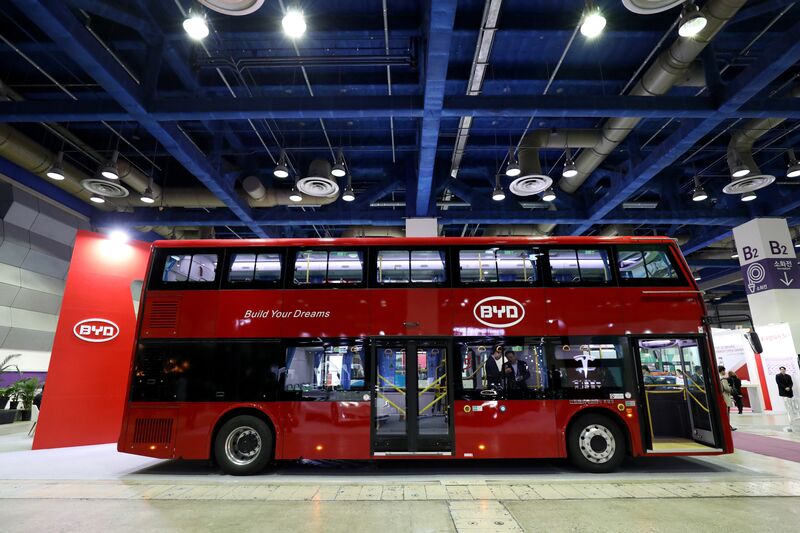
Bloomberg has a report on the rapidly growing electric bus industry, with China leading the way (adding a London-sized electric bus fleet every five weeks) - Electric Buses Are Hurting the Oil Industry.

Electric buses were seen as a joke at an industry conference in Belgium seven years ago when the Chinese manufacturer BYD Co. showed an early model. “Everyone was laughing at BYD for making a toy,” recalled Isbrand Ho, the Shenzhen-based company’s managing director in Europe. “And look now. Everyone has one.”

Suddenly, buses with battery-powered motors are a serious matter with the potential to revolutionize city transport—and add to the forces reshaping the energy industry. With China leading the way, making the traditional smog-belching diesel behemoth run on electricity is starting to eat away at fossil fuel demand.

The numbers are staggering. China had about 99 percent of the 385,000 electric buses on the roads worldwide in 2017, accounting for 17 percent of the country’s entire fleet. Every five weeks, Chinese cities add 9,500 of the zero-emissions transporters—the equivalent of London’s entire working fleet, according Bloomberg New Energy Finance.

All this is starting to make an observable reduction in fuel demand. And because they consume 30 times more fuel than average sized cars, their impact on energy use so far has become much greater than the passenger sedans produced by companies from Tesla Inc. to Toyota Motor Corp.
Meet the High-Tech Buses of Tomorrow  

Posted by Big Gav in ,

The Atlantic's CityLab has an interesting look at the future of urban transportation, including electric buses - Meet the High-Tech Buses of Tomorrow.

While many speculate that the autonomous vehicle technology now being pioneered by the likes of Tesla, Google, Uber, and (maybe!) Apple could spell the end of public transit, others are convinced of the opposite: AVs may roll out first not in private vehicles but in shared, public ones—driverless buses with sensors and artificial intelligence behind the wheel. In fact, some are already being tested in a handful of cities, from Helsinki, Finland, to Washington, D.C., to the city-state Singapore.

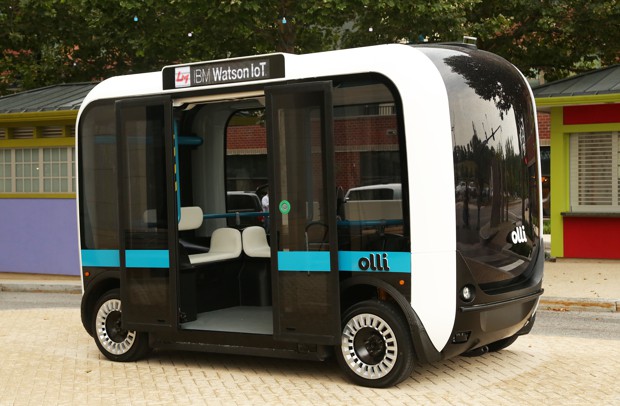
Among the vehicles vying to lead the autonomous bus race is Olli, a self-driving electric minibus from the Arizona-based Local Motors. It’s the first of its kind to use IBM’s cognitive Watson technology to interact with passengers. The bus can be summoned in Uber-like fashion, can answer questions about routes and nearby attractions, and could eventually personalize the trip by linking with the passengers’ social media accounts.

Wireless Charging Of Electric Vehicles While In Transit  

Posted by Big Gav in ,

CleanTechnica has an article on recharging electric buses while they are on the move - Active Wireless Charging In Transit; Remarkable Progress In Korea For Electric Vehicles.

Improvements with the electric transit infrastructure unfold at light speed. Active wireless charging in transit with electric vehicles, in this case electric buses, is taking place. Korea has broken through with accelerated wireless power efficiency with the Online Electric Vehicle (OLEV). This technology from the Advanced Institute of Science and Technology (KAIST) is setting another standard that increases the development of electric vehicles and addresses the (slight) time issue of charging. This breakthrough works for personal or public transportation presently, allowing vehicles to be charged while stationary or while moving. “This is accomplished by solving technological issues that limit the commercialization of electric vehicles such as price, weight, volume, driving distance, and lack of charging infrastructure,” ResearchSEA writes.

Electric Buses Get a Jump Start  

Posted by Big Gav in , ,

Technology Review has a look at electric bus company Proterra - Electric Buses Get a Jump Start.

The electric-bus startup Proterra has raised $30 million in new funding, including $6 million from GM Ventures. The company uses relatively small battery packs to keep down costs, intending them to be recharged frequently at rapid-charging stations that can replenish them in less than 10 minutes.

Fuel-saving technology is important to transit agencies, especially now that diesel prices are high and volatile—a gallon of diesel costs a dollar more that it did a year ago. Proterra CEO Jeff Granato says each bus will save the transit agency $600,000 in fuel costs over the 12-year life of the vehicle, plus another $70,000 to $95,000 in maintenance costs. Electricity to charge the buses costs about 18 cents per mile, compared with about $1 a mile for diesel fuel. Granato says these savings make the total cost of an electric bus comparable to that of a diesel bus over the life of the vehicle, even though the electric bus costs more up front. (The company won't say how much the buses cost, but they do, apparently, need nearly $700,000 in fuel and maintenance savings to break even with diesel buses.)

In general, the main problem with electric vehicles is the high cost of the battery packs. Batteries are the most expensive part of electric cars, and they're an important reason GM's Volt costs twice as much as a comparably sized gasoline-powered vehicle and the Nissan Leaf has a small battery pack that limits the car's range to around 70 miles per charge. The Proterra bus has a range of only 30 to 40 miles. Achieving even the modest range of the Leaf would add roughly $60,000 to a bus's price, according to analyst estimates of current automotive battery costs. (Proterra also isn't saying what its batteries cost.) Although its short range would be inconvenient in a car, it is more practical in a transit bus, which runs a predictable route and can regularly pull into a charging station.

Proterra uses a type of battery chemistry—lithium titanate—that it says allows the batteries to be recharged in less than 10 minutes every few hours all day and still last eight years or more. Such frequent and fast charging would damage other lithium-ion batteries, rendering them useless after just a few years, Granato says. Proterra has also developed an automated charging system. As the bus approaches a charging station, it communicates wirelessly with an overhead charging arm, which takes control of the motion of the bus as it passes underneath, stopping it when the charger is in place. The bus can charge as passengers get on and off.

Statistics

Locations of visitors to this page

blogspot visitor
Stat Counter

Total Pageviews

Ads

Books

Followers

Blog Archive

Labels

australia (619) global warming (423) solar power (397) peak oil (355) renewable energy (302) electric vehicles (250) wind power (194) ocean energy (165) csp (159) solar thermal power (145) geothermal energy (144) energy storage (142) smart grids (140) oil (139) solar pv (138) tidal power (137) coal seam gas (131) nuclear power (129) china (120) lng (117) iraq (113) geothermal power (112) green buildings (110) natural gas (110) agriculture (91) oil price (80) biofuel (78) wave power (73) smart meters (72) coal (70) uk (69) electricity grid (67) energy efficiency (64) google (58) internet (50) surveillance (50) bicycle (49) big brother (49) shale gas (49) food prices (48) tesla (46) thin film solar (42) biomimicry (40) canada (40) scotland (38) ocean power (37) politics (37) shale oil (37) new zealand (35) air transport (34) algae (34) water (34) arctic ice (33) concentrating solar power (33) saudi arabia (33) queensland (32) california (31) credit crunch (31) bioplastic (30) offshore wind power (30) population (30) cogeneration (28) geoengineering (28) batteries (26) drought (26) resource wars (26) woodside (26) censorship (25) cleantech (25) bruce sterling (24) ctl (23) limits to growth (23) carbon tax (22) economics (22) exxon (22) lithium (22) buckminster fuller (21) distributed manufacturing (21) iraq oil law (21) coal to liquids (20) indonesia (20) origin energy (20) brightsource (19) rail transport (19) ultracapacitor (19) santos (18) ausra (17) collapse (17) electric bikes (17) michael klare (17) atlantis (16) cellulosic ethanol (16) iceland (16) lithium ion batteries (16) mapping (16) ucg (16) bees (15) concentrating solar thermal power (15) ethanol (15) geodynamics (15) psychology (15) al gore (14) brazil (14) bucky fuller (14) carbon emissions (14) fertiliser (14) matthew simmons (14) ambient energy (13) biodiesel (13) investment (13) kenya (13) public transport (13) big oil (12) biochar (12) chile (12) cities (12) desertec (12) internet of things (12) otec (12) texas (12) victoria (12) antarctica (11) cradle to cradle (11) energy policy (11) hybrid car (11) terra preta (11) tinfoil (11) toyota (11) amory lovins (10) fabber (10) gazprom (10) goldman sachs (10) gtl (10) severn estuary (10) volt (10) afghanistan (9) alaska (9) biomass (9) carbon trading (9) distributed generation (9) esolar (9) four day week (9) fuel cells (9) jeremy leggett (9) methane hydrates (9) pge (9) sweden (9) arrow energy (8) bolivia (8) eroei (8) fish (8) floating offshore wind power (8) guerilla gardening (8) linc energy (8) methane (8) nanosolar (8) natural gas pipelines (8) pentland firth (8) saul griffith (8) stirling engine (8) us elections (8) western australia (8) airborne wind turbines (7) bloom energy (7) boeing (7) chp (7) climategate (7) copenhagen (7) scenario planning (7) vinod khosla (7) apocaphilia (6) ceramic fuel cells (6) cigs (6) futurism (6) jatropha (6) nigeria (6) ocean acidification (6) relocalisation (6) somalia (6) t boone pickens (6) local currencies (5) space based solar power (5) varanus island (5) garbage (4) global energy grid (4) kevin kelly (4) low temperature geothermal power (4) oled (4) tim flannery (4) v2g (4) club of rome (3) norman borlaug (2) peak oil portfolio (1)