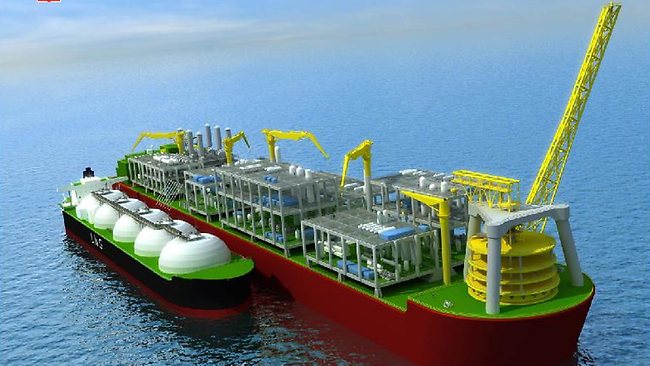
The true reason for tripling gas prices  

Posted by Big Gav in , ,

Ross Gittins at the SMH has an article on the Australian government's plumbing of new moral depths, including a look at the dishonest debate about natural gas exports - Under Tony Abbott, political principles reach an all-time low.

Declining standards at federal level have been matched by bad behaviour at state level. For an example of state politicians willing to blatantly mislead their electorates, look no further than the Victorian and NSW governments' dishonest explanation for the looming jump of about 25 per cent in the price of household gas.

The true reason for the rise is that the building of natural gas liquefaction plants in Gladstone will soon allow gas producers on Australia's east coast to export their gas and obtain the much higher prices paid on the world market. The east coast will go from being outside the world market to inside it.

The price rise is thus inevitable unless governments were to prohibit the companies from exporting their gas, forcing them to continue accepting below-world prices. There has been no suggestion of penalising the gas producers in this way. Rather, state politicians have taken up the dishonest claim of the gas companies that permitting them to build new and controversial coal seam gas plants would somehow prevent gas prices from rising or force them back down. But as any student of economics could tell you, there's no way NSW and Victoria could ever produce enough natural gas to significantly affect the world price of gas.

The price of gas in NSW and Victoria would stay below the world price only if the new producers were compelled to sell their gas to local users at below the world price. Again, there's been no suggestion of this.

Last week the gas companies' illogical argument was taken up by the new NSW Minister for Energy and Resources, Anthony Roberts. I'm prepared to believe Roberts may be economically illiterate, but I don't believe his advisers are - nor that they don't read the papers, where the scam has been exposed.

Although Roberts has replaced a minister who left the cabinet under a cloud, he seems uninhibited in his efforts to mislead the electorate. It's hard to know whether he is simply seeking to advance the gas industry's vested interests or is setting up an alibi which allows the government to blame the inevitable jump in gas prices on those terrible people opposed to fracking.

Either way, his only crime is seeking to deceive voters. And these days that's the way everyone plays the political game, isn't it?

What Gas shortage? Tapping the bubbling wells of spin and self-interest  

Posted by Big Gav in , , ,

Crikey has a look at the lobbying being done on behalf of the natural gas (particularly coal seam gas) industry to try to demolish opposition to expanded drilling programs - Gas shortage? Tapping the bubbling wells of spin and self-interest. One benefit of Labor losing office is Martin Ferguson no longer being in Parliament - its a shame he didn't retire to obscurity instead of getting paid to do what he was doing before as energy minister - lobbying on behalf of the fossil fuel industry.

New South Wales is about to run out of gas, so says the scare campaign. It’s bully-boy tactics by Australia’s powerful oil and gas industry, designed to pressure the state government into quickly approving contentious coal seam gas projects proposed by Santos at Narrabri and AGL at Gloucester.

Federal Industry Minister Ian Macfarlane is on board, warning last year NSW would “run short of gas by 2016” and moving to knock heads together on the issue straight after the election. For months we have been hearing the same lines trotted out: how NSW is “running on empty”, suddenly needs “energy security”, and how developing its own “indigenous” gas supplies will ease prices.

Former John Howard industrial relations minister Peter Reith — whose recommendation to lift fracking bans was ignored by the Victorian government last year — used his column in Fairfax papers yesterday to accuse the O’Farrell government of abandoning the CSG debate, warning “there is a real prospect Sydney could suffer gas shortages”. Reith failed to disclose his consultancy with construction giant Bechtel, a major contractor to the CSG industry.

Former federal energy minister Martin Ferguson was appointed chair of new advisory group APPEA (“the voice of Australia’s oil and gas industry”) in October, barely six months after he stepped down from his cabinet post and only weeks after retiring from Parliament — flouting the 18-month cooling-off period required of ex-ministers under the lobbying code of conduct. Ferguson had a dig at his erstwhile NSW Labor colleagues for “parroting the lines of the Greens and showing itself to be completely irrelevant to the debate”, urging Premier Barry O’Farrell to break “the impasse preventing the development of the state’s abundant gas resources to put downward pressure on rising prices”.

The ABC’s fact checkers concluded Macfarlane’s alarming claims about a NSW gas shortage were “unverifiable”. They were way too generous. The claims are rubbish, designed to confuse the public. Here’s what they’re not telling you:

* No one is going to run out of gas; * Developing CSG in NSW won’t lower rising gas prices; * It’s too late anyway for NSW CSG to ease the current uncertainty affecting gas markets; and * There are plenty of alternative sources of supply for NSW.

Australia has an incredible amount of gas; we’re about to overtake Qatar to become the world’s largest exporter of liquefied natural gas. Between Western Australia, the Northern Territory and Queensland, seven LNG projects worth more than $200 billion are on the go.

The chart above shows three seriously big gas resources that supply the southern and eastern states: the massive coal seam gas in Queensland’s Bowen and Surat basins (41620PJ), plus conventional gas in the Gippsland Basin (3890PJ) and the Cooper Basin (1835PJ). Not shown but certainly exercising the mind of investors is a vast potential resource of tight and shale gas in the Cooper Basin — which may turn out to be bigger than CSG in Queensland, and which oil majors like Chevron and BG Group are scrambling to invest in. By comparison, the coal seam gas discovered in NSW is significant, but no game-changer: Santos has 1426PJ in the Gunnedah Basin, which accounts for half the state’s known reserves.

Overall, there is no doubt Australia has enough gas in the ground to supply both the domestic and export markets. As a country we can afford to think strategically, pick and choose which gas fields we develop, and in what order.

As the Australian Energy Market Operator found last year, if there’s one place in Australia susceptible to shortage it’s Gladstone in Queensland. That’s where three massive LNG export projects operated by BG, Santos and Origin Energy are about to treble gas demand in eastern Australia — ultimately representing some 80% of total gas demand in the eastern market — once they begin to come online later this year. By exposing the domestic market to higher international LNG prices of around $14-15 a gigajoule (which are geared to the oil price), the LNG projects are going to double domestic wholesale gas prices, from around $3-4/GJ to $8-10/GJ and higher, inevitably pushing up retail prices (as NSW saw last week).

The three big projects in Gladstone were approved quickly in 2010 and 2011 — without any strategic consideration of the impact on the domestic gas market — in a rush to sign lucrative contracts with buyers in Asia. It’s a bold experiment; the world’s first attempt to convert coal seam gas into LNG for export. Nobody knows yet if the thousands of CSG wells required to feed the six big LNG liquefaction units (or “trains”) under construction — each one consuming roughly as much gas each year as say Queensland or Victoria, so adding six new states’ worth of demand to the network — can be drilled fast enough, and will flow enough gas for long enough, to fulfil those contractual commitments.

Grantham: Wind, solar to replace fossil fuels within decades  

Posted by Big Gav in ,

RNE has an article on Jeremy Grantham's latest pronouncements on our energy future - Grantham: Wind, solar to replace fossil fuels within decades.

Legendary hedge fund investor Jeremy Grantham says there is no doubt that solar and wind energy will “completely replace” coal and gas across the globe, it is just a matter of when.

The founder of $100 billion funds manager GMO Capital is known as a contrarian. But he suggests that the pace of change in the fuel supply will surprise everyone, and have huge implications for fossil fuel investments.

“I have become increasingly impressed with the potential for a revolution in energy, which will make it extremely unlikely that a lack of energy will be the issue that brings us to our knees,” Grantham writes in his latest quarterly newsletter.

“Even in the expected event that there are no important breakthroughs in the cost of nuclear power, the potential for alternative energy sources, mainly solar and wind power, to completely replace coal and gas for utility generation globally is, I think, certain.

“The question is only whether it takes 30 years or 70 years. That we will replace oil for land transportation with electricity or fuel cells derived indirectly from electricity is also certain, and there, perhaps, the timing question is whether this will take 20 or 40 years.”

Grantham’s predictions go against the conventional wisdowm of the fossil fuel industry, but they the thoughts of many people, including Stanford researcher Tony Seba, who said last year this could occur within a few decades.

And Grantham says it could happen quicker than even he believes, and will have major implications for new investments in the fossil fuel industry – a topic very much in mind for project developers and bankers in Australia.

“I have felt for some time that new investments today in coal and tar sands are highly likely to become stranded assets, and everything I have seen, in the last year particularly, increases my confidence,” Grantham writes.

Exxon pushing for floating LNG for Scarborough field  

Posted by Big Gav in , , , , , , ,

The SMH reports that Exxon is pushing for a floating LNG platform for the Scarborough gas field offshore from Western Australia - Exxon for floating gas.

ExxonMobil insists a floating liquefied natural gas processor is the preferred way to develop the big Scarborough offshore gas project in Western Australia, despite its partner BHP Billiton talking up an alternative model.

ExxonMobil has approval from the government to develop the project using a floating processor, but that did not stop BHP's petroleum chief Tim Cutt suggesting last month that connection to an existing gas processing plant may be preferable. ''Developed capacity … is typically a more cost-effective and value-accretive way to go,'' Mr Cutt said.

The North West Shelf, which is partly owned by BHP, looms as the logical place to process Scarborough gas if the floating option is abandoned, given its proximity and the fact gas production at the shelf will soon plateau.

On the other side of the country it looks unlikely that the Arrow Energy coal seam gas LNG plant will go ahead - Struggling Shell defers Arrow LNG project again.

Royal Dutch Shell has ruled out any commitment this year to the development of its Arrow liquefied natural gas venture in Queensland and signalled a more rigorous approach to other new projects in Australia, where it is also considering big asset sales. ...

Speaking after Shell reported a 70 per cent slump in fourth-quarter profit, the company's new global head named the $20-billion-plus Arrow LNG venture with PetroChina among the next potential wave of LNG investments for the oil giant, alongside the Browse floating venture and others. But he said Shell had deferred the project, deterred by ''the economics and inflation risks''. The delay is the second for the struggling Arrow venture, where at least 250 jobs were cut in January.

Speculation is increasing that Shell and PetroChina will sell their gas to one of the three LNG plants being built in Queensland, either for an expansion, or to supplement initial inadequate supplies.

New 3D Printer by MarkForged Can Print With Carbon Fiber  

Posted by Big Gav in ,

Popular Mechanics has an article on a new 3d printer that can use carbon fiber - New 3D Printer by MarkForged Can Print With Carbon Fiber.

Gregory Mark co-owns Aeromotions, which builds computer-controlled racecar wings. To make those wings both strong and lightweight, they use carbon fiber. No surprise there—it's the material of choice for many advanced motorsports parts. The problem is that making custom racecar parts out of carbon fiber is daunting. The only real method available is the expensive and difficult process of laying up carbon fiber pieces by hand.

To improve the process, Mark looked to 3D printing. But nothing on the market could print the material, and no available materials could print pieces strong enough for his purposes. So Mark devised his own solution: the MarkForged Mark One, the world's first carbon fiber 3D printer.

Mark debuted his Boston area-based startup MarkForged at SolidWorks World 2014 in San Diego with a working prototype. The Mark One can print in carbon fiber, fiberglass, nylon and PLA (a thermoplastic).

Hydrinos In Your Future?  

Posted by Big Gav in , , ,

Tom Whipple at the FCNP has an article on the cold fusion / free energy world, displaying rather less skepticism than I feel comfortable with (but I guess it's a change from the intense doomerism he traditionally emanated back in the heyday of peak oil) - The Peak Oil Crisis: Hydrinos In Your Future?.

One of the companies mentioned, Blacklight Power, has received a reasonable amount of press lately - see these links for some examples - Impact Lab: Hydrino Theory validated by Harvard tests, EarthTechling: HYDRINOS A PIE IN THE SKY CLEAN ENERGY? and Next Big Future: Move over Rossi. Blacklight Power is claiming megawatts from their super-controversial hydrino process and devices.

In recent months I have written about the progress being made in “cold fusion” which is short hand for a third way to extract energy from the forces binding atoms together. Some who are familiar with the details of what has been going on appreciate that we are nearly over denying that cold fusion is real as at least three companies have mastered the technology at lab bench level and are working on commercial-scale hydrogen powered devices that hopefully will one day replace fossil fuels as a source of energy for heat, electricity, and transportation.

The Italian developer Rossi seems to have linked up with a North Carolina company that not only is supplying the cash he needs to develop a marketable product, but apparently has made contacts to develop the technology in China.

The California company Brillouin was recently the subject of a series of videos detailing the current state of development of the prototype commercial boiler it is developing along with SRI to replace fossil fuels as the source of heat in electric power stations. Moreover Brillouin has recently licensed its technology to a Korean manufacturer who hopes to have a prototype in operation before the end of the year. The major take home from the videos, however, is that scaling up cold fusion from lab bench to commercial boiler size will involve some difficult engineering.

The third major contender in the race for cold fusion, Defkalion Green Technologies, announced last week that they are making good progress and hope to “commercialize’ their technology by the third quarter of this year. All three of these companies say they have had their technology verified by outside scientists, but have no intention of releasing their proprietary techniques as to how they make cold fusion work at this time.

Last week another contender in the race to replace fossil fuels resurfaced with the announcement by a New Jersey company, BlackLight Power, that it has applied for a patent and will be demonstrating its technology to selected observers on February 28th. BlackLight Power and its technology has been around for over 20 years; has raised and spent circa $80 million developing their technology; and have released a mountain of reports, data and even books describing how their technology works. Every few years they have announced that they were close to a commercial product that could produce heat, but somehow they always slipped back into the R&D mode and were largely forgotten even by close observers of the field and certainly not remembered by the mainstream media.

The biggest problem with gaining acceptance for the technology that BlackLight Power claims to have invented that it is so revolutionary that, should it pan out, the world and much science will never be the same. The simple version of BlackLight’s technology is easy to understand. By taking hydrogen atoms (protons with an electron orbiting around the nucleus), all one has to do is give the atoms a good zap of electricity in the presence of the right catalyst and the electrons drop down into orbits closer to the nuclei – releasing very large amounts of energy in the process.

After the hydrogen atoms’ electrons falls into a lower orbit, the resulting now-shrunken atom was called a “hydrino” by its discoverer, Randell Mills. The main problem with this idea is that our current chemistry says there are no stable states of hydrogen below what is known as the base state. Therefore most scientists say Mill’s hydrino thesis must be wrong. For 20 years, Mills has had to contend with an endless string of naysayers, including some very well-known scientists many of which called him a charlatan for raising and spending some $80 million dollars in search of something which cannot possibly be true – or so they contend.

American wind power to be stored in Canadian Pumped Hydro  

Posted by Big Gav in , ,

Wind Energy Update has an article on Canadian pumped hydro energy storage storing American wind power - American wind to be stored in Canada.

A pair of utilities, Minnesota Power and Manitoba Hydro, have inked a Renewable Optimisation Agreement (ROA) under which electricity from excess wind produced in North Dakota can be stored in Manitoba’s hydro reservoir when loads and prices are low, with the potential for selling that power back onto the huge United States Midwest Independent Transmission System Operator (MISO) market at times when needs are high.

The deal involves the pair building a new 400 mile 500 kV transmission line, with a capacity of 750 megawatts, connecting northeastern Minnesota with Winnipeg, at a cost of $1bn split between the two utilities. ...

The province lies at the centre of a 400,000 square mile watershed that drains from the Rocky Mountains to the west and Lake Superior to the east. The Nelson River drains north to Hudson Bay with an average flow at the sea of 115,000 cubic feet per second - eight times that of the Colorado River.

Manitoba's 1,000 feet of hydro-electric potential remains only half developed and two new hydro projects with associated storage planned for the Nelson River has created the opportunity for further interconnecting the Manitoba battery to MISO.

WA grid may become first big victim of “death spiral”  

Posted by Big Gav in , , ,

ReNew Economy has a look at the impact of solar power and fossil fuel prices on the WA electricity grid - WA grid may become first big victim of “death spiral”.

The chances of the West Australian electricity grid becoming the first to fall victim to the so-called “death spiral” for utilities appears to have increased after it was revealed this week that the gap between the cost to generate, transmit and sell electricity and the charge to consumer has widened.

The “death spiral” is a term coined by utilities in an attempt to defend their business models against the rise of the “pro-sumer”, customers who are no longer just buying energy but who are sourcing cheaper electricity from their own generation, usually rooftop solar, and cutting demand from the grid.

The WA grid, however, has helped create its own death spiral because it has never recovered the cost of its largely fossil-fuel fired electricity from the consumer. The costs keep rising, and now it has emerged that electricity demand has fallen so low that the major utilities may be forced to pay for fossil-fuel generation they will never use.

It is hard to imagine a more unsustainable situation, and it is quite possible that the WA grid is the most at risk in the developed world from the emergence of cheaper solar and storage solutions.

Synergy, the WA Government-owned electricity and gas retailer that has just been merged with the government owned generator Verve Energy, revealed this week that the gap between consumer bills and the cost of delivery through the grid had blown out to nearly $500 million in the 2013 fiscal year.

This is despite the fact that residential power prices have risen 70 per cent since the Barnett government came to power in 2008. Synergy told the Upper House financial estimates committee that consumer bills would have needed to increase by another one third in 2012-13 to match the cost of production.

Synergy CFO Karl Matacz told the committee that solar panel installations, which have grown from zero to 130,000 in just five years, continue to grow at a rate of more than 2,000 a month, despite the removal of feed in tariffs. ...

If the WA government was to lift the consumer price to reflect the actual cost of generation and delivery, this would put the retail price at close to 40c/kWh. That compares to around 15c/kWh for rooftop solar PV. The difference provides an awful lot of room for alternatives such as storage, and even micro-grids to fill the gap.

5 ways to play the end of the natural gas renaissance  

Posted by Big Gav in

Resource Investor has an example of some of the bearish commentary on the US shale boom (more negative than my personal views but I thought it was worth noting) - 5 ways to play the end of the natural gas renaissance.

The Energy Report: Bill, you published a book six months ago, "Cold, Hungry and in the Dark: Exploding the Natural Gas Supply Myth," questioning the conventional wisdom of shale gas. Have events supported your thesis?

Bill Powers: Yes, absolutely. Several of the predictions I made in the book have come true since the book hit the shelves in July. First, we've seen numerous shale plays head into decline. We've seen big declines from the Haynesville as well as the Barnett. The Fayetteville is in decline; there have been further declines in the Gulf of Mexico and Wyoming. But what has really changed is the North American natural gas market has become extremely unbalanced, which was what I had predicted would come to pass sometime in the 2013–2015 timeframe. The cold weather over the last six weeks has accelerated what I have been talking about in the book.

TER: How so?

BP: I predicted that gas prices would lead to layoffs and industry supply disruptions, and that's already occurred. We've seen paper mills in New Hampshire lay people off because natural gas prices in New England were north of $50/million Btu ($50/MMBtu) for a period and remain very high. We've also seen incredibly high prices in New York, and this is a time of record production coming out of the Marcellus. These are really the first examples of the violent price spikes and industrial shutdowns we will see in other parts of the country.

Across the U.S. over the next several years, I predict we will see spikes of very high prices, which will fall back to higher levels than they previously reached. Then, as the next weather event comes, prices will spike to new highs. That has already happened in New England and other areas of the Northeast in part because those areas are supply-constrained due to limited pipeline availability, but also because of increased demand.

The Northeast has also had several nuclear power plants close. Just recently the Vermont Yankee closed. Nuclear power plants have closed over the last decade or so in Maine as well as Connecticut. Much of this capacity has been taken up by increased natural gas demand for electricity generation. So you've had constrained supply because of the limited pipeline capacity and increased demand. In addition to the new demand from electricity generation, significant new demand in the Northeast has come from people converting from heating oil to natural gas furnaces.

Also, there's been a huge disappointment in supply coming from Canada into the Northeast U.S. because Sable Island production offshore Nova Scotia has been so low compared to some very lofty original expectations. We've just had Deep Panuke come on in late 2013 after several delays and many cost overruns, but the pipeline that services those offshore fields in Nova Scotia is not even close to full, and the fields will be depleted fairly rapidly over the next three to seven years. This will be a period of continued supply constraints for New England. The Marcellus and Eagle Ford are the only two fields that are still growing, and I expect the Marcellus to flatten out in 2014. Additionally, we are going to see supply constraints throughout much of the rest of the United States over the next several years.

TER: The pipeline companies have acknowledged that there's a supply constraint. Haven't any of them made plans to extend lines to the Northeast?

BP: Yes, that is happening, and some of them are probably going to increase throughput from the production growth in the Marcellus, but there will be significant calls on Marcellus production, which is probably going to peak this year.

The U.S. Energy Information Administration late last year put out a white paper that talked about how gas production is becoming more efficient. But this white paper did not include the Barnett Shale, which is in steep decline now. It's true, efficiencies have been gained over the last several years, such as the way fracking has changed, and operators are becoming more efficient in fracking, with longer laterals. But what is really happening is the completion of the inventory of previously drilled wells.

When companies ramp up their drilling activity, they often will drill more wells than they actually complete due to lack of pipeline capacity. Just recently, there have been about 200 wells in the Marcellus that were waiting for pipeline connections or to be fracked. A lot of those wells have been fracked over the last six months and the inventory continues to go down. I believe that inventory will be depleted by Q1/14, and given the drilling activity, the very high decline rates of the wells and the number of rigs running in the Marcellus, further growth is not supported. The Marcellus is still a very significant field, the biggest in the United States. When it peaks out it will probably plateau for a while, depending on activity levels, but it still will not be able to make up for falling production in nearly every other region in the United States. When this happens, we will see price spikes more frequently.

Oh no! The oil price could fall  

Posted by Big Gav in ,

While I rarely agree with Ambrose Evans-Pritchard I do appreciate his continual columns on the energy industry and related topics. One recent column of his looked at oil price movements in the near term, predicting that oil prices may fall due to a surge in supply (and moving on to the even less likely conclusion that this will be the trigger for global deflation - surely the economic stimulus caused by cheaper energy would outweigh the loss in income for oil suppliers !) - Coming 'oil glut' may push global economy into deflation.

Personally I think the US shale oil boom will end pretty quickly if oil prices drop much below current levels so there's no chance of any long term "oil glut" depressing prices for any significant period of time. I do agree with his concluding paragraphs at leas...

To avoid confusion, let me be clear that the dangers of dwindling oil supplies in the long-run have not gone away. Easy reserves of crude are being depleted. New fields are more costly. Peak oil may have the last laugh. Yet this should not be confused with the short-term risks of deflationary shock.

I recently attended a Transatlantic Dialogue on Energy Security with senior military officers in London and Washington. The message was that shale will come and go - with US tight gas peaking by 2017 - creating a false sense of security as the deeper strategic threat continues to build. That is broadly my view as well. Much drama can intrude along the way.

Alan Kohler at The BS has a column weakly echoing Evans-Pritchard - Oh no! The oil price could fall.

There is a limit to what Saudi Arabia can do to limit supply. Lewis estimates that it would have to cut output by a quarter to stop the bottom falling out of the market, but Ambrose Evans-Pritchard of The Telegraph says this would push its budget into deep deficit and endanger the welfare subsidies required to keep a lid on tensions in its Eastern Province and the aggrieved Shia minority.

Europe is clearly at the greatest risk of falling into a Japan-style quagmire of long-term deflation and depression, caused by a combination of fiscal austerity and zombie banks.

Last week a report by researchers in Berlin and New York estimated that European banks have a capital shortfall of up to $US1 trillion, with French and German banks in the worst shape. Global bank regulators have let them off the hook to some extent by not increasing the leverage ratio as much as expected, but they still have a long way to go to get their balances sheets back to non-zombie status.

In that context a big drop in the oil price – a reverse oil shock – would not necessarily be a good thing, as you might think.

In theory deflation causes demand to shrink and the value of debt to rise, although in practice during the 19th century prices halved and output increased seven fold. The difference this time is the existence of so much debt and the fact that so many banks are still under-capitalised.

And in addition to Europe, China’s economy has serious problems with debt and falling money supply. Ambrose Evans-Pritchard wrote the other day that “China looks eerily like the US in 2007 when broad money buckled.”

If Chinese demand collapses at the same time as an oil supply glut emerges and United States imports continue to fall, we could find out what deflation in the modern world means in practice, instead of just in theory.

Return Of The Polar Vortex  

Posted by Big Gav in ,

While it's been a blistering hot summer down here the stories of the polar vortex from the northern hemisphere have made interesting reading / viewing.

As usual whenever it snows the usual maniac shouts and global warming being disproven have been doing the rounds - US Science Advisor John Holdren has a good (and brief) talk on the causes of the polar vortex / jetstream deciding to head south for a while - The White House Releases Its Climate Heavy Hitter on the Polar Vortex.

Last week, amid the media furor over the "polar vortex," the White House did something pretty unusual. It released a highly produced scientific video titled "The Polar Vortex Explained in 2 Minutes."

In the video, White House science adviser and physicist John Holdren dismantles silly claims that cold weather refutes global warming. "The fact is that no single weather episode can either prove or disprove global climate change," explains Holdren. He then describes how, in fact, climate change could make extreme winter weather in the mid-latitudes more common. "A growing body of evidence suggests that the kind of extreme cold being experienced by much of the United States as we speak is a pattern that we can expect to see with increasing frequency as global warming continues," Holdren asserts.

Where will the new jobs come from ?  

Posted by Big Gav in

The Economist has an article on the effect of technology on employment, declaring "The effect of today’s technology on tomorrow’s jobs will be immense — and no country is ready for it" -

Optimism remains the right starting-point, but for workers the dislocating effects of technology may make themselves evident faster than its benefits (see article). Even if new jobs and wonderful products emerge, in the short term income gaps will widen, causing huge social dislocation and perhaps even changing politics. Technology’s impact will feel like a tornado, hitting the rich world first, but eventually sweeping through poorer countries too. No government is prepared for it.

Why be worried? It is partly just a matter of history repeating itself. In the early part of the Industrial Revolution the rewards of increasing productivity went disproportionately to capital; later on, labour reaped most of the benefits. The pattern today is similar. The prosperity unleashed by the digital revolution has gone overwhelmingly to the owners of capital and the highest-skilled workers. Over the past three decades, labour’s share of output has shrunk globally from 64% to 59%. Meanwhile, the share of income going to the top 1% in America has risen from around 9% in the 1970s to 22% today. Unemployment is at alarming levels in much of the rich world, and not just for cyclical reasons. In 2000, 65% of working-age Americans were in work; since then the proportion has fallen, during good years as well as bad, to the current level of 59%.

Worse, it seems likely that this wave of technological disruption to the job market has only just started. From driverless cars to clever household gadgets (see article), innovations that already exist could destroy swathes of jobs that have hitherto been untouched. The public sector is one obvious target: it has proved singularly resistant to tech-driven reinvention. But the step change in what computers can do will have a powerful effect on middle-class jobs in the private sector too.

Until now the jobs most vulnerable to machines were those that involved routine, repetitive tasks. But thanks to the exponential rise in processing power and the ubiquity of digitised information (“big data”), computers are increasingly able to perform complicated tasks more cheaply and effectively than people. Clever industrial robots can quickly “learn” a set of human actions. Services may be even more vulnerable. Computers can already detect intruders in a closed-circuit camera picture more reliably than a human can. By comparing reams of financial or biometric data, they can often diagnose fraud or illness more accurately than any number of accountants or doctors. One recent study by academics at Oxford University suggests that 47% of today’s jobs could be automated in the next two decades.

At the same time, the digital revolution is transforming the process of innovation itself, as our special report explains. Thanks to off-the-shelf code from the internet and platforms that host services (such as Amazon’s cloud computing), provide distribution (Apple’s app store) and offer marketing (Facebook), the number of digital startups has exploded. Just as computer-games designers invented a product that humanity never knew it needed but now cannot do without, so these firms will no doubt dream up new goods and services to employ millions. But for now they are singularly light on workers. When Instagram, a popular photo-sharing site, was sold to Facebook for about $1 billion in 2012, it had 30m customers and employed 13 people. Kodak, which filed for bankruptcy a few months earlier, employed 145,000 people in its heyday.

The problem is one of timing as much as anything. Google now employs 46,000 people. But it takes years for new industries to grow, whereas the disruption a startup causes to incumbents is felt sooner. Airbnb may turn homeowners with spare rooms into entrepreneurs, but it poses a direct threat to the lower end of the hotel business—a massive employer. ...

Innovation has brought great benefits to humanity. Nobody in their right mind would want to return to the world of handloom weavers. But the benefits of technological progress are unevenly distributed, especially in the early stages of each new wave, and it is up to governments to spread them. In the 19th century it took the threat of revolution to bring about progressive reforms. Today’s governments would do well to start making the changes needed before their people get angry.

One area where cheap machines have made a radical difference is outdoor adventure photography - the video below was shot with a $300 GoPro camera mounted on a $700 drone helicopter - total cost probably 2 orders of magnitude less than the gear to shoot equivalent footage would have cost 10 years ago.

Solar saved southern states from new and costly demand peaks  

Posted by Big Gav in , , ,

ReNew Economy has a pair of articles looking at the benefits provided by solar power during the recent heatwave in southern Australia - Solar saved southern states from new and costly demand peaks.

Victoria and South Australia have just finished a week which put the highest stress on the electricity grid since a similar heatwave occurred on 28th-30th January 2009. Despite the population of Victoria and South Australia increasing at least 7%2 since then, the electricity demand supplied by the grid during the heat wave was just lower than the peak usage reached on the 29th of Jan 2009.

Electricity demand from the grid in the recent heatwave peaked on Wednesday. There were initially warnings of potential load shedding1 from the grid operator after the usually baseload Loy Yang A3 brown coal unit and one of the Torrens Island gas units tripped offline on Tuesday. However, demand came in slightly lower than forecast and apart from some minor local transmission outages, demand was fully supplied. ...

If no solar had been installed, Victoria would have set a new demand record of 10,675MW at 1:55pm today 17th-Jan-2014, higher than the metered demand of 10,572MW used at 12:35pm on the 29th-Jan-2009. South Australia would have set a new demand record of 3,549MW at 4:30pm yesterday 16th-Jan-2014, higher than the metered demand of 3,441MW set 4:25pm on the 29th-Jan-2009. Solar reduced the maximum combined VIC & SA demand by 448MW.

Asking what happens when the sun doesn’t shine and the wind doesn’t blow ignores the spare capacity built into the grid to handle record demand days like yesterday and today. For the majority of the year, spare generation capacity can backup variations in solar or sudden failures at fossil fuel plants. Record demands, where there is little spare capacity, are caused by hot conditions and strong sunlight. Solar is now a critical component of the generation fleet that reliably supplies our power.

An the second from Giles Parkinson - Solar puts heat on big generators as demand peaks subside.
There seems no doubt that solar is playing a key role in moderating demand and stress on the grid.

It’s interesting to note that the differences between the peaks of previous years – such as in 2009 when there was little solar – correspond with the amount of solar that has been installed (notwithstanding the need to add in population and air-con growth, offset by more energy efficient appliances and less manufacturing).

On Wednesday, for instance, the interval peaks were 10,110 MW in Victoria and 3,108MW in SA. The corresponding numbers on January 29, 2009, were 10,446 MW and 3,270 MW. According to the APVI’s Live Solar website, the PV contribution at the peak times was around 220 MW in each state. Some suggest that without solar, Victoria would have hit record demand from the grid on Thursday – and prices to boot.

In WA, the peak in electricity demand has fallen well short of previous years, despite the record-breaking streak of temperatures, rising population and growing use of air conditioning.

In 2011 and 2012, peak demand peaked at more than 4,000GW. In the past week, it made it only as high as 3,733. How much solar does WA have on its rooftops? About 340MW.

This has had an impact on peak pricing events. In 2009, the average spot price between 8am and 4pm was over $6,000/MWh. The average price – despite a few peaks – in the latest period has been about one tenth of that.

On Thursday, the volume weighted pool prices between 08.00 and 16.00 yesterday were $299/MWh in Victoria and $377/MWh in South Australia, despite the huge levels of demand. The reaching of super peaks of $12,000/MWh or more in Victoria occurred mostly when Loy Yang A – the biggest brown coal generator – had one of its four units off-line for urgent repairs .

Generators and retailers use elaborate hedging policies to reduce their exposure to such fluctuations – which can be triggered as much by bidding tactics and other factors as much as weather – but the fact remains that a large revenue pool has been evaporated by the impact of solar.

In the same way that one third of the network costs are to cater for about 100 hours of peak demand a year, generators source a huge amount of their annual revenue from similar events. The problem for many coal generators is that they grew to rely on these peak pricing events to boost their revenue, and inflate their values. Solar eats into those revenues whenever they produce – because the output comes during the day-time period, when prices are normally higher.

Crippled Kashagan oil project a bureaucratic 'nightmare'  

Posted by Big Gav in

I was over in Perth late last year and it was interesting to see how the end of the mining (construction) boom is impacting on the locals. The engineering types are in austerity mode while the technology folk are much less affected - with a new focus on "efficiency' projects to try and squeeze more value from the massive investments made over the past decade.

Oil and gas services work has dried up to the point where one friend was forced to start looking at opportunities offshore (after following his once 120 person team into redundancy). He noted that the pay available elsewhere is far less than most Perth engineers have become accustomed too, and was considering heading to Kazahkstan for his next job.

Kashagan remains one of the larger projects underway worldwide - Reuters report that it's not progressing all that well - Crippled Kashagan oil project a bureaucratic 'nightmare'.

Giant Kazakh oilfield Kashagan, which was brought to a halt by leaks shortly after start-up last year, is grappling with a bureaucratic "nightmare" on top of its engineering troubles as it strives for commercial production in 2014.

The scale and complexity of the world's most expensive standalone oil project led its seven partners away from the traditional single operator command-and-control model, where one of the larger companies takes charge while the others provide support and share the risks, costs and rewards. ...

The Caspian Sea project aims to exploit the biggest oil discovery in decades, producing a peak of 1.66 million barrels a day - as much oil as OPEC member Angola, from a reserve almost as big as Brazil's. Much of it is built on artificial islands to avoid damage from pack ice in a shallow sea that freezes for five months a year in temperatures that drop below minus 30 degrees Celsius (-22F).

The field extends over 3,375 square kilometres (1,303 sq miles), and the whole onshore and offshore site is bigger still. The oil is 4,200 metres (4,590 yards) below the seabed, at very high pressure, and the associated gas reaching the surface is mixed with some of the highest concentrations of toxic, metal-eating hydrogen sulphide (H2S) ever encountered.

Kashagan has cost an estimated $50 billion so far, five times early projections, and its 13-year life is a tale mostly of delay.

NOAA: 2013 fourth-warmest year on record  

Posted by Big Gav in

While 2013 was Australia's hottest year ever apparently it was "only" the fourth warmest ever around the globe - Noaa: 2013 tied for fourth-warmest year on record.

Last year was tied for the fourth-warmest year on record around the world.

The National Oceanic and Atmospheric Administration on Tuesday released its global temperature figures for 2013. The average world temperature was 58.12F (14.52C) tying with 2003 for the fourth-warmest since 1880. ... Both agencies said nine of the 10th warmest years on record have happened in the 21st century. The hottest year was 2010.

Deutsche Bank predicts second solar “gold-rush”  

Posted by Big Gav in ,

ReNew Economy has an article on a new report on the solar power industry by Deutsche Bank - Deutsche Bank predicts second solar “gold-rush”.

Leading investment house Deutsche Bank has dramatically lifted its demand forecasts for the global solar industry – predicting that 46 gigawatts (GW) of solar PV will be installed across the world in 2014, before jumping by another 25 per cent to 56GW in 2015. It notes that the world’s three biggest solar markets – co-incidentally located in the world’s three biggest economies, US, China and Japan – are currently booming and are likely to deliver what market analysts describe as more “upside demand surprises.”

But it also points to other countries such as India, Australia, South Africa, Mexico, as well as regions in the Middle East, South America and South East Asia, to act as strong growth contributors. “The majority of these markets are at grid parity and as such sustainable,” the analysts write. “Moreover, we believe some of the grid and financing constraints that have inhibited growth so far are set to improve in 2014.”

Nissan Sells 100,000 LEAFs, Captures 48% Of Worldwide Market To Date  

Posted by Big Gav in

Inside EVs has a report on the progress of Nissan's electric vehicle sales - Nissan Sells 100,000 LEAFs, Captures 48% Of Worldwide Market To Date.

This past weekend Nissan announced that after just more than 3 years on the market, the LEAF had reached the 100,000 vehicles sold level.

More impressive still is that InsideEVs calculated Nissan had only sold about 88,000 through the end of November, and the company themselves shortly thereafter announced reaching the 92,000 LEAF sold mark in early December - meaning the company has sold about 12,000 copies in the past two months worldwide.

Overall, Nissan has captured 48% of pure electric sales worldwide since 2010 according to the company.

India Is Building The World's Largest Solar Plant For $4.4 Billion  

Posted by Big Gav in , ,

The Business Insider has an article on India's plan to build a 4 GW solar power plant in Rajasthan - India Is Building The World's Largest Solar Plant For $4.4 Billion.

Since 2010, India has hiked installed solar power capacity from a meagre 17.8 megawatts to more than 2,000MW, official figures show, as part of Prime Minister Manmohan Singh's aim to make "the sun occupy centre-stage" in the country's energy mix. Key to the progress has been a rapid fall in the cost per unit of solar electricity to close to what is known as "grid parity" -- the cost of conventional electricity generated by carbon-gas emitting coal. ... The next stage of expansion will see India build the world's largest solar plant to generate 4,000MW on the shores of a saltwater lake in the northwestern desert state of Rajasthan, which should drive solar power costs even lower. Operators believe economies of scale from the 280-billion-rupee ($4.4 billion) Sambhar plant to be constructed over the next seven years will reduce prices to 5.0-5.5 rupees a kilowatt-hour. "This is the first project of this scale anywhere in the world" and "is expected to set a trend for large-scale solar power developments," said Ashvini Kumar, director of Solar Energy Corp, one of five public utilities that will run the plant.

Holmgren’s ‘Crash on Demand’: be careful what you wish for  

Posted by Big Gav in ,

Energy Bulletin has an article by Rob Hopkins looking at a collapse manifesto from David Holmgren (I feel like I've gone back in time about 10 years !) - Holmgren’s ‘Crash on Demand’: be careful what you wish for.

It is a rare occurence that I disagree with David Holmgren. One of my heroes, and the co-founder of permaculture, I generally find his intellect formidable, his insights on permaculture revelatory, and his take on the wider patterns and scenarios unfolding around us to be deeply insightful. But while there is much insight in his most recent paper, Crash on Demand, it also raises many questions and issues that I'd like to explore here. I am troubled by his conclusions, and although I understand the logic behind them, I fear that they could prove a dangerous route to go down if left unchallenged.

So what are the paper's core arguments? It picks up from his 'Future Scenarios' work a few years on, reassessing their relevance in a rapidly changing world (you can read Jason Heppenstall's summary of the new paper here). In essence, he has shifted to thinking that a gradual energy descent isn't going to happen. Rather than his Green Tech Future scenario which sees a concerted government response (similar to what we're seeing in Germany) or the Earth Stewardship scenario, an intentional powering down, he argues that in reality we are moving deeper and deeper into what he calls 'Brown Tech'.

Brown Tech has emerged because "sustained high energy prices have allowed private and national energy corporations to put in place many new fossil and renewable energy projects that are moderating the impact of the decline in production from ageing 'super giant' fields". Most of these new fossil fuel projects, he argues, "generate far more greenhouse gases than the conventional sources they have replaced".

The pace of the unfolding of climate change has outpaced expectations, and the world, if it continues to pursue Business as Usual, is still on course for a 6 degree rise in temperature, which would be catastrophic. He states that we have left it too late for a planned and intentional 'Green Tech' future, and the structural vulnerabilities of the economy mean that the currently emergent 'Brown Tech' future will be short-lived.

He suggests that in this context, "severe global economic and societal collapse would switch off greenhouse gas emissions enough to begin reversing climate change", and that we should deliberately seek to make this happen. That troubles me. I have two key objections to the paper which I'll set out below.

Think “peak oil” is a discredited idea? Think again  

Posted by Big Gav in ,

Grist has an article from Michael Klare shifting his position on peak oil yet again - Think “peak oil” is a discredited idea? Think again.

Among the big energy stories of 2013, “peak oil” — the once-popular notion that worldwide oil production would soon reach a maximum level and begin an irreversible decline — was thoroughly discredited. The explosive development of shale oil and other unconventional fuels in the United States helped put it in its grave.

As the year went on, the eulogies came in fast and furious. “Today, it is probably safe to say we have slayed ‘peak oil’ once and for all, thanks to the combination of new shale oil and gas production techniques,” declared Rob Wile, an energy and economics reporter for Business Insider. Similar comments from energy experts were commonplace, prompting an R.I.P. headline at Time.com announcing, “Peak Oil is Dead.”

Not so fast, though. The present round of eulogies brings to mind Mark Twain’s famous line: “The reports of my death have been greatly exaggerated.” Before obits for peak oil theory pile up too high, let’s take a careful look at these assertions. Fortunately, the International Energy Agency (IEA), the Paris-based research arm of the major industrialized powers, recently did just that — and the results were unexpected. While not exactly reinstalling peak oil on its throne, it did make clear that much of the talk of a perpetual gusher of American shale oil is greatly exaggerated. The exploitation of those shale reserves may delay the onset of peak oil for a year or so, the agency’s experts noted, but the long-term picture “has not changed much with the arrival of [shale oil].”

The IEA’s take on this subject is especially noteworthy, since its assertion only a year earlier that the U.S. would overtake Saudi Arabia as the world’s No. 1 oil producer sparked the “peak oil is dead” deluge in the first place. Writing in the 2012 edition of its World Energy Outlook, the agency claimed not only that “the United States is projected to become the largest global oil producer” by around 2020, but also that with U.S. shale production and Canadian tar sands coming online, “North America becomes a net oil exporter around 2030.”

That November 2012 report highlighted the use of advanced production technologies — notably horizontal drilling and hydraulic fracturing (“fracking”) — to extract oil and natural gas from once inaccessible rock, especially shale. It also covered the accelerating exploitation of Canada’s bitumen (tar sands or oil sands), another resource previously considered too forbidding to be economical to develop. With the output of these and other “unconventional” fuels set to explode in the years ahead, the report then suggested, the long-awaited peak of world oil production could be pushed far into the future.

The release of the 2012 edition of World Energy Outlook triggered a global frenzy of speculative reporting, much of it announcing a new era of American energy abundance. “Saudi America” was the headline over one such hosanna in the Wall Street Journal. Citing the new IEA study, that paper heralded a coming “U.S. energy boom” driven by “technological innovation and risk-taking funded by private capital.” From then on, American energy analysts spoke rapturously of the capabilities of a set of new extractive technologies, especially fracking, to unlock oil and natural gas from hitherto inaccessible shale formations. “This is a real energy revolution,” the Journal crowed.

But that was then. The most recent edition of World Energy Outlook, published this past November, was a lot more circumspect. Yes, shale oil, tar sands, and other unconventional fuels will add to global supplies in the years ahead, and, yes, technology will help prolong the life of petroleum. Nonetheless, it’s easy to forget that we are also witnessing the wholesale depletion of the world’s existing oil fields and so all these increases in shale output must be balanced against declines in conventional production. Under ideal circumstances — high levels of investment, continuing technological progress, adequate demand and prices — it might be possible to avert an imminent peak in worldwide production, but as the latest IEA report makes clear, there is no guarantee whatsoever that this will occur.

Statistics

Locations of visitors to this page

blogspot visitor
Stat Counter

Total Pageviews

Ads

Books

Followers

Blog Archive

Labels

australia (619) global warming (423) solar power (397) peak oil (355) renewable energy (302) electric vehicles (250) wind power (194) ocean energy (165) csp (159) solar thermal power (145) geothermal energy (144) energy storage (142) smart grids (140) oil (139) solar pv (138) tidal power (137) coal seam gas (131) nuclear power (129) china (120) lng (117) iraq (113) geothermal power (112) green buildings (110) natural gas (110) agriculture (91) oil price (80) biofuel (78) wave power (73) smart meters (72) coal (70) uk (69) electricity grid (67) energy efficiency (64) google (58) internet (50) surveillance (50) bicycle (49) big brother (49) shale gas (49) food prices (48) tesla (46) thin film solar (42) biomimicry (40) canada (40) scotland (38) ocean power (37) politics (37) shale oil (37) new zealand (35) air transport (34) algae (34) water (34) arctic ice (33) concentrating solar power (33) saudi arabia (33) queensland (32) california (31) credit crunch (31) bioplastic (30) offshore wind power (30) population (30) cogeneration (28) geoengineering (28) batteries (26) drought (26) resource wars (26) woodside (26) censorship (25) cleantech (25) bruce sterling (24) ctl (23) limits to growth (23) carbon tax (22) economics (22) exxon (22) lithium (22) buckminster fuller (21) distributed manufacturing (21) iraq oil law (21) coal to liquids (20) indonesia (20) origin energy (20) brightsource (19) rail transport (19) ultracapacitor (19) santos (18) ausra (17) collapse (17) electric bikes (17) michael klare (17) atlantis (16) cellulosic ethanol (16) iceland (16) lithium ion batteries (16) mapping (16) ucg (16) bees (15) concentrating solar thermal power (15) ethanol (15) geodynamics (15) psychology (15) al gore (14) brazil (14) bucky fuller (14) carbon emissions (14) fertiliser (14) matthew simmons (14) ambient energy (13) biodiesel (13) investment (13) kenya (13) public transport (13) big oil (12) biochar (12) chile (12) cities (12) desertec (12) internet of things (12) otec (12) texas (12) victoria (12) antarctica (11) cradle to cradle (11) energy policy (11) hybrid car (11) terra preta (11) tinfoil (11) toyota (11) amory lovins (10) fabber (10) gazprom (10) goldman sachs (10) gtl (10) severn estuary (10) volt (10) afghanistan (9) alaska (9) biomass (9) carbon trading (9) distributed generation (9) esolar (9) four day week (9) fuel cells (9) jeremy leggett (9) methane hydrates (9) pge (9) sweden (9) arrow energy (8) bolivia (8) eroei (8) fish (8) floating offshore wind power (8) guerilla gardening (8) linc energy (8) methane (8) nanosolar (8) natural gas pipelines (8) pentland firth (8) saul griffith (8) stirling engine (8) us elections (8) western australia (8) airborne wind turbines (7) bloom energy (7) boeing (7) chp (7) climategate (7) copenhagen (7) scenario planning (7) vinod khosla (7) apocaphilia (6) ceramic fuel cells (6) cigs (6) futurism (6) jatropha (6) nigeria (6) ocean acidification (6) relocalisation (6) somalia (6) t boone pickens (6) local currencies (5) space based solar power (5) varanus island (5) garbage (4) global energy grid (4) kevin kelly (4) low temperature geothermal power (4) oled (4) tim flannery (4) v2g (4) club of rome (3) norman borlaug (2) peak oil portfolio (1)