Showing posts with label gigafactory. Show all posts

A Wave Of Gigafactories  

Posted by Big Gav in , , , ,

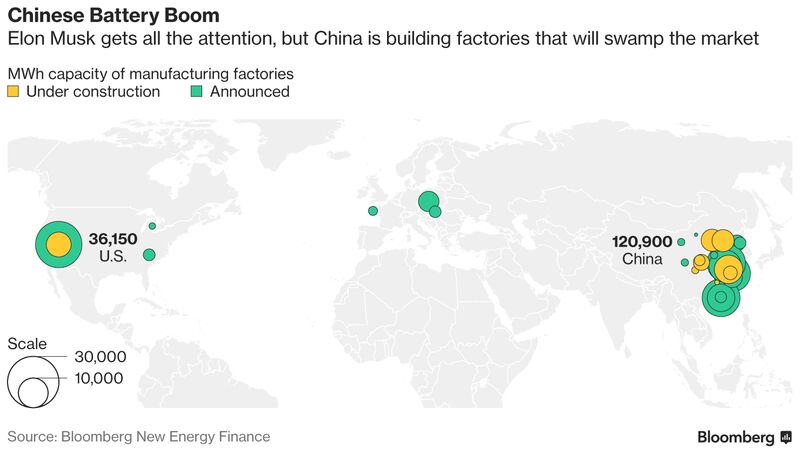
GTM has a look at the wave of gigafactories being built - 10 Battery Gigafactories Are Now in the Works. And Elon Musk May Add 4 More.

Gigafactory announcements have been trending in recent months, with plans for at least 10 new plants revealed in the last six months. Half a dozen have been planned in the last month alone.

In Germany, for example, the Daimler subsidiary Accumotive laid the foundation for a $550 million plant designed to take annual lithium-ion battery production from its current level of 80,000 units up to around 320,000.

And Energy Absolute, of Thailand, reportedly has plans for a $2.9 billion factory in Asia, with an annual production capacity of 1 gigawatt-hour per year, scaling to 50 gigawatt-hours a year by 2020.

Meanwhile, a consortium including Boston Energy and Innovation (BEI), Charge CCCV, C&D Assembly, Primet Precision Materials and Magnis Resources confirmed it will build a 15-gigawatt-hour-a-year plant on IBM’s former Huron Campus manufacturing site in New York.

BEI, Charge CCCV, C&D Assembly and Magnis Resources are also working with Eastman Kodak Group to build a similarly sized plant near Townsville in Queensland, Australia. The backers have said the plant could create around 7,000 jobs.

More recently a company called Energy Renaissance has lifted the lid on plans for a factory in Darwin, in Australia’s Northern Territory, with a production capacity of a gigawatt-hour of batteries a year.

The most aggressive gigafactory plans, however, remain with the company that came up with the concept. Tesla’s Elon Musk has said he will announce “probably four” new gigafactories this year. One has long been slated for Europe, and another has been confirmed to be in the works in Shanghai, China. ...
Tesla Gigafactory Commences Production  

Posted by Big Gav in , , ,

Bloomberg reports that Elon Musk has met his first deadline for Gigafactory production of lithium ion batteries - Tesla Flips the Switch on the Gigafactory.

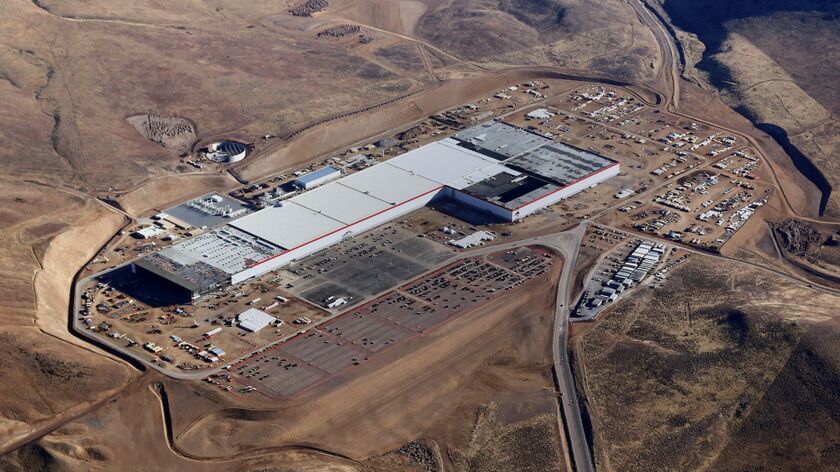
The Gigafactory has been activated. Hidden in the scrubland east of Reno, Nev., where cowboys gamble and wild horses still roam—a diamond-shaped factory of outlandish proportions is emerging from the sweat and promises of Tesla CEO Elon Musk. It’s known as the Gigafactory, and today its first battery cells are rolling off production lines to power the company’s energy storage products and, before long, the Model 3 electric car.

The start of mass production is a huge milestone in Tesla’s quest to electrify transportation, and it brings to America a manufacturing industry—battery cells—that’s long been dominated by China, Japan, and South Korea. More than 2,900 people are already working at the 4.9 million square-foot facility, and another 4,000 jobs (including temporary construction work) will be added this year through the partnership between Tesla and Panasonic.

By 2018, the Gigafactory, which is less than a third complete, will double the world’s production capacity for lithium-ion batteries and employ 6,500 full-time Reno-based workers, according to a new hiring forecast from Tesla.

Inside the Gigafactory  

Posted by Big Gav in , , , ,

Bloomberg has a progress report on the construction of Tesla's battery Gigafactory (now 14% complete) - Inside the Gigafactory That Will Decide Tesla’s Fate.

Elon Musk is also getting attention by announcing a sped-up production schedule that calls for a half-million electric vehicles per year by 2018 (advancing from 2020). Bloomberg noptes - "For a company that delivered just 50,658 vehicles in 2015, the ramp looks like a hockey stick".

There has been a lot of speculation about why Elon does the opposite of "over promising and under delivering" when it comes to announcing release dates, with one observer describing it thusly - "It goes something like this: People do paradigm-shifting work only when they're under tremendous pressure, so the key is to ensure deadlines are always impossible. This could help explain why Musk has never launched a product on time, yet no one seems able to keep up with him. It drives Wall Street nuts."

Whenever I see photos of the Gigafactory landscape I always wonder if Walter White is wandering around in the wastelands beyond...

Why Tesla Wants to Sell a Battery for Your Home  

Posted by Big Gav in , , , , ,

The Tesla Powerwall was the big energy storage news item of last year (though it didn't meet with universal acclaim).

Technology Review had a good summary at the time of what Tesla was looking to achieve - Why Tesla Wants to Sell a Battery for Your Home.

Tesla is launching the home battery business partly because it’s already making vehicle batteries—and as a result it can benefit from the economies of scale that come from making both. Another reason is that the market for storage is expected to grow in concert with the use of solar power. Tesla needs both electric vehicles and solar power to boom if it hopes to fulfill the projected output from a vast $5 billion battery “gigafactory” it’s building in Nevada.

The ABC also has a good explainer from earlier this year on the economics of the Powerwall in Australia - Explained: The Tesla Powerwall and what it means for Australia's energy market (drawing from this analysis by Choice - Powerwall payback).

Tesla is apparently looking to launch a new version of the Powerwall mid-year - in the meantime RenewEconomy reports that they have stopped selling the 10kwh model of the original version - Tesla quietly removes 10kWh Powerwall back-up battery storage option.

The primary use case for home storage is daily cycling, also known as peak shaving, which can be applied a few different ways. The primary reason for the product existing is to store up solar energy made from customer panels during the day, which can then be used at night. In markets with net metering, there is no financial incentive for doing this. In markets with no net metering regulation, Powerwalls — and residential battery storage in general — could be game changers.

GreenTech Media has a report on Tesla's efforts to drive storage costs lower as the Gigafactory nears completion - How Soon Can Tesla Get Battery Cell Costs Below $100 per Kilowatt-Hour?

Ben Kallo at equity analyst firm RW Baird believes that Tesla's current battery costs are ~$150 to ~$200 per kilowatt-hour, well below the industry average pack costs of ~$350 per kilowatt-hour. ... Kallo suggests that the Chevy Bolt's battery costs "are significantly higher" than those of Tesla. Kallo suggests that Tesla "could reach its <$100 per kilowatt-hour target in the intermediate term as Gigafactory production ramps." ... GM sees its battery cell cost hitting $100 per kilowatt-hour in 2022. (GM is quoting cell cost, while Kallo is talking about battery packs. A complete battery pack "typically adds 20 percent above the cost of cells," according to David Snydacker, a battery expert at Dosima Research.)

How Big Is The Tesla Gigafactory ?  

Posted by Big Gav in , , ,

EV Obsession has a graphic putting the new Tesla Gigafactory into context - How Big Is The Tesla Gigafactory?.

Everything is better with a bit of perspective, and a Tesla investor and redditor recently decided to add a bit of perspective with a graphic comparing the Gigafactory to a bunch of large towers an such. With feedback from members of the reddit community, he then had a better idea for how to put the Gigafactory into perspective, so he created another graphic comparing it to other large things.

Gas 2.0 also has a look at the Gigafactory and plans for powering it with renewable energy - Can The Gigafactory Run On Just Renewable Energy?.

It is no small task to power a facility as huge as the Gigafactory, which is said to cover 929,000 square meters and about a thousand acres of land, and over at Engineering.com Tom Lombardo ran some calculations to see just how much power the Gigafactory would need. Based on a Navigant Research study, Lombardo estimates the Gigafactory could consume as much as 2,400 MWh each day if it’s running at full-tilt (that is to say, 500,000 battery packs per year). That’s enough energy to power 80,000 average American homes. Where the hell is Elon Musk going to get all that power?

Well Lombardo goes on to say that if 850,000 square-meters were covered in efficient solar panels (from, say, Solar City?), that alone would generate about 850 MWh of energy per day, about ⅓ of what’s needed. The official Gigafactory picture also included about 85 windmills on the hills in the background, and despite the Reno area not been particularly friendly to wind farms, a setup of similar size would generate about 1,836 MWh of energy, which puts the Gigafactory well past its 2,400 MWh needs. Musk also said geothermal energy could play a role, and a small 10 Mw facility could produce 240 MWh of usable energy each day. All told, the Gigafactory could actually produce 20% more energy than it needs on a daily basis.

Statistics

Locations of visitors to this page

blogspot visitor
Stat Counter

Total Pageviews

Ads

Books

Followers

Blog Archive

Labels

australia (619) global warming (423) solar power (397) peak oil (355) renewable energy (302) electric vehicles (250) wind power (194) ocean energy (165) csp (159) solar thermal power (145) geothermal energy (144) energy storage (142) smart grids (140) oil (139) solar pv (138) tidal power (137) coal seam gas (131) nuclear power (129) china (120) lng (117) iraq (113) geothermal power (112) green buildings (110) natural gas (110) agriculture (91) oil price (80) biofuel (78) wave power (73) smart meters (72) coal (70) uk (69) electricity grid (67) energy efficiency (64) google (58) internet (50) surveillance (50) bicycle (49) big brother (49) shale gas (49) food prices (48) tesla (46) thin film solar (42) biomimicry (40) canada (40) scotland (38) ocean power (37) politics (37) shale oil (37) new zealand (35) air transport (34) algae (34) water (34) arctic ice (33) concentrating solar power (33) saudi arabia (33) queensland (32) california (31) credit crunch (31) bioplastic (30) offshore wind power (30) population (30) cogeneration (28) geoengineering (28) batteries (26) drought (26) resource wars (26) woodside (26) censorship (25) cleantech (25) bruce sterling (24) ctl (23) limits to growth (23) carbon tax (22) economics (22) exxon (22) lithium (22) buckminster fuller (21) distributed manufacturing (21) iraq oil law (21) coal to liquids (20) indonesia (20) origin energy (20) brightsource (19) rail transport (19) ultracapacitor (19) santos (18) ausra (17) collapse (17) electric bikes (17) michael klare (17) atlantis (16) cellulosic ethanol (16) iceland (16) lithium ion batteries (16) mapping (16) ucg (16) bees (15) concentrating solar thermal power (15) ethanol (15) geodynamics (15) psychology (15) al gore (14) brazil (14) bucky fuller (14) carbon emissions (14) fertiliser (14) matthew simmons (14) ambient energy (13) biodiesel (13) investment (13) kenya (13) public transport (13) big oil (12) biochar (12) chile (12) cities (12) desertec (12) internet of things (12) otec (12) texas (12) victoria (12) antarctica (11) cradle to cradle (11) energy policy (11) hybrid car (11) terra preta (11) tinfoil (11) toyota (11) amory lovins (10) fabber (10) gazprom (10) goldman sachs (10) gtl (10) severn estuary (10) volt (10) afghanistan (9) alaska (9) biomass (9) carbon trading (9) distributed generation (9) esolar (9) four day week (9) fuel cells (9) jeremy leggett (9) methane hydrates (9) pge (9) sweden (9) arrow energy (8) bolivia (8) eroei (8) fish (8) floating offshore wind power (8) guerilla gardening (8) linc energy (8) methane (8) nanosolar (8) natural gas pipelines (8) pentland firth (8) saul griffith (8) stirling engine (8) us elections (8) western australia (8) airborne wind turbines (7) bloom energy (7) boeing (7) chp (7) climategate (7) copenhagen (7) scenario planning (7) vinod khosla (7) apocaphilia (6) ceramic fuel cells (6) cigs (6) futurism (6) jatropha (6) nigeria (6) ocean acidification (6) relocalisation (6) somalia (6) t boone pickens (6) local currencies (5) space based solar power (5) varanus island (5) garbage (4) global energy grid (4) kevin kelly (4) low temperature geothermal power (4) oled (4) tim flannery (4) v2g (4) club of rome (3) norman borlaug (2) peak oil portfolio (1)