100% renewable energy cheapest for South America  

Posted by Big Gav in ,

RNE has an article on how to transition South America to 100% renewable energy - 100% renewable energy system cheapest for South America.

Transitioning to a fully renewable energy system, with over 50% coming from solar PV, would be the cheapest option for South America and it is possible in the next 15 years, according to research conducted by the Lappeenranta University of Technology.

As an ever-present accomplice to South America’s dramatic scenery, heavy sunlight could also be the dominant source of energy for the region by 2030, according to a new study from Finnish Lappeenranta University of Technology (LUT) and VTT Technical Research Centre of Finland. But this is not the only clean energy source that the region should adopt, as the study finds that a 100% renewable energy system, including numerous renewable technologies, would be the cheapest energy system option for the region, due to its rich solar, wind and hydro resources.

Mayors Of Paris, Mexico City, Madrid and Athens Move To Ban All Diesel Vehicles By 2025  

Posted by Big Gav in ,

Paris is so smog afflicted it has made public transport free and limited the days drivers are allowed on the roads in a bid to reduce traffic congestion. Paris is also one of a number of city looking to ban diesel vehicles from use by 2025 - Mayors Of Paris, Mexico City, Madrid, & Athens Move To Ban All Diesel Vehicles By 2025.

To be clear on the first commitment, this would apparently apply to all diesel vehicles — including trucks, not just cars. The idea is to improve local air quality and also to reduce greenhouse gas emissions — which is what the C40 forum was initially formed for, the idea being to give mayors working to mitigate and prevent anthropogenic climate change a place to share notes, so to speak.

The mayor of Madrid, Manuela Carmena, commented on this: “The quality of the air that we breathe in our cities is directly linked to tackling climate change. As we reduce the greenhouse gas emissions generated in our cities, our air will become cleaner and our children, our grandparents and our neighbours will be healthier.”

Fake News !  

Posted by Big Gav in ,

With all the recent kerfuffle about "fake news" contributing to Trump's election I found this story about the old "Mockingbird" / Watergate days of official fake news entertaining - The CIA and the Press: When the Washington Post Ran the CIA’s Propaganda Network.

Last week, the Washington Post published a scurrilous piece by a heretofore obscure technology reporter named Craig Timberg, alleging without the faintest evidence that Russian intelligence was using more than 200 independent news sites to pump out pro-Putin and anti-Clinton propaganda during the election campaign.

Under the breathless headline, “Russian propaganda effort helped spread ‘fake news’ during election, experts say,” Timberg concocted his story based on allegations from a vaporous group called ProporNot, run by nameless individuals of unknown origin, whom Timberg (cribbing from the Bob Woodward stylesheet) agreed to quote as anonymous sources. ...

In the meantime, here is a brief historical note on how at the height of the Cold War the CIA developed it’s very own stable of writers, editors and publishers (swelling to as many as 3000 individuals) that it paid to scribble Agency propaganda under a program called Operation Mockingbird. The disinformation network was supervised by the late Philip Graham, former publisher of Timberg’s very own paper, the Washington Post.

Seven energy charts  

Posted by Big Gav in ,

Bloomberg NEF's Michael Liebreich has been in town this week, generating some local press coverage for renewable energy - Seven energy charts that will cheer and frighten about Australia and the world.

Australia has unmatched renewable energy resources but will meet its climate targets only by intervening to accelerate the retirement of coal-fired power plants, according to Michael Liebreich, founder of global advisory service, Bloomberg New Energy Finance. Mr Liebreich said the Turnbull government should avoid setting renewable energy targets and instead focus on devising market-based methods to phase out coal. It should also avoid "perverse" subsidies, such as the speculated $1 billion loan being considered for Adani's proposed mega-coal mine in Queensland, he said. ..

Mr Liebreich told a Sydney audience advances in renewable energy technologies were rapid, with solar photovoltaic prices falling by almost a quarter for each doubling of production. For wind, costs sank 19 per cent with each doubling of turbine output. Breakthroughs come regularly, with the University of NSW last week revealing it had achieved record efficiency rates for its perovskite solar cells, with prospects of more to come.

Meet the High-Tech Buses of Tomorrow  

Posted by Big Gav in ,

The Atlantic's CityLab has an interesting look at the future of urban transportation, including electric buses - Meet the High-Tech Buses of Tomorrow.

While many speculate that the autonomous vehicle technology now being pioneered by the likes of Tesla, Google, Uber, and (maybe!) Apple could spell the end of public transit, others are convinced of the opposite: AVs may roll out first not in private vehicles but in shared, public ones—driverless buses with sensors and artificial intelligence behind the wheel. In fact, some are already being tested in a handful of cities, from Helsinki, Finland, to Washington, D.C., to the city-state Singapore.

Among the vehicles vying to lead the autonomous bus race is Olli, a self-driving electric minibus from the Arizona-based Local Motors. It’s the first of its kind to use IBM’s cognitive Watson technology to interact with passengers. The bus can be summoned in Uber-like fashion, can answer questions about routes and nearby attractions, and could eventually personalize the trip by linking with the passengers’ social media accounts.

Australian Government killed emissions scheme despite knowing it could shave $15 billion off electricity bills  

Posted by Big Gav in , ,

The Australian government is copping a huge amount of flack about its lack of energy policy this week, having first flip flopped (at the behest of the fundamentalist wing of the party) on suggestions that it might consider reintroducing carbon pricing in response to calls from energy industry participants and now having been found to have killed an emissions trading scheme that would have reduced power costs - Government killed emissions scheme despite knowing it could shave $15 billion off electricity bills.

State governments are now talking about introducing their own carbon pricing schemes (see the link for a good summary of carbon pricing schemes around the world) to make up for the policy chaos in Canberra which is stifling investment in energy.

The Turnbull government has been sitting on advice that an emissions intensity scheme - the carbon policy it put on the table only to rule out just 36 hours later - would save households and businesses up to $15 billion in electricity bills over a decade.

While Malcolm Turnbull has rejected this sort of scheme by claiming it would push up prices, analysis in an Australian Electricity Market Commission report handed to the government months ago finds it would actually cost consumers far less than other approaches, including doing nothing.

The Economist: Bolshiness Is Back  

Posted by Big Gav in

The Economist has a look at the slide towards deglobalisation in their "World In 2016" edition - Bolshiness Is Back. I'm not sure raising the spectre of Lenin and communism makes much sense though, given that the global left is basically dead and the threat to the liberal order is coming entirely from right wing authoritarian nationalists.

The global economy has delivered too many of its benefits to the richest: in America, the proportion of after-tax income going to the top 1% doubled from 8% in 1979 to 17% in 2007. And in many ways the future looks worse. Productivity growth has slowed. Unless this can be changed, politics will inevitably become a struggle over dividing up the pie. Tech giants such as Google and Amazon enjoy market shares not seen since the late 19th century, the era of the robber barons.

How can liberals save what is left of the liberal order? Part of the solution lies in being more vigorous in its defence—for example, pointing out that globalisation has lifted millions out of poverty and that reversing it will make today’s economic woes much worse. Part of the solution lies in exposing liberalism’s enemies as the paper tigers that they are: Mr Putin, in particular, presides, by fear and fraud, over a country whose economic power is stalling and whose people are plagued by poverty and illness. Other strongmen around the world are far less tough than they claim.

But liberalism’s champions must do more than just repeat tired mantras. They need to take worries about immigration more seriously and check their instinct to ride roughshod over minorities such as evangelical Christians. They also need to redouble their efforts to fix capitalism’s most obvious problems. High levels of inequality are threatening stability. Economic concentration is allowing companies to extract record profits. Overregulation is driving businesspeople to distraction. The revival of bolshiness has already taken a terrible toll. Liberals need to think more clearly, and act more forcefully, to stop the rot.

Australian Government To Reintroduce Carbon Pricing ?  

Posted by Big Gav in ,

Apparently re-introduction of carbon pricing is a possibility being considered by the Australian government, following pressure from energy industry groups to reduce policy uncertainty and start planning for a de-carbonised future - Conservatives furious over climate review. A dummy spit from the usual suspects happened shortly after the prospect was aired.

Australian Energy Council chief Matthew Warren, representing the bulk of generators, said the most important thing for the industry was a policy that would withstand changes in government. "We'd go for almost anything that has a substantial chance of succeeding and garners bipartisan support, because we can build on it," he said. Mr Warren said a decade of uncertainty on climate and energy policy had driven away investment, leaving a system "now materially degrading before our eyes". He said the energy industry wanted some form of carbon price linked to a clear emissions target that extended beyond 2030 - something the review will consider - to trigger investments in new power stations that would last decades.

Australian Industry Group chief Innes Willox said the country could only play its part in tackling climate change at lowest cost if investors believed policies would survive. "Bipartisanship on climate and energy is the only way forward. The alternative is costly failure," he said.

The Climate Institute said the country had a clear choice: between a review that set Australia on a pathway to zero emissions, or continued the policy chaos of the past 10 years. Deputy chief executive Erwin Jackson said the goal must be a policy framework that was capable of decarbonising the electricity system well before 2050. It must include some form of carbon price, but that alone would not be enough as experience had taught that any scheme would be a political compromise.

CSIRO inks major China solar thermal power deal  

Posted by Big Gav in , , , ,

RNE reports that Australia's CSIRO agency is licencing its solar thermal power technology to the Chinese- CSIRO inks major China solar thermal deal, but home market remains stalled.

Australia’s top science and research organisation, the CSIRO, has inked a deal with Chinese company Thermal Focus to make, sell and install its patented concentrating solar thermal generation technology in China. The partnership is a major coup for the CSIRO, particularly considering the potential market for CST in China, which just last month was named by the IEA as one of the countries most likely to lead the world in a solar

China’s plans for CST – to build 1.4GW of capacity 2018, and 5GW by 2020 – will double the world’s installed CST plants, and the CSIRO deal puts its proven solar heliostat technology in a prime position to bid for a piece of this action.

Standing Rock Stands Tall  

Posted by Big Gav in , ,

The standoff at Standing Rock was looking like turning to Wounded Knee 3 over the weekend, as a small army of veterans converged on the site to try to defend the "water protectors" protesting against the planned North Dakota Access pipeline.

While Donald Trump's financial ties to the project will no doubt ensure that he will attempt to ensure the success of the project as part of his 4 year plan to increase his wealth at taxpayer expense any way he can, for now the natives and the vets can relax as the Army Corps of Engineers decided to deny the pipeline company a permit for their planned river crossing.

The Army Corps of Engineers will not grant the permit for the Dakota Access pipeline to drill under the Missouri river, the army announced on Sunday, handing a major victory to the Standing Rock Sioux Tribe after a months-long campaign against the pipeline. Assistant secretary for civil works Jo-Ellen Darcy announced the decision on Sunday, with the army saying it was based on “a need to explore alternate routes” for the crossing.

The announcement came just one day before the corps’ deadline for thousands of Native American and environmental activists – who call themselves water protectors – to leave the sprawling encampment on the banks of the river. For months, they have protested over their fears that the pipeline would contaminate their water source and destroy sacred sites, and over the weekend hundreds of military veterans arrived at the camps in a show of support for the movement.

Australian Government to Subsidise Building World's Largest Coal Mine  

Posted by Big Gav in

I think it is fair to say that Malcolm Turnbull has been a total disappointment in his time as Prime Minister - Turnbull government eyes $1 billion Adani loan backed by new infrastructure fund.

Environmental groups were outraged by reports the government was moving closer to granting the $1 billion loan. Tim Buckley, analyst at the Institute of Energy Economics and Financial Analysis, said Australian taxpayers should not give "subsidies to foreign billionaires", despite the 1500 jobs that could be created by the mine.

"If you were to provide a billion dollars for solar projects across Australia you would probably create 3000 jobs," Mr Buckley told Fairfax Media. "It's farcical that they're paying out a foreign billionaire and they're doing it into structures that are clearly in tax havens."

Castro exits  

Posted by Big Gav

Fidel Castro must have died a reasonably happy man, having managed to defy an endless succession of US governments determined to kill him.

I've never been to Cuba so I never formed a strong opinion of him or his government, but they did seem to be remarkably effective in areas like healthcare even if they weren't so effective at creating material prosperity.

The hapless BBC interviewer in the video below made me laugh - a classic demonstration of our post truth era. She couldn't manage to deliver even a half coherent official government propaganda line.

German Leaders at Odds with Industry over Electric Cars  

Posted by Big Gav in

Der Spiegel has an article on the slow progress German carmakers are making towards switching to electric vehicles - German Leaders at Odds with Industry over Electric Cars.

With the trend in electric cars picking up, and not just in China, Berlin government circles are increasingly worried that the apparent technological dominance of Daimler, BMW and other German carmakers could soon be a thing of the past. Germany's industry value is being "put to the test" on a "scale that perhaps hasn't yet been totally registered," Chancellor Angela Merkel warned last week in parliament. Economics Minister Gabriel, who is also Merkel's deputy chancellor, pleaded with the industry "to preserve car manufacturing as the leading industry in Germany and Europe." An internal report from his ministry also warned that the companies in question are falling behind in the development of key electromobility components.

Two-wheel takeover: bikes outnumber cars for the first time in Copenhagen  

Posted by Big Gav in

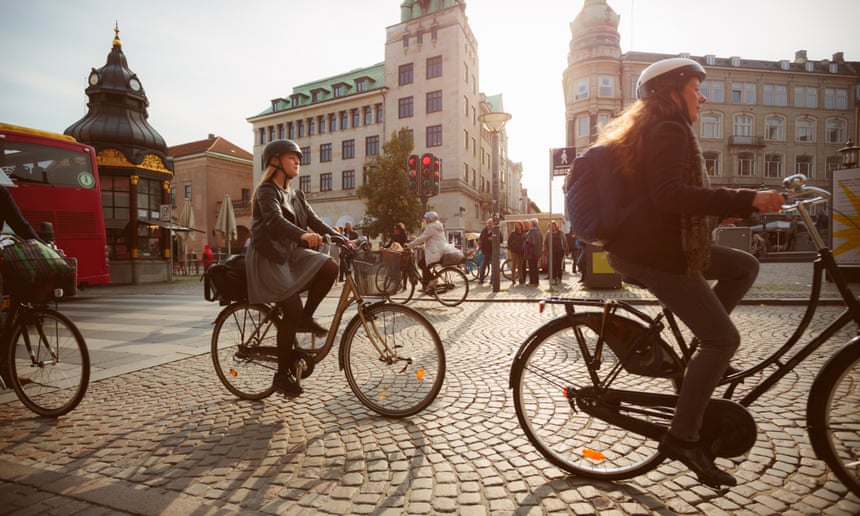
The Guardian has an article on Copenhagen's switch from cars to cycling - Two-wheel takeover: bikes outnumber cars for the first time in Copenhagen.

Bicycle sensors in Copenhagen clocked a new record this month: there are now more bikes than cars in the heart of the city. In the last year, 35,080 more bikes have joined the daily roll, bringing the total number to 265,700, compared with 252,600 cars.

Over in the Netherlands, the Dutch are already reaching the point at which bike traffic is overtaking car traffic. In Amsterdam, 48% of city-centre trips are pedal-powered, while in Groningen’s core, bikes are used for 61% of all trips.

1 GW Solar PV array, the world’s largest, comes on line in China  

Posted by Big Gav in , , ,

Looks like the Indian PV plant touted as the world's largest at 648 MW has lost its crown very quickly to a much larger Chinese installation - 1 GW PV array, the world’s largest, comes on line.

The same solution but on a much larger scale has now been applied at the gigantic Yanchi, Ningxia, solar park, which came on line in September this year and is at 1000 MW the largest contiguous array in the world. Originally planned as a 2 GW array, the park currently contains 1 GW of solar panels controlled by SUN2000-40KTL and SUN2000-50KTL smart PV controllers with internal connection via a smart PV wireless transmission system.

IEA World Energy Outlook 2016  

Posted by Big Gav in , , ,

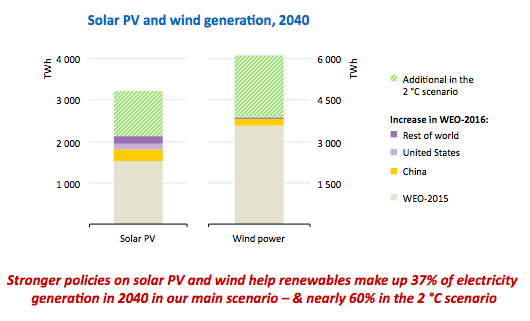
The IEA has released the 2016 version of their annual world energy outlook report - World Energy Outlook 2016.

The report has prompted a spate of articles about "peak oil demand" (with earlier reports from the Economist and WSJ being joined this week by Forbes, Bloomberg and The FT).

Other than speculation about when demand-driven peak oil production will occur, attention concentrated on:

1. Chinese coal use peaking in 2013 - China's coal use likely peaked in 2013 amid rapid shift to renewables, global energy report says (ABC).

2. Wind and solar will contribute will become the dominant source of energy in most major economies within two decades - IEA makes mockery of Turnbull’s renewable energy scare campaign (RNE).

3. Oil production from conventional non-OPEC fields and oil sands will drop by 6.1 million barrels a day by 2040 (although they still predict overall production will rise) - How Big Oil Loses Even Without Peak Demand (Bloomberg).

4. Fatih Birol says"We see clear winners for the next 25 years — natural gas but especially wind and solar — replacing the champion of the previous 25 years, coal" - Renewables & Natural Gas Win Out In World Energy Outlook, But Investors Must Not Misread Oil Demand (Cleantechnica).

5. A combination of efficiency and deployment of renewables has decoupled economic growth from carbon emissions - Massive report details the energy economy that limits warming to 2°C (Ars Technica).

Key Glacier In West Antarctica Breaking Apart From Inside Out  

Posted by Big Gav in ,

CleanTechnica has an article on danger signs emerging on the west antarctic ice sheet - Key Glacier In West Antarctica Breaking Apart From Inside Out — “We May See Significant Collapse Of West Antarctica In Our Lifetimes”.

One of the key glaciers in West Antarctica, as far as the stability of the ice sheet there, Pine Island Glacier, was the site of an enormous 225-square mile iceberg calving in 2015. New research from Ohio State University has determined that this event was even more notable than first thought, as it was the result of a deep, subsurface crack that had formed approximately 20 miles inland — nowhere directly near the calving event.

What this means is that the the West Antarctic Ice Sheet is becoming more unstable far inland, rather than just at the edges in, or near, direct contact with the ocean — very likely due to mechanisms similar to those witnessed in Greenland in recent years. As the bottom of the West Antarctic Ice Sheet actually lies below sea level, relatively warm ocean water can make it far inland, unseen, slowly eroding the foundations — causing increased ice sheet flow, mobility, breakage, and general instability.

Dawn in the desert ?  

Posted by Big Gav in , , , , ,

During the mid-noughties I thought that solar thermal power was going to become in the dominant form of renewable energy in the medium term - failing to foresee just how dramatic the price and performance improvements for solar PV and energy storage would be over the following decade.

Back then a vision called Desertec promised cheap, clean north African solar power providing Europe with a healthy slice of its energy needs (and reducing dependence on Russian gas as a side benefit).

The vision slowly faded as it become clearer that Europe could be largely self-sufficient in renewable energy and that building the grid interconnects between Africa and Europe was going to take along time to eventuate. The organisation pivoting in 2013 to focus more on supplying local power demand, particularly in Morocco, Algeria and Tunisia.

There have been some concerns voiced about the 2.25 GW Tunisian project at Tunur in particular, which still aims to export power to Europe in spite of local power shortages by 2018, via a HVDC interconnect to Malta.

The other major North African solar thermal plant under development is at Ouarzazate in Morocco, featuring in a recent BBC report - The colossal African solar farm that could power Europe.

Noor 1, the first phase of the Moroccan plant, has already surpassed expectations in terms of the amount of energy it has produced. ... Noor 2 will be similar to the first phase, but Noor 3 will experiment with a different design. Instead of ranks of mirrors it will capture and store the Sun’s energy with a single large tower, which is thought to be more efficient. Seven thousand flat mirrors surrounding the tower will all track and reflect the sun’s rays towards a receiver at the top, requiring much less space than existing arrangement of mirrors. Molten salts filling the interior of the tower will capture and store heat directly, doing away with the need for hot oil.

Similar systems are already used in South Africa, Spain and a few sites in the US, such as California’s Mojave desert and Nevada. But at 86ft (26m) tall, Ouarzazate’s recently erected structure is the highest of its kind in the world. Other plants in Morocco are already underway. Next year construction will begin at two sites in the south-west, near Laayoune and Boujdour, with plants near Tata and Midelt to follow.

The success of these plants in Morocco – and those in South Africa - may encourage other African countries to turn to solar power. South Africa is already one of the world’s top 10 producers of solar power and Rwanda is home to east Africa’s first solar plant, which opened in 2014. Large plants are being planned for Ghana and Uganda.

400 ultra-fast charging stations for electric vehicles on the way for Europe  

Posted by Big Gav in

Elektrek reports that Ford and a group of German car manufacturers are rolling out a network of fast charging stations in Europe - 5 major automakers join forces to deploy 400 ultra-fast (350 kW) charging stations for electric vehicles in Europe.

BMW, Daimler’s Mercedes, Ford, and Volkswagen’s Audi and Porsche announced today that they are creating a joint-venture with the goal of a “quick build-up of a sizable number of stations in order to enable long-range travel for battery electric vehicle drivers.” ...

The new network will be based on Combined Charging System (CCS) standard technology and each station will feature not only both level 2 AC chargers and level 3 DC chargers, but also the new ” ultra-fast high-powered chargers” and, like the ones of the Ultra E project, they will be able to deliver up to 350 kW – more than twice the capacity of the current best charger, Tesla’s Supercharger at 145 kW. 400 sites are apparently just the “initial target” of the joint-venture and deployment will start in 2017.

The automakers confirmed that every vehicle using the CCS standard will be able to use the new network – meaning that they will create an independent network. It reflects recent comments made by Porsche executives regarding the deployment of their new 800 volts charging system being compatible with other vehicles, like Tesla’s.

Tesla currently has just over 260 Supercharger stations in Europe, but it plans to almost double that number before the Model 3 arrives in Europe in 2018. Some good healthy competition in charging station deployment is likely to accelerate adoption.

India unveils the world's largest solar power plant  

Posted by Big Gav in , , ,

Al Jazeera has a report on India's massive Kamuthi solar PV power plant - India unveils the world's largest solar power plant.

The facility in Kamuthi, Tamil Nadu, has a capacity of 648 MW and covers an area of 10 sq km. This makes it the largest solar power plant at a single location, taking the title from the Topaz Solar Farm in California, which has a capacity of 550 MW. The solar plant, built in an impressive eight months and funded by the Adani Group, is cleaned every day by a robotic system, charged by its own solar panels.

The project is comprised of 2.5 million individual solar modules, and cost $679m to build. The new plant has helped nudge India's total installed solar capacity across the 10 GW mark.

Statistics

Locations of visitors to this page

blogspot visitor
Stat Counter

Total Pageviews

Ads

Books

Followers

Blog Archive

Labels

australia (619) global warming (423) solar power (397) peak oil (355) renewable energy (302) electric vehicles (250) wind power (194) ocean energy (165) csp (159) solar thermal power (145) geothermal energy (144) energy storage (142) smart grids (140) oil (139) solar pv (138) tidal power (137) coal seam gas (131) nuclear power (129) china (120) lng (117) iraq (113) geothermal power (112) green buildings (110) natural gas (110) agriculture (91) oil price (80) biofuel (78) wave power (73) smart meters (72) coal (70) uk (69) electricity grid (67) energy efficiency (64) google (58) internet (50) surveillance (50) bicycle (49) big brother (49) shale gas (49) food prices (48) tesla (46) thin film solar (42) biomimicry (40) canada (40) scotland (38) ocean power (37) politics (37) shale oil (37) new zealand (35) air transport (34) algae (34) water (34) arctic ice (33) concentrating solar power (33) saudi arabia (33) queensland (32) california (31) credit crunch (31) bioplastic (30) offshore wind power (30) population (30) cogeneration (28) geoengineering (28) batteries (26) drought (26) resource wars (26) woodside (26) censorship (25) cleantech (25) bruce sterling (24) ctl (23) limits to growth (23) carbon tax (22) economics (22) exxon (22) lithium (22) buckminster fuller (21) distributed manufacturing (21) iraq oil law (21) coal to liquids (20) indonesia (20) origin energy (20) brightsource (19) rail transport (19) ultracapacitor (19) santos (18) ausra (17) collapse (17) electric bikes (17) michael klare (17) atlantis (16) cellulosic ethanol (16) iceland (16) lithium ion batteries (16) mapping (16) ucg (16) bees (15) concentrating solar thermal power (15) ethanol (15) geodynamics (15) psychology (15) al gore (14) brazil (14) bucky fuller (14) carbon emissions (14) fertiliser (14) matthew simmons (14) ambient energy (13) biodiesel (13) investment (13) kenya (13) public transport (13) big oil (12) biochar (12) chile (12) cities (12) desertec (12) internet of things (12) otec (12) texas (12) victoria (12) antarctica (11) cradle to cradle (11) energy policy (11) hybrid car (11) terra preta (11) tinfoil (11) toyota (11) amory lovins (10) fabber (10) gazprom (10) goldman sachs (10) gtl (10) severn estuary (10) volt (10) afghanistan (9) alaska (9) biomass (9) carbon trading (9) distributed generation (9) esolar (9) four day week (9) fuel cells (9) jeremy leggett (9) methane hydrates (9) pge (9) sweden (9) arrow energy (8) bolivia (8) eroei (8) fish (8) floating offshore wind power (8) guerilla gardening (8) linc energy (8) methane (8) nanosolar (8) natural gas pipelines (8) pentland firth (8) saul griffith (8) stirling engine (8) us elections (8) western australia (8) airborne wind turbines (7) bloom energy (7) boeing (7) chp (7) climategate (7) copenhagen (7) scenario planning (7) vinod khosla (7) apocaphilia (6) ceramic fuel cells (6) cigs (6) futurism (6) jatropha (6) nigeria (6) ocean acidification (6) relocalisation (6) somalia (6) t boone pickens (6) local currencies (5) space based solar power (5) varanus island (5) garbage (4) global energy grid (4) kevin kelly (4) low temperature geothermal power (4) oled (4) tim flannery (4) v2g (4) club of rome (3) norman borlaug (2) peak oil portfolio (1)