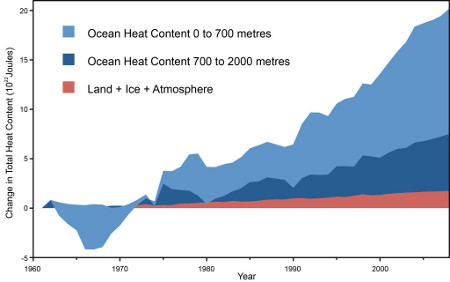
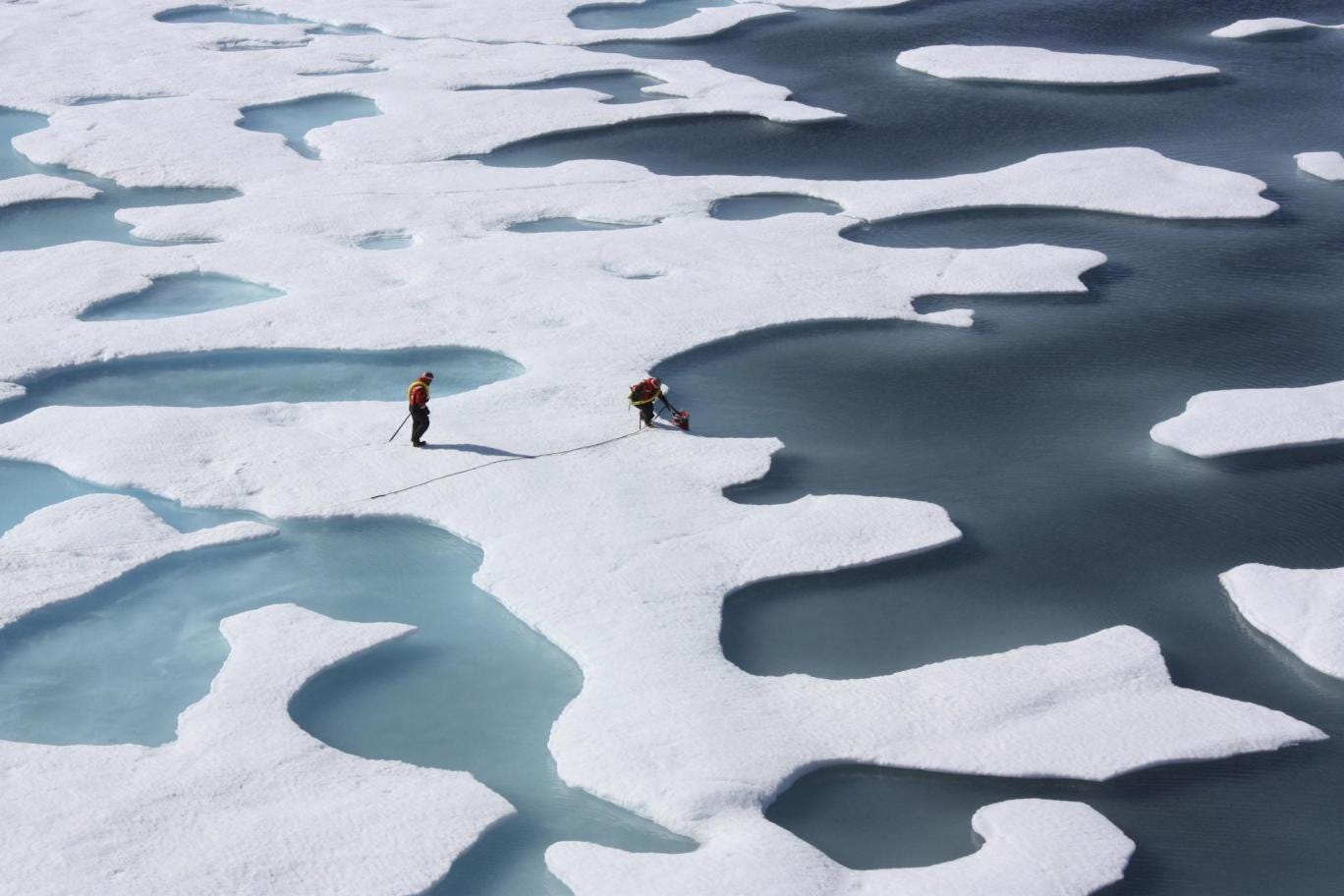
Showing posts with label arctic ice. Show all posts

Arctic Sea Ice At Record Low Level  

Posted by Big Gav in ,

"A Climate Change Economist Sounds the Alarm" - Nordhaus admits he was wrong  

Posted by Big Gav in ,

Bloomberg reports that Yale's William Nordhaus has finally admitted urgent action is required to reduce carbon emissions - A Climate Change Economist Sounds the Alarm.

In the early 1990s, Yale's William Nordhaus was among the first to examine the economics of reducing carbon emissions. Since then, he and colleagues have mixed climate physics with economic modeling to explore how various policies might play out both for global temperatures and growth. The approach attempts to weigh, in present-value terms, the costs of preventative measures against the future benefit of avoiding disaster.

Nordhaus has mostly argued for a small carbon tax, aimed at achieving a modest reduction in emissions, followed by sharper reductions in the medium and long term. Too much mitigation now, he has suggested, would damage economic growth, making us less capable of doing more in the future. This view has helped fossil fuel companies and climate change skeptics oppose any serious policy response.

In his latest analysis, though, Nordhaus comes to a very different conclusion. Using a more accurate treatment of how carbon dioxide may affect temperatures, and how remaining uncertainties affect the likely economic outcomes, he finds that our current response to global warming is probably inadequate to prevent temperatures from rising more than 2 degrees Celsius above their pre-industrial levels, a stated goal of the Paris accords.

Worse, the analysis suggests that the required carbon-dioxide reductions are beyond what's politically possible. For all the talk of curbing climate change, most nations remain on a business-as-usual trajectory. Meanwhile, further economic growth will drive even greater carbon emissions over coming decades, particularly in developing nations.

‘Beyond the extreme’: Scientists marvel at ‘increasingly non-natural’ Arctic warmth  

Posted by Big Gav in , ,

While it isn't as hot as Sydney has been, the Arctic is still wildly warmer than normal - ‘Beyond the extreme’: Scientists marvel at ‘increasingly non-natural’ Arctic warmth. How many years until it is ice free ?

Apparently Antarctic sea ice is likely to hit new record lows in the coming days as well...

2016 was the warmest year on record in the Arctic, and 2017 has picked up right where it left off. “Arctic extreme (relative) warmth continues,” Ryan Maue, a meteorologist with WeatherBell Analytics, tweeted on Wednesday, referring to January’s temperatures.

Veteran Arctic climate scientists are stunned. “[A]fter studying the Arctic and its climate for three and a half decades, I have concluded that what has happened over the last year goes beyond even the extreme,” wrote Mark Serreze, director of the National Snow and Ice Data Center in Boulder, Colo., in an essay for Earth magazine.

At the North Pole, the mercury has rocketed to near the melting point twice since November, and another huge flux of warmth is projected by models next week. Their simulations predict some places in the high Arctic will rise over 50 degrees above normal.

Why is the Arctic so warm in winter ?  

Posted by Big Gav in ,

The Independent has an article by Chris Mooney on the melting Arctic and research into how this affects the weather patterns in North America an Eurasia - The Arctic is showing stunning winter warmth, and these scientists think they know why.

Last month, temperatures in the high Arctic spiked dramatically, some 36 degrees Fahrenheit above normal -- a move that corresponded with record low levels of Arctic sea ice during a time of year when this ice is supposed to be expanding during the freezing polar night.

And now this week we're seeing another huge burst of Arctic warmth. A buoy close to the North Pole just reported temperatures close to the freezing point of 32 degrees Fahrenheit (0 Celsius), which is 10s of degrees warmer than normal for this time of year. Although it isn't clear yet, we could now be in for another period when sea ice either pauses its spread across the Arctic ocean, or reverses course entirely.

But these bursts of Arctic warmth don't stand alone -- last month, extremely warm North Pole temperatures corresponded with extremely cold temperatures over Siberia. This week, meanwhile, there are large bursts of un-seasonally cold air over Alaska and Siberia once again.

It is all looking rather consistent with an outlook that has been dubbed "Warm Arctic, Cold Continents" -- a notion that remains scientifically contentious but, if accurate, is deeply consequential for how climate change could unfold in the Northern Hemisphere winter.

The core idea here begins with the fact that the Arctic is warming up faster than the mid-latitudes and the equator, and losing its characteristic floating sea ice cover in the process. This also changes the Arctic atmosphere, the theory goes, and these changes interact with large scale atmospheric patterns that affect our weather (phenomena like the jet stream and the polar vortex). We won't get into the details yet, but in essence, the result can be a kind of swapping of the cold air masses of the Arctic with the warm air masses to the south of them. The Arctic then gets hot (relatively), and the mid-latitudes -- including sometimes, as during the infamous "polar vortex" event of 2013-2014, the United States -- get cold.

Arctic ice melt could trigger uncontrollable climate change at global level  

Posted by Big Gav in ,

The Guardian has a look at the melting arctic - Arctic ice melt could trigger uncontrollable climate change at global level.

Arctic scientists have warned that the increasingly rapid melting of the ice cap risks triggering 19 “tipping points” in the region that could have catastrophic consequences around the globe. The Arctic Resilience Report found that the effects of Arctic warming could be felt as far away as the Indian Ocean, in a stark warning that changes in the region could cause uncontrollable climate change at a global level.

Temperatures in the Arctic are currently about 20C above what would be expected for the time of year, which scientists describe as “off the charts”. Sea ice is at the lowest extent ever recorded for the time of year.

Strange, super-hot temperatures at the Arctic mean that sea ice is melting  

Posted by Big Gav in ,

The Independent has an article on the unprecedented warmth in the Arctic - Strange, super-hot temperatures at the Arctic mean that sea ice is melting. Yale Environment 360 reports that the Chinese and Russians are looking to take advantage of the new shipping lanes opening up to the North - Full Speed Ahead: Shipping Plans Grow as Arctic Ice Fades.

Russia, China, and other nations are stepping up preparations for the day when large numbers of cargo ships will be traversing a once-icebound Arctic Ocean. But with vessels already plying these waters, experts say the time is now to prepare for the inevitable environmental fallout.

A bleak-looking sea ice graph has Twitter in a frenzy  

Posted by Big Gav in ,

The Verge has a look at this week's Twitter (and Facebook) storm about sea ice extent - A bleak-looking sea ice graph has Twitter in a frenzy. It is at record lows in the arctic, but not quite as catastrophically low as the graph circulating suggested (yet).

So why is this causing such a hubbub on Twitter? What's so alarming about this representation?

It's global sea ice area — meaning both the Arctic and Antarctic. We typically associate recent low sea ice cover (from climate change and natural variability) in the Arctic, but not the Antarctic. In this case, both the Arctic and Antarctic are at record lows for the date.

Greenland ice sheet melt breaking records  

Posted by Big Gav in , ,

Climate Change News has a slightly alarming report about the accelerating warming of the Arctic - Greenland sees record-smashing early ice sheet melt - "Even a weather station 1840 metres above sea level recorded a maximum of 3.1C, which data analysts said would be warm for July, let alone April".

Global warming melts edge of Greenland ice sheet  

Posted by Big Gav in , ,

The SMH has a look at monitoring of the melting of Greenland's glaciers - Global warming melts edge of Greenland icesheet.

The last edge of the Greenland ice sheet that had resisted global warming has now become unstable, adding billions of tonnes of meltwater to rising seas, scientists say. In a study published in the journal Nature Climate Change, they say a surge in temperature from 2003 has eased the brakes on a long "river" of ice that flows to the coast in northeastern Greenland.

Known as an ice stream, the "river" takes ice from a vast basin and slowly shifts it to the sea - in the same way the Amazon River drains water.

In the past, the flow from this ice stream was constrained by massive buildups of ice debris choking its mouth. But a three-year spell of exceptionally high temperatures removed this blockage - and like a cork removed from a bottle helped accelerate the flow, the study said.

Global Cooling ? The Growing Arctic Sea Ice Delusion  

Posted by Big Gav in ,

The Guardian has a great article on one of the usual recurrences of climate skepticism that accompany any annual arctic sea ice shrinkage not being as large as a preceding year - Arctic sea ice delusions strike the Mail on Sunday and Telegraph.

The reason so many climate scientists predicted more ice this year than last is quite simple. There's a principle in statistics known as "regression toward the mean," which is the phenomenon that if an extreme value of a variable is observed, the next measurement will generally be less extreme. In other words, we should not often expect to observe records in consecutive years. 2012 shattered the previous record low sea ice extent; hence 'regression towards the mean' told us that 2013 would likely have a higher minimum extent.

The amount of Arctic sea ice left at the end of the annual melt season is mainly determined by two factors – natural variability (weather patterns and ocean cycles), and human-caused global warming. The Arctic has lost 75 percent of its summer sea ice volume over the past three decades primarily due to human-caused global warming, but in any given year the weather can act to either preserve more or melt more sea ice. Last year the weather helped melt more ice, while this year the weather helped preserve more ice.

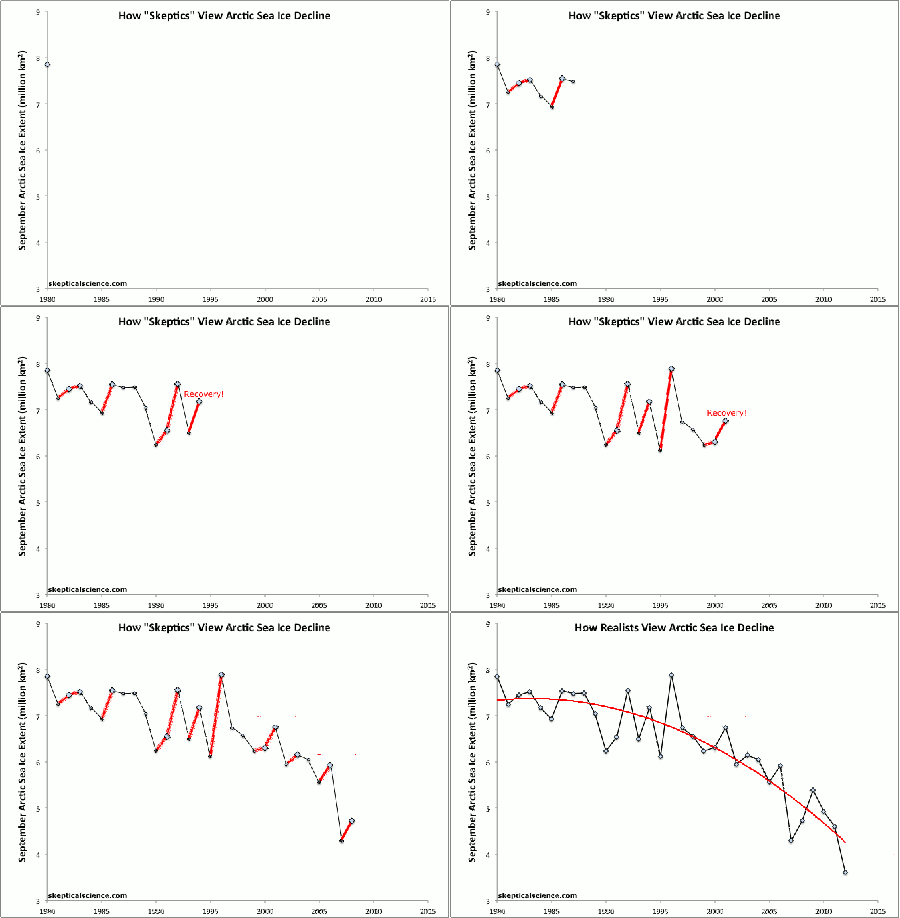
Last year I created an animated graphic called the 'Arctic Escalator' that predicted the behavior we're now seeing from the Mail on Sunday and Telegraph. Every year when the weather acts to preserve more ice than the previous year, we can rely on climate contrarians to claim that Arctic sea ice is "rebounding" or "recovering" and there's nothing to worry about. Given the likelihood that 2013 would not break the 2012 record, I anticipated that climate contrarians would claim this year as yet another "recovery" year, exactly as the Mail on Sunday and Telegraph have done.

In short, this year's higher sea ice extent is merely due to the fact that last year's minimum extent was record-shattering, and the weather was not as optimal for sea ice loss this summer. However, the long-term trend is one of rapid Arctic sea ice decline, and research has shown this is mostly due to human-caused global warming.
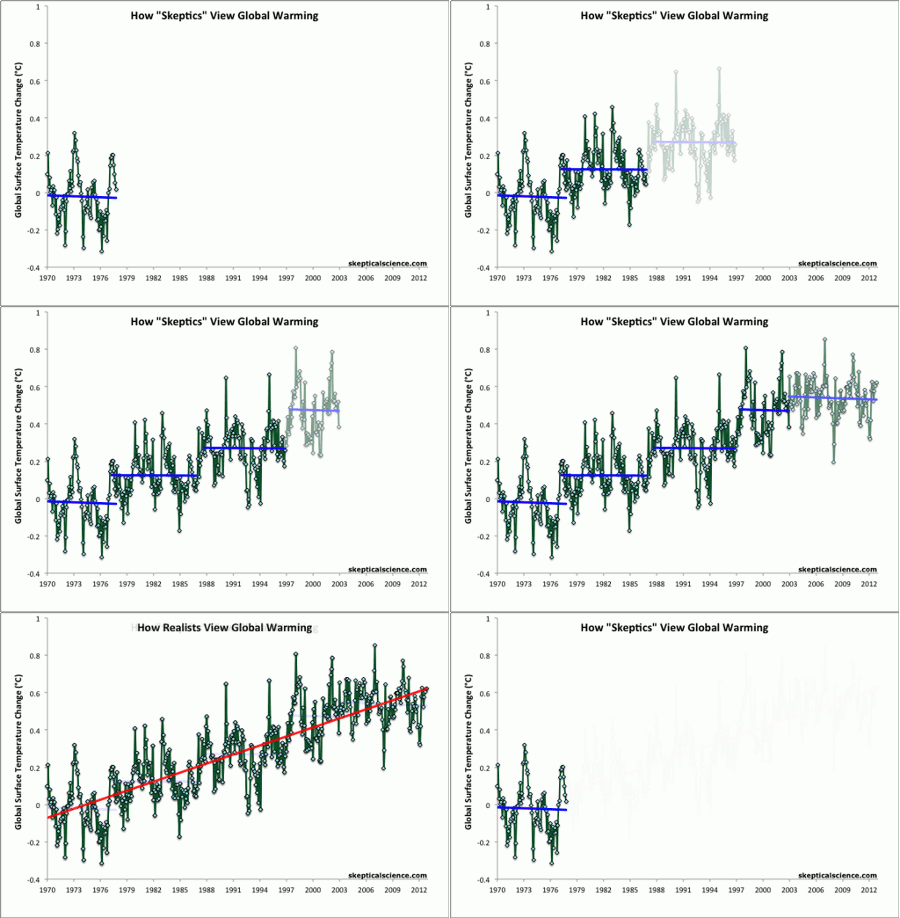
The Guardian also has an article on the bout of unseasonally hot weather in eastern Australia - Bushfires in September: voting while the planet burns.

We still get more or less the same rainfall but it now seems to come down in huge torrents, rather than weeks of slow drizzle, so we get more raging floods and then it stops completely, like it has now. It hasn't rained a drop up here for almost three months and the place is dry – very dry. It's also getting much hotter much earlier. My husband used to complain bitterly that we didn't see even a hint of spring until October at the earliest.

In the last few years, however, the daffodils are finished already and the wisteria is in full bloom – and it's only just September. And as we drove along the narrow dirt road towards our place yesterday, my daughter and I observed something much more sinister. The valley was in flames. Now don't get me wrong, spring is the traditional time when farmers up here burn to keep down weeds and ticks, so the grass fires we passed didn't worry us unduly at first. Though, as we commented, at 30 degrees (in September!) and with everything so tinder dry, it seemed high risk to do even a controlled burn. Then we got to our own property, and it was on fire too. Which couldn't be a controlled burn because we had not been there to either light it or control it. And, as well as breeding cattle, we grow trees as a commercial plantation – so when we burn, we watch it very carefully.

As a neighbour explained, the fires had been burning for three solid weeks, slowly eating their way up the valley. They hadn't done any real damage, sticking to the undergrowth and not getting into the canopy at all. To be honest, they've probably done us a favour by getting rid of the built up fuel that might be a real danger once summer hits, particularly if it stays this dry. Nevertheless, it spooked us a bit. In 40 years of visiting this valley, we had never seen or heard of such a slow fire, especially in August and September. Nor can anyone remember spring coming quite so early or being quite so hot. In fact, the world has just experienced its 342nd consecutive month of hotter-than-average temperatures.

In the evening as we watched Australia elect a government sworn to repeal the carbon tax, we couldn't help remarking on the irony, particularly as we watched the results come in while listening to the fire in the paddock across the river crackle and burn. As darkness fell, we could see little red pockets of fire scattered amongst the thick woodlands to our north and hear the crash of the occasional burnt out tree as it fell – in early September, on the edge of a temperate rainforest. We may have got a little drunker than we'd intended listening to the fire while watching Australians decide that what we could see, smell and hear either didn't matter or, if it did, wasn't important enough to truly do anything about it.

According to leaked details from the most recent report from the Intergovernmental Panel on Climate Change in the Sydney Morning Herald yesterday, the world's ice sheets are melting rapidly as the planet warms. Greenland's ice added six times more to sea levels in the decade up to 2011 than in the previous 10 years and the Antarctic melt produced a five-fold increase.

Energy Companies Try Arctic Shipping Shortcut Between Europe and Asia  

Posted by Big Gav in ,

The WSJ has an example of a vicious circle in action - now global warming has melted half of the Arctic we can now ship hydrocarbons across it - Energy Companies Try Arctic Shipping Shortcut Between Europe and Asia.

Japanese and South Korean energy companies have begun shipping oil products through the Arctic's melting ice—adding credibility to a route that could slash costs while avoiding risks associated with ferrying cargo through the Suez Canal.

The ships are taking the so-called Northern Sea Route, traders and shipbrokers in Singapore said, a shortcut between Asia and Europe along Russia's Arctic Ocean coast. This marks the first time oil-derived products have been moved in such large volume through what maritime explorers of centuries past dubbed the Northeast Passage.

There have also been shipments by this route of gas condensate—a form of hydrocarbon—and iron ore in the past couple of years, and last year Russian gas giant Gazprom, OGZPY -1.25% in a test run, sent a load of liquefied natural gas to Japan.

Rapid Arctic thawing could be economic timebomb, scientists say  

Posted by Big Gav in ,

The Guardian has a look at a new report on the cost of unfreezing the arctic - Rapid Arctic thawing could be economic timebomb, scientists say.

Rapid thawing of the Arctic could trigger a catastrophic "economic timebomb" which would cost trillions of dollars and undermine the global financial system, say a group of economists and polar scientists.

Governments and industry have expected the widespread warming of the Arctic region in the past 20 years to be an economic boon, allowing the exploitation of new gas and oilfields and enabling shipping to travel faster between Europe and Asia. But the release of a single giant "pulse" of methane from thawing Arctic permafrost beneath the East Siberian sea "could come with a $60tn [£39tn] global price tag", according to the researchers who have for the first time quantified the effects on the global economy.

Even the slow emission of a much smaller proportion of the vast quantities of methane locked up in the Arctic permafrost and offshore waters could trigger catastrophic climate change and "steep" economic losses, they say.

The Arctic sea ice, which largely melts and reforms each year, is declining at an unprecedented rate. In 2012, it collapsed to under 3.5m sqkm by mid September, just 40% of its usual extent in the 1970s. Because the ice is also losing its thickness, some scientists expect the Arctic ocean to be largely free of summer ice by 2020.

The growing fear is that as the ice retreats, the warming of the sea water will allow offshore permafrost to release ever greater quantities of methane. A giant reservoir of the greenhouse gas, in the form of gas hydrates on the East Siberian Arctic Shelf (ESAS), could be emitted, either slowly over 50 years or catastrophically fast over a shorter time frame, say the researchers.

Snow and Arctic sea ice extent plummet suddenly as globe bakes  

Posted by Big Gav in ,

the Washington Post has a look at this years arctic sea ice melt - Snow and Arctic sea ice extent plummet suddenly as globe bakes.

You may recall, late last summer the Arctic sea ice extent dropped to its lowest level on record, 49 percent below the 1979-2000 average. It’s not clear if 2013 levels will match 2012′s astonishing record low, but – with temperatures over the Arctic Ocean 1-3 degrees above average – the 2013 melt season has picked up in earnest during July.

“During the first two weeks of July, ice extent declined at a rate of 132,000 square kilometers (51,000 square miles) per day. This was 61% faster than the average rate of decline over the period 1981 to 2010 of 82,000 square kilometers (32,000 square miles) per day,” the National Snow and Ice Data Center writes on its website.

UN sounds alarm on record Arctic ice melt  

Posted by Big Gav in ,

The SMH has a report on last year's arctic ice melt - UN sounds alarm on record Arctic ice melt.

The Arctic's sea ice melted at a record pace in 2012, the ninth-hottest year on record, compounding concerns about climate change underscored by extreme weather such as Hurricane Sandy, the UN weather agency says. In a report on the situation in 2012, the World Meteorological Organisation said on Thursday that during the August to September melting season, the Arctic's sea ice cover was just 3.4 million square kilometres. That was a full 18 per cent less than the previous record low set in 2007.

WMO Secretary-General Michel Jarraud dubbed it a "disturbing sign of climate change." "The year 2012 saw many other extremes as well, such as droughts and tropical cyclones. Natural climate variability has always resulted in such extremes, but the physical characteristics of extreme weather and climate events are being increasingly shaped by climate change," he said. "For example, because global sea levels are now about 20 centimetres higher than they were in 1880, storms such as Hurricane Sandy are bringing more coastal flooding than they would have otherwise," he added.

Latest Arctic Sea Ice Area  

Posted by Big Gav in ,

Via Early Warning.

Climate Skeptics To Sink Through The Disappearing Sea Ice ?  

Posted by Big Gav in ,

Stuart at Early Warning has a look at the likely point where arctic sea ice disappears completely during the northern summer - More on Arctic Sea Ice Volume.

Following up to yesterday's quick lunchtime ice volume post. This morning I processed the data a bit differently by computing the average for each month in each year and then plotting the monthly series separately. The results are above. For the months July-December I fit a quadratic - which gives a decent fit in all cases.

The extrapolations show the Arctic ice free for six months out of the year by 2025.

A word about extrapolations, which are always dangerous. They get more dangerous when:

There is no particular theoretical basis for the curve used as a model.
The model has a lot of parameters (so that it has the opportunity to fit tightly in the sample period but go haywire outside of it).
The extrapolation goes for a long way relative to the interval over which there is data.
There is reason to suspect the underlying dynamics of the system might change during the extrapolated period.
The underlying data are suspect, particularly if there are systematic errors that the fit is sensitive too.

In this case, we have no theoretical model - this is purely an empirical fit. (The theoretical models of the Arctic are climate models, which uniformly failed to predict the rapid and early collapse in sea-ice volume that has actually been observed - so they are presumably missing something important about the dynamics). On the plus side, we only have three parameters - a quadratic is the simplest possible model of an accelerating process, and this process is clearly accelerating. Furthermore, the quadratic gives a decent fit for all months, it's not just a fluke that it happened to fit in September. The resulting extrapolations tell a fairly consistent plausible story: ice will disappear first in September, with October and August very close behind, and then November and July, followed by December.

For the extrapolation interval, it appears to be quite short for August - October - around 15% of the data interval. We don't need the system to keep behaving the same way for very long at all in order for the extrapolated curve to go to zero. For the succeeding months the extrapolations obviously get more and more speculative.

We don't particularly have any reason to expect the dynamics to change soon. The Arctic has long been expected to warm dramatically under climate change, and all indications are that it has indeed been warming and will continue to warm. There is no historical evidence of climate fluctuations this large in Arctic ice. However, it's possible that part of the recent move is a fluctuation that could revert and delay the inevitable. In particular, look at the recovery in ice volume in the early 1980s - a similar recovery in the next few years could push things out by a decade.

This was a follow up to an earlier post - Arctic Sea Ice Volume.

Strange that explorers competed for years to travel by sled to a place that will no longer exist. Maybe I'm naive, but it seems this will change the debate about climate change - the complete absence of a polar ice cap seems much easier for an ordinary person to understand, versus complex arguments about data-analysis on global temperature statistics, requiring that you trust scientists and their computer models. Arguing that climate change isn't happening will become akin to arguing that the earth is flat.

Why The Arctic Sea Ice Death Spiral Matters  

Posted by Big Gav in ,

Climate Progress has an update on the slow demise of arctic sea ice - Why The Arctic Sea Ice Death Spiral Matters.

In the past week the Arctic sea ice cover reached an all-time low, several weeks before previous records, several weeks before the end of the melting season. The long-term decline of Arctic sea ice has been incredibly fast, and at this point a sudden reversal of events doesn’t seem likely. The question no longer seems to be “will we see an ice-free Arctic?” but “how soon will we see it?”. By running the Arctic Sea Ice blog for the past three years I’ve learned much about the importance of Arctic sea ice. With the help of Kevin McKinney I’ve written the piece below, which is a summary of all the potential consequences of disappearing Arctic sea ice.

Arctic sea ice became a recurrent feature on planet Earth around 47 million years ago. Since the start of the current ice age, about 2.5 million years ago, the Arctic Ocean has been completely covered with sea ice. Only during interglacials, like the one we are in now, does some of the sea ice melt during summer, when the top of the planet is oriented a bit more towards the Sun and receives large amounts of sunlight for several summer months. Even then, when winter starts, the ice-free portion of the Arctic Ocean freezes over again with a new layer of sea ice.

Since the dawn of human civilization, 5000 to 8000 years ago, this annual ebb and flow of melting and freezing Arctic sea ice has been more or less consistent. There were periods when more ice melted during summer, and periods when less melted. However, a radical shift has occurred in recent times. Ever since satellites allowed a detailed view of the Arctic and its ice, a pronounced decrease in summer sea ice cover has been observed (with this year setting a new record low). When the IPCC released its Fourth Assessment Report in 2007, it was generally thought that the Arctic could become ice-free somewhere near the end of this century. But changes in the Arctic have progressed at such speed that most experts now think 2030 might see an ice-free Arctic for the first time. Some say it could even happen this decade.

Shock as retreat of Arctic sea ice releases greenhouse gas  

Posted by Big Gav in ,

The Independent has a report on global warming in the Arctic - Shock as retreat of Arctic sea ice releases deadly greenhouse gas.

Dramatic and unprecedented plumes of methane – a greenhouse gas 20 times more potent than carbon dioxide – have been seen bubbling to the surface of the Arctic Ocean by scientists undertaking an extensive survey of the region.

The scale and volume of the methane release has astonished the head of the Russian research team who has been surveying the seabed of the East Siberian Arctic Shelf off northern Russia for nearly 20 years.

In an exclusive interview with The Independent, Igor Semiletov, of the Far Eastern branch of the Russian Academy of Sciences, said that he has never before witnessed the scale and force of the methane being released from beneath the Arctic seabed.

"Earlier we found torch-like structures like this but they were only tens of metres in diameter. This is the first time that we've found continuous, powerful and impressive seeping structures, more than 1,000 metres in diameter. It's amazing," Dr Semiletov said. "I was most impressed by the sheer scale and high density of the plumes. Over a relatively small area we found more than 100, but over a wider area there should be thousands of them."

Updates on Greenland’s Ice  

Posted by Big Gav in , ,

The NYT's Dot Earth blog has an update on Greenland's melting ice - Updates on Greenland’s Ice.

New research on the dynamics of Greenland’s ice sheets complicates efforts to forecast sea level rise in this century, as the Green Blog reports. Expanding fields of crevasses appear to be limiting the flow of water to the base of the ice through tube-like moulins. That flow has been thought to ease the seaward movement of the ice over bedrock. But the crevasses also warm the ice as liquid water descends deep inside the frozen mass, with that process also potentially speeding its flow. This diagram shows the two types of plumbing.

In the meantime, the high recent rate of ice loss in Greenland, according to other new research, has largely continued.

Arctic ice melts to lowest level on record  

Posted by Big Gav in ,

The SMH reports that this year is a new low for Arctic sea ice coverage - Arctic ice melts to lowest level on record

Ice at the North Pole has melted to the lowest level since satellite observations began in 1972, meaning the Arctic is almost certainly the smallest it has been for 8000 years, polar scientists said. If the trend continues, the Arctic will be largely ice-free in the northern summer 40 years earlier than anticipated in the last Intergovernmental Panel on Climate Change assessment report.

Daily satellite sea ice maps released by Bremen University physicists show that with a week's further melt expected this year, the floating ice in the Arctic covered 4.24 million square kilometres on September 8. The previous one-day minimum was 4.27 million square kilometres on September 17, 2007. ...

The German researchers said the record melt was undoubtedly because of human-induced global warming. ''The sea ice retreat can no more be explained with the natural variability … caused by weather,'' the head of the Institute of Environmental Physics at Bremen, Georg Heygster, said. ''Climate models show that the reduction is related to the man-made global warming, which, due to the albedo effect, is particularly pronounced in the Arctic.'' ...

Separate research suggests Arctic ice is in a downward spiral, declining in area and also thinning. Scientists at the Polar Science Centre of the University of Washington, Seattle, said last week that Arctic sea ice volume hit its lowest level in 2010 and was on course to set more records this year. Their data suggests that the volume of sea ice last month was half the average and 62 per cent lower than the maximum covering the Arctic in 1979. The research will be published in the Journal of Geophysical Research. …

The last time the Arctic was uncontestably free of summer-time ice was 125,000 years ago, at the height of the last major interglacial period. Arctic ice plays a critical role in regulating Earth's climate. Retreating summer sea ice is described by scientists as a measure and a driver of global warming. This year, the Northwest and Northeast passages were mostly ice free, as they have been twice since 2008.

Last month, the 74,000-tonne STI Heritage tanker passed through the Northeast Passage in just eight days on its way from Houston, Texas, to Thailand. The north-east sea route, which links the Atlantic to the Pacific, is likely to become a ship operator's favourite.

Statistics

Locations of visitors to this page

blogspot visitor
Stat Counter

Total Pageviews

Ads

Books

Followers

Blog Archive

Labels

australia (619) global warming (423) solar power (397) peak oil (355) renewable energy (302) electric vehicles (250) wind power (194) ocean energy (165) csp (159) solar thermal power (145) geothermal energy (144) energy storage (142) smart grids (140) oil (139) solar pv (138) tidal power (137) coal seam gas (131) nuclear power (129) china (120) lng (117) iraq (113) geothermal power (112) green buildings (110) natural gas (110) agriculture (91) oil price (80) biofuel (78) wave power (73) smart meters (72) coal (70) uk (69) electricity grid (67) energy efficiency (64) google (58) internet (50) surveillance (50) bicycle (49) big brother (49) shale gas (49) food prices (48) tesla (46) thin film solar (42) biomimicry (40) canada (40) scotland (38) ocean power (37) politics (37) shale oil (37) new zealand (35) air transport (34) algae (34) water (34) arctic ice (33) concentrating solar power (33) saudi arabia (33) queensland (32) california (31) credit crunch (31) bioplastic (30) offshore wind power (30) population (30) cogeneration (28) geoengineering (28) batteries (26) drought (26) resource wars (26) woodside (26) censorship (25) cleantech (25) bruce sterling (24) ctl (23) limits to growth (23) carbon tax (22) economics (22) exxon (22) lithium (22) buckminster fuller (21) distributed manufacturing (21) iraq oil law (21) coal to liquids (20) indonesia (20) origin energy (20) brightsource (19) rail transport (19) ultracapacitor (19) santos (18) ausra (17) collapse (17) electric bikes (17) michael klare (17) atlantis (16) cellulosic ethanol (16) iceland (16) lithium ion batteries (16) mapping (16) ucg (16) bees (15) concentrating solar thermal power (15) ethanol (15) geodynamics (15) psychology (15) al gore (14) brazil (14) bucky fuller (14) carbon emissions (14) fertiliser (14) matthew simmons (14) ambient energy (13) biodiesel (13) investment (13) kenya (13) public transport (13) big oil (12) biochar (12) chile (12) cities (12) desertec (12) internet of things (12) otec (12) texas (12) victoria (12) antarctica (11) cradle to cradle (11) energy policy (11) hybrid car (11) terra preta (11) tinfoil (11) toyota (11) amory lovins (10) fabber (10) gazprom (10) goldman sachs (10) gtl (10) severn estuary (10) volt (10) afghanistan (9) alaska (9) biomass (9) carbon trading (9) distributed generation (9) esolar (9) four day week (9) fuel cells (9) jeremy leggett (9) methane hydrates (9) pge (9) sweden (9) arrow energy (8) bolivia (8) eroei (8) fish (8) floating offshore wind power (8) guerilla gardening (8) linc energy (8) methane (8) nanosolar (8) natural gas pipelines (8) pentland firth (8) saul griffith (8) stirling engine (8) us elections (8) western australia (8) airborne wind turbines (7) bloom energy (7) boeing (7) chp (7) climategate (7) copenhagen (7) scenario planning (7) vinod khosla (7) apocaphilia (6) ceramic fuel cells (6) cigs (6) futurism (6) jatropha (6) nigeria (6) ocean acidification (6) relocalisation (6) somalia (6) t boone pickens (6) local currencies (5) space based solar power (5) varanus island (5) garbage (4) global energy grid (4) kevin kelly (4) low temperature geothermal power (4) oled (4) tim flannery (4) v2g (4) club of rome (3) norman borlaug (2) peak oil portfolio (1)