Posted
by Big Gav
in
australia,
csp,
renewable energy,
solar power,
solar thermal power,
solarreserve
The SMH reports that SolarReserve will be building a 150MW solar thermal power plant in South Australia, following on the commissioning of the world's largest battery storage facility by Tesla in the state and in parallel with Zen Energy’s 1GW solar / storage project - South Australia planning to build the world’s largest thermal solar plant.
Following the success of the world’s largest battery, South Australia is aiming to build the world’s largest thermal solar plant. SolarReserve’s $650 million, 150 megawatt Aurora solar thermal plant has received state development approval. Construction of the facility will begin this year.
n
Posted
by Big Gav
in
renewable energy,
solar power,
wind power
Quartz has an article noting that Trump's withdrawal from the Paris agreement is just an act of carbonite theatre - renewable energy is now so cheap the US will meet its target anyway - Renewable energy is becoming so cheap the US will meet Paris commitments even if Trump withdraws.
Research analysts at Morgan Stanley believe that renewable energy like solar and wind power are hurtling towards a level of ubiquity where not even politics can hinder them. Renewable energy is simply becoming the cheapest option, fast. Basic economics, the analysts say, suggest that the US will exceed its commitments in the Paris agreement regardless of whether or not president Donald Trump withdraws, as he’s stated he will.
“We project that by 2020, renewables will be the cheapest form of new-power generation across the globe,” with the exception of a few countries in Southeast Asia, the Morgan Stanley analysts said in a report published Thursday. “By our forecasts, in most cases favorable renewables economics rather than government policy will be the primary driver of changes to utilities’ carbon emissions levels,” they wrote. “For example, notwithstanding president Trump’s stated intention to withdraw the US from the Paris climate accord, we expect the US to exceed the Paris commitment of a 26-28% reduction in its 2005-level carbon emissions by 2020.”

Posted
by Big Gav
in
renewable energy,
solar power,
solar pv
RNE reports that solar PV installations in Australia are now well above their feed-in tariff driven peak of 2013 - Record half year for rooftop solar after another bumper month.
The new statistics, released by industry analyst Sunwiz, follow a new report released last week that showed that the average uptake of rooftop solar in Australia had now reached 25 per cent, and above 31 per cent in Queensland and South Australia. The Sunwiz data shows that Australia now has 5.83GW of rooftop solar installed on 1.71 million homes and businesses. Queensland leads the way with 1.77GW – bigger in capacity than the state’s largest coal fired generator.
Businesses are the biggest mover in the uptake of rooftop solar – possibly because they are being hit with even bigger rises in electricity bills, and accounted for a record 33 per cent of installations in the last month, and more than 40 per cent of installations in states likes South Australia.
Posted
by Big Gav
in
energy storage,
renewable energy,
solar power
Dave Roberts at Vox has an interesting look at the problem cheap battery storage is posing for utilities trying to stop the spread of solar power - Utilities fighting against rooftop solar are only hastening their own doom.
As they get cheaper, batteries make sense for more commercial applications. As new markets for storage grow, demand for batteries increases. As demand increases, economies of scale kick in and batteries get cheaper. Rinse, repeat.
The McKinsey analysis shows this dynamic playing out within the power sector, both “behind the meter” (batteries inside a customer’s home or building) and “in front of the meter” (batteries assembled into large-scale storage installations). Batteries are soon going to disrupt power markets at all scales.
The whole analysis is interesting, but I want to focus in on the way batteries will affect rooftop solar. Across the country, intense battles are being waged as utilities push back against the rapid spread of rooftop solar. (See, as the latest example, Nevada.) Batteries, McKinsey reveals, are going to scramble those battles, making them effectively unwinnable for utilities. The existential crisis they hoped to avoid by slowing rooftop solar is going to slam into them twice as hard once batteries enter the picture.


Posted
by Big Gav
in
donald trump,
renewable energy
Michael Klare has an article at TomDispatch looking at the emerging US-Russia-Saudi Arabia axis of "petro-powers" and their confrontation with the greens that make up the rest of the world - The Petro-Powers vs. the Greens.
That Donald Trump is a grand disruptor when it comes to international affairs is now a commonplace observation in the establishment media. By snubbing NATO and withdrawing from the Paris climate agreement, we’ve been told, President Trump is dismantling the liberal world order created by Franklin D. Roosevelt at the end of World War II. “Present at the Destruction” is the way Foreign Affairs magazine, the flagship publication of the Council on Foreign Relations, put it on its latest cover. Similar headlines can be found on the editorial pages of the New York Times and the Washington Post. But these prophecies of impending global disorder miss a crucial point: in his own quixotic way, Donald Trump is not only trying to obliterate the existing world order, but also attempting to lay the foundations for a new one, a world in which fossil-fuel powers will contend for supremacy with post-carbon, green-energy states.
This grand strategic design is evident in virtually everything Trump has done at home and abroad. Domestically, he’s pulled out all the stops in attempting to cripple the rise of alternative energy and ensure the perpetuation of a carbon-dominated economy. Abroad, he is seeking the formation of an alliance of fossil-fuel states led by the United States, Russia, and Saudi Arabia, while attempting to isolate emerging renewable-energy powers like Germany and China. If his project of global realignment proceeds as imagined, the world will soon enough be divided into two camps, each competing for power, wealth, and influence: the carbonites on one side and the post-carbon greens on the other.
Posted
by Big Gav
in
renewable energy,
wind power
Reuters has an article on the evolution of wind turbines to exceed 10 MW generation - Wind power's big bet: turbines taller than skyscrapers.
Michael Simmelsgaard, head of offshore business at Swedish utility Vattenfall, said the industry would cross the 10 MW turbine threshold "faster than many expect now", without being more specific. A 10 W turbine could power about 9,000 homes. "We will definitely see these big turbines," he added.
DONG Energy's wind business, Samuel Leupold, laid out more ambitious plans: "We believe we can utilize (turbines) in the range of 13 to 15 megawatts," he said on the sidelines of an offshore wind conference in London this month - the first time an industry executive has given such a high figure. Previously, companies have only spoken about turbines in the region of 10W.
EnBW also said it was turning to megaturbines. "Size is an important driver of efficiency," said Dirk Guesewell, its head of generation portfolio development. "Bigger rotors mean fewer turbines and foundations are needed to achieve the same capacity."
German turbine maker Senvion said it was developing megaturbines of over 10 MW. While the machines are still in the design stage, it said it was already offering them for future use to wind farm operators.

Posted
by Big Gav
in
caes,
energy storage,
renewable energy,
wind power
The Houston Chronicle has an article on a compressed air energy storage project in Texas - Houston startup plans to store wind energy underground.
Texans have long stored oil, natural gas and other forms of energy in underground salt caverns, so it's only natural that a Houston startup wants to store wind energy there, too. The method is in the company's name, Apex-CAES, where CAES stands for compressed air energy storage. The company plans to use electricity at night, when it's cheap, to compress air into an underground cavern. The company then releases the air through turbines to generate electricity when the price is right.
The only thing holding back this 30-year-old technology has been the economics. The difference between the high and low prices in a 24-hour period has not been large enough to generate a reasonable return on the capital investment. Texas' wholesale electricity market and huge nightly wind resource, though, make compressed air energy storage viable, said Jack Farley, CEO of Apex-CAES. Build enough compressed air energy storage, and Texas would never have to burn coal again, and consumers would enjoy even lower electricity prices, he told me.

Posted
by Big Gav
in
australia,
elon musk,
energy storage,
renewable energy,
south australia,
tesla
The South Australian government continues to lead Australian states on the way towards 100% renewable energy, announcing they will build the world's largest lithium ion battery storage facility using Tesla batteries (with Elon Musk promising the storage will be free if not delivered within 100 days) - Tesla to supply world's biggest battery for SA, but what is it and how will it work?.
An array of lithium ion batteries will be connected to the Hornsdale wind farm, which is currently under construction in SA. It will look like a field of boxes, each housing Tesla commercial-scale Powerpack batteries. The array will be capable of an output of 100 megawatts (MW) of power at a time and the huge battery will be able to store 129 megawatt hours (MWh) of energy so, if used at full capacity, it would be able to provide its maximum output for more than an hour.
Posted
by Big Gav
in
agriculture,
australia,
energy storage,
renewable energy,
wind power
RNE has the latest in a string of articles about Australian businesses adopting to build their own renewable energy and energy storage systems rather than pay extortionate gas prices - Victoria agribusiness turns to 196MW wind farm with 20MW storage.
Agri-business company Nectar Farms has announced a $565 million expansion of its new hydroponics business near Stawell in the Victoria’s western districts, that will include a 196MW wind farm and 20MW of battery storage and make it 100 per cent renewable-powered. ... It is possibly the first time that a major project has relied on the ability to source renewable energy, because without it the cost of fossil fuels would have been too prohibitive.
Nectar Farms had planned to use gas – as the hydroponic farms needs heat and Co2 – but the cost was overwhelming and the gas supply was not guaranteed – so instead of abandoning the project altogether, or moving it elsewhere, it has turned to renewables and decided to completely electrify the process.
Posted
by Big Gav
in
energy forecast,
iea,
renewable energy,
solar power,
solar pv
Stunningly wrong, year after year...
Posted
by Big Gav
in
china,
renewable energy,
solar power,
solar pv
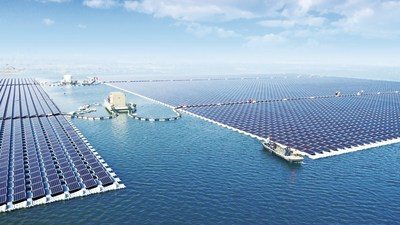
PV magazine reports on a new floating solar PV plant in China - World’s largest floating solar PV plant connected to grid in China.
Chinese PV inverter manufacturer Sungrow announced that a 40MW aquaculture project, the world’s largest floating PV power plant, had been grid connected with its SG2500-MV central inverters in the flooded coal-mining region of Huainan, China.
The power plant is located on a lake that formed in this coal-rich area as a result of gradual subsidence and floods caused by heavy rains. Its water depth today ranges from to 4 to 10 meters.
Posted
by Big Gav
in
renewable energy
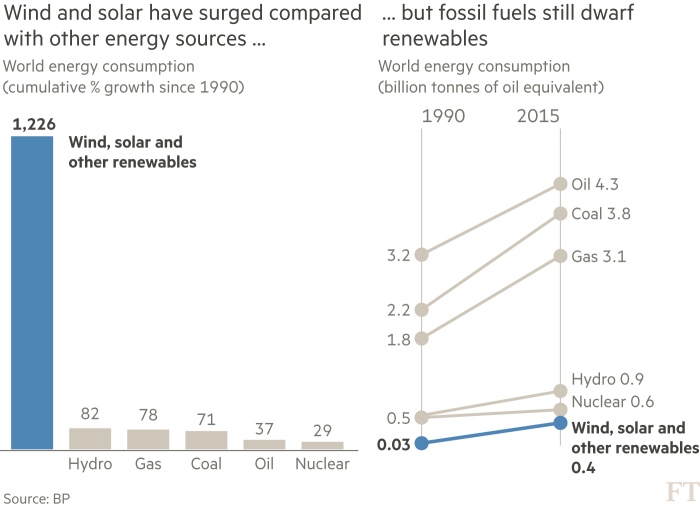
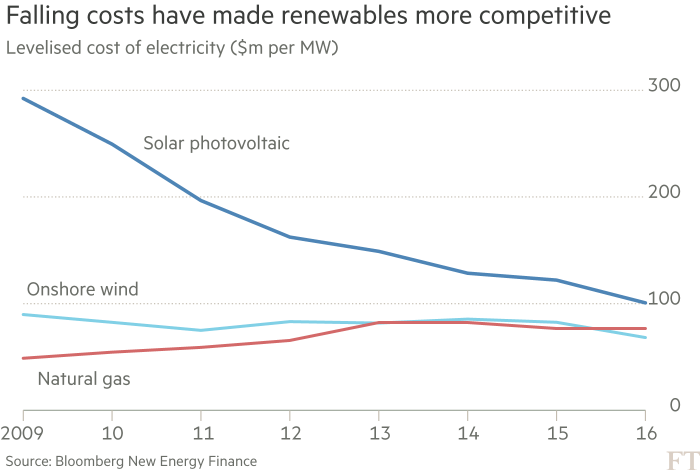
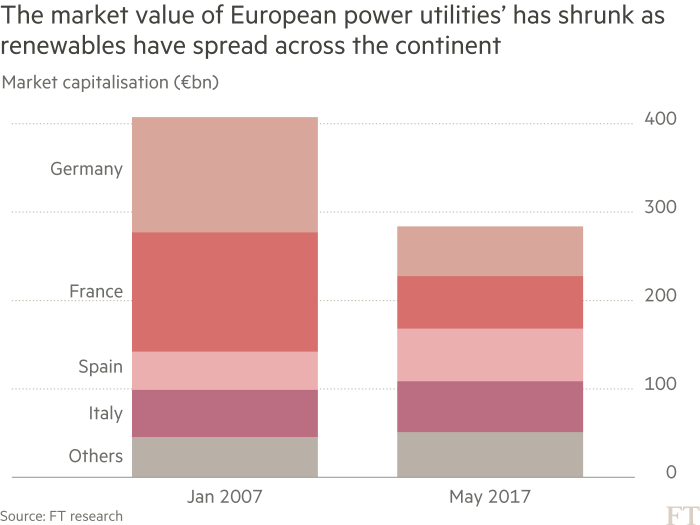
The FT has an in-depth look at the transition to renewable energy - The Big Green Bang: how renewable energy became unstoppable. The article contains some choice quotes along with a raft of statistics:
Irish executive Eddie O’Connor: “Fossil fuels have lost. The rest of the world just doesn’t know it yet.”
Investor Jeremy Grantham: "I think [the energy transition] is happening much faster than most well-educated business people in America understand. Because the science is being deliberately obfuscated in the US, the consequences are being obscured as well.”
Posted
by Big Gav
in
energy forecast,
renewable energy
IRENA has released their annual report on the transition to renewable energy - REthinking Energy 2017: Accelerating the global energy transformation (PDF report).
Renewable energy is a fundamental and growing part of the global energy transformation. Increasingly, renewables have become the first choice for expanding, upgrading and modernising power systems around the world.
REthinking Energy, the flagship report from the International Renewable Energy Agency (IRENA), examines trends and developments in the global quest for a sustainable energy future. As this third edition emphasises, accelerated deployment will fuel economic growth, create new employment opportunities, enhance human welfare and contribute to a climate-safe future.
Posted
by Big Gav
in
bipv,
boring,
electric vehicles,
elon musk,
energy storage,
renewable energy,
solar power,
solar pv,
tesla
Elon Musk recently had a TED talk with Chris Anderson covering a wide range of topics, including the Tesla Semi and expanding the Gigafactory fleet - What will the future look like? Elon Musk speaks at TED2017.
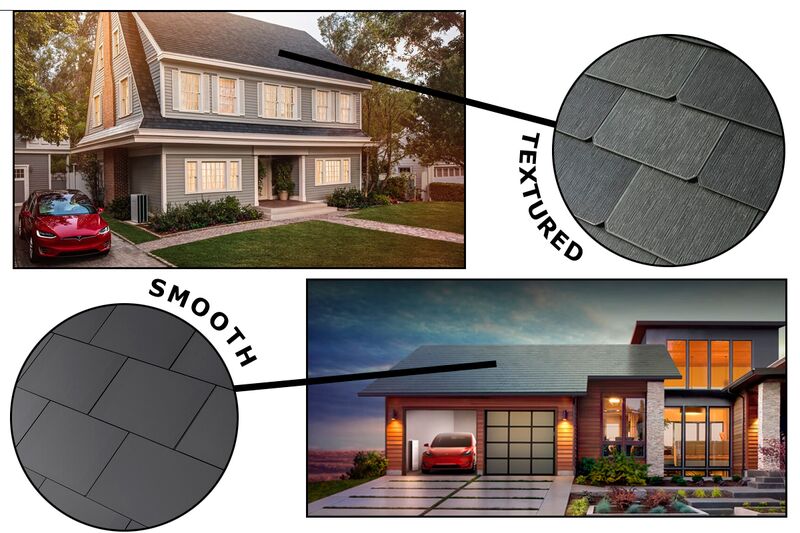
Showing a concept photo of a house with a Tesla in the driveway, Powerwalls on the side of the house and a solar glass roof, Musk talks about his vision for the home of the future. Most houses in the US, he says, have enough roof area for solar panels to power all the needs of the house. “Eventually almost all houses will have a solar roof,” he says. “Fast forward 15 years from now, it’ll be unusual to have a roof that doesn’t have solar.”
And to store all that electricity needed to power our homes and cars, Musk has made a huge bet on lithium-ion batteries. Moving on to a discussion of the Gigafactory, a massive diamond-shaped lithium-ion battery factory near Sparks, Nevada, Musk talks about how power will be stored in the future.
“When it’s running full speed, you can’t see the cells without a strobe light,” Musk says as a video of the factory pumping out Li-ion batteries plays behind him. Musk thinks we’ll need about 100 such factories to power the world in a future where we don’t feel guilty about using and producing energy, and Tesla plans to announce locations for another four Gigafactories late this year. “We need to address a global market,” Musk says, hinting that the new factories will be spread out across the world. ...
Sustainable energy will happen no matter what, out of necessity, Musk says. “If you don’t have sustainable energy, you have unsustainable energy … The fundamental value of a company like Tesla is the degree to which it accelerates the advent of sustainable energy faster than it would otherwise occur,” he says.
But becoming a multi-planet species isn’t inevitable. “If you look at the progress in space, in 1969 we were able to send somebody to the moon. Then we had the space shuttle, which could only take people to low-Earth orbit. Now we take no one to orbit. That’s the trend — it’s down to nothing. We’re mistaken when we think technology automatically improves. It only improves if a lot of people work very hard to make it better.”
Tesla have also released their "solar roof" product, with Bloomberg declaring it "better than anyone expected". RNE has a summary - Tesla’s solar roof sets Musk’s grand unification into motion.
Production of the tiles will begin at Tesla’s Fremont solar plant in California and then shift this summer to its new factory in Buffalo, New York, with additional investments from Tesla’s partner, Panasonic. Musk said initial sales will be limited by manufacturing capacity. As production ramps up into 2018, sales will begin in the UK, Australia, and other locations, along with the introduction of sculpted terracotta and slate versions of the solar roof.
The tempered glass in Tesla’s tiles is designed to conform to the toughest durability standards for both roofs and solar products, according to Tesla. The roof itself is guaranteed to outlast your home, while the power production of the solar cells is covered under a 30 year warranty, according to the company’s website. Glass, as Musk likes to point out, has a “quasi-infinite” lifetime, though the underlying solar cell will degrade over time.
Tesla’s basic premise is to make solar ownership more attractive and affordable by eliminating the need to install both a roof and solar panels. Tesla will manage the entire process of solar roof installation, including removal of existing roofs, design, permits, installation, and maintenance. The company estimates that each installation will take about a week.
Posted
by Big Gav
in
renewable energy,
solar power,
solar pv
PV Magazine has an article on the now unstoppable transition to solar power - Solar to attract more investment than coal, gas and nuclear combined this year, says Frost & Sullivan.
Analysts expect global renewable power investment to reach $243bn this year, with solar PV the fastest-growing segment and non-hydro renewables to account for 65% of all global power investment by 2020.
Posted
by Big Gav
in
global warming,
paul hawken,
renewable energy,
scenario planning
Dave Roberts at Vox has an interview with Paul Hawken about his book on the "Drawdown" project to assess the effectiveness of carbon emission reduction options - A new book ranks the top 100 solutions to climate change. The results are surprising..
Hawken is a legend in environmental circles. Since the early 1980s, he has been starting green businesses, writing books on ecological commerce (President Bill Clinton called Hawken’s Natural Capitalism one of the five most important books in the world), consulting with businesses and governments, speaking to civic groups, and collecting honorary doctorates (six so far).
A few years ago, he set out to pull together the careful coverage of solutions that had so long been lacking. With the help of a little funding, he and a team of several dozen research fellows set out to “map, measure, and model” the 100 most substantive solutions to climate change, using only peer-reviewed research.
The result, released last month, is called Drawdown: The Most Comprehensive Plan Ever Proposed to Reverse Global Warming.
Unlike most popular books on climate change, it is not a polemic or a collection of anecdotes and exhortations. In fact, with the exception of a few thoughtful essays scattered throughout, it’s basically a reference book: a list of solutions, ranked by potential carbon impact, each with cost estimates and a short description. A set of scenarios show the cumulative potential.
It is fascinating, a powerful reminder of how narrow a set of solutions dominates the public’s attention. Alternatives range from farmland irrigation to heat pumps to ride-sharing.
The number one solution, in terms of potential impact? A combination of educating girls and family planning, which together could reduce 120 gigatons of CO2-equivalent by 2050 — more than on- and offshore wind power combined (99 GT).
Also sitting atop the list, with an impact that dwarfs any single energy source: refrigerant management. (Don’t hear much about that, do you? Here’s a great Brad Plumer piece on it.)
Both reduced food waste and plant-rich diets, on their own, beat solar farms and rooftop solar combined.
(Important note: The above comparisons are true in Drawdown’s central, “probable” scenario. There are also more ambitious scenarios, in which each solution is pushed to its full potential. In the “optimum” scenario, onshore wind rises to crush all competitors, reducing 139 GT. All scenarios use only existing, commercialized technologies, so they should be considered conservative. All the solutions, data, and references are available at drawdown.org.)

Posted
by Big Gav
in
australia,
carnegie wave energy,
ocean energy,
renewable energy,
wave power
Australian wave power company Carnegie Clean Energy is expressing interest in building the country's first commercial scale wave power plant on the south coast of Western Australia - Carnegie eyes 100MW wave farm in Albany if Labor wins W.A. poll.
Perth-based Carnegie Clean Energy says it will consider a 20MW wave farm off the cost of Albany in West Australia if Labor wins the state poll and delivers on a commitment to provide $19.5 million of funding. Carnegie, which is currently preparing its first full-size wave farm off the coast of Fremantle, helping to supply Garden Island naval base with a mixture of wave and solar energy and battery storage, says the Albany plant could be upgraded to 100MW. ...
Carnegie CEO Michael Ottaviano said the Albany wave farm would be an opportunity to tap into a highly consistent renewable resource; delivering “24/7 clean power” into the electrical grid at a time where recognition of the importance of reliable, clean energy in Australia has never been higher. “Albany has one the most consistent wave energy resources in the world, experiencing greater than 1m swell 99.7 per cent of the time,” he said in a statement.
Posted
by Big Gav
in
energy storage,
renewable energy
ReNew Economy has a look at a report from the Australian National University claiming the lowest cost electricity grid for Australia is a 100% renewable energy one - ANU: Wind, solar and hydro grid cheapest option for Australia.
A new study by energy experts from the Australian National University suggests that a 100 per cent renewable energy electricity grid – with 90 per cent of power coming from wind and solar – will be significantly cheaper future option than a coal or gas-fired network in Australia. The study, led by Andrew Blakers, Bin Lu and Matthew Stocks, suggests that with most of Australia’s current fleet of coal generators due to retire before 2030, a mix of solar PV and wind energy, backed up by pumped hydro, will be the cheapest option for Australia, and this includes integration costs.
Posted
by Big Gav
in
electric vehicles,
energy forecast,
energy storage,
jeremy grantham,
peak oil,
renewable energy
Nick Butler at the FT points to this paper from the Grantham Institute and Carbon Tracker on the disruption cheap renewable power and electric vehicles are starting to have on global energy markets, a process which is going to continue to accelerate - Expect the Unexpected: The Disruptive Power of Low-carbon Technology (pdf).
Butler notes of the report:
* Solar will take 23 per cent of the power generation market by 2040 and 29 per cent by 2050.
* Wind power could constitute another 12 per cent of the power market by 2050.
* Electric vehicles will account for around 35 per cent of the road transport market by 2035.
* Hydrocarbons will peak and the authors are bold enough to foresee peak oil and coal demand in 2020







 Posts




