Posted
by Big Gav
in
smart meters,
victoria
The Age has a look at spiralling power prices in Victoria and the need for smart meters to provide detailed price data to consumers to help them keep costs under control - Power surge to price surge: prepare for an expensive education, says expert.
VICTORIANS need to urgently educate themselves about the looming surge in electricity prices this year, or face bills so high many will struggle to pay them, the chief of an energy price comparison service says.
Power use surged yesterday, after temperatures in Melbourne hit 39.6 degrees at 6pm. Today the temperature is forecast to hit 35 degrees, after an overnight low of 24.
The spike in electricity use followed power prices in Victoria jumping on New Year's Day, by an average 10 per cent.
Much of this increase was on the charge to consumers for simply being connected to the grid - meaning users will now pay more regardless of whether they cut their power use or not.
The new tax, combined with mandatory renewable energy targets and chronic under-investment by power companies in infrastructure, will cause prices to rise further across Australia. ''We are looking at the doubling of the cost of power in five years' time,'' Mr Freund said. ''At that point people will start getting into serious hardship.'' ...
Also likely to have an impact on future electricity price rises will be the introduction of smart meters to every home in Victoria, which will measure energy consumption every 30 minutes, rather than every three months.
The new meters will allow for time-of-use tariffs to be charged, allowing energy retailers to charge more for using electricity at times when everyone wants to use their power, and less at low-demand times.
Energy Minister Michael O'Brien has guaranteed this new way of charging will not happen until next year, and that those who wish to stay on fixed charges will be able to do so. But Victorian Greens MP Greg Barber warned that anyone who had considered the $2.3 billion smart meter rollout a ripoff so far needed to be aware of what was coming. "You can't put people on time-of-use pricing unless they've got instantaneous access to information about how much they'll be paying for the power they are using,'' he said.

Posted
by Big Gav
in
smart meters,
victoria,
water
Smart Meters.com reports that the Victorian government doesn't have the courage to rollout smart meters for water, following resistance to their electricity smart metering program - Victoria Government Rules Out Water Smart Meters, Despite Test.
Victoria, Australia will not be introducing water smart meters for household use after receiving a voter backlash against smart electricity meters, even though it conducted a test program in the southeastern suburbs. "Our Government will not be rolling our smart water meters for households in Victoria," stated Water Minister Tim Holding.
The State Government was looking to expand the bungled smart electricity meter system to cover water use as well, even though there were concerns that the system is useful for retail companies but causes household bills to rise.
Before ruling out the meter deployment, the Government conducted a trial by offering South East Water’s residential customers a $50 Myer voucher to participate, according to the Herald Sun.
Before the scrapping of this plan, there were revelations that residential smart electricity consumers will have to pay up to $285 per year just for having the meter. Electricity distributors have permission to recover smart meter installation costs directly from residential consumers.
To counter the customer concerns about bills, the Government-hired consultants gave the cynical suggestion of having a monthly billing period instead of a quarterly.
According to the Marchment Hill Consulting report for the Government, implementation of the water smart meter system will help water companies to reduce costs but it may not be able to reduce water price.
The smart meter system will give more control to households regarding water use management, however, it may cause "bill shock," says the report.
The water bill that an average household pays annually is already expected to reach $1000 this year with recovery process starting for the $3.5 billion Wonthaggi Desalination Plant.
Posted
by Big Gav
in
smart grids,
smart meters,
victoria
The Australian has a look at some of the FUD being generated about smart meters, with one criticism being that they hit poor people who are at home during the day harder than average - Smart power meters 'to hit poor'. Given that most power prices are regulated still this would be easy enough to address, either via the regulatory or tax systems (of course, you'd probably want market driven prices for power to make smart meters really useful, which points to the tax system for making this "fairer").
HOUSEHOLDS that rely on daytime airconditioning, cooking and heating will be hit with higher power bills. This will occur as hi-tech "smart meters" are rolled out nationally.
Victorians are being slugged an average of $68 a year just for the remote digital meters to be installed -- even though barely 10 per cent of households have them.
Consumers are being billed upfront for the rollout to 2.5 million households, which is not due for completion before the end of 2013.
Other states and territories are trialling the devices, which send real-time readings to power companies every half-hour.
Utilities can then tailor their bills, to charge more for electricity used at peak times of demand during the day, and less at nights and weekends.
Victoria has stalled the new pricing system for at least nine months, after complaints from welfare and consumer groups that it would punish low-income families and pensioners.
The introduction of the smart meters comes in the wake of Australians' electricity bills rising 18.2 per cent last financial year, according to the Australian Bureau of Statistics, with a typical bill going up by as much as 27 per cent to $2012 in Victoria and 12 per cent to $2278 for rural NSW residents.
The Age has a look at some of the deficiencies with the Victorian smart meter rollout -
Smart meters look dumb for users.
SMART meters, the new technology pushing up Victorian power bills, will provide little benefit to customers over the next five years, as the big electricity companies reap hundreds of millions of dollars from the rollout, a Sunday Age investigation has revealed.
Findings by the Australian Energy Regulator have undermined the state government's position on smart meters - which will be fitted to every Victorian home by the end of 2013 - and the most recent cost-benefit analysis shows the implementation will deliver $1.5 billion in cost savings to power companies over 20 years and few real benefits to customers.
This comes as Victorians face escalating bills driven by smart meters. Customers pay up front, regardless of whether they have a smart meter. This year the cost was $68, next year $72, and the Auditor-General warned that costs could climb higher.
Advertisement: Story continues below
Power companies will recover the cost of installing and operating meters through bills until 2028. So far, 250,000 meters have been installed.
Smart meters replace the old ''spinning disk'', manually read meters measuring electricity use. The new meters have two-way remote communication with the power company, sending energy use data 48 times a day. They will be able to connect and disconnect homes with the touch of a button. Retiring energy minister Peter Batchelor says the $1.6 billion rollout is like going from ''telegrams to email''.
Even the government's critics support the concept of smart meters but worry that, in leading the nation, Victoria has gone too far, too fast. The program, dubbed by the opposition as the ''myki of metering'', has doubled in price.
When it committed to a universal implementation, the Brumby government promised the meters would help ''tackle climate change'' and allow householders to manage energy and reduce power costs.
The customer benefits, however, now appear shaky. The meters tell customers virtually nothing about their energy use. Households need an ''in-home display'' or web-based program to see energy use and power charges. There is no plan about who - the retailer or the householder - pays for this technology in the program's next stage.
The government has also put a moratorium on a big benefit of smart meters: time-of-use tariffs. These allow people to shift energy use to cheaper times of the day.
The tariffs have been put on hold, possibly until the end of 2011, after the government accepted it had not considered disadvantaged groups and stay-at-home families who cannot easily shift power use and could be penalised by up to $200 a year.
Posted
by Big Gav
in
australia,
better place,
electric vehicles,
victoria
Better Place has announced they will be participating in an electric vehicle trial in Victoria - Better Place helps Victoria harness its electric vehicle future.
Better Place, the leading electric vehicle (EV) services provider, today announced it will support the Victorian Government’s ‘Victorian Electric Vehicle Trial’.
Launched today, the trial is designed to establish Victoria as an EV friendly state ready for the mass adoption of electric vehicles.
As part of its involvement, Better Place will provide charging infrastructure to support extended range driving and the smart software and systems to intelligently manage EV charging through the electricity network.
Better Place will also provide in-car management software capable of providing real-time information on odometer readings, vehicle locations and battery state of charge to inform trial operations.
Better Place will bring invaluable experience to this trial learned through its electric vehicle deployments in Israel and Denmark.
Alan Finkel, Chief Technology Officer for Better Place in Australia said, “This is a very exciting moment for us and a real milestone in the evolution of EVs in this country.
Posted
by Big Gav
in
australia,
smart meters,
victoria
The Age has an article on a cost benefit analysis that has been done on the Victorian smart meter rollout - Smart meters to save $5bn: report.
THE Brumby government's troubled $2 billion smart meter rollout has been given a ringing endorsement by an independent economic analysis, which found it to be ''cost effective no matter which mix of costs and benefits are used''.
The Oakley Greenwood report, to be released today, found that the benefit of rolling out the smart meters would be between $1.87 billion and $3.51 billion over 20 years and that when combined with additional demand management services the benefits would be between $2.58 billion and $5 billion over the same period.
The report found that the cost over a 20-year period of installing 2.5 million smart meters in Victorian homes would be up to $2 billion (with additional services) compared with continuing to operate current manual meters for a cost of $1.5 billion.
Energy Minister Peter Batchelor told The Age that a moratorium on time-of-use pricing, which charges households more during peak times, would remain until the end of current trials.
Digital smart meters are being installed to encourage households to cut energy use and shift to off-peak usage when power is cheaper to reduce greenhouse gas emissions.
Posted
by Big Gav
in
australia,
geothermal energy,
victoria
The ABC has a report on a survey of Victorian geothermal energy resources - 'Significant' geothermal energy reserves discovered.
Studies of underground water tables in Victoria's north and west have revealed a significant new store of geothermal energy reserves.
Geothermal energy is a clean renewable resource and is generated from hot rocks and aquifers deep below the earth's surface.
The State Government and Geoscience Victoria, have undertaken large studies of underground energy over the last year and released a new map of available reserves to attract investment.
The Energy and Resources Minister, Peter Batchelor, says Stawell, Horsham, Mildura, and Ballarat, have all been identified as new areas with significant energy potential.
Posted
by Big Gav
in
geothermal energy,
geothermal power,
victoria
The ABC has a report on a new pilot geothermal energy project in Victoria - Vic Govt funds new geothermal project.
The Victorian Government has allocated $25-million for exploration associated with a new geothermal energy project at Anglesea, in the state's west. Geothermal energy used heat from subterrannean rocks to produce clean energy.
The Resources Minister, Peter Batchelor, says the project could become the site of Victoria's first geothermal energy plant. "We'll have the possibility of building a geothermal demonstration plant very close to the existing electricity grid," he said. "It will mean that we'll have the largest demonstration geothermal project in Victoria, and one that can be connected to the grid."
Posted
by Big Gav
in
coal,
victoria
The Age has a look at Victoria's inability to kick the coal habit - and their desire to start exporting the lowest form of coal around the globe - Brumby's dirty secret: coal for export. Anyone who can explain what a "dirtier" fuel that would be importers could use please speak up.
Victoria’s brown coal reserves look set to be opened up to export on a mass scale — prompting claims the state is putting commercial opportunity ahead of its responsibility to curb greenhouse gas emissions.
Confidential cabinet documents obtained by The Age show the Brumby Government is considering offering billions of tonnes of Latrobe Valley coal for competitive tender next year.
The tender process would be preceded by a green light for a $1.5billion scheme by the company Exergen to mine, dry and export 12 million tonnes of brown coal a year to be burned in Indian power stations.
Exergen wants to build a 150-kilometre underground pipe to carry the dried coal from the Latrobe Valley to an expanded port at Hastings on Western Port.
The cabinet documents acknowledge that community concerns could be raised by the export of brown coal, a ‘‘dirty’’ fuel that that emits significantly more greenhouse gases than alternative electricity sources such as gas and black coal.
But the documents say exports can be justified on three grounds: Victoria cannot unilaterally limit global emissions, the coal products could help developing countries overcome poverty, and emissions may be even higher if countries are denied Victorian coal and use dirtier fuels.
Environment Victoria, the state’s main green lobby, said it was stunned the Government would want to expand an industry that needed to be phased out to tackle climate change.
Campaigns director Mark Wakeham said Victoria justifying coal exports on the grounds that the state was not responsible for a global climate deal would be ‘‘like saying we can’t single-handedly deliver world peace so let’s go on a killing spree’’.

Posted
by Big Gav
in
global warming,
heat wave,
melbourne,
victoria
Gary at Public Opinion has a post on the toll in South Australia from the latest bout of hot weather - Heat Wave.
In Adelaide the plain trees are already shedding their leaves, the bodies of dead possums litter the parklands, and the death toll of human beings is around 75. As in Melbourne, there have been crippling blackouts due to the failure of the $780 million Basslink interconnector cable linking Victoria and Tasmania, which is unable to operate when temperatures in Launceston Tasmania pass 35C.
NEMMCO continues to talk in terms of the national electricity market having sufficient capacity to deliver reliable supply. Politicians explain the disconnect between assurance and reality by talking in terms of the heatwave being one-in-100-year event, rather than this being an indication of southern Australia's future. Yet there have been a series of rolling blackouts over the past years due to supply falling short of increasing demand --hence the frequent load shedding that causes the blackouts during a heatwave.
A warmed up world means hotter conditions in cities, towns and the regions since long hot, dry summers are becoming the norm. Shouldn't we see the blackouts as a timely warning about a rundown energy system with its old industrial technology utilizing fossil fuels? This is an electricity grid that has seen little new investment in the last decade.

The Age reports the temperature in Melbourne hit an all-time record on the weekend -
City swelters, records tumble in heat - causing
power outages.
Melbourne's all-time weather record has been broken and the city is sweltering under the twin effects of high temperatures and hot north-west winds. The city hit 46.4 degrees at 3.04pm - the hottest day since the Bureau of Meteorology started keeping records 150 years ago.
City dwellers had it pretty easy compared to people in country victoria, where the temperature got over 48 degrees and over 100 people lost their lives in bushfires -
Australia's bushfire disaster: many good people lie dead in Victoria.
Power outages in the country may last for days
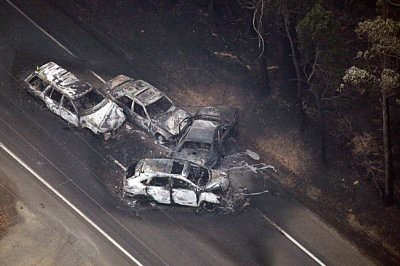
AUSTRALIA has witnessed its greatest natural disaster. ... At 7.35am today the official death toll was 108, with at least 750 homes destroyed - 550 of those in Kinglake, north of Melbourne, and surrounding areas.
According to police figures, another 11 people were found dead at Kinglake West, north of Melbourne, taking that community's toll to 20, while another four bodies were found at Marysville taking that town's toll to eight.

The Age has a report on warnings that these events will get worse as global warming proceeds unchecked -
It will only get worse as climate changesAUSTRALIA faces "a very dangerous decade or decades" as climate change increases the intensity of fires and lengthens the bushfire season, scientists and environmentalists warn. Research by the Australian Bureau of Meteorology and the CSIRO has found that bushfire seasons will start earlier, end slightly later and become more intense in coming decades.
A climate study of south-east Australia by the agencies in 2007 found the number of days with "very high" or "extreme" fire danger ratings would increase significantly. The worst changes were predicted for northern NSW. By 2020, days of extreme fire danger are forecast to increase by 5 to 25 per cent if climate change is low and by 15 to 65 per cent if it is high.
An author of the report, Kevin Hennessy from the CSIRO, told the Herald yesterday: "There does seem to be a human element to bushfire risk. In terms of human contribution it is clear that most of the global warming since about 1950 is likely due to increases in greenhouse gases. Higher temperatures clearly increase the risk of bushfires."

The Age notes that the various social media channels are keeping up a running commentary on the fires -
Social media rush as Victorian bushfires rageAs the worst bushfires in Australia's history raged across Victoria, Twitter, Flickr and Facebook lit up with condolences and horrific first-hand accounts, while many used innovative online mapping tools to assess the risk of the fires reaching their own homes.
Mainstream news outlets, battling to provide comprehensive coverage of the tragedy, have incorporated accounts published on the social networking sites extensively in their reports.
Using online social media to spread vital information and personal stories is becoming increasingly commonplace in times of crisis, but this may be the first time the social networking sites have been used extensively during an Australian disaster.
Google's engineers have created a map containing the latest up-to-date information about fire locations and their status, based on data provided by Victoria's Country Fire Authority (CFA).
The map, updated in real-time with information about the number, type and size of fires in a particular location, buckled as thousands of web users sought out updates. But the site appeared to be working as normal this morning.
Google created the map after the CFA's website struggled to cope with the surge in people looking for information about the fires.
"We hope that it's of some use to people who may be affected, to emergency services personnel, and that it takes some load off other websites which are being inundated," Google wrote in a blog post.
Aus-emaps.com created its own map of the fire locations - derived from data provided by Federal Government body Geoscience Australia through its Sentinel national bushfire monitoring system - before Google but also reported slowdowns due to high demand. And NASA has published satellite images showing the bushfires here.
On Twitter, "bushfires" is as of this morning the No.1 "trending topic" as users traded first-hand accounts, news, and information on how to donate and seek help. Prime Minister Kevin Rudd, through his Twitter account, has published messages telling his 7000 followers how to make cash and blood donations, find out more information on the fires and seek emergency Government assistance.
Posted
by Big Gav
in
geothermal energy,
mauritius,
victoria
The Wimmera Mail Times has an article on a new geothermal drilling program in Western Victoria - Geothermal plans positive.
A GEOTHERMAL exploration company is confident it will be successful with a shallow drilling program near St Arnaud due to start in early 2009.
Geogen Victoria has been investigating a range of granites and other geological anomalies in its Geothermal Exploration Permit 1 area, which includes St Arnaud, Maryborough, Avoca and Dunolly. Geothermal, an energy generated by heat stored beneath the earth's surface, is regarded as one of the cleanest forms of base-load renewable energy.
Geogen director Andrew Carroll said areas of interest had been identified close to St Arnaud. Mr Carroll said Geogen had three exploration areas in central and western Victoria, covering a total area of 18,300 square kilometres, approved by the State Government in May 2007.
"Geogen Victoria believes that the generation of base-load geothermal power on the three exploration areas in Victoria will be able to compete with the burning of dirty La Trobe Valley lignites, even without the need for carbon offsets or an emissions trading scheme," he said. "We are planning to drill up to 30 shallow scout holes to determine the area's geothermal gradient, that is the level of high-grade heat, which can be used for the generation of geothermal base-load electricity." ...
Mr Carroll said the proximity to the national grid in Ballarat would benefit the project. "The location of the scout holes is being finalised but all will be close to high voltage transmission lines connected to the national electricity grid," he said. "It's an ideal terrain for geothermal energy resources. It will be able to provide a large source of energy in the area, and encourage the growth of industries that require heat."
Mr Carroll said once the results of the shallow drilling program were analysed by Geogen, the private company looked forward to a community consultation process.

Geothermal power is also coming to Mauritius, courtesy of a German company -
German company to produce geothermal electricity in Mauritius.
German company Honet Badger will set up a joint venture with a local company in Mauritius to produce geothermal electricity in the island. Honet Badger representative Dan Kellar told journalists on Wednesday in the Mauritian capital Port Louis that the new company will exploit boiling underground water and steam found in different regions of the island to produce geothermal energy.
He said there is a great potential for geothermal electricity in the island. The venture will reduce the dependency of the country on charcoal and heavy oil, he said. Kellar said the production of geothermal electricity costs less compared to other methods and the raw material is available all year round.
Posted
by Big Gav
in
ausra,
australia,
csp,
solar power,
solar thermal power,
victoria
The ABC reports that Victorian Premier John Brumby says up to six solar energy plants could be built across Victoria.
A solar plant will be built in north-west Victoria, but Mr Brumby, who is in Bendigo today, says the region is well placed to have more. He says the solar energy plants he has seen overseas have been simple technology and visually unobtrusive.
Mr Brumby says solar energy is the key to meeting renewable energy targets. "We are impeccably well placed in the north of the state, across the north, across the great divide for more solar facilities," he said. "There are of course both manufacturing facilities and of course the ongoing maintenance opportunities in a job sense."
His new found enthusiasm may have been sparked by a
visit to Nevada, where he checked out the new
Ausra manufacturing plant and the
Nevada Solar One power plant (as well as hobnobbing with
Arnie in California).
While work is under way on the development of a 154-megawatt solar power station in the state's north-west, Mr Brumby said he could "foresee another three or four plants of that potential size and scale over the next decade".
The $420 million solar plant near Mildura, a partnership between TRUenergy and Melbourne-based company Solar Systems, is expected to provide enough green power for 45,000 homes by the time work is completed in 2013.
Mr Brumby said Victoria had excellent prospects for solar power, particularly in the north and north-west, and large industrial users in the western suburbs could benefit from the technology.
"I really want to push this through, and we're seeing just great opportunities," he said, adding that he would like work to begin on another solar plant in Victoria within two years.
Last month's state budget included a $72 million fund for large-scale, renewable energy projects. The Premier also told The Age he was considering a mandatory solar energy component within the state's renewable energy target, possibly at a quarter of the overall 10% target to be achieved by 2016.
"If we set the 2.5% target, that will lead to a very high degree of interest (from companies) … you'll see a rush of activity," he said.
Mr Brumby made the comments as he and Queensland Premier Anna Bligh toured solar facilities in the US state of Nevada, which has a renewable energy target of 20% by 2015, of which 5% must be solar.
They visited a new Las Vegas factory for Ausra — the solar thermal technology company founded by former Sydney University professor Dr David Mills — and a 75-megawatt solar thermal plant in Boulder City.
After taking part in a solar thermal business forum — in collaboration with the Clinton Foundation's climate initiative — the two premiers jointly announced a $680,000 project to develop a solar atlas for Victoria and Queensland that would help companies identify the best locations for solar investment.

Posted
by Big Gav
in
australia,
coal to liquids,
ctl,
urea,
victoria
The Australian has an article on a new proposed coal to liquids plant in Australia, near the Monash Energy project. This one aims to produce urea as well as diesel, and hopes to try and sequester the CO2 produced in Bass Strait gas fields (making the large assumption that BHP will let them) - $2bn plan to 'fuel petroleum needs'.
The entrepreneur behind the project, Allan Blood, said Victoria's reserves of brown coal had enormous potential for fertiliser and oil production. The plant would generate 1.2million tonnes a year of urea and all the CO2 produced would be stored in reservoirs that once contained natural gas in Bass Strait.
The plant, expected to be operational by 2012, has the backing of several London-based equity funds. Joint-venture discussions with several major chemical companies have begun. The project will require 1000 workers to produce urea through a gasification process similar to the one used in the first stage of producing oil from coal.
Mr Blood was the brains behind a $5 billion coal-to-oil project in the Latrobe Valley that was bought by Shell and Anglo American. It is designed to produce 70,000 barrels of oil a day. The Australian Energy Corporation chairman said the tremendous amount of energy trapped in brown coal - coupled with gasification and geosequestration technology - provided a clean source of a range of hydrocarbons.
"There's no reason why Australia could not be totally self sustainable in petroleum products, or any other chemical product such as urea, from coal," he said. "We have got all the coal in the world here for goodness sake. It becomes the highest-quality fuel or diesel imaginable. Sasol in South Africa have been doing it since 1968, making 150,000 barrels a day."
Turning coal into diesel goes back to World War II, when besieged Germany used it to supplement its dwindling oil supplies. South Africa is by far the biggest user of the technology in what is a hangover from apartheid days when the country was concerned it would be locked out of world oil markets. However, it hasn't been widely taken up despite the wide geographic spread of coal reserves, largely because it is expensive.
It also produces significantly more carbon than traditional petrol-diesel production and has been described as one of the most environmentally unfriendly means of producing oil.
Australia imports 550,000 barrels a day of oil and 1.3 million tonnes, or $300 million worth, of urea for fertiliser each year. The urea comes from the Middle East.
Gasification works by treating coal at very high temperature with a controlled amount of oxygen to produce a gas that can be converted to diesel. Nitrogen is added towards the end of the process to make urea. Mr Blood said once the reaction was established, it was self-propelling and the CO2 generated was easy to trap and then store.


 Posts




