Posted
by Big Gav
in
australia,
electricity grid,
queensland,
solar power,
utility death spiral
RNE has a look at moves in Queensland to shift from usage based pricing for electricity to a model with heavy "service charges" for grid connection, punishing on-premise generation - The $500-a-day service charge designed to kill solar.
Queensland businesses are being hit with daily service charges of more than $500 a day on their electricity bills, in a move the solar industry says is designed to kill the roll-out of commercial-scale rooftop solar across the state.
The charges were quietly unveiled by the Queensland Competition Authority and the state government in July. But their implications are only now being absorbed as business operators do the numbers on proposed solar installations. ...
The changes have horrified members of the solar industry, businesses looking to install solar, and those who have invested tens of thousands of dollar in energy efficiency measures such as LEDs or upgraded machinery.
That’s because, according to Steve Madson, director of Country Solar, one of the country’s largest installers of commercial-scale solar, the new tariffs reduce any incentive for businesses to lower consumption from the grid, either by installing solar panels for their own use, or by investing in more efficiency machinery and lighting.
Madson says the charges appear designed to stop the rollout of commercial-scale solar in Queensland. “The changes are clever in their design,” Madson told RenewEconomy. “They do not actually result in an increase in total electricity costs, and in some cases they actually cause a fall. But they kill the possibility of reducing the bills by installing solar. ”How can they charge $500 a day to read the meter, that is what the daily service charge is after all.”
The QCA, and the state government has long been accused of acting only to protect the interests of the network operators and retailers, and to boost the dividends paid to the government. Last year, as RenewEconomy reported, QCA came out in favour of special tariffs on residential solar customers, even though it admitted that they would be more costly, ineffective, unfair and possibly illegal. But they favoured the move because it would protect network revenues.
The raising of fixed charges has been a common response among utilities fearing the impact of rooftop solar and a “death spiral” of falling revenues on a fixed asset base.
Analysts such as Morgan Stanley have ridiculed the practice of imposing high fixed charges, saying it was ultimately self-defeating and could simply accelerate that death spiral, and encourage people to go off-grid, particularly when battery storage became commercially viable. “There may be a ‘tipping point’ that causes customers to seek an off-grid approach — higher fixed charges to distributed generation customers are likely to drive more battery purchases and exits from the grid,” the Morgan Stanley researchers wrote.
Madson agrees: “In three years’ time (when battery storage improves), this will also be enough for a mass exodus from the grid altogether.”
Posted
by Big Gav
in
australia,
carbon tax,
electricity,
queensland
The Brisbane Times has an article on possible electricity shortages emerging in Queensland - Queensland to be left in the dark.
Warnings that Queensland could experience power shortages in two years proved the need for a carbon tax, according to the Climate Institute.
But the state government and energy provider Origin have denied the state is at risk of power shortages as argued by the Australian Energy Market Operator.
Its Electricity Statement of Opportunities report found Queensland would be the first jurisdiction in Australia to experience shortages if it failed to attract more investment in power stations.
Climate Institute CEO John Connor said the report warned uncertainty over the carbon tax could deter or distort energy investments costing electricity consumers up to $5 billion in higher bills.
"It's clear that the best possible outcome for electricity consumers is decisive action from our politicians to cut our carbon emissions by putting a price on carbon," Mr Connor said.
"Without a pollution price and the clarity of the renewable energy target, investors will try and second guess government policy, make inefficient decisions or delay investment and this will increase electricity costs.
"A pollution price will be a green light for the electricity sector to get on with the job of building the infrastructure needed to provide clean energy power for Australians."
A spokesman for electricity company Origin responded to questions with a short statement saying the company was "well placed to underpin our positions in Queensland".
Energy Minister Stephen Robertson also said Queensland was "well placed" to have the electricity generating capacity to meet the energy demands of a fast-growing state.
‘‘Queensland is fortunate to have a number of large-scale energy project proposals that should ensure we meet energy demand in 2013-14 and beyond,’’ he said in a statement.
“These include ERM Power Ltd’s 500 megawatt Braemar 3 gas power station, Origin Energy’s 500 megawatt Darling Downs Stage 2 gas-fired project and the 44 megawatt solar thermal project at the Kogan Creek power station.’’
Posted
by Big Gav
in
australia,
coal seam gas,
queensland
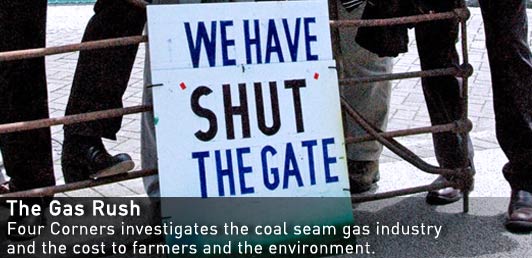
The ABC's Four Corners program has a look at resistance to the coal seam gas rush in Queensland - The Gas Rush (it can be seen again later this week on ABC News 24 or online with iView). Robert Gottliebsen at The Business Spectator (who cheerled the mining industry's campaign against Kevin Rudd and his mining tax) seems somewhat alarmed by the idea of a fight between farmers and the gas industry - A cloud over coal-seam gas - it seems its not as easy to dismiss cranky cockies as it was a Labor Prime Minister.
With access to guerrilla activists and their undercover filming, Matthew Carney reports on the coalition of farmers, local townspeople and even a corporate titan who want to halt Australia's gas rush.
Imagine you are running a successful farming operation; then one day a man from the gas company arrives with news that a coal seam gas field lies beneath your feet. From there 3 wells are sunk, then another 18. And then a proposal for another 30, turning your property into a thriving gas field, while threatening the viability of the working farm.
Down the road, the neighbour sells after 48 wells are sunk into his property. The compensation of $250 a year, per well was not much inducement to stay. The wells themselves are estimated to be making the companies a million dollars a year, each.
And then the gas company says they might have to move your house to sink another well into the land.
This is the experience of just one of the farmers featured on Four Corners this week.
Right across Australia gas companies are drilling down through the earth to extract the resource that the industry says will be one of the answers to our future energy needs. Already some $31 billion worth of gas projects have been approved by the Federal Government, which are expected to generate thousands of jobs and billions in revenues.
But this precious resource lies beneath homes and farms, and the food bowls of Australia.
And this is where the gas companies are drilling; prompting a heated conflict over who should pay the price for our energy supplies.
Matthew Carney reports from communities in Queensland and NSW that are directly affected. Farmers tell of their feelings of violation and frustration; their belief that they are losing control of their properties and their ability to plan for the future. As one says "It's really frustrating. We have taken on extra debt to fund our farming business and we are powerless to stop people accessing it and abusing it."
But it's not only what's happening above ground that worries them.
One farmer claims his water supplies are dropping alarmingly as the coal seam drilling causes the water table to drop at an accelerated rate. This cattle farmer believes he may only have two years supply left in one of his key water bores.
Then there is the danger posed by faulty gas wells. The program shows local activists testing for leaks and finding highly explosive gasses leaking at alarming levels.
Others talk of their fears that Australia's greatest underground water resource, the Great Artesian Basin will be contaminated and depleted. Four Corners details cases of water supplies being tainted by salty toxic water.
Many of those affected are beginning to work together on a national campaign to call a halt to "The Gas Rush".
Posted
by Big Gav
in
australia,
coal seam gas,
jp morgan,
lng,
queensland
The SMH has an article on a recent JP Morgan report listing challenges ahead for the coal seam gas industry - Coal seam gas a risk: JPMorgan.
One of the world’s leading investment banks has poured cold water on Queensland’s emerging $50 billion coal seam gas industry.
A report by JPMorgan says the industry has significant water risks, an unknown impact from growth and is a potential risk to public safety.
The report, by analyst Garry Sherriff, says costs involved in developing the projects, which involve piping gas from the Surat Basin to export terminals at Gladstone, are likely to blow out because of environmental concerns.
It warns that towns and landowners risk reduced water supplies; there is a risk of reduced water quality; and of gas migrating to existing bores.
Once on the surface, the saline water extracted in the CSG mining process will have to be treated, stored and disposed of, the report says.
JPMorgan also expresses doubts about the cumulative impact from multiple CSG developments.
These water risks could translate into project cost increases, government intervention, changes to regulations and potential disruption to long-term gas supply contracts, the report says.
There is also a danger that a build-up of gas in water bores could result in large, uncontrolled gas releases which may pose a risk to public health and safety, the report says.
JPMorgan’s report backs up community concerns over the industry, says Friends of the Earth campaigner Drew Hutton.
‘‘It is time for the state government to start listening to community voices calling for a moratorium on the industry,’’ Mr Hutton said. ‘‘The report states there are so many environmental risks associated with the operation of coal seam gas that the government will need to change the rules along the way and this could create great uncertainty for the companies and their markets."
Posted
by Big Gav
in
cougar energy,
queensland,
ucg
The SMH has a brief report on more obstacles for the underground coal gasification industry in Queensland - Cougar to meet with Qld govt.
Executives from embattled gas explorer Cougar Energy will meet with Queensland government officials this week to discuss getting their project back on track. The Department of Environment and Resource Management (DERM) has declined to accept an environmental report that Cougar provided on August 16.
Cougar Energy was forced to shut down its pilot underground coal gasificiation plant in July after the state government learned traces of the toxic chemicals benzene and toluene had been found in groundwater at the site and a neighbouring property. The department has yet to advise the ASX-listed company of what further regulatory action it wants Cougar to take.
Cougar managing director Dr Len Walker said the company planned to respond to any request for further information "as quickly as possible". "Cougar Energy remains committed to recommencing operations at its Kingaroy project in Queensland and will continue to work with DERM to demonstrate that the company's underground coal gasification activities have not and will not harm the environment," Dr Walker said in a statement.
Posted
by Big Gav
in
australia,
coal seam gas,
queensland
The Business Spectator has a column on some of the problems facing the coal seam gas boom in Queensland - The bust side of the gas boom.
Totally overrun by media attention on the federal election, one of the last gasps of Kevin Rudd’s administration nonetheless deserves attention because it underlines the importance of the mining and energy industries and highlights a key factor that could trip up the renewed boom in the next few years.
Spurred by the demands of the massive Gorgon LNG development in the west, Rudd set up a taskforce under Gary Gray, Parliamentary Secretary for Western and Northern Australia, to look at skills issues for the resources sector. It reported just before Julia Gillard motored off to Yarralumla.
Gray’s committee received 97 submissions in March and April and held talks in all mainland capitals, Karratha, Gladstone, Cairns and Mackay. The resulting report is a serious piece of work that shouldn’t be overlooked.
Its bottom line is that “there is significant potential for skills gaps to emerge between 2011 and 2013”.
Taking in to account 75 resource projects under advanced planning, with a combined value of $110 billion, the taskforce predicts that construction job demand in the sector could peak at 45,000 in 2012 and 2013. Mining operations, it says, could require 61,500 new workers by 2015. LNG developments could require another 3200.
The big issues are where to find them and how to meet the pay and conditions required to attract and retain them – as well as the implications for the rest of the economy.
The taskforce foresees a shortage of 35,800 tradespeople over the next five years and problems for the industry in finding about 1700 mining engineers and 3000 geoscientists.
As it points out, the broad recovery of the Australian economy will add to the skills shortage facing the resources sector and, in the competition for workers, become a wider problem for business managers. It estimates that about $70 billion worth of non-resources infrastructure projects (development of rail, road, port and hospital infrastructure as well as sports complexes) will be in the mix over the next two years, chasing many of the same people.
Posted
by Big Gav
in
australia,
coal seam gas,
queensland
The ABC reports that opposition to coal seam gas extraction in Queensland is growing - Farmers fuming over natural gas rush.
Farmers and environmentalists are joining forces on Queensland's Darling Downs to try to stop the rush for natural gas.
The Darling Downs is one of Australia's most productive farming regions, but it is being overrun with drilling rigs as some of the world's biggest energy companies try to bank a new resource bonanza - millions of tonnes of methane from coal.
The farmers are now worried that thousands of gas wells are going to damage their ability to grow food.
"I think the coal seam gas companies are where we were 100 years ago; come in and rape and pillage, grab what you can and leave," said Dalby farmer Ian Hayllor.
"And we're not going to let them do that. They're going to have to be sustainable. If they want to work in our environment, they've got to be sustainable.
"They can come in, take the gas, but they're not going to destroy the environment they're working in. If they can leave it the way they found it, we'll accept them onto our properties."
The anger of farmers is mounting as the gas companies begin a push into some of the more productive cropping areas of the Darling Downs.
Posted
by Big Gav
in
australia,
coal seam gas,
queensland
The Courier Mail reports that Queensland farmers continue to be unhappy about coal seam gas developments on mining land - Surat Basin farmers call for moratorium on coal seam gas mining.
MORE than 500 farmers who attended a protest meeting called for the government to place a moratorium on coal seam gas mining.
Growers lined up one kilometre of farm machinery at a paddock at Cecil Plains west of Toowoomba in a show of strength to demonstrate they are capable of blocking mining company access to their land.
The farmers face up to 40,000 gas wells being drilled across some of the state’s best food-producing land.
Protest organiser Dave Armstrong said famers were gearing up for the fight of their lives. “What other choice do we have?” Mr Armstrong asked. “They have put us in a corner.”
Posted
by Big Gav
in
australia,
coal seam gas,
queensland
The ABC has a look at the coal seam gas industry in Queensland - Risk Management.
RAY BROWN, WESTERN DOWNS REGIONAL COUNCIL MAYOR: We had this huge youth drift from our region ten years ago. We were losing our young people everywhere. Average age of a farmer was 58. Now we've got this massive pull back that people can't wait to get out of university, get out there because there's dollars out there.
PIP COURTNEY: The gas is good for Queensland too. Nearly $1 billion in royalties will go to the cash strapped State Government every year for the next 40 years.
ANNA BLIGH, QLD PREMIER: The size of this resource so that Queenslanders understand what's under their ground rivals what is in the North West shelf in Western Australia. That is the sort of resource and prosperity that is involved here.
PIP COURTNEY: It's hard to imagine now but ten years ago there was no coal seam gas industry. Incredibly, this gas, once regarded as a nuisance to coal miners, now supplies 30% of Queensland's electricity and 70% of its gas needs. Origin Energy's new $780 million Darling Downs power station near Dalby is the State's newest gas fired power station. It will supply electricity to 400,000 homes when it hits full capacity midyear.
PAUL ZEALAND, ORIGIN ENERGY: It will be the biggest most efficient combined cycle power station on the electricity grid.
PIP COURTNEY: Further west near miles is QGC's new 140 megawatt power station. It will reach full capacity later this year. The next ten years will see 17,000 wells drilled, hundreds of kilometres of pipelines and roads laid and the construction of more compression units and power stations.
PAUL ZEALAND: Staggering amounts of figures and the Government's well aware of it. They've identified this as a major energy province not only in Queensland and Australia but also the world. ...
PIP COURTNEY: Farmers see the coal seam gas industry as one of the Queensland Government's most pressing environmental challenges.
DREW WAGNER, AGFORCE, QLD: This is impacting on productive agricultural land, it's impacting on a food resource that has been generated in perpetuity and can continue to do so. Some of these gas wells have a very, very short life span. We don't know what is going to be left after they've actually been removed from the environment because you may not be able to put it back to what it once was.
PIP COURTNEY: The big unknown here is water. The gas company's problem is what to do with the 286,000 mega litres of salty water 20,000 wells will produce annually. Farmers fear their land could be ruined by the millions of tonnes of salt that's to be brought to the surface.
UNKNOWN VOICE: The philosophy of both the Government and the resource companies seems to be oh well, we'll get on and exploit the resource and we'll worry about the salt later.
PAUL ZEALAND: I think the way we can reassure farmers is the salt is very contained within brine ponds and so we know exactly where it is, so it's not going to be spread all over the land, it can be contained in ponds. And ultimately as the project progresses years down the road, we will find some other disposal options for that salt. It may be recovered and it might be used as a commercial product itself as salt, or we may reinject it.
PIP COURTNEY: Neither ponds or reinjection are practical disposal options, though. Evaporation dams are being phased out due to leakage concerns and reinjection is untried.
DREW WAGNER: If you're concentrating this water and reinjecting it back into an aquifer that it may or may not have originally come out of depending on what this aquifer interaction is, how can you guarantee there's some impact either directly below you or some kilometre downstream either.
MAL HELLMUTH, QLD GOVERNMENT: This is not proven and neither government nor industry have an absolute position.
PIP COURTNEY: Even government experts admit they don't know how reinjection will affect the aquifers that feed the 1,500 bores in the Great Artesian Basin.
![]()
Posted
by Big Gav
in
australia,
electricity grid,
queensland
Dynamic Business News has an article on a new transmission line proposed for northern Queensland - Renewable energy transmission lines planned for Queensland.
The Queensland Resources Council (QRC) claims it will cost $1 billion to construct transmission lines linking Mount Isa to Townsville, but will create 1,800 jobs in the region.
BIS Shrapnel has prepared the report Developing a Resource Corridor jointly commissioned by North Queensland regional development group MITEZ, Townsville Enterprise, Queensland Resources Council and local governments across the region.
The BIS Shrapnel report concludes that constructing the transmission line would enable North Queensland to become a renewable energy corridor for the state with significant potential.
Queensland Resources Council chief executive Michael Roche was confident that the proposed transmission line is a viable investment that will not only provide for the state’s renewable energy needs in the future, but will create a much needed boost to jobs in the corridor.
“The report’s key finding is the jobs dividend to north Queensland of the region’s renewable energy potential,”
“A transmission line from Townsville to Mount Isa would open opportunities for a host of renewable energy resources including wind, solar thermal, geothermal, bagasse and biofuels, along with coal seam gas and shale oil.” Mr Roche Said.
With the corridor ripe with opportunity to exploit renewable energy resources, it is seen as necessary to link this corridor to the rest of the network to allow the state to meet its commitment to reduce its carbon footprint by one third by 2020 as well as assist in the Federal Government’s commitment to a 20 percent renewable energy target by the same year.
Posted
by Big Gav
in
australia,
coal seam gas,
queensland
The Australian has a report on some of the concerns being raised about the coal seam gas boom in Queensland - Methane bonanza not for all.
WHILE international business is starting to take a closer interest in Queensland's fledgling liquefied natural gas industry, farmers on the Darling Downs, where the gas will be extracted, don't see much upside in having 30,000 oil wells springing up in their paddocks.
There are four big proposals for extraction of coal seam methane gas, predominantly from the western Darling Downs region. These proposals involve piping the gas to Gladstone, where it is liquefied before being exported.
Energy giants British Gas and Santos have projects under examination, and this week Shell sought to increase its presence by making a takeover offer for Origin Energy, which has vast reserves of coal-seam methane on the downs in the area known as the Surat Basin.
The Queensland government talks longingly of how LNG can save the Queensland economy. Premier Anna Bligh and Treasurer Andrew Fraser say the industry can bring 18,000 jobs, investment of $40 billion, an increase of $3bn in gross state product, and $850 million in royalties alone each year.
All this plus a better environmental outcome, as gas-fired power stations are considerably more greenhouse-friendly than coal-fired ones.
Origin Energy's gas-fired power station on the Darling Downs is due to be commissioned over the next few months.
But what the politicians and the big companies are coy about is the effect all this activity will have on the land from which the coal-seam gas is extracted. Having four LNG projects go ahead in Gladstone will mean that about 30,000 small wells will have to be dug back in the Surat Basin west of Brisbane.
Each well will occupy an area of about 20sq m on the ground, and these 30,000 wells will have to be linked by a network of pipelines, with two pipes to carry away the water and the gas that is extracted.
From the wells, each company will have several smaller processing plants that will undertake a preliminary refining of the gas before it is put into a larger pipeline that runs north, away from crowded southeast Queensland and towards the coast at the port of Gladstone, where the north side of the harbour has been set aside as the designated LNG refining area.
There are two main areas where the gas will be extracted, the Surat Basin and the Bowen Basin, west of Gladstone.
While few of the 30,000 wells are on quality agricultural land, farmers are still worried about their impact. It's not only the wells and pipes (which will be underground), it's also the roads and tracks that need to be built to service the wells.
Posted
by Big Gav
in
bg,
coal seam gas,
lng,
origin energy,
queensland
Reuters reports that Origin and Conoco will be selling some coal seam gas to rival BG's planned Gladstone LNG plant - which makes me wonder when their own plant will go ahead - Origin, Conoco in Australia gas jv with BG Group.
Australia's Origin Energy and partner ConocoPhillips will sell feed gas to BG Group's rival liquefied natural gas project, marking the first collaboration in the country's LNG sector.
The partnership could herald more cooperation among the five rival projects at Gladstone port in the northern state of Queensland, analysts said, as operators seek ways to lower their costs in multi-billion dollar LNG projects.
While the gas sales agreement is set to add value for Origin, some analysts have raised concerns about possible delays in its own LNG project, known as Australia Pacific LNG (APLNG), with the firm giving little update on its progress on LNG sales negotiations.
"We are still in discussions with potential LNG customers... but we are now in a buyers' market and they now have substantial choices between competing LNG developments," Managing Director Grant King told analysts at a results briefing.
Posted
by Big Gav
in
coal seam gas,
origin energy,
queensland
The SMH has an article on the search for more coal seam gas in Queensland - Origin steps up gas search.
ORIGIN ENERGY and its joint-venture partner ConocoPhillips have taken another step in the race to export Queensland's coal-seam gas reserves, awarding a $220 million drilling contract to the US firm Savanna Energy Services.
Under the contract, Savanna will supply two drilling rigs for five years from September next year, helping in the extensive drilling needed to extract gas from underground coal seams.
The move comes amid growing market concern that Origin and Conoco are losing ground to rival projects also planning to export liquefied natural gas from the region. ...
The contract will create 50 jobs and is a milestone for Origin, which is responsible for extracting the gas from coal deposits across southern Queensland. Coal-seam gas is dispersed across a large area, and for each LNG project that goes ahead, the proponents will have to drill approximately one hole a day to supply enough gas over the life of the project.
"This contract is designed to provide the very latest in drilling and rig technology, supplement our existing drilling operations, and help us to meet our target of between 300 and 500 wells a year over the life of the project,'' Origin's executive general manager of upstream oil and gas, Paul Zealand, said.
Posted
by Big Gav
in
desalination,
geothermal energy,
low temperature geothermal power,
queensland
The University of Queensland thinks that geothermal energy could be used to produce fresh water via reverse osmosis in the outback - Cheap fresh water for Queensland country towns using geothermal heat.
An underground source of hot-rock energy may have the potential to produce low-cost fresh water, according to The University of Queensland's Queensland Geothermal Energy Centre of Excellence.
The Centre's research has found that Queensland has ample geothermal energy resources to power thermal desalination plants and provide clean water for small towns suffering from water shortages.
Centre Director Professor Gurgenci said the geothermal-powered desalination systems could play a pivotal role in helping ease the water crisis facing small towns.
“This may not be the solution for large-scale desalination needed for cities like Brisbane, but should have a significant contribution in smaller towns like Dalby and Maleny, which have recently experienced extreme water shortages,” he said.
“Overseas experience suggests that these systems can be scaled up to provide 10 to 20 kilolitres of water per day while also helping greenhouse plant growing.”
Queensland's geothermal resources range from high-temperature Hot Fractured Rock (HFR) of the Cooper, Eromanga and possibly Drummond Basins to Hot Sedimentary Aquifiers (HSA) of the Great Artesian Basin.
Professor Gurgenci said that while some of these resources may not be hot enough for electricity generation, they would be a perfect fit for thermal desalination of underground brackish aquifers.
“Australian emphasis so far has been on large-scale desalination using reverse osmosis technology although an overwhelming fraction of desalination around the whole is done by thermal means,” Professor Gurgenci said.
“Studies indicate that for plants in the range of one to 100 megalitres per day, thermal desalination technologies are more suitable than reverse osmosis especially if there is a cheap and abundant supply of heat.
“A geothermal-powered desalination plant in that range can easily provide the entire fresh water needs for an outback city at the cost of around 80 cents to $1.60 per kilolitre.”
The estimated cost developed by the Centre's researchers significantly undercuts the 2010/2011 bulk water prices of $1.00 to $2.00 per kilolitre outlined by the Queensland Water Commission.
Posted
by Big Gav
in
geothermal energy,
geothermal power,
mt isa,
queensland
The ABC has a report on more interest in geothermal energy in Queensland - Geothermal power plans for Qld.
A Brisbane-based company wants to build a geothermal power plant in Queensland's north-west, which it says would be of national significance.
Clean Energy Australasia is planning a pilot plant south of the Cannington mine near Mount Isa. If it is successful the company says other geothermal power stations could follow in western Queensland, generating hundreds of jobs.
The managing director, Joe Reichman, says the initial pilot plant could make the region a powerhouse of the state. "We can potentially grow 500 megawatts by around 2020 and that we believe would set aside the entire baseload power needs of all the mining in the Mount Isa region," he said.
Posted
by Big Gav
in
caltex,
coal seam gas,
lng,
queensland
The Australian reports that Clatex is considering builing a coal seam gas to LNG plant in Brisbane - Caltex looking at LNG production .
OIL refiner Caltex has become a surprise potential exporter of Queensland's vast coal seam gas reserves, with new chief executive Julian Segal flagging a $500 million Brisbane liquefied natural gas plant as part of the company's potential growth plans.
Speaking at a lunch in Melbourne, Mr Segal said the company's Lytton refinery at the mouth of the Brisbane River would be a good place to host an LNG plant of a similar size to the smallest of five that are proposed at Gladstone.
"If you look on the east coast, a key ingredient for success (in LNG plants) is location, to have the infrastructure of the port," Mr Segal said. "We've got just the right facility at Lytton to do that."
He said the typical cost of a project would be about $500m, which was about the cost of LNG Limited's and Arrow Energy's planned 1.5 million tonnes a year plant at Gladstone. Other proponents Santos, BG Group, Origin and Shell are looking at projects with costs above $8 billion.
Posted
by Big Gav
in
australia,
geothermal energy,
geothermal power,
queensland
The ABC reports on initiatives in Queensland to map potential geothermal power sites - Search on for geothermal sites.
The State Government says it has started assessing sites along the Queensland coastline that are potential sources of geothermal energy.
Natural Resources, Mines and Energy Minister, Stephen Robertson, says Queensland Government scientists are collecting temperature and heat flow data at population centres on the electricity grid.
He told Parliament, the information gathered will be used to map potential geothermal sites before drill tenders are put out next year. "This is an Australia first," he said. "The first State Government program designed to directly target information gaps in data for geothermal potential along the eastern coastal region of Australia."
The Government says exploration drilling is expected to start at potential geothermal energy sites by mid next year. "Sources of geothermal energy identified near transmission lines have the potential to reduce greenhouse gas emissions through increased use of geothermal energy for powered generators," Mr Robertson said.
Posted
by Big Gav
in
australia,
coal,
galilee basin,
queensland
The Australian has an article boosting the extraction of coal from Queensland's Gaililee Basin, noting the 3 proposed mines in the region "could be exporting 100 million tonnes of coal within four years - more than the entire amount exported from the Hunter Valley in NSW" and that there are other operators like Linc Energy active in the area - Underground coal bounty powers new era
The two main proponents in the Galilee Basin hail from the Bjelke-Petersen era: one of Sir Joh's closest confidants, Lang Hancock, first found coal in the area in the 1970s, and now his daughter, Gina Rinehart, is preparing an environmental impact statement for two new mines there.
Sir Joh's former spokesman, Clive Palmer, now Australia's fifth-richest man, is the other major player, with an $8bn proposal that includes not only a new coalmine but also the power station and associated infrastructure to get the coal to port.
This is very much a sunrise enterprise and, if it comes off, the Galilee Basin will join the $43bn Gorgon liquefied natural gas project off Western Australia and Queensland's emerging coal-seam gas industry in powering the nation into a new era of prosperity, hooked into the economic juggernauts of China and India.
Posted
by Big Gav
in
australia,
coal seam gas,
csg,
gladstone,
golar,
lng,
queensland
The Australian reports that Golar has signed a deal to buy gas from the first of the 5 coal seam gas LNG plants planned for Gladstone - Gas deal for Golar as Shell loses out
NORWEGIAN LNG shipper Golar has signed the first offtake agreement for liquefied natural gas produced from coal seam gas. Golar agreed to take a 40 per cent stake in LNG Ltd's $US500million ($779million) Gladstone LNG plant and buy all its product.
As revealed in The Australian in December, Golar has edged out energy giant Shell, which had been widely expected to take LNG produced from the plant after last year buying into Arrow Energy's CSG reserves. Arrow has a non-binding agreement to supply LNG Ltd's plant and the option to take a 20per cent stake.
LNG and Golar are planning the first and smallest of five CSG-to-LNG plants at Gladstone and plan to be in production in late 2012, back from an earlier target of 2011.
Posted
by Big Gav
in
coal seam gas,
queensland,
ucg
The ABC reports that one UCG hopeful has apparently prevailed over the coal seam gas juggernaut and won some acreage in Queensland - Metrocoal secures Surat Basin exploration rights.
Energy company Metrocoal says it has secured exclusive exploration rights over a coal seam deposit in the Surat Basin.
There have been disputes between companies that conduct underground coal gasification (UCG) and those that build coal seam gas fields, because their mining permits often overlap each other.
Metrocoal says a coal seam gas company has withdrawn its application over the 60 square kilometre site, which will allow it to test whether the coal deposit is suitable for the UCG process.


 Posts




