Showing posts with label otec. Show all posts

Ocean Thermal Energy: Back From the Deep  

Posted by Big Gav in , , ,

IEEE Spectrum has a look at a new OTEC pilot plant in Hawaii - Ocean Thermal Energy: Back From the Deep.

The finished facility, which will be only a bit higher in capacity than existing test plants in Japan and South Korea, is quite modest by energy production standards. The plant will be able to produce at most 100 kilowatts of power—enough, when operating continuously, to supply electricity to about 80 average American homes.

The plant and its pumps will consume most of the energy produced. But Makai’s plant is geared toward research, Eldred notes, not energy generation. The facility was built primarily to design and test heat exchangers, which are among the most expensive components of an OTEC plant. With the addition of a turbine, Eldred says, Makai will be able to design an automatic control system and improve both performance and cost predictions for its commercial plant designs. The company also hopes to get a sense of how fluctuations in the temperature and pressure of ocean water will alter power output, a factor that might prove significant for wave-tossed offshore plants.

That’s likely to be where OTEC energy production winds up. A 10-megawatt plant, such as one that Lockheed Martin aims to build for China’s Reignwood Group, will require a cold-water pipe that is several meters wide. A plant floating in open water could send a pipe straight to the depth required instead of diagonally, down a long slope extending out from shore. That would make for a shorter and less expensive pipe, reduce the impact on the landscape, and cut down on the energy required to pump the cold water.

The first large-scale plant to make the leap could be New Energy for Martinique and Overseas (NEMO), says Luis Vega of the University of Hawaii’s National Marine Renewable Energy Center. The project, which is a collaboration between renewable energy firm Akuo Energy and naval defense company DCNS, both based in Paris, plans to construct a 16-MW plant about 5 kilometers off the shore of the island of Martinique.

Construction is set to start next year, and the team aims to have the plant operational in four years. When complete, NEMO should be able to supply some 11 MW of energy to the Caribbean island, with the other 5 MW powering the plant and its pumps.

Our Clean Energy Future (2013)  

Posted by Big Gav in , , , , , , , , ,

This post was done to commemorate the end of the Oil Drum - in many ways it is a first draft of a longer post that I've been meaning to write for a number of years but never quite found the time to do.

I'm planning to make a number of changes and enhancements to it - however I'll leave this as a snapshot and let the post evolve at Our Clean Energy Future - with periodic updates being noted here at Peak Energy.

Following on my recent post bidding Farewell to The Oil Drum, I'd like to have a look at what I view as our longer term future for energy production and consumption.

As noted in my previous post, for the time being the combination of unconventional oil extraction and the ramping up of extraction of natural gas (from both conventional and unconventional sources) has continued to push the point of peak oil production out into the future, defying the predictions of the more pessimistic peak oil observers. During this period we have seen a boom in the research and development of solutions to help us eliminate our dependency on fossil fuels, which I'll explore in this post.

Solutions can be divided into 3 groups :

  • Renewable energy - solar power, wind power, geothermal power, hydro power, ocean energy and biomass derived power (including biofuels)
  • Distribution of renewable energy - energy storage and the electricity grid
  • Adopting alternatives to oil and other fossil fuels - electric transport, bioplastic, alternatives to fossil fuel based fertiliser and new models for manufacturing, construction and agriculture

Renewable Energy

The graphic below shows the energy available from renewable energy sources annually compared to global energy consumption. The numbers are intended to give a rough idea of relative scale - for any given energy source a wide range of estimates can be found in the literature so the numbers are indicative.

These numbers in some ways understate the amount of energy potentially available (ignoring solar power potential at sea or in space, for example, or wind power at high altitudes or far offshore, or geothermal power deep below the surface of the earth) but still serve the demonstrate that the renewable energy available to us is orders of magnitude larger than our current global energy consumption.

The contribution made by renewable energy to our energy needs is expected to exceed that made by gas (and double that made by nuclear power) by 2016, though progress needs to be accelerated if we wish to create a sustainable energy system.

Solar power

Solar power is the largest energy source available to us, dwarfing all other sources - renewable and non-renewable. Approximately 36,000 Terawatts of power could be captured by land based solar power generation - compared to current global energy use of around 16 TW. As a result, most of the plans floated for shifting to 100% renewable energy (examples include proposals by Mark Jacobson and Stuart Staniford and local plans for countries like Germany and Australia) rely primarily on solar power.

Solar power is not only the largest energy source available to us but it is also the fastest growing energy source, with solar power generation increasing by over 58% in 2012.

There are a number of options for harnessing solar power - power generation using solar photovoltaic (PV) cells and solar thermal arrays along with passive solar techniques such as solar hot water heaters.

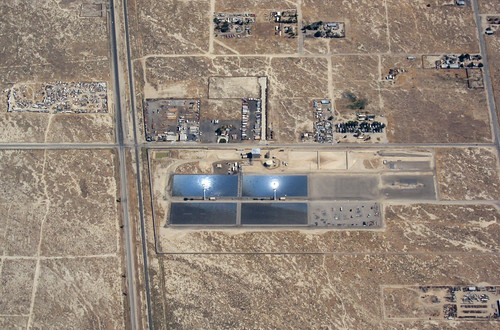
I have been of the view that solar thermal power generation (also known as concentrating solar power or CSP) would become our most important source of power in the longer term. This view was based on a number of advantages that solar thermal possesses - it does not require rare or expensive materials (enabling it to scale without hitting resource limits), it can be built on (and is best suited to) arid land that has few other uses, it can incorporate energy storage (thus avoiding the intermittency issue), it is compatible with the existing centralised generation model and it can be combined with traditional sources of power generation (coal or gas) in hybrid power plants that allow an easy transition using existing connections to the electricity grid.

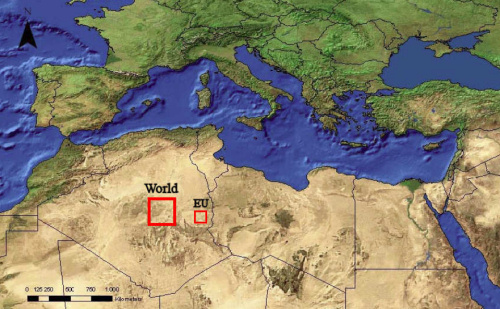
An area of desert around 250 km by 250 km covered with solar thermal power generation could supply all the world's current electricity demand.

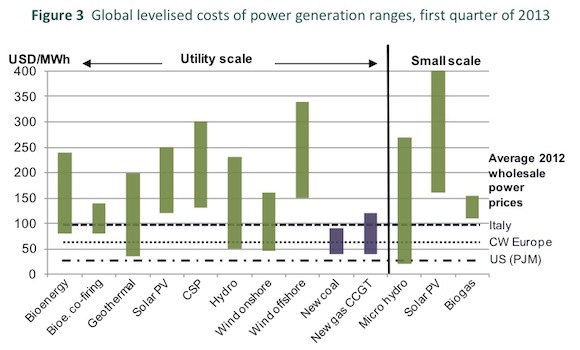
To my continuing dismay, this hasn't happened yet (though it was our fastest growing energy source in 2012) - primarily due to the lack of progress in pushing down costs - the LCOE (levelised cost of energy) of solar thermal still being around twice that other renewable energy options.

I retain some hope given that solar thermal technology remains relatively immature - there was a very long gap between the original plant (SEGS) built in California in the 1980s and the next generation of plants built in Spain beginning in 2007 and the south west of the US shortly afterwards.

Construction of plants is now spreading around the globe, with plants being built in Abu Dhabi, Kuwait, Saudi Arabia, Egypt, Israel, Morocco, Algeria (though at this point the immense Desertec proposal has fallen off the radar), South Africa, India, China and Chile.

While there are encouraging signs for solar thermal power, by and large it has been eclipsed by solar PV in recent years, with solar panel prices plummeting and manufacturing capacity surging. While thin film solar has also become competitive it is traditional silicon based solar PV that has dominated after years of being dismissed as being too expensive.

Research into improving solar PV remains vibrant, with new materials and concentrating solar power techniques looking to push the cost of solar PV below that of coal or gas fired power (the holy grail of solar grid parity).

Wind power

Wind power is the second largest renewable energy source available to us, with the potential supply also exceeding current global energy demand.

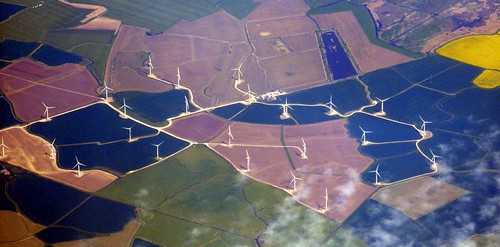
Wind power has also seen rapid growth over the past decade, with generation increasing by over 18% in 2012 and accounting for more than half of new renewable energy supply. In Denmark it now supplies more than 28% of electricity consumption.

Wind power is now the cheapest source of renewable energy, with the LCOE being competitive with coal or gas fired power in many locations. Thanks to the merit order effect, wind power can also help lower the cost of power paid by consumers. While wind power is now a relatively mature technology, advances in turbine size and electromagnet technology along with optimisation of wind farm sites are allowing the overall efficiency of generation to increase further.

Like solar power, wind power can coexist with other uses of land - and large wind farm developments can also be located offshore.

Also like solar power, wind power is criticised for its intermittency. While geographical diversity of generation (along with diversity of energy sources and expanded grids, which will be discussed later) can help to address this, energy storage can also be built into wind turbines, a technique used in new models from GE.

Hydro power

Hydro power is the most mature source of renewable energy (the burning of wood aside) and still accounts for more electricity production than solar, wind, and geothermal combined - however it has a growth rate (around 3% in 2012) lower than most other renewables.

Hydro power current provides 16% if global power generation - the 4 largest power stations in the world are all hydro power projects.

Large scale hydro power doesn't have a lot of room for growth in the developed world, though the Himalayan region and Africa both still have significant room for growth.

Microhydro power is an alternative that is underdeveloped and often has an LCOE quoted that makes it competitive with wind power and with fossil fuels - however I've never seen any useful figures outlining the energy potential from this source (if you look at some designs you'd guess that this is something that could be deployed very widely).

Geothermal power

Geothermal energy is unusual compared to other large renewable power sources, in that it provides "baseload" power (thus placating those suffering from the "baseload fallacy") unlike other more intermittent sources like solar, wind and ocean power. The potential supply of geothermal energy is approximately equal to current global energy demand.

The first geothermal power generation plant was constructed in 1904 in Larderello, Italy, followed by Wairakei, New Zealand in the 1950's then the Geysers in California in the 1960’s. In 2012, 24 countries operated geothermal plants for electricity production, generating around 12 GW in total.

In 2012, growth in geothermal power was less than 3%, leaving it very much a niche energy source. Geothermal power generation is currently concentrated in geologically active areas - the western US, Indonesia, The Philippines, New Zealand, Iceland, Costa Rica, El Salvador and east Africa.

As well as active power generation from traditional geothermal power sources (including low temperature geothermal, ground source heat pumps can be used to provide direct heating.

The great white hope for geothermal power generation is known as "Enhanced Geothermal System" (EGS) (or sometimes Hot Dry Rock or Hot Fractured Rock) - generating power by drilling holes deep into the earth's crust to circulate water through. The energy potential for this type of geothermal energy is vast, however progress so far in terms of producing commercial power has been very disappointing.

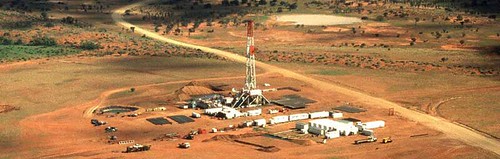
Some early experiments were built in Switzerland but have been shut down due to concerns about earthquakes being caused by the drilling. The most promising experiment is being performed by GeoDynamics in Australia's outback - progress has been extremely slow, with numerous setbacks occurring before a 1 MW pilot plant was finally commissioned this year. On a positive note, operation of the pilot is beating expectations.

Ocean energy

Energy can be tapped from the oceans in 3 different ways - tidal power, wave power and the little known OTEC (Ocean Thermal Energy Conversion).

While there is a significant potential resource in ocean energy - broadly equivalent to our current energy use - the technology for exploiting all 3 forms of energy remains immature and costly. Tidal power has been commercially generated since the 1960's, with France's 240 MW "La Rance" power station only recently being eclipsed in size by a South Korean project. South Korea is looking to greatly expand tidal power production over the next 5 years and a range of projects are proposed for the UK, Australia and the United States - however it appears unlikely that we will see large scale tidal power production in the next couple of decades.

Wave power and OTEC are even less advanced, however pilot projects are at various stages of development for both of them and interest will no doubt slowly build in size over time. Another even more exotic alternative is the generation of electricity using differences in salinity between bodies of water.

Biomass, Biogas and Biofuel

Photosynthesis provides a steady stream of material that can be used for energy - with the caveat that there are limits before this impacts on our ability to produce food and maintain a healthy environment.

There are a range of ways of harnessing organic material for energy (other than the traditional approach of burning it for heat - which the REN21 (pdf) report on renewable energy notes is still the dominant use for biomass - contributing almost 7% of global energy supply) - using biomass to generate power, producing biogas which can be used for heat, power generation or for transport, producing biofuels that can replace or supplement traditional liquid fuels and for pyrolysis which can generate biodiesel, fertiliser and biochar.

Biofuels have been the subject of widespread criticism (critics citing competition with food production and low EROI) and seem unlikely to be able to replace a significant proportion of our oil consumption. Production of ethanol and biodiesel has stagnated in recent years, with production declining by 0.4% in 2012.

Other advanced biofuels such as cellulosic ethanol and algae based biofuels have failed to be produced in significant quantities thus far.

Biomass based power generation also has its critics, though most seem to agree that it is preferable to biofuel production. Global biomass power generation capacity was 58 GW in 2011 and is expected to grow to 86 GW by 2021. The industry seems to be suffering some headwinds, with the largest biomass power plant (Tilbury in the UK) recently being mothballed. Another large scale project in the UK (Drax still seems to be going ahead, and generation of power from waste is booming in Europe.

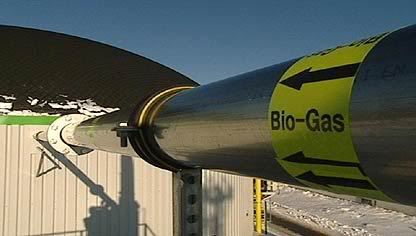
Biogas is the most promising of the biomass based energy generation approaches, with far fewer criticisms being leveled at it (most importantly, there is limited competition between food production and biogas production - the two are often complementary in fact - and the net energy available from biogas far exceeds that of biofuels). It can either be extracted from landfills or produced using "digesters" that process agricultural waste (or occasionally by exploiting natural sources of biogas).

The upper limits for biogas production are not clear, though some studies claim vast amounts can potentially be produced - for example, one European study said that all of Europe's gas needs could be met with biogas. Biogas power generation apparently produced about 14.5 GW in 2012.

Biogas is not only the most environmentally friendly of the biomass based energy alternatives it is also the most versatile, with the gas being able to be used for heat, power (or a mix of both - combined heat and power) or transport.

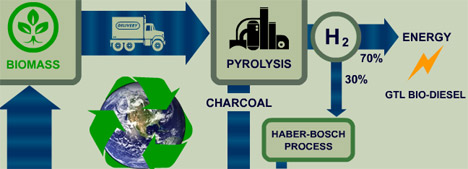
One last use for biomass is the production of biochar. Producers of biochar take dry biomass and bake it in a kiln to produce charcoal. Biochar is the term for what is left over after the energy is removed: a charcoal-based soil amendment. This process is called pyrolysis. Various gases and oils are driven off the material during the process and then used to generate energy. The charcoal is buried in the ground, sequestering the carbon that the growing plants had pulled out of the atmosphere. The end result is increased soil fertility and an energy source with negative carbon emissions.

Distribution of renewable energy

Smart Meters and Smart Grids

Renewable energy (primarily solar and wind power) is often criticised for being intermittent.

In the traditional model of electricity generation and distribution, large, centralised power stations were built with sufficient capacity to handle expected peaks in demand - with significant amounts of capacity idle during non peak parts of the day / year (and brownouts occurring if demand did happen to exceed supply). Consumers were charged a regulated price that ignored fluctuations in supply and demand - instead supply was adjusted as far as was practicable to meet demand.

Adopting a more dynamic (market based) pricing mechanism would allow energy users to have an incentive to shape their energy use to the available supply, thereby enabling fluctuations in supply to be dealt with.

The keys to making this possible are to provide electricity consumers with smart meters and the ability to alter their energy usage based on market price fluctuations. Smart grids are required for electricity distributors to create a more flexible grid incorporating a much more diverse range of power generators.

Supergrids and The Global Energy Grid

As well as making the grid more dynamic, interconnections between grids need to be expanded to enable a greater diversity of suppliers to be available across a wide region - this helps further address the issue of intermittency of supply - the sun may not be shining and the wind may not be blowing in one region however this won't be true across all regions making up a greater grid.

Proposals for extending regional grids into continent wide ones (usually by building HVDC connections between existing grids) tend to be dubbed "supergrids" - examples can be found for North America, Germany and the whole of Europe and between Europe and North Africa.

Buckminster Fuller took this idea to its logical endpoint and recommended the creation of a "global energy grid" as a step towards ending our dependency on fossil fuels.

Energy Storage

The final piece of transforming the electricity grid to distribute 100% renewable energy is building in sufficient energy storage to ensure that suppliers have the ability to react to swings in demand as well as vice versa.

Traditionally energy storage has been available in greater or lesser amounts (depending on what grid you are connected to) in the form of pumped hydro storage.

A wide range of other options have been proposed and explored over the years, ranging from Compressed air energy storage to batteries to flywheels to generating hydrogen (pumped hydro even has an ocean equivalent which is one of the more promising options).

Most battery storage being implemented today involves either lithium ion batteries or flow batteries - however further cost reductions are viewed as being necessary to enable wider availability of energy storage services.

One option receiving a lot of attention recently has been a proposal by MIT Professor Donald Sadoway to build liquid metal batteries.

Adopting alternatives to oil

While it is clear that we can replace all the energy we currently get from fossil fuels with renewable energy, the problem remains that electricity is not a direct substitute for liquid fuels - and that fossil fuels have some other important uses other than providing energy.

Transport

The most important use of liquid fuels is in transport. Increasing fuel efficiency of vehicles (around 3% per year) and substitution of natural gas for oil as a fuel for heavy vehicles has been constraining the growth of oil consumption for road transport in recent years, however this can only ever be a temporary solution - in the longer term we need to use either electricity .

Electrifying as much of the transport system as possible is the first step, with biofuels being used for those forms of transport that cannot be electrified (either liquid biofuel such as ethanol or biodiesel, or compressed biogas) such as large planes and ships.

Hybrid electric vehicles (including plug in hybrids and solar hybrids) are a maturing technology with over 5 million vehicles on the roads now.

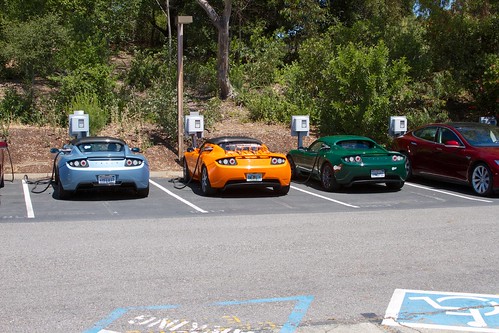
These are providing the stepping stone to fully electric vehicles (which are already outselling plug in hybrids in the US). The journey towards fully electric cars has been a slow one with the star example so far being Tesla Motors (other promising projects such as Better Place have fallen by the wayside in recent years, though manufacturers such as Nissan are competing at the lower end of the market and a raft of car makers are building high end electric sports cars.

Three problems are holding up the transition to electric vehicles at this point - slow recharge times, "range anxiety" and the relatively high cost of electric vehicles compared to legacy internal combustion engine based vehicles. Tesla are looking to address both of the first two issues by pursuing both fast recharge technology (with various other schemes being implemented around the globe) and a battery swap system similar to that pursued by Better Place.

The IEA has set a target of 20 million electric vehicles by 2020, with further 50% increase in battery performance a key to achieving this goal, following on the 50% increase achieved in the past 3 years.

Cars aren't the only type of vehicle that requires fuel of course - heavier forms of of transport also consume oil. We are now starting to see electric trucks, electric buses and electric boats begin to appear out in the marketplace. Where heavy vehicles such as buses follow the same route on a regular basis they become candidates for recharging while in transit.

Of course, we don't have to simply substitute electric vehicles for existing liquid fuel powered ones. There is a wide range of alternatives available including:

  • Walkable communities
  • Cycling. Many journeys do not need to be made by car, particularly if cities are designed to enable transport by cycle (both by pedal powered bicycles and electric bikes) as well as by foot or rail transit.
  • Transit oriented development
  • Rail transport. Rail transport can be electrified where it isn't already and can provide both transit within cities and long distance travel as well (preferably via a high speed rail network)
  • Exotic options such as Personal rapid transit and Elon Musk's proposed Hyperloop

Bioplastic

Nearly all the plastics sold today come from petroleum, accounting for up to 5% of global petroleum consumption by some estimates. Recycled plastics are a good first step towards reducing oil consumption, however they can only be recycled two to four times, and only around 25% of plastics are actually recycled.

The sustainable alternative to traditional plastic is bioplastic. The cost of producing bioplastic has been falling thanks to improved processes, requiring lower temperatures. Combining this with the increasing cost of crude oil has made bioplastic prices competitive with regular plastics.

Bioplastic production is expected to reach 1 million tons in 2015, out of total global plastics production of around 300 million tons.

Leading manufacturers include Avantium, BASF, Braskem, Cereplast, Metabolix and Natureworks. Bioplastic feedstocks include vegetable oil, corn starch, plant cellulose and mycellium.

Bioplastic doesn't necessarily need to replace all current uses of plastic - other alternatives are materials that have been replaced by plastics in recent decades, including steel, wood, aluminum, glass, cardboard and paper.

Agriculture

Agriculture obviously requires transport to grow and distribute food products, however it also requires fertiliser (at least if we continue to follow the green revolution model), which is usually produced using natural gas.

This can be addressed via a range of techniques - by being more efficient with fertiliser use (which would have many environmental and health benefits), by adopting organic farming techniques, by growing food near where we live, by generating ammonia using air, water and renewable energy - or by getting to the root of the problem and enabling plants to fix nitrogen themselves.

Another way of reducing energy consumption from agriculture is to find new ways of producing food - efforts to produce artificial meat (or "cultured beef", as it is sometimes known) have the potential to reduce the amount of energy required to produce meat by 45%.

Manufacturing and Construction

Manufacturing is a major consumer of energy and raw materials. The amount of energy and other raw materials devoted to manufacturing can be reduced by optimising for recycling - in particular by adopting "cradle to cradle" design and manufacturing techniques.

Distributed manufacturing and 3D printing also have potential for reducing the amount of energy required to distribute manufactured goods.

The construction and ongoing operation of buildings is another major consumer of energy, with "green buildings" and energy efficient devices such as LED lighting that minimise energy consumption being an important part of our clean energy future.

Conclusion

The aim of this post was to demonstrate the following (or at least provide food for thought to irredeemable skeptics) - I hope you've found it thought provoking.

  • There is more than enough renewable energy available to meet all our needs - primarily using solar and wind power - and this can be done at a reasonable cost
  • The keys to shifting to renewable energy are to expand the interconnectedness of our electricity grids, to make electricity demand more dynamic (responding to changes in electricity supply / price) and to put more energy storage in place
  • That we need to be aware of the areas where we use fossil fuels and transform these to use renewable energy - to electrify our transport systems, to adopt alternatives to traditional plastics and to adapt our agricultural, manufacturing and construction processes to reduce the amount of energy required and to eliminate dependencies on fossil fuels

OTEC Ahoy - Atoll nations at cutting edge of climate and clean energy  

Posted by Big Gav in ,

Renew Economy has a post on continuing interest in a thus far unexploited form of ocean energy known as OTEC - Atoll nations at cutting edge of climate and clean energy.

A Pacific island nation that is at the centre of crucial climate change negotiations this year wants to build the world’s first commercial ocean thermal energy conversion (OTEC) project – a move that would allow it to look after its own energy needs and even export fuels for shipping and the like.

The Marshall Islands, a sprawling nation of 34 atolls and islands spread over some 2 million square kilometres in the western Pacific, has been battered in the past year by an unprecedented drought and rising seas that have flooded its airport and water catchment facilities.

Next month it plays host to the 44th South Pacific Forum, which this year will be focused on the real impacts of climate change. And it plans a few big announcements to try to encourage larger nations to lift their own ambition and actions

The first is a project that vice president Tony de Brum says has effectively “solarised” the nation. All of its 34 islands now have solar power for homes, schools and dispensaries – no mean feat given the spread and distance of the atolls. On its main islands, solar will account for 20 per cent of its electricity needs and has been installed at hospitals and colleges.

But de Brum has an even more ambitious plan. For much of the past decade he has been pursuing a dream to install the world’s first OTEC commercial plant, and he has been locked in negotiations with Japanese funders and technology developer Lockheed Martin.

In October, a $2.9 million location feasibility study funded by the World Bank will begin. De Brum believes a 20-30MW plant could be in operation before the end of the decade.

The Marshall Islands currently relies on hugely expensive diesel for its energy needs. It costs more than 60c/kWh, and government subsidies reduce the cost to consumers to around 42c/kWh. But diesel sucks up 25 per cent of the nation’s GDP, and the high cost means that the few industries it has – such as the local fish processing plant that employs 800 people – cannot afford to expand.

De Brum believes that OTEC can deliver electricity at around 25c/kWh. He expects funding to come from international bodies, and be underpinned by a power purchase agreement from the US military, which has a large base on the islands and also depends on expensive diesel.

Partnership to build world's largest OTEC plant off China coast  

Posted by Big Gav in ,

PhysOrg has an article about a planned resort development powered by OTEC technology (a type of ocean energy) in China - Partnership to build world's largest OTEC plant off China coast.

Hong Kong based Reignwood Group and U.S. aerospace company Lockheed Martin have announced plans to build an Ocean Thermal Energy Conversion (OTEC) electricity generating plant off the coast of China to power a planned resort community. Lockheed Martin is to build the facility and run it, while the Reignwood Group will be building the resort community that is to use the power generated. The new plant is expected to produce 100 percent of the power needs of the community.

OTEC plants generate electricity by taking advantage of the difference in water temperature at different ocean depths—warm surface water is used to boil a fluid (one that has a low boiling temperature such as ammonia) that in turn drives a turbine. Cold water brought up from below cools the liquid causing it to once again liquefy allowing the process to repeat over and over. To date, few such plants have been built due to the large expense involved in transporting cold water up from below. The new plant to be built off the coast of southern China will be a pilot project designed to not only supply electricity to the new resort community, but also to serve as a learning environment, helping lead the way to more efficient, and hopefully cheaper plant designs.

Global Exergy Resource Chart  

Posted by Big Gav in , , , , , , , , ,

Stanford's "Global Climate and Energy project" has a great chart showing the energy sources available to us and how much we are currently using - Global Exergy Resource Chart.

OTEC In Guam  

Posted by Big Gav in , ,

OTEC News has a post on a potential Ocean Thermal energy project in Guam, which is claimed to cost $1.5 billion - Guam OTEC.

An interview with American Samoa Territorial Energy Office (TEO) Acting Director Mauigoa Reupena Tagaloa, with Radio New Zealand International, triggered a couple of articles on Guam Newsfactor. The most interesting part of the articles may be the claim that the US Navy would be spending 1.5 Billion to build OTEC for the military facilities on Guam. That seems like a very high number and I would be interested to hear what has been included in that.

More OTEC Power For Hawaii ?  

Posted by Big Gav in , ,

OTEC News reports that there may be a second OTEC plant planned for Hawaii - Not one, but two OTEC plants in Hawaii? .

Thanks to Maria Tome, Hawaii State Energy Office for confirming that the Lookheed Martin OTEC will be built on Oahu, Hawaii. She pointed to this Energy Agreement which was signed by the State of Hawaii and the Hawaiian Electric Companies.

Looking a little deeper into the 52 page agreement (2 MB PDF) I found something which I hadn't seemed mentioned before, and I am not sure I understand what it means. On page 45 in the document it says "Cumulative Target Goal (MW per year end)", and has a table. The Lookheed Martin OTEC is in there with 10 MW. But there is a second line with "Sea Solar OTEC 100 MW", to be in place at the same time as the Lookheed Martin installation. Sea Solar OTEC shows up on page 49 as well and as having a "completed term sheet" by Q3 2008, and a proposed "commercial operation date" of Q3 2013.

Is there a separate OTEC plant being negotiated with Sea Solar Power for Oahu, Hawaii?

Plumbing the oceans for clean energy  

Posted by Big Gav in ,

New Scientist has an update in progress of the lowest profile form of ocean energy - OTEC - Plumbing the oceans could bring limitless clean energy.

FOR a company whose business is rocket science Lockheed Martin has been paying unusual attention to plumbing of late. The aerospace giant has kept its engineers occupied for the past 12 months poring over designs for what amounts to a very long fibreglass pipe.

It is, of course, no ordinary pipe but an integral part of the technology behind Ocean Thermal Energy Conversion (OTEC), a clean, renewable energy source that has the potential to free many economies from their dependence on oil.

As the price of fossil fuels soars, private companies from Hawaii to Japan are racing to build commercial OTEC plants. The trick is to exploit the difference in temperature between seawater near the surface and deep down (see diagram).

First, warm surface water heats a fluid with a low boiling point, such as ammonia or a mixture of ammonia and water. When this "working fluid" boils, the resulting gas creates enough pressure to drive a turbine that generates power. The gas is then cooled by passing it through cold water pumped up from the ocean depths via massive fibreglass tubes, perhaps 1000 metres long and 27 metres in diameter, that suck up cold water at a rate of 1000 tonnes per second. While the gas condenses back into a liquid that can be used again, the water is returned to the deep ocean. "It's just like a conventional power plant where you burn a fuel like coal to create steam," says Cohen.

The idea of tapping the ocean's different thermal layers to generate electricity was first proposed in 1881 by French physicist Jacques d'Arsonval but didn't receive much attention until the world oil crises of the 1970s. In 1979, a US government-backed partnership that included Lockheed Martin, lowered a cold water pipe from a barge off Hawaii that was part of an OTEC system generating 50 kilowatts of electricity. Two years later, a Japanese group built a pilot plant off the South Pacific island of Nauru capable of generating 120 kilowatts.

In the first flush of success, the US Department of Energy began planning a 40 megawatt test plant off Hawaii. Then in 1981, the funding for ocean thermal technologies began to dwindle. It dried up altogether in 1995 when the price of oil began to drop, eventually falling below $20 a barrel.

Now rising fuel costs have revived interest in this neglected technology. In September, the Department of Energy awarded its first grant for ocean thermal energy in more than a decade, giving Lockheed Martin $600,000 to develop a new generation of cold water pipes.

Cohen believes this could eventually lead to 500 MW OTEC plants on floating offshore platforms sending electricity to onshore grids via submarine cables, and factory ships "grazing" the open ocean for power.

Lockheed's first goal is to get a test facility up and running. The company has got together with Makai Ocean Engineering of Waimanalo, Hawaii, to build a 10 to 20 MW plant, most likely off Hawaii, that it hopes to have up and running in the next four to six years. The plant - including a 1000-metre pipe some 4 metres in diameter - would feed electricity to the island's energy grid via submarine cables.

While Lockheed gears up for its test facility, a plant for the US military could come online even sooner. OCEES International, based in Honolulu, is finishing designs for an ocean thermal facility to be built off the island of Diego Garcia in the Indian Ocean, which is home to a major US military base.

The plant would provide 8 MW of electricity and would also power the desalination of 1.25 million gallons of seawater per day. OCEES says it could be up and running by the end of 2011.

At the moment Diego Garcia is powered entirely by diesel fuel, and base commanders see ocean thermal as a means to energy independence. "It's a strategic military installation in the middle of the Indian Ocean," says Harry Jackson of OCEES. "They don't want to rely on others to provide their power."

"I think OTEC has the potential to develop sufficient power output much quicker than wave buoys or tidal power would," says Bill Tayler, director of the US navy's Shore Energy Office. "It would take a lot of buoys to produce 8 to 10 MW of power. We're looking at them all but have our hopes on OTEC."

Still, both teams will have to work out issues such as how to connect the floating, bobbing platforms to fixed submarine power lines. Heat exchangers will have to be designed in a way that prevents excessive buildup of algae, barnacles and other marine organisms that could clog the system.

OTECSteading: The New Tuvalu  

Posted by Big Gav in , ,

"Pruned" has a post on an OTEC based "energy island" concept - OTEC Steading.

It looks more sleek and futuristic (or retro-futuristic, if you're much versed in vintage SF) than other prototypes, a creature more adapted to fictional outer space than to the oceans.

But something about its bulbous main compartment led us to wonder if there is enough room inside for seasteaders to muck about with nation-building. Amidst all those noisy condensers and turbine generators and navigational gears, perhaps even inspired by them, they try to formulate the mechanics of a new micro-civilization, new identities and new cultural traditions.

If not, how about a second, similarly bulbous habitat module perched on top, above the water line? Or a polyhedral honeycomb of spherical units for, you guessed it, climate change refugees to call home? It would be a kind of artificial energy island but sovereign.

With an overabundance of low-cost, carbon-neutral energy, this New Tuvulu could desalinate fresh water for its citizens and a mini-aquaponics industry. Power enough open-ocean aquaculture cages, and all will be well fed. Any surplus electricity, fish and fresh water would then be traded to neighboring countries. Consequently, their GDP skyrockets.

New Funding For OTEC Research  

Posted by Big Gav in , ,

The New York Times has a report on new funding for work on OTEC by Lockheed Martin (better than paying them to build weapons, says I) - Lockheed Set to Tap Ocean Thermal Energy With DOE Funds (via OTEC News).

The world’s oceans are an energetic place, and military-industrial giant Lockheed Martin said today it has been granted $1.2 million by the Department of Energy to demonstrate that ocean thermal energy conversion is possible. Although the ocean often doesn’t feel very warm, the temperature gradient between the warm, sun-soaked surface and the frigid, dark depths provides enough of a differential to run a heat engine. The idea has been kicking around for over a century but has never been scaled. Lockheed Martin helped build the largest ocean thermal energy conversion system to date back in the 80s, but it only ever produced 50,000 watts, or .05 megawatts.

For those who aren’t so up on their thermodynamics, whenever you have a temperature gradient, there is accessible energy to be had. Ocean thermal energy conversion (OTEC) works best when there’s a temperature difference of at least 20 degrees Celsius. Waters of two different temperatures are pumped through a heat exchanger which vaporizes and then condenses the water, producing energetic steam in the process.

Lockheed will work on the problem of getting that cold, deep water up to the surface. The small-scale OTEC system Lockheed had previously help design in Hawaii used a polyethylene pipe that was 2,150 feet long and 2 feet in diameter to draw up cold water. Under terms of the grant, Lockheed will demonstrate cold water pipe fabrication using modern fiberglass and low-cost composite material manufacturing methods.

Harnessing ocean thermal energy is likely farther out than both wave and tidal energy systems. But if scaled, it could provide consistent base-load energy and help tropical islands, like Hawaii, attain energy independence, a serious issue in a world of petropolitics.

Marshall Islands Declares State Of Economic Emergency  

Posted by Big Gav in , , , ,

I made a brief mention of this story on the weekend in "Short Takes", but I came across a more detailed accounting of what is happening from Pacific Magazine which is worth a read. In summary - rising oil prices are pushing smaller countries like the Marshall Islands that generate power using diesel to the (economic) brink. In this case they are taking the novel approach of considering using OTEC to supply their energy needs.

With spiraling fuel costs threatening the government’s ability to maintain power services in Majuro, Ebeye and other islands, the Marshall Islands declared a state of emergency Thursday afternoon to address the deteriorating economic situation.

Government officials said that declaration of a national state of economic emergency is aimed at fast-tracking domestic energy reduction and cost cutting measures, while lending weight to appeals by the Marshall Islands to donor countries and regional lending agencies for help.

“The national power utilities are projected to face an estimated shortfall of $17.5 million to $21 million over the next 12 months assuming the global trend continues,” said President Litokwa Tomeing in a nationally broadcast statement Thursday night. This deficit amounts to close to 20 percent of the entire national budget.

The government’s utility companies have raised power rates three times since January, but revenues have fallen as customers have cut back energy use or been disconnected for not being able to afford power costs that now range from 39 cents per kilowatt hour for “lifeline” residential use to 47 cents for businesses.

The Marshall Islands has enough diesel on island to keep the lights on until the end of August. But if it cannot come up with $8.5 million by next weekend to pay Seoul-based SK Networks for last month’s diesel shipment and a down payment on the next shipment, the likelihood of power rationing — and the possibility of running out of fuel — is looming.

The Marshalls Energy Company told Cabinet last week that without an immediate cash injection, it cannot raise the $8.5 million by next weekend. ...

While over the past three years a big alternative energy push has led to nearly half of the remote outer atoll homes getting donor-funded solar units, the state of emergency has ordered government agencies to redirect their alternative energy efforts to the two urban centers to help get people off costly electricity supplied by the government’s diesel-fired power plants.

The Cabinet has called for an fast-tracking a study on the feasibility of ocean thermal energy conversion (OTEC) as an alternative to using fossil fuels for power generation, while also ordering the cost-cutting measure of parking government vehicles immediately after work to end the current practice of workers using government vehicles for personal needs after working hours.

Tapping The Source: The Power Of The Oceans  

Posted by Big Gav in , , , , , ,

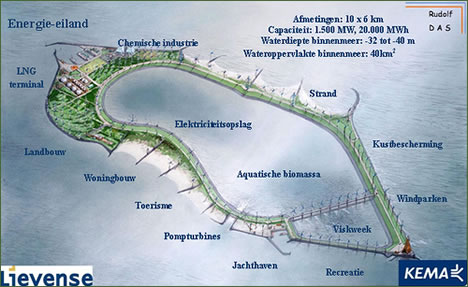
Last year I came across the story of Dutch company Kema and their energy island idea - basically a variant on the usual pumped hydro energy storage concept where water is pumped out of a space below sea level then allowed to flow back in, generating power as it does. The "island" uses wind power to pump water out of the enclosed area. An obvious extension to this idea would be to harness ocean energy as well - letting wave and/or tidal power supplement the output of the wind turbines. An attraction of this concept is that it potentially allows a large amount of new energy storage to be brought online - and this storage would be along the world's coastlines, where most of the population lives.


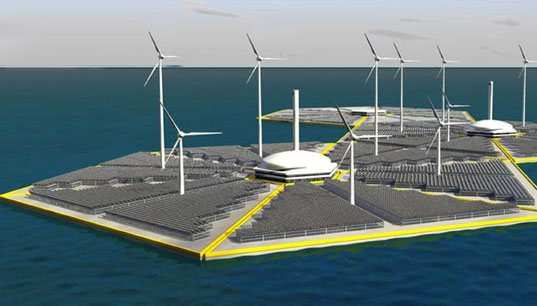
Another form of energy island has been in the news recently, this one a substantially more ambitious proposal which envisions artificial islands to collect wind, wave, ocean current and solar power in the tropics, along with a more unusual energy source - harnessing the difference in water temperatures between the warm surface and the cold depths using a technique called OTEC (Ocean Thermal Energy Conversion). These islands are being proposed by architects Dominic Michaelis and his son Alex Michaelin as a response to Richard Branson’s Virgin Earth Challenge, which offers $25 million in prizes for innovative solutions for combating global warming.


While the practicality of these particular proposals has yet to be put to the test, the various forms of ocean power are probably the most overlooked of the big 6 renewable energy sources (along with solar, wind, geothermal, biomass and hydro).

Other forms of renewable energy are sometimes criticised for being more intermittent and less predictable than traditional power generation, however ocean energy is much more reliable - steady ocean currents could provide good baseload power, as could OTEC, tidal power is diurnal and highly predictable and waves are predictable days in advance.

In this post I'll have a look at the amount of energy that could potentially be harvested from these sources and the various projects underway to try and make this a reality.

Tidal and Ocean Current Power

Tidal power stations usually take the form of a dam (or barrage) built across a narrow bay or river mouth. As the tide flows in or out, it creates uneven water levels on either side of the barrier. The water flows through the barrier, turning turbines to generate electricity.

Benefits of tidal barrage power generation include :

* Predictable source of clean energy
* No dependence on foreign fuel sources
* Flood protection
* Transport links for road and/or rail
* Better shipping and boating conditions behind the barrier

Disadvantages include :

* The timing of the tides doesn't often correlate with peak demand times (less of a problem if there are good energy storage options available)
* Existing ecosystems behind the barrage tend to be heavily altered
* Likely to stimulate silting in some areas and coastal erosion in others
* Enhance flood risk on the seaward side
* Shipping would have to navigate locks
* Industrial discharges behind the barrage are less likely to be dispersed out to sea

Variations on this theme include offshore tidal lagoons, which use a water impoundment structure and low-head hydroelectric generating equipment on shallow tidal flats, and tidal fences, which are composed of a number of individual vertical axis turbines mounted within the fence structure, known as a caisson.

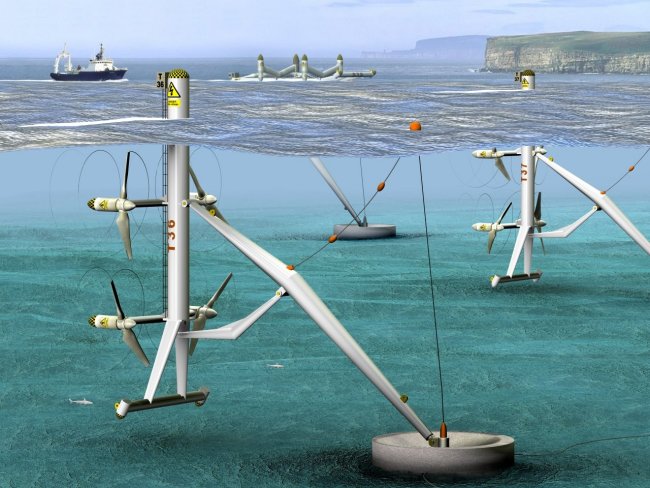
Underwater turbines can also be used to harness both tidal power and ocean current power. The turbines (sometimes called aquanators) are similar to wind turbines. In water moving between 6 and 9 km per hour, a 15 m diameter water turbine could generate as much energy as a 60 m diameter wind turbine. Given the smaller amount of infrastructure required and the larger range of possible sites that this technology could be deployed to, it seems likely that underwater turbines will become much more widespread than tidal barrage style generation.


World tidal energy resources have been estimated at around 3000 GW, however less than 3% of this is located in areas considered suitable for power generation (these figures probably don't include ocean current power, which doesn't seem to be well studied).

A 240 MW tidal-barrage power plant has been operating at La Rance in Brittany since 1966. Other operational barrage sites are at Annapolis Royal in Nova Scotia (18 MW), the Bay of Kislaya near Murmansk and at Jangxia Creek in the East China Sea.

The largest tides in the world are found in Canada's Bay of Fundy, which has been earmarked to become a 4-berth test site for tidal power generation next year.

On the west coast of Canada, Marine Current Turbine and BC Tidal Energy Corporation plan to install at least three 1.2 MW tidal energy turbines in Vancouver Island's Campbell River by 2009. This the first step in a plan to develop larger tidal farms off British Columbia's coast, which the company says have a tidal energy potential of up to 4,000 MW.

In the United States, at the southern end of the Bay of Fundy, lies Passamaquoddy Bay, which has long been a target for a tidal power development - first initiated in 1935 by the Public Works Administration under the Roosevelt administration, then halted by Congress a year later. John F Kennedy revived the 550 MW project in 1963, however the plan died with him (spawning one of the stranger JFK assassination conspiracy theories I have come across).

Further south, in the Martha's Vineyard area, two underwater turbine projects are trying to get started - one a 300 MW proposal from Oceana Energy Company and the other from Natural Currents Energy Services. Other projects are being considered in the Cape Cod and New Bedford areas - part of a "gold rush" for good tidal power sites (the most desirable ones usually have hourglass figures, to get maximum force in the incoming tide) which has seen the FERC issue 47 preliminary permits for ocean energy projects (and generated mainstream news coverage on the NBC network).

New York's East River is the location of one of the more high profile tidal power experiments currently underway, with Verdant Power experimenting with underwater turbines there. The first attempt eventually ended in failure, with the strong tides breaking the devices.

The Gulf Stream has also caught the eye of hopeful ocean energy companies, particularly in Florida, with the 30 mile wide current pushing 8.5 billion gallons of water along per second and prompting some observers to consider the prospect of "Infinite Underwater Energy".

Californian utility PG&E is also investigating tapping tidal power in San Francsico Bay, with some observers talking about a plant of up to 400 MW in size.

Another bay famous for its tides is the Severn river estuary in Britain, with a tidal range of 14 metres. Plans for damming the Severn estuary or Bristol channel have existed since the 19th century (with tidal power generation being just one proposed application). The UK government recently proposed a new barrage design, which could produce 5% of the UK's electricity requirements, with a peak rate of 8.6 GW. A feasibility study is expected to be complete by 2010. An alternative proposal, by Tidal Electric, involves a series of lagoons, the first of which would be built in Swansea Bay. Some observers have noted underwater turbines may be more appropriate than a barrage.

Pentland Firth in Scotland is another UK location that is considered to have a large amount of tidal power potential - a DTI study in 1993 indicated that if all potential sites were developed, the total UK tidal stream resource could be about 60 TWh. Of this, almost half (28 TWh) could come from the Pentland Firth. The water depth is 60m or more, making potential energy capture huge but technically difficult - 63% of the tidal stream resource is estimated to be in waters deeper than 40m.

Marine Current Turbines launched the world's first underwater turbine project off north Devon in 2003. MCT also began installing a 1.2 MW "SeaGen" tidal current turbine in Northern Ireland's Strangford Lough in 2007, with the company planning to scale up to build a 10MW tidal power farm off Anglesey in North Wales, and to have 500MW of tidal capacity by 2015. Also in Wales, Lunar Energy and Eon are hoping to build an underwater tidal project off Pembrokeshire.

Another UK tidal power proposal is part of a plan by Metrotidal to build a tunnel under the Thames, currently under fire from environmental groups. There is also talk about regions like the Isle Of Wight and the Humber estuary harnessing tidal power as part of initiatives to become energy self-sufficient (like other "Transition Towns").

Norway has also begun investigating the use of tidal power, with an experimental facility opening in Hammerfest in 2003. The company that developed that technology, Hammerfest Strøm, is working with Scottish Power to develop a project near the Orkney Islands (the islands have also been a test site for another venture by Lunar Energy and Rotech).

There has been no tidal power development in Australia thus far, though the Kimberly region has long been a target for would be developers of tidal power projects, due to its enormous potential (a tidal range of 11 metres). Thus far all of the proposed projects have been stymied by the remoteness of the location from the Western Australian and national electricity grids and by environmental concerns. A number of possible sites have been identified, including Secure Bay, Walcott Inlet, George Water and St. George's Basin.

Liberal backbencher Wilson "Ironbar" Tuckey has been the most vocal supporter of a Kimberly tidal project, pointing out if a link was built to the eastern states grid it would obviate the need for any consideration of nuclear power. Some Kimberly tidal power advocates have also tried to base the idea of a "hydrogen economy" on the resource, though this seems a lot more far-fetched than a grid link (the grid link could also potentially include large scale CSP solar in the western australian deserts, which are one of the best solar resources in the world) .

The Bass Strait area is also considered to have significant potential for tidal / ocean current power generation (one estimate claiming there is potential for 3000 MW of generation in the channel between King Island and Cape Otway).


New Zealand is another country with large tidal resources but without any existing tidal energy generation. According to TVNZ, there are at least 24 wave and tidal power projects currently under development. Trying to get a handle on who might be behind these projects isn't easy - there is an NZ wave and tidal power association, but it doesn't list members or projects - according to their latest newsletter they have 59 members. Crest Energy seems to be the most prominent local company, with a plan for a 200 MW plant in Kaipara Harbour using underwater turbines. Other potential locations include Manukau and Hokianga Harbours, and Tory Strait and French Pass in the Marlborough Sounds. The harbours produce 5 to 6-knot currents and tidal flows of 100,000 cu m a second from the flood and ebb tides, with tidal volumes 12 times greater than the flow in the largest local rivers.

The Phillipines is another potential location for tidal power, with a 2.2GW tidal fence proposed for the Dalupiri Passage using the Davis turbine, from the Blue Energy company and an estimated cost of $US 2.8 Billion is unfortunately on hold due to political instability.


South Korea also has ambitions to generate power from ocean currents, with pilot underwater turbines being installed at Uldolmok, in the country's south-west. Researchers at the Korea Ocean Research and Development Institute (KORDI) chose the site because it has flows up to 12 knots, believed to be among the fastest in Asia. The strong currents have resulted in a number of accidents, hampering progress. KORDI is also trying to improve the efficiency of more conventional barrage-type tidal power plants. The primary project involves building a power plant with a capacity of 250 MW at Lake Sihwa, with another plant up to 520 MW being considered for Garolim Bay.


Taiwan is another Asian nation considering the the possibility of large-scale ocean current power generation. There have been discussions about using the strong Kuroshio current off the east coast of Taiwan to generate up to 1.68 trillion kilowatt-hours per year (compared to Taiwan's current annual demand of electricity of around 98 billion kilowatt-hours).

Wave Power

Surface waves and pressure variations below the ocean's surface can be used by floating buoys or submerged platforms to generate intermittent power. Wave energy sources are widely available, are relatively consistent and predictable and (According to analysts Frost and Sullivan) have the highest energy density among all renewable energy sources. The best resource is found between 40-60 degrees of latitude where the available resource is 30 to 70 kW/m, with peaks of 100 kW/m. The potential global wave power potential has been estimated to be around 8,000-80,000TWh/y (1-10TW), which is the same order of magnitude as world electrical energy consumption.

The UK, for example, is estimated to possess the capacity to generate approximately 87 TWh of wave power per year - equivalent to almost 25 per cent of current UK demand. There are two main research centres in Europe focusing on the development and commercialisation of ocean energy technologies. The first is the European Marine Energy Centre located in Orkney, Scotland, which provides developers with sites to test their prototypes. The other is the Wave Energy Centre in Portugal.

Wave energy ideas are plentiful but real world examples are still rare - there are around 1000 patents for wave energy converters currently on the market and no consensus has emerged yet on which technologies will succeed.

Australian company Oceanlinx (previously known as Energetech) has had a 450 kilowatt wave power unit running at Port Kembla in NSW for a number of years, and plans to connect to the commercial power grid in early 2008. Oceanlinx is also at the advanced permitting stage for a project in Portland, Victoria which would deploy eighteen 1.5MW units for a total capacity of 27MW, which the company claims will be the largest wave energy project in the world.

The company has other projects planned in Rhode Island, Hawaii and Namibia, and intends to participate in the South West of England Regional Development Agency's "Cornwall Wave Hub" in the UK.

The Cornwall Wave Hub aims to create the world's first large scale wave energy farm by constructing a wave hub, or "socket", on the seabed. Oceanlinx is participating along with Ocean Power Technologies, Fred Olsen Renewables and WestWave. Ireland is looking to build a similar grid connected test facility on the Mullet Peninsula in Ireland's County Mayo. While the marine renewables industry in the UK seems to be quite vibrant, government programs to fund the sector have been criticised for not spending the money they have been allocated.

Another Australian company, Carnegie Corp has installed a small array of its CETO II units off Fremantle in WA, and is looking to set up a 50 MW facility in South Australia to desalinate seawater for the Adelaide market and the mining industry. The CETO technology was devised in the 1970s by Carnegie's chairman Alan Burns, a well-known Perth oil man who also founded Hardman Resources. It operates mostly underwater rather than on the surface like many buoy based alternatives, which the company believes will result in a much lower likelihood of damage from storms and rough conditions.

Another Australian company exploring wave (and tidal) power is Sydney based BioPowerSystems, which is trying to is commercialise "biomimetic ocean energy conversion technologies" (an example of "biomimicry", which I'll be doing a post on at a later date). BioPower has been awarded a $5 million grant under the Australian Government's AusIndustry Renewable Energy Development Initiative to test prototypes of the wave energy device (most likely at King Island) and the tidal energy device (at Flinders Island), with each generating around 250 kW.

Pelamis Wave power is a Scottish company that is constructing a 3 MW wave farm off the coast of the Orkney Islands. The company is also involved in the construction of a 2.25 MW plant in Portugal at Aguçadoura, which will soon be expanded to 20 MW, and is providing the technology for the WestWave project in Cornwall. The Pelamis design is a distinctive device resembling a 150m long red snake.

The Scottish government is considering building a connection linking the north and west coasts of Scotland with England, Norway, Germany and the Netherlands by 2020 which could be connected to the proposed European Supergrid, with the aim of harvesting up to 10 GW of wind and wave power.


Spain is also dipping a toe into the waters of wave generation, with a 300 kW "breakwater wave energy plant" being constructed on the north coast, using Wavegen (now owned by Siemens) equipment.

In the US, the wave energy company getting the most attention has been Finavera, which has received preliminary approval to build a 100 MW facility off northern California (and has signed a power purchase agreement with PG&E for part of this). At hasn't all been plain sailing for Finavera however, with a test AquaBuoy device sinking off Oregon late last year.

The Electric Power Research Institute (EPRI) estimated that waves off the Washington, Oregon and California coasts could produce from 250 to 500 terawatt-hours per year - around 12% of US energy demand. Finavera also has approval for a project in Washington state, along with others in South Africa and Canada.

Another US based company is Ocean Power Technologies, which is looking at developing projects in Hawaii, New Jersey and Spain.


OTEC

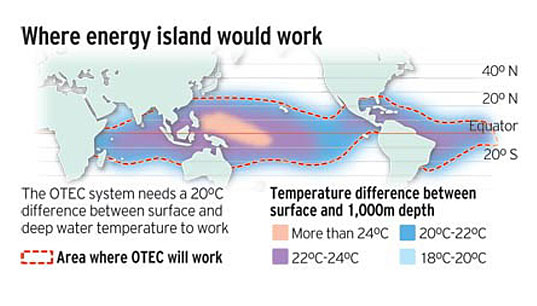
Ocean Thermal Energy Conversion is not a new idea, it has been around for more than a century. OTEC uses the temperature difference between warm surface water and cold deep water to drive a power-producing cycle. For this to be practical, the temperature difference needs to be at least 20 degrees C, which tends to limit potential application to the tropics. The potential of this energy source has been estimated to be about 10 TW, according to some experts.

The economics of energy production today have delayed the financing of a permanent, continuously operating OTEC plant. However, OTEC is promising as an alternative energy resource for tropical island communities that rely heavily on imported fuel. OTEC plants in these markets could provide islands with power and desalinated water. Other applications that have been considered are aquaculture and mineral extraction.

OTEC plants have been trialled in Nauru and India (along with extensive research in Hawaii). There are also plans to build plants for the US military base on Diego Garcia, and in the Marianas Islands.

One unusual apparent application of this energy source that I came across recently is a robotic "thermal glider" which, at the least, seems like a very interesting tool for environmental monitoring.

Regular news updates on OTEC can be found at OTEC News.

Energy Island Ideas

The thinking behind harnessing ocean power has traditionally focussed on systems built on or near the shoreline. The amount of power available is large, however we are still at the very early stages of learning to harness it, and it is unlikely that ocean power will provide a significant proportion of our energy needs in the next decade or two.

The Energy Island concepts that I began the post with show that people are now beginning to consider harnessing ocean power out at sea as well, which vastly increases the amount of energy that could be tapped.

(The term "energy island" is an overloaded one unfortunately - the Danish island of Samso, for example, calls itself Energy Island as it is completely self-sufficient. There is also a "solar island" being developed off Dubai known as Ras Al Khaima.)

Dominic Michaelis' energy islands are by far the most ambitious plan I've seen for harnessing ocean power in the open seas. These hexagonal islands, are designed to generate electricity using wave, ocean current, OTEC, wind and solar sources. The group estimates that each island complex could produce around 250 MW of power. 50,000 energy islands could meet the world’s energy requirements - ands provide two tons of fresh water per person per day for the entire world population as a byproduct of the OTEC process.

The island design also supports farming seafood in small pens below deck and growing vegetables in shaded areas on the platform. The group is planning to conduct a pilot in the waters off the British Virgin Islands or in the Indian Ocean over the coming year.

Most observers consider the likelihood of energy islands appearing in the near term as remote, however the ideas are thought provoking and put into context just how much energy could be obtained out at sea.

One of the main issues with generating power offshore is how to store or transfer the energy (assuming that the islands don't simply become mobile aquatic arcologies of the sort science fiction writers used to dream about). One possible way of storing the energy would be to produce hydrogen, and to use the islands as refuelling stations for ships that use hydrogen fuel cells. Alternatively, the energy could be used to process raw materials, or to produce materials like ammonia.

Statistics

Locations of visitors to this page

blogspot visitor
Stat Counter

Total Pageviews

Ads

Books

Followers

Blog Archive

Labels

australia (619) global warming (423) solar power (397) peak oil (355) renewable energy (302) electric vehicles (250) wind power (194) ocean energy (165) csp (159) solar thermal power (145) geothermal energy (144) energy storage (142) smart grids (140) oil (139) solar pv (138) tidal power (137) coal seam gas (131) nuclear power (129) china (120) lng (117) iraq (113) geothermal power (112) green buildings (110) natural gas (110) agriculture (91) oil price (80) biofuel (78) wave power (73) smart meters (72) coal (70) uk (69) electricity grid (67) energy efficiency (64) google (58) internet (50) surveillance (50) bicycle (49) big brother (49) shale gas (49) food prices (48) tesla (46) thin film solar (42) biomimicry (40) canada (40) scotland (38) ocean power (37) politics (37) shale oil (37) new zealand (35) air transport (34) algae (34) water (34) arctic ice (33) concentrating solar power (33) saudi arabia (33) queensland (32) california (31) credit crunch (31) bioplastic (30) offshore wind power (30) population (30) cogeneration (28) geoengineering (28) batteries (26) drought (26) resource wars (26) woodside (26) censorship (25) cleantech (25) bruce sterling (24) ctl (23) limits to growth (23) carbon tax (22) economics (22) exxon (22) lithium (22) buckminster fuller (21) distributed manufacturing (21) iraq oil law (21) coal to liquids (20) indonesia (20) origin energy (20) brightsource (19) rail transport (19) ultracapacitor (19) santos (18) ausra (17) collapse (17) electric bikes (17) michael klare (17) atlantis (16) cellulosic ethanol (16) iceland (16) lithium ion batteries (16) mapping (16) ucg (16) bees (15) concentrating solar thermal power (15) ethanol (15) geodynamics (15) psychology (15) al gore (14) brazil (14) bucky fuller (14) carbon emissions (14) fertiliser (14) matthew simmons (14) ambient energy (13) biodiesel (13) investment (13) kenya (13) public transport (13) big oil (12) biochar (12) chile (12) cities (12) desertec (12) internet of things (12) otec (12) texas (12) victoria (12) antarctica (11) cradle to cradle (11) energy policy (11) hybrid car (11) terra preta (11) tinfoil (11) toyota (11) amory lovins (10) fabber (10) gazprom (10) goldman sachs (10) gtl (10) severn estuary (10) volt (10) afghanistan (9) alaska (9) biomass (9) carbon trading (9) distributed generation (9) esolar (9) four day week (9) fuel cells (9) jeremy leggett (9) methane hydrates (9) pge (9) sweden (9) arrow energy (8) bolivia (8) eroei (8) fish (8) floating offshore wind power (8) guerilla gardening (8) linc energy (8) methane (8) nanosolar (8) natural gas pipelines (8) pentland firth (8) saul griffith (8) stirling engine (8) us elections (8) western australia (8) airborne wind turbines (7) bloom energy (7) boeing (7) chp (7) climategate (7) copenhagen (7) scenario planning (7) vinod khosla (7) apocaphilia (6) ceramic fuel cells (6) cigs (6) futurism (6) jatropha (6) nigeria (6) ocean acidification (6) relocalisation (6) somalia (6) t boone pickens (6) local currencies (5) space based solar power (5) varanus island (5) garbage (4) global energy grid (4) kevin kelly (4) low temperature geothermal power (4) oled (4) tim flannery (4) v2g (4) club of rome (3) norman borlaug (2) peak oil portfolio (1)