Showing posts with label texas. Show all posts

A Texan tragedy: ample oil, no water  

Posted by Big Gav in , , ,

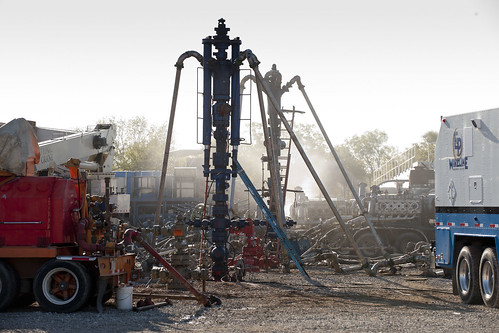
The Guardian has an article on the unfortunate intersection of the Texas drought and shale oil boom - A Texan tragedy: ample oil, no water.

Beverly McGuire saw the warning signs before the town well went dry: sand in the toilet bowl, the sputter of air in the tap, a pump working overtime to no effect. But it still did not prepare her for the night last month when she turned on the tap and discovered the tiny town where she had made her home for 35 years was out of water.

"The day that we ran out of water I turned on my faucet and nothing was there and at that moment I knew the whole of Barnhart was down the tubes," she said, blinking back tears. "I went: 'dear God help us. That was the first thought that came to mind."

Across the south-west, residents of small communities like Barnhart are confronting the reality that something as basic as running water, as unthinking as turning on a tap, can no longer be taken for granted.

Three years of drought, decades of overuse and now the oil industry's outsize demands on water for fracking are running down reservoirs and underground aquifers. And climate change is making things worse.

In Texas alone, about 30 communities could run out of water by the end of the year, according to the Texas Commission on Environmental Quality.

Nearly 15 million people are living under some form of water rationing, barred from freely sprinkling their lawns or refilling their swimming pools. In Barnhart's case, the well appears to have run dry because the water was being extracted for shale gas fracking.

The town — a gas station, a community hall and a taco truck – sits in the midst of the great Texan oil rush, on the eastern edge of the Permian basin.

A few years ago, it seemed like a place on the way out. Now McGuire said she can see nine oil wells from her back porch, and there are dozens of RVs parked outside town, full of oil workers.

But soon after the first frack trucks pulled up two years ago, the well on McGuire's property ran dry.

No-one in Barnhart paid much attention at the time, and McGuire hooked up to the town's central water supply. "Everyone just said: 'too bad'. Well now it's all going dry," McGuire said.
MacBank looking to expand US energy trade  

Posted by Big Gav in , , ,

The SMH reports that shale gas from the drought stricken Eagle Ford area in Texas is expected to supply the US’ first LNG export project, which is being pushed by the Silver Donut’s US operation - MacBank looking to expand US energy trade.

Macquarie Bank is looking to expand its energy trading business in the physical North American crude, liquefied natural gas, and coal sectors in the coming years, says the head of the energy markets division.

Macquarie, Australia's largest investment bank and already one of the top traders of physical natural gas in the United States, has been looking into several new markets based on client requests and the expected leverage it will have with a planned LNG export terminal. ...

Trading of Canadian crude has surged in recent years due to rising production from the oil sands, and O'Kane says the bank has opened a 12 person Calgary office to help handle trade.
Overall, the bank has expanded its energy trading division from around 16 people when it started in late 2002 to currently employ around 240 people in the front office, with a strong focus on natural gas.

Macquarie entered the U.S. natural gas market in 2005 with the acquisition of Cook Inlet Energy Supply, and in 2009 acquired Constellation Energy's downstream natural gas trading platform. O'Kane said it now ranks fourth in physical U.S. natural gas trade, behind BP, Shell, and ConocoPhillips, trading 12 billion cubic feet per day.

With natural gas prices under looking under pressure and rangebound in the near future due to rising U.S. output from shale plays, O'Kane said the start up of its planned LNG export terminal with Freeport LNG in Texas in 2015 will lead to further opportunities to trade the fuel.

He said that even with Freeport and other LNG export options elsewhere under discussion, there probably will not be enough export projects built to tip the balance of U.S. markets and send prices strongly higher.

"We don't think ... the export projects that have been talked about at the moment will have a large impact on the price, particularly Freeport which is close to the Eagle Ford (shale reserves)," O'Kane said, adding that the company has been looking to lock in buyers for the project.

Worst Drought in More Than a Century Strikes Texas Shale Gas Boom  

Posted by Big Gav in , , ,

Bloomberg has an article on competition between farmers and frackers for scarce water in drought stricken Texas - Worst Drought in More Than a Century Strikes Texas Oil Boom.

The worst Texas drought since record-keeping began 116 years ago may crimp an oil and natural- gas drilling boom as government officials ration water supplies crucial to energy exploration.

In the hardest-hit areas, water-management districts are warning residents and businesses to curtail usage from rivers, lakes and aquifers. The shortage is forcing oil companies to go farther afield to buy water from farmers, irrigation districts and municipalities, said Erasmo Yarrito Jr., the state’s overseer of water supplies from the Rio Grande River.

Concern over water usage is especially acute in southern Texas’s Eagle Ford Shale area because drilling there is more water-intensive than other regions, said Robert Mace, a deputy executive administrator of the Texas Water Development Board. “It’s pretty dry down here and a lot of oil companies are looking for water," Mace said.

The water crisis in Texas, the biggest oil- and gas- producing state in the U.S., highlights a continuing debate in North America and Europe over the impact on water supplies of a production technique called hydraulic fracturing. Environmental groups are concerned the so-called fracking method may pose a contamination threat, while farmers in arid regions like south Texas face growing competition for scarce water. …

The Eagle Ford’s peculiar geology means it takes three to four times as much water to fracture as the Barnett Shale near Fort Worth, said Mace, of the state water board. Fracking a single Eagle Ford well requires as much as 13 million gallons of water, enough to supply the cooking, washing and drinking needs of 240 adults for an entire year, he said.

“This is not the drilling your grandparents knew in west Texas," said Sharon Wilson, an organizer for Earthworks’ Oil and Gas Accountability Project, which lobbies for tougher government regulation of oil drillers. “It’s a heavy industrial activity with massive amounts of water and chemicals."

Texas to install world’s largest wind energy storage system  

Posted by Big Gav in , , , , ,

Todd Woody at Grist has a post on a project in Texas to install a large battery for energy storage at a wind power plant - Texas to install world’s largest wind energy storage system.

They like to do things big in Texas, so it's no surprise that the Lone Star state will launch the world's largest wind battery storage project.

Duke Energy is not a Texas company, but it owns the aptly named Notrees wind farm in the Texas panhandle. The North Carolina power giant is teaming up with an Austin area startup called Xtreme Power to install a 36-megawatt battery at the 153-megawatt Notrees Windpower Project near Kermit, Texas.

That's one big battery. Such technology is likely to become crucial as wind farms become ever larger but erratic suppliers of electricity to the grid. In wind-blown West Texas, the region's massive turbine farms can generate more electricity than the grid can handle at some times while all but ceasing production at other times. That creates headaches for grid operators, and the ability to store wind energy and release it when needed would help smooth out the ebbs and flows of the electricity stream.

"This system will store excess wind energy and discharge it whenever demand for electricity is highest -- not just when wind turbine blades are turning. In addition to increasing the supply of renewable energy during periods of peak demand," Duke said in a statement.

Pacific Northwest grid operators will probably be watching the experiment closely. That region boasts abundant hydropower and huge wind farms, which has created situations when there's a surplus of both wind and water power and insufficient capacity on transmission lines to offload the electricity. Batteries would help, though it probably would take huge banks of them to have a significant impact.

The federal government is obviously interested in the technology. The Department of Energy has thrown in $22 million for the project, with Duke matching the grant with another $22 million.

Xtreme Power Joins the Transmission Hub Project  

Posted by Big Gav in , , , , ,

Earth2Tech has an update on efforts to connect the major regional electricity grids in the US - Xtreme Power Joins the Transmission Hub Project.

The startups that have teamed up to build a transmission hub to connect the U.S.’s three major grids in the east, west and Texas are adding another startup player for energy storage. This afternoon, Tres Amigas, the Santa Fe, N.M-based company behind the transmission project, announced that they have partnered with Xtreme Power, a startup which provides groups of batteries for energy storage for the power grid. In June, Tres Amigas also signed on startup Viridity Energy, which makes software that dynamically manages loads on the grid in terms of energy pricing, renewable energy generation and energy storage.

Tres Amigas’ plan is to build a so-called “SuperStation” — the mother of all substations — that would use superconducting cables from American Superconductor Corp. that can carry 5,000 MW of electricity, are super-chilled to minus 300 degrees Fahrenheit, and can boost the lines’ carrying capacity. The substation itself would act as a hub and balancing authority, and would convert the alternating current (AC) from the three grids into direct current (DC) and then back to AC in order to move the electricity back out onto the three grids in an efficient and reliable way.

Xtreme Power’s batteries would provide storage for the SuperStation to help balance the flow of electricity, and importantly, to enable the addition of more clean power, which is variable, depending on the wind and sunlight, which aren’t always available. Xtreme Power’s batteries would store and release power in response to fluctuations in demand and supply at the hub.

Six-year-old Xtreme Power is building this type of storage system for other clean power projects, including a 10-megawatt storage system meant to back up a 30-megawatt wind farm planned for the Hawaiian island of Oahu. The developer of the wind project, First Wind, recently received a $117 million Department of Energy loan guarantee for the project, and Xtreme Power said it will be managing not only its battery, but the entire wind farm’s output via its own smart grid network. Xtreme has also tested a 1.5-megawatt battery system at another 30-megawatt wind project on the island of Maui.

For its batteries, Xtreme uses a PowerCell battery chemistry that it calls a “chemical capacitor,” which it says can beat lithium-ion batteries in terms of energy storage, efficiency, cycle life and cost. CEO Carlos Coe told us back in March that Xtreme’s PowerCell battery tech acts more like capacitors: charging and discharging at high speeds, while at the same time, maintaining the qualities that make batteries better than capacitors for long-term energy storage.

Landis + Gyr to Install a Million More Meters in Texas  

Posted by Big Gav in ,

GreenTech Media reports that Texas is looking to rollout a large number of smart meters, riasing the total number of devices in the US to 5 million - Landis + Gyr to Install a Million More Meters in Texas.

Landis + Gyr will install over 1 million gas and electricity smart meters for CPS Energy in San Antonio, Texas bringing the total number of meters for which Landis is under contract for that state to over five million.

CPS serves approximately 707,000 electricity customers and 322,000 natural gas customers in the region. The utility wants to gets its smart meter network fully operational by 2015. Like smart meter deployments elsewhere, CPS' network will grow in size and complexity as time goes on. It will start with automated meter reading and graduate to energy management.

Landis is also part of the Oncor smart meter project in the state, which has drawn complaints from residents alleging that the smart meters have caused their electricity bills to spike. Both Oncor and Landis have denied that the meters have caused bills to rise -- the largest number of calls are coming from households that use space heaters. Nonetheless, the Texas PUC is looking into the issue. A similar conflict in northern California has been brewing over the PG&E/Silver Spring smart grid deployment there.

Texas Pioneers Energy Storage in Giant Sodium Sulphur Battery  

Posted by Big Gav in , ,

National Geographic has an article on a large scale sodium sulphur battery being built in Texas - Texas Pioneers Energy Storage in Giant Battery.

Presidio, Texas, has one link to U.S. electrical power, stretching some 60 miles (100 kilometers) from Marfa in the high desert to the banks of the Rio Grande.

Built in 1948, the transmission line was around when Rock Hudson, Elizabeth Taylor, and James Dean walked Marfa’s streets while filming the epic movie Giant.

Electrical storms erupt frequently in the rugged expanse between Marfa, nearly one mile (1,600 meters) above sea level, and Presidio, on the Mexico border, “one of the hottest places in the nation,” in the words of city administrator Brad Newton. “It really creates a situation unique to our geographic area,” he says.

Reliance on a single aging, transmission line in this hostile terrain has made life in Presidio different than in most of the United States.

Chronic power outages and electrical fluctuations have been the norm.

And sweltering in the dark has been only part of the problem. The situation wreaks havoc with electrical devices, causing computer systems to reset frequently—an annoyance in homes and a constant worry for authorities.

“The area is a significant border crossing and for them to lose computers was not a good option,” said Calvin Crowder, president of Electric Transmission Texas, LLC, a joint venture between subsidiaries of American Electric Power and Warren Buffett’s electricity company, Berkshire Hathaway’s MidAmerican Energy Holdings.

ETT is just completing installation of a system designed to resolve Presidio’s power woes.

The hoped-for remedy is a battery, a Texas-size battery, which could eventually end up playing an important role in wider use of green power generation such as solar and wind. The U.S. $25 million system, which is now charging and is set to be dedicated April 8, will be the largest use of this energy storage technology in the United States.

The four-megawatt sodium-sulfur (NaS) battery system consists of 80 modules, 8,000 pounds (3,600 kilograms) each, constructed by the Japanese firm NGK-Locke. They were shipped to Long Beach, California, in December and transported to Texas aboard 24 trucks.

The cost of the battery system includes $10 million just to construct the building in which it will be housed and the new substation it requires.

World's Largest Wind Farm Completed in Texas  

Posted by Big Gav in , ,

TreeHugger reports that construction of a large new wind farm has finished in Texas - World's Largest Wind Farm (781.5 MW) Completed in Texas by E.ON Renewables.

Living up to its bigger is better (for better and worse) reputation, Texas can now boast having the world's current largest wind farm. E.ON Climate & Renewables has announced the completion of the 781.5 MW Roscoe wind complex, which is expected to generate enough power for more than 230,000 average homes:

Sticking with the bigger is better theme: E.ON boasts that the completion of the Roscoe wind farm took an expenditure of more than $1 billion, negotiations with more than 300 individual landowners and management of 500 workers. ...

Though it's still a couple years from coming online, E.ON also touted the fact that it has (finally!!!) begun construction on the London Array offshore wind farm, the first 630 MW phase of which alone will make it the largest offshore wind farm in the world.

Its Time For Solar Power In Texas  

Posted by Big Gav in ,

The Houston Chronicle has an editorial calling for expanded use of solar power in Texas - Now it's time for Texas to develop solar power industry.

Texans have never been afraid to take advantage of an opportunity — particularly when it comes to energy.

Over the decades, Texans have relied on private enterprise — coupled with a supportive hand from state government — to develop the state’s wealth of energy resources: oil and gas, coal, nuclear power and, over the last decade, wind. Texas’ recent experience with wind power – fueled by wise choices by the Texas Legislature – has created thousands of jobs and millions in new tax revenue.

Yet, wind power isn’t the only renewable energy source with the potential to transform Texas’ economy and our environment. Indeed, the sun that strikes our buildings and soil each day has the potential to power the state many times over — and the technologies needed to harvest that energy are already here. Add to that our vast untapped reserves of energy efficiency and we’ve got ourselves homegrown resources that can more than meet the growing demand for energy.

The question facing Texas is whether we will continue to lead the clean energy revolution — bringing good jobs and clean power to our state — or whether we will lag behind. Already, states such as California and New Jersey — and nations such as Spain, Germany and Japan — are taking the lead in solar power development and reaping the benefits of their investment. While in 1999 Texas became the first state in the nation to create an energy efficiency resource standard, today we have fallen behind, ranking just 25th in the nation for utility investment in energy efficiency. Here in Texas, we know how to build cutting-edge industries from the bottom up. Our state’s role in the creation of the Microcomputer Consortium and Sematech led to the creation of a multibillion-dollar manufacturing center in Texas that has employed tens of thousands of people. We now stand at similar crossroads in the development of solar power and energy efficiency technologies. The good news is that the Texas Legislature is taking this opportunity seriously. More than 100 bills have been filed to incentivize solar power and energy efficiency.

The best way for Texas to ensure a future expansion in solar power capacity is by committing to a 10-year market development program that includes financial incentives and new building design policies, allowing us to develop 4,000 megawatts of solar by 2020 — the equivalent of solar on more than 1 million rooftops. Experience in California and in other countries, especially Germany, has shown that such government programs can lead to increased demand and lower prices — the first steps on the road to a robust, self-sufficient solar market in which government incentives are no longer necessary.

Pickens Plan: Gone With The Wind ?  

Posted by Big Gav in , , , ,

The Texas Monthly is wondering what happened to the "much hyped" Pickens Plan - Gone With the Wind. While I think the CNG powered cars part of the plan was misguided and doomed to fail, the setback to further expanding the Texas grid and wind power capacity is very unfortunate (via Energy Bulletin).

Remember T. Boone Pickens? In September, I wrote a flattering cover story (“There Will Be Boone”) on the Dallas billionaire and his plan to break America’s dependence off foreign oil. Basically, I gushed—and gushed.

Actually, back then, just about everyone in the media was gushing over Boone. With his newly published memoir and his $65 million advertising campaign to promote wind energy and natural-gas fueled automobiles, he was a genuine media sensation. On top of that, his energy-oriented hedge fund was raking in hundreds of millions of dollars in profits, leading some Wall Street experts to call him a financial genius. At the age of eighty, he was on top of his game.

Uh-oh. Since my article was published, Boone has been taking a shellacking. To begin with, he has taken a huge financial hit as the price of oil has collapsed. Since its peak in June, Pickens’s hedge fund has lost $2 billion, about sixty percent of its value, leading half of the fund’s investors to withdraw their money. (Now the fund has an estimated $400 million to $500 million left—a paltry number by Pickens standards.)

And remember that record-setting $165 million gift he made to his alma mater, Oklahoma State University, a couple of years ago—which he then had the university invest into his hedge fund so that he could grow it even more? The rumors are that much, if not all, of the OSU fund has vanished with the stock market collapse.

Yikes. Some of the Wall Street experts who once praised Boone as a wizard now say Boone has lost his credibility because he foolishly remained too bullish on oil, even as the market continued to slide.

But that’s not all. When I first wrote about the Pickens Plan, as it is now known, he was putting his money where his mouth was, declaring that he was going to build a giant 2,700-turbine wind farm in West Texas costing upward of $10 billion. Nope, not anymore. The nation’s credit crunch has gutted the wind project’s financing, putting the whole project on hold. He’s also delayed work on a state permit to build 170 miles of transmission lines from West Texas that would carry enough wind energy to power 300,000 homes. “For now,” Boone told one reporter, “the wind stuff is deader than hell.”

In fact, the whole Pickens Plan seems to be going, well, nowhere. In November, California voters resoundingly defeated a ballot measure he supported to put $5 billion in bond money into promoting natural-gas vehicles in the Golden State. (Pickens’s own company, Clean Energy Fuels Corp., the country’s largest owner of natural-gas filling stations, sponsored the plan and put up $19 million to back it.) What’s more, automakers have simply refused to embrace the idea of natural gas-powered cars. They are focused on building cars that run on electric power.

Smart Meters In Texas  

Posted by Big Gav in , , ,

The WSJ has a report on the rollout of 3 million smart meters in Dallas (and more in Houston).

Landis+Gyr Holdings Pty Ltd., an international utility-meter company, is expected to announce Tuesday a $360 million deal to furnish Dallas utility Oncor Electric Delivery Co. with "smart" meters for three million homes and small businesses.

The meters are part of an important trend to help consumers control electricity use and to help utilities cut operating costs and improve electric-system reliability. Texas has seen some of the sharpest electricity price increases in the U.S., and the meters have the potential to curb costs by giving retail suppliers new pricing options.

Among other features, the meters will send readings wirelessly, giving consumers and suppliers very detailed information on electricity use.

"What seems pretty clear, as people try to make better use of electricity and water, is that the old monthly meter reading won't cut it anymore," said Howard Scott, managing director of the Scott Report, a publication that covers the advanced-meter industry and is a unit of Cognyst Advisors LLC. It doesn't invest in any of the companies it covers.

Though the contract is big, it is likely that even bigger ones are coming as the nation's utilities and regulators search for ways to cut "peak" energy use, which plays an especially large role in pushing up energy costs. The biggest California utilities are making meter selections currently.

In a recent analysis by Deutsche Bank, researchers said 50 million old-fashioned meters in the U.S. are likely to be replaced by advanced meters by 2010, at a cost of about $18 billion. ...

Oncor is proposing to give all low-income consumers free in-home display monitors to enable them to see, at a glance, how much electricity they have consumed and at what cost. The displays will help "the low-income consumers stay within their budgets so they can manage their costs better" and avoid bill shocks, said Oncor spokesman Chris Schein.

Oncor doesn't yet have rate approval, but it said its program, as currently envisioned, will cost its customers $2.35 a month for 11 years, or about $300. The meters alone cost about $120.

T Boone Pickens: From Big Oil To Big Wind  

Posted by Big Gav in , ,

The Guardian has a report on the Texas oilman's conversion to wind power in his home state, building a 4 GW wind farm - Big oil to big wind: Texas veteran sets up $10bn clean energy project (via TreeHugger).

T Boone Pickens is famous for thinking big. He founded his Texan oil company, Mesa Petroleum, in 1956 with just $2,500 (£1,200) in the bank. After a string of audacious takeovers he turned it into an independent empire that challenged the big oil companies, and today he is worth $3bn.

Now this straight-talking Southerner is launching the biggest and most audacious project of his career. This month he will make the first down payment on 500 wind turbines at a cost of $2m each. The order is the first material step towards his goal of building the world's largest wind farm.

Over the next four years he intends to erect 2,700 turbines across 200,000 acres of the Texan panhandle. The scheme is five times bigger than the world's current record-holding wind farm and when finished will supply 4,000 megawatts of electricity - enough to power about one million homes.

It's not just the breathtaking scale of the scheme that is striking, though at a total cost of $10bn it impresses even Pickens himself: "It's pretty mind boggling," he says. The fact that Pickens, a tycoon who made his fortune in oil, has turned his attention to wind power is an indication of how the tectonic plates are moving. Until recently wind was seen as marginal and alternative; now it is being eyed by Wall Street.

"Don't get the idea that I've turned green," Pickens tells the Guardian in the Dallas offices of his new venture Mesa Power. "My business is making money, and I think this is going to make a lot of money."

The three largest wind farms in America are all situated in the surrounding area, Nolan county, which, with a population of just 18,000, now produces more wind power than the UK, France and California. ...

Back in Dallas, Pickens believes there are several reasons to invest in this new energy source. Beyond the mere profit motive, which clearly excites him, there is the fact that Texan oil has been on the wane since it peaked at 10m barrels a day in 1973, and is already down to half that amount. "Oil fields have a declining curve - you find one, it peaks and starts downhill, you've got to find another one to replace it. It drives you crazy! With wind, there's no decline."

There is also a political edge to his obsession. Politics and Pickens go together, as is obvious from the walls of his offices, lined with photographs of him with world leaders. One shows him with the Queen, Prince Philip and George HW Bush; another is with Margaret Thatcher and Ronald Reagan; a third shows him on board Air Force One with the current President Bush. There is a signed calendar from Arnold Schwarzenegger on the table.

As the pictures suggest, Pickens has for many years been a major financial backer of both George Bushes, but he professes to be frustrated by the lack of action on energy by this administration and all its predecessors. "George Bush has done nothing. Nothing. Every guy that ran for president clear back to Nixon said he would make us energy independent, but not one goddamned thing has been done. Zero. The biggest problem facing the United States in the next 50 years is energy and nobody has come up with a solution."

Pickens, being Pickens, has come up with a solution - and it makes his own gargantuan plans for a wind farm in the panhandle look tiny. For the benefit of the Guardian, he draws on a white board his master scheme. He carves out an enormous corridor of land running north to south through the middle of the US - along the great plains - where he would build an army of wind farms. Then he draws an equally enormous corridor running east to west from Texas to southern California which he would similarly dedicate to solar energy.

"You need a giant plan for America. Not the pissant 83 megawatt [windfarm] deals being stamped all over the country. There needs to be a huge plan from someone with leadership. It's going to take years to do, but it has to start now." Only then, he explains, can the US stop what he regards as the madness of a flood of money flowing out of America to the oil producers of the Middle East. "That money is going God knows where - a few friends, a lot of enemies. We've got to stop it."

Statistics

Locations of visitors to this page

blogspot visitor
Stat Counter

Total Pageviews

Ads

Books

Followers

Blog Archive

Labels

australia (619) global warming (423) solar power (397) peak oil (355) renewable energy (302) electric vehicles (250) wind power (194) ocean energy (165) csp (159) solar thermal power (145) geothermal energy (144) energy storage (142) smart grids (140) oil (139) solar pv (138) tidal power (137) coal seam gas (131) nuclear power (129) china (120) lng (117) iraq (113) geothermal power (112) green buildings (110) natural gas (110) agriculture (91) oil price (80) biofuel (78) wave power (73) smart meters (72) coal (70) uk (69) electricity grid (67) energy efficiency (64) google (58) internet (50) surveillance (50) bicycle (49) big brother (49) shale gas (49) food prices (48) tesla (46) thin film solar (42) biomimicry (40) canada (40) scotland (38) ocean power (37) politics (37) shale oil (37) new zealand (35) air transport (34) algae (34) water (34) arctic ice (33) concentrating solar power (33) saudi arabia (33) queensland (32) california (31) credit crunch (31) bioplastic (30) offshore wind power (30) population (30) cogeneration (28) geoengineering (28) batteries (26) drought (26) resource wars (26) woodside (26) censorship (25) cleantech (25) bruce sterling (24) ctl (23) limits to growth (23) carbon tax (22) economics (22) exxon (22) lithium (22) buckminster fuller (21) distributed manufacturing (21) iraq oil law (21) coal to liquids (20) indonesia (20) origin energy (20) brightsource (19) rail transport (19) ultracapacitor (19) santos (18) ausra (17) collapse (17) electric bikes (17) michael klare (17) atlantis (16) cellulosic ethanol (16) iceland (16) lithium ion batteries (16) mapping (16) ucg (16) bees (15) concentrating solar thermal power (15) ethanol (15) geodynamics (15) psychology (15) al gore (14) brazil (14) bucky fuller (14) carbon emissions (14) fertiliser (14) matthew simmons (14) ambient energy (13) biodiesel (13) investment (13) kenya (13) public transport (13) big oil (12) biochar (12) chile (12) cities (12) desertec (12) internet of things (12) otec (12) texas (12) victoria (12) antarctica (11) cradle to cradle (11) energy policy (11) hybrid car (11) terra preta (11) tinfoil (11) toyota (11) amory lovins (10) fabber (10) gazprom (10) goldman sachs (10) gtl (10) severn estuary (10) volt (10) afghanistan (9) alaska (9) biomass (9) carbon trading (9) distributed generation (9) esolar (9) four day week (9) fuel cells (9) jeremy leggett (9) methane hydrates (9) pge (9) sweden (9) arrow energy (8) bolivia (8) eroei (8) fish (8) floating offshore wind power (8) guerilla gardening (8) linc energy (8) methane (8) nanosolar (8) natural gas pipelines (8) pentland firth (8) saul griffith (8) stirling engine (8) us elections (8) western australia (8) airborne wind turbines (7) bloom energy (7) boeing (7) chp (7) climategate (7) copenhagen (7) scenario planning (7) vinod khosla (7) apocaphilia (6) ceramic fuel cells (6) cigs (6) futurism (6) jatropha (6) nigeria (6) ocean acidification (6) relocalisation (6) somalia (6) t boone pickens (6) local currencies (5) space based solar power (5) varanus island (5) garbage (4) global energy grid (4) kevin kelly (4) low temperature geothermal power (4) oled (4) tim flannery (4) v2g (4) club of rome (3) norman borlaug (2) peak oil portfolio (1)
