Showing posts with label unconventional gas. Show all posts

Worst Drought in More Than a Century Strikes Texas Shale Gas Boom  

Posted by Big Gav in , , ,

Bloomberg has an article on competition between farmers and frackers for scarce water in drought stricken Texas - Worst Drought in More Than a Century Strikes Texas Oil Boom.

The worst Texas drought since record-keeping began 116 years ago may crimp an oil and natural- gas drilling boom as government officials ration water supplies crucial to energy exploration.

In the hardest-hit areas, water-management districts are warning residents and businesses to curtail usage from rivers, lakes and aquifers. The shortage is forcing oil companies to go farther afield to buy water from farmers, irrigation districts and municipalities, said Erasmo Yarrito Jr., the state’s overseer of water supplies from the Rio Grande River.

Concern over water usage is especially acute in southern Texas’s Eagle Ford Shale area because drilling there is more water-intensive than other regions, said Robert Mace, a deputy executive administrator of the Texas Water Development Board. “It’s pretty dry down here and a lot of oil companies are looking for water," Mace said.

The water crisis in Texas, the biggest oil- and gas- producing state in the U.S., highlights a continuing debate in North America and Europe over the impact on water supplies of a production technique called hydraulic fracturing. Environmental groups are concerned the so-called fracking method may pose a contamination threat, while farmers in arid regions like south Texas face growing competition for scarce water. …

The Eagle Ford’s peculiar geology means it takes three to four times as much water to fracture as the Barnett Shale near Fort Worth, said Mace, of the state water board. Fracking a single Eagle Ford well requires as much as 13 million gallons of water, enough to supply the cooking, washing and drinking needs of 240 adults for an entire year, he said.

“This is not the drilling your grandparents knew in west Texas," said Sharon Wilson, an organizer for Earthworks’ Oil and Gas Accountability Project, which lobbies for tougher government regulation of oil drillers. “It’s a heavy industrial activity with massive amounts of water and chemicals."

Australian Energy generators betting on a shale gas future ?  

Posted by Big Gav in , , , ,

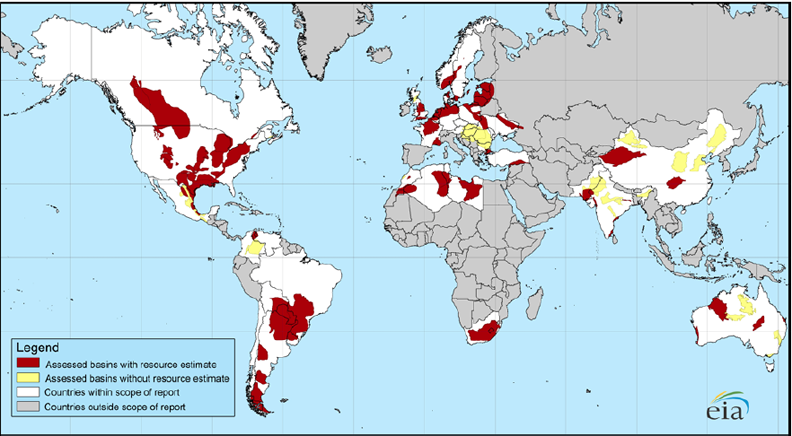
The recent (optimistic) EIA report into global shale gas resources has local gas producers wondering if a repeat of the coal seam gas boom may be on the cards in Australia, particularly in South Australia and West Australia. The Australian reports on Santos’ interest in this other form of unconventional gas - Energy generators bet on shale gas future.

THE hype about shale gas increased yesterday when Santos chief executive David Knox revealed he is planning to drill an onshore well in the next month to test for the unconventional gas, which has turned US domestic energy markets on their heads.
The move comes on the back of a report by the US Energy Information Agency that said Australia was sitting on the world's fifth-biggest reserves of shale gas and was ready to become a major producer. A revolution in shale gas technology has turned the US from a net importer of gas to one with a surplus in just the past five years, capping gas prices and dashing a host of planned liquefied natural gas import terminals.

The EIA, which is the US Energy Department's respected statistics and analysis arm, completed a study of global shale gas prospects last month and found Australia was one of the most prospective countries for development. "With geologic and industry conditions resembling those of the US and Canada, the country is poised to commercialise its gas shale resources on a large scale," the EIA said.

Santos is planning to drill in the Cooper Basin, which straddles the South Australia/Queensland border. Beach Energy, which claims it has more prospective shale ground than Santos, has already drilled there and is planning to do a frac test -- where the shale is fractured to release gas -- this quarter.

Gas captured in shale does not flow as easily as conventional gas, which is released from the rocks it is found in by pressure alone. The recent technology breakthroughs of the last decade mean the shale can be fractured underground to release the gas relatively economically.

While the Cooper Basin has a good chance to become Australia's first commercial producer of the gas, there are plenty of reasons to keep an eye on companies such as New Standard Energy and Buru Energy. which have grabbed early ground in Western Australia's big Canning Basin. The EIA says the Canning, in the northern part of the state, has 229 trillion cubic feet of risked recoverable reserves, compared to 85tcf in the Cooper and 69tcf in the Perth Basin, where AWE has shale ground.


If the EIA is correct and approximately 385 tcf of gas can be extracted from shale in Australia, this would extend the lifespan of domestic gas production even under a scenario of greatly increased consumption to over a century (thus further undermining any arguments to restrict exports based on resource nationalism - though obviously environmental issues remain, particularly given the experience in the US with unconventional gas extraction).

A Dream Dashed by the Rush on Gas  

Posted by Big Gav in , , , ,

National Geographic has a series of articles on the shale gas boom in the US - A Dream Dashed by the Rush on Gas.

Both Hanger’s office and the gas industry maintain that if the process is done properly, there is no threat to drinking water when chemically treated water and sand are blasted underground to fracture shale to produce gas.

(Related: “Forcing Gas Out of Rock With Water”)

The hydraulic fracturing (fracking) fluid, about 4 million gallons (15 million liters) per well, is released into the shale layer at a depth of 4,000 to 8,500 feet (1,220 to 2,590 meters). (Related:Breaking Fuel From the Rock). That means that there is about a mile or more of rock between the shale and underground water sources used for drinking water. About 1 million Pennsylvania households, nearly 20 percent of residences in the state, draw their water from private wells that are relatively shallow. Wells in the western half of the state, for instance, would likely be drilled to depths of less than 150 feet (46 meters), according to the Pennsylvania Geological Survey.

The potential for contamination of drinking water aquifers is a major concern in the Keystone State, which has more people served by well water than any state but Michigan, according to a 2009 analysis year prepared for the state legislature. The chief bulwark against water pollution is a separating wall—a casing made of tons of steel and cement—built in each gas well not only to protect the environment, but also to ensure the valuable gas doesn’t escape.

Hanger says there hasn’t been a single confirmed case of frack fluid migrating from the shale layer deep underground to the shallow drinking water supplies in Pennsylvania. However, about 20 to 50 percent of the drilling liquid flows back to the surface, most of it right after the well is completed. And that’s when proven trouble can occur.

‘It’s Not Water of Any Kind’

This “produced water,” which includes the frack chemicals, is a super-salty brine, prone to bacterial growth, and potentially contaminated with heavy metals. “It smells like turpentine,” says Conrad Dan Volz, director of the Center for Healthy Environments and Communities at the University of Pittsburgh’s Graduate School of Public Health, who has been researching the environmental impact. “It’s not water of any kind.”

State regulations say the frack fluid has to be collected and disposed of as an industrial waste, or it can be treated and reused to drill more wells, a practice pioneered in Pennsylvania within the past year. (Related: “Forcing Gas Out of Rock With Water”) Hanger says the water reuse is in no small measure a result of the DEP’s tough stance on wastewater handling.

But in at least 130 cases documented since 2008 by the DEP, drilling wastewater has spilled into creeks and tributaries due to holding pond overflows, pump failures, and other errors. There have been at least two small fish kills. One occurred in October 2009, soon after Range started its program to reuse frack fluid: about 10,500 gallons (40,000 liters/250 barrels) leaked from a broken pipeline joint and killed about 170 creek chubs, blacknose dace, and other small fish, along with some salamanders and frogs in Brush Run, 30 miles southwest of Pittsburgh. Range says the fish killed collectively weighed about a pound. The company suspects vandalism, because bolts had been removed from the pipe connection. But no perpetrators have been tracked down, and the company was fined $140,000 for polluting a high-quality waterway. (Range since has switched to using unbolted high-density polyethylene pipeline to transfer its drilling fluid, Pitzarella says.)

In another case, involving East Resources* in north-central Pennsylvania, the state quarantined cattle exposed to wastewater that leaked from a containment pond and killed grass over 1,200 square feet on a farm. State agriculture officials said they acted to prevent contaminated beef from entering the food chain, since the water contained the heavy metal strontium, a substance especially toxic to children and one that lingers long in an animal’s system.

In a case that echoed the BP oil spill, although the results certainly weren’t as severe, an EOG Resources well blew out on June 3, with natural gas and frack fluid spewing for 16 hours from the gas well on hunting club land inside the Moshannon State Forest in central Pennsylvania.(Related: “Parks, Forests Eyed for the Fuel Beneath”) There should have been at least two pressure barriers or blowout preventers in the underground piping to prevent contaminated fluid from flowing to the surface, but only one barrier was in place, and it was damaged, the DEP’s investigation showed. EOG was hit with the harshest punishment to date by Pennsylvania’s shale regulators—a fine of $353,000 and temporary suspension from drilling.

The Dimock Case

But perhaps the most notorious Pennsylvania contamination case was in the northeastern part of the state, in rural Dimock Township, where natural gas was found in early 2009 to have contaminated the drinking water wells of 14 homes. Investigators were able to do a kind of “fingerprinting” to determine the source, and concluded the gas did not come from the Marcellus shale. But the state DEP contends that faulty well casing set into the ground by Cabot Oil & Gas as it drilled into the deep Marcellus allowed gas to migrate from more shallow geological formations into the groundwater. Dimock’s woes were recounted in the award-winning documentary film Gasland, forever linking the image of flammable drinking water to the Marcellus shale (even though the man who memorably set fire to his tap water in the film was in Colorado).

A High-Risk Energy Boom Sweeps Across North America  

Posted by Big Gav in , ,

Yale Environment 360 has a report on the unconventional oil and gas boom in North America - A High-Risk Energy Boom Sweeps Across North America.

The most direct path to America’s newest big oil and gas fields is U.S. Highway 12, two lanes of blacktop that unfold from Grays Harbor in Washington State and head east across the top of the country to Detroit.

The 2,500-mile route has quickly become an essential supply line for the energy industry. With astonishing speed, U.S. oil companies, Canadian pipeline builders, and investors from all over the globe are spending huge sums in an economically promising and ecologically risky race to open the next era of hydrocarbon development. As domestic U.S. pools of conventional oil and gas dwindle, energy companies are increasingly turning to “unconventional” fossil fuel reserves contained in the carbon rich-sands and deep shales of Canada, the Great Plains, and the Rocky Mountain West.

Colorado, Utah, and Wyoming hold oil shale reserves estimated to contain 1.2 trillion to 1.8 trillion barrels of oil, according to the U.S. Department of Energy, half of which the department says is recoverable. Eastern Utah alone holds tar sands oil reserves estimated at 12 billion to 19 billion barrels. The tar sands region of northern Alberta, Canada contains recoverable oil reserves conservatively estimated at 175 billion barrels, and with new technology could reach 400 billion barrels. Deep gas-bearing shales of the Great Plains, Rocky Mountain West, Great Lakes, Northeast, and Gulf Coast contain countless trillions of feet of natural gas. If current projections turn out to be accurate, there would be enough oil and gas to power the United States for at least another century.

But even as one of the largest energy booms in history has erupted along a great arc of the continent, the consequences are prompting civic discontent, lawsuits, and political battles in state capitals. The boom is producing fresh scars on the land and new threats to scarce water supplies. Government studies show that exploiting unconventional fossil-fuel reserves generates more C02 emissions than drilling for conventional oil and gas and uses three to five times more water. “It’s a pact with the devil,” says Randy Udall, a consulting energy analyst from Colorado. “The tar sands and shale oil and shale gas require a lot of water. It sets up a collision course for the West.”

In communities from Wyoming to Texas, thousands of trucks now rumble down rural roads, carrying the huge amounts of water — 2 million to 4 million gallons per well — needed to free oil and natural gas from shales by blasting them with high-pressure fluids. In places such as North Dakota, which receives modest amounts of rainfall, local residents and conservationists worry that the energy boom will deplete aquifers.

And the explosion in development of these unconventional fossil fuels raises a troubling question at the national level: At a time when the country should be embracing a renewable energy revolution, it is hurtling in the opposite direction, developing on a massive scale sources of energy that cause considerably more environmental harm than conventional oil and gas drilling.

Natural gas from shale rock promises energy revolution in UK ?  

Posted by Big Gav in , ,

The BBC has a report on interest in shale gas in the UK - Natural gas from shale rock promises energy revolution.

BP's former chief executive Tony Hayward has described it as a "game changer" in energy supply, the major oil companies are betting millions on its success and it might just turn Blackpool into the new Dallas.

Shale gas seems to answer the oil industry's desire for an accessible energy source perfectly just as other sources are becoming more problematic.

The Deepwater Horizon disaster demonstrated the dangers of searching for oil and gas in ever more extreme environments.

Alaska, Greenland and the South Atlantic may have tempting oil reserves but when something goes wrong in deep water or in an isolated region it can be fearsomely difficult to fix. And this is what is spurring the search for land-based sources of hydrocarbons.

Shale gas exists in large quantities and promising sources lie close to many big energy-intensive cities. ...

In Britain, the shale gas revolution may be just beginning.The geology of Dorset and the Isle of Wight is said to bear comparison with the fruitful Barnett shale of Texas but it is Lancashire that has got the energy companies excited.

Four miles from Blackpool Tower, Cuadrilla Resources has built what looks almost like a replica to drill deep into Bowland shale, geological parent of some of the UK's offshore gas reserves.

It could be three or four years before gas is produced in significant quantities in the UK but the signs are promising. Mark Miller, the general manager of the operations group at Cuadrilla Resources said the gas was there, it was just

a question of whether his men could extract it economically.

Another gas source for Australia - unconventional (shale) gas from the Cooper Basin ?  

Posted by Big Gav in , , , , ,

Santos recently raised their gas reserves (largely due to new coal seam gas exploration) by 42 per cent, saying "the reserves upgrade brings its total reserves to 1.44 billion barrels of oil equivalent at the end of 2009".

They now say they have enough gas to proceed with the first phase of their Gladstone based LNG project (partnering with Petronas), noting that total 2P reserves for the project were 4,003 petajoules as of December 31.

Santos CEO David Knox recently made an address to the Melbourne Mining Club, spruiking the proposal that brown coal fired power stations in Victoria be replaced with gas fired power, and pointing out that the Cooper Basin may have more life in it than many think, courtesy of shale gas - the Business Spectator has a report - Gas game changer.

In the address Knox forecast that, in time, the share market would come to understand the enormity of the Santos gas reserves and how they can supply both the export LNG markets at export prices and the local markets at prices that are based on current low levels, plus an inflation adjustment.

In particular, he said, over time there would sufficient gas to replace the four Victorian brown coal power stations, which are one of Australia’s biggest sources of carbon emissions.

The eastern Australian export gas would come from Gladstone, while Gunnedah gas in NSW could be used for both export and local. But then he added a third source – the Cooper basin. Until relatively recently, the Cooper basin has been seen as a dying field but Knox said that the new technology to extract gas from tight shale rocks opens up a new opportunity for the basin to supply NSW, Victoria and South Australia. ...

Knox pointed out that Exxon has paid $US40 billion for a shale gas deposit in the US. No one is suggesting that the Cooper basin is worth anything like that, but its significance to Santos and to Australia was dramatically underestimated until today’s Knox address.

Knox has warned that the natural gas market in the Asian region is becoming very competitive as the US becomes self-sufficient in gas. Nevertheless he believes that the potential in the international market has been underestimated because of the carbon reductions it offers.

Beach Energy has also been showing interest in Cooper Basin shale gas, with chief Reg Nelson claiming unconventional gas had the potential for “a very large gas resource in the order of many tens of trillions of cubic feet that could begin to approach the CSG reserves of Queensland".

Oil and Gas Journal says that Drillsearch Energy are the other company active in the unconventional gas sector in the Cooper Basin.

If Nelson is correct, this would further expand Australian gas reserves, extending their lifespan even under a scenario of greatly increased consumption to around a century (and thus further undermining any arguments to restrict exports based on resource nationalism - though obviously environmental issues remain, particularly given the experience in the US with unconventional gas extraction).

Environmental concerns are also dogging the coal seam gas industry, with farmers starting to resist developments in rural Queensland. The Brisbane Times has a report - Farmers wonder if LNG is worth its salt.
The Darling Downs area in Queensland is not exactly a hot-bed of anti-business radicalism. The prime agricultural region - which has also found itself in the midst of the energy boom - held the seat of the former premier Joh Bjelke-Petersen, while the office of the Nationals senator Barnaby Joyce is in nearby St George.

But in response to energy companies' plans to extract billions of dollars worth of gas from the area's underground coal, normally conservative farmers are shaping up for a fight with big business.

A clutch of energy giants are planning to use the area - part of the Surat Basin in the state's south - as a source of gas to four separate liquefied natural gas (LNG) export plants in Gladstone. All want to make final investment decisions this year, in time to catch a predicted upswing in Asian energy demand and ship their first gas from about 2015.

Mirroring a bitter stoush between farmers and miners in NSW, farmers north of the border are questioning if cashing in on the energy boom might threaten the environment they depend on.

But this is not just a debate over environmental impacts and regional development. The battle highlights an emerging tension between resources development and the rural economy, which could provide another hurdle to the LNG industry's ambitious expansion plans.

One of the most problematic byproducts from coal-seam gas extraction - which requires drilling thousands of holes for each LNG plant - is salt. ''It's toxic to the plants, it's toxic to the soil, it's toxic to the animals,'' said Ian Hayllor, a grain, oilseed and cotton farmer based 250 kilometres west of Brisbane.

AgForce, a peak organisation representing rural producers, says the coal-seam gas projects proposed in Queensland could produce up to 50 million tonnes of salt over the projects' lifetime, suggesting it should be renamed the ''salt-mining industry''.

Salt cannot be burnt or sent into the ocean. It needs a commercial use, but the LNG companies have not yet found one. Santos, one of the LNG proponents, has said trucking the salt to other parts of the country is not economically viable; others are still looking for alternatives.

Mr Hayllor's other concern involves the most valuable commodity of all in these parts: water. It is produced in abundance by the drilling process. Up to 36,000 wells may be drilled in Queensland over the next three to five years.

While the "waste water" could be treated and put to use, Mr Hayllor said the intensive drilling also threatened a shallow aquifer in the Darling Downs that supplied towns, businesses and farmers.

Gasland  

Posted by Big Gav in , , ,

The hunt for unconventional gas sources has created a swathe of health problems and a growing backlash against the industry, with an example being the new documentary "Gasland" - Gasland - The Movie.

When filmmaker Josh Fox discovers that Natural Gas drilling is coming to his area—the Catskillls/Poconos region of Upstate New York and Pennsylvania, he sets off on a 24 state journey to uncover the deep consequences of the United States’ natural gas drilling boom. What he uncovers is truly shocking—water that can be lit on fire right out of the sink, chronically ill residents of drilling areas from disparate locations in the US all with the same mysterious symptoms, huge pools of toxic waste that kill cattle and vegetation well blowouts and huge gas explosions consistently covered up by state and federal regulatory agencies. These are just a few of the many absurd and astonishing revelations of a new country called GASLAND.

CAN YOU DO THIS WITH YOUR TAP WATER? from JOSHFOX on Vimeo.

Shale-Gas Skeptic’s Supply Doubts Draw Wrath of Devon Energy  

Posted by Big Gav in , ,

Bloomberg has an article on the interesting saga of Arthur Berman and hos views about unconventional gas production from shale - Shale-Gas Skeptic’s Supply Doubts Draw Wrath of Devon.

Arthur Berman runs a one-man energy consulting firm out of his home near Houston, producing research that says forecasts for natural-gas production in the U.S. are flawed. He’s won the industry’s attention and its anger.

Since last month, Chesapeake Energy Corp. and Devon Energy Corp., two of the five largest gas producers in the U.S., attacked Berman’s claims. Berman, 59, had his monthly column pulled from the November issue of World Oil after gas companies complained, prompting him to quit the trade journal.

Oil geologist Berman, who worked two decades for Amoco Corp., says company production projections for so-called shale gas in the U.S. are at least double what drill results justify. At issue are the rates of production decline in shale wells, where water, sand and other materials are injected to fracture rock and make gas flow.

“I think that the wells decline at a much higher rate than the operators think they do,” Berman said in an interview in Houston. “They’re being overly optimistic.”

Companies such as Chesapeake, which had climbed 55 percent this year before today in New York stock trading, say their shale wells will produce for four or more decades. In an Oct. 12 speech at a conference in Denver, Berman said data he’s seen filed with the Texas Railroad Commission suggests the life of shale-gas wells is 10 to 20 years.

European gas firms turn to shale to drill for gas  

Posted by Big Gav in ,

The WSJ (via The Australian) has a report on interest in unconventional gas in Europe - European gas firms turn to shale to drill for gas.

ENERY companies operating in Europe are turning to more unorthodox sources of natural gas to get around maturing gasfields and the European Union's worries about its dependence on Russian fuel.

Unconventional gas, as it is known, is trapped in different types of rock formations - much of it in shale - and can be freed through drilling horizontally, fracturing the rocks or injecting water into spaces.

While unconventional sources usually have a longer lifespan than normal gas reservoirs, getting at the gas inside them is more expensive.

In recent years Europe has made up for its maturing natural gas fields by tapping pipelines from Russia and Norway, and is also now looking to the Middle East and North Africa. But a series of spats between Russia and Ukraine that curtailed gas-flow to Europe has reinvigorated the search for more secure sources of the fuel.

"All the European utilities are interested in indigenous gas supplies," said Christopher Wheaton, manager of Allianz RCM Energy Fund. "With technology, the application of cash, brute force and the best ingenuity, we've the potential to unlock a previously unusable resource."

Recent technological advances have made it more cost-effective to get at the gas, so much so that in the US, production of unconventional gases in 2008 helped drive the highest-ever annual increase in gas output. It rose 7.5 per cent over the last year, 10 times the 10-year average growth rate, according to BP’s 2009 statistical review.

Exxon Mobil is now exporting expertise and technology it developed in North America to gas markets in Europe. In Germany, for example, drilling and testing activity on licences covering 1.3 million acres of the Lower Saxony Basin started in 2008.

The company also has a joint exploration program with MOL Hungarian Oil & Gas, in the Mako Trough of southeast Hungary. It will evaluate its findings for two to three years before deciding whether production would be commercially viable, the company said.

Statistics

Locations of visitors to this page

blogspot visitor
Stat Counter

Total Pageviews

Ads

Books

Followers

Blog Archive

Labels

australia (619) global warming (423) solar power (397) peak oil (355) renewable energy (302) electric vehicles (250) wind power (194) ocean energy (165) csp (159) solar thermal power (145) geothermal energy (144) energy storage (142) smart grids (140) oil (139) solar pv (138) tidal power (137) coal seam gas (131) nuclear power (129) china (120) lng (117) iraq (113) geothermal power (112) green buildings (110) natural gas (110) agriculture (91) oil price (80) biofuel (78) wave power (73) smart meters (72) coal (70) uk (69) electricity grid (67) energy efficiency (64) google (58) internet (50) surveillance (50) bicycle (49) big brother (49) shale gas (49) food prices (48) tesla (46) thin film solar (42) biomimicry (40) canada (40) scotland (38) ocean power (37) politics (37) shale oil (37) new zealand (35) air transport (34) algae (34) water (34) arctic ice (33) concentrating solar power (33) saudi arabia (33) queensland (32) california (31) credit crunch (31) bioplastic (30) offshore wind power (30) population (30) cogeneration (28) geoengineering (28) batteries (26) drought (26) resource wars (26) woodside (26) censorship (25) cleantech (25) bruce sterling (24) ctl (23) limits to growth (23) carbon tax (22) economics (22) exxon (22) lithium (22) buckminster fuller (21) distributed manufacturing (21) iraq oil law (21) coal to liquids (20) indonesia (20) origin energy (20) brightsource (19) rail transport (19) ultracapacitor (19) santos (18) ausra (17) collapse (17) electric bikes (17) michael klare (17) atlantis (16) cellulosic ethanol (16) iceland (16) lithium ion batteries (16) mapping (16) ucg (16) bees (15) concentrating solar thermal power (15) ethanol (15) geodynamics (15) psychology (15) al gore (14) brazil (14) bucky fuller (14) carbon emissions (14) fertiliser (14) matthew simmons (14) ambient energy (13) biodiesel (13) investment (13) kenya (13) public transport (13) big oil (12) biochar (12) chile (12) cities (12) desertec (12) internet of things (12) otec (12) texas (12) victoria (12) antarctica (11) cradle to cradle (11) energy policy (11) hybrid car (11) terra preta (11) tinfoil (11) toyota (11) amory lovins (10) fabber (10) gazprom (10) goldman sachs (10) gtl (10) severn estuary (10) volt (10) afghanistan (9) alaska (9) biomass (9) carbon trading (9) distributed generation (9) esolar (9) four day week (9) fuel cells (9) jeremy leggett (9) methane hydrates (9) pge (9) sweden (9) arrow energy (8) bolivia (8) eroei (8) fish (8) floating offshore wind power (8) guerilla gardening (8) linc energy (8) methane (8) nanosolar (8) natural gas pipelines (8) pentland firth (8) saul griffith (8) stirling engine (8) us elections (8) western australia (8) airborne wind turbines (7) bloom energy (7) boeing (7) chp (7) climategate (7) copenhagen (7) scenario planning (7) vinod khosla (7) apocaphilia (6) ceramic fuel cells (6) cigs (6) futurism (6) jatropha (6) nigeria (6) ocean acidification (6) relocalisation (6) somalia (6) t boone pickens (6) local currencies (5) space based solar power (5) varanus island (5) garbage (4) global energy grid (4) kevin kelly (4) low temperature geothermal power (4) oled (4) tim flannery (4) v2g (4) club of rome (3) norman borlaug (2) peak oil portfolio (1)
