I guess nature has a black sense of humour, with Canadian tar sands capital Fort McMurray baking in temperatures 22 degrees above average and its residents having to be evacuated because of forest fires. Climate Central has a report - Here’s the Climate Context For the Fort McMurray Wildfire.
Oil spills at a major oil sands operation in Alberta have been ongoing for at least six weeks and have cast doubts on the safety of underground extraction methods, according to documents obtained by the Star and a government scientist who has been on site.
Canadian Natural Resources Ltd. has been unable to stop an underground oil blowout that has killed numerous animals and contaminated a lake, forest, and muskeg at its operations in Cold Lake, Alta.
The documents indicate that, since cleanup started in May, some 26,000 barrels of bitumen mixed with surface water have been removed, including more than 4,500 barrels of bitumen.
Andrew Leonard has a look at the choices facing Obama as he ponders the future of the Keystone XL tar sands pipeline to Texas - Obama's big dirty oil test.
Sometime before the end of this year, the State Department will decide whether to approve the 1,700-mile-long Keystone XL pipeline, intended to connect the tar sands of Alberta, Canada, with the refineries of southern Texas. For many environmentalists, the fate of the world, literally, depends on the Obama administration's yea or nay.
"The Keystone Pipeline," wrote global warming activist Bill McKibben, in a letter urging concerned citizens to join a two-week protest in front of the White House, would be "a fuse to the biggest carbon bomb on the continent, a way to make it easier and faster to trigger the final overheating of our planet ..." In an essay titled "Silence Is Deadly," NASA climatologist James Hansen declared that if the tar sands are fully exploited for their oil deposits, "it is essentially game over" for the planet.
Hansen is sometimes criticized even by other environmentalists for the audacity of his rhetoric, but that doesn't mean he or McKibben is necessarily wrong. Extracting oil from tar sands is an expensive, massively environmentally destructive process that produces more greenhouse gases than the exploitation of conventional sources of oil. If the world continues down its current pell-mell path, avidly devouring dirtier and dirtier sources of fossil fuel, the amount of carbon dioxide in the earth's atmosphere will surely go far past the point of no return. The droughts currently plaguing exactly those regions where the southern end of the pipeline will stretch may one day be remembered fondly as an era of balmy weather.
So it has been inspiring to see how environmentalists have heeded McKibben's call to action. Each day this week, 50 or so protesters have linked arms in front of the White House and proudly waited their turn to get handcuffed and arrested, only to be replaced by a different 50 activists the next day. Their stories are invigorating. Environmental advocacy groups with a long history of squabbling with each other have joined together in an impressive display of unity. If Obama approves the Keystone Pipeline the backlash from the environmental community will be intense.
Politico reports: "We see this pipeline as the biggest environmental test President [Barack] Obama will have before the 2012 election," said Jamie Henn, a spokesman for jailed protest organizer Bill McKibben's group Tar Sands Action. "With the stroke of a pen, he'll be able to end a potential environmental disaster, stop the pipeline and electrify a base of support that hasn't been enthusiastic about his reelection."
Of course, at the same time, Obama will also be gift-wrapping his Republican opponents a handy bludgeon with which to clobber him on two of the most politically explosive issues likely to dominate the presidential campaign: jobs and gas prices. Big Labor wants the pipeline – it's a "shovel-ready" project with plenty of union job potential. And even though gas prices are on the way down from recent peaks – and both domestic oil and natural gas production have risen during Obama's presidency – there's still nothing Michele Bachmann or Rick Perry or Mitt Romney would love better than to bash Obama for limiting US access to oil from up North. Yes, any sane person understands that, no matter what Bachmann says, no US president can meaningfully affect the price of oil unilaterally, but that doesn't make high energy prices any less potent as a campaign issue, as we learned in 2008.
Even worse, there's zero chance that Obama actually will be able to avoid a "potential environmental disaster," even if he directs Hillary Clinton to put the kibosh on the pipeline. Without a global commitment to a carbon tax or cap-and-trade regime that properly penalizes the production of greenhouse gases, the tar sands will be fully exploited. If the dirty oil doesn't end up in Texas refineries, it will go straight to China. (It may end up going to China anyway, but but that's a separate story.)
Unfortunately, there is no conceivable chance that any significant carbon-limiting legislation will come out of this US Congress – and even if Obama had thrown the full weight of his bully pulpit into the climate change battle before the 2010 midterms it is far from obvious that he could have gotten anything through the Senate even when Democrats had a 60-seat majority. Too many members of his own party had cold feet – whether because of powerful energy-related special interests in their own states, or because of the dreadful condition of the US economy.
Guess what? The economy is still dreadful, and that puts Obama, again, in a tough position. Despite the passion of Keystone protesters, the payoff for climate change activism at the ballot box is highly dubious. Voters are looking for action on jobs – they may well question why the White House doesn't give the green light to a huge construction project, and instead makes what is fundamentally a symbolic gesture as far as restricting greenhouse gas emissions is concerned.
But at the same time, many voters have come to see Obama as a president unwilling to take strong stands. The Keystone Pipeline offers yet another test of this evolving consensus wisdom. Obama appointed a head of the EPA who has been willing to make tough decisions; maybe it is time he followed her lead. Because even though whatever he does, he won't be able to save the world -- there's still something to be said for saving your reputation.
The Sand Hills of Nebraska are a unique Great Plains prairie ecosystem. The rolling dunes, rising to 300 feet, cover about a quarter of the state, and because the grasses and wildflowers there are adapted to wet, sandy soil, many grow nowhere else. Thousands of ponds and lakes dot the Sand Hills, nourishing the Ogallala Aquifer.
This region is an unlikely ground zero for a growing rebellion against a different kind of sand — the Athabascan oil sands of Alberta, 1,400 miles to the north. But that is precisely what is happening as energy companies seek to construct a pipeline from Alberta’s tar sands — the second-largest petroleum deposit in the world, after Saudi Arabia — across the length of the U.S. to refineries in Texas, passing through the Sand Hills on its way.
And the so-called Keystone XL pipeline is not the only tentacle of the tar sands poised to spread across North America: Energy companies are seeking to build a second pipeline to carry tar sands oil across the wild heart of British Columbia, while other firms are proposing to truck gargantuan equipment for the tar sands project along narrow roads in one of most remote parts of the northern Rocky Mountains.
Environmentalists, farmers, ranchers, elected officials, native people, and a host of others have risen up in opposition to the potential environmental threats posed by the expanding reach of Alberta’s tar sands. Some opponents are concerned that pipelines or oversized equipment running through their communities pose an unacceptable environmental risk. But for others, the battle is about something far larger. They believe that wreaking so much environmental destruction to continue expanding supplies of planet-warming fossil fuels is fundamentally wrong, noting that the tar sands project has razed hundreds of square miles of boreal forest, led to the creation of dozens of toxic tailings ponds, and released vast quantities of CO2. And they are convinced that choking off the tar sands pipelines is a way of stopping, or at least hampering, the development of the Alberta tar sands themselves.
Indeed, the fight over the tar sands pipelines has become a proxy battle between two diametrically opposed worldviews: Those who see the planet as heading toward irreversible environmental harm, driven largely by human CO2 emission from fossil fuels, and those who say that the U.S. needs oil at almost any environmental cost to keep its economy growing.
“The pipeline has become a symbol of where America is going,” says Jane Kleeb, director of BOLD Nebraska, a group working to protect the unique ecology of the Sand Hills. “We’re concerned about climate change, absolutely. America is smart enough to figure out how to do clean energy.”
Among the growing protests over Alberta’s tar sands and the proposed pipelines are a series of acts of civil disobedience planned in Washington, D.C., for the last two weeks of August. The campaign, Tar Sands Action, will feature protests at the White House and will include author and environmental activist Bill McKibben, NASA climate scientist James Hansen, and Canadian scientist and broadcaster, David Suzuki.
Roughly 173 billion barrels of Alberta tar sands reserves, worth more than $15 trillion, underlay an area the size of Florida, making it by far the largest petroleum deposit in North America. The strange solid or semi-solid oil, called bitumen, is essentially mined, and doing so means digging up large tracts of boreal forest and releasing a lot of CO2, which is why critics call the product of the tar sands “dirty oil.”
But supporters of the tar sands and the pipelines say that the “dirty oil” rap is unfair. Canada’s environment minister, Peter Kent, says tar sands crude creates just 1 percent of the greenhouse gas emissions generated annually by U.S. coal-fired power plants. It’s really “ethical oil,” he says, because the profits won’t go to corrupt dictators or civil wars.
Oil companies have limited refining capacity for the dense crude in Alberta, and that’s where the biggest pipeline project, Keystone XL, figures in. Each day the proposed Keystone XL pipeline — to be built by Calgary-based TransCanada Corporation — would move 910,000 barrels of a slurry of bitumen, natural gas, and undisclosed chemicals through a 36-inch-diameter, high-pressure pipe, buried four feet underground. The nearly 1,700-mile route would run from Hardisty, Alberta, through Saskatchewan, Montana, South Dakota, Nebraska (including 92 miles of the Sand Hills), and Oklahoma. After connecting with an existing pipeline in Nebraska, the new Keystone XL would begin again in Cushing, Oklahoma and continue on to Houston and Port Arthur, Texas. There, company officials say, they would have the special refining capacity they need.
The $7 billion pipeline, which must be approved by the U.S. State Department and the Environmental Protection Agency (EPA), has drawn both opposition and support across its route. But it has run into the fiercest resistance in the conservative farming state of Nebraska, largely because the pipeline would cross the Sand Hills. Should the toxic brew leak, it could pollute not only the water there, but could seep into portions of the Ogallala Aquifer, the 174,000-square-mile underground reservoir, fed in part by water from the Sand Hills.
Spills are not a far-fetched scenario. In a year of operation, a similar pipeline in the U.S. — the existing Keystone, also owned by TransCanada Corporation — had 11 spills. Most of them were tiny, but the largest, in southeastern North Dakota, was 21,000 gallons, and federal officials temporarily suspended the company’s operating permit. And last year a 30-inch oil pipeline owned by Enbridge, another Canadian pipeline company, suffered a 4-foot-long rupture and spilled nearly 20,000 barrels — 840,000 gallons — of oil into the Kalamazoo River in Michigan, killing much of the aquatic life for miles. It was the worst spill ever in the Midwest.
Tyler Hamilton at Clean Break has a post noting that relatively cheap shale gas in North America is helping to spur rapid expansion of tar sands projects in Canada - Dirty shale gas = lower gas prices = oilsands boom = double-barrelled emissions increase. This is a classic example of the peak oil driven lurch towards alternative (dirtier and lower EROI) fossil fuel alternatives exacerbates global warming and other forms of environmental damage.
For a generation that’s supposed to start cleaning up its energy mix, I find it disturbing that the big money is flowing toward dirtier and dirtier sources instead. Take the case of shale gas, which is plentiful and now economical to develop in North America. Shale gas, at the point of combustion, is no cleaner or dirtier than conventional natural gas, and a heck of a lot better than coal.
But it’s the way we get the shale gas that’s the problem. The hydraulic fracturing process used to release methane from shale rock formations disrupts and pollutes local water tables by contaminating them with a nasty chemical cocktail. Now, as recently reported in the news (and what you’ll hear more about from me tomorrow), there’s rising concern that the methane leaks that result during shale-gas development are substantial and that this makes shale gas just as bad, or worse, than coal with respect to its climate impacts. But the picture gets a whole lot worse.
Let me explain: Because shale gas is plentiful and an increasing amount of it is filling market demand for natural gas, it has kept natural gas prices low. This is expected to be the case for the foreseeable future. By 2035, shale gas will represent nearly half of all U.S. natural gas production, according to the U.S. Energy Information Administration. The low prices are great if you’re a business or consumer, and wonderful if you’re an oilsands developer. That’s because natural gas is the single-largest operational cost for many oilsands projects, particularly steam-assisted gravity drainage (SAGD) projects and other in situ developments that require enormous amounts of the gas to make steam.
In fact, it’s never been so good for them. Gas is about $4.50 per million BTU and oil is at about $106 a barrel right now on NYMEX — that’s a 24-1 spread! Now think about the spread at the height of the 2008 oilsands boom. Oil peaked at $147 a barrel and gas bounced between $11 and $12 per MBTU, giving a spread of 13-1.
So what am I getting at here? Oilsands developers are more profitable than they’ve ever been, and as a result there has been a burst of development activity likely to lead to a sustained boom. (I get into more detail in this story I wrote for MIT Technology Review). I’m also hearing that things are so good that oil companies are starting to throw more money into shale oil development. We’re going down a dirtier path, folks.
Bottom line: a dirty form of natural gas is helping spur development of a dirty form of oil.
The most direct path to America’s newest big oil and gas fields is U.S. Highway 12, two lanes of blacktop that unfold from Grays Harbor in Washington State and head east across the top of the country to Detroit.
The 2,500-mile route has quickly become an essential supply line for the energy industry. With astonishing speed, U.S. oil companies, Canadian pipeline builders, and investors from all over the globe are spending huge sums in an economically promising and ecologically risky race to open the next era of hydrocarbon development. As domestic U.S. pools of conventional oil and gas dwindle, energy companies are increasingly turning to “unconventional” fossil fuel reserves contained in the carbon rich-sands and deep shales of Canada, the Great Plains, and the Rocky Mountain West.
Colorado, Utah, and Wyoming hold oil shale reserves estimated to contain 1.2 trillion to 1.8 trillion barrels of oil, according to the U.S. Department of Energy, half of which the department says is recoverable. Eastern Utah alone holds tar sands oil reserves estimated at 12 billion to 19 billion barrels. The tar sands region of northern Alberta, Canada contains recoverable oil reserves conservatively estimated at 175 billion barrels, and with new technology could reach 400 billion barrels. Deep gas-bearing shales of the Great Plains, Rocky Mountain West, Great Lakes, Northeast, and Gulf Coast contain countless trillions of feet of natural gas. If current projections turn out to be accurate, there would be enough oil and gas to power the United States for at least another century.
But even as one of the largest energy booms in history has erupted along a great arc of the continent, the consequences are prompting civic discontent, lawsuits, and political battles in state capitals. The boom is producing fresh scars on the land and new threats to scarce water supplies. Government studies show that exploiting unconventional fossil-fuel reserves generates more C02 emissions than drilling for conventional oil and gas and uses three to five times more water. “It’s a pact with the devil,” says Randy Udall, a consulting energy analyst from Colorado. “The tar sands and shale oil and shale gas require a lot of water. It sets up a collision course for the West.”
In communities from Wyoming to Texas, thousands of trucks now rumble down rural roads, carrying the huge amounts of water — 2 million to 4 million gallons per well — needed to free oil and natural gas from shales by blasting them with high-pressure fluids. In places such as North Dakota, which receives modest amounts of rainfall, local residents and conservationists worry that the energy boom will deplete aquifers.
And the explosion in development of these unconventional fossil fuels raises a troubling question at the national level: At a time when the country should be embracing a renewable energy revolution, it is hurtling in the opposite direction, developing on a massive scale sources of energy that cause considerably more environmental harm than conventional oil and gas drilling.
EIGHTY-FIVE million barrels. That's how much oil we consume every day. It's a staggering amount - enough to fill over 5400 Olympic swimming pools - and demand is expected to keep on rising, despite the impending supply crunch.
The International Energy Agency forecasts that by 2030 it will rise to about 105 million barrels per day with a commensurate increase in production (see graph), although whistle-blowers recently told The Guardian newspaper in London that insiders at the IEA believe the agency vastly over-estimates our chances of plugging that gap. The agency officially denies this.
Wherever the truth lies, it is widely expected that by 2030 we will have passed the peak of conventional oil production - the moment that output from conventional oil reserves goes into terminal decline. A report from the UK Energy Research Centre (UKERC) published in August said there was a "significant risk" it would happen before 2020. And that means we will soon be staring down the barrel of the ultimate oil crisis.
Some governments and corporations are waking up to the idea and beginning to develop alternatives to keep the world's transport systems moving when cheap oil runs out. These include biofuels, more energy-efficient - or electric - carsMovie Camera, and hydrogen. But none of these is likely to make up the global shortfall in time. The pressure is on to keep the black stuff flowing and so the next two decades will see an unprecedented effort to exploit increasingly exotic and unconventional sources of oil. They include tar sands (a mixture of sand or clay and a viscous, black, sticky petroleum deposit called bitumen), oil shale (a sedimentary rock containing kerogen, a precursor to petroleum) and synthetic liquid fuels made from coal or gas.
Purely in terms of geological abundance, these sources look more than sufficient to meet global demand. According to the IEA, taken together, they raise the remaining global oil resource to about 9 trillion barrels (see map) - almost nine times the amount of oil humanity has consumed to date. The trouble is that the name "non-conventional oil" hides several dirty little secrets and a whole host of huge challenges.
Conventional oil refers to liquid hydrocarbons trapped in deep, highly pressurised reservoirs, which means that when the wells are drilled, the oil usually gushes to the surface of its own accord. Non-conventional oils are not so forthcoming, and need large amounts of energy, water and money to coax them from the ground and turn them into anything useful, like diesel or jet fuel.
As a result, non-conventional oil production to date has been slow to expand - with current output of just 1.5 million barrels per day. Not only that, because they take so much energy to produce, they are responsible for higher carbon emissions per barrel than conventional oil.
A new international research partnership based in Alberta hopes to answer an intriguing question: Could the warm rocks of deep Earth wean the oil sands off their heavy natural gas diet?
The University of Alberta has linked arms with the Helmholtz Association of German Research Centres, Germany's largest scientific organization, in hopes of furthering research into this and other oil-sands-emissions-related questions.
The partnership, signed Tuesday, brings with it the promise of international financing and German expertise in research areas where Canada has not typically excelled. One area is the use of geothermal energy in the oil sands.
Some researchers believe the earth in northeastern Alberta is hot enough to use as a sort of “preheater” for major oil sands mines, which use 40-degree Celsius water to separate oil from sand. Most of that heat comes from natural gas; the industry uses about one billion cubic feet of gas a day, or 7 per cent of Canada's daily production – a tally expected to grow substantially.
The Sierra Club is campaigning against piping oil from the Canadian tar sands southwards (the "Dirtiest oil on earth to enter the U.S") - Dirty Oil Sands.
Quick Facts
Canada is the United States’ number one source of foreign oil, and the oil sands comprise about half of Canadian oil. Also known as tar sands oil, it is the world’s most harmful type of oil for the atmosphere, emitting high volumes of greenhouse gases during development, which contribute to global warming. Learn more about the source of the dirtiest oil on earth. Read more.
The Spread of Oil Sands Crude
Although mined in Canada, dirty oil sands are a U.S. problem too. If Big Oil has its way, instead of a new clean energy economy the U.S. will be addicted to the dirtiest oil on earth. Read more.
The Alberta Clipper Pipeline
The Alberta Clipper pipeline would penetrate to Wisconsin, providing hundreds of thousands of barrels of dirty oil sands crude to the United States. Read more.
Alberta’s Oil Sands Explained
In this video renowned journalist Andrew Nikiforuk, author of Tar Sands: Dirty Oil and the Future of a Continent, provides a five minute backgrounder on the tar sands and presents some potential solutions.
Next month's edition of National Geographic has an article on the tar sands of Canada - The Canadian Oil Boom. How long the boom lasts if the current downturn continues is questionable of course. In the same issue is an article on Energy Conservation.
In Boucher's memory, though, the change begins that day in 1963, on the long trail his grandfather used to set his traps, near a place called Mildred Lake. Generations of his ancestors had worked that trapline. "These trails had been here thousands of years," Boucher said one day last summer, sitting in his spacious and tasteful corner office in Fort McKay. His golf putter stood in one corner; Mozart played softly on the stereo. "And that day, all of a sudden, we came upon this clearing. A huge clearing. There had been no notice. In the 1970s they went in and tore down my grandfather's cabin—with no notice or discussion." That was Boucher's first encounter with the oil sands industry. It's an industry that has utterly transformed this part of northeastern Alberta in just the past few years, with astonishing speed. Boucher is surrounded by it now and immersed in it himself.
Where the trapline and the cabin once were, and the forest, there is now a large open-pit mine. Here Syncrude, Canada's largest oil producer, digs bitumen-laced sand from the ground with electric shovels five stories high, then washes the bitumen off the sand with hot water and sometimes caustic soda. Next to the mine, flames flare from the stacks of an "upgrader," which cracks the tarry bitumen and converts it into Syncrude Sweet Blend, a synthetic crude that travels down a pipeline to refineries in Edmonton, Alberta; Ontario, and the United States. Mildred Lake, meanwhile, is now dwarfed by its neighbor, the Mildred Lake Settling Basin, a four-square-mile lake of toxic mine tailings. The sand dike that contains it is by volume one of the largest dams in the world.
Nor is Syncrude alone. Within a 20-mile radius of Boucher's office are a total of six mines that produce nearly three-quarters of a million barrels of synthetic crude oil a day; and more are in the pipeline. Wherever the bitumen layer lies too deep to be strip-mined, the industry melts it "in situ" with copious amounts of steam, so that it can be pumped to the surface. The industry has spent more than $50 billion on construction during the past decade, including some $20 billion in 2008 alone. Before the collapse in oil prices last fall, it was forecasting another $100 billion over the next few years and a doubling of production by 2015, with most of that oil flowing through new pipelines to the U.S. The economic crisis has put many expansion projects on hold, but it has not diminished the long-term prospects for the oil sands. In mid-November, the International Energy Agency released a report forecasting $120-a-barrel oil in 2030—a price that would more than justify the effort it takes to get oil from oil sands.
Nowhere on Earth is more earth being moved these days than in the Athabasca Valley. To extract each barrel of oil from a surface mine, the industry must first cut down the forest, then remove an average of two tons of peat and dirt that lie above the oil sands layer, then two tons of the sand itself. It must heat several barrels of water to strip the bitumen from the sand and upgrade it, and afterward it discharges contaminated water into tailings ponds like the one near Mildred Lake. They now cover around 50 square miles. Last April some 500 migrating ducks mistook one of those ponds, at a newer Syncrude mine north of Fort McKay, for a hospitable stopover, landed on its oily surface, and died. The incident stirred international attention—Greenpeace broke into the Syncrude facility and hoisted a banner of a skull over the pipe discharging tailings, along with a sign that read "World's Dirtiest Oil: Stop the Tar Sands."
As expected, investment in Alberta Tar Sand (what the industry likes to refer to as "oil sands") developments are being cut back a bit; but tar sands developers still expect to remain profitable, even if oil hits US$60/barrel.
Suncor Energy Inc., which last week rolled out massive spending cuts because of the credit crisis and slumping oil prices, said it will earn C$28 for every barrel of oil it produces should crude trade at US$60/barrel and Canadian dollar hover around US78 cents.
So, tar patch boys will survive the credit crunch. However, it appears that the real business opportunity for them comes after Peak Oil gets serious, and prices spike.
Rick George, the Suncor's chief executive is quoted as saying:
"The advantage that we have in the oil sands business on that is no decline curves – and you're going to see some big decline curves, I believe, worldwide – and no exploration costs."
No mention of climate change, of course. Making a business investment contingent on climate action is still, apparently, a non-starter for the North American business class.
We’ve covered the environmental risks of tar sands many times. However, a new report co-authored by Greenpeace and PLATFORM outlines the possible financial risks faced by companies such as Shell and BP which invest heavily in tar sands to offset shortfalls in their conventional oil reserves.
The Guardian quotes Mark Hoskin, senior partner at investment advisors Holden & Partners as saying, “There is a good chance that tar sands could be to the oil industry what sub-prime lending was to the banking sector.”
The main points that BP and Shell: Rising Risks in Tar Sands Investments cites as factors which threaten the long term profitability of tar sands investment are as follows:
* Low Carbon Fuel Standards Legislation * Labor Shortages * Reliance on Untested Carbon Capture Technology * Future Litigation Risk and Site Clean-Up Costs * Climate Change a ‘Reputational Challenge’
Mark Hoskin, again from the Guardian:
The recent banking crisis has shown how the financial markets can totally misjudge both the risks and values inherent in company balance sheets. Oil companies depend on oil reserves for their market values. BP and Shell are two of our most trusted UK stocks, but it is a shocking fact that 30% of Shell's oil reserves are in tar sands.
Greenpeace chose an even more stark viewpoint to promote the report:
"The idea that oil sands will enhance energy security is delusional," said Andrew Dlugolecki, Director of Andlug Consulting in the UK. "Investors should do all they can to challenge this misguided use of shareholders' money, which will make global warming worse, and instead call for a new approach that is based on the reality of climate change."
If the long term profitability weren’t enough to question the wisdom of tar sands investment (ignoring entirely the environmental issues), the report also highlights that tar sands should not be seen as a quick fix for reserve shortfalls:
The perception that ‘there is no where else to go other than unconventionals’ is leading to a distorted perspective from management and messages to investors and industry alike, are lacking transparency. Significant extraction expansion decisions are being made at precisely the time when the political and economic environment is shifting against these carbon intensive fuels.
In the high-stakes battle between the oil industry and environmentalists over the image of Canada's oil sands, it appears a pair of multibillionaires beats a two-mouthed fish.
The week started out tough for oil sands producers, whose shares had been beaten down as crude prices skidded and projects suffered more cost overruns.
Three environmental groups quit a northern Alberta oil sands development advisory body that also includes government and industry representatives, saying it had lost legitimacy.
Then reports surfaced that children had reeled in a fish with two jaws from a lake downstream from where tens of billions of dollars worth of projects are pumping synthetic oil.
But by midweek, the mood changed. A stealth visit to Canadian Natural Resources' new Horizon oil sands mining project by two of the world's richest men, Bill Gates and Warren Buffett, overshadowed all.
The two-mouthed fish created a stir at the Keepers of the Water conference on the weekend at Fort Chipewyan, about 600 kilometres northeast of Edmonton.
Aboriginal communities downstream of the oil sands have expressed concerns about how industrial development is affecting the animals that they eat and their drinking water. Elders believe pollution is responsible for high cancer rates and other health problems in the region.
George Poitras of the Mikesew Cree said he quickly froze the fish and later put it on display for 20 minutes at the conference on a bucket of ice.
“It was important for the fish to be displayed at the conference to show people what we have been claiming all along,” Mr. Poitras said.
“People were in disbelief. Here they saw a fish that we suspect is very much linked to tar sands development and contamination of the Athabasca River. Our elders tell us that what happens to the animals and the fish is just a sign of what is going to happen to human life.”
The IHT reports that toxic pools of tar sands waste are killing ducks that are unlucky enough to mistake them for lakes.
lberta's environment minister said the provincial government's efforts to allay environmental concerns about its booming oil sands industry will be hurt by the deaths of hundreds of ducks that landed on a pond filled with toxic waste.
Environment Minister Rob Renner concedes the deaths have put a dent in Alberta's efforts to counter the message being spread by environmental groups that Canada's oil sands projects are taking a toll on the environment. "It's a real blow to our messaging that we are working very, very hard ensure that we do have sustainable development," Renner said.
The government is investigating the incident in which about 500 birds landed and died in the oil sands pond. The pond full of toxic sludge sits along a major flight path for migrating waterfowl.
The Toronto Star has an editorial on "the scary oil sands" and the massive problem they pose.
Canadians' concerns over Alberta oil-sands development centre largely around its impact on climate change.
And for good reason. In a list of 207 nations ranked by greenhouse gas emissions, Alberta's oil sands come out higher than 145 of them.
And that comparison is based on 2007 emissions. Under its proposed "intensity" caps to fight global warming, the Harper government predicts a near doubling in oil-sand emissions by 2020.
But as a study released last week by the advocacy group Environmental Defence shows, the dangers posed by the tar sands go far beyond climate change. The most frightening is the leaching of toxins into the region's water supplies, which the study terms "a giant slow-motion oil spill."
After one study found that moose meat in the region could contain 453 times acceptable levels of arsenic, the Alberta government produced its own study showing arsenic to be "only" 17 to 33 times the acceptable levels. So tainted are fish in the area that some First Nations have reported that "fish frying in a pan smell like burning plastic."
The study, Canada's Toxic Tar Sands: The Most Destructive Project on Earth, goes on to discuss the massive tailing ponds containing a poisonous mixture of water and oil that result from the oil extraction process. It says they constitute "a megadisaster waiting to happen to the region's water supplies." Already covering more than 50 square kilometres, these lakes of toxic soup are held back only by earthen dikes, one of which rivals China's Three Gorges as the largest dam on the planet. Quoting David Schindler, one of the world's top water scientists, the study warns: "If any of those tailing ponds were ever to breach and discharge into the river, the world would forever forget about the Exxon Valdez."
Clearly released to stir debate in the provincial election campaign underway in Alberta, the frightening findings in this study also need to be addressed by federal parties as they gear up for a spring election.
Oil does not sprout like geysers from wells in northern Alberta. It is trapped in the mud, in the form of bitumen, a thick, pasty hydrocarbon that native people once used to seal their canoes. (The Bible says Noah did the same to waterproof the Ark.)
Early explorers predicted that one day the sands would prove useful. In 1789, Alexander Mackenzie described how the banks of the Athabasca seeped oil into the river. A century later, a member of a delegation that had come to negotiate a land treaty wrote:
“That this region is stored with a substance of great economic value is beyond all doubt, and when the hour of development comes it will, I believe, prove to be one of the wonders of Northern Canada.”
The hour of development took more than a century to arrive. A tour of the oil sands in the early 1990s would have found only two companies trying to make a go of it and close to wishing they had not bothered. Suncor Energy Inc., partly owned by the Ontario government, had started first, along a stretch of the Athabasca River in 1967. “No other event in Canada's centennial year is more important,” Alberta premier Ernest Manning declared on opening day.
But despite all the cheerleading, the project was “a leap of faith,” says Paul Chastko, a University of Calgary historian and the author of Developing Alberta's Oil Sands. “It was based on this calculation that we don't necessarily need this resource today, but we may need it in some deep, dark distant day in the future.”
A tantalizing treasure lay in wait underground; digging it up with commercially untested methods and still managing to turn a profit was the challenge. And by 1990, after decades of technical hiccups and economic volatility, opening-day optimism had long since flagged. The Suncor mine was plagued by fires and machinery that constantly broke down in cold weather. The situation wasn't much better down the river at Syncrude Canada Ltd., a consortium of U.S. and Canadian companies that had started producing oil in 1978.
Crude prices had recovered from the disastrous lows of the mid-1980s, but were still hovering around $20 (U.S.) a barrel. The cost of production at both operations was not much below that. It was understood, one Suncor former executive recalls, that the company might have walked away then and there, were it not for the billions spent in capital costs and the mammoth environmental liability it had created, most of which was waste water sitting in vast ponds created next to the Athabasca River.
Rick George recalls his first trip to Fort McMurray as the new chief executive officer of Suncor, which The Globe and Mail had dubbed “the unluckiest company in Canada.” It was 1991, and Mr. George, an American who had come to Canada from the booming North Sea oil industry, found himself running an operation dogged by negative politicking and lumbering technology.
“I can remember coming over the horizon and looking at that plant for the first time, and I did wonder what I had got myself into,” he says. “But I'm a very optimistic person. I thought we could make a difference and the people here have executed way beyond anything I ever imagined would happen.”
It was no easy feat. Unlike the vast majority of the world's bitumen reserves, the first sites being developed around the Athabasca are shallow enough to mine from the surface, although this still requires a great deal of energy and labour.
To put the situation in context, Alberta writer David Finch, the author of Pumped: Everyone's Guide to the Oil Patch, suggests this experiment: “Take molasses out of your kitchen cupboard, put as much sand in there as molasses, stir it up, and then put it outside where it gets cold and thick and won't flow – well, that's what the tar sand is like. It's extremely hard to work with, and it wrecks all your equipment.”
The muddy dirt clogs gears and conveyors; the sand corrodes pipelines. To mine bitumen, the land must first be cleared and drained. Clumps of sand are shovelled out and then mixed with water and heated, to force the hydrocarbon to rise to the top. It is then processed in an “upgrader” to produce synthetic crude before being sent to a refinery and turned into gasoline and heating oil.
Estimates vary, but environmental groups says it now takes two to four barrels of fresh water from the Athabasca plus 750 cubic feet of natural gas and about two tons of oily sand to produce one barrel of oil. The process produces two to three times the carbon emissions of a conventional oil well and creates toxic waste water, called tailings, that cannot be allowed back in the river.
To expand profitably, the companies needed to have two things happen: The technology had to improve and the price of oil had to go up. In the early 1990s, a simple switch helped to solve the first problem. Companies went back to using enormous dump trucks – as big as a two-storey house – to haul out the sand, rather than conveyer belts, which were difficult to move when needed and often froze in the northern cold. At Suncor, this yielded immediate results: Energy requirements were reduced by 40 per cent and the overall cost per barrel was slashed by several dollars.
Syncrude also fared better after it figured out how to transport the bitumen more cheaply by sending it through pipes as a watery slurry. Even with the price of oil bouncing around $20 a barrel, the improvements were enough for both companies to turn a profit. But to the rest of the world, the oil sands might as well have been on another planet. The year Mr. George arrived at Suncor, they were producing about 350,000 barrels a day, a tiny fraction of what geologists believe the sands hold.
And how much oil is there? Estimates bounced around for years until 1999, when Alberta got serious about determining its potential. Based on data from 56,000 wells and 6,000 core samples, the Energy and Utilities Board (EUB) came up with an astonishing figure: The amount of oil that could be recovered with existing technology totalled 175 billion barrels, enough to cover U.S. consumption for more than 50 years. ...
There is no question that extracting, upgrading and transporting unconventional crude leaves a crushing ecological footprint. Based on current mining leases, the oil sands may transform that Florida-sized swath of forest into a massive lunar landscape – much of it unlikely ever to return to its original state. (Existing projects have already stripped roughly 460 square kilometres.) As well, the mining operations are licensed to draw 349 million cubic metres of fresh water from the Athabasca every year, twice the amount used by Calgary, a city of one million people. Some of the water is recycled, but most of the muddy leftovers, or tailings, wind up in those toxic “ponds” that are large enough to be seen from space.
By comparison, the so-called “in situ” operations needed to exploit the vast majority of sand reserves, which are located deep underground, cause less disturbance on the surface and require less water. But heating the bitumen underground and pumping it up also requires much more energy and produces far more greenhouse gas.
A swelling chorus of environmentalists – and a tide of bad publicity internationally – has led to calls to slow development until proper measures can be taken. Oil companies have managed to reduce their per-barrel environmental impact by recycling water and controlling toxins from their smokestacks. But there has been so much growth, the environmental impact has ballooned anyway.
“I don't think anybody gets how big it is and how much bigger it's going to get,” says Ruth Kleinbud, an outspoken naturalist who moved to Fort McMurray in the early 1980s. ...
Unless improvements are made, the environmental damage will mushroom, given that production could triple over the next seven years, says study co-author Simon Dyer, a biologist and senior policy analyst at the Pembina, which has called for a moratorium on approving further projects. “We are really at the tip of the iceberg,” he warns. “If people are concerned about the environment, you don't want to be around in 2015.”
In the end, logistics may be the biggest damper on developing the oil sands. The rising price of natural gas needed to heat the bitumen, the limited pipeline capacity and constraints on how much water can be taken from Athabasca River all pose serious problems. But the biggest hurdle may be a shortage of human capital.
In the years ahead, an army of skilled workers like Thunder Bay's Dave Bohonis will be needed – as many as 30,000 of them, ranging from engineers to welders, pipe fitters and electricians. And Petro-Canada senior vice-president Neil Camarta says the province historically has trouble if worker demand tops 10,000.
His company is already looking for skilled labour to build Fort Hills, its largest project in the sands. Phase one alone calls for 7,000 trades people and 2,500 engineers – and “we're struggling right now,” he says from his Calgary office. Based on projections, he says, “there just aren't going to be enough construction workers here in Alberta available to build all these projects.”
Just as many labourers were brought from China to build the railway, oil companies are now recruiting abroad. But the sudden influx of newcomers is already overwhelming Alberta's social services, causing a spike in housing costs and clogging the 435 kilometres of two-lane highway between Edmonton and Fort McMurray.
The Agonist has a post wondering if Mr Greenspan had some angry phone calls to field in the wake of his inconvenient bout of truth telling about Iraqi oil.
Alan Greenspan backpedals from his statement that the war was about oil:
Greenspan, who was the country's top voice on monetary policy at the time Bush decided to go to war in Iraq, has refrained from extensive public comment on it until now, but he made the striking comment in a new memoir out today that "the Iraq War is largely about oil." In the interview, he clarified that sentence in his 531-page book, saying that while securing global oil supplies was "not the administration's motive," he had presented the White House with the case for why removing Hussein was important for the global economy.
Go to the link to watch Greenspan spinning furiously backwards. Guess he got some phone calls. Iraq would not have been invaded if it didn't have oil. Here's the deal - while oil prices were still relatively low when the invasion happened, supplies were tightening. The only easily accessible cheap light sweet crude available in large amounts which wasn't already being pumped was in Iraq. The problem was that if you removed the sanctions without removing Saddam, the feeling was he'd spend the money in ways that were unacceptable. But sanctions were already cracking and so was the consensus for sanctions. So, under that view of the world, Saddam had to go.
Unfortunately for the Bush administration they were too incompetent to even get oil out of Iraq. But while certainly the war was about more than oil -- many different constituencies wanted many different things out of the war, which was one of the reasons it was prosecuted so badly -- anyone who says it had nothing to do with oil needs to answer this question: "If Iraq had no oil, would it have been invaded?"
It's very hard to argue the answer is anything but no, and thus Greenspan's original assertion is basically correct. The Iraq war was about oil. Not only about oil, but oil was a big deal -- which is why the oil ministry got protected when the US conquered Baghdad, and nothing else; including munitions depots that were prime suspects for the WMD that was the supposed causus belli, which didn't. ...
Lord Oxburgh, the former chairman of Shell, has issued a stark warning that the price of oil could hit $150 per barrel, with oil production peaking within the next 20 years.
He accused the industry of having its head "in the sand" about the depletion of supplies, and warned: "We may be sleepwalking into a problem which is actually going to be very serious and it may be too late to do anything about it by the time we are fully aware."
In an interview with The Independent on Sunday ahead of his address to the Association for the Study of Peak Oil in Ireland this week, Lord Oxburgh, one of the most respected names in the energy industry, said a rapid increase in the price of oil was inevitable as demand continued to outstrip supply. He said: "We can probably go on extracting oil from the ground for a very long time, but it is going to get very expensive indeed.
"And once you see oil prices in excess of $100 or $150 a barrel, the alternatives simply become more attractive on price grounds if on no others."
Lord Oxburgh added that oil majors must invest more heavily in developing viable alternatives to oil and gas. "If you look at it from oil companies' point of view, effectively what they're doing at the moment is continuing business as usual, and sticking their toes in the water in a number of areas which might become important in future.
"But at present there is a relatively poor business case for making significantly greater investment in these new areas."
Commenting on whether "peak oil" – the point when global oil production goes into terminal decline – was likely to be reached in the near future, he said: "In a way it scarcely matters; what really matters is the gap between production and demand. I don't know whether there is going to be a peak in world oil production, whether it's going to plateau and then slowly come down.
"It could well plateau within the next 20 years, and I guess I would be surprised if it hadn't."
Alternet has a look at Canada's tar sands and the huge environmental cost involved in extracting oil from them.
The United States has its hopes pinned on Canada's "tar sands" for North American security in the oil market. But their "black gold" is an environmental nightmare.
It's well-known that the United States consumes more oil per capita than any other country in the world, absorbing two-thirds of global oil production. This heavy dependence has often, and aptly, been described as an addiction; even U.S. President George W. Bush trotted out the metaphor in his 2006 State of the Union address ("America is addicted to oil").
Most of us regard addictions (to anything) as inherently unhealthy and admission of the problem as the first step toward getting clean. In this case, however, U.S. policy has simply been to seek increased oil imports from more reliable sources closer to home, in effect, to replace distant and unstable dealers with one from the neighborhood -- specifically, Canada, already the kingpin dealer of oil to the United States. In 2005 Canada exported almost 1.5 million barrels per day to the United States, about 7 percent of U.S. daily consumption. Canada exports 66 percent of its domestic crude oil production, and since 1995 the United States has received 99 percent of these exports. At first glance, it would seem that Canada wouldn't be able to boost oil production to fill the gap; production of conventional light and heavy oil in Canada was predicted to peak in 2006 and then rapidly decline. But that's where Canada's "unconventional" tar sands come in.
The vast bulk of Canada's tar sands is found in the province of Alberta, the country's most prolific producer of fossil fuels. The tar sands deposits underlie more than 140,000 square kilometers of relatively pristine boreal forest, an area larger than the state of Florida. It's estimated that the tar sands hold approximately 1.7 trillion barrels of crude bitumen (the technical term for the fossil fuel extracted from the tar sands). But most of this bitumen will never be recovered and only a fraction, 174 billion barrels, is estimated to be recoverable with today's technology and under current and anticipated economic conditions. ...
Producing oil from the tar sands is scraping the bottom of the oil barrel. Tar sands consist of a mixture of 85 percent sand, clay, and silt; 5 percent water; and 10 percent crude bitumen, the tarlike substance that can be converted to oil. Bitumen doesn't flow like crude oil, and getting it out of the tar sands is a messy job. The current technology, which has evolved relatively little since it was first developed in the early 20th century, is a hot water-based separation process that requires huge quantities of water and energy (see diagram). Imagine mixing a bucket of roofing tar into a child's sandbox. Then boil some water, pour it into the sandbox, and try to wash the tar out of the sand.
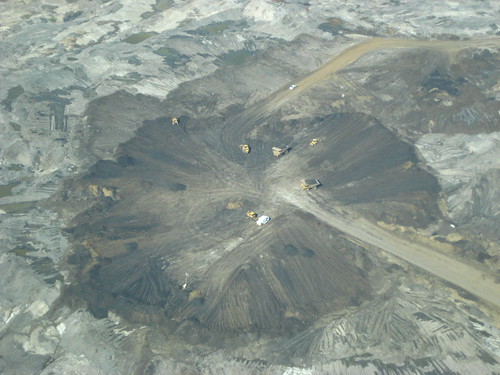
Most tar sands production takes place in vast open-pit mines, some as large as 150 square kilometers and as deep as 90 meters. Before strip-mining can begin, the boreal forest must be clear-cut, rivers and streams diverted, and wetlands drained. The overburden (the soil, rocks, and clay overlying the tar sands deposit) must be stripped away and stockpiled to reach the bitumen. Four tons of material are moved to produce every barrel of bitumen.
At current production rates, with just three mines operating, enough material is moved every two days to fill a 60,000-seat stadium. But only a small fraction of the bitumen deposits is close enough to the surface to be strip-mined. Over 80 percent of the established tar sands reserves are deeper and must be extracted in situ (in place) by injecting high-pressure steam into the ground to soften the bitumen so it can be pumped to the surface.
Once separated from the sand, the bitumen is still a low-grade, heavy fossil fuel that must undergo an energy-intensive process to upgrade it into a synthetic crude oil more like conventional crude, either by adding hydrogen or removing carbon. Upgrading the bitumen usually occurs before it is shipped to refineries, but sometimes raw bitumen is diluted (e.g., with naphtha) and pipelined to a refinery where it is both upgraded and refined. In the United States about three-quarters of the oil is refined into transportation fuels.
But even then not just any refinery will do. A certain amount of reconfiguring must occur at refineries more accustomed to handling conventional crude oil. Some American refineries, primarily in the Midwest and the Rocky Mountain region, already accept some synthetic crude oil from the tar sands. But with growing reliance on this source of oil, numerous American refineries are converting or expanding in order to handle tar sands-derived synthetic crude oil or raw bitumen.
TreeHugger ahas a classic quote from Salon about Danish political scientist Bjorn Lomborg.
When we last mentioned climate change delayer Bjorn Lomborg after his Colbert interview, , commenters noted "Why have you labeled him a denier? He simply sounds like a pragmatist." Over at Climate Progress, Joe Romm has prepared a two-part debunking of Lomborg, first going after his comments on polar bears (Lomborg thinks they will simply follow the ice or turn into land animals) and in part 2, Lomborg's cherry picking of statistics on sea level rise. There is also a review of Lomborg's new book, Cool it, in Salon that starts with a parody, with Lomborg talking to Noah while he is building the ark:
Up walks a man who introduces himself as an adjunct professor at the Copenhagen Business School. He says, "Noah, you have to stop. We've run the numbers and they don't add up. I agree that there may be a few days of rain, but if you really want to help future generations, don't build the ark. Grow the economy!"
Links:
* AP - Blackwater license being revoked in Iraq. This will be quite significant if they really do get ejected - good for both Iraq and America. But they'll probably tell the Iraqi government who really runs the show. "Monday's action against Blackwater was likely to give the unpopular government a boost, given Iraqis' dislike of the contractors. Many of the contractors have been accused of indiscriminately firing at American and Iraqi troops, and of shooting to death an unknown number of Iraqi citizens who got too close to their heavily armed convoys, but none has faced charges or prosecution." * AP - Iranian influence increasing in Iraq * Haaretz - Iranian TV series follows fate of Jews in World War II * TreeHugger - Green Guide to Houses Down Under




 Posts




