Showing posts with label shale gas. Show all posts

US Natural Gas Prices To Double Over the Next Year ?  

Posted by Big Gav in , , ,

Art Berman has an article prophesying that US natural gas prices are going to come out of their slump and double over the next year - Natural Gas Prices Should Double. His reasoning is that the supply surplus is ending (supplies have declined since October 2015 because gas production is flat, imports are decreasing and exports are increasing - shale gas production has stopped growing and conventional gas has been in long term decline for the past 15 years) and will move into deficit in November.

How important is gas to China's energy mix?  

Posted by Big Gav in , , , , , ,

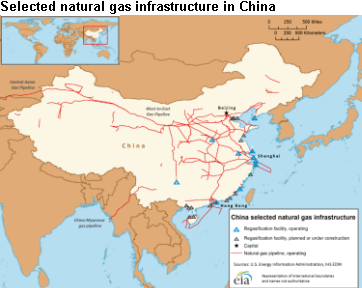
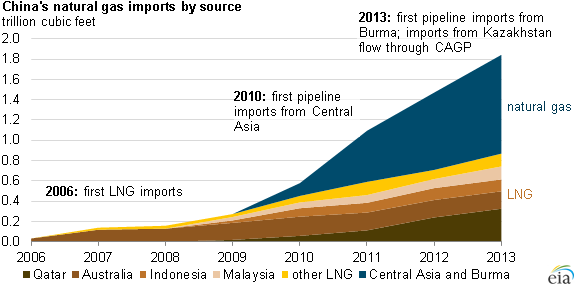
The Climate Spectator has a pair of article on EIA research into China's appetite for natural gas. The first looks at where China currently gets its gas from - How important is gas to China's energy mix?.

China more than tripled natural gas production since 2003, producing 3.8 trillion cubic feet in 2012, and the government is targeting production to reach about 5.5 Tcf of natural gas per year by the end of 2015. Most of the anticipated production growth is from large onshore fields in the western and north central regions of China as well as from the offshore deepwater regions in the South China Sea. China's natural gas consumption has outstripped domestic supply since 2007, triggering rising imports of both liquefied natural gas and pipeline gas. China's natural gas consumption rose at an average annual rate of 17 per cent from 2003 through 2013, reaching nearly 5.7 Tcf in 2013.

In 2013, China imported nearly 1.8 Tcf of LNG and pipeline gas to fill the growing gap between supply and demand. Imported natural gas met 32 per cent of China's demand in 2013, up from 2 per cent in 2006. China is swiftly developing its LNG import capacity in the urban coastal areas and currently has 10 major regasification terminals with 1.7 Tcf/y of capacity. In 2012, China rose to become the third-largest LNG importer in the world, after Japan and South Korea, and in 2013, the country imported 870 billion cubic feet of LNG. Estimates for the first half of 2014 show LNG imports growing at faster levels than in previous years.

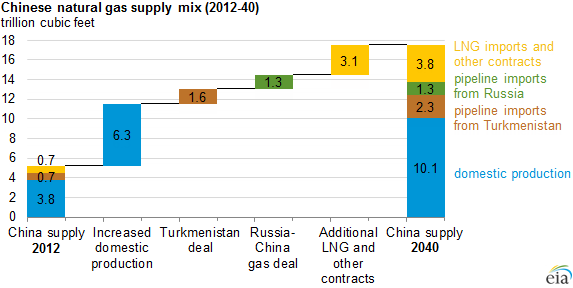
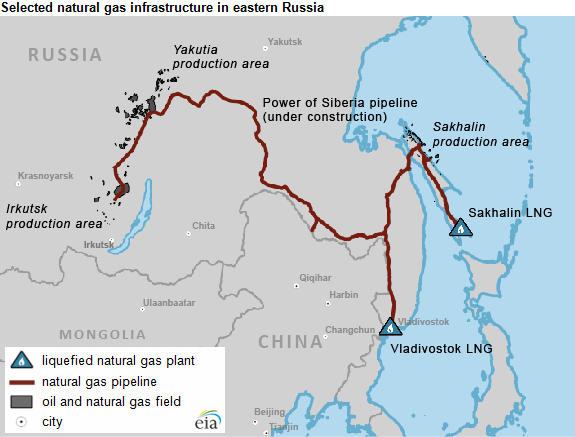
The second article looks at the supply situation from Russia - China's gas equation, post-Gazprom.

Russia's largest natural gas company, Gazprom, finalised a deal with the Chinese National Petroleum Corporation in May. New natural gas production in Russia will mainly come from fields in eastern Siberia, which currently lack export infrastructure. The planned Power of Siberia pipeline will export gas south to China and east to a liquefied natural gas plant on Russia's east coast.

This contract is Gazprom's largest to date. Gazprom has a monopoly on pipeline natural gas export contracts made by Russia. The situation differs from that in LNG markets, where other companies such as Rosneft and Novatek may participate.

China's northern and eastern provinces have growing natural gas demand that cannot be met by existing pipelines or LNG, and the new Russian natural gas will mostly go to meet demand in these regions. China has also committed to purchasing 38 bcm (1.3 Tcf) per year of natural gas from Turkmenistan by 2016, increasing to 65 bcm (2.2Tcf) per year by 2020.

As a footnote, Technology Review has an article on China's problems trying to develop shale gas - China’s Shale Gas Bust.

In 2013 China became the third biggest user of natural gas behind the United States and Russia, consuming 166 billion cubic meters (bcm). By 2019, the International Energy Agency expects China’s annual natural gas consumption to grow 90 percent, to 315 bcm. Half of that increase is expected to be supplied by domestic gas production, which would come from multiple sources, including shale reserves.

That IEA estimate for gas consumption is much lower than the production target China had set for itself: 420 bcm of natural gas annually by 2020, with hydrofracturing, or fracking, being used to get 60 to 80 bcm from shale.

China is estimated to hold the largest technically recoverable reserves of shale gas in the world—nearly twice as much as the U.S. But the shale industry in China has struggled to get off the ground. Most projects are still in the exploration phase. In many cases the formations that hold gas are deeper than in North America and more expensive to reach. Further, Chinese shale tends to have more clay in it, which is an obstacle to extraction (see “China Has Plenty of Shale Gas, But It Will Be Hard to Mine”). These challenges led the government last week to reduce the 2020 shale-gas target to 30 bcm.

Even that would represent a huge increase. Of the 117 bcm of natural gas that China produced in 2013, only 0.2 bcm came from shale.

Shale gas: 'The dotcom bubble of our times'  

Posted by Big Gav in

The UK Daily Telegraph has a jaundiced look at the shale boom - Shale gas: 'The dotcom bubble of our times'.

Rather oddly, hardly anyone seems to have asked the one question which is surely fundamental: does shale development make economic sense?

My conclusion is that it does not.

That Britain needs new energy sources is surely beyond dispute. Between 2003 and 2013, domestic production of oil and gas slumped by 62pc and 65pc respectively, while coal output decreased by 55pc. Despite sharp increases in the output of renewables, overall energy production has fallen by more than half. A net exporter of energy as recently as 2003, Britain now buys almost half of its energy from abroad, and this gap seems certain to widen. ...

We now have more than enough data to know what has really happened in America. Shale has been hyped ("Saudi America") and investors have poured hundreds of billions of dollars into the shale sector. If you invest this much, you get a lot of wells, even though shale wells cost about twice as much as ordinary ones.

If a huge number of wells come on stream in a short time, you get a lot of initial production. This is exactly what has happened in the US. The key word here, though, is "initial". The big snag with shale wells is that output falls away very quickly indeed after production begins. Compared with “normal” oil and gas wells, where output typically decreases by 7pc-10pc annually, rates of decline for shale wells are dramatically worse. It is by no means unusual for production from each well to fall by 60pc or more in the first 12 months of operations alone.

Faced with such rates of decline, the only way to keep production rates up (and to keep investors on side) is to drill yet more wells. This puts operators on a "drilling treadmill", which should worry local residents just as much as investors. Net cash flow from US shale has been negative year after year, and some of the industry’s biggest names have already walked away.

The seemingly inevitable outcome for the US shale industry is that, once investors wise up, and once the drilling sweet spots have been used, production will slump, probably peaking in 2017-18 and falling precipitously after that. The US is already littered with wells that have been abandoned, often without the site being cleaned up. Meanwhile, recoverable reserves estimates for the Monterey shale – supposedly the biggest shale liquids play in the US – have been revised downwards by 96pc. In Poland, drilling 30-40 wells has so far produced virtually no worthwhile production.

In the future, shale will be recognised as this decade's version of the dotcom bubble. In the shorter term, it's a counsel of despair as an energy supply squeeze draws ever nearer. While policymakers and investors should favour solar, waste conversion and conservation over the chimera of shale riches, opponents would be well advised to promote the economic case against the shale fad.

Solar costs to halve as gas prices surge  

Posted by Big Gav in , , , , ,

RNE has a look at the fading competitiveness of gas compared to solar power - Solar costs to halve as gas prices surge.

Another of the world’s leading solar PV manufacturing giants has underlined the potential for yet more substantial falls in the manufacturing cost of solar modules, even as the cost of fossil fuels – and gas in particular – surges in the opposite direction.

Beyond the near-term revenue forecasts that obsess market analysts, one of the big take-outs of First Solar’s annual market day in New York this week was its predictions about the cost of solar modules over the next five years. In short, First Solar expects its average manufacturing cost to nearly halve – from an average $US0.63/watt in 2013, to $US0.35/W in 2018. That will bring the total installed cost of a module (including racking and inverters) from around $1.59/W to below $1/W by 2017 – so meeting the US Department of Energy’s ambitious Sunshot Initiative goals at least three years ahead of time.

This is significant because as solar prices are coming down, fossil fuel prices are headed quickly in the opposite direction. The US has been hailed as the nation of cheap gas, but that is proving to be an illusion betrayed by rapid depletion rates of wells and the growing challenge of deeper and more complicated reserves. Not to mention the water and other environmental considerations.

As this story from EnergyWire states, wholesale prices in the north-east grid in the US jumped 55 per cent in 2013, thanks mostly to a 76 per cent jump in the price of gas to $US6.97/MMBTU, which is now back above its pre GFC, pre-fracking boom levels. (Bookmark the graph, and point it out to the next person that tells you how the fracking boom has guaranteed low electricity prices into the future. It’s bunkum).

The future of large-scale solar was in balance just a year ago, mostly because many of the initial big projects had been funded by California’s ambitious renewable energy target, and a strong solar mandate. But First Solar now sees this large-scale market rebounding, mostly because interest is turning to solar because of those rising gas prices. Power purchase agreements, according to Deutsche Bank analysts, are in the range of $US50-$US70/MWh (helped by a tax credit because the LCOE of most utility scale solar is still probably above $100/MWh.

Exxon CEO Sues Against Fracking  

Posted by Big Gav in , ,

Forbes has an amusing article on opposition to fracking from Exxon CEO Rex Tillerson - Exxon CEO Profits Huge As America's Largest Natural Gas Producer-But Frack In His Own Backyard And He Sues!.

Sometimes, the hypocrisy expressed in real life is so sublimely rich that one could never hope to construct a similar scenario out of pure imagination.

Meet Rex Tillerson, the CEO of oil and gas superstar ExxonMobil Corporation—the largest natural gas producer in these United States of America—and a newly emerging giant in the world of exquisite hypocrisy.

A key and critical function of Mr. Tillerson’s day job is to do all he can to protect and nurture the process of hydraulic fracturing—aka ‘fracking’—so that his company can continue to rack in billions via the production and sale of natural gas. Indeed, so committed is Rex to the process of fracking that he has loudly lashed out at those who criticize and seek to regulate hydraulic fracturing, suggesting that such efforts are a very bad idea, indeed.

According to Tillerson, “This type of dysfunctional regulation is holding back the American economic recovery, growth, and global competitiveness.”

Thus, according to Rex Tillerson, nobody should have much of a reason to be disturbed or concerned when ExxonMobil comes knocking on your door to deliver the news that fracking is about to become a part of your daily life…unless, or course, you happen to live in Mr. Tillerson’s neighborhood.

In that case, the rules are, apparently, very, very different.

You see, while Tillerson believes that the inevitable noise pollution that accompanies the fracking process—not to mention the potential for water contamination and other dangerous side-effects even when it is done safely (and some would strenuously argue that it is not possible to frack safely)— is of no real significance when it affects someone else’s neighborhood, he surely thinks it to be a pretty big deal when someone dares to get involved in fracking in Rex Tillerson’s neighborhood.

So much is this the case that Tillerson—ExxonMobil CEO and proud proponent of fracking as a key to both America’s and his company’s great energy future—has joined a lawsuit seeking to shut down a fracking project near Mr. and Mrs. Tillerson’s Texas ranch.

5 ways to play the end of the natural gas renaissance  

Posted by Big Gav in

Resource Investor has an example of some of the bearish commentary on the US shale boom (more negative than my personal views but I thought it was worth noting) - 5 ways to play the end of the natural gas renaissance.

The Energy Report: Bill, you published a book six months ago, "Cold, Hungry and in the Dark: Exploding the Natural Gas Supply Myth," questioning the conventional wisdom of shale gas. Have events supported your thesis?

Bill Powers: Yes, absolutely. Several of the predictions I made in the book have come true since the book hit the shelves in July. First, we've seen numerous shale plays head into decline. We've seen big declines from the Haynesville as well as the Barnett. The Fayetteville is in decline; there have been further declines in the Gulf of Mexico and Wyoming. But what has really changed is the North American natural gas market has become extremely unbalanced, which was what I had predicted would come to pass sometime in the 2013–2015 timeframe. The cold weather over the last six weeks has accelerated what I have been talking about in the book.

TER: How so?

BP: I predicted that gas prices would lead to layoffs and industry supply disruptions, and that's already occurred. We've seen paper mills in New Hampshire lay people off because natural gas prices in New England were north of $50/million Btu ($50/MMBtu) for a period and remain very high. We've also seen incredibly high prices in New York, and this is a time of record production coming out of the Marcellus. These are really the first examples of the violent price spikes and industrial shutdowns we will see in other parts of the country.

Across the U.S. over the next several years, I predict we will see spikes of very high prices, which will fall back to higher levels than they previously reached. Then, as the next weather event comes, prices will spike to new highs. That has already happened in New England and other areas of the Northeast in part because those areas are supply-constrained due to limited pipeline availability, but also because of increased demand.

The Northeast has also had several nuclear power plants close. Just recently the Vermont Yankee closed. Nuclear power plants have closed over the last decade or so in Maine as well as Connecticut. Much of this capacity has been taken up by increased natural gas demand for electricity generation. So you've had constrained supply because of the limited pipeline capacity and increased demand. In addition to the new demand from electricity generation, significant new demand in the Northeast has come from people converting from heating oil to natural gas furnaces.

Also, there's been a huge disappointment in supply coming from Canada into the Northeast U.S. because Sable Island production offshore Nova Scotia has been so low compared to some very lofty original expectations. We've just had Deep Panuke come on in late 2013 after several delays and many cost overruns, but the pipeline that services those offshore fields in Nova Scotia is not even close to full, and the fields will be depleted fairly rapidly over the next three to seven years. This will be a period of continued supply constraints for New England. The Marcellus and Eagle Ford are the only two fields that are still growing, and I expect the Marcellus to flatten out in 2014. Additionally, we are going to see supply constraints throughout much of the rest of the United States over the next several years.

TER: The pipeline companies have acknowledged that there's a supply constraint. Haven't any of them made plans to extend lines to the Northeast?

BP: Yes, that is happening, and some of them are probably going to increase throughput from the production growth in the Marcellus, but there will be significant calls on Marcellus production, which is probably going to peak this year.

The U.S. Energy Information Administration late last year put out a white paper that talked about how gas production is becoming more efficient. But this white paper did not include the Barnett Shale, which is in steep decline now. It's true, efficiencies have been gained over the last several years, such as the way fracking has changed, and operators are becoming more efficient in fracking, with longer laterals. But what is really happening is the completion of the inventory of previously drilled wells.

When companies ramp up their drilling activity, they often will drill more wells than they actually complete due to lack of pipeline capacity. Just recently, there have been about 200 wells in the Marcellus that were waiting for pipeline connections or to be fracked. A lot of those wells have been fracked over the last six months and the inventory continues to go down. I believe that inventory will be depleted by Q1/14, and given the drilling activity, the very high decline rates of the wells and the number of rigs running in the Marcellus, further growth is not supported. The Marcellus is still a very significant field, the biggest in the United States. When it peaks out it will probably plateau for a while, depending on activity levels, but it still will not be able to make up for falling production in nearly every other region in the United States. When this happens, we will see price spikes more frequently.

Study Finds Emissions of Methane in U.S. Exceed Estimates  

Posted by Big Gav in

The NYT has an article on a new study of methane emissions into the atmosphere - Emissions of Methane in U.S. Exceed Estimates, Study Finds.

Emissions of the greenhouse gas methane due to human activity were roughly 1.5 times greater in the United States in the middle of the last decade than prevailing estimates, according to a new analysis by 15 climate scientists published Monday in The Proceedings of the National Academy of Sciences.

The analysis also said that methane discharges in Texas and Oklahoma, where oil and gas production was concentrated at the time, were 2.7 times greater than conventional estimates. Emissions from oil and gas activity alone could be five times greater than the prevailing estimate, the report said.

Andrew Revkin at "Dot Earth" has a look at some new films about the shale gas boom - A Fresh Look at America’s Gas Lands.

I’ve been meaning to post for awhile on “Gas Rush Stories,” a series of simple, but captivating short films on America’s gas drilling boom made by Kirsi Jansa, a Finnish video journalist currently living in Pittsburgh.

The time is right because Jansa is in the running for a $10,000 grant from the Sprout Fund that could help her sustain and refine this effort to portray the many meanings and realities surrounding hydraulic fracturing, better known as fracking, in Pennsylvania communities scattered over the gas-rich Marcellus Shale.

North Dakota's Salty Fracked Wells Drink More Water to Keep Oil Flowing  

Posted by Big Gav in , ,

National Geographic has an article on the water demands of North Dakota's shale oil wells - North Dakota's Salty Fracked Wells Drink More Water to Keep Oil Flowing.

It's well known that water has been key to the shale oil and gas rush in the United States. But in one center of the hydraulic fracturing boom—North Dakota—authorities are finding that the initial blast of water to frack the wells is only the beginning.

The wells being drilled into the prairie to tap into the Bakken shale need "maintenance water"—lots of it—to keep the oil flowing.

So while the water first pumped down the hole to crack rock formations and release the underground oil and natural gas typically totals 2 million gallons (7.5 million liters) per well, each of North Dakota's wells is daily drinking down an average of more than 600 gallons (2,300 liters) in maintenance water, according to recent calculations by North Dakota's Department of Mineral Resources (DMR). Without water, salt buildup forms and restricts the flow of oil.

Fracking Boom Leading to Fracking Bust  

Posted by Big Gav in ,

Climate Central has a look at the shale oil boom, quoting Dave Hughes and Arthur Berman - Fracking Boom Leading to Fracking Bust.

Scientists studying oil and gas well production data are beginning to question how long the boom will last, however, suggesting that a shale oil and gas bust may come sooner than expected, even as the industry insists that the boom has been and will continue to be a success.

British Columbia-based geoscientist David Hughes, whose research was presented at the Geological Society of America meeting this week in Denver, says the story hidden in oil well production numbers is that oil and gas production from fracking could peak in some places as soon as 2016.

Soon after the Jake well was drilled, the amount of oil it produced declined sharply. In just a few months in 2009, the well produced 48,373 barrels of oil, Colorado Oil and Gas Conservation Commission data show. By 2012, the Jake well’s annual production totaled 22,300 barrels. So far in 2013, the gusher has eeked out only about 6,000 barrels.

It’s the same picture in oil wells throughout the Niobrara shale, where oil production declines more than 65 percent in a new well’s first year of production, Hughes said.

In the Bakken shale of North Dakota, an oil play slated to tie into the controversial Keystone XL Pipeline, production declines 44 percent in the first year across the entire oil field. Production in the Eagle Ford shale south of San Antonio, Texas, declines 34 percent in the first year, according to Hughes’ data. Production in the Haynesville oil field in Texas and Louisiana peaked after just 5 years, he said.

And as Hughes noted, the more production drops off in individual oil wells, the more wells companies have to drill and frack to make up the difference.

Chinese oil companies attempt to slash shale gas drilling costs  

Posted by Big Gav in , , , ,

Platts has an article on Chinese progress in extracting shale gas (Chinese wells still take 3 times as long to drill as US ones and cost around 4 times as much) - Chinese oil companies attempt to slash shale gas drilling costs.

Chinese companies are aiming to cut costs and enhance efficiencies as they become more familiar with shale gas development in the country, delegates at an unconventional gas conference said in Beijing this week.

State-owned Sinopec has been focused on the gas-rich Sichuan Basin, where it already has experience working on complex fields with high sulfur in tight reservoirs, particularly with its Puguang and Yuanba projects. Its main shale development is the Fuling project in the Sichuan Basin in Chongqing covering up to 500 sq km. Sinopec said in March that it hoped to reach 1 billion cubic meters/year of production capacity at the project by 2015.

Ma Yongsheng, the company's chief geologist, told delegates at the Global Unconventional Gas Summit on Tuesday that Fuling has produced more than 20 million cu m since late last year from an ongoing trial production, and daily output has hit 60,000 cu m of gas. There are now five wells with stable output. Working on the project has already yielded some efficiencies, Ma said, with the drilling time for each well cut by half to about three months. Ma added that the cost of one shale gas well is now around Yuan 90 million ($14.7 million), including costs for drilling, fracturing and procurement of services from technical service companies.

Gas still is the subject of much debate in Australia, with The Age recently running an article on opposition to natural gas export projects pushing up the price of domestic gas - Gas companies 'hoarding' for export projects.

Gas companies have been accused of leaving gas in the ground that could be profitably sold today, so they can sell the gas more expensively in the future. The claim comes as gas prices along the east coast are forecast to rise to international levels after the development of a string of export gas projects in Queensland. This has already driven the price of gas for some large industrial users to $9 a gigajoule from 2016, up 50 per cent.

''An oil company that expects to sell … LNG [liquefied natural gas] at a price of $14.85 ma unit in 20 years' time would be better off if it secured $3 for that same unit of gas in the domestic market today,'' Mike Lauer, director of Gas Trading Australia, told the Australian Pipeline Industry Association on Monday. ''The overwhelming focus of our oil and gas producers on big, exciting and sexy LNG developments has come at a substantial cost to resource allocation in Australia. This focus has seen oil company executives decline to profitably sell gas in domestic markets today so that the gas can be reserved for sale in 15 or 20 years as LNG.''

An example is the Northern Territory, where more than 150 petajoules of gas is brought into Darwin each year and exported to Japan. ''Apparently, there was not 12 PJ to 20 PJ of gas per annum available to supply Channel Island, 12 kilometres away from the LNG plant, because the gas was needed to supply LNG in the plant's 17th contract year,'' he said. ''It beggars belief that there was no price at which such small volumes of gas could be liberated from the LNG project. ...

His comments came as pipeline owner and operator Jemena said government must be prepared to intervene to prevent ''demand destruction'' among some gas users when the gas price spikes, which would put trade-exposed industries that use large volumes of gas at risk. ''Temporary, targeted government assistance for trade-exposed industries would be justified to ease transitional pressures,'' said Shaun Reardon, Jemena's executive director.

The Daily Reckoning reckons this is all as it should be (I'm not sure your average punter would be swayed by these arguments but they are preaching to the choir) - Should Australia Have a Shortage of Natural Gas or Cash ?.

If you can buy something for $3.15 in America and sell it for $16.40 in Mexico, should you? Not if you're a patriotic Australian, as you'll discover below.

Oddly enough, Australia is at the centre of the story the image is trying to tell, but we don't even get a price label. Maybe that's because there are some foul smelling goings on within our borders. We're talking about the natural gas industry, of course.

'Rip and reap, baby' is for the wimpy resource cowboys of the past, reports The Age. 'Rip, reap, hoard and flog overseas' is the new motto of the Australian gas industry. And they're infuriating the greenies, industry, politicians and every other busybody in the country. So, as a matter of principle, let's give the scroungedrels some support.

Why are they 'scroungedrels'? Well, instead of providing much needed cheap natural gas to Australian homes and industry, the scoundrels are scrounging around for higher prices overseas. Despite having one of the largest gas production booms in the country, Australia could end up with a shortage of natural gas!

That's a bit misleading. The correct way of putting it is that local consumers of gas are being outbid by foreigners. We're not willing to pay the international market price. But for the sake of the journalists who have to write about this stuff, let's call it a gas 'shortage'.

More and more gas export terminals are coming online, but not fast enough for the natural gas producers. Now the villains have gone one worse than just selling Australia's valuable and needed resources overseas for a higher price. [Gasp!] They're hoarding and storing natural gas in anticipation of being able to sell it overseas at a higher price. [Outraged gasp!] And that's driving up the price of natural gas here in the meantime. [Bang fist on table.] There's nothing worse than a hoarding scroungedrel, is there? [Shake head.]

Actually, things are just as they should be. For now anyway. Politicians and lobbyists are already on the move to 'fix' the 'problem'. As always, they're being egged on by big business trying to get some protection from international competition. BlueScope Chief Paul O'Malley pointed out that Australia is the only country in the world that exports gas without having a national gas policy.

Maybe it's not a coincidence we're in the middle of a gas boom then. But try substituting 'gas' for something else like 'cabbage'. 'Australia is the only country in the world that exports cabbage without having a national cabbage policy.' Ridiculous, right? ...

First of all, hoarding in anticipation of future use is a signal to the economy that a lot of gas will be needed soon, so production needs to be ramped up. Nothing ramps up production like higher prices, and that's just what hoarding causes. So hoarders are actually quite helpful. They also stabilise prices when they sell their amassed holdings. And prepare the rest of the economy for the coming higher prices.

Secondly, selling your exports overseas for multiple times their local price generates a greater benefit than cheap natural gas would here. It's just that the dollars flow into different hands. So the real question should be how Aussie investors can get their hands on the Aussie companies that will be making a mint.

One widely touted answer to natural gas availability in Australia is (naturally) shale gas, with the ABC's Landline program recently having a look at action in the Cooper Basin - It's a Gas.

Australia is on the cusp of a new resource industry, one based on extracting gas from shale rock.

Like coal seam gas, this new industry raises questions about how gas extraction will interfere with underground aquifers, an issue that's troubled some farming communities.

Although shale gas reserves are found throughout Australia, the initial exploration and drilling is being done in a remote part of the Cooper Basin. ...

MIKE SEXTON, REPORTER: This is well number 191 in the Moomba gas field at the Cooper Basin. It isn't the most impressive piece of infrastructure, a 2m high wellhead with a length of 20mm pipe. But it's the closest you'll ever see to an iceberg in the desert, because it's what's hidden that counts.

JAMES BAULDERSTONE, SANTOS: Quite rightly say it doesn't look overly impressive. What you don't see is what happens under the ground. So here you have a well that's some 3.5km deep and is extracting a resource from that one single well that provides the energy for 40,000 homes in Adelaide and Sydney.

MIKE SEXTON: It's Australia's first production well for shale gas, which is often referred to as unconventional gas. And the company operating it, Santos, believes it's a game-changing resource.

JAMES BAULDERSTONE: In the Moomba field and surrounding fields we have some 700 producing gas wells. This is one of those 700 and we're hopeful we can drill many wells like this that can really take the production from central Australia that's been producing, supplying half of the gas of the eastern seaboard for 40 years, and provide that for another 40 years.

MIKE SEXTON: Geologists have long known about the shale deposits. The reason they're now being exploited is because of Asia's continuing demand for energy.

In 2010 Santos signed enormous contracts to supply gas from the Cooper Basin via its joint venture LNG plant at Gladstone in North Queensland. Leaving themselves five years to find enough gas.

The Cooper Basin was slowly being turned off. Now the dynamic has dramatically changed.

The Australian also has an article promoting shale gas production - Shale gas will transform energy market, says experts (sic).
Santos last year became the first company to begin commercial production of shale gas in Australia, after developing a well near its conventional gas activities in the Cooper Basin, which straddles South Australia's border with Queensland.

Chatham House energy expert Paul Stevens said a strong shale-gas industry in Australia could be expected in the medium-to-long term, and a more attractive tax regime should be implemented to ensure it happens. Professor Stevens said the shale gas revolution in the US had developed while companies were receiving a US$0.50 tax credit for producing unconventional gas until 2002. "Government's can't change geology, but they can change the commercially of the geology,'' Professor Stevens told The Australian after the event. "Tweaking the fiscal terms is quite a good way of doing it.''

Australia has about 396 trillion cubic feet (TCF) in potential shale-gas reserves. Proven conventional gas reserves which do no require "fracking'' - a process in which fluids and sand are injected into rocks to split them in order release gas trapped inside - are about 133 TCF.

The shale gas bubble: burning your home in order to save it  

Posted by Big Gav in

Ugo at Cassandra's Legacy has a post on the shale gas bubble in the US - The shale gas bubble: burning your home in order to save it.

Ladies and gentlemen, let me comment on a point of this interesting discussion. We have been told, correctly, that the production of shale gas in North America is booming and also that prices are now very low; around 2 dollars per million cubic feet. It is, actually, somewhat more than that but it is still a low price in comparison to what it was some years ago; before the shale gas "revolution".

On the other hand, producing shale gas is expensive. "Fracking" is a technology that was developed long ago, but it was never used on a large scale because it was too expensive in comparison to conventional gas production. And that's reasonable: for fracking you need sophisticated equipment, chemicals, and more. In addition, a shale gas well is rapidly exhausted, so that you must go on drilling in order to keep producing. Indeed, mining technology has this characteristic: it can be used to mobilize more resources, but it can rarely make them cheap.

So, there is a contradiction here: we are using a more expensive technology to produce a commodity whose prices, however, went down considerably. What's happening?

I think the explanation, here, lies in financial factors. What we are seeing, indeed, is mainly a financial bubble in which investors are led to pour money into a market with the hope to make a lot of money. That's a hope, obviously, for the future because, right now, I am sure that nobody can make a lot of money with such low gas prices - actually I think a lot of people are losing money. But this is the magic of the financial market: if everyone believes that a certain commodity will have a large value in the future, then they invest in it, and the result is overproduction.

Shale Grab Stalls as Falling Values Repel Buyers  

Posted by Big Gav in ,

Bloomberg has a (2 week old) article on the fading shale oil boom in the US - Shale Grab in U.S. Stalls as Falling Values Repel Buyers.

Oil companies are hitting the brakes on a U.S. shale land grab that produced an abundance of cheap natural gas -- and troubles for the industry. The spending slowdown by international companies including BHP Billiton Ltd. (BHP) and Royal Dutch Shell Plc (RDSA) comes amid a series of write-downs of oil and gas shale assets, caused by plunging prices and disappointing wells. The companies are turning instead to developing current projects, unable to justify buying more property while fields bought during the 2009-2012 flurry remain below their purchase price, according to analysts.

Australia revisits transnational natural gas pipeline  

Posted by Big Gav in , , ,

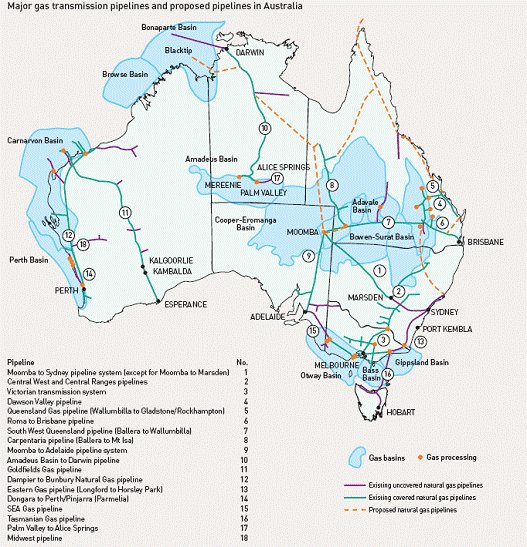
Platts' "The Barrel" blog has an interesting post looking at the history of natural gas pipeline proposals in Asutralia, including the last plan to pipe gas from the Northern Territory to the eastern states (which face an impending shortfall now most of the coal seam gas being extracted is destined to be sent offshore in the form of LNG), which the gas potentially coming from both offshore fields and shale gas projects in the dead heart - Australia revisits transnational gas pipeline.

Australia is no stranger to the idea of transnational or even international pipelines when it comes to solving the vexed issue of getting enough gas to its eastern seaboard, home to its biggest cities.

Australia currently has two separate gas pipeline networks in the west and east of the country which supply markets of around 1 Bcf/day and 1.6 Bcf/d respectively. A much smaller, also separate, network in central Australia services the Northern Territory capital of Darwin. ...

The latest proposal for a transnational interconnection between Australia’s pipeline networks was initially aired in recent months by former Chief Minister of the Northern Territory Terry Mills, as part of his efforts to secure the future of Rio Tinto’s alumina refinery at Gove. In February, just before being ousted in a party room coup, Mills secured a deal under which Gove would be supplied with gas from Eni’s Blacktip offshore field, heralding a project which would include the construction of a A$500 million pipeline to the plant. ...

That call has now been taken up by Australia’s largest pipeline operator APA Group, manager of 14,120 km of pipeline infrastructure. One of APA’s assets is the 1,600 km Amadeus Basin to Darwin gas pipeline, which was the world’s third-longest when it was completed in 1986 at a cost of just A$380 million. ...

A raft of international oil and gas industry heavyweights have taken a foothold in northern and central Australia’s nascent shale sector over the past few years. Companies including Chevron, ConocoPhillips, Statoil, Total and BG Group have secured farm-in agreements and pledged investments of more than $1.55 billion in Australian shale, according to the US Energy Information Administration. The EIA has estimated that Australia has 437 Tcf of technically recoverable shale gas reserves, ranking the country sixth highest in the world.

HUGE CAPEX = FREE CASH FLOW ? NOT IN SHALES  

Posted by Big Gav in , ,

Energy Policy Forum has an interesting article by Deborah Lawrence Rogers about the financials of the companies frantically scraping the bottom of the barrel in the Bakken - HUGE CAPEX = FREE CASH FLOW? NOT IN SHALES.

Taking a universe of 5 shale companies, some primarily with shale gas assets and others with shale oil, it is of note that there has been a significant deterioration of free cash flow since 2010. But what is even more interesting is that some of these companies are reporting that net income has been growing though free cash is falling.

Not wishing to bore everyone with an esoteric discussion of financial statements, it is of note that when a company shows a growth in net income with a concomitant deterioration of free cash flow, it may be an indicator that management is taking aggressive steps to boost earnings artificially. Not always. But possibly.

So how much deterioration has there been in free cash flow? It is impressive.

When you adjust the figures to include capital expenditure (and dividends where appropriate), their free cash available is negative. Significantly negative.

This is highly problematic because if a company cannot generate cash from operations then it has to go outside and get the monies through borrowings or equity offerings. In other words, debt or dilution for investors.

Free cash flow of Continental Resources, a big player in the Bakken, has dropped from ($430M) to ($2.4B) since 2010, all of it negative. And Continental is not the only one. Devon Energy’s free cash flow has dropped from ($1.2B) to a significant ($3.5B) over the same time frame. Range Resources, who are drilling primarily in the Marcellus, booked a negative free cash flow of ($556M) in 2010 and this has deteriorated to ($1.0B). Kodiak Oil and Gas, another Bakken player, had negative free cash flow in 2010 of ($170M). It has now deteriorated to ($1.0B). Chesapeake is interesting because its free cash flow for 2012 ($3.3B) is now roughly equivalent to its level in 2010, ($3.4B). But over the last two years Chesapeake has liquidated approximately $13 billion in assets with no commensurate gain to free cash flow. Management still needs to move outside the company to generate cash to continue operations. And yet, shareholders have had their underlying assets disappear to the tune of $13B to pay down debt.

Clearly there is a pattern here of severe deterioration. But that is not all. CAPEX has exploded during this time which means that companies have spent enormous sums of money drilling wells that are not providing enough cash to continue drilling operations on their own. Not even close. For instance, Continental’s CAPEX grew from $1.0B to $4.1B. Devon’s CAPEX grew from $6.4B to $8.2B. In total, these 5 companies spent approximately $56B in capital expenditure since 2010 while the free cash generated from this $56B spending spree is non-existent. In fact, it is worse than non-existent because it is alarmingly negative.

This is not sustainable. It could be argued that it is not even moral. It is a failed business model of epic proportion. While companies could make the argument at one time that this was a short term downtrend, that no longer holds water because this pattern is long term.

The most troubling aspect of this is that we are fast tracking exportation of this commodity in spite of the glaring financial anomalies. It is extraordinary that some members of Congress proclaim whole heartedly for fiscal responsibility while turning a blind eye to fiscal irresponsibility among their campaign donors and promoting exportation.

The shale gas revolution: is it already over?  

Posted by Big Gav in ,

Ugo at Cassandra's Legacy has a post on the shale gas "revolution" (I always liked Suart Staniford's description of the boom as the "frantic scraping of the bottom of the barrel") - The shale gas revolution: is it already over?.

The production of natural gas in the US has not been increasing for about two years. Fitted with a Gaussian function, it shows a peak in the second half of 2012 and, from then on, a tendency to decline. Decoupled in its various components, the data show that shale gas production is still increasing, but not fast enough to compensate for the decline of conventional gas production.

Are we already seeing the end of the "shale gas revolution"? It is too early to say but, surely, these data agree with the viewpoint of those who had been seeing the whole story as a short lived financial bubble. (see, e.g., a recent series of statements by Arthur Berman)

US shale boom starts to fade  

Posted by Big Gav in ,

The SMH has an article opining that prospects for US shale oil production are fading - US shale boom starts to fade.

For the past three years, the boom in the US shale oil industry has outstripped all expectations. Production surged far faster than any forecasts; drillers raced to secure space in new pipelines to get their crude to market. Now, at the periphery, that may be changing - at least for a while.

News from two of the country's less developed shale plays in Colorado and Ohio last week offer a reality check for the wave of euphoria that has washed across the industry. The stumbles mark a break from the past few years, when nearly every new project was an overnight success and output grew and grew.

On Thursday, Ohio, home to the Utica shale, finally released annual data on 2012 production that showed the state pumped less than 700,000 barrels of oil from its shale wells -- barely enough to fill a small oil tanker. North Dakota's Bakken shale pumps more than that every day. Even state officials said it the result was "lower than initially estimated."

The day before, NuStar Energy LP had said it would shelve a plan to reverse a pair of underused refined products pipelines to ship crude from Colorado's Niobrara shale oil play to Texas. It failed, twice, to garner enough commitments from potential customers to justify investing in the conversion. Neither development was a surprise to industry experts, and both were likely affected by extenuating circumstances.

A growing preference for rail shipments likely dimmed interest in long-term commitments to use NuStar's pipeline. Ohio's shale may yet offer up large volumes of liquid gas and condensate, if drillers can find new ways to coax it out.

Yet taken together they offered a sign that the flush of enthusiasm and rush of investment that piled into shale fields from one coast to the other has hit a curve. While the basic technologies of hydraulic fracturing and horizontal drilling was enough to coax an unexpected gusher of oil from shale rock in many regions, these more challenging seams may require incremental innovation to unlock.

Platts has an article boosting the prospects for the shale industry finding more plays like the Eagle Ford in Texas - Did the shale revolution already find its biggest oil field at the Eagle Ford?.
In case you didn’t catch it, investment house Credit Suisse had a wonderfully informative conference call for their clients last week on how they see the future of the shale revolution that has engulfed the oil patch in the last decade and become hyper-active especially in the last several years.

Among the bank’s conclusions: shale is a vital component of current US production which is growing at a huge clip — CS sees as much as 10 million b/d of US oil production in the next several years, up from 6.5 million b/d last year. CS also noted consistently improving well results from big plays such as the Permian Basin in West Texas and Bakken Shale in North Dakota.

Moreover, it’s not only the upstream that is exploding, but also companies that supply the technologies to eke out more oil in less time. Even ancillary services are exploding, such as technologies that can treat and dispose of water — a crucial component of well fracturing. And all this will require many billions of investment dollars into a shale economy still years away from the mature development stage.

But one other thing Credit Suisse said, which echoes the sentiments of many in the industry, was that it was “skeptical” a new large field on the order of the Eagle Ford Shale in South Texas would happen. The Eagle Ford is one of the most prolific shale fields which boasts an estimated 943,000 b/d of liquids production and is forecast to produce 1.6 million b/d by late 2018. Instead, Credit Suisse said existing areas with “stacked” pay targets — i.e., layered formations –are better bets right now. When you consider how far industry has come in the last five years alone, it seems almost reactionary to make such a statement. And Credit Suisse is far from alone in that view: many executives share it — even from top shale producers.

Five years ago, the Eagle Ford Shale hadn’t even been discovered, at least not officially. Although a few companies were out there quietly working the field, it was Petrohawk Energy that announced a gas find there in October, 2008. By that time, other shale fields had already been discovered — the Haynesville in Louisiana, a gas field; the Bakken oil field in North Dakota; and of course, the granddaddy of them all, the Barnett in North Texas which sparked the widespread move by operators to shale exploitation in the early 2000s, although the field’s first wells were drilled in the early 1980s.

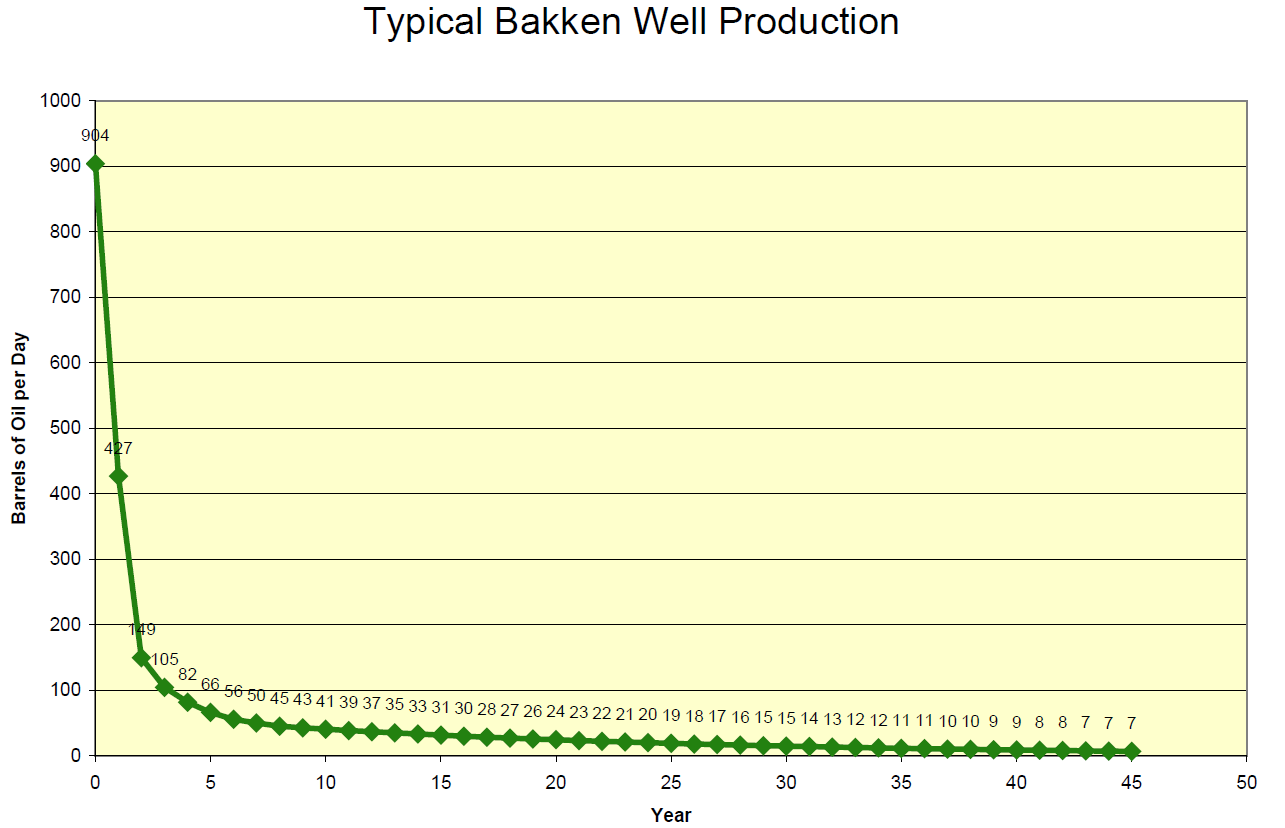
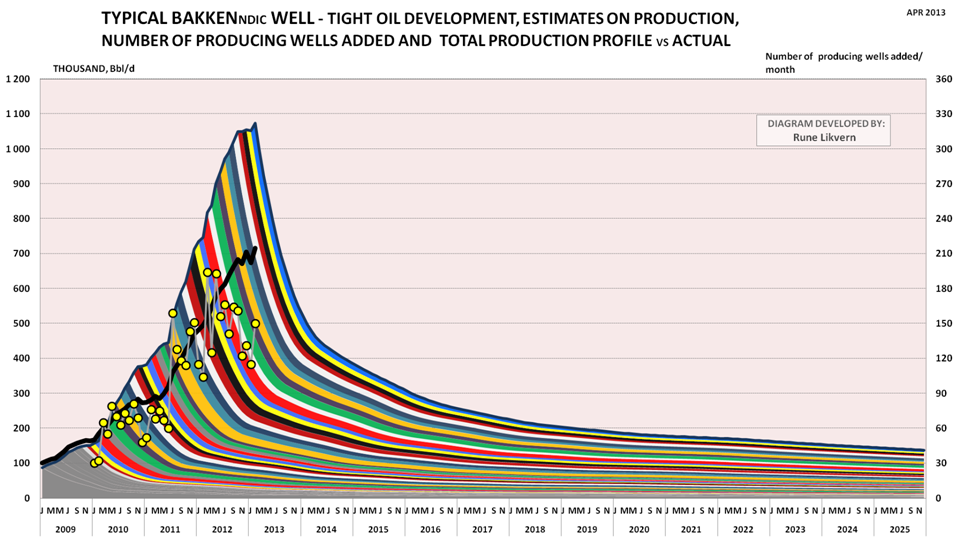
The Oil Drum has a skeptical look at the endless treadmill of drilling that shale oil / gas extraction requires- Is the Typical NDIC Bakken Tight Oil Well a Sales Pitch?.
In this post I present the results from dynamic simulations using the typical tight oil well for the Bakken as recently presented by the North Dakota Industrial Commission (NDIC), together with the “2011 average” well as defined from actual production data from around 240 wells that were reported to have started producing from June through December 2011.

The use of the phrase “Typical Bakken Well” by NDIC as shown in Figure 01 is here believed to depict what is to be expected from the average tight oil well.

The results from the dynamic simulations show:

If the “Typical Bakken Well” is what NDIC recently has presented, total production from Bakken (the portion that lies in North Dakota) should have been around 1.1 Mb/d in February 2013.
Reported production from Bakken by NDIC as of February 2013 was 0.7 Mb/d.
Actual production data shows that the first year’s production for the average well in Bakken (North Dakota) presently is around 55% of the “Typical Bakken Well” presented by NDIC.
The results from the simulations anticipate a slowdown for the annual growth in oil production from Bakken (ND) through 2013 and 2014.

...

The production developments in Bakken and other tight oil plays are very much a function of monthly additions of producing wells, developments in well productivity, decline rates (for the growing population of “older” producing wells), development in costs, strategies deployed by the companies for development of their acreage, adequate infrastructure and not least the developments/expectations for the oil price.

LNG exports from Canada and the US get closer  

Posted by Big Gav in , , ,

The SMH reports that LNG exports from North America are starting to look likely - the gas age is in full swing - US and Canada step on the gas.

JUST hours after the Canadian government approved its third export gas project, another US export gas project, this time in Texas, has moved closer to getting a green light. The approvals come as concern is mounting that a large rise in North American gas reserves on the back of the shale gas boom will undercut much of the optimism of Australia's gas exporters over projects being developed off Western Australia and in Queensland.

Australia is set to be one of the world's largest gas exporters in the next five years, although growth prospects beyond that are being hurt by the increase in export projects vying for approval in North America.

On Tuesday Shell won approval for a project it is promoting in British Columbia, on Canada's west coast, which includes PetroChina, Korean Gas and Mitsubishi Corp as shareholders. Both PetroChina and Mitsubishi are participants in export gas projects in Australia.

As well, the US Department of Energy granted Pangea LNG approval to begin exports from its south Texas project. Pangea has been authorised to export up to 8 million tonnes annually of liquefied natural gas for 25 years.

Shell, also, has joined another consortium planning to export gas from Georgia, in the US south.

The inability of large vessels to use the Panama Canal always meant that gas exports from the US could only be exported to Asia from the west coast and Alaska, but that will change from late 2015 when the canal's capacity rises after a $US5.5 billion ($A5.28 billion) expansion.

BHP's Shale PR boom gathers pace  

Posted by Big Gav in ,

I speculated recently that some of the gushing press in Australia about the US shale gas boom was being driven by BHP. This weekend's SMH has a column which indicates this theory is spot on (as the author is transparent about who was feeding him information) - Shale boom gathers pace. I think the key takeaway from this one is that shale oil is uneconomic below $80 a barrel - so there is one (starting) floor price in the new age of unconventional oil.

MY TRIP to Texas as a guest of BHP and my subsequent talks in New York with economists, analysts and investment bankers in New York about America's shale oil and gas production boom meanwhile underlined that BHP Billiton got its biggest shale deal in the US right. The growing consensus on Wall Street is also that the US shale boom is a global economic and geopolitical game-changer.

BHP's first purchase of shale gas leases in Arkansas for $US4.6 billion was fully valued at the gas price of the day, and the $US2.84 billion write-down the group announced in August was arithmetically generated as US shale gas production soared, and US gas prices plunged.

The group's subsequent $US15 billion takeover of US group Petrohawk at 65 per cent premium to Petrohawk's market price could produce an asset valuation uplift this financial year that more than compensates for the first write-down.

BHP can still earn returns of more than 20 per cent by developing gas wells in Arkansas, but it is aiming instead to increase production of oil and other liquids that are roughly four times more valuable by 15 per cent in 2012-13 by redirecting the vast bulk of its $US4 billion shale capital expenditure budget to Petrohawk's oil and liquids-rich fields in Texas.

In New York, the big bulge-bracket banks are all doing their sums on the shale boom. One estimate of the value transfer from the rest of the world to the US is already $US900 million a day as US domestic production grows and imports fall. That's an amount equal to 2.2 per cent of raw GDP, but what the US does with the income windfall is the key, as it was here during the commodities boom. To the extent that the new income finances consumption of imports, for example, domestic benefits of the boom will be lower.

The US will certainly benefit from cheap domestic gas that will deliver cost benefits to heavy industries including petrochemical plants and power stations, but the horizontal drilling and rock-fracturing technology that is freeing up shale gas and oil will ultimately generate sweeping global changes.

Shale oil can be commercially exploited at oil prices as low as $US80 a barrel, and as shale oil volumes rise, oil price spikes in response to accelerating growth in demand that work to slow demand again will be much less frequent. Shale oil, in other words, is going to raise the maximum speed limit of the global economy. I will have more about the amazing shale boom and BHP's piece of it in coming columns.

Fracking: A new dawn for misplaced optimism  

Posted by Big Gav in , ,

The Independent has a jaundiced look at the shale gas boom in the US - Fracking: A new dawn for misplaced optimism.

You would think we were swimming in oil. The International Energy Agency's (IEA) latest World Energy Outlook forecasts that the United States will outstrip Saudi Arabia as the world's largest producer by 2017, becoming "all but self-sufficient in net terms" in energy production. While the "peak oil" pessimists are clearly wrong, so is a simplistic picture of fossil fuel abundance.

When the IEA predicts an increase in "oil production" from 84 million barrels a day in 2011 to 97 in 2035, it is talking about "natural gas liquids and unconventional sources", which includes a big reliance on "fracking" for shale gas. Conventional oil output will stay largely flat, or fall.

The IEA has been exposed before as having, under US pressure, artificially inflated official reserve figures. And now US energy consultants Ruud Weijermars and Crispian McCredie say there is strong "basis for reasonable doubts about the reliability and durability of US shale gas reserves". The New York Times found that state geologists, industry lawyers and market analysts privately questioned "whether companies are intentionally, and even illegally, overstating the productivity of their wells and the size of their reserves." And former UK chief government scientist Sir David King has concluded that the industry had overstated world oil reserves by about a third. In Nature, he dismissed notions that a shale gas boom would avert an energy crisis, noting that production at wells drops by as much as 90 per cent within the first year.

The rapid decline rates make shale gas distinctly unprofitable. Arthur Berman, a former Amoco petroleum geologist, cites the Eagle Ford shale, Texas, where the decline rate is so high that simply to keep production flat, they will have to drill "almost 1,000 wells" a year, requiring "about $10bn or $12bn a year just to replace supply". In all, "it starts to approach the amount of money needed to bail out the banking industry. Where is that money to come from?"

In September, the leader of the US shale gas revolution, Chesapeake Energy, sold $6.9bn of gas fields and pipelines to stave off collapse. Four months ago Exxon's CEO, Rex Tillerson, told a private meeting: "We're making no money. It's all in the red." The worst-case scenario is that several large oil companies at once face financial distress. Then, says Berman, "you may have a couple of big bankruptcies or takeovers and everybody pulls back, all the money evaporates, all the capital goes away."

Deutsche Bank: Don’t bet on the IEA's prediction of U.S. oil dominance  

Posted by Big Gav in , ,

Reading the pages of the Business Spectator in recent months I've noticed a seemingly endless stream of articles by Robert Gottliebsen claiming the US "shale gas revolution" will result in US energy independence, a resurgence in US domestic manufacturing and the demise of Australia's LNG export industry (unless the unions are crushed and construction costs dramatically lowered).

I usually just write these sort of crazed ramblings off as some sort of PR campaign on behalf of BHP in particular (someone needs to give Marius Kloppers some good press) and the mining and energy industries in general, as they fight the endless battle of capital against labour.

Maybe I'm missing something but from my high level understanding of the US gas industry, the natural gas "cliff" predicted by the likes of Julian Darley never eventuated courtesy of the shale gas boom - however US gas production isn't making new highs (so where is the glut people keep claiming exists ?) - instead the price collapsed due to a combination of manufacturing moving offshore (particularly gas intensive industries like fertiliser and chemicals) and the recession in the US causing demand to slump. Should the US return to growth and industry return based on the lure of cheap gas I think we'll find gas prices climbing rapidly again.

The IEA gave this sort of delusional thinking (US energy independence ahoy !) more momentum recently with the new World Energy Outlook report echoing Citibank's claims earlier this year that the US will soon be the world's leading oil producer (again, thanks to shale oil). Its probably worthwhile remembering that 10 years ago the IEA was claiming global oil production would now be over 100 million barrels per day (currently it stands at 90 million barrels per day, with significant contributions from biofuels and natural gas liquids).

Technology Review has a look at the report - Shale Oil Will Boost U.S. Production, But It Won’t Bring Energy Independence.

The idea that the U.S. could overtake Saudi Arabia, even temporarily, is a stunning development after years of seemingly inexorable declines in domestic oil production. U.S. production had fallen from 10 million barrels a day in the 1980s to 6.9 barrels per day in 2008, even as consumption increased from 15.7 million barrels per day in 1985 to 19.5 million barrels per day in 2008. The IEA estimates that production could reach 11.1 million barrels per day by 2020, almost entirely because of increases in the production of shale oil, which is extracted using the same horizontal drilling and fracking techniques that have flooded the U.S. with cheap natural gas.

As of the end of 2011, production had already increased to 8.1 million barrels per day, almost entirely because of shale oil. Production from two major shale resources in the U.S.—the Bakken formation in North Dakota and Montana and the Eagle Ford shale in Texas, now total about 900,000 barrels per day. In comparison, Saudi Arabia is expected to produce 10.6 million barrels per day in 2020.The shale oil resource, however, is limited. The IEA expects production to start gradually declining by the mid-2020s, at which time Saudi Arabia will reclaim the top spot. ...

The other potential issue is whether opposition to fracking in local communities might put the brakes on shale oil development, Sears says. Concerns that fracking will contaminate drinking water have led to objections in some areas, as have concerns that shale oil requires far more drilling wells than conventional oil production. Even if the U.S. is able to quickly develop its shale oil resource, it isn’t likely to be enough to completely eliminate oil imports. The IEA expects that the U.S. will still import 3.4 million barrels per day in 2035. The U.S. consumes nearly 19 million barrels per day, leaving a gap of more than 7 million even at the expected peak in shale oil production in the mid-2020s. However, the IEA expects the gap will be reduced partly by increased use of biofuels and natural gas in transportation, as well as improved vehicle efficiency, which could lower demand for oil.

The IEA does conclude that the United States will nearly be energy self-sufficient by 2035, but that’s after offsetting oil imports with exports of coal and natural gas. To be truly energy independent, the United States would have to invest in technology for converting natural gas and coal into the liquid fuels needed for transportation, or have other technical breakthroughs, such as improved batteries or biofuels, that would quickly reduce the demand for oil.

The Globe and Mail reports that Deutsche Bank analysts aren't convinced by the IEA's predictions for US oil production - Don’t bet on U.S. oil dominance.
An influential report arguing that the U.S. will soon become the world’s largest oil producer made a lot of headlines, especially in Canada where the implications are huge.

Too bad its findings are wrong, argue the energy analysts at Deutsche Bank.

It’s not that the oil isn’t there, but the conditions needed to develop it are lacking, Deutsche Bank analysts Paul Sankey, David Clark and Silvio Micheloto write in a note entitled ‘Why the U.S. WON"T surpass Saudi Arabia as Number 1 oil producer.’ (The emphasis is the authors’. And if you’re wondering if these guys know what they are talking about, Mr. Sankey has been ranked No. 1 for the last two years by Institutional Investor for coverage of integrated oil companies.)

A combination of U.S. policy restricting exports and sagging domestic U.S. demand for oil products will keep prices soft relative to the rest of the world, making the projects needed to create the huge U.S. supply growth uneconomical, they wrote Thursday in their critique of the report by the International Energy Agency which pointed to a huge shift toward North America in oil production.

“We don’t think the U.S. can become the largest oil producer in the world. Why not? Price, cost and returns. None are really dealt with by the IEA.”

OilPrice.com has an interview with longtime shale gas critic Arthur Berman - Shale Gas Will be the Next Bubble to Pop - An Interview with Arthur Berman.
The “shale revolution” has been grabbing a great deal of headlines for some time now. A favourite topic of investors, sector commentators and analysts – many of whom claim we are about to enter a new energy era with cheap and abundant shale gas leading the charge. But on closer examination the incredible claims and figures behind many of the plays just don’t add up. To help us to look past the hype and take a critical look at whether shale really is the golden goose many believe it to be or just another over-hyped bubble that is about to pop, we were fortunate to speak with energy expert Arthur Berman.

Arthur is a geological consultant with thirty-four years of experience in petroleum exploration and production. He is currently consulting for several E&P companies and capital groups in the energy sector. ...

Oilprice.com: How do you see the shale boom impacting U.S. foreign policy?

Arthur Berman: Well, not very much is my simple answer.

A lot of investors from other parts of the world, particularly the oil-rich parts have been making somewhat high-risk investments in the United States for many years and, for a long time, those investments were in real estate.

Now these people have shifted their focus and are putting cash into shale. There are two important things going on here, one is that the capital isn't going to last forever, especially since shale gas is a commercial failure. Shale gas has lost hundreds of billions of dollars and investors will not keep on pumping money into something that doesn’t generate a return.

The second thing that nobody thinks very much about is the decline rates shale reservoirs experience. Well, I've looked at this. The decline rates are incredibly high. In the Eagleford shale, which is supposed to be the mother of all shale oil plays, the annual decline rate is higher than 42%.

They're going to have to drill hundreds, almost 1000 wells in the Eagleford shale, every year, to keep production flat. Just for one play, we're talking about $10 or $12 billion a year just to replace supply. I add all these things up and it starts to approach the amount of money needed to bail out the banking industry. Where is that money going to come from? Do you see what I'm saying?

Oilprice.com: You've been noted suggesting that shale gas will be the next bubble to collapse. How do you think this will occur and what will the effects be?

Arthur Berman: Well, it depends, as with all collapses, on how quickly the collapse occurs. I guess the worst-case scenario would be that several large companies find themselves in financial distress.

Chesapeake Energy recently had a very close call. They had to sell, I don't know how many, billions of dollars worth of assets just to maintain paying their obligations, and that's the kind of scenario I'm talking about. You may have a couple of big bankruptcies or takeovers and everybody pulls back, all the money evaporates, all the capital goes away. That's the worst-case scenario.

Oilprice.com: Energy became a big part of the election race, but what did you make of the energy policies and promises that were being made by both candidates?

Arthur Berman: Mitt Romney, particularly, talked about how the United States would be able to achieve energy independence in five years. Well, that's garbage.

The Oil Drum also has some cynical words about the potential of shale gas - Tech Talk - Global Oil Supply .
One of the headlines this week from the IEA Report suggests that the United States will be the top global oil producer in five years. Yet back in DeSoto Parish in Louisiana, where the Haynesville Shale discovery in 2008 started the bonanza, revenues are now falling and school board budgets are strapped as the end of the glory days are beginning to appear.

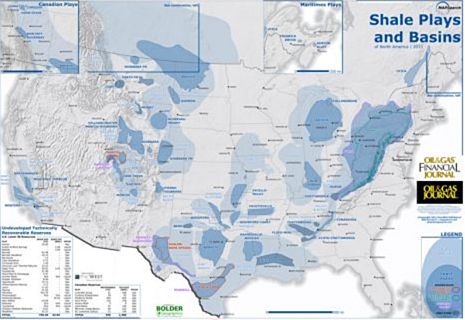
Just this week Aubrey McClendon said that Chesapeake’s prospects for oil in Ohio, where Chesapeake had high hopes for the Utica Shale, are now dim. It is easy to look at one of the large maps showing all the shale deposits in the United States that the Oil and Gas Journal include in their print editions, and to be carried away (as the IEA apparently are) with the vast acreage that is shaded on the map. Unfortunately, as we can see, reality tells another story. The size of the resources have been measured in the past, and with the best plays being given preference, the recognition of decline rates and unprofitable wells have not yet been given the prominence in the popular press that they will ultimately draw.

It seems unrealistic to anticipate the levels now being projected for future North American production of oil. Nevertheless, these projections do tend to crowd conflicting stories on the subject out of the spotlight. Further, if the predictions for American production gains, even in the short term, turn out to be optimistic, then the impacts may be even more exaggerated than is currently appreciated. Consider that OPEC now expects that North America will continue to provide the greatest y-o-y increase in supply over other nations, and there are in fact, few other nations that will contribute much more in the next year.
Stuart at Early Warning also has a post on the IEA report - IEA: US To Be World's Largest Oil Producer. Plus Energy Bulletin has a set of links to commentary too - Commentaries on the IEA WEO 2012 - peak postponed? - Nov 14.
I am less persuaded myself that using a thousand oil rigs to generate an extra one million barrels per day of oil is necessarily a sign of a large and long-term sustainable increase in US oil production (as opposed to, say, frenzied scraping of the bottom of the barrel). But, still, I'm not certain beyond a reasonable doubt just how deep this particular barrel can be scraped.

At any rate, one thing that is interesting is that the chart above shows the US second peak just reaching 10mbd of oil, and yet the US will be the largest producer of oil. Since the IEA says Saudi production is currently at 9.5mbd and Russia at 10.75mbd, the implication is that neither Russia or Saudi Arabian production will increase at all between now and 2020 when the US will surpass them.

Apparently, the strategy of massed hordes of drilling rigs fracking for shale oil can only be of benefit in the United States.

It used to be Saudi Arabia that was used to fill in the wedge between desired supply and expected demand in official energy projections. Apparently the agencies have now accepted that Saudi Arabia cannot or will not increase production and the US is now being assigned the role of supplier of last resort for future energy projections.

Statistics

Locations of visitors to this page

blogspot visitor
Stat Counter

Total Pageviews

Ads

Books

Followers

Blog Archive

Labels

australia (619) global warming (423) solar power (397) peak oil (355) renewable energy (302) electric vehicles (250) wind power (194) ocean energy (165) csp (159) solar thermal power (145) geothermal energy (144) energy storage (142) smart grids (140) oil (139) solar pv (138) tidal power (137) coal seam gas (131) nuclear power (129) china (120) lng (117) iraq (113) geothermal power (112) green buildings (110) natural gas (110) agriculture (91) oil price (80) biofuel (78) wave power (73) smart meters (72) coal (70) uk (69) electricity grid (67) energy efficiency (64) google (58) internet (50) surveillance (50) bicycle (49) big brother (49) shale gas (49) food prices (48) tesla (46) thin film solar (42) biomimicry (40) canada (40) scotland (38) ocean power (37) politics (37) shale oil (37) new zealand (35) air transport (34) algae (34) water (34) arctic ice (33) concentrating solar power (33) saudi arabia (33) queensland (32) california (31) credit crunch (31) bioplastic (30) offshore wind power (30) population (30) cogeneration (28) geoengineering (28) batteries (26) drought (26) resource wars (26) woodside (26) censorship (25) cleantech (25) bruce sterling (24) ctl (23) limits to growth (23) carbon tax (22) economics (22) exxon (22) lithium (22) buckminster fuller (21) distributed manufacturing (21) iraq oil law (21) coal to liquids (20) indonesia (20) origin energy (20) brightsource (19) rail transport (19) ultracapacitor (19) santos (18) ausra (17) collapse (17) electric bikes (17) michael klare (17) atlantis (16) cellulosic ethanol (16) iceland (16) lithium ion batteries (16) mapping (16) ucg (16) bees (15) concentrating solar thermal power (15) ethanol (15) geodynamics (15) psychology (15) al gore (14) brazil (14) bucky fuller (14) carbon emissions (14) fertiliser (14) matthew simmons (14) ambient energy (13) biodiesel (13) investment (13) kenya (13) public transport (13) big oil (12) biochar (12) chile (12) cities (12) desertec (12) internet of things (12) otec (12) texas (12) victoria (12) antarctica (11) cradle to cradle (11) energy policy (11) hybrid car (11) terra preta (11) tinfoil (11) toyota (11) amory lovins (10) fabber (10) gazprom (10) goldman sachs (10) gtl (10) severn estuary (10) volt (10) afghanistan (9) alaska (9) biomass (9) carbon trading (9) distributed generation (9) esolar (9) four day week (9) fuel cells (9) jeremy leggett (9) methane hydrates (9) pge (9) sweden (9) arrow energy (8) bolivia (8) eroei (8) fish (8) floating offshore wind power (8) guerilla gardening (8) linc energy (8) methane (8) nanosolar (8) natural gas pipelines (8) pentland firth (8) saul griffith (8) stirling engine (8) us elections (8) western australia (8) airborne wind turbines (7) bloom energy (7) boeing (7) chp (7) climategate (7) copenhagen (7) scenario planning (7) vinod khosla (7) apocaphilia (6) ceramic fuel cells (6) cigs (6) futurism (6) jatropha (6) nigeria (6) ocean acidification (6) relocalisation (6) somalia (6) t boone pickens (6) local currencies (5) space based solar power (5) varanus island (5) garbage (4) global energy grid (4) kevin kelly (4) low temperature geothermal power (4) oled (4) tim flannery (4) v2g (4) club of rome (3) norman borlaug (2) peak oil portfolio (1)