Posted
by Big Gav
in
environment,
fish
I noticed this today - it is 2 years old now but is worth having a look at if you want to be horrified at how quickly the world's fisheries are collapsing - Net losses.
Posted
by Big Gav
in
fish
Ugo at Cassandra's Legacy has a downer post about fishing in the south pacific (quoting the NYT) - Why Cassandra's task is hopeless.
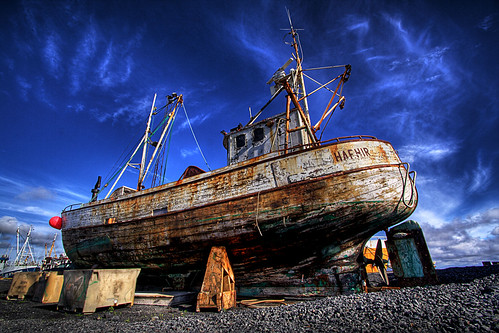
Eric Pineda, a dock agent in this old port south of Santiago, peered deep into the Achernar’s hold at a measly 10 tons of jack mackerel — the catch after four days in waters once so rich they filled the 17-meter fishing boat in a few hours.
Mr. Pineda, like everyone here, grew up with the bony, bronze-hued fish they call jurel, which roams in schools in the southern Pacific.
“It’s going fast,” he said as he looked at the 57-foot boat. “We’ve got to fish harder before it’s all gone.” Asked what he would leave his son, he shrugged: “He’ll have to find something else.”
Posted
by Big Gav
in
fish,
lake victoria,
uganda
InfranetLab has an interesting post on the changing geography (and fish-ography) of the east African lake system - Wet Borders: Microslums and Meanders.
Migingo Island, home to some 300 residents, sits precariously within Lake Victoria along the watery border of Uganda and Kenya. Its undetermined origins declare that either: a) two Kenyan fisherman settled there in 1991, or b) a Ugandan fisherman also claimed to have settled there in an abandoned house in 2004. Regardless, since that time, the place has really taken off – becoming what one journalist called a microslum. Each successive year that the level of Lake Victoria decreased, the originally rocky tip exposed greater landmass to occupy. So, complicating matters is Lake Victoria’s rapidly receding lake. But why here, why such a precious outpost?
Its all about the perch, Nile perch. Fishing in Lake Victoria, one of the largest bodies of fresh water, is essential to some of the 30 million Africans that live within its reach. Nile perch was introduced here in the 1950s and has risen to become an essential part of the economy of Lake Victoria’s fishery. (The perch was so successful in rejuvenating the fishing economy here that it decimated nearly 350 native fish species to rise to the top of the chain.) This success means that in recent years the Nile perch populations have dwindled and many native species are thought to be recovering. But really the whole Nile perch story, which in a Jared Diamond-esque way utlimately leads to weapons, is epic enough to be a film in its own right.
Fishing supports an export industry in East Africa whose value is estimated at US$250 million annually. And the convenience of Migingo Island in this tightening economy (and shrinking ecology) has placed extreme presue on the island, with Ugandan police patrolling the waters and intercepting catch from Kenyan fisherman. A claim by several locals involved in the dispute has even lobbied that the fish are Kenyan because of which side of the border they breed on. Another strange claim is that the land belongs to Kenya but the water belongs to Uganda. And the dispute continues as on the island itself Ugandans and Kenyans exist within different ‘neighborhoods’ on this tiny acre of rock.

Posted
by Big Gav
in
fish,
ocean
The Times has a report on the decimation of the world's fish population and some signs of hope for the future - Census of Marine Life brings hope of revival to the seas. The photo that accompanies this article reminded me of photos of my grandfather catching fish bigger than him in Perth's Swan River 40 years ago - nowadays I suspect there isn't a fish a quarter of that size in the whole river system.
Three hundred years ago the view from the cliffs of Cornwall would have been very different. Rather than today’s lonely fishing trawlers, the scene was dominated by the glistening bulk of blue whales. Huge schools of harbour porpoise chased shoals of fish so thick they darkened the water, while common dolphins filled the inland waters. Eighteen-foot orca menaced the mammals, while schools of blue sharks harassed fishermen who ventured out to dip their nets.
The vision may seem like the stuff of legend, but by delving into ship’s logs, ancient manuscripts, tax records, legal documents and even the devoted labours of monks living in Russia’s frozen north, an international team of researchers — part of the ten-year Census of Marine Life — has revealed the teeming abundance of life that once filled the seas not just off Britain but around the world. “We hope to be able to use this data to reverse the trend that we’ve been seeing,” Poul Holm, global chairman of the History of Marine Animal Population project, told The Times. “Lots of fish management is done using only 25-30 years of data. Using the timescales gives a much more realistic picture.”
The project’s findings reveal not only how much has been lost, but how far the sea can be expected to rebound, if given a chance. It is hoped that, by providing an accurate vision of Cornwall’s past productivity, the public and policymakers can be motivated to help its recovery. “History is a powerful motivator,” Professor Holm said.
The results of other investigations — which will be shared at a conference in Vancouver this week — show that rampant whaling left the waters off New Zealand with an estimated 25 southern right whales by 1925.
Although populations have risen to more than 1,000 whales, in the early 1800s those waters supported about 27,000. “Eighty-five to ninety per cent of the biomass has been removed. These are significant changes with big implications for ecosystem functioning,” Professor Holm said.
Size as well as abundance has been affected. Using records of trophy catches in Key West, Florida, researchers from the Scripps Institution of Oceanography showed that between 1956 and 2007 the average weight of fish fell from about 20kg to 2.3kg and that their average length shrank from nearly 2m to 35cm.
“The worst part of these ‘shifting environmental baselines’ is that we have come to accept the degraded condition of the sea as normal,” Callum Roberts, author of The Unnatural History of the Sea, said. “We cannot return the oceans to some primordial condition absent of human influence, but it is in everyone’s interest to recover some of the lost abundance of creatures in the sea.”
Experts are encouraged by the knowledge that the sea can return to former levels of productivity. The connectivity of the oceans means that is difficult to drive marine animals to extinction. Several rebounds are recorded, most notably during the world wars when it was too dangerous for fishing fleets to operate in the North Sea. Between 1914 and 1918 stocks trebled. A similar rebound occurred after the Second World War, although the bounty was quickly retaken.
“We now have long-term evidence that catches can be three or four times their current level,” Ron O’Dor, chief scientist of the Census of Marine Life, said. “The oceans will sustain that.” The time that the ocean would require to recover depends on how much protection is afforded. “It’s not about shutting down fisheries but about letting the ecosystem, with its shelter, structure and nurseries, rebound,” Dr O’Dor said.

Posted
by Big Gav
in
fish,
fishing,
ocean
GOOD Magazine has a look at the world's dwindling fish stocks - Fin: The Last Days of Fish.
The first to suffer were the fishermen of Newfoundland, who saw their industry collapse in the early 1990s. Later it was the fishing communities further south, along the Gulf of Maine. Fishermen of the southern Cape, like Ligenza, could still find enough cod even five or six years ago to make a decent living, but that, too, has changed. Today, cod populations in the Georges Bank, off Cape Cod, hover near the brink, at levels 10 percent of what scientists consider healthy. Large areas of the Bank are losed entirely to groundfishing.
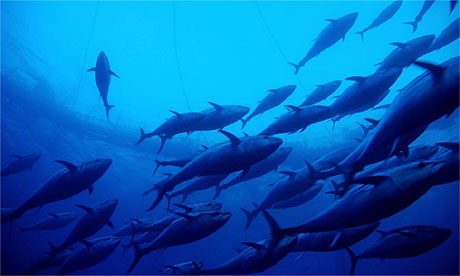
By now, the collapse is a well-known story in New England, chronicled in books like Mark Kurlansky’s Cod and in newspaper accounts of riotous fishery meetings and bank foreclosures in port towns. But it is only part of the story. Less appreciated is what else is missing from the New England coast. The number of overfished or threatened species makes for a sobering list: Atlantic halibut, yellowtail flounder, haddock, wolffish, river herring, Atlantic salmon. Shark populations in the North Atlantic have dropped by half since 1986, in the same time that bluefin tuna, which once swept past the Cape in schools a hundred thick, have been brought near commercial collapse. The astonishing fecundity of the New England coast has been reduced to a memory—one that haunts a generation of fishermen. In Harwich, on the Cape, a fisherman points me to a map of the coastal channels he once fished and covers it with a big, callused hand. “You can’t find anything there anymore,” he says.
What has transpired off the shores of Cape Cod is not unique. The same has occurred on coasts throughout the world. In 1988, at the peak of the output of the world’s fisheries, boats around the globe landed something on the order of 80 million tons of fish. Since then, depending upon which numbers you believe, the world’s annual catch has either plateaued or fallen by as much as 500,000 tons a year.
The rise of industrial fishing in the latter half of the 20th century, coupled with a growing world population, has overmatched the ocean’s supply. And while the history of New England fishing might seem a stark example—and it is—American fisheries are actually among the most enlightened in the world (though that is not saying much), with stringent management plans and some notable fish recoveries. In Europe, by contrast, nearly half of fish stocks are considered seriously depleted, and the North Sea has become a relatively barren body of water (to fill their nets, the “distant water” fleets of Europe now sail the west coast of Africa). And while fish stocks dwindle worldwide, an estimated 90 percent of large predatory fish—tuna, swordfish, cod, halibut—have disappeared since the mid-20th century. One study, published almost two years ago in Science, predicted a worldwide collapse of commercial fish stocks in just 40 years, if the present pace of fishing continues.
The demise of commercial fishing is beyond the limits of even our darkest environmental imaginations. And yet the evidence of the ocean’s diminishment is everywhere. Leaving aside the legitimate concerns of conservationists, the possibility of a broad fish collapse is harrowing for other reasons. At a time when we are mired in a global food crisis, nearly 1.5 billion people depend upon the sea as a source of food or income. The destabilizing effect of such a collapse would be tremendous, bringing communities and countries into conflict over a resource we once considered boundless. It is fair to say that the endgame has begun.
Posted
by Big Gav
in
fish,
george monbiot,
george orwell
George Monbiot has been complaining about over-fishing and the impact of fish deficient diets on mental health for some time - his latest installment looks at the case of Senegal - Rich countries once used gunboats to seize food. Now they use trade deals.
In his book Late Victorian Holocausts, Mike Davis tells the story of the famines that sucked the guts out of India in the 1870s. The hunger began when a drought, caused by El Niño, killed the crops on the Deccan plateau. As starvation bit, the viceroy, Lord Lytton, oversaw the export to England of a record 6.4m hundredweight of wheat. While Lytton lived in imperial splendour and commissioned, among other extravagances, "the most colossal and expensive meal in world history", between 12 million and 29 million people died. Only Stalin manufactured a comparable hunger.
Now a new Lord Lytton is seeking to engineer another brutal food grab. As Tony Blair's favoured courtier, Peter Mandelson often created the impression that he would do anything to please his master. Today he is the European trade commissioner. From his sumptuous offices in Brussels and Strasbourg, he hopes to impose a treaty that will permit Europe to snatch food from the mouths of some of the world's poorest people.
Seventy per cent of the protein eaten by the people of Senegal comes from fish. Traditionally cheaper than other animal products, it sustains a population that ranks close to the bottom of the human development index. One in six of the working population is employed in the fishing industry; about two-thirds of these workers are women. Over the past three decades, their means of subsistence has started to collapse as other nations have plundered Senegal's stocks.
The EU has two big fish problems. One is that, partly as a result of its failure to manage them properly, its own fisheries can no longer meet European demand. The other is that its governments won't confront their fishing lobbies and decommission all the surplus boats. The EU has tried to solve both problems by sending its fishermen to west Africa. Since 1979 it has struck agreements with the government of Senegal, granting our fleets access to its waters. As a result, Senegal's marine ecosystem has started to go the same way as ours. Between 1994 and 2005, the weight of fish taken from the country's waters fell from 95,000 tonnes to 45,000 tonnes. Muscled out by European trawlers, the indigenous fishery is crumpling: the number of boats run by local people has fallen by 48% since 1997. ...
This is one instance of the food colonialism that is again coming to govern the relations between rich and poor counties. As global food supplies tighten, rich consumers are pushed into competition with the hungry. Last week the environmental group WWF published a report on the UK's indirect consumption of water, purchased in the form of food. We buy much of our rice and cotton, for example, from the Indus valley, which contains most of Pakistan's best farmland. To meet the demand for exports, the valley's aquifers are being pumped out faster than they can be recharged. At the same time, rain and snow in the Himalayan headwaters have decreased, probably as a result of climate change. In some places, salt and other crop poisons are being drawn through the diminishing water table, knocking out farmland for good. The crops we buy are, for the most part, freely traded, but the unaccounted costs all accrue to Pakistan.
Now we learn that Middle Eastern countries, led by Saudi Arabia, are securing their future food supplies by trying to buy land in poorer nations. The Financial Times reports that Saudi Arabia wants to set up a series of farms abroad, each of which could exceed 100,000 hectares. Their produce would not be traded: it would be shipped directly to the owners. The FT, which usually agitates for the sale of everything, frets over "the nightmare scenario of crops being transported out of fortified farms as hungry locals look on". Through "secretive bilateral agreements", the paper reports, "the investors hope to be able to bypass any potential trade restriction that the host country might impose during a crisis".
Both Ethiopia and Sudan have offered the oil states hundreds of thousands of hectares. This is easy for the corrupt governments of these countries: in Ethiopia the state claims to own most of the land; in Sudan an envelope passed across the right desk magically transforms other people's property into foreign exchange. But 5.6 million Sudanese and 10 million Ethiopians are currently in need of food aid. The deals their governments propose can only exacerbate such famines.
None of this is to suggest that the poor nations should not sell food to the rich. To escape from famine, countries must enhance their purchasing power. This often means selling farm products, and increasing their value by processing them locally. But there is nothing fair about the deals I have described. Where once they used gunboats and sepoys, the rich nations now use chequebooks and lawyers to seize food from the hungry. The scramble for resources has begun, but - in the short term, at any rate - we will hardly notice. The rich world's governments will protect themselves from the political cost of shortages, even if it means that other people must starve.

Another George from the left, George Orwell, has recently taken up blogging. This is quite a feat given that he has been dead for some time, so the people trying to keep his memory alive are using his old diary entries -
The Orwell Diaries.
Posted
by Big Gav
in
fish
The Observer has one of those sorry tales about over-fishing that appear in the press from time to time - How the world's oceans are running out of fish.

The future of our seas has never been more precarious. Ninety years of industrial-scale overfishing has brought us to the brink of an ecological catastrophe and deprived millions of their livelihoods.
It is early morning in Barcelona's La Boqueria market and the fish stallholders are setting out their wares. Mounds of pink and grey glisten down the dim alleys - shoppers and tourists peering at the fins and tentacles. It is not like any fish shop in Britain - some stalls sell five different species of squid and cuttlefish, half a dozen types of shrimp and prawn, 10 different cuts of salt cod. It is a fish eater's haven in the heart of a city that eats and sells more fish than anywhere else in Europe.
Anyone who cares about where their fish come from - and this should mean anyone who wants to go on eating them - should take two tools when they visit the fishmonger. One is the handy guidance provided by the Marine Conservation Society, Fish to Avoid and Fish to Eat (the latter is still the longer); the other is a ruler. My ruler is the type handed out to commercial fishermen by the international advisory body, Incofish, and has pictures of key species with marks indicating when they can be considered mature (and, thus, OK to catch).
So I set about lining up my ruler against the La Boqueria fish, starting with the mackerel (should be 34cm), the plaice (39cm) and the redfish (45cm). All turn out to be mere babies. The mackerel is half the designated length. A glance around the stalls shows 10 or more species on the MCS's Avoid list, including hake, swordfish, monkfish, bluefin tuna and, of course, cod.
I don't spend much time doing this because the Catalan fishmongers don't like my ruler - or me. They don't want to talk about why they are selling tiny hake (one of Europe's most endangered species) and why not a single fish in the market has any 'sustainable' labelling.
One old lady asks me what I'm after. 'I want to know why the Spanish are eating so many undersized fish from populations that are running out,' I say. 'It's simple,' she says. 'We like fish and small fish taste better.'
Is anyone not aware that wild fish are in deep trouble? That three-quarters of commercially caught species are over-exploited or exploited to their maximum? Do they not know that industrial fishing is so inefficient that a third of the catch, some 32 million tonnes a year, is thrown away? For every ocean prawn you eat, fish weighing 10-20 times as much have been thrown overboard. These figures all come from the United Nations Food and Agriculture Organisation (FAO), which also claims that, of all the world's natural resources, fish are being depleted the fastest. With even the most abundant commercial species, we eat smaller and smaller fish every year - we eat the babies before they can breed.
Callum Roberts, professor of marine conservation at York University, predicts that by 2050 we will only be able to meet the fish protein needs of half the world population: all that will be left for the unlucky half may be, as he puts it, 'jellyfish and slime'. Ninety years of industrial-scale exploitation of fish has, he and most scientists agree, led to 'ecological meltdown'. Whole biological food chains have been destroyed.
Many of those fish you can see in such glorious abundance in Spanish markets - and on our own supermarket shelves - come not from European seas but from the coasts of the continents of the poor: Africa, South America and parts of Asia. Fishermen have always roamed far afield - the Basques began fishing the great cod populations off Newfoundland at least 500 years ago. And when serious shortages in traditional stocks around Europe began to be commercially apparent 30 years ago, the trawler fleets began to move south.
Strangely one of the first international attempts to conserve fish stocks, especially for the more easily exploited nations, also became part of the disaster. The United Nations Convention on Law of the Sea, signed in 1979, extended national rights over fisheries to 200 miles from a country's coasts. But it included a provision that, if fish stocks in that zone were surplus to national needs, the country could sell its rights to outsiders. That convention allowed cash-strapped and sometimes corrupt countries in west Africa to raise funds by letting the industrial trawler fleets in. Since 1979 the EU has negotiated deals on fishing rights with a string of impoverished African countries. Despite the EU's own studies indicating massive and quite possibly irreversible damage to fish stocks off west Africa, these deals continue to be struck.
In 2002, the year an EU report revealed that the Senegalese fish biomass had declined 75 per cent in 15 years, Brussels bought rights for four years' fishing of tuna and bottom-dwelling fish on the Senegal coasts, for just $4m a year. In 2006, access for 43 giant EU factory fishing vessels to Mauritania's long coastline was bought for £24.3m a year. It's estimated that these deals have put 400,000 west African fishermen out of work; some of them now take to the sea only as ferrymen for desperate would-be migrants to the Canary Islands and Europe. And among the millions of Africans who depend on fish as their main source of protein, consumption has declined from 9kg per year to 7kg.
North Atlantic fish stocks have been in decline for well over a century. Callum Roberts points out in his recent book The Unnatural History of the Sea that it was obvious from the 1880s that fish stocks were in decline. Fish catch records from the 1920s onwards show that, despite the enormous improvements in boat design and trawling technology and better refrigeration, catches of the great Atlantic species, such as haddock, cod, hake and turbot, remained constant or slowly declined. As they have ever since.
Unlike global warming, the science of fish stock collapse is old and its practitioners have been pretty much in agreement since the 1950s. Yet Roberts can think of only one international agreement that has actually worked and preserved stocks of an exploited marine animal - a deal in the Arctic in 1911 to regulate the hunting of fur seals on the Pribilof Islands. So why has the international community failed so badly in its attempts to stop the long-heralded disaster with our fish?
'Quite simply,' Roberts says, 'agreements and deals brokered by politicians will never be satisfactory. They always look for the short-term fix.' ...
The Newfoundland cod fishery, for 500 years the world's greatest, was exhausted and closed in 1992, and there's still no evidence of any return of the fish. Once stocks dip below a certain critical level, the scientists believe, they can never recover because the entire eco-system has changed. The question is whether, after 50 years of vacillation and denial, there's any prospect of the politicians acting decisively now. 'It is awful and we are on the road to disaster,' says Tudela. 'But the collapse - in some, not all the situations - is still reversible. And it's worth trying.'
Posted
by Big Gav
in
fish,
garbage,
pacific ocean,
rubbish
TreeHugger has a post on the gigantic meal of rubbish soup being prepared by eddies in the Pacific ocean - slowly collecting the vast torrents of rubbish we discard. Luckily it isn't all wasted - fish eat some of it, then we eat them...
Deep Sea News' Kevin Zilnio points us to a great piece in The Independent describing what has become known as the "Great Pacific Garbage Patch," or "trash vortex" - essentially a floating expanse of waste and debris in the Pacific Ocean now covering an area twice the size of the continental U.S. Believed to hold almost 100m tons of flotsam, this vast "plastic soup" stretches 500 nautical miles off the Californian coast, past Hawaii and almost as far as Japan:
"The "soup" is actually two linked areas, either side of the islands of Hawaii, known as the Western and Eastern Pacific Garbage Patches. About one-fifth of the junk – which includes everything from footballs and kayaks to Lego blocks and carrier bags – is thrown off ships or oil platforms. The rest comes from land."
David Karl, an oceanographer at the University of Hawaii, believes the "plastic soup" may actually represent a new habitat; he plans on organizing a research expedition later this year to examine its size and nature. Plastic waste is one of the most significant sources of marine pollution: According to UNEP, plastic accounts for 90% of all debris floating in the oceans - with every square mile containing close to 46,000 pieces.
The pernicious effects of this "trash vortex" aren't just limited to the marine ecosystem either. Every year, hundreds of millions of nurdles, tiny pieces of plastic, are dumped into or lost at sea, where they eventually make their way into the food chain by acting as sponges for a variety of anthropogenic chemicals (e.g. hydrocarbons and DDT).
Marcus Eriksen, research director of the Algalita Marine Research Foundation, put is thusly: "What goes into the ocean goes into these animals and onto your dinner plate. It's that simple."


 Posts
Posts