I’m thrilled to announce that in 2017 Google will reach 100% renewable energy for our global operations — including both our data centers and offices. This is a huge milestone. We were one of the first corporations to create large-scale, long-term contracts to buy renewable energy directly; we signed our first agreement to purchase all the electricity from a 114-megawatt wind farm in Iowa, in 2010. Today, we are the world’s largest corporate buyer of renewable power, with commitments reaching 2.6 gigawatts (2,600 megawatts) of wind and solar energy. That’s bigger than many large utilities and more than twice as much as the 1.21 gigawatts it took to send Marty McFly back in time. ...
Over the last six years, the cost of wind and solar came down 60 percent and 80 percent, respectively, proving that renewables are increasingly becoming the lowest cost option. Electricity costs are one of the largest components of our operating expenses at our data centers, and having a long-term stable cost of renewable power provides protection against price swings in energy.
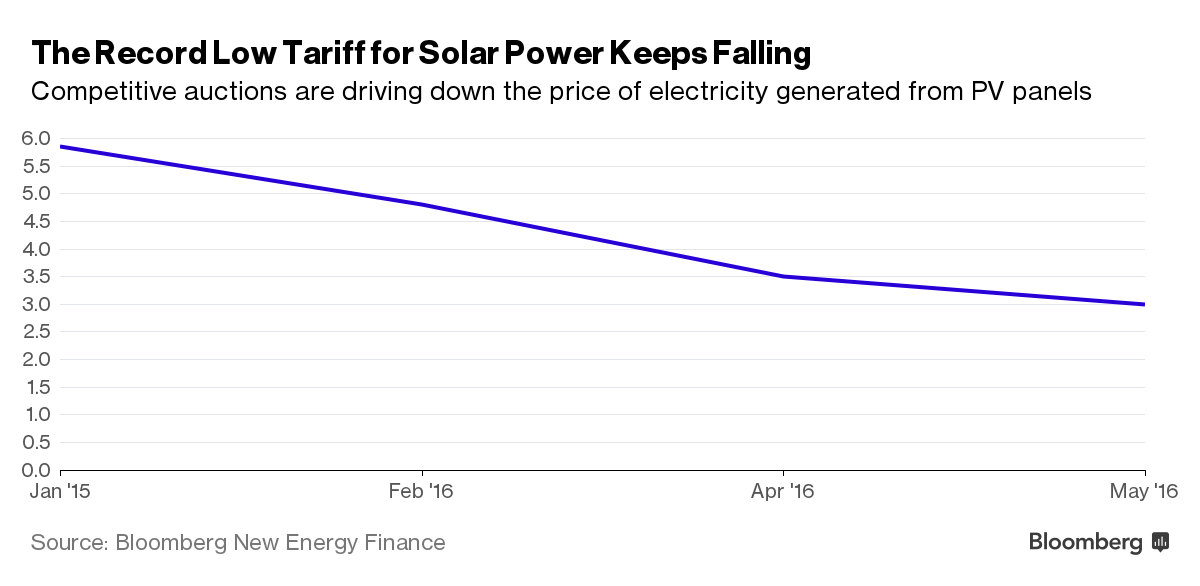
Bloomberg reports that the developers bid as little as 2.99 cents a kilowatt-hour to develop 800 MW of solar power projects for the Dubai utility company - 15% below than the previous record set in Mexico. The lowest priced solar power has plunged around 50% in the past year - New Record Set for World's Cheapest Solar, Now Undercutting Coal.
Makani is working to accelerate the shift to clean, renewable energy by developing energy kites, a new type of wind turbine that uses lightweight electronics, advanced materials, and smart software to generate more energy with less materials—all at lower cost.
Kevin seems to have a love-hate relationship with Google, also pointing to this piece of investigative journalism on Medium - How the CIA made Google.
INSURGE INTELLIGENCE, a new crowd-funded investigative journalism project, breaks the exclusive story of how the United States intelligence community funded, nurtured and incubated Google as part of a drive to dominate the world through control of information. Seed-funded by the NSA and CIA, Google was merely the first among a plethora of private sector start-ups co-opted by US intelligence to retain ‘information superiority.’
The origins of this ingenious strategy trace back to a secret Pentagon-sponsored group, that for the last two decades has functioned as a bridge between the US government and elites across the business, industry, finance, corporate, and media sectors. The group has allowed some of the most powerful special interests in corporate America to systematically circumvent democratic accountability and the rule of law to influence government policies, as well as public opinion in the US and around the world. The results have been catastrophic: NSA mass surveillance, a permanent state of global war, and a new initiative to transform the US military into Skynet.
US tech giant Google has signed up for its 17th renewable energy project, to put $145 million towards an 82 megawatt solar project being built by SunEdison on a former oil and gas field. The deal, announced last week, puts the internet search company’s clean energy investment tab at more than $1.5 billion, for projects spanning three continents and totalling a capacity of more than 2.5GW.
This latest, the “Regulus” solar project in Google’s home state of California, will be SunEdison’s largest in North America once finished, comprising more than 248,000 monocrystalline solar PV panels spanning 737 acres.Solar-google-logo “Over the years, this particular site in California has gone from 30 oil wells to five as it was exhausted of profitable fossil fuel reserves,” writes Google’s renewable energy principal Nick Coons on Google’s blog. “The land sat for some time and today we’re ready to spiff things up.”
2011: Google announces an end to RE less than C, citing cost drops in solar PV
After four years of experimentation in CSP and EGS, Google finally decided to end its ambitious RE less than C initiative. Some in the press wrongly reported that Google had "abandoned" renewable energy. Instead, the company cited the steady cost drops in photovoltaics, saying that it would rather focus on project financing rather than R&D.
Shortly after announcing the end to RE less than C, Google dropped more than $350 million into funds for solar service companies Clean Power Finance and SolarCity. And in the subsequent years, it has scaled its project financing from $580 million to more than $1 billion.
Spring 2010 to present: Google expands its investment bonanza
Since arming itself with the ability to act like a utility and phasing out its R&D efforts, Google has supported fourteen projects worth more than 2 gigawatts of capacity.
GTM's Herman Trabish assembled a list of some of the top plays Google made in one year alone:
$75 million in a fund operated by Clean Power Finance (CPF) that will finance 3,000 rooftop solar home installations
$280 million in a fund operated by SolarCity that will extend that company’s lease program to some 8,000 new system owners
$168 million in BrightSource Energy’s Mojave Desert utility-scale CSP solar power tower facility that will supply 392 megawatts of electricity to California power suppliers SCE and PG&E (following an initial $10 million investment in the company itself)
37.5 percent early equity stake in the Atlantic Wind Connection, a transmission backbone that will ultimately cost approximately $5 billion and deliver 7,000 megawatts of offshore wind-generated electricity from a 2,000-megawatt-capacity, high-voltage, direct-current, 250-mile transmission path between southern Virginia and northern New Jersey
$157 million in 270 megawatts of wind being built at the Alta Wind Center in Southern California’s Tehachapi Mountains
$100 million in the 845-megawatt Shepherd’s Flat project in Oregon, the biggest on-land wind farm in the world
$38.8 million in two North Dakota wind farms with a total capacity of 169.5 megawatts, the first production tax credit deal done after the 2008 economic crash
€3.5 million (~$5 million) for 49 percent of an 18.65-megawatt PV solar installation in Brandenburg, Germany
This list will likely get quite a bit longer in the coming years. As Kojo Ako-Asare, head of corporate finance for Google, wrote on the company's blog yesterday, the tech giant has every intention of becoming a renewable energy giant.
"You’d think the thrill might wear off this whole renewable energy investing thing after a while. Nope -- we’re still as into it as ever," wrote Ako-Asare.
According to the San Francisco CBS affiliate KPIX, Google will actually use the barge as a party space and an upscale showroom for the company's Google X projects. Google has yet to comment on the mysterious barge, but KPIX cites "multiple sources" familiar with the matter.
As CNET reported Friday, it looks very much like Google has been building a floating data center made from shipping containers on a barge in the middle of San Francisco Bay. But it may not be the only one of its kind.
Google has not responded to multiple requests for comment. But the project in San Francisco Bay appears likely to be the manifestation of a 2009 patent for a "water-based data center," and would likely leverage the fact that wave energy can provide cheap and plentiful power.
Now it seems as though Google may well have built a sister version of the project, and, according to the Portland Press Herald, it recently showed up in the harbor in Portland, Maine.
CNet has an article speculating Google is building a floating data centre - possibly powered using wave power (which seems cool but unlikely - though I guess if you couple it with solar and energy storage it might be feasible) - Is Google building a hulking floating data center in SF Bay?.
Something big and mysterious is rising from a floating barge at the end of Treasure Island, a former Navy base in the middle of San Francisco Bay. And Google's fingerprints are all over it.
It's unclear what's inside the structure, which stands about four stories high and was made with a series of modern cargo containers. The same goes for when it will be unveiled, but the big tease has already begun. Locals refer to it as the secret project.
Google did not respond to multiple requests for comment. But after going through lease agreements, tracking a contact tied to the project on LinkedIn, talking to locals on Treasure Island, and consulting with experts, it's all but certain that Google is the entity that is building the massive structure that's in plain sight, but behind tight security.
Could the structure be a sea-faring data center? One expert who was shown pictures of the structure thinks so, especially because being on a barge provides easy access to a source of cooling, as well as an inexpensive source of power -- the sea. And even more tellingly, Google was granted a patent in 2009 for a floating data center, and putting data centers inside shipping containers is already a well-established practice.
Google is known for putting its resources into some novel technologies like self-driving cars and wearable computing devices. Now, the Web giant is moving into yet another field—wind power.
After previously investing in the company, Google has agreed to acquire Alameda, Calif.-based green energy startup Makani Power. ...
Makani, which takes its name from the Hawaiian word for breeze, develops airborne wind turbines that are mounted on self-piloting flying wings tethered to the ground like a kite. Google will bring the Makani team into its secret "moonshot" research lab Google X, which produced Google Glass. "This formalizes a long and productive relationship between our two companies, and will provide Makani with the resources to accelerate our work to make wind energy cost competitive with fossil fuels.
In a statement to PCMag on Thursday, Google confirmed the acquisition and said it's eager to bring Makani on board. "Creating clean energy is one of the most pressing issues facing the world, and Google for years has been interested in helping to solve this problem," Google X Director Astro Teller, said in the statement. "Makani Power's technology has opened the door to a radical new approach to wind energy. They've turned a technology that today involves hundreds of tons of steel and precious open space into a problem that can be solved with really intelligent software. We're looking forward to bringing them into Google[x]."
Makani said the timing of the acquisition "couldn't be better" since its so-called Wing 7 kite-power prototype just completed its first ever fully autonomous flight. The startup has said its wing-shaped high-altitude kite design can produce 10 times more energy than conventional turbines.
Renewable Energy Cheaper than Coal —This initiative was developed as an effort to drive down the cost of renewable energy, with an RE < C engineering team focused on researching improvements to solar power technology. At this point, other institutions are better positioned than Google to take this research to the next level. So we’ve published our results to help others in the field continue to advance the state of power tower technology, and we’ve closed our efforts. We will continue our work to generate cleaner, more efficient energy—including our on-campus efforts, procuring renewable energy for our data centers, making our data centers even more efficient and investing more than $850 million in renewable energy technologies.
Announced in 2007 by Google, RE < C was focused on driving down the cost of renewable electricity (mostly solar and geothermal) to meet the cost of generating electricity from coal. The initiative funded R&D in capital-intensive, early-stage technologies that would enable cheaper Enhanced Geothermal Systems and Concentrating Solar Power projects.
But Google says it’s now shifting its focus to project financing rather than R&D, citing the need for more sophisticated research on CSP technologies beyond Google’s scope, and the rapidly changing economics of solar PV:
Over the last few years, we’ve seen a lot of progress in clean energy. We’re excited that some technologies are so quickly approaching cost competitiveness with traditional forms of energy in parts of the US and the world. Power tower technology has come a long way, too. But the installed cost of solar photovoltaic technology has declined dramatically over the past few years, making solar photovoltaic technology a compelling choice for consumers.
At this point, other institutions are better positioned than Google to take this research to the next level. So we’ve published our results to help others in the field continue to advance the state of power tower technology, and we’ve closed our efforts. We will continue our work to generate cleaner, more efficient energy—including our on-campus efforts, procuring renewable energy for our data centers, making our data centers even more efficient and investing more than $850 million in renewable energy technologies.
Although the news was hidden at the bottom of a blog post, this is a pretty important announcement. (Only at Google would they casually “spring clean” millions of dollars in R&D investments for renewable energy).
Firstly, it shows how capital intensive many of these technologies are. Google invested tens of millions of dollars into R&D for new methods of building CSP plants. Today, we’ve got a number of commercial projects deployed using some of the technologies and methods funded by Google — but even after investing all that money, much of the research is still in the early phases, the company says.
The same goes for Google’s funding of Potter Drilling, a company working on developing a technique for drilling through deep, hard rock called “thermal spallation.” The drill is designed for Enhanced Geothermal projects. Potter has been working on the technique since 2004, with Google investing over $10 million in the company through its RE < C initiative in 2008. But like most development in the EGS sector, progress has been slow and the drill has not been commercialized yet.
Google’s shift away from these projects doesn’t prove whether or not they’ll be successful. It just shows how much money and time goes into bringing new energy technologies to scale.
Meanwhile, the stunning changes in the economics of solar PV have made market conditions far different today than in 2007. Google has since invested more than $350 million into the deployment of distributed solar, investing in SolarCity and Clean Power Finance, and a variety of projects in Germany. (Google also threw $168 million behind the Ivahpah CSP project, showing that it still has a lot of confidence in that technology too).
Back in 2008, Frank wrote about how Google.org was using Google Earth to visualize Geothermal Data in the United States.
Google has continued to increase the amount of data behind the map, making it a more and more powerful tool as times goes on. ...
To see this data for yourself in Google Earth, simply load this KMZ file (which was last updated just a few days ago). Also worth your time is this short article in Forbes that talks a bit more about how EGS could benefit all of us.
Google is the first major Web company to reveal exactly how much energy it uses—information that will help researchers and policy makers understand how the massive explosion of Internet usage and cloud computing is contributing to global energy consumption.
Google uses 260 million watts continuously across the globe, the company reported on Wednesday. This is equivalent to the power used by all the homes in Richmond, Virginia, or Irvine, California (around 200,000 homes), and roughly a quarter of the output of a standard nuclear power plant.
By far, the majority of Google's energy use is associated with its data centers, according to Jonathan Koomey, a professor at Stanford University and a researcher who focuses on energy and IT. He says that 80 to 90 percent of those watts are used solely by the company's data centers, based on estimates he made of Google's power use in an August 2011 report. Most of this energy is used in powering the IT equipment in Google's data centers. Google custom builds many data centers, such as a new one in Finland that uses a seawater cooling system, to cut down on electricity costs.
This has enabled Google to be relatively energy efficient, says Koomey, who estimates that the company owns about 3 percent of servers worldwide and uses only 1 percent of electricity for data centers worldwide. "They're operating more efficiently than other data centers," he says.
Other Web giants, including Amazon and Facebook, probably operate their data centers with similar efficiency due to hardware and software customization, and innovative cooling equipment, Koomey says. However, the majority of data center power use comes from non-IT companies running their own data centers less efficiently [which is in turn, far less than that used by equipment in homes and offices].
In its report, Google compares the energy usage of companies' in-house computer systems to the energy used by its cloud servers. It estimates that running Gmail instead of an in-house e-mail system can be almost 80 times more energy efficient. Google says that 25 percent of its energy was supplied by renewable fuels—such as from wind farms—in 2011, and plans to increase that to 30 percent this year.
Google officially shuttered its web energy tool PowerMeter Friday after the application failed to bring in enough users. For those who have watched PowerMeter’s slow slog over its two-year lifespan, the move to kill it isn’t all that shocking. But the application, which enabled people to monitor and manage their home energy consumption, does have an important legacy as one of the first examples of how the Internet and broadband will change the way people consume energy.
Here are some of the reasons why I think PowerMeter didn’t take off:
1. It’s early. The market for energy management tools is still in a really early stage. Consumers are largely unaware of the tools and technologies available to monitor and manage their own energy. The Consumer Electronics Association found that 64 percent of consumers are unaware of electricity management programs, and 66 percent of consumers aren’t familiar with the smart grid. Google launched its PowerMeter tool in early 2009, when very few smart meters and smart grid network deployments had been installed in the U.S.
2. Opt-in, not opt-out. In this early stage of the market, it seems like programs that are opt-out (sent unless the customer says they don’t want it), not opt-in (only sent if the customer wants it), are the ones working. OPower has been successful largely because it connected with utilities early on, and OPower’s detailed energy bills and energy savings recommendations, are delivered to utility customers automatically. A utility is one of a few types of companies that can send its customers this type of information without getting an opt-in agreement, and the mailed OPower energy bills have a very high open rate, because they look just like a utility energy bill. ...
3. Utility friend or foe? Since Google first launched PowerMeter, some utilities saw the tool as a threat to the relationship they have with their customers. … At the same time, when Google first launched PowerMeter, it focused on connecting with data from smart meters, then later opened its API and connected with gadget makers to circumvent smart meters. Smart meters were in a very early stage then (and relatively still are), and are the end devices for utilities (utilities are behind their installments). …
4. Direct to consumer. Perhaps Google would have been better served if it created PowerMeter to go directly to the consumer originally, but did it in its own algorithm-focused way. Earth Aid, for example, uses algorithms to take utility data straight from an online utility account if the consumer gives Earth Aid permission to link that account to its system, and Earth Aid doesn’t need utility partnerships. …
5. Google isn’t an energy company. Google didn’t ever really market PowerMeter, and PowerMeter came out of its philanthropic arm Google.org. It was an experiment, and one that didn’t work. Despite the amount of funding Google has been putting into clean power, Google isn’t an energy supplier or manager at heart. ...
The charging stations, via Coulomb Technologies’ ChargePoint Network, are used by employee-owned electric vehicles, as well as the company’s growing car sharing program that includes Chevrolet Volts and Nissan LEAFs. The company has additional plans for 250 more charging stations on its campus, and a goal to make five percent of its campus parking EV-ready, making it the largest workplace charging installation for electric vehicles in the United States.
Rolf Schreiber, Google’s technical program manager of Electric Transportation, explains, “By investing in new, green transportation technologies, Google is making a significant contribution to reducing our own greenhouse gas emissions. Our EVs and charging stations are part of our broader green transportation system that includes biodiesel shuttles that Googlers use to commute to work instead of driving their own cars. But we’re only one company among many, so we hope our green transportation initiatives serve as a model for other companies to incorporate sustainability programs into their own workplaces."
ChargePoint Network has the world’s largest network of charging stations and EV charging applications, which have a number of available features. Controlled access, for example, enables customers—via an online portal and smartcards—to control who accesses their charging stations in order to control costs, eliminate electricity theft, and optimize station use.
As part of the Green Highway project where California, Oregon and Washington are partnering to turn Interstate 5 into the first alternative-fuel-friendly freeway in the U.S., AeroVironment is installing Level 3 EV quick chargers along the route in Southern Oregon.
For this first phase of the project, from the California state line to the Willamette Valley, 150 miles of the highway will have convenient access to EV chargers that can fully charge a battery in 30 minutes. Eight interchanges will be picked based on common destinations, vehicle range and driving distances. The chargers will be installed by the end of the fall.
The Green Highway will ultimately run from San Diego to Vancouver, B.C. and will feature not only EV charging and battery swap stations, but alternative fuel filling stations for biodiesel, compressed natural gas and hydrogen. The project is being funded by the American Recovery and Reinvestment Act.
We recently invested approximately $100 million in the Shepherds Flat Wind Farm, anticipated to be the largest wind farm in the world. Shepherds Flat is currently under construction near windy Arlington, Ore., and when completed in 2012 will produce 845 MW of energy. That’s a lot of wind—enough to power more than 235,000 homes.
This project is exciting to us not only because of its size and scale, but also because it uses advanced technology. This will be the first commercial wind farm in the U.S. to deploy, at scale, turbines that use permanent magnet generators—tech-speak for evolutionary turbine technology that will improve efficiency, reliability and grid connection capabilities. Though the technology has been installed outside the U.S., it’s an important, incremental step in lowering the cost of wind energy over the long term in the U.S.
Shepherds Flat will help Oregon continue to be one of the top wind producing states in the nation, while providing significant direct economic benefits to the state. The project will also benefit the region by helping California meet its aggressive renewable energy goals with a cost-effective and clean wind resource. The electricity produced at Shepherds Flat will be sold under long term agreements to Southern California Edison. ...
This project brings our total invested in clean energy to more than $350 million, including our most recent investments in a German solar photovoltaic plant and in the BrightSource Ivanpah solar power tower—the largest solar energy project in the world. We’re excited about helping deliver clean energy to the grid and we hope this latest investment encourages other companies to think about ways they can help accelerate the deployment of more renewable energy. We remain on the lookout for more projects that make business sense and will help all of us take advantage of clean, renewable energy.
Google’s investments in clean power are now rivaling that of stand alone clean energy investors. Monday morning, the search engine giant said it has invested $100 million in the world’s largest wind farm, the 845 MW Shepherds Flat project under construction in Oregon. With this investment, Google has put more than $350 million (a jaw-dropping amount for an Internet company) into clean power.
The investment in the Shepherds Flat project follows on a $168 million investment announced last week into a solar thermal project being built by startup BrightSource Energy in California’s Mojave Desert, as well as a planned $38.8 million investment into 169.5 MW worth of wind projects developed by NextEra Energy Resources in North Dakota, and a €3.5 million ($5 million USD) investment in a solar photovoltaic farm in Brandenburg an der Havel, Germany, which is near Berlin. In addition to its investments, Google’s subsidiary Google Energy — which can buy and sell electricity on the wholesale markets — plans to buy 114 MW of wind power from an Iowa wind farm owned by NextEra Energy resources.
Google's plowing $100 million into what will be the world's largest wind farm, Shepherds Flat, near Arlington, Oregon. It follows a $168 million investment in Brightsource's Ivanpah solar plant in the Mojave and brings the Mountain View company's total investments in green tech projects to over $350 million.
There are two fascinating things about Google's recent moves. First, this is money for deployment. It's project finance, not R&D. Other big tech companies like LG and Samsung have announced massive investments in green tech research, but Google is putting money to get real projects off the ground. Second, this money comes from Google, Inc, not Google.org under the RE < C program. Google expects to make money on the big projects. …
With project finance hard to come by since 2008's financial collapse, Google's dollars are helping to get clean tech plants built. Kachan noted that the company had a vested interest in clean electricity, given that after personnel, power is the biggest cost on its balance sheet.
The New York Times has a report on plans to build a transmission backbone for offshore wind power off the east coast of the US - Offshore Wind Power Line Wins Backing.
Google and a New York financial firm have each agreed to invest heavily in a proposed $5 billion transmission backbone for future offshore wind farms along the Atlantic Seaboard that could ultimately transform the region’s electrical map.
The 350-mile underwater spine, which could remove some critical obstacles to wind power development, has stirred excitement among investors, government officials and environmentalists who have been briefed on it.
Google and Good Energies, an investment firm specializing in renewable energy, have each agreed to take 37.5 percent of the equity portion of the project. They are likely to bring in additional investors, which would reduce their stakes.
If they hold on to their stakes, that would come to an initial investment of about $200 million apiece in the first phase of construction alone, said Robert L. Mitchell, the chief executive of Trans-Elect, the Maryland-based transmission-line company that proposed the venture.
Marubeni, a Japanese trading company, has taken a 15 percent stake. Trans-Elect said it hoped to begin construction in 2013.
Several government officials praised the idea underlying the project as ingenious, while cautioning that they could not prejudge the specifics.
“Conceptually it looks to me to be one of the most interesting transmission projects that I’ve ever seen walk through the door,” said Jon Wellinghoff, the chairman of the Federal Energy Regulatory Commission, which oversees interstate electricity transmission. “It provides a gathering point for offshore wind for multiple projects up and down the coast.”
Industry experts called the plan promising, but warned that as a first-of-a-kind effort, it was bound to face bureaucratic delays and could run into unforeseen challenges, from technology problems to cost overruns. While several undersea electrical cables exist off the Atlantic Coast already, none has ever picked up power from generators along the way.
The system’s backbone cable, with a capacity of 6,000 megawatts, equal to the output of five large nuclear reactors, would run in shallow trenches on the seabed in federal waters 15 to 20 miles offshore, from northern New Jersey to Norfolk, Va. The notion would be to harvest energy from turbines in an area where the wind is strong but the hulking towers would barely be visible.
Along with the great news that Google is investing a ton of money in an offshore wind energy superhighway, other recent Google energy news is that a Google-funded project has discovered enough geothermal potential under a rather infamous coal state — West Virginia — to more than double the state’s electricity generation capacity.
Google gave the Southern Methodist University a $481,500 grant to look into this issue and the research findings were huge.
78% more geothermal energy is under the state than was previously expected.
The implications are rather clear: West Virginia could kick its dirty coal and mountaintop removal habit and start tapping into geothermal. This would be a benefit for the state economically and environmentally, meaning a better quality of life for its residents.
It could also help the country become more energy secure.
“The presence of a large, baseload, carbon neutral and sustainable energy resource in West Virginia could make an important contribution to enhancing the US energy security and for decreasing CO2 emissions,” the report concluded.
West Virginia currently has an electricity generating capacity of 16,350 MW (~97% of that coming from coal power), but the report concluded that if only 2% of the state’s geothermal energy were recovered, it could produce up to 18,890 MW of capacity from clean energy.
Google, the world's largest internet search engine, has been tinkering with engines of another sort and come up with some futuristic results - a car that drives itself. ...
The automated cars use video cameras, radar sensors and a laser range finder to "see" other traffic, as well as detailed maps to navigate the road ahead.
The futuristic cars have already been tested on the heavily trafficked California roadways - including highways, bridges and busy city streets. They have even navigated San Franciso's famed Lombard Street, a tourist favorite known as the nation's most dramatically winding address.
The Google Blog has the official explanation of what they are up to - What we’re driving at.
Larry and Sergey founded Google because they wanted to help solve really big problems using technology. And one of the big problems we’re working on today is car safety and efficiency. Our goal is to help prevent traffic accidents, free up people’s time and reduce carbon emissions by fundamentally changing car use.
So we have developed technology for cars that can drive themselves. Our automated cars, manned by trained operators, just drove from our Mountain View campus to our Santa Monica office and on to Hollywood Boulevard. They’ve driven down Lombard Street, crossed the Golden Gate bridge, navigated the Pacific Coast Highway, and even made it all the way around Lake Tahoe. All in all, our self-driving cars have logged over 140,000 miles. We think this is a first in robotics research.
Our automated cars use video cameras, radar sensors and a laser range finder to “see” other traffic, as well as detailed maps (which we collect using manually driven vehicles) to navigate the road ahead. This is all made possible by Google’s data centers, which can process the enormous amounts of information gathered by our cars when mapping their terrain.
To develop this technology, we gathered some of the very best engineers from the DARPA Challenges, a series of autonomous vehicle races organized by the U.S. Government. Chris Urmson was the technical team leader of the CMU team that won the 2007 Urban Challenge. Mike Montemerlo was the software lead for the Stanford team that won the 2005 Grand Challenge. Also on the team is Anthony Levandowski, who built the world’s first autonomous motorcycle that participated in a DARPA Grand Challenge, and who also built a modified Prius that delivered pizza without a person inside. The work of these and other engineers on the team is on display in the National Museum of American History. ...
According to the World Health Organization, more than 1.2 million lives are lost every year in road traffic accidents. We believe our technology has the potential to cut that number, perhaps by as much as half. We’re also confident that self-driving cars will transform car sharing, significantly reducing car usage, as well as help create the new “highway trains of tomorrow." These highway trains should cut energy consumption while also increasing the number of people that can be transported on our major roads. In terms of time efficiency, the U.S. Department of Transportation estimates that people spend on average 52 minutes each working day commuting. Imagine being able to spend that time more productively.
We’ve always been optimistic about technology’s ability to advance society, which is why we have pushed so hard to improve the capabilities of self-driving cars beyond where they are today. While this project is very much in the experimental stage, it provides a glimpse of what transportation might look like in the future thanks to advanced computer science. And that future is very exciting.
Google is officially in the green energy business. The search giant announced on Tuesday that its Google Energy subsidiary signed a 20-year power purchase agreement with NextEra Energy. Google will begin buying 114 megawatts of electricity from an Iowa wind farm on July 30.
Google, of course, cannot directly use the clean green energy generated by the wind farm; that power goes into the local grid. So Google Energy will sell the power on the regional spot market, where utilities and electricity retailers go to buy power when demand spikes and they have a shortfall. Google will use the revenue from spot market sales to buy renewable energy certificates (RECs) which will offset its greenhouse gas emissions.
Many companies buy RECs in an attempt to be carbon neutral, obtaining them from third-party brokers. But by purchasing RECs directly tied to the renewable energy it is also buying, Google is getting a bigger bang for its buck.
"By contracting to purchase so much energy for so long, we're giving the developer of the wind farm financial certainty to build additional clean energy projects," Urs Hoelzle, Google's senior vice president for operations, wrote on a blog post Tuesday.
"The inability of renewable energy developers to obtain financing has been a significant inhibitor to the expansion of renewable energy," he added. "We've been excited about this deal because taking 114 megawatts of wind power off the market for so long means producers have the incentive and means to build more renewable energy capacity for other customers."
In a statement on its site, Google also noted that its motivations for signing long-term renewable energy contracts are not entirely altruistic.
"Through the long term purchase of renewable energy at a predetermined price, we're partially protecting ourselves against future increases in power prices," the company stated. "This is a case where buying green makes business sense."
Divining Google’s intentions in the energy management world is a bit like guessing the identity of an individual in a portrait as each little section is revealed piece by piece. You get a chin here, an ear there, you begin to make out the jawline, and then, ah, there it is…
Between PowerMeter, the company’s wholesale energy trading license, and investments in a handful of cleantech startups such as high altitude wind-catcher Makani Power, I haven’t quite had my “aha” moment. However, we did, today, get one more piece of the puzzle.
It was announced that Google is working alongside Spectrum Bridge to help Plumas-Sierra Rural Electric Cooperative & Telecommunications deploy an AMI system that makes use of unlicensed TV “white space” to send energy data. This white space spectrum was made available by the national analog-to-digital transition of broadcast television; the transmission of signals over these airwaves seems to be particularly effective in rural areas where topography can be a serious challenge to deploying certain wireless networks. ...
There is clearly an analogous, emerging Google theme in the energy space around open access to data that involves more than a pretty user interface for your utility bill. As the utility AMI world continues to fret over network technology decisions (i.e. private RF mesh or WiMax networks vs. public broadband networks), Google seems to be a very interested party. Much like its headfake on purchasing telecom spectrum was enough to ensure open access to a variety of devices, the company certainly seems to have a method to its madness. The team at the Googleplex has something up its sleeve in the energy world and it is well worth keeping our eyes on.




 Posts
Posts




