Showing posts with label population. Show all posts

RIP Hans Rosling  

Posted by Big Gav in ,

The NYT reports that star statistician Hans Rosling of Gapminder has passed away - Hans Rosling, Swedish Doctor and Pop-Star Statistician, Dies at 68. There's a good list of his TED talks here.

Hans Rosling, a Swedish doctor who transformed himself into a pop-star statistician by converting dry numbers into dynamic graphics that challenged preconceptions about global health and gloomy prospects for population growth, died on Tuesday in Uppsala, Sweden. He was 68.

The cause was pancreatic cancer, according to Gapminder, a foundation he established to generate and disseminate demystified data using images. Even before “post-truth” entered the lexicon, Dr. Rosling was echoing former Senator Daniel Patrick Moynihan’s maxim that everyone is entitled to his own opinions but not to his own facts.

Animating the changing shape of the world population pyramid  

Posted by Big Gav in

From Peter Winfield (via The Economist) - Animating the changing shape of the world population pyramid.

Light Traffic  

Posted by Big Gav in , ,

It's interesting (albeit mildly depressing) looking at the site traffic stats nowadays - while "peak oil" itself is just having a rest while the bottom of the barrel gets thoroughly scraped, interest in the topic (and related ones, like global warming) really has plummeted based on the traffic this blog is receiving.

A year ago (after a couple of years of little to no activity) I was still seeing well over 500 visitors a day coming to the site directly and a similar number via RSS. Lately the number is more like 220.

Admittedly its difficult to compare the numbers directly as the long period of inactivity has resulted in a dwindling number of inbound links and the site's Alexa rating dropping rapidly - so traffic from search engines is far lower than it used to be.

Nevertheless, my recent post on "Our Clean Energy Future" gave me some insight into how the other major energy sites are faring based on the volume of inbound traffic resulting from cross-posts.

When The Oil Drum was in its heyday it peaked at over 100,000 visitors in a single day. If I wrote something interesting and topical there I'd expect to see more than 10,000 readers for a single post and around 200 comments - perhaps 300 if the topic was hot.

Lately TOD seems to have dwindled to around 8,500 visitors per day - it still generated some referred traffic - perhaps another 250 visitors all up.

I also posted the article to Resilience (previously Energy Bulletin) and PeakOil.com.

Resilience's traffic isn't clear (I can't see Sitemeter or an equivalent on their pages) but they referred almost as many visitors as TOD - around 180 - so perhaps their daily readership is around 5,000 visitors these days assuming a similar proportion of readers click through.

PO.com only referred around 30 readers, so their traffic appears to have almost vanished (and judging by the comments made there, the remaining readership is still living in some doom-world circa 2005 that allows no new thought to enter - no wonder they drove JD insane during his long years in the wilderness there).

I tried to post to the Energy Collective as well but it didn't make it through moderation.

While the peak oil sites remain afflicted with a doom ridden view of the future one guy did pipe up at Resilience defending my article - weirdly enough from the IWW (I never imagined when I was younger that I'd be popular with the communists, but there you go). He posted a link to an interesting article of his - Capital Blight - Green Illusions or Malthusian Miasma?. Who knows what your PRISM / XKeyScore file will be tagged with if you click the link, but hey - you only live once...

A recent item on truth-out.org, published on April 8, 2013, features an interview by Steve Horn of Ozzie Zehner, author of the book Green Illusions: the Dirty Secrets of Clean Energy and the Future of Environmentalism . Titled, “Power Shift Away from Green Illusions” the interview would have been more appropriately named, “Deep Dive into a Vat of Malthusian Miasma.”

The interviewee, author Ozzie Zehner, argues that the public is being offered a false choice between fossil fuel based civilization and a renewable energy / clean tech based alternative, and that “most environmentalists” have “jumped on board the bandwagon”.

In Zehner’s mind these are not choices at all but, in fact, the same choice, because renewable energy technology production, usage, and maintenance cannot exist without fossil fuels coexisting alongside of it throughout its usage cycle, from manufacturing, to deployment, to maintenance, and so forth.

“There’s no such thing as clean energy, but there’s such a thing as less energy,” he says. “There’s a misconception that once alternative energy technologies are off the ground they can fly on their own. But alternative energy technologies are better understood as a product of fossil fuels,” he continues, also declaring, “Our planet has bounded resources and limited capacity to absorb the impacts of human activities.” Zehner goes on to dismiss electric cars as being no better than conventional fossil fuel vehicle, asserting that electric cars “merely create a different set of side effects (than their fossil fuel counterparts). It’s just that those side effects didn’t come out of a tail pipe, where we are accustomed to looking for them." He finishes up by opining that, “Mainstream environmental groups seem transfixed by technological gadgetry and have succumbed to magical thinking about their pet fetishes.”

These arguments are hardly fresh or groundbreaking. They are, in fact, essentially the same that were made by Richard Heinberg in The Party’s Over: Oil, Water, and the Fate of Industrial Society, in 2003, by William R Catton Jr. in Overshoot: The Ecological Basis of Revolutionary Change, in 1973, and by Paul Erlich in The Population Bomb, in 1968, and Zehner expressly considers Heinberg and Erlich his compatriots (though he doesn’t mention Catton).

In their minds, the source of industrial pollution (and just about all of society’s ills for that matter) can be traced to an excess of human population, which is itself the result of fossil fuel based technology which enables a false increase in the survivability of human beings that would otherwise not be possible in nature. This core assumption (of nature as a rather harsh and unforgiving mistress) itself is a rather twisted reinterpretation of the ideas of reactionary cleric Thomas Malthus.

Malthus is most famous for his essay On Population which essentially argues that human population expands until the available sources of food is scarce enough to induce starvation among its poorest and/or weakest members. Early naturalists, including Charles Darwin expanded this line of reasoning to other species, and it has long been assumed to be an ecological maxim, but in fact, this is not true.

Malthus was not an environmentalist, and were he alive today, he would have likely been vehemently hostile to most environmentalists, primarily because of the latter’s tendency towards antiestablishment beliefs. Malthus was a defender of the status quo, a deeply religious Anglican cleric, whose treatise had been written as a rebuttal to the ideas advocated by William Godwin, the “father” of modern anarchism. Godwin had married the radical feminist, Mary Wollstonecraft, and their daughter, Mary Shelley wrote the original poem that became the story of Frankenstein, an allegory for class struggle based environmentalism if there ever was one.

Such ideas were an anathema to Malthus who defended class stratification as “God’s will” for punishing sin--though he never offered any coherent analysis on how the rich were somehow able to avoid it. If anything, Malthus was as antithetical to environmentalism as one could get, and Shelley much closer to it. Many an environmentalist invokes Frankenstein as a metaphor for the industrial technocracy they so vehemently oppose never grasping the sheer irony in doing so! ...

Seven Billion: The Graph  

Posted by Big Gav in

Stuart at Early Warning has a post marking the global population's breaching the 7 billion mark - Seven Billion: The Graph.


According to the UN, yesterday the planetary human population crossed the seven billion mark. The New York Times notes that there's some carping among the demographers as to the exact date but it hardly matters. There's a six month or so window of uncertainty, but we might as well pick a date to do a little collective reflection on the meaning of seven billion, and now will serve quite well.

The above shows estimates of global population from the time of Christ on: data are from the UN after 1950 and via Brad deLong before that. I like to look at it on this longer timescale as it makes it clear what an extraordinary event we are living through. The steepness of the wall in the second half of the twentieth century shows it graphically. Since I was born in 1965 the global population has more than doubled, and it could easily add as many people again before I die. It's an extraordinary thing for a population to have a doubling time markedly less than the lifetime of an individual member. Throughout the pre-industrial era the doubling time was many times longer than that, and indeed the population frequently shrank (for example, in the Dark Ages, and following the Black Death).

As to how it ends: who knows? Here is the range of official scenarios from the UN:

Alex Steffen on carbon-free cities  

Posted by Big Gav in , , ,

Dave Roberts at Grist has a pointer to a new TED talk from Alex Steffen - Alex Steffen on carbon-free cities.

I hope that everyone will watch this short, excellent presentation on the promise of sustainable cities from Alex Steffen, proprietor of the late, lamented Worldchanging and all-around smart dude. If it sounds reminiscent of my great places series, it's only because I stole most of that from Alex.

U.S. national politics is extraordinarily depressing right now. My refuge right now is keeping in mind the lede of this recent Foreign Policy feature story:
The 21st century will not be dominated by America or China, Brazil or India, but by the city. In an age that appears increasingly unmanageable, cities rather than states are becoming the islands of governance on which the future world order will be built.

If we want to accommodate 10 billion people on this planet and provide them all with some measure of security and dignity, we have to master cities. That is, or should be, a central axiom of 21st century politics, economics, environmentalism, and humanism.


TreeHugger has a post comparing Steffen's vision to that of James Kunstler and Kaid Benfield - Three Views of Urbanism: Alex Steffen, Kaid Benfield and Jim Kunstler.
Three important urban theorists are making the rounds this week, with Alex Steffen delivering a TED talk on the Sharable Future of Cities. He starts of with our "clean energy problem"- that we cannot possibly generate enough to replace the fossil fuels we use in our cars.

Steffen uses the famous UNEP graph to demonstrate that our energy use is predestined by the kind of city we live in, that there is a direct correlation of energy consumption to density. The talk is really a summary of much of what he had written and promoted on Worldchanging, starting with what I think i probably the best post he ever wrote, 2008's My Other Car is a Bright Green City, in which he wrote
The best car-related innovation we have is not to improve the car, but eliminate the need to drive it everywhere we go.

or, as he puts it in the TED talk,
The most sustainable trip is the one you never had to take in the first place.

It is a terrific summary of everything Alex has been saying, and writing about for years. If you have followed Alex and Worldchanging you will be familiar with it, but it never hurts to hear it again. More at TED.

But the problem with that UNEP graph, and the position developed by David Owen in the Green Metropolis and Edward Glaeser in The Triumph of the City is that while those extremely dense cities like Hong Kong and New York use less energy per capita, they still use a hell of a lot of energy and the back of house required to support it, the food supplies, the water and electricity infrastructure, are all huge and not particularly efficient. Nor are they necessarily terrific places to live.

Kaid Benfield of the NRDC writes in Seeing cities as the environmental solution, not the problem that while Owen and Glaeser
are sometimes excessive in extolling the virtues of urban density without giving attention to the other things that make cities attractive and successful, they are absolutely right that city living reduces energy consumption, carbon emissions and other environmental impacts.

But he doesn't see it all happening in forty storey towers, but in a rebuilding of our existing inner cities and towns.
For our cities and towns to function as successful people habitat, they must be communities where people want to live, work and play. We must make them great, but always within a decidedly urban, nonsprawling form. As it turns out, compact living - in communities of streets, homes, shops, workplaces, schools and the like assembled at a walkable scale - not only helps to save the landscape; it also reduces pollution and consumption of resources. We don't drive as far or as often; we share infrastructure.


Thomas Friedman: The Earth Is Full  

Posted by Big Gav in

Thomas Friedman's latest op-ed at The New York Times quotes Paul Gilding (unfortunately missing the third option - maintaining economic growth while reducing our consumption of natural resources) - The Earth Is Full.

You really do have to wonder whether a few years from now we’ll look back at the first decade of the 21st century — when food prices spiked, energy prices soared, world population surged, tornados plowed through cities, floods and droughts set records, populations were displaced and governments were threatened by the confluence of it all — and ask ourselves: What were we thinking? How did we not panic when the evidence was so obvious that we’d crossed some growth/climate/natural resource/population redlines all at once?

“The only answer can be denial,” argues Paul Gilding, the veteran Australian environmentalist-entrepreneur, who described this moment in a new book called “The Great Disruption: Why the Climate Crisis Will Bring On the End of Shopping and the Birth of a New World.” “When you are surrounded by something so big that requires you to change everything about the way you think and see the world, then denial is the natural response. But the longer we wait, the bigger the response required.”

Gilding cites the work of the Global Footprint Network, an alliance of scientists, which calculates how many “planet Earths” we need to sustain our current growth rates. G.F.N. measures how much land and water area we need to produce the resources we consume and absorb our waste, using prevailing technology. On the whole, says G.F.N., we are currently growing at a rate that is using up the Earth’s resources far faster than they can be sustainably replenished, so we are eating into the future. Right now, global growth is using about 1.5 Earths. “Having only one planet makes this a rather significant problem,” says Gilding.

This is not science fiction. This is what happens when our system of growth and the system of nature hit the wall at once. While in Yemen last year, I saw a tanker truck delivering water in the capital, Sana. Why? Because Sana could be the first big city in the world to run out of water, within a decade. That is what happens when one generation in one country lives at 150 percent of sustainable capacity.

“If you cut down more trees than you grow, you run out of trees,” writes Gilding. “If you put additional nitrogen into a water system, you change the type and quantity of life that water can support. If you thicken the Earth’s CO2 blanket, the Earth gets warmer. If you do all these and many more things at once, you change the way the whole system of planet Earth behaves, with social, economic, and life support impacts. This is not speculation; this is high school science.”

It is also current affairs. “In China’s thousands of years of civilization, the conflict between humankind and nature has never been as serious as it is today,” China’s environment minister, Zhou Shengxian, said recently. “The depletion, deterioration and exhaustion of resources and the worsening ecological environment have become bottlenecks and grave impediments to the nation’s economic and social development.” What China’s minister is telling us, says Gilding, is that “the Earth is full. We are now using so many resources and putting out so much waste into the Earth that we have reached some kind of limit, given current technologies. The economy is going to have to get smaller in terms of physical impact.”

We will not change systems, though, without a crisis. But don’t worry, we’re getting there.

We’re currently caught in two loops: One is that more population growth and more global warming together are pushing up food prices; rising food prices cause political instability in the Middle East, which leads to higher oil prices, which leads to higher food prices, which leads to more instability. At the same time, improved productivity means fewer people are needed in every factory to produce more stuff. So if we want to have more jobs, we need more factories. More factories making more stuff make more global warming, and that is where the two loops meet.

But Gilding is actually an eco-optimist. As the impact of the imminent Great Disruption hits us, he says, “our response will be proportionally dramatic, mobilizing as we do in war. We will change at a scale and speed we can barely imagine today, completely transforming our economy, including our energy and transport industries, in just a few short decades.”

We will realize, he predicts, that the consumer-driven growth model is broken and we have to move to a more happiness-driven growth model, based on people working less and owning less. “How many people,” Gilding asks, “lie on their death bed and say, ‘I wish I had worked harder or built more shareholder value,’ and how many say, ‘I wish I had gone to more ballgames, read more books to my kids, taken more walks?’ To do that, you need a growth model based on giving people more time to enjoy life, but with less stuff.”

Peak Children ?  

Posted by Big Gav in ,

Gapminder thinks the recent enlarged future population predictions overshadowed the likely fact that we have reached the peak number of children being born each year - The World has reached Peak Number of Children!.

world population continueS to grow, but the number of children in the world has now reached its peak.

In 1960 we were 1 billion children below 15 years of age and we were 35% of the world population.

Now there are 1,9 billion children in the world, but they are but 27% of world population.

In 2050 there will still be an estimated 1.9 billion kids, but they will be only 20% of world population.

The reason, 40% of world population has less than 2 children per women and thus compensationg for the 18% that get more than 3 children per women.

http://esa.un.org/unpd/wpp/unpp/p2k0data.asp

World population growth racing ahead, UN reports  

Posted by Big Gav in

The SMH reports that population modellers are revising their long terms forecasts upwards, with renewed growth in Africa and the US dashing hopes of global population levelling off below 10 billion - World population growth racing ahead, UN reports.

HE world's population, long expected to stabilise just above 9 billion in the middle of the century, will instead keep growing and may even hit 10.1 billion by 2100, a United Nations report said.

Growth in Africa remains so high that the population there could more than triple in this century, from 1 billion at present to 3.6 billion, the report said - a sobering forecast for a continent already struggling to provide food and water for its people.

The report, released on Tuesday, comes just months ahead of a demographic milestone - the world population is expected to exceed 7 billion in late October, only a dozen years after it surpassed 6 billion.

Demographers labelled the new projections as a reminder that a problem that helped define global politics in the 20th century was still far from solved.

''Every billion more people makes life more difficult for everybody - it's as simple as that,'' said John Bongaarts, a demographer at the Population Council, a research group in New York. ''Is it the end of the world? No. Can we feed 10 billion people? Probably. But we obviously would be better off with a smaller population.''

The projections were made by the UN population division, which has a track record of fairly accurate forecasts. In the new report, the division raised its forecast for 2050, arriving at a figure of 9.3 billion, an increase of 156 million over the previous estimate for that year, published in 2008.

Among factors behind the reisions is that fertility is not declining as rapidly as expected in some poor countries and has shown a slight increase in some wealthier countries. The US is growing faster than many rich countries, largely due to high immigration and higher fertility among Hispanic immigrants.

The population timebomb is a myth  

Posted by Big Gav in

The Independent has an article from Dominic Lawson, declaring "The population timebomb is a myth".

The human appetite for bad news knows no bounds. That is why gossip is usually malicious and why, on a grander scale, prophets of doom are always guaranteed a credulous audience. Conversely, good news – however well attested – is generally squeezed in the margins of newspapers.

For example, The Independent buried in a few paragraphs a story with the headline "Population growth not a threat, say engineers". But at least The Independent found some space to cover the publication of a report last week by the Institution of Mechanical Engineers entitled Population: One Planet, Too Many People? – I could find nothing about it in other newspapers.

The reason for that distinct lack of column inches is that the institution answered its own question in the negative. No, there are not (and will never be) too many people for the planet to feed. As the report's lead author, Dr Tim Fox, pointed out, its verdict is not based on speculative guesses about the development of new agricultural processes as yet unknown: "We can meet the challenge of feeding a planet of 9 billion people through the application of existing technologies". For example, Dr Fox pointed out, in Africa, no less than half the food produced is destroyed before it reaches its local marketplace: with refrigeration and good roads, the developing world could avoid this horrendous waste.

Interestingly, another detailed report on "sustainability" published last week by the French national agricultural and development research agencies came up with the same answer. The French scientists set themselves the goal of discovering whether a global population of 9 billion, the likely peak according to the UN, could readily have access to 3,000 calories a day, even as farms take measures to cut down on the use of fossil fuels and refrain from cutting down more forests: their answer was, you will be thrilled to know, "yes".

Some people will not be so thrilled. There is an increasingly noisy claque of Malthusians who insist that an "exploding" global population (as they put it) is going to lead to disaster – from Boris Johnson to Joanna Lumley, not to mention Jeremy Irons and Prince Charles. For example, last weekend The Independent published a lengthy interview with the Bermuda-based philanthropist James Martin, who has given Oxford University $125m to set up a forecasting institute in his name. Mr Martin's own forecast is that "by mid-century we're going to be using the term 'giga-famine', meaning a famine where more than a billion people will die, a catastrophe on a scale that's never been known before on Earth."

Martin sounds uncannily like Paul Ehrlich, the secular saint of the neo-Malthusian movement. Back in the 1970s, Ehrlich's book The Population Bomb became a global best-seller on the back of his forecast that by the end of the century even the United States would be enduring mass famine and that there was no better than a 50 per chance of anyone remaining alive in Great Britain by the year 2000. You might have thought that events would have discredited Ehrlich as a forecaster, but he is still constantly cited as an authority by the population control freaks, and is himself remarkably unbothered by the fact that agricultural techniques had rapidly developed in a way which he was unable to envisage. Asked in 2000 about his prediction of a wipe-out of the UK by famine, he replied: "If you look closely at England, what can I tell you? They're having all kinds of problems just like everybody else." If his original forecast had merely been that "The world – including Britain – will have all kinds of problems", I somehow doubt he would have found a publisher.

One reason why the population doomsters have come out in force in recent weeks is that, according to the UN Population Division, this year will see the number of living inhabitants hit the figure of 7 billion; or according to an imaginative piece of global palm-reading by The Guardian: "Later this year, on 31 October to be precise, a boy will be born in a rural village in the Indian state of Uttar Pradesh. His parents will not know it, but his birth will prove to be a considerable landmark for our species as his arrival will mark the moment when the human population reaches 7 billion."

Or it might not; but we get the drift: lacking only the prognosticated presence of three wise men from the East, this is a Big Moment. It's also not a bad moment, either for the parents (they'll probably be delighted it's a boy) or for the planet. While the misanthropic Malthusians will gloomily see his arrival as just "another mouth to feed", he might more charitably be seen as another human whose ingenuity, creativity and intellect can be of benefit to the world.

As a matter of fact the population doom-sayers among the media and showbusiness are becoming more fashionable just as the experts are coming round to the view that it has all been one giant false alarm. This year National Geographic magazine is making population its theme; but its lengthy opening essay was notable for its lack of alarmism. It quoted Hania Zlotnik, the director of the UN's Population Division, saying: "We still don't understand why fertility has gone down so fast in so many societies, so many cultures and religions. It's just mind-boggling. At this moment, much as I want to say there's still a problem of high fertility rates, it's only about 16 per cent of the world's population, mostly in Africa."

The most fashionable of all arguments for some sort of global anti-natalist legislation comes in the form of professed concern for the atmosphere – too many people produce too much CO2, thus damaging the planet via climate change. The Malthusians have seized on this as grist to their mill, having been refuted on every other argument. Yet Joel Cohen, the professor of populations at Columbia University's Earth Institute, told National Geographic: "Those who say the whole problem is population are wrong. It's not even the dominant factor."

Apart from anything else, the developed world, which uses vastly more energy per capita than sub-Saharan Africa (the only part of the globe with high fertility rates), is going through a period of rapid demographic decline. As Matt Ridley, the author of The Rational Optimist, pointed out last week, the world's population is not "exploding" but growing at 1 per cent a year, and the actual number of people added to the figure each year has been dropping for more than 20 years.

Still, morbid pessimism about the ability of the Earth to support its population has always been with us. In AD200, Tertullian wrote: "We are burdensome to the world; the resources are scarcely adequate for us." Of course, the resources of the planet are not, in the purely mathematical sense, infinite; but neither is the population.

How Malthus drove the Discovery Channel gunman crazy  

Posted by Big Gav in

Salon has a look at the strange case of population doomer gone postal James Jay Lee, who invaded the Discovery Channel and was later shot by police - How Malthus drove the Discovery Channel gunman crazy. Cryptogon also has a look at the episode - Discovery Channel Situation: Manifesto of James Jay Lee.

Among the demands of James Lee, the deranged gunman who rampaged through the headquarters of the Discovery Channel in Washington, D.C., before being shot and killed late Wednesday afternoon, was a request that the TV network "develop shows that mention the Malthusian sciences about how food production leads to the overpopulation of the Human race."

Insane, but perhaps not quite as kooky as it might initially seem. Because when choosing crazy-making prophets of doom and destruction as your inspiration, you could do a lot worse than the late 18th-century economist Rev. Thomas Robert Malthus.

The original "dismal scientist's" main contribution to economics -- the theory that the growth of population would always outrun the growth of production, thus dooming humanity to crushing poverty -- was proven wrong by the Industrial Revolution almost immediately after he set his thoughts down on paper. Few theorists whose names have endured for centuries have been more spectacularly off the mark. In almost every measurable way, the world is immensely richer than it was at the time of Malthus, even in the face of a surge in global population that the economist would never have dreamed remotely feasible. For at least the last century Malthus' ideas have been routinely dismissed in introductory economics textbooks and scoffed at by most mainstream economists, whether liberal or conservative, Keynesian or Chicago School.

Not only has food production outpaced population growth, thanks to technological innovation, but the richest nations on the planet tend to be the ones in which the birth rate drops the fastest -- the so-called demographic transition. So Malthus was wrong twice.

And yet his dystopian vision that humanity's lot, our inescapable fate, will be grinding, desperate poverty, lives on. Down for more than 200 years, but not yet out, because there's always a get-out-of-jail-free card for Malthus: Just wait.

Just wait until the technological wellsprings of innovation run dry, when even the most advanced genetic modification technologies can no longer boost food yields. Just wait until peak oil puts an end to the age of cheap energy, until the oceans are overfished and the atmosphere is choked with carbon dioxide. Just wait until Chinese and Indians and Brazilians consume with the same unsustainable abandon as Americans. Malthus isn't wrong -- he just isn't right ... yet.

Dick Smith's Wilberforce Award - Endless Growth is Not Sustainable  

Posted by Big Gav in , ,

Phil Hart at TOD ANZ has a post on Dick Smith's efforts to promote discussion of sustainable population levels - Dick Smith's Wilberforce Award - Endless Growth is Not Sustainable.

Dick Smith is a famous Australian, an entrepreneur, aviator and well regarded 'good guy' who was honoured with the 'Australian of the Year' award in 1986. Until recently, he was not prominent in the environmental movement or the sustainability debate. But over the last year he appears to have had an 'epiphany' and is now running a crusade on 'the population debate' and slowly (not too fast to scare anyone) linking the dots with the consumption and availability of fossil fuels. He has vigorously pushed the population debate in Australia over the last six months, under the banner of "Dick Smith's Population Puzzle". His new documentary is available to watch online for another week.

Now, he has launched the 'Wilberforce Award', a prize for a young person under 30 anywhere in the world who gets publicity and raises awareness of the fact (old news to many here) that 'endless growth is not sustainable'. The prize.. ONE MILLION (Australian) DOLLARS.

Stop beating about the bush and talk about Big Australia  

Posted by Big Gav in , ,

Ross Gittins has an interesting article in the SMH about the debate in Australia about appropriate population levels (noting its interesting the elite are starting to talk about it in public) - Stop beating about the bush and talk about Big Australia.

Something significant has happened in this hollow, populist election campaign: the long-standing bipartisan support for strong population growth - Big Australia - has collapsed. Though both sides imagine they're merely conning the punters, it's hard to see how they'll put Humpty Dumpty together again. Which will be no bad thing.

The original bipartisanship was a kind of conspiracy. The nation's business, economic and political elite has always believed in economic growth and, with it, population growth, meaning it has always believed in high immigration.

Trouble is, stretching back to the origins of the White Australia policy, the public has had its reservations about immigration. Hence the tacit decision of the parties to pursue continuing immigration, but not debate it in front of the children. That's why we've never had a formal population policy. ...

It's true politicians and economists have used the term [sustainability] to mean whatever they've wanted it to mean, but that's why it needs to be held up to the light. I suspect those scientists who argue we're close to the limits of our natural environment's ''carrying capacity'' are right, and the economists' airy argument that technological advance will solve all problems is wrong.

So let's get both sides out of their corners to debate the issue in front of us. We can't continue treating the economy like it exists in splendid isolation from the natural environment. Even when you ignore the environmental consequences, the proposition that population growth makes us better off materially isn't as self-evident as most business people, economists and politicians want us to accept. Business people like high immigration because it gives them an ever-growing market to sell to and profit from. But what's convenient for business is not necessarily good for the economy.

Since self-interest is no crime in conventional economics, the advocates of immigration need to answer the question: what's in it for us? A bigger population undoubtedly leads to a bigger economy (as measured by the nation's production of goods and services, which is also the nation's income), but it leaves people better off in narrow material terms only if it leads to higher national income per person.

So does it? The most recent study by the Productivity Commission found an increase in skilled migration led to only a minor increase in income per person, far less than could be gained from measures to increase the productivity of the workforce.

What's more, it found the gains actually went to the immigrants, leaving the original inhabitants a fraction worse off. So among business people, economists and politicians there is much blind faith in population growth, a belief in growth for its own sake, not because it makes you and me better off.

Why doesn't immigration lead to higher living standards? To shortcut the explanation, because each extra immigrant family requires more capital investment to put them at the same standard as the rest of us: homes to live in, machines to work with, hospitals and schools, public transport and so forth.

Little of that extra physical capital and infrastructure is paid for by the immigrants themselves. The rest is paid for by businesses and, particularly, governments. When the infrastructure is provided, taxes and public debt levels rise. When it isn't provided, the result is declining standards, rising house prices, overcrowding and congestion.

I suspect the punters' heightened resentment of immigration arises from governments' failure to keep up with the housing, transport and other infrastructure needs of the much higher numbers of immigrants in recent years.

This failure is explained partly by the rise of Costelloism - the belief all public debt is bad - but mainly because the federal hand has increased immigration while the state hand has failed to increase housing and infrastructure.

At its best, the message to the elite from the unwashed of the outer suburbs is: if you want more migrants, first get your act together.

Why is India the poster child for the population problem ?  

Posted by Big Gav in ,

Grist has a look at how to frame population related issues - Why is India the poster child for the population problem?.

Julia Whitty has written a smart, nuanced cover story on population for Mother Jones. She addresses the important issues, she connects the dots, she knows her stuff. But I have a bone to pick.

About half of the article explores the wide-ranging set of issues associated with global population growth and (over)consumption; the other half focuses on particular problems and signs of progress in India. And the whole thing is illustrated with more than a dozen richly colored photographs of poor or middle-class Indians.

Whitty makes clear that population growth in the developing world is not the main problem, that the high-consuming lifestyles of the rich are the big driver of environmental degradation:

[E]ven though India has a much larger population and a higher rate of population growth than the U.S., its overall carbon legacy is vastly reduced, due to its population's drastically lower levels of consumption combined with shorter lifespans ... At current rates, an American child has 55 times the carbon legacy of a child born to a family in India.

And I can see why Whitty would want to report on India: She has family roots in Kolkata, and she weaves her grandmother's story into her larger narrative.

But I think both she and Mother Jones erred in making India the focus of this particular piece. A person casually browsing through the magazine is likely to come away with one impression: population problem = India. Even people who read every word of Whitty's article will be left thinking about the relationship between population pressures and India.

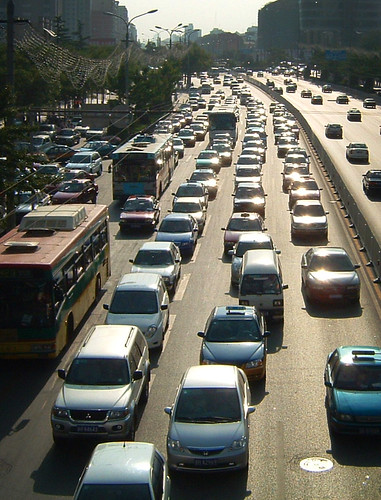
Optics matter. If Indians aren't the main offenders, why put them in the spotlight? Why not illustrate an article about the global population problem with photos of New York City's traffic-choked streets, or London's jam-packed Tube system, or a crowded mega-mall in Alberta, or Phoenix's bleak sprawl?

Whitty's words tell a true story; the framing of her article hints at a false one.

Longtime population scholar and activist Paul Ehrlich did the same thing when he began writing about these issues. Ehrlich, who has long been concerned about population increase among all peoples, wrote in the first chapter of his monumental 1968 bestseller The Population Bomb that he first became viscerally aware of the population problem during a late-night taxi ride through Delhi:
The streets seemed alive with people. People eating, people washing, people sleeping, people visiting, arguing and screaming. People thrusting their hands through the taxi window begging. People defecating and urinating. People clinging to buses. People herding animals. People, people, people, people. As we moved through the mob, hand horn squealing, the dust, noise, heat and cooking fires gave the scene a hellish aspect. Would we ever get to our hotel? All three of us [Ehrlich plus his wife and daughter] were, frankly, frightened. ... Since that night I've known the feel of overpopulation.

As demographer Jack Caldwell wrote later, Ehrlich "did not see population explosion, for Delhi's birth rate is relatively slow. He probably saw fewer people than one would see with pleasure in New York, London or Paris at Christmas or in the peak hour. What he did see were poor non-Europeans." (Quoted from The Coming Population Crash by Fred Pearce.)

More than 40 years later, Whitty begins her article with a strikingly similar (though less melodramatically rendered) scene -- a late-night taxi ride through crowded streets, this time in Kolkata instead of Delhi.

Taiwanese solution to soaring house prices: don't have kids  

Posted by Big Gav in , ,

The Age has an interesting article on house prices and population growth - Taiwanese solution to soaring house prices: don't have kids.

In Taipei the other day, a crane drove up to the front of the Parliament building. It lowered a man sitting in a plastic container shaped like a house, and suspended him in the air in a protest against the high price of real estate. Through a microphone, he urged onlookers to rise up against high housing prices, declaring: ''People without homes, slaves to property, stand up!'' ...

This matters because housing is not just an asset like shares or bonds. It is where we live. It's natural for investors to prefer the security of bricks and mortar. But as governments throughout the region are discovering, it is also natural for people to want to own a home - and to turn against governments that allow prices to soar out of their reach. In Taiwan, the costs have become particularly serious, as we shall see. Their would-be home buyers - ''snails without shells'' as they call themselves - have reacted by scrapping the other big expense facing young couples: children.

At home, the Rudd government last week reversed its 2008 liberalisation of foreign investment rules on real estate, and set up a unit to ensure the rules are obeyed. It also set up a joint working party with the states to ask why housing prices have soared out of reach. But that will work only if it tackles the single biggest cause: the tax-driven growth of rental investors, whose borrowing has grown 30-fold in 20 years, squeezing out home owners. ...

Taiwan has become rich very fast, largely by inching its way into a central role in global IT and communications manufacturing. This year, the International Monetary Fund estimates, its GDP per head will overtake that of its one-time colonial master, Japan. Its economy is almost as big as Australia's, and growing twice as fast. Yet its new wealth shows only fleetingly amid the grimy, cramped apartments built in earlier, poorer times.

Taiwan is in the grip of a housing crisis worse than ours. It is a rich country, but wages and most prices are roughly half the levels here - because the government, like China's, holds down the exchange rate to keep its manufacturing globally competitive. ...

Why can't they build more apartments? Because ownership of those grimy old apartment blocks is fragmented among dozens of occupants and investors. To demolish, even to upgrade, a developer must buy them all out, which is prohibitively expensive in time and money. There are classy new apartments on the urban fringe, on greenfields sites, but too few to meet the demand from occupiers and investors. So prices have soared.

So the snails save hard to buy a shell, and do without other things. That means, above all, they do without children, or with just one child. By 2008, Taiwan's fertility rate was the lowest in the world. Its women bear on average just 1.05 children over their lifetimes. The cost of housing is not the only reason, but analysts say it is the main one.

But not having children creates even bigger costs ahead. Right now, Taiwan has 6.8 people of working age for every retiree. But preschools are already closing for lack of children, and the population is set to shrink dramatically. By 2032, demographers project, Taiwan will have just 2.5 potential workers for every retiree - and by 2056, just 1.4. If nothing changes, Taiwan - like China, Japan and Korea - will slowly become economically unviable.

So far, that hasn't happened here. But if governments keep subsidising investors to outbid first home buyers and low income earners, it will. Snails want shells. Taiwan - and soon, possibly China - are showing us what else can go wrong when the price of shells soars out of the snails' reach.

If All Chinese Had Wheels  

Posted by Big Gav in , ,

Bill Totten has exhumed an old New York Times (1972) column by Paul Ehrlich, commenting "Nothing but the numbers has changed" - If All Chinese Had Wheels.

Now that the People's Republic of China has been admitted to the United Nations and American leaders are jetting to Peking, it is inevitable that we will be hearing more proposals for trade and aid to help the Chinese bring themselves up to "our standard of living". The idea of helping less developed nations "industrialize" or "catch up" seems as American as baseball. Few people question the common wisdom behind these programs, the idea that the developing areas of the world can somehow catch up with contemporary consumptive standards of living in industrial societies.

The emergence of China as a needy superpower must surely generate a re-evaluation of these beliefs. First, it is doubtful that the Chinese will ever reach our current standard of living; indeed it is not certain that this is even possible. But, more important, it is questionable whether such an achievement would be desirable, from any point of view. If the level of industrialization in China could be increased to the point that each Chinese family possessed an automobile and other amenities of industrial society, the effect on China and the entire world would be catastrophic. This observation immediately raises the point, of course, that the US should be considered overdeveloped by virtue of having attained a level of per capita consumption far in excess of that to which the bulk of humanity can realistically aspire.

Some very basic figures shed light on the development dilemma. There are currently at least 750 million people in mainland China. By contrast, the population of the United States is slightly over 200 million. Since there are more than 3.5 Chinese for every American, it would require some 3.5 times the present United States resource consumption to sustain China at current American levels. Such affluence in China would necessitate a tremendous shift in world consumption of raw materials.

Energy consumption is the best summary measure of industrial sophistication, and per capita energy consumption is indicative of average individual environmental impact. The world currently consumes 6.5 billion metric tons of coal equivalent in energy each year. The United States uses 2.2 billion metric tons equivalent or one-third of total world consumption. The Chinese, on the other hand, consume less than 400 million metric tons equivalent. In per capita terms, each person in China is supported by the consumption of less than 500 kilograms of coal equivalent, while his American counterpart is supported by some 11,000. Roughly speaking, twenty-two times as much energy is used to sustain an American as to sustain one citizen of China.

The United States of Brooklyn, NH  

Posted by Big Gav in ,

Strange Maps has a great example of how we could reduce our population footprint, if we chose to - The United States of Brooklyn, NH.

Is There Enough Food Out There For Nine Billion People ?  

Posted by Big Gav in , , ,

The New Matilda has an interesting article by James Arvanitakis looking at the debate prompted by the 2010 Intergenerational Report and pointing out its not the size of our population is that matters, its how we structure our economy to support the population in a sustainable way - Right Room, Wrong Elephant.


Photo courtesy flickr/photonquantique

In a parliamentary speech on global environmental issues delivered late last year, ALP MP Kelvin Thomson said it was time to discuss the environmental elephant in the room. At the time, you'd have been forgiven for assuming he was fed up with the shortcomings of Kevin Rudd's climate policy as the Government focused all its attention on outmanoeuvring Malcolm Turnbull, rather than addressing the problems with its ETS.

Actually, the elephant Thomson wanted to talk about was population growth, both here and globally. Thomson read out a long list of global issues, from traffic congestion and waste, to global warming and terrorism, and explained how the population explosion was at the base of each of these problems.

Now, a couple of months later, the issue of population as a so-called "elephant in the room" is front and centre. Driven by the release of the 2010 Intergenerational Report — as well as by a Prime Minister who seems genuinely excited by the prospect of an Australian population of 35 million — everyone is talking about this particular elephant. Buying into the debate, entrepreneur Dick Smith and former NSW premier, Bob Carr, have both warned that this level of growth will lead to ecological disaster and that Australia is unlikely to be able to handle many more people.

For myself and many of my colleagues, however, this issue is far from being a new one. Population and sustainability are concerns that we see raised constantly in our work and we have seen that, while the motivations of those raising the concerns may vary significantly, the way the population question plays out is very specific. There's just one question we are asked again and again: "What is the right population number for Australia?"

Is it a valid question? Well, perhaps, but before we even try to answer it, we need to understand that there is another elephant in the room. This one has been pointed out by British social commentator George Monbiot, and it's one that Kelvin Thomson and his contemporaries have chosen to ignore: that those worrying most about population seem to be post-reproductive middle aged, comfortable white men who have reached a certain level of material success. Further, Monbiot reminds us, the population explosion is the one environmental problem that this high energy consuming sub-section of the population can not actually be blamed for.

In other words, to ask questions about an ideal population size completely misses the point.

On a related note, Science has a paper on the radical" changes to the current global food system required to support the expanded global population we'll see in a couple of decades time - "Food Security: The Challenge of Feeding 9 Billion People".

The primary recommendations of the report are:

* "Closing the Yield Gap" (achieving "best practice" results everywhere)
* Increasing Production Limits
* Reducing Waste of Food
* Changing Diets (primarily eating less meat)
* Expanding Aquaculture
A threefold challenge now faces the world: Match the rapidly changing demand for food from a larger and more affluent population to its supply; do so in ways that are environmentally and socially sustainable; and ensure that the world’s poorest people are no longer hungry. This challenge requires changes in the way food is produced, stored, processed, distributed, and accessed that are as radical as those that occurred during the 18th- and 19th-century Industrial and Agricultural Revolutions and the 20th-century Green Revolution. Increases in production will have an important part to play, but they will be constrained as never before by the finite resources provided by Earth’s lands, oceans, and atmosphere.

Patterns in global food prices are indicators of trends in the availability of food, at least for those who can afford it and have access to world markets. Over the past century, gross food prices have generally fallen, leveling off in the past three decades but punctuated by price spikes such as that caused by the 1970s oil crisis. In mid-2008, there was an unexpected rapid rise in food prices, the cause of which is still being debated, that subsided when the world economy went into recession. However, many (but not all) commentators have predicted that this spike heralds a period of rising and more volatile food prices driven primarily by increased demand from rapidly developing countries, as well as by competition for resources from first-generation biofuels production. Increased food prices will stimulate greater investment in food production, but the critical importance of food to human well-being and also to social and political stability makes it likely that governments and other organizations will want to encourage food production beyond that driven by simple market mechanisms. The long-term nature of returns on investment for many aspects of food production and the importance of policies that promote sustainability and equity also argue against purely relying on market solutions.

So how can more food be produced sustainably? In the past, the primary solution to food shortages has been to bring more land into agriculture and to exploit new fish stocks. Yet over the past 5 decades, while grain production has more than doubled, the amount of land devoted to arable agriculture globally has increased by only ~9%. Some new land could be brought into cultivation, but the competition for land from other human activities makes this an increasingly unlikely and costly solution, particularly if protecting biodiversity and the public goods provided by natural ecosystems (for example, carbon storage in rainforest) are given higher priority. In recent decades, agricultural land that was formerly productive has been lost to urbanization and other human uses, as well as to desertification, salinization, soil erosion, and other consequences of unsustainable land management. Further losses, which may be exacerbated by climate change, are likely. Recent policy decisions to produce first-generation biofuels on good quality agricultural land have added to the competitive pressures. Thus, the most likely scenario is that more food will need to be produced from the same amount of (or even less) land. Moreover, there are no major new fishing grounds: Virtually all capture fisheries are fully exploited, and most are overexploited.

Recent studies suggest that the world will need 70 to 100% more food by 2050. In this article, major strategies for contributing to the challenge of feeding 9 billion people, including the most disadvantaged, are explored. Particular emphasis is given to sustainability, as well as to the combined role of the natural and social sciences in analyzing and addressing the challenge.

Related posts :

* The Fat Man, The Population Bomb And The Green Revolution
* Norman Borlaug: Saint Or Sinner ?

The New Population Bomb  

Posted by Big Gav in

Foreign Affairs has an article on "The Four Megatrends That Will Change the World", including the population bomb
- The New Population Bomb.

Forty-two years ago, the biologist Paul Ehrlich warned in The Population Bomb that mass starvation would strike in the 1970s and 1980s, with the world's population growth outpacing the production of food and other critical resources. Thanks to innovations and efforts such as the "green revolution" in farming and the widespread adoption of family planning, Ehrlich's worst fears did not come to pass. In fact, since the 1970s, global economic output has increased and fertility has fallen dramatically, especially in developing countries.

The United Nations Population Division now projects that global population growth will nearly halt by 2050. By that date, the world's population will have stabilized at 9.15 billion people, according to the "medium growth" variant of the UN's authoritative population database World Population Prospects: The 2008 Revision. (Today's global population is 6.83 billion.) Barring a cataclysmic climate crisis or a complete failure to recover from the current economic malaise, global economic output is expected to increase by two to three percent per year, meaning that global income will increase far more than population over the next four decades.

But twenty-first-century international security will depend less on how many people inhabit the world than on how the global population is composed and distributed: where populations are declining and where they are growing, which countries are relatively older and which are more youthful, and how demographics will influence population movements across regions.

Stop blaming the poor  

Posted by Big Gav in

George Monbiot has a column in The Guardian echoing John Brunner's theory in "The Sheep Look Up" - population growth isn't the root cause of environmental degradation - Stop blaming the poor. It's the wally yachters who are burning the planet.

It's no coincidence that most of those who are obsessed with population growth are post-reproductive wealthy white men: it's about the only environmental issue for which they can't be blamed. The brilliant Earth systems scientist James Lovelock, for instance, claimed last month that "those who fail to see that population growth and climate change are two sides of the same coin are either ignorant or hiding from the truth. These two huge environmental problems are inseparable and to discuss one while ignoring the other is irrational." But it's Lovelock who is being ignorant and irrational.

A paper published yesterday in the journal Environment and Urbanization shows that the places where population has been growing fastest are those in which carbon dioxide has been growing most slowly, and vice versa. Between 1980 and 2005, for instance, sub-Saharan Africa produced 18.5% of the world's population growth and just 2.4% of the growth in CO2. North America turned out only 4% of the extra people, but 14% of the extra emissions. Sixty-three percent of the world's population growth happened in places with very low emissions.

Even this does not capture it. The paper points out that about one sixth of the world's population is so poor that it produces no significant emissions at all. This is also the group whose growth rate is likely to be highest. Households in India earning less than 3,000 rupees (£40) a month use a fifth of the electricity per head and one seventh of the transport fuel of households earning 30,000 rupees or more. Street sleepers use almost nothing. Those who live by processing waste (a large part of the urban underclass) often save more greenhouse gases than they produce. ...

Someone I know who hangs out with the very rich tells me that in the banker belt of the lower Thames valley there are people who heat their outdoor swimming pools to bath temperature, all round the year. They like to lie in the pool on winter nights, looking up at the stars. The fuel costs them £3,000 a month. One hundred thousand people living like these bankers would knacker our life support systems faster than 10 billion people living like the African peasantry. But at least the super wealthy have the good manners not to breed very much, so the rich old men who bang on about human reproduction leave them alone.

In May the Sunday Times carried an article headlined "Billionaire club in bid to curb overpopulation". It revealed that "some of America's leading billionaires have met secretly" to decide which good cause they should support. "A consensus emerged that they would back a strategy in which population growth would be tackled as a potentially disastrous environmental, social and industrial threat." The ultra-rich, in other words, have decided that it's the very poor who are trashing the planet. You grope for a metaphor, but it's impossible to satirise.

James Lovelock, like Sir David Attenborough and Jonathan Porritt, is a patron of the Optimum Population Trust. It is one of dozens of campaigns and charities whose sole purpose is to discourage people from breeding in the name of saving the biosphere. But I haven't been able to find any campaign whose sole purpose is to address the impacts of the very rich.

The obsessives could argue that the people breeding rapidly today might one day become richer. But as the super wealthy grab an ever greater share and resources begin to run dry, this, for most of the very poor, is a diminishing prospect. There are strong social reasons for helping people to manage their reproduction, but weak environmental reasons – except among wealthier populations.

The Optimum Population Trust glosses over the fact that the world is going through demographic transition: population growth rates are slowing down almost everywhere and the number of people is likely, according to a paper in Nature, to peak this century, probably at about 10 billion. Most of the growth will take place among those who consume almost nothing.

But no one anticipates a consumption transition. People breed less as they become richer, but they don't consume less – they consume more. As the habits of the super-rich show, there are no limits to human extravagance. Consumption can be expected to rise with economic growth until the biosphere hits the buffers. Anyone who understands this and still considers that population, not consumption, is the big issue is, in Lovelock's words, "hiding from the truth". It is the worst kind of paternalism, blaming the poor for the excesses of the rich.

Population: Overconsumption is the real problem  

Posted by Big Gav in ,

The topic of population (revisited here recently with my post on Norman Borlaug) is the subject of a special in New Scientist on "The Population Delusion". One article notes that the problem isn't population growth (which has slowed dramatically, in spite of the wailing put up by population doomers), it is our consumption patterns - Population: Overconsumption is the real problem. The edition has a column for Paul and Anne Ehrlich, still concerned about populatiuon regardless - Enough of us now.

Now the demographic monster has become a hot topic again. Yet the arguments still don't fit the reality. The population "bomb" is fast being defused. Women across the poor world are having dramatically fewer babies than their mothers did - mostly out of choice, not compulsion. Half a century ago, the worldwide average for the number of children a woman had was between five and six. Now she has 2.6. In the face of such a fall it is hard to see what more "doing something" about global population might achieve.

Half the world now has a fertility rate below the replacement level, which, allowing for girls who don't make it to adulthood, is around 2.3. This includes most of Europe, east Asia, North America and the Caribbean. There are holdouts in a few Muslim countries - but not Iran, where fertility is 1.7 - and many parts of Africa. But rich or poor, socialist or capitalist, Muslim or Catholic, secular or devout, with tough government birth control policies or none, most countries tell the same story.

This hasn't yet stopped the world's population from rising. It stands at 6.8 billion, and is growing by 75 million a year. This is mostly because the huge numbers of young women born during the 20th-century's worldwide baby boom are still fertile: they may typically only have two children each, but that is still a lot of babies. Soon, however, if fertility rates continue to decline, each generation of women will be smaller than the last.

Of course fertility rates may not continue to decline, but to date the evidence of countries that have got down to the replacement level is that they don't stick there, they carry on declining. The reasons for this may have a lot to do with the changing position of women in society. Where men take a greater role in bringing up children, and the state intervenes to help working mothers, fertility rates stay quite close to replacement. Where they do not, then super-low fertility may follow; women, in effect, go on childbirth strike.

Even if the world population does stabilise soon and starts to glide downwards, that won't solve the world's environmental problems. The real issue is not overpopulation but overconsumption - mostly in rich countries that have long since given up adding substantial numbers to their population.
The key problem facing humanity... is how to bring a better quality of life for 8 billion or more people without wrecking the environment entirely in the attempt - E. O. Wilson

Take one measure: carbon dioxide emissions. Stephen Pacala, director of the Princeton Environmental Institute, calculates that the world's richest half billion people - that's about 7 per cent of the global population - are responsible for 50 per cent of the world's emissions. Meanwhile, the poorest 50 per cent are responsible for just 7 per cent of emissions. One American or European is more often than not responsible for more emissions than an entire village of Africans.

Every time those of us in the rich world talk about too many babies in Africa or India, we are denying our own culpability. It is the world's consumption patterns we need to fix, not its reproductive habits.

Ross Gittins is also talking about population growth (in a purely Australian context) in the SMH, noting that boosting GDP via immigration driven population increases misses the point - if GDP per person isn't growing, we are making citizen's (economic) lives worse, not better - Lets think twice about growth by immigration.
Over the past seven financial years, real GDP has grown by 23 per cent, but real GDP per person has grown by less than half that. So we haven't been doing as well as the headline growth figures imply.

You have to ask yourself what's so good about rapid population growth. And it's not good enough to say it makes the economy grow faster. From a narrow materialistic point of view, immigration-fed growth in the economy is good only if it raises the real average incomes of the pre-existing population.

And it's debatable whether it does. If it doesn't, we're running a high immigration policy mainly for the benefit of the immigrants, who are able to earn more in our country than in their own. Which is jolly decent of us.

Of course, if you were a business person, you wouldn't care whether high immigration led to a rise in income per person. All you're after is a bigger market because you believe it will allow you to make bigger profits.

So business believes in growth for growth's sake. Whether that attitude is shared by our politicians and economists, I'm less sure. Sometimes I think our economists are so mesmerised by Growth that they forget to inquire further.

But the other point that tends to be overlooked is that when you use immigration to force the pace of economic growth, it comes with a lot more costs attached than usual.

As the Treasury Secretary, Ken Henry, acknowledged last week, the expected continuation of high immigration raises strong questions about ''land-use sustainability and infrastructure requirements, both economic and social''.

Even so, these costs tend to be underplayed and hidden from view, partly because they're not acknowledged in our standard measure of growth, GDP. Indeed, some costs actually show up as additions to GDP. More growth - you beauty!

GDP ignores the cost of the environmental damage done by immigration. Apart from being morally dubious, poaching skilled workers from developing countries roughly doubles their greenhouse gas emissions, in the process making it all the harder for us to achieve the necessary reduction in our emissions.

So how come all those National Party and renegade Liberal politicians busy grossly exaggerating the economic cost of the emissions trading scheme have failed to mention the additional cost arising from the 6.5 million upward revision in projected population growth?

But the extra carbon emissions are just one of the environmental costs. A total projected population increase of 13 million over the next 40 years does raise the question of whether we'll exceed our ecosystem's carrying capacity.

Is the additional land use sustainable? Here's a country that badly stuffed up its river and underground water systems, and as we speak is demonstrating a serious lack of political will to fix the problem, telling itself an extra 13 million people will be no probs.

And what about the cost of all the roads, hospitals, schools, police stations and untold other infrastructure we'll need to build to accommodate a 65 per cent increase in the population? All that spending will add to growth as measured by GDP, but that doesn't mean it won't come at considerable cost to taxpayers.

Statistics

Locations of visitors to this page

blogspot visitor
Stat Counter

Total Pageviews

Ads

Books

Followers

Blog Archive

Labels

australia (619) global warming (423) solar power (397) peak oil (355) renewable energy (302) electric vehicles (250) wind power (194) ocean energy (165) csp (159) solar thermal power (145) geothermal energy (144) energy storage (142) smart grids (140) oil (139) solar pv (138) tidal power (137) coal seam gas (131) nuclear power (129) china (120) lng (117) iraq (113) geothermal power (112) green buildings (110) natural gas (110) agriculture (91) oil price (80) biofuel (78) wave power (73) smart meters (72) coal (70) uk (69) electricity grid (67) energy efficiency (64) google (58) internet (50) surveillance (50) bicycle (49) big brother (49) shale gas (49) food prices (48) tesla (46) thin film solar (42) biomimicry (40) canada (40) scotland (38) ocean power (37) politics (37) shale oil (37) new zealand (35) air transport (34) algae (34) water (34) arctic ice (33) concentrating solar power (33) saudi arabia (33) queensland (32) california (31) credit crunch (31) bioplastic (30) offshore wind power (30) population (30) cogeneration (28) geoengineering (28) batteries (26) drought (26) resource wars (26) woodside (26) censorship (25) cleantech (25) bruce sterling (24) ctl (23) limits to growth (23) carbon tax (22) economics (22) exxon (22) lithium (22) buckminster fuller (21) distributed manufacturing (21) iraq oil law (21) coal to liquids (20) indonesia (20) origin energy (20) brightsource (19) rail transport (19) ultracapacitor (19) santos (18) ausra (17) collapse (17) electric bikes (17) michael klare (17) atlantis (16) cellulosic ethanol (16) iceland (16) lithium ion batteries (16) mapping (16) ucg (16) bees (15) concentrating solar thermal power (15) ethanol (15) geodynamics (15) psychology (15) al gore (14) brazil (14) bucky fuller (14) carbon emissions (14) fertiliser (14) matthew simmons (14) ambient energy (13) biodiesel (13) investment (13) kenya (13) public transport (13) big oil (12) biochar (12) chile (12) cities (12) desertec (12) internet of things (12) otec (12) texas (12) victoria (12) antarctica (11) cradle to cradle (11) energy policy (11) hybrid car (11) terra preta (11) tinfoil (11) toyota (11) amory lovins (10) fabber (10) gazprom (10) goldman sachs (10) gtl (10) severn estuary (10) volt (10) afghanistan (9) alaska (9) biomass (9) carbon trading (9) distributed generation (9) esolar (9) four day week (9) fuel cells (9) jeremy leggett (9) methane hydrates (9) pge (9) sweden (9) arrow energy (8) bolivia (8) eroei (8) fish (8) floating offshore wind power (8) guerilla gardening (8) linc energy (8) methane (8) nanosolar (8) natural gas pipelines (8) pentland firth (8) saul griffith (8) stirling engine (8) us elections (8) western australia (8) airborne wind turbines (7) bloom energy (7) boeing (7) chp (7) climategate (7) copenhagen (7) scenario planning (7) vinod khosla (7) apocaphilia (6) ceramic fuel cells (6) cigs (6) futurism (6) jatropha (6) nigeria (6) ocean acidification (6) relocalisation (6) somalia (6) t boone pickens (6) local currencies (5) space based solar power (5) varanus island (5) garbage (4) global energy grid (4) kevin kelly (4) low temperature geothermal power (4) oled (4) tim flannery (4) v2g (4) club of rome (3) norman borlaug (2) peak oil portfolio (1)