Showing posts with label ehrlich. Show all posts

If All Chinese Had Wheels  

Posted by Big Gav in , ,

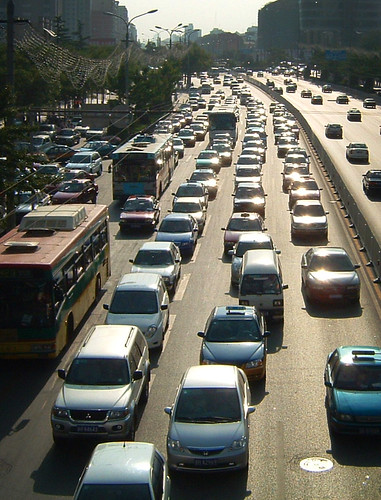
Bill Totten has exhumed an old New York Times (1972) column by Paul Ehrlich, commenting "Nothing but the numbers has changed" - If All Chinese Had Wheels.

Now that the People's Republic of China has been admitted to the United Nations and American leaders are jetting to Peking, it is inevitable that we will be hearing more proposals for trade and aid to help the Chinese bring themselves up to "our standard of living". The idea of helping less developed nations "industrialize" or "catch up" seems as American as baseball. Few people question the common wisdom behind these programs, the idea that the developing areas of the world can somehow catch up with contemporary consumptive standards of living in industrial societies.

The emergence of China as a needy superpower must surely generate a re-evaluation of these beliefs. First, it is doubtful that the Chinese will ever reach our current standard of living; indeed it is not certain that this is even possible. But, more important, it is questionable whether such an achievement would be desirable, from any point of view. If the level of industrialization in China could be increased to the point that each Chinese family possessed an automobile and other amenities of industrial society, the effect on China and the entire world would be catastrophic. This observation immediately raises the point, of course, that the US should be considered overdeveloped by virtue of having attained a level of per capita consumption far in excess of that to which the bulk of humanity can realistically aspire.

Some very basic figures shed light on the development dilemma. There are currently at least 750 million people in mainland China. By contrast, the population of the United States is slightly over 200 million. Since there are more than 3.5 Chinese for every American, it would require some 3.5 times the present United States resource consumption to sustain China at current American levels. Such affluence in China would necessitate a tremendous shift in world consumption of raw materials.

Energy consumption is the best summary measure of industrial sophistication, and per capita energy consumption is indicative of average individual environmental impact. The world currently consumes 6.5 billion metric tons of coal equivalent in energy each year. The United States uses 2.2 billion metric tons equivalent or one-third of total world consumption. The Chinese, on the other hand, consume less than 400 million metric tons equivalent. In per capita terms, each person in China is supported by the consumption of less than 500 kilograms of coal equivalent, while his American counterpart is supported by some 11,000. Roughly speaking, twenty-two times as much energy is used to sustain an American as to sustain one citizen of China.
The Population Bomb: Has It Been Defused ?  

Posted by Big Gav in ,

Yale's "Environment 360" periodical has an interesting article on population - The Population Bomb: Has It Been Defused ? (via Crikey).

The “population bomb” is creeping back onto the environmental agenda. Back in the late 1960s and early 1970s, when Paul Ehrlich wrote his book of that name and the Club of Rome produced computer simulations of a resources crisis in Limits to Growth, population was the number one environmental issue. Only strict birth control could prevent doomsday.

After the scandals of India’s forced vasectomies and China’s draconian one-child policy, such views became too hot to express in progressive circles. But they didn’t altogether go away, and now more and more people are blaming the “p-word” for climate change and rising oil and food prices.

“New Limits to Growth Revive Malthusian Fears,” warned the Wall Street Journal back in March. “Philippines Population Climbs; Food Problems Loom,” Reuters offered the following month. The online magazine Slate summed it up neatly with a recent headline: Global Swarming. And in an accompanying piece on this page Paul and Anne Ehrlich return to the barricades citing the twin perils of overconsumption and overpopulation.

The Ehrlichs are sometimes ridiculed because Paul’s original book predicted hundreds of millions of deaths from famine in the 1980s, when we were bailed out by the Green Revolution. But they are right to question the new orthodoxy that technological fixes will always save the day. For myself, I fear that when the Wall Street Journal talks about a revival of Malthusian fears, it reflects a tendency to excuse those guilty of overconsumption, while instead blaming the poor for their poverty and our planetary predicament.

At the heart of this debate is some recent — and very good — news: The population bomb is being defused at a quite remarkable rate. Women across the poor world have confounded the doomsters and are choosing to have dramatically fewer babies. They are doing it for their own good, the good of their families, and, well, if it helps the planet too, then so much the better.

You may not have noticed, but for some time now the average number of babies being born to each woman has been in decline in most of the world. A generation ago, the world fertility rate was around six kids per woman. Today it is 2.6, which is getting close to the level needed just to maintain the current population long-term. Allowing for girls who don’t make it to adulthood, that is around 2.3.

Statistics

Locations of visitors to this page

blogspot visitor
Stat Counter

Total Pageviews

Ads

Books

Followers

Blog Archive

Labels

australia (619) global warming (423) solar power (397) peak oil (355) renewable energy (302) electric vehicles (250) wind power (194) ocean energy (165) csp (159) solar thermal power (145) geothermal energy (144) energy storage (142) smart grids (140) oil (139) solar pv (138) tidal power (137) coal seam gas (131) nuclear power (129) china (120) lng (117) iraq (113) geothermal power (112) green buildings (110) natural gas (110) agriculture (91) oil price (80) biofuel (78) wave power (73) smart meters (72) coal (70) uk (69) electricity grid (67) energy efficiency (64) google (58) internet (50) surveillance (50) bicycle (49) big brother (49) shale gas (49) food prices (48) tesla (46) thin film solar (42) biomimicry (40) canada (40) scotland (38) ocean power (37) politics (37) shale oil (37) new zealand (35) air transport (34) algae (34) water (34) arctic ice (33) concentrating solar power (33) saudi arabia (33) queensland (32) california (31) credit crunch (31) bioplastic (30) offshore wind power (30) population (30) cogeneration (28) geoengineering (28) batteries (26) drought (26) resource wars (26) woodside (26) censorship (25) cleantech (25) bruce sterling (24) ctl (23) limits to growth (23) carbon tax (22) economics (22) exxon (22) lithium (22) buckminster fuller (21) distributed manufacturing (21) iraq oil law (21) coal to liquids (20) indonesia (20) origin energy (20) brightsource (19) rail transport (19) ultracapacitor (19) santos (18) ausra (17) collapse (17) electric bikes (17) michael klare (17) atlantis (16) cellulosic ethanol (16) iceland (16) lithium ion batteries (16) mapping (16) ucg (16) bees (15) concentrating solar thermal power (15) ethanol (15) geodynamics (15) psychology (15) al gore (14) brazil (14) bucky fuller (14) carbon emissions (14) fertiliser (14) matthew simmons (14) ambient energy (13) biodiesel (13) investment (13) kenya (13) public transport (13) big oil (12) biochar (12) chile (12) cities (12) desertec (12) internet of things (12) otec (12) texas (12) victoria (12) antarctica (11) cradle to cradle (11) energy policy (11) hybrid car (11) terra preta (11) tinfoil (11) toyota (11) amory lovins (10) fabber (10) gazprom (10) goldman sachs (10) gtl (10) severn estuary (10) volt (10) afghanistan (9) alaska (9) biomass (9) carbon trading (9) distributed generation (9) esolar (9) four day week (9) fuel cells (9) jeremy leggett (9) methane hydrates (9) pge (9) sweden (9) arrow energy (8) bolivia (8) eroei (8) fish (8) floating offshore wind power (8) guerilla gardening (8) linc energy (8) methane (8) nanosolar (8) natural gas pipelines (8) pentland firth (8) saul griffith (8) stirling engine (8) us elections (8) western australia (8) airborne wind turbines (7) bloom energy (7) boeing (7) chp (7) climategate (7) copenhagen (7) scenario planning (7) vinod khosla (7) apocaphilia (6) ceramic fuel cells (6) cigs (6) futurism (6) jatropha (6) nigeria (6) ocean acidification (6) relocalisation (6) somalia (6) t boone pickens (6) local currencies (5) space based solar power (5) varanus island (5) garbage (4) global energy grid (4) kevin kelly (4) low temperature geothermal power (4) oled (4) tim flannery (4) v2g (4) club of rome (3) norman borlaug (2) peak oil portfolio (1)