I was involved in one of those periodic discussions that spring up about "The Limits To Growth" recently (one of my eternal bugbears) and found myself wondering, not for the first time, if other people have read a completely different version of the book to the one I possess.
In this case, the remark that prompted this was an assertion that the book only mentions energy once - when it actually mentions energy at least 40 times. However, most misconceptions about "Limits" fall into one of 2 categories:
1. Doomers and cornucopians alike claim the book makes a prediction that industrial civilisation will collapse, as we overwhelm our resource base and the environment (the doomers view this as a correct prediction, the cornucopians as a prediction that has been proved wrong - see this article at The Economist for a classic example).
2. Conspiracy theorists claim the book advocates world government and forced population reduction in order to avoid the collapse that it predicts.
Both of these views are completely false, yet I have never come across a rational discussion of what the book actually describes - which is a number of scenarios involving population, economic growth and resource consumption that have been generated using a computer model (known as World3) operating under various sets of assumptions and looking at a timeframe spanning the next 100 years.
The book doesn't actually "predict" anything. The authors explicitly note that it is not a forecast, and that they do not believe the available data and theories would enable an accurate prediction of what will happen to the world over the next century. The scenarios are simply a range of different examples of how the world might evolve.
Given this, I wondered why so many people have misunderstood what the book actually says...
[The graphs below display part of the output for scenario 9 in "Limits" - the forgotten scenario that I am complaining about.]

Each scenario in "Limits" describes a number of factors - state of the world (population, food, pollution, available resources and industrial output), material standard of living (life expectancy, food/person, services/person, consumer goods/person) and human welfare and footprint (human welfare index, human ecological footprint).
In the most recent edition of the book, the "
30 Year Update", there are 9 scenarios described, plus an additional show what might have happened if the recommendations in earlier editions of the book had been put into practice 20 years ago.
Most scenarios do end in various levels of overshoot or collapse - it certainly isn't an optimistic tome.
* Scenario 1 shows the model's output assuming "business as usual" continues, with all indicators heading down by 2050, and population back at 1970's levels by 2100.
* Scenario 2 looks at a variant of BAU that assumes a much higher availability of nonrenewable resources (imagine if we could ramp up tar sand / heavy oil / shale oil extraction to keep oil production growing for another 40 years), which it calls the "global pollution crisis" scenario. Again, it ends badly.
* Scenario 3 combines the large nonrenewable resources assumption with widely deployed pollution control technology - this delays the peaking of the indicators, but still ends in disaster, starting around 2070.
* Scenario 4 extends scenario 3 with the assumption that agricultural yields can be further improved using technology - again, things start to fall apart around 2070.
* Scenario 5 adds better control of land erosion to the previous scenario - this delays the onset of problems by another 10 years or so (all of these scenarios basically run into trouble once the extraction of non renewable resources has peaked and gone into decline).
* Scenario 6 considers the outcome of making much more efficient use of resources on top of the assumptions listed previously. This scenario looks much better - the overall human welfare index and population both increase for a while and then level out. By the end of the modeled period industrial output, goods/person and food/person are in decline as a result of what they call a "cost crisis" (apparently because increasing efficiency can't indefinitely sustain production based on a depleting base of non renewables). No overshoot or collapse has occurred at the end of the 100 year period.
* Scenario 7 is based on the same assumptions as scenario 2, but with universal birth control availability resulting in an average 2 children per couple. Like scenario 2, it ends in a "pollution crisis".
* Scenario 8 extends scenario 7 with a political limit on industrial production that restricts output per capita around current levels. Again, this starts to fail around 2050.
* Lastly, scenario 9 (the one everyone seems to forget) assumes pollution control technology, increasing efficiency of resource utilisation, increased agricultural yields, stable population (growth easing down to replacement rate) and stable industrial output per capita. This scenario (shown above) ends with all indicators stable and above present levels at the end of the century.
Obviously there are a lot of other variations that could have been modeled - the set above isn't exhaustive.
Following the scenarios is a section entitled "Transitions to a sustainable system", which recommends a wide range of practices to be implemented in order to make scenario 9 the one which eventuates (which presumably is the one most people would choose if given the option). The recommendations include:
* improved monitoring of our impact on the environment and the resource base
* improved response times to signals from the monitoring described above
* extending planning horizons
* increased use of renewable resource (such as clean energy sources)
* aiming for maximum efficiency in use of resources
* closed loop industrial techniques (commonly known as "cradle to cradle" manufacturing)
* regenerative agricultural practices
* poverty reduction
* nonviolent conflict resolution
* accurate/unbiased media
* “decentralisation of economic power, political influence and scientific expertise”
* “stable populations” and “low birth rates” by “individual choice”
Influence and Critiques"Limits" is one of a number of books that have influenced the study of issues such as peak oil and global warming. Matt Simmons produced a 2 part "Energy White Paper" back in 2000 called "
Revisiting The Limits to Growth: Could The Club of Rome Have Been Correct, After All?" (
part 2). "The internet's ultimate malthusian", Jay Hanson, also appears to have been
heavily influenced by it (I might note once again that I'm thoroughly against Jay's national socialist "solution" to peak oil, as described at "warsocialism.com").
"Limits" has also been the subject of a number of critiques of varying degrees of quality - some of the most prominent being "
Thinking About The Future" (also known as "
Models Of Doom") by a group of authors (and including a reply by the "Limits" authors) and Herman Kahn's "
The Next 200 Years", which I reviewed a while back in "
The Fat Man, The Population Bomb And The Green Revolution" (and which I'm soon to write a follow up to).
Scenario Planning"Limits" is an exercise in
scenario planning (you can find a great set of resources on the topic from Martin Börjesson
here), a practice popularised in the business world by
Shell.
Shell's
latest exercise in scenario planning ("
Blueprints or The Scramble") was the subject of a lot of attention in peak oil cricles recently. Shell also has a
set of resources for learning about scenario planning. Another prominent group in this area is the
Global Business Network (GBN) which includes a number of Shell alumni.
One ex-GBN scenario planner who is prominent in the Viridian world and has written frequently about energy and the environment is Jamais Cascio, who co-founded
WorldChanging and now runs a site called "
Open The Future".
Jamais writes about both the art of scenario planning and actual scenarios considering a diverse range of issues - some posts that are worth checking out are one on "
Open Source Scenario Planning", which I think is particularly relevant for group blogs like TOD with a large readership, and "
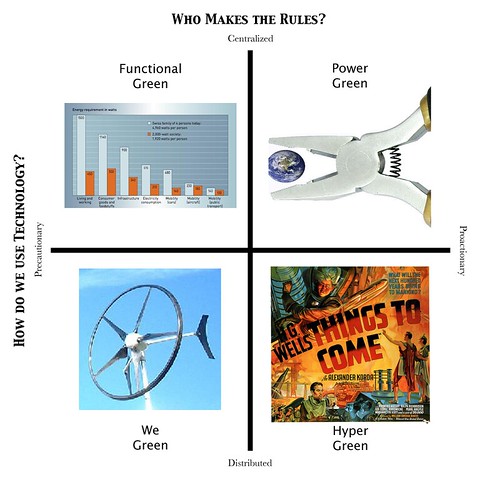
Green Tomorrows: The Scenarios", which considers a set of scenarios involving responses to global warming. These scenarios are also largely applicable to peak oil (as global warming solutions are often solutions to peak oil as well - though the converse frequently isn't the case).
LimitsGiven that Jamais has a lot of experience modelling scenarios and presenting the results to decision makers, I thought I'd ask him if the problem we encounter with people misunderstanding "Limits" is a common one - do people only remember the scenarios that fit their preconceptions (and thus seem the most plausible, to them), particularly when the modellers don't assign probabilities to the scenarios ?
Jamais responds:
[This happens] all too often. It is a recurring problem when scenarios move from the hands of the people who worked on them (and thus have an emotional investment in all of a set) to people who are supposed to act on them. The classic example is when the strategy group offers scenarios to the executives, who proceed to focus on a single one and ignore or dismiss the others.
Today, many scenario strategists, rather than simply present the set of scenario options, walk the recipients through a set of experiences around the set of scenarios, in order to provoke a visceral response.
This, in my experience, has been one of the most useful recent developments in the scenario practice -- it works. That's what the fictional narratives try to provide for written scenarios, although they obviously don't work as well as in-person encounters.
So how do you achieve this effect when you publish your scenarios in book form then ?
Then it's time to get creative: add a game of the scenarios to the book, or give instructions as to how to build a walk-through, that sort of thing...
Tenuously Relevant Closing ItemsWhile scenario planning usual involves considering a set of scenarios (whether the 9 scenarios of "Limits" or the 2 scenarios in Shell's latest report), it can be useful to consider a single scenario in isolation to test responses to it.
Stuart Staniford from The Oil Drum (now frequently referred to simply as "Staniford" in peak oil circles - depending on who is doing the talking this can sometimes sound like "Gandhi" and other times like "Hitler" - in the case of some angry "reversalists") recently posted an article called "
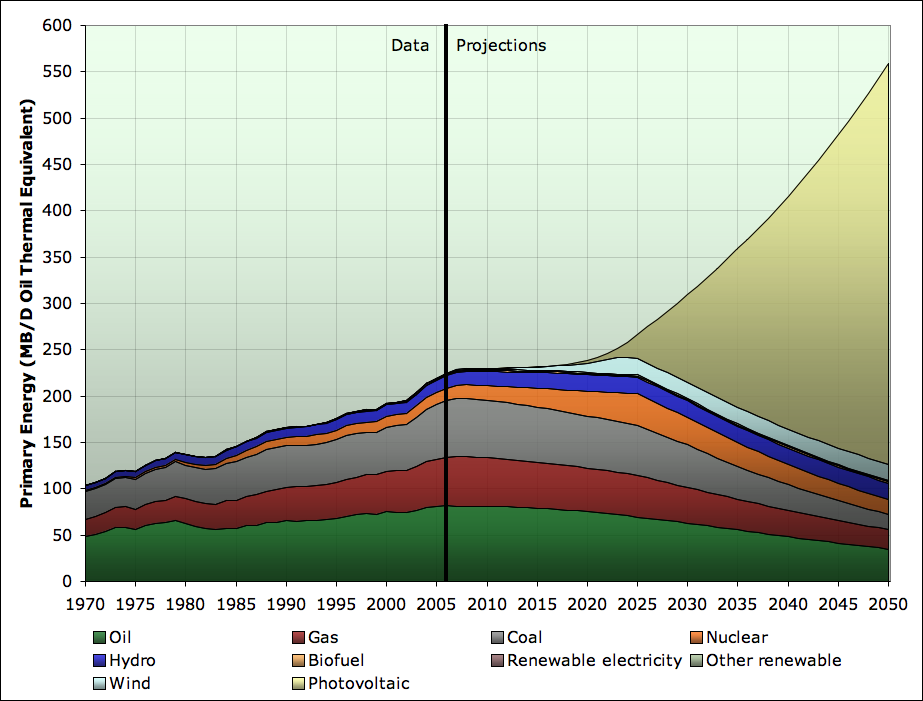
Powering Civilisation To 2050", which looked at a scenario where our future energy needs are increasingly met by solar (PV) power.
I'm a little miffed by this, as it has quite a degree of overlap with a post I've been writing at an excruciatingly slow pace over the last 18 months called "Our Clean Energy Future" - but the scenario I'll be outlining is sufficiently different that I think I'll still have some value to add, whenever I manage to finish it.
Stuart's scenario considers a world where PV (including thin film) is deployed on an immense scale, with a
GENI like global energy grid distributing the energy called the
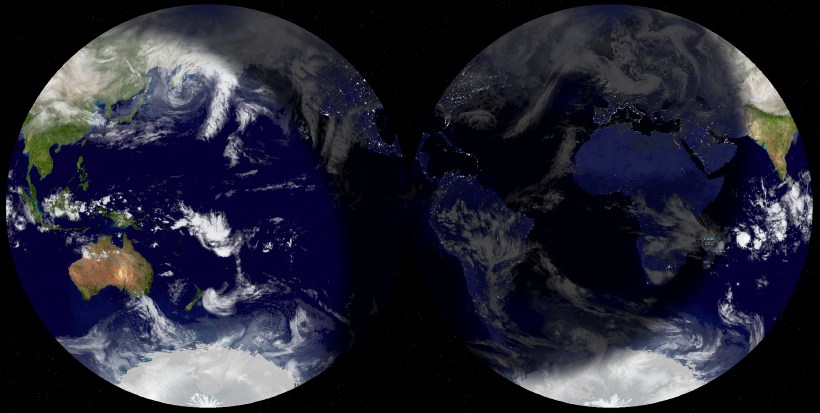
Genesis Project, which is being proposed by a Japanese group including Sanyo. As seen from the graphic below, this idea has a weak spot during the northern hemisphere winter - though from an Australian point of view this could provide yet another opportunity for our politicians to make grandiose plans about our future as an "energy superpower".
I'll close with a tinfoil decoration - a pair of conspiracy style links from a site called "Questions, Questions" which I came across while researching this post - appropriately enough, these take a paranoid look at the scenario modelling world, the green techno-libertarians and the peak oil world (which narrows things down quite considerably) without coming to any firm conclusions -
About that Pentagon "Climate Change" report... and
Catherine Austin Fitts, libertarian.
I guess if you were sufficiently open-minded about this sort of thing you could consider a scenario where the idea of imminent peak oil is an engineered meme hatched at The Arlington Institute under the guidance of James Woolsey and released into the wild for some nefarious purpose (given the apparent political outlook of the site, the demise of socialism being a guess).
If this is true I can tell you one thing for sure - I'm not in on the conspiracy...


 Posts
Posts