Showing posts with label origin energy. Show all posts

The Utility Shift To Energy Solutions Provision  

Posted by Big Gav in , , , , ,

The Climate Spectator has a pair of articles looking at how Australian utilities are trying to avoid the utility death spiral - partly by resisting change and partly by trying to work out how to adapt to i. The first article looks at AGL, which has been marching backwards lately as it invests heavily in old (but very cheap) coal fired power plants - AGL's tense shift towards energy solutions provider.

Average household customer electricity consumption was down nearly 10 per cent for the year and this comes on top of similar falls in prior years (detailed in the chart below). Part of this year’s fall is attributed to the mild May and June but, nonetheless, “AGL expects average consumer demand to continue to be impacted by energy efficiency, solar and new technologies”.

With less volume AGL finds itself unable to make the kind of margin per customer which it has in the past in the retail end of its business. Earnings per 'customer account' were down 16.7 per cent compared to last year for AGL. At the same time, the reduced energy sales also flow down the line to lower prices and margins in the power generation part of its business as well.

The problem for AGL, and indeed other power companies, is that energy equipment suppliers for buildings – such as solar PV but also other products, such as energy efficient lighting – are cutting their lunch. These equipment suppliers are helping customers to reduce the amount of energy they need from the grid.

AGL’s chief executive Michael Fraser appears acutely aware of this challenge. He suggests that the company needs to transition from a conventional vertically integrated energy supplier which makes money through selling volume of energy, to what they term an integrated energy solutions provider, which they symbolise in the picture below.

Essentially, AGL believes it needs to vertically integrate yet another step beyond the centralised grid and into its customers’ homes. Under such a model the company would make money less by selling electrons from the grid and more by charging for services linked to equipment such as solar PV, batteries and devices which would improve a household’s energy efficiency and shift its electricity demand out of the periods when power is most costly, such as very hot and very cold days.

Boston Consulting Group released a paper recently looking at how this energy solution provision model may arise and the challenges it presents for traditional power utilities. BCG outlines in the diagram below how the revenues available upstream from the customer are likely to erode over time due to solar, cheaper batteries and more efficient and communication-enabled electrical equipment. It shows that while the revenue available to generation and power networks, declines, the available revenue for behind-the-meter equipment and services – as well as metering equipment – rises.

The second article looks at another of the big 3 Australian utility companies - Origin Energy - and how the rapid rise in east coast gas prices (caused by the export of coal seam gas as LNG) is impacting the generation mix - Origin hit by solar and efficiency demand drop.

Origin, like AGL, is also talking up its ability to vertically integrate into the customer-side of the grid to counter the loss of margins through lower grid-based electricity volumes. In its presentation to investors it states it is focusing on development of a “revitalised solar business, smart meter technology, electric vehicles, distributed generation and storage”.

However, Origin does not elaborate on what is meant by its “revitalised strategy in solar”. In its latest results it notes gross profit decreased in its non-energy commodity business dropped by 35 per cent, or $17 million, primarily due to lower demand for rooftop solar PV systems. Origin used to be the largest solar retailer in the country but in the last few years its market share has declined dramatically.

At the same time Origin’s presentation seems to indicate that it is hopeful regulatory changes might alleviate declines in power consumption, such as changes to the Renewable Energy Target and adjusting network charges away from being averaged across energy consumption to more of a fixed nature.

Also, the company notes they’d be looking to limit capital investment in their energy markets division. This seems to suggest they see better opportunities in oil and gas rather than funneling money into provision of innovative energy solution offerings to replace lost grid sales.

Also just like AGL, Origin see prospects for returns to improve in conventional power generation with large price rises possible. They believe that there will be a mass withdrawal of around 15 terrawatt-hours of gas fired generation from the NEM as LNG plants suck in this gas. They also expect some further power plant capacity to be retired.

The utilisation of their mix of power plants (detailed in the table below) underlies the shift we’ll see. Darling Downs and Mortlake are running at quite high capacity factors given their position in the power plant merit order while the coal-fired Eraring operated at less than half its full capacity (45 per cent capacity factor).

One can imagine with gas rising to around $8 per gigajoule these plants will almost drop off the grid while Eraring’s output will increase considerably.

Origin Seeking at Least One More Buyer to Expand Coal Seam Gas LNG Project  

Posted by Big Gav in ,

Bloomberg reports that origin is looking to expand its APLNG coal seam gas export project - Origin Seeking at Least One More Buyer to Expand LNG Project.

Origin Energy Ltd., ConocoPhillips’s partner in a $20 billion Australian liquefied natural gas venture, said it aims to sell more than half the fuel from the project’s second phase before committing to an expansion.

The project in Queensland state will likely need to sell 50 percent to 75 percent of the LNG from the second stage before the partners make an investment decision, Karen Moses, executive director of finance and strategy at Sydney-based Origin, said today in a telephone interview, adding that no final decision had been made.

Origin and Conoco, the third-largest U.S. oil company, are among energy companies in Australia planning more than A$200 billion ($200 billion) of LNG projects to tap rising Asian demand for the cleaner-burning alternative to coal. The venture yesterday agreed to supply Japan’s Kansai Electric Power Co. with 1 million metric tons of LNG a year, or almost 25 percent of the capacity from the second unit, or train.

Origin and Conoco are pursuing “at least one more” buyer for the coal seam gas-to-LNG venture, with customer interest increasing since the nuclear crisis in Japan caused by the March 11 earthquake and tsunami, she said.

The partners approved the first stage of their Australia Pacific LNG development in July, targeting first exports in mid-2015.

Origin and Sasol to look for coal seam gas in Botswana  

Posted by Big Gav in , , ,

Upstream Online reports that Origin and Sasol are teaming up to look for coal seam gas in Botswana - Duo to explore Botswana CBM.

Australia’s Origin Energy and South Africa’s Sasol have partnered up to explore for coalbed methane (CBM) in the central province of Botswana.

The 50:50 joint venture, named Kubu Energy Resources, has already signed an agreement with local exploration company Sekaname to acquire three prospecting licences – PL143/2010, PL135/2010 and PL136/2010 – covering an area of about 3000 square kilometres. ...

“Establishment of the Kubu joint venture is consistent with Origin’s strategy to target Greenfield resources close to markets at low entry prices,” Origin chief executive Grant King said. “The delineation of a large [CBM] resource in Botswana could be used for power gene

Q&A with Origin’s Grant King  

Posted by Big Gav in , , , ,

The Business Spectator’s Robert Gottliebsen and Stephen Bartholomeus have an interesting interview with Origin Energy’s Grant King, looking at the impact of "export parity" on gas and coal prices in eastern Australia (amongst other things) - Q&A: Origin’s Grant King.

Robert Gottliebsen: Grant, looking at the industry there are four major projects in Queensland. Do you think it’s a possibility that they won’t all find enough gas and that there may be pressure on the local gas supplies as the export Queensland contracts are then forced to try and cover any shortfall?

GK: Look, our view, and again I’ve said this quite publically for quite some time, that we believe the resource would support, you know, five or six LNG trains being built in Gladstone and that’s what’s happening. So there’s more than sufficient resource to support that capital investment. As for whether the resource is sort of perfectly aligned within each of the joint ventures, or is there a need to be in the longer term some borrow and loan against the projects to make sure that those LNG trains remain full, my view is that it’s quite likely in the fullness of time that the projects will find a way of sharing amongst themselves on a purely commercial basis the resource that produces most value, you know, in respect of keeping those trains full, so I think that’s quite likely in the years ahead. Again, the deeper question you asked in respect of the impact of that on the domestic gas market. I think the two important points to make are that what the LNG industry has shown in respect of natural gas resources in Queensland, in this case CSG, is that as you move prices towards export parity, the resource base does expand and as that perception of that expanding resource base grows, what you’re seeing is other companies invest in exploration, for example, in other sources of gas as well, so we’re seeing the industry now test shale gas plays, for example, in the Cooper Basin, other unconventional gas plays as well as coal seam gas. So, what we expect as gas prices do begin to reflect that export parity is that the resource base will actually expand even further, and our view is that, and this might sound somewhat of a paradox, but our view is that eastern Australia, you know, can now look at a very long gas position, and it’s a bit like the emergence of the shale gas industry in the US where compared with five or ten years ago the US can now look at a very long period of gas self sufficiency.

RG: What’s the difference between the export prices as they currently are and what the local prices are in percentage terms? Is it ten per cent?

GK: Oh no, it’s more than that. I mean the best way of seeing that is to say that in Western Australia where there’s been an LNG channel to market for quite some time, contract gas prices are probably more typically in that six to eight dollar range. In eastern Australia because gas has competed with coal at the margin historically in the power generation sector, gas prices when coal was cheap were more typically in the three to four dollar range. But what is happening is that coal is also moving toward export parity, obviously if you export coal, you get export parity. But what will happen through time is that coal used for domestic generation in Australia as well will move towards export parity. So, you’re seeing these two trends. You’re seeing both of the main thermal fuels in eastern Australia move progressively towards export parity and one tends to support the other with increasing coal prices also feeding back into the value of natural gas as well.

RG: You mentioned two prices for local gas in Australia. What’s the export parity price equivalent to those?

GK: Well, the Western Australia price you’d have to say is export parity because the existence of an LNG export channel in Western Australia tells you that that price range is about six to eight dollars.

RG: And then in eastern Australia it’s in the three to four dollar price range?

GK: It’s historically been in the three to four dollar range when coal was cheap. I believe you’ll find gas prices have started to move along already, but that was historically where they were.

RG: So, it’s between 33 and 50 per cent higher?

GK: Correct.

RG:So , as we move to gas fired power stations on the eastern seaboard as seems likely, then that’s the sort of gas price increase that we’re going to look for?

GK: What we’re going to see and if I could perhaps take your question and extend the point a little bit, in terms of wholesale cost of fuel the fuels we use in Australia for our power generation are traditionally coal of course, gas increasingly, but also renewables. So, if you think about those three fuels, it’s worth thinking about what’s driving the underlying costs of those fuels. Now, in the case of coal and gas, it’s simply export parity and the broader view that one would take from a national wealth perspective is that our resources ought to receive their true value in the market and that’s in the greater interests of the country. So, we’re seeing the move towards export parity in respect of our fossil fuels. In respect of our renewable fuels, which in a sense you don’t export, they are generally much more expensive to develop and to date their development is supported through mandatory schemes like the renewable energy target. They are still much more expensive than fossil fuels at either historical costs or export parity prices. So, in the normal course those fuels will still be competitive and we would expect to see continued use of coal and gas with the other overlay of course that sitting on top of that now is, potentially at least, a carbon price of $23 a tonne and that will also affect which fuels are most competitive to use for which purpose.

SB: There’s a kind of perverse benefit in higher prices, isn’t there? Consumers will see high gas prices as a negative, but in fact it should bring more base load and combined cycle capacity into the market.

GK: That’s a very good observation and the point I’m trying to make is that it does sound paradoxical, but the reality is that if we move towards export parity, our resource base expands enormously and it’s already stimulating additional exploration, and my view is we will find that we’ve got even more gas resources available. So, you know, our view is gas has a great role to play. In the period through to 2020 that role of course is somewhat affected by the existence of the mandatory renewable energy target which will mean that a fair bit of the investment in generation and a fair bit of the fuel used for generation between now and 2020 will be driven by that renewable investment target, and gas through that period will play a role to firm the interruptibility of that fuel. So, as you know, if wind primarily is the fuel for the renewable energy target, then it will need to be firmed. So, for the period through to 2020 gas will play a very significant role in firming that interruptible fuel and beyond 2020 it’ll depend a lot on whether a carbon price exists and what that price is as to what mix of fuels, coal, gas, renewables, drives generation investment beyond 2020.

Origin, AGL call for national energy scheme  

Posted by Big Gav in , , ,

The Australian has an article on utilities AGL and Origin calling for dynamic pricing of power in order to send energy consumers price signals which will make smart meters useful - Call for national energy scheme.

AGL Energy and Origin Energy have called for a national energy saving scheme to slash the costs they face to comply with fragmented state-based schemes. The nation's two biggest energy retailers have also renewed calls for an end to government control of retail power prices.

The companies have told a review, ordered by the Ministerial Council on Energy in response to increasing demand for power, that they are being saddled with compliance costs because of the lack of a national energy efficiency scheme.

Victoria, South Australia and NSW operate separate schemes that require energy and gas retailers to purchase and surrender energy efficiency certificates. In Queensland, a parliamentary committee has recommended consideration of a scheme. The schemes are expected to grow as the carbon tax is due to start next year and electricity prices are forecast to rise. ...

The review is being conducted by the Australian Energy Market Commission, which will release a discussion paper in November. It was ordered because demand for peak power -- most commonly on summer days when air-conditioning use soars -- is growing faster than normal demand, requiring multi-billion-dollar investments in energy infrastructure that is used only for a few hours a year. It is expected to propose measures to encourage users to manage their usage to reduce pressure for new spending.

But AGL and Origin argue that retail price regulation is the main barrier to more efficient electricity use as consumers are not exposed to price signals. "It is not realistic to talk about reforms to the electricity system involving new technologies (for example, smart meters) when the very value they provide cannot be extracted due to rigid pricing structures enforced through ongoing retail price regulation," AGL says.

Origin has told the review the price caps discouraged retailers from offering alternative price structures, such as time-of-use pricing, charging more for peak-time energy use. Controversy erupted in Victoria over price reforms proposed last year as part of the roll-out of smart meters, but the retailers say the meter rollout was mandatory.

Power Industry News reports that a display centre for the Newcastle Smart Grid demonstration project has been opened - Newcastle's Shopfront for Smart-Grid Technology.
The Smart Grid, Smart City Information Centre was today launched in Newcastle to engage consumers and business in new technologies that are being trialled in the region to use energy more efficiently.

The Smart Grid, Smart City project is a $100 million commitment by the Australian Government to work with industry to demonstrate and test the integration of a range of new technologies such as smart grids, smart meters, electric vehicles and ceramic fuel cells into an existing community.

The Minister for Resources and Energy, Martin Ferguson AM MP said the project will test the possibilities of smart grid technologies including the potential to help consumers reduce their energy use and ultimately reduce their electricity bills.

Meeting peak demand is one of the biggest pressures pushing up the cost of electricity, and smarter use of our appliances could help ease that pressure, Minister Ferguson said. … Further information on the project is available at www.ret.gov.au

Origin Energy Approves First Stage of $20 Billion APLNG Project  

Posted by Big Gav in , , ,

Bloomberg reports that origin and Conoco have approved the first train the APLNG coal seam gas to LNG project - Conoco, Origin Approve First Stage of $20 Billion Project.

ConocoPhillips (COP), the third-largest U.S. oil company, and partner Origin Energy Ltd. (ORG) approved the first stage of a $20 billion liquefied natural gas project in Australia to supply the fuel to Asia.

Shipments from the first phase, estimated to cost $14 billion, are expected to begin in mid-2015, Sydney-based Origin said today in a statement. Total annual output capacity from stages one and two of the Australia Pacific LNG venture will be 9 million metric tons of LNG, the company said.

Conoco and Origin are among energy companies building Australian LNG ventures to tap rising Asian demand for less- polluting alternatives to coal. LNG prices are headed for a three-year high as Japan seeks additional shipments to replace nuclear capacity damaged by the March 11 earthquake and tsunami and China increases imports to boost power production.

“We believe the prospects of LNG markets have improved relative to six months ago,” Grant King, Origin’s managing director, said on a call with reporters. “Compared with 2009 and 2010, quite clearly demand for energy and the oil price remain more robust than people might have thought.” ...

Approval for the project follows the start of construction of rival coal seam gas-to-LNG ventures in Queensland state being built by BG Group Plc (BG/) and Santos Ltd. (STO) Adelaide-based Santos said in January its project in Queensland would cost $16 billion, while BG said in October it would invest $15 billion in its Australian LNG venture. The three Queensland ventures are using U.S. contractor Bechtel Corp.

The Business Spectator has more - An LNG train on track to deliver.
From the moment Origin Energy and ConocoPhillips locked in China’s Sinopec as an equity participant and foundation customer, it was almost a foregone conclusion that their giant Australia Pacific LNG project would gain financial investment decision approval.

It is, nevertheless, a massive milestone in Origin’s history, in the development of the coal seam gas-fed export LNG industry in Queensland, and in the Australian export LNG sector more generally.

The first phase of the project – the first LNG train with a capacity to produce 4.5 million tonnes of LNG per annum – will cost $US14 billion but the APLNG partners are already marketing the gas they could produce from a second train with similar capacity.

A decision to go ahead with the construction of that second train, which would push the cost of the project up to $US20 billion, is likely to be made within six to nine months.

Origin is coy about the differing economics of a single train project versus one with two trains, but the $US14 billion initial commitment does include a significant component of costs related to the infrastructure to support a two-train project, which is why the second train is budgeted to cost only $US6 billion.

The group is adamant, however, that the economics of a $US14 billion single-train project would still deliver attractive rates of return well above its internal hurdle rates.

Despite the potential over-capitalisation of that first train in the unlikely event the second train is deferred or shelved, APLNG will support that train with its lowest-cost gas.

If the second train comes on stream, the consortium will need to access higher cost gas but will generate returns on the excess capital it is investing in the initial train in anticipation of the second, and it also expects to extract efficiency gains over time.

The other factor working in favour of the economics of the second train is that to attract Sinopec as the foundation customer – and the Sinopec contract accounts for almost all the production from the first train – APLNG would not only have had to offer an equity inducement (Sinopec is taking up a 15 per cent interest) but gas on relatively attractive terms.

While it is possible that APLNG will offer equity to larger customers for the second train’s output, it is unlikely that the equity on offer will be as significant as Sinopec was able to negotiate, that the terms will be as favourable or that the pricing of the LNG will be as attractive

APLNG should get a better yield from that production, which in any event is likely to be marketed to smaller customers and traders on a more opportunistic basis.

While there are now a host of new LNG projects under development in Australia, including three committed and another likely at Gladstone, the APLNG partners are convinced they will be getting their gas into the market at a period where there will be a considerable gap between uncontracted demand and then uncontracted supply available to meet that demand.

First gas from their plant is scheduled for mid-2015, with gas from the second train flowing in early 2016.

The BS notes that Shell is preferring to take the slow road to developing their LNG project - Shell in no rush on Qld LNG: report.
Royal Dutch Shell is in no rush to develop its LNG venture in Gladstone, under the belief that costs will decline after the current rush of LNG work in Queensland subsides, according to a report by the Australian Financial Review that quoted the company's chief executive, Peter Voser.

The Origin of an energy revolution  

Posted by Big Gav in , ,

Giles Parkinson has an in-depth look at Origin Energy's interest in smart grids - Origin of an energy revolution.

The roll-out of in-house display systems for energy use promises to revolutionise the way the consumers understand and consume energy.

Origin, the largest retailer in the country, has kicked it off by announcing the largest pilot scheme of in-home displays in Australia – one that will involve 5,000 households over the next six months. But the rollout has far greater implications than consumer experience: it also promises to revolutionise the way that energy utilities conduct their business.

The basic business model of the energy utility has not changed for decades. It’s a simple model that revolves around selling as many electrons to as many customers as they can. But technology has caught up with the industry and, combined with the need to respond to rising costs, conserve energy and reduce emissions, the rollout of the “smarts” – meters, displays and appliances – is poised to cause as dramatic a restructuring as occurred in the banking industry in the 1980s and the telecommunications industry in the 1990s.

How the utilities manage that transformation could decide how they evolve and maintain influence over their industry, as the major banks have managed to do in theirs, and how much third party corporates such as Google, Intel and others come to play a dominant role, as a range of new companies have done in telecommunications.

“We’ve been in one paradigm for the last 100 years,” says Phil Craig, the head of retail at Origin Energy. “The electrons came down the poles and wires, you got the bill in the mail and you went into the post office and wrote the check. That hasn’t changed much, but we re now looking at a whole different model.”

A report released last year by Ernst & Young entitled Seeing Energy Differently described the challenge facing energy utilities in dealing with the providers of new “smart technology” and responding to the demands of improved efficiency. Basically it came down to two options: either the utilities form partnerships with third parties to help consumers manage their energy and evolve the model into a new, sophisticated form of energy service; or they stonewall and come under competitive attack all along the value chain.

Origin has clearly decided to evolve rather than having change thrust upon them. “The telecommunications industry is not like it was 15 years ago, it has experienced radical change,” says Craig. “That‘s what is going to happen to energy over the next 10 years, so we want to be in the best position to manage that.”

Origin has chosen as its partner the Colorado-based Tendril, which provides an in-home display that allows customers “unprecedented visibility” into energy usage, personalised estimates of monthly electricity bills and the ability to control household consumption. It allows communications over the web, mobile phone and home area networks, and can link with smart appliances and electric vehicles. And, of course, the energy company can see this information too.

Exactly how that business model will evolve is not yet clear because there are so many different factors that can still be brought to bear. But for Australian energy consumers, in-house displays – which look something like the dashboard displays in your car – are not far away. After the six-month pilot, Origin intends to then roll out the displays to all its 4.6 million customers – although the extent to which this can happen will depend on the rollout of the underlying infrastructure, which in this case is smart meters.

Craig says that by the end of the decade, consumers can expect to have smart appliances in their home that can respond to a pricing signal and turn themselves off. There will be charge points in the garage where the plug-in electric vehicle can choose the best time to charge itself, or even send electrons back into the grid. And, says Davis, there could be much larger solar systems on our homes.

And just as electric vehicle batteries will be able to be purchased under a leasing phone, just as people buy plans for their mobile phone, consumers might want to negotiate similar packages with their electricity supplier, possibly via third parties such as electrical retailers.

Tendril Smartening Up Victorian Energy Users  

Posted by Big Gav in , , ,

The Daily Camera reports that US smart grid software company Tendril is celebrating signing a contract with Origin Energy to provide their applications to Australian customers - Joe Biden touts renewable energy, Boulder's Tendril at NREL speech.

In addition, Biden lauded Boulder-based Tendril, a company that specializes in smart-grid and home-energy technology, for its investments in helping Americans and citizens worldwide consume less energy.

Tendril on Friday announced it signed a contract with Origin Energy, an Australian firm that plans to deploy Tendril's application suite -- used by consumers to gauge, modify and learn about energy use -- to thousands of its customers in the second half of 2011.

Under the contract, Tendril's products potentially be deployed across Origin Energy's entire 4.5 million customer base, Ivo Steklac, Tendril's chief operating officer, said in an interview with the Camera on Friday afternoon.

The Climate Spectator notes the initial rollout will be limited to 5000 customers in Victoria that already have smart meters - Smartening up.
Origin Energy says it will conduct what it describes as Australia’s first large scale Smart Home pilot, with new technology to be tested in 5000 homes in the second half of 2011. The company has partnered with Colorado-based Tendril, which will supply in-home displays that will allow customers to monitor energy use via web, mobile, paper, and home area network devices and advanced application development for future programs such as solar, smart appliances and electric vehicles.

Origin says the Tendril device will provide customers with easy-to-use tools to engages in energy efficiency and accelerate participation in new programs, pricing and active home energy management, and can be adapted for smart meters, smart appliances and new technologies such as solar. The pilot is to be held in Victoria, where smart meters have already been installed.

“The pilot of the Tendril program is a very exciting development for Origin, the leading Australian energy retailer, as it signals the beginning of a very different relationship between customers and their energy retailer,” said Phil Craig, the general manager of Origin Retail. “Origin will have the potential to better engage with our customers and deliver a range of new, more targeted products and services to help customers better manage their energy consumption and power bills.

Origin says its own research suggests Australians are confused about the impact they can have on their bills and the environment, and more than half struggled to make the correlation between their behavioural changes and their impact on the environment.

Origin's hot Chile play  

Posted by Big Gav in , , ,

The Climate Spectator reports that Origin are expanding their geothermal interets further throughout the southern hemisphere - Origin Energy Chasing Geothermal Power In Chile.

Origin Energy has further expanded its overseas geothermal portfolio and followed the path of smaller Australian companies by taking a significant interest in the South American geothermal industry. Origin said on Monday it had bought a 40 per cent take in EnergĂ­a Andina (EASE), which it described as Chile's leading geothermal exploration company, and is 60 per cent owned Antofagasta Minerals.

Origin's head of finance and strategy, Karen Moses, said preliminary assessments indicated that geothermal could provide 16,000MW of power in Chile. "It is our view that geothermal can provide large-scale renewable baseload energy and Chile has significant potential from a resource and growing local demand perspective," she said in a statement. EASA, which was founded in 2008, has a portfolio of eight geothermal exploration projects in the Northern and Central regions of Chile. The stake was bought from Empresa Nacional del PetrĂłleo following a competitive bidding process.

Origin has exposure to 290MW of geothermal generation through its majority stake in New Zealand’s Contact Energy, and is also involved in a consortium with India’s Tata Power PT Supraco Indonesia for a potential 300MW project on the island of Sumatra. It has an interest in the Geodynamics’ Innaminckka Deeps projects, and also recently began drilling as operator of the Innamincka Shallows project that is seeking to target more conventional geothermal resources in the Cooper Basin of South Australia.

Sydney's trigen power play  

Posted by Big Gav in , , ,

The Climate Spectator has an article on interest in trigeneration in large Sydney office buildings- Sydney's trigen power play.

The path towards distributed generation in Australia made another important step forward today with the switching on of the country’s first trigeneration precinct.

Distributed generation has become an important part of energy systems in Europe and elsewhere in recent years, but it has barely taken a toehold in Australia. However, the deal struck between the Origin Energy subsidiary Cogent and Investa Property Group, for the supply of energy to two buildings owned by Investa, may signal a change in the way energy use and network demand is managed in our CBDs.

The system switched on today is a trigeneration facility installed by Cogent in the Coca Cola Place building in North Sydney. Trigen uses gas to generate electricity on site, but then captures the excess heat for use as heating, and for cooling via an absorption chiller. Its promoters say it increases energy efficiency to around 80 per cent, compared to just 30-40 per cent in coal-fired power stations, where excess heat is usually vented.

It is not the first trigen system to be installed in Australia, but the groundbreaking nature of this facility is the “precinct” concept, meaning that Investa will be able to use the excess energy generated in one building to supply power to its Deutsche Bank building located on the other side of the harbour.

It’s a development that considerably enhances the economics of tri-gen, as some tri-gen facilities have been installed and then left idle because the buildings in which they were located could not generate the demand needed to make them efficient and to properly balance the demand on electricity and thermal energy. The precinct concept solves this by providing another electricity outlet, and could also allow the installation of larger and more efficient facilities. It is expected to be the fore-runner of numerous other such precincts in coming years.

“It is a great example of how we are paving the way for more intelligent energy systems of the future,” said Frank Calabria, the head of energy markets at Origin Energy.

The City of Sydney has bold plans to make its CBD virtually self sufficient in energy within two decades by having 360MW of such generation installed in its city building, helping avoid the costs of new generation capacity and transmission upgrades. It is negotiating on a contract with Cogent to begin installing trigen systems at various council buildings that it hopes will be able to supply energy to other council buildings, and also neighbouring offices.

Craig Roussac, the general manager of sustainability, safety and environment at Investa, said the precinct concept meant that trigen systems were now an attractive proposition, and that the company, Australia’s biggest office building owner, would be looking to retro-fit them in other buildings with the aim to create more energy precincts.

Roussac says he was not in favour of trigen systems before the precinct concept, because buildings were either forced to create artificial energy demand, switch the trigen systems off, or run them inefficiently. For him, many of these plants were only there for show.

“Responsible building operators strive to use as little energy as possible,” he said. “This agreement proves we can have our cake and eat it too. We can power a super-efficient building with lower emissions electricity, while at the same time heating and cooling it with the waste heat that would normally go up a coal-fired power station’s smoke stack. In addition, further benefits flow from the ability to export excess electricity to the grid.”

Roussac said such systems would be essential for any building aiming for a 6-star green rating. The installation costs were around “a couple of million per megawatt”, but in the case of the Coca Cola building, the return on investment was enhanced because it was leasing the plant back to Origin/Cogent and gaining a fixed income from that. “It’s like having an extra tenant. when you capitalise that income, the return on investment is quite good – it increases the value of the asset by considerably more than the cost of the plant.”

Origin's Calabria says the tri-gen plan provides 774 kWe of power to the base building and 650kWe of cooling to the air conditioning system when running at full capacity. About 50 per cent of the energy will be consumed by the base building and about half will be to the grid, for the benefit of the other building.

Sinopec to open doors for coal seam gas from Origin Energy  

Posted by Big Gav in , , , ,

The Business Spectator has a look at the recent coal seam gas export deal between origin Energy and Sinopec - Sinopec to open doors for Origin.

Despite, relative to his peers, taking an apparently leisurely route towards a green-lighting of Origin Energy and ConocoPhillips’ proposed massive Queensland export LNG facility, Grant King has always appeared confident he put together the customer base to support a go ahead for the project. Today the Australian Pacific LNG partnership was expanded as it locked in its first big customer.

That was not much of a surprise, given that APLNG had signed a non-binding heads of agreement with China’s Sinopec back in February but converting that agreement into a firm commitment was a necessary pre-requisite before Origin and ConocoPhillips could even consider a final investment decision.

Sinopec has committed to taking 4.3 million tonnes a year of LNG from the Curtis Island plant for the next 20 years – the largest single gas contract, by volume, yet entered into by the industry. It will also acquire a 15 per cent stake in the project for $US1.5 billion, diluting the existing partners to matching 42.5 per cent holdings but also reducing the amount of funding they will need to put in place to develop the project.

The contract will underwrite one train in what APLNG plans to be, initially, at least a two-train project that would be developed at a cost of around $US20 billion. Eventually it would like to have a four-train facility at Curtis Island, with an overall investment closer to $US25 billion.

Securing Sinopec ought to help convince other customers to sign up. APLNG has been negotiating with other prospective customers about off-take agreements and with a committed foundation customer and therefore a near-certainty that the project will proceed one would normally expect the prospects of signing up additional customers to strengthen.

Assuming a final investment decision to proceed is made this year, Origin hopes to deliver first gas to Sinopec in 2015.

King has been quite sanguine about demand for APLNG output even thought his project has been lagging the progress of the rival BG Group and Santos/Petronas projects in lining up customers.

The long term outlook for demand for LNG in the wider region is regarded as very strong but, until recently, there were some concerns that the sheer number and scale of new LNG projects planned for Queensland and north-west Australia might overwhelm demand in the near term.

The natural disasters in Japan, and the impact that has had on planned expansions of nuclear plants, however, has fundamentally altered the dynamics of energy supply and demand throughout Asia and, indeed, elsewhere. LNG is the most obvious beneficiary.

The SMH has an article on concerns being raised about the environmental impact of the development on the great artesian basin - Major LNG deal sparks enviornmental fears.
A major liquified natural gas (LNG) deal between Australia and China has environmentalists fearing for the future of the Great Artesian Basin. Australia will supply China with a further 4.3 million tonnes of LNG each year for 20 years. ...

The coal seam gas-to-LNG project involves the extraction of CSG from coal seams in the Surat and Bowen basins in southern and central Queensland.

Friends of the Earth spokesman Drew Hutton says this is bad news for the environment, the Great Artesian Basin and for landowners. "The federal government water group and Geoscience Australia believe there are going to be dramatic draw-downs [of the water table] in sections of the Great Artesian Basin and the damage could last for hundreds of years," Mr Hutton said. The basin is a major source of water for farmers and communities in inland Queensland.

Origin Energy managing director Grant King said he was confident the project would not harm the basin. "Our project has done an enormous amount of work in understanding the impact the project will have on water, acquifers and the Great Artesian Basin," Mr King said. "The technical work, the engineering and scientific work done by our teams gives us the confidence there won't be any adverse impacts."

Mr King said trials were under way to understand issues surrounding water management. He also said they were treating the unwanted water that comes up during the gas extraction. "That water is treated and applied for a number of beneficial uses and one of the uses could be reinjection [into acquifers]," Mr King said.

Mr Hutton said CSG companies did not know what to do with the unwanted water. "They don't know how to treat it to an acceptable level at an acceptable cost," he said. "They don't know what to do with the one million tonnes of salt a year that comes to the surface except to wack it into landfill. "Is it worth disrupting and sometimes destroying the farms that provide our food and fibre? "The cost of this industry is far too great."

The Climate Spectator had an interview by Giles Parkinson with Grant King last month, covering a range of topics related to the local energy industry - Q&A: Grant King.
GP: Ok. Let’s move onto the renewable energy target, because you’re obviously sort of closely involved with that now, being the largest energy retailer in the country. How do you see the renewable energy target being acquitted and, I guess we’re talking here, which technology by 2020?

GK: Well, clearly in the short term the market price of the two instruments under scheme now, the LRECs and the SRECs, is quite low and that tells us therefore that there is plenty of supply – and I think that the reason for that is pretty well understood, particularly generation of RECs from solar PV installations last year. And in our case, we’ve said quite publicly we have secured RECs that will probably cover our position inclusive of the recent acquisition in NSW for three or four years.

We do not expect this low price to remain, and the price has already started to move up from the lows of late last year, and in our view must inevitably get to a level that will cause more renewable energy assets to be built, because there is clearly insufficient renewable generation to generate a level of RECs required in the future years, and particularly the 2015 to 2020 period as the REC curve or the liability increase is substantially under the scheme. Now, it’s always difficult to call a forward market – and we couldn’t call all that movement towards replacement cost will happen in a year’s time or two years’ time or whatever – but inevitably it must rise because there is insufficient renewable generation yet in store to meet the future REC requirements of the market.

GP: Can you make any sort of call as to when that build does occur, whether it will be still mostly wind, or do you think other technologies will be capable of pushing some of the wind capacity aside?

GK: Well, I think one of the features of the current long REC position is that it probably will bring a bit of a pause to the development of wind assets. Origin has, for example, invested substantially in other technologies, primarily geothermal, and I think that probably means there’s another couple of years for us and others to do some more development activity around geothermal and see whether that can be a major source of RECs. But at the moment, you’d have to say that there is a substantial amount of wind development sites consented and in the consenting pipeline which I would have thought would have met the greater part, if not all, of that REC requirement.

So, it can, and it certainly could be met from wind, but we’ve probably got another couple of years to find out whether there are other technologies which will compete on a cost basis with wind. But certainly, from about at least I would think two years on, we’re going to start to need to see a substantial building or development of new renewable energy assets to meet the overall REC targets.

GP: Yes. And Origin has 3000MW of wind capacity in development, either with planning approval or not. Are you likely to develop your own wind farms to meet your own obligations or will you be seeking third parties where appropriate?

GK: We’ve done both. And in fact, historically, we’ve tended to buy more from third parties, either to buy RECs in the market or buy renewable energy from third parties; for example, Waubra is a case in point. Ultimately, that question is answered more in terms of the overall funding demand on Origin and we’ve got some quite, big projects underway, obviously the energy acquisition in NSW, but looking ahead, construction of APING.

GP: Ok. Can we just go back to geothermal because you mentioned that just a few moments ago? Origin made a a big write down on its investment in the so called Innamincka deeps, the hot dry rock technology. Symbolically, that was a bit of a blow to that particular technology. Is it simply a question of time? Or do you think it’s just going to be too hard?

GK: By the time we entered into that project, we were hopeful that that the Deeps could be developed in a time frame that was much more immediate and relevant. In other words, there was enough time left under the REC target through to 2020 to do a substantial amount of production in that period because that, of course, was a major economic driver for renewable energy and that investment in particular. Now it’s taken longer than we would have hoped a few years ago to move through that development path and therefore the economics of it are influenced by that, and therefore we feel it’s less likely to be developed, driven by the REC target through to 2020, because it’s just becoming less and less part of the asset’s overall economic life.

There is no question that the work done in the Deeps by Geodynamics has in our view confirmed that the heat resource is there. But it probably will take a bit longer to develop technologies to access that resource through the deeps in particular. At the same time we are investing in what we call the shallows which is the geological formations immediately above the deeps which are more in reach of conventional technology and therefore more capable of coming into production sooner, but for which the key question is: is there enough heat in that sedimentary basin? And clearly it’s cooler than the deeps because it’s shallower, but if there’s enough heat there, then I think the prospects for developing that are much more immediate and much more real because it’s within the reach of current technology.

GP: It is a much smaller resource, though, in general, isn’t it?

GK: Well, to the best of our knowledge, the Cooper Basin in broad terms is a far bigger resource than any other potential geothermal resource that we have in Australia. Now, that’s a reasonably studied comment, but we may prove to be wrong, but at the moment we would rate the Cooper Basin resource or the potential of that resource as much, much bigger. There’s more than enough resource there if we can access it through the shallows to make geothermal a major contributor to Australia’s renewable energy requirements.

GP: Ok. So, you think it could be developed in the time frame needed to be able to benefit from the renewable energy target?

GK: If we start to see a carbon price, then that gives a second bit of legs and second bit of momentum to the deeps. Our original involvement in the deeps was on the premise that the REC target would be increased which it was and it did offer a potential resource and technology that might be able to contribute to that target. But it’s important to say that that target’s finite, but ultimately a carbon price isn’t; it will go on forever. So, those sorts of technologies and resources will have their day.

GP: Skipping over to other technologies, Hydro – you talked of a fascinating new scheme in Papua New Guinea, a 1800MW run-of-river hydro scheme and its potential to provide energy for Australia. Can you tell us a little bit more about that, what you’ve learned since then and are you still as optimistic about that project as you were when you announced it? Have there been any developments at all since then?

GK: Well, we’ve continued to work on that project. At the time we announced it, we had done some preliminary studies on hydrology and transmission, etcetera, and construction. What we’re now doing is seeing various advices, engineering advices and environmental consultants to do the much deeper studies. That process is underway and it will probably take another year. At the end of that, we expect to have a much better defined understanding of a project and its costs. To the best of our knowledge, the project still remains very attractive conceptually and economically viable and, of course, any movement towards a carbon price will clearly increase the attractiveness of that resource.

Having said that, it’s a massive project. It takes a lot of effort and planning and development and capital make big projects happen, but we happen to think it’s a project that could significantly contribute to a change in the way we source our energy and certainly substantially lower the carbon intensity of generation, in Australia and New Guinea obviously because they’d be connected electrically. ...

GP: Can we talk about solar now? Fans of the solar technology are well aware of Sliver and its potential. That technology has now gone into a joint venture with Micron. Are we about to see the emergence of that technology?

GK: The aim of that joint venture was to migrate the IP, the technology we developed into Micron’s production facilities, and that process has progressed pretty much consistent with our expectations of a year ago. What we’re wanting to do is scale that production up and get product out in the market and establish the market acceptance for the Sliver technology. There should be increasing amounts of that product available through calendar 2011. We then need to get confident that we can scale the production of that technology up to the hundreds and hundreds of megawatts level and move that amount of product into the market.

And so, 2011 is a pretty important year because we will or have migrated the technology and we will get more product into the market and I would imagine by year end, we will have or we will be very close to making a decision as to whether we ramp that production up through the large capital investment. ...

GP: Can we just go quickly to electric vehicles? Origin opened its first charging point station recently. What’s your view of the electric vehicle market? How quickly do you think it would expand? And what role do you hope Origin plays in it?

GK: Well, we are very interested in that technology as we are in many other forms of technology for power use or for people’s engine needs. Now, we’ve historically not brought that much into the transport fuel sector of the market. We probably operate in the non transport space. But electric cars is one of those technologies that bridges those two spaces, and so we’re very interested in understanding the technology, the viability and the cost competitiveness of the technology. I don’t have a research reason for saying this, but my experience over many years is that it does take a while to get these technologies taken up in a way that they achieve a sort of critical mass to support the different sorts of fuelling infrastructure that you need, etc. At the end of the day, electric vehicles will have their place, but I’m not sure I would see them displacing the conventional, certainly in in the very long term, but not in the medium to long term.

GP: On Smart meters, what are your plans for the roll-out of Smart meters and the potential of smart metering technology?

GK: Well, clearly this is an issue that’s been grappled with in Australia where we’ve seen generally the roll-out of smart meters, in Victoria is the obvious example, where it’s been mandated by government and done through the network owners and, at the moment, that’s pretty much the state of play. And when I say ‘state of play’, no pun intended. I mean some states have mandated it, some states are running trials and the federal government is sponsoring trials to sort of test the viability and contribution this technology can make.

Again, we are very closely involved in some of those trials. We’re very closely involved in installing and selling, not so much residential but the SME commercial end of the market, to try and help customers understand how it might benefit them and help us understand how it might be best deployed. Large scale roll-outs of that technology is something that’s tended to be mandated by governments and promoted through the networks.

GP: The concept of the 'negawatt' and this idea that energy companies might one day make more money by selling less energy, rather than by selling more energy, is that another Utopian view of where it might all end up or do you think that that’s actually a possibility?

GK: I can understand the seductiveness of that view, but for us to get us many consumers to get our energy, a lot of capital is invested. So, I think the real question ultimately on what it will cost us to get the energy is a question of what will we have to pay and the timing. The second point is – and we have the data for this – is that energy efficiency is improving, but there’s also not a lot of evidence that energy consumption is reducing and that equation balances simply because we tend to use more electricity in more applications than we’ve historically done. Now, I can’t say that will happen forever, but certainly at the moment that very positive trend of improving efficiency is at least in part offset by all of the lifestyle elements of the way we use energy.

The ABC's Lateline program also had an interview with King recently - Origin chief talks up Qld coal seam gas benefits.
TICKY FULLERTON: The deal is nearly $100 billion over 20 years. Was the high Australian dollar at all a barrier during negotiations?

GRANT KING: Not a barrier directly, Ticky, because these deals essentially are done in US dollars, so the sales are in US dollars and therefore the A dollar-US dollar exchange rate doesn't matter that much to the sales agreements. Where the exchange rate is relevant of course is to companies like Origin who are A dollar companies. And at the moment with high exchange rates and the capital costs ahead of us, that's actually quite favourable to the project.

TICKY FULLERTON: When would the money start flowing through because it's come at a very good time for Queensland? I'm thinking about when they might see some royalties.

GRANT KING: Well Queensland will benefit initially from the construction activity. The Finance Minister of Queensland, Rachel Nolan, who joined with us today was talking about $900 million a year of investment in regional economies in Queensland from now. So the regional communities in Queensland around Gladstone, Curtis Island and Gladstone community and then the Darling Downs region will benefit immediately. The project will take four to four and a half years to generate revenues and those revenues will of course then attract royalties so the Queensland Government at a Treasury level of course will begin to receive royalties from that time. But the community will benefit from direct investment immediately.

TICKY FULLERTON: What about the environmental side? I'm thinking of the media around the Surat Basin in particular. Does your board see a real business risk here?

GRANT KING: Well I think the important thing to acknowledge is that we very much understand the community's interests in this area, particularly environmental impacts and particularly on water, water table, ground water and water use for agricultural production. That sits very high on our risks, if you'd like to think about it that way, our risk register and we're working very hard to make sure that we understand those risks, those risks are manageable and we have a minimal impact on the community and on the environment. Now we're quite confident because we've done extensive work in this area that these risks are all manageable, but we are very mindful of the concern and interest the community has, but we do believe the risks are very manageable.

TICKY FULLERTON: Now, I'm thinking back to that Four Corners program in February and I know you guys came out a little bit better than your competitors. But the issues were particularly of farmers saying they were losing control of their properties and indeed that the water table, they think, might be sinking. But this issue of connected aquifers is an issue, isn't it?

GRANT KING: Well we think we have a very good scientific understanding of what's happening in the aquifers when we produce coal seam gas and we believe that the concerns around interconnection between aquifers and depletion of the water table should not be of great concern and is quite manageable. But I think the very important point is that we're not just asking the community to rely on that assurance. Both state and federal government permits require very, very extensive monitoring of ground water through water bores on properties or on adjacent to properties we're on and in the region. And I think it's that very extensive monitoring that will see us pick up very early, whether there are any adverse impacts. And whilst we don't expect there will be, if there are we will see them very early and we can then ensure that they're mitigated. ...

TICKY FULLERTON: In broad terms, are you seeing interest from the Japanese post the nuclear crisis over there?

GRANT KING: We are, but I think it's very important to say that the Japanese are dealing very much with short-term issues at the moment. They've had to do an enormous amount of work to reconfigure their supply chain, their energy supply chain, and those that are in the LNG business today with spare cargoes are all working very hard to meet that increased demand from Japan and help Japan get through this sort of immediate crisis. Firstly - secondly, there's a very strong consensus in industry that demand for LNG in Japan will increase medium term, but it would be important to say that that Japanese interest on buying is very much short-term focused on buying cargoes at this point in time.

Sinopec signs coals seam gas LNG deal with Origin Energy  

Posted by Big Gav in , , , ,

The SMH reports that Origin Energy's coal seam gas LNG project has taken another step forward with Sinopec signing on as both a customer and a new shareholder in the project - Sinopec inks LNG deal with Origin.

China's Sinopec has signed a binding agreement to buy 4.3 million tonnes of liquefied natural gas annually for 20 years from a project to be developed by Australia's Origin Energy and US oil company ConocoPhillips, Origin said today.

Sinopec will also take a 15 per cent stake in the project, Origin Energy Chief Executive Grant King told reporters at a joint news conference. ... The project equity sale leaves the Australian and American firms with 42.5 per cent interest each in APLNG. Sinopec was welcomed as a joint venture partner with a signing ceremony in Brisbane today.

Resources minister Martin Ferguson said it was the biggest single LNG sales and purchase agreement by annual volume in Australian history. ‘‘Deals like this one put Australia on track to be one of the world’s largest suppliers of LNG in coming years,’’ Mr Ferguson said. ‘‘The APLNG project has the potential to significantly expand the burgeoning coal seam gas to LNG industry on Australia’s east coast and cement Gladstone’s place as a key LNG hub.’’

APLNG chairman and Origin managing director Grant King said the joint venture was engaged with potential buyers for gas from a second processing ‘‘train’’.

Origin resurrects plan for PNG hydro  

Posted by Big Gav in , , , ,

The SMH has an article on plans to link a large scale hydro power project in Papua New Guinea to the Australian electricity grid - Origin resurrects plan for PNG hydro.

Origin Energy says it will sign an agreement with the governments of Papua New Guinea and Queensland to potentially support development of a large hydro-electricity project.

The 50:50 joint venture between Origin and PNG Sustainable Development Program Ltd could ultimately see the hydro plant built at PNG's Purari River, the nation's third largest waterway.

Under the plan, electricity from the project would be used to power villages in PNG and would be transmitted to Australia via Weipa to join the national electricity grid at Townsville.

Plans for such a project have been in existence since the 1970s, a company spokesman said, but have now been updated.

The governments of PNG and Queensland will on Wednesday sign a Memorandum of Cooperation with the joint venture company, PNG Energy Developments Ltd (PNG EDL) concerning the plans.

"Capturing the power of the existing river flows, the development under consideration would have the capacity to generate approximately 1800 MW (megawatts) of renewable baseload electricity," Origin said.

PNG EDL is currently evaluating the hydro-electric potential of Purari at Wabo, in the Gulf Province of PNG and about 350 km from Port Moresby.

By itself the run-off from the Wabo delta is about equal to one quarter of the run-off from all Australia’s waterways, and PNG’s highlands receive eight to 11 metres of rainfall each year, an Origin spokesman said.

If the project was completed it would supply into Queensland about five times more renewable power than currently generated in the state.Origin chief executive Grant King said in a statement that the ongoing assessment of the project was consistent with his company’s pursuit of renewable energy opportunities.

‘‘This would be the first project to deliver year-round baseload renewable energy into mainland Australia,’’ Mr King said in a statement.

Big potential seen in outback hot rocks  

Posted by Big Gav in , , , ,

The ABC has a report on Origin Energy and GeoDynamics' search for shallow geothermal energy sources in outback Australia - Big potential seen in outback hot rocks.

A major Australian energy company says it believes geothermal resources in parts of the outback have enormous potential to meet the nation's future energy needs.

Origin Energy has established a new joint venture with Geodynamics Limited to explore for shallow geothermal resources in the Eromanga Basin in south-west Queensland and parts of far north South Australia.

The exploration will focus on developing renewable energy generation.

Origin spokesman Andrew Stock says geothermal could play a significant role in providing Australia's future energy needs if its potential can be realised.

"It is another significant investment and commitment by Origin to its belief that in the medium term this is a huge resource that if we can - in a sense - crack the nut as to how it can be developed, it is worth staying the course," he said.

"That's what we're doing in opening up this new opportunity with Geodynamics."

Mr Stock says the initial work will include drilling and testing two wells at a cost of about $10 million.

Origin, Conoco to sell coal seam gas to BG  

Posted by Big Gav in , , , ,

Reuters reports that Origin and Conoco will be selling some coal seam gas to rival BG's planned Gladstone LNG plant - which makes me wonder when their own plant will go ahead - Origin, Conoco in Australia gas jv with BG Group.

Australia's Origin Energy and partner ConocoPhillips will sell feed gas to BG Group's rival liquefied natural gas project, marking the first collaboration in the country's LNG sector.

The partnership could herald more cooperation among the five rival projects at Gladstone port in the northern state of Queensland, analysts said, as operators seek ways to lower their costs in multi-billion dollar LNG projects.

While the gas sales agreement is set to add value for Origin, some analysts have raised concerns about possible delays in its own LNG project, known as Australia Pacific LNG (APLNG), with the firm giving little update on its progress on LNG sales negotiations.

"We are still in discussions with potential LNG customers... but we are now in a buyers' market and they now have substantial choices between competing LNG developments," Managing Director Grant King told analysts at a results briefing.

Origin seeks environmental nod for A$35bln LNG project  

Posted by Big Gav in ,

Reuters has an update on Origin Energy's proposed coal seam gas to LNG project - Origin seeks environmental nod for A$35bln LNG project.

Australia's Origin Energy Ltd (ORG.AX) reported a small rise in quarterly output on Friday and said it had sought formal environmental clearance for its gas export project with U.S. ConocoPhillips (COP.N).

Origin, the country's largest producer of coal seam gas, said the lodging of the draft environmental statement with the Queensland state government advances the A$35 billion ($31.3 billion) project towards a final investment decision by December this year and first LNG shipments by late 2014.

Origin posted a 2 percent gain in its second-quarter output and a 16 percent rise in revenue, helped by higher commodity prices.

Production for the three months ended Dec. 31 was 24 petajoules equivalent (PJe), bringing its half year output to 49.8 PJe. Sales revenue for the quarter was A$135.4 million.

While the lodging of the environmental statement is a key project milestone, investors are still looking for firm gas sales before validating the project, analysts say.

There are four other projects racing to start exporting Australian coal seam gas and the Origin/Conoco development is seen by some analysts as a falling behind the rivals as it was yet to lock in any gas sales.

Origin's project, also known as Australia Pacific LNG, will produce between 3.5-4 million tonnes per year (mtpy) of LNG in the first phase in 2014, before progressively expanding up to 14-16 mtpy.

Origin steps up gas search  

Posted by Big Gav in , ,

The SMH has an article on the search for more coal seam gas in Queensland - Origin steps up gas search.

ORIGIN ENERGY and its joint-venture partner ConocoPhillips have taken another step in the race to export Queensland's coal-seam gas reserves, awarding a $220 million drilling contract to the US firm Savanna Energy Services.

Under the contract, Savanna will supply two drilling rigs for five years from September next year, helping in the extensive drilling needed to extract gas from underground coal seams.

The move comes amid growing market concern that Origin and Conoco are losing ground to rival projects also planning to export liquefied natural gas from the region. ...

The contract will create 50 jobs and is a milestone for Origin, which is responsible for extracting the gas from coal deposits across southern Queensland. Coal-seam gas is dispersed across a large area, and for each LNG project that goes ahead, the proponents will have to drill approximately one hole a day to supply enough gas over the life of the project.

"This contract is designed to provide the very latest in drilling and rig technology, supplement our existing drilling operations, and help us to meet our target of between 300 and 500 wells a year over the life of the project,'' Origin's executive general manager of upstream oil and gas, Paul Zealand, said.

Coal Seam Gas Producers - The New Masters Of The Universe ?  

Posted by Big Gav in , , , , , , , , , , ,

Alan Kohler had an interesting column in The Business Spectator recently, in which he speculated that oil and gas producers could emerge from the credit crunch as the new financial "masters of the universe".

In 1999 a barrel of oil would have bought just 40 cents of global earnings. Now that earnings are falling and that figure has gone up to $US8 of earnings, the price of oil would have to fall to $US20 a barrel to return the purchasing power of a barrel to its long-term average. Just as the equity market looked cheap between 2003 and 2007 to anybody who could source capital from the debt markets, it now looks cheap to anybody who can source it from oil. ...

The other big liquidity pool is Asian central banks, which are now sitting on $US4 trillion of foreign exchange reserves, up from $US1 trillion in 2001. Private equity has a surprisingly resilient pool of liquidity ($US323 billion) but the buying power of this money has contracted dramatically with the availability of debt.

No, the real financial power now lies with those who are sitting on oil and gas. In Australia we have seen incredible wealth being generated out of the coal seam methane reserves in Queensland’s Surat Basin, thanks in part to a rise in the price of LNG towards parity with oil.

The world’s oil-rich – including the Australian gas producers – could emerge from the bear market as the new masters of the universe.

It certainly won’t be Gordon Gekko and his mob on Wall Street.

While gas producers in Australia have traditionally focused on natural gas production - originally in central Australia, later in Bass Strait and most recently offshore the north west and northern coastlines - in recent months we've seen a surge in interest in coal seam gas (CSG) production and stock market valuations of coal seam gas producers, triggered by a bid by BG for Origin Energy - one of the major players in the sector - a few months ago. The bid eventually failed, with Origin instead choosing to partner with Conoco Phillips in a CSG to LNG development, with Conoco paying $US9.6 billion ($12 billion) for a half-share of Origin Energy's CSG assets.

In this post I'll look at recent events in the industry and what they mean for Australian gas production in future.

Coal Seam Gas - What Is It ?

Coal seam gas (also called coal seam methane or coal bed methane) is trapped in coal seams (usually 300-600 metres underground) by water, which must be removed to initiate gas flow. In the past it has been viewed as more of a hazard to miners than a benefit.

CSG is extracted via wells which are drilled down into coal seams - the water is pumped out and the CSG is then released (desorbed) from the coal. If the pressure within the seam is high enough the gas may flow to the surface unaided, otherwise the gas must be pumped.

Various techniques have been developed to enhance the rate of desorbtion, including the pumping of carbon dioxide underground to increase field pressure (which leads some CSG promoters to describe it as a form of "clean coal").

Like shale gas, coal seam gas is often called "unconventional gas" and seems to have been overlooked as an alternative to natural gas until recently.

The technology for extracting gas from coal seams was originally developed in the United States, though in recent years Australian companies have enhanced the technology considerably.

Coal seam gas producers in Queensland's Surat Basin claim their gas contains more than 98% methane, with very small amounts of nitrogen and carbon dioxide, and is therefore "cleaner" than natural gas alternatives. However a recent JPMorgan study found that CSG projects actually had higher emissions than some offshore natural gas developments, so it appears that this varies on a case by case basis.
"The lowest emitting project according to our estimates is the Pluto project, whereas the highest carbon emitting project is the Browse LNG project," analyst Mark Greenwood said. "We were surprised when we worked through the details that the coal seam methane LNG projects, which contain negligible CO2, do not have the lowest CO2 emissions."

Coal Seam Gas - The X Factor In Australian Gas Supplies

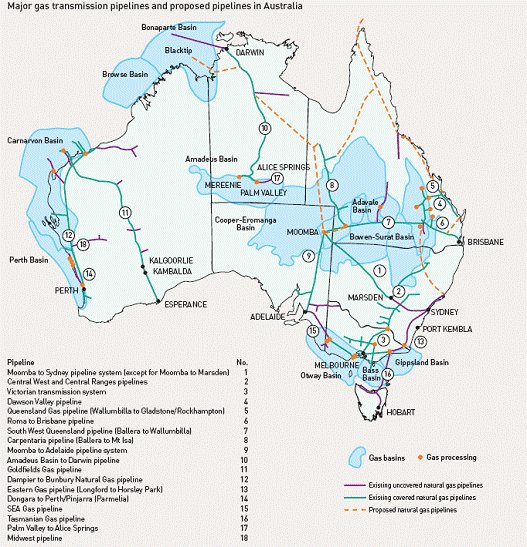
In my recent post on Australian natural gas supplies, I mentioned that the big unknown when estimating reserves is the amount of coal seam methane (CSM - also known as coal seam gas or coal bed methane) that can potentially be extracted.

The coal seam gas sector has been pioneered in Australia by Queensland Gas (QGC) and Arrow Energy, with Origin Energy and Santos also emerging as major players, along with a host of smaller competitors - primarily in the Surat and Bowen basins in Queensland.

Exploration is now expanding to the Galilee Basin and Millungera Basin in Queensland, the Gunnedah Basin and Clarence Morton Basin in NSW and regions in other states like Western Australia.


Some international players like Conoco, Amoco and Enron have also tried to become CSG producers, without success.

There has been a lot of corporate activity in this area lately, including:

* The failed bid by BG (British Gas) for Origin Energy, the largest local CSM producer. Origin instead did a $9.6 billion deal with ConocoPhillips acquiring a half share in Origin's CSG assets.

* Petronas acquiring a stake in Santos' planned CSM to LNG plant.

* Shell buying a stake in the CSM gas projects of Arrow Energy.

* QGC making a $900 million bid to buy Sunshine Gas.

Smaller CSM operators like Beach Petroleum have been pondering their now substantially enlarged valuations and wondering if "prices might have been blown out of proportion".

CSG currently accounts for around 15% of gas production in the eastern states (and over 70% of production in Queensland). According to consultants EnergyQuest, CSG production is growing rapidly, as are proven and probable reserves.
"In less than five years the east coast has gone from facing a looming gas shortage to having more than enough gas to meet local demand and export overseas," EnergyQuest CEO Graeme Bethune says.

Output in the June quarter rose by 34 per cent to 36.9 petajoules on a year-by-year basis. Over the year, proven CSG reserves have almost doubled from 6600PJ to 12,400PJ.

Oil companies like AWE are also considering expanding into the CSG sector.


Total coal seam methane reserves in Australia are hard to get a handle on - The Australian claims that "as a guide, Queensland now has bigger estimated reserves of gas than offshore Western Australia", though they fail to quantify this or point to a source for the data. The SMH says "analysts believe the state might ultimately hold just as vast resources of coal-seam gas as [Queensland]".
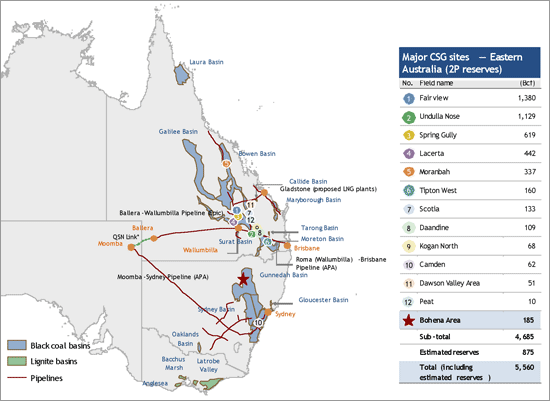


Source: Wood Mackenzie, ABARE (via Eastern Star Gas)
Notes: Reserves announced up to 1 January 2007.

The Business Spectator had some numbers in this article on Phil Mathews ("Australia's peak oil billionaire), claiming Santos alone has 100 tcf of CSG (in comparison, Australia's proven natural gas reserves are around 150 tcf). Santos recently said it likely has a 40 tcf resource in the Gunnedah Basin alone.
That stake in Santos is worth $660 million. Mathews told me this morning that his main fund – called the Sabre Fund - totals $2 billion, and there are two others in his stable worth a total of $1.5 billion, called the Tomahawk Fund and the Velocity Fund. So he has a third of his main fund in Santos. This is a man who likes a big bet.

According to other recent substantial shareholder filings Mathews also owns 19.6 million shares in Nexus Energy, 15.4 million in Arrow Energy, 9.6 million in Metgasco and 6.5 million in Pure Energy. On top of that he also owns 93 million shares or 10.5 per cent of Renison. ...

[Mathews] wouldn't comment on the stories about a big oil futures bet, but one thing we know for sure: he is making a massive bet on coal seam gas. “It’s bigger than the Bass Strait,” he told me. “Santos has 100 trillion cubic feet, which is equivalent to 40 billion barrels of oil. 40 billion barrels! That’s bigger than that new oil discovery off Brazil.”

Eastern Star Gas estimates that resources of CSG in Queensland and New South Wales are more than 250 Tcf. The same figure is quoted in this interview with Belinda Robinson of the APPEA.
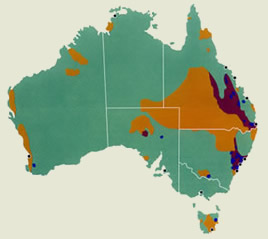
The 250 tcf number is also quoted by Arrow Energy's CEO Shaun Scott, referring to an estimate from the CSIRO.
Certainly in Queensland as you know there's lots and lots of coal. Coal seam gas is really created at the same time the coal's made. So, you know, coal exploration's been going on for a lot longer than coal seam gas so we know a lot about coal and where it is and the properties of it and we know there's gas in it. So I think, you know. From a resource potential. It's enormous, CSIRO I think estimating in Queensland somewhere between 250 to 300 trillion cubic feet of resource exists in coal seam gas.

Santos CEO David Knox is also quoting the 250 tcf figure for Queensland, though he quotes ABARE rather than the CSIRO.
ABARE has said there's 250 TCF of gas in eastern Australia. ... Whether there's 250 [TCF] still has to be proven. Right now our proven resources are much smaller than that.


I came across the CSIRO study mentioned about 3 years ago, but my bookmark has succumbed to linkrot and I've been unable to find the paper on a recent search.

The CSIRO is also investigating if injecting microbes and carbon dioxide into coal seams can produce commercially viable quantities of methane.

CSG to LNG

Using coal seam methane for LNG is a new development - until now this hasn't occurred as the gas does not contain the higher value liquids (LPG and condensates) that can offset the high capital cost of an LNG development.

Rising LNG prices seem to have changed this equation, with the cost of producing LNG from CSG estimated to be around $2.60 per gigajoule while (according to The Australian) Asian customers will pay around $12 per gigajoule.

Several LNG project development proposals have been made for sites at Gladstone in Queensland by a number of groups, with 5 major projects currently under consideration.

* Origin Energy and ConocoPhilips plan to build a 7 million tonnes per annum LNG plant, which they hope to eventually increase to 14 million tonnes, with first shipments starting in 2014. By way of comparison, he east coast of Australia currently consumes about 9 million tonnes each year.

* Santos and Petronas are proposing to develop a 3—4 mmtpa LNG plant costing around $7 billion and commencing operation in 2014, which they would like to eventually increase to 8 million tonnes.

* BG and QGC are also proposing a 3—4 mmtpa LNG plant costing around $8 billion which they hope to eventually increase to 12 million tonnes. The first shipment is expected in 2013.

* Arrow and Shell are working with LNG Ltd to a proposed 1.3 mmtpa LNG facility (though doubling the capacity is under consideration) at Fisherman's Landing. Arrow Energy plans to build a pipeline from Moranbah to supply the gas. The plant has been delayed by the credit crunch, with LNG looking for more equity to compensate for frozen debt markets.

* Sunshine Gas is working with Sojitz to develop a 0.5 mmtpa LNG plant. Production is planned in 2012. Sunshine is the subject of a takeover bid from QGC, which would remove this project from the equation if successful.

Extracting gas from coal seams requires a lot more drilling than extracting conventional natural gas, which has led existing Australian LNG exporter Woodside to downplay the likelihood of competition emerging on the east coast.
Woodside's Don Voelte is on the record as saying that not only does he know a bit about coal seam gas but he doesn't think much of it. He told ABC television in July: "No LNG plants have been built based on coal bed methane. It takes literally thousands of wells. There are a lot of issues around. It's a low quality gas. We've looked at it. We have an opinion about it, and we're pretty happy with our gas."

Regarding the "low quality gas" jibe, both Arrow and QGC are both claiming their is no difference in gas quality and that Japanese customers are very interested in buying LNG from the projects when it becomes available.

QGC's Richard Cottee has more comments on the quality issue at the Business Spectator:
Richard Cottee: This is a very unusual situation for the Australian gas market in the sense that it’s actually not market constrained. The demand for LNG is highly elastic. For example LNG demand in China is presently 3 million tonnes per annum and projected to go to about 30 million tonnes per annum by 2020 which in the context of Japan, which at the same time will be 80 million tonnes per annum, shows that obviously the demand’s not the issue. The real problem I think is going to be market acceptance because this is the first…this will be CBM and it’s the first time that that’s actually going to be used for LNG.

AK: What do you mean by that?

RC: Coal-seam gas or 'coal-bed methane' – CBM. It’s the same concept. CBM is the American term...we’re divided by a common language so we had to invent our own acronym for it.

AK: And what do you mean by market acceptance?

RC: Well there’s two prime issues there. Historically LNG started off with what they call some degree of liquids in it because they couldn’t strip out the butane and the propane efficiently 20 years ago. They can now, so they’ve clearly left some of the LPGs – 1 or 2 per cent of the LPGs. Now coal-bed methane is pure methane which is a cleaner fuel from the point of view of greenhouse gases – but vis-a-vis what’s presently being traded it has got a slightly lower calorific value. Now that doesn’t cause any problems, we believe, with power stations and various others but if you’ve got town gas in say Tokyo or Osaka that is predicated on a particular quality, then each of the mums and dads there may have to have a slight conversion of the gas heaters and so on to take a different quality…

AK: You’re saying that coal-seam methane is not appropriate for domestic use?

RC: I am saying it is appropriate provided you get the right customer who will then commingle it with other energy. Obviously that means you’re talking about big customers or if you get into a new market like China, then they will be more likely to want to build at the leaner end… because of the less pollution that the pure gas will provide.


The Business Spectator notes that the economics of unconventional gas are "radically different – but not necessarily either inferior or superior – to conventional gas".
A recent comparison of conventional LNG projects with coal seam gas projects by Deutsche Bank analysts illustrated the differences neatly. They compared Woodside’s Pluto project with Santos’ Gladstone LNG (GLNG) project, which will source gas from its Fairview resource.

Pluto will drill five wells to support its initial LNG production. GLNG will drill 540. Pluto will increase its number of wells to 8, while GLNG will be adding about 60 wells a year.

The ramp up period to first production is about five days for Pluto, but two years for GLNG, while production per well is about 120 million cubic feet of gas a day for Pluto and only about one million cubic feet per well for Fairview. Total production for Pluto would be around 614 million cubic feet where Fairview is expected to produce 526 million cubic feet.

So, at face value, coal seam gas involves far more drilling for significantly less production and, because coal seam gas contains no liquids, significantly less valuable production.

The capital expenditure on the upstream phase of the development to bring Pluto into production, however, is about $5 billion, whereas Fairview will cost only about $1.2 billion – that’s the difference between an offshore development and an onshore project. Moreover, where Pluto faces a petroleum resource rent tax rate of 40 per cent, as an onshore project Fairview will only pay royalties of 10 per cent – the upstream tax take, the analysts say, will be $6.7 billion for Pluto but only $2.3 billion for Fairview.

As Santos says, the growth in Australian coal seam gas production is following a similar path to coal seam gas in the US, although average production from the Queensland fields is substantially greater than from the average well in the US – Santos says the Australian resources are of better quality than those in the US.

The downside for eastern states gas customers is that once local gas producers have an export market it is likely that domestic prices will rise towards those paid by overseas customers. This may result in some mild form of resource nationalism being adopted, similar to the law passed in Western Australia that mandates 15% of production be reserved for the local market.

CSG For Power Generation

In 2000, the then Beattie government in Queensland mandated that 13% of the state's electricity be sourced from gas by 2005 (this has since been raised to an 18% target for 2020). At the time, this was believed to be an incentive to build the planned Papua New Guinea gas pipeline (which has since been cancelled, with an LNG development in PNG likely to ship gas to Asian markets instead).

During this timeframe CSG explorers kept proving reserves in the Bowen and Surat Basins and signing agreements to supply gas-fired power stations, while existing sources of gas supply, such as Bass Strait and the Cooper Basin, have plateaued.

As a result, construction of gas fired power stations using CSG is booming, creating what one ABC reporter termed a "carbon war" between coal and gas for power generation. As gas fired power emits around half the carbon dioxide that coal does (leading the APPEA to market it as a "transition fuel" to a low carbon economy), it seems likely that gas will win in the medium term - especially if the proposed Emissions Trading Scheme is implemented.
Ian Townsend: The carbon war between gas and coal is already under way.

Two weeks ago, the Queensland Gas Company said it was going to spend $600-million on a gas-fired power station in the Hunter Valley. In fact, the Queensland Gas Company's already building its first power station on top of its gas reserves near Condamine, a bit further west of Chinchilla.

Richard Cottee: The gas is coming straight out of the ground, not even being compressed. and thrown straight into the power station. Can you imagine the energy savings on that? And therefore carbon savings, and you start to become just eternally efficient; you don't waste any energy, and the water the power station's using for cooling is coming from your own water. A Scottish frugality I think we'd call it.

Ian Townsend: You've still got to push the energy out, though, into the grid if you want to build big power stations and supply a large proportion of the state, or even in New South Wales; is it more efficient to have a power station on top of the gas and push the electricity out?

Richard Cottee: Obviously it depends where the gas is discovered. In the past everyone had assumed that whoever made the gas had a wry sense of humour, and they put it in the worst possible location, whether it was Bass Strait, North West Shelf or the centre of Australia. So therefore you couldn't possibly build an industry in situ, but with coal seam gas, it's where the coal is. And coal is the predominant fuel source of the 1800s, and therefore is the place where the industrialisation occurred. It doesn't matter whether you're talking about the Ruhr or Pennsylvania or Newcastle in Australia, or Ipswich in Queensland, the population centres went where the coal was. And the industrialisation occurred where the coal was. So therefore you've suddenly got capturing this new source of energy that was always there, called coal seam gas, where the demand is. The Queensland-New South Wales interconnector goes straight through our acreage, so it makes eminent sense.

Ian Townsend: Gas power stations are starting to pop up all across the Darling Downs.

The Darling Downs is one of Australia's big food bowls but there's also this sense that there's an industrial revolution under way here.

Just off a side road near Dalby, tucked behind some scrub, is another power station.

Man: Well to tell you the truth he's putting in about 30 megawatts but it does the local area, ...

Ian Townsend: The Daandine Power Station's run by just two people. It's a series of big generators set up by Clark Energy, and it basically runs itself. The gas comes out of the ground; it's fed into these big motors, and out the other side comes electricity, enough to power the town of Dalby, with a bit for the grid.

Down the road, bigger power stations are being built.

Other recently built or under construction gas fired power plants include:

* Origin is building a 630 MW air cooled, combined cycle power station at Darling Downs using CSG.

* Origin is also planning a 1000 MW combined cycle power station at Spring Gully, colocated with a CSG development.

* Anglo Coal has opened a 32MW CSG fired power station at its German Creek mine in Queensland.

* QGC is building a 135 MW plant at Condamine,

* QGC is planning a gas-fired power station in the Hunter Valley (and an accompanying $850 million pipeline to bring gas down from Queensland).

* Energy Developments is building a 40 MW plant at the Monanbah North colliery, using coal mine methane.

* Various other CSG companies, including Arrow and Eastern Star Gas, own or operate smaller power stations using CSG as feedstock.

* Metgasco is building a 30 MW CSG fired power plant at Casino in northern NSW.

* Delta Energy is building the 667 MW Colongra plant at the existing Munmorah coal fired plant site in NSW. This plant is an open cycle peaking plant rather than a (significantly more efficient) closed cycle plant than can run continuously - apparently because gas supplies in NSW are so limited that they couldn't obtain the necessary gas volumes for full time operation (the plant can operate around 5 hours per day, with gas stored in a giant pipe that snakes around the complex).

* TRUenergy is building the 400 MW Tallawarra combined cycle gas power plant near Wollongong in NSW.

* Babcock & Brown has built a 640 MW open cycle gas power plant at Uranquinty, near Wagga Wagga in NSW.
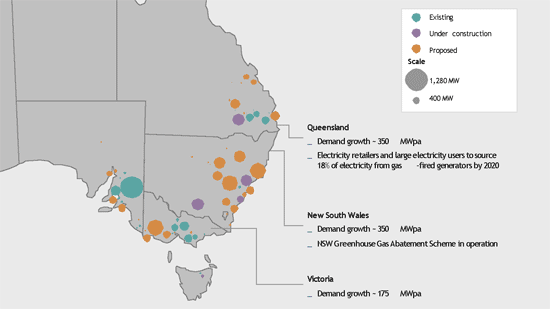


At one point Santos had a project proposed called Fairview which would have used coal seam gas to run a power station at Injune in Queensland, which was to sequester the carbon dioxide produced in order to qualify for funding from the Federal Government's low emissions demonstration fund, however this development has fallen through on economic grounds (like many other proposed clean coal initiatives over the years).

The Business Spectator claims that one problem with drilling for CSG is that once the gas is flowing, you need to use it, which is a positive for power generation until the planned LNG plants are online.
The major issue not getting much attention is the big difference between CSG and regular natural gas is that with the latter, once discovered and proved up, you just turn off the tap until you want to go into production. With CSG that's not possible. You can tweak a bit, but essentially the gas will continue to flow whether you can use it or not. All but one of the LNG/CSG plays have a looming issue with ALL the gas they're proving up for their large LNG trains will be next to useless to them until those trains come onstream. Arrow is best placed as it has under capacity in it's electricity plants, with more being added, so it can divert the gas that will eventually go to LNG to the electricity plants. They will probably be able to buy some of the useless gas off the others as well. This is why they went the smaller model route. They will be in production well before any of the bigger players and they don't have to prove up as much gas on the way.

One issue facing CSG based power generators is a lack of transmission capacity, with Queensland grid company Powerlink estimating that $2.9 billion will need to be spent extending the grid over the next five years to handle CSG and renewables powered generation (expansion of the grid - and generation capacity - in Queensland and NSW in particular is urgently required after decades of under-investment and rapidly rising demand).

If some of the geothermal power projects in outback South Australia are successful, this additional grid investment could be the first step towards a Queensland - South Australia interconnector and eventually a national electricity grid (ideally linking in some large scale solar thermal power stations as well, like the ones proposed by Worley Parsons, and perhaps some ocean energy plants like the ones proposed by Carnegie Corp).

Waste Water From CSG

The process of extracting coal seam gas produces large amounts of (non-potable) water as a by-product - as an example, QGC estimates that it will be producing 100 megalitres of water a day at its Condamine field in south east Queensland within a decade.

Waste water is often one of the drivers for groups opposing the development of CSG projects. The Queensland government has commissioned a feasibility study into the use of this water for agriculture and industry purposes, looking at treatment and transmission costs.

Queensland farming lobby group Agforce has been unenthused by the prospect of using CSG waste water for agriculture - and warns that salt and other contaminants could do serious environmental damage if not treated properly.
AgForce water spokesman, Kim Bremner, says an environmental disaster is also waiting to happen and the companies chasing the gas need to be held accountable and responsible for ensuring this is averted.

"The prime agricultural land on the Darling Downs is essential for Queensland's future food supplies and should not be compromised by an extractive industry that is building multiple pipelines and vast evaporation ponds across the landscape but may only be around for 20-30 years," Mr Bremner said.

"The evaporation ponds popping up all over the Downs will have long-term ramifications on farmland availability as well as the quality of soils, ground water in aquifers and flood plain areas. Condamine Alliance figures predict that if all proposed coal seam gas development goes ahead, there will be 50,000 hectares of evaporation ponds. This will result in millions of tonnes of salt across the landscape. From just one small field south of Dalby, it has been estimated more than 400,000 tonnes of salt will be brought to the surface with the associated water."

According to AgForce, each megalitre of coal-seam gas water has between 1300 and 9000ppm salt, compared with normal river water which is 250ppm. Cattle cannot drink water with more than 2000ppm and on certain soils that level of salts can destroy the land.

Origin has opened a reverse osmosis desalination plant at Spring Gully which can process nine megalitres per day, which should overcome some of the fears, but there are still questions about what will be done with the salt and other impurities.

Origin is also planning to use water produced at the site to cool its Spring Gully power plant, which seems to be a way of solving both the waste water problem and the problems obtaining water experienced by other Queensland power stations in recent years.

The Dutch Disease

In my post on Australian natural gas reserves I noted that fossil fuel exports form a large and growing proportion of the Australian economy, and that we are at risk of contracting what is known as "the dutch disease".
Another impact of the LNG export industry is that it will further increase the nation's dependence on income from fossil fuel exports.

Coal is currently our major export earner, which has prompted concern about Australia suffering from what is known as "The Dutch Disease" - the theory that an increase in revenues from natural resources will deindustrialise a nation’s economy by raising the exchange rate, which makes the manufacturing sector less competitive. The term was coined in 1977 by The Economist to describe the decline of the manufacturing sector in the Netherlands after the discovery of natural gas in the 1960s.

With the value of gas exports likely to rise to a similar level to that of coal if all the planned LNG projects go ahead, we could see more than a quarter of national GNP coming from these 2 industries.

A large Queensland LNG export industry based on coal seam gas will obviously further exacerbate this risk, as the economy becomes even more heavily weighted towards resources.


CSG vs UCG

Another process for extracting energy from coal seams is known as underground coal gasification (UCG). UCG is being trialled at Chinchilla on Queensland's Darling Downs by a company called Linc Energy, which is using the process to produce syngas, then converting the syngas into liquids using the Fischer Tropsch process (ie. a coal to liquids project).

The company is claiming it can produce syngas for about 70c a gigajoule, which The Australian claims is "causing some discomfort for Queensland's coal seam methane producers". The company also claims UCG produces 20 times more gas for a given volume of coal than CSM can.

However, the Queensland state government has concerns that the UCG process may be more environmentally unfriendly than CSG extraction, and is "putting the brakes" on the industry while it asks Linc to prove that its process does not contaminate groundwater.

While some skeptical observers seem to think that this may be a case of the CSG / LNG industry using the state government to minimise competition for coal tenements, it would seem possible that UCG could be performed on coal seams after the CSG has been extracted, thus enabling two bites to be taken of the cherry (which wouldn't be the case if UCG was performed first). I'm just speculating here though - any better informed comments are welcome.

UCG projects are being considered outside Queensland - one recent proposal talked about using coal deposits offshore from NSW.

Coal Seam Gas In New Zealand

Coal seam gas has appeared in national gas reserve estimates for the first time this year. Solid Energy is exploring for CSG on the North Island, with 300 PJ of gas estimated to be available in the Huntly field. L&M Petroleum has been exploring for gas on the South Island, with encouraging discoveries so far leading to estimates of around 300 PJ of gas.

Coal Seam Gas Elsewhere

Coal seam gas is also produced in the United States and Canada. The US Geological Survey estimates there is more than 700 tcf within the US of which at least 100 tcf is economically viable to produce. The Economist recently noted that American gas production grew 4.3% last year, and by 9% in the first quarter of this year and quoted a CERA spokesman claiming that this spurt will delay America’s emergence as a big importer of LNG by a decade.

One report, "Overview of Unconventional Natural Gas and its Impact on Supply" (pdf) estimates that 300 tcf are technically recoverable and that 110 tcf could be produced by 2020.


Known Canadian resources are of the order of 300 tcf.

There are also reports of Asian reserves of around 2,100 tcf - including 1,000 tcf in China, where the government is looking to rapidly increase production. There is also interest in CSG production emerging in India, with reserves estimated to be around 16 tcf, and in Indonesia (Sumatran resources are estimated to be 240 tcf), where there is talk of building CSG LNG plants in Kalimantan in future.

Old coal mining regions in Europe may also get in on the act, with some people in Wales already talking about setting up a sovereign wealth fund to handle potential revenues from coal seam gas production in the valleys (maybe getting just a little ahead of themselves).

Conclusion

While the idea that the the merchants of coal seam gas will become the new "masters of the universe" seems unlikely, there is no doubt that the past decade has seen a rapid turnaround in the fortunes of the energy compared to those of the financial industry (an event which recurs periodically, if you view history through the right lens) and that coal seam gas is likely to become a significant contributor to the Australian economy.

When I looked at Australian natural gas reserves alone, I concluded that we could ramp up LNG exports, increase domestic gas consumption for power generation and use CNG for vehicles, and still have enough gas to last around 4 decades.

If the estimates for coal seam gas reserves of over 300 tcf are correct, then we may well still be using gas in Australia on a large scale 70 years from now - assuming global warming hasn't worsened to the point that all carbon emissions are banned entirely of course.

Other countries with large coal resources (particularly the US, China and India) would seem likely to increase CSG production over time as well. It would be interesting to see any studies that have estimated the global potential for CSG and what effect they have on the peak production point for gas, as the gas depletion models I've seen seem to focus exclusively on natural gas.

Related posts:

Peak Energy - Australian Natural Gas - How Much Do We Have And How Long Will It Last ?
http://peakenergy.blogspot.com/2008/06/no-post-tonight.html (TOD ANZ)

The Oil Drum - Will Unconventional Natural Gas Save Us?
http://www.theoildrum.com/story/2006/3/8/222920/5485

The Oil Drum - US Natural Gas: The Role of Unconventional Gas
http://www.theoildrum.com/node/3981

The Oil Drum - Can US Natural Gas Production Be Ramped Up?
http://www.theoildrum.com/node/4436

The Oil Drum - Chesapeake's Cutback of Natural Gas Expenditures
http://www.theoildrum.com/node/4562

Peak Energy - Coal To Liquids In Australia
http://peakenergy.blogspot.com/2008/04/coal-to-liquids-in-australia.html (TOD ANZ)

Peak Energy - Queensland's Shale Oil Billions in The Balance ?
http://peakenergy.blogspot.com/2007/12/queensland-shale-oil-billions-in.html (TOD ANZ)

Peak Energy - Gas To Liquids On The North West Shelf
http://peakenergy.blogspot.com/2008/03/gas-to-liquids-plant-for-north-west.html (TOD ANZ)

Peak Energy - Cogeneration At Home: Ceramic Fuel Cells And Bloom Energy
http://peakenergy.blogspot.com/2008/03/cogeneration-at-home-ceramic-fuel-cells.html (TOD ANZ)

Peak Energy - Banana Methane Powered Cars, Pig Poo Power And Other Uses For Biogas
http://peakenergy.blogspot.com/2008/03/banana-methane-powered-cars-pig-poo.html (TOD ANZ)

Statistics

Locations of visitors to this page

blogspot visitor
Stat Counter

Total Pageviews

Ads

Books

Followers

Blog Archive

Labels

australia (619) global warming (423) solar power (397) peak oil (355) renewable energy (302) electric vehicles (250) wind power (194) ocean energy (165) csp (159) solar thermal power (145) geothermal energy (144) energy storage (142) smart grids (140) oil (139) solar pv (138) tidal power (137) coal seam gas (131) nuclear power (129) china (120) lng (117) iraq (113) geothermal power (112) green buildings (110) natural gas (110) agriculture (91) oil price (80) biofuel (78) wave power (73) smart meters (72) coal (70) uk (69) electricity grid (67) energy efficiency (64) google (58) internet (50) surveillance (50) bicycle (49) big brother (49) shale gas (49) food prices (48) tesla (46) thin film solar (42) biomimicry (40) canada (40) scotland (38) ocean power (37) politics (37) shale oil (37) new zealand (35) air transport (34) algae (34) water (34) arctic ice (33) concentrating solar power (33) saudi arabia (33) queensland (32) california (31) credit crunch (31) bioplastic (30) offshore wind power (30) population (30) cogeneration (28) geoengineering (28) batteries (26) drought (26) resource wars (26) woodside (26) censorship (25) cleantech (25) bruce sterling (24) ctl (23) limits to growth (23) carbon tax (22) economics (22) exxon (22) lithium (22) buckminster fuller (21) distributed manufacturing (21) iraq oil law (21) coal to liquids (20) indonesia (20) origin energy (20) brightsource (19) rail transport (19) ultracapacitor (19) santos (18) ausra (17) collapse (17) electric bikes (17) michael klare (17) atlantis (16) cellulosic ethanol (16) iceland (16) lithium ion batteries (16) mapping (16) ucg (16) bees (15) concentrating solar thermal power (15) ethanol (15) geodynamics (15) psychology (15) al gore (14) brazil (14) bucky fuller (14) carbon emissions (14) fertiliser (14) matthew simmons (14) ambient energy (13) biodiesel (13) investment (13) kenya (13) public transport (13) big oil (12) biochar (12) chile (12) cities (12) desertec (12) internet of things (12) otec (12) texas (12) victoria (12) antarctica (11) cradle to cradle (11) energy policy (11) hybrid car (11) terra preta (11) tinfoil (11) toyota (11) amory lovins (10) fabber (10) gazprom (10) goldman sachs (10) gtl (10) severn estuary (10) volt (10) afghanistan (9) alaska (9) biomass (9) carbon trading (9) distributed generation (9) esolar (9) four day week (9) fuel cells (9) jeremy leggett (9) methane hydrates (9) pge (9) sweden (9) arrow energy (8) bolivia (8) eroei (8) fish (8) floating offshore wind power (8) guerilla gardening (8) linc energy (8) methane (8) nanosolar (8) natural gas pipelines (8) pentland firth (8) saul griffith (8) stirling engine (8) us elections (8) western australia (8) airborne wind turbines (7) bloom energy (7) boeing (7) chp (7) climategate (7) copenhagen (7) scenario planning (7) vinod khosla (7) apocaphilia (6) ceramic fuel cells (6) cigs (6) futurism (6) jatropha (6) nigeria (6) ocean acidification (6) relocalisation (6) somalia (6) t boone pickens (6) local currencies (5) space based solar power (5) varanus island (5) garbage (4) global energy grid (4) kevin kelly (4) low temperature geothermal power (4) oled (4) tim flannery (4) v2g (4) club of rome (3) norman borlaug (2) peak oil portfolio (1)