Showing posts with label scenario planning. Show all posts

Paul Hawken's "Drawdown" project  

Posted by Big Gav in , , ,

Dave Roberts at Vox has an interview with Paul Hawken about his book on the "Drawdown" project to assess the effectiveness of carbon emission reduction options - A new book ranks the top 100 solutions to climate change. The results are surprising..

Hawken is a legend in environmental circles. Since the early 1980s, he has been starting green businesses, writing books on ecological commerce (President Bill Clinton called Hawken’s Natural Capitalism one of the five most important books in the world), consulting with businesses and governments, speaking to civic groups, and collecting honorary doctorates (six so far).

A few years ago, he set out to pull together the careful coverage of solutions that had so long been lacking. With the help of a little funding, he and a team of several dozen research fellows set out to “map, measure, and model” the 100 most substantive solutions to climate change, using only peer-reviewed research.

The result, released last month, is called Drawdown: The Most Comprehensive Plan Ever Proposed to Reverse Global Warming.

Unlike most popular books on climate change, it is not a polemic or a collection of anecdotes and exhortations. In fact, with the exception of a few thoughtful essays scattered throughout, it’s basically a reference book: a list of solutions, ranked by potential carbon impact, each with cost estimates and a short description. A set of scenarios show the cumulative potential.

It is fascinating, a powerful reminder of how narrow a set of solutions dominates the public’s attention. Alternatives range from farmland irrigation to heat pumps to ride-sharing.

The number one solution, in terms of potential impact? A combination of educating girls and family planning, which together could reduce 120 gigatons of CO2-equivalent by 2050 — more than on- and offshore wind power combined (99 GT).

Also sitting atop the list, with an impact that dwarfs any single energy source: refrigerant management. (Don’t hear much about that, do you? Here’s a great Brad Plumer piece on it.)

Both reduced food waste and plant-rich diets, on their own, beat solar farms and rooftop solar combined.

(Important note: The above comparisons are true in Drawdown’s central, “probable” scenario. There are also more ambitious scenarios, in which each solution is pushed to its full potential. In the “optimum” scenario, onshore wind rises to crush all competitors, reducing 139 GT. All scenarios use only existing, commercialized technologies, so they should be considered conservative. All the solutions, data, and references are available at drawdown.org.)

The Limits to Growth was right ?  

Posted by Big Gav in ,

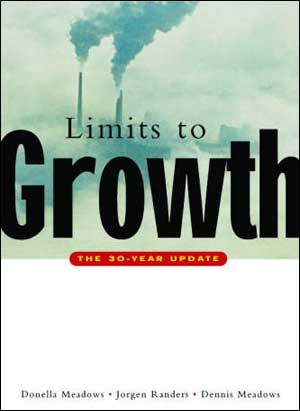
The Guardian has an article on "The Limits to Growth", written by a pair of Australians researchers from the University of Melbourne, claiming we are currently tracking to LTG's "baseline scenario" - Limits to Growth was right. New research shows we're nearing collapse.

Unlike most media reports referencing LTG it demonstrates the authors actually read and understood the book. The paper it is based on is here (pdf).

The 1972 book Limits to Growth, which predicted our civilisation would probably collapse some time this century, has been criticised as doomsday fantasy since it was published. Back in 2002, self-styled environmental expert Bjorn Lomborg consigned it to the “dustbin of history”.

It doesn’t belong there. Research from the University of Melbourne has found the book’s forecasts are accurate, 40 years on. If we continue to track in line with the book’s scenario, expect the early stages of global collapse to start appearing soon.

Limits to Growth was commissioned by a think tank called the Club of Rome. Researchers working out of the Massachusetts Institute of Technology, including husband-and-wife team Donella and Dennis Meadows, built a computer model to track the world’s economy and environment. Called World3, this computer model was cutting edge.

The task was very ambitious. The team tracked industrialisation, population, food, use of resources, and pollution. They modelled data up to 1970, then developed a range of scenarios out to 2100, depending on whether humanity took serious action on environmental and resource issues. If that didn’t happen, the model predicted “overshoot and collapse” – in the economy, environment and population – before 2070. This was called the “business-as-usual” scenario.

The book’s central point, much criticised since, is that “the earth is finite” and the quest for unlimited growth in population, material goods etc would eventually lead to a crash.

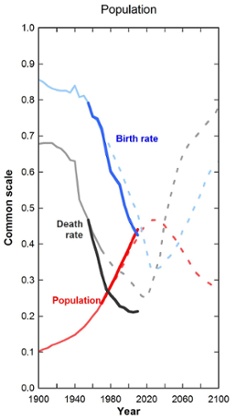
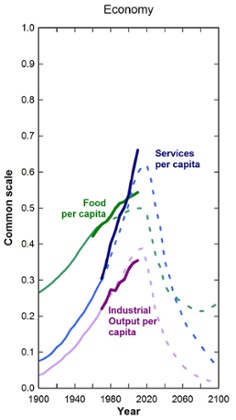
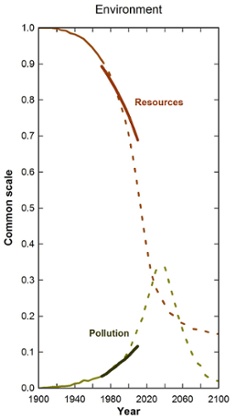
So were they right? We decided to check in with those scenarios after 40 years. Dr Graham Turner gathered data from the UN (its department of economic and social affairs, Unesco, the food and agriculture organisation, and the UN statistics yearbook). He also checked in with the US national oceanic and atmospheric administration, the BP statistical review, and elsewhere. That data was plotted alongside the Limits to Growth scenarios.

The results show that the world is tracking pretty closely to the Limits to Growth “business-as-usual” scenario. The data doesn’t match up with other scenarios.

These graphs show real-world data (first from the MIT work, then from our research), plotted in a solid line. The dotted line shows the Limits to Growth “business-as-usual” scenario out to 2100. Up to 2010, the data is strikingly similar to the book’s forecasts.

I'd like to think with a bit of determined effort that instead of falling into the "baseline scenario" outlined above that we can instead switch gears to "scenario 9" as outlined in Limits to Growth (shown below).

Shell "New Lens" Scenarios 2013 - Mountains and Oceans  

Posted by Big Gav in , ,

The Harvard Business Review has an article on Shell's scenario planning practice over the years - Living in the Futures - going back to it's genesis in 1965 and chronicling the evolution of the practice over the years.

The authors of the article are a former Shell scenario planner and a former Shell executive who recently completed a history of scenario planning at the company after interviewing almost every surviving veteran of the operation, along with current and former top company executives. They identified the following principles that have been followed by scenario planners over the years:

  • Make It Plausible, Not Probable
  • Strike a Balance Between Relevant and Challenging
  • Tell Stories That Are Memorable Yet Disposable - You are trying to manipulate people into being open-minded.
  • Add Numbers to Narrative
  • Scenarios Open Doors
  • Manage Disagreement as an Asset
  • Fit into a Broader Strategic Management System

The 2013 scenarios were released in March, dubbed the "News lens Scenarios" (pdf), looking at 2 scenarios - "Mountains" and "Oceans".

With the world’s population headed toward 9 billion at mid-century and millions of people climbing out of poverty, global energy demand could increase by as much as 80% by 2050. That’s according to Shell’s latest scenarios, which look at trends in the economy, politics and energy in considering developments over the next half a century.

What might lie ahead 50 years from now… or even in 2100? We consider two possible scenarios of the future, taking a number of pressing global trends and issues and using them as “lenses” through which to view the world.

The scenarios provide a detailed analysis of current trends and their likely trajectory into the future. They dive into the implications for the pace of global economic development, the types of energy we use to power our lives and the growth in greenhouse gas emissions.

The scenarios also highlight areas of public policy likely to have the greatest influence on the development of cleaner fuels, improvements in energy efficiency and on moderating greenhouse gas emissions.

Mountains

The first scenario, labelled “mountains”, sees a strong role for government and the introduction of firm and far-reaching policy measures. These help to develop more compact cities and transform the global transport network. New policies unlock plentiful natural gas resources – making it the largest global energy source by the 2030s – and accelerate carbon capture and storage technology, supporting a cleaner energy system.

Oceans

The second scenario, which we call “oceans”, describes a more prosperous and volatile world. Energy demand surges, due to strong economic growth. Power is more widely distributed and governments take longer to agree major decisions. Market forces rather than policies shape the energy system: oil and coal remain part of the energy mix but renewable energy also grows. By the 2070s solar becomes the world’s largest energy source.

The Limits to Growth Revisited  

Posted by Big Gav in , ,

Ugo Bardi at Cassandra's Legacy has a post on his new book on The Limits To Growth - The Limits to Growth Revisited. You can read the book online here at Springer Link.

In some respects, "The Limits to Growth Revisited" is a rather technical book. It goes in some depth in describing the controversy that flared between critics (mainly economists) and supporters of the system dynamics methods used for the 1972 study "The Limits to Growth" (LTG). But "LTG revisited" is not just a technical book. It also tells the whole story of the LTG study: how it was conceived, what were the political reactions to it, how it was demonized and misunderstood, and what is its relevance - also in its more recent versions of 1992 and 2004 - to the present situation of the world.

Writing this book has been a fascinating work. Re-examining the story of LTG opens up a whole new world that urban legends and propaganda had tried to bury under a layer of lies and misinterpretations. We all have heard of the "mistakes" that the authors of LTG, or their sponsors, the Club of Rome, are said to have made. But LTG was not "wrong": nowhere in the 1972 book you find the mistakes that are commonly attributed to it. LTG never predicted catastrophes to occur soon, never estimated that some specific mineral resources should run out by some specific date, it never contained prophecies of doom. In other words, LTG was not, and never was, "Chicken Little with a computer."

What caused the demonization of the study was, in large part, the fact that it was so new and so advanced for its times that it was widely misunderstood, often by its supporters as well as by its detractors. But the misunderstanding was enhanced by a media campaign very similar to the one that has been recently directed against climate science. The trick of these campaigns is always the same: find a single mistake and use it to demonize the whole concept. It doesn't matter that the mistake is real or an invention, it doesn't count whether it is relevant or not. The trick is to repeat the concept of "mistakes" a large number of times and that is enough to confuse the public and cloud the issue. In recent times, the method has been used to demonize climate science with the alleged mistake found in the "hockey stick" temperature reconstruction of past climate. For LTG, the "mistake" was found in a few numbers taken from just one of the many tables of the 1972 book. There was nothing wrong in these numbers, but the concept of the "mistakes of the Club of Rome" went viral and it is still widespread, and perhaps prevalent, whenever the LTG study is mentioned today.

Understanding the real message that LTG sent to us in 1972, and that it is still sending, takes a certain effort. First, you have to free your mind from the layers of legends that have accumulated around it over four decades, but that is not enough. You have to free yourself also from the common attitude that prevents us from understanding how complex systems behave. There is no fixed future for systems such as the world's economic system, only trends. But these systems still obey physical laws: the limits of natural resources, the finiteness of the world system, the concentration of greenhouse gases in the atmosphere. And there are the constants of human behavior: mainly our tendency of preferring immediate satisfaction to a future one, a phenomenon known as "discounting the future."

All together, these factors push the world system to follow a well defined path. We cannot determine exactly what the future will be, but we can produce a "fan" of trajectories that show to us how where the system is heading to. The original 1972 LTG study had already identified the main factors that have been dominating the behavior of the world's economy. The combined effects of resource depletion and pollution accumulation (seen today mainly in terms of climate change) have been gradually reducing the ability of the industrial system of accumulating capital and of fuelling growth. These factors will, eventually, cause the world's industrial and agricultural systems to start a decline that could be defined as "collapse" which, later on, involves also the world's population.

It is not possible to determine exact dates for these events but, still, the insight that this kind of modelling offers to us is amazing. Just think how, already 40 years ago, the LTG study may have anticipated the worldwide financial crisis that occurred in 2008 and also the present debate on whether climate change or "peak resources" is the most important problem that we face. Dynamic modelling is a flexible tool, something that enhances the capability of the human mind to understand the world that surrounds us. The 1972 LTG study was the first to use this tool, but it is not the only possible way. Simpler dynamic models will tend to produce the same final outcome.

If we use this tool, and we use it wisely, we can discover that nothing of the future is written in stone. The future is something that we create every day with our actions. At the same time, we can also discover that the future has a life of its own, that it resents being forced into what we think it should be on the basis of obsolete ideologies. We will have to adapt to the future and that may not be painless but, if we try to understand the future, we may discover that it doesn't need to be our enemy.

Signals and Signposts: The world is heading for an oil drought, says Shell  

Posted by Big Gav in , , ,

The Australian has an article on Shell's latest set of scenarios for world energy consumption, called "Signals and Signposts" (see here for their previous version, "Blueprints or the Scramble"), which predicts a plateau in oil production by the end of the decade (its still mostly optimistic for fossil fuels and overly pessimistic about renewables) - The world is heading for an oil drought, says Shell. In the latest report, Shell predicts Iraq will double oil output over the next 10 year.

THE global appetite for energy is likely to swell far more rapidly than available supply in coming decades as oil production hits a plateau and emerging markets see rampant economic growth, Royal Dutch Shell has said.

The oil giant predicts that by 2050 world energy demand may have tripled compared with 2000 levels, based on historical patterns of development.

However, energy supplies may grow by only 50 per cent in the same period.

Improvements in energy efficiency could curb demand by 20 per cent.

But the world still needs to figure out how to bridge a looming gap between supply and demand equivalent to the global energy industry's entire output in 2000, Shell calculated. By the end of this decade the world will run into a plateau in oil production, a development that will put "upward pressure" on oil prices. Jeremy Bentham, the vice-president for Business Environment at Shell, said: "The coming surge in energy demand reflects the surge in developing nations. China will be continuing through its industrialisation period over the next 10 years, and India is probably 10 years behind that.

"This will be followed by the likes of Indonesia, Vietnam, and so on. These successive waves of development will create a surge in underlying demand for energy. This is leading us to a vast zone of uncertainty."

The projections came in a report updating energy scenarios that Shell published in 2008.

Since then the recession set global energy demand back by about two to three years, meaning that 2008 demand levels will be reached again only this year.

However the broader trend in energy markets is clear, a Shell report said. The world faces rapid demand growth as emerging markets industrialise, coupled with increasing strains on traditional sources of energy.

Oil production is likely to rise 16 per cent between last year and 2020, Shell's projections show.

Growth over the subsequent 10 years will be virtually non-existent, however, leaving oil production at about 96 million barrels of oil a day, Shell said.

Mr Bentham said that while oil production is set to plateau at the end of the current decade, "the stresses in the oil markets may come much earlier".

He said: "You saw the foreshocks of those developments in 2007-08, interrupted by the recession. Now you are seeing in the market a building up of tension again. In the short term you are in a manageable situation given Opec's spare capacity but you get to a more stressed situation later in the decade."

Brent crude prices currently hover above $US100 a barrel amid tensions in the Middle East and growth of about 10 per cent a year in China.

Resilience Economics  

Posted by Big Gav in ,

Jamais Cascio at Open The Future has sketched out a scenario describing a post-capitalist economic order - One Model for a New World Economy.

The trigger was a phrase we'd all become sick of: "Too Big to Fail." The phrase had moved quickly from sarcasm to cliché, but ended up as the pole star for what to avoid. Any economy that enabled the creation of institutions that were too big to fail -- that is, whose failure would threaten to collapse the system -- could never be thought of as resilient. And, as the early 21st century rolled along, resilience is what mattered, in our environment, in our societies, and increasingly in our economics.

Traditional capitalism was, arguably, driven by the desire to increase wealth, even at the expense of other values. Traditional socialism, conversely, theoretically wanted to increase equality, even if that meant less wealth. But both 19th/20th century economic models had insufficient focus on increasing resilience, and would often actively undermine it. The economic rules we started to assemble in the early 2010s seek to change that.

Resilience economics continues to uphold the elements of previous economic models that offer continued value: freedom and openness from capitalism at its best; equality and a safety net from socialism's intent. But it's not just another form of "mixed economy" or "social democracy." The focus is on something entirely new: decentralized diversity as a way of managing the unexpected.

Decentralized diversity (what we sometimes call the "polyculture" model) means setting the rules so that no one institution or approach to solving a problem/meeting a need ever becomes overwhelmingly dominant. This comes at a cost to efficiency, but efficiency only works when there are no bumps in the road. Redundancy works out better in times of chaos and uncertainty -- backups and alternatives and slack in the system able to counter momentary failures.

It generates less wealth than traditional capitalism would, at least when it was working well, but is far less prone to wild swings, and has an inherent safety net (what designers call "graceful failure") to cushion downturns.

Completely transactional transparency also helps, giving us a better chance to avoid surprises and to spot problems before they get too big. The open-source folks called this the "many eyes" effect, and they were definitely on to something. It's much harder to game the system when everyone can see what you're doing.

Flexibility and collaboration have long been recognized as fundamental to resilient systems, and that's certainly true here. One headline on a news site referred to it as the "LEGO economy," and that was pretty spot-on. Lots of little pieces able to combine and recombine; not everything fits together perfectly, but surprising combinations often have the most creative result.

Lastly, the resilience economy has adopted a much more active approach to looking ahead. Not predicting, not even planning -- no "five year plans" here. It's usually referred to as "scanning," and the focus is less on visions of the future than on early identification of emerging uncertainties. Resilience economists are today's foresight specialists.

What does this all look like for everyday people? For most of us, it's actually not far off from how we lived a generation ago. We still shop for goods, although the brands are more numerous and there are far fewer "big players" -- and those that emerge tend not to last long. People still go to work, although more and more of us engage in micro-production of goods and intellectual content. And people still lose their jobs and suffer personal economic problems... but, again, there's far less risk of economic catastrophe, and some societies are even starting to experiment with a "guaranteed basic income" system.

Is it perfect? By no means. We're still finding ways in which resilience economics isn't working out as well as past approaches, and situations where a polyculture model doesn't provide the kinds of results that the old oligarchic/monopoly capitalist model could. But those of us who remember the dark days of the econopalypse know where non-resilient models can lead, and would rather fix what we've made than go back to the past.

The Limits To Scenario Planning  

Posted by Big Gav in , , , , , ,

I was involved in one of those periodic discussions that spring up about "The Limits To Growth" recently (one of my eternal bugbears) and found myself wondering, not for the first time, if other people have read a completely different version of the book to the one I possess.

In this case, the remark that prompted this was an assertion that the book only mentions energy once - when it actually mentions energy at least 40 times. However, most misconceptions about "Limits" fall into one of 2 categories:

1. Doomers and cornucopians alike claim the book makes a prediction that industrial civilisation will collapse, as we overwhelm our resource base and the environment (the doomers view this as a correct prediction, the cornucopians as a prediction that has been proved wrong - see this article at The Economist for a classic example).

2. Conspiracy theorists claim the book advocates world government and forced population reduction in order to avoid the collapse that it predicts.

Both of these views are completely false, yet I have never come across a rational discussion of what the book actually describes - which is a number of scenarios involving population, economic growth and resource consumption that have been generated using a computer model (known as World3) operating under various sets of assumptions and looking at a timeframe spanning the next 100 years.

The book doesn't actually "predict" anything. The authors explicitly note that it is not a forecast, and that they do not believe the available data and theories would enable an accurate prediction of what will happen to the world over the next century. The scenarios are simply a range of different examples of how the world might evolve.

Given this, I wondered why so many people have misunderstood what the book actually says...

[The graphs below display part of the output for scenario 9 in "Limits" - the forgotten scenario that I am complaining about.]


The Scenarios

Each scenario in "Limits" describes a number of factors - state of the world (population, food, pollution, available resources and industrial output), material standard of living (life expectancy, food/person, services/person, consumer goods/person) and human welfare and footprint (human welfare index, human ecological footprint).

In the most recent edition of the book, the "30 Year Update", there are 9 scenarios described, plus an additional show what might have happened if the recommendations in earlier editions of the book had been put into practice 20 years ago.

Most scenarios do end in various levels of overshoot or collapse - it certainly isn't an optimistic tome.

* Scenario 1 shows the model's output assuming "business as usual" continues, with all indicators heading down by 2050, and population back at 1970's levels by 2100.
* Scenario 2 looks at a variant of BAU that assumes a much higher availability of nonrenewable resources (imagine if we could ramp up tar sand / heavy oil / shale oil extraction to keep oil production growing for another 40 years), which it calls the "global pollution crisis" scenario. Again, it ends badly.
* Scenario 3 combines the large nonrenewable resources assumption with widely deployed pollution control technology - this delays the peaking of the indicators, but still ends in disaster, starting around 2070.
* Scenario 4 extends scenario 3 with the assumption that agricultural yields can be further improved using technology - again, things start to fall apart around 2070.
* Scenario 5 adds better control of land erosion to the previous scenario - this delays the onset of problems by another 10 years or so (all of these scenarios basically run into trouble once the extraction of non renewable resources has peaked and gone into decline).
* Scenario 6 considers the outcome of making much more efficient use of resources on top of the assumptions listed previously. This scenario looks much better - the overall human welfare index and population both increase for a while and then level out. By the end of the modeled period industrial output, goods/person and food/person are in decline as a result of what they call a "cost crisis" (apparently because increasing efficiency can't indefinitely sustain production based on a depleting base of non renewables). No overshoot or collapse has occurred at the end of the 100 year period.
* Scenario 7 is based on the same assumptions as scenario 2, but with universal birth control availability resulting in an average 2 children per couple. Like scenario 2, it ends in a "pollution crisis".
* Scenario 8 extends scenario 7 with a political limit on industrial production that restricts output per capita around current levels. Again, this starts to fail around 2050.
* Lastly, scenario 9 (the one everyone seems to forget) assumes pollution control technology, increasing efficiency of resource utilisation, increased agricultural yields, stable population (growth easing down to replacement rate) and stable industrial output per capita. This scenario (shown above) ends with all indicators stable and above present levels at the end of the century.

Obviously there are a lot of other variations that could have been modeled - the set above isn't exhaustive.

Following the scenarios is a section entitled "Transitions to a sustainable system", which recommends a wide range of practices to be implemented in order to make scenario 9 the one which eventuates (which presumably is the one most people would choose if given the option). The recommendations include:

* improved monitoring of our impact on the environment and the resource base
* improved response times to signals from the monitoring described above
* extending planning horizons
* increased use of renewable resource (such as clean energy sources)
* aiming for maximum efficiency in use of resources
* closed loop industrial techniques (commonly known as "cradle to cradle" manufacturing)
* regenerative agricultural practices
* poverty reduction
* nonviolent conflict resolution
* accurate/unbiased media
* “decentralisation of economic power, political influence and scientific expertise”
* “stable populations” and “low birth rates” by “individual choice”


Influence and Critiques

"Limits" is one of a number of books that have influenced the study of issues such as peak oil and global warming. Matt Simmons produced a 2 part "Energy White Paper" back in 2000 called "Revisiting The Limits to Growth: Could The Club of Rome Have Been Correct, After All?" (part 2). "The internet's ultimate malthusian", Jay Hanson, also appears to have been heavily influenced by it (I might note once again that I'm thoroughly against Jay's national socialist "solution" to peak oil, as described at "warsocialism.com").

"Limits" has also been the subject of a number of critiques of varying degrees of quality - some of the most prominent being "Thinking About The Future" (also known as "Models Of Doom") by a group of authors (and including a reply by the "Limits" authors) and Herman Kahn's "The Next 200 Years", which I reviewed a while back in "The Fat Man, The Population Bomb And The Green Revolution" (and which I'm soon to write a follow up to).

Scenario Planning

"Limits" is an exercise in scenario planning (you can find a great set of resources on the topic from Martin Börjesson here), a practice popularised in the business world by Shell.

Shell's latest exercise in scenario planning ("Blueprints or The Scramble") was the subject of a lot of attention in peak oil cricles recently. Shell also has a set of resources for learning about scenario planning. Another prominent group in this area is the Global Business Network (GBN) which includes a number of Shell alumni.

One ex-GBN scenario planner who is prominent in the Viridian world and has written frequently about energy and the environment is Jamais Cascio, who co-founded WorldChanging and now runs a site called "Open The Future".

Jamais writes about both the art of scenario planning and actual scenarios considering a diverse range of issues - some posts that are worth checking out are one on "Open Source Scenario Planning", which I think is particularly relevant for group blogs like TOD with a large readership, and "Green Tomorrows: The Scenarios", which considers a set of scenarios involving responses to global warming. These scenarios are also largely applicable to peak oil (as global warming solutions are often solutions to peak oil as well - though the converse frequently isn't the case).


Limits

Given that Jamais has a lot of experience modelling scenarios and presenting the results to decision makers, I thought I'd ask him if the problem we encounter with people misunderstanding "Limits" is a common one - do people only remember the scenarios that fit their preconceptions (and thus seem the most plausible, to them), particularly when the modellers don't assign probabilities to the scenarios ?

Jamais responds:
[This happens] all too often. It is a recurring problem when scenarios move from the hands of the people who worked on them (and thus have an emotional investment in all of a set) to people who are supposed to act on them. The classic example is when the strategy group offers scenarios to the executives, who proceed to focus on a single one and ignore or dismiss the others.

Today, many scenario strategists, rather than simply present the set of scenario options, walk the recipients through a set of experiences around the set of scenarios, in order to provoke a visceral response.

This, in my experience, has been one of the most useful recent developments in the scenario practice -- it works. That's what the fictional narratives try to provide for written scenarios, although they obviously don't work as well as in-person encounters.

So how do you achieve this effect when you publish your scenarios in book form then ?
Then it's time to get creative: add a game of the scenarios to the book, or give instructions as to how to build a walk-through, that sort of thing...

Tenuously Relevant Closing Items

While scenario planning usual involves considering a set of scenarios (whether the 9 scenarios of "Limits" or the 2 scenarios in Shell's latest report), it can be useful to consider a single scenario in isolation to test responses to it.

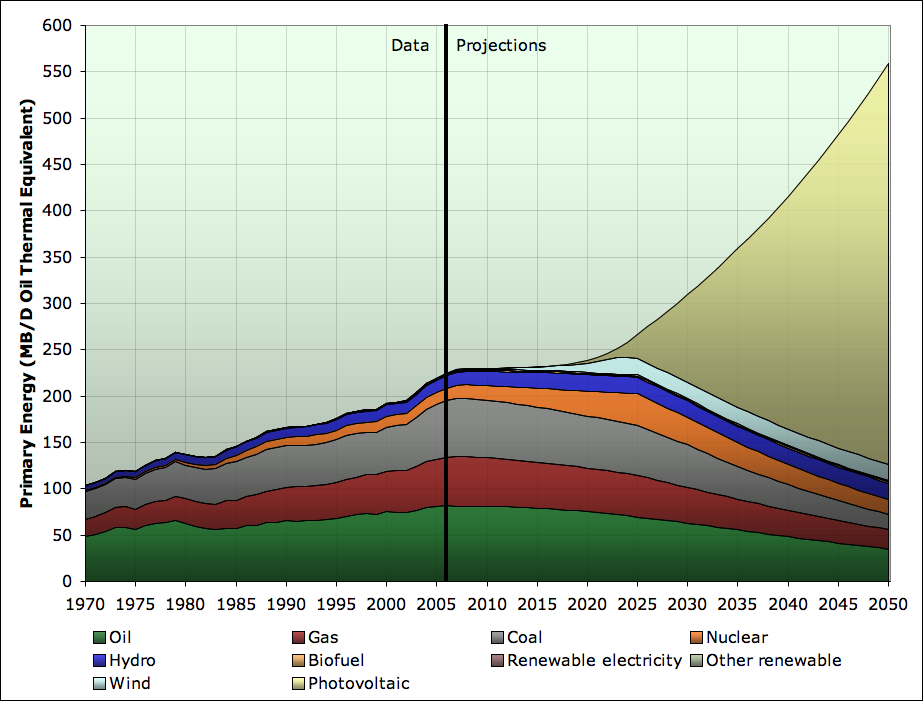
Stuart Staniford from The Oil Drum (now frequently referred to simply as "Staniford" in peak oil circles - depending on who is doing the talking this can sometimes sound like "Gandhi" and other times like "Hitler" - in the case of some angry "reversalists") recently posted an article called "Powering Civilisation To 2050", which looked at a scenario where our future energy needs are increasingly met by solar (PV) power.

I'm a little miffed by this, as it has quite a degree of overlap with a post I've been writing at an excruciatingly slow pace over the last 18 months called "Our Clean Energy Future" - but the scenario I'll be outlining is sufficiently different that I think I'll still have some value to add, whenever I manage to finish it.


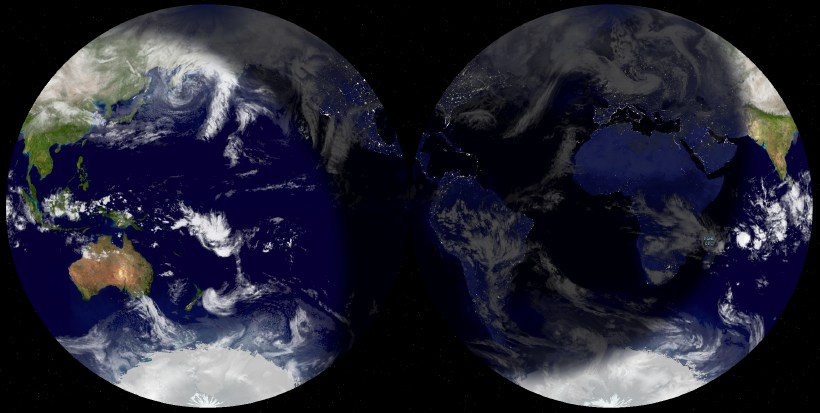
Stuart's scenario considers a world where PV (including thin film) is deployed on an immense scale, with a GENI like global energy grid distributing the energy called the Genesis Project, which is being proposed by a Japanese group including Sanyo. As seen from the graphic below, this idea has a weak spot during the northern hemisphere winter - though from an Australian point of view this could provide yet another opportunity for our politicians to make grandiose plans about our future as an "energy superpower".


I'll close with a tinfoil decoration - a pair of conspiracy style links from a site called "Questions, Questions" which I came across while researching this post - appropriately enough, these take a paranoid look at the scenario modelling world, the green techno-libertarians and the peak oil world (which narrows things down quite considerably) without coming to any firm conclusions - About that Pentagon "Climate Change" report... and Catherine Austin Fitts, libertarian.

I guess if you were sufficiently open-minded about this sort of thing you could consider a scenario where the idea of imminent peak oil is an engineered meme hatched at The Arlington Institute under the guidance of James Woolsey and released into the wild for some nefarious purpose (given the apparent political outlook of the site, the demise of socialism being a guess).

If this is true I can tell you one thing for sure - I'm not in on the conspiracy...

Statistics

Locations of visitors to this page

blogspot visitor
Stat Counter

Total Pageviews

Ads

Books

Followers

Blog Archive

Labels

australia (619) global warming (423) solar power (397) peak oil (355) renewable energy (302) electric vehicles (250) wind power (194) ocean energy (165) csp (159) solar thermal power (145) geothermal energy (144) energy storage (142) smart grids (140) oil (139) solar pv (138) tidal power (137) coal seam gas (131) nuclear power (129) china (120) lng (117) iraq (113) geothermal power (112) green buildings (110) natural gas (110) agriculture (91) oil price (80) biofuel (78) wave power (73) smart meters (72) coal (70) uk (69) electricity grid (67) energy efficiency (64) google (58) internet (50) surveillance (50) bicycle (49) big brother (49) shale gas (49) food prices (48) tesla (46) thin film solar (42) biomimicry (40) canada (40) scotland (38) ocean power (37) politics (37) shale oil (37) new zealand (35) air transport (34) algae (34) water (34) arctic ice (33) concentrating solar power (33) saudi arabia (33) queensland (32) california (31) credit crunch (31) bioplastic (30) offshore wind power (30) population (30) cogeneration (28) geoengineering (28) batteries (26) drought (26) resource wars (26) woodside (26) censorship (25) cleantech (25) bruce sterling (24) ctl (23) limits to growth (23) carbon tax (22) economics (22) exxon (22) lithium (22) buckminster fuller (21) distributed manufacturing (21) iraq oil law (21) coal to liquids (20) indonesia (20) origin energy (20) brightsource (19) rail transport (19) ultracapacitor (19) santos (18) ausra (17) collapse (17) electric bikes (17) michael klare (17) atlantis (16) cellulosic ethanol (16) iceland (16) lithium ion batteries (16) mapping (16) ucg (16) bees (15) concentrating solar thermal power (15) ethanol (15) geodynamics (15) psychology (15) al gore (14) brazil (14) bucky fuller (14) carbon emissions (14) fertiliser (14) matthew simmons (14) ambient energy (13) biodiesel (13) investment (13) kenya (13) public transport (13) big oil (12) biochar (12) chile (12) cities (12) desertec (12) internet of things (12) otec (12) texas (12) victoria (12) antarctica (11) cradle to cradle (11) energy policy (11) hybrid car (11) terra preta (11) tinfoil (11) toyota (11) amory lovins (10) fabber (10) gazprom (10) goldman sachs (10) gtl (10) severn estuary (10) volt (10) afghanistan (9) alaska (9) biomass (9) carbon trading (9) distributed generation (9) esolar (9) four day week (9) fuel cells (9) jeremy leggett (9) methane hydrates (9) pge (9) sweden (9) arrow energy (8) bolivia (8) eroei (8) fish (8) floating offshore wind power (8) guerilla gardening (8) linc energy (8) methane (8) nanosolar (8) natural gas pipelines (8) pentland firth (8) saul griffith (8) stirling engine (8) us elections (8) western australia (8) airborne wind turbines (7) bloom energy (7) boeing (7) chp (7) climategate (7) copenhagen (7) scenario planning (7) vinod khosla (7) apocaphilia (6) ceramic fuel cells (6) cigs (6) futurism (6) jatropha (6) nigeria (6) ocean acidification (6) relocalisation (6) somalia (6) t boone pickens (6) local currencies (5) space based solar power (5) varanus island (5) garbage (4) global energy grid (4) kevin kelly (4) low temperature geothermal power (4) oled (4) tim flannery (4) v2g (4) club of rome (3) norman borlaug (2) peak oil portfolio (1)