Walnuts, like those grown on Russ Lester’s Dixon Ridge Farms in Winters, California, are some of agriculture’s most energy-intensive crops given the amount of product you get from them. The inedible shell constitutes 50 to 60 per cent of each nut, and has conventionally just been discarded. On Dixon Ridge’s 400 acres, that translates into about 2.5 million pounds (more than 1200 tons) of shell waste annually. But rather than pay someone to dispose of these shells, Lester instead converts them into syngas using a cadre of downdraft gasifiers built by the Community Power Corporation of Englewood, CO.
Known as the BioMax, these machines can transmogrify a variety of woody biomass, and even some plastics, into nitrogen-diluted syngas. This includes everything from wood chips and pellets to orange and grape skins, cardboard and product packaging to kitchen waste and plastic utensils. Anything with less than 25 per cent moisture can undergo gasification.
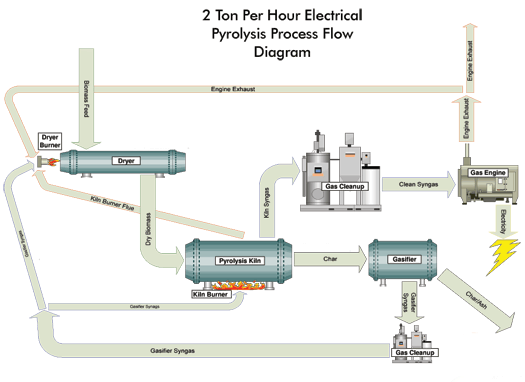
The BioMax system relies on pyrolysis (greek for “fire separation”) to convert biomass into syngas, the same process used to make charcoal. Organic material is placed in an anaerobic environment and heated to a minimum of 200C — 300C. This causes the material to separate into gas and liquid components, leaving a solid residue of char. In the BioMax system, the resulting gas is a mix of ~17 per cent hydrogen, 20 per cent carbon monoxide, 8 per cent carbon dioxide, 2 per cent methane and the remainder nitrogen (all of which can be separated, bottled, and either used on-site or sold). It also leaves behind char-ash, a carbon-rich fertiliser. What’s more, this char-ash is created from some of the CO2 produced by the process, resulting in a net-loss of carbon.
TREEHUGGER: What are the major advances have you seen (in your field) during the past 40 years? What, if any, were the major failures?
JASON ARAMBURU: I think one of the greatest advancements we've seen in renewable energy recently is cost reduction. Companies like GE continue to improve the capital cost of renewables such that they may soon compete with fossil fuels on a cost/kW basis. Achieving cost parity with fossil fuels is the only way to sustainably displace them. The biofuels boom and bust has taught the industry (and the public) that subsidies are simply not an effective long-term strategy.
I think the greatest failure in the energy field has been the notion that 'bigger is better.' The United States built its national grid to distribute power generated by large, centralized fossil fuel and nuclear plants. This design was predicated on the assumption of infinite, cheap sources of fossil fuel.
In reality, a centralized model is both inefficient and incapable of responding to changes in demand or fuel prices. Brilliant thinkers like Amory Lovins of the Rocky Mountain Institute have long supported a more distributed system, based around a diverse portfolio of energy technologies. The advantages of a distributed model include reduced logistical costs, improved efficiency and the ability to produce power where and when it is actually needed. Unfortunately, we have come to this realization too late. Our national grid (and our local utilities) are not set up to handle distributed, intermittent generation. Now, we must spend billions to upgrade the grid.
TH: What does a bright green future look like to you? What's the utopian vison?
JA: I envision a bright green future of true self-sufficiency, where ideas from the past blend with the realities of the present. We've become very specialized and almost totally incapable of providing for ourselves. We buy our power from the grid, our food from the supermarket and have no connection whatsoever to the production or disposal of anything. If one element of this support system fails, chaos ensues.
If we hope to survive in a greenhouse and energy constrained world, we must learn to be self-sufficient. We need to form a healthy and sustainable relationship with our natural resources, while limiting waste. We can learn a lot from Amazonian tribal societies. These tribes, while primitive, have existed for thousands of years without depleting their resources.
TH: How would we realistically transition into that sort of ideal situation?
JA: We first need to realize that the main hurdle to true self-sufficiency is laziness. If we can overcome this inertia, there are three areas where we can make massive strides with existing technologies:
Food - Every American Household is fully capable of producing basic foodstuffs like eggs and vegetables. If we could provide homeowners with the tools to produce some of their own food, we would realize dramatic improvements in health and nutrition, while saving money and reducing environmental impact.
Energy - All new constructions should be required to produce at least half of their energy on-site. A myriad of mature technologies exist to produce energy locally (solar, wind, biomass etc). Local production and consumption of energy would eliminate the need for a smart grid, and would encourage efficiency and conservation.
Waste - Landfills are a strange concept--they allow consumers to discretely and shamelessly waste. At the very least, all municipalities should institute mandatory household composting and recycling. It would be interesting to require households to dispose of the remaining solid waste in transparent trashcans. The fear of public shaming can do wonders to change human behavior.
I'm a big fan of the potential of biochar to help solve some of our problems (at least when we try to follow the terra preta example), so I was disappointed to see that George Monbiot is slamming the idea - Monbiot blasts biochar (via Energy Bulletin.
The latest miracle mass fuel cure, biochar, does not stand up; yet many who should know better have been suckered into it ...
Whenever you hear the word miracle, you know there's trouble just around the corner. But no matter many times they lead to disappointment or disaster, the newspapers never tire of promoting miracle cures, miracle crops, miracle fuels and miracle financial instruments. We have a limitless ability to disregard the laws of economics, biology and thermodynamics when we encounter a simple solution to complex problems. So welcome, ladies and gentlemen, to the new miracle. It's a low-carbon regime for the planet that makes the Atkins diet look healthy: woodchips with everything.
Biomass is suddenly the universal answer to our climate and energy problems. Its advocates claim that it will become the primary source of the world's heating fuel, electricity, road transport fuel (cellulosic ethanol) and aviation fuel (biokerosene). Few people stop to wonder how the planet can accommodate these demands and still produce food and preserve wild places. Now an even crazier use of woodchips is being promoted everywhere (including in the Guardian). The great green miracle works like this: we turn the planet's surface into charcoal.
Sorry, not charcoal. We don't call it that any more. Now we say biochar. The idea is that wood and crop wastes are cooked to release the volatile components (which can be used as fuel), then the residue - the charcoal - is buried in the soil. According to the magical thinkers who promote it, the new miracle stops climate breakdown, replaces gas and petroleum, improves the fertility of the soil, reduces deforestation, cuts labour, creates employment, prevents respiratory disease and ensures that when you drop your toast it always lands butter side up. (I invented the last one, but give them time).
James Lovelock has a reply in The Guardian, noting that most sensible people would agree that creating plantations in the tropics in order to create charcoal is a bad idea, but that processing some existing crop wastes and using them for carbon sequestration is an entirely sensible idea - Lovelock replies to Monbiot on biochar.
I usually agree with George Monbiot and love the way he says it but this time – with his assertion that the latest miracle mass fuel cure, biochar, does not stand up – he has got it only half right.
Yes, it is silly to rename charcoal as biochar and yes, it would be wrong to plant anything specifically to make charcoal. So I agree, George, it would be wrong to have plantations in the tropics just to make charcoal.
I said in my recent book that perhaps the only tool we had to bring carbon dioxide back to pre-industrial levels was to let the biosphere pump it from the air for us. It currently removes 550bn tons a year, about 18 times more than we emit, but 99.9% of the carbon captured this way goes back to the air as CO2 when things are eat eaten.
What we have to do is turn a portion of all the waste of agriculture into charcoal and bury it. Consider grain like wheat or rice; most of the plant mass is in the stems, stalks and roots and we only eat the seeds. So instead of just ploughing in the stalks or turning them into cardboard, make it into charcoal and bury it or sink it in the ocean. We don't need plantations or crops planted for biochar, what we need is a charcoal maker on every farm so the farmer can turn his waste into carbon. Charcoal making might even work instead of landfill for waste paper and plastic.
In Brazil’s Amazon basin, farmers have long sought out a special form of fertiliser – a locally sourced compost-like substance prized for its amazing qualities of reviving poor or exhausted soils. They buy it in sacks or dig it out of the earth from patches that are sometimes as much as 6ft deep. Spread on fields, it retains its fertile qualities for long periods.
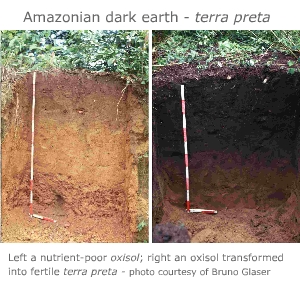
They call it the terra preta do indio – literally, “the dark earth of the Indians”. Dense, rich and loamy, this earth forms a stark contrast with the thin, poor soils of the region. (It seems a paradox, but rainforest soils have low fertility. This is why farmers who cut down the forest for agriculture have to keep on felling – after a few years of cropping, yields collapse and they have to move on.) Patches of terra preta extend for many hectares in some places but until recently, no one really knew what the mysterious dark earth was. Some guessed it was volcanic, or the sediment of old lakes, or the residue of some long-rotted vegetation. Few imagined that it was man-made.
Terra preta, modern analysis has proved, is one of the last remaining traces of pre-Columbian agriculture in the Amazon basin. It was made more than 2,500 – and perhaps as long as 6,000 – years ago by people living by the river. These cultures survived and supported complex agriculture, despite poor soil, by making their own earth. They used dung, fish, animal bones and plant waste – the usual suspects. But the key ingredient in terra preta, and what gives it its dark colour, is charcoal.
“It’s wonderful stuff,” says Simon Shackley, a social science lecturer at the University of Edinburgh. “We started to get to know about it when Dutch scientists began to look at it in the 1960s. They found these dark soils in this area of very poor soil, where it was being put on fields like compost. It’s really the product of slash-and-burn agriculture, and other organic waste, incorporated into the soils over hundreds or even thousands of years – and it does appear to be fertile indefinitely, which is really a very odd thing.”
This ancient product of the Amazon is now the subject of intense scrutiny by climate change scientists. The tenacity of the charcoal of terra preta – retaining its fertilising properties over centuries – has given them an idea. Charcoal is a form of carbon, the burnt remains of plant and animal material. If it can stay intact in the earth for so long, without being released as carbon dioxide gas, why not lock up more carbon in the earth in this manner?
Scientists have begun to refer to the charcoal made from plants for the purpose of storing carbon as “biochar”. The theory is that biomass – any plant or animal material – can be turned into charcoal by heating it in the absence of oxygen. By taking CO2 out of the atmosphere, the impact on climate change could be huge.
THE COALITION'S "green carbon initiative" is a three-pronged policy that aims to significantly reduce greenhouse gas emissions by making buildings more energy efficient, having faith in clean coal and burying greenhouse pollution with a process known as biochar.
Geosequestration - the burying of greenhouse pollution underground or beneath the ocean floor - remains the great technological hope for solving climate change even though its adoption does not appear to be any time soon.
Biochar, about which researchers are optimistic, is a new hope in climate science. Biochar refers to small pellets of charcoal produced when plant waste, such as wood chips, are heated in a process called pyrolysis.
When added to the soil, the pellets help boost fertility, retain moisture better, and efficiently store carbon dioxide and other greenhouse gas emissions.
Scientists believe biochar is stable enough to hold gases for at least 100 years, a finding that has been eagerly seized on by politicians desperate to find a technology that will mop up greenhouse gas emissions.
The Opposition Leader, Malcolm Turnbull, argues that Australia's large land mass could be its greenhouse saviour, citing research that finds a small increase in the amount of carbon stored in soil could absorb all of the nation's annual emissions.
Research projects, including one by the NSW Department of Primary Industries, are encouraging, but scientists are concerned that the technique has not yet been properly investigated.
Dr Evelyn Krull, of CSIRO Land and Water, says one of the main areas that needs further study is how different types of soil react to the addition of biochar. "From a scientist's point of view I would be hesitant to say let's apply it to all soils, because we haven't done proper studies on it," she said.
"There's no doubt [biochar] will have multiple benefits but we would like to make sure that we have advised the public best about what is safe."
Malcolm Turnbull has released the opposition's response (dubbed the "Green Carbon Initiative") to the Labor government's proposed ETS (Emissions Trading Scheme), with the plan promising extra spending on alternative energy sources, more money for "clean coal" (cough), tax breaks for green buildings and retrofitting existing building to make them more energy efficient, mass forestry plantings and, most interestingly, research into storing carbon in soil via biochar (also known as terra preta).
The measures include creation of the Green Carbon Initiative to offset greenhouse gases by capturing carbon and storing it in the soil by using improved farming practices.
He will argue that large quantities of soil carbon are lost to the atmosphere because of conventional cropping methods that leave soil exposed for long periods, and that the opportunities for carbon abatement through changes in agricultural practices are gigantic.
The Opposition Leader also wants to fast-track the development of "biochar" technology, under which green farm waste is heated in the absence of oxygen in a process called pyrolysis.
It turns half of the material into bio-fuels that can be used to generate clean electricity, and the remainder into charcoal called biochar.
"Biochar is then returned to the soil, which dramatically increases agricultural productivity," he will say. "We will invest in our own land and at the same time offer the world an example of how real, practical action can be taken in the battle against global warming in the here and now. ...
Mr Turnbull also proposes mass tree-planting to absorb emissions.
The move could upset the Nationals, who last year split with the Liberals in the Senate to oppose the creation of tax breaks for investment in forestry carbon sinks, arguing forests would consume prime agricultural land. But Mr Turnbull will assert that planting trees can assist agricultural production.
"Every wind break, tree lot or hedge planted by farmers to protect pastures, crops and livestock is both sequestering CO2 and increasing agricultural production - as (wife) Lucy and I know very well from our experience over 26 years of farming in the Hunter Valley." ...
"Carbon capture and storage is a vital technology for our nation," the speech says. "I commit that a coalition government will ensure that at least two industrial-scale CCS power stations projects will be built. We will ensure the financial support is there to make this happen.
"It will be a key objective of the Coalition government that I lead that Australia successfully deploys industrial-scale demonstration projects in solar energy, in geo-thermal energy and harnessing the energy of the ocean through tidal and wave power."
Turnbull toured Newcastle biochar company Crucible Carbon's facility before making the announcement. The announcement didn't get met with much enthusiasm from the Cattlemen's association or from coalition partners in the National party, while the government is calling the technology "unproven", which seems ridiculous given the $500 million they are spending on clean coal research (though to be fair, so is a CSIRO researcher).
THE enormous potential of biochar to capture and store carbon is being overlooked by the Federal Government, Opposition Leader Malcolm Turnbull says. Mr Turnbull yesterday toured Crucible Carbon, which is developing technology for the mass production of biochar, at Newcastle in NSW.
Biochar, a charcoal produced from biomass, has the potential to provide long-term carbon storage in soil with the offset of improving soil quality and increasing agricultural productivity.
Mr Turnbull said biochar had the potential to absorb up to 100 million tonnes of CO2 each year, close to 20 per cent of Australia's emissions. "Globally, this could be the single biggest opportunity, new opportunity, for biosequestration of CO2 after forestry, and of course, organic soil carbon," he told reporters.
"We have an enormous opportunity here in Australia to absorb millions of tonnes of carbon dioxide from the atmosphere, store it safely as carbon, and put it back into the soil and increase the productivity and the health of our own landscape. "A win-win. A win for jobs, a win for the environment, a win for agriculture." ...
He said the Crucible Carbon technology had been estimated to be able to capture and store carbon for $20 a tonne or less, but companies which wanted to use biochar to offset emissions would not get a credit for it under the Rudd government's emissions trading scheme.
This month's edition of National Geographic has a feature article on "Soil", which looks at the steady degradation of agricultural land and the problem this poses in world where the population is heading for 9+ billion people - effectively calling attention to the "peak dirt" problem (however soil is renewable, so any "peak" should be able to be reversed if sufficient time and effort is put into doing so).
The article uses an acronym I've never come across before to describe the problem faced by those trying to draw attention to the issue: MEGO (My Eyes Glaze Over) - a phenomenon which should be familiar to anyone who has ever talked about peak oil, global warming or any of the other "limits to growth".
This year food shortages, caused in part by the diminishing quantity and quality of the world's soil, have led to riots in Asia, Africa, and Latin America. By 2030, when today's toddlers have toddlers of their own, 8.3 billion people will walk the Earth; to feed them, the UN Food and Agriculture Organization estimates, farmers will have to grow almost 30 percent more grain than they do now. Connoisseurs of human fecklessness will appreciate that even as humankind is ratchetting up its demands on soil, we are destroying it faster than ever before. "Taking the long view, we are running out of dirt," says David R. Montgomery, a geologist at the University of Washington in Seattle.
Journalists sometimes describe unsexy subjects as MEGO: My eyes glaze over. Alas, soil degradation is the essence of MEGO.
One subject that features in the article is soil restoration, including a look at "terra preta" - rich, fertile artificial soils found in the Amazon. In this post I'll have a look at modern day techniques to produce terra preta (often called biochar or agrichar) which have the potential to increase soil fertility, generate energy and sequester carbon all at the same time.
The History Of Terra Preta
Terra Preta ("dark earth") was discovered by Dutch soil scientist Wim Sombroek in the 1950's, when he discovered pockets of rich, fertile soil amidst the Amazon rainforest (otherwise known for its poor, thin soils), which he documented in a 1966 book "Amazon Soils". Similar pockets have since been found in other sites in Ecuador and Peru, and also in Western Africa (Benin and Liberia) and the Savannas of South Africa. Carbon dating has shown them to date back between 1,780 and 2,260 years.
Terra preta is found only where people lived - it is an artificial, human-made soil, which originated before the arrival of Europeans in South America. The soil is rich in minerals including phosphorus, calcium, zinc, and manganese - however its most important ingredient is charcoal, the source of terra preta's color.
It isn't entirely clear if the Amazon Indians whose old settlements terra preta is found at deliberately created the soils or if they were an accidental by-product of "slash and smoulder" farming techniques, though the emerging consensus seems to be that the Indians deliberately created the material, with some early European accounts in the area noting the practice still being performed.
The key ingredient is apparently the activated carbon in the charocal. Activated carbon has a complex, spongelike molecular structure - a single gram can have a surface area of 500 to 1,500 square meters (or about the equivalent of one to three basketball courts). Having this material in the soil has several beneficial effects, including a 20% increase in water retention, increased mineral retention, increased mineral availability to plant roots, and increased microbial activity.
It has also been shown to be particularly beneficial to arbuscular mycorrhizal fungi, which form a symbiotic relationship with plant root fibers, allowing for greater nutrient uptake by plants. There is speculation that the mycorrhizal fungi may play a part in terra preta’s ability to seemingly regenerate itself.
Pyrolysis and Eprida
Modern day producers of biochar (agrichar) take dry biomass and bake it in a kiln to produce charcoal. Biochar is the term not for what is left over after the energy is removed: a charcoal-based soil amendment - this process is called pyrolysis. Various gases and oils are driven off the material during the process and then used to generate energy. The charcoal is buried in the ground, sequestering the carbon that the growing plants had pulled out of the atmosphere. The end result is increased soil fertility and an energy source with negative carbon emissions.
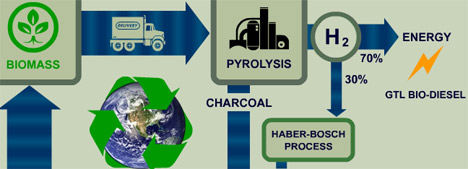
Eprida is a company founded by Danny Day, which is attempting to commercialise the idea by building systems that turn farm waste into hydrogen, biofuel, and biochar (see here for a short movie explaining their process).
The Eprida technology uses agricultural waste biomass to produce hydrogen-rich bio-fuels and a new restorative high-carbon fertilizer (ECOSS) ...In tropical or depleted soils ECOSS fertilizer sustainably improves soil fertility, water holding and plant yield far beyond what is possible with nitrogen fertilizers alone. The hydrogen produced from biomass can be used to make ethanol, or a Fischer-Troupsch gas-to-liquids diesel (BTL diesel), as well as the ammonia used to enrich the carbon to make ECOSS fertilizer.
We don't maximize for hydrogen; we don't maximize for biodisel; we don't maximize for char...By being a little bit inefficient in each, we approximate nature and get a completely efficient cycle.
The potential power of biochar lies in this closed loop production process , where agricultural practices involving biochar production see increasing returns of crop yields, energy and soil fertility over time.
Biochar also has potential to address problems such as waste disposal and rural development. A significant proportion of the world's population relies on charcoal as a cooking fuel, the production of which drives deforestation in Africa and other places.
Replacing traditional charcoal kilns with modern pyrolysis units could reduce the demand for wood from forests by increasing the efficiency of energy production and adding the ability to use any source of biomass, including agricultural waste products. This would also help to reduce respiratory diseases in the developing world, particularly amongst children.
There has also been speculation that pyrolysis could be a useful technique for dealing with the huge swathes of Canadian forests that have been killed by pine beetles recently.
Some industry participants believe that energy, rather than agriculture, will be the key driver for adopting biomass pyrolysis. Desmond Radlein of Dynamotive Energy Systems has been quoted as saying "It is wishful thinking that people will switch to renewable fuels unless it is cheaper. All of this is tied to the price of oil; as it goes up, many more things are possible."
Another company active in the pyrolysis sector is Best Energies. Technical Manager Adriana Downey recently had an interview with Beyond Zero Emissions, talking about some of the pilot programs they have been running and plans to build the first fully commercial scale pyrolysis plant in Australia.
Lukas's program with the NSW DPI (Department of Primary Industries) in Northern NSW have basically taken some of the agrichar material that we've made here at Best Energies and they've been trialling that material in different agronomic applications to see how the agrichar, when its applied, can help crop-productivity and improve the sustainability of agriculture as well as, and what you guys are more interested in, sequester carbon long-term in soils and also decrease the potent greenhouse gas nitrous oxide emissions from soil. ...
The agrichar when it's applied to the soil has a good effect on the general physical structure of the soil. Because the agrichar has a really high surface area, it means that there's lots of pores in the soil which can then retain moisture and act as little reservoirs for the water to be retained in the soil. As well as this, all of the surface area helps to bind nutrients in the soil and also provides a microhabitat for micro organisms in the soil which are essential for the natural processes in the soil which allow micro organisms to flourish.
Carbon Capture Potential
There is a large difference between terra preta and ordinary soils - a hectare of meter-deep terra preta can contain 250 tonnes of carbon, as opposed to 100 tonnes in unimproved soils from similar parent material, according to Bruno Glaser, of the University of Bayreuth, Germany. The difference in the carbon between these soils matches all of the carbon contained in the vegetation on top of them.
It is not yet clear what the limits are to how much biochar can be added to the soils using these techniques, however some fairly extravagant claims about biochar's capacity to capture carbon have been made. Soil scientist and author of "Amazonian Dark Earths: Origin, Properties, Management" Johannes Lehmann believes that a strategy combining biochar with biofuels could ultimately offset 9.5 billion tons of carbon per year - an amount equal to the total current fossil fuel emissions. Lehmann also notes that unlike biodiesel and corn ethanol, biochar doesn’t take land away from food production.
If true, this would be an interesting form of geoengineering to try and reverse the effects of global warming (and one far less risky than some of the alternatives proposed) but I would still question our ability to turn all the world's oil, coal and gas reserves back into rich soil via burn - atmosphere - pyrolysis loop.
* The technology to implement the process is still immature. * Scientists don’t know how much charcoal farmers should use, how they should apply it, or which feedstocks work best. * Farmers are reluctant to spread unproven products on their fields, so the few companies manufacturing biochar have struggled to find buyers. * Charcoal production can generate toxic waste if performed incorrectly. * The energy needed to produce, transport, and bury biochar could outweigh the carbon savings. * Some analysts say the economics of the process will not be acceptable until carbon markets are established, allowing farmers to earn carbon credits for applying biochar to their fields. * Some environmental activists claim that applying the process on a large scale would result in further rainforest clearing which would actually degrade soil quality and increase global warming.
Rhizome In The Amazon
Jeff Vail recently had a post on a "Rhizome Template in the Amazon ?", which looked at a paper by Mark Heckenberger suggesting that a dense civilization of networked villages once existed in the Amazon, which Jeff noted was interesting because it "appears to show a form of organization that permits density without significant hierarchy".
The paper shows that the Xingu region of the Amazon was once populated by a grid-like pattern or villages, each connected by a precisely aligned network of roadways (the Xingu river is the Amazon's second longest tributary, with the region currently experiencing tension over plans to dam the river).
Here's an alternate mode of organization--a networked "grid," "lattice," or "peer-to-peer" structure of small, minimally self-sufficient villages, or "rhizome" as proposed in my article The Hamlet Economy. The Xingu settlement structure seems to consicously model itself in the latter pattern. Heckenberger even notes that each village was surrounded by a buffer zone of "managed parkland," exactly the kind of fall-back, resiliency-enhancing production zone that I recommended for rhizome. Here's a link to a satellite image of one section fo Xingu settlement.
Did this Xingu civilization really develop a dense, ecologically sustainable civilization without hierarchal structure? Or did they simply find a new way to impose hierarchy without developing the signatures of "central places"? Was this a conscious reaction to prior abuses of hierarchy, or simply an expedient to survival in the dense forrests and poor agricultural soils of the Amazon? We don't know the answers to these questions at this time, but the research of Heckenberger and his colleagues suggests that there is still a great deal for us to learn from the past about how we can best live in the future
Heckenberger also examined the terra preta pockets in the region, which is described briefly in an interesting article by Charles Mann in The Atlantic Monthly called "1491".
Scientific American also notes the correlation between the lost cities of the Amazon and terra preta in "Ancient Amazon Actually Highly Urbanized", as does The Vermont Quarterly in "Pay Dirt".
Terra preta, Woods guesses, covers at least 10 percent of Amazonia, an area the size of France. It has amazing properties, he says. Tropical rain doesn't leach nutrients from terra preta fields; instead the soil, so to speak, fights back. Not far from Painted Rock Cave is a 300-acre area with a two-foot layer of terra preta quarried by locals for potting soil. The bottom third of the layer is never removed, workers there explain, because over time it will re-create the original soil layer in its initial thickness. The reason, scientists suspect, is that terra preta is generated by a special suite of microorganisms that resists depletion. "Apparently," Woods and the Wisconsin geographer Joseph M. McCann argued in a presentation last summer, "at some threshold level ... dark earth attains the capacity to perpetuate—even regenerate itself—thus behaving more like a living 'super'-organism than an inert material."
In as yet unpublished research the archaeologists Eduardo Neves, of the University of São Paulo; Michael Heckenberger, of the University of Florida; and their colleagues examined terra preta in the upper Xingu, a huge southern tributary of the Amazon. Not all Xingu cultures left behind this living earth, they discovered. But the ones that did generated it rapidly—suggesting to Woods that terra preta was created deliberately. In a process reminiscent of dropping microorganism-rich starter into plain dough to create sourdough bread, Amazonian peoples, he believes, inoculated bad soil with a transforming bacterial charge. Not every group of Indians there did this, but quite a few did, and over an extended period of time.
When Woods told me this, I was so amazed that I almost dropped the phone. I ceased to be articulate for a moment and said things like "wow" and "gosh." Woods chuckled at my reaction, probably because he understood what was passing through my mind. Faced with an ecological problem, I was thinking, the Indians fixed it. They were in the process of terraforming the Amazon when Columbus showed up and ruined everything.
Scientists should study the microorganisms in terra preta, Woods told me, to find out how they work. If that could be learned, maybe some version of Amazonian dark earth could be used to improve the vast expanses of bad soil that cripple agriculture in Africa—a final gift from the people who brought us tomatoes, corn, and the immense grasslands of the Great Plains.
All in all I think biochar is worth exploring further in some depth.
Journalists sometimes describe unsexy subjects as MEGO: My eyes glaze over. Alas, soil degradation is the essence of MEGO. Nonetheless, the stakes—and the opportunities—could hardly be higher, says Rattan Lal, a prominent soil scientist at Ohio State University. Researchers and ordinary farmers around the world are finding that even devastated soils can be restored. The payoff, Lal says, is the chance not only to fight hunger but also to attack problems like water scarcity and even global warming. Indeed, some researchers believe that global warming can be slowed significantly by using vast stores of carbon to reengineer the world’s bad soils. “Political stability, environmental quality, hunger, and poverty all have the same root,” Lal says. “In the long run, the solution to each is restoring the most basic of all resources, the soil.” ...
A black revolution might even help combat global warming. Agriculture accounts for more than one-eighth of humankind's production of greenhouse gases. Heavily plowed soil releases carbon dioxide as it exposes once buried organic matter. Sombroek argued that creating terra preta around the world would use so much carbon-rich charcoal that it could more than offset the release of soil carbon into the atmosphere. According to William I. Woods, a geographer and soil scientist at the University of Kansas, charcoal-rich terra preta has 10 or 20 times more carbon than typical tropical soils, and the carbon can be buried much deeper down. Rough calculations show that "the amount of carbon we can put into the soil is staggering," Woods says. Last year Cornell University soil scientist Johannes Lehmann estimated in Nature that simply converting residues from commercial forestry, fallow farm fields, and annual crops to charcoal could compensate for about a third of U.S. fossil-fuel emissions. Indeed, Lehmann and two colleagues have argued that humankind's use of fossil fuels worldwide could be wholly offset by storing carbon in terra preta nova.
Such hopes will not be easy to fulfill. Identifying the organisms associated with terra preta will be difficult. And nobody knows for sure how much carbon can be stored in soil—some studies suggest there may be a finite limit. But Woods believes that the odds of a payoff are good. "The world is going to hear a lot more about terra preta," he says.
Walking the roads on the farm hosting Wisconsin Farm Technology Days, it was easy for me to figure out what had worried Jethro Tull. Not Jethro Tull the 1970s rock band—Jethro Tull the agricultural reformer of the 18th century. Under my feet the prairie soil had been squashed by tractors and harvesters into a peculiar surface that felt like the poured-rubber flooring used around swimming pools. It was a modern version of a phenomenon noted by Tull: When farmers always plow in the same path, the ground becomes "trodden as hard as the Highway by the Cattle that draw the Harrows."
Tull knew the solution: Don't keep plowing in the same path. In fact, farmers are increasingly not using plows at all—a system called no-till farming. But their other machines continue to grow in size and weight. In Europe, soil compaction is thought to affect almost 130,000 square miles of farmland, and one expert suggests that the reduced harvests from compaction cost midwestern farmers in the U.S. $100 million in lost revenue every year.
The ultimate reason that compaction continues to afflict rich nations is the same reason that other forms of soil degradation afflict poor ones: Political and economic institutions are not set up to pay attention to soils. The Chinese officials who are rewarded for getting trees planted without concern about their survival are little different from the farmers in the Midwest who continue to use huge harvesters because they can't afford the labor to run several smaller machines.
Next to the compacted road on the Wisconsin farm was a demonstration of horse-drawn plowing. The earth curling up from the moldboard was dark, moist, refulgent—perfect midwestern topsoil. Photographer Jim Richardson got on his belly to capture it. He asked me to hunker down and hold a light. Soon we drew a small, puzzled crowd. Someone explained that we were looking at the soil. "What are they doing that for?" one woman asked loudly. In her voice I could hear the thought: MEGO.
When I told this story over the phone to David Montgomery, the University of Washington geologist, I could almost hear him shaking his head. "With eight billion people, we're going to have to start getting interested in soil," he said. "We're simply not going to be able to keep treating it like dirt."
The Guardian has an essay from Tim Flannery on the current state of play for global warming - Words Of Warming.
A sophisticated understanding of the great climatic cycles has permitted a new approach to the climate problem that finds its closest parallel in the "wiggle matching" used by stock-market analysis. William Ruddiman is a climatic historian whose book Ploughs, Plagues and Petroleum, published by Princeton in 2005, uses this approach to identify evidence of human impact on the climate system, by identifying precisely where we are in the current cycle and comparing the trend with earlier ones. We are, he explains, 12,000 years into a cooling phase which, judging from previous cycles, should continue for tens of thousands of years more. Instead the world is warming. But what is most remarkable about Ruddiman's work is the evidence it provides for an initial disruption to the climate system that occurred long before the industrial revolution - around 8,000 years ago.
It was then, at the dawn of agriculture, that the "wiggle" of the current cycle first departed from earlier patterns - for instead of cooling, Earth's average temperature remained remarkably stable. Ruddiman thinks that this was caused by carbon and methane being released into the atmosphere from early agriculture and the destruction of forests. In his account, human activity and the great cycles struck a delicate balance that allowed the flowering of civilisations. He also sees evidence in the ice cores for the consequences of the Black Death (a drop of around two parts per million of CO2 as forests grew over abandoned fields, absorbing carbon from the atmosphere), as well as other historic events. Aspects of his work remain highly contentious, yet I believe that Ruddiman's realisation that the gaseous composition of Earth's atmosphere is an exquisitely sensitive barometer of changes to life itself represents a great breakthrough.
Now that the majority of politicians, industry leaders and the public are convinced there is a climate problem, the focus is on what to do. The most influential assessments of the problem's scale are doubtless those of the IPCC, whose projections of various outcomes form the basis of global negotiations and national action plans. One of the most influential of these projections concerns the extent to which Earth's surface will warm over the next century. The lower bound is 1.4°C; the upper bound is 5.8°C. This is an extraordinary range of possible impacts - 1.4°C poses some threat, but 5.8°C is widely recognised as sufficient to induce a Lovelockian Ragnarok. The chance of either outcome, according to the IPCC, is small - less than 10%, and so political dialogue has come to concentrate on the mid-range of the projections.
The moment of truth will arrive in December 2009, in Copenhagen, when the world's political leaders will come together to decide the basis of a new global treaty to replace the Kyoto protocol. It's no overstatement to say that the Copenhagen protocol, as it may well come to be known, will play a large role in deciding the fate of humanity. It will come into force in 2012, and if it fails to deliver we'll have to wait until 2020 for a replacement. That will be too late. ...
In his analysis, Nordhaus does identify one economically effective strategy worth pursuing. Called the "low-cost backstop", it revolves around identifying and developing some as yet unknown technology to combat the problem. Possible candidates include "low-cost solar power, geothermal energy, some non-intrusive climatic engineering or genetically engineered carbon-eating trees".
Writing in the New York Review of Books, Freeman Dyson has explored the unappealing option of such trees. The graph that first alerted humanity to the climate problem - drawn up by Charles David Keeling to show the CO2 increase from 1956 to the present - might, Dyson argues, hold the key to the solution. The graph has a generally rising line, with jags, like saw teeth, along it, which indicate a spike in CO2 each autumn in the northern hemisphere and a dip each spring. The difference between the minimum and maximum each year is around six parts per million, and it is due to the growth, then leaf fall, of the forests that grow across North America, Europe and Asia. It turns out, Dyson says, "that about 8% of the carbon dioxide in the atmosphere is absorbed by vegetation and returned to the atmosphere every year".
If only a way could be found, he muses, to permanently sequester that carbon, we would go a long way towards solving the climate crisis - hence the genetically modified trees. But the truth is that all trees are carbon eaters. They grow from the air by drawing CO2 into their leaves, and there solidifying it to build their wood, bark and leaf tissues. Trees are congealed CO2. What we need is a way of transforming the carbon they capture into an inert state. It turns out that humanity has had the capacity to do this for thousands of years, and is now on the brink of doing it on a very large scale.
The process of charcoal-making is called pyrolysis, and involves the heating of any biological matter in the absence of oxygen. The result is the generation of a synthetic gas, or a crude-oil like material, and charcoal. If the gas or oily matter is captured, it can be used to generate electricity or power transport. The charcoal is largely carbon (representing one-third to half of the carbon in the biomass) and it is inert. Indeed, the tenacity with which charcoal resists rotting, even when buried in the soil, is clear from C14-dating, which uses ancient charcoal from hearths or fires as much as 60,000 years old.
Modern pyrolysis involves machinery that captures flue gas or oil, and needs no external inputs to run the machine (some of the gas being used to heat the biomass). It's already being used on a small scale on farms, for urban garbage disposal (where 1,000-tonne units are deployed) and in forestry. On farms it has multiple benefits, for the charcoal can be ploughed back into the soil, where it balances acid soils, aids soil moisture retention, adds nutrients and acts as a habitat for soil fungi and bacteria. A farmer pyrolysing crop waste gains four benefits: 1) as usual, he gets to sell the commercial part of his crop; 2) he gets to generate electricity or transport fuel; 3) where carbon is traded, he can potentially sell the carbon he sequesters; and 4) by adding charcoal to his soil, he will increase the chances of getting a better crop the following year.
With so many benefits, why is pyrolysis not more widely used? Because pyrolysis machines are expensive, and farms are mostly still family businesses. If farmers are ever to be able to afford the machines, they'll need to be paid around $37 per tonne for the carbon they create. They'll also need to be living in areas with carbon trading schemes that allow charcoal as a recognised method of carbon sequestration.
The earth's uncertain oil reserves and dwindling freshwater supply may get all the attention, but modern society is also overtaxing the ground itself. At the same time that a growing population and the newfound appetites of the global middle class are straining our food supply, governments all over the world are also pushing for more ethanol-generating energy crops.
To support all that production on a limited amount of arable land, scientists and farmers have long focused on technical improvements like plant breeding, bioengineering and creating new fertilizers and pesticides. But some are now asking a different question: What if we could create better dirt?
An increasing number of scientists are starting to emphasize the extent to which soil - even more than petroleum or water or air - is a limited and fragile resource. Managing it better, and even improving it, will be vital to any equation that allows the earth to support the more than nine billion people the United Nations estimates will live on the planet by mid-century.
The most dramatic research is still in the early stages, but soil specialists already have developed farming techniques that maintain and temporarily enhance the nutrient content of soil. Scientists in Australia and the United States have started making rich new earth from industrial waste, and research into the astonishing fertility of a mysterious Amazonian soil may lead to an additive that can boost the power of soil for thousands of years.
"A few decades ago, the philosophy was, 'Well, if your soil's degraded, just put some more fertilizer on, or till it another time and you can get the same crop yield,' " says David Laird, a soil scientist at the National Soil Tilth Laboratory, part of the U.S. Department of Agriculture. "Now there is growing interest in putting together systems that enhance the actual quality of the soil itself."
Dirt remains, in certain ways, a puzzle: Despite its seeming simplicity, it is a complex system whose fertility arises from the interaction of myriad physical, biological, and chemical properties. Even the most advanced current research does not claim to be able to synthesize enough of it for use on a global scale.
Nevertheless, progress in the science of soil has the potential to be truly transformative and to help solve some of the biggest problems the planet faces. By 2050, according to Rattan Lal, a professor of soil science at Ohio State University, "All the necessities of food, feed, fiber, and fuel are going to be met by less than one-tenth of an acre per person, on average. And we already have seriously degraded a lot of the available land. So unless you can restore some of it you will just run out."
Soil does not arise quickly. In nature it starts with a layer of glacial grit, or windblown sand, or cooled lava, or alluvial silt, or some other crumbled mineral matter. A few pioneer plants put down shallow roots, and living things begin to make their homes in and on the surface, enriching it with their excrement, and enriching it further when they die and rot.
The resulting organic matter feeds a whole underground ecology that aerates the soil, fixes nutrients, and makes it more hospitable for plant life, and over time the process feeds back on itself. If the soil does not wash away or get parched by drought, it very gradually thickens. It takes tens of thousands of years to make 15 centimeters of topsoil, about 6 inches' worth.
Because of all the things human beings do to it, a University of Washington geologist, David Montgomery, has calculated, the world today is losing soil 10 to 20 times faster than it is replenishing it. In some places it is happening much faster: northern China, sub-Saharan Africa, parts of the American West and Australia are already seeing large tracts of arable land disappear.
In his book, "Dirt: The Erosion of Civilizations," Montgomery traces the decline of numerous early societies - including ancient Greece, imperial Rome, various Pacific Island cultures and the Mayans - to poor management of their soil.
However, it has also happened that some civilizations have improved their dirt. Among the world's richer soils is terra preta, the "black earth" found in certain swaths of the Amazon basin. It is dark, loose and loamy, and unlike the pallid earth that characterizes most of the Amazon, it is strikingly fertile.
In the last few years, archaeologists have established something else intriguing about terra preta: it is man-made. It contains high concentrations of charcoal, along with organic matter such as manure and fish bones - essentially the household trash of a pre-Columbian society practicing a distinctive brand of slash-and-burn agriculture.
Researchers trying to replicate the fertility of terra preta have concluded that its secret is in the charcoal. Work by soil scientists like Laird, Johannes Lehmann of Cornell University, and Mingxin Guo of Delaware State University suggests that the benefits of supplementing soil with charcoal, which they call "biochar" to distinguish it from the fuel of backyard barbecues, could be dramatic, widespread, and durable. Biochar, they have found, enhances the retention of water and nutrients, decreases the need for fertilizer, encourages microbial growth, and allows more air to reach crop roots. It also breaks down at a far slower rate than traditional fertilizers and soil additives. Depending on how the charcoal is made and applied, estimates of its life span range from decades to millennia. Scientists believe that some Amazonian terra preta soils are at least 2,000 years old.
Look I think we should start with the knowledge that there is 200 gigatonnes of excess carbon floating around in our atmosphere. Now that is a very large amount of carbon. I won't explain what a gigatonne is but it's a lot, and that started to accumulate at the beginning of the Industrial Revolution as we burnt the coal and put the carbon into the atmosphere.
Now, it has become very clear that we have to find a way of drawing down that carbon stock in the atmospher. So we've got to not only reduce our emissions, so get rid of the burning of coal and so on and so forth, we've have to draw down the existing gas and people have been searching for ways of doing this. Some of your listeners may have heard about proposals to re-grow tropical forests for example or forestry's "I'll plant a tree and off set your emissions" and this sort of thing.
Well these Terra Preta solutions are in some ways or certainly for some purposes are a better solution, a superior solution to anything that's been brought up so far. What the process basically involves is taking any biological material, that could be crop waste or corn stalks or whatever, forestry waste, even human sewage, and partially burning it in the absence of oxygen so that you get a synthetic gas at one end of the process that you can then burn which is hydrogen rich, not so much carbon in it, but hydrogen rich, you can burn that for transport purposes or to generate electricity and at the other end of the process you get charcoal. And the great thing about charcoal is that it is a very stable form of carbon.






 Posts
Posts