The article notes that the Abadi project in Indonesia has also given up on floating LNG technology for now.
Woodside's reasoning seems to have been based more on the sliding price for LNG and a lack of buyers willing to make long term commitments rather than any perceived problems with the technology.
The article also noted that other FLNG projects are proceeding, such as ENI's Coral venture in Mozambique and Golar LNG's projects in west Africa for Ophir Energy and Perenco.
Shell's Prelude FLNG project in northern Australia is still going ahead as well.
Woodside's proposal is one of more than 10 LNG export ventures proposed on Canada's Pacific coast, where cargoes are expected to target high-priced markets in Asia.
The government is assuming about five of the projects will get built, creating more than 39,000 annual jobs during a nine-year construction period, and 75,000 jobs once the plans are fully operational. Among the most advanced are the Kitimat LNG project between Apache and Chevron, and Shell's LNG Canada venture which involves LNG import giant Korea Gas Corporation, Mitsubishi and PetroChina.
I recently read John Le Carre's latest book, "A Delicate Truth", and today's news stories about Australian intelligence agencies spying on East Timor's government as it negotiated with Australia over oil and gas resources in the Timor Sea did leave a similar bitter taste in the mouth.
ASIO officers have allegedly detained a man and raided the office of a lawyer who claims that Australian spies bugged the cabinet room of East Timor's government during negotiations over oil and gas deposits. Attorney-General George Brandis confirmed last night that he had issued a search warrant for a Canberra address and that ASIO had executed it, seizing a number of documents "on the grounds that [they] contained intelligence related to security matters". The current director general of ASIO, David Irvine, was head of ASIS when the alleged bugging operation against East Timor took place.
Lawyer Bernard Collaery is representing the East Timorese government in the Hague as it seeks arbitration over a treaty it signed with Australia over the lucrative deposits, which it has since declared invalid. East Timor, also known as Timor Leste, will tender evidence of the eavesdropping as part of its case.
Mr Collaery, who has just arrived in the Hague, told Fairfax Media the raids were a "disgrace". He said the man ASIO had detained in Australia was a whistleblower who had led the Australian Secret Intelligence Serice operation to bug the cabinet room in East Timor. ...
East Timor alleges that former foreign minister Alexander Downer dispatched a team of ASIS officers to East Timor's capital, Dili, to bug the government's cabinet room and Prime Minister's office in 2004. ... At the time of the alleged ASIS operation, the two countries were negotiating a treaty covering the Greater Sunrise oil and gas deposits, worth many billions of dollars and the fledgling country's major source of revenue. ...
The negotiations over the Greater Sunrise were tense and Mr Downer was eventually forced to give East Timor a greater share of the deposits after public outrage here and in East Timor.
The SBS report on the subject notes that the Australian foreign minister at the time, Alexander Downer, went on to become a lobbyist for Woodside after he left politics - PM defends ASIO raid on Timor lawyer's office.
Lawyers for the tiny nation argue the Howard government used the Australian Secret Intelligence Service (ASIS) to spy on the East Timorese government to give Australia an unfair advantage in talks over the resources deal and a benefit to Woodside.
On Wednesday, officers from Australia's domestic intelligence agency, ASIO - on the orders of Senator Brandis - raided the Canberra office of lawyer Bernard Collaery, who is in the Netherlands preparing for the case. ASIO officers also reportedly interviewed a former senior ASIS agent who was expected to give evidence at The Hague, and cancelled his passport.
Mr Collaery says the ASIS agent had decided to blow the whistle on the 2004 operation because former foreign minister Alexander Downer had, after leaving politics, become a lobbyist for Woodside.
Crikey's Bernard Keane notes that US style tactic for suppressing whistleblowers are being adopted here (it's worth noting these revelations aren't part of the endless series of information dumpes coming from Edward Snowden) - The war on whistleblowers — it’s come to Australia.
To the extent that it hadn’t before, the war on whistleblowers and journalists that has been waged in the United States and the United Kingdom for the past several years has now been opened in Australia in the past 24 hours.
The Prime Minister’s attack yesterday on the ABC, Communications Minister Malcolm Turnbull’s unusual direct intervention with the ABC managing director Mark Scott, the smear campaign directed at Scott and The Guardian by loyalist media and then the remarkable news that ASIO had raided a Canberra lawyer’s office to seize information relating to an action brought by Timor-Leste in the International Court of Justice, are all profoundly concerning and all very familiar.
The Timor-Leste matter is entirely separate from the the ongoing Snowden revelations. The information was seized by ASIO agents in a raid on the office of Bernard Collaery, who was ACT attorney-general in the Kaine Liberal government in the late 1980s, authorised by current Attorney-General George Brandis under a remarkably wide warrant. It reveals that the Australian Secret Intelligence Service used Australia’s aid program to Timor-Leste as a cover for bugging the East Timorese cabinet to advantage the Howard government in commercial negotiations. The whistleblower who revealed this particularly shabby and highly damaging operation was also detained.
That whistleblower, said to be a former senior ASIS official, has not approached the media but is instead providing evidence in the legal action brought by Timor-Leste. In a crude attempt to prevent the former official from giving evidence in The Hague, his passport has now been cancelled. This particular dirty laundry goes back nearly a decade: the current head of ASIO, David Irvine, headed ASIS when it undertook this commercial espionage for the Howard government in 2004.
We’ve seen such tactics before, time and again, almost to the point of ritual, from the Obama administration in response to leaks by national security whistleblowers and their reporting by journalists: distract from the information revealed by attacking media outlets and journalists, suggest they are harming national security and should be prosecuted, attempt to discredit the revelations and use whatever legal measures are possible to harass whistleblowers and journalists, including, if necessary, anti-terrorism legislation.
The behaviour of the Abbott government in relation to the Indonesian phone-tapping story perfectly fits this pattern. While admitting that the revelations were a genuine story, both Tony Abbott and Malcolm Turnbull have attacked the ABC, which partnered with The Guardian in breaking the story. In a remarkable statement yesterday, Abbott suggested the ABC had breached its own act by “advertising a left-wing British newspaper”. When Katharine Murphy of The Guardian asked him whether the ABC’s partnering with Fairfax or News Corp to break stories was also “advertising”, Abbott refused to answer.
The location of the sea boundaries between Australia and East Timor has been an issue of contention between the two countries since East Timor attained independence in 2002. Their differing positions matter because there are major oil and gas reserves lying beneath the Timor Sea, known as the Sunrise and Troubadour deposits.
Following a series of negotiations, Australia and East Timor signed the CMATS treaty on January 12, 2006 and it came into force on February 23, 2007. The purpose of the CMATS treaty was "to allow the exploitation of the Greater Sunrise gas and oil resources" by providing for "equal sharing of the upstream government revenues flowing from the project". It was also agreed that Australia and East Timor would not make further claims over territory in the Timor Sea for 50 years.
The Sunrise project was to be developed by private oil and gas companies including Woodside, Shell and ConocoPhillips.
Both the Australian and East Timorese governments supported the treaty at the time it was signed, although Dr Clive Schofield of the Australian National Centre for Ocean Resources Security at the University of Wollongong notes some have argued that "the treaty is inequitable, favouring Australia at East Timor's expense and that it is the consequence of an unfair bargaining process"
Indonesia isn't the only country in our region upset about Australia's spying. East Timor has accused Australia not just of spying on it, but of doing so for economic gain. Earlier this year, East Timor launched an arbitration process arguing that a key treaty concerning lucrative oil and gas resources in the Timor Sea was not valid because Australia had spied on Timor's negotiating team and bugged the Timorese cabinet room. ...
Many hoped the Australian-led peacekeeping mission in 1999 would not only be a great redeeming act, but would mark the beginning of a new era in which Australia would finally and unreservedly respect the sovereignty of its tiny neighbour. However, three years later, in 2002, two months before East Timor's independence, Australia made a decision that set a very different tone. It withdrew its recognition of the maritime boundary jurisdiction of the International Court of Justice and the International Tribunal for the Law of the Sea.
By turning its back on the independent umpire, Australia knew East Timor would have no legal avenue to stop Australia from unilaterally depleting contested oil and gas resources in the Timor Sea. This gave Australia an immense advantage when it begrudgingly agreed to sit down at the negotiating table in 2005.
East Timor, understandably, like any sovereign country, wanted to establish permanent maritime boundaries and it wanted to do so in accordance with international law. Australia had other ideas and successfully jostled Timor into yet another temporary resource-sharing agreement that required the establishment of permanent boundaries to be postponed for 50 years.
At the beginning of 2006 the two countries signed the Treaty on Certain Maritime Arrangements in the Timor Sea, which would split 50-50 the upstream revenues to be generated by the massive Greater Sunrise gas field.
The field, which is expected to generate about $40 billion in government revenues, lies just over 100 kilometres from East Timor's coastline. If permanent maritime boundaries were established in accordance with current international law the field would lie entirely within East Timor's exclusive economic zone.
Since the 1982 United Nations Convention on the Law of the Sea, international law has strongly favoured median line boundaries between countries less than 400 nautical miles apart - that is, draw a line halfway between the two countries' coastlines. While there are 80 examples of the median line resolving such claims, there is only one exception; the 1972 Australian-Indonesian seabed boundary.
If West Australian Premier Colin Barnett is looking for someone to blame for crushing his dreams to develop a massive gas processing hub near Broome he needs to go to The Hague. The seeds were sown in 1996, when a senior engineer at Shell’s headquarters jotted down an idea in an internal staff suggestion box. Why not liquify gas offshore rather than develop pipelines and convert gas into liquified natural gas onshore?
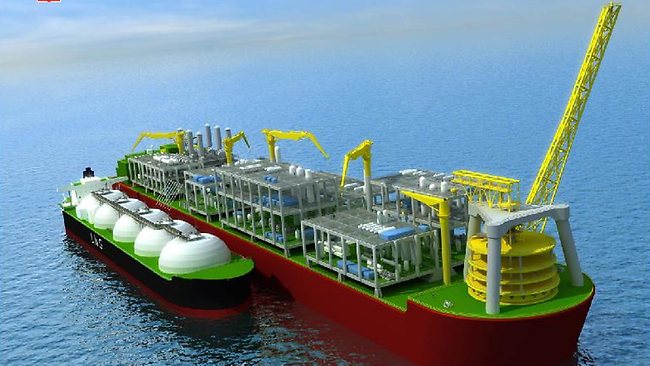
Nearly 20 years and 1.6 million man-hours later Shell is recruiting the first wave of workers for a massive vessel about 200 kilometres off the Kimberley coast, processing gas from its Prelude gas field. It will be the first vessel in the world that will be able to take gas from the reservoir below, liquify it and transfer the gas to cargo ships that will moor alongside the processing facility in the middle of the ocean.
It wasn’t that long ago that the technology, known as floating LNG, was viewed as an expensive option only to be used to unlock small or stranded gas fields like Prelude. This week the game changed. Woodside, Australia’s biggest oil and gas company, has thrown its support behind the technology, declaring it wants to be a world-leading floating LNG operator as it decided to unleash not just one, but three floating LNG ships to develop its Browse gas resources.
The Business Spectator has an interview with Woodside CEO Peter Coleman about Brows, Israel's Leviathan field and the possibility of shale gas exports from the US (something the Japanese seem keen to encourage). The BS's Robert Gottliebsen continuing his incessant anti-union / government diatribe (Coleman deftly ignored him thankfully) - KGB Interview: Woodside's Peter Coleman.
SB: Peter, looking at your presentation this week, you don’t seem particularly concerned about the potential impact of US shale-fed LNG hitting your markets. Could it have a material impact on prices or more particularly could it have an impact on the way LNG is priced?
PC: Well, there are probably two impacts of that. Firstly, the impact of US shale gas is quite clearly improving productivity in the US and making the US actually a more attractive place to invest, particularly for some industries around chemicals and plastics. And so, those energy intensive industries are actually moving back into the US and will soak up some of that excess supply. The supply that may get into LNG , and remember there’s not very much that has actually gone to FID yet …
AK: Sorry Peter, we’re getting some static.
PC: Yeah, so I was saying, the shale gas industry and the surge in gas available and into the US has really made the US attractive as an investment destination for those industries that are very energy intensive or turn gas into something else, being the chemicals and the plastic industry. The gas that’s left over and, you know, the gas that will be exported, you know, there are a couple of things there to consider. Firstly, there are a lot of projects at the moment on the drawing board. Not many have gone to a final investment decision. When you look at the total cost structure, the landed priced into Asia will be competitive but it won’t be low cost by any means. So, the headline price of $4 gas hitting Asia is just simply untrue. Now, the price is going to be in the low to mid-teens and it doesn’t really take very much of a rise in gas prices in the US to in fact make it marginal to uneconomic. So, I think that we a balance will occur, and an equilibrium point will occur, within industry within the next five to 10 years. What does that mean? There’s going to be an evolution in the market. The market is already evolving to become a more fungible commodity. I see trading hubs will be established. True training hubs will be established. Will that be in Singapore, Shanghai, Hong Kong? I can’t say, but Woodside is preparing ourselves for the advent of trading hubs. So, all of those sorts of things will come into play. The consumer is starting to see. You’re starting to see a proliferation now of regasification terminals being put into Asia. As many terminals that as currently exist are now being built in Asia, so there are 40 currently underway. So, clearly the buyers can see that the market is changing. It’s becoming more commoditised. Henry Hub gas just simply puts another gas stream into that. I wouldn’t see Henry Hub any differently from gas that’s going to come out of East Africa or other parts of the world. It’s just another gas stream that’s going to come in.
Gottliebsen has been banging this drum forever it seems, though the BS getting sold to Rupert Murdoch last year hasn't helped matters. Crikey's Guy Rundle has some thoughts about Rupert's malign influence on the Australian election (I liked the Gus Fring comparison) - In Murdoch-land, sans-public sphere, it all sounds the same.
Getting out and about in Brisbane of a morning, you’re greeted with something you’ve forgotten: this is a one-owner town, newspaper wise. Looking at a news rack and seeing The Australian and The Courier-Mail side-by-side — and nothing else — it’s a sort of parody of pluralism. Yeah, I know it’s newspapers, and having a monopoly on them is a little like cornering the spats market, no one under 30, blah blah, etc, but it’s still the way a city talks to itself, the public face of its dialogue. And yes, there’s other TV networks — supposing that they differ in any significant fashion — and the ABC, etc, but still.
There’s a pseudo-pluralism at play that still rankles — would you like the broadsheet which does Kevin Rudd slowly, or the tabloid that sinks the slipper? The Courier-Mail runs with a “Does this man ever shut up?” cover while The Daily Telegraph has a “Mr Rude”, Mr Man parody, using allegations by a make-up artist from a debate run by Sky News — a broadcaster Rupert Murdoch owns a stake in — that Rudd was a bit of a grump. Such “front pages” are nothing of the sort. They’re propaganda posters which happen to be attached to the front of a newspaper, their purpose political as much as commercial. Knowing that people don’t buy newspapers, but still see them around, they go for the microsecond hit, the fast meme. Which may be enough, when aggregated for a Coalition win, without anything else whatsoever.
Really, to talk about the election without mentioning this — the framework of information within which people will make their decision — is really to aid and abet the process. The whole country has become a leagues club owned by a monolithic media corporation; pokies in the main room, a debate going on in the entertainment lounge, the ownership and core business a series of windfalls and rents — mining, sports rights — with the ultimate ownership arrangements a matter of mystery. But to mention this every time is the pathway to madness. So the debate cannot help but be skewed, every time we tap out a line about costings or paid parental leave or whatever. That’s really the genius of Murdoch taking to Twitter — he now hides in plain sight. When he was a mysterious presence behind the scenes, speculation on his motives and power were endless. Now he simply tells us in his weird telegrammatic/spoken-word style that he wants Rudd turfed — and pretty much nothing more can be said about it.
Thus, as soon as the campaign started, the Tele was off and running with its front-page propaganda campaign (even though some of the news within is played — or delivered — straight). Two weeks later, in its major market of western Sydney — perhaps the latest place with a large, old-style working class and literate tabloid readers, out of the social media/The Project/etc carnivale loop — Labor is suddenly tanking, its numbers running well below the national average. What a surprise! What could possibly have created this sudden shift, this bifurcation in the numbers, we go. Is it the boats? Is it the negativity? Is it being mean to TV crew? We know what it is, but we can’t talk about it because that would be the politics of how we do politics, of who controls the information on which we make our decisions. Rudd quite sensibly put his marker down on Murdochracy quite early — and then left it alone, also quite sensible. Because you either run on that, and nothing else, suggest an all-encompassing undemocratic process, and risk the charge that you are sledging the umpire, or you leave it alone — and try and deal with it by a series of guerrilla tactics.
The Australian has a report on the unfolding gas age with Woodside now being tipped to process natural gas from the Browse field at the North West Shelf LNG plant to replace declining gas reserves rather than a new LNG development at James Price Point in the Kimberly - Woodside's $30bn Browse LNG plant in doubt . There is also more speculation about LNG exports of shale gas from North America to Asia.
Woodside Petroleum's plans to build the $30 billion-plus Browse liquefied natural gas plant near Broome appear to have become less appealing against the alternative of piping the gas 1000km for processing at the North West Shelf plant near Karratha when reserves there run low. After recent industry developments here and in the US, analysts now put a greater probability on the Browse project's offshore gas fields being turned into LNG at the North West Shelf and say this would give the project a greater value. ...
Credit Suisse analyst Sandra McCullagh said she was now using a North West Shelf option as a base-case scenario. "Woodside maintains a preference for James Price Point, but we expect that competition for skilled labour and recent LNG sales from the US at prices linked to Henry Hub (domestic US gas prices) could see a shift in the company," Ms McCullagh said.
On top of this, development cost pressure, competition for scarce labour from eight other regional LNG plants under construction, no certain gas to extend the life of the Woodside-operated North West Shelf and LNG buyers' preference for expanding existing plants rather than building new ones make a James Price Point plant less likely, according to Credit Suisse.
Credit Suisse has boosted its expected Browse development cost to $US36bn, compared to a development cost of $US26bn to use the gas to backfill the North West Shelf. …
One of the game changers in Credit Suisse's analysis has been a plan to export US shale gas. Even at US domestic gas prices of $US7 a gigajoule, which is double current prices, it would be profitable to export to Asia at current Asian spot LNG prices.
"Less than 12 months ago, most commentators didn't see much of a threat from North America, but within the space of one month, 7 million tonnes of LNG a year has been sold from Louisiana, earmarked for Asian and European markets," Ms McCullagh said. "We expect unsanctioned Australian LNG projects will struggle to stack up against North American imports."
Prelude is expected to produce 3.6 million tonnes per annum of LNG, as well as 1.3 million tonnes of condensate and 400,000 tonnes of LPG.
The facility is scheduled to begin production in 2016. The gas will be cooled by cold water pumped from about 150m below the ocean’s surface - allowing around 50,000 m3 of cold seawater each hour to cool the gas.
The project will be the world’s floating LNG development and the facility will be the largest floating structure ever built. The vessel will be built by South Korea's Samsung Heavy Industries. At 488 metres long, 74 metres wide and 600,000-tonne in weight it will be longer than four soccer fields laid end-to-end and will be six times heavier than the world's largest aircraft carrier.
The vessel will be permanently moored about 200km off the coast for its 25 years of production and is designed to withstand severe category 5 cyclones (or a “one-in-10,000-year" tropical cyclone, as Shell executive director Malcolm Brinded put it).
Shell has self-insured the project, so its not clear what the view of maritime insurers is of the likelihood of the project suffering significant damage during its lifetime is.
In Australia we’ve seen onshore natural gas largely depleted, near offshore natural gas well developed (the north west shelf LNG operation has now been in operation for decades and long-stalled projects like Gorgon are now well underway), a boom in coal seam gas and emerging interest in exploiting shale gas (local producers seem to view speculation that US shale gas production will undermine Australian LNG export markets in Asia as unfounded, notwithstanding the strong Australian dollar) and biogas.
Research by the CSIRO in 2008 found that up to half Australia's natural gas resources (140 trillion cubic feet) could not be developed because they were too remote to be connected to onshore processing plants.
Floating LNG platforms remove this barrier and would seem to be the final stage of our entry into what has been dubbed by some (including the IEA [pdf]) as "The Gas Age" (I guess you could view the fossil fuel era as an act in 3 parts, similar to the era of the dinosaurs, with the coal age being analagous to the Triassic period, the oil age to the Jurassic and the gas age echoing the Cretaceous, with the end of the era approaching).
By adopting the offshore floating LNG solution Shell hopes to also substantially reduce the time and cost of the project development phase.
Global LNG demand is expected to double this decade and the introduction of floating storage and regasification vessels in recent years has enabled fast entry of new buyers such as Argentina, Brazil, Kuwait and Dubai in recent years, with Thailand and Singapore soon to join the club and Indonesia, Malaysia, Pakistan, Sri Lanka and possibly the Philippines following along behind them.
Shell is already looking at a number of other locations for floating LNG projects, including the Greater Sunrise project in East Timor, and projects in Indonesia, Cyprus, East Africa and South America. Other companies are also interested in floating LNG with the BBC claiming Flex LNG and Hoegh LNG hoping to make final investment decisions shortly on projects in Papua New Guinea.
Jarand Rystad, founder of a Norway-based research consultancy for the oil industry says there are up to 160 gas fields where floating LNG could be applicable worldwide over the next decade.
The 10 platforms figure may have emerged from a statement from Samsung Heavy Industries estimating the size of the market last year.
Besides the PNG projects mentioned earlier, Woodside have been pushing for a floating LNG development for the Sunrise development between Australia and East Timor, and there has been some speculation that Woodside's Browse development could avoid opposition to plans to build an onshore LNG plant in the Kimberly region. There has also been speculation that Inpex's Abadi and Ichthys projects could be candidates.
THE resources boom is gathering strength as companies commit to new mega-projects in Queensland and Western Australia and gear up for a massive surge in investment over the next year. In the past six months, resource companies have given firm commitments to 33 new projects worth a combined $43.9 billion, led by investments in coal-seam gas, iron ore and new coalmines.
The government's resource industry adviser, ABARE, now has 94 projects worth $173.5bn on its books, a 31 per cent increase since last October. … The biggest new project announced in the past six months was the $16bn coal-seam gas venture in Gladstone, which is being led by Santos. Gas and oil projects account for $101bn, or 60 per cent of the total number of projects under construction.
CHEVRON says it is close to signing contracts to supply gas to industrial users from its $43 billion Gorgon project in Western Australia after it reached a crucial access agreement with the Dampier-Bunbury Pipeline to transport the fuel. The US energy giant's Australian operations head, Roy Krzywosinski, said yesterday the access agreement meant all the infrastructure contract arrangements were in place to supply the energy-hungry WA market by 2015. …
Major industrial users have complained for several years about a lack of cheap gas supplies for mines, alumina plants, fertiliser operations and power stations. The Woodside Petroleum-operated North West Shelf Venture and Apache's Varanus Island are the only suppliers to the domestic gas market.
But Apache's $US1bn Devil Creek project is expected to become the next major domestic gas supplier later this year. The project will inject up to 220 terajoules of extra gas into the state's domestic system every day.
A parliamentary inquiry into gas pricing in WA found that prices were double those in other states, and recommended domestic gas reservation requirements should remain. The producers have strongly opposed the reservation policy, which stipulates that 15 per cent of a project's output may have to be set aside for domestic needs.
Mr Krzywosinski said work on Chevron's estimated $30bn Wheatstone project would begin before the end of the year, generating 6500 direct jobs at peak construction and $21bn in government revenue.
WA Today reports that the gas industry continues to generate a lot of protest, with the latest round complaining about the proposed Kimberly gas hub - John Butler stands up to Woodside.
WA musician John Butler has led a lunchtime musical protest outside mining giant Woodside's city offices in protest against its proposed Kimberley gas hub. The multiple ARIA award-winning musician performed on the steps of Woodside’s St George’s Terrace skyscraper as part of a nationwide stance against industrialisation of the Kimberley. Rock stars including Jimmy Barnes and Midnight Oil's Rob Hirst entertained crowds in Sydney while musician Shane Howard hit Melbourne’s Swanston Street.
Woodside, with joint-venture partners Chevron, BP, Shell and BHP, plan to build a multi-million dollar gas processing hub at James Price Point on the Dampier Peninsula, north of Broome. The move has sparked outrage from environmentalists as the area is frequented by migrating humpback whales, untouched beauty and gardens of unique coral.
THE safety reputation of the gas sector has taken a battering after a well blew out in Queensland and a dangerous ''planking'' act was carried out on top of a 60-metre gas flare tower in South Australia.
The sacking of two Santos workers who carried out the prank on top of the Whyalla flare tower was overshadowed yesterday when a gas well operated by Shell and PetroChina blew out for reasons that are uncertain. The blow-out was triggered when workers tried to install a pump and created a pressurised spout of water and gas which spewed for more than 24 hours until it was plugged.
The farmer who owns the land around the well said it was the fourth gas-related incident on the property in five years, denting efforts by the gas sector to build confidence in the controversial practice of tapping coal seam gas.
Rival coal seam gas operators were seething over the potential damage to the sector's image and the Queensland Premier, Anna Bligh, said the joint venture company - Arrow Energy - would be subject to a ''thorough investigation''.
Coal seam gas has prompted concern among farmers over land access and water quality issues and environmentalists are worried about the pumping of chemicals into wells and aquifers. A theatre company in Queensland has been subjected to a boycott campaign because it accepted sponsorship from the gas company QGC.
OIL and gas producer Woodside Petroleum is a step closer to its goal of expanding the $14 billion Pluto project, after discovering more gas off Western Australia.
Analysts were speculating last night that Woodside may now have enough gas to push ahead with a second processing train at Pluto, after it announced success in its Xeres well in the Carnarvon Basin. The Xeres well and the nearby Martin well have long been touted as holding the key to Woodside's expansion hopes, and yesterday's announcement revealed the company had intersected 51 metres of gross gas within the triassic target at Xeres.
The well depth exceeded three kilometres and the discovery had been confirmed by several methods, including with the recovery of gas samples to the surface. The discovery is the seventh in the region and comes after 100 metres of gross gas was discovered at the Martin field in March.
Citi analyst Mark Greenwood said the Xeres find was relatively small, but might be enough to get the second stage of Pluto over the line. ''I think they've probably got enough gas,'' he said. ''They've been aiming to get about 3 trillion cubic feet of gas or more. ''They've made seven discoveries, so each of these discoveries have been pretty small and this one might get them to the threshold or slightly above the threshold.''
Australia’s liquefied natural gas industry faces “serious challenges” such as labor shortages that may force energy companies to delay, merge or cancel their projects, Moody’s Investors Service said.
Moody’s cited Woodside Petroleum Ltd.’s announcement on Nov. 30 that its Pluto LNG venture would cost A$900 million ($889 million) more and start about six months later than previously forecast. The increased cost “is symptomatic of Australia’s resource boom,” Saranga Ranasinghe and Ian Lewis, analysts at Moody’s, wrote in a report dated yesterday.
“While credit negative for Woodside, the cost overruns at Pluto also hold negative implications for the rest of Australia’s energy industry,” and its A$150 billion of proposed investments, the Sydney-based Moody’s analysts said. ...
“These are serious challenges,” the report said. “While we have a favorable view of the long-term LNG demand, these operating challenges will mean that some of Australia’s planned LNG projects will not proceed as currently anticipated. Whether that will lead to the merger of some projects, or to their outright cancellation, remains to be seen,” it said.
While coal seam gas operators on the east coast are finding resistance growing from farmers wanting to protect their land, The Australian reports that Woodside is hitting headwinds on the west coast as well, with labour costs for their Pluto natural gas project rising rapidly - Pluto delayed as costs soar: Woodside.
The company's new $14 billion cost estimate is $900m to $1.3bn higher than its November estimate last year of $12.7bn to $13.1bn. ...
Tapping fields containing 5 trillion cubic feet of natural gas, Pluto is Woodside's most important development project.
Related sales to Asian utilities stand to boost its revenue considerably and it is one of few LNG developments to come on line globally in 2011.
Construction of Pluto has been delayed by industrial action from construction workers over their accommodation arrangements and crane drivers over pay, as Australia's resource-driven economy continues its robust growth.
Woodside in November hiked its cost estimate for Pluto by 6 per cent to 10 per cent after experiencing a shortage of skilled workers.
The company today stuck to its 2010 annual production forecast of 70 million-75 million barrels of oil equivalent, adding production is expected in the middle of that range.
Production in 2011 is expected at 63 million-66 million BOE plus 5 million-9 million BOE from Pluto, creating a wide target of 68 million-75 million BOE.
The Australian reports the WA government is trying to force Kimberley locals to accept a new LNG plant for the Browse basin to be built on their land - Barnett could ignite local opposition to Woodside gas project . I saw John Butler play at the Hordern on Friday night - it was a good gig and he was actively promoting the cause of the locals.
Their support may be withdrawn not so much because of agitation from the likes of musician John Butler -- but thanks to one of its biggest supporters -- West Australian Premier Colin Barnett.
The KLC, which had strongly supported the project as a way of bringing jobs, health, housing and education services to the remote region, last night declared itself at a crossroads. "There's going to be a big meeting next week and I kind of think we're on the knife edge of splitting either way," KLC chief Wayne Bergmann told The Weekend Australian.
With anger growing over the Barnett government's decision to forcibly acquire 2500 hectares of unallocated Crown land -- which is subject to two native title claims -- at James Price Point in a bid to kickstart the project, former federal court judge Murray Wilcox again entered the debate, calling for a public inquiry into the matter.
Butler, who is touring the country agitating against the project north of Broome, yesterday warned of a major community backlash over the Barnett announcement. He revealed that Kimberley law man Joseph Roe, whose divisive court action against the KLC sparked the breakdown with the government, has been appearing at his concerts.
The award-winning blues and roots musician said Aboriginal people should not have to give up their land to get the services and opportunities other Australians were given.
Mr Bergmann said the dynamic could change if traditional owners withdrew their support for the project. "The risk is that my instructions might start to be changed to now oppose the project. I've had phone calls from traditional owners very upset," he said.
The KLC signed an in-principle agreement on behalf of the traditional owners with Woodside and the government last year. The process stalled when Mr Roe, on advice from Mr Wilcox, took the KLC to the federal court, claiming the body had no right to sign the agreement on behalf of the traditional owners. Yesterday Mr Roe promised to fight Mr Barnett "with every breath".
Many analysts had expected Woodside would miss its target timeline of sanctioning the second-train expansion of the Pluto liquefied natural gas (LNG) project by the end of 2010, as mixed exploration success raised doubts it would find the required gas reserves to underpin the expansion.
The latest gas discovery could put Pluto's swift expansion plans back on the table and Woodside shares rose as much as 2 per cent in early trade, outperforming a broader market that was down 1.1 percent.
"Initial analysis of drilling fluids suggests the gas could be comparatively liquids rich, but this requires confirmation by further analysis," Woodside said of its Alaric-1 well, which intersected about 185 metres of gas.
It will proceed to conduct further testing to confirm the full depth of the gas column and the quality of the gas.
Woodside, which is due to report first-half earnings on Wednesday, is rushing to complete Pluto's first train, which is expected to cost A13 billion and scheduled to start LNG production of 4.3 million tonnes per annum (mtpa) in late 2010.
The addition of a second train, which will have an output of about 4 mtpa, would greatly improve Pluto's economics and allow Woodside to roll over its current workforce, which is expected to be in shortage over the coming years amid a raft of other LNG projects.
Woodside Petroleum Ltd has undertaken informal discussions with renewable energy company Tidal Power over the possibility of using its technology to provide power for the oil producer's James Point LNG project, the Australian Financial Review reports.
Tidal Energy is the operator of a stalled $400 million tidal river energy project in the Kimberley region, which it says could supply a small portion of the proposed LNG operation's total electricity requirements. ...
Earlier this year, Woodside chief executive Don Voelte said the Kimberley coastline could become a major gas hub in four or five years after final approval for the James Point project, expected in 2012.
The SMH has an interesting headline for their article on the impasse between the East Timorese government and Woodside (and partners) over the location of the LNG plant to process gas from the Sunrise field in the Timor Sea - Impasse on deal to plunder Timor's gas riches. Unfortunately for the Timorese, there is still plenty of Australian security in the country and, if what happened to Mari Alkatiri is any guide, regime change is always an option.
A serious dispute has broken out between Australian oil company Woodside and the East Timorese government over the processing of gas from the Greater Sunrise field in the Timor Sea. The dispute looks set to lock up one of the richest gas fields in the region and cost Woodside hundreds of millions of dollars already spent on research and development.
At the heart of the dispute is East Timor's claim for natural gas taken from the joint Australian-East Timorese field to be processed into LNG in East Timor. Woodside has rejected that option, saying it wants to process the gas on a floating platform in the Timor Sea. The East Timorese government has said, however, that its position is not negotiable and that without an agreement on refining in East Timor there will be no deal to proceed with drilling.
Both the floating platform and on-shore processing is likely to cost about $5 billion to develop, which is the equivalent of East Timor's current financial reserves from which it derives interest to, in effect, run the country. The profit from the project, however, is expected to run into tens of billions of dollars.
East Timor's claim to have processing undertaken on-shore is similar, in essence, to the Australian government's extended tax on mining companies. It wants its people to receive greater benefit from national resources that will otherwise enrich a foreign-owned company. It also says that Australia already benefits from an earlier processing agreement and that it is now East Timor's turn to benefit.
East Timor sees its economic future built upon the oil and gas reserves in the Timor Sea. An on-shore processing plant would mean not just the initial massive investment, but will further require establishing related infrastructure, meaning significant secondary economic benefits, as well as technology transfers and the training of local workers.
This, the East Timorese government believes, would herald the start of East Timor's own petrochemical industry and its chance to leap-frog the development cycle from little more than subsistence to industrialised status.
The ABC reports that Woodside are looking to build a floating LNG production platform for the Sunrise field between Darwin and East Timor (with the East Timorese continuing to lobby vigorously for the plant to be built there) - Floating LNG plant to be built near East Timor
After years of speculation, the Sunrise Joint Venture has finally announced it will build a floating liquefied natural gas processing plant in the Timor Sea. The Greater Sunrise field is in both Australian and Timorese waters, about 700 kilometres north-west of Darwin, and the two countries will have an equal share of royalties.
The floating rig means Darwin will miss out on having a multi-billion dollar plant built there. Operator Woodside Petroleum says after considering on-shore LNG processing in both Darwin and East Timor, the joint venture partners, which include Osaka Gas, Shell and ConocoPhillips, decided a floating plant was the most viable.
Woodside CEO Don Voelte says the decision is a boon for the new but impoverished democracy. "We expect that the selection of a floating LNG processing option will, in addition to generating significant long-term petroleum revenue, provide a broad range of social investment, employment and training opportunities for Timor-Leste."
The Santos share price has risen strongly in the past three weeks on the strength of rumours that Woodside has been sounding out industry personnel about their willingness to join a team for a major venture, now said to be a move on Santos.
Analysts described the Santos rumours as chatter and pointed out that Woodside has its own LNG growth plans to pursue without having to bother with the unknowns of LNG exports from coal seam gas resources. The chatter nevertheless persists.
The theory is that Woodside would sell Santos's non-export gas interests to defray the cost of the acquisition. A bid for Santos has been on the cards since the South Australian government lifted the 15 per cent shareholding restrictions in the company - a throwback to when Alan Bond was stalking the Adelaide company.
The Santos rumour comes as BG Group has jumped to the lead in the race to become the first of the Queensland gas exporters after formally signing a deal for the supply of $50 billion of gas to China.
The signing followed the May 2009 agreement with China National Offshore Oil Corp for gas sales from its proposed Curtis LNG project near Gladstone.
The agreement covers the supply of 3.6 million tonnes of LNG annually over 20 years. The value was not disclosed and is dependent on oil price assumptions. A range of $40 billion to $60 billion is expected.
It ranks as one of the biggest LNG contracts ever written and has particular importance because it is the first fully-termed sales and purchase agreements for the supply of LNG from coal seam methane, as distinct from an understanding to buy on terms yet to be decided.
Following its 2008 takeover of QGC, BG is laying claim to a resource base to underpin the Curtis LNG development of 13.5 trillion cubic feet. The deal with CNOOC also means that the project is now fully sold on its planned output of more than 8 million tonnes of LNG annually. Previous supply deals with Singapore and Chile have been struck.
BG plans to have the plant on Curtis Island come on stream in 2014.
WOODSIDE Petroleum said the joint venture partners in the Browse project have agreed to develop a liquefied natural gas plant at James Price Point in the north west of Western Australia.
There had been disagreement between the project partners on the best site for the plant, so the decision to choose James Price Point is a positive development for Woodside and the project.
The federal and Western Australian state governments had imposed a deadline for the partners to select a development concept within 120 days of December 2 as a condition of retaining leases associated with the project.
Santos Ltd. and Oil Search Ltd., which are developing liquefied natural gas projects in Asia Pacific, are of “superior” value to Woodside Petroleum Ltd., JPMorgan Chase & Co. said.
“Woodside is overvalued versus peers based on our capital expenditure estimates for its LNG projects, and also given greater uncertainties in LNG growth,” Mark Greenwood, a Sydney- based analyst for JP Morgan, said in a Jan. 22 note to clients.
Woodside, operator of Australia’s North West Shelf LNG project, is building a A$13 billion ($11.8 billion) LNG project in Western Australia, and planning new ventures at Pluto, Sunrise and Browse gas deposits.
“We do not think Browse and Sunrise are at a mature enough stage currently to secure heads of agreements, and timely exploration success is required for Pluto-2 to meet its target final investment decision date at the end of 2010,” Greenwood said. ...
East Timor will block Woodside’s plans to develop the Sunrise LNG plant, the Associated Press reported this month, citing a statement from Secretary of State Agio Pereira.
Woodside's decision to tap investors comes after a cost blow-out of up to $1.1 billion at its Pluto LNG project because of slower construction work. ...
Woodside said in November that it would cover the Pluto budget blow-out via the debt markets, asset sales and underwriting of its dividends. The company also said at the time that it may boost its stake in the joint venture Browse project if it could not agree on a development plan with its partners.
The project is currently 82 per cent complete and on track to deliver first LNG shipments in 2011, with a production capacity of 4.3 million tonnes per year.
Pluto is now the second LNG project in the Asia-Pacific region to see costs rise – a trend that could also haunt the other Australian LNG projects. ExxonMobil Corp, which approved its LNG project in Papua New Guinea last week, has raised the forecast cost for the project by about 15 per cent to $15 billion.
While most of the media attention in the Australian energy sector was focussed on the big deals done by the Gorgon consortium, Woodside also got some press after announcing plans to triple the size of the Pluto LNG plant by 2014, beating both Gorgon and Chevron's proposed Wheatstone plant into production (The Australian - Woodside steps on gas to triple size of Pluto).
The two new Pluto LNG trains will boost production from the project from 4.3 million tonnes a year to 12.9 million tonnes. At this point Woodside doesn't have sufficient gas reserves to supply these, but CEO Don Voelte is claiming the gas will come from a mix of third-party gas, existing discoveries and a new 20-well Carnarvon Basin drilling program the company will start in the coming months.
Voelte is also pushing the line that gas is a "transition fuel" on the way from coal to renewables - something we are seeing a lot of lately. “LNG is going to be a great transition fuel as we all stride to get to renewable alternatives. China along with Taiwan, Korea, Japan -- all are increasing their LNG demands over the coming years.” (Bloomberg - Woodside’s World-Record LNG Targets ‘Not a Stretch’ ).
Alan Kohler at The Business Spectator has also been arguing for gas as a transition fuel, suggesting that our worst carbon emitters - Victorian power stations using brown coal - should be converted to burn gas instead (Business Spectator - Gas is the natural choice for Latrobe Valley).
The intensifying race to build mass-market electric cars means the Rudd government will have to rethink its carbon pollution reduction scheme.
All the modelling that shows electricity demand declining as the price rises due to carbon emissions trading will have to be thrown out. Power demand is going surge again, as it did with the rapid take-up of household air conditioning.
It means, in my view, that the government will have to find a way to convert Victoria’s Latrobe Valley power industry from brown coal to gas.
Tesla Motors, which is shipping more than 100 lithium-battery-powered cars a month out of its factory in California, claims to get mileage of 12.7 kilowatt hours per 100 kilometres. That means your standard 15,000 km a year per car will add 2 megawatt hours to household power consumption – a 33 per cent increase on the household average. Two cars will double most family’s power consumption.
Don’t think it won’t happen, and fast. Bruce Mountain of Carbon Market Economics says that at current prices it will cost around $300 a year to power an electric car, compared to $2,300 a year for a standard 6-cylinder petrol-driven family car. And what’s more the Tesla is supposed to go faster than a Porsche, so with the latest technology there will be no reasons not to make the switch.
Nissan has just unveiled the Leaf, Chevrolet has the Volt, Mitsubishi the MiEV and BYD Co of China is also making electric cars. In Australia, Evan Thornley has jumped out of politics into Shai Agassi’s business, Better Place, which calls itself the world’s leading electric vehicle services provider, and will be pushing hard to encourage take-up here.
Last night the German government became the latest to jump on board the electric bandwagon, announcing a plan to put a million electric cars on the road by 2020. It is planning to spend $US1 billion on battery research over the next three years so Germany doesn’t have to replace oil imports with battery imports.
While all this may be excellent news for the planet, it’s an awkward development for the Rudd government.
Australia’s greatest carbon reduction problem is that we have the world’s greatest reliance on coal-fired power generation, and in particular on brown coal – the worst possible fuel for carbon emissions.
This country’s carbon reduction challenge really boils down to this: how do we make the transition from brown coal in the Latrobe Valley to gas base-load power. ...
In the meantime the renewable energy target legislation – decoupled from the CPRS and passed by the Senate this week – is supposed to kick start the building of wind and gas turbine generators.
But this will not cut it – the RET scheme is really just another rent-seekers’ cash shower, and won’t work much anyway because most of the RET certificates will come from households buying solar hot water and heat pumps.
It’s all about how to close down the Latrobe Valley mines and replace them with gas. Even black coal generation would do.
The simplest way for Australia to meet its entire commitment to greenhouse gas reduction under any scheme that might be devised in Copenhagen would be simply to convert the Latrobe Valley generators to gas.
It would, in fact, be the most efficient thing to do in many ways, since they already have the rotors, switching, transformers, transmission lines out, access to water and plentiful labour from people who will otherwise be out of work as a result of the CPRS.
Kohler touches on the same subject in an interview with Origin Energy CEO Grant King (Business Spectator - KGB INTERROGATION: Grant King).
AK: I mean there’s another element to it which is also political, which is the regional development issues concerning the Latrobe Valley, which I presume the Victorian government is extremely worried about.
GK: But the reality is the Latrobe Valley, in our view, will be generating power in 2020. The total megawatts of output in the Latrobe Valley may be less, should be less in order to reduce carbon. Most of the power stations will still be running. Most of the people working the power stations will still be working there. The average cost of generation will go up for a coal-fired generator and as Karen says they will therefore bid a different price into the market and they will be dispatched according to their competitiveness against all other forms of generation.
AK: Well do you think they could be using gas instead of brown coal?
GK: To give you a different example, it’s just an exercise in logic. If brown coal power stations operate as they do at 0.8 emissions intensity, simply because of the lower carbon intensity of black coal. The interesting and simple puzzle is that Victoria ought to import black coal into Latrobe Valley, right, because they’ve nearly halved their carbon emissions, ok, and you’re not going to find that as a realistic option preferred because Victorians will not be overly enthused about importing New South Wales or Queensland black coal, right, but if you really just think about it as an economic and technical problem, then you would simply substitute less carbon-intensive fuels for more carbon-intensive fuels.
It’s important to remember that black coal is far less carbon-intensive than brown coal and if you substituted black for brown, you would have an enormous reduction in carbon emissions in Victoria. Now, the other way of getting there is these coal-drying projects, where the aim is to make brown coal like black coal and so it’s very important and when you go back to the compensation arguments, it’s very important to understand that what the brown coal generators own is two assets; a brown coal resource and a power station built to run on brown coal. If coal-drying works, then that reduces brown coal’s carbon. The carbon in terms of our brown coal begins to look more like black coal and there is still substantial value in the resource that’s owned by those generators and therefore why should they be compensated for it.
AK: Well, why do you think parliament is blocking the ETS and passing the RET?
GK: Look, my view – and I guess I’ll rely on you guys to understand the difference between a kind of a personal view and a logical, reasoned view, not that there’s a difference – but I think the community intuitively believes that renewable energy is good, that irrespective of carbon our fossil fuel resources are finite and therefore intuitively no matter what the cost and I’m not sure people really do understand the cost, but intuitively no matter what the cost, it is a good and worthy thing to increase our understanding, knowledge, pricing and competitiveness of renewable energy. I think that that is gaining momentum to the point where the if you like the concern particularly by business around the impact of the CPRS has brought complexity to that debate to the point that the community is less clear about the benefits of making that change and particularly when that change is expressed in the consequence or in terms of job losses which clearly quite now is a matter of great concern to the community.
Now, I think it’s fair to say that we in the gas industry see a change for our fuel type from coal to gas as job-creating, but that certainly people have been much more willing to buy the argument that the CPRS is a job destroying initiative and for those that have wanted to advance that argument I think it’s created some momentum. I mean it’s created some traction in the community. Now, I don’t know whether that is the true reason and that is my opinion, but that almost always political alignment occurs when community alignment occurs and, you know, political division exists when community division exists.
On the subject of the RET, Crikey's Bernard Keane isn't particularly impressed with how the lobbyists have been handled by the government (Crikey - Sucking the RENT out of RET).
The capacity of the Australian Parliament to bastardise good policy and turn it into a feeding trough for rentseekers and other parasites is truly remarkable.
You can’t move in this place or open a paper without the bottom-feeding filth of the political economy springing out, hands extended, threatening disaster unless they can fasten tightly onto the public teat. And it’s getting worse, as more and more sectors heed the example of lowlifes like the Minerals Council of Australia and come in for their chop.
The Coalition and the Government managed a deal yesterday on the Renewable Energy Target, or what’s left of it. Just in the nick of time before a Question Time in which the Government would assuredly have contrasted its success in facilitating the Gorgon deal with the inability of the Coalition to even agree amongst themselves on a bill they had committed to support.
In the event, Western Australian backbenchers — Mal Washer and Judi Moylan honourably excepted — found another way to ruin Malcolm Turnbull’s afternoon, but the Coalition demonstrating it is a rabble is now so common as to no longer be newsworthy.
Bear in mind that the RET is a dud idea improved only by the fact that the Government’s ETS is even worse. As Ross Garnaut noted, a renewable energy target should be wholly unnecessary and in fact counter-productive if you have a proper emissions trading scheme that will allow the market to effectively respond to the price of carbon emissions.
But now that’s the counterfactual. The Government’s ETS will be almost completely ineffectual (and may be rendered entirely ineffectual in negotiations between the Government and Opposition over the next couple of months) and that means the RET is now the only game in town in terms of driving any sort of move to a lower-carbon economy.
It already had flaws, like the bizarre solar multiplier component, in which solar panel power will generate five times more credits than it should generate, artificially bumping up the scheme.
But the RET, like the Government’s emissions trading scheme, has been further degraded by rentseekers and whingeing industries demanding a free kick. As Lenore Taylor notes this morning in a great little piece, the industries eligible for “interim assistance” under the RET bill were initially only a small number with an electricity intensity above a certain threshold of megawatt‑hours per $million revenue. That, as the Government’s own explanatory memorandum made clear, was expected to include only the aluminium smelting, silicon production and newsprint manufacturing sectors.
Well, scratch that, because under the deal with the Coalition everyone who is getting a handout of free CPRS permits will now be getting assistance under the RET bill, at the same thresholds, for the cost of Renewable Energy Certificates. And if the price of price of RECs goes above $40, there’ll be additional assistance for big electricity users for complying not just with the RET but with the current renewable energy target of 5%. At least the CPRS debacle hasn’t yet led to the softening of existing greenhouse reduction schemes.
Now, bear in mind that those big electricity users are going to enjoy a fall in the cost of wholesale electricity as a consequence of the RET, because it will bring renewable energy sources online that big users won’t have to pay for, increasing overall generation capacity. That will go straight onto the bottom line of big electricity users, at everyone else’s expense. ...
There are a number of reasons why we now have a political system apparently structured to reward the basest instincts of our business sector. The proliferation of lobbyists — frequently former politicians and staffers — is one. The rise of economics consultancies who will “model” any outcome clients want — and the unwillingness or inability of journalists to call bullshit on such modelling — is another. The finely-balanced nature of the Senate also plays a role, especially when unpredictable dropkicks like Steve Fielding hold a swing vote. But ultimately it’s because we don’t have politicians — on either side, but this is primarily a fault of the Government — apparently capable of resisting rentseeking. At least John Howard knew a try-on when he saw one, and refused to let the GST be ruined by concessions until he absolutely had to when confronted with Meg Lees. Paul Keating sent rentseekers of any kind away with a black eye and a warning not to come back. Bob Hawke was adept at crafting outcomes that looked after those genuinely affected by reforms without undermining what he was trying to achieve.
Oh for a small part, just a lousy bloody fraction, of that sort of political courage now.





 Posts
Posts