Posted
by Big Gav
in
australia,
chevron,
oil
The Australian reports that Chevron is looking to explore for oil offshore from South Australia - Chevron shifts offshore in $500m Bight Basin push.
ENERGY giant Chevron is preparing to spend almost $500 million on oil and gas exploration as part of a massive push into the Bight Basin off South Australia, in a departure from its primary focus on LNG projects in Western Australia. Federal Industry Minister Ian Macfarlane said yesterday that exploration permits had been awarded to Chevron to explore in two frontier offshore blocks spanning more than 32,000sqkm -- almost doubling the US group's total offshore acreage holdings in Australia.
The Bight Basin, part of the Great Australian Bight, is believed to be highly prospective and is similar in size to the Gulf of Mexico. Last year, the federal government granted permits to BP in the Bight Basin, marking the first time the environmentally sensitive region had been explored for more than a decade.
Posted
by Big Gav
in
brightsource,
chevron,
csp,
enhanced oil recovery,
solar thermal power
Bloomberg has an article on enhanced oil recovery using solar thermal energy in California - Chevron Uses Solar-Thermal Steam to Extract Oil in California.
Chevron Corp. (CVX), the second-largest U.S. oil company, began extracting crude from a southern California field using steam produced by a 29-megawatt solar- thermal power plant. BrightSource Energy Inc.’s system uses mirrors to focus sunlight on a boiler at Chevron’s Coalinga, California, enhanced oil recovery project, the solar company said in a statement after extraction began today.
Solar-thermal technology companies such as BrightSource are targeting industrial users in the oil-recovery and food- processing industries as customers as well as power generation. Mining and metals processing are also very promising, especially in remote areas where power can also be generated along with heat, Charlie Ricker, BrightSource senior vice president of business development, said today in an interview. ...
The Coalinga plant consists of 3,822 mirror systems, or heliostats, each with two 10-foot (3-meter) by 7-foot mirrors mounted on a 6-foot steel pole focusing light on a 327-foot solar tower. Steam created by the heat is fed into the oil reservoir, making it easier to bring to the surface. The system began generating steam in August, Kristin Hunter, a spokeswoman for Oakland, California-based BrightSource, said today in an e- mail.
Areva SA’s Areva Solar, Seville, Spain-based Abengoa SA, Erlangen, Germany-based Solar Millennium AG (S2M) and Burbank, California-based eSolar Inc. are competing with BrightSource with their own solar-thermal technology. Glasspoint Solar Inc., based in Fremont, California, makes solar steam generators for the oil and gas industry using mirrored troughs inside of glasshouse enclosures to protect the mirrors.
Enhanced oil recovery, or EOR, fits very well with solar temperatures, Glasspoint Vice President John O’Donnell, said today in an interview.
Some 32 percent of California’s industrial and commercial gas use is for EOR as its use grows in the U.S. and all over the world, O’Donnell said. The state produces about 40% of its oil using EOR and in a few years that will grow to 60%, he said.
The company can produce heat for EOR for about $3 per million British thermal units, compared with about $4 for a comparable natural-gas plant in the U.S. and between $10 to $12 for other conventional solar thermal technologies, O’Donnell said. “We are the only ones below natural gas right now in the U.S.”
Posted
by Big Gav
in
australia,
chevron,
lng,
wheatstone
The ABC reports that Chevron's Wheatstone liquefied natural gas project in WA has been given the go-ahead - Wheatstone LNG project to make Aus second largest global producer.
The Chevron-operated Wheatstone liquefied natural gas (LNG) project will officially go ahead.
The project was given the federal environmental approval last week and the outcome of a final investment decision (FID) of $29 billion by Chevron was really little more than a formality.
Wheatstone is a joint venture project with Chevron 73.6 per cent, Apache 13 per cent, Kuwait Foreign Petroleum Co (KUFPEC) 7 per cent, Shell Australia 6.4 per cent.
The Wheatstone gas field is about 250 kilometres off the coast of Onslow, north-west Western Australia.
Gas from the field will be pumped via subsea pipelines to the onshore processing facility just north of the town of Onslow.
The project has come on stream in record time, from discovery in 2004 to first gas production by 2016.
Up to 3,500 jobs and 3,000 indirect jobs will be created during the construction phase of approximately six years.
A permanent workforce of 300 will operate the rigs and plant.
WA Premier Colin Barnett says Wheatstone will confirm WA as the world's second-largest supplier of LNG behind Quatar, and CEO of Shell, Ann Pickard, went one step further.
She says Australia will soon strip the title of leading producer from Qatar, in the Middle-East, within the decade.
Federal Government counting the royalties before they flow
The Federal Resources Minister, Martin Ferguson, says the revenue stream from the Wheatstone project is estimated at $20 billion over the 20-year life of the project.
And he welcomes the commitment by the company to spend $17 billion on Australian goods and services over the lift of the project. "The investment of just under $30 billion means that we now have $140 billion committed in Australia to new LNG investments" he says.

Posted
by Big Gav
in
chevron,
geothermal energy,
geothermal power,
indonesia
The San Francisco Chronicle has an article on the geothermal power boom in Indonesia - Chevron Bets on $30 Billion Volcanoes in Indonesian Rainforest.
Chevron Corp. drilled 84 wells to a depth of two miles beneath the Indonesian rainforest to tap steam, not oil and gas, that's trapped in the world's richest store of volcanic energy.
The geothermal plant, set among wild orchids and bamboo trees, uses 315 degree Celsius (600 degree Fahrenheit) heat to spin turbines 24 hours a day, generating electricity for Jakarta, a four-hour drive to the north. The oil driller, which pioneered geothermal energy 20 years ago in Southeast Asia's biggest economy, is about to see competition.
Companies from General Electric Co. to India's Tata Corp. are leading an investment boom in Indonesia that may climb to more than $30 billion, anticipating President Susilo Bambang Yudhoyono will honor his promise in February to boost clean- energy subsidies. The pledge has spurred the biggest geothermal spending spree in Asia and the largest outside of the U.S.
Posted
by Big Gav
in
australia,
chevron,
concentrating solar power,
cpv,
csp,
mildura,
new mexico,
silex,
soitec,
solar pv
The Climate Spectator reports that Silex's long delayed CPV plant for Mildura in Victoria may at last be moving ahead - All Systems go.
Silex Systems has finally secured formal agreement from the federal government to continue the $75 million of fund granted to a proposed 152MW concentrated solar project in Mildura. The fate of the grant had been in some doubt, because the company that originally received the grant, Solar Systems, went bankrupt in late 2009 before being bought by Silex early in 2010. Silex says the grant – combined with $50 million in funds from the Victorian government – will enable the company to progress to a 2MW pilot plant, then a 100MW demonstration project that could be expanded by a further 50MW at a later date.
Silex says it has refined and solved many of the technical difficulties that had plagued the original project, and which had forced the company into receivership because its shareholders, which include TRUenergy and several private, either couldn’t or wouldn’t provide more funds. The unique 'dense array' concentrating PV technology is said to be deal for large commercial and utility-scale solar projects, and Silex says the Mildura facility has the potential to be of the one of the largest and most efficient solar power stations in the world.
Silex says it continues to investigate opportunities to construct utility-scale solar plants in Australia and US, as well as growth opportunities worldwide. The $75 million of Commonwealth funding was announced in 2006 as part of the Low Emissions Technology Demonstration Fund. The Federal Government has further assisted the project with a $4.5 million grant under the Asia Pacific Partnership on Clean Development and Climate, of which approximately $1.9 million was transferred to Solar Systems.
Renewable Energy World has a report on a CPV project in New Mexico -
San Diego's New CPV Solar Giant.
With a 150 MW project planned in San Diego and a 25-year PPA in place, CPV has at last entered the commercial arena. Standing in the New Mexico desert, a 1 MW Concentrating Photovoltaic (CPV) power plant is establishing a route for the emergence of this utility-scale technology. Installation of this first pilot commercial deployment began in the summer of 2010 and the plant was commissioned early in 2011, with official inauguration in April.
Located on the tailings site of Chevron Mining Inc's (CMI) molybdenum mine in Questa, New Mexico, some 2000 metres above sea level in an area of the US noted for its high levels of Direct Normal Irradiance (DNI), its developers say the project will demonstrate the technology as well as a practical use of previously impacted land. Electricity produced from the installation will be sold to the Kit Carson Electric Cooperative, through a power purchase agreement.
Covering some 20 acres (8 ha) the site has 173 CPV modules, each of which has an area of about 18 by 21 feet (35 m²) and is pole mounted on dual axis trackers supplied by a major manufacturer. The Concentrix technology uses Fresnel lenses to concentrate sunlight almost 500 times onto high efficiency multi-junction PV cells. With this technology, Soitec claims to achieve AC system efficiencies of 25% and more, significantly higher than currently available conventional solar PV technology, and as a result, cost reductions of 10%-20% could be reached, depending on the location of the installation, it says. ...
CPV systems are typically more efficient than conventional solar systems at locations with both high ambient temperatures and dry weather conditions. Because of the very low temperature coefficient of its solar cells, a CPV system's performance is much less affected by temperature than other photovoltaic technologies. Another key advantage of CPV technology is the very low levels of water required for operations, essentially used in cleaning only, a crucial consideration for the water-constrained regions to which it is suited, such as the Imperial Valley, which is some 150 miles (230 km) from the coast.
Indeed, such technology is expected to work best in areas with higher DNI like northern New Mexico and southern California, as well as in north and southern Africa, the Middle East, and much of China and India. Certainly, in 2010 Soitec announced that it had joined the Desertec Industrial Initiative (Dii) as Associated Partner and Medgrid as a founding member, in the expectation that the decision will pave the way to utility-scale CPV projects in the Middle East and North Africa (MENA).

Posted
by Big Gav
in
australia,
browse,
chevron,
gorgon,
lng,
natural gas,
woodside
The Australian has a report on the investment boom in resource (particularly natural gas) projects in Australia - Boom gathers pace as resource projects surge.
THE resources boom is gathering strength as companies commit to new mega-projects in Queensland and Western Australia and gear up for a massive surge in investment over the next year.
In the past six months, resource companies have given firm commitments to 33 new projects worth a combined $43.9 billion, led by investments in coal-seam gas, iron ore and new coalmines.
The government's resource industry adviser, ABARE, now has 94 projects worth $173.5bn on its books, a 31 per cent increase since last October. … The biggest new project announced in the past six months was the $16bn coal-seam gas venture in Gladstone, which is being led by Santos. Gas and oil projects account for $101bn, or 60 per cent of the total number of projects under construction.
One major component in the investment boom is Chevron’s Gorgon LNG project in WA - The Australian reports that the WA government is continuing to insist on 15% of the gas being supplied to the
domestic market -
Chevron close to domestic gas deal on Gorgon project.
CHEVRON says it is close to signing contracts to supply gas to industrial users from its $43 billion Gorgon project in Western Australia after it reached a crucial access agreement with the Dampier-Bunbury Pipeline to transport the fuel.
The US energy giant's Australian operations head, Roy Krzywosinski, said yesterday the access agreement meant all the infrastructure contract arrangements were in place to supply the energy-hungry WA market by 2015.
…
Major industrial users have complained for several years about a lack of cheap gas supplies for mines, alumina plants, fertiliser operations and power stations. The Woodside Petroleum-operated North West Shelf Venture and Apache's Varanus Island are the only suppliers to the domestic gas market.
But Apache's $US1bn Devil Creek project is expected to become the next major domestic gas supplier later this year. The project will inject up to 220 terajoules of extra gas into the state's domestic system every day.
A parliamentary inquiry into gas pricing in WA found that prices were double those in other states, and recommended domestic gas reservation requirements should remain.
The producers have strongly opposed the reservation policy, which stipulates that 15 per cent of a project's output may have to be set aside for domestic needs.
Mr Krzywosinski said work on Chevron's estimated $30bn Wheatstone project would begin before the end of the year, generating 6500 direct jobs at peak construction and $21bn in government revenue.
WA Today reports that the gas industry continues to generate a lot of protest, with the latest round complaining about the proposed Kimberly gas hub -
John Butler stands up to Woodside.
WA musician John Butler has led a lunchtime musical protest outside mining giant Woodside's city offices in protest against its proposed Kimberley gas hub.
The multiple ARIA award-winning musician performed on the steps of Woodside’s St George’s Terrace skyscraper as part of a nationwide stance against industrialisation of the Kimberley. Rock stars including Jimmy Barnes and Midnight Oil's Rob Hirst entertained crowds in Sydney while musician Shane Howard hit Melbourne’s Swanston Street.
Woodside, with joint-venture partners Chevron, BP, Shell and BHP, plan to build a multi-million dollar gas processing hub at James Price Point on the Dampier Peninsula, north of Broome. The move has sparked outrage from environmentalists as the area is frequented by migrating humpback whales, untouched beauty and gardens of unique coral.
Posted
by Big Gav
in
australia,
chevron,
lng,
natural gas,
shell,
wheatstone
Chevron aren't talking much about gas to liquids at their proposed Wheatstone LNG plant lately, but the project itself seems to be making steady progress - Shell to join Chevron's Australia Wheatstone LNG project.
Chevron Corp said on Sunday Royal Dutch Shell (RDSa.L) will join its Wheatstone liquefied natural gas project off the coast of Western Australia as an equity participant and natural gas supplier to the project.
Chevron will sell 6.4 percent of its stake to Shell, and remain the operator of the project with 73.6 percent stake. Shell will also assume an 8 percent participating interest in the Wheatstone and Iago natural gas fields, which will supply the first two trains of the Wheatstone project.
The agreement comes as Chevron prepares to make a final investment in the project.
"A final investment decision is expected in the second half of this year once environmental approvals and other associated agreements are finalized with various levels of government," Chevron Australia managing director, Roy Krzywosinski said in a statement. He also said front-end engineering and design (FEED) activity on Wheatstone is nearly complete.
The first phase of the Wheatstone project will have a combined capacity of 8.9 million tonnes per annum (mtpa) of LNG as well as a domestic gas plant.
Chevron is positioning itself to become one of the largest LNG producers in Australia, with the construction of the A$43 billion Gorgon project, also off the coast of Western Australia, which is set to produce 15 mtpa by 2014.
Shell is also developing several LNG projects in Australia, and is set to make a final investment decision on its 3.5 mtpa Prelude floating LNG project this year. Shell has also proposed a coal seam gas to LNG project in Australia's eastern Queensland state.
Posted
by Big Gav
in
australia,
chevron,
korea,
lng,
wheatstone
The Australian reports Korea Gas Corp has signed up for delivery of LNG from Chevron's Wheatstone project - Korea Gas signs up for Wheatstone LNG
KOREA Gas Corp has signed a preliminary agreement for delivery of LNG for up to 20 years from the Wheatstone project offshore Australia.
The agreement between Chevron and its partners and the state-run KOGAS is the latest in a string of deals to supply LNG between major oil companies and customers in East Asia.
The agreement also is a significant step for Chevron in adding credibility to Wheatstone, which faces stiff competition from other projects to secure customers.
It also helps Chevron to keep on track the development of the project, about which the company confirmed there will be a final investment decision in 2011.
Oppenheimer & Co analyst Fadel Gheit said: "There is plenty of LNG coming out of Australia and obviously securing long-term supply contracts is very critical for the development of any major project."
Posted
by Big Gav
in
chevron,
cpv,
csp,
project brightfield,
solar power,
solar pv,
solar thermal power
The New York Times has a look at Chevron's interest in solar PV and their "Project Brightfield" test bed for powering an oil refinery (also referencing their involvement in Brightsource's solar thermal power project at Ivanpah and Chevron Mining's recent implementation of a CPV system at a molybdenum mine in New Mexico) - Chevron Testing Solar Technologies.
The oil giant Chevron has transformed an old refinery site in California into a test bed for seven advanced photovoltaic solar technologies, which the company is evaluating for use at its facilities worldwide.
On Monday, Chevron is unveiling 7,700 solar panels installed on 18 acres in Bakersfield, the capital of California’s oil patch. Called Project Brightfield, the plant will generate 740 kilowatts of electricity to power nearby oil operations.
Any excess electricity will be fed to the power grid.
“We were looking for the next-generation technology that we believe could well be the low-cost solution — not just in terms of panels but in total cost of ownership,” said Des King, president of Chevron Technology Ventures, the company’s venture capital and technology development arm. “It’s one of most comprehensive side-by-side tests in shear numbers of panels.”
Mr. King said Chevron collected data on 180 solar companies, visited 38 of them and narrowed the list to 19 before choosing seven finalists.
Six of the companies make thin-film solar panels that deposit or print solar cells on glass or flexible metals. Though less efficient than traditional crystalline photovoltaic technology, thin-film solar panels typically do not use much expensive silicon and can be manufactured at a lower cost.
Chevron has installed panels from Abound Solar of Colorado; MiaSolé, a Silicon Valley start-up; Schüco, a German industrial company; Solar Frontier, a subsidiary of Japan’s Showa Shell Solar; Sharp; and Solibro, a division Q-Cells, a big German solar module maker.
Project Brightfield’s sole crystalline panel maker is Innovalight, a Silicon Valley start-up that has developed a “silicon ink” that it uses to make photovoltaic modules. “We hope this is a boost to new technology providers,” Mr. King said.
For MiaSolé, Brightfield is the start-up’s first commercial project and the company will supply solar panels that will generate about a third of the facility’s electricity.
Posted
by Big Gav
in
arrow energy,
australia,
chevron,
coal seam gas,
lng,
natural gas
The Australian reports that Chevron are continuing their run of success selling LNG from the north west shelf - Chevron signs $18bn North West Shelf natural gas deal with Japanese utility.
US oil major Chevron continues to pull in more deals and equity partners in its two big West Australian liquefied natural gas projects, announcing it has agreed to sell LNG potentially worth $18 billion to Japan's Kyushu Electric over the next 20 years in two separate deals.
The two heads of agreements announced yesterday come as Queensland's LNG hopefuls, who want to export coal seam gas through Gladstone, have struggled to lock in buyers for projects they hope to approve this year.
Chevron says Kyushu has agreed to buy 300,000 tonnes of LNG a year for 15 years from the recently started $43bn Gorgon project on Barrow Island.
The power utility also agreed to take 700,000 tonnes of LNG a year for 20 years from the yet-to-be approved Wheatstone project planned for Onslow.
"The agreements with Kyushu Electric further demonstrate our ability to attract large and experienced LNG buyers as we develop these two legacy gas projects in Australia," Chevron Asia-Pacific exploration and production president Jim Blackwell said
On top of the gas sales, Kyushu, which is a customer of the Woodside-operated North West Shelf LNG plant, has agreed to take an equity stake in Wheatstone.
Reuters reports that on the other side of the country, Arrow has made a large upwrd revision to their
coal seam gas reserves -
Arrow upgrades gas reserves, eyes LNG opportunities. More at
Gas Today.
Australian coal seam gas firm Arrow Energy Ltd (AOE.AX) sharply raised its gas reserves and said that the increase would help boost its ability to supply gas to more liquefied natural gas (LNG) projects.
Arrow, a coal seam gas supplier of Royal Dutch Shell (RDSa.L) in Australia, said it may be able to add up to 1.5 trillion cubic feet (tcf) of gas reserves per year to its gross proved and probable (2P) reserves over the next three years, up from an earlier goal of 1 tcf per year.
The firm's 2P reserves, defined by the industry as having 50 percent chance of recovery, jumped by 50.3 percent from a year ago to 6,150 petajoules (PJ), while reserves by the widest estimate increased by 18.6 percent to 11,042 PJ.
"This acceleration of reserves additions will ensure that we are well placed for future commitments to further growth opportunities in the domestic market, the Fisherman's Landing project or (Shell's proposed) Curtis Island," Arrow's Managing Director Nick Davies said in a statement.
Total uncontracted 2P gas reserves from its operated tenements now stand at 5,379 PJ, the firm said.

Posted
by Big Gav
in
australia,
chevron,
gas,
lng,
wheatstone
Chevron's Wheatstone gas field has long been the subject of a tug of war between Chevron (who want to develop it themselves - at one point talking up the possibility of building a GTL plant) and Woodside, who want to use the gas as feedstock for their second Pluto LNG train, which will shortly begin construction at the Burrup Penninsula.
It appears that Chevron have found a customer for the gas at last, with weekend press reports trumpeting a "$90 billion" gas sale to Japanese power company Tokyo Electric. The development is expected to produce 4.1 million tonnes of LNG exported each year. A final decision on the project is expected in 2011.
With Pluto, Gorgon and Wheatstone all looking to move forward after long delays, and the federal government's "use it or lose it" push to get holders of gas reserves to develop them quickly, we may see the Browse and Sunrise fields developed in the coming decade as well.
Posted
by Big Gav
in
australia,
chevron,
gorgon,
lng,
natural gas
The SMH reports that Chevron has now sold most of its share of future gas production from the Gorgon field off WA - Japan, Korea sign $70b Gorgon gas export deals. Note the projected income from these sales is based on a much higher oil price than at present.
THE giant Gorgon project in Western Australia has signed a binding agreement worth $70 billion with Japan and Korea to export almost 3 million tonnes of liquefied natural gas a year until 2039.
As the joint venture partners prepare to deliver a final investment decision as early as next week, the project's operator, Chevron, firmed up three in-principle deals negotiated in 2005.
Under the deal, Japan's Osaka Gas will take 1,375,000 tonnes a year over 25 years starting in 2014. The larger Tokyo Gas will take 1.1 million tonnes a year over the same period.
GS Caltex, a major South Korean energy company, will take 500,000 tonnes a year over 20 years, partly from Gorgon and the rest from Chevron's other gas projects.
Chevron, which has a 50 per cent interest in the project - ExxonMobil and Shell each have 25 per cent - will sell down its equity in Gorgon. Osaka Gas will purchase a 1.25 per cent share and Tokyo Gas 1 per cent, leaving Chevron with 47.75 per cent. The equity deals will require the approval of the Foreign Investment Review Board but are not considered to be a concern.
The three deals leave about 2.7 million tonnes a year of LNG for Chevron to sell. Market sources say the company is in talks with China National Offshore Oil Corp and China Petroleum & Chemical Corp (known as Sinopec) to sell the remainder. Chevron expects final sales to be completed ''in the coming months''.
China remains hungry for LNG even after ExxonMobil agreed last month to supply the state-owned PetroChina with 2.25 million tonnes a year from the Gorgon project over 20 years - establishing it as Australia's biggest trade deal.
The Prime Minister, Kevin Rudd, said the $50 billion Gorgon project was on track to become Australia's biggest single infrastructure investment, creating up to 6000 jobs and generating $40 billion in revenue for the Government.
''It has been a great four weeks for Australia's LNG sector,'' he said. ''More than 2250 cargoes of Australian LNG have been delivered to Japan since 1989 and these agreements … mean there will be many more to come.
''Throughout the Asia Pacific, Australian LNG will be increasingly important as a reliable, secure, clean energy source to power continued economic growth.''
Doubts have been raised about the headline figures attached to the Gorgon LNG deals. A recent Goldman Sachs JBWere report gave current LNG prices at $US322 ($374) a tonne. Forecasts for 2014, when the project is expected to start exporting, are about $450 a tonne. This figure values the three deals at about $32 billion. To arrive at a figure more than double that, even allowing for the 2.25 per cent equity interest, would mean the Government is forecasting oil prices, from which the LNG price is calculated, to soar.
Posted
by Big Gav
in
chevron,
csp,
solar thermal power
Reuters reports that Chevron is building a solar thermal plant to provide heat for advanced oil recovery - Chevron building solar-steam plant
Chevron Corp is building a solar plant here to create the steam that boosts production at an aging California oilfield, in a pioneering project the company aims to replicate elsewhere if it works.
Chevron outlined the previously undisclosed plan at a city council meeting in Coalinga, a city halfway between Los Angeles and San Francisco that started as a coal outpost, boomed with oil gushers, and is now a potential solar energy hub.
The second-largest U.S. oil company said the solar thermal plant, which will collect reflected sunlight from thousands of mirrors at a 323-foot (98-meter) tower where the water boils, will replace some steam production now powered by natural gas.
Steam is injected into wells to heat up heavier oil and thus lower its viscosity to make it easier to extract.
Solar thermal company BrightSource Energy is partnering with Chevron on the project, which will employ BrightSource's technology. A spokesman for Oakland, California-based BrightSource would not comment on the terms of that deal.
Sergio Hoyos, a business developer at Chevron Technology Ventures, said construction of the Coalinga plant would begin this year, with production slated to start by the end of 2010.
"The only problem we have is when it's cloudy," he said to a few laughs at the city council meeting on Thursday night.
Although he said solar thermal could never replace natural gas in steam production, it is an opportunity for Chevron to save energy while championing a technology pegged by some as a winner in the long run.
Just this week, German solar thermal company Solar Millennium AG and plant builder MAN Ferrostaal AG announced that they have joined forces to capture a chunk of the growing U.S. solar thermal power market.
The Coalinga plant will cover 100 acres of Chevron-owned land with more than 7,000 mirrors. Hoyos said Chevron would consider deploying the solar thermal system, which will be the first of its kind to produce steam for oil production, at larger fields if it is successful.
Posted
by Big Gav
in
australia,
chevron,
exxon,
gas,
gorgon,
lng,
natural gas
The Age reports that the Exxon has signed up its first customer for LNG from the Gorogn field off WA, with India's Petronet LNG signing a 20-year agreement to take gas from the project (First Australia-India long-term LNG deal reached).
Under the agreement, Exxon will supply about 1.5 million tonnes per annum from its 25% share of LNG from the project over 20 years (the project as a whole will produce 15 million tonnes a year) - the gas will be delivered to Petronet's new LNG terminal under construction at Kochi in southern India.
WA Environment Minister Donna Faragher has given final environmental approval for the proposed development on Barrow Island, removing one of the remaining obstacles to construction (Green light for Gorgon in time for lucrative deal), and the local press is already reporting on some of the activity required to support the construction of the project (Hercules to airlift Gorgon materials).
Federal Environment minister Peter Garrett also needs to approve the project, though given his recent stance on large scale energy developments he seems unlikely to oppose it (Chevron set to go ahead with big gas project). The Australian reports the project partners are aiming to tick off on developing Gorgon in mid-September. If approved, Gorgon will be the largest Australian resources project and, as federal Resources Minister Martin Ferguson has pointed out, will provide a greater investment than the Rudd government's $42bn stimulus package.
Annual sales from Gorgon would be worth around $12.5bn at current prices and would boost the nation's mineral and energy revenues by 10 per cent, based on government export forecasts for this year (as I've noted previously if all of Australia's proposed gas developments proceed - especially if we include coal seam gas - we'll have to be wary of the "dutch disease").
The Gorgon plant will have three 5 million tonnes a year LNG trains and will produce LNG using the 40 trillion cubic feet of gas in the two Greater Gorgon fields.
The fields, Gorgon and Io/Janz, contain Australia's biggest gas reserves and are expected to support the project, which will start production in 2014 and ramp up to full output 18 months later, for more than 40 years.
The strangest and most unsettling aspect of the project is that the federal government and WA state government will bear the costs for any problems related to sequestration of carbon dioxide from the project in future years, which seems like a spectacularly risky bet for taxpayers over the long run - (Gorgon deal on carbon).
In other Australian gas news, Gas Today has a report on the various projects under consideration further north in the Browse Basin (Browsing gas fields).
And the UK Daily Telegraph has a report on Shell's bid the purchase the rest of coal seam gas producer Arrow Energy (Royal Dutch Shell tables £1.5bn bid for Australia's Arrow Energy).
Gas Today also has a look at the wisdom of exporting LNG in such large quantities over the long term and what this means for local gas consumers (Are we exporting our energy future?).

Posted
by Big Gav
in
chevron,
ecuador
The WSJ has an article on Chevron's legal woes in the wake of the environmental damage they have caused in Ecuador - Pension Funds Fret as Chevron Faces Ecuador Ruling.
Big public pension funds are raising concerns about an impending court judgment that could hold Chevron Corp. liable for billions of dollars in alleged environmental damages in the Ecuadorian jungle.
The funds, which together hold $1 billion in Chevron shares, are worried that the oil giant could face as much as $27 billion in damages in the 15-year-old class-action case, which was filed by a U.S. law firm on behalf of thousands of indigenous Ecuadorians.
The lawsuit, being tried in the Amazonian town of Lago Agrio, alleges that Texaco polluted waterways and wells across a vast area of Ecuador by dumping billions of gallons of oil waste into leaky pits during 20 years of operations there. Chevron acquired Texaco in 2001 for about $30 billion.
The potential damages in the case, which were tallied by a court-appointed expert, could dwarf the $3.5 billion Exxon Corp. had to pay for cleanup, fines and damages after the 1989 Valdez oil spill.
Chevron has said the lawsuit is baseless, and has attacked the assessment of its potential damages as flawed.
The long legal fight has spilled over into Washington. Chevron is pushing the U.S. Trade Representative's office to strip Ecuador of a range of trade preferences. It says the Ecuadorian government and state-owned oil company PetroEcuador haven't lived up to agreements indemnifying Chevron against future liabilities in the case. The USTR hasn't acted on Chevron's requests, the most recent of which came in a letter last month.
Eric Bloom, a lawyer who represents Ecuador in Washington, dismisses the Chevron petitions as "an attempt to use political muscle to shut down a legal case."
Others have urged the trade agency to stay out of the matter, including then-Sen. Barack Obama, who wrote a letter to the Bush administration in 2006 saying the Ecuadorian plaintiffs "deserve their day in court."
Posted
by Big Gav
in
australia,
chevron,
gorgon,
lng
The Australian has an interesting article on Australian LNG developments, reporting that Chevron are making noise about starting work on the Gorgon project after years of delays - LNG looks good as oil prices continue to fall.
FALLING oil prices are raising interest in Australia's liquefied natural gas sector as oil majors look to boost vital reserves they can no longer secure in areas like Canada's oil sands.
Despite the steep drop in global energy prices over the past nine months, Queensland's coal seam gas sector has been strong as global and local Gladstone LNG proponents jostle for the state's reserves.
On the other side of the country, the long-delayed $50 billion Gorgon LNG project, potentially the nation's biggest development yet, is picking up steam, with operator Chevron labelling it the company's top 2009 priority.
Reserve replacement among international oil companies is a key driver of share prices, meaning they will not sit idle if one of the areas they are in dries up.
"Australia is key on the target list for many companies because they are opportunity constrained and that is evidenced by the numbers that are active here," PricewaterhouseCoopers global LNG leader Michael Hurley said. "If you look at other investment opportunities companies have had in the past few years, there's been a big play for oil sands in Canada," he said.
However, oil sands require an oil price exceeding $US70 a barrel, he said, meaning oil price slides from heights of nearly $US150 in July to about $US50 had companies looking elsewhere. Oil at $US50 was a sweet spot for LNG, where it was still profitable but not high enough to attract companies to alternative upstream sources, he said.
Chevron's Perth offices have become increasingly busy of late. In a presentation to analysts earlier this month Chevron chief executive David O'Reilly said he hoped to approve the massive Gorgon project, to be built on Western Australia's Barrow Island, by the end of the year. A decision on the nearby Wheatstone project, which is slightly smaller at 10 million tonnes a year, is planned for 18 months later.
Unlike oil, gas requires linkage to a market and an approved project to be classed as commercial reserves. This was strengthening the incentive to go ahead with LNG projects, Mr Hurley said.
Mr O'Reilly said Gorgon could grow to four or five trains. "Chevron is exhibiting similar characteristics to most of the other large integrated oil companies: an increasing reliance on very large projects to replace the more diverse existing production base," Credit Suisse analyst Mark Flannery said in a report following Mr O'Reilly's comment.
Also underlying the increasing focus on Gorgon, 25 per cent partner Exxon Mobil, which has previously been seen as a potential hurdle to the project going ahead, this month signed a deal to supply 2 million tonnes a year of gas from the project to PetroChina.
Posted
by Big Gav
in
brazil,
chevron,
frade
The WSJ has an article on the high cost of developing oil projects on the new frontiers like deepwater offshore Brazil - Chevron Project Offers Glimpse Of Future: More Work, Less Oil.

Chevron Corp. executive Ali Moshiri spent the past seven years scouring the globe for hard-to-get equipment, schmoozing foreign officials and taking billion-dollar risks to fast-track a new oil prospect off the coast of Brazil.
Despite the full-out effort, Mr. Moshiri concedes Chevron's $3 billion Frade (pronounced Frah-jay) project is a mediocre prospect compared with the huge pools of easy-to-get oil the company has tapped in the past. Even if it fulfills its greatest promise, the deep-water oil field will contribute only a trickle to the global river of petroleum. And Frade, whose first well is now being drilled, could still fail to deliver enough oil to make all the effort worthwhile.
But Mr. Moshiri remained dedicated to the project for a simple reason: It's about as good as it gets these days. For oil companies seeking to reverse years of falling production, the consuming and expensive birthing of Frade has become the norm.
Big Western oil companies such as Chevron once had the run of the world's biggest oil fields, known in the industry as elephants. Not anymore. Today, they are locked out of the best prospects by uncooperative governments. "If you're only going after elephants, you'll never hunt," says Mr. Moshiri, sitting in his wood-paneled office in a downtown Houston skyscraper.
What does all the effort buy? Chevron believes it can extract about 270 million barrels out of Frade over the next 18 years. The world guzzles that much every three days.
The global economic slowdown is shrinking demand for crude oil and has caused oil prices to plummet since this summer. Pressure on the global oil industry to find new sources of crude is receding, but the daily struggle of replacing production declines in aging fields is a problem that isn't going away. And cuts to capital budgets to cope with the downturn in prices could hobble the industry's ability to ramp up supply when demand returns. The result could be "a serious supply crunch" in as little as two years, says Paul Horsnell, commodities research head for Barclays Capital.
Companies in oil-rich exporting nations, of course, don't face as bad a squeeze, because they usually get first shot at fields on their home turf. Brazil, for instance, has announced a series of vast offshore discoveries this year, which the government may open to home-grown giant Petróleo Brasileiro SA or a new national oil operator. But in general, even oil superpowers such as Saudi Arabia have fewer giant fields to tap than in the past, making large increases in output costlier and tougher to achieve.
Posted
by Big Gav
in
australia,
chevron,
lng,
natural gas,
wheatstone
The Australian reports that Chevron are looking at building a new LNG plant in the Pilbara - an onshore one to process gas from the Wheatstone field, which would complement their other planned development offshore for the Gorgon field - Chevron wants to build LNG plant on Pilbara coast. I've talked about the Wheatstone field before a couple of times (particularly in Gas to liquids on the north west shelf and Australian Natural Gas - How Much Do We Have And How Long Will It Last ?) and the general feeling seems to be that it isn't big enough to justify an LNG plant on its own, so its possible that this is just a way of bargaining with Woodside (who would prefer the gas be used to feed into the Pluto 2 development).
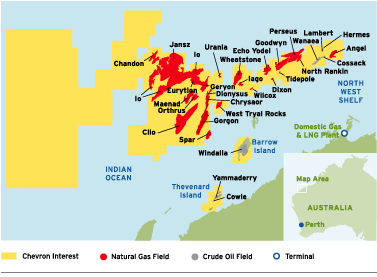
IN what could become the nation's biggest development, US oil major Chevron is looking at building a giant 25 million-tonnes-a-year liquefied natural gas export hub on the Pilbara coast from which it plans to start producing from 2015.
The project, for which three sites are being considered, would start by producing 10 million tonnes of LNG a year through two trains. It would be underpinned by gas from the company's Wheatstone field in the Carnarvon Basin, Chevron said in documents submitted to the federal Environment Department. And in a move bound to rile rival Woodside Petroleum, Chevron is seeking approval to boost the plant to a five-train operation, if it can source enough third party gas and shore up gas from its own fields outside the Greater Gorgon area.
While the later phases are a long way down the track, if they came to fruition the hub would be larger than the current North West Shelf LNG project and the Chevron-operated Gorgon, which is currently Australia's biggest planned resources development. Chevron would not give a cost estimate for Wheatstone, but it would be expected to be in the same realm as Gorgon, which analysts say could cost $30 billion.
The plans for more trains flag competition for Woodside, which is building its $12 billion Pluto LNG project on the Burrup Peninsula and is trying to secure gas to approve a second train there. Wheatstone had been seen as a prime contender to supply the second train until earlier this year when Chevron said it would pursue development of its own LNG plant. ...
As well as an LNG plant, Chevron is planning a domestic gas plant that would produce 250 million cubic feet of gas a day, which represents 15 per cent of LNG sales from the first train, and would increase in with LNG sales line after that.
Chevron has said that the 4.5 trillion cubic feet of gas reserves at Wheatstone would underpin one LNG train, but in July said drilling at the nearby Iago field had led it to consider a three-train operation.
Iago spans two retention permits, one owned by Chevron, and another owned one-third by Shell and two-thirds by Chevron. Chevron did not mention Iago in the documents but this is likely to be the source of gas for the second train.
Chevron said the Wheatstone Development was expected to run for about 30 years and that it planned to select a final site in the second quarter of next year.
Posted
by Big Gav
in
australia,
chevron,
gas,
gorgon,
lng
The Australian reports that Chevron is now planning to include a domestic gas plant as part of its Gorgon development - Chevron's domestic gas proposal to coincide with LNG plan. Background material on Australian natural gas can be found here, here and here.
CHEVRON plans to include a domestic gas plant as part of its $20 billion Gorgon liquefied natural gas project in Western Australia. The company had planned to submit a proposal to develop a 300 terrajoule per day domestic gas plant by December 31, 2010 but will now accelerate that to coincide with its development proposals for the LNG project.
The importance of securing new sources of domestic gas in WA was underlined recently when Apache Energy's Varanus Island gas processing facility was shut down after a pipeline explosion, slashing the state's supply by 370 terrajoules per day. The state consumes about 1,000 terrajoules per day of domestic gas.
Posted
by Big Gav
in
brightsource,
chevron,
csp,
economics,
goldman sachs,
google,
nrel,
solar power,
solar thermal power
Bloomberg has an article on the rush to build solar thermal power plants in California, with Google being joined by Chevron and Goldman Sachs in investing in Brightsource - Google, Chevron Build Mirrors in Desert to Beat Coal With Solar.
Along a dusty two-lane highway in California's Mojave Desert, 550,000 mirrors point skyward to make steam for electricity. Google Inc., Chevron Corp. and Goldman Sachs Group Inc. are betting this energy will become cheaper than coal.
The 1,000-acre plant uses concentrated sunlight to generate power for as many as 112,500 homes in Southern California. Rising natural gas prices and emissions limits may make solar thermal the fastest-growing energy source in the next decade, say backers including Vinod Khosla, the founder of computer maker Sun Microsystems Inc.
Costs for the technology will fall below coal as soon as 2020, the U.S. government estimates. JPMorgan Chase & Co. and Wells Fargo & Co. invested last year in the biggest solar plant built in a generation; Chevron and Google are funding research; and Goldman Sachs is seeking land to lease as demand outpaces wind turbines and geothermal. ...
Costs for solar thermal may fall as low as 3.5 cents a kilowatt hour by 2020, according to a report commissioned by the U.S. Energy Department. Meanwhile, coal expenses may rise. Congress is considering limits on carbon dioxide and other greenhouse gas emissions. The purchase of pollution permits may be required under a measure the Senate will begin debating next month.
`To Beat Coal'
Ausra's plants will produce electricity at 10 cents a kilowatt-hour starting in 2010, and the price will fall to 8 cents a few years later as it adopts systems with fewer parts that will be less costly when widely deployed, the company says. ``We are going to beat coal,'' says Bob Fishman, Ausra's chief executive officer. His company has a contract with PG&E Corp.'s Pacific Gas & Electric for a site in central California.
Chevron, Goldman Sachs, FPL, PG&E and other companies have filed more than 50 applications with the Bureau of Land Management to lease government-owned desert property for solar power systems. Chevron, which has invested in the solar thermal builder BrightSource Energy Inc. in Oakland, California, and Goldman, the biggest U.S. securities firm, declined to comment.
Google's philanthropic division put $10 million into eSolar, a start-up in Pasadena, California. Dan Reicher, a former Energy Department official who manages the unit's climate and energy initiatives, said there will be more such investments.

The Bloomberg article points to this report from the NREL last year to congress on the
Potential impact of CSP for electricity generation (pdf), quoting a likely cost of CSP power of 5 cents per kilowatt by 2020.
Between 2000 and 2003, four reports were released on the potential for CSP. An assessment of the main issues raised by these reports leads to the following conclusions:
1. Further technology development and deployment could reduce the cost of CSP: The S&L study quantified the significant cost reductions that are possible with continued technology development and deployment. It concluded that there were three elements that could reduce the cost of CSP from approximately 12 cents/kWh today to about 5 cents/kWh by 2020: technology development (42 percent), building larger plants (37 percent), and volume production (21 percent). All four studies mentioned in this report are in agreement that the costs of CSP would fall with greater levels of deployment.
2. CSP requires policy incentives for initial deployment: All the reports emphasized that in the near-term, deployment of CSP depends on the establishment of policy incentives that offset the current higher cost of solar energy. The CSP industry provided a list of incentives it stated were necessary to initiate deployment. These were included in DOE’s 2002 report. Six southwestern States have now established renewable portfolio standards, and the Federal Government has created an investment tax credit that encourages the deployment of CSP. These policies have resulted in the establishment of CSP projects in California, Arizona, and Nevada that could result in 2,000 MW by 2010.
Development of CSP could provide energy, economic, environmental, and security benefits. The following factors could make CSP an attractive option for the Southwestern States if policymakers determine that these benefits outweigh the costs.
1. Energy: CSP could provide hundreds of gigawatts of clean power.
2. Economic: Analyses for California, Nevada, and New Mexico estimate that there could be significant benefits in job creation and additions to gross state product accruing from building and operating CSP plants. It is expensive to build a CSP plant and it requires a relatively large number of people to operate and maintain it. Counter balancing this, however, is the absence of a fuel cost. Much of the money that would otherwise be spent on monthly fuel costs, instead is spent on salaries. States and the Federal government have indicated their concern over the rising and volatile price of fossil fuels and their impact on the economy.
3. Environmental: CSP plants do not emit criteria pollutants or greenhouse gases, an issue of growing concern throughout the Federal and State governments. Thus, CSP could be an element of potential future policies related to climate change.
Bruce Sterling has a
few comments on the Bloomberg report - as usual his interjections are marked ((())).
Along a dusty two-lane highway in California's Mojave Desert, 550,000 mirrors point skyward to make steam for electricity. Google Inc., (((dot-greens))) Chevron Corp. (((reforming petrocrats))) and Goldman Sachs Group Inc. (((East Coast finance establishment))) are betting this energy will become cheaper than coal.
(((Once people realize that coal plants are drowning major cities, coal plants are gonna get really, really expensive. Like, probably dangerous even to stand around. There must be any number of rich and evil people who own seaside mansions and could hire a global-guerrilla gang to blow up coal plants with truck bombs. You could probably leverage that activity in the markets and make a whole lot of money. Very "Shadow OPEC," except that the general population would cheer you on.)))
The 1,000-acre plant uses concentrated sunlight to generate power for as many as 112,500 homes in Southern California. Rising natural gas prices and emissions limits may make solar thermal the fastest-growing energy source in the next decade, say backers including Vinod Khosla, the founder of computer maker Sun Microsystems Inc. (((Rupert Murdoch's Wall Street Journal is afraid of Vinod Khosla. Proof the guy is onto something useful.)))
Costs for the technology will fall below coal as soon as 2020, the U.S. government estimates. JPMorgan Chase & Co. and Wells Fargo & Co. invested last year in the biggest solar plant built in a generation; Chevron and Google are funding research; and Goldman Sachs is seeking land to lease as demand outpaces wind turbines and geothermal.
``Solar thermal can provide a substantial amount of our power, more than 50 percent,'' says Khosla, who along with the Menlo Park, California, venture capital firm Kleiner Perkins Caufield & Byers led a $40 million investment in solar power producer Ausra Inc. ``This is an industrial-strength solution.''


 Posts
Posts