Posted
by Big Gav
in
ocean energy,
renewable energy,
scotland,
tidal power
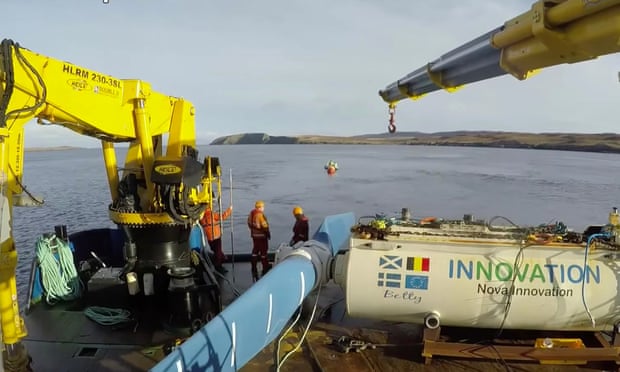
The Guardian has a report on the first fully operational array of tidal power turbines in Scotland's Bluemull Sound - World first for Shetlands in tidal power breakthrough
Nova Innovation said it had deployed the world’s first fully operational array of tidal power turbines in the Bluemull Sound between the islands of Unst and Yell in the north of Shetland, where the North Sea meets the Atlantic. It switched on the second of five 100kW turbines due to be installed in the sound this month, sending electricity on a commercial basis into Shetland’s local grid.
Existing tidal schemes use single power plants or installations rather than a chain of separate turbines. A French company, OpenHydro, says it too is very close to linking two tidal machines, off Brittany, to build a more powerful 1MW array.
Posted
by Big Gav
in
ocean energy,
renewable energy,
scotland,
shetland islands,
tidal power
The Shetland Tidal Array, one of the world’s first tidal arrays has commenced power generation.
The
tidal power plant consists of three 100 kW turbines, with more planned in following phases.
Posted
by Big Gav
in
ocean energy,
pentland firth,
scotland,
tidal power
Tidal Today has an update on the tidal power project in Scotland's Pentland firth - Pentland Firth: building the multi-array dream.
Work is now set to begin on the largest turbine proposal in Europe, after the Scottish Government gave the consent to begin the 86MW Pentland Firth tidal energy project.
Initially construction will begin on a demonstration array consisting of six turbines, located in the Inner Sound off Pentland Firth, starting in the early months of 2014 with the turbines to be commissioned the following year. The aim is that the demonstration device will provide important data on environmental surroundings, and the future of the development phases to implement the full project.
Eventually it is hoped that the array will produce up to 398MW, this has the potential to power over 40,000 homes.
Posted
by Big Gav
in
offshore wind power,
scotland,
wind power
REW has an article on the construction of the world's largest wind turbines (7 MW) off Fife in Scotland - Securing the World’s Largest Wind Turbine.
At 7 megawatts (MW), Samsung Heavy Industries' S7.0-171 is the world's largest offshore wind turbine. The 196-metre tall structure is being installed 20 metres offshore in Fife, Scotland, with a connecting walkway to enable visitors to get up close to the structure. ...
In the next five years, an estimated 4,000 new fixed structures are scheduled to be installed in the North Sea alone. This is mainly due to the upsurge in offshore wind activity associated with Round 2 and Round 3 projects.
Posted
by Big Gav
in
atlantis,
ocean energy,
pelamis,
renewable energy,
scotland,
tidal power,
uk
Business Green has a report on tidal power developments in Scotland's Pentland Firth - Europe's largest tidal power array surges forward.
The UK’s fledgling tidal power sector is set to take a major step forward today, as the Scottish government awards planning consent to the Europe's largest tidal array, located in the Pentland Firth. Meygen, a group led by Morgan Stanley, International Power and tidal technology provider Atlantis, is planning to deploy up to 400 tidal turbines in the Inner Sound, which is known as the “crown jewel” of the Pentland Firth for its fast flowing waters.
Today, Scottish Energy Minister Fergus Ewing will confirm planning permission for the first 86MW phase of the project. Meygen is expected to install the tidal array in stages, starting with a 9MW demonstration project of up to six turbines.
The news will make Maygen the first tidal project in the Pentland Firth and the largest tidal power array in Europe to receive planning consent, marking a major boost for the industry. “This exciting development in the waters around Orkney is just the first phase for a site that could eventually yield up 398MW,” Ewing will say.

Posted
by Big Gav
in
ocean energy,
pentland firth,
scotland,
tidal power
The Smithsonian blog has a post on a new study on the amount of tidal power available in Scotland's Pentland Firth - Is Scotland the “Saudi Arabia” of Tidal Power ?. A lot of the commentary elsewhere seemed to have a vast amount of political spin on it, claiming that earlier estimates of 10 - 20 GW were vastly overblown. if you actually look at the report (and particularly the image below) its fairly obvious that the new "1.9 GW" estimate is for an installation crossing the firth at one point - obviously you could build a number of installations along the firth (points A1 and A2 for example, or out to the Skerries) and get a rather larger number similar to earlier estimates, not that logic is a strong point for many critics of renewable energy.
The researchers looked at the construction of multiple rows of these sorts of turbines, placed in a variety of locations within the Firth. Their models took into account the depth of the water at each given location, observed tidal speeds and heights over the course of each month, and a number of other variables.
Ultimately, the team found that the maximum practical capacity of 1.9 gigawatts would be possible with three rows of turbines, built in the locations mapped below (B, C, and D on the map). Because each row slows down the movement of the tides that pass through it, building more then three would only marginally improve the power capacity, while increasing the overall cost of the project at a constant rate. (A, on the map, is a proposed alternate scheme that would produce a similar level of energy but at a higher cost.) ...
As of now, the biggest hurdle is price: without any carbon pollution regulation schemes in place, most renewable sources of energy, including tidal power, just aren’t as cheap as burning coal or other fossil fuels. But many energy companies have already recognized that, long-term, the cost of fossil fuel production will increase—both because of eventual regulations of the emissions of greenhouse gases and because of fossil fuels are becoming increasingly costly to extract—and harnessing the power of the tides could provide a reliable way to meet a portion of our energy demands.

Posted
by Big Gav
in
ocean energy,
scotland,
tidal power
Inhabitat has a post on a new tidal power project in Scotland - Scotland to Build World's First Community-Owned Tidal Turbine.
As a country, Scotland has some of the most aggressive renewable energy targets in the world – the entire nation is working to be completely independent of fossil fuels in the next decade, and has pledged to use 100 percent renewable energy by 2020. You don’t have to be an energy expert to know that’s no small goal, so it’s no surprise that Scotland is embracing practically every clean energy technology it can find. The country recently announced plans to build the world’s first community-owned tidal turbine. The turbine will be deployed in the Bluemull Sound between the islands of Yell and Unst, and used to power a local ice plant and industrial estate. It will be owned by the North Yell community.
Posted
by Big Gav
in
ocean energy,
orkney islands,
scotland,
tidal power
Renewable Energy Focus has a post on the commissioning of a tidal power array in Scotland - 1MW Orkney tidal project paves way for “world’s first” array. PhysOrg has more - Scotland passes turbine test to harness tidal power.
A 1MW tidal power device has started full export of power in Scottish waters, paving the way for ScottishPower, to deploy the technology in the “world’s first” tidal array.
The 1MW HS1000 tidal turbine, developed by Norway’s Andritz Hydro Hammerfest, was installed in the fast-flowing waters around Orkney last December. It has now successfully completed a range of tests, and is supplying electricity to the island of Eday, one of Orkney’s northern isles.
The test device in Orkney aims to fully prove that the technology can operate efficiently in Scotland’s fast flowing tides, that monitoring and maintenance operations can be honed and to help drive down costs in operations and installation.
The technology will be used by Iberdrola-owned ScottishPower Renewables as part of the “world’s first” tidal turbine array in the Sound of Islay. The company’s proposal for a 10MW tidal array received planning consent from the Scottish government in March 2011.

The Scotsman has some additional commentary on the politics of tidal power in the UK -
Comment: Lord Smith not convinced by toe in the water.
IT WAS perhaps just a bit of bad luck that Lord Smith of Kelvin, the chairman of the much-anticipated Green Investment Bank (GIB), kicked investment in wave and tidal power into the long grass on the same day the sector highlighted it was desperate for cash.
The Marine Energy Action Plan, unveiled by the Scottish Government and its industry-led Marine Energy Group, reported on the significant progress made by Scotland’s wave and tidal energy sector.
It counted the 11 wave and tidal devices deployed or being deployed at the European Marine Energy Centre on Orkney, adding that there will be three more being tested by 2014.
Near Islay, there is also the world’s largest consented tidal stream project that will deploy the HS1000 tidal device in a project being undertaken by ScottishPower Renewables and the Austrian/Norwegian group, Andritz Hydro Hammerfest.
Then there is the Crown Estate’s leasing agreements for projects with a potential to produce up to 1,600 MW in the Pentland Firth and Orkney waters.
But, as Niall Stuart, the chief executive of industry body Scottish Renewables points out, getting the finance to scale up these projects to commercially viable arrays is a “major challenge”, not to mention the “massive costs to connect these projects to the grid”.
So where is the money going to come from? There are some technology developers that have got at least some support and investment from big private firms such as Alstom, Rolls Royce and Siemens.
The sector will have to rely on a range of funds being made available through the Department of Energy and Climate Change (£20 million), the Scottish Government’s Marine Renewables Commercialisation Fund (£18m) and the Technology Strategy Board (£10.5m).
It also has high hopes for the Renewable Energy Infrastructure Fund, made up from the £100m disbursement from the Fossil Fuel Levy that the Scottish Government wrangled from the Treasury last year. The other half of the levy was used to fund the foundation of the GIB.
The GIB, on the other hand, has £3 billion burning a hole in its pocket that has to be spent by April 2015.
Lord Smith says there is huge interest in the innovative developments taking place in wave and tidal energy, but despite his enthusiasm the entire sector still has its sceptics.
The GIB is taxpayer funded and while some will want it to take risks it has first to prove to the markets that it can deliver a return on its investment.
Scottish Enterprise has a map of offshore power investments in Scotland (including wind power as well as ocean energy -
Examples of recent announcements of intended investments in offshore renewables.
Posted
by Big Gav
in
ocean energy,
scotland,
tidal power
Wired has a report on the progress of tidal power in Scotland - Largest tidal array in the world to be built in Scotland.
Western Scotland will see the world's largest tidal array constructed off the coast, as the first large-scale rollout of tidal energy generation.
A trial with one 30m turbine, the HS1000, anchored to the ocean floor in a fast-flowing channel near the Orkney Islands, raised one megawatt of electricity -- enough to power around 500 homes. Now, Scottish Power is planning on building two farms of turbines off the Scottish coast.
The project at the Sound of Islay should hopefully generate 10MW, and then the later project off Duncansby Head (the most northeasterly point of Scotland) should generate around 95MW. While individual turbines have been trialled across the world, the arrays will be the largest of their kind, with local communities having their power provided by renewable tidal sources.
The turbines -- built by Andritz Hydro Hammerfest, a Norwegian firm -- represent a tricky engineering challenge. Considerations for wild plants and fish means that the blades can't move too fast, and the turbines must be located in areas where there is a reliably fast current travelling at at least 2.5m/s (such as the Sound of Islay, a narrow passage between the Scottish mainland and the island of Jura).
Once a suitable location has been identified, a giant steel frame is lowered to the seabed and secured. The turbines are between 40 to 100 metres below the surface of the sea, so theoretically pose no danger to shipping. The turbines are designed to turn in both directions to generate power, giving a constant supply of electricity.
Some have estimated that around ten percent of the UK's total energy needs could be met with tidal arrays -- and the long-dreamed-of Severn Barrage alone could meet five percent of UK demand if numerous engineering difficulties are overcome.
As with many renewable energy technologies, the initial costs can be prohibitive. Scottish Power estimates the cost of the turbine farm to be around £70 million.

Posted
by Big Gav
in
ocean energy,
scotland,
tidal power
The BBC has a report on testing of a tidal power design in Scotland - Giant tidal device set for tests off Orkney.
A giant underwater turbine which could form the world's first tidal power array has been deployed off Orkney. The 100ft-high 1MW (megawatt) Hammerfest Strom HS1000 device was installed by the European Marine Energy Centre (EMEC). It will now undergo tests in preparation for larger-scale production and deployment.
Scottish Power Renewables (SPR) hopes to use the design for a planned array in the Sound of Islay. The device has been developed by Hammerfest Strom, a company partly owned by SPR parent firm Iberdrola. Its substructure was constructed in the Arnish Yard, near Stornoway, in Lewis.
SPR intends to develop a 10MW tidal array in Islay after receiving planning consent from the Scottish government in March this year.
The HS1000 device, which SPR said could power the annual electricity needs of 500 homes, is expected to be fully operational in early 2012. The tests will also help to finalise the timetable for the Islay project, with machines being installed "as early as feasible" between 2013 and 2015.

Posted
by Big Gav
in
marine current turbines,
ocean energy,
scotland,
siemens,
tidal power
GreenBang reports that Siemens its expanding its presence in the ocean energy market - In marine current energy, Siemens wants to be 800-lb gorilla.
There’s a lot of energy in the world’s oceans, and Siemens wants to play a big part in developing that power for our use.
The Germany-based technology giant announced today that it’s taken on a larger stake in a British marine-energy company, Marine Current Turbines Ltd. Siemens first dipped its toe into the marine current tidal energy sector in February of 2010, when it acquired a minor stake in the company. It now has a 45-percent stake.
“With this increase in its stake, Siemens is strengthening its activities in ocean power generation,” said Michael Axmann, CFO of the newly founded Solar & Hydro Division within Siemens’ Energy Sector. “We will actively shape the commercialization process of innovative marine current power plants.” ...
Some estimates say tidal power plants deployed around the world could generate up to 800 terawatt-hours of clean energy each year. That’s enough to meet 3 to 4 percent of the world’s energy needs, and 25 percent more than all the energy used in Germany.
Marine Current Turbines plans to present two project investment prospectuses to the market in November: one for the 8 megawatt (MW) Kyle Rhea project in Scotland and another for the 10MW Anglesey Skerries project in Wales. The company also has lease approval to deploy a 100MW tidal farm off Brough Ness on the southernmost tip of the Orkney Islands in Scotland. ...
The company has already demonstrated its first commercial-scale project, SeaGen in Northern Ireland. Since November 2008, two turbines with a combined capacity of 1.2MW have been plugged into the grid and providing enough power to supply about 1,500 homes. With more than 2.7 gigawatt-hours of electricity generated so far, SeaGen is so far the top electricity producer in the marine current power sector.
EarthTechling reports that the Japanese are also getting in deeper with tidal energy -
Kawasaki Testing Tidal Power In Scotland.
The name “Kawasaki” may be most readily associated with motors of the two-wheeled, gasoline-powered variety; but the Japanese multinational company has recently announced that it will soon be getting into the tidal power generation business. Kawasaki Heavy Industries (KHI) has announced that it will work with Okinawa Electric Power and Okinawa New Energy Development to prepare a new tidal power generator technology for testing off the coast of Okinawa, Japan. Then, KHI will test the technology at the European Marine Energy Centre (EMEC) in Orkney, Scotland.
The EMEC is the first center of its kind to offer developers an opportunity to test full-scale, grid-connected prototypes under high velocity wave and tidal conditions. High velocity currents at the tidal test site at the Fall of Warness, where the KHI technology will be tested, reach almost 4m/sec (7.8 knots). The facility offers seven test beds at depths ranging from 12 to 50 meters, in an area of over three square miles.

Posted
by Big Gav
in
ocean energy,
scotland,
tidal power
SMarterMeters.com has a report on the successful test of a tidal power device offshore from Scotland - Rolls-Royce Orkney Tidal Turbine Operational.
Rolls-Royce reports that its prototype subsea tidal turbine, located off the Orkney Islands, Scotland, has successfully generated and fed over 100 megawatt hours (MWh) of electrical power into the national grid. The 500 kilowatt (kW) tidal turbine prototype was designed and built by Rolls-Royce’s subsidiary, Tidal Generation Limited.
Rolls-Royce’s Vice-President of Power Ventures, Robert Stevenson, explains, “Rolls-Royce has injected its world-class engineering expertise and incubation processes to deliver this innovative renewable energy project. Reaching the 100 megawatt hours milestone highlights the significant potential of cleaner, greener tidal power as part of a diversified UK energy mix. Having proven the capability of tidal energy, Rolls-Royce is well placed to meet any future demand with larger, more efficient technology on a commercial scale.”
Deep water tidal stream power generation is seen as a reliable and predictable energy source, making it a valuable renewable option. Rolls-Royce tidal technology could generate up to 30TWh (terawatt-hours) of UK electricity, the equivalent to more than seven percent of existing UK electricity needs or enough to power three million homes.
Posted
by Big Gav
in
atlantis,
humber estuary,
ocean energy,
scotland,
tidal power,
uk
Forbes reports that tidal power company Atlantis has launched its first project in Scotland - Scotland Plugs Tidal Power into Electricity Grid.
Scotland plugged the first commercial scale tidal-power turbine into the central power grid earlier this week.
Atlantis Resources, a Singapore-based marine renewables developer, installed the 1-megawatt tidal-power turbine at the European Marine Energy Centre in Orkney, Scotland.
Equipped with a rotor measuring roughly 60 feet in diameter, the three-bladed horizontal-axis AR1000 aims to be among the world’s most powerful single-rotor tidal turbine, delivering 1 MW of power from tidal resources moving at speeds of about eight feet per second.
The system weighs 1,500 tons and stands about 75 feet tall on a seabed-mounted tripod foundation.
The BBC reports that tidal power is forging ahead in the north east of the UK as well -
Humber tidal project given Parliamentary approval.
Plans for a tidal power vessel in the Humber to generate electricity for a Hull aquarium have been approved.
The Neptune Proteus device will use the tides of the estuary to power The Deep.
The 150-tonne generator is expected to be deployed in the autumn. It is hoped five additional units will be installed in the future to generate energy for 5,000 homes.
Colin Brown, chief executive of The Deep, said the Humber had "massive" potential as a power source.
Mr Brown said: "Because of the nature of the aquarium, pumps are running 24/7 - we have a requirement for power all the time - and this one installation is anticipated to provide perhaps 30 or 40 percent of our entire electricity load."
Posted
by Big Gav
in
ocean energy,
scotland,
wave power
The Climate Spectator has an update on wave power developments in Europe - Bad break.
German utility RWE has pulled funding for the world’s largest wave project in Scotland, and walked away from the 4MW facility that was to have been installed on the Scottish island of Lewis in the outer Herbrides. It will focus instead on a tidal energy plant in nearby Orkney. The decision has left the prime developer, the Scottish-based Voith Hydro Wavegen in search of new funding for the development, which is based around an oscillating water column, which uses the power of the ocean to move air in and out of specially constructed chambers, thereby driving a turbine to generate power.
Voith only last week commissioned a smaller version of the technology at a 300kW breakwater array at the Basque seaport of Mutriku, in a development co-sponsored by Spanish utility Ente Vasco de la Energia, Voith said it would continue to pursue the project at Lewis, but would seek new partners in the venture. Voith Hydro is majority owned by the German engineering group Voith and 35 per cent by Siemens.
The decision by RWE is seen by some in the industry as evidence that investor interest in marine power is tipping towards tidal technology. RWE said it was still committed to researching how best to harness marine energy off the coast of Scotland, but has chosen to redirect its efforts towards projects that are “faster and cheaper" to develop. It remained committed to a 1MW tidal development off Orkney, which will also use Voith technology. Scotland aims to harness 1.6 gigawatts of wave and tidal power in the Pentland Firth and Orkney waters.
Posted
by Big Gav
in
geothermal energy,
geothermal power,
scotland,
uk
The BBC has a report on interest in geothermal power in Scotland - Cairngorms and Lothian hot rocks potential highlighted.
Hot rocks far below the surface of Scotland offer a means of generating limitless amounts of electricity, according to a new study.
Ed Stephens, a geologist at St Andrews University in Fife, said the Cairngorms and East Lothian have the potential for geothermal systems. He said more research would be needed on how to exploit the resource and overcome expensive drilling costs. Germany and Australia are already developing geothermal projects.
Mr Stephens' study used data gathered in the 1980s. He said geothermal's potential in Scotland was again topical because the Scottish government had added it to its list of renewable energy resources.
Radioactive decay
Hard granites in the eastern Cairngorms and running towards Aberdeen offered some of the best sources of hot rocks, Mr Stephens said. The origin of the heat is the radioactive decay of uranium, thorium and potassium contained within the rock.
Mr Stephens said this heat accumulated slowly over geological time and granites deep in the Earth's crust have become repositories of "effectively limitless supplies of thermal energy". Electricity could be generated by pumping water down bore holes to create steam to drive power plants.

Posted
by Big Gav
in
ocean energy,
scotland,
shetland islands,
tidal power
The Shetland Times has an article on a tidal power project on the islands - World first for Yell with community-owned tidal generator poised to go live.
One of the world’s first community-owned tidal power generators could be producing electricity in north Yell by the autumn. The North Yell Development Council hopes to have its machine from Leith-based company Nova Innovation harnessing the tidal race in Bluemull Sound by September or early October.
The local people behind the tide farm and other community ventures in north Yell were praised by Highlands and Islands Enterprise this week for showing “local leadership of an exceptional kind”.
The small 30 kiloWatt generator will go on the seabed in 30 metres of water off the Ness of Cullivoe. Its power will be sold to the electricity grid at Cullivoe but will be consumed by RS Henderson’s modernised ice-making plant at times when ice is being manufactured for fishing boats and salmon harvests.
The pioneering tidal project has been funded by £168,000 in grants from Community Energy Scotland, Shetland Islands Council and HIE Shetland. NYDC will use profits to fund other community ventures and may eventually invest in an array of tidal generators in Bluemull Sound if the first one proves a success. ...
The ferocious currents running at up to six knots through the sound make it a hot spot for potential tidal energy in the same way the particularly vicious Shetland winds make it desirable to wind farm developers. Unlike onshore windfarms there is no established system under which tidal or wave power developers reward the communities that allow their environment and renewable energy to be exploited.
The beauty of the Cullivoe project is that the local people are the developer and will reap the full financial benefits from the natural resources on their doorstep rather than seeing them siphoned off by some acquisitive and distant multi-national. The Crown Estate will still extract a tax for use of its seabed, however.

.
Posted
by Big Gav
in
new zealand,
ocean energy,
scotland,
tidal power,
uk
Energy Efficiency News has a post on a tidal power project in Scotland - Scottish Government gives go ahead to world’s largest tidal power project.
The Scottish Government has given the go ahead to what will be the world’s largest tidal stream energy array to date in the Sound of Islay.
The £40 million ScottishPower Renewables development of underwater turbines will have a capacity of 10 MW, generating enough electricity to power around 5000 homes and eight local distilleries and maltings.
“With around a quarter of Europe’s potential tidal energy resource and a tenth of the wave capacity, Scotland’s seas have unrivalled potential to generate green energy, create new, low carbon jobs, and bring billions of pounds of investment,” commented Cabinet Secretary for Finance and Sustainable Growth John Swinney in a statement yesterday.
He said that ScottishPower Renewables, which is owned by Spanish power giant Iberdrola Renovables, will work with the Islay Energy Trust to maximise local social and economic benefits.
Local Scottish businesses are also set to benefit, with £4 million in contracts to make the turbines, with a test prototype being manufactured at Burntisland Fabrication’s (BiFab) facility in Arnish.
BiFab has a £2 million contract to build turbines for the ten 1 MW HS1000 devices to be used in the Islay project, which are being developed by Hammerfest Strøm, a joint venture between Scottish Power Renewables and Norwegian energy companies.
A prototype of the HS1000 device has been generating electricity in Norwegian waters for six years and the company is currently constructing the first commercial-scale device for testing in Scottish waters off Orkney later in the year.
Scotland is one of the leaders in tidal development, with world’s first commercial wave and tidal leasing round already underway for the Pentland Firth, which could ultimately produce some 1600 MW of marine energy.
“[The] announcement moves the whole marine renewables industry forward in Scotland and the UK,” says Keith Anderson, chief executive of ScottishPower Renewables. “The understanding we develop from Islay will be essential in delivering the larger planned projects in the Pentland Firth.”
The testing of the HS1000 later this year in Orkney will determine the rollout of the devices in Islay, but ScottishPower Renewables expects to start work on the project next year and start installation between 2013 and 2015.
New Zealand is also looking to develop some large scale tidal power -
Kaipara tide turbine plan gets Govt green light.
A $600 million proposal to create New Zealand's first tide-driven power station in the Kaipara Harbour has been approved by Government despite concerns it could kill off fish stocks and threaten critically endangered Maui dolphin.
Conservation Minister Kate Wilkinson this morning signed off the staged installation of 200 tidal turbines near the mouth of the harbour by Crest Energy.
Local fisherman, Te Uri O Hau Settlement Trust and the Department of Conservation had opposed the plan, arguing it could reduce west coast snapper stocks, threaten the environment of the pristine harbour and impact Maui dolphin numbers.
But Ms Wilkinson backed an Environment Court ruling approving the station on the condition it started with only three turbines and conducted two years of environmental monitoring.
If fully implemented, it is estimated the development could generate enough electricity to power the area from Auckland's North Shore to Cape Reinga, she said.
Posted
by Big Gav
in
floating offshore wind power,
scotland,
wind power
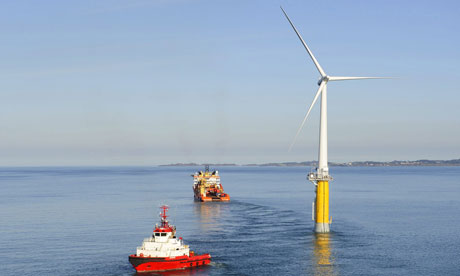
The Guardian has a report on floating offshore wind power developments in Scotland - Scotland bids to host world's first floating windfarm.
The Scottish government yesterday revealed it is in talks with Norwegian energy giant Statoil about hosting the world's first floating windfarm at two potential sites off the Scottish coast.
Statoil is currently testing a prototype version of its Hywind floating turbine 10km offshore at Karmøy in Norway and, after a successful wave of tests, is now assessing potential sites for a full-scale floating windfarm.
The company is planning to deploy between three and five floating wind turbines to demonstrate the commercial viability of the technology and senior executives at the firm met yesterday with Scottish First Minister Alex Salmond to discuss the viability of two prospective sites – one off the coast of Lewis and one off Aberdeenshire.
The talks are at a fairly advanced stage with Scottish Development International and Marine Scotland having already worked with Statoil to undertake feasibility studies at the proposed sites.
Speaking following the meeting in Norway, Salmond said that the talks had been "very positive", adding that the project had the potential to revolutionise the offshore energy industry.
"The Hywind II windfarm project would see a Scotland-Norway collaboration push the boundaries of deepwater offshore wind beyond the 100m mark and open up vast areas of the world's oceans to the development of wind energy for the first time," he said.
Posted
by Big Gav
in
atlantis,
ocean energy,
scotland,
tidal power
The BBC has a report on a massive new tidal power turbine destined for a Scottish test site - Largest tidal power device unveiled.
A device thought to be the largest tidal energy turbine to be built in the world has been described by its developer as "simple and robust". Atlantis Resources unveiled its AK-1000 at Invergordon ahead of it being shipped to a European Marine Energy Centre test site off Eday, Orkney.
Chief executive Tim Cornelius said it was designed to survive in a harsh marine environment. The device stands 22.5m (73ft) tall and weighs 130 tonnes. It has two sets of blades to harness ebb and flood tides and could provide electricity for about 1,000 homes.
Mr Cornelius told BBC Scotland that the focus of the marine industry at the moment was making the Pentland Firth a huge success in terms of generating electricity from renewable energy devices. Mr Cornelius said: "It is one of the harshest environments on the planet. In order to get a robust turbine we have had to make what we call ultimately the dumbest, simple but most robust turbine you could possibly put in such a harsh environment."
The AK-1000's two sets of blades have also been designed to move slowly underwater and Atlantis said they would not pose a threat to sea life.
Mr Cornelius said: "The turbines turn at six to eight revolutions per minute so are incredibly slow turning and will have zero impact on the surrounding environment."

Posted
by Big Gav
in
ocean energy,
scotland,
tidal power,
wave power
Technology Review has a look at the British surge towards harnessing wave and tidal power - Wave Energy Scales Up Off Scotland.
Scotland hopes to ride the next renewable energy wave. Site leases for several big wave and tidal power projects were awarded last week by the U.K. government, concluding a two-year bidding process that elicited strong interest from major utilities and energy entrepreneurs. The awards open the way for six wave energy projects and four tidal energy systems around Scotland's Orkney Islands that could collectively generate up to 1.2 gigawatts, exceeding the U.K.'s 700-megawatt target for the bidding round. This is an immense scale for an industry that so far has installed only pilot projects involving a handful of small devices. ...
Technical and environmental challenges could, of course, slow some marine energy technologies more than others. That is what McAdam is betting for Aquamarine's Oyster wave converter, a buoyant steel flap that uses wave power to drive a hydraulic piston and send high-pressure water to a turbine generator on the shore. The design puts no fast-moving parts or power generator in the water, and McAdam claims this will minimize both technical failures and threats to marine life. In contrast, the tidal devices selected by all of the Orkney site developers, made by OpenHydro, Marine Current Turbines, and Hammerfest Strøm, use underwater turbines.
McAdam says that Aquamarine has worked through minor valve and pipeline glitches since installing the first Oyster demonstrator, a 315-kilowatt device, at EMEC in October. Aquamarine is now building its commercial-scale device--a three-flap array feeding a single 2.5-megawatt turbine--which it plans to test at EMEC next year.
Building that device is expensive, and this is the biggest challenge of all facing the industry. Developers of the Orkney sites will benefit from marine energy's favorable treatment under the U.K.'s renewable energy mandates. However, that value only kicks in when the projects reach full scale, and developers say additional small-scale installations are needed.
"Where we're lacking at the moment is this capital intensive phase of installing equipment to prove that it's feasible," says McAdam. He notes that Alex Salmond, who leads Scotland's government, is planning a green energy conference later this year that will consider further incentives for marine energy.
A 2005 study by the Palo Alto, CA-based Electric Power Research Institute (EPRI) suggests that wave energy could be generated at comparable cost to onshore wind power off Hawaii, California, Oregon, and Massachusetts. EPRI has previously said that wave and tidal energy could meet about 10 percent of U.S. electrical demand. Paul Jacobson, ocean energy leader for EPRI, says these first-pass estimates are now being updated by a comprehensive national wave energy assessment that EPRI will complete next year, and a national tidal assessment underway at Georgia Tech.




 Posts




