Showing posts with label eroei. Show all posts

Declining energy quality could be root cause of current recession  

Posted by Big Gav in , , ,

PhysOrg has an article linking recent recessions with declines in the EROI of major fuel sources - Declining energy quality could be root cause of current recession.

Many economists have pointed to a bursting real estate bubble as the initial trigger for the current recession, which in turn caused global investments in U.S. real estate to turn sour and drag down the global economy. King suggests the real estate bubble burst because individuals were forced to pay a higher and higher percentage of their income for energy—including electricity, gasoline and heating oil—leaving less money for their home mortgages.

In economic terms, the quality of the nation's energy supply is referred to as Energy Return on Energy Investment (EROI). For example, if an oil company uses a 10th of a barrel of oil to drill, pump, transport and refine one barrel of oil, the EROI for the refined fuel is 10.

"Many economists don't think of energy as being a limiting factor to economic growth," says King, a research associate in the university's Center for International Energy and Environmental Policy. "They think continual improvements in technology and efficiency have completely decoupled the two factors. My research is part of a growing body of evidence that says that's just not true. Energy still plays a big role."

In a paper published this November in the journal Environmental Research Letters, King introduced a new way to measure energy quality, the Energy Intensity Ratio (EIR), that is easier to calculate, highly correlated to EROI and in some ways more powerful than EROI. EIR measures how much profit is obtained by energy consumers relative to energy producers. The higher the EIR, the more economic value consumers (including businesses, governments and people) get from their energy.

When King plots EIR for various fuels every year since World War II, the graphs indicate two large declines, one before the recessions of the mid-1970s and early 1980s and the other during the 2000s, leading up to the current economic recession. There have been other recessions in the U.S. since World War II, but the longest and deepest were preceded by sustained declines in EIR for all fossil fuels.

EIR is proportional to EROI, meaning they rise and fall together, but the basic data behind the EIR calculations come out annually as opposed to every five years for EROI. EIR also gives insight into different parts of the supply chain such as at the refinery or at the gas pump, which are harder to study with EROI.

King's analysis suggests if EIR falls below a certain threshold, the economy stops growing. For example, in 1972, EIR for gasoline was 5.9 and in 2008 it was 5.5. During times of robust economic growth, such as the 1990s, EIR for gasoline was well over eight. Compare that to some estimates of EROI and EIR for corn ethanol of around one, and it's clear why corn ethanol has been widely criticized as a low quality energy source.

To get the U.S. economy growing again, King says Americans will have to produce and use energy more efficiently. That's essentially what the U.S. did after the last energy crisis by raising fuel efficiency standards for cars, increasing use of natural gas for electric power generation and developing new technologies such as Enhanced Oil Recovery to coax more oil out of the ground.

Managing the Peak Fossil Fuel Transition: EROI and EIRR  

Posted by Big Gav in , , ,

The Oil Drum has a post from Tom Konrad looking at the concepts of EROI and EIRR and how they impact the transition to a post-oil world - Managing the Peak Fossil Fuel Transition: EROI and EIRR.

Energy keeps our economy running. Energy is also what we use to obtain more energy. The more energy we use to obtain more energy, the less we have for the rest of the economy.

The concept of Energy Return on Investment (EROI), alternatively called Energy Return on Energy Invested (EROEI) has been widely used to quantify this concept. The following chart, from a SciAm paper, shows the EROI of various sources of energy, with the tan section of the bar representing the range of EROIs depending on the source and the technology used. I've seen many other estimates of EROI, and this one seems to be on the optimistic (high EROI) end for most renewable energy sources.

The general trend is clear: the energy of the future will have lower EROI than the energy of the past. Low carbon fuels such as natural gas, nuclear, photovoltaics, wind, and biofuels have low EROI compared to high-carbon fuels such as coal and (formerly) oil.

The graph also clearly shows the decline in the EROI over time for oil. Other fossil fuels, such as coal and natural gas, also will have declining EROI over time. This happens because we always exploit the easiest resources first. The biggest coal deposits that are nearest to the surface and nearest to customers will be the first ones we mine. When those are depleted, we move on to the less easy to exploit deposits. The decline will not be linear, and new technology can also bring temporary improvements in EROI, but new technology cannot change the fact that we've already exploited all the easiest to get deposits, and new sources and technologies for extracting fossil fuels often fail to live up to the hype.

While there is room for improvement in renewable energy technologies, the fact remains that fossil fuels allow us to exploit the energy of millions of years of stored sunlight at once. All renewable energy (solar, wind, biomass, geothermal) involves extracting a current energy flux (sunlight, wind, plant growth, or heat from the earth) as it arrives. In essence, fossil fuels are all biofuels, but biofuels from plants that grew and harvested sunlight over millions of years. I don't think that technological improvements can make up for the inherent EROI advantage of the many-millions-to-one time compression conveys to fossil fuels.

Hence, going forward, we are going to have to power our society with a combination of renewable energy and fossil fuels that have EROI no better than the approximately 30:1 potentially available from firewood and wind. Since neither of these two fuels can come close to powering our entire society (firewood because of limited supply, and wind because of its inherent variability.) Also, storable fuels such as natural gas, oil, and biofuels all have either declining EROI below 20 or extremely low EROI to begin with (biofuels). Energy storage is needed to match electricity supply with variable demand, and to power transportation.


The Net Hubbert Curve: What Does It Mean?  

Posted by Big Gav in ,

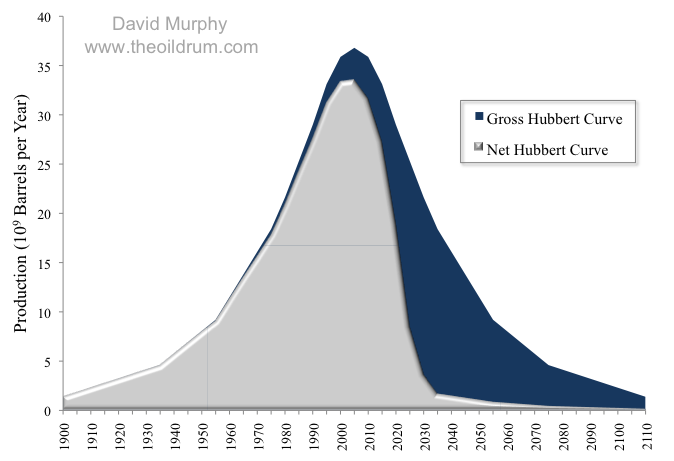
David Murphy has a post at TOD with a good graphic showing the effect of declining EROEI on a Hubbert curve (the "Net Hubbert Curve") = The Net Hubbert Curve: What Does It Mean?.

Cutler Cleveland of Boston University has reported that the EROI of oil and gas extraction in the U.S. has decreased from 100:1 in the 1930’s to 30:1 in the 1970’s to roughly 11:1 as of 2000 (Figure 1). But beyond the fact that society receives currently around 11 barrels of oil for every 1 barrel that it spends getting that oil, What does this mean?

Well, first, it means that, if the trend of declining EROI continues, society will be spending an increasingly larger chunk of their remaining energy to get more energy. This cycle is positively reinforcing:

Declining EROI means that the net energy contained in each unit of energy delivered to society is decreasing over time, requiring the extraction of increasingly greater quantities just to meet societal demand →
decreases the quantity of energy remaining in the ground for future society →
makes it more difficult to find and develop the remaining bit of energy.

With every barrel we pull out of the ground we propel ourselves further down this path, creating a more difficult situation for future generations. (note: I assume that the “Best First Principle” applies to this scenario, i.e. society is using the best resources (i.e. oil fields) first, then the second best, etc…)

More importantly, declining EROI also means that the amount of discretionary energy available to society is FAR less than that predicted by a Hubbert curve (Figure 2). The Hubbert curve represents the total gross quantity of energy available, and, as it is calculated, there are equal quantities of energy available on the left and right side of the peak. This, however, is only true in a gross sense. The net energy available (i.e. discretionary energy) is less. In other words, declining EROI means that there will be much less net energy extracted post-peak than pre-peak on the Hubbert curve.

The Renewables Hump 4: EROEI Issues  

Posted by Big Gav in

Jeff Vail has 2 new posts in his Renewables Hump / EROEI Hole series - The Renewables Hump 4: EROEI Issues and The Renewables Hump 5: Proxy EROEI Measurement.

As discussed in the last post in this series, the energy return on energy invested in renewable sources of energy will be a critical measure of whether it is possible to transition on a large scale from a fossil-fuel powered economy, or whether a global "powerdown" is eventually inevitable. If EROEI, the net-energy ratio of a renewable energy source, is high--say 40:1--then it should be possible to rapidly transition our fossil-fuel driven economy to a renewable energy base, and to support ongoing economic growth that requires ever more energy. If this ratio, however, is low--say 4:1--then at a minimum a transition to renewable energy will be extremely challenging, and may be effectively impossible. As a result, the actual EROEI value of the various renewable energy options available to us is plainly critical. There are lots of measures, lots of studies, and lots of figures floated about for the EROEI value of solar photovoltaics, wind turbines, etc. There is not, however, a universally accepted methodology for calculating EROEI. In fact, I don't think it's a stretch to say that EROEI figures are more likely to be marketing copy intended to secure venture capital than the result of rigorous inquiry.

In my opinion, understanding the reality of our society's ability to transition to a renewable energy basis for our economy is one of, if not THE most important issue to be resolved. If this transition is a realistic possibility, then it should be our society's primary and immediate focus. In addition, improving our understanding of just how realistic such a societal transition is will help us understand the necessary rate of investment in renewables, as well as the nature and degree of the challenges to be accomplished. If it is not realistic, then we must not waste what little surplus energy we have on a fools errand. In addition, the present understanding that such a transition is unrealistic will allow us to both develop and focus on those societal options that are realistic. Given the importance of accurate EROEI calculations, this post will discuss the current methodology issues with EROEI calculation and make recommendations for proceeding.

There are two generally used methods for calculating EROEI: process-analysis and input-output analysis. Both basically boil down to a brute-force accounting of energy used in various component processes of producing a renewable energy source, with the key differences being how wide a net is cast in counting energy inputs. For example, is the diesel fuel required to deliver the turbine blades to the installation site accounted for? What about the energy required to build the truck, divided by the percentage of that truck's useful life used in that delivery? What about fraction of the energy required to build the machine tools used in the manufacture of that truck?

This highlights the problem main problem with current system boundary calculations: you can regress these energy inputs infinitely far (e.g. what about the energy used to grow the rice eaten by the merchant marine captain who piloted the ship that delivered the metal ores used in manufacturing the bolts that hold together the turbine tower), and it's fundamentally impossible to use a brute-force accounting methodology to account for all energy inputs. If one hopes to use such a brute force approach (as used in both process-analysis and input-output analysis methods of EROEI calculation), then one must draw an artificial boundary for what is counted, and what is not. Is it acceptable to artificially constrain the accounted system? Clearly any artificial system boundary results in an artificially high EROEI, but how artificially high? Does this long-tail of non-accounted-for system inputs make the resulting EROEI figure 1% too high? 10%? 100%? 10 times too high? It's easy to dismiss, but how do we know if we are completely ignoring these long-tail energy inputs? I think there's great cause for concern that our EROEI is significantly over-estimated. For example, in a paper by Prof. Cutler Cleveland and others, the EROEI of wind-power is assessed by looking at over 100 separate EROEI studies. These studies are broken down into process-analysis and input-output methodologies. Prof. Cleveland notes that process-analysis generally draws a tighter system boundary than input-output analysis--that is, it counts fewer inputs. In that survey, the process-analysis EROEI measurements for wind average 24:1, and the input-output measurements average 12:1. That's a 100% difference based on where the artificial system boundary is drawn. In light of that significant difference, how can we be sure that a truly inclusive system boundary wouldn't result in a further 100% (or more) decrease in the measured EROEI? The take-away here is that we simply can't trust the accuracy of currently available EROEI calculations. Further, it seems unreasonable to place any credence in any brute-force (e.g process-analysis or input-output analysis) approach to EROEI calculation.

How can we get around the accounting difficulties and arrive at an accurate EROEI calculation--a calculation that can do more than just provide a comparison between renewables, and can actually provide a self-contained assessment of whether a given technology can facilitate a societal energy-transition? Odum has proposed what he calls an "Emergy" measurement that intends to account for a true EROEI measurement. However, while Odum recognizes the importance of an inclusive calculation, Odum's methodology does nothing to address these accounting issues, and the end result is still a brute-force estimate that suffers from the same methodological failings as traditional EROEI calculations (even if it tends to arrive at lower EROEI figures).

Rather than a brute-force approach that literally attempts to count all the energy inputs, I think it will be necessary to use a proxy to calculate "true" EROEI. One methodology that I've proposed for this task is to use price as a proxy for EROEI. I'll discuss briefly the theory of how this would work, as well as the clear problems with this approach.

It always struck me as fishy that various EROEI claims (especially for wind) result in an energy payback time of less than a year. In other words, these figures suggest that it would only take a few months to pay back all the energy required to build a wind turbine, and then that wind turbine would go on generating electricity for decades more. Why, then, didn't we already transition the vast majority of our energy base to wind if it's so efficient? The answer is that the financial payback isn't nearly so rosy. What accounts for the difference between the rapid energy payback (only months) and the much longer financial payback (often an order of magnitude or more longer)? Intuitively, it seems that at least part of the answer is that the EROEI wasn't accounting for many inputs that were counted in the financial analysis. For example, the financial analysis accounted for the high salaries--derivatives of the long years of training--that must be paid to the engineers, the financiers, the technicians, the managers, the materials scientists, etc. that are involved in the production of a wind turbine. These long years of education certainly represent an energy input, but aren't accounted for in either process-analysis or input-output analysis EROEI calculations. Similarly, the cost of raw materials represents, at least in theory, the full spectrum of energy, machinery, personnel, and support systems needed to extract, refine, transport, and market it--a great deal of which lies outside the traditional artificial system boundaries drawn in traditional EROEI calculations. It seemed to me that the financial cost of a renewable was a better proxy for the energy inputs to that renewable than were any of the accepted EROEI calculation methodologies. This is the core of what I've called "price-estimated EROEI," which uses financial cost as a proxy for energy cost. The basic calculation assumes that the entire cost of a renewable is made up--eventually, if one regresses far enough--by energy, so divides that cost by an average energy cost to arrive at the energy input, and then compares that as a ratio to the amount of energy the renewable will produce over its lifetime. Not surprisingly, this form of calculation tends to produce a far lower EROEI than any of the accepted EROEI methodologies.

Of course, there are acknowledged flaws with this price-estimated EROEI methodology. Just to name a few, it's difficult to account for the differing values of the various types of input energies and the resulting output energy; there are market distortions, tax-incentive distortions, geopolitical distortions, etc. That said, I think this type of proxy calculation at least directly addresses the need to calculate a truly inclusive EROEI, and may well be much closer to the "truth" of the required energy inputs than any traditional methodology.

In the next two post I'll address two other potential methods for measuring "true" EROEI: asymptote location and worker-year calculation (as suggested by Neil Howes). Then, I'll look at the EROEI of wind power and solar power from both traditional and proxy methods of calculation.

Validating The Viridian Vision  

Posted by Big Gav in ,

Jeff Vail has the next installment of his series on the "renewables hump" (what I call the "EROEI hole") - The Renewables Hump 3: The Target.

In he last post in this series, I discussed the criticality of accurately measuring EROEI of potential alternative energy technologies. If the EROEI of a renewable energy is high enough, then a relatively small initial investment of energy can lead to the rapid scale-up of renewable generation by bootstrapping its own energy production to finance (in energy terms) its own growth. However, if EROEI is too low, then the amount of energy that society must invest to meet a renewable target would be so great as to be effectively impracticable (because it would cause sufficient energy price spikes as to threaten so much immediate economic damage as to be politically impossible).

Before proceeding with this discussion of EROEI, I thought it would be worth defining what this target for a renewable transition actually looks like:

First, it's important to recognize that there are a variety of possible targets. Some include: a general transition target (either total transition to renewables, or transition to some arbitrary %), a peak-oil mitigation target, a peak fossil-fuel mitigation target, and a climate change mitigation target. All have differences and similarities. Clearly, its one can define a "target" that is plainly achievable, as can one define a "target" that simply can't be done (e.g. 100% transition in 5 years). As such, the definition of "transition target" represents an easily manipulable variable in any discussion of renewables transition. If two people or organizations don't recognize the same target, they'll be constantly talking past each other in discussing renewables and the practicality of transition. While I certainly don't think that I'll be able to convince all parties to adopt a unified transition target in this blog post, I do plan to argue for a threshold target that, in my opinion, represents a minimum rate of transition to keep the "viridian vision" of a renewable future possible: a peak oil mitigation target.

So, it seems clear that a renewable energy transition will need to, at a minimum, replace the decline in oil production with renewable energy generation. I'll elaborate on why I draw this line in the sand below, but in brief the viridian vision (by which I mean a general continuation of our current neo-liberal, capitalist/market-socialist civilizational structure into the distant future by leveraging technological advances and a transition to a renewable energy base and "green" economic foundation) requires that we maintain generally the same level of present energy consumption into the foreseeable future.

Why this focus on the "viridian vision"? I think my personal biases are clear: I'm very skeptical about the practicality of viridian vision--to be more plain, I don't think it's realistic, and further I think it's the modern opiate of the masses when it comes to confronting current energy issues. That said, I think anyone who refuses to recognize that both 1) the viridian may be possible, and that 2) it may be fundamentally impossible is taking a faith-based and irrational position. I don't want anyone to accuse me of hiding the ball as this series progresses--my own studies to date suggest that the renewables transition necessary to fuel the viridian vision is most likely not realistic, and my purpose in this series is to build an argument to this effect. I'm not trying to be pessimistic. Rather, I'm trying to prevent a waste of effort, focus, and our limited (and dwindling) supply of surplus energy on an epochal folly. For lack of a better analogy, it's a bit like our childhood fantasies: at some point, the little league baseball player needs to give up on the dream of becoming a star professional athlete and focus on a more realistic plan for the future. Sure, for any given kid it's a possibility to become the next big star, but it would be folly to advise all of them to pursue that dream at all expense.

Now - while describing the "viridian vision" is basically the point of this blog nowadays, I'd hate to be accused of taking a faith based position on anything, so I'm glad Jeff is trying to work through the numbers to see what is possible (or impossible, given his take on the matter) - at least for one scenario.
One key argument in favor of the viridian vision is that we can mitigate peak oil with increases in efficiency and energy conservation. These arguments generally don't, however, address how we're going to meet the energy demands of 1) a growing population, and 2) a huge third-world population that wants to live at Western standards of energy consumption. The more optimistic population estimates show the Earth's population peaking at 8.3 billion, and more pessimistic estimates show population peaks between 9 and 13 billion. It's important to point out that may population estimates reason that population will stabilize--and then decline--because of the effect of bringing the standard of living of the world's poor closer to Western standards. Will the energy pressures presented by population growth and efforts to improve living standards roughly balance out any improvements in efficiency and conservation? I think so. In fact, I think that this is overly optimistic, and that demographic pressures will more than eat up any energy savings from efficiency and conservation. For this reason, I think that we must increase renewable generation capacity at the same rate that oil production declines--we can't count on efficiency and conservation to make up any of this decline.

Additionally, any renewables transition that attempts to mitigate peak oil must cope with the disparity between effective ramp-up rates and effective oil decline rates. It's nothing more than a simple issue of math: if you use a post-peak decline rate of 5% for oil decline, then that works out to about 4.4 million barrels per day of decline per year, gradually decreasing over time. Conversely, because the current renewable generation base is so small (excluding hydropower, which can't be easily ramped up), even a 100% per year increase in renewable generation comes nowhere close to mitigating this 4.4 million barrel per day decline in the early years. At some point, a 100% annual increase in renewable generation overtakes the declining annual oil production decline figure, but there is a significant gap, especially if we are currently at or very near peak oil. For this reason, we can't necessarily look at the rate of increase of renewables generation over a 20 or 30 year window, because this long-term view alone may overlook a very significant energy gap. It's possible that this gap can be filled with fossil alternatives that are not yet at peak--specifically coal and gas--but that's probably the best we can expect from such fossil alternatives given that they are already experiencing significant EROEI declines (and cost increases) and that their climate consequences may be incompatible with the viridian vision...

All of these values--renewable generation, population growth, conservation, efficiency--are arbitrary decisions. There are simply too many variables to produce a single, agreed set of assumptions on which to base a target estimate. Here, my goal is simply to make my assumptions (and their rationale) clear so that others can question them and change them if they wish. Ultimately, I'll continue with this Renewables Hump series using this peak oil mitigation transition target outlined below. If others have alternative targets, it should be relatively simple to apply the remainder of this series to those different targets...

At this point I'll describe what I think "viridian vision" is, especially regarding peak oil.

1. Replacing fossil fuels with renewable energy - specifically solar (PV, thin film, CSP and passive), wind, geothermal, ocean (tidal, wave and OTEC), hydro (traditional and run-of-river) and biogas/biomass/biofuel (though there are clear limits on how far the last 2 can be scaled without causing problems elsewhere).

2. Electrifying the transport system - increasing the use of electric rail and swapping out the internal combustion engine in favour of electric vehicles.

3. Expanding the grid - building continent wide smart grids that dynamically match demand to supply and reduce (or ideally eliminate) the issue of intermittency from particular power plants (with embedded energy storage, using pumped hydro and other techniques).

4. Increasing efficiency of energy usage - low energy lighting, more efficient traditional and hybrid engines, designing buildings to be low energy (or energy neutral), designing walkable and cyclable neighbourhoods, expanding public transport systems, using cogeneration etc.

5. Eliminating petrochemicals as far as possible - bioplastics and green chemistry.

Doing all of these in combination allows us to cope with oil depletion (and that of other fossil fuels, in the longer term) by both reducing oil usage and substituting renewable energy for oil.

I think there are a lot of possible scenarios to consider (both in terms of when peak oil occurs and how fast the real decline rate is - especially when tempered with short-term substitutes like biofuel, GTL and CTL, and in terms of population growth rates and economic growth rates, not to mention how seriously governments eventually take the issue and move to encourage the measures listed above), so Jeff will struggle to demonstrate the "viridian vision" is impossible - except under the scenario he considers.
In looking at these figures, I'm choosing to ignore hydropower, which has a current generation capacity of approximately 800 GW. My rationale is that hydropower is largely location constrained, and is not scalable in the way that other renewables (especially wind and solar) are. For example, only about 10 GW of hydropower were added in 2008. Compare this to a rough doubling in wind generation capacity.

The world consumes roughly 500 Quads per year (Quadrillion BTUs) from all energy sources. Of this roughly 186 Quads come from oil consumption. If you accept a post-peak decline rate of 5% per year, then that represents a decline of 9.3 Quads per year. 9.3 Quads equates to roughly 102.3 GW-years, or 896,000 GWh. To round that off, let's call it 100 GW-years, or 900,000 GW-hours. That's how much new renewable generation must be added each year going forward. That's the transition target. How does that compare with current renewable generation rates?

The current global installed (nameplate) solar capacity is about 15 GW, including about 5.5 GW added in 2008. That works out to roughly 1 GW-year of solar generation capacity added in 2008. One EIA study estimates that, under an "aggressive" growth scenario, total all sources of solar power could displace a total of 22 Quads of fossil fuel consumption by 2050 (that's the total from present to 2050, to an annual rate). Clearly this rate of transition is woefully insufficient to mitigate peak oil.

At the end of 2008, global (nameplate) wind generation capacity was 121 GW. That works out to roughly 42 GW-years of total global wind generation, of which 35 GW, or about 12 GW-years of wind generation was added in 2008. Combining solar and wind, we added about 13 GW-years of renewable generation capacity in 2008. That's a bit over 10% of the rate at which we'll need to add new renewable capacity each year just to compensate for a 5% global oil production decline rate (not to mention future natural gas decline, coal decline, etc.). There are two take-aways from this: 1) the current rate at which we are increasing renewable energy generation is an order of magnitude lower than that necessary to mitigate peak oil, and 2) the amount of energy invested in renewable energy projects at present does not pose the kind of energy drain that will be presented by investment sufficient to mitigate peak oil.

I don't think anyone would argue that current investment in renewables (and the other factors that make up "viridian vision") is sufficient to compensate for peak oil occurring now and declining at 5% thereafter (not that I think this is likely, myself).

However, I doubt anyone could argue that we are investing anything close to what we could be into renewable energy generation, the grid and our transport systems - imagine if the money going into the Iraq war and bailing out the financial system had instead been ploughed into "viridian projects" instead.
On this last point, mitigating a decline of 4.4 million barrels of oil per day each year with new renewable generation capacity will impose a significant up-front energy cost. If the energy payback time is 1 year for the mitigating renewable source, and this represents a 90% increase in current renewable energy investment, then we need to invest the equivalent of an additional 3.96 million barrels of oil each day to facilitate the transition. That's like adding another half of China to global demand, and that 1-year payback time assumes an EROEI of 40:1 on a 40-year generating life. If the energy payback time is 2 years (or a 20:1 EROEI) then you can add another full China to global demand. If it's 10 years (an EROEi of 4:1), then go ahead and add 5 Chinas. You can see where this is going--getting an accurate measure of EROEI, and properly understanding the mechanics of scalability, are critical before we can determine if it's possible to mitigate peak oil with renewables...

The Renewables Hump: Digging Out of a Hole  

Posted by Big Gav in

Jeff Vail has started a series looking at what I've long called the "EROEI hole" problem - making sure we don't leave the transition to renewables too late and find ourselves stuck in a situation where we have shrinking production of fossil fuels which are produced at ever lower EROEI values, thereby making constructing an alternative energy infrastructure a lot more problematic than it would be today - The Renewables Hump: Digging Out of a Hole.

In the first post in this series, I introduced the general notion that renewable energy requires an up-front investment of energy, and that this may dramatically impact our ability to transition to a renewable-energy economy because the transition effort will initially exacerbate the very energy scarcity that is its impetus. Beyond this general notion that the transition to renewables first requires exacerbating our current energy scarcity, the time that it takes a renewable source of energy to return the up-front energy invested in it becomes especially critical. Here’s a quick example (for the simplicity of these examples, I'm assuming that 100% of energy requirement is up-front with no maintenance requirement):

Let’s say you want to transition 1 million Barrels of Oil Equivalent per year (mBOE/y) of current global energy to a renewable source this year. If this renewable source (a concentrating solar power plant, for example), has an EROEI of 20:1, and will generate for the full-power equivalent of 40 years, then it will take roughly 2 years for the solar plant to return the energy invested in it. Over the course of 40 years it will generate 40 mBOE, and it will take the equivalent of 2 mBOE of energy invested up-front to enter operation. While this return-on-investment seems excellent, this up front investment of 2 mBOE is still very significant—it is an increase in global energy consumption roughly equal to the decrease caused by the current economic crisis—but the reward of a mBOE of renewable generation capacity every year for the next 40 years seem well worth the price. With this kind of EROEI, a transition to a renewable energy economy seems feasible, and it may be possible to affect such a transition quite quickly.

What happens if the EROEI of that renewable is actually only 4:1? Now it takes 10 mBOE to bring this renewable capacity into operation, and you won’t pay this back for ten years. In the meantime, where are we going to find an extra 10 mBOE beyond what we currently need to fuel our economy? The answer is that, of course, we won’t. We’ll instead reallocate our existing energy supply, displacing the most highly elastic 10 mBOE in demand. Prices will spike. And this is only to create 1 mBOE of renewable capacity each year. That’s enough to compensate for a decline rate of about 1.2% in global oil production—far lower than most post-peak projections, and less than ½ of 1% of total global energy use. Of course, renewables with an EROEI below 4:1 would present an even less feasible scenario.

This is an extremely simplistic example intended only to introduce the problem (more detailed examples will follow), but it highlights two issues:

First, the type of net-energy barriers illustrated by these examples only become an issue when significant amounts of renewable capacity are in the pipeline at once. If we continue to bring insignificant amounts of renewable energy online each year (compared to what will be needed to affect a transition within a few decades, or to keep pace with fossil-energy descent), then the impact of the up-front energy investment will be similarly insignificant. This may seem like a tautology, but it explains one important point: this “renewables hump” is a novel issue lurking below the surface of current discussion precisely because we have not yet encountered it with current renewable energy projects—and we won’t until we begin a serious effort to transition to renewables. At that point, failure to understand this problem may be catastrophic.

Second, EROEI--how we measure it, and what its true value is for a given technology--is critical to the feasibility of any transition to renewable energy. If EROEI is high enough, then it is possible to rapidly transition to renewable energy sources and get ahead of the peak oil (and peak fossil fuels in general) decline curve, especially because renewables will soon be able to provide enough energy to bootstrap their own production to a significant degree. However, lower EROEI values will make transition increasingly challenging, and below some threshold a low net-energy value will render transition entirely impracticable.

In order to facilitate a transition of our civilization to renewable energy, renewables must offer more than a high EROEI ratio alone. Time to pay back energy invested also becomes critical, as does generation/production life after payback—these figures must be considered separately and in unison. Consider, for example, the difference between two renewable sources, both with an EROEI of 5:1, but one with a lifespan of 10 years and another with a lifespan of 50 years. The 10-year option may appear inferior, but it represents a payback time of only 2 years—this means that the renewable can begin to bootstrap the energy for its replacement at a much more rapid pace, making it far more scaleable from a net-energy perspective. Conversely, the 50-year option won’t pay back its initial investment for 10 years, making it much more difficult to scale rapidly enough to address time-critical issues such as peak oil without an increased (and likely impractical) up-front investment of energy. To consider the mechanics of transitioning to renewable energy, we must be aware of all these measures: EROEI ratio, payback time, production/generation lifespan.

Now that the problem has been more clearly defined, the future course of this series will make more sense. In the next post I will look at problems in EROEI measurement methodology, and discuss both the potential to address system-boundary issues and the challenges posed by our inability to precisely measure EROEI. In the following two posts, I will analyze the possible EROEI measures for current renewable energy options presented by solar and wind energy. I will also discuss the transition potential presented by these technologies. If I have time, I will also look at the EROEI for geothermal, tidal, nuclear (with a discussion of the issue that fission reactors are non-renewable, and that so-called "fast-breeder" reactors have yet to be proven), and biofuels. More likely, however, I will skip these later renewable options for the moment to continue with this series as a whole, and revisit them individually at a later date...

Brain power can meet the energy crisis  

Posted by Big Gav in , ,

The Guardian has an article calling for a "Bletchley Park for renewable energy" to help Britain deal with peak oil - Brain power can meet the energy crisis.

Back in the 1970s, North Sea oil was seen as the saviour of the British ­economy. The money would be spent modernising industry so that it could play in the big league with the ­Germans, the Japanese and the ­Americans. Instead, we spent the money on ­unemployment benefit and tax cuts. The industrial ­renaissance never happened.

By the time the oil started to run out, financial services were the next big thing. The City would be Britain's unique selling point, we would pay our way in the world through banking, insurance, arranging bids and deals and by being better speculators than our rivals. With the banks bust and the financial sector in a state of petrification, we are now going to find out what life is like without artificial stimulants. ...

Oil prices nudged above $60 a barrel briefly last week before falling back on news that inventories are high and that demand for crude is set for its biggest fall this year since 1981. An oil price at these levels looks suspiciously high amid the first fall in global gross domestic product since the second world war, although there are possible explanations. One is that commodity traders believe there will be a more rapid recovery in the global economy than anybody is expecting. A second is that the money central banks are pumping into financial markets through quantitative easing is spilling over into speculation. Third, and most worrying, the days of cheap oil may be a thing of the past. If this is the true explanation, there will be serious consequences.

In the post-war years, there has been a clear link between oil prices and global growth: the long boom of the 1950s and 1960s was an era when crude was dirt cheap; all four major recessions (1974-75, 1980-82, 1990-92 and 2007 to now) followed a spike in oil prices.

The last trough in oil prices occurred at the end of the 1990s, coinciding with the dotcom bubble and talk in the US of the new paradigm economy. Since then, the trend has been inexorably up, with supply struggling to keep up with strong demand from the mature markets of the developed world and the big emerging economies such as China and India.

Chris Sanders, of Sanders Research Associates, traces the origins of the current crisis back to the turn of the millennium, when the fall in production from the big finds of the late 1970s – Alaska, deepwater Mexico and the North Sea – ended the era of cheap oil.

A serious recession in the wake of the dotcom bubble was only averted because policymakers – Alan Greenspan in particular – manipulated interest rates to create another unsustainable boom. This did not mean the problem had been solved; indeed, putting it off for another day simply meant the problem grew bigger. Seen from this ­perspective, what we are witnessing is not the early stages of a new bull market, but a ­temporary lull in a much longer ­crisis that will see recovery hampered by high and volatile energy prices. Indeed, the volatility of crude over the coming years is likely to be as damaging as the fact that fuel will be becoming steadily more expensive.

To envisage this scenario, you don't have to accept that we are at – or close to – peak oil. There are many oil experts who have deep reservations about the notion that the moment of maximum petroleum extraction is at hand; they argue that rising prices will encourage exploration and make it viable for oil companies to extract crude from parts of the globe that were uneconomic at a price of $20-$30 a barrel. New and better technologies will be deployed to keep oil supply in tandem with demand.

Price signals

There is no doubting the economic validity of this case. Price signals do matter, and oil companies are far more likely to beef up their spending on exploration and new refineries if the oil price is $100 a barrel than if it is $10 a barrel. That's the good news.

The bad news is that even if the peak oil sceptics are right and there is plenty of untapped crude in the South Atlantic, Canada's tar sands or Central Asia, it is going to be more expensive to extract it. Oil has been critical to the development of industrial societies but energy firms, unsurprisingly, went for the oil that was easiest to get at and of the highest quality, since that meant low extraction costs and high profits.

In other words, the energy required to get fuel out of the ground was small; the energy return on energy investment (EROI) was high. But as companies have moved to tougher environments, the EROI on oil and gas production has fallen – one estimate is from 33:1 in 1999 to 19:1 in 2005. This global trend mirrors what happened in the US, where oil is still produced in large quantities but much less efficiently than it was 75 years ago. From an estimated 100:1 in 1939, the EROI for American oil production dropped to 30:1 by 1970 and 11:1 in 2000.

As Sanders puts it: "Today we are attempting to extract oil and gas in commercially viable quantities from offshore deposits that lie under more than 25,000 feet of water, rock and hot salt. It may well be possible to do so, but what is highly unlikely is that it will be possible to do so in sufficiently large flows to make a material difference to general prosperity. Another way of putting this is that economic growth rates are going to have to slow."

On the basis of what has happened in the recent past, we are likely to see oil prices on an upward trend but with wild gyrations. Frequent oil spikes when the global ­economy appears to be on the mend will be ­followed by a crash in prices as the impact of dearer energy raises business costs and bites into consumer spending power.

There is a silver lining to this cloud. Another half century of global growth at 5% a year powered by cheap fossil fuels would almost certainly be the death of the planet as we know it. But we are as ill prepared for the post-fossil fuel age as we were for war in 1939.

But we are at our best when we have our backs to the wall: let's ­establish a ­Bletchley Park for renewable energy schemes, where the best ­scientists work out how ­Britain will survive when the oil runs out. And let's do it now.

The future of energy is renewable  

Posted by Big Gav in , ,

The Ecologist has an article on the future of energy, including an interesting graph of EROEI - The future of energy is renewable.

Yet despite this – and the fact that renewable technologies are becoming increasingly efficient and price-competitive by the day – the Government remains resolutely unimpressed and is set to drive investment towards uncertain technologies, such as CCS and nuclear fusion, and towards heat-inefficient centralisation.

To coin what is fast becoming an anodyne phrase, this is business as usual. The business as usual that Sir Nicholas Stern warned would end in climate catastrophe. As the recognised world leader on climate change, the Government’s insistence that continued and sustained economic growth is inviolable is terrifying and baffling, and simply incompatible with what is known.

It’s not just fossil fuels that are running out. Most major raw materials integral to modern manufacture are following a similar trajectory, on slightly varying timelines, as was detailed in May in an investigation published in New Scientist. In 50–100 years, it concluded, the era of cheap consumer goods will be over. Indeed, the OECD has convened a task force to look at resource depletion.

Growth cannot address the converging crises. Unless we take this single concept on board we will not be able to move forward with any sense of purpose. The business as usual approach simply mortgages the future, as we can see by looking at the EROEI of competing energy supplies and their respective carbon footprints. These are the critical considerations when assessing a viable long-term strategy to deliver energy security and mitigate against climate change. By seeing how much energy is generated by a given technology in its lifetime and then dividing this figure by all the energy used to construct, install, maintain and decommission, it is possible to calculate where best to spend our remaining supplies of fossil energy.

We can also immediately see which sources of energy build in security of supply and resilience to climate change, and which ones leave us exposed to random blackouts and climate catastrophe, spiralling costs, terrorism and far-reaching foreign policy demands.

The EROEI exposes government policy as falling into the latter category. Essentially, it is proposing that we burn our fossil fuels simply to meet current consumer demand, with no end game in sight.

Not only does this contradict the stated aim of tackling climate change, it compounds the evident belief that a techno-fix will emerge, which in turn undermines the drive to get consumers to be more energy-efficient. Historically, whenever there has been a technological advance in electricity generation or delivery, usage has gone up. The only times it has fallen is during a recession.

The R-word, perhaps more than anything, explains the current reluctance to go down the renewable route. It will make us uncompetitive if we act unilaterally, the Government says, wheeling out its mantra that we are only responsible for two per cent of global emissions. However, if the City of London’s offshore investments – from which the UK directly profits – are taken into account, as they were in the recent Christian Aid, report Coming Clean, the UK is actually responsible for 15 per cent of global emissions.

Today, admittedly, fossil fuels remain cheaper than most renewable sources, but in a decade that won’t be the case, as the costs per unit of renewable energy are fixed – the sun always shines, the wind always blows, the tide always turns and once the technology is installed, it requires maintenance alone. Conversely, the costs of fossil fuel and uranium over the next 30 years will be inherently volatile as supplies run out. To stand the faintest hope of controlling our destiny and preserving the lifestyle choices we enjoy today we have to end our reliance on fossil fuels. Contrary to popular myth, it is the pursuit of some kind of hybrid fossil fuel future that will return us to the cave, not the pursuit of a renewable energy future.

Undoubtedly, the switch to renewable energy will slow growth but the impact will be negligible compared to what we can expect if we crash into recession as a result of inflationary pressures arising from fuel scarcity, or suffer climate shocks of which the floods in Tewkesbury were just a foretaste. The impact of these converging crises is already emerging in the form of higher fuel prices, higher food prices and higher insurance premiums.

Statistics

Locations of visitors to this page

blogspot visitor
Stat Counter

Total Pageviews

Ads

Books

Followers

Blog Archive

Labels

australia (619) global warming (423) solar power (397) peak oil (355) renewable energy (302) electric vehicles (250) wind power (194) ocean energy (165) csp (159) solar thermal power (145) geothermal energy (144) energy storage (142) smart grids (140) oil (139) solar pv (138) tidal power (137) coal seam gas (131) nuclear power (129) china (120) lng (117) iraq (113) geothermal power (112) green buildings (110) natural gas (110) agriculture (91) oil price (80) biofuel (78) wave power (73) smart meters (72) coal (70) uk (69) electricity grid (67) energy efficiency (64) google (58) internet (50) surveillance (50) bicycle (49) big brother (49) shale gas (49) food prices (48) tesla (46) thin film solar (42) biomimicry (40) canada (40) scotland (38) ocean power (37) politics (37) shale oil (37) new zealand (35) air transport (34) algae (34) water (34) arctic ice (33) concentrating solar power (33) saudi arabia (33) queensland (32) california (31) credit crunch (31) bioplastic (30) offshore wind power (30) population (30) cogeneration (28) geoengineering (28) batteries (26) drought (26) resource wars (26) woodside (26) censorship (25) cleantech (25) bruce sterling (24) ctl (23) limits to growth (23) carbon tax (22) economics (22) exxon (22) lithium (22) buckminster fuller (21) distributed manufacturing (21) iraq oil law (21) coal to liquids (20) indonesia (20) origin energy (20) brightsource (19) rail transport (19) ultracapacitor (19) santos (18) ausra (17) collapse (17) electric bikes (17) michael klare (17) atlantis (16) cellulosic ethanol (16) iceland (16) lithium ion batteries (16) mapping (16) ucg (16) bees (15) concentrating solar thermal power (15) ethanol (15) geodynamics (15) psychology (15) al gore (14) brazil (14) bucky fuller (14) carbon emissions (14) fertiliser (14) matthew simmons (14) ambient energy (13) biodiesel (13) investment (13) kenya (13) public transport (13) big oil (12) biochar (12) chile (12) cities (12) desertec (12) internet of things (12) otec (12) texas (12) victoria (12) antarctica (11) cradle to cradle (11) energy policy (11) hybrid car (11) terra preta (11) tinfoil (11) toyota (11) amory lovins (10) fabber (10) gazprom (10) goldman sachs (10) gtl (10) severn estuary (10) volt (10) afghanistan (9) alaska (9) biomass (9) carbon trading (9) distributed generation (9) esolar (9) four day week (9) fuel cells (9) jeremy leggett (9) methane hydrates (9) pge (9) sweden (9) arrow energy (8) bolivia (8) eroei (8) fish (8) floating offshore wind power (8) guerilla gardening (8) linc energy (8) methane (8) nanosolar (8) natural gas pipelines (8) pentland firth (8) saul griffith (8) stirling engine (8) us elections (8) western australia (8) airborne wind turbines (7) bloom energy (7) boeing (7) chp (7) climategate (7) copenhagen (7) scenario planning (7) vinod khosla (7) apocaphilia (6) ceramic fuel cells (6) cigs (6) futurism (6) jatropha (6) nigeria (6) ocean acidification (6) relocalisation (6) somalia (6) t boone pickens (6) local currencies (5) space based solar power (5) varanus island (5) garbage (4) global energy grid (4) kevin kelly (4) low temperature geothermal power (4) oled (4) tim flannery (4) v2g (4) club of rome (3) norman borlaug (2) peak oil portfolio (1)