Showing posts with label matthew simmons. Show all posts

Twilight In The Desert ?  

Posted by Big Gav in , , , ,

Bloomberg reports that Matt Simmons may have been right after all - according to data released by Saudi Aramco the Ghawar field appears to have substantial production declines in recent years - The Biggest Saudi Oil Field Is Fading Faster Than Anyone Guessed.

When Saudi Aramco on Monday published its first ever profit figures since its nationalization nearly 40 years ago, it also lifted the veil of secrecy around its mega oil fields. The company’s bond prospectus revealed that Ghawar is able to pump a maximum of 3.8 million barrels a day -- well below the more than 5 million that had become conventional wisdom in the market.

The Energy Information Administration, a U.S. government body that provides statistical information and often is used as a benchmark by the oil market, listed Ghawar’s production capacity at 5.8 million barrels a day in 2017. Aramco, in a presentation in Washington in 2004 when it tried to debunk the “peak oil” supply theories of the late U.S. oil banker Matt Simmons, also said the field was pumping more than 5 million barrels a day, and had been doing so since at least the previous decade.

In his book “Twilight in the Desert,” Simmons argued that Saudi Arabia would struggle to boost production due to the imminent depletion of Ghawar, among other factors. “Field-by-field production reports disappeared behind a wall of secrecy over two decades ago,” he wrote in his book in reference to Aramco’s nationalization.

The new details about Ghawar prove one of Simmons’s points but he missed other changes in technology that allowed Saudi Arabia -- and, more importantly, U.S. shale producers -- to boost output significantly, with global oil production yet to peak.

The prospectus offered no information about why Ghawar can produce today a quarter less than 15 years ago -- a significant reduction for any oil field. The report also didn’t say whether capacity would continue to decline at a similar rate in the future.

Michael Lynch's Revenge  

Posted by Big Gav in , , ,

Forbes has an article from long time peak oil skeptic Michael Lynch, in which he appears quite chuffed at the demise of the peak oil doomers - Saudi Oil Confounds The Skeptics (Who Remain Unrepentant).

Lynch concentrates on the non-peaking of Saudi oil production (dissing Matt Simmons, James Hamilton and Stuart Staniford along the way) and note that the peak oil pessimists all assumed that inaccurate oil reserve data was over-estimated - however in the case of he large oil producers like Saudi and Iraq it has seemingly been under-estimated...

Simmons is probably rolling in his grave when Lynch quotes one of his many dire predictions - "[Simmons] said the previous peak of 144 thousand barrels per day in 1981 for the Khurais field was “likely Khurais’ all-time peak output.” It restarted five years later at 1.2 million barrels a day."

Ouch.

Cornucopia or Malthusia - a reply to John Tierney  

Posted by Big Gav in , ,

Heading Out has an interesting blog post in the wake of the Tierney-Simmons bet over oil prices being resolved in Tierney's favour, looking at the famous Simon-Erlich bet about metal prices many years ago, pointing out that if the bet had been over 30 years instead of 10, Erlich would have won handsomely Cornucopia or Malthusia - a reply to John Tierney.

Five years ago John Tierney agreed on a bet with Matt Simmons that by this year the average price of crude oil would average $200 a barrel. The bet is now due, although, sadly, in the interim Matt has passed away. And Mr Tierney has just posted (h/t Leanan) his comment upon winning the bet. While recognizing the impact of the recession on oil prices, after their rise to $147 in the intervening years, he points out that this year crude averaged $80. This he feels justifies the position of the Cornucopian approach to life, rather than the Malthusian.

Would that he were right! In his article he cites oil from new fields coming ashore from fields off Africa and Brazil, and increased production from the oil sands of Canada and the United States, as promising a maintenance of this Cornucopian era into the future. And he uses a historic parallel to show how in an earlier time Julian Simon won a similar bet against Paul Ehrlich, John Holdren and John Harte over the price of a basket of 5 metals.

Admittedly he is currently in good company, since the EIA is not looking for the price of crude to rise above $100 a barrel for another six years, and the IEA recently posted in their December Oil Market Report that global production increased from both OPEC (up 45 kbd) and non-OPEC (up 355 kbd) sources in November. It sees that production will continue to increase through 2011, meeting an increase in demand to 88.8 mbd. 0.5 mbd of that will come from an increase in NGL from OPEC, rising to 5.8 mbd.

Art Berman has just explained some of his concerns with the optimistic projections of the EIA Annual Energy Outlook and I agree with his line of argument. But let me take a slightly different tack in disagreeing with the Cornucopian position.

And it is true that oil companies are now gearing up for a much greater level of investment in this next year than in the recent past. The WSJ quotes a Barclay’s Capital report that levels will reach $490 billion, up 11% on last year. It also notes that the price rises of 2008 led to a boom in deepwater rig construction, and the 25 built in 2010 will be joined by 35 next year. All of which allows the Journal to end with a quote that “Higher investment now will mean lower prices than they would otherwise be in the future.” (Well yes, but . . . . ) But the reality is that the levels of investment that will be required to sustain current levels of production are likely to exceed these numbers, and we are in a time when greater prospecting will likely only lead to a diminished return. Not that we don’t need that investment.

So how does one address this issue. Well Let’s just go back to that original bet by Simon against Ehrlich et al on the price of metals. The original bet was as follows:
Ehrlich and his colleagues picked five metals that they thought would undergo big price rises: chromium, copper, nickel, tin, and tungsten. Then, on paper, they bought $200 worth of each, for a total bet of $1,000, using the prices on September 29, 1980, as an index. They designated September 29, 1990, 10 years hence, as the payoff date. If the inflation-adjusted prices of the various metals rose in the interim, Simon would pay Ehrlich the combined difference; if the prices fell, Ehrlich et alia would pay Simon.

Then they sat back and waited.

Between 1980 and 1990, the world's population grew by more than 800 million, the largest increase in one decade in all of history. But by September 1990, without a single exception, the price of each of Ehrlich's selected metals had fallen, and in some cases had dropped through the floor. Chrome, which had sold for $3.90 a pound in 1980, was down to $3.70 in 1990. Tin, which was $8.72 a pound in 1980, was down to $3.88 a decade later.

Which is how it came to pass that in October 1990, Paul Ehrlich mailed Julian Simon a check for $576.07.

Just out of curiosity I went to Infomine and looked at the price of those metals over the past 10 years (though they only plot chromium and tungsten prices for five). The plots for the 5 metals follow, and to make the calculations simple I have rounded the metal values a little.

Chromium:

$200 in 2000 would have bought 66.7 lbs (it was $3), and in 2005 would have bought 160 lbs of chrome, which would now be worth $425 roughly. Over the 10-year interval however, buying $200 of chromium would have cost you $23, not counting inflation.

Copper:

However, when we look at copper, that $200 would have bought 250 lb of copper in 2000, and over the decade that purchase has gained $862, roughly.

Nickel:

A similar situation applies to nickel, where $200 would have bought about 66.7 lbs of nickel in 2000, and that investment would have gained $533 over the 10 years.

Tin:

The same is also true for tin, where $200 would have bought 91 lb of tin in 2000, and that would sell today for about $1,090; the investment thus making $890 over the decade.

Tungsten:

$200 would have bought 6.25 lb of tungsten in 2005, which would now be worth $265 roughly. It has been difficult to find the price of tungsten in 2000, although the price is reported to have trebled from that pre-2004, suggesting that it was around $14 back then. That would give a purchase of some 14 lb, which would now be worth around $600.

So the $1,000 investment from 2000 would now be worth (in 2010 dollars) $177+$1,062+$733+$1090+$600 = $3,663

Using the Inflation Calculator there has been 27% inflation since 2000, so that the $1,000 would now be worth $1,270. The price of the metals has thus roughly trebled over the time period.

I have not been able to find an accurate value for tungsten in 2000, though I know that the price went up significantly in 2003 when the only mine in the North Americas (the Cantung mine in Canada) closed. It is now re-opening. Most of the world’s tungsten now comes from China.

This reality suggests the underlying longer-term truth to the supply situation for materials that are extracted from the earth. There is only a finite amount there, and while it is possible, due to changing economic circumstance, that a Cornucopian viewpoint might for a while appear true, the growing demand for product, as countries, particularly those in Asia, aspire to Western levels of consumption, will rapidly emphasize the Malthusian long-term condition. (Although cherry-picking specific dates may allow one to transiently make the alternate case).

One has only to consider what is happening to gold and silver, not to mention the rare earth minerals.

Matt may have been a little early in his prediction on $200 oil, but I would be very surprised if we did not see a bit more than $100 within the year. The impact that a price rise above this level will have on the global economy makes it difficult to predict what will happen after that, but we could easily see $150 a barrel by 2015, if the economy can sustain it.

RIP Matt Simmons  

Posted by Big Gav in ,

I was sorry to see this article in the WSJ reporting on the passing away of Matt Simmons - Without Matt Simmons: Has Peak Oil, Well, Peaked?. Even if he had become a little erratic in recent years, he was still an individual with a lot of interesting ideas.

Matt Simmons, the maverick investment banker who championed the concept of peak oil, died of a heart attack in a hot tub in Maine. He was 67.

Simmons is best known for raising the alarm, in books, in lectures, television interviews and to anyone who would listen, that the world’s oil reserves had peaked.

The concept of “peak oil” wasn’t new when Simmons wrote Twilight in the Desert: The Coming Saudi Oil Shock and the World Economy, in 2005. In fact, peak oil was first posited by a geophysicist named M. King Hubbert in the 1950s who predicted that world oil supply would peak in 1995.

But Simmons helped to being the theory to the mass media, after traveling to Saudi Arabia in 2003 to research that nation’s secretive data on oil reserves, or the amount of oil able to be pumped out of the ground. His book became an instant classic among conspiracy theorists. It gained mainstream exposure when, in the summer of 2008, crude-oil prices began spiking to $147 a barrel and American drivers were getting crushed at the gas pump.

“I find it ironic that here we have the biggest industry on earth, and I’m one of the few people to figure out that we have a major problem,’’ Simmons told Fortune in September 2008. “And I did it all in my spare time. How stupid and tragic is that? I shouldn’t be one of the only folks that actually has a handful of ideas of how we can keep from blowing each other up and get through this.”

Simmons’ stood out because of his street credibility, not with environmentalists, but in the oil industry, where he worked for decades as an investment banker. He started his own firm Simmons & Co in 1974. He espoused maverick views, but he was still of the industry establishment (admired by T. Boone Pickens and an energy adviser to George W. Bush)

It was against the backdrop of peak-oil concerns that the industry underwent a consolidation wave, as companies clamored for greater share of a finite resource, and oil giants made plays for natural gas, such as Exxon Mobil’s acquisition of XTO late last year.

Simmons was back in the limelight this spring when BP oil’s rig in the Gulf of Mexico exploded. He went out on a limb (his critics say too far out) by predicting in June that the spill would cause BP to go bankrupt and that “if a hurricane comes and blows this to shore, it could paint the Gulf Coast black.”

In recent weeks, BP has capped the leak and independent scientists have found that environment damage from the spill has been less than initially feared. (Simmons supported offshore oil drilling in 2008, but said Americans need to change their energy-consumption habits because even offshore sources wouldn’t produce enough oil to sustain world demand.)

Peak oil remains hotly contested and the information about reserves from less than forthcoming from such oil-rich nations as Saudi Arabia and Nigeria is incomplete, to say the least. Regardless, peak oil has lost one of its most eloquent adherents.

Berman, Rapier and Staniford on Matt Simmons and BP Horizon  

Posted by Big Gav in , , ,

TOD's Arthur Berman had an interview on CNN last week about BP's oil spill in the gulf - Berman on CNN.


Robert Rapier has a fairly jaundiced look at some of Matt Simmons' claims about what is happening in the gulf - Is Matt Simmons Credible?.
I am going to address a touchy subject in this essay, but I simply can’t ignore it any longer. I have noticed that a lot of people are finding my blog through keyword searches of “Debunking Matt Simmons.” About two and a half years ago, I did write an essay called Debunking Matt Simmons. Because of Matt’s recent claims about the disaster in the Gulf of Mexico, there has been a spike in interest over whether his claims related to the disaster are actually credible. So now seems like a good time to revisit the subject.

The topic is touchy because Matt Simmons has long been revered in the energy business, and some of his fans will be upset with me for writing this.

But Simmons has lately been making what I feel are very irresponsible and sensational claims that don’t hold up to scrutiny. ...

Simmons’ Sensational Claims on the Gulf Spill

In these and various other interviews, Simmons claims:

1. Use of a small bore nuclear device is the “only option” to stop the flow of oil.

I don’t want a banker who doesn’t know what fuzzy logic is being taken seriously on the issue of using nukes in the Gulf of Mexico.

2. BP would be insolvent by July 8, 2010. He has also stated several times that the stock is going to zero.

While I have said that I don’t think the BP brand can continue in the long run, I wouldn’t call them insolvent and it will certainly take some time for the legal issues to play out. A prediction of insolvency by July 8th was ridiculous. Simmons has also shorted BP stock, so some of this may be wishful thinking on his part.

3. The “real, untold story” is another leak that is 5-7 miles away spewing 120,000 bbls/day.

I haven’t the faintest idea where he came up with this, but I have spoken to several experts who say the chance of that is zero.

4. That there is an underground lake of oil that is 500 feet thick, 100 miles wide, and may be covering 40% of the Gulf of Mexico.

As one person calculated, that would equate to 500 trillion barrels of oil; total global reserves are estimated in the region of 2 trillion barrels.

5. The leak could last 24 years.

He believes this, because short of the nuclear weapon idea he sees no other way to stop the leak and thinks we may have to wait for all of the oil to come out of the reservoir. Meanwhile, the news is that BP is starting to get the leak under control.

6. The gulf states need to be evacuated.

Simmons says “We’re going to have to evacuate the gulf states. Can you imagine evacuating 20 million people? . . . This story is 80 times worse than I thought.”

That last claim was in the Washington Post, leading one critic to ask of the story’s author:
Did he consider that Simmons is a financial analyst and may have an agenda in creating heightened hysteria surrounding the spill?

Did he consider the effect printing this claim could have on the people of the Gulf Coast?

Stuart Staniford has some additional commentary - Robert Rapier on Matt Simmons.
I am uncomfortable having to deal with this kind of thing: I have talked with Matt on several occasions, and emailed with him more often. He is a decent and well-intended man, has been helpful to me personally, and he has in the past had a track-record of good calls in the oil and gas industry, back before he got so famous. However, I'm afraid that Robert is now right: there is a history of sensationalistic overstatement in recent years, and since Matt is the premier peak oil spokesperson that can actually get attention from the mass media, that is a real problem. Robert shouldn't be the only voice to say so.

I think the most salient issue to me is the famous Tierney-Simmons bet, where Matt intentionally set the terms of the bet far out of the money. 2010 oil futures were $59/barrel back in 2005, so setting the terms at $200 was very disadvantageous to his chances of winning. It now looks extremely unlikely that oil will break the $200 level before the end of this year and so Matt will lose, and this does no good at all for the cause of getting people to do what is required to reduce their dependence on oil. It didn't have to be that way if Matt were a little less certain of his own rightness.

Tierney Wins The Peak Oil Bet  

Posted by Big Gav in

Mark Perry has an update on the bet on oil prices between Matt Simmons and John Tierney - Tierney Wins The Peak Oil Bet.

In August of 2005, Houston banking executive Matthew Simmons (one of the world's "leading experts" on the topic of peak oil, although not very good at predicting oil prices) and New York Times columnist John Tierney each put up $5,000 and made a bet about the price of oil in 2010.

The wager was based on the price of oil in 2010, specifically on the average daily price for the entire year, adjusted for inflation into 2005 dollars. If the inflation-adjusted oil price this year is $200 or more per barrel, Mr. Simmons wins $10,000 plus interest, and if the average price this year is less than $200, Tierney wins the bet.

The bet was made public in Tierney's New York Times column on August 23, 2005 called "The $10,000.00 Question." Economist Julian Simon's widow put up $2,500 towards Tierney's $5,000 obligation, to honor the tradition of her husband's famous wager with Paul Ehrlich.

The chart above shows monthly oil prices in 2010 (converted to 2005 dollars), including monthly projections through the end of the year, from the Energy Information Administration. Now that we're halfway through 2010, it looks pretty certain that average oil prices this year won't even be anywhere close to $100, and will probably average less than $70, far below the $200 price predicted by Simmons. Unless oil somehow averages more than $330 per barrel for the rest of the year, I think it's pretty safe to assume that Tierney has won the "peak oil bet."

BP's gulf well plug fails, next step LRMP (or nukes) ?  

Posted by Big Gav in , , , , ,

The SMH reports that BP's "top kill" approach to stopping the Deepwater Horizon leak in the gulf of mexico has failed - BP's gulf well plug fails.

BP's "top kill" operation to plug the ruptured well in the Gulf of Mexico has failed, in a stunning setback to efforts to stem the worst oil spill in US history.

BP and federal authorities are now turning to a new strategy to stop the leak, but it will take at least four to seven days before it can be put in place.

At least 75 million gallons are now estimated to have gushed into the ocean since the disaster unfolded five weeks ago, threatening an environmental and economic catastrophe across hundreds of kilometres of the US Gulf Coast.

"After three full days of attempting 'top kill', we have been unable to overcome the flow from the well, so we now believe it's time to move on to the next of our options," BP Chief Operations Officer Doug Suttles told a news briefing.

Engineers had spent days pumping some 30,000 barrels of heavy drilling fluid into the leaking well head on the ocean floor in a high-pressure bid to smother the gushing crude and ultimately seal the well with cement. ....

The announcement marks the latest failure for BP, which despite a series of high-tech operations over the past month has appeared powerless to bring the disaster to heel since an explosion on the BP-leased Deepwater Horizon oil rig on April 20 that killed eleven workers. The rig sank two days later.

The British energy giant had stressed that "top kill" was the best chance at stopping the leak other than drilling an entirely new relief well, a process that has already begun but is expected to take another two months.


The Oil Drum has been doing continuous coverage of the spill lately (with traffic starting to head back to the record levels of 2008), and reports BP's latest tactical plan is to try another containment dome style approach while waiting for relief wells to be drilled, this one dubbed the LMRP (lower marine riser package) - Deepwater Oil Spill - The LMRP Attempt Continued and Sunday's Open Thread .
BP said preparations have been made for the possible deployment of the lower marine riser package (LMRP) cap containment system, which would be complex because of the depth of the oil leak.

Deployment would first involve removing the damaged riser from the top of the failed BOP to leave a cleanly-cut pipe at the top of the BOP's LMRP.

The cap, a containment device with a sealing grommet, will be connected to a riser from the Discoverer Enterprise drillship, 5,000 feet above on the surface, and placed over the LMRP with the intention of capturing most of the oil and gas flowing from the well.

Mr Suttles said it should capture "most of the oil" and was expected to last at least four days but "we cannot guarantee success at this time."

Zero Hedge points to a Bloomberg interview with Matt Simmons talking about using a nuclear explosion to plug the well, Russian style - Matt Simmons Tells Bloomberg Only Way To Contain Oil Leak Is With Small Nuclear Bombs, "Top Kill" Is Just A Distraction. It might stop the leak, but presumably the environmental issues will be just as large, albeit different....
In his May 28th interview with Bloomberg's Mark Crumpton and Lori Rothman, Matt Simmons of energy investment bank Simmons & Company, provides some stunning revelations on what is really occurring in the Gulf of Mexico, and proposes that the only effective way to contain the leak is to relieve BP, bring in the military, and do what the Russians have done on comparable occasions, namely explode nuclear weapons within the wellbore. Simmons knows what he is talking about. As Jim Bianco points out: "Matt Simmons gained fame with his book 2005 Twilight in the Desert where he claimed that the Saudis were overstating their oil output because they hit “peak oil.” Right or wrong Simmons claimed the price of oil was going to skyrocket and three years after the book’s release the crude oil hit $147/Barrel.


Grist has an article wondering if people are starting to lose the plot - Is the Gulf oil spill spinning out of control?.
op Hat, Top Kill, Junk Shot, Hail Mary. I don't know about you but it sure feels like nobody's going to stop this leak. Even BP CEO and chief spinmeister Tony Hayward is lowering expectations. This mess is officially out of control.

"Plug the damn hole"

Presidents don't do impotence -- usually. But while BP pipes spew non-stop on webcams, President Obama reduced to sending Cabinet members to the scene where they hold daily press briefings to explain what BP is (or is not) doing. Should we be surprised then at Obama's "Plug the damn hole" outburst at a recent White House meeting?

In his Washington Post blog Joel Achenbach calls BP the ballerina and the federal government the Stage Mom. But here's an alt analogy: BP is the teen learning to drive and the government is the parent in the front seat. Only he doesn't know how to drive either.

They got nothin'

The speculation in Washington is that if BP can't pull off its "top kill" gambit tomorrow, the White House will need to do something dramatic, like take over.

The feds do have the authority. But what would they do if they took charge of the unstoppable spill? The government's top man in the field, Coast Guard Commandant Thad Allen, flat out concedes that the feds are out of their league-technically-when it comes to plugging the damn hole.

Got any ideas?

Andrew Revkin, in his Dot Earth blog in the New York Times, wants a swat team, of gung-ho geologists and engineers. David Gergen, writing for CNN, wants to rally the country's best and brightest to brainstorm a solution.

Sen. Bill Nelson (D-Fla.) wants to send in the troops. Let the U.S. military take over the cleanup operation.

Screw the army, we want Bruce Willis!

There is one other option out there, a dark option that BP wants nothing to do with. Nuclear weapons. Hey, we're serious here, people! The Soviet Union has used nukes four times in the past to cap leaking oil and gas wells. Sure it sounds crazy, but according to Russian writer Vladimir Lagovsky, the explosion "compresses the rock and squeezes the channel shut."

Of course, resorting to nukes could be a tough call for a Nobel Peace Prize winner, notes Christopher Brownfield, writing in The Daily Beast.
... using nuclear weapons, even for peaceful purposes, would be problematic for a president who stood in Prague and declared that the world should rid itself of such devices. If President Obama were to use a nuke to close this well, he would give other states an excuse to seek nuclear weapons of their own.

Elizabeth Kolbert has some background on oil spills and why these may become more common due to peak oil at The New Yorker - Oil Shocks.
n September of 1968, Union Oil Company of California, which later became Unocal and is now part of Chevron, erected a drilling platform off the coast near Santa Barbara. Over the next four months, four wells were constructed. Work on a fifth had begun and was proceeding uneventfully until, on January 28, 1969, the new well suffered a blowout. It took ten days’ effort before it was finally plugged, with cement slurry. By the time the flow had stopped completely, an estimated hundred thousand barrels of oil had poured into the Santa Barbara Channel. The slick it created covered eight hundred square miles. The area’s fishing industry was shut down, and pictures of blackened beaches filled the news.

Americans had never seen a spill like this, and they were shocked by it. There were protests—Californians stuck their gasoline credit cards on skewers and lit them on fire—followed by new horrors. In June of 1969, Ohio’s spectacularly polluted Cuyahoga River burst into flame. By the end of the year, Congress had passed the National Environmental Policy Act, known by the acronym NEPA, which requires federal agencies to file impact statements for all actions that could have a significant ecological effect. The following spring, millions of people took to the streets for Earth Day, and by the second anniversary of the spill President Richard Nixon had created the Environmental Protection Agency and signed into law the Clean Air Act.

BP’s Deepwater Horizon spill makes the Santa Barbara spill look like a puddle. By some estimates, the BP spill is spewing as much oil into the Gulf of Mexico each day as the Union well spewed into the Santa Barbara Channel in all, and the BP spill is now in its second month. The news out of the Gulf continues to range from grim to grimmer. Recently, it was revealed that the spill has created an undersea plume of oil ten miles long, and that some of the oil has already entered the loop current and is being carried toward Florida. Then the federal government doubled the area of the Gulf that had been closed to fishing. On Friday, the government increased that area again, to forty-eight thousand square miles. President Barack Obama has called the spill a “massive and potentially unprecedented environmental disaster,” a characterization that, if anything, probably understates the case.

In an immediate sense, the causes of the catastrophe are technical. Apparently, the Deepwater Horizon well was inadequately sealed, and natural gas built up inside it. When workers on the rig tried to activate the well’s blowout preventer, it failed. An attempt to activate the blowout preventer after the fact, using undersea robots, also proved unsuccessful. Another effort to cap the leak, by using what amounted to a hundred-ton steel funnel, flopped as well. Last week, BP finally succeeded in inserting a mile-long tube into the riser leading from the well. The company said that it was capturing a thousand barrels of oil a day, which is what it originally claimed that the well was leaking; nevertheless, crude continued to pour into the Gulf. (In a recent column in the Miami Herald, the author Carl Hiaasen joked that BP’s next move would be to try to seal the well with thousands of tons of instant oatmeal.)

But the real causes of the disaster go, as it were, much deeper. Having consumed most of the world’s readily accessible oil, we are now compelled to look for fuel in ever more remote places, and to extract it in ever riskier and more damaging ways. The Deepwater Horizon well was being drilled in five thousand feet of water, to a total depth of eighteen thousand feet. (By contrast, the Santa Barbara well was drilled in less than two hundred feet of water, to a total depth of thirty-five hundred feet.) While the point of “peak oil” may or may not have been reached, what Michael Klare, a professor at Hampshire College, has dubbed the Age of Tough Oil has clearly begun. This year, the United States’ largest single source of imported oil is expected to be the Canadian tar sands. Oil from the tar sands comes in what is essentially a solid form: it has to be either strip-mined, a process that leaves behind a devastated landscape, or melted out of the earth using vast quantities of natural gas.

Meanwhile, as everyone knows, no matter where oil comes from or how it has been extracted, burning it is destructive: oil combustion accounts for nearly a third of the greenhouse-gas emissions in the United States. A report issued last week by the National Academy of Sciences called on Congress to enact legislation to dramatically reduce greenhouse-gas emissions, by, among other things, “reducing oil use.”

Matt Simmons On "Oil Spin"  

Posted by Big Gav in ,

Matt Simmons has an article in Foreign policy responding to the recent Yergin / Lynch articles on peak oil - Oil Spin.

Last week, four of the world's most outspoken oil aficionados waded into the controversy of peak oil, publishing articles packed with myth and distortion. This "Gang of Four" all claimed the issue was silly, moot, or simply a myth. The four pieces were Pulitzer Prize-winning author Daniel Yergin's seven-page article in Foreign Policy, energy analyst Michael Lynch's three column op-ed in the New York Times, analyst Edward Morse's essay in Foreign Affairs, and scholar Amy Jaffe's paper published by the Baker Institute at Rice University. ...

Thus, these four global oil authorities mused that oil, celebrating its 150th birthday last week, has never been in better shape. How terrific the world's outlook would be if these four myths had even a touch of reality! Sadly, if one ignores opinion and simply adheres to a body of well-documented -- if ugly -- facts, it quickly becomes clear that these four assertions are utterly without substance.

First, alarming data from the International Energy Agency and the U.S. Department of Energy shows that the flow of global crude oil peaked in 2005 and is now sliding steadily. The world will never "run out of oil," but its flow is in decline. There may still be ample oil reserves left in the ground when oil flows fall to half of today's use. But these remaining reserves are all either very low-quality heavy oil, which is difficult to process, or tainted with toxic elements that make it hard to refine into usable petroleum products.

It would be comforting if some vast new oil frontier existed that would recreate the 20th century's oil miracle, but almost five decades have now elapsed since the last great super-giant oil fields were discovered and the last frontier basins were found.

Second, while global oil demand is growing far beyond what can easily be supplied, countries like China and India are still in relative economic infancy and their per-capita oil use is tiny when compared to the prosperous OECD countries. Demand is insatiable, but oil use can only match oil supply -- this is an irrefutable law of nature. ...

The final topic the Gang discussed was the rapid advances in oilfield technology. Sadly, this is the greatest myth of all. I spent four decades as an investment banker to the global oil-service industry, which collectively invented all of this technology. The concept that there are new innovations in this area is false.

In fact, the seeds of this so-called technological revolution -- the ability to exploit oil from deep water or drill horizontally -- were first developed 40 years ago. I personally raised a great deal of the venture capital that helped implement some of the most important technical advances in the industry. Our firm, through advising on mergers, consolidations, reorganizations, and bankruptcies, helped save the oil-service companies that created these great technological advances that help us find and commercially exploit oil and gas.

None of this technology is new -- in fact, it is now quite mature. Sadly, there are few new ideas in the oilfield pipeline to replace advances that were made decades ago.

In my view, while Yergin, Lynch, Morse, and Jaffe, are articulate in their theories, none seem to have any strong sense of the brutally grim reality of today's oil markets. The facts speak for themselves: Oil flows have peaked, technology is now mature, the people running the industry are far too old, and few top-notch graduates are interested in embarking on a career in such a volatile field.

Even oil's much-touted 150th anniversary is a myth. You can read about an oil flame burning next to Babylon in the Old Testament. This was oil flaring from Kirkuk, which later became the first super-giant oilfield found in the Middle East in the late 1920s.

Oil has been a miracle resource for ages but has never been well understood. For more than a century, myths about oil kept the real facts buried in a fog of bad information. Until the world's oil producers allow third-party audits of the flow rates of the world's largest oil fields, which they have so far been reluctant to do, it is impossible to know just how dire a situation we are in. I believe that such an audit would prove peak oil, but it is certainly irresponsible to make optimistic projections without hard data.

Once this transparency is attained, we can debate true facts and end flow of myths that led so many well-intentioned people into so many bad decisions about the future of oil.

Forbes On Matthew Simmons  

Posted by Big Gav in ,

Forbes has an article on Matt Simmons, declaring "as the price of petroleum plunges, the prince of Peak Oil finds himself a contrarian again" - Crude Cassandra. I think his predictions about Russian gas are unlikely to come true, but at least he continues to draw attention to the peak oil problem.

Matthew Simmons has given 30-plus speeches in the past year, to audiences as diverse as the Pentagon and the Colorado School of Mines. One talk was tortuously titled: "Quo Vadis Energy? (Will Dawn Follow Darkness as Twilight of Energy Fades?)" Short answer: No. Simmons' message is always some variation on the global implications of Peak Oil--that point after which global crude supplies wane, prices soar and shortages spur geopolitical strife.

The Ukraine-Russia gas tiff is a first taste of the transnational energy disputes to come. Simmons believes Moscow's saber rattling is political cover for a more serious problem: a shortage of gas in Gazprom's pipeline system. "This is really serious stuff. We've had a peak in Russian gas. Next year Europe is toast. Cold toast." Could he be right? Chief Executive Alexei Miller stated last July that Gazprom's output had flattened out below 2006 production levels. Russia is already importing gas from the central Asian "Stans" and exporting it to Europe.

Peak Oil zealots eat this stuff up. As crude climbed to $147 a barrel last year, Simmons won lots of converts. But prices have since fallen 75%; OPEC has slashed output; oil companies are laying off workers and mothballing drilling rigs at a rate not seen in a decade. The market signals oodles of oil. Can't we put Peak Oil to rest?

No way, says Simmons. In the library of Simmons & Co., the Houston investment bank he founded 40 years ago, he insists we've already passed Peak Oil--but the world won't realize it until economic recovery stimulates oil thirst anew. When that comes, gird for shortages and $500 a barrel. "There's no logical reason for the price to be this low. If it doesn't reverse itself soon, it will destroy the industry," he says. If Simmons ruled the world, he'd order an oil price floor of at least $150 a barrel to stimulate exploration and to combat rust, which he says is the biggest threat to the oil supply. He figures it could cost $100 trillion to replace aged pipelines, rigs and platforms. That's quite a sum--70 years of oil industry revenues, at present rates.

According to the U.S. Department of Energy and the International Energy (otcbb: IENI.OB - news - people ) Agency, non-OPEC output appears to have peaked in 2006 at just above 51 million barrels per day (bpd), and fell below 50 million in 2008. World output inched up to 86 million bpd a year ago only by dint of spigot-opening by OPEC.

"We've avoided shortages only by squeezing every molecule of natural gas liquids, ethanol and biofuels, by increasing refinery gains a bit, by drawing down stocks," says Simmons. "That's how we balanced a market we couldn't supply." OPEC's numbers include natural gas liquids (like propane and butane), up from 4.5 million bpd to 5 million in two years. U.S. figures also include ethanol, which now contributes 600,000 bpd. Back out such substitutes and crude oil volumes have been flat at around 75 million bpd for four years. Simmons prophesies that in ten years oil will be down to 60 million bpd and natural gas production will be off 20%. He thinks the Saudis are lying about their ability to crank up output and that natural decline rates from existing fields will overwhelm new fields from Iraq, Venezuela or Nigeria.

Can the deepest commodities market on earth be getting it so wrong? "What would be really unfortunate is if 80% of the collapse in oil prices were the unforeseen implications of the credit freeze," he says. Simmons contends that traders were forced to liquidate oil contracts as credit dried up, causing prices to fall. He pulls out a chart showing the price of credit default swaps on Glencore (a Swiss firm and the biggest oil trader not part of an oil company). It went from 300 basis points (3%) in September to 3,200 in December. The chart line is a near-perfect inverse of the plunging cost of crude. As credit markets recover, he says, traders will bid up oil once again.

It wouldn't be the first time the market miscalculated. Simmons points to a framed copy of a 1999 cover story in the Economist--"Drowning in Oil"--which asserted that crude, then around $10 a barrel, would fall to $5 and stay there for a decade. Simmons (interviewed, but excluded from the article) insisted plenitude was a mirage and prices were set to soar. Nine months later oil passed $25 and the magazine issued a mea culpa.

Floating Offshore Wind Power  

Posted by Big Gav in , , , , , , ,

Matthew Simmons has received quite a bit of press in the past week, after his Ocean Energy Institute floated a proposal to build a $25 billion, 5 GW wind farm in the Gulf of Maine.

Offshore wind farms have a number of advantages over their land based equivalents - they are less hazardous to wildlife, have fewer objections raised on NIMBY concerns and winds are generally stronger over the oceans than they are over land.

Ideally, offshore wind farms will be far enough away from land to avoid being seen from the shoreline, eliminating any residual objections from local residents. Current offshore projects tend to site turbines in waters less than 20 metres deep - going further offshore would mean locating them at depths of 50 meters or more, which is too deep to build supporting towers or trusses down to the sea floor at an affordable cost.

A solution to this problem is floating platforms - one of the key elements of the Ocean Energy Institute proposal. In this post I'll look at some of the work being done to develop floating offshore wind power platforms in order to enable these sorts of schemes to become a reality.

Floating Wind Turbines

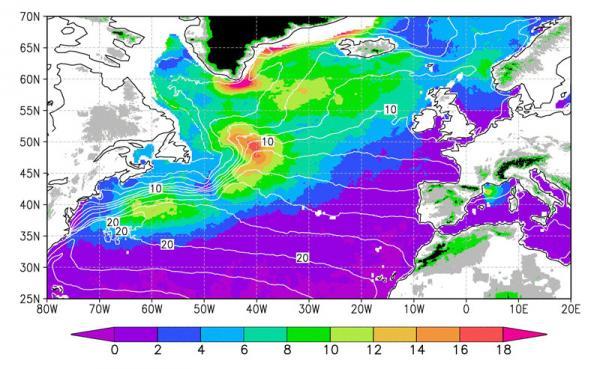
According to a 2006 report by the U.S. Department of Energy, General Electric and the Massachusetts Technology Collaborative, offshore wind resources on the Atlantic and Pacific coasts of the United States exceed the current electricity generation of the entire U.S. power industry. NASA has also been investigating ocean wind strengths worldwide, using the QuikSCAT satellite.


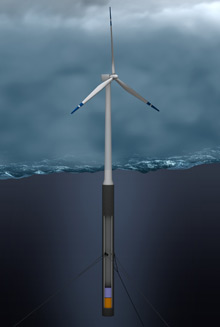
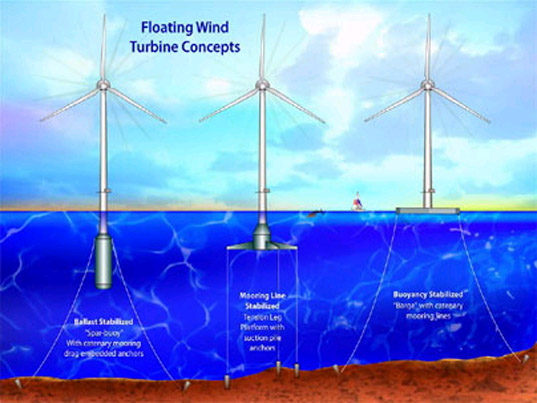
Researchers at MIT and elsewhere have been investigating the feasibility of "tension-leg" platforms for wind turbines, a technology that oil companies have been using for deep-water rigs. The structures would be assembled at a shipyard and placed on large floating cylinders that are ballasted with high-density concrete (to keep the structure from tipping over) and then tugged out to sea. Once in location, steel cables would be attached to the platform, anchoring it to the sea floor.

The MIT researchers claim that large turbines located far offshore could eventually generate cheaper power than both land based wind farms and near-offshore ones (even taking into account the increased cost of longer underground electricity transmission cables). Part of the cost advantage is the higher capacity factor achieved due to more consistent offshore winds - potentially averaging between 40 percent and 50 percent compared with 30 percent or less with land based turbines.

Some offshore wind farms could also have advantages in terms of proximity to large coastal cities compared to wind farms in remote areas, which require grid transmission upgrades to transport the power to places where it is consumed. Floating offshore wind farms also avoid bottlenecks in the supply of marine construction equipment such as pile drivers and cranes that may hamper rapid expansion of shallow offshore wind structures (however they may instead compete for some resources with offshore oil exploration and production, which could be problematical in the short to medium term).

A number of companies are active in the area of floating offshore wind technology - primarily Blue H Technologies, StatOil Hydro and SWAY.

Blue H Technologies

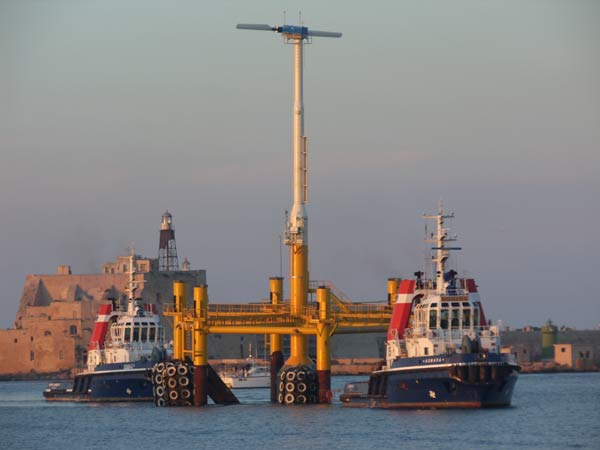
Blue H Technologies is a Dutch company that launched their first test platform at Tricase off Italy's southern coast late last year. The company has also announced plans to install another test turbine off Massachusetts.

The Blue H test platform in Italy is a tension-leg platform - a conventional offshore oil and gas platform design that floats below the surface, held in place by chains running to steel or concrete anchors on the seabed. The platform is located 10 km offshore and hosts an 80-kilowatt wind turbine which is mounted with sensors to record the wave and wind forces experienced by the equipment.

Blue H is now constructing a commercial wind farm for the Tricase site, which will have an installed capacity of 92 MW.

Blue H's design is unusual in that the turbine has a two-bladed rotor rather than the conventional three-blade design used elsewhere in. Technology Review has quoted Martin Jakubowski, Blue H cofounder and chief technology officer, as saying that "the noise and jarringly high rotation speeds that made two-bladers a loser on land are either irrelevant or a plus offshore" and that the fast rotation is "less susceptible to interference from the back-and-forth swing of the platform under wave action" and means less torque, resulting in a lighter structure (Blue H's 2.5-megawatt turbine will weigh 97 tons - 53 tons lighter than the lightest machine of the same power output on the market).

Tech Review also quotes Jakubowski as estimating that Blue H's wind farms will "deliver wind energy for seven to eight cents per kilowatt-hour, roughly matching the current cost of natural gas-fired generation and conventional onshore wind energy".


StatOil Hydro

Norwegian oil and gas producer StatoilHydro and Germany's Siemens (a major wind-turbine producer) are partnering in a project to build a commercial-scale floating wind farm about 10 kilometers offshore from Karmøy on Norway's southwestern tip.

StatoilHydro initially plans to operate a 2.3 MW wind turbine atop a conventional oil and gas platform, and is hoping for this to be operational in late 2009. Unlike the Blue H design, StatOilHydro is using traditional wind turbines.

The company believes floating wind farms are the way of the future, with a company spokesman saying that there are a declining number of sites available onshore and in shallow waters and citing regions without a shallow continental shelf like California, Japan and Norway where traditional offshore wind is not possible.

StatOilHydro says that deepwater wind power will be expensive in the initial stages but that the economics could eventually rival those of conventional wind power.

If deep offshore wind power in the North Sea proves to be successful it would become a major component on the planned European Supergrid, which backers hope will link up the region's power networks and allow a much higher proportion of renewable energy in future (possibly entirely fossil-free, as it will need to become eventually).


SWAY

SWAY, based in Bergen, Norway, plans to field a prototype of its floating wind turbine in 2010. SWAY's platform is basically a spar buoy that can rise and fall gently with wave action, requiring less anchoring than the tension-leg platform. The buoy, mounted on a column nearly 200 meters tall, is held in place by a 2,400-ton gravel ballast. A three-bladed turbine is used, but, unlike conventional onshore turbines, it faces downwind rather upwind to better accommodate heeling of the tower, which may make it more effective in rougher waters than alternative designs.

The Simmons Plan

The cost estimated for Simmons' plan is $5 billion per gigawatt — more than double the amount that T. Boone Pickens’ now delayed wind farm in Texas is supposed to cost.

This seems high if the cost savings expected by the companies mentioned above eventuate, with the StatOilHydro experiment probably being the best guide, with the North Sea facing similar weather challenges to those experienced off New England.

Winter winds in the Gulf of Maine carry as much as eight times more energy as summer breezes, meaning maximum power is available during periods of greatest demand. About 80 percent of Maine residents use oil to heat their homes. The average family uses about 1,000 gallons, or 3,785 liters a year - when prices are around $4 a gallon ($1 a litre) this consumes about one-tenth of the average family's annual income, leading Simmons to declare "If we don't do this, we're [eventually] going to have to evacuate most of Maine".

Seen in that light, even an expensive offshore wind farm is better than the alternative.

As an added bonus, construction and maintenance of the structures will bring valuable job opportunities to a region hard hit by the decline of the fishing industry.

Related Posts :

The Oil Drum - Alternative Wind Power Experiments - SkySails and Airborne Wind Turbines (Peak Energy)

The Oil Drum - Offshore Wind

Cross-posted from Our Clean Energy Future.

Matt Simmons' Plan for the world's biggest wind farm  

Posted by Big Gav in , ,

The IHT has a report on a plan by Matt Simmons and George Hart to build the world's largest wind farm in the gulf of Maine - Plans for the world's biggest wind farm.

It is not the usual green suspect. But it hopes to build a 5-gigawatt, deep-water wind farm - the largest in the world, equal to the output from five nuclear plants.

"It" is the Ocean Energy Institute, a tiny research organization founded by Matthew Simmons. An energy investment banker who specializes in oil and gas, Simmons was an energy adviser to President George W. Bush. His main partner, George Hart, is a physicist who consults for the Pentagon on the Strategic Defense Initiative, where he uses supercomputers for the mathematical modeling of complex systems. He also co-invented a laser used for eye surgery and semiconductor manufacturing.

Simmons does not believe in climate change, but he believes in peak oil. His book, "Twilight in the Desert: The Coming Saudi Oil Shock and the World Economy," presciently published in 2005, argued that the world was at or near peak oil production, which would limit supply and drive prices skyward.

The International Energy Agency appeared to support that thesis in a report released Nov. 12, saying that, even if demand remained flat, by 2030, the world would need to find new oil production equivalent to four Saudi Arabias, merely to offset oil field decline.

Simmons predicts resource wars if the world fails to change course; and he is particularly concerned with the future of Maine, where he has a home.

"Understand how dire it is in the state of Maine," said Habib Dagher, an engineering professor at the University of Maine who specializes in composite materials and is working to develop advanced turbines. About 80 percent of Maine residents use oil to heat their homes, and the price of heating oil tracks that of crude. The average family uses about 1,000 gallons, or 3,785 liters a year, so if prices are $4 a gallon, or $1.06 a liter, that's about one-tenth of the average family's annual income.

Simmons, referring to the proposed wind farm, said, "If we don't do this, we're going to have to evacuate most of Maine."

The institute's founding mission was to study different forms of ocean energy. But Hart quickly realized that the Gulf of Maine has one of the best wind resources on the planet. The U.S. Department of Energy has rated it up to a Class 6 on a scale of 7.

Gale-force winds there in winter carry as much as eight times more energy than summer breezes. That means more power could be available precisely at periods of greatest demand. "The resource matches the problem the state of Maine faces," Dagher said.

The target generating capacity of 5 gigawatts equals the power required to replace the use of home heating oil in winter, said Simmons. But more could be generated if necessary. The Gulf of Maine has an estimated total wind power potential of 100 gigawatts.

Matt Simmons: Here comes $500 oil  

Posted by Big Gav in ,

Fortune has an article on Matt Simmons and peak oil - Here comes $500 oil.

Matt Simmons is as perplexed as anyone that it has fallen to him to take on OPEC, Exxon, the Saudis, and all the other misguided defenders of conventional wisdom in the oil patch. Why should one investment banker with a penchant for research be required to point out what he regards as the obvious - that from here on out, oil supplies can't meet demand, and if we don't act soon to solve this crisis, World War III could be looming?

Why should a man who scorns most environmentalists have to argue that locally grown produce and wind power are the way of the future? Why should a lifelong Republican need to be the one to point out that his party's new mantra - "Drill, baby, drill!" - won't really fix anything and that his party's presidential candidate is clueless about energy? That the spike in oil prices earlier this year wasn't a temporary market anomaly and the recent retreat in prices is just a misleading calm before a calamitous storm? That we're headed toward $500-a-barrel oil?

"I find it ironic that here we have the biggest industry on earth, and I'm one of the few people to figure out that we have a major problem," he says, in his confident if not quite brash way. "And I did it all in my spare time. How stupid and tragic is that? I shouldn't be one of the only folks that actually has a handful of ideas of how we can keep from blowing each other up and get through this."

Indeed, Simmons isn't the obvious candidate to be the bearer of bad news about oil. He's spent his career working in the business, has lived in Houston for decades, and is such an industry insider that he helped edit the Bush campaign's comprehensive energy plan in the 2000 election - the document that was ultimately more or less rubber-stamped by Vice President Dick Cheney's infamous secret Energy Task Force. Over the past 35 years, his boutique investment bank, Simmons & Co., has helped finance and shape much of the country's existing oil-services business. With profits gushing, you might expect him to be celebrating. ...

The soaring price of crude - it has risen from below $20 a barrel in 2002 to as high as $147 earlier this year - has helped thrust Simmons further into the spotlight. He was one of the main voices, for instance, in the recent oil-shock documentary "Crude Awakening," and his book has now sold more than 100,000 copies. His willingness to make bold predictions about how high crude may go has made him an A-list guest for cable TV news programs and a go-to source for newspaper reporters covering oil and gas. In 2005, when oil was $58 a barrel, he predicted it would be at or above $100 within a few years. Now he sees it climbing to $200, $300, or higher. "There really is no roof on oil prices at this point," he says.

Being so outspoken, of course, invites criticism, and Simmons has endured plenty. But he has also won a lot of high-profile admirers. "Like most people who ignore conventional wisdom, he was scoffed at, ridiculed, and denied," says commodities guru Jim Rogers. "And now, of course, people are starting to say, 'Oh, well, I thought of that.'" Billionaire oil and gas investors Richard Rainwater and Boone Pickens both heap praise on Simmons's analytical abilities. Maine's Senator Susan Collins, a Republican who recently began consulting with Simmons on energy issues, says, "I think he's issuing a clarion call that policymakers need to listen to."

In his own upbeat way, he despairs about what is to come. As the price of oil has fallen this summer (to $101 at press time), Simmons has watched in dismay as complacency has returned and the champions of do-nothingism have popped out of the woodwork to say I told you so. Not that it's lessened his conviction about the road ahead. "I do think there are a growing number of people who are getting it," he says. "But I guess it just reminds me that as a society, we don't have the ability to actually come to grips with a crisis until it's hit us in the face. I am discouraged enough now to think that we're going to have to have a really nasty shock before we wake people up."

Matt Simmons In The Economist  

Posted by Big Gav in , , ,

The Economist has an article on Matt Simmons. The most surprising part (other than Matt's retreat to a doomstead in Maine) is them quoting him saying "globalisation must stop". Isn't that considered the ultimate heresy in St James ?

Simmons & Company, the investment bank Mr Simmons went on to found (along with Michael Huffington, an oilman and politician), helped to funnel money and financial advice to the nascent “oil services” industry, which performs tasks such as seismic surveys and drilling wells on behalf of oil firms. Indeed, Mr Simmons says it was his bank that coined the very phrase “oil services”. It has handled over 500 merger-and-acquisition deals in the industry—49 of them last year alone.

All this means that Mr Simmons can draw upon long experience and deep knowledge of the oil industry. He does not dispute the main criticism of the “peak oil” theory: that improvements in technology, spurred by high prices, will eventually allow new fields to be found, more oil to be recovered from existing fields and artificial oil to be conjured from substances such as tar sands, coal and shale. But he thinks such advances will take longer to appear and have less of an impact than his detractors assume.

As it is, he points out, all the world’s drilling rigs are working flat out, and old ones are being retired faster than new ones can be produced. The same is true of geologists and many more of the industry’s essential inputs. This is slowing the development of new fields and pushing up the cost. By the same token, the technology being used to extract oil today has been in the works since the 1970s. It will take a long time for the next generation of clever kit to come into widespread use. Besides, many technological improvements seem to have simply speeded up the extraction of oil, rather than increasing the share of each reservoir that can be recovered.

In short, as Mr Simmons readily concedes, the debate between proponents and critics of “peak oil” boils down to an argument about timing. The optimists think that technology will advance quickly enough to offset declining production from mammoth fields such as those Mr Simmons studied in Saudi Arabia. But he and his disciples think the declines will come too soon, and be too sharp, for the world to adapt in time. The whole row could easily be solved, he says, if Saudi Arabia would only allow independent auditors to assess its reserves.

In the meantime, Mr Simmons is taking no chances. He plans to start up a farm near his house in Maine, in case the supply chain that provides America with food breaks down for lack of fuel. He plans to fertilise his fields with manure, rather than chemicals derived from oil and natural gas. He thinks globalisation must stop, and that as much trade as possible should be conducted by boat, to conserve whatever oil remains.

But Mr Simmons has not despaired. He holds out great hope for wave energy, and believes that at least one of the many different species of seaweed found along Maine’s coast will yield oil that can be turned into biofuel. He has got Simmons & Company involved in alternative energy. It is a brave choice for someone who is so pessimistic about technology.

The Economist also recently had a special issue covering energy issues - The power and the glory - which had a look at a range of alternative energy options.
In the space of a couple of years, all that has changed. Oil is no longer cheap; indeed, it has never been more expensive. Moreover, there is growing concern that the supply of oil may soon peak as consumption continues to grow, known supplies run out and new reserves become harder to find.

The idea of growing what you put in the tank of your car, rather than sucking it out of a hole in the ground, no longer looks like economic madness. Nor does the idea of throwing away the tank and plugging your car into an electric socket instead. Much of the world’s oil is in the hands of governments who have little sympathy with the rich West. When a former head of America’s Central Intelligence Agency allies himself with tree-hugging greens that his outfit would once have suspected of subversion, you know something is up. Yet that is one tack James Woolsey is trying in order to reduce his country’s dependence on imported oil.

The price of natural gas, too, has risen in sympathy with oil. That is putting up the cost of electricity. Wind- and solar-powered alternatives no longer look so costly by comparison. It is true that coal remains cheap, and is the favoured fuel for power stations in industrialising Asia. But the rich world sees things differently.

In theory, there is a long queue of coal-fired power stations waiting to be built in America. But few have been completed in the past 15 years and many in that queue have been put on hold or withdrawn, for two reasons. First, Americans have become intolerant of large, polluting industrial plants on their doorsteps. Second, American power companies are fearful that they will soon have to pay for one particular pollutant, carbon dioxide, as is starting to happen in other parts of the rich world. Having invested heavily in gas-fired stations, only to find themselves locked into an increasingly expensive fuel, they do not want to make another mistake.

That has opened up a capacity gap and an opportunity for wind and sunlight. The future price of these resources—zero—is known. That certainty has economic value as a hedge, even if the capital cost of wind and solar power stations is, at the moment, higher than that of coal-fired ones.

The reasons for the boom, then, are tangled, and the way they are perceived may change. Global warming, a long-range phenomenon, may not be uppermost in people’s minds during an economic downturn. High fuel prices may fall as new sources of supply are exploited to fill rising demand from Asia. Security of supply may improve if hostile governments are replaced by friendly ones and sources become more diversified. But none of the reasons is likely to go away entirely.

Global warming certainly will not. “Peak oil”, if oil means the traditional sort that comes cheaply out of holes in the ground, probably will arrive soon. There is oil aplenty of other sorts (tar sands, liquefied coal and so on), so the stuff is unlikely to run out for a long time yet. But it will get more expensive to produce, putting a floor on the price that is way above today’s.

Other articles in the section cover most of the way forward (ocean power, biogas and cradle to cradle manufacturing being the most notable exceptions, while "negawatts" were deliberately omitted):

* Trade Winds - "Wind power has come of age. But to make the most of it, electrical grids will have to be overhauled"
* Solar Energy: Another silicon valley?
* Beneath your feet: Geothermal could be hot
* Bespoke biofuels
* Electric cars: The end of the petrolhead

Massive Oil And Gas Find Off Aceh ?  

Posted by Big Gav in , , , , , , ,

Energy Current has a brief report about an enormous (but highly theoretical at this stage) oil and gas find offshore from Indonesia's semi-autonomous Aceh province. The only other source with a report on this seems to be the Jakarta Post.

I vaguely recall some of the (very dodgy) tinfoil theories that washed ashore in the wake of the 2004 tsunami claimed that it was deliberately triggered as part of a grab for the regions' resources. I wonder if any of the foreign forces that landed to help in the clean up and reconstruction are still there ?

Indonesian and German research agencies claimed a massive find of subsea hydrocarbons holding between 107 billion to 320 billion barrels of oil and gas reserves in a basin off the western shore of Aceh Nangroe Darussalam, Indonesia, according to a Jakarta Post report.

Research vessel Sonne encountered the underwater basin while performing a survey to map the geological construction of the surrounding sea in Aceh after the 2004 Indian Ocean tsunami, Indonesia's Agency for the Assessment and Application of Technology (BPPT) and Germany's Bundesanstalt fur Geowissenschaften und Rohstoffe (BGR) said in a statement.

The research and preliminary finding remains subject to further tests to determine the actual reserve size of the basin. Further information is required before energy companies would be able to feasibly explore for oil or gas. If the hydrocarbon potential of the basin is proven, the area may well be among the largest oil and gas reservoirs in the world.

The Wall Street Journal has a look at the Matt Simmons vs Aramco debate in "Peak Oil: Simmons v. Saudis, Round Two". I'll note the comments thread has more kooks than most tinfoil sites could muster - where do these people come from - isn't the WSJ supposed to be for respectable people...
Both Nansen Saleri, former chief of reservoir management at Saudi Aramco, and Houston-based investment banker Matthew Simmons are feeling good these days about the famous–and weighty–debate they held four years ago at Washington’s Center for Strategic and International Studies. Are Saudi Arabia’s massive oil fields in great shape—or falling apart? Can Saudi Aramco help slake the globe’s soaring energy thirst far into the century—or has that ability already peaked?

Simmons, in his book “Twilight in the Desert” argued that several big Saudi fields, including the massive Ghawar field, were showing signs of serious strain. Their debate before a packed house at CSIS marked an unprecedented moment of openness for the secretive Aramco.

Saleri now says in an interview that time has proven Aramco right. Simmons “was saying four years ago that Ghawar was going to collapse and that Saudi Aramco was going to go into decline….[But] that precipitous decline never occurred,” he says. Saleri, who left Aramco last year to create his own Houston-based reservoir-management company, insists Ghawar will keep pumping five million barrels a day far into the future. Aramco also managed to revive some other behemoths, like Abqaiq. “Abqaiq became a renaissance story for Aramco,” he says, insisting that the field’s pressure remains strong and its water content is going down even after more than 60 years in production. Abqaiq “is doing fantastically,” Saleri says.

Simmons, reached by phone in Houston, says he feels equally vindicated—and increasingly alarmed. He based his book largely on information dug up in old technical journals. In recent weeks he has hit the archives again, with thoughts of writing a second book. What he has found, he says, “is so unbelievably scary you can’t believe it.” He claims that there is mounting technical evidence that Aramco is struggling to deal with increasing volumes of water at its hugest fields. With water production going up, he says, oil production is going down. “It is absolutely clear as a bell now that all of those fields are heading toward being another Cantarell,” referring to the massive Mexican offshore field, which is now in rapid decline.

More on Simmons at The Rude Awakening, looking at "Empty Holes and Black Swans".
It may be blasphemous to ponder in a region that produces a good deal of the world's hydrocarbon-based energy, but what if Peak Oil has already occurred?

"My opinion is that it's increasingly likely that we actually set an all-time record in May 2005 of 74,252,000 barrels per day," states Matt Simmons, founder and chairman of the world's largest energy investment banking company, Simmons & Co. International.

"And for the first three months of 2007," Simmons continues, "we were almost a million barrels per day behind that, and we're dropping fast. If that record still holds a year from now, I'll bet someone ten-to-one that we set peak oil in May 2005 and it's now past tense."

Not one to shy away from a bet, Bud Conrad, chief economist at Casey Energy Speculator and fellow Peak Oil enthusiast, plotted the following slightly more inclusive chart to give us an idea of where we stand today.


As the graph clearly illustrates, world production has been on a rather unimpressive plateau for the past couple of years. Part of this stagnation in global output growth stems from the coughing, spluttering "chokepoints" that we read about in the news every other day.

Just this past weekend we saw crude shoot up about four bucks on the back of threats made by Venezuela's head honcho, Hugo Chavez, that he may sever export lines to the thirsty U.S. Then there was a decline in production in Nigeria...troubles in the North Sea...ongoing issues in Iran...the "problem with Putin"...the list goes on.

The thumbscrews are tightening for net oil importers. As we explained in yesterday's Rude, "The American SUV driver was a tad sluggish in his gait this morning. Once again his pocketbook has been pinched. The hefty drive from his suburban McMansion to work in the city and the heating in his Connecticut vacation home just became a little more expensive."

But the issues that face net-importing nations around the world may soon be felt by the net-exporting nations too. Oil, as a finite commodity, will one day dry up. The impetus for economies with a heavy oil hand to diversify, therefore, is rather serious.

Consider that Abu Dhabi, capital of the UAE and one of the Middle East's largest crude exporters, has just pumped $15 billion into their Masdar Green City initiative and one begins to understand just how seriously even the crude rich nations are taking the issue of ultimate depletion.

In the following column, Bud sits down with Matt Simmons to root out some of the grim realities emerging at the tail end of our petroleum age. This may hurt a little...but we hope it also helps. Enjoy...

Energy Bulletin has an interesting article on the "Pakistan problem: Washington's perspective", outlining a theory that the US would like to see Pakistan broken up and then merged back into India. The idea of merging Pakistan into India seems pretty far-fetched (I really can't imagine it being possible under any circumstances) but the idea that US policy involves making sure there are no functioning states within the middle east that could pose any threat to US control of the oil seems more plausible.
The Bush administration has persistently supported Pakistan’s military dictator, General Musharraf, despite widespread criticism of this policy at home and abroad. With the likely induction of the Democrats in to the White House, should one anticipate a different U.S policy towards Pakistan? This question is best answered when placed within the framework of Washington’s long term objectives in South Asia.

The neocon vision of national security is described by President Bush in the 2006 edition of the official document titled the “National Security Strategy of the United States of America” in the following words:
“We seek to shape the world, not merely be shaped by it; to influence events for the better, instead of being at their mercy”.

This preemptive foreign policy is driven by “Peak Oil” related anxiety. Cognizant of the fact that the world is headed towards a new type of international rivalry that will entail a scramble for world’s diminishing supply of fossil fuel, and encouraged by the U.S’s unrivaled status, the necocons embarked upon a policy to establish greater control over the world’s energy resources. As a functional prerequisite of this control, Washington has set out to establish alliances that will strengthen its created “energy order”, prevent China from emerging as a competitor of the U.S, and prevent major Asian countries from forming a multi polar power bloc against the U.S.

The Middle East is at the heart of this policy, where Washington is pursuing the following objectives.

1. Middle Eastern countries that produce fossil fuel and those through which vital pipelines transit (called the “strategic core” of the Middle East), should not be allowed to develop or retain, state-of-the-art military. U.S protected Gulf kingdoms are deemed harmless and therefore allowed the purchase of military hardware.
2. No Middle Eastern state (except Israel) should be allowed to develop or retain nuclear weapons.
3. The concept of modern “nationhood” encompassing large states overriding ethnic loyalties should be discouraged in the “strategic core” of the Middle East as a preemptive strategy against pan-Islamic revolutions such as the '79 revolution in Iran.

U.S policy in these areas is aimed at scuttling the “sources” of modern nationalism, i.e. a large, multiethnic nation state equipped with an equally large military. (These two ingredients serve simultaneously as the symbol and the source of modern nationalism as it evolved in Europe out of the Napoleonic wars). This explains the Bush administration’s bid to petrol the high seas under the “Proliferation Security Initiative”, its itch to attack Iran, the result of its engagement in Iraq, its post Cold War policy in Afghanistan and its current policy in Pakistan.

The imperatives of the above objectives negate the institutional strengthening of Pakistani state and society and require, above all, the dismantling of Pakistan’s nuclear arsenal. Furthermore, for reasons elaborated below, an altogether end to Pakistan as an entity, rather then its continuity, serves long term interests of the U.S better. Events in Pakistan, it seems, are being influenced in that direction.

For Washington, the strategic importance of Pakistan has been replaced by India and Afghanistan, in that order. Afghanistan’s long term relevance to U.S energy policy lies in its proximity to resource rich Central Asian republics and Russia. Its short term importance lies in its 800 mile long border with Pakistan, a proximity which is being utilized for destabilizing the latter. The fact that Pakistan is a nuclear Islamic state is a significant negativity in the neocons’ envisaged world order. Pakistan’s size and its nuclear arsenal discourages overt military engagement to neutralize this negativity. The long standing, entrenched CIA presence in the country, on the other hand, facilitates the deployment of covert means, pivotal to which is the spill over into Pakistan of terrorism caused by U.S invasion and occupation of Afghanistan. As a “terror inflicted, failed state”, Pakistan becomes vulnerable to international pressure to disarm its nuclear arsenal.

As a transit route for Central Asian fossil fuel, Afghanistan circumvents Russia, China and Iran. It establishes an alternative route which passes through the Afghan-Pakistan territory to the Indian Ocean. To stabilize this route, the neocons plan to break Afghanistan into smaller, ethnically contiguous states capable of ensuring the safety of pipelines as they transit through the area into India. Washington does not envisage a unified Afghanistan, otherwise it would have used King Zahir Shah and his family to rally disparate Afghans, instead of the ineffective Hamid Karzai. That is why in the 2003 budget proposal, the Bush administration did not request any reconstruction aid for Afghanistan, a state it declared central to the war on terror. The Bush administration slashed reconstruction aid to Afghanistan from one billion dollars in 2005 to $623 million in 2006. Washington’s monetary commitment to the reconstruction of Afghanistan is paltry and is executed with blatant insincerity. Similarly, Washington did not engage in de-radicalization of Pakistan after the end of Soviet Afghan war, like its post Camp David engagement with Egypt. Pakistan, the only nuclear Islamic state, is too important a country to have suffered such neglect simply due to policy oversight. Washington did not commit its resources to de-radicalizing Pakistan because it does not envision a stable Pakistan as a long term U.S ally. ...

During the 1971 Indo-Pak war, when Pakistan’s defeat in the Eastern sector became imminent and the fear that New Delhi would invade West Pakistan increased, U.S sent its nuclear armed USS Enterprise to the Indian Ocean to prevent India from dismembering Pakistan. In response, the Soviet navy dispatched its nuclear submarines to ward off the U.S threat to India. The imperatives of the Cold War, thus, saved Pakistan. The new alignment of international political forces and the imperatives of Peak Oil politics are both fatefully arrayed against Pakistan. The forces with a plausible interest in destabilizing Pakistan include groups as diverse as the Indian RAW, the American CIA, the global Al Qaeda and the regional Taliban. Pakistani military dictators have failed to enter into a system of alliance that would serve Pakistan well in the post Cold War era. Their continued alliance with the U.S has enriched them personally, but it has augured ill for their country. Under the current circumstances, Pakistan’s nukes, instead of serving as its strategic asset, have become a liability. Instead of being able to dyke the flood of instability that is engulfing Pakistan, Musharraf is drowning in it more and more by the day. This, above all, explains why the neocons are so pleased with him.

The above analysis by no means entails that Washington’s policy in Pakistan will alter radically with the induction of the Democrats in to the White House. Although the current U.S energy policy, and its offshoot “the new South Asia policy” was “envisioned” by the neocons, the Democrats have already embraced it publicly during Bill Clinton’s historic visit to India in March 2000. Pakistan is not only of no use to Washington any more, it is a thorn in its side. Washington hopes to manipulate a new military rivalry in Asia to its advantage. It wants the Indo-Pak rivalry replaced by the Sino-Indian rivalry. With India as its ally, Washington hopes to gain much out of this rivalry. There is every likelihood, therefore, that the neocon policy of covertly engineering Pakistan’s dismemberment will continue under the Democrats till such time as the policy objectives have been met.

Idleworm also points to a story (what it calls "a socialist analysis of Obama") that mentions the goal of dominating the middle east and central asia.
Obama is not, however, the product of the civil rights struggles against racial oppression, nor is he associated with any popular movement from below. His career has far more in common with those of Condoleezza Rice and Colin Powell, individuals selected and groomed by the American ruling class to carry out its policies. Like them, he is being used to put a new face on fundamentally reactionary policies and institutions...

Important sections of the ruling elite have concluded that, particularly for the overseas interests of American imperialism, a President Obama would provided important advantages. He would at one stroke put a “new face” on American foreign policy, and make it more likely that Washington could overcome the international isolation and global hostility created by the arrogant unilateralism of the Bush White House and its failed intervention in Iraq. And it may well require a Democrat in the White House to reinstate the draft and provide the manpower required to sustain and expand the US drive for military domination of the oil-rich Middle East and Central Asia...

An Obama presidency (or a Clinton presidency, should her campaign ultimately prevail), would thus represent a fine-tuning or adjustment in American foreign policy, but no let-up in American imperialism’s drive to war and conquest, which arises not out of the brains of George W. Bush and Richard Cheney, but out of the historical crisis of American and world capitalism.

Heading back to the fringes of the Indonesian archipelago, Crikey has some comments ("More questions than answers in East Timor") on the recent assassination attempts on the East Timorese Prime Minister and President. There's something very fishy about this whole affair, though not as obviously dodgy as the original set of events kicked off by the now-deceased Major Reinado that resulted in the downfall of previous Prime Minster Mari Alkatiri, who I suspect paid the price for trying to be too assertive about East Timorese independence. For what its worth, the Green Left Weekly probably had the most accurate take on that one.

The power plays in East Timor (with Australia, Indonesia, China and Portugal all jostling for control of the country's energy resources) are murky, and whowever who was behind this latest outbreak of violence is beyond me.
If you'd heard that East Timor president Jose Ramos Horta had been shot, and Prime Minister Gusmao shot at, you'd immediately suspect the hand of rebel leader Alfredo Reinado. Ipso facto.

But there's muddying of the waters in the press and across blogs today, as people try to come to grips with what's happened. Reinado himself was killed in the shoot-out at the President's residence.

Timor-Leste radio has been reporting that Reinado was actually staying with Ramos Horta, according to one blogger. This is directly contradicted by Gusmao in today's Australian: "Some people have said that President Ramos Horta had called Alfredo Reinado to come to Dili. But this is not true. Before taking any action, the President always contacts me and the President of the national parliament to co-ordinate activities. I would have known if he had contacted Alfredo."

What does seem clear is that the threat wasn't taken seriously enough, either by East Timor's leaders or the ADF and the UN. (In fact, UN forces apparently stayed 300 metres away from Ramos Horta after he was shot, ABC's PM was told last night.)

Tough questions must be asked over the security role of the ADF in East Timor, writes Patrick Walters in today's Australian:
Why, amid renewed threats last week from Reinado against East Timor's leaders, did the ADF and the UN-sponsored International Stabilisation Force not lift security around Jose Ramos Horta and Xanana Gusmao? While both leaders have declined the offer of Australian personal bodyguards in recent months, why, given the heightened threats, did the ADF and UN authorities not move to lift the overall level of surveillance protection and perimeter security provided to both men?

And if yesterday's attacks really were an attempted coup, some are asking why security hasn't been more significantly stepped up since.

Conspicuous by their absence yesterday were "extra security at the TV and radio station (if this was a coup attempt these places should both have extra guards)", writes Xanana Republic's English blogger.

Perhaps it's just with Reinado gone, the threat seems diminished. As Tom Allard writes in today's SMH, "there is no-one to replace him".

Below are a couple of the blog posts that digest the situation, trying to untangle the half-based truths and jumbled facts. In East Timor, unconfirmed stories need to be taken with a grain of salt. As one of the bloggers says, they're "about 90% correct but that 10% error can affect conclusions by 100%. Some local media were reporting that the President had died which everyone seems to agree is not the case. It is rarely straightforward here."

Eyewitness report and some unanswered questions. I received an email this afternoon from a mate who is the de-facto head of the Dili surf life saving club. This is the 3rd person I know who was in the area at the time but this one is a bit closer to the bone. In fact, TS has had the nervous sh-ts all day - I can understand why. He writes :
I went out for my morning exercise at 0630, and got to the intersection to The President’s house when it all went pear shaped.

I had turned up the road for the hill ride, stopped and started when I heard the gunfire. There was a vehicle straddling the road, some rubbish as well, and I could see what looked like uniformed personnel running around the area. Lots of gunfire, then three rounds went off just beside me, but in the bush. I was still about 400 metres from the house so hopefully they were only shooting quail and not me. But I don’t think so. It was still around dawn, so I couldn’t see exactly what the vehicle was, but it looked familiar.

I turned back, and headed east, and bumped into the President who was with two of his guards. One was on the road, the other with the President on the beach. All this was about 6.40am.

I stopped them and told them what had happened … he said no to the offer of a ride, saying it should be OK...

My old mate FOS over at xananarepublic.blogspot.com also has his acquaintances down the eastern end of town and all I can suggest is you read what his take is. So if Radio Timor-Leste is correct and Alfredo really was staying at the President’s place, which group of people dressed as soldiers attempted to simultaneously (give or take 5 minutes) take out Alfredo, the President and the Prime Minister who lives some 10 kms away? -- Dili-gence

Was Reinado staying with Ramos-Horta? As speculated earlier, it seems that the attack was carried out during JRH's normal morning walk/run. A friend who lives about 300 metres away reported a fire-fight occurring at about 0650 this morning. From various wires/radio sources it appears that two vehicles drove by and then opened fire. Radio Timor Leste is reporting that Alfredo Reinado was indeed killed in the shootout but rather than being an attacker he was in fact a guest at JRH's house and had been there for up to a week and ran out of the house during the attack to try and stop it and was killed in the crossfire. A contact at Dili hospital confirms two dead were brought to the hospital, neither of whom whas Alfredo. The Deputy PM is saying that three people were killed in the attack so maybe Alfredo was among them and not taken to Dili hospital. We are also hearing about an attack on a convoy containing Prime Minister Gusmao roughly 30 minutes after the attack on JRH. I have had a bit of a trawl around Dili in the past few hours and here are some observations:
Conspicuous by their absence: UN police cars outside Castaways and Dili Beach Hotel.

Conspicuous by their absence: Extra security at the TV and radio station (if this was a coup attempt these places should both have extra guards).

Conspicuous by their absence: Malae in Dili centre, apart from security forces.

Conspicuous by the non-absence: Many Timorese on the streets, especially in central Dili but not many people on the street in my area. Maybe the news hasn't filtered down yet. -- Xanana Republic

Statistics

Locations of visitors to this page

blogspot visitor
Stat Counter

Total Pageviews

Ads

Books

Followers

Blog Archive

Labels

australia (619) global warming (423) solar power (397) peak oil (355) renewable energy (302) electric vehicles (250) wind power (194) ocean energy (165) csp (159) solar thermal power (145) geothermal energy (144) energy storage (142) smart grids (140) oil (139) solar pv (138) tidal power (137) coal seam gas (131) nuclear power (129) china (120) lng (117) iraq (113) geothermal power (112) green buildings (110) natural gas (110) agriculture (91) oil price (80) biofuel (78) wave power (73) smart meters (72) coal (70) uk (69) electricity grid (67) energy efficiency (64) google (58) internet (50) surveillance (50) bicycle (49) big brother (49) shale gas (49) food prices (48) tesla (46) thin film solar (42) biomimicry (40) canada (40) scotland (38) ocean power (37) politics (37) shale oil (37) new zealand (35) air transport (34) algae (34) water (34) arctic ice (33) concentrating solar power (33) saudi arabia (33) queensland (32) california (31) credit crunch (31) bioplastic (30) offshore wind power (30) population (30) cogeneration (28) geoengineering (28) batteries (26) drought (26) resource wars (26) woodside (26) censorship (25) cleantech (25) bruce sterling (24) ctl (23) limits to growth (23) carbon tax (22) economics (22) exxon (22) lithium (22) buckminster fuller (21) distributed manufacturing (21) iraq oil law (21) coal to liquids (20) indonesia (20) origin energy (20) brightsource (19) rail transport (19) ultracapacitor (19) santos (18) ausra (17) collapse (17) electric bikes (17) michael klare (17) atlantis (16) cellulosic ethanol (16) iceland (16) lithium ion batteries (16) mapping (16) ucg (16) bees (15) concentrating solar thermal power (15) ethanol (15) geodynamics (15) psychology (15) al gore (14) brazil (14) bucky fuller (14) carbon emissions (14) fertiliser (14) matthew simmons (14) ambient energy (13) biodiesel (13) investment (13) kenya (13) public transport (13) big oil (12) biochar (12) chile (12) cities (12) desertec (12) internet of things (12) otec (12) texas (12) victoria (12) antarctica (11) cradle to cradle (11) energy policy (11) hybrid car (11) terra preta (11) tinfoil (11) toyota (11) amory lovins (10) fabber (10) gazprom (10) goldman sachs (10) gtl (10) severn estuary (10) volt (10) afghanistan (9) alaska (9) biomass (9) carbon trading (9) distributed generation (9) esolar (9) four day week (9) fuel cells (9) jeremy leggett (9) methane hydrates (9) pge (9) sweden (9) arrow energy (8) bolivia (8) eroei (8) fish (8) floating offshore wind power (8) guerilla gardening (8) linc energy (8) methane (8) nanosolar (8) natural gas pipelines (8) pentland firth (8) saul griffith (8) stirling engine (8) us elections (8) western australia (8) airborne wind turbines (7) bloom energy (7) boeing (7) chp (7) climategate (7) copenhagen (7) scenario planning (7) vinod khosla (7) apocaphilia (6) ceramic fuel cells (6) cigs (6) futurism (6) jatropha (6) nigeria (6) ocean acidification (6) relocalisation (6) somalia (6) t boone pickens (6) local currencies (5) space based solar power (5) varanus island (5) garbage (4) global energy grid (4) kevin kelly (4) low temperature geothermal power (4) oled (4) tim flannery (4) v2g (4) club of rome (3) norman borlaug (2) peak oil portfolio (1)