Deepwater Horizon - The Movie
Posted by Big Gav in bp, deepwater horizon, gom, gulf of mexico, oil
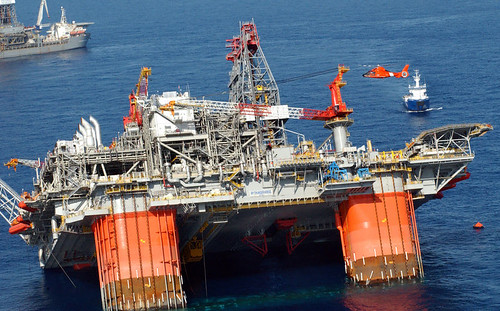
Due out in September apparently.
0
comments »

Posted by Big Gav in bp, deepwater horizon, gom, gulf of mexico, oil
Due out in September apparently.
Posted by Big Gav in bp, geothermal power, iea, irena, oil, ren21, renewable energy, world energy outlook
All of this year's major energy reports are now out :
Euan at Energy Matters has a summary of the BP report - Global Energy Trends – BP Statistical Review 2014.
- Global primary energy supply has continued to grow, mainly fossil fuels (FF), mainly coal. FF supply was up 183 million tonnes oil equivalent (mtoe) in 2013 while new renewable supply was up 42 mtoe from 2012.
- In 2003, FF accounted for 87% of global primary energy consumption. In 2013, FF accounted for 87% of global primary energy consumption. This is testimony to the absolute failure of energy policies aimed at reducing CO2 emissions.
- In 2003, new renewables (wind, solar, geothermal, biofuels etc) accounted for 0.82% of total primary energy and by 2013 this had grown to 2.69%. In 2003, nuclear power accounted for 6.01% and this fell to 4.40% in 2013. The 1.87% growth in share of new renewables almost matches the 1.61% fall in the share of nuclear power. On the CO2 account, low emissions nuclear power has been replaced by low emissions renewable energy. The actual energy substitutions are a little more complex.
- Oil consumption has been on a gently rising plateau since 2005 (Figure 1) and oil is declining in importance in the global energy mix (Figure 2). The fall in oil’s share has been picked up by coal and the only simple way for this substitution to occur is for oil fired power generation to close. Once all oil fired generation has been closed, expect severe upwards pressure on the oil price.

Robert Rapier also has some articles on the BP report - World Sets New Oil Production and Consumption Records and The US and Russia are Gas Giants.
First a note about BP’s definitions. “Oil” in the BP Statistical Review (BPSR) is defined as ”crude oil, tight oil, oil sands and natural gas liquids”, but excludes biofuels and liquid fuels produced from coal or natural gas. Consumption numbers do include all liquid fuels, so consumption numbers are always greater than production numbers, but this is merely an artifact of BP’s definitions.Global oil production advanced in 2013 by 557,000 barrels per day (bpd), reaching a new all-time high of 86.8 million bpd (an increase of 0.6 percent over 2012). After declining in 2009, global crude oil production has now increased 4 years in a row. But as I noted in last month’s short article, while global oil production did indeed set a new record, the US production increase alone was 1.1 million bpd. Thus, outside the US global production actually declined by 554,000 bpd. ...
In 2013 global natural gas production advanced 1.1% to a new all-time high of 328 billion cubic feet per day (Bcfd). Except for a one-year decline in 2008-2009, global gas production has risen fairly steadily for about three decades, and production has more than doubled during that time span.

Power magazine also has a look at the BP report - Above-Average Growth Reported for Renewables in 2013.
According to the report, world power generation grew 2.5% in 2013, slightly up over 2012 (which saw 2.2% growth over 2011) but below the 10-year trend (3.3%). And while electricity generation fell for the third year in a row in member countries of the Organisation for Economic Co-operation and Development (OECD), it surged 4.8% in non-OECD countries. China, followed by the U.S., was the world’s largest power generator (Figure 1). Meanwhile, India overtook Japan to take third place. ...Nuclear saw its first increase since 2010, climbing 0.9%. Nuclear consumption grew in the U.S., China, and Canada, but was offset by declines in South Korea, Ukraine, Spain, Russia, and Japan—whose nuclear output has fallen 95% since 2010 with nearly all of its reactors still offline after the Fukushima disaster.
Renewables generation, on the other hand, soared 16.3% and accounted for a record 5.3% share of global power generation, said the report. Globally, wind energy (up 20.7%) again accounted for more than half of renewable power generation growth, and solar power generation grew even more rapidly (33%).

The BS has a snippet from the IEA report looking at shifts in oil consumption - World oil's pivot to Asia.
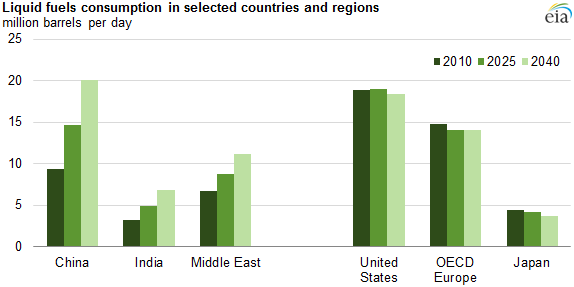
In the Reference case projection, world liquid fuels consumption increases 38 per cent from 87 million barrels per day in 2010 to 119 MMbbl/d in 2040. China, India, and other developing countries in Asia account for 72 per cent of the net world increase in liquid fuels consumption, with Middle East consumers accounting for another 13 per cent. Most liquid fuel demand is for industrial uses and transportation.In the United States, Europe, Japan, and other mature industrialised economies, liquid fuel demand has leveled off and is projected to slowly decline. The combined effects of several factors have slowed or even reversed the growth in liquid fuels use. These factors include sustained high oil prices, efficiency standards for vehicles and equipment together with high taxation of motor fuels, price-driven fuel switching towards non-oil fuels outside of transportation, vehicle saturation, as well as structural changes in factors such as demographics and consumer behavior.
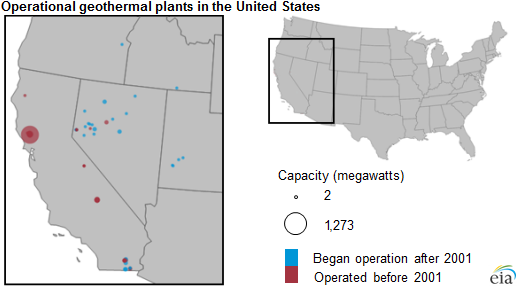
The BS also has an update on geothermal power in the US - Geothermal expands out of California.
EGS plants are currently being developed in several countries, and the first commercial-scale plant in the United States, the Desert Peak East pilot project in Nevada, began operating in 2013.There are currently 64 operating conventional geothermal power plants in the United States, accounting for nearly 2700 megawatts of total capacity at the end o 2013. Over three-fourths of US geothermal power generation in 2013 was in California, largely because of favourable geothermal resources, policy, and market conditions in the state. The largest group of geothermal power plants in the world, a complex called the Geysers, located in Northern California, has more than 700 MW of capacity.
Since 2001, only seven of 30 new plants exceeding 1 MW have been built in California, where most available low-cost geothermal resources have previously been developed. Sixteen of those 30 plants built after 2001 are in Nevada, with the remainder in Oregon, Idaho, Utah, and Hawaii. Most of the newer plants are relatively small, and while geothermal generation rose 11 per cent between 2008 and 2013, the geothermal share of total US electricity generation has remained consistently around 0.4 per cent since 2001
ReNew Economy has a post on the IEA reports' comments on solar power and renewable energy - Only solar PV is exceeding expectations for clean energy
The main message in the new Medium-Term Renewable Energy Market Report from IEA is that sustained growth in renewable energy is at risk. Governments, therefore, need to strengthen efforts to facilitate growth of renewables in all energy sectors. In the power sector, both hydropower, wind and bioenergy fall short of the deployment speed consistent with IEAs 2 Degree Scenario. Solar PV, says IEA, is «the only source expected to exceed global 2DS targets by 2020, boosted by cost declines and an increasingly rapid scale-up in non-OECD markets.»This is troublesome news for renewables in general, but encouraging news for solar energy. And having studied the underlying assumptions in the report, I am tempted to add: This is just the beginning of the solar awakening of IEA; be ready for better news next year.


Posted by Big Gav in bp, gulf of mexico, horizon
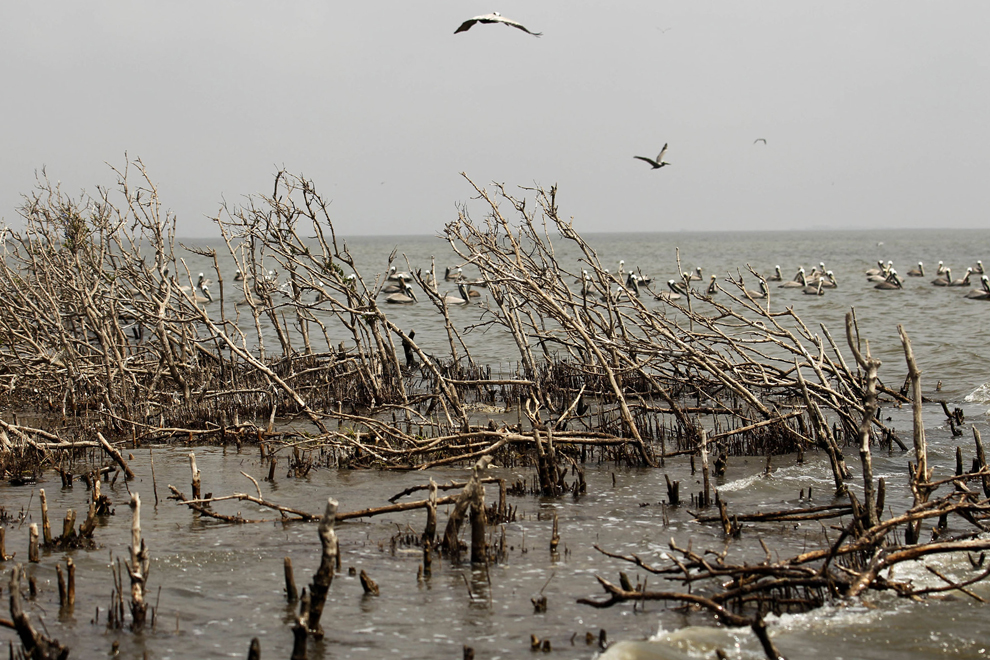
The Boston Globe has an interesting photo essay showing the Gulf of Mexico coast just after the BP oil spill and on the first anniversary of the spill - Gulf oil spill one year later. Looks like there is still plenty of oil floating around...
Posted by Big Gav in azerbaijan, bp, caspian, oil
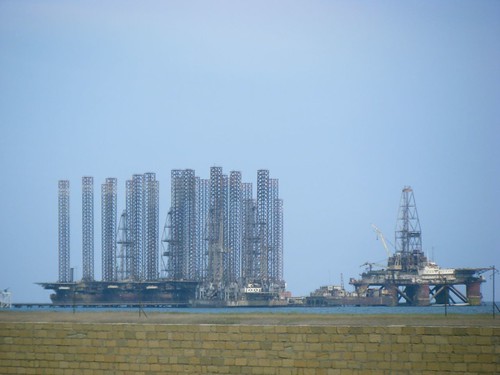
Greg Palast has a report on another offshore oil drilling accident by BP during oil exploration in Azerbaijan - BP's Secret Deepwater Blowout.
Only 17 months before BP's Deepwater Horizon rig suffered a deadly blowout in the Gulf of Mexico, another BP deepwater oil platform also blew out.
You've heard and seen much about the Gulf disaster that killed 11 BP workers. If you have not heard about the earlier blowout, it's because BP has kept the full story under wraps. Nor did BP inform Congress or US safety regulators, and BP, along with its oil industry partners, have preferred to keep it that way.
The earlier blowout occurred in September 2008 on BP's Central Azeri platform in the Caspian Sea.
As one memo marked "secret" puts it, "Given the explosive potential, BP was quite fortunate to have been able to evacuate everyone safely and to prevent any gas ignition." The Caspian oil platform was a spark away from exploding, but luck was with the 211 rig workers.
It was eerily similar to the Gulf catastrophe as it involved BP's controversial "quick set" drilling cement.
The question we have to ask: If BP had laid out the true and full facts to Congress and regulators about the earlier blowout, would those 11 Gulf workers be alive today - and the Gulf Coast spared oil-spill poisons?
The bigger question is, why is there no clear law to require disclosure? If you bump into another car on the Los Angeles freeway, you have to report it. But there seems no clear requirement on corporations to report a disaster in which knowledge of it could save lives.
Five months prior to the Deepwater Horizon explosion, BP's Chief of Exploration in the Gulf, David Rainey, testified before Congress against increased safety regulation of its deepwater drilling operation. Despite the company's knowledge of the Caspian blowout a year earlier, the oil company's man told the Senate Energy Committee that BP's methods are, "both safe and protective of the environment."
Really? BP's quick-dry cement saves money, but other drillers find it too risky in deepwater. It was a key factor in the Caspian blowout. Would US regulators or Congress have permitted BP to continue to use this cement had they known? Would they have investigated before issuing permits to drill?
This is not about BP the industry Bad Boy. This is about a system that condones silence, the withholding of life-and-death information.
Even BP's oil company partners, including Chevron and Exxon, were kept in the dark. It is only through WikiLeaks that my own investigations team was able to confirm insider tips I had received about the Caspian blowout. In that same confidential memo mentioned earlier, the US Embassy in Azerbaijan complained, "At least some of BP's [Caspian] partners are similarly upset with BP's performance in this episode, as they claim BP has sought to limit information flow about this event even to its [Caspian] partners."
Posted by Big Gav in big oil, bp, iraq, resource wars
The Independent has a report on discussions between the British government and BP in the lead up to the Iraq war - Secret memos expose link between oil firms and invasion of Iraq. Hands up if you are surprised by this. More at Empty Wheel and Patrick Cockburn at The Independent - They denied it was about Iraq's resources. But it never rang true, along with another article at The Indy on Iraq's "untapped potential" - Black gold rush was fuelled by enormous untapped potential.
Plans to exploit Iraq's oil reserves were discussed by government ministers and the world's largest oil companies the year before Britain took a leading role in invading Iraq, government documents show.
The papers, revealed here for the first time, raise new questions over Britain's involvement in the war, which had divided Tony Blair's cabinet and was voted through only after his claims that Saddam Hussein had weapons of mass destruction.
The minutes of a series of meetings between ministers and senior oil executives are at odds with the public denials of self-interest from oil companies and Western governments at the time.
The documents were not offered as evidence in the ongoing Chilcot Inquiry into the UK's involvement in the Iraq war. In March 2003, just before Britain went to war, Shell denounced reports that it had held talks with Downing Street about Iraqi oil as "highly inaccurate". BP denied that it had any "strategic interest" in Iraq, while Tony Blair described "the oil conspiracy theory" as "the most absurd".
But documents from October and November the previous year paint a very different picture.
Five months before the March 2003 invasion, Baroness Symons, then the Trade Minister, told BP that the Government believed British energy firms should be given a share of Iraq's enormous oil and gas reserves as a reward for Tony Blair's military commitment to US plans for regime change.
The papers show that Lady Symons agreed to lobby the Bush administration on BP's behalf because the oil giant feared it was being "locked out" of deals that Washington was quietly striking with US, French and Russian governments and their energy firms.
Minutes of a meeting with BP, Shell and BG (formerly British Gas) on 31 October 2002 read: "Baroness Symons agreed that it would be difficult to justify British companies losing out in Iraq in that way if the UK had itself been a conspicuous supporter of the US government throughout the crisis."
The minister then promised to "report back to the companies before Christmas" on her lobbying efforts.
The Foreign Office invited BP in on 6 November 2002 to talk about opportunities in Iraq "post regime change". Its minutes state: "Iraq is the big oil prospect. BP is desperate to get in there and anxious that political deals should not deny them the opportunity."
After another meeting, this one in October 2002, the Foreign Office's Middle East director at the time, Edward Chaplin, noted: "Shell and BP could not afford not to have a stake in [Iraq] for the sake of their long-term future... We were determined to get a fair slice of the action for UK companies in a post-Saddam Iraq."
Whereas BP was insisting in public that it had "no strategic interest" in Iraq, in private it told the Foreign Office that Iraq was "more important than anything we've seen for a long time".
BP was concerned that if Washington allowed TotalFinaElf's existing contact with Saddam Hussein to stand after the invasion it would make the French conglomerate the world's leading oil company. BP told the Government it was willing to take "big risks" to get a share of the Iraqi reserves, the second largest in the world.
Over 1,000 documents were obtained under Freedom of Information over five years by the oil campaigner Greg Muttitt. They reveal that at least five meetings were held between civil servants, ministers and BP and Shell in late 2002.
The 20-year contracts signed in the wake of the invasion were the largest in the history of the oil industry. They covered half of Iraq's reserves – 60 billion barrels of oil, bought up by companies such as BP and CNPC (China National Petroleum Company), whose joint consortium alone stands to make £403m ($658m) profit per year from the Rumaila field in southern Iraq.
Last week, Iraq raised its oil output to the highest level for almost decade, 2.7 million barrels a day – seen as especially important at the moment given the regional volatility and loss of Libyan output. Many opponents of the war suspected that one of Washington's main ambitions in invading Iraq was to secure a cheap and plentiful source of oil.

Posted by Big Gav in australia, bp, oil
The SMH reports that BP are looking to start exploring for oil off the South Australian coast - BP given permit to drill for oil off SA.
THE company behind last year's disastrous Deepwater Horizon oil spill, BP, has been granted its first Australian oil-exploration permit since the accident.
The move could pave the way for deepwater drilling.
The Deepwater Horizon well spewed nearly 5 million barrels of oil into the Gulf of Mexico beginning last April. Now the company plans to begin seismic surveys in the Great Australian Bight off South Australia from next summer with a view to drilling in 2013 or 2014.
Advertisement: Story continues below
The Minister for Resources and Energy, Martin Ferguson, said yesterday that the government would impose particularly stringent conditions on BP because of last year's spill.
Although the permit gives BP the right to explore and develop any commercial oil or gas fields it finds, drilling and seismic surveys would require further environmental approval.
''This is the start of a long, extensive, drawn-out and exhaustive process,'' Mr Ferguson said. ''BP's exploration activities, and indeed those of all operators in Australia waters, will be undertaken in accordance with our stringent environmental and safety standards.''
The permits cover an area 180 kilometres off the coast at depths of 140 to 4600 metres. ...
The Deepwater Horizon disaster, which killed 11 workers when the rig exploded, is regarded as one of the worst oil spills and highlighted the risks of deepwater oil drilling.
But Mr Ferguson said oil exploration had to be encouraged to deal with the nation's $16 billion trade deficit in petroleum products. Due to dwindling reserves, the deficit is expected to widen to as much as $30 billion by 2015.
''Our energy security will be greatly enhanced by opening up new geological frontiers and reducing our dependence on imports,'' he said.
Posted by Big Gav in alaska, bp, oil
The SMH has an article on the maintenance nightmare that is BP's ALaskan oil pipeline system - BP's Alaska pipelines in danger of rupturing.
The huge pipeline system that moves oil, gas and waste between BP's operations in Alaska is plagued by severe corrosion, an internal maintenance report says.
The document, obtained by the independent investigative journalism group ProPublica, shows that as of October 1, at least 148 BP pipelines on Alaska's North Slope received an ''F-rank'' from the company.
BP workers say this means inspections have found that more than 80 per cent of the pipe wall is corroded and could rupture.
Most of the pipelines carry toxic or flammable substances. The document says many metal walls of the F-ranked pipes are worn within millimetres of bursting, risking an explosion or spills.
BP oil workers say the company's fire and gas warning systems are unreliable, that the giant turbines that pump oil and gas through the system are ageing and that some oil and waste holding tanks are verging on collapse.
Posted by Big Gav in bp, gulf of mexico, horizon, pollution
The SMH has an article about the new BP COO saying he'll happily eat seafood from the Gulf of Mexico - BP chief happy to eat Gulf seafood. For some reason I can't get the image of Mr Burns being served a three eyed fish from downstream of his nuclear power plant out of my mind...
BP will begin a legal offensive this month to cap its liabilities from disaster by offering those affected one-off compensation payouts in return for them waiving the right to sue.
It is also continuing its public relations efforts, with its chief operating officer, Doug Suttles, saying on Sunday he would ''absolutely'' eat Gulf of Mexico seafood. ...
Doug Suttles gave his vote of confidence two days after Louisiana state authorities re-opened 6200 square kilometres of coastal waters for fishing, with the Food and Drug Administration saying Gulf seafood harvested from such open areas is safe for human consumption.
Environmentalists worry that not enough testing has been done on the seafood as the use of chemicals to dissipate the oil from the surface leaves lingering questions about toxicity in the fish.
When asked whether he would eat the Gulf's bounty, Mr Suttles didn't flinch. ''I absolutely would,'' he said. ''There's been a tremendous amount of testing done …
''I have a lot of confidence in those agencies and I trust their recommendations and I would eat their food - the seafood out of the Gulf - and I would feed it to my family.''

Posted by Big Gav in bp, gulf of mexico, horizon, pollution
AP has a report on BP's efforts to finishing capping the Macondo oil spill - Signs of oil spill recovery entering new phase. The Oil Drum has a couple of new posts on the topic as well - BP's Deepwater Oil Spill - Windows Can be Short, a Delay, and a Digression and BP Macondo Blowout - Static Top Kill vs. Bottom Kill: Weighing the Risks .
BP's new boss says it's time for a "scaleback" in cleaning up the Gulf of Mexico oil spill. Federal officials say there is no way the crude could reach the East Coast. And fishing areas are starting to reopen.
There were several signs Friday that the era of thousands of oil-skimming boats and hazmat-suited beach crews is giving way to long-term efforts to clean up, compensate people for their losses and understand the damage wrought. Local fishermen are doubtful, however, and say oil remains a bigger problem than BP and the federal government are letting on.
Other people contend the impact of the spill has been overblown, given that little oil remains on the Gulf surface, but Bob Dudley, who heads BP's oil spill recovery and will take over as CEO in October, rejected those claims.
"Anyone who thinks this wasn't a catastrophe must be far away from it," he said in Biloxi, where he announced that former Federal Emergency Management Agency chief James Lee Witt will be supporting BP's Gulf restoration work.
After an April 20 rig explosion that killed 11 workers, BP's blown-out well gushed an estimated 94 million to 184 million gallons of oil before a temporary cap stopped it July 15. Efforts to permanently plug the gusher had been expected to begin as early as Sunday, but the government's point man for the spill said Friday that those plans hit a snag.
Crews found debris in the bottom of the relief well that ultimately will be used to plug the leak for good, retired Coast Guard Adm. Thad Allen said. The debris must be fished out before crews can begin a procedure known as a static kill that hopefully will make the rest of the job easier.
"It's not a huge problem, but it has to be removed before we can put the pipe casing down," Allen said.
The sediment settled in the relief well last week when crews popped in a plug to keep it safe ahead of Tropical Storm Bonnie. Removing it will take 24 to 36 hours and likely push the kill back to Tuesday, Allen said.
Once the relief well is ready, crews can begin the static kill, in which mud, and possibly cement, are pumped in through the temporary cap. The better that procedure seals the blown-out well, the easier it will be to plug it forever by pumping in cement from below using the relief well. The blown-out well could be killed for good by late August, though a tropical storm could set the timetable back.
Posted by Big Gav in bp, gulf of mexico, horizon, pollution
Inhabitat has a look at some oil spill inspired marketing - Oil-Spill Condoms Want You to "Drill Without the Spill".

Posted by Big Gav in bp, renewable energy
Giles Parkinson at The Climate Spectator has a look at BP's ventures into renewable energy over the years - BP's other disaster.
The headlines relating to BP today will no doubt be about the oil giant's record losses and the huge payout for its departing CEO. But there’s a fascinating story to be told about its flirtation with renewable technologies, and it’s a cautionary tale that has lessons for investors large and small, company boards and policy makers, as well as the PR industry.
London-based analysts at Citigroup have done a bit of research into BP and its experimentation with renewable energy and, in doing so, have contrasted the fortunes of one company that talked about doing something, and another company that did something.
Just over 10 years ago, both BP and its Spanish equivalent, Iberdrola were large energy companies with minimal exposure to the renewables market. This is what happened next.
After the merger with Amoco, and the purchases of Atlantic Richfield Corporation and Burmah Castrol in 1999, BP decided to invest $US200 million in a branding campaign called Beyond Petroleum managed by Ogilvy and Mather.
It was a stunning success. And O&M marveled at their own work: "Our Brand Champions implemented change internally with leadership communications, toolkits, chat room promotions, CEO satellite broadcasts, town hall meetings and celebrations." Hooray!
Shareholders must have thought it was money well spent. The campaign lifted BP’s “brand power” in the US among business decision makers from a score of 30 in 2000 to an all-time high of 50 in 2008. It was quickly adopted within the sustainable investment community as a champion of corporate responsibility, and was held up as an example to others of progressive management of environmental and social issues.
According to Citigroup, rating agencies comparing the sustainability performance of the energy sector routinely graded BP "best in class" on environmental issues, making the company eligible for inclusion in SRI and ethical funds run on this strategy.
But there was little substance to it. According to Citigroup’s analysis of BP’s 2009 results, after a decade of talk, the alternative energy business had grown into just 711MW of wind capacity, sales of 203MW of solar equipment, a 50 per cent joint venture with Rio Tinto to build and demonstrate a hydrogen-powered electricity generating facility with carbon capture and storage, and a CCS project in Abu Dhabi.
The revenue from these businesses are not disclosed separately in the company’s financial reporting, but included in the “other businesses division,” which Citigroup says is expected to contribute an annual loss of around $400 million in 2010.
Meanwhile, in Spain, Iberdrola over the same period lifted its renewables portfolio to 20 per cent from 3 per cent, floated its renewables division Iberdrola Renovalbles for a direct cash injection of €4.5 billion, and now has a renewable capacity of 10.8GW – about 13 times bigger than BP.
This includes 2.1GW of wind in the US, the market that BP described as its prime target. In 2010, according to Citigroup, Iberdrola will install 1.7GW of wind, twice as much as BP has installed in the last decade. Iberdrola Renovables had total sales of €2 billion in 2009 and a net income of €371 million.
Posted by Big Gav in bp, gulf of mexico, horizon, matthew simmons
TOD's Arthur Berman had an interview on CNN last week about BP's oil spill in the gulf - Berman on CNN.
I am going to address a touchy subject in this essay, but I simply can’t ignore it any longer. I have noticed that a lot of people are finding my blog through keyword searches of “Debunking Matt Simmons.” About two and a half years ago, I did write an essay called Debunking Matt Simmons. Because of Matt’s recent claims about the disaster in the Gulf of Mexico, there has been a spike in interest over whether his claims related to the disaster are actually credible. So now seems like a good time to revisit the subject.
The topic is touchy because Matt Simmons has long been revered in the energy business, and some of his fans will be upset with me for writing this.
But Simmons has lately been making what I feel are very irresponsible and sensational claims that don’t hold up to scrutiny. ...
Simmons’ Sensational Claims on the Gulf Spill
In these and various other interviews, Simmons claims:
1. Use of a small bore nuclear device is the “only option” to stop the flow of oil.
I don’t want a banker who doesn’t know what fuzzy logic is being taken seriously on the issue of using nukes in the Gulf of Mexico.
2. BP would be insolvent by July 8, 2010. He has also stated several times that the stock is going to zero.
While I have said that I don’t think the BP brand can continue in the long run, I wouldn’t call them insolvent and it will certainly take some time for the legal issues to play out. A prediction of insolvency by July 8th was ridiculous. Simmons has also shorted BP stock, so some of this may be wishful thinking on his part.
3. The “real, untold story” is another leak that is 5-7 miles away spewing 120,000 bbls/day.
I haven’t the faintest idea where he came up with this, but I have spoken to several experts who say the chance of that is zero.
4. That there is an underground lake of oil that is 500 feet thick, 100 miles wide, and may be covering 40% of the Gulf of Mexico.
As one person calculated, that would equate to 500 trillion barrels of oil; total global reserves are estimated in the region of 2 trillion barrels.
5. The leak could last 24 years.
He believes this, because short of the nuclear weapon idea he sees no other way to stop the leak and thinks we may have to wait for all of the oil to come out of the reservoir. Meanwhile, the news is that BP is starting to get the leak under control.
6. The gulf states need to be evacuated.
Simmons says “We’re going to have to evacuate the gulf states. Can you imagine evacuating 20 million people? . . . This story is 80 times worse than I thought.”
That last claim was in the Washington Post, leading one critic to ask of the story’s author:Did he consider that Simmons is a financial analyst and may have an agenda in creating heightened hysteria surrounding the spill?
Did he consider the effect printing this claim could have on the people of the Gulf Coast?
I am uncomfortable having to deal with this kind of thing: I have talked with Matt on several occasions, and emailed with him more often. He is a decent and well-intended man, has been helpful to me personally, and he has in the past had a track-record of good calls in the oil and gas industry, back before he got so famous. However, I'm afraid that Robert is now right: there is a history of sensationalistic overstatement in recent years, and since Matt is the premier peak oil spokesperson that can actually get attention from the mass media, that is a real problem. Robert shouldn't be the only voice to say so.
I think the most salient issue to me is the famous Tierney-Simmons bet, where Matt intentionally set the terms of the bet far out of the money. 2010 oil futures were $59/barrel back in 2005, so setting the terms at $200 was very disadvantageous to his chances of winning. It now looks extremely unlikely that oil will break the $200 level before the end of this year and so Matt will lose, and this does no good at all for the cause of getting people to do what is required to reduce their dependence on oil. It didn't have to be that way if Matt were a little less certain of his own rightness.
Posted by Big Gav in bp, gom, gulf of mexico, oil, pollution
TomDispatch has an article on the history of oil pollution around the globe - Ellen Cantarow, Blowback Crude. From Tom's introduction:
I don’t know about you, but when I see a headline like this one (from the July 11th Washington Post), “White House Confident Latest BP Effort Will Work,” my heart immediately sinks. Of course, there’s a first time for everything, but amid the ever worsening news from the Gulf of Mexico’s waters about astonishingly high methane concentrations, dangerous levels of arsenic, the lack of testing of seafood for absorption of toxic compounds from the dispersant BP has been massively pumping out, the National Oceanic and Atmospheric Administration’s “hoarding” of raw scientific data about the disaster, and both BP's and the government's “stranglehold on media access” in the Gulf, that oily undercurrent of a positive narrative has been relentless (even as press coverage slowly begins to drop off). At the end of the storm lies hope and a rainbow. Or at least a permanently sealed well on the floor of the Gulf of Mexico.
Of course, three days after that confident headline, the same government showed something less than confidence in BP. It suddenly moved to freeze that company’s work on closing the new version of “top hat,” the massive "3 ram capping stack" meant to seal off the well, until further testing could be done. Secretary of Energy Stephen Chu and his experts feared that closing the cap’s valves might actually cause even more harm to a possibly already damaged well bore. In the meantime, the oil, essentially cap-less, continued to gush forth, as it had for days, even as work on the first relief well, the supposed permanent solution to the problem, was halted for fear of further problems while the testing went on.
Late Wednesday, the test of the cap finally began, only to be briefly interrupted by the discovery of a leak on a line attached to one of its valves. Everything was again halted briefly before those valves were finally closed and the oil did stop for the first time in 87 days; and yes, in the next few days, for all we know, that seal may hold, or maybe this nightmare won’t really end until the dog days of late July or mid-August, all dates repeatedly promised for the completion of the relief well. Or maybe not then either. The positive story line has been offered up and deep-sixed so many times already that, as with warnings on a cigarette pack, even with good news coming in, caution is still advised. Worse yet, if the happy ending does come, we already have a reasonable hint about how this story works out. As with the Exxon Valdez spill, big oil may prefer to learn remarkably few lessons from this disaster, as it prepares to head into far rougher waters in search of ever tougher oil to extract. After all, the big oil companies have preferred to learn next to nothing, as Ellen Cantarow makes clear, from a 50-year history of disastrous spills in Nigeria and a decades-long version of the same in the Amazon.
And of course, in these last weeks when the Northeast has been sizzling under record temperatures (with more to come), and researchers at the University of Alabama’s Earth System Science Center have concluded that the first five months of 2010 were the second hottest in human history (runner-up only to 1998) -- and this decade the warmest on record for the planet -- the worst disaster may prove to be not the gusher in the Gulf, but the gas in our tanks.
Posted by Big Gav in bp, gom, gulf of mexico, horizon, libya
The SMH reports that BP are claiming a new cap fitted over the leaking Macondo well has is capturing the oil flow - After three months, oil gusher plugged, says BP. The SMH also reports that BP's role in the release of the Lockerbie bomber is being viewed with suspicion in the US as the companmy looks to expand operations in Libya - BP faces grilling over oil deal links to Lockerbie.
Engineers have stopped oil flowing freely into the Gulf of Mexico for the first time in almost three months - but stress tests over the next 48 hours will determine whether the new cap on the deep-sea well will hold.
The chief operating officer of BP, Doug Suttles, was cautiously optimistic. "Clearly, it's encouraging for the first time in 86 days not to see oil gushing out of this well ... But it's way too early to celebrate," he said.
Officials claimed the next two days would be critical as engineers keep a close watch on pressure levels within the well. The new construction includes a containment cap with a built-in "blow-out preventer", the device that failed to cut off the oil flow when the Deepwater Horizon drill rig caught fire after an explosion in April.
BP, the well operator, hopes that pressure levels beneath the cap remain high, indicating there are no leaks beneath the sea bed. Six-hourly tests are planned over the next 48 hours.
The discovery of a new leak would force the company to resume recovering as much oil as possible through lines from the well to vessels on the surface of the Gulf, Coast Guard boss Thad Allen said.
"The number one goal is to shut in the well and kill it and stop it at the source," Admiral Allen told reporters in New Orleans. "This is merely an intermediate step to plugging the hole."
Stopping the oil is a long-awaited milestone in the worst environmental disaster in US history. The well has been spewing between 35,000 and 60,000 barrels of crude a day into the Gulf, according to a US government-led panel of scientists, inundating sensitive coastal habitats and disrupting fishing and tourism across four Gulf states.
The cost of the mishap has been put at several billions of dollars with Louisiana and Mississippi bearing the brunt of the disaster.
Plugging the well for good will depend on relief wells being drilled simultaneously. The first is within 30 metres of intercepting the well, which taps into the rich Macondo oil field, and could be in a position to divert the flow by the end of the month, BP said.

Posted by Big Gav in bp, gulf of mexico, pollution
The SMH has a report on the collateral damage being created by BP's burn off efforts for the oil spill - BP sued for burning turtles alive.
Animal welfare groups are suing BP for burning endangered sea turtles and are asking a US court to stop the oil giant's "controlled burns" on the Gulf of Mexico spill.
The lawsuit filed on Wednesday says BP is violating the Endangered Species Act and other laws with their "controlled burns" in the Gulf of Mexico.
The complainants, Animal Welfare Institute (AWI), Centre for Biological Diversity, Turtle Island Restoration Network and Animal Legal Defence Fund, have asked the federal court for a temporary restraining order to stop all burning activities "until ... mechanisms are implemented that will prevent any additional sea turtles from being burned alive."
"It is horrifying that these innocent creatures whose habitat has already been devastated by the oil spill are now being burned alive," AWI president Cathy Liss told the court in Louisiana.
Containment efforts put in place since a BP-leased offshore oil rig exploded April 20 unleashing the worst oil spill in US history include "controlled burns", in which oil is gathered by ship-towed floating booms and set on fire.
"Endangered sea turtles, including the Kemp's ridley, one of the rarest sea turtles on Earth, are caught in the gathered oil and unable to escape when the oil is set ablaze," the animal welfare groups said.

Posted by Big Gav in bp, gulf of mexico, thunder horse
The Houston Chronicle has an article on disappointing oil production from BP's Thunder Horse field in the gulf of mexico - In deep, and falling far short.
BP has a big problem in the Gulf of Mexico — and it's not just the oil spill emanating from the wreckage of the Deepwater Horizon.
At another platform in the Gulf — this one owned and operated by BP, unlike the Horizon — the problem is the opposite: Not enough oil is coming out.
Thunder Horse is the massive 60,000-ton, $1 billion production platform that BP, after some engineering difficulties, brought into operation in 2008. It was supposed to produce 250,000 barrels of oil a day.
It hasn't gotten close.
Production from Thunder Horse's main field reached a peak of about 172,000 barrels a day in January 2009, then began declining, falling to 61,000 barrels by December, according to data from the Minerals Management Service.
“The field has collapsed,” said Matthew Simmons, CEO of Houston-based Simmons & Company International, an investment banking firm specializing in energy. Simmons, author of Twilight in the Desert, has studied the Thunder Horse data along with production at most other deep-water wells.
BP's initial projections that Thunder Horse would produce 1 billion barrels of oil now seem unrealistic, Simmons said.
A BP spokesman said the company won't discuss Thunder Horse production until year's end. However, he noted that the main Thunder Horse field is undergoing maintenance, which will affect production numbers for the current quarter.
The maintenance, though, doesn't address the declining production that has been going on for more than a year. Geologists who have studied the data and posted their findings on the energy website The Oil Drum have estimated that Thunder Horse's production is falling by as much as 3 percent a month, even though additional wells have been brought on line.
It's also curious that BP would be slowing production at the field for maintenance after just 18 months, Simmons said.
While the energy industry talks up the potential of deep-water production, many of the wells drilled so far show rapid declines similar to those that appear to be happening at Thunder Horse. The wells are among the most expensive drilling projects in the world, and the exploration companies need rapid payouts to generate a return on their investment, Simmons said.
In all, he's tracked as many as 25 deep-water wells that show rapid declines. “That's been the pattern in all the deep-water fields,” he said. “We are at the twilight of offshore oil and gas.”
Because of the high drilling costs, companies typically drill few secondary, or appraisal, wells, which help determine the size of a reservoir.
At the same time, generating the return to cover the drilling expenses requires draining the reservoirs quickly, which shortens the life of recoverable oil. The result is a faster decline and smaller reservoirs than are initially announced.
Posted by Big Gav in bp, gulf of mexico, tinfoil
I haven't done any Friday Night Fear Mongering in a while and amusing tinfoil has been pretty rare too - but I thought I'd throw in this one from Infowars about impending doom for the Gulf of Mexico and all who live near it (in a way these guys do a better job of putting things in perspective than BP and their PR agencies are capable of - things could be much worse !) - Methane and Martial Law in the Gulf of Mexico.
Earlier this week Reuters reported on a massive amount of methane discovered in the Gulf of Mexico. Texas A&M University oceanography professor John Kessler said methane gas levels in some areas are “astonishingly high.” Kessler recently returned from a 10-day research expedition near the BP oil gusher. Kessler’s team measured both surface and deep water within a 5-mile (8 kilometer) radius of BP’s destroyed wellhead. “There is an incredible amount of methane in there,” Kessler told reporters. He said the level may be as much as one million times the normal level.
In late May BP said methane makes up about 40 percent of the leaking crude by mass. In addition to methane, large mounts of toxic hydrogen sulfide, benzene and methylene chloride are leaking into the Gulf according to the EPA and others.
Lindsay Williams, a former Alaskan pipeline chaplain with high-level oil industry connections, told the Alex Jones Show on June 10 that deadly gases are indeed escaping from the breached wellhead.
Investigative journalist Wayne Madsen, writing for Oil Price, states that his sources inside the federal government, FEMA, and the US Army Corps of Engineers are dealing with a prospective “dead zone” created by the escaping methane within a 200 mile radius from the Deepwater Horizon disaster.
In addition, Madsen reports, Corexit 9500, the oil dispersant used by BP, is viewed by FEMA sources as mixing with evaporated water from the Gulf. This deadly mixture is then absorbed by rain clouds and produces toxic precipitation that threatens to continue killing marine and land animals, plant life, and humans within a 200-mile radius of the Deepwater Horizon disaster site in the Gulf.
The “dead zone” created by a combination of methane gas and Corexit toxic rain, Madsen continues, will ultimately result in the evacuation and long-term abandonment of cities and towns within the 200-mile radius of the oil gusher.
“Plans are being put in place for the mandatory evacuation of New Orleans, Baton Rouge, Mandeville, Hammond, Houma, Belle Chase, Chalmette, Slidell, Biloxi, Gulfport, Pensacola, Hattiesburg, Mobile, Bay Minette, Fort Walton Beach, Panama City, Crestview, and Pascagoula,” Madsen writes.
On June 13, SoCal Martial Law Alerts (SCMLA) predicted that Gulf states would be evacuated. “Greg Evensen, a retired Kansas Highway Patrolman, estimates that 30-40 million people would need to be evacuated away from the Gulf’s coastline (i.e. at least 200 miles inland),” SCMLA reported.In order to accomplish this gargantuan feat, the federal government (through FEMA and other agencies) would most likely seek first to control and manage the transportation system and then operate relocation centers to manage evacuees. Toward this end, the Federal Aviation Administration (FAA) has already declared the airspace over the oil spill site to be a no-fly zone until further notice. Various sources have indicated that local police, highway patrol, National Guard, US military and foreign troops may be involved in an operation to evacuate the Gulf Coast. In fact, the Governor of Louisiana has already requested evacuation assistance (i.e. National Guard) for his state from the Department of Defense (DoD) and the Department of Homeland Security (DHS).
Madsen’s trusted sources now lend credence to the SCMLA report.
DK Matai reports that by some geologists’ estimates, the methane now escaping into the Gulf may have been part of a massive bubble trapped for thousands of years under the sea floor. “More than a year ago, geologists expressed alarm in regard to BP and Transocean putting their exploratory rig directly over this massive underground reservoir of methane. Warnings were raised before the Deepwater Horizon catastrophe that the area of seabed chosen might be unstable and inherently dangerous,” writes Matai.
Matai and others fear the methane — under intense pressure (experts estimate the pressure to be between 30,000 and 70,000 pounds per square inch) — may form a bubble that would then rupture the seabed and erupt with an explosion.
“The bubble is likely to explode upwards propelled by more than 50,000 psi of pressure, bursting through the cracks and fissures of the sea floor, fracturing and rupturing miles of ocean bottom with a single extreme explosion,” Matai explains. “If the toxic gas bubble explodes, it might simultaneously set off a tsunami traveling at a high speed of hundreds of miles per hour. Florida might be most exposed to the fury of a tsunami wave. The entire Gulf coastline would be vulnerable, if the tsunami is manifest. Texas, Louisiana, Mississippi, Alabama and southern region of Georgia might experience the effects of the tsunami according to some sources.”
Posted by Big Gav in bp, gulf of mexico, horizon, pollution
The press Register has a great picture of the BP oil spill, as seen from underwater in an Alabama wildlife preserve - Lots of sharks, lots of oil seen off Bon Secour.

Posted by Big Gav in bp, gulf of mexico, horizon, pollution
Billmon has a post at Daily Kos looking at some of the stranger theories floating around about the compensation fund BP has set up to deal with the oil spill aftermath - Dear Teabaggers.
Your stupidity, fanaticism and all around mean spiritedness continue to astound, with your bizarre and – dare I say it – unpatriotic defense of British Petroleum only the latest example.
While I realize facts and logic are completely lost on you, can you at least TRY to get it through your tiny, floresiensis-like skulls that:
1.) The Constitution in your head notwithstanding, the REAL one doesn't forbid the president and/or his Attorney General from negotiating settlements of this kind. The Justice Department does it in environmental enforcement actions all the time, although usually without the 24/7 hysteria.
2.) The money is going to be held in an ESCROW account. Are you familiar with the term? Have you ever closed on a house? It means the money cannot be spent or disbursed without the approval of the trustee, who in turn will need to get approval from the courts. Again, this is a completely standard way of handling settlements in environmental cases.
3.) The money is NOT going to ACORN, your favorite all-purpose boogeyman. ACORN doesn't exist any more. Deal with it.
4.) BP agreed to the deal BECAUSE IT IS IN ITS OWN CORPORATE INTEREST. Lately investors have been shunning BP until they have some kind of idea of the company's potential legal liability. This has caused yields on BP bonds to soar and made it hard for the company to roll over short-term debt, threatening the company (and the entire financial system) with insolvency. While the settlement is not final, it does give investors some reason to hope the company will remain viable -- which in turn makes it more likely that it WILL remain viable.
5.) BP, its shareholders, and the wildlife in the Gulf of Mexico aren't the only ones at risk here. Do you by chance remember what happened to a company called Lehman Brothers when it couldn't roll over its short-term debt a couple of years ago? Do want to see a repeat of that fun-filled episode?
6.) If anything, Obama is doing BP a favor by coming to terms so quickly. The fact that BP was so eager to accept those terms is a clear sign it understands just how MORE humongeous its liabilities could be if this ends up in court. If you want to blame Obama for subverting the course of justice, go right ahead (although I'm not sure he had any realistic choice) but it's ridiculous to blame him for that with one breath and then accuse him of "shaking down" BP in the next. There was no shakedown – or, if there was, the muscle behind it was provided by Wall Street, not Chicago (unless you mean the futures pits).
Even for you, this is mendacity on a pathological scale, amounting practically to a psychotic break from reality. Your movement has become the social equivalent of BP’s blown out well: completely out of control and spewing toxic crap in every direction. Joe Barton, at least, had the excuse of being a well paid prostitute on permanent retainer to the oil industry. What’s yours? Only fools give it away for free.
Sincerely,
Billmon

 Posts
Posts