The above graph shows the latest available data from the three agencies that publish estimates of global oil production (the EIA, the IEA, and OPEC). According to the IEA, production increased by about 270 thousand barrels/day in May. However, as you can see, we have not yet made up the loss of Libyan oil in February and March. ...
The gap between the black line (average of the three agency's data) and the purple line (approx projection of what might have happened absent the Libyan revolution) is about 1.6mbd, or about 1.8% of global production - call it 2% to this level of accuracy. Note that the 1.6mbd from the graph above is in excellent agreement with the level of Libyan oil production before the revolution.
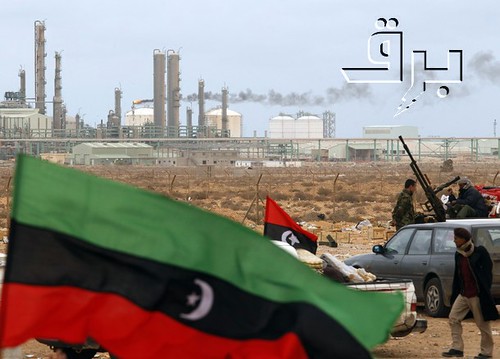
When the war in Libya began, the U.S. government convinced a large number of war supporters that we were there to achieve the very limited goal of creating a no-fly zone in Benghazi to protect civilians from air attacks, while President Obama specifically vowed that "broadening our military mission to include regime change would be a mistake." This no-fly zone was created in the first week, yet now, almost three months later, the war drags on without any end in sight, and NATO is no longer even hiding what has long been obvious: that its real goal is exactly the one Obama vowed would not be pursued -- regime change through the use of military force. We're in Libya to forcibly remove Gaddafi from power and replace him with a regime that we like better, i.e., one that is more accommodating to the interests of the West. That's not even a debatable proposition at this point.
What I suppose is debatable, in the most generous sense of that term, is our motive in doing this. Why -- at a time when American political leaders feel compelled to advocate politically radioactive budget cuts to reduce the deficit and when polls show Americans solidly and increasingly opposed to the war -- would the U.S. Government continue to spend huge sums of money to fight this war? Why is President Obama willing to endure self-evidently valid accusations -- even from his own Party -- that he's fighting an illegal war by brazenly flouting the requirements for Congressional approval? Why would Defense Secretary Gates risk fissures by so angrily and publicly chiding NATO allies for failing to build more Freedom Bombs to devote to the war? And why would we, to use the President's phrase, "stand idly by" while numerous other regimes -- including our close allies in Bahrain and Yemen and the one in Syria -- engage in attacks on their own people at least as heinous as those threatened by Gaddafi, yet be so devoted to targeting the Libyan leader?
Whatever the answers to those mysteries, no responsible or Serious person, by definition, would suggest that any of this -- from today's Washington Post -- has anything to do with it:
The relationship between Gaddafi and the U.S. oil industry as a whole was odd. In 2004, President George W. Bush unexpectedly lifted economic sanctions on Libya in return for its renunciation of nuclear weapons and terrorism. There was a burst of optimism among American oil executives eager to return to the Libyan oil fields they had been forced to abandon two decades earlier. . . .
Yet even before armed conflict drove the U.S. companies out of Libya this year, their relations with Gaddafi had soured. The Libyan leader demanded tough contract terms. He sought big bonus payments up front. Moreover, upset that he was not getting more U.S. government respect and recognition for his earlier concessions, he pressured the oil companies to influence U.S. policies. . . .
When Gaddafi made his deal with Bush in 2004, he had hoped that returning foreign oil companies would help boost Libya’s output . . . The U.S. government also encouraged American oil companies to go back to Libya. . . .
The companies needed little encouragement. Libya has some of the biggest and most proven oil reserves -- 43.6 billion barrels -- outside Saudi Arabia, and some of the best drilling prospects. . . . Throughout this time, oil prices kept rising, whetting the appetite for greater supplies of Libya's unusually "sweet" and "light," or high-quality, crude oil.
By the time Secretary of State Condoleezza Rice visited in 2008, U.S. joint ventures accounted for 510,000 of Libya's 1.7 million barrels a day of production, a State Department cable said. . . .
But all was not well. By November 2007, a State Department cable noted "growing evidence of Libyan resource nationalism." It noted that in his 2006 speech marking the founding of his regime, Gaddafi said: "Oil companies are controlled by foreigners who have made millions from them. Now, Libyans must take their place to profit from this money." His son made similar remarks in 2007.
Oil companies had been forced to give their local subsidiaries Libyan names, the cable said. . . .
The entire article is worth reading, as it details how Gaddafi has progressively impeded the interests of U.S. and Western oil companies by demanding a greater share of profits and other concessions, to the point where some of those corporations were deciding that it may no longer be profitable or worthwhile to drill for oil there. But now, in a pure coincidence, there is hope on the horizon for these Western oil companies, thanks to the war profoundly humanitarian action being waged by the 2009 Nobel Peace Prize winner and his nation's closest Western allies ...
I have two points to make about all this:
(1) The reason -- the only reason -- we know about any of this is because WikiLeaks (and, allegedly, Bradley Manning) disclosed to the world the diplomatic cables which detail these conflicts. Virtually the entirety of the Post article -- like most significant revelations over the last 12 months, especially in the Middle East and North Africa -- are based exclusively on WikiLeaks disclosures. That's why we know about Gaddafi's increasingly strident demands for the "Libyanization" of his country's resource exploitation. That's how we know about most of the things we've learned about the world's most powerful political and corporate factions over the last 12 months. Is there anything easier to understand than why U.S. Government officials are so eager to punish WikiLeaks and deter future transparency projects of this sort?
(2) Is there anyone -- anywhere -- who actually believes that these aren't the driving considerations in why we're waging this war in Libya? After almost three months of fighting and bombing -- when we're so far from the original justifications and commitments that they're barely a distant memory -- is there anyone who still believes that humanitarian concerns are what brought us and other Western powers to the war in Libya? Is there anything more obvious -- as the world's oil supplies rapidly diminish -- than the fact that our prime objective is to remove Gaddafi and install a regime that is a far more reliable servant to Western oil interests, and that protecting civilians was the justifying pretext for this war, not the purpose? If (as is quite possible) the new regime turns out to be as oppressive as Gaddafi but far more subservient to Western corporations (like, say, our good Saudi friends), does anyone think we're going to care in the slightest or (at most) do anything other than pay occasional lip service to protesting it? Does anyone think we're going to care about The Libyan People if they're being oppressed or brutalized by a reliably pro-Western successor to Gaddafi?
In 2006, George Bush instructed us that there was a "responsible" and an "irresponsible" way for citizens to debate the Iraq War: the "responsible" way was to suggest that there may be better tactics for waging the war more effectively, while the "irresponsible" way was to outrageously insinuate that perhaps oil or Israel or deceit played a role in the invasion. ...
It's certainly possible to contend reasonably that (as was true for Iraq) removing a heinous dictator and other humanitarian outcomes will be the incidental by-product of our war in Libya even if not its purpose (although, as was also true in Iraq, one would need to see the regime that replaces Gaddafi to know if that's true). And it's fine -- or at least candid -- to argue, as Ann Coulter often does, that "of course we should go to war for oil. . . .We need oil. That's a good reason to go to war." But to believe that humanitarianism (protection of Libya civilians) was why we went to war in Libya requires a blindness so willful and complete that it's genuinely difficult to describe.
The SMH reports that Donald Trump is following in Sarah Palin's footsteps as the latest Republican joke candidate for President - and he wants Libya's oil - Newsmaker: Donald Trump . Finding a decent wig is probably also a high priority for him.
By this stage of his career it should be easy to dismiss Donald Trump as a TV huckster and failed real estate tycoon with a fraudulent shock of hair and an unnerving sense of self-belief. ...
Trump first agitated for high office in 2000, when he considered putting his hand up for the Reform Party, an after-thought of the independent Ross Perot's two failed presidential bids. Back then Trump cast himself as a pro-business liberal, going so far as to advocate for a once-only 14.25 per cent tax on personal estates and trusts to help retire the national debt.
Trump was pro-choice and supported universal healthcare. This time around Trump is anti-abortion, anti-gun control and anti-foreign aid.
He has aligned himself with the howling fringe of America's dissolute far right, the Birthers. These conspiracy theorists believe Barack Obama was born in Kenya, not Hawaii, and that his presidency is invalid. (The release and endorsement of Obama's birth certificate by Hawaii's health director only seemed to inflame the mob.)
But it is Trump's recent declarations on foreign affairs that have excited the crazies and left many in America desperately hoping that Trump has simply hijacked their nation's grand democratic traditions as part of a low-rent publicity stunt.
''With respect to Libya, I'm interested in Libya if we take the oil. If we don't take the oil, no interest,'' he told Fox News this week, prompting the question, ''How do you think that would impact our relationship with other Arab nations if we go in and say, hey we're taking all the oil?''
''Who cares?'' squawked Trump. ''Who cares? They've been taking advantage of us for years.''
Stuart at Early Warning has a post on global oil production in the wake of the Libyan crisis (see the original for lots more graphs) - Saudi Arabia did not make up for Libyan Oil.
The OPEC MOMR came out late yesterday, but it adds to the picture from the IEA report mentioned yesterday morning. In particular, I can now present revised graphs for total liquid fuel production. Here's the last three year view (not zero scaled):
Note that the rise that's been going in since last fall has now been abruptly interrupted by the Libyan situation, and total oil production has fallen by about 0.5mbd. This is about 0.6% of global production, but given that the world economy has been growing rapidly and needing about another 0.5mbd/month, the shortfall over what would have happened in a counterfactual world with no Middle Eastern unrest is more like 1.2% of global production.
In terms of the price production picture, this has put us much more into territory akin to the 2005-2008 oil shock:
We can put the situation almost entirely down to two things: the fact that Libyan production has plummeted, and that Saudi Arabia has made no significant move to compensate. In fact, Saudi Arabia slowed down production increases that it had been making in prior months. First, here's all the Libyan data currently available:
So the world has abruptly lost something like 1.3mbd of oil production between mid February and March. Now there were a lot of news reports in the business press at the time this was first happening that Saudi Arabia was going to make up the difference. ...
Now that the stats are out, we can see that this was total bull. Will that fact be all over the business press? My bet is you'll have to read some obscure blog called Early Warning to find out what really happened. First off, here's all the Saudi production data I have (not zero scaled to better show changes):
Indeed Saudi production has increased to around 9mbd, but the timing makes it clear this has nothing to do with Libya. For better comparison, I have put both the Libyan and Saudi averages on the same graph (only since 2005), with the scales adjusted to allow easy comparison. In particular, note that the size of the units on both scales is the same, so similar vertical moves in both curves mean the same amount of oil, but the Saudi scale (left hand scale) has been shifted to put the Saudi curve next to the Libyan one (right scale):
I have circled the March data in each case. You can see what was going on. The Saudis were slowly increasing their production from last fall through February, presumably in response to growing global demand and rising prices. But then, in March, when Libyan production went into freefall, they put on the brakes and did almost nothing to make up for the shortage.
The burning question is: why? Back in 2006, when their production started to gradually decline from 9.5mbd even as global oil prices were in the worst spike since the 1970s, I was an advocate of the view that the decline was largely involuntary: they'd never produced more than 9.5mbd, they'd underinvested for decades, and some of their big fields were getting very tired (particular northern Ghawar and Abqaiq) and they were starting a big rash of new projects and ramping up their rig counts at the same time.
I see current events differently. The reduction in late 2008 was clearly voluntary to support prices in the face of the great recession. There's no new projects announced, and the rig count hasn't taken off. So my take is that the failure to increase production to compensate for Libya is deliberate. We can only speculate, but my guess is that, having watched how the west has helped to ease Mubarak and Ben-Ali out of power and is intervening in Libya to the same end, the Saudi regime is in no mood to care about our desire for more oil. Instead, they are very much in the mood to build as large a war chest as possible with which to appease their own population, strengthen their defense measures, etc.
So, instead of Saudi production increasing to compensate for Libya, total world production decreased, and oil prices went up sharply to enforce the necessary conservation on the world's oil consumers. ...
So, here's the latest data on the discount of the three Saudi grades of oil, to Brent (with a seven week moving average applied to reduce noise):
You can see that these discounts have actually fallen sharply in recent weeks to levels usually seen only in the depths of recessions when the Saudis are trying to raise prices. So rather than trying to flood the market with their oil to help supplies post Libya, the Saudis are ramping back and extracting every dollar they can get.
This video made me laugh - the outrage from the CNN hosts at someone telling the truth was hysterical - do people in the US take their media seriously ?
Glenn Greenwald has a rare example of an intellectually honest article opposing the intervention in Libya (personally I still think the no-fly zone is a good thing, as long as we don't extend operations to actually occupying the country and attempting to control the oil, as the US did in Iraq) - The manipulative pro-war argument in Libya.
Advocating for the U.S.'s military action in Libya, The New Republic's John Judis lays out the argument which many of his fellow war advocates are making: that those who oppose the intervention are guilty of indifference to the plight of the rebels and to Gadaffi's tyranny:
So I ask myself, would these opponents of U.S. intervention (as part of U.N. Security Council approved action), have preferred:
(1) That gangs of mercenaries, financed by the country’s oil wealth, conduct a bloodbath against Muammar Qaddafi’s many opponents?
(2) That Qaddafi himself, wounded, enraged, embittered, and still in power, retain control of an important source of the world’s oil supply, particularly for Europe, and be able to spend the wealth he derives from it to sow discord in the region?
(3) And that the movement toward democratization in the Arab world -- which has spread from Tunisia to Bahrain, and now includes such unlikely locales as Syria -- be dealt an enormous setback through the survival of one of region's most notorious autocrats?
If you answer "Who cares?" to each of these, I have no counter-arguments to offer, but if you worry about two or three of these prospects, then I think you have to reconsider whether Barack Obama did the right thing in lending American support to this intervention.
Note how, in Judis' moral world, there are only two possibilities: one can either support the American military action in Libya or be guilty of a "who cares?" attitude toward Gadaffi's butchery. At least as far as this specific line of pro-war argumentation goes, this is just 2003 all over again. Back then, those opposed to the war in Iraq were deemed pro-Saddam: indifferent to the repression and brutalities suffered by the Iraqi people at his hands and willing to protect his power. Now, those opposed to U.S. involvement in the civil war in Libya are deemed indifferent to the repression and brutalities suffered by the Libyan people from Gadaffi and willing to protect his power. This rationale is as flawed logically as it is morally.
Why didn't this same moral calculus justify the attack on Iraq? Saddam Hussein really was a murderous, repressive monster: at least Gadaffi's equal when it came to psychotic blood-spilling. Those who favored regime change there made exactly the same arguments as Judis (and many others) make now for Libya: it's humane and noble to topple a brutal dictator; using force is the only way to protect parts of the population from slaughter (in Iraq, the Kurds and Shiites; in Libya, the rebels); it's not in America's interests to allow a deranged despot (or his deranged sons) to control a vital oil-rich nation; and removing the tyrant will aid the spread of freedom and democracy in the Middle East. Why does that reasoning justify war in Libya but not Iraq?
In Foreign Policy, Stephen Walt argues that "liberal interventionists" and neocons share most of the same premises about America's foreign policy and its role in the world, with the sole exception being that the former seek to act through international institutions to legitimize their military actions while the latter don't. Strongly bolstering Walt's view is this morning's pro-war New York Times Editorial, which ends this way:
Libya is a specific case: Muammar el-Qaddafi is erratic, widely reviled, armed with mustard gas and has a history of supporting terrorism. If he is allowed to crush the opposition, it would chill pro-democracy movements across the Arab world.
Wasn't all of that at least as true of Saddam Hussein? Wasn't that exactly the "humanitarian" case made to justify that invasion? And wasn't that exactly the basis for the accusation against Iraq war opponents that they were indifferent to Saddam's tyranny -- i.e., if you oppose the war to remove Saddam, it means you are ensuring that he and his sons will stay in power, which in turn means you are indifferent to his rape rooms and mass graves and are willing to stand by while the Iraqi people suffer under his despotism? How can the "indifference-to-suffering" accusation be fair when made against opponents of the Libya war but not when made against Iraq war opponents?
But my real question for Judis (and those who voice the same accusations against Libya intervention opponents) is this: do you support military intervention to protect protesters in Yemen, Bahrain, Saudi Arabia and other U.S. allies from suppression, or to stop the still-horrendous suffering in the Sudan, or to prevent the worsening humanitarian crisis in the Ivory Coast? Did you advocate military intervention to protect protesters in Iran and Egypt, or to stop the Israeli slaughter of hundreds of trapped innocent civilians in Gaza and Lebanon or its brutal and growing occupation of the West Bank?
If not, doesn't that necessarily mean -- using this same reasoning -- that you're indifferent to the suffering of all of those people, willing to stand idly by while innocents are slaughtered, to leave in place brutal tyrants who terrorize their own population or those in neighboring countries? Or, in those instances where you oppose military intervention despite widespread suffering, do you grant yourself the prerogative of weighing other factors: such as the finitude of resources, doubt about whether U.S. military action will hurt rather than help the situation, cynicism about the true motives of the U.S. government in intervening, how intervention will affect other priorities, the civilian deaths that will inevitably occur at our hands, the precedents that such intervention will set for future crises, and the moral justification of invading foreign countries? For those places where you know there is widespread violence and suffering yet do not advocate for U.S. military action to stop it, is it fair to assume that you are simply indifferent to the suffering you refuse to act to prevent, or do you recognize there might be other reasons why you oppose the intervention?
In the very same Editorial where it advocates for the Libya intervention on the grounds of stopping government violence and tyranny, The New York Times acknowledges about its pro-intervention view: "not in Bahrain or Yemen, even though we condemn the violence against protesters in both countries." Are those who merely "condemn" the violence by those two U.S. allies but who do not want to intervene to stop it guilty of indifference to the killings there? What rationale is there for intervening in Libya but not in those places? In a very well-argued column, The Washington Post's Eugene Robinson today provides the only plausible answer:
Anyone looking for principle and logic in the attack on Moammar Gaddafi's tyrannical regime will be disappointed. . . . Why is Libya so different? Basically, because the dictators of Yemen, Bahrain and Saudi Arabia -- also Jordan and the Persian Gulf sheikdoms, for that matter -- are friendly, cooperative and useful. Gaddafi is not. . . .
Gaddafi is crazy and evil; obviously, he wasn’t going to listen to our advice about democracy. The world would be fortunate to be rid of him. But war in Libya is justifiable only if we are going to hold compliant dictators to the same standard we set for defiant ones. If not, then please spare us all the homilies about universal rights and freedoms. We'll know this isn’t about justice, it's about power.
I understand -- and absolutely believe -- that many people who support the intervention in Libya are doing so for good and noble reasons: disgust at standing by and watching Gadaffi murder hundreds or thousands of rebels. I also believe that some people who supported the attack on Iraq did so out of disgust for Saddam Hussein and a desire to see him removed from power. It's commendable to oppose that type of despotism, and I understand -- and share -- the impulse.
But what I cannot understand at all is how people are willing to believe that the U.S. Government is deploying its military and fighting this war because, out of abundant humanitarianism, it simply cannot abide internal repression, tyranny and violence against one's own citizens. This is the same government that enthusiastically supports and props up regimes around the world that do exactly that, and that have done exactly that for decades.
By all accounts, one of the prime administration advocates for this war was Hillary Clinton; she's the same person who, just two years ago, said this about the torture-loving Egyptian dictator: "I really consider President and Mrs. Mubarak to be friends of my family." They're the same people overseeing multiple wars that routinely result in all sorts of atrocities. They are winking and nodding to their Yemeni, Bahrani and Saudi friends who are doing very similar things to what Gadaffi is doing, albeit (for now) on a smaller scale. They just all suddenly woke up one day and decided to wage war in an oil-rich Muslim nation because they just can't stand idly by and tolerate internal repression and violence against civilians? Please.
For the reasons I identified the other day, there are major differences between the military actions in Iraq and Libya. But what is true of both -- as is true for most wars -- is that each will spawn suffering for some people even if they alleviate it for others. Dropping lots of American bombs on a country tends to kill a lot of innocent people. For that reason, indifference to suffering is often what war proponents -- not war opponents -- are guilty of. But whatever else is true, the notion that opposing a war is evidence of indifference to tyranny and suffering is equally simple-minded, propagandistic, manipulative and intellectually bankrupt in both the Iraq and Libya contexts. And, in particular, those who opposed or still oppose intervention in Bahrain, Yemen, Egypt, Iraq, the Sudan, against Israel, in the Ivory Coast -- and/or any other similar places where there is widespread human-caused suffering -- have no business advancing that argument.
We all know about the obvious oil component to what is happening in Libya, but that’s definitely not he full story. Here are some other factors to keep in mind as the U.S. leads a war in Libya for “humanitarian” reasons.
Saudi Aramco, Seas Beneath the Sands:
Libya is already pumping water from the Kufra Oasis, in its southeast corner, through a four-meter-diameter pipeline to its thirsty coastal cities. When fully operational, that project will pump some 3.6 million cubic meters per day. Still, at current extraction rates, the aquifer is not likely to be depleted for a thousand years.
Christian Science Monitor, Libya’s Qaddafi Taps ‘Fossil Water’ to Irrigate Desert Farms:
While many countries in the Middle East and North Africa bicker over water rights, Libya has tapped into an aquifer of ‘fossil water’ to change its topography – turning sand into soil. The 26-year, $20 billion project is nearly finished.
As I was reading about how bone dry (on the surface) and sunny Libya is, I thought, “Wow, sounds great for solar power.” And then I found this, from the Tripoli Post:
Moreover, since this report came out, there has been some encouraging progress in Libya on the practical front regarding the issue of solar power. In October this year (as reported by the Tripoli Post in issue 171) the U.S. Department of Energy (DOE) announced that it was sending a team of experts from its National Renewable Energy Laboratory in Colorado to collaborate on concentrating solar power in Libya. The DOE confirmed that Libya, with its low humidity and numerous sunny days, had the ideal conditions for the possible exploitation of solar power technologies.
This is indeed encouraging news. Libya has an area of almost 1.8 million square kilometres, 90% of which is hot sunny desert. Libya, through its proximity to mainland Europe, already supplies Europe energy by pipeline via the Greenstream pipeline – the longest sub-sea pipeline in the Mediterranean. If this new technology is realized, it would hopefully put Libya in the centre of any future post-oil era energy industry.
Oil has jumped by more than $US2, sending Brent to $US116 after Western forces launched a military campaign against Libya, raising the stakes in a civil war that has nearly paralysed crude exports from the north African nation.
Brent crude for May rose as much as $US2.26 to $US116.19 a barrel and was up almost 1.5 per cent at $US115.62. US crude for April rose as much as $US2.12 to $US103.19 and was up $US1.84 at $US102.91.
President Barack Obama has ordered US forces into the biggest military intervention in the Arab world since the 2003 invasion of Iraq, while Libyan leader Muammar Gaddafi vowed to fight to the death.
Unrest over the weekend also flared in Syria and Yemen in the wake of popular uprisings that toppled long-time leaders in Tunisia and Egypt earlier this year. A crackdown on protests in Bahrain last week also had oil traders on edge.
"I can see uncertainty and fear driving the price of oil higher in the short term," said Matthew Lewis, an analyst at CMC Markets in Sydney. "At this stage, it looks like Libya has further to play. Gaddafi still seems very defiant. We'll see further spikes and shocks in the oil market this week.’’
Military action on Libyan air defenses over the past two days, sanctioned by the United Nations in a Security Council resolution on Thursday, has crippled Gaddafi's capability to launch airstrikes and detect foreign aircraft, a senior US military official said on Sunday.
Crikey's Guy Rundle has been an enthusiastic backer of the no-fly zone over Libya and has spent quite a bit of time wondering the weird reaction across the left, with this being just one example - Libya … US move really a police intervention.
The Libyan revolution has been restarted by the support given to it by Western powers, and Libyan rebels have started to reverse the gains made by Gaddafi’s force in the past few days.
They have already retaken Ajdabiya and Zuwaytinah, two towns to the west of the rebel capital of Benghazi, and would appear to be on the march westward.
Though there is still a chance that the revolution will bog down into a protracted territorial civil war or stalemate, a more rapid victory may also be possible.
As Patrick Cockburn has noted, Gaddafi has only been able to call on a few thousand troops in his assaults — their lethality and power has been augmented by his forces’ continued reliance on firepower.
Should he be prevented from using them — which appears to be the case — a space may well open up whereby dissent within his western strongholds becomes possible.
Half the army or more has already deserted — there is no reason to believe that with some more pressure on the ground and from the air, it will dissolve altogether, and the revolution will be won.
Though they have launched attacks on his compound, the US and other forces claim they have no interest in a direct military assassination. It is hard to know whether to believe this.
Much of the anti-support sentiment wants to argue both sides of this; that the US is seeking to dismember Libya, and impose its will, to which end assassination is being employed — and that international forces are involved to stabilise the situation, to frustrate the revolution in its final victory.
Since the Libyan revolution appears to have come within 12 hours of breathing its last before international support came in, such assessments do not make a blind bit of sense.
But nothing has, in the concerted anti-imperialist opposition to the strategic imperatives of an actual revolution.
Indeed by Monday morning there was a wider question — had the survival of the Libyan revolution emboldened people elsewhere? Had it contributed to the progress of uprising in Yemen, following the killing of 40 protesters on Saturday?
With generals now defecting, and the army appearing to turn against President Ali Saleh, his regime would appear to be near collapse.
Whether that will result in anything more promising than a takeover by the army remains to be seen.
Quite possibly the process was entirely autonomous to the Libyan revolution — and quite possibly the rebel resurge in Libya was what was required as encouragement to push forward.
After all, Tunisia and Egypt were relatively non-violent revolutions — and the latter substantially involved a handover to the army.
Libya was the first uprising with met with concerted opposition — which in turn created a genuinely revolutionary situation, dissolving existing institutions, emboldening people to struggle for radical freedom.
It was thus pretty important that it survive by any means necessary. The alternative was that it be another valiant defeat, another “not-yet” — a situation that many who were opposed to foreign involvement half seemed to welcome.
As international military action intensified, notions of an “imperialist” takeover being spruiked became positively mystical, and increasingly conspiratorial.
Contrary to the likely scenario — that the US had been dragged into a conflict with a petro-dictator they had spent years cultivating — the “anti-imperialist” version has been that the US, broke and with two wars under way, had been desperately looking for a way to insert itself into the conflict.
The analysis stems from an archaic theory of imperialism, formed in the era of the Belgian Congo, and solidified, if not petrified during the decades of the Cold War.
It sees power as expressed only and always in military dominance, territorial occupation, and high capitalist exploitation.
Not only does it fail to consider the contradictions of different types of power — the rather desperate need for the US not to have further drains on its resources, for example — it also fails to consider any process by which ideological fantasies, obsessions, self-delusions might motivate action.
The result is to cede an awesome degree of power and knowingness to great powers that showed, in the Iraq war, that they were utterly incapable of imposing a desired monolithic order.
It would seem obvious that this is the case with the French today. It is also to deny subjectivity or knowingness to the people conducting the revolt, whose wishes those opposed to military support for the revolution have largely ignored — and projected onto them a simplistic anti-colonialism, which it is clear is far from uppermost in their minds.
It’s one reason why US acquiescence in the “assistance” — really a police intervention — by Saudi Arabia in Bahrain, has had such importance attached to it. If you believe imperialism to be a monolithic force — really an idea, rather than an ensemble of material practices — then the fact that it might be capable of having its actions split, set against each other and rendered contradictory, does not occur.
It’s the Libyan rebels who’ve shown a capacity to be reflexive, risk-taking, and radically oriented to the future and its possibilities — including the possibility that it may go terribly wrong.
Meanwhile, in Syria, protesters have torched the ruling party HQ … and Al Jazeera is keeping a keen eye on Algeria …
Bloomberg has an article quoting an investment bank predicting oil prices may hit $220 a barrel if Libya and Algeria cease exports - Oil May Surge to $220 If Libya, Algeria Halt, Nomura Says. This makes the assumption that the global economy could handle prices at this level before growth (and demand) fall away, bringing prices back with them...
Oil prices may surge to $220 a barrel if political unrest in North Africa halts exports from Libya and Algeria, Nomura Holdings Inc. said.
Crude futures rose to almost $100 in New York today, the highest in more than two years, as violence in Libya threatened to disrupt exports from Africa’s third-biggest supplier. Libyan leader Muammar Qaddafi vowed yesterday to fight a growing rebellion until his “last drop of blood.” Protests in Algeria led to the ending of a 19-year state of emergency.
“If Libya and Algeria were to halt oil production together, prices could peak above $220 a barrel and OPEC spare capacity will be reduced to 2.1 million barrels a day, similar to levels seen during the Gulf war and when prices hit $147 in 2008,” the Tokyo-based bank said in a note today.
US crude surged to a 28-month high of $US100 a barrel on Wednesday as escalating violence in OPEC producer Libya slashed output there and investors bet the unrest could spread to other oil exporters.
Brent has posted the biggest three-day gain since October 2009, rising to as much as $US111.85 a barrel. That marked its highest since October 2008, shortly after the collapse of US investment bank Lehman Brothers. US crude has shot up more than 15 per cent since Friday.
West Texas Intermediate futures rose 3.7 per cent to $US99 a barrel in New York, paring some earlier gains.
Brent gave up some of its earlier advance to trade up 5.1 per cent at $US111.18. A lethal political standoff between Libyan strongman Muammar Gaddafi and rebel factions now in control of oil-rich eastern Libya has already cut output in the world's No 12 crude exporter by more than 25 per cent, or 400,000 barrels a day, according to Reuters calculations.
The price surge raised concern about the impact of costly fuel on a fragile US economic recovery and dragged US equities lower. A jump in oil to a record $US147 a barrel during 2008 led to demand destruction and contributed to the deepest global economic downturn since World War II.
The FT has a look from some comments by John Roberts about the Libyan revolt implying the Saudis may not be able to prevent a similar occurence by handing out more of their oil income to the people - If Libya revolts, Saudi Arabia could be next.
If you look at Libya right now, something like 56 per cent of per capita income is directly attributable to oil. The government directly controls most household budgets.
It should be able to buy people off in the way that the Kuwaitis have done and the Bahrainis are now seeking to do, by raising incomes and increasing subsidies.
Whatever the Libyans are doing on this front is not working – the people want more. Simply having availability to cash doesn’t bail you out.
If that is the case with Libya, which has a comparible ratio of income to population to Saudi Arabia, one might worry more about the stability of Saudi Arabia, which is of course the big one.
As Saudi Arabia's 86-year-old monarch returned home from back surgery, his government tried to get ahead of potential unrest in the oil-rich country Wednesday by announcing an unprecedented economic package that will provide Saudis interest-free home loans, unemployment assistance and sweeping debt forgiveness.
The total cost was estimated at 135 billion Saudi riyals ($36 billion), but this was not largesse. Saudi Arabia clearly wants no part of the revolts and bloodshed sweeping the already unsettled Arab world.
Saudi officials are "pumping in huge amounts of money into areas where it will have an obvious trickle-down by addressing issues like housing shortages," said John Sfakianakis, chief economist for the Riyadh, Saudi Arabia-based Banque Saudi Fransi. "It has, really, a social welfare purpose to it."
TOD has a history of oil discoveries in Libya, which gives some context to reports about the uprising in the country spooking oil traders in recent days (and probably the Italians as well, given Italy's dependence on Libyan oil and gas exports) - Libya and World Oil Exports.
Crikey's Guy Rundle has some thoughts about why the conservative media have gone so quiet about the wave of revolutions sweeping across the middle east, wondering if their silence is because a successful Libyan overthrow of Colonel Gaddafi implies the people of Iraq would have been able to ditch Saddam Hussein on their own too - Why the silence on Libya?.
Iran was the goods, uprising wise, for the neocons. Evil, Islamist/Shiite anti-Western dictator, good folks on streets, twittering away. Brave young folk, women being extra-persecuted, etc, etc. Slam dunk.
Tunisia? Pretty good. Place didn’t matter, uprising wasn’t Islamist, could make a claim that Dubya lit the (extremely slow-burning) fuse of freedom, etc, etc.
Egypt? Tricky. Really tricky. Our pharaoh in Cairo, keeping a lid on the Muslim Brotherhood, backstopping Gaza. On the other hand, the protesters sounded pretty modern, and dammit they had media access. Had to talk about the shadowy Islamists behind it all, and the damn Right got split down the middle by it.
Bahrain? Christ, there’s a US fleet there. It’s less a country than a jetty.
Libya? Libya?? Libya????? Oh shut up.
The Right’s gradual and encroaching silence about the Arab uprisings is a wonder to behold. On National Review, the US conservative website, which ran wall-to-wall coverage of the Iranian protests in 2009, and berated the left for not praising the brave Iranians, there is barely a word — just as there has been barely a word on Bahrain. In The Spectator, Melanie Phillips focused on the attack on US reporter Lara Logan, taking her attackers to be representative of the whole crowd — and not the women protesters and soldiers who rescued Logan. In Oz, the Bolter has a straight news rundown on his blog, and manages to use the Libyan thing to attack … the United Nations. Nothing at all on Quadrant. The News Ltd Blogger Who Cannot Be Named because S/he Will Sue (TNLBWCBNBS/HWS) confines self to a side issue. And at the Oz, a contribution from the opinion page is confined to … Strewth.
Why such reticence? The bravery of the Libyans is immense, inspiring. And they appear to be winning against a heavily armed regime whose fearsome power is crumbling …
Ah, of course. It is precisely because the Libyan uprising has occurred at all that it makes so little appearance on right-wing radar. For it kicks away another prop from the neocon argument about the Iraq invasion, and intervention more generally — that some regimes are so heavily armed that a people’s liberation must be done on their behalf. This was fall-back position No.2 in the war, as I recall, after the WMDs thing. For a giddy while there in 2003-4, the debate was mainly around who we’d invade next — Zimbabwe? North Korea, with nukes (Johann Hari’s choice)? Eventually we settled on the Northern Territory.
The “proxy liberation” defence survived for quite a while. Desperate members of the British Labour Party adopted the mantra — “the world is better off without Saddam Hussein” — although they didn’t mention the 200,000 or so other people the world was deprived of in the ensuing years.
The Libyan revolution makes it clear that the Iraqi people could have, and almost certainly would have, stood up to Saddam in this current wave of uprisings — taking upon themselves the responsibility for their own liberation, and the sacrifice of it. It’s a process whose importance lies as much in the meaning it gives to death — chosen, willed, as opposed to getting shot at a checkpoint or bombed — as it does to life. Furthermore, as the other uprisings have shown, it would have generated genuine solidarity among people, rather than the seemingly permanent divisions created by the US’s clientalism.
That’s a clue to the second reason why the Right has lost any ability to speak — the argument that there were anti-American ultra-dictators made it possible to defend dictators such as Hosni Mubarak. Thus Melanie Phillips in one of her 50,000 jeremiads bemoaned the simple abandonment of America’s allies in a process that would not challenge America’s enemies.
That got even more complicated when one of Gaddafi’s sons came on TV, in junior Dr Evil garb, to say that his dad was all that stood between his country and the Islamists.
The Right’s paralysis is that on the one hand this may be truer of Libya than of other places, due to the absence of organised political opposition. But they can’t support Gaddafi.
The confusion is now total for them — principally because the one thing they can’t admit is that had there been no Iraq invasion, Iraq would now be part of this process.
From there, it ramifies endlessly. For all the talk of not appeasing dictators, the red carpet has been rolled out for Gaddafi, ever since it became clear that Libya might have quite a bit more oil left than some of the other Arab states.
This involved a largely ceremonial process whereby Libya was welcomed back into the trade club after it surrendered its vestigial WMD program, and cemented further when Lockerbie bomber Al-Megrahi was released with extensive UK government support. Tony Blair is one figure who put a lot of hope in Gaddafi as “someone we can do business with”. There are more photos of Blair with Gaddafi, than with his youngest child.
Now the nightmare scenario has occurred. The Libyan UN delegation has quit the government en masse and asked the international community to intervene and help ordinary Libyans. Goddamit — after all that talk about the West having a mission for international solidarity and the defence of universal values, somebody actually believed it.
Listen to the sound of the pro-war party rushing to demand that their governments respond to the Libyans’ call.
(*Tumbleweeds*).
Nevermind, some of them are on the case. David Aaronovitch has intervened — to remind us that a WikiLeaks associate once said some nice things about Gaddafi. Meanwhile in Cairo, where the public is starting to square off against the military, David Cameron has arrived … with the heads of eight arms manufacturing companies. You couldn’t make it up.
You don’t really need to. Can anyone not say that military humanitarianism is finally, utterly dead?
Engineers have stopped oil flowing freely into the Gulf of Mexico for the first time in almost three months - but stress tests over the next 48 hours will determine whether the new cap on the deep-sea well will hold.
The chief operating officer of BP, Doug Suttles, was cautiously optimistic. "Clearly, it's encouraging for the first time in 86 days not to see oil gushing out of this well ... But it's way too early to celebrate," he said.
Officials claimed the next two days would be critical as engineers keep a close watch on pressure levels within the well. The new construction includes a containment cap with a built-in "blow-out preventer", the device that failed to cut off the oil flow when the Deepwater Horizon drill rig caught fire after an explosion in April.
BP, the well operator, hopes that pressure levels beneath the cap remain high, indicating there are no leaks beneath the sea bed. Six-hourly tests are planned over the next 48 hours.
The discovery of a new leak would force the company to resume recovering as much oil as possible through lines from the well to vessels on the surface of the Gulf, Coast Guard boss Thad Allen said.
"The number one goal is to shut in the well and kill it and stop it at the source," Admiral Allen told reporters in New Orleans. "This is merely an intermediate step to plugging the hole."
Stopping the oil is a long-awaited milestone in the worst environmental disaster in US history. The well has been spewing between 35,000 and 60,000 barrels of crude a day into the Gulf, according to a US government-led panel of scientists, inundating sensitive coastal habitats and disrupting fishing and tourism across four Gulf states.
The cost of the mishap has been put at several billions of dollars with Louisiana and Mississippi bearing the brunt of the disaster.
Plugging the well for good will depend on relief wells being drilled simultaneously. The first is within 30 metres of intercepting the well, which taps into the rich Macondo oil field, and could be in a position to divert the flow by the end of the month, BP said.
Was this simply an irresponsible decision by parish-pump Scottish politicians, or was the British Government really pulling their strings? There had been long-running negotiations between British ministers and Gaddafi and his son, Saif, over trade, in particular British Petroleum's access to untapped Libyan oil deposits. Al-Megrahi's release was always, as Saif admitted, "on the table", so there was suspicion it may have become the quid pro quo for the success of BP's contract bid. ...
he stakes must be extremely high before Britain will defy the US. The Labour Government shows inordinate servility. It has, for example, accepted a bullying US extradition request to put a Scotsman suffering Asperger's syndrome in prison for up to 60 years for hacking into Pentagon networks (he was searching for evidence of UFOs and left a message "Your security is crap"). No decent person in Britain believes he should be extradited and the Government has made itself extremely unpopular by insisting American wishes are its command.
Would the British Government really incur US displeasure to help British Petroleum to 590 million barrels of crude oil?
At 42 billion barrels, Libya has the largest proven oil reserves of any African country — equal to about 3 per cent of the global total. Its gas reserves are some 1.5 trillion cubic metres, the fourth-largest in Africa.
But Libya remains relatively unexplored, and the potential for fresh discoveries means that the true total could be far higher. That is why Libya’s return to the international fold has triggered a scramble for drilling rights among international oil companies.
Three of Britain’s biggest — BP, Royal Dutch Shell and BG — have already signed preliminary deals to provide cash and expertise to develop Libya’s investment-starved oil and gas industry. Shell signed in 2004, only months after Libya publicly abandoned plans to develop weapons of mass destruction, and the UN Security Council voted unanimously to lift sanctions.
BP’s much bigger deal, worth an estimated $900 million, was announced in 2007 during a visit by Tony Blair, then Prime Minister, to Tripoli. The company, which withdrew from Libya in 1974 when the country nationalised its oil industry, will explore 54,000sq km — at the onshore Ghadames and offshore Sirte basins.
British companies are competing against a host of rivals including Total, of France, the American ConocoPhillips, China National Petroleum Corp and Gazprom, the Russian state-controlled producer.
The British Government also has a strong vested interest in the programme. With North Sea gas running out fast, it hopes that Libya could become an alternative to Russia as a source of supply. By 2015, Britain could be importing as much as 80 per cent of its gas needs, up from 40 per cent now.
Exploration work in Libya in the 1960s identified at least ten fields each with more than a billion barrels of oil. Modern techniques could uncover more, and vast areas of the Libyan Sahara remain unexplored. Exploration licences cover only one third of the country. A spokesman for BP said that — if its exploration programmes offshore and in the country’s west are successful — it could invest $20 billion or more over the next 20 years building refineries, pipelines, petrochemical and liquefied natural gas plants to allow exports to the UK and elsewhere.
Libya is one of those countries that I've long suspected has a fair amount of oil left to discover - not in Iraq's league, but still significant. Reuters reports that a lot of oil companies are still hoping for a bonanza in the country - Doubts cloud outlook for Libyan oil bonanza.
Majors oil companies are pouring money into Libya, home to Africa's biggest petroleum reserves, but it is unclear whether the desert country can achieve its goal of almost doubling output within four years.
Tripoli wants to increase output to 3 million barrels of crude oil per day by about 2012 from 1.7 million now, raising extra revenues to help rebuild infrastructure that is crumbling after years of sanctions.
Libya's peak oil output was around 3.3 million bopd in the late 1960s but analysts said that, with output at mature fields declining, it might be hard to push production above 2 million.
Much of the planned increase relies on enhanced oil recovery -- raising output at existing fields -- and the proportion of water to oil being produced at some of those fields is extremely high, a consultant to Libya's oil industry said. ...
Industry consultants remain upbeat, saying there are plenty of oil reserves to be discovered in Libya and some existing fields could double or triple output once firms like Royal Dutch Shell and BP roll out new extraction technology.
Oilfields discovered in past decades but not considered economic at the time have become viable prospects thanks to technology improvements and today's high oil prices.
"I believe (3 million bpd) is a realistic target but the question is whether it's a realistic timeframe," said Craig McMahon of Wood MacKenzie. "Early exploration campaigns have not been particularly successful ... but there's a lot of exploration still to come and we expect some significant discoveries going forward."
Much attention is on BP, which returned to Libya last year after a 30-year break, and has begun exploration work in a large onshore and offshore zone in a high-risk, high-reward operation. The venture is searching for gas but may also find oil, and is viewed by some as Libya's best hope of a major new discovery.




 Posts
Posts