Showing posts with label lithium. Show all posts

Bolivia's Lithium Mining Boom  

Posted by Big Gav in , ,

The SMH has a look at the Bolivian lithium mining boom - The open veins of Bolivia's lithium powering the world.

On a clear day and from afar, Salar de Uyuni looks like a colossal mirage. From up close, it looks nothing less than a miracle. But it may not remain that way for long.

Along the salt lake's southern rim, industrial machines roar. Hundreds of heavy trucks are coming and going over the salty crust, wheezing like exhausted beasts, some 40 years old. Diesel fumes permeate the crisp mountain air. In their wake, the trucks leave perfect brown lines in the virginal whiteness, making the lake's scores of square kilometres look like a giant bowl of cafe latte. The workers are drilling the salt with humungous rigs, aiming for the brine beneath. Lodged under enormous quantities of magnesium and potassium lies their goal: lithium, the essential power source for all the world's gadgets, the key component to fuel the entire 21st century.

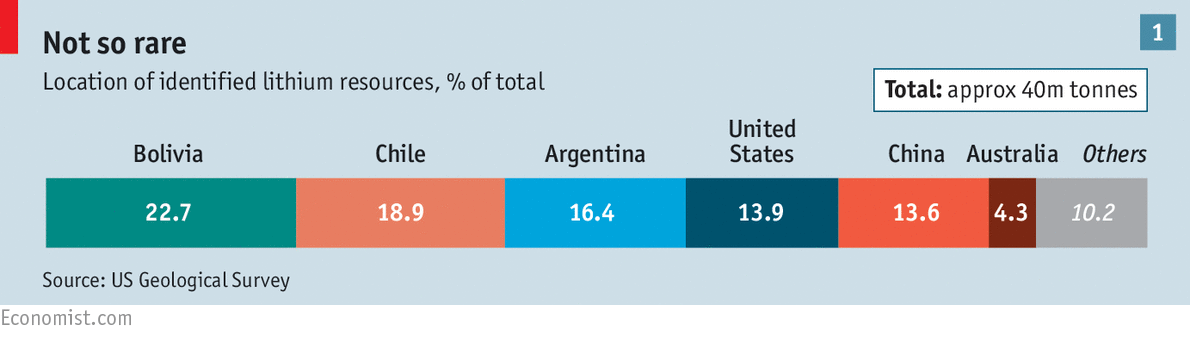
While these quantities may seem negligible in the wider scheme of things, the depths under the world's largest salt flats are claimed to contain the world's largest lithium reserves. According to some estimates, the Bolivian Andes harbour 70 per cent of the planet's lithium.

A number of studies have been done to corroborate these claims. According to the most optimistic one, as many as 140 million tons of lithium may be available in Salar de Uyuni, while the most pessimistic (US Geological Survey) foretells 'merely' nine million tons. Vast quantities of lithium have also been detected at the bottom of the world's oceans. Little wonder then that the mining industry, one of the planet's most toxic enterprises, is already turning its gaze downward into the seas. ...

The Bolivian market is opening and is attracting the attention of the Japanese, Germans, Swedes, French, Swiss, Koreans and Canadians. Sources say the American electrics giant Tesla also wants in on the action. The battery for Tesla's Model S requires as many as 63 kilograms of lithium carbonate, which is enough to power approximately 10,000 cell phone batteries.

In a recent report, the Goldman Sachs investment bank has called lithium carbonate the new gasoline. Eight years from now, the world's yearly demand is expected to total 470,000 tons. A 1 per cent increase in electric vehicle production could increase lithium demand by more than 40 per cent of current global production, the report boldly states.

Argentina Eyeing Lithium Superpower Status Amid Battery Boom  

Posted by Big Gav in , , ,

Bloomberg has a report on Argentina's hopes to dramatically expand lithium production - Argentina Eyeing Lithium Superpower Status Amid Battery Boom.

If all of the projects go ahead, Argentina’s annual output of the metal used in electric-vehicle batteries would surge to 165,000 metric tons, or about 45 percent of global supply, according to government projections. Prices will increase as much as 15 percent this year, Albemarle predicted last month. “Conservatively, Argentina will represent about half of global lithium production by 2020,”

Doubling the battery power of consumer electronics using lithium metal batteries  

Posted by Big Gav in , ,

MIT News has a report on "new lithium metal batteries could make smartphones, drones, and electric cars last twice as long" - Doubling battery power of consumer electronics.

Founded in 2012 by MIT alumnus and former postdoc Qichao Hu ’07, SolidEnergy Systems has developed an “anode-free” lithium metal battery with several material advances that make it twice as energy-dense, yet just as safe and long-lasting as the lithium ion batteries used in smartphones, electric cars, wearables, drones, and other devices.

“With two-times the energy density, we can make a battery half the size, but that still lasts the same amount of time, as a lithium ion battery. Or we can make a battery the same size as a lithium ion battery, but now it will last twice as long,” says Hu, who co-invented the battery at MIT and is now CEO of SolidEnergy.

The battery essentially swaps out a common battery anode material, graphite, for very thin, high-energy lithium-metal foil, which can hold more ions — and, therefore, provide more energy capacity. Chemical modifications to the electrolyte also make the typically short-lived and volatile lithium metal batteries rechargeable and safer to use. Moreover, the batteries are made using existing lithium ion manufacturing equipment, which makes them scalable.

It’s going to be a wild ride in the global lithium market  

Posted by Big Gav in , ,

RENew Economy has a look at the forecast demand for lithium worldwide as demand for electric vehicles and energy storage ramps up - It’s going to be a wild ride in the global lithium market.

Lithium: An increasingly precious metal  

Posted by Big Gav in , , , , , ,

While the Australian mining boom is now receding in the rear view mirror, one mining sector that is still attracting enthusiastic investment is the lithium mining industry.

Western Australia currently produces about 30% of the world's lithium supplies, and 20 new companies are scrambling about the state trying to take advantage of the boom in "white oil". WA Business News has an article on the evolving market for the metal, looking at producers in Australia and South America - A Window opens for lithium hopefuls.

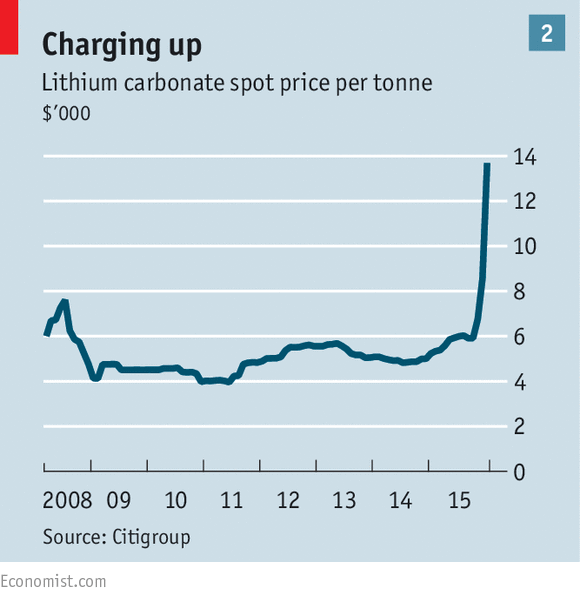
The investment frenzy may have already reached a peak locally however, with some investment columnists warning there aren't any bargains left in the sector - Ten years on, lithium may as well be uranium and This 'new gasoline' could burn eager investors.

The Economist also has a look at the soaring demand for lithium, with some interesting tales from Chile as the jostling begins to supply the expanding battery market for electric vehicles and home energy storage - An increasingly precious metal.

SQM, Chile’s biggest lithium producer, is the kind of company you might find in an industrial-espionage thriller. Its headquarters in the military district of Santiago bears no name. The man who for years ran the business, Julio Ponce, is the former son-in-law of the late dictator, Augusto Pinochet. He quit as chairman in 2015, during an investigation into SQM for alleged tax evasion. (The company is co-operating with the inquiry.) Last month it emerged that CITIC, a Chinese state-controlled firm, may bid for part of Mr Ponce’s controlling stake in SQM, as part of China’s bid to secure supplies of a vital raw material.

The focus of CITIC’s interest appears to lie on a lunar-like landscape of encrusted salt in Chile’s Atacama desert. It is a brine deposit washed off the Andes millions of years ago, containing about a fifth of the world’s known lithium resources. (Even more are in adjacent Bolivia but they are mostly untapped). Just weeks before, CITIC had bought a stake in a Hong Kong electric-vehicle maker that uses lithium-ion batteries, indicating its growing interest in clean-energy technologies.

The sleeping giant of lithium production is Bolivia, which by most estimates possesses the largest reserves of the metal. Evo Morales has announced a $1 billion investment push to kick start production, expanding links with Chinese companies to both extract the material and produce lithium ion batteries in the country - Bolivia’s lithium boom: dream or nightmare?.

Lithium production will clearly need to expand given the pre-sales for the Tesla 3 are now approaching 4000,000 vehicles and projected sales would consume all of world's lithium production at current levels - Rising Lithium Prices Threaten to Short-Circuit EV Market. The Chevrolet Bolt is also due out on the market this year, putting further pressure on supplies.

One way to boost production is to improve the efficiency of extraction processes. CleanTechnica has an article on improvements on extracting lithium from brine - New Method Of Extracting Lithium From Natural Brine Yields 99.9% Purity.

Talison snapped up on bet of a battery-charged future  

Posted by Big Gav in

Renew Economy reports that WA based lithium miner Talison has been taken over - Talison snapped up on bet of a battery-charged future.

Three years after it was forced to pull an Australian stock market float due to a lack of interest from local investors, the Australian-based Talison Lithium (TLH:TSX) – the world’s largest producer of lithium ore – has been snapped up in a deal that values it at more than twice the price.

Talison, which has been producing lithium at its Greenbushes mine in Western Australia for more than 25 years, and accounts for one-third of the global market in lithium ore, has agreed to a buyout by US-based materials group Rockwood Holdings for $C724 million ($704 million).

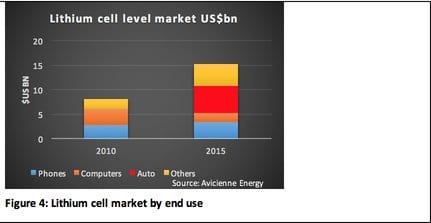
Lithium is the key ingredient used in the manufacture of lithium-ion batteries – one of the favoured technologies in the so-called “secondary” or “rechargeable” battery market. The batteries are used in mobile phones, laptops, tablets and the like, but are also expected to gain a major share of the electric vehicle market, and play a key role in the development of solar energy storage and in grid stabilisation.

The purchase comes just after Talison doubled production at its main mine in anticipation of a boom in demand of lithium-ion batteries, and secured a 15 per cent increase in prices – taking its price increases for calendar 2012 to date to 25 per cent.

“Talison was, and remains of the view that lithium will be a major part of the world’s new energy future, not just for mobile electronics such as iPads, but electric vehicles, grid stabilisation batteries, and solar storage,” chairman Peter Robinson said at the opening of the expanded operations earlier this month.

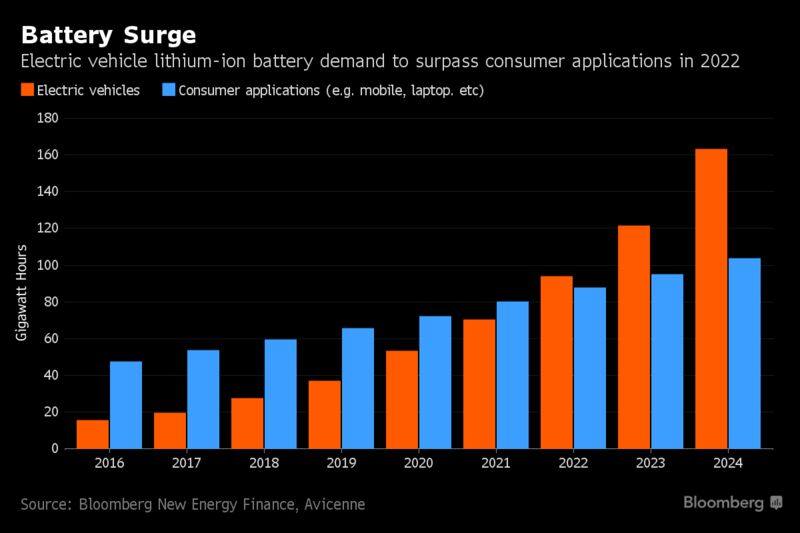
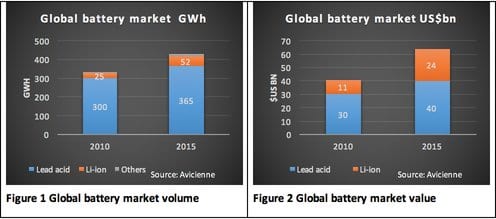
According to a recent presentation by Talison, demand for lithium-ion batteries has been growing by more than 20 per cent a year since 2000, and this is expected to surge from around 2015, as the rollout of electric vehicles takes off, and as lithium-ion batteries are deployed in large format basis in electricity grids and for storing solar energy.

And then there is the boom in smart phones and tablets. This graph below indicates anticipated demand over the next decade.

Salton Sea Could Be Source of Lithium Riches for the U.S.  

Posted by Big Gav in , ,

Fast Company has an article on Simbol Mining's plans to produce lithium from the Salton Sea in California - Salton Sea Could Be Source of Lithium Riches for the U.S..

In 18 months, Simbol Mining will attempt to make some serious cash from the Salton Sea's lithium-filled waters (the Sea has a lithium concentration of at least 200 parts per million) with its first commercial lithium extraction plant. The company, a spinoff from Lawrence Livermore National Laboratory, plans to swipe lithium from the geothermal brine of already-existing geothermal plants in the sea, according to Greentech Media.

The toxic brine--a byproduct of geothermal energy production--is usually treated as waste. But Simbol believes that the brine byproducts of just one of the five geothermal plants in the Salton Sea could produce millions of dollars worth of lithium each year. With four more 50 MW geothermal plants lined up for production in the sea, Simbol could be looking at a veritable cash cow.

The Salton Sea's lithium riches won't just benefit Simbol. As it stands, the U.S. relies on often-unstable countries (Bolivia, Afghanistan) for lithium supplies. And as electric cars become more popular, the demand for lithium batteries also continues to grow. If Simbol can remove international lithium producers from the equation, lithium prices could drop precipitously--and that might mean cheaper hybrid and electric vehicles for consumers.

New Lithium Mine Announced  

Posted by Big Gav in

Mineweb reports development of a new Australian lithium mine has been announced -

Australian diversified resources company Reed Resources Ltd, is pleased to announce the receipt from joint venture partner Mineral Resources Limited of notice that they intend to commence operations at the Mt Marion Lithium Deposits, near Kalgoorlie, Western Australia.

Production is expected to commence in March 2011 quarter at an initial rate of 200,000tpa of spodumene concentrate grading nominal 6.5% Li2O, containing some 13,000 tonnes lithium oxide (Li2O). Total contained lithium oxide resources at present are 128,000 tonnes (Li2O). The Joint Venture has been expanded to include mica, tantalum and potash feldspars; testwork has highlighted the potential to recover significant volumes of these by products.

This project will ensure both Reed and Mineral Resources can become major participants in the world lithium market.

The WSJ has a report on a new exchange traded fund tracking lithium producers and battery makers - New ETF Charges Up a Niche.
Bolivian magnate R. Marcelo Claure had been looking for a way to make a broad-based bet on lithium. A hedge fund in which he invests found him one.

The fund, MC Capital Advisors, this year turned to a company that creates exchange-traded funds. The result was Global X Lithium, an ETF that tracks lithium producers and battery makers. It is expected to launch this week.
MC Capital provided seed money to New York-based Global X Management Co., to start the ETF, and will receive half the ETF's profits.

Global X Lithium is an unusual case of ETF creation. But it also is part of a trend in which ETF firms are joining forces with other companies to launch funds that track obscure parts of the financial markets. ETFs typically are tradable securities designed to track an index of stocks, bonds or commodities.

Among ETFs soon to be released are funds designed to track small-cap companies in Thailand, producers of rare metals such as gallium and selenium, and shares of fishing-related companies.

Japan trading house buys into US lithium producer Simbol  

Posted by Big Gav in ,

AFP has a report on Japanese interest in US based lithium producer Simbol Mining - Japan trading house buys into US lithium producer.

Japanese trading house Itochu Corp said Monday it will buy a 20 percent stake in US lithium extraction startup Simbol Mining, winning exclusive rights to sell the precious metal in Asia.

The deal comes amid runaway demand from emerging markets for lightweight but costly lithium, a key energy storage medium used in rechargeable batteries powering portable consumer goods and electric vehicles.

Simbol Mining extracts lithium chemicals from geothermal brines in Southern California, a cheaper and cleaner alternative to the typical processing of the mineral, Itochu said in a statement.

While some lithium is mined, most is pumped up from brines in salt deserts in a lengthy and energy intensive process that sucks large amounts of local drinking water and damages the landscape.

Geothermal pumps do not endanger drinking water because brine comes from beneath the level of groundwater.

Most of the output comes from Argentina, Australia and Chile, which together accounted for 82 percent of total lithium production in 2008, according to Roskill Information Services, a metals and minerals research group.

Simbol Mining, founded in 2007, aims to produce 16,000 tonnes of lithium carbonates a year and increase production capacity in coming years.

Afghanistan: The Saudi Arabia of Lithium ?  

Posted by Big Gav in ,

The New York Times has a report on a survey of Afghanistan's mineral resources, noting there may be substantial lithium reserves in the country - U.S. Identifies Vast Riches of Minerals in Afghanistan. Mother Jones has more.

The previously unknown deposits — including huge veins of iron, copper, cobalt, gold and critical industrial metals like lithium — are so big and include so many minerals that are essential to modern industry that Afghanistan could eventually be transformed into one of the most important mining centers in the world, the United States officials believe.

An internal Pentagon memo, for example, states that Afghanistan could become the “Saudi Arabia of lithium,” a key raw material in the manufacture of batteries for laptops and BlackBerrys.

The vast scale of Afghanistan’s mineral wealth was discovered by a small team of Pentagon officials and American geologists. The Afghan government and President Hamid Karzai were recently briefed, American officials said.

While it could take many years to develop a mining industry, the potential is so great that officials and executives in the industry believe it could attract heavy investment even before mines are profitable, providing the possibility of jobs that could distract from generations of war.

“There is stunning potential here,” Gen. David H. Petraeus, commander of the United States Central Command, said in an interview on Saturday. “There are a lot of ifs, of course, but I think potentially it is hugely significant.”

The value of the newly discovered mineral deposits dwarfs the size of Afghanistan’s existing war-bedraggled economy, which is based largely on opium production and narcotics trafficking as well as aid from the United States and other industrialized countries. Afghanistan’s gross domestic product is only about $12 billion.

“This will become the backbone of the Afghan economy,” said Jalil Jumriany, an adviser to the Afghan minister of mines.

American and Afghan officials agreed to discuss the mineral discoveries at a difficult moment in the war in Afghanistan. The American-led offensive in Marja in southern Afghanistan has achieved only limited gains. Meanwhile, charges of corruption and favoritism continue to plague the Karzai government, and Mr. Karzai seems increasingly embittered toward the White House.

Peak Everything ?  

Posted by Big Gav in , , , ,

Ronald Bailey at Reason - a long time skeptic of peak oil - has a new article looking at some other potential resource extraction peaks (peak lithium, peak neodymium, and peak phosphorus), arguing - correctly in my view - that substitution and recycling can overcome these problems - (Peak Everything ?.

Peak Lithium

Lithium is the element at the heart of the electric car revolution that many green energy enthusiasts are trying to foment. For example, the Chevy Volt, scheduled to be at dealers this fall, will be energized by 400 pounds of lithium ion batteries, plus a gasoline engine to produce electricity to extend the car’s range of travel once the batteries are drained. In 2007, William Tahil, an analyst with the France-based consultancy, Meridian International Research, issued a report that alarmingly concluded that there is “insufficient economically recoverable lithium available in the Earth's crust to sustain electric vehicle manufacture in the volumes required.” Tahil added, “Depletion rates would exceed current oil depletion rates and switch dependency from one diminishing resource to another.” Not everyone agrees with Tahil’s peak lithium prognostications. ...

Even Tahil’s original report argued that there were alternative battery technologies in the works using far more common substances that could substitute for lithium. For example, the Swiss company ReVolt is developing rechargeable zinc-air batteries which hold 300 percent more charge than lithium ion batteries and cost half as much. And then there is Fluidic Energy which claims that it can develop a metal air battery that will hold 11 times the charge of the best lithium ion batteries for less than one-third the cost. A car running on such batteries would have a range of 400 to 500 miles on a single charge. These batteries are made from far more available materials which can be fairly easily recycled.

Peak Neodymium

Neodymium is a rare earth metal used extensively to produce permanent magnets found in everything from computer magnetic disks and cell phones to wind turbines and automobiles. For example, the magnets that drive a Prius hybrid’s electric motor use more than two pounds of neodymium. Interestingly, neodymium magnets were invented in the 1980s to overcome the global cobalt supply shock that occurred as the result of internal warfare in Zaire. Because China can more cheaply produce neodymium than any other country in the world, that country is now the source of 95 percent of the world’s neodymium. ...

On the other hand, if neodymium supplies really are a problem, perhaps there is a technical fix. For example, the privately held Chorus Motors has invented and developed an improved AC induction motor that completely eliminates the permanent neodymium magnets to supply the energy needed to accelerate hybrid or electric vehicles. If this technology is widely adopted, it would free up neodymium supplies for other uses and also tend to lower the metal’s price.

Peak Phosphorus

In the 1840s, scientists discovered that plants need the element phosphorus to grow. The phosphorus fertilizer industry grew rapidly, initially by exploiting vast deposits of seabird guano left on oceanic islands. Today phosphate rocks are mined to produce the fertilizer. The Global Phosphorus Research Initiative (GPRI) notes that modern agriculture is dependent on continual inputs of phosphorus fertilizer and that known reserves could be depleted within the next 50 to 100 years. The current issue of Foreign Policy ominously warns that failing to meet the challenge of “peak phosphorus” would mean that “humanity faces a Malthusian trap of widespread famine on a scale that we have not yet experienced.” But unlike petroleum or natural gas, phosphorus, as an element, is not destroyed when it’s used and so could be recovered and recycled.

The folks at the GPRI point out that the phosphorus in just one person’s urine would be close to the amount needed to fertilize the food supply for one person. So why not recycle urine? ...

Stanford University economist Paul Romer has observed, "Every generation has perceived the limits to growth that finite resources and undesirable side effects would pose if no new recipes or ideas were discovered. And every generation has underestimated the potential for finding new recipes and ideas. We consistently fail to grasp how many ideas remain to be discovered. The difficulty is the same one we have with compounding: possibilities do not merely add up; they multiply.” The above examples show that while the production of physical supplies of resources may peak, there is no sign that human creativity is about to peak.

The End Of Australian Manufacturing ?  

Posted by Big Gav in , , ,

Alan Kohler had an interesting column in The Business Spectator recently ("The cars that ate Australia") warning that as our car fleet transitions from the internal combustion to electric vehicles, local car manufacturers need to start looking to manufacture EV's or they (and all their suppliers) will end up shutting down.

Yesterday’s announcement of an electric car trial by the WA government means that at least some politicians in Australia are at last taking seriously what is shaping up as the next great industrial revolution.

But unless something changes on the east coast, electric cars will be a disaster for Australian manufacturing. At this stage it looks like no electric cars will be made here – Ford, GM, Toyota and Mitsubishi are all gearing up rapidly to make them somewhere else.

Yesterday the man in charge of the Perth trial, Professor Thomas Brauni, said: “It’s quite likely that you have a significant percentage of all cars being electric in 10-20 years time”.

If he’s only half right, Australia has a big problem. Manufacturing industry rests on the car industry and is already in trouble because China’s demand for raw materials is pushing the currency higher. If Australia doesn’t make electric cars, and there is a big switch from petrol to electricity over the next decade or two, manufacturing in this country will shut down.


Kohler points out that there will be accompanying booms in clean energy generation and both lithium and copper production (which provide opportunities as well as challenges for local companies).

Kohler had an article in a similar vein at The Eureka Report ("Wheels of fortune") recently, looking at both clean energy companies linked to Better Place and lithium producers that could benefit from the electric vehicle revolution, like Talison Minerals, Galaxy resources and Haddington (another Australian miner - Greenland Minerals And Energy - is hoping to develop a uranium / lithium deposit in Greenland).
It would be quite pointless to generate the electricity for the new era of transportation with brown coal, or even black coal. The emissions would still be lower than petrol exhausts, but the gains from using renewable energy instead would be enormous. In fact, electric cars can underpin the development of viable renewable energy industries in most countries.

Better Place plans to buy only renewables and expects to become Australia’s largest buyer of wind power. This is likely to a boon for Origin, AGL and Infigen from about 2013.

Seventy percent of the world’s mineral lithium comes from the Greenbushes mine in Western Australia, owned by a Canadian company called Talison Minerals. The company announced in November last year that it planned to list in both Canada and Australia during 2010 but nothing has happened yet.

Another local producer is Galaxy Resources, an ASX listed company that owns a lithium/tantalum deposit near Ravensthorpe in WA. Galaxy is currently at $1.18 and market cap of $178.4 million. The stock was 25¢ a year ago and peaked at $2.21 in September last year because of a flurry of interest in lithium batteries around the time that A123 Systems Inc listed on Nasdaq, becoming the hottest new listing in 2009.


Australian lithium mines aren't the only ones looking to increase production - The New York Times recently had an article on the surge of interest worldwide in the metal ("The Lithium Chase").
Toyota Tsusho, the material supplier for the big Japanese automaker, announced a joint venture in January with the Australian miner Orocobre to develop a $100 million lithium project in Argentina. That deal came only days after Magna International, the Canadian car parts company that is helping develop a battery-powered version of the Ford Focus, announced that it was investing $10 million in a small Canadian lithium firm that also has projects in Argentina. ...

About 60 mining companies have begun feasibility studies in Argentina, Serbia and Nevada that could lead to more than $1 billion in new lithium projects in the next several years, while dozens of smaller projects are being proposed in China, Finland, Mexico and Canada. ...

In the meantime the four biggest current producers, which mine and otherwise gather lithium in Chile, Argentina and Australia, say they are planning to expand long-running projects as future demand warrants.

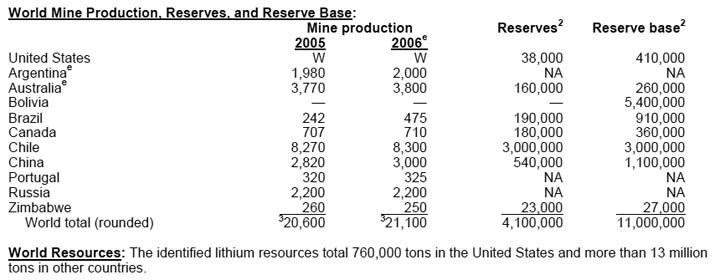
In Bolivia, which has almost half of the world’s reserves, the leftist government is building a pilot production plant and is drilling exploratory holes. That Bolivia is a remote, unstable country often hostile to foreign investment has helped spur interest in producing lithium in neighboring Argentina and Chile, in Australia, and in the United States. Several Canadian and American companies are making claims about future production prospects in Nevada, though few analysts foresee large-scale production from that state.

While most experts are skeptical that meaningful amounts of lithium can be produced domestically, they maintain that adequate supplies will be available from sources outside of Bolivia for many years to come and note that the biggest producer, Chile, is a dependable American ally.

While the NYT is dubious about increased lithium production within the US, one american company which has garnered attention for its potential to is Simbol Mining, which is looking to extract lithium from the water flowing through geothermal power plants.

Most of the attention for large scale future production of lithium tends to focus on Bolivia, which has the world's largest lithium resource soaked into the coating on the world's largest salt flat, the Salar De Uyuni.


The subject of Peak lithium has been raised from time to time (with recent commentary at Seeking Alpha and The Oil Drum) with Jack Lifton (author of the Seeking Alpha article) arguing that lithium supplies will be insufficient to meet our needs while Keith Evans argues there is more than enough resources available.
The Lithium Rush  

Posted by Big Gav in ,

Technology Review has a look at Bolivia, where the Andes contains "a vast salt flat that may shape the future of transportation" - The Lithium Rush

Nearly four kilometers above sea level in the Bolivian Andes lies the Salar de Uyuni, the world's largest salt flat. But there is more to this ­surreal, moonlike landscape than meets the eye. Flowing in salt-water ­channels beneath the surface is the world's largest supply of lithium--and, possibly, the future of transportation. Lithium is the key ingredient in the lithium-ion batteries that will power the electric vehicles that will soon be rolling off production lines worldwide. Demand for the metal is expected to double in the next 10 years, and Bolivia, with an untapped resource estimated at nine million tons by the U.S. Geological Survey, is being called a potential "Saudi Arabia of lithium."

Australian Renewable energy target needs a rethink ?  

Posted by Big Gav in , ,

The Australian has an article on the impact of large scale solar hot water power programs on the price of renewable energy certificates, noting "THE accelerating slump in the price of renewable energy certificates is putting pressure on the federal government to review the structure of the system that supports its renewable energy target" - Renewable energy target needs a rethink.

While European countries, the US and China are surging forward with investment in renewables, Australia has been left flat-footed.

The renewable energy target is expected to fix part of the problem and spark large investments in wind turbines, but the development of two of the transformative energy sources of the future, solar and geothermal, are at a virtual standstill, despite the fact Australia enjoys the most generous resources in the world.

This year, about 6000MW of solar energy capacity will be installed around the world, a further 9000MW expected next year and doubling to an estimated 20,000MW by 2013. Australia's share this year is a paltry 50MW and it is not expected to increase significantly in the next few years.

Solar thermal is expected to offer the best solution for large-scale and distributed solar power supplies and the present confirmed development portfolio across the world is estimated at 4000MW and in Australia just 8MW.

In geothermal, there is 10,000MW of capacity as well as a similar amount in the pipeline. Australia is expected to bring just 1Mw of capacity into production next year, adding to the tiny facility that has been operating at Birdsville since 1992.

Australia does have the opportunity to be a world leader in developing enhanced geothermal systems, tapping hotter rocks that lie deep underground, but the drip-feed nature of government funding, particularly in regards to drilling, means progress in this and in developing more conventional geothermal energy sources in deep-lying aquifers is slow, and there are now concerns that further delays will impede the country's ability to develop its expected 2000MW of geothermal capacity by 2020.

While we haven't been doing too well at implementing large scale solar or geothermal power plants, we are always happy to dig up dirt and ship it offshore - with the rising demand for batteries leading to a lithium boom in WA - Haddington boards lithium train. I guess there's more ways than one to participate in a cleantech boom.
PERTH junior Haddington has jumped aboard the lithium train, annoucing a new discovery in Western Australia's Pilbara region. Rock chip sampling has thrown up results from 0.4 per cent to 5 per cent lithium at its Pilgangoora prospect south of Port Hedland.

Lithium, like rare earths, has been cause for excitement because of its use in hybrid cars and has been a handy driver of the share prices of Galaxy, Orocobre, and Reed Resources. Mr Haddington says lithium consumption has been growing at a rate of 5 to 7 per cent in the past five years, dirven by use in rechargeable batteries.

The Great Lithium Rush ?  

Posted by Big Gav in ,

In the wake of ongoing concern about availability of and access to the metals required in various clean technologies, the most notable being lithium for use in batteries (particularly in electric vehicles) The Australian has had a few articles promoting the prospects of junior mining companies looking to develop lithium deposits (as have smaller, more hysterical, share tip sheets). First off, Robin Bromby in his "Pure Speculation" column - Watch Lithium !.

NISSAN has revealed details of the new 24 kilowatt-hour battery to be installed in its Leaf electric car. Hold your hats. Each battery will contain 4kg of lithium, according to New York-based scientific consultants Gerson Lehrman Group. The planned production numbers of the Leaf means that just under 10 per cent of the world’s production of lithium will be snapped up by Nissan. ...

That explains the significance this week of the announcement that Galaxy Resources is getting into bed with Great Group, described as a private sector investment company based in Beijing - although, in China, there is no such thing as a purely private sector company, especially when strategic metals are involved. Galaxy is, of course, the most advanced lithium player in Australia and about to develop a project near Ravensthorpe, Western Australia.

There are still some independent lithium plays, although they are well back in the queue in terms of advancement. Reed Resources recently joined the pack and received a massive boost to its share price as a result, and then there’s Orocobre with its project in Argentina and poised for development in 2012.

The latest entrant is Reward Minerals which, rebounding from being thwarted at its main potash project by Native Title problems, has applied for an exploration near the West Australian town of Dumbleyung. The company was surveying lake systems for potash and was surprised to find in Lake Dumbleyung relatively high lithium values.

So watch lithium. With electric cars coming, the world will all of this mineral it can gets its hands on.

Next, Tim Boreham on Galaxy Resources (which has a large stake already owned by the Chinese).
FORGET about iron ore, rare earths or even gold: the real flyer at the moment is any stock with an exposure to lithium. Lithium is in hot demand as China turns to electric cars and scooters in a serious way.

Lithium has applications in ceramics, glass manufacturing, lubricants and treating depression, but it's demand for lithium-ion batteries which has got investors excited in the last couple of weeks. According to Galaxy chief Iggy Tan, lithium demand is expected to soar from 100,000 tonnes currently to 300,000t by 2020. And there isn't a lot of new supply coming on.

Galaxy is in pole position with its Mt Cattlin resource at Ravensthorpe in Western Australia, which the company claims to be the world's second-biggest hard rock lithium deposit. ...

The bad news for investors is that Galaxy's share price has already had a decent run (up 150 per cent over the last two months). Still, Galaxy's $150 million market cap is defensible and it's one to hold on to for the demise of the carbon economy.

Peak Lithium: Will Supply Fears Drive Alternative Batteries?  

Posted by Big Gav in ,

Keith Johnson at The WSJ has a post on the "peak lithium" question - Peak Lithium: Will Supply Fears Drive Alternative Batteries?.

Saudis like to say that the stone age didn’t end for a lack of stones. But could a lack of lithium end the electric car age before it begins?

“Peak lithium” is back in focus, as the New York Times looks at Bolivia’s quest to cash in on the world’s biggest reserves of lithium, a key component in batteries. Simply put, global automakers and battery makers need to ensure a steady supply of lithium to power the expected electric-car revolution, but Bolivia’s populist government and its embrace of resource nationalism raises a lot of concerns about access to the country’s mineral wealth. TIME recently did a big takeout on Bolvia’s lithium, too.

Concerns about global supplies of lithium are a lot like the debate over peak oil. Some experts believe the huge increase in electric cars will actually strain the world’s lithium supplies in a few years; as with peak oil, “above-ground” factors like Bolivia’s politics may be just as critical as geology. Other experts figure lithium supplies are ample and exploding demand will just juice more lithium exploration, as happened with oil.

Either way, though, as hybrid and electric vehicles take a bigger share of the market, that threatens to push up lithium prices. That would make batteries, the costliest part of electric cars, even pricier, further threatening the economics of the electric-car revolution. (Ford on Tuesday announced its lithium-ion battery supplier.)A recent report by Lux Research called lithium availability the “ultimate limit” on electric cars’ future.

So what’s the alternative? Skip lithium altogether. Just as thin-film solar-power companies gained in appeal when global polysilicon supplies were tight, batteries that use materials other than lithium are gaining attention now. “Forward-thinking automakers will aggressively pursue alternative chemistries. As auto manufacturers come to terms with limited lithium supplies, they will increasingly consider alternative chemistries like zinc-air or other batteries made from more abundant elements,” Lux said in the report.

Toyota started researching a zinc-air battery, initially out of safety concerns (lithium-ion batteries sometimes explode). Germay’s RWE recently poured more research money into zinc-air batteries, too. Zinc-air and other metal-air batteries sidestep the lithium supply issue.

But if alternative batteries are still in the lab, that’s because they face a host of hurdles lithium-ion and nickel-metal hydrate batteries don’t share. Most importantly, zinc-air batteries aren’t rechargable and have a short lifespan—crucial negatives for the auto market. Some alternative batteries suffer from other shortcomings, too, including weight. That will leave lithium and existing nickel-metal batteries to share the global market in coming years, Lux figures.

One commenter at the WSJ referred to this article at AutoBlogGreen which quotes some industry PR saying all is fine - Got lithium? Lots.
When companies need to know about future market conditions for various commodities, they hire a firm with the expertise to evaluate the situation and report back. For instance, as Mitsubishi was mulling the possible future of electric cars equipped with lithium ion batteries, they hired TRU Group to do an analysis on future battery options. Usually, ordinary folks don't get to see the results of this kind of work, but in the case here, we can. In a rare move, Mitsubishi has allowed their consultants to release some of the findings about the global markets for lithium through to 2020 and that's just what they did at the IM Lithium Supply & Markets Conference Santiago 2009.

The results are comforting to those worried about a sudden upsurge in the production of electric cars using lithium ion batteries, especially over the next few years. Because of the sudden recession, there is actually an oversupply of the mineral right now and this should continue until about 2013. It doesn't seem as though there will be a "peak lithium" after that either. Although brine deposits, like those in Bolivia and China, may offer the easiest and cheapest supplies to extract, a moderate price rise would support mining here in America, where we appear to have quite a bit.

The same commenter referred to a recent lithium conference in South America. One presenter was Keith Evans, who had this to day:
In my presentation at the Santiago conference to which reference has been made earlier, I tabulated lithium resources totaling approximately 30.0 million tonnes equivalent to approximately 160,0 million tonnes of lithium carbonate-the primary feedstock for the lithium chemicals used in lithium-ion batteries. Presentations subsequent to mine increased the tonnage and other estimates by SQM and in a paper to which I made reference had somewhat higher figures.

Of my total, 17.6 million tonnes occur in Salar-type continental brines as are found in Chile, Argentina, Bolivia, China and Tibet, 7.65 million tonnes in pegmatites, 1.7 million tonnes in geothermal and oil field brines, 2.0 million tonnes in the clay mineral Hectorite and 0.85 million tonnes in a newly discovered boron/lithium mineral named Jadarite.

Of the brines the largest resource is in the Salar de Atacama, Chile, (the world’s current leading source of lithium) with 6.9 million tonnes.

The Salar de Uyuni is the second largest brine source. This occurrence receives massive publicity but, in fact, contains only 18% of the world’s resources. It is not the “Saudi Arabia of Lithium” and the large scale use of lithium ion batteries is not in any way dependent upon its development. It could possibly become a significant source of supply but in all respects it is inferior to the Salar de Atacama and some other salares.

Pegmatites are widely distributed throughout the world and suggestions have been made that switching to spodumene as a source for chemical production would result in a major increase in prices. Most Chinese production currently is from spodumene at costs estimated at about $2.00/lb using domestic ores and concentrates imported from Western Australia. A former North Carolina producer estimates that production from there currently would be at about $2.50/lb for carbonate.

These are higher than Chilean costs but if a massive demand materializes they can be readily absorbed by the battery industry where lithium costs represent 3-5% of the total battery cost. At current carbonate prices a vehicle requiring, for example, 6.6/lbs in a hybrid would contain lithium costing $20 in a battery selling for many thousands of dollars.

Regarding the statement concerning “untested technologies for lithium recoveries” Western Lithium appear confident that their hectorite project will be viable as does Simbol Mining with its process for geothermal and other possible brines. The Jadarite deposit in Serbia appears to be a uniquely attractive resource.
Of the various sources a question mark must remain on the viability of recovery from Smackover Formation oil field brines but in my tabulation it represents only 2.5% of the listed resources.

And as another commenter, David Ahlport, noted:
Well, the Federal Government could simply just do eminent domain on the patent for large form-factor Nickel Metal Hydride Batteries, which Chevron now holds.

That, or if they combine this technology with this one. You got yourself a nearly scarcity-proof battery source:

web.mit.edu/newsoffice/2006/batteries-0208.html
lbl.gov/tt/techs/lbnl1719.html

More On Peak Lithium  

Posted by Big Gav in

The Next 100 blog has a post on the recurring "peak lithium" issue - Peak Lithium ?.

If you believe them, the looming crisis of "peak oil" will soon have a counterpart in "peak lithium," as demand from the consumer electronics sector and plug-in vehicles converges to overwhelm limited supplies of the Periodic Table's third element. (The nuclear industry faces similar skeptics who claim that uranium supplies have peaked.) ...

Concerns over the adequacy of world lithium reserves first surfaced in the mid-1970s, when advocates of fusion power wondered if their miracle cure for the energy crisis would be foiled by shortages of the element. (Lithium deuteride was a key to the ignition of the first hydrogen fusion bomb.) A panel subsequently convened by the National Research Council estimated world reserves of lithium at less than 11 million tonnes--but the potential crisis fizzled along with fusion power.

The latest alarm was sounded by William Tahil, research director of Meridian International Research, His December 2006 paper, "The Trouble with Lithium," concluded, "there is insufficient lithium available in the Earth's crust to sustain electric vehicle manufacture in the volumes required, based solely on LiIon batteries. Depletion rates would exceed current oil depletion rates and switch dependency from one diminishing resource to another. Concentration of supply would create new geopolitical tensions, not reduce them." ...

Lithium optimists have a champion in Keith Evans, a geologist who has specialized in the element for forty years. He maintains that world reserves of elemental lithium are today more than twice the estimate in 1976, despite growing production. ...

So who's right? One way for non-experts to decide is to watch the money. GM, as noted, is banking on lithium batteries. So is Nissan, which reportedly plans to invest a billion dollars with NEC to produce lithium-ion batteries for the vehicle market. Honda reportedly plans to produce as many as 500,000 lithium-ion batteries a year. They must know something.

But then there's Toyota, the world's most experienced manufacturer of hybrid vehicles. Toyota uses nickel-metal hydride batteries in the Prius and doesn't see much future in lithium. "The future supply of lithium will not be able to sustain both the exponential growth in batteries for consumer electronics and a large automotive battery demand," said Jaycie Chitwood, environmental strategy manager for Toyota's advanced technology group.

Bolivia holds key to electric car future  

Posted by Big Gav in ,

The BBC reports on Bolivia's lithium gold mine - or perhaps just another resource curse - Bolivia holds key to electric car future.

High in the Andes, in a remote corner of Bolivia, lies more than half the world's reserves of a mineral that could radically reduce our reliance on dwindling fossil fuels.

Lithium carries a great promise. It could help power the fuel efficient electric or petrol-electric hybrid vehicles of the future. But, as is the case with fossil fuels, it is a limited resource.

Lithium carbonate is already in the batteries of laptop computers and mobile phones. It is used because it allows more energy to be stored in a lighter, smaller space than most alternatives.

And as the auto industry rushes to produce new fuel efficient and electric cars, it too is turning to lithium batteries as its first choice to boost the power of their new models.

GM has one in its new hybrid Volt, Toyota is testing one in its next generation hybrid Prius. Mercedes is testing an electric version of its Smart, while BMW is doing the same with its Mini. And Nissan-Renault, Mitsubishi and VW are all rushing to buy or produce enough of the batteries to power their future models.

The best of the pure electric cars can reach ranges of more than 150 kilometres per charge. More is needed But there is a problem.

Mitsubishi, which plans to release its own electric car soon, estimates that the demand for lithium will outstrip supply in less than 10 years unless new sources are found. And they have ended up in Bolivia.

"The demand for lithium won't double but increase by five times," according to Eichi Maeyama Mitsubishi's general manager in La Paz. "We will need more lithium sources - and 50% of the world's reserves of lithium exist in Bolivia, in the Salar de Uyuni," he adds, pointing out that without new production, the price of lithium will rise prohibitively.

Valuable resource

Lithium is found in rocks and sea water. But almost all the commercially exploitable reserves are found in the brine under salt flats. The world's largest reserves lie in Bolivia at the Salar de Uyuni - in the remote southern Andean plane.

But Bolivia is not a country known to be friendly to foreign industry. Its socialist president, Evo Morales, is keen to expand state control over its natural resources, a task carried out by Bolivia's minister for mining, Luis Alberto Echazu.

"We want to send a message to the industrialized countries and their companies," Mr Echazu says. "We will not repeat the historical experience since the fifteenth century: raw materials exported for the industrialisation of the west that has left us poor."

Gold, silver, tin, oil and gas have all been found and exported from here whilst the country remains the poorest in the region. For President Morales' supporters, that is reason enough not to allow in foreign mining companies to extract the lithium.

The Simbol For Lithium  

Posted by Big Gav in ,

I've mentioned these guys before but as lithium is an important material for electric car batteries I'll post this new article from Wired anyway - Mining Company Gets Cash to Pull Lithium from Waste Water.

The latest old school industrial business to receive new money is Simbol Mining, which announced a $6.7 million round of financing from Mohr Davidow Ventures and Firelake Capital, yesterday.

Simbol plans to extract lithium carbonate, the main raw ingredient in the lithium-ion batteries that power your laptop and maybe someday your car, from brines and waste streams.

"This is not for the faint of heart: the technology is complex," said CEO Luka Erceg by telephone. "It doesn't surprise me that we're the only ones looking at it right now."

Lithium-carbonate is an increasingly important mineral as rechargeable battery production continues to ramp up. Right now, as the US Geological Survey puts it, "Two brine operations in Chile dominate the world market." Some energy analysts worry that as electric vehicle and laptop production continue to climb, the world could face a serious lithium scarcity problem. The USGS Mineral Yearbook on Lithium from 2006, the most recent year available, states that "as demand and prices rise, lithium resources that had been considered uneconomic might once again yield economically feasible raw materials for the production of lithium carbonate."

Erceg wasn't talking about how their actual process works, but we dug into the backgrounds of the former Lawrence Livermore National Laboratory scientists with whom he's working to to reveal some tantalizing hints about their process and who their first geothermal power plant partner could be.

What is going to power our cars ?  

Posted by Big Gav in , , , ,

The Guardian has an interesting article on available lithium supplies that could be used in electric car batteries - What is going to power our cars ?.

It wasn't the sound of his car engine that was distracting Ian Clifford. The chief executive of Canadian business Zenn Motors makes electric vehicles that give off no noise. He was worried that the obvious choice to power his next car - the same stuff that goes into laptops and cellphone batteries - was going to be in short supply.

"If you look at the increase in lithium prices over the past seven to 10 years, it's been dramatic," says Clifford. Zenn's short-range urban cars traditionally used nickel metal hydride (NiMH) batteries, but his next vehicle - an 80mph model with a 250-mile range - needed more efficiency. "There are very limited global reserves, and they're in potentially very unstable parts of the world," adds Clifford.

Supplies under strain

The US moved the previously obscure chemical element to centre stage in the 1950s when its lithium-hungry H-bomb programme kickstarted world production. The rising popularity of lithium-ion (Li-Ion) in batteries has sent demand soaring again, and pundits now worry that electric cars will strain our supplies.

Your laptop might use six finger-sized Li-Ion cells in its battery, but US-based Tesla Motors bolts together 6,000 cells to power one of its high-end electric sports cars. Now others, drawn to Li-Ion's light weight and high capacity, are joining in. Toyota's Prius hybrid electric vehicle (HEV) runs on a small battery powered by braking energy that switches to petrol when it runs out. The group will switch its Nickel Metal Hydrid (NiMH) chemistry to Li-Ion in 2010. GM will be putting Li-Ion batteries in the Volt, its plug-in hybrid electric vehicle (PHEV) due out the same year. Other vendors also promise PHEVs, which are similar to HEVs, but with a larger, plug-in battery. Many will take the Li-Ion approach.

So how much lithium do we have? 1m tonnes of lithium metal is used to produce 5.3m tonnes of lithium carbonate, says Brian Jaskula, an analyst at the US Geological Survey (USGS), which goes into Li-Ion batteries.

Data from USGS puts total world resources of lithium metal at around 14m tonnes. The total world resource includes all the lithium metal we know about, whether it is commercially viable to extract it or not. But the USGS data is based on a 1976 National Research Council report.

A lot has changed in 32 years. Back then, most lithium came from a mineral called spodumene. But in 2001 SQM, a large mining group, began producing it in huge volumes by extracting it from salars - salt flats through which water has leached. The cheaper process sent prices plummeting and put many spodumene mines out of business.

"That was the last time that an organisation got together to do that type of research," Jaskula notes. But now two independent researchers are hoping to update the facts. In the pessimist corner is William Tahil, research director at Meridian International Research, who predicted two years ago that demand for lithium in cars would outpace supply. "There is no surplus lithium carbonate available for the automotive market. It's all being used by existing industrial applications," he says.

His report provoked a rebuttal from retired industry veteran Keith Evans, who worked on the original 1976 report. In March, he released An Abundance of Lithium, claiming a world resource of 28m tonnes, almost half of which he says could be extracted commercially (worldlithium.com). This would produce nearly 74m tonnes of lithium carbonate. "Tahil's argument that the world is short of lithium carbonate is wrong," Evans says. Two months later, Tahil released an even more pessimistic report, claiming that economically viable lithium metal reserves were just 4m tonnes. Evans is due to respond with a further rebuttal soon. Who is correct?

"Tahil considers that the total world lithium reserves are 4m tonnes," says an insider at SQM, which produces 37% of the world's lithium carbonate. "However, SQM's proven and probable in situ reserves alone total 5m tonnes."

Tahil, who still stands behind another report he wrote in 2006 claiming that the World Trade Center was felled by underground nuclear explosions, also dismisses the potential extraction of lithium from hectorite, a type of clay. But Western Uranium Corporation, a Canadian group, is testing recovery methods that it says could be worth 2m tonnes of lithium. Tahil has also largely dismissed the option of recycling lithium carbonate from Li-Ion batteries.

Disagreements over lithium reserves aside, the other debate is about how much lithium we can produce from our reserves, and whether it can match the growth of the car industry. ...

Peak oil advocates will worry that in spite of Kumar's analysis, we'll be forced to embrace Li-Ion in the coming years because oil will simply run out. But Bill van Amburg of research organisation Weststart-Calstart says that lithium won't have to support the auto industry on its own. "You'll have more efficient cars, alternative fuel, blended fuel, then the hybrids and electric drives, and all of them will have their piece of the wedge," he says.


Zenn and EEstor continue to get much of the press for electric cars lately - Tyler Hamilton has another article on them up at Technology Review - Better Batteries Charge Up.
A Texas startup says that it has taken a big step toward high-volume production of an ultracapacitor-based energy-storage system that, if claims hold true, would far outperform the best lithium-ion batteries on the market.

Dick Weir, founder and chief executive of EEStor, a startup based in Cedar Park, TX, says that the company has manufactured materials that have met all certification milestones for crystallization, chemical purity, and particle-size consistency. The results suggest that the materials can be made at a high-enough grade to meet the company's performance goals, as well as withstand the extreme voltages needed for high energy storage, the company said in a press release last week.

"These advancements provide the pathway to meeting our present requirements," Weir says. "This data says we hit the home run."

EEStor claims that its system, called an electrical energy storage unit (EESU), will have more than three times the energy density of the top lithium-ion batteries today. The company also says that the solid-state device will be safer and longer lasting, and will have the ability to recharge in less than five minutes. Toronto-based ZENN Motor, an EEStor investor and customer, says that it's developing an EESU-powered car with a top speed of 80 miles per hour and a 250-mile range. It hopes to launch the vehicle, which the company says will be inexpensive, in the fall of 2009.

But skepticism in the research community is high. At the EESU's core is a ceramic material consisting of a barium titanate powder that is coated with aluminum oxide and a type of glass material. At a materials-research conference earlier this year in San Francisco, it was asked whether such an energy-storage device was possible. "The response was not very positive," said one engineering professor who attended the conference. ...

Weir says that EEStor's latest production milestones lay the foundation for what follows. It has taken longer than originally expected, he says, but the company is now in a position to deploy more-advanced technologies for the production of military-grade applications, alluding to EEStor's partnership with Lockheed Martin.

Weir says that momentum is building and that he'll start coming out with information about the company's progress on a "more rapid basis." Plans are also under way for a major expansion of EEStor's production lines. "There's nothing complex in this," he says, pointing to his past engineering days at IBM. "It's nowhere near the complexity of disk-drive fabrication."

Despite its critics, EEStor has won support from some significant corners. In addition to Lockheed Martin, venture-capital firm Kleiner Perkins Caufield & Byers is an investor, and former Dell Computer chairman Morton Topfer sits on EEStor's board.

The company is also in serious talks with potential partners in the solar and wind industry, where EEStor's technology can, according to Weir, help put 45 percent more energy into the grid. He says that the company is working toward commercial production "as soon as possible in 2009," although when asked, he gave no specific date. "I'm not going to make claims on when we're going to get product out there. That's between me and the customer. I don't want to tell the industry."

Dahn says that he hopes EEStor will succeed. "I hope it works like a charm, because it will be a lot easier than fuel cells and batteries if it comes to pass."

Another high profile ultracapacitor manufacturer is Maxwell technologies, who Cleantech.com reports have landed a contract with a Chinese hybrid bus company - Golden Dragon Bus to use Maxwell ultracapacitors
Golden Dragon is producing diesel-electric hybrid buses for the Hangzhou, China, Public Transport Group. San Diego-based Maxwell Technologies made a deal to supply its Boostcap ultracapacitors to Xiamen, China's Golden Dragon Bus. Golden Dragon is producing diesel-electric hybrid buses for the Hangzhou, China, Public Transport Group.

Maxwell said today that it has completed delivery of 720 of its 48-volt multi-cell ultracapacitor modules to Golden Dragon for installation into 45 hybrid buses. Financial terms of the supply contract were not disclosed.

Green Car Congress reports the Th!nk City electric car has appeared at a show in London - TH!NK city Debuts in UK.
The TH!NK city electric vehicle made its debut at the 2008 British International Motor Show in London. The two-seater urban car has a top speed of 65 mph and a range of 126 miles in city driving on a single charge. Charging the batteries from 20% capacity to 80% takes four hours.

The TH!NK city accelerates from zero to 30 mph in 6.5 seconds and to 50 mph in 16 seconds. It requires just an overnight top-up of electricity and can travel for 126 miles in city driving on a fully charged battery.

Production started this year in Norway, and the first batch of right-hand drive cars will be delivered to UK customers in summer 2009. Prices of the TH!NK city will be announced closer to the on-sale date.

The TH!NK city is the sixth-generation electric vehicle that has been produced in Norway. Series production of the newly designed TH!NK city car recently started and the first cars have been delivered to Norwegian customers. Currently, cars are being produced at a rate of three to five a day, rising to 20 a day in the next six months.

The capacity of Think’s first assembly plant in Aurskog, outside Oslo, is presently being increased to 10,000 cars per year. Think plans to increase its production capacity with new assembly plants in the USA, Continental Europe and Asia in the next two years.

Joel Makower has a look at some of the adjustments that need to be made to support large scale rollouts of plugin hybrids - GM and the New Plug-In Infrastructure.
This week's announcement by General Motors that it has joined with more than 30 utility companies across the U.S. to work on issues related to electric vehicles got a great deal of media play. But the coverage only began to scratch the surface of the complexity of bringing plug-in electric vehicles to market in mass quantities.

In reality, the GM-utility conversation isn't entirely new. It began in January, at a Vehicle Electrification Workshop held at GM's research center in Warren, Michigan. I had the privilege of attending the meeting, which was facilitated by my colleagues at the sustainability strategy firm GreenOrder. The meeting included more than two dozen utility executives, including a team from the Electric Power Research Institute, the industry-funded consortium that served as the co-convener of the meeting.

It was an eye-opener, to say the least. It turns out that building the infrastructure for the plug-in electric vehicle isn't simply a matter of, "Here's a plug, here's a socket. End of story."

First of all, not everyone has a socket — a secure place to park their car and recharge it. Those living in apartment buildings, for example, lack this ability. Even where a plug exists, it may not have sufficient amperage to handle the load. (I'm a good example: I have a socket in my garage, but it's on the same circuit as my bedroom. If you plug in a power-hungry appliance in the garage, TiVo gets grumpy.)

But that's the least of it. Building the plug-in infrastructure involves a mind-numbing array of technical challenges. Among them ...

The Boston Herald reports that rising fuel costs are forcing police departments to increase the use of foot and bike patrols and to shift to electric vehicles - Police: rising fuel costs are ‘major public safety issue’. Coming soon - the Tesla Patrol Car.
Municipal police departments, which must run 24-hour fleets on $4-a-gallon gas, are charging extra for cruisers at traffic details, increasing bicycle and motorcycle patrols, and putting electric-powered vehicles into commission, a Herald review has found.

A Herald survey of the state’s largest police forces found that cops are being asked to morph into fuel-efficient crime fighters while gas costs gobble tens of thousands of dollars in law enforcement cash.

“The whole fuel thing is a major public safety issue. It’s a major economic issue,” said Framingham police Chief Steven B. Carl. “We put cops in very specific areas to keep them from driving around a lot and to be more efficient. You just can’t get away from answering calls. Most people don’t have accidents or commit crimes in areas that are convenient to police.”

And finally, EcoGeek reports that the Tata Nano may be going electric too - The Tata Nano: World's Cheapest (Electric) Car? . It sounds like they are talking about the (very) long awaited air car.
So it looks like the world's cheapest car (the Tata Nano) could soon be the world's cheapest electric car as well.

The price of the Nano is just above $2,500 and Tata's chairman Ratan Tata says he expects demand to exceed supply. Tata's plant in the city of Singur in the state of West Bengal will eventually have the capacity to make 350,000 Nanos a year.

Tata Motors plans to make a second generation of its four-passenger Nano with a diesel engine. But initially, it will have a gasoline engine capable of 50 miles to the gallon.

But the interesting news out of Mr. Tata's talk to shareholders at the annual general meeting last week was that the company is competing for an Eco car in Thailand and looking at other ways to make even more fuel-efficient versions of the Nano.

Tata is working with a French firm in developing an electric Nano. The electric car will use compressed air. Tata Motors also announced earlier this year it is in talks with Chrysler on developing electric vehicles.

Statistics

Locations of visitors to this page

blogspot visitor
Stat Counter

Total Pageviews

Ads

Books

Followers

Blog Archive

Labels

australia (619) global warming (423) solar power (397) peak oil (355) renewable energy (302) electric vehicles (250) wind power (194) ocean energy (165) csp (159) solar thermal power (145) geothermal energy (144) energy storage (142) smart grids (140) oil (139) solar pv (138) tidal power (137) coal seam gas (131) nuclear power (129) china (120) lng (117) iraq (113) geothermal power (112) green buildings (110) natural gas (110) agriculture (91) oil price (80) biofuel (78) wave power (73) smart meters (72) coal (70) uk (69) electricity grid (67) energy efficiency (64) google (58) internet (50) surveillance (50) bicycle (49) big brother (49) shale gas (49) food prices (48) tesla (46) thin film solar (42) biomimicry (40) canada (40) scotland (38) ocean power (37) politics (37) shale oil (37) new zealand (35) air transport (34) algae (34) water (34) arctic ice (33) concentrating solar power (33) saudi arabia (33) queensland (32) california (31) credit crunch (31) bioplastic (30) offshore wind power (30) population (30) cogeneration (28) geoengineering (28) batteries (26) drought (26) resource wars (26) woodside (26) censorship (25) cleantech (25) bruce sterling (24) ctl (23) limits to growth (23) carbon tax (22) economics (22) exxon (22) lithium (22) buckminster fuller (21) distributed manufacturing (21) iraq oil law (21) coal to liquids (20) indonesia (20) origin energy (20) brightsource (19) rail transport (19) ultracapacitor (19) santos (18) ausra (17) collapse (17) electric bikes (17) michael klare (17) atlantis (16) cellulosic ethanol (16) iceland (16) lithium ion batteries (16) mapping (16) ucg (16) bees (15) concentrating solar thermal power (15) ethanol (15) geodynamics (15) psychology (15) al gore (14) brazil (14) bucky fuller (14) carbon emissions (14) fertiliser (14) matthew simmons (14) ambient energy (13) biodiesel (13) investment (13) kenya (13) public transport (13) big oil (12) biochar (12) chile (12) cities (12) desertec (12) internet of things (12) otec (12) texas (12) victoria (12) antarctica (11) cradle to cradle (11) energy policy (11) hybrid car (11) terra preta (11) tinfoil (11) toyota (11) amory lovins (10) fabber (10) gazprom (10) goldman sachs (10) gtl (10) severn estuary (10) volt (10) afghanistan (9) alaska (9) biomass (9) carbon trading (9) distributed generation (9) esolar (9) four day week (9) fuel cells (9) jeremy leggett (9) methane hydrates (9) pge (9) sweden (9) arrow energy (8) bolivia (8) eroei (8) fish (8) floating offshore wind power (8) guerilla gardening (8) linc energy (8) methane (8) nanosolar (8) natural gas pipelines (8) pentland firth (8) saul griffith (8) stirling engine (8) us elections (8) western australia (8) airborne wind turbines (7) bloom energy (7) boeing (7) chp (7) climategate (7) copenhagen (7) scenario planning (7) vinod khosla (7) apocaphilia (6) ceramic fuel cells (6) cigs (6) futurism (6) jatropha (6) nigeria (6) ocean acidification (6) relocalisation (6) somalia (6) t boone pickens (6) local currencies (5) space based solar power (5) varanus island (5) garbage (4) global energy grid (4) kevin kelly (4) low temperature geothermal power (4) oled (4) tim flannery (4) v2g (4) club of rome (3) norman borlaug (2) peak oil portfolio (1)