Showing posts with label kevin kelly. Show all posts

Technology: The Most Powerful Force in the World  

Posted by Big Gav in , ,

Kevin Kelly is continuing to put out material for his forthcoming book on "The Technium" fairly regularly - the latest in stall looks at the power of technology - The Most Powerful Force in the World.

Even counting vast tracks of agriculture, the technium entails fewer than one percent of the atoms on the Earth's land surface. Yet the impact which this minute fraction of technological mass and energy has on the planet is in far disproportion to its size. Measured by impact per gram or calorie, there is nothing comparable to things we invent. Technology is the most powerful force in the world.

From the moment Sapiens emerged from Africa to colonize every inhabitable watershed on this planet, their inventions began to alter their environment. Sapien's hunting tools and techniques had far reaching affects: their technology enabled them to kill off key herbivores (mammoths, giant elk, etc.) whose extinctions altered the ecology of entire grassland biomes forever. Once dominant grazers were eliminated, their absence cascaded through the ecosystem, enabling the rise of new predators, new plant species, and all their competitors and allies, surfacing a modified ecosystem. Thus a few clans of people shifted the destiny of thousands of other species. When Sapiens gained control of fire, this technology further modified the natural terrain on a massive scale. Such a tiny trick — burning grasslands, controlling it with backfires, and summoning flames to cook grains — disrupted vast regions of the continents.

Later the repeated inventions and spread of agriculture around the planet affected not only the surface of the Earth, but its 100 km (60-mile) wide atmosphere as well. Farming disturbed the soil and increased CO2. Some climatologists believe that this early anthropogenic warming, starting 8,000 years ago, kept the next ice age at bay. Widespread adoption of farming disrupted a natural climate cycle which would have ordinarily refrozen the northern most portions of the planet by now. In other words, agriculture made (and still makes) the world safe for more agriculture. Like most complex technologies, agriculture — the integrated system of domesticated crops and animals, irrigation infrastructure and soil management — is self-sustaining and will alter its environment to further its own benefit.

Of course, once humans invented machines that ate concentrated old plants (coal) instead of fresh plants, the mechanical exhalations of CO2 furthered altered the balance of the atmosphere as the number of machines multiplied. The technium bloomed as machines harnessed this source of abundant energy. Petroleum eating machines not only transformed the ease, productivity, and spread of agriculture (accelerating an old trend), machines also drilled for more oil faster (a new trend), accelerating the rate of acceleration. Today the CO2 exhalation of all machines greatly exceeds the exhalation of all animals, and even approaches the volume generated by geological forces. Alan Weisman, writing in the World Without Us, suggest that the modern technium is the geological equivalent to a series of ceaseless volcanoes: "by tapping the [fuels of the] Carboniferous Formation and spewing it up into the sky, we've become a volcano that hasn't stopped erupting since the 1700s." And this impact is not only global, but extremely persistent: "Among the human-crafted artifacts that will last the longest after we're gone is our redesigned atmosphere." Climatologist Tyler Volk estimates that a natural geological cycle — with no technological mitigation — would take 100,000 years to return the agricultural and industrial induced CO2 atmosphere to pre-technium levels.

Each year the technium consumes more than 40 trillion pounds of coal, 1.6 trillion pounds of iron, 200 billion pounds of gypsum, and 1.2 trillion pounds of wheat, just four inputs among thousands of others needed to appease its appetite, and all those totals grow more than 5% per year. On average the technium must process twenty tons of atoms per year to support each man, women and child in the modern world.

The technium gains its immense power not from its scale but from its self-amplifying nature. One breakthrough invention, such as the alphabet, the steam pump, or electricity, can lead to further breakthrough inventions, like books, coal mines, and telephones. These advances in turn lead to other breakthrough inventions, such as libraries, power generators, and the internet. Each step adds further powers while retaining most of the virtues of the previous inventions. Someone has an idea (a spinning wheel!) which can hop to other minds, mutate into a derivative idea (place the spinning wheel beneath a sled to make it easy to haul) which disrupts the prevailing balance, causing a shift. That shift will often suggest another idea to someone else (use a cow to pull the wheeled sled), which in turn produces yet another disturbance, another rebalancing, another shift. Once started the teetering continues for many generations. As one ideas sparks two new ones and two ideas spark four, and four eight, this chain reaction of technology reverberates through the society, always gaining in accumulating energy and ceaseless movement. Efficient machines enable industry to make even more efficient machines. Smart chips assist humans in making even smarter chips. These virtuous circles are like rubbing the genie's lamp and getting three more wishes for the last wish. Magical self-amplification is a story retold in every domain of technology.

But not all changes induced by technology are magically positive. Industrial scale slavery, like that imposed upon Africa, was enabled by sailing ships which transported captives across oceans, and encouraged by the mechanical cotton gin which could cheaply process the fibers the slaves planted and harvested. Without technology, slavery at this massive scale would have been unknown. Thousands of synthetic persistent toxins have caused mass disruptions of natural cycles in both humans and other species, a huge unwanted downside from small inventions. War is a particularly serious amplifier of the great negative powers brought by technology. Horrific weapons of destruction, capable of inflicting entirely new atrocities upon society, spring directly from the most powerful force in the world.

On the other hand, the remedies and offsets to the negative consequences also stem from this most powerful force. Local ethnic slavery was practiced by most earlier civilizations, and probably in prehistoric times as well, and still continues in sporadic remote areas; it's overall diminishment globally is due to the technological tools of communication, law, and education. Technologies of detection, and substitution, can remove the routine use of synthetic toxins. The technologies of monitoring, law, treaties, policing, courts, citizen media and economic globalism can temper, dampen, and in the long run diminish the vicious cycles of war.

All change in society can be traced back to the products of our minds. The history of civilization is an ever up-cascading sequence of social organization that we invent. Societies begin as leaderless bands of hunter-gatherers, and over generational time acquire chiefs, put down roots (literally) with farms, land and water rights adjudicated by authorities, hatch cities, and eventually become states and nations. Each step in civilization is characterized by more social organization, more different kinds connections between people (beyond family relations), more webs of interdependence, producing more of what Robert Wright, author of Non Zero, calls "non-zero-sumness," that is, self-reinforcing mutual benefit. Each emergent organization in the evolution of society serves as a platform for citizens to birth yet more new ways to organize. This self-improving recursive "3-more-wishes" loop goes round and round, amplifying its original force.

The power of cooperation is not new, but this virtuous circle is more than ordinary altruism, because participants are often not consciously cooperating, and may in fact compete, or even be parasitic. A merchant in Athens selling a barrel of raisins is not cooperating with the grower of grapes in Macedonia, or the speculator in Corinth hoarding stock, but the three form a system (an emergent market) that expands all their interests. It's a win-win condition. This kind of accumulating social organization exhibits an almost mathematical flavor that transcends neighborly kindness. Rather than happy camaraderie, this increasing structure is built on information flows that tighten both trust and rivalries into a web of interdependence. As these links increase, so does the power of amplification and acceleration.

Progress, even moral progress, is ultimately a human invention. It is a product of our wills and minds, and thus a technology. We can decide slavery is not a good idea. We can decide that evenly applied laws, rather than nepotic favoritism, is a good idea. We can outlaw certain punishments with treaties. We can encourage accountability with the invention of writing. We can consciously expand our circle of empathy. These are all inventions and as much products of our minds as light bulbs and telegraphs.

The larger point is that this cyclotron of social betterment is not propelled by ethics or religion, but by technology. Society is evolved by injecting it with incremental doses of that most powerful force in the world; each rise in social organization throughout history is driven by an insertion of a new technology. ...

Name a disruption in culture today, either positive or negative, and if you press far enough back you'll find an tangible invention that sets off the imbalance. Globalism? Cheap, ubiquitous global communications. Social Security overhang? Medical advances for increasing longevity and decreasing fertility. Obesity epidemic? Cheap monoculture food system combined with passive entertainment technology. Gay rights? Emboldened by science showing gender preferences are biological. Celebrity obsessions? Broadcast media. Militant jihadism? Islam has been around 1500 years. But an imbalance between a medically enabled population explosion without a corresponding explosion in economic or political progress disrupts the former social equilibrium.

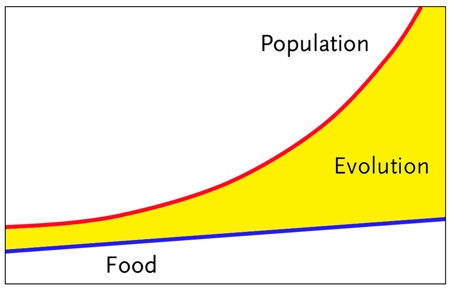
Charles Darwin and Alfred Wallace both realized from reading Malthus's work on population that natural selection is propelled by the difference between two growth patterns in the wild: population versus food. The greater propulsion of population growth could not be contained in the lesser geometric gains of its food production. This tension between the overwhelming multiplication of population and the slower expansion of its material container is the drive behind evolution.


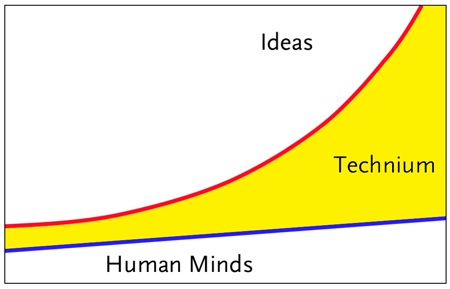
The evolution of the technium likewise gains its unmatched power from the difference between two growth rates. The number of ideas and their transmission via computers, books, telephone lines, patents, and so on increases in an exponential fashion. Information is, in fact, the fastest growing thing on this planet. Information is especially conducive to amplification and compounding. As the number of facts increase, the connections between facts increases exponentially faster. Because the mathematical law of combinations, the number of links between pages explodes faster than the number of pages increases. New inventions in certain fields like communication, which are powered by increasing combinations of connections, can increase the speed of invention overall, revving the engines of creation. Everywhere we look, the technium is wired with self-amplifying loops ballooning up the scale of change. Fundamentally, discoveries in the science of how to discover, and inventions in how to invent (the genie process we call science) accelerate the rate of discovery and invention everywhere.

But our human ability to absorb or process this explosion of ideas increases only linearly at best. Despite years spent in education, or bathed in the best nutrition, our brains are not doubling in speed, memory, and insight every 18 months, as computers do. In fact, biologically speaking, our brains are remarkably similar to the brains of the first Sapiens 50,000 years ago. The smartest humans are not exponentially smarter than the average ones, and the average IQ of a human is only slowly increasing over time by the most minute amount (a few percent per decade in modern times). Even collectively, unaided human intelligence is only growing in tandem with the number of humans. The gap between the escalating growth of information generated by us and our machines, and our tiny marginal improvements in being able to understand the oceans of information and make meaning from it is the driver behind the rapid evolution of the technium.


The work of understanding all this information is migrating from humans to the technium. We can no longer keep up with our own creations, and so we are constructing an apparatus to structure what we think, in the same manner that we first used writing on paper to extend our memory. Now we are offloading other mental functions. The technium contains an elaborate knowledge processing system consisting of encyclopedias, classification indexes, cross references, search engines, footnotes, citations, hypertext, and the web. These technologies organize the output of our collective minds — both intangible ideas and tangible inventions — into a semantic structure, much like an ecosystem. This incredibly complicated mesh of connections, interdependencies, associations, and emergent structure gives the technium a "meaning" that is outside our of understanding.

It's reasonable to figure that since the technium is simply "that which the mind produces" then at its root the most powerful force in the world must not be technology but the human mind. If this were so we'd have to recalibrate the equation above to state that the origin of all change in our lives lays in the mysterious force of intelligence and consciousness hiding between our ears. (That assertion reminds me of a joke I heard from a friend who said "whenever I get the idea that human mind is the most powerful thing in world I just remember what it is that is telling me this.") But the claim that the human mind is foremost power is not valid. No matter how much we use our biological mind's awareness to reflect upon our mind's workings, this type of mental introspection and self-improvement leads to extremely limited improvement at best, and usually none at all. Contemplation (even in a zen position) to optimize our own mind just doesn't scale up. Unaided, the mind makes very little headway in amplifying itself.

However, the technium, which is a product of our brain, can alter the circuits that produced it. People who grow up immersed in the technologies of writing and reading think differently. I don't mean humans think differently while reading. Reading and writing are cognitive tools that, once acquired, change the way in which the brain memorizes facts and conceptualizes ideas, and these changes stimulate abstract thinking. When psychologists use neuroimaging technology, like MRI, to compare the brains of literates and illiterates working on a task, they find many differences in how their brains work whether or not they are reading. Researcher Alexandre Castro-Caldas discovered that processing between the hemispheres of the brain was different between those who could read and those who could not. A key part of the corpus callosum was thicker in literates, and "the occipital lobe processed information more slowly in individuals who learned to read as adults compared to those who learned at the usual age." Psychologists Ostrosky-Solis, Garcia and Perez tested literates and illiterates with a battery of cognitive tests while measuring their brain waves and concluded that "the acquisition of reading and writing skills has changed the brain organization of cognitive activity in general… not only in language but also in visual perception, logical reasoning, remembering strategies, and formal operational thinking." Literacy — a human invention — rewires the human mind.

It is not just writing. Music, another invention, also alters the brain in a sustainable way. Many studies have shown how listening to music strengthens the communication wiring between brain hemispheres. Beside fostering an expected growth in auditory regions of the brain, regularly playing musical instruments significantly strengthens the thickness of the corpus callosum fibers and activates the cerebral cortex. Our mind makes a drum and flute, and the drum and flute remakes our mind.
The Wisdom of Public Prediction Markets And The Limits Of Statistics  

Posted by Big Gav in , , , ,

Kevin Kelly has an interesting (and thorough) look at the state of play in predictive markets at the Long Now blog - The Wisdom of Public Prediction Markets.

Prediction markets continue to proliferate. These communities use money to bet on outcomes in the future. If a prediction comes true, the winners reap the money from the losing betters. The price of a bet, or share, fluctuates over time — and thus can be used as a signal for the community’s opinion. In theory a prediction market taps into the “wisdom of crowds,” but can also be viewed as conventional wisdom. However the results of prediction markets have been proven to be reliable conventional wisdom. (See my previous post on the subject.)

There are two kinds of prediction markets: ones where you bet real money, and ones where you bet funny money. Since betting real money keeps people honest (to reduce their loses), markets with real money are considered a much better indicator of opinion than a mere poll — which has no “penalty” for being less than honest. But real money prediction markets are (stupidly) illegal in the US. So token markets like Long Bets and Bet2Give are devised to innovate around the law.

For instance, Hubdub trades token dollars. You are given $1,000 hubdubs at the start, and $20 each day you log on. You win or loose these token dollars on various predictions. There is a leaderboard which displays the highest ranked traders, showing how much they have gained in the last quarter. One fellow gained $1 million hubdubs, and now has a net worth of $3 million. Hubdub dollars are only good for bragging rights.

One clarification of how the price of a bet works (from Hubdub’s FAQ):
If a prediction has a yes value of 43%, does that mean that 43% of people have voted yes?
No, not really. The forecast is dependent on both the number of people who have selected this outcome and the amount they have risked on it. Very roughly, 43% means that 43% of the money risked by users is riding on that outcome.

I was curious how closely the two formats (real and token money) might match each other so I hunted for a bet that I thought most prediction markets might share: the outcome of the US presidential election. From my brief survey, betting real dollars and token dollars give similar results. More so, there is a pretty close convergence of price among all the prediction markets ...

My conclusion is that token money prediction markets carry the same validity as real money prediction markets, and that they are fairly consistent across markets. In that sense they are probably reliable indicators of what people believe at this moment (not be confused with reliable predictions).

Prediction markets aren't a new idea of course - John Brunner made them a central feature of The Shockwave Rider and pointed out that if they become ubiquitous they are just as likely to become a tool for manipulating public perception as they are to be a useful way of gauging it (and perhaps predicting future events). They key to making them successful is absolute transparency - all market participants need to be sure that they data they see is accurate (and how everyone else "voted").

Predictive markets are the sort of thing the folks at The Arlington Institute like to mess about with, though their latest scheme is a little more metaphysical in nature (and highly reminiscent of the opening sections of "The Men Who Stare At Goats") - TAI Alert 15 - Impending Event Alert.
Here at the Arlington Institute, we have worked with real precognizant dreamers who have had experience with intelligence services and we have subsequently learned about the hundreds of case studies of individuals who had explicit dreams about the 9/11 affair (people jumping out of burning high rise buildings, etc.), beginning some six months before the event. We have been intrigued with the notion that the human collective unconscious somehow anticipates large impending perturbations. Our WHETHEReport project, for which we are looking for funding, is in fact based upon this dynamic. In telling people about this project I have received strong confirmations of the efficacy of the underlying logic from many individuals around the world.

Well, in the last two days I have received four independent, explicit indications from far removed friends suggesting that something very substantial and disruptive is going to happen to the U.S. within the next 60 days or so. If these warnings manifest themselves in an event of the significance of something like 9/11 then people all over the world should begin to experience dreams and other intuitions suggesting that something extraordinary is about to happen.

So I’m asking you to participate in an experiment with us. If you, or someone you know, experiences any kind of significant suggestion (dream, intuition, etc.) that something big and disruptive is about to happen in the coming weeks, send us a note and tell us about it. We’ll compile them all and see if we can find any patterns or pointers toward an actual future event. Just cut and paste the form below into an email and fill it out and send it in. I’ll let you know what happens. If you have multiple experiences, please send them along too.

You don’t need to include any identification and we’ll certainly keep all of this information confidential.

Besides the "Desperately Seeking Psychics" ad above, TAI also issued another alert recently, this one noting the financial system seems to be on the verge of meltdown (something David Martin predicted a while back, to be fair) - TAI Alert: 16 - The Next Step in the Unwinding of the Economy.

Nassim Nicholas Taleb (of "Black Swan" fame) is a man who has scant respect for any sort of prediction-merchant, be they individuals or markets assessing the wisdom of the masses. His latest essay is up at the EDGE - THE FOURTH QUADRANT: A MAP OF THE LIMITS OF STATISTICS.
Statistical and applied probabilistic knowledge is the core of knowledge; statistics is what tells you if something is true, false, or merely anecdotal; it is the "logic of science"; it is the instrument of risk-taking; it is the applied tools of epistemology; you can't be a modern intellectual and not think probabilistically—but... let's not be suckers. The problem is much more complicated than it seems to the casual, mechanistic user who picked it up in graduate school. Statistics can fool you. In fact it is fooling your government right now. It can even bankrupt the system (let's face it: use of probabilistic methods for the estimation of risks did just blow up the banking system).

The current subprime crisis has been doing wonders for the reception of any ideas about probability-driven claims in science, particularly in social science, economics, and "econometrics" (quantitative economics). Clearly, with current International Monetary Fund estimates of the costs of the 2007-2008 subprime crisis, the banking system seems to have lost more on risk taking (from the failures of quantitative risk management) than every penny banks ever earned taking risks. But it was easy to see from the past that the pilot did not have the qualifications to fly the plane and was using the wrong navigation tools: The same happened in 1983 with money center banks losing cumulatively every penny ever made, and in 1991-1992 when the Savings and Loans industry became history.

It appears that financial institutions earn money on transactions (say fees on your mother-in-law's checking account) and lose everything taking risks they don't understand. I want this to stop, and stop now— the current patching by the banking establishment worldwide is akin to using the same doctor to cure the patient when the doctor has a track record of systematically killing them. And this is not limited to banking—I generalize to an entire class of random variables that do not have the structure we thing they have, in which we can be suckers.

And we are beyond suckers: not only, for socio-economic and other nonlinear, complicated variables, we are riding in a bus driven a blindfolded driver, but we refuse to acknowledge it in spite of the evidence, which to me is a pathological problem with academia. After 1998, when a "Nobel-crowned" collection of people (and the crème de la crème of the financial economics establishment) blew up Long Term Capital Management, a hedge fund, because the "scientific" methods they used misestimated the role of the rare event, such methodologies and such claims on understanding risks of rare events should have been discredited. Yet the Fed helped their bailout and exposure to rare events (and model error) patently increased exponentially (as we can see from banks' swelling portfolios of derivatives that we do not understand).

Are we using models of uncertainty to produce certainties?

This masquerade does not seem to come from statisticians—but from the commoditized, "me-too" users of the products. Professional statisticians can be remarkably introspective and self-critical. Recently, the American Statistical Association had a special panel session on the "black swan" concept at the annual Joint Statistical Meeting in Denver last August. They insistently made a distinction between the "statisticians" (those who deal with the subject itself and design the tools and methods) and those in other fields who pick up statistical tools from textbooks without really understanding them. For them it is a problem with statistical education and half-baked expertise. Alas, this category of blind users includes regulators and risk managers, whom I accuse of creating more risk than they reduce.

So the good news is that we can identify where the danger zone is located, which I call "the fourth quadrant", and show it on a map with more or less clear boundaries. A map is a useful thing because you know where you are safe and where your knowledge is questionable. So I drew for the Edge readers a tableau showing the boundaries where statistics works well and where it is questionable or unreliable. Now once you identify where the danger zone is, where your knowledge is no longer valid, you can easily make some policy rules: how to conduct yourself in that fourth quadrant; what to avoid.

So the principal value of the map is that it allows for policy making. Indeed, I am moving on: my new project is about methods on how to domesticate the unknown, exploit randomness, figure out how to live in a world we don't understand very well. While most human thought (particularly since the enlightenment) has focused us on how to turn knowledge into decisions, my new mission is to build methods to turn lack of information, lack of understanding, and lack of "knowledge" into decisions—how, as we will see, not to be a "turkey". ...

I start with my old crusade against "quants" (people like me who do mathematical work in finance), economists, and bank risk managers, my prime perpetrators of iatrogenic risks (the healer killing the patient). Why iatrogenic risks? Because, not only have economists been unable to prove that their models work, but no one managed to prove that the use of a model that does not work is neutral, that it does not increase blind risk taking, hence the accumulation of hidden risks.


Figure 1 My classical metaphor: A Turkey is fed for a 1000 days—every days confirms to its statistical department that the human race cares about its welfare "with increased statistical significance". On the 1001st day, the turkey has a surprise.


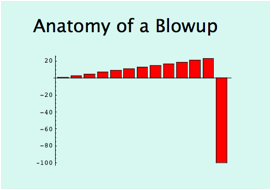
Figure 2 The graph above shows the fate of close to 1000 financial institutions (includes busts such as FNMA, Bear Stearns, Northern Rock, Lehman Brothers, etc.). The banking system (betting AGAINST rare events) just lost > 1 Trillion dollars (so far) on a single error, more than was ever earned in the history of banking. Yet bankers kept their previous bonuses and it looks like citizens have to foot the bills. And one Professor Ben Bernanke pronounced right before the blowup that we live in an era of stability and "great moderation" (he is now piloting a plane and we all are passengers on it).

Figures 1 and 2 show you the classical problem of the turkey making statements on the risks based on past history (mixed with some theorizing that happens to narrate well with the data). A friend of mine was sold a package of subprime loans (leveraged) on grounds that "30 years of history show that the trade is safe." He found the argument unassailable "empirically". And the unusual dominance of the rare event shown in Figure 3 is not unique: it affects all macroeconomic data—if you look long enough almost all the contribution in some classes of variables will come from rare events (I looked in the appendix at 98% of trade-weighted data).

Now let me tell you what worries me. Imagine that the Turkey can be the most powerful man in world economics, managing our economic fates. How? A then-Princeton economist called Ben Bernanke made a pronouncement in late 2004 about the "new moderation" in economic life: the world getting more and more stable—before becoming the Chairman of the Federal Reserve. Yet the system was getting riskier and riskier as we were turkey-style sitting on more and more barrels of dynamite—and Prof. Bernanke's predecessor the former Federal Reserve Chairman Alan Greenspan was systematically increasing the hidden risks in the system, making us all more vulnerable to blowups.

By the "narrative fallacy" the turkey economics department will always manage to state, before thanksgivings that "we are in a new era of safety", and back-it up with thorough and "rigorous" analysis. And Professor Bernanke indeed found plenty of economic explanations—what I call the narrative fallacy—with graphs, jargon, curves, the kind of facade-of-knowledge that you find in economics textbooks. (This is the find of glib, snake-oil facade of knowledge—even more dangerous because of the mathematics—that made me, before accepting the new position in NYU's engineering department, verify that there was not a single economist in the building. I have nothing against economists: you should let them entertain each others with their theories and elegant mathematics, and help keep college students inside buildings. But beware: they can be plain wrong, yet frame things in a way to make you feel stupid arguing with them. So make sure you do not give any of them risk-management responsibilities.) ...

Many researchers, such as Philip Tetlock, have looked into the incapacity of social scientists in forecasting (economists, political scientists). It is thus evident that while the forecasters might be just "empty suits", the forecast errors are dominated by rare events, and we are limited in our ability to track them. The "wisdom of crowds" might work in the first three quadrant; but it certainly fails (and has failed) in the fourth.

Living In The Fourth Quadrant

Beware the Charlatan. When I was a quant-trader in complex derivatives, people mistaking my profession used to ask me for "stock tips" which put me in a state of rage: a charlatan is someone likely (statistically) to give you positive advice, of the "how to" variety.

Go to a bookstore, and look at the business shelves: you will find plenty of books telling you how to make your first million, or your first quarter-billion, etc. You will not be likely to find a book on "how I failed in business and in life"—though the second type of advice is vastly more informational, and typically less charlatanic. Indeed, the only popular such finance book I found that was not quacky in nature—on how someone lost his fortune—was both self-published and out of print. Even in academia, there is little room for promotion by publishing negative results—though these, are vastly informational and less marred with statistical biases of the kind we call data snooping. So all I am saying is "what is it that we don't know", and my advice is what to avoid, no more.

You can live longer if you avoid death, get better if you avoid bankruptcy, and become prosperous if you avoid blowups in the fourth quadrant.

Now you would think that people would buy my arguments about lack of knowledge and accept unpredictability. But many kept asking me "now that you say that our measures are wrong, do you have anything better?"

I used to give the same mathematical finance lectures for both graduate students and practitioners before giving up on academic students and grade-seekers. Students cannot understand the value of "this is what we don't know"—they think it is not information, that they are learning nothing. Practitioners on the other hand value it immensely. Likewise with statisticians: I never had a disagreement with statisticians (who build the field)—only with users of statistical methods.

Spyros Makridakis and I are editors of a special issue of a decision science journal, The International Journal of Forecasting. The issue is about "What to do in an environment of low predictability". We received tons of papers, but guess what? Very few addressed the point: they mostly focused on showing us that they predict better (on paper). This convinced me to engage in my new project: "how to live in a world we don't understand".

So for now I can produce phronetic rules (in the Aristotelian sense of phronesis, decision-making wisdom). Here are a few, to conclude.

Phronetic Rules: What Is Wise To Do (Or Not Do) In The Fourth Quadrant

1) Avoid Optimization, Learn to Love Redundancy. Psychologists tell us that getting rich does not bring happiness—if you spend it. But if you hide it under the mattress, you are less vulnerable to a black swan. Only fools (such as Banks) optimize, not realizing that a simple model error can blow through their capital (as it just did). In one day in August 2007, Goldman Sachs experienced 24 x the average daily transaction volume—would 29 times have blown up the system? The only weak point I know of financial markets is their ability to drive people & companies to "efficiency" (to please a stock analyst’s earnings target) against risks of extreme events.

Indeed some systems tend to optimize—therefore become more fragile. Electricity grids for example optimize to the point of not coping with unexpected surges—Albert-Lazlo Barabasi warned us of the possibility of a NYC blackout like the one we had in August 2003. Quite prophetic, the fellow. Yet energy supply kept getting more and more efficient since. Commodity prices can double on a short burst in demand (oil, copper, wheat) —we no longer have any slack. Almost everyone who talks about "flat earth" does not realize that it is overoptimized to the point of maximal vulnerability.

Biological systems—those that survived millions of years—include huge redundancies. Just consider why we like sexual encounters (so redundant to do it so often!). Historically populations tended to produced around 4-12 children to get to the historical average of ~2 survivors to adulthood.

Option-theoretic analysis: redundancy is like long an option. You certainly pay for it, but it may be necessary for survival.

2) Avoid prediction of remote payoffs—though not necessarily ordinary ones. Payoffs from remote parts of the distribution are more difficult to predict than closer parts.

A general principle is that, while in the first three quadrants you can use the best model you can find, this is dangerous in the fourth quadrant: no model should be better than just any model.

3) Beware the "atypicality" of remote events. There is a sucker's method called "scenario analysis" and "stress testing"—usually based on the past (or some "make sense" theory). Yet I show in the appendix how past shortfalls that do not predict subsequent shortfalls. Likewise, "prediction markets" are for fools. They might work for a binary election, but not in the Fourth Quadrant. Recall the very definition of events is complicated: success might mean one million in the bank ...or five billions!

4) Time. It takes much, much longer for a times series in the Fourth Quadrant to reveal its property. At the worst, we don't know how long. Yet compensation for bank executives is done on a short term window, causing a mismatch between observation window and necessary window. They get rich in spite of negative returns. But we can have a pretty clear idea if the "Black Swan" can hit on the left (losses) or on the right (profits).

The point can be used in climatic analysis. Things that have worked for a long time are preferable—they are more likely to have reached their ergodic states.

5) Beware Moral Hazard. Is optimal to make series of bonuses betting on hidden risks in the Fourth Quadrant, then blow up and write a thank you letter. Fannie Mae and Freddie Mac's Chairmen will in all likelihood keep their previous bonuses (as in all previous cases) and even get close to 15 million of severance pay each. ...

And finally, as the complete looting of the US Treasury by the Republican cabal becomes obvious to all, Bob Morris is echoing Kunstler's call to rename the thieves - The party that wrecked America.
It’s time to end the looting of this country by a tiny fanatical elite who use their extremist political philosophy to justify greed and plundering. Look, lots of them belong in prison. Once we get Obama, a centrist adult, in the White House then perhaps we can start to clean up the mess these thieves have left us. But none of that will happen with McCain in the White House as the thievery will simply continue.

The Linear And The Exponential  

Posted by Big Gav in , , ,

John Quiggin has a post on the dwindling bands of climate "delusionists" and their "Radical scepticism".

For a long time, I’ve used the term “delusionist” rather than “sceptic” to describe those who reject mainstream science on global warming. In general, the term “sceptic” is inappropriate for the vast majority of this group, since their position is hardly ever based on a willingness to look sceptically at evidence without reliance on a preconceived views. The gullibility with which so many delusionists parrot the latest talking points (”Hockey stick broken!”, “Global warming on Mars”, Warming stopped in 1998″ and so on) is clearly incompatible with any kind of scepticism. And, given the volume of evidence that has accumulated on the issue, only an adherent of some very strong form of scepticism could reasonably remain undecided. Such a sceptic has now appeared in the form of Adam Shand, a Channel 9 journalist who said, in a recent Sunday program on global warming “it’s only an assumption” that summer is warmer than winter. I imagine he gets great prices on ski holidays, by going in January!

Of course, once you’ve gone this far in scepticism, why not go the whole hog? Radical scepticism provides the perfect argument for rejecting action to mitigate global warming - if we have no reason to believe in the existence of the external world, then trashing it can’t be a problem, can it?

One skeptic of sorts is Freeman Dyson, though he makes more sophisticated arguments around the cost and methods of mitigation than the average anti-global warming loon ranting about broken hockey sticks.

Freeman had an interesting review of a pair of books about climate change (Nordhaus' "A Question of Balance: Weighing the Options on Global Warming Policies" and Zedillo's Global Warming: Looking Beyond Kyoto) recently in The New York Review Of Books - The Question of Global Warming. Its is a long article worth reading in its entirety.
I begin this review with a prologue, describing the measurements that transformed global warming from a vague theoretical speculation into a precise observational science.

There is a famous graph showing the fraction of carbon dioxide in the atmosphere as it varies month by month and year by year (see the graph). It gives us our firmest and most accurate evidence of effects of human activities on our global environment. The graph is generally known as the Keeling graph because it summarizes the lifework of Charles David Keeling, a professor at the Scripps Institution of Oceanography in La Jolla, California. Keeling measured the carbon dioxide abundance in the atmosphere for forty-seven years, from 1958 until his death in 2005. He designed and built the instruments that made accurate measurements possible. He began making his measurements near the summit of the dormant volcano Mauna Loa on the big island of Hawaii.

He chose this place for his observatory because the ambient air is far from any continent and is uncontaminated by local human activities or vegetation. The measurements have continued after Keeling's death, and show an unbroken record of rising carbon dioxide abundance extending over fifty years. The graph has two obvious and conspicuous features. First, a steady increase of carbon dioxide with time, beginning at 315 parts per million in 1958 and reaching 385 parts per million in 2008. Second, a regular wiggle showing a yearly cycle of growth and decline of carbon dioxide levels. The maximum happens each year in the Northern Hemisphere spring, the minimum in the Northern Hemisphere fall. The difference between maximum and minimum each year is about six parts per million. ...

When we put together the evidence from the wiggles and the distribution of vegetation over the earth, it turns out that about 8 percent of the carbon dioxide in the atmosphere is absorbed by vegetation and returned to the atmosphere every year. This means that the average lifetime of a molecule of carbon dioxide in the atmosphere, before it is captured by vegetation and afterward released, is about twelve years. This fact, that the exchange of carbon between atmosphere and vegetation is rapid, is of fundamental importance to the long-range future of global warming, as will become clear in what follows. Neither of the books under review mentions it. ...

Nordhaus's book is not for the casual reader. It is full of graphs and tables of numbers, with an occasional equation to show how the numbers are related. The graphs and tables show how the world economy reacts to the various policy options. To understand these graphs and tables, readers should be familiar with financial statements and compound interest, but they do not need to be experts in economic theory. Anyone who knows enough mathematics to balance a checkbook or complete an income tax return should be able to understand the numbers.

For the benefit of those who are mathematically illiterate or uninterested in numerical details, Nordhaus has put a nonmathematical chapter at the beginning with the title "Summary for the Concerned Citizen." This first chapter contains an admirably clear summary of his results and their practical consequences, digested so as to be read by busy politicians and ordinary people who may vote the politicians into office. He believes that the most important concern of any policy that aims to address climate change should be how to set the most efficient "carbon price," which he defines as "the market price or penalty that would be paid by those who use fossil fuels and thereby generate CO2 emissions." He writes:
Whether someone is serious about tackling the global-warming problem can be readily gauged by listening to what he or she says about the carbon price. Suppose you hear a public figure who speaks eloquently of the perils of global warming and proposes that the nation should move urgently to slow climate change. Suppose that person proposes regulating the fuel efficiency of cars, or requiring high-efficiency lightbulbs, or subsidizing ethanol, or providing research support for solar power—but nowhere does the proposal raise the price of carbon. You should conclude that the proposal is not really serious and does not recognize the central economic message about how to slow climate change. To a first approximation, raising the price of carbon is a necessary and sufficient step for tackling global warming. The rest is at best rhetoric and may actually be harmful in inducing economic inefficiencies.

If this chapter were widely read, the public understanding of global warming and possible responses to it would be greatly improved. ...

Nordhaus examines five kinds of global-warming policy, with many runs of DICE for each kind. The first kind is business-as-usual, with no restriction of carbon dioxide emissions—in which case, he estimates damages to the environment amounting to some $23 trillion in current dollars by the year 2100. The second kind is the "optimal policy," judged by Nordhaus to be the most cost-effective, with a worldwide tax on carbon emissions adjusted each year to give the maximum aggregate economic gain as calculated by DICE. The third kind is the Kyoto Protocol, in operation since 2005 with 175 participating countries, imposing fixed limits to the emissions of economically developed countries only. Nordhaus tests various versions of the Kyoto Protocol, with or without the participation of the United States.

The fourth kind of policy is labeled "ambitious" proposals, with two versions which Nordhaus calls "Stern" and "Gore." "Stern" is the policy advocated by Sir Nicholas Stern in the Stern Review, an economic analysis of global-warming policy sponsored by the British government.[*] "Stern" imposes draconian limits on emissions, similar to the Kyoto limits but much stronger. "Gore" is a policy advocated by Al Gore, with emissions reduced drastically but gradually, the reductions reaching 90 percent of current levels before the year 2050. The fifth and last kind is called "low-cost backstop," a policy based on a hypothetical low-cost technology for removing carbon dioxide from the atmosphere, or for producing energy without carbon dioxide emission, assuming that such a technology will become available at some specified future date. According to Nordhaus, this technology might include "low-cost solar power, geothermal energy, some nonintrusive climatic engineering, or genetically engineered carbon-eating trees." ...

The main deficiency of Nordhaus's book is that he does not discuss the details of the "low-cost backstop" that might provide a climate policy vastly more profitable than his optimum policy. He avoids this subject because he is an economist and not a scientist. He does not wish to question the pronouncements of the Intergovernmental Panel on Climate Change, a group of hundreds of scientists officially appointed by the United Nations to give scientific advice to governments. The Intergovernmental Panel considers the science of climate change to be settled, and does not believe in low-cost backstops. Concerning the possible candidates for a low-cost backstop technology he mentions in the sentence I previously quoted—for example, "low-cost solar power"—Nordhaus has little to say. He writes that "no such technology presently exists, and we can only speculate on it." The "low-cost backstop" policy is displayed in his tables as an abstract possibility without any details. It is nowhere emphasized as a practical solution to the problem of climate change.

At this point I return to the Keeling graph, which demonstrates the strong coupling between atmosphere and plants. The wiggles in the graph show us that every carbon dioxide molecule in the atmosphere is incorporated in a plant within a time of the order of twelve years. Therefore, if we can control what the plants do with the carbon, the fate of the carbon in the atmosphere is in our hands. That is what Nordhaus meant when he mentioned "genetically engineered carbon-eating trees" as a low-cost backstop to global warming. The science and technology of genetic engineering are not yet ripe for large-scale use. We do not understand the language of the genome well enough to read and write it fluently. But the science is advancing rapidly, and the technology of reading and writing genomes is advancing even more rapidly. I consider it likely that we shall have "genetically engineered carbon-eating trees" within twenty years, and almost certainly within fifty years.

Carbon-eating trees could convert most of the carbon that they absorb from the atmosphere into some chemically stable form and bury it underground. Or they could convert the carbon into liquid fuels and other useful chemicals. Biotechnology is enormously powerful, capable of burying or transforming any molecule of carbon dioxide that comes into its grasp. Keeling's wiggles prove that a big fraction of the carbon dioxide in the atmosphere comes within the grasp of biotechnology every decade. If one quarter of the world's forests were replanted with carbon-eating varieties of the same species, the forests would be preserved as ecological resources and as habitats for wildlife, and the carbon dioxide in the atmosphere would be reduced by half in about fifty years.

It is likely that biotechnology will dominate our lives and our economic activities during the second half of the twenty-first century, just as computer technology dominated our lives and our economy during the second half of the twentieth. Biotechnology could be a great equalizer, spreading wealth over the world wherever there is land and air and water and sunlight. This has nothing to do with the misguided efforts that are now being made to reduce carbon emissions by growing corn and converting it into ethanol fuel. The ethanol program fails to reduce emissions and incidentally hurts poor people all over the world by raising the price of food. After we have mastered biotechnology, the rules of the climate game will be radically changed. In a world economy based on biotechnology, some low-cost and environmentally benign backstop to carbon emissions is likely to become a reality.

Kevin Kelly has a review of Dyson's review up at The Long Now Foundation, looking at how exponential change can alter the "is it cheaper/better to take action now or later" question - Where the Linear Crosses the Exponential. Again, its worth reading the whole piece.
Dyson has penned the best description of the new global religion, an emergent religion few others have noticed. I think he is 100% correct about this:
There is a worldwide secular religion which we may call environmentalism, holding that we are stewards of the earth, that despoiling the planet with waste products of our luxurious living is a sin, and that the path of righteousness is to live as frugally as possible. The ethics of environmentalism are being taught to children in kindergartens, schools, and colleges all over the world. Environmentalism has replaced socialism as the leading secular religion. And the ethics of environmentalism are fundamentally sound. Scientists and economists can agree with Buddhist monks and Christian activists that ruthless destruction of natural habitats is evil and careful preservation of birds and butterflies is good. The worldwide community of environmentalists—most of whom are not scientists—holds the moral high ground, and is guiding human societies toward a hopeful future. Environmentalism, as a religion of hope and respect for nature, is here to stay. This is a religion that we can all share, whether or not we believe that global warming is harmful.

Most importantly, and the reason why his essay is noteworthy for long term thinking, Dyson explains in brilliant clarity one of the key riddles for generational thinking: how much of a “penalty” today should this generation pay in order to ensure prosperity in the future? Here’s Dyson on the riddle:
If we can save M dollars of damage caused by climate change in the year 2110 by spending one dollar on reducing emissions in the year 2010, how large must M be to make the spending worthwhile? Or, as economists might put it, how much can future losses from climate change be diminished or “discounted” by money invested in reducing emissions now?

This is called the “future discount.” Any long-term project must confront this calculation.
The conventional answer given by economists to this question is to say that M must be larger than the expected return in 2110 if the 2010 dollar were invested in the world economy for a hundred years at an average rate of compound interest. For example, the value of one dollar invested at an average interest rate of 4 percent for a period of one hundred years would be 54 dollars; this would be the future value of one dollar in one hundred years’ time. Therefore, for every dollar spent now on a particular strategy to fight global warming, the investment must reduce the damage caused by warming by an amount that exceeds 54 dollars in one hundred years’ time to accrue a positive economic benefit to society. If a strategy of a tax on carbon emissions results in a return of only 44 dollars per dollar invested, the benefits of adopting the strategy will be outweighed by the costs of paying for it. But if the strategy produces a return of 64 dollars per dollar invested, the advantages are clear. The question then is how well different strategies of dealing with global warming succeed in producing long-term benefits that outweigh their present costs.

The choice of discount rate for the future is the most important decision for anyone making long-range plans. The discount rate is the assumed annual percentage loss in present value of a future dollar as it moves further into the future.

...

There are a number of ways to recast the same quandary. Is it okay to burn a lot of coal right now if it will lift millions out of poverty today, instead of burning less coal now and postponing poverty alleviation for later? Will prosperity/pollution today deliver more to future generations or will environmental health/poverty today deliver more? If you were to be born of a future generation, what would you want? To be born into poverty or to be born into a clean world?

Shouldn’t we pass on both, prosperity and health? Sure, that is the goal. But what Dyson’s explanation of the future discount makes clear, there will always be a tradeoff. Almost by definition we cannot absolutely satisfy both the present generation and future generations. The needs of each — present and future — may overlap but they don’t coincide.

There is a very definite time preference for individuals. Almost without exception a person would prefer to have $1,000 today rather than $1,000 in fifty years from now. But if you make the choice between $1,000 today and $30,000 fifty years from now, the two vie for preference. That difference between those two amounts — present and future — drives what we call interest — the amount of money someone will pay to have something now. Some people will pay too much for current rewards, and may get stuck in a position of never being able to pay off their interest. So the rate of interest and the discount rate for the future need to be set wisely.

Societies also seem to have a time preference. All things being equal they would like to have prosperity now rather than later. How much are they willing to pay to have their reward now? Would they pay the price of dirty air, and climate change, and long-term debt in order to gain prosperity right now? They may, and they may also be willing to pay too much. The “interest” rate for immediate prosperity might be something that no future generation could every repay.

Furthermore, the push of technology accentuates the weirdness of the future discount. In some projects delay vastly increases the cost in the future. Waiting to maintain infrastructure such as roads and bridges means it requires ever more money to upgrade them as decay breeds decay. Neglect can be self-accelerating so it becomes almost impossibly expensive to repair what is seriously neglected. On the other hand, take Moore’s Law. If computers are half as cheap and twice as fast every year into the future, then it makes sense to delay some very computational challenges. Many biologists suggested it made the most economical sense to delay sequencing the human genome. You could wait a few years for the technology to evolve and then once it was cheap it would overtake the quick start as the efficiency and speed doubled each year. Thus it would be cheaper and faster to wait.

All extropic systems — economy, nature and technology — are governed by self-accelerating feedback cycles. Like compounding interest, or virtuous circles, they are powered by increasing returns. Success breeds success. There is a long tail of incremental build up and then as they keep doubling every cycle, they explode out of invisibility into significance. Extropic systems can also collapse in the same self-accelerating way, one subtraction triggering many other subtractions, so in a vicious cycle the whole system implodes. Our view of the future is warped and blinded by these exponential curves.

But while progress runs on exponential curves, our individual lives proceed in a linear fashion. We live day by day by day. While we might think time flies as we age, it really trickles out steadily. Today will always be more valuable than some day in the future, in large part because we have no guarantee we’ll get that extra day. Ditto for civilizations. In linear time, the future is a loss. But because human minds and societies can improve things over time, and compound that improvement in virtuous circles, the future in this dimension is a gain. Therefore long-term thinking entails the confluence of the linear and the exponential. The linear march of our time intersects the cascading rise and fall of numerous self-amplifying exponential forces. Generations, too, proceed in a linear sequence. They advance steadily one after another while pushed by the compounding cycles of exponential change.

Balancing that point where the linear crosses the exponential is what long-term thinking should be about. For each generation and for each issue that equation of intersection will be different. Sometimes the immediate needs of the now will dominate, and the discount rate will favor the present. For example, the chronic use of childhood vaccines and antibiotics may prove to have long-term downsides, but their value to present generations is so great that we agree to send the cost to the future. Descending generations will have to pay the price — or to solve the problem by inventing better medicines using exponentially better knowledge and resources. Other times future generations will be so enhanced by the later exponential growth begun in a small immediate gain that we raise the discount rate. For example the yield in educating girls in any society is so great, so amplified and compounded in so many ways, over so many generations, that it is worth an awful lot to pay its costs now — even stiff costs in the face of cultural resistance and low immediate yields. Here the cost point is shifted to the present.

A timeline of where we expect these cost/benefit/risk-thresholds to fall in each sector of our civilization, or a field map of places we can see where our linear lives cross exponential change — either would be very handy to have.

Scenius  

Posted by Big Gav in , ,

Kevin' Kelly's article on "The Technium" that I referred to recently seems to have morphed into a blog of its own now - the latest installment is on "Scenius, or Communal Genius".

Scenius is like genius, only embedded in a scene rather than in genes. Brian Eno suggested the word to convey the extreme creativity that groups, places or "scenes" can occasionally generate. His actual definition is: "Scenius stands for the intelligence and the intuition of a whole cultural scene. It is the communal form of the concept of the genius."

Individuals immersed in a productive scenius will blossom and produce their best work. When buoyed by scenius, you act like genius. Your like-minded peers, and the entire environment inspire you.

The geography of scenius is nurtured by several factors:

• Mutual appreciation -- Risky moves are applauded by the group, subtlety is appreciated, and friendly competition goads the shy. Scenius can be thought of as the best of peer pressure.
• Rapid exchange of tools and techniques -- As soon as something is invented, it is flaunted and then shared. Ideas flow quickly because they are flowing inside a common language and sensibility.
• Network effects of success -- When a record is broken, a hit happens, or breakthrough erupts, the success is claimed by the entire scene. This empowers the scene to further success.
• Local tolerance for the novelties -- The local "outside" does not push back too hard against the transgressions of the scene. The renegades and mavericks are protected by this buffer zone.

Scenius can erupt almost anywhere, and at different scales: in a corner of a company, in a neighborhood, or in an entire region. ...

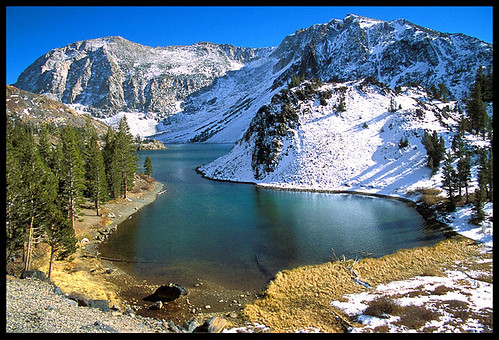
I was reminded of scenius while watching a documentary about rock climbers in Yosemite. The documentary Vertical Frontiers did not make my True Films list of best-ever docs, but it did reveal a new flavor of scenius I had not known before. The particulars of this scene are a fine example of what makes scenius work. ...

Over the next 60 years this scenius would invent most of the modern techniques of rock climbing, and many innovations that would later spill into outdoor skills and gear in general.

But the geography of this scenius is unremarkable. Camp 4 is a nondescript, bland, dusty campground. Building 20 at MIT, the home of fantastic engineering exploits like the improvement of radar, was likewise architecturally boring, almost dilapidated. Soho was blocks of unwanted industrial space. Like these other places, Camp 4 was a generic space with flexibility. However Camp 4 is also a walk-in camp. You need to haul everything on your back. That immediately filters out a lot of wannabes. The absence of cars also keeps everyone around. From the outside you would never guess there was anything special about the place. I think that is true of most scenius. ...

Although many have tried many times, it is not really possible to command scenius into being. Every start up company, or university would like their offices to be an example of scenius. The number of cities in the world hoping to recreate the scenius of Silicon Valley is endless, but very few have achieved anything close. Innumerable art scenes begin and vanish quickly. The serendipitous ingredients for scenius are hard to control. They depend on the presence of the right early pioneers. A place that is open, but not too open. A buffer that is tolerant of outlaws. And some flash of excitement to kick off the virtuous circle. You just can't order this.

What Camp 4 illustrated is that the best you can do is NOT KILL IT. When it pops up, don't crush it. When it starts rolling, don't formalize it. When it sparks, fan it. But don't move the scenius to better quarters. Try to keep accountants and architects and police and do-gooders away from it. Let it remain inefficient, wasteful, edgy, marginal, in the basement, downtown, in the 'burbs, in the hotel ballroom, on the fringes, out back, in Camp 4.

When it happens, honor and protect it.

Statistics

Locations of visitors to this page

blogspot visitor
Stat Counter

Total Pageviews

Ads

Books

Followers

Blog Archive

Labels

australia (619) global warming (423) solar power (397) peak oil (355) renewable energy (302) electric vehicles (250) wind power (194) ocean energy (165) csp (159) solar thermal power (145) geothermal energy (144) energy storage (142) smart grids (140) oil (139) solar pv (138) tidal power (137) coal seam gas (131) nuclear power (129) china (120) lng (117) iraq (113) geothermal power (112) green buildings (110) natural gas (110) agriculture (91) oil price (80) biofuel (78) wave power (73) smart meters (72) coal (70) uk (69) electricity grid (67) energy efficiency (64) google (58) internet (50) surveillance (50) bicycle (49) big brother (49) shale gas (49) food prices (48) tesla (46) thin film solar (42) biomimicry (40) canada (40) scotland (38) ocean power (37) politics (37) shale oil (37) new zealand (35) air transport (34) algae (34) water (34) arctic ice (33) concentrating solar power (33) saudi arabia (33) queensland (32) california (31) credit crunch (31) bioplastic (30) offshore wind power (30) population (30) cogeneration (28) geoengineering (28) batteries (26) drought (26) resource wars (26) woodside (26) censorship (25) cleantech (25) bruce sterling (24) ctl (23) limits to growth (23) carbon tax (22) economics (22) exxon (22) lithium (22) buckminster fuller (21) distributed manufacturing (21) iraq oil law (21) coal to liquids (20) indonesia (20) origin energy (20) brightsource (19) rail transport (19) ultracapacitor (19) santos (18) ausra (17) collapse (17) electric bikes (17) michael klare (17) atlantis (16) cellulosic ethanol (16) iceland (16) lithium ion batteries (16) mapping (16) ucg (16) bees (15) concentrating solar thermal power (15) ethanol (15) geodynamics (15) psychology (15) al gore (14) brazil (14) bucky fuller (14) carbon emissions (14) fertiliser (14) matthew simmons (14) ambient energy (13) biodiesel (13) investment (13) kenya (13) public transport (13) big oil (12) biochar (12) chile (12) cities (12) desertec (12) internet of things (12) otec (12) texas (12) victoria (12) antarctica (11) cradle to cradle (11) energy policy (11) hybrid car (11) terra preta (11) tinfoil (11) toyota (11) amory lovins (10) fabber (10) gazprom (10) goldman sachs (10) gtl (10) severn estuary (10) volt (10) afghanistan (9) alaska (9) biomass (9) carbon trading (9) distributed generation (9) esolar (9) four day week (9) fuel cells (9) jeremy leggett (9) methane hydrates (9) pge (9) sweden (9) arrow energy (8) bolivia (8) eroei (8) fish (8) floating offshore wind power (8) guerilla gardening (8) linc energy (8) methane (8) nanosolar (8) natural gas pipelines (8) pentland firth (8) saul griffith (8) stirling engine (8) us elections (8) western australia (8) airborne wind turbines (7) bloom energy (7) boeing (7) chp (7) climategate (7) copenhagen (7) scenario planning (7) vinod khosla (7) apocaphilia (6) ceramic fuel cells (6) cigs (6) futurism (6) jatropha (6) nigeria (6) ocean acidification (6) relocalisation (6) somalia (6) t boone pickens (6) local currencies (5) space based solar power (5) varanus island (5) garbage (4) global energy grid (4) kevin kelly (4) low temperature geothermal power (4) oled (4) tim flannery (4) v2g (4) club of rome (3) norman borlaug (2) peak oil portfolio (1)