Showing posts with label esolar. Show all posts

The Intersection Of Information And Energy  

Posted by Big Gav in , , , , ,

Technology Review has a series of reports on the intersection of computing and the electrical grid, including this article by eSolar's Bill Gross on improving the price and performance of solar thermal power plants - a textbook example of Bucky Fuller's concept of "ephemeralization" - The Intersection Of Information And Energy.

I believe that we will need great ingenuity to enable our planet to provide successfully for more than seven billion human beings, let alone the nine billion that will probably inhabit it by 2050, and I believe that information technology will make this ingenuity possible. Because of fluid marketplaces and an ever more globalized economy, nearly every important resource is becoming scarcer and more costly. Evidence of this is seen in the price not only of oil but also of aluminum, concrete, wood, water, rare-earth elements, and even common elements like copper. Everything is getting more expensive because billions of people are trying creatively to repackage and consume these materials. But there is one resource whose price has consistently has gone down: computation.

The power, cost, and energy use involved in one unit of computation is declining at a more consistent, dependable rate than we have seen with any other commodity in human history. That declining cost curve must be tapped to lower energy prices—and I believe it will be. This will happen as people ask: To achieve my purpose (in designing whatever device or system), can I use more "atoms" or more "bits" (computation power)? The choice will have to be bits, because atoms are going up in price while bits are going down.

Here are a few examples. When designing a car, one can put a bit more effort into stronger, lighter-weight materials, which will increase energy efficiency but possibly drive up cost; or one can put a lot more effort into using computational power to run simulations that optimize the use of materials. Today, computational fluid dynamics allow a designer to accurately design a new shape of car, put it in a computer wind tunnel instead of a physical one, and test 1,000,000 body designs to improve fuel mileage by significant amounts. This was never before possible for those constructing vehicles.

In solar energy, large fields of mirrors or photovoltaic panels can be optimized to be lighter, more reliable, and more power-efficient by putting a $2 microprocessor in every panel. An onboard computer that lets each panel track the sun independently replaces previous systems that used more steel, bigger gears, and bigger gearboxes—basically, more materials. As little as 10 years ago, the computing power and sensors needed to build a closed-loop, sun-tracking solar panel might have cost $2,000, or more than the panel itself, and thus the system would not have been cost effective. But with computing costs coming down by a factor of 1,000 every 15 years, all kinds of new opportunities arise to improve system design.

At eSolar, one of our companies, we designed and built a utility-scale solar-thermal power plant with a huge amount of computation embedded into the field of mirrors. We reduced the size of the components, cut the installation expense, and drove the cost of the system down to nearly half what had been achieved before. This experience proved to me the feasibility of replacing atoms with bits.

The price reduction curve for computing is not over—it's continuing, and each year will open up further avenues for ingenuity. That is important because our current energy resources are not at all easy to compete with. Fuels that we dig out of the ground and burn are extremely cheap. They are, in effect, the concentrated storage of millions of years of sunlight falling on Earth. Ironically, the biggest component of energy costs is the expense of moving the fuel to consumers from where it's obtained—and transportation costs are mostly fuel, too. So we are in a kind of vicious cycle. The way to break free of fossil fuels is to introduce something new to our energy equation that isn't fuel.

I believe ingenuity in the form of information technology is the only variable that offers sufficient leverage. We need to replace a cheap, unsustainable form of energy with sustainable forms of energy that are equally cheap. The only way to compete with cheap fuels is to be more clever with computation; that is, to use as little of anything else as possible.

Improving The Performance Of Solar Thermal Power  

Posted by Big Gav in , , , , ,

The US Department of Energy granted a US$1.37 billion loan guarantee to Brightsource Energy last week which could help clear the way for over 15 gigawatts of solar thermal power projects in California. Brightsource built a pilot plant in Israel to prove their technology and has tested it over the past 18 months. Their flagship Ivanpah project in California got a big boost when construction giant Bechtel agreed to build the plant.

Solar thermal (often referred to as CSP) is a way of harnessing the largest source of energy available to us, so in this post I'll have a look at the upswing in interest in the technology in recent years and look at some of the approaches being pursued to make it economically competitive with coal fired power generation.


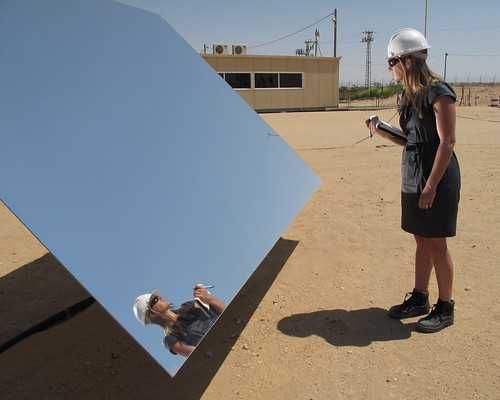
Photo credit: http://www.flickr.com/photos/jurvetson/


One-time Australian solar thermal company Ausra was the leader in terms of publicity a couple of years ago when I last covered this topic, but the company seems to have slipped off the pace, failing to build a large scale facility and recently being purchased by French energy company Areva.

Interest continues to bubble away in solar thermal power in Australia, with energy policy advocacy group "Beyond Zero Emissions" launching their "T10" campaign to switch Australia to 100% renewable power in a decade, largely using solar thermal power, and the Desertec Asia proposal also featuring CSP heavily. At one point Prime Minster Kevin Rudd was promising to build the world's largest CSP plant here but that idea hasn't had any media airtime lately - and neither has Worley Parsons' proposal to build a large scale plant in north west WA. The most active plans to build a local CSP plant seem to be coming out of ERM Power, who are proposing gas / solar hybrid plants to be built in Queensland and/or NSW in conjunction with Siemens.

The company making the most waves from a technology point of view lately is Californian company eSolar, founded by IdeaLab's Bill Gross. eSolar has been in the news lately as a result of their partnership to construct turnkey CSP systems with German company Ferrostaal in Spain, the United Arab Emirates and South Africa. eSolar has also received attention for Chinese plans to build 2000 MW of combined solar/biomass facilities using their technology.

eSolar's Gross was recently interviewed for Yale Environment 360 and outlined his vision for improving the performance of solar thermal power generation, with some of his key points being :

* Use software to analyse and optimise performance of plants
The biggest lesson that we brought was — I don’t know if it was a lesson, but it was a philosophy — which is Internet-enable everything and put monitoring into everything.

So we have a microprocessor in every mirror and we have statistics second-by-second on the status, position, reliability, pointing accuracy — everything — of every single mirror. We structured ourselves almost like an Internet company from the beginning to have logs of everything — every revolution of the turbine, every control from the control room, every Web cam image captured — so we could do data mining and data analysis on everything.

We want the ability to make software upgrades and impact every power plant around the world. That’s probably one of the biggest differences between our technology and all other solar technology. If you [have] a big field of [photovoltaic] panels, those PV panels are there for 25 years. They’ll have that same performance, and there’s nothing you can do to change that.

We can make a software upgrade and every power plant in the world can suddenly put out 3 percent more power potentially. And we found already a number of software improvements that we can make even over the past six months, which significantly boosts performance of an already-constructed power plant. There’s new improvements we can make to the actual hardware, too, but even without changing the hardware there are software changes that can make more power, so we’re really excited about that.

* Don't build plants, get utilities (customers) to.
For renewable energy, about 80 percent, maybe 90 percent, of the cost is upfront and there’s no fuel costs and the only cost over the years is operation and maintenance, which is small. The biggest bottleneck is that these things cost big dollars, and you’re limited how fast you can grow by how much money you can raise to build plants.

Our particular strategy to deal with that is to not have us be the bottleneck for raising that money. Our customers raise that money. If we want to renewably power this planet, it’s going to take a lot of capital, and that capital has to be spent upfront.

* Avoid environmental conflicts and transmission line costs by building smaller plants on brownfield sites near cities.
We have a strategy at eSolar to never impact pristine land. And the way we address that is several-fold. First, we have a higher output per acre, so we take a smaller footprint. Second, we’re economical at a smaller size. We can be fully economical at our 46-megawatt size. Those two things combined let us use a small enough footprint that we can locate on private land closer to population centers.

So rather than needing 2,000 acres contiguous to make the economics work — which you almost only can find far away on pristine land or [federal] land — we can locate on only 200 acres very close to a city and we can buy previously disturbed farmland or other properties that’s already been developed so we’re not causing any disturbance to natural habitat. And that’s an important part of our philosophy. It gives us an economic advantage because we’re locating closer to transmission. That’s probably even a bigger factor.

It takes years and years to build the transmission out to the pristine lands. [But] the power plant, for example, in Lancaster [California], is across the street from a transmission line. We didn’t have to build miles and miles of transmission, which takes years and years to get people to approve.

* Leverage energy storage and volume of scale in manufacturing to reduce costs.
I feel we still need to get almost another factor of two in the reduction of energy costs to potentially compete with coal. We’re already close to competing with natural gas. It depends on the sunshine and the region. Another factor of two is going to require two things to make that happen: Approximately 25 percent of that can be gotten by adding [energy] storage, and 25 percent can be gotten by increasing efficiency and lowering costs by volume production.

We produced 500 mirrors two years ago, 24,000 last year, and this year we’ll produce a million. So we’re going to get a quantity break just by going to a million mirrors from 24,000.

And everything gets more efficient in the supply chains as you get up to those volumes. Anything that we buy in our lives that has dramatic cost reduction has seen a million — a million cars, or a million iPhones, or a million laptops. So far there’s only been thousands of heliostats. So finally this year we’ll cross the million number and that’s when we can get the price reduction to really be competitive with fossil fuels.

Google recently announced they have developed a prototype for a new mirror technology that could cut by half the cost of building a solar thermal plant, with both eSolar and BrightSource expressing interest in using the technology.

A High-Tech Entrepreneur On the Front Lines of Solar  

Posted by Big Gav in , , , , ,

Todd Woody (who seems to be writing for half the green business periodicals in the US) has an interview with (solar thermal power company) eSolar CEO Bill Gross at Yale Environment 360 - A High-Tech Entrepreneur On the Front Lines of Solar. Gross talks about how techniques from the software industry are being applied to continuously improve the performance of next generation CSP plants, how the Chinese market is moving much faster than that in the US, how eSolar tries to build smaller plants on private land close to cities to avoid the transmission bottlenecks plaguing remote locations currently and what is needed to make CSP cost competitive with coal fired power.

Bill Gross is not your typical solar energy entrepreneur. In a business dominated by Silicon Valley technologists and veterans of the fossil fuel industry, Gross is a Southern Californian who made his name in software. His Idealab startup incubator led to the creation of companies such as eToys, CitySearch, and GoTo.com. The latter pioneered search advertising — think Google — and was acquired by Yahoo for $1.6 billion in 2003.

That payday has allowed Gross to pursue his green dreams. (As a teenager, he started a company to sell plans for a parabolic solar dish he had designed.) Over the past decade, Gross has launched a slew of green tech startups, including solar power plant builder eSolar, electric car company Aptera, and Energy Innovations, which is developing advanced photovoltaic technology.

But it has been eSolar, backed by Google and other investors, that has been Idealab’s brightest light. In January, the company signed one of the world’s largest green-energy deals when it agreed to provide the technology to build solar farms in China that would generate 2,000 megawatts of electricity — at peak output the equivalent of two large nuclear power plants. And last week, eSolar licensed its technology to German industrial giant Ferrostaal to build solar power plants in Europe, the Middle East, and South Africa. Those deals followed eSolar partnerships in India and the U.S.

ESolar’s power plants deploy thousands of mirrors called heliostats to focus the sun’s rays on a water-filled boiler that sits atop a slender tower. The heat creates steam that drives an electricity-generating turbine. Last year, eSolar built its first project, a five-megawatt demonstration power plant, called Sierra, in the desert near Los Angeles.

This “power tower” technology is not new, but what sets the company apart is Gross’ use of sophisticated software and imaging technology to control the 176,000 mirrors that form a standard, 46-megawatt eSolar power plant. That computing firepower precisely positions the mirrors to create a virtual parabola that focuses the sun on the tower. That allows the company to place small, inexpensive mirrors close together, which dramatically reduces the land needed for the power plant and cuts manufacturing and installation costs. ...

e360: Were there any particular lessons you were able bring from the Internet industry to the solar industry?

Gross: The biggest lesson that we brought was — I don’t know if it was a lesson, but it was a philosophy — which is Internet-enable everything and put monitoring into everything.

So we have a microprocessor in every mirror and we have statistics second-by-second on the status, position, reliability, pointing accuracy — everything — of every single mirror. We structured ourselves almost like an Internet company from the beginning to have logs of everything — every revolution of the turbine, every control from the control room, every Web cam image captured — so we could do data mining and data analysis on everything.

We want the ability to make software upgrades and impact every power plant around the world. That’s probably one of the biggest differences between our technology and all other solar technology. If you [have] a big field of [photovoltaic] panels, those PV panels are there for 25 years. They’ll have that same performance, and there’s nothing you can do to change that.

We can make a software upgrade and every power plant in the world can suddenly put out 3 percent more power potentially. And we found already a number of software improvements that we can make even over the past six months, which significantly boosts performance of an already-constructed power plant. There’s new improvements we can make to the actual hardware, too, but even without changing the hardware there are software changes that can make more power, so we’re really excited about that. ...

e360: At a time when some big solar power plant projects are bogged down in disputes over their environmental impact on desert ecosystems and their water consumption, eSolar so far has avoided such controversies.

Gross: We have a strategy at eSolar to never impact pristine land. And the way we address that is several-fold. First, we have a higher output per acre, so we take a smaller footprint. Second, we’re economical at a smaller size. We can be fully economical at our 46-megawatt size. Those two things combined let us use a small enough footprint that we can locate on private land closer to population centers.

So rather than needing 2,000 acres contiguous to make the economics work — which you almost only can find far away on pristine land or [federal] land — we can locate on only 200 acres very close to a city and we can buy previously disturbed farmland or other properties that’s already been developed so we’re not causing any disturbance to natural habitat. And that’s an important part of our philosophy. It gives us an economic advantage because we’re locating closer to transmission. That’s probably even a bigger factor.

It takes years and years to build the transmission out to the pristine lands. [But] the power plant, for example, in Lancaster [California], is across the street from a transmission line. We didn’t have to build miles and miles of transmission, which takes years and years to get people to approve. ...

e360: Where do you see the next big innovations in solar thermal technology coming from?

Gross: I feel we still need to get almost another factor of two in the reduction of energy costs to potentially compete with coal. We’re already close to competing with natural gas. It depends on the sunshine and the region. Another factor of two is going to require two things to make that happen: Approximately 25 percent of that can be gotten by adding [energy] storage, and 25 percent can be gotten by increasing efficiency and lowering costs by volume production.

We produced 500 mirrors two years ago, 24,000 last year, and this year we’ll produce a million. So we’re going to get a quantity break just by going to a million mirrors from 24,000.

And everything gets more efficient in the supply chains as you get up to those volumes. Anything that we buy in our lives that has dramatic cost reduction has seen a million — a million cars, or a million iPhones, or a million laptops. So far there’s only been thousands of heliostats. So finally this year we’ll cross the million number and that’s when we can get the price reduction to really be competitive with fossil fuels.

eSolar & Ferrostaal To Provide Turnkey Solar Thermal Plants  

Posted by Big Gav in , ,

REW reports that solar thermal power company eSolar are looking to sell turnkey CSP systems in partnership with Ferrostaal in the EMEA region - eSolar & Ferrostaal To Provide Turnkey Solar Thermal Plants.

eSolar and Ferrostaal AG have agreed to form a partnership that will deploy turnkey solar power plants in Spain, the United Arab Emirates and South Africa.

Under the agreement, eSolar will provide solar field and receiver technology, while Ferrostaal will provide the power block as well as manage the overall realization as general contractor, including financing activities.

“This partnership with Ferrostaal is a real coup for eSolar,” said John Van Scoter, CEO of eSolar. “Ferrostaal’s extensive construction capacity and expertise – particularly in the concentrated solar thermal field – together with eSolar’s award-winning technology, offers us the opportunity to rapidly construct solar power projects across the globe in coming years.”

eSolar unveiled Sierra SunTower, a 5 MW commercial-scale solar power plant, in the summer of 2009. Located in Lancaster, California, Sierra SunTower is the only power tower facility currently operating in North America. eSolar has continued the momentum of its international development with three licensing partnerships across three continents, including China.

Solar and Biomass Plants to Work in Tandem in China  

Posted by Big Gav in , , ,

Todd Woddy has an article in the New York Times on solar thermal power plants using biomass to generate power around the clock - Solar and Biomass Plants to Work in Tandem in China. A longer version can be found at Grist.

China’s plans to build 2,000 megawatts of solar thermal power using technology from a California company, eSolar, will also include the construction of biomass power plants to generate electricity when the sun sets.

The solar and biomass plants will share turbines and other infrastructure, reducing the projects’ cost and allowing around-the-clock electricity production, according to Bill Gross, eSolar’s chairman.

“That supercharges the economics of solar,” said Mr. Gross in a telephone interview, noting that the addition of biomass generation will allow power plants to operate at 90 percent of capacity.

Under terms of the deal announced Saturday in Beijing, eSolar will license its “power tower” technology to Penglai Electric, which will manage the construction of the power plants over the next decade.

Another Chinese company, the China Shaanxi Yulin Huayang New Energy Company, will own and operate the first projects to be built in the 66-square-mile Yulin Energy Park in northern China.

A local shrub grown in the surrounding region to fight desertification, called the sand willow, will supply fuel for the biomass power plants, according to Penglai Electric.

“It’s an economical use of a resource that’s already in place,” said Nathaniel Bullard, a solar analyst with Bloomberg New Energy Finance, a research and consulting firm. “That’s a very savvy move, rather than attach an energy storage system to the solar project.”

(A 107-megawatt project in California being developed by a Portuguese developer plans to use a similar biomass hybrid solar design.)

As The Times’ Keith Bradsher pointed out in his story, one issue with solar power plants in China is the large amount of land they require.

Eric Wang, a spokesman for Penglai Electric, wrote in an e-mail message that the relatively small footprint of an eSolar plant compared with other solar technologies proved attractive to the Chinese developer of the $5 billion project.

The Next Great Leap Forward ?  

Posted by Big Gav in , , , ,

Todd Woody at Grist has a report on interest in solar thermal power (and eSolar in particular) in China - China powers the global green tech revolution. More at The New York Times.

Forget Red China. It’s Green China these days—at least when it comes to making big renewable deals.

eSolar power plant. eSolar power plant. Friday night, a Chinese developer and eSolar of Pasadena, Calif., signed an agreement to build solar thermal power plants in the Mongolian desert over the next decade. These plants would generate a total of 2,000 megawatts of electricity. It’s the largest solar thermal project in the world and follows another two-gigawatt deal China struck in October with Arizona’s First Solar for a massive photovoltaic power complex. Altogether, the eSolar and First Solar projects would produce, at peak output, the amount of electricity generated by about four large nuclear power plants, lighting up millions of Chinese homes.

Is China the new California, the engine powering the green tech revolution?

Yes and no. When it comes to technological and entrepreneurial innovation, Beijing lags Silicon Valley (and Austin, Boston, and Los Angeles)—for now. But as a market, China is likely to drive demand for renewable energy, giving companies like eSolar the opportunity to scale up their technology and drive down costs.

[We’ll pause here to state the obvious: China’s investment in renewable energy and other green technologies is miniscule compared to the resources devoted to its continued building of coal-fired power plants and efforts to secure dirty oil shale supplies in Canada and elsewhere.]

“All the learning from this partnership will help us in the United States,” Bill Gross, eSolar’s founder and chairman, told me. “I think as soon as the economy improves in the rest of the world and banks start lending, there will be a lot of competition in the U.S. and Europe. But, until then, China has the money and the demand.”

In a one-party state, a government official saying, “Make it so,” can remove obstacles to any given project and allocate resources for its development. Construction of the first eSolar project, a 92-megawatt power plant, in a 66-square-mile energy park in northern China, is set to begin this year

“They’re moving very fast, much faster than the state and U.S. governments are moving,” says Gross, who is licensing eSolar’s technology to a Chinese firm, Penglai Electric, which will manage the construction of the power plants. Another Chinese company will open and operate the projects.

For the past two-and-a-half years in California, meanwhile, the state’s first new solar thermal power plant in two decades has been undergoing licensing as part of an extensive environmental review process. The goal is to maximize production of carbon-free electricity from BrightSource Energy’s 400-megawatt Ivanpah Solar Electric Generating System project in the Mojave Desert while minimizing its impact on fragile ecosystems.

The end game begins Monday in Sacramento at a public hearing where BrightSource will face off with environmental groups that argue the project will harm the imperiled desert tortoise and destroy the habitat for a host of plants and animals.

In contrast, it was only six months ago that executives from Penglai Electric first contacted eSolar as they scoured the world for a technology to use in that nation’s first big foray into solar thermal power.

China leads the world in production of photovolatic panels like those found on residential and commercial rooftops, but the country has had little experience with solar thermal technology, which uses arrays of mirrors called heliostats to heat a liquid to create steam that drives an electricity-generating turbine.


China might be making headlines but there is still a steady trickle of new solar project announcements from the US - Solar project proposed north of Reno.
A large solar energy project is being proposed by Vidler Water Co. on up to 1,000 acres north of Reno. Project backers say construction could start next year and be phased in over the next 10 to 15 years if approved by county and regional officials, the Reno Gazette-Journal reported. The proposed 100-megawatt farm would be among the largest in the nation, officials said.

Nevertheless, US cleantech investment has dropped from the previous year;s boom levels - Clean Technology Investing Slips, but Could Be Worse, Report Finds.
In a flurry of deal making bolstered by government subsidies for renewable energy, venture capitalists invested $5.6 billion in green technology companies worldwide in 2009, according to a preliminary report released Wednesday by the Cleantech Group and Deloitte.

That represents a 33 percent drop from the $8.5 billion invested in 2008, a reflection, the report said, of the global economic downturn. But the overall amount of venture capital fared much worse, retreating to 2003 levels, according to the report, whereas clean technology investments were on track to match 2007 levels.

“In 2009, clean-tech went from a niche category to become the dominant category in venture capital investing,” said Dallas Kachan, managing director of the Cleantech Group, a San Francisco market research and consulting firm. “Clean-tech continued to outpace software and biotech.”

The report’s preliminary survey showed that there were 557 deals in the clean technology space in 2009, compared to 567 deals in 2008 and 488 in 2007.

Solar companies secured $1.2 billion in 2009 — 21 percent of the total and the largest share of venture funding. The biggest deal of the year also went to a solar company, Silicon Valley’s Solyndra, which raised $198 million at the same time it secured a $535 million federal loan guarantee to build a solar module factory.

eSolar takes solar thermal to Sub-Saharan Africa  

Posted by Big Gav in , , ,

Cleantech.com has a post on efforts to bring solar thermal power technology to Africa - eSolar takes solar thermal to Sub-Saharan Africa.

Pasadena, Calif.-based eSolar said today its signed a deal with Johannesburg-based Clean Energy Solutions to sell and market the startup's solar thermal power plants in Sub-Saharan Africa.

The deal gives eSolar a presence on three continents. The company is operating a 5-megawatt demonstration facility in California, and has signed deals with developers in the U.S. and India (see eSolar completes 5-MW power-tower solar plant as NRG waits in wings).

Cleantech.com also has a new report on the state of the solar thermal market - Cleantech Group picks winners and losers in concentrated solar thermal.
Sub-sectors of the concentrated solar thermal (CST) market still offer ample opportunities for venture-stage capital investment, according to a report released today by the Cleantech Group.

In addition to high-profile emerging CST technologies, many of the high-growth areas lie outside traditional solar investing, including innovations to components such as steel, coating material and heat-transfer fluid, the report says.

The Cleantech Group’s Concentrated Solar Thermal report predicts trough-based CST systems will be most prevalent until 2012 or 2013 but then could be displaced by power towers, compact linear Fresnel reflectors (CLFR) and dish-engine developers if the technology advances more quickly. Still, the report says, additional investment opportunities exist in follow-on rounds for all the technologies.

"Troughs will dominate the first generation of CST. It's project financeable today because we know the costs, we know the technologies, and there are no technology risks. Developers have a roadmap to bring down the cost," said Brian Fan, senior director of research for the Cleantech Group.

"But if the power-tower concept is proven in the field in test operations, because of higher thermodynamic efficiency and higher scalability, I believe power tower will be the next generation of CST plants past 2012," he said.

eSolar and computing power  

Posted by Big Gav in , ,

Grist has an article from Todd Woody on the progress of solar thermal power company eSolar - For eSolar, clean energy starts with computing power.

I’m sitting in the back of a black Lincoln Continental with eSolar CEO Bill Gross on the downward glide into Antelope Valley, a sun-blasted stretch of semi-suburbanized desert northeast of Los Angeles. We’re on our way to take a look at an alternative future called Sierra, the Google-backed startup’s first solar power plant and the prototype for what might be called Solar 2.0—green energy that’s as much a product of software and computing firepower as steel and glass.

California has become an epicenter of green tech innovation, and I’ve written endlessly about the stream of Big Solar deals utilities have signed to carpet the Golden State with solar farms. Most, however, exist only as futuristic artist renderings (and some undoubtedly will remain frozen in PowerPoint). But steel is starting to go to ground and a shakeout is inevitable—the winners will be those solar technologies that produce the most carbon-free electricity at the cheapest prices.

“Two years ago when we were developing this design we looked at all the resources that go into making a solar plant and the cost of virtually all those commodities—steel, copper, aluminum—was going up,” says Gross, a laptop balanced on his knees. “The only thing going down was the cost of processing power. So we consciously decided to trade a design that needed much more computational power in return for using less materials.”

In an industry populated by engineers and scientists, Gross is a software guy with some serious smarts. Some of the dot-com era companies hatched by his Idealab tech incubator might ring a bell - eToys, CitySearch, GoTo.com. That last one pioneered search advertising, an idea later embraced by a little startup called Google. Yahoo subsequently bought GoTo for $1.6 billion. Gross walked away from the crash of ‘01 with a lot of cash to play with, and he went on to start a series of alt-energy companies. (The roof of Idealab’s Pasadena headquarters is a Mr. Wizard’s workshop of solar, with prototypes of various photovoltaic technologies silently working away under the sun.)

Gross’ solar dreams began as a teenager during the 1973 oil crisis. “I started making little parabolic dishes out of cardboard and tinfoil and then started making them out of metal in metal shop,” he says. The 15-year-old started his first company, Solar Devices, and began selling plans for solar dishes in the back of Popular Science magazine for $4 a pop. Ten thousand sales later he had his tuition to Cal Tech in the bank.

Like his rivals at other solar startups, Gross is determined that the current solar boom won’t be a repeat of that ‘70s show—when solar farms blossomed in the Mojave Desert but their builders went bankrupt when oil prices dropped and interest in (and tax breaks for) alternative energy became as fashionable as Farah Fawcett.

“The only way you’re going to make a big enough impact is if you can compete with fossil fuels with no subsidies, and the only way to do that is at a very large scale,” Gross says as the foreclosed subdivisions of the blue-collar exurb of Palmdale give way to open desert pockmarked by abandoned trailer homes and burnt-out pickups.

Two thin white towers appear on the horizon and we pull off the highway, heading to the construction site of the five-megawatt Sierra demonstration plant. The towers, framed by the snow-capped San Gabriel Mountains, appear to be surrounded by a shimmering lake, an effect created by 24,000 mirrors turned toward the sun. A standard 46-megawatt eSolar farm will have 176,000(!) mirrors.

There’s nothing particularly new about “power tower” solar thermal plants. Arrays of mirrors called heliostats track the sun and focus its rays onto a water-filled boiler that sits atop a tower. The intense heat vaporizes the water and the resulting high-pressure steam drives an electricity-generating turbine like those found in conventional power plants.

eSolar’s innovation is to rely on software and imaging technology rather than complex hardware to concentrate the sun’s energy. The difference becomes apparent as Gross and I don hard hats and walk along the perimeter of the plant, which is swarming with workers installing a giant turbine in the unfinished power block. In other power tower designs, each heliostat is picture window-sized or larger and slightly curved to create a parabola to focus the sun’s rays. That means each mirror must be precisely placed, spaced and calibrated in the field.

These eSolar mirrors, in contrast, are flat and about the size of an LCD television screen, packed tightly together in long rows. They sit seven to a platform that rolls off an assembly line in China with the motors and circuitry built-in. The makes it possible for just two workers to install the “sticks” on concrete ballasts and attach the mirrors. Since the heliostats are small and flat, far less steel is needed to hold them in place.

“The new thing is distributing 176,000 mirrors around a field and pointing them to one spot without requiring a human to calibrate every one of them,” says Gross, who happily bops around Sierra like a boy in a very big toy store - at 50 he still seems like the Doogie Howser of solar. “That’s our key breakthrough.”

It’s all about the algorithm. Flat mirrors won’t focus the sun, so eSolar’s software creates a “dynamic parabola” out of the entire heliostat field to concentrate the sunlight on the power tower. He points to one of the 100-foot cell phone towers that ring the site. Each tower sports several 10 megapixel sensors that constantly scan the solar field, pinpointing the location of each mirror and the sun’s reflection. With the precise position of the sunbeam on each mirror known, eSolar’s software sends messages to the microprocessor in each seven-mirror stick so that the arrays align themselves to form a long sweeping curve across the solar field. That saves the company from doing extensive and expensive surveys to lay out the solar field; if the rows are crooked the software corrects for it.

Not too ago, it would have cost $1,000 for each of the 25,000 microprocessors used in the solar field; today the price is 50 cents. “We use Moore’s law rather than more steel,” Gross likes to quip, referring to Intel co-founder Gordon Moore’s maxim that computing power doubles every two years.

Its Sunny In Spain  

Posted by Big Gav in , , , ,

TreeHugger reports that Acciona has received the go ahead for 2 more 50MW solar thermal power plants in Spain.

It was only a couple months ago that we wrote about Torresol's plans to build 3 new solar thermal power plants in Spain (price tag: $1.24 Billion). The good news keep rolling in and now it is Acciona Energia's turn to announce a 500 million euros investment (about $775 million) into 2 new solar thermal plants in Palma del Río, Cordoba, in southern Spain. Each will have a capacity of 50 megawatts and together they should be able to power 75,000 homes, or 244 million kWh a year. They should be operational in 2010.

"The plants will cover the area of about 260 hectares, or 364 soccer fields, comprising 1,520 solar collectors and a truly mind boggling 364,800 mirrors which will focus the sun’s rays into the collectors. "

This story is a few weeks old but I forgot to post it at the time - Red Herring on US solar thermal company eSolar's plans to make solar power cheaper than fossil fuels.
eSolar, whose large-scale solar power facilities are designed to rival coal-powered plants, has closed on $130 million in funding from Idealab, Oak Investment Partners, and Google.org, the company said Monday.

The Pasadena, California, company, which competes against companies like Ausra (backed by Khosla Ventures) and SolarReserve (funded by United Technologies), plans to build a demonstration facility at an undisclosed location in Southern California later this year, said Rob Rogan, eSolar's executive vice president, corporate development.

"We believe we've cut the cost of solar energy in half," he said, without providing a firm cost per kilowatt hour. "eSolar believes we'll be competitive with fossil fuels.

eSolar plans to use prefabricated modules manufactured oversea to cut the cost of building a solar power plant and allow utilities to build them closer to the cities that will draw their current.

Rather than use mirrors that can run to 100 square meters as other thermal solar systems do, eSolar uses mirrors that are about one square meter. Mr. Rogan said the smaller mirrors give eSolar a 10-fold advantage in concentrating sunlight aimed at tanks filled with water that is turned to steam, which is used to turn steam turbines.

Mr. Rogan acknowledged, however, that the 70-person company's proposed 33-kilowatt power plants, large enough to power 10,000 to 25,000 homes, will be cost-effective only in regions with abundant sun like Caloifornia, Nevada and Australia.

Still, Bill Gross, eSolar Chairman and founder of Idealab, said in a statement that the business model will allow the company to compete against plants fueled by traditional fossil fuels.

“eSolar’s primary business goal is nothing short of making solar electricity for less than the price of coal, without subsidies,” he said.

More at Cleantech.com.


Renewable Energy World has a look at the question - which is cheaper, solar thermal or photovoltaics ?
The short answer would be that on an apples-to-apples comparison in the southwestern United States, concentrating solar thermal parabolic troughs (CST) have a lower levelized cost of energy (LCOE) per kilowatt-hour (kWh) than photovoltaics (PV) today. Outside of the broad southwest (which includes 7-8 states), PV is really the only game in town (at least for now, a CST project in Florida not-withstanding).

Looking forward, PV probably has a faster cost reduction curve than CST and their LCOE will cross paths within the next five years, i.e. PV will become cheaper. Concentrating photovoltaics (CPV) is the wild card that could also reach parity with CST over the next ten years.

The next obvious question is that given cost parity between the three technologies, which one is preferred by utilities?

The cost of energy is not the only criteria for utilities seeking renewable energy. The ability to generate during periods of high demand, including into the evening, makes any renewable technology much more valuable. Additionally, minute-to-minute operating characteristics on the grid, such as the potential for rapid changes in output, are also important, especially at the utility scale.

CST projects can offer both better peak capacity characteristics, with 6-8 hour thermal storage, as well as a smoother short-term fluctuations. Intermittent clouds going over a PV system will cause output to spike widely. But with a CST plant, which has thermal inertia in the heat transfer fluids, an operator can have some warning of the clouds, slow the fluid flow rate, which increases the fluid temperatures, and ride through short-term cloud events. (For reference, a wind turbine probably falls somewhere between the two technologies-there is kinetic inertia in the wind and the turbine blades, which provides a somewhat better short-term profile than PV.)

Of course, utility scale storage technologies for PV are being developed, and in some cases demonstrated. Initially these will provide similar ride-through capabilities during short-term cloud events, but as the storage technologies scale-up, they could potentially offer hourly storage into the evening. But right now in the southwest, CST has the cost and storage advantage, but PV essentially has a geographic monopoly everywhere else.

Statistics

Locations of visitors to this page

blogspot visitor
Stat Counter

Total Pageviews

Ads

Books

Followers

Blog Archive

Labels

australia (619) global warming (423) solar power (397) peak oil (355) renewable energy (302) electric vehicles (250) wind power (194) ocean energy (165) csp (159) solar thermal power (145) geothermal energy (144) energy storage (142) smart grids (140) oil (139) solar pv (138) tidal power (137) coal seam gas (131) nuclear power (129) china (120) lng (117) iraq (113) geothermal power (112) green buildings (110) natural gas (110) agriculture (91) oil price (80) biofuel (78) wave power (73) smart meters (72) coal (70) uk (69) electricity grid (67) energy efficiency (64) google (58) internet (50) surveillance (50) bicycle (49) big brother (49) shale gas (49) food prices (48) tesla (46) thin film solar (42) biomimicry (40) canada (40) scotland (38) ocean power (37) politics (37) shale oil (37) new zealand (35) air transport (34) algae (34) water (34) arctic ice (33) concentrating solar power (33) saudi arabia (33) queensland (32) california (31) credit crunch (31) bioplastic (30) offshore wind power (30) population (30) cogeneration (28) geoengineering (28) batteries (26) drought (26) resource wars (26) woodside (26) censorship (25) cleantech (25) bruce sterling (24) ctl (23) limits to growth (23) carbon tax (22) economics (22) exxon (22) lithium (22) buckminster fuller (21) distributed manufacturing (21) iraq oil law (21) coal to liquids (20) indonesia (20) origin energy (20) brightsource (19) rail transport (19) ultracapacitor (19) santos (18) ausra (17) collapse (17) electric bikes (17) michael klare (17) atlantis (16) cellulosic ethanol (16) iceland (16) lithium ion batteries (16) mapping (16) ucg (16) bees (15) concentrating solar thermal power (15) ethanol (15) geodynamics (15) psychology (15) al gore (14) brazil (14) bucky fuller (14) carbon emissions (14) fertiliser (14) matthew simmons (14) ambient energy (13) biodiesel (13) investment (13) kenya (13) public transport (13) big oil (12) biochar (12) chile (12) cities (12) desertec (12) internet of things (12) otec (12) texas (12) victoria (12) antarctica (11) cradle to cradle (11) energy policy (11) hybrid car (11) terra preta (11) tinfoil (11) toyota (11) amory lovins (10) fabber (10) gazprom (10) goldman sachs (10) gtl (10) severn estuary (10) volt (10) afghanistan (9) alaska (9) biomass (9) carbon trading (9) distributed generation (9) esolar (9) four day week (9) fuel cells (9) jeremy leggett (9) methane hydrates (9) pge (9) sweden (9) arrow energy (8) bolivia (8) eroei (8) fish (8) floating offshore wind power (8) guerilla gardening (8) linc energy (8) methane (8) nanosolar (8) natural gas pipelines (8) pentland firth (8) saul griffith (8) stirling engine (8) us elections (8) western australia (8) airborne wind turbines (7) bloom energy (7) boeing (7) chp (7) climategate (7) copenhagen (7) scenario planning (7) vinod khosla (7) apocaphilia (6) ceramic fuel cells (6) cigs (6) futurism (6) jatropha (6) nigeria (6) ocean acidification (6) relocalisation (6) somalia (6) t boone pickens (6) local currencies (5) space based solar power (5) varanus island (5) garbage (4) global energy grid (4) kevin kelly (4) low temperature geothermal power (4) oled (4) tim flannery (4) v2g (4) club of rome (3) norman borlaug (2) peak oil portfolio (1)
