Showing posts with label oil. Show all posts

Twilight In The Desert ?  

Posted by Big Gav in , , , ,

Bloomberg reports that Matt Simmons may have been right after all - according to data released by Saudi Aramco the Ghawar field appears to have substantial production declines in recent years - The Biggest Saudi Oil Field Is Fading Faster Than Anyone Guessed.

When Saudi Aramco on Monday published its first ever profit figures since its nationalization nearly 40 years ago, it also lifted the veil of secrecy around its mega oil fields. The company’s bond prospectus revealed that Ghawar is able to pump a maximum of 3.8 million barrels a day -- well below the more than 5 million that had become conventional wisdom in the market.

The Energy Information Administration, a U.S. government body that provides statistical information and often is used as a benchmark by the oil market, listed Ghawar’s production capacity at 5.8 million barrels a day in 2017. Aramco, in a presentation in Washington in 2004 when it tried to debunk the “peak oil” supply theories of the late U.S. oil banker Matt Simmons, also said the field was pumping more than 5 million barrels a day, and had been doing so since at least the previous decade.

In his book “Twilight in the Desert,” Simmons argued that Saudi Arabia would struggle to boost production due to the imminent depletion of Ghawar, among other factors. “Field-by-field production reports disappeared behind a wall of secrecy over two decades ago,” he wrote in his book in reference to Aramco’s nationalization.

The new details about Ghawar prove one of Simmons’s points but he missed other changes in technology that allowed Saudi Arabia -- and, more importantly, U.S. shale producers -- to boost output significantly, with global oil production yet to peak.

The prospectus offered no information about why Ghawar can produce today a quarter less than 15 years ago -- a significant reduction for any oil field. The report also didn’t say whether capacity would continue to decline at a similar rate in the future.

Venezuela to issue $5.9 billion in oil-backed cryptocurrency  

Posted by Big Gav in , , ,

Reuters has a report on Venezuela's plans to issue an oil backed alternative currency, apparently trying to leverage the crypto-currency boom to circumvent US sanctions. Using a fossil fuel to back the currency is bad but no worse than the massive waste of energy Bitcoin and other cryptocurrencies represent - Maduro says Venezuela will issue $5.9 billion in oil-backed cryptocurrency.

President Nicolas Maduro said on Friday that Venezuela would issue 100 million units of its new oil-backed cryptocurrency in coming days ... Socialist Maduro surprised many last month when he announced the launch of the cryptocurrency, to be backed by Venezuela’s oil, gas, gold and diamond reserves, as a way to circumvent U.S. sanctions that have hurt Venezuela’s access to international banks.

Charlie Stross on slow AIs  

Posted by Big Gav in , ,

Charlie Stross did an interesting talk to the Chaos Computer Club about the first generation of AIs that is wrecking the plane - Dude, you broke the future!.

History gives us the perspective to see what went wrong in the past, and to look for patterns, and check whether those patterns apply to the present and near future. And looking in particular at the history of the past 200-400 years—the age of increasingly rapid change—one glaringly obvious deviation from the norm of the preceding three thousand centuries—is the development of Artificial Intelligence, which happened no earlier than 1553 and no later than 1844. I'm talking about the very old, very slow AIs we call corporations, of course. What lessons from the history of the company can we draw that tell us about the likely behaviour of the type of artificial intelligence we are all interested in today? ...

What do our current, actually-existing AI overlords want?

Elon Musk—who I believe you have all heard of—has an obsessive fear of one particular hazard of artificial intelligence—which he conceives of as being a piece of software that functions like a brain-in-a-box)—namely, the paperclip maximizer. A paperclip maximizer is a term of art for a goal-seeking AI that has a single priority, for example maximizing the number of paperclips in the universe. The paperclip maximizer is able to improve itself in pursuit of that goal but has no ability to vary its goal, so it will ultimately attempt to convert all the metallic elements in the solar system into paperclips, even if this is obviously detrimental to the wellbeing of the humans who designed it.

Unfortunately, Musk isn't paying enough attention. Consider his own companies. Tesla is a battery maximizer—an electric car is a battery with wheels and seats. SpaceX is an orbital payload maximizer, driving down the cost of space launches in order to encourage more sales for the service it provides. Solar City is a photovoltaic panel maximizer. And so on. All three of Musk's very own slow AIs are based on an architecture that is designed to maximize return on shareholder investment, even if by doing so they cook the planet the shareholders have to live on. ...

The problem with corporations is that despite their overt goals—whether they make electric vehicles or beer or sell life insurance policies—they are all subject to instrumental convergence insofar as they all have a common implicit paperclip-maximizer goal: to generate revenue. If they don't make money, they are eaten by a bigger predator or they go bust. Making money is an instrumental goal—it's as vital to them as breathing is for us mammals, and without pursuing it they will fail to achieve their final goal, whatever it may be. Corporations generally pursue their instrumental goals—notably maximizing revenue—as a side-effect of the pursuit of their overt goal. But sometimes they try instead to manipulate the regulatory environment they operate in, to ensure that money flows towards them regardless.

Human tool-making culture has become increasingly complicated over time. New technologies always come with an implicit political agenda that seeks to extend its use, governments react by legislating to control the technologies, and sometimes we end up with industries indulging in legal duels.

For example, consider the automobile. You can't have mass automobile transport without gas stations and fuel distribution pipelines. These in turn require access to whoever owns the land the oil is extracted from—and before you know it, you end up with a permanent occupation force in Iraq and a client dictatorship in Saudi Arabia. Closer to home, automobiles imply jaywalking laws and drink-driving laws. They affect town planning regulations and encourage suburban sprawl, the construction of human infrastructure on the scale required by automobiles, not pedestrians. This in turn is bad for competing transport technologies like buses or trams (which work best in cities with a high population density).

To get these laws in place, providing an environment conducive to doing business, corporations spend money on political lobbyists—and, when they can get away with it, on bribes. Bribery need not be blatant, of course. For example, the reforms of the British railway network in the 1960s dismembered many branch services and coincided with a surge in road building and automobile sales. These reforms were orchestrated by Transport Minister Ernest Marples, who was purely a politician. However, Marples accumulated a considerable personal fortune during this time by owning shares in a motorway construction corporation. (So, no conflict of interest there!)

The automobile industry in isolation isn't a pure paperclip maximizer. But if you look at it in conjunction with the fossil fuel industries, the road-construction industry, the accident insurance industry, and so on, you begin to see the outline of a paperclip maximizing ecosystem that invades far-flung lands and grinds up and kills around one and a quarter million people per year—that's the global death toll from automobile accidents according to the world health organization: it rivals the first world war on an ongoing basis—as side-effects of its drive to sell you a new car.

BNEF: How EVs are driving the next oil crisis (update)  

Posted by Big Gav in ,

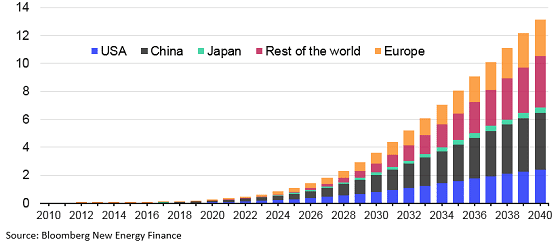
Bloomberg NEF have revised their oil consumption forecasts as electric vehicles expand their market share - Graph of the Day: How EVs are driving the next oil crisis.

When Bloomberg published a story under a version of the above headline at around this time last year, it was based on data predicting that by 2040, 35 per cent of new cars worldwide “would have a plug.” Last week, a new graph based on new data by Bloomberg New Energy Finance has updated the details on how such a global shift electric vehilces might play out for the oil sector.

According to the graph, featured below, some 13 million barrels of oil per day will be displaced by electric vehicles by the year 2040 – an amount, BNEF says, that is equivalent to 14 per cent of the Energy Information Agency’s estimated global crude oil demand in 2016. ...

For the record, that’s slightly down on what BNEF forecast last year: that electric vehicles could displace oil demand of 2 million barrels a day as early as 2023. But we will leave you with Tom Randall’s closing comments on the February 2016 BNEF analysis: “One thing is certain: Whenever the oil crash comes, it will be only the beginning. Every year that follows will bring more electric cars to the road, and less demand for oil. Someone will be left holding the barrel.”

Putin Transfers 19% Of Rosneft to Trump ?  

Posted by Big Gav in , ,

I've been wondering for a while how Putin's rumoured videos of Donald Trump's hobbies would be enough to convince him to run for President hard enough to actually win it.

The carrot to accompany the stick became clearer over the last 24 hours as stories linking the transfer of ownership of 19% of Russian oil company Rosneft to an unknown party - now widely believed to be Trump.

The stories seem to be partially born out by the dossier assembled by ex-MI6 agent Christopher Steele that ended up being put forward by US Intelligence agencies, predicting that 19% of Rosneft would be given to Trump if sanctions were lifted.

This also helps to explain Trump's desire to ally with Russia, his hostility to clean energy and action to reduce global warming, and the likes of oilman Rex Tillerson in his cabinet - rather than just having a yearning for returning the US to the 1950s he now has a large financial interest in maintaining oil as a primary source of energy.

Keeping Iraq unstable in the coming years will no doubt help the oil price, and his personal wealth, increase too.

Trump's Threat To Steal Iraq's Oil  

Posted by Big Gav in , , ,

The spectacle of Donald Trump abruptly transitioning the US political system into open fascism is quite horrifying even from the other side of the Pacific, however by and large ourlocal media aren't bothering to report the details.

Paul McGeough at the SMH gets to do a summary piece each day though (today's piece looking on the blatant blackmail involved in the new anti-muslim immigration laws, with countries that host Trump properties exempt and those without them hit hard - it's more a mafia style shakedown than a real immigration policy).

Long time business writer Michael Pascoe was also moved to voice his shock ("Australia is investing billions in madman Donald Trump") after Trump's bizarre interview with ABC News recently where he once again threatened to steal Iraq's oil.

As I've noted here many times before, Iraq has the world's largest and cheapest to extract oil reserves, and trying to gain control of them was a major reason for the Iraq war.

Bush and the neocons at least tried to maintain a fig leaf of legality around their attempt's to bully the Iraqi government into signing over control of the oil, so Trump's naked imperialism has managed to outrage the entire political spectrum outside of the fascist right.

The Washington Post - Trump’s illegal, impossible, and ‘beyond goofy’ idea of seizing Iraq’s oil.

The United States can’t just walk off with Iraq’s oil when it decides to get out. In 2015, Iraq produced about 4 million barrels a day, enough crude oil to fill more than 700 Trump Towers. Billions of barrels more sit underground in conventional reservoirs. The International Energy Agency has estimated that Iraq could produce twice as much as it does currently — by 2035. That means taking the oil would take decades. That might explain Trump’s suggestion that “a certain group” should be left behind to hold down parts of the country so that the United States could siphon off oil. What he didn’t say is that that group – undoubtedly U.S. soldiers — could be there quite a while. ...

“To ‘take the oil’ would require the United States to occupy Iraq. We tried that after 2003 with something approaching 200,000 troops and it did not work,” said Andrew Bacevich, a retired colonel and professor of history and international relations at Boston University. “What would effective occupation actually require? A minimum of a half-million troops, perhaps more.” Bacevich added, “Presumably, Trump would have them stay until the oil runs out, which would entail an occupation running into decades. The total cost? Probably more than the value of the oil itself. The whole idea is beyond goofy.”

Juan Cole - Trump to CIA: We now have 2nd Chance to take Iraq’s Oil.

The United Nations Charter and other treaty instruments that are part of US law actually abolished the principle of ‘to the victors go the spoils.’ Conquering states in a war are not allowed to annex territory from the vanquished as of 1945. That’s what is wrong with the Israeli creeping annexation of Palestine since 1967.

Given that the US has 6000 troops in Iraq, as Thomas Doherty pointed out, this kind of talk puts them in danger from Iraqi nationalists who may begin seeing them not as allies against ISIL but as stalking horses for a sinister imperialism. Trump just painted a big red target on the backs of our troops. ...

This isn’t speculation: the great Borzou Daragahi reports that the Iraqis are indeed ‘pissed’ and ready to fight for their oil.

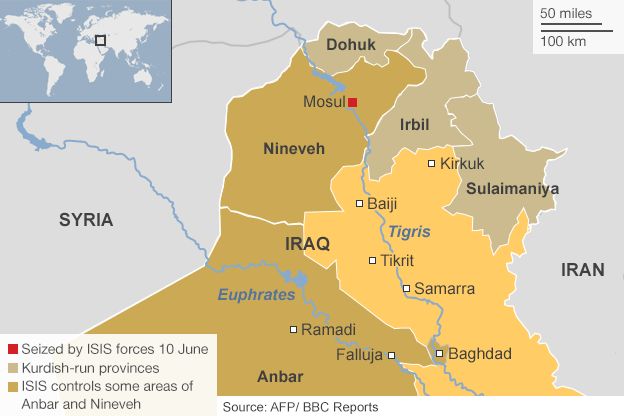
Trump is also wrong that Iraqi petroleum fueled Daesh (ISIS, ISIL), or that the US could have “taken” Iraqi petroleum. This is because he does not know Iraqi geography or political geography. Most oil in Iraq is either down in Shiite territory at Basra (the vast majority of what is pumped) or up in Kurdish-held territory at Kirkuk. Daesh in Iraq had relatively little access to petroleum revenues, and the experts on it believe that contributions from Gulf supporters and taxes and plunder from local people (including on agriculture) were much more important. The situation is perhaps a little different in Syria, but we’re talking about Iraq.

The Independent - Iraq says Donald Trump's threat to seize the country's oil makes no sense.

US enemies and friends would oppose the move. While Iraqi Prime Minister Haider al-Abadi has accepted US help to retake Isis-held territory in his country, he has repeatedly asserted Iraqi sovereignty. He said of Trump's oil vow in November, “I am going to judge him by what he does later.” Reuters reported Mr al-Abadi as saying: “It wasn't clear what he meant. Did he mean in 2003 or to prevent the terrorists from seizing Iraq's oil? Iraq's oil is constitutionally the property of the Iraqis.”

The Atlantic - Why Iraq Needs the Oil.

It is into this delicate situation that Trump has pitched himself, without apparent regard to the consequences. That his threat to strip Iraq of its oil survived his transition into the White House demands careful consideration of what the proposal could actually entail. The U.S. military would not, as Trump has suggested, occupy Iraq to oversee the illegal extraction of crude from its oil fields, which are dispersed across the country. ...

Or he could just push the Iraqi government to award favorable contracts to American companies like ExxonMobil, whose former CEO Rex Tillerson has just been confirmed as secretary of state. Tillerson’s previous escapades, of course, present a cautionary tale. Under Tillerson, ExxonMobil purchased oil rights to land blocks controlled by the KRG in 2011—a deal that directly challenged the authority of the Iraqi government and was partially responsible for an armed stand-off between the Iraqi army and the Kurdish peshmerga.

Tillerson’s record of aggressively asserting corporate interests into decidedly thorny diplomatic climates also reflects the lack of common purpose among Trump’s team. James Mattis, Trump’s secretary of defense, has a record of seeking to confront Iran’s growing influence in Baghdad. Destabilizing Iraq’s oil sector would weaken Baghdad’s hold on the country, thereby strengthening Iran’s position.

The Boston Globe - As Trump muses about seizing Iraq oil, energy experts say it makes no sense.

“This is foolish,” Kenneth Pollack, a senior fellow at Brookings Institution, said. “This is a typical Trump remark. It’s moronic. It makes no sense. We couldn’t just suddenly grab Iraq’s oil and walk away with it.” In order to extract the oil, American forces would need to occupy the country, a costly, dangerous, and politically risky process, Pollack said. He added Iraqi resistance to these efforts would be quite strong given oil is a crucial source of income for the country.

In response to Trump’s comments, Massachusetts Representative Seth Moulton, a former Marine, tweeted on Saturday, “No. That’s pillaging, and it’s a war crime.”

The Guardian - Trump's plan to seize Iraq's oil: 'It's not stealing, we're reimbursing ourselves'.

The idea predates Trump’s presidential campaign. As far back as 2011, he was telling the Wall Street Journal that this was his policy for Iraq. “You heard me, I would take the oil,” he said. “I would not leave Iraq and let Iran take the oil.” And he insisted to ABC News that this did not amount to national theft. “You’re not stealing anything,” Trump said. “We’re reimbursing ourselves … at a minimum, and I say more. We’re taking back $1.5tn to reimburse ourselves.”

As a security strategy, this presents huge problems from almost every angle, according to military, strategic, legal and oil experts. First of all, there are issues of principle and legality. Trump’s frequent invocation of the “spoils of war” seems to hark back to a bygone age of conquistadors and plunder-based imperialism, illegal now under the laws of war.

“In international law, you can’t take civilian goods or seize them. That would amount to a war crime,” Anthony Cordesman, the Arleigh Burke chair in strategy at the Centre for Strategic and International Studies. “Oil exports were almost the only Iraqi source of money. So you would have to pay for government salaries, maintain the army, and you have triggered a level of national animosity far worse than we did. It would be the worst kind of neo-colonialism. Not even Britain did that.”

Jay Hakes, the author of A Declaration of Energy Independence, about the relationship between US national security and Middle Eastern oil, was similarly unsparing. “It is hard to overstate the stupidity of this idea,” he wrote on Real Clear Energy. “Even our allies in the Middle East regard oil in their lands as a gift from God and the only major source of income to develop their countries. Seizing Iraq’s oil would make our current allies against Isis our new enemies. We would likely, at the least, have to return to the massive military expenditures and deployment of American troops at the war’s peak.”

East Timor tears up oil and gas treaty with Australia after Hague dispute  

Posted by Big Gav in , , ,

Rather surprisingly, the most read post from this blog this week is an old one from 2013 - East Timor Complains About Australian Spying On Oil And Gas Negotiations / Australia Detains Whistleblower.

Presumably interest has been piqued by East Timor's recent decision to abandon an earlier agreement on oil and gas revenue sharing from Timor Sea fields - East Timor tears up oil and gas treaty with Australia after Hague dispute. The SMH has an article outlining the case for a better deal for the Timorese - Australia's unscrupulous pursuit of East Timor's oil needs to stop.

East Timor will tear up an oil and gas treaty with Australia that has been at the centre of espionage allegations, international arbitration and a bitter diplomatic dispute. The 2006 treaty relates to a temporary maritime border in the Timor Sea, and access to oil and gas deposits worth an estimated $40 billion. The agreement had outlined a 50-year freeze on negotiations for a permanent border.

But East Timor, also known as Timor-Leste, had claimed the treaty was invalid given Australian intelligence operations in 2004. Diplomatic relations have been tense since East Timorese officials accused Australia of spying on cabinet ministers amid negotiations on the treaty to divide the oil and gas fields.

What reduces women's rights more - Oil or Islam ?  

Posted by Big Gav in

Interesting theory - Oil, Islam, and Women.

This paper suggests that Middle East women are underrepresented in the workforce and in government because of oil—–not Islam. Oil and mineral production can also explain the unusually low status of women in many countries outside the Middle East, including Azerbaijan, Botswana, Chile, Nigeria, and Russia.

Oil production affects gender relations by reducing the presence of women in the labor force. The failure of women to join the nonagricultural labor force has profound social consequences: it leads to higher fertility rates, less education for girls, and less female influence within the family. It also has far-reaching political consequences: when fewer women work outside the home, they are less likely to exchange information and overcome collective action problems; less likely to mobilize politically, and to lobby for expanded rights; and less likely to gain representation in government. This leaves oil-producing states with atypically strong patriarchal cultures and political institutions

We Need to Accept That Oil Is a Dying Industry  

Posted by Big Gav in ,

Motherboard has an article from Nafeez Ahmed on the dim long term prospects for the oil industry - We Need to Accept That Oil Is a Dying Industry.

The future is not good for oil, no matter which way you look at it. A new OPEC deal designed to return the global oil industry to profitability will fail to prevent its ongoing march toward trillion dollar debt defaults, according to a new report published by a Washington group of senior global banking executives. But the report also warns that the rise of renewable energy and climate policy agreements will rapidly make oil obsolete, whatever OPEC does in efforts to prolong its market share. ...

As oil gets more expensive again, there is more incentive to use alternative, cheaper forms of energy—like solar photovoltaics, which can now generate more energy than oil for every unit of energy invested. ...

A report published in October by the Group of 30 (G30), a Washington DC-based financial advisory group run by executives of the world’s biggest banks, warns investors that the entire global oil industry has expanded on the basis of an unsustainable debt bubble. ...

The industry’s long-term debts now total over $2 trillion, the report concludes, half of which “will never be repaid because the issuing firms comprehend neither how dramatically their industry has changed nor how these changes threaten to soon engulf them.”

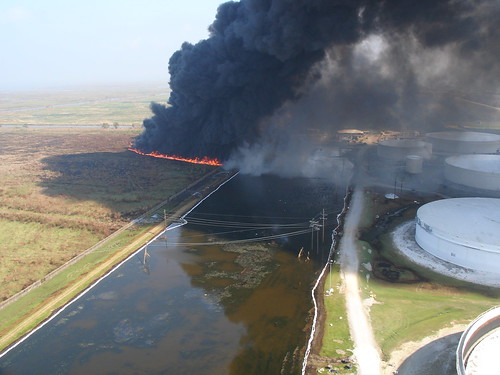
Oil being burned off of a Louisiana marsh after Hurricanes Katrina and Rita

Standing Rock Stands Tall  

Posted by Big Gav in , ,

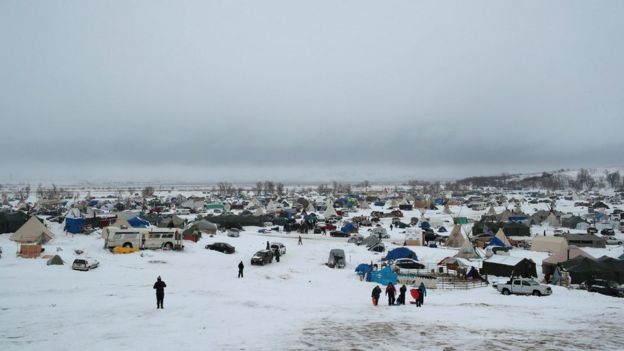
The standoff at Standing Rock was looking like turning to Wounded Knee 3 over the weekend, as a small army of veterans converged on the site to try to defend the "water protectors" protesting against the planned North Dakota Access pipeline.

While Donald Trump's financial ties to the project will no doubt ensure that he will attempt to ensure the success of the project as part of his 4 year plan to increase his wealth at taxpayer expense any way he can, for now the natives and the vets can relax as the Army Corps of Engineers decided to deny the pipeline company a permit for their planned river crossing.

The Army Corps of Engineers will not grant the permit for the Dakota Access pipeline to drill under the Missouri river, the army announced on Sunday, handing a major victory to the Standing Rock Sioux Tribe after a months-long campaign against the pipeline. Assistant secretary for civil works Jo-Ellen Darcy announced the decision on Sunday, with the army saying it was based on “a need to explore alternate routes” for the crossing.

The announcement came just one day before the corps’ deadline for thousands of Native American and environmental activists – who call themselves water protectors – to leave the sprawling encampment on the banks of the river. For months, they have protested over their fears that the pipeline would contaminate their water source and destroy sacred sites, and over the weekend hundreds of military veterans arrived at the camps in a show of support for the movement.

The Economist on The future of oil  

Posted by Big Gav in , ,

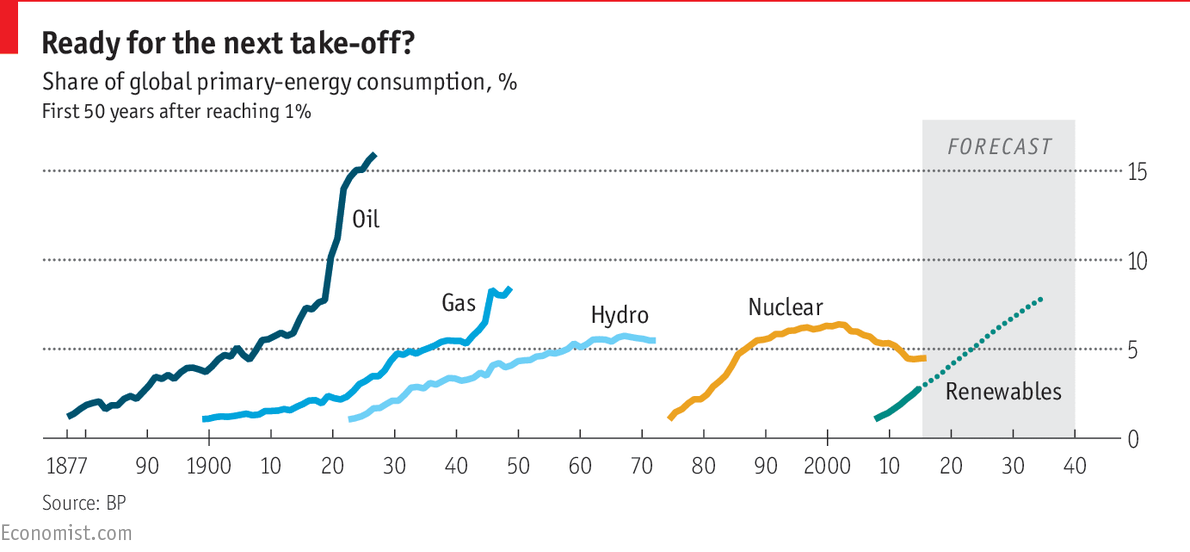
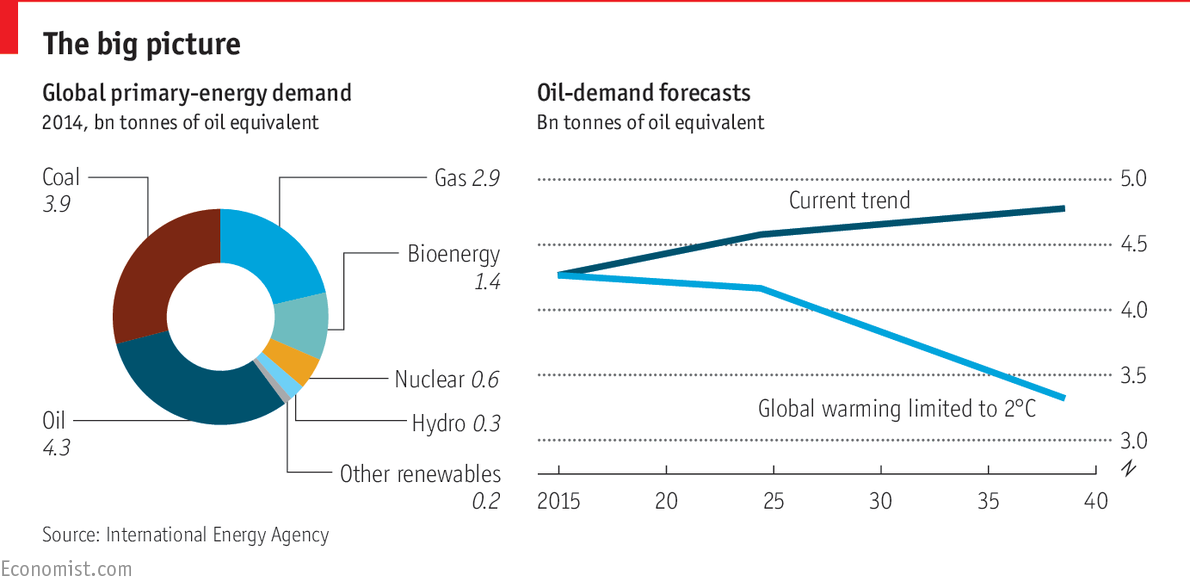
The Economist has a special report on energy, looking at how to break the oil habit - The future of oil.

For all its staying power, oil may be facing its Model T moment. The danger is not an imminent collapse in demand but the start of a shift in investment strategies away from finding new sources of oil to finding alternatives to it. The immediate catalyst is the global response to climate change. An agreement in Paris last year that offers a 50/50 chance of keeping global warming to less than 2ºC above pre-industrial levels, and perhaps limiting it to 1.5ºC, was seen by some as a declaration of war against fossil fuels.

The International Energy Agency (IEA), a global forecaster, says that to come close to a 2ºC target, oil demand would have to peak in 2020 at 93m barrels per day (b/d), just above current levels. Oil use in passenger transport and freight would plummet over the next 25 years, to be replaced by electricity, natural gas and biofuels. None of the signatories to the Paris accord has pledged such draconian action yet, but as the costs of renewable energy and batteries fall, such a transition appears ever more inevitable. “Whether or not you believe in climate change, an unstoppable shift away from coal and oil towards lower-carbon fuels is under way, which will ultimately bring about an end to the oil age,” says Bernstein, an investment-research firm.

Few doubt that the fossil fuel which will suffer most from this transition is coal. In 2014 it generated 46% of the world’s fuel-based carbon-dioxide emissions, compared with 34% for oil and 20% for natural gas. Natural gas is likely to be the last fossil fuel to remain standing, because of its relative cleanliness. Many see electricity powered by gas and renewables as the first step in an overhaul of the global energy system.

This special report will focus on oil because it is the biggest single component of the energy industry and the world’s most traded commodity, with about $1.5trn-worth exported each year. Half of the Global Fortune 500’s top ten listed companies produce oil, and unlisted Saudi Aramco dwarfs them all. Oil bankrolls countries that bring stability to global geopolitics as well as those in the grip of tyrants and terrorists. And its products fuel 93% of the world’s transport, so its price affects almost everyone.

Another article in the report looks out into the post oil future - When oil is no longer in demand.

As the world enters what could be the twilight of the oil age, some wonder whether Aberdeen’s travails could be a harbinger of things to come in oil-producing regions across the world. Mr Spence thinks so. He still runs the smartest hotel in Aberdeen and is about to install a charging station for electric vehicles. ...

Statoil, the Norwegian state oil company, has set an example of what oil companies might do in future. Earlier this year it acquired a lease to build the world’s largest floating wind farm 15 miles off the coast of Peterhead, north of Aberdeen. Each of its five 6MW turbines will be tethered to the seabed on a floating steel base, enabling it to operate in deeper water than a conventional turbine embedded into the sea floor. That will give it access to stronger winds farther offshore, making it cheaper to produce electricity.

Picnic at Standing Rock  

Posted by Big Gav in ,

Protests about the North Dakota pipeline have been going on for more than 6 months now, with recent reports like "Police fire water cannon at Dakota pipeline protesters in freezing weather" and ugly associated video footage becoming more common. Yale Environment 360 has a look at what has been happening - At Standing Rock, A Battle Over Fossil Fuels and Land.

For more than eight months, the Standing Rock Sioux Tribe in North Dakota has been leading a protest to stop an oil pipeline from crossing near its land and potentially threatening its drinking water and sacred sites. In many ways, the battle over the Dakota Access Pipeline, which would carry up to 570,000 barrels of crude oil some 1,200 miles daily, is a traditional fight over Native American land rights. But as indigenous environmental justice expert Kyle Powys Whyte sees it, the demonstration also points to the important role tribes have played in opposing fossil fuel energy projects in recent years, from the Keystone XL pipeline in the U.S. to the Northern Gateway pipeline in Canada.

“Almost everywhere you go, tribes have taken direct action to protect their health and their cultures and their economies from the threats, as well as the false promises of, extractive industries,” says Powys Whyte, an associate professor at Michigan State University who studies climate policy and indigenous peoples and is a member of the Potawatomi Nation.

In an interview with Yale Environment 360, Powys Whyte talks about the long history of coal and oil and gas development on native lands, the longstanding divisions within indigenous communities over allowing such projects, and why the Standing Rock protest has become a lightning rod for opposition to fossil fuels.

A $900 Billion Oil Treasure Lies Beneath West Texas Desert ?  

Posted by Big Gav in , ,

Art Berman has a post at Forbes looking rather skeptically at breathless reports about a "massive oil find" in the Permian basin in Texas (like this one - A $900 Billion Oil Treasure Lies Beneath West Texas Desert) - Permian Giant Oil Field Would Lose $500 Billion At Today's Prices. Tim Worstall isn't very impressed either - The Midland Basin Wolfcamp Shale Is Not Worth $900 Billion - That's Not How Resource Economics Works.

Read the source–the U.S. Geological Survey. The USGS did an assessment of the undiscovered, technically recoverable resources of the Wolfcamp shale in the Permian basin. “Undiscovered” means what it says–it has not been discovered. It’s an estimate, an educated guess. ”Technically recoverable resources” means the oil that could be produced if cost didn’t matter.

Where Did $900 Billion Come From?

Where did the $900 billion value come from? Multiply 20 billion barrels times $45 per barrel and you get $900 billion. In other words, if the oil magically leaped out of the ground without the cost of drilling and completing wells; if there were no operating costs to produce it; if there were no taxes and no royalties.

Trump & Woolsey: Was There a Bait-and-Switch?  

Posted by Big Gav in , , ,

Counterpunch has a look at the unlikely presence of ex CIA director (and prominent Iraq war era neco, "geo green" and peak oil proponent) James Woolsey in Team Trump - Trump & Woolsey: Was There a Bait-and-Switch?.

The article has an interesting section on the motley collection of characters, including Dick Cheney and Rupert Murdoch, that are behind a company called genie Energy looking to exploit oil fomrations in Syria's Golan Heights region.

For voters hoping to ease global tensions and diminish the threat of World War III, Donald Trump seemed to be saying some sensible things on the campaign trail. He questioned the role of NATO, and the use of “regime change” by the U.S. against other nations. He asked why the U.S. and Russia couldn’t be partners rather than belligerents. He even questioned why the U.S. must always play the role of the world’s policeman and suggested that the U.S. should turn its attention to solving its own domestic problems. Such campaign rhetoric was unusual and likely struck a chord with some war-weary listeners.

But in early September 2016, in a move that should have received far more attention than it did, Trump appointed former CIA director James Woolsey as his senior advisor on national security issues. Woolsey – a key member of the neoconservative Project for a New American Century (PNAC) – had been a strong advocate for invading Iraq in 2003 and for waging war throughout the Middle East.

Big Trouble At ExxonMobil ?  

Posted by Big Gav in , ,

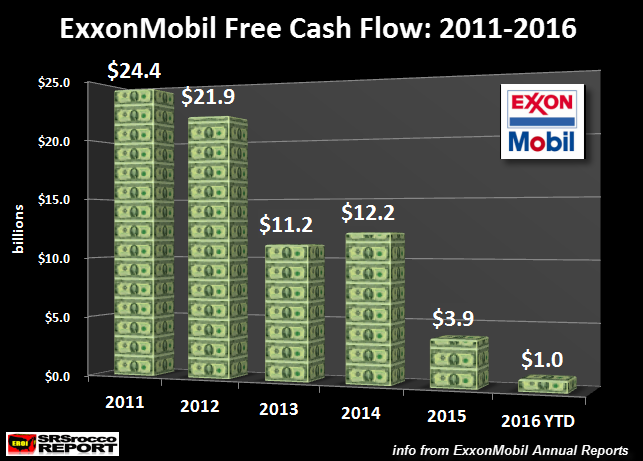
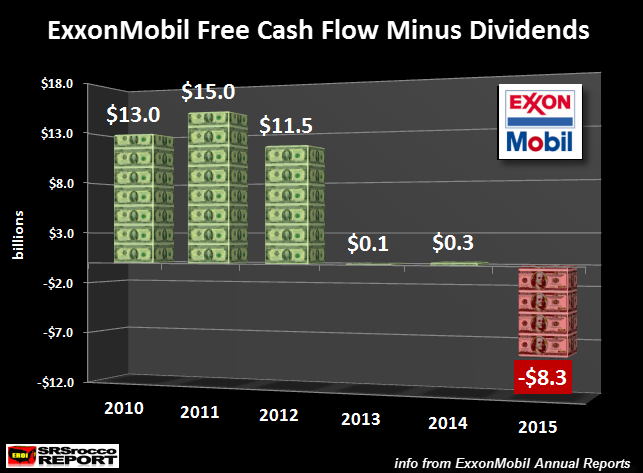
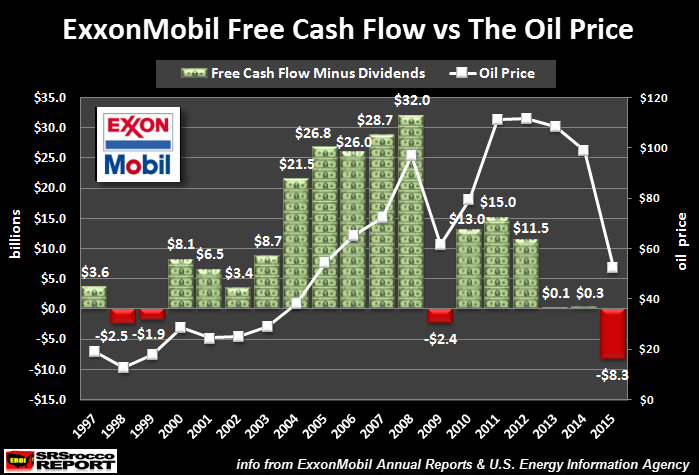
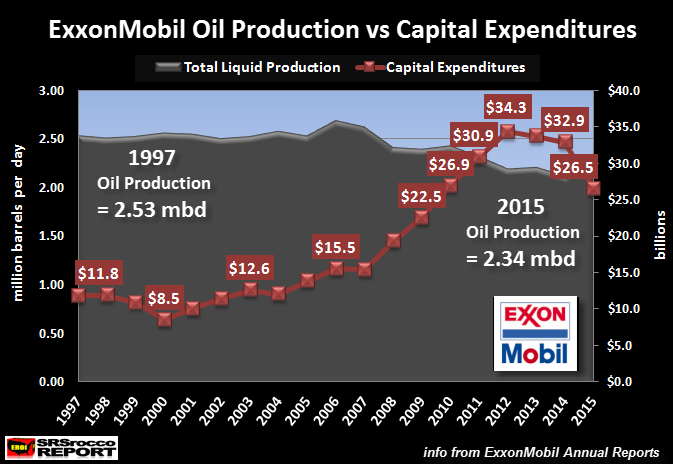
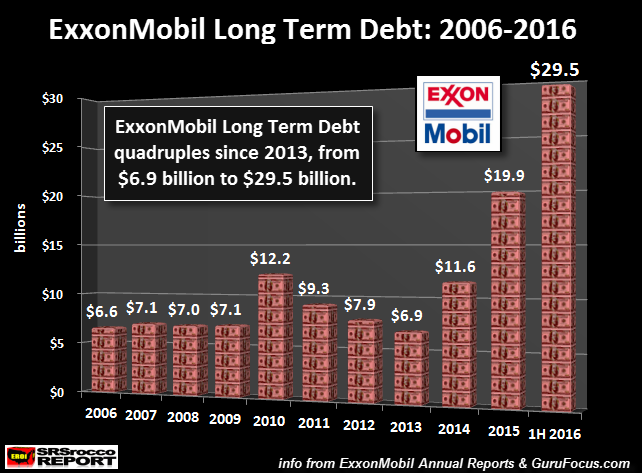
Zero Hedge has an article by SRSrocco on Exxon's inability to increase oil production as production costs rise - END OF THE U.S. MAJOR OIL INDUSTRY ERA: Big Trouble At ExxonMobil.

in 1997, Exxon spent $11.8 billion on capital expenditures while producing 2.5 million barrels per day (mbd) of oil. However, their capital expenditures nearly tripled to $34 billion in 2012 as total liquid production fell to 2.2 mbd. Basically, Exxon spent three times more money in 2012 to produce 300,000 barrels per day less than it did in 1997. ...

It seems as if Exxon realized early on that peak oil had finally arrived (privately, of course), so it decided to not waste too much money on future oil projects. Instead, the company spent a massive amount of money on stock repurchases over the past two decades... especially since 2005.

China's growing oil stockpile  

Posted by Big Gav in ,

The Washington Post has an article on China's strategic oil reserve - China may be stockpiling more oil than anyone realized.

One of the mysteries of the oil market is the question of how much crude oil China has squirreled away in commercial and strategic stockpiles.

Now a satellite-imaging firm called Orbital Insight claims to have an answer. It says Chinese inventories in May stood at 600 million barrels, substantially more than commonly thought and nearly as much as the U.S. Strategic Petroleum Reserve. Chinese storage capacity, which includes working inventory, is four times widely used estimates, Orbital Insight says, adding that the firm has not only counted storage tanks but has also used imaging techniques to figure out how much oil is in the tanks.

The issue could influence expectations in oil markets. If China has built larger reserves than previously estimated, that means much of what looked like oil demand over the past couple of years was not a result of higher consumption but of strategic planning.

Bloomberg on Saudi Arabian Petrodollar recycling  

Posted by Big Gav in ,

Bloomberg has an article on the volume of oil money that Saudi Arabia has recycled into US treasuries - The Untold Story Behind Saudi Arabia’s 41-Year U.S. Debt Secret.

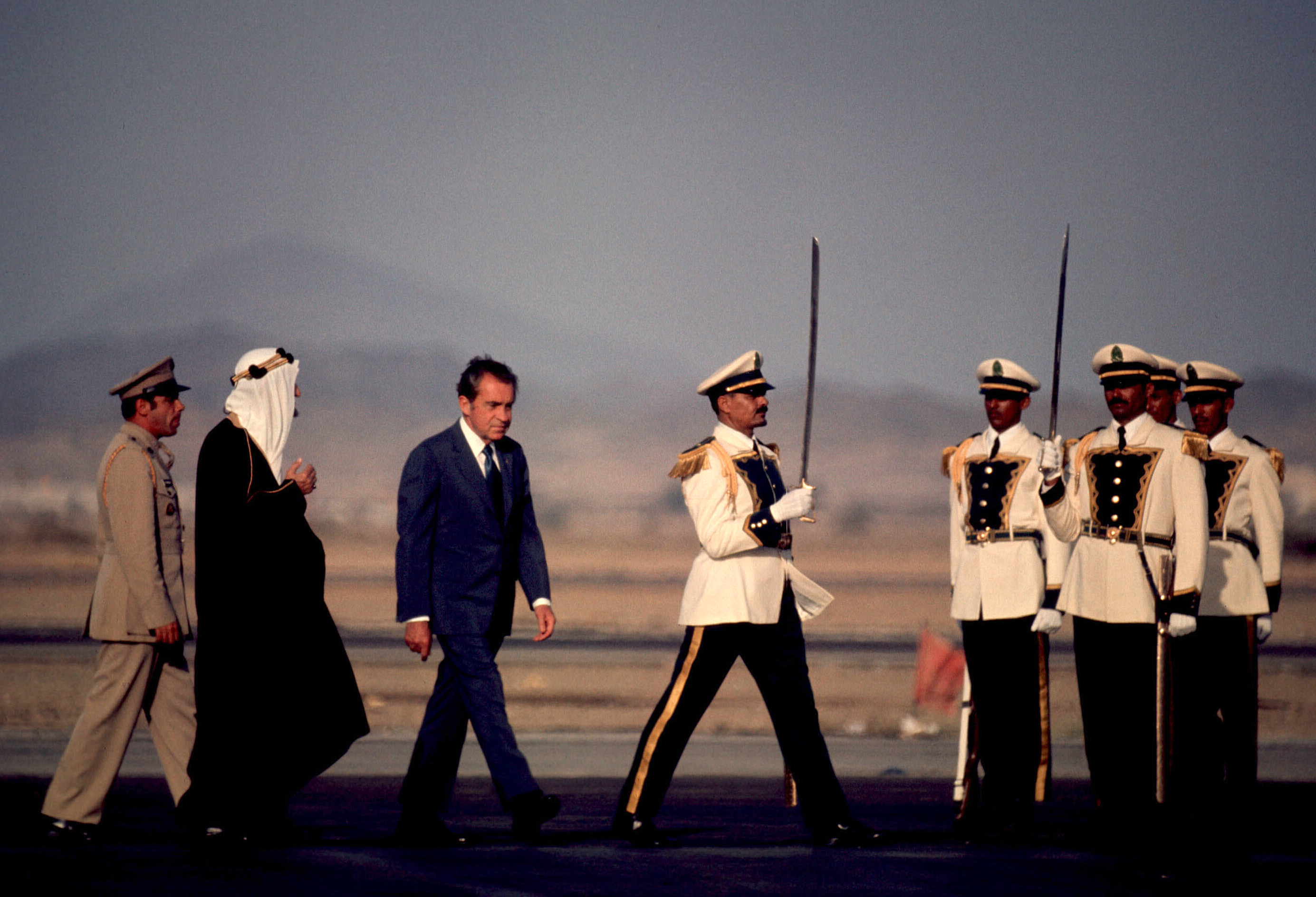
This flow of money has historically been known as petrodollar recycling (a system put in place by Henry Kissinger in the early 1970s).

Saudi Arabian holdings of US assets have been of interest lately due to threats they will be sold off if the US allows the country to be to be held liable in court for the September 11 2001 terrorist attacks on the World Trade Centre.

The Battle Of Kirkuk  

Posted by Big Gav in , ,

OilPrice.com has an article on the battle between the Iraqi government, the Iraqi Kurds and ISIS for the oil fields of northern Iraq - The Battle Is On For Control Of Iraq’s Oil-Rich Kirkuk.

Michael Klare, The Coming World of "Peak Oil Demand," Not "Peak Oil"  

Posted by Big Gav in , , , , ,

TomDispatch has a new article from Michael Klare on what he calls "The Collapse of the Old Oil Order " - Michael Klare, The Coming World of "Peak Oil Demand," Not "Peak Oil".

Klare views the discord amongst oil producers (evident at the failed talks aimed restraining supply in Doha) as another sign of weak demand for oil in the coming years and a fight between suppliers for market share. He also notes Saudi Arabia is claiming it will raise production from its current 10.2 million barrels per day to 11.5 million barrels and could add another million barrels in the next six to nine months.

At the beginning of this century, many energy analysts were convinced that we were at the edge of the arrival of “peak oil”; a peak, that is, in the output of petroleum in which planetary reserves would be exhausted long before the demand for oil disappeared, triggering a global economic crisis. As a result of advances in drilling technology, however, the supply of oil has continued to grow, while demand has unexpectedly begun to stall. This can be traced both to slowing economic growth globally and to an accelerating “green revolution” in which the planet will be transitioning to non-carbon fuel sources. With most nations now committed to measures aimed at reducing emissions of greenhouse gases under the just-signed Paris climate accord, the demand for oil is likely to experience significant declines in the years ahead. In other words, global oil demand will peak long before supplies begin to run low, creating a monumental challenge for the oil-producing countries.

This is no theoretical construct. It’s reality itself. Net consumption of oil in the advanced industrialized nations has already dropped from 50 million barrels per day in 2005 to 45 million barrels in 2014. Further declines are in store as strict fuel efficiency standards for the production of new vehicles and other climate-related measures take effect, the price of solar and wind power continues to fall, and other alternative energy sources come on line. While the demand for oil does continue to rise in the developing world, even there it’s not climbing at rates previously taken for granted.

Saudi Oil Gambit Moves to Phase Two  

Posted by Big Gav in , , , ,

Julian Lee at Bloomberg has a look at Saudi Arabia's rapidly growing drilling program and their efforts to grab back market share - Saudi Oil Gambit Moves to Phase Two.

10 years on for the great surge of peak oil speculation, it has been interesting to see that Saudi Arabia and Russia have both managed to maintain (and expand) production of conventional oil. The US managed to attain its own peak of production once again off the back of unconventional oil extraction but the article notes even that is falling off again (by around 600,000 barrels per day so far) now new drilling has almost stopped in the shale regions.

The article notes that Saudi Arabia is expanding the Shaybah field by 250,000 barrels a day and Khurais by 300,000 barrels as part of an effort to build production capacity of more than 12 million barrels per day - 2 million barrels above its current rate. Kuwait also plans to raise production capacity to 4 million barrels by 2020 and Abu Dhabi to up production capacity to 3.5 million barrels a day by 2017.

In a slightly older article, Bloomberg also made some comments about speculation that Saudi Arabia may float part of Aramco - "don’t forget the warnings given by Saudi Arabia’s petroleum minister just over a year ago that global oil demand growth may face a "black swan" in the next few decades. Viewed through that lens, the policy of pumping more barrels out now looks like not merely a strategy to maintain market share but also to simply monetize reserves that might otherwise be left to mire underground" - Saudi Aramco's Fire Sale.

Statistics

Locations of visitors to this page

blogspot visitor
Stat Counter

Total Pageviews

Ads

Books

Followers

Blog Archive

Labels

australia (619) global warming (423) solar power (397) peak oil (355) renewable energy (302) electric vehicles (250) wind power (194) ocean energy (165) csp (159) solar thermal power (145) geothermal energy (144) energy storage (142) smart grids (140) oil (139) solar pv (138) tidal power (137) coal seam gas (131) nuclear power (129) china (120) lng (117) iraq (113) geothermal power (112) green buildings (110) natural gas (110) agriculture (91) oil price (80) biofuel (78) wave power (73) smart meters (72) coal (70) uk (69) electricity grid (67) energy efficiency (64) google (58) internet (50) surveillance (50) bicycle (49) big brother (49) shale gas (49) food prices (48) tesla (46) thin film solar (42) biomimicry (40) canada (40) scotland (38) ocean power (37) politics (37) shale oil (37) new zealand (35) air transport (34) algae (34) water (34) arctic ice (33) concentrating solar power (33) saudi arabia (33) queensland (32) california (31) credit crunch (31) bioplastic (30) offshore wind power (30) population (30) cogeneration (28) geoengineering (28) batteries (26) drought (26) resource wars (26) woodside (26) censorship (25) cleantech (25) bruce sterling (24) ctl (23) limits to growth (23) carbon tax (22) economics (22) exxon (22) lithium (22) buckminster fuller (21) distributed manufacturing (21) iraq oil law (21) coal to liquids (20) indonesia (20) origin energy (20) brightsource (19) rail transport (19) ultracapacitor (19) santos (18) ausra (17) collapse (17) electric bikes (17) michael klare (17) atlantis (16) cellulosic ethanol (16) iceland (16) lithium ion batteries (16) mapping (16) ucg (16) bees (15) concentrating solar thermal power (15) ethanol (15) geodynamics (15) psychology (15) al gore (14) brazil (14) bucky fuller (14) carbon emissions (14) fertiliser (14) matthew simmons (14) ambient energy (13) biodiesel (13) investment (13) kenya (13) public transport (13) big oil (12) biochar (12) chile (12) cities (12) desertec (12) internet of things (12) otec (12) texas (12) victoria (12) antarctica (11) cradle to cradle (11) energy policy (11) hybrid car (11) terra preta (11) tinfoil (11) toyota (11) amory lovins (10) fabber (10) gazprom (10) goldman sachs (10) gtl (10) severn estuary (10) volt (10) afghanistan (9) alaska (9) biomass (9) carbon trading (9) distributed generation (9) esolar (9) four day week (9) fuel cells (9) jeremy leggett (9) methane hydrates (9) pge (9) sweden (9) arrow energy (8) bolivia (8) eroei (8) fish (8) floating offshore wind power (8) guerilla gardening (8) linc energy (8) methane (8) nanosolar (8) natural gas pipelines (8) pentland firth (8) saul griffith (8) stirling engine (8) us elections (8) western australia (8) airborne wind turbines (7) bloom energy (7) boeing (7) chp (7) climategate (7) copenhagen (7) scenario planning (7) vinod khosla (7) apocaphilia (6) ceramic fuel cells (6) cigs (6) futurism (6) jatropha (6) nigeria (6) ocean acidification (6) relocalisation (6) somalia (6) t boone pickens (6) local currencies (5) space based solar power (5) varanus island (5) garbage (4) global energy grid (4) kevin kelly (4) low temperature geothermal power (4) oled (4) tim flannery (4) v2g (4) club of rome (3) norman borlaug (2) peak oil portfolio (1)