Showing posts with label lithium ion batteries. Show all posts

A Wave Of Gigafactories  

Posted by Big Gav in , , , ,

GTM has a look at the wave of gigafactories being built - 10 Battery Gigafactories Are Now in the Works. And Elon Musk May Add 4 More.

Gigafactory announcements have been trending in recent months, with plans for at least 10 new plants revealed in the last six months. Half a dozen have been planned in the last month alone.

In Germany, for example, the Daimler subsidiary Accumotive laid the foundation for a $550 million plant designed to take annual lithium-ion battery production from its current level of 80,000 units up to around 320,000.

And Energy Absolute, of Thailand, reportedly has plans for a $2.9 billion factory in Asia, with an annual production capacity of 1 gigawatt-hour per year, scaling to 50 gigawatt-hours a year by 2020.

Meanwhile, a consortium including Boston Energy and Innovation (BEI), Charge CCCV, C&D Assembly, Primet Precision Materials and Magnis Resources confirmed it will build a 15-gigawatt-hour-a-year plant on IBM’s former Huron Campus manufacturing site in New York.

BEI, Charge CCCV, C&D Assembly and Magnis Resources are also working with Eastman Kodak Group to build a similarly sized plant near Townsville in Queensland, Australia. The backers have said the plant could create around 7,000 jobs.

More recently a company called Energy Renaissance has lifted the lid on plans for a factory in Darwin, in Australia’s Northern Territory, with a production capacity of a gigawatt-hour of batteries a year.

The most aggressive gigafactory plans, however, remain with the company that came up with the concept. Tesla’s Elon Musk has said he will announce “probably four” new gigafactories this year. One has long been slated for Europe, and another has been confirmed to be in the works in Shanghai, China. ...

Tesla Gigafactory Commences Production  

Posted by Big Gav in , , ,

Bloomberg reports that Elon Musk has met his first deadline for Gigafactory production of lithium ion batteries - Tesla Flips the Switch on the Gigafactory.

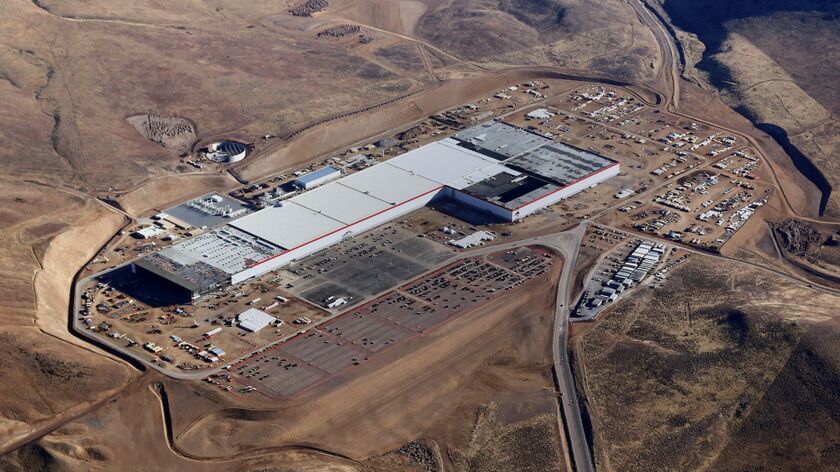
The Gigafactory has been activated. Hidden in the scrubland east of Reno, Nev., where cowboys gamble and wild horses still roam—a diamond-shaped factory of outlandish proportions is emerging from the sweat and promises of Tesla CEO Elon Musk. It’s known as the Gigafactory, and today its first battery cells are rolling off production lines to power the company’s energy storage products and, before long, the Model 3 electric car.

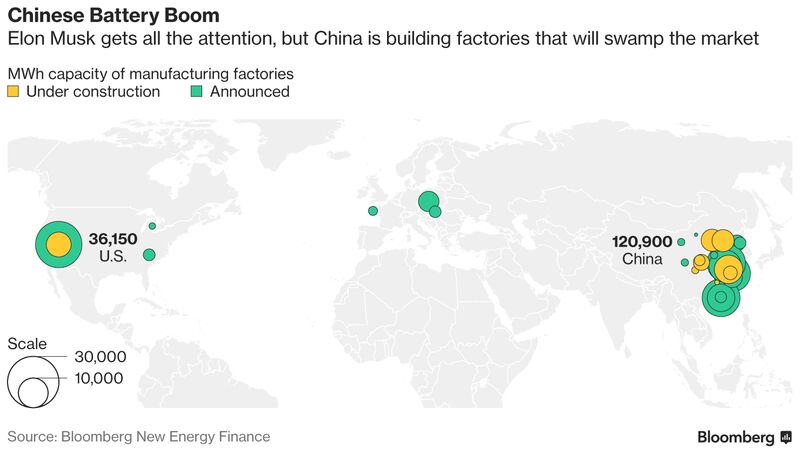
The start of mass production is a huge milestone in Tesla’s quest to electrify transportation, and it brings to America a manufacturing industry—battery cells—that’s long been dominated by China, Japan, and South Korea. More than 2,900 people are already working at the 4.9 million square-foot facility, and another 4,000 jobs (including temporary construction work) will be added this year through the partnership between Tesla and Panasonic.

By 2018, the Gigafactory, which is less than a third complete, will double the world’s production capacity for lithium-ion batteries and employ 6,500 full-time Reno-based workers, according to a new hiring forecast from Tesla.

VW to go electric ?  

Posted by Big Gav in , , ,

Quartz and the Australian Financial Review have reports that Volkswagen are hoping to put their diesel emissions scandal woes behind them and switch to electric vehicles along with a massive Tesla style battery factory.

VW are dismissing the reports as "speculation" at this stage.

Lithium: An increasingly precious metal  

Posted by Big Gav in , , , , , ,

While the Australian mining boom is now receding in the rear view mirror, one mining sector that is still attracting enthusiastic investment is the lithium mining industry.

Western Australia currently produces about 30% of the world's lithium supplies, and 20 new companies are scrambling about the state trying to take advantage of the boom in "white oil". WA Business News has an article on the evolving market for the metal, looking at producers in Australia and South America - A Window opens for lithium hopefuls.

The investment frenzy may have already reached a peak locally however, with some investment columnists warning there aren't any bargains left in the sector - Ten years on, lithium may as well be uranium and This 'new gasoline' could burn eager investors.

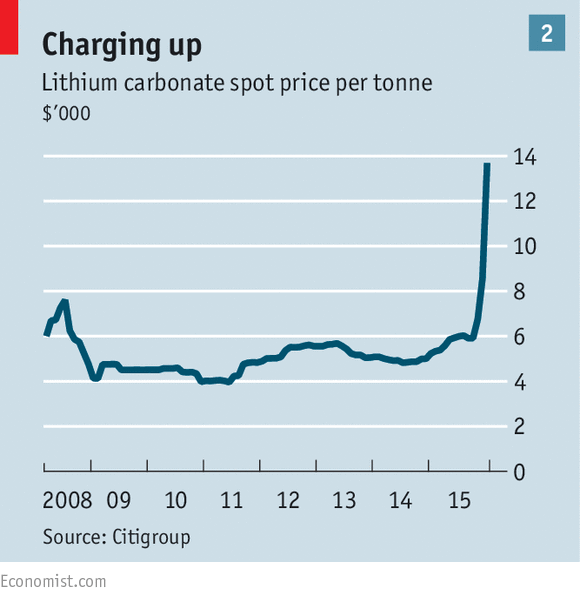
The Economist also has a look at the soaring demand for lithium, with some interesting tales from Chile as the jostling begins to supply the expanding battery market for electric vehicles and home energy storage - An increasingly precious metal.

SQM, Chile’s biggest lithium producer, is the kind of company you might find in an industrial-espionage thriller. Its headquarters in the military district of Santiago bears no name. The man who for years ran the business, Julio Ponce, is the former son-in-law of the late dictator, Augusto Pinochet. He quit as chairman in 2015, during an investigation into SQM for alleged tax evasion. (The company is co-operating with the inquiry.) Last month it emerged that CITIC, a Chinese state-controlled firm, may bid for part of Mr Ponce’s controlling stake in SQM, as part of China’s bid to secure supplies of a vital raw material.

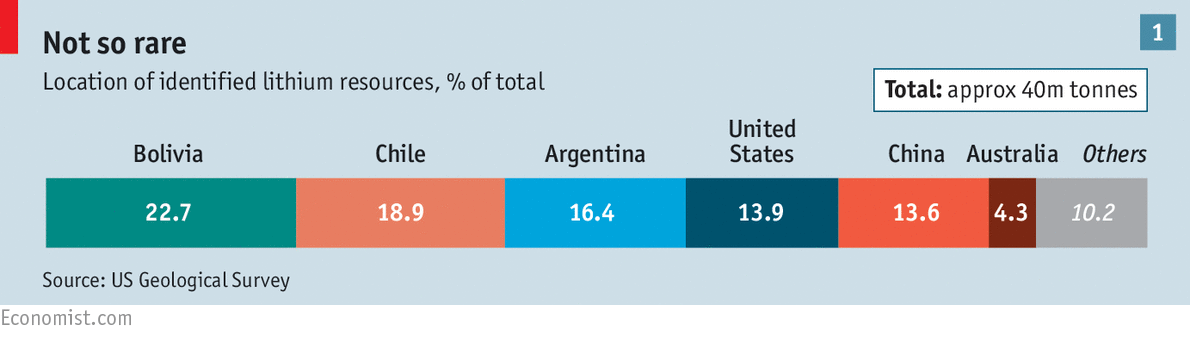
The focus of CITIC’s interest appears to lie on a lunar-like landscape of encrusted salt in Chile’s Atacama desert. It is a brine deposit washed off the Andes millions of years ago, containing about a fifth of the world’s known lithium resources. (Even more are in adjacent Bolivia but they are mostly untapped). Just weeks before, CITIC had bought a stake in a Hong Kong electric-vehicle maker that uses lithium-ion batteries, indicating its growing interest in clean-energy technologies.

The sleeping giant of lithium production is Bolivia, which by most estimates possesses the largest reserves of the metal. Evo Morales has announced a $1 billion investment push to kick start production, expanding links with Chinese companies to both extract the material and produce lithium ion batteries in the country - Bolivia’s lithium boom: dream or nightmare?.

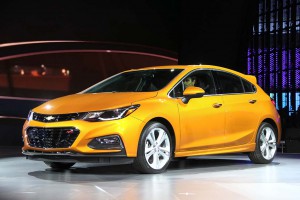
Lithium production will clearly need to expand given the pre-sales for the Tesla 3 are now approaching 4000,000 vehicles and projected sales would consume all of world's lithium production at current levels - Rising Lithium Prices Threaten to Short-Circuit EV Market. The Chevrolet Bolt is also due out on the market this year, putting further pressure on supplies.

One way to boost production is to improve the efficiency of extraction processes. CleanTechnica has an article on improvements on extracting lithium from brine - New Method Of Extracting Lithium From Natural Brine Yields 99.9% Purity.

Catalyst: Battery Powered Homes  

Posted by Big Gav in , , , ,

The ABC's Catalyst program has a good episode on battery technologies and how they are being used in Australia - Battery Powered Homes.

How Tesla could pull more consumers off the grid  

Posted by Big Gav in , , , , , , , ,

RNE has a post on a Morgan Stanley report on tesla's potential to hasten the utility death spiral - How Tesla could pull more consumers off the grid.

Investment bank Morgan Stanley says the global electricity utility industry is still underestimating the potential of EV maker Tesla to achieve a dramatic reduction in battery storage costs, luring more and more consumers to go “off-grid.”

In a detailed report released in late July, Solar Power & Energy Storage, Morgan Stanley said that energy storage, specifically that being developed by Tesla in its so-called “giga-factory” could be disruptive in US and Europe, and elsewhere.

It does not mention Australia in the report, but Australia has all the ingredients of a market perfect for such disruption – excellent solar resources and high electricity costs, and more specifically, high network charges.

“Given the relatively high cost of the power grid, we think that customers in parts of the US and Europe may seek to avoid utility grid fees by going “off-grid” through a combination of solar power and energy storage,” Morgan Stanley’s leading energy analysts write in the report.

“We believe there is not sufficient appreciation of the magnitude of energy storage cost reduction that Tesla has already achieved, nor of the further cost reduction magnitude that Tesla might be able to achieve. once the company has constructed its “Gigafactory,” targeted for completion later in the decade.“

This, of course, has massive implication for the incumbent utilities, not to mention for other consumers. The immediate response for networks has been to seek to raise fixed charges to protect their revenue, an option that Morgan Stanley says will be counter-productive.

Tesla's Battery Giga Factory  

Posted by Big Gav in , , , ,

Greentech Media has an article on Tesla's massive "giga factory" for producing batteries - Tesla Giga Factory: $4B to $5B Price Tag, With Battery Production Slated for 2017. More at GigaOm - Tesla confirms huge battery factory plan, will ship 35K Model S cars this year.

Tesla CEO Elon Musk provided some more details on the company's proposed battery factory:

* The company just announced a $1.6 billion convertible debt offering. Tesla looks to offer $800 million of convertible senior notes due in 2019 and $800 million due in 2021 to build the world's largest battery factory.
* Musk predicts that the new factory will produce batteries for 500,000 vehicles by 2020.
* Tesla expects to send the kilowatt-hour price of batteries down by 30 percent.
* The plan is for construction to start in 2014, with production beginning in 2017. ...

Musk also said that Panasonic, currently supplying hundreds of millions of cells to Tesla, would likely join in on the new factory. Samsung has been mentioned as a potential partner. I'll throw in Apple as a potential partner; computers and tablets need lithium-ion batteries (albeit in different form factors), and there's been talk of recent Apple-Tesla meetings.

The Tesla CEO envisions "a plant that is heavily powered by renewables, wind and solar, and that has built into it the recycling capability for old battery packs." “It is going to be a really giant facility. [...] We are doing that something that’s comparable to all lithium-ion production in the world in one factory," said Musk in a previous earnings call.

Investment bank Barclays writes, "For the time being, our model does not reflect the additional cost of building out a giga factory, or the significant potential revenue that Tesla could generate from non-automotive sources such as grid storage. Optionality could provide upside for the stock, as investors consider the potential upside to revenue from non-automotive sources."

“We believe the days when Tesla was known as purely an auto company are numbered,” wrote Morgan Stanley analyst Adam Jonas in a January research note, adding, "We are witnessing the most disruptive intersection of manufacturing, innovation and capital experienced by the auto industry in more than a century.” Jonas also opined that “Tesla may be in position to disrupt industries well beyond the realm of traditional auto manufacturing. It’s not just cars."

Bloomberg also has an older article on Tesla's sister company Solar City which looks like being a big customer for batteries from the Gigafactory - Tesla's Industrial-Grade Solar Power Storage System.

It’s weird to see the big, red Tesla Motors “T” logo hanging from the side of a house or a building. But it’s the real deal. The company’s march from the automobile to the home, office, and factory has begun.

This week, SolarCity, which sells and installs solar panels for residential and commercial customers, began offering an industrial-grade power storage unit produced by Tesla. The system mounts on a wall and looks something like a white mini-fridge with Tesla’s distinctive logo in the upper left corner. It contains hundreds of the same lithium-ion batteries that Tesla’s Model S sedan needs to run and, in fact, has about one-eighth of the juice found in Tesla’s top-of-the-line battery pack. “If you go to the end of the manufacturing line at the Tesla factory where they put the battery pack on, you will see these storage systems being assembled,” says Pete Rive, the co-founder and chief technology officer at Tesla.

The purpose of the storage system is twofold. It lets solar customers shift off the grid during times when energy companies charge their highest rates, and it provides a backup system during power outages. SolarCity has been offering these systems to consumers on a limited basis—a few hundred customers so far—and, as of this week, began selling it to commercial customers as well. Customers do not have to pay upfront for the hardware but will need, instead, to commit to a 10-year service agreement with monthly payments.

The battery pack would cost about $15,000 without financing. “Our long run goal is to include a storage system with every solar system we sell,” says Rive.

3D Printing Batteries  

Posted by Big Gav in , ,

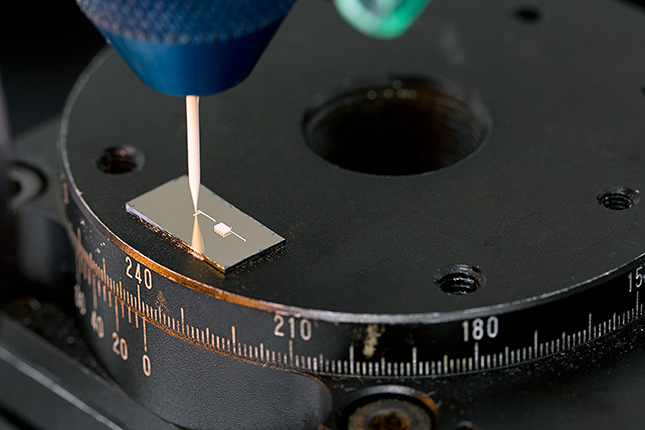
Technology Review has an article on new inks and tools that allow 3-D printing of lithium-ion technology - Printing Batteries.

By making the basic building blocks of batteries out of ink, Harvard materials scientist Jennifer Lewis is laying the groundwork for lithium-ion batteries and other high-performing electronics that can be produced with 3-D printers.Although the technology is still at an early stage, the ability to print batteries and other electronics could make it possible to manufacture new kinds of devices. Think of self-powered biomedical sensors, affixed to the skin, that would continuously transmit vital signs to a smartphone. Or existing products could be made more simply and efficiently.For example, the plastic shell of a hearing aid is already 3-D printed for a custom fit inside a wearer’s ear. But the electronics are manufactured separately, and the batteries are often the type that must be replaced frequently. If the electronics and a rechargeable battery were printed together, the final product could be made more rapidly and seamlessly.

Envia: Record Battery Energy Density in Context  

Posted by Big Gav in , , , , ,

Jamais at Open The Future has a look at Envia's advanced lithium ion battery technology - Record Battery Energy Density in Context. More commentary can be found at REnew Economy, The Falls Church News Press and Cryptogon.

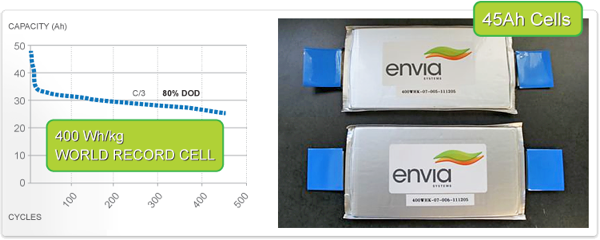
A tech company called Envia Systems has announced that it is able to produce rechargeable lithium-ion batteries (Li-ion, i.e., the standard kind of rechargeable batteries that go in everything from phones to electric cars) with a world-record energy density of 400 Watt-hours per kilogram! (Gigaom has lots of info, and useful background material.) Cool, right?

Yes? No?

Energy density is one of those really important concepts that not many people know about; it's not an exaggeration to say that a viable renewable energy future depends upon boosting energy density of batteries.

But it's hard to evaluate the importance of an announcement like this if you don't have context, so here you go:

Okay, 400 Watt-hours per kilogram (henceforth Wh/kg) means that one kilogram of battery material will be able to pump out electricity at a level of 400 Watts for one hour.

According to Envia, the best commercially-available Li-ion battery has an energy density of around 245 Wh/kg, so this new technology almost doubles that. This is good. Moreover, most Li-ion batteries operate at about 100-150 Wh/kg. The batteries in the Nissan Leaf, for example, have an energy density of about 120 Wh/kg (24 KWh/200kg). Tripling that density would, in principle, triple the range of the Leaf, taking it from around 100 miles to around 300 miles, a range close to a typical gasoline-powered car. This is very good.

But it's not revolutionary -- it's a (significant) incremental improvement.

That's because, even at 400Wh/kg, batteries still don't have an energy density anywhere close to fossil fuels.

Gasoline offers somewhere around 12,000 Wh/kg, 30x the energy density of the Envia battery technology. A Nissan Leaf with the same mass of gasoline-equivalent superbatteries would have a range of around 9,000 miles. Alternatively, to get the same 300 mile range as with the Envia batteries, the Nissan SuperLeaf would only need around 3kg of batteries.

I'm not discounting the importance of this breakthrough, not by any means, but it's important to keep this in context. There's a good reason why petroleum has such a hold on the world of transportation, and it's going to take a lot more than a tripling of battery energy density to beat it. Or, more to the point, moving beyond the gasoline automobile is going to take more than simply chipping away at energy density comparisons -- it's going to take a complete re-thinking of what we mean by transportation.

[UPDATE:]

As has been pointed out to me, in comments and in direct communication (and with varying degrees of politeness), this isn't an entirely fair comparison. It would be more accurate to compare the combination of energy density + drive efficiency.

Most standard automobiles have an average internal combustion engine efficiency of around 20% -- that is, of the energy available in the fuel, about 20% is eventually translated into motive force. So that 12,000 Wh/kg is effectively "only" 2,400 Wh/kg.

Electric motors, conversely, are extremely efficient at translating available energy into motive force; at 90%, that 400 Wh/kg Envia battery is still effectively 360 Wh/kg.

So a gasoline engine system 6.67x better than the Envia, not 30x better. The difference isn't as gobsmacking, but it's still significant, and remains a reminder of just how far battery technology has yet to evolve.

Large Capacity Lithium Ion Storage Units  

Posted by Big Gav in , , ,

After Gutenberg has a post on a Japanese energy storage / frequency control unit using Lithium Ion batteries - Large Capacity Lithium Ion Storage Units.

This blog reported before about energy storage that absorbs or delivers energy to the grid at intervals of five seconds. The frequency regulation system uses thousands of lithium-ion batteries.”

Now Green Car Congress reports on “Japan’s first cargo container-type large-capacity energy storage system using Li-ion batteries.” Mitsubishi Heavy Industries, Ltd. has developed a system capable of providing power of up to one megawatt (MW)
Its mobility makes the system suitable for a wide range of applications, including emergency use. The actual system has been installed at the Nagasaki Shipyard & Machinery Works of MHI in Nagasaki Prefecture, Japan, to begin verification testing for a power stabilization system application from early July towards the commercialization of the system.

The container-type “megawatt-class large-capacity energy storage system (ESS)” consists of a 40ft-long container unit, which houses more than 2,000 units of lithium-ion rechargeable batteries, and a 20ft-long container unit, in which two power conditioners are installed. Power conditioners are used for direct current (DC)/alternating current (AC) conversion and their input/output control. Each container unit can be moved by container trailers. The system has a capacity of 408 kWh and is designed to have a system efficiency of 90%.

The End Of Australian Manufacturing ?  

Posted by Big Gav in , , ,

Alan Kohler had an interesting column in The Business Spectator recently ("The cars that ate Australia") warning that as our car fleet transitions from the internal combustion to electric vehicles, local car manufacturers need to start looking to manufacture EV's or they (and all their suppliers) will end up shutting down.

Yesterday’s announcement of an electric car trial by the WA government means that at least some politicians in Australia are at last taking seriously what is shaping up as the next great industrial revolution.

But unless something changes on the east coast, electric cars will be a disaster for Australian manufacturing. At this stage it looks like no electric cars will be made here – Ford, GM, Toyota and Mitsubishi are all gearing up rapidly to make them somewhere else.

Yesterday the man in charge of the Perth trial, Professor Thomas Brauni, said: “It’s quite likely that you have a significant percentage of all cars being electric in 10-20 years time”.

If he’s only half right, Australia has a big problem. Manufacturing industry rests on the car industry and is already in trouble because China’s demand for raw materials is pushing the currency higher. If Australia doesn’t make electric cars, and there is a big switch from petrol to electricity over the next decade or two, manufacturing in this country will shut down.


Kohler points out that there will be accompanying booms in clean energy generation and both lithium and copper production (which provide opportunities as well as challenges for local companies).

Kohler had an article in a similar vein at The Eureka Report ("Wheels of fortune") recently, looking at both clean energy companies linked to Better Place and lithium producers that could benefit from the electric vehicle revolution, like Talison Minerals, Galaxy resources and Haddington (another Australian miner - Greenland Minerals And Energy - is hoping to develop a uranium / lithium deposit in Greenland).
It would be quite pointless to generate the electricity for the new era of transportation with brown coal, or even black coal. The emissions would still be lower than petrol exhausts, but the gains from using renewable energy instead would be enormous. In fact, electric cars can underpin the development of viable renewable energy industries in most countries.

Better Place plans to buy only renewables and expects to become Australia’s largest buyer of wind power. This is likely to a boon for Origin, AGL and Infigen from about 2013.

Seventy percent of the world’s mineral lithium comes from the Greenbushes mine in Western Australia, owned by a Canadian company called Talison Minerals. The company announced in November last year that it planned to list in both Canada and Australia during 2010 but nothing has happened yet.

Another local producer is Galaxy Resources, an ASX listed company that owns a lithium/tantalum deposit near Ravensthorpe in WA. Galaxy is currently at $1.18 and market cap of $178.4 million. The stock was 25¢ a year ago and peaked at $2.21 in September last year because of a flurry of interest in lithium batteries around the time that A123 Systems Inc listed on Nasdaq, becoming the hottest new listing in 2009.
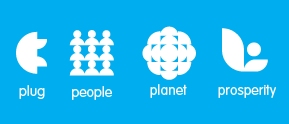


Australian lithium mines aren't the only ones looking to increase production - The New York Times recently had an article on the surge of interest worldwide in the metal ("The Lithium Chase").
Toyota Tsusho, the material supplier for the big Japanese automaker, announced a joint venture in January with the Australian miner Orocobre to develop a $100 million lithium project in Argentina. That deal came only days after Magna International, the Canadian car parts company that is helping develop a battery-powered version of the Ford Focus, announced that it was investing $10 million in a small Canadian lithium firm that also has projects in Argentina. ...

About 60 mining companies have begun feasibility studies in Argentina, Serbia and Nevada that could lead to more than $1 billion in new lithium projects in the next several years, while dozens of smaller projects are being proposed in China, Finland, Mexico and Canada. ...

In the meantime the four biggest current producers, which mine and otherwise gather lithium in Chile, Argentina and Australia, say they are planning to expand long-running projects as future demand warrants.

In Bolivia, which has almost half of the world’s reserves, the leftist government is building a pilot production plant and is drilling exploratory holes. That Bolivia is a remote, unstable country often hostile to foreign investment has helped spur interest in producing lithium in neighboring Argentina and Chile, in Australia, and in the United States. Several Canadian and American companies are making claims about future production prospects in Nevada, though few analysts foresee large-scale production from that state.

While most experts are skeptical that meaningful amounts of lithium can be produced domestically, they maintain that adequate supplies will be available from sources outside of Bolivia for many years to come and note that the biggest producer, Chile, is a dependable American ally.

While the NYT is dubious about increased lithium production within the US, one american company which has garnered attention for its potential to is Simbol Mining, which is looking to extract lithium from the water flowing through geothermal power plants.

Most of the attention for large scale future production of lithium tends to focus on Bolivia, which has the world's largest lithium resource soaked into the coating on the world's largest salt flat, the Salar De Uyuni.


The subject of Peak lithium has been raised from time to time (with recent commentary at Seeking Alpha and The Oil Drum) with Jack Lifton (author of the Seeking Alpha article) arguing that lithium supplies will be insufficient to meet our needs while Keith Evans argues there is more than enough resources available.
Tesla to Use High-Energy Batteries from Panasonic  

Posted by Big Gav in , ,

Technology Review reports that Tesla are partnering with Panasonic to supply long life lithium ion batteries - Tesla to Use High-Energy Batteries from Panasonic.

Tesla Motors, the maker of high-performance electric vehicles, is working with Panasonic, the battery and consumer electronics giant, to develop its next generation of batteries. The partnership is intended to help Tesla lower the cost of its batteries and improve the range of its vehicles.

Last month Panasonic announced two high-energy batteries for electric vehicles. These new batteries store as much as 30 percent more energy than its previous lithium-ion batteries, and this increased storage could, in theory, increase a vehicle's range by a similar amount, thereby addressing one of the main problems with electric cars. Tesla's Roadster currently has a range of 244 miles and takes three and a half hours to charge with a special charger.

The other major challenge with electric vehicles is the cost of the battery packs. Tesla isn't announcing the potential cost savings with future batteries, but JB Straubel, Tesla Motor's chief technology officer, says battery costs have been steadily declining at about 8 percent a year.

Tesla plans to incorporate Panasonic's cells into its battery packs, and will work with Panasonic to develop cells fine-tuned for use in cars, Straubel says. To do this, Tesla will draw on data gathered from the 1,000 cars it has made so far, which have been driven for over a million miles. Tesla currently gets its batteries from a variety of manufacturers.

Storing More Energy in Batteries  

Posted by Big Gav in , ,

Technology Review has an article on "Nanowire anodes [which] could let lithium-ion batteries run twice as long" - More Energy in Batteries.

A start-up based in Menlo Park, CA, plans to sell a new type of anode for lithium-ion batteries that, the company says, will let electric vehicles travel farther and mobile devices last longer without a recharge. Amprius' lithium-ion anodes are made of silicon nanowires, which can store 10 times more charge than graphite, the material used for today's lithium-ion battery anodes. According to the company, electric vehicles that run 200 miles between charges could go 380 miles on its batteries, and laptops that have four hours of run time could last for seven hours between charges.

While other advanced battery companies are focused on power, which makes for fast charging and zippy acceleration, Amprius is trying to improve energy density, which enables longer run times. The more total energy a battery can store, the longer it can power a car or a phone between charges. As vehicle manufacturers look toward electric cars, and as mobile devices like iPhones run more energy-intensive applications, a battery's energy density, and thus the time it can go without a recharge, becomes a more pressing issue.

Better Lithium-ion Batteries  

Posted by Big Gav in ,

Technology Review has an article on a startup that says its "solid polymer electrolytes will mean cheaper, more-reliable batteries" - Better Lithium-ion Batteries.

A new incarnation of lithium-ion batteries based on solid polymers is in the works. Berkeley, CA-based startup Seeo, Inc. says its lithium-ion cells will be safer, longer-lasting, lighter, and cheaper than current batteries. Seeo's batteries use thin films of polymer as the electrolyte and high-energy-density, light-weight electrodes. Lawrence Berkeley National Laboratory is now making and testing cells designed by the University of California, Berkeley spinoff.

Lithium-ion batteries are used in cell phones and laptops because they are smaller and lighter than other types of batteries. They are also promising for electric and hybrid vehicles. However, conventional materials and chemistries have stopped them from being used extensively in cars.

Today's lithium-ion batteries use lithium cobalt oxide electrodes and a liquid electrolyte, typically lithium salts dissolved in an organic solvent. The electrode material can release oxygen when overcharged or punctured, causing the flammable solvent to catch fire and the battery to explode. Besides, "the charged electrodes are very reactive with the liquid electrolyte, which reduces power and [cycle-life]," says Khalil Amine, manager of the advanced battery technology group at Argonne National Laboratory.

Seeo's key breakthrough is a solid polymer electrolyte. It is not flammable and hence inherently safer. In addition, the battery will retain more of its capacity over time because the polymer does not react with the charged electrode. "Lifetime data suggests that conventional lithium-ion systems lose about 40 percent capacity in 500 cycles," says Mohit Singh, the cofounder of Seeo. "We get a much better cycle life. We can go through 1,000 cycles with less than 5 percent capacity loss."

For the negative electrode, or anode, the electrolyte also works with lithium metal films, which are lighter than current anode materials. That means the battery can provide more energy for the same weight. Based on the battery's single cell, Seeo has calculated that it would have an energy density of up to 300 watt-hours per kilogram, which is 50 percent greater than lithium-ion batteries that are on the market today.

Lithium Ion Batteries For Grid Backup ?  

Posted by Big Gav in , , ,

Cleantech.com has an article on a company promoting the use of lithium ion batteries for embedding energy storage into the grid (V2G without the V, in some respects) - GreenSmith launches backup battery for grid.

Washington D.C.-based GreenSmith Energy Management Systems unveiled technology it says can solve the peak demand problems of U.S. utilities.

CEO Rodney Smith said the company has designed a battery control and management system that, when paired with lithium ion battery GreenSmith acquired from a manufacturer overseas, can store 20 kilowatt-hours at a time and provide between 3,000 and 4,000 full-discharge cycles.

The idea is that utilities could charge the battery when it's cheaper to produce energy, such as in the middle of the night, and could discharge that energy onto the grid when it's most expensive to produce power.

Smith said ideal circumstances would be to use the battery during peak demand instead of firing up a peak power plant, which is more expensive to run. The unit could help reduce the need for additional power plants and prevent utilities from losing excess power generated.

"Utilities are far more receptive to distributed storage technologies than they are to smart grid, and for a reason," Smith told the Cleantech Group. "Grid replacement is like trying to replace the air traffic control system. You have to put a lot of money into it before you see any rewards from it. With our technology, you get the benefit right away."

The technology can be paired with intermittent renewable energy sources, such as wind and solar, to better align power supply with power demand, Smith said.

That field is also being targeted by companies such as ZBB Energy, which has contracted with the Australian government to accelerate development of the company's zinc-bromine storage systems for renewable energy projects (see ZBB gets Australian contract for renewable energy storage and ZBB, Zest in energy storage deal).

Tyngsboro, Mass.-based Beacon Power (Nasdaq: BCON) is promoting its multiple-flywheel systems to supply or absorb electricity, giving extra stability to a grid that's experiencing demand or supply peaks (see Beacon slows flywheel storage plans).

According to the Carnegie Mellon Electricity Industry Center, there is a strong economic case for flywheel installations to improve grid stability, as evidenced by the New York Independent System Operator and the PJM Interconnection.

Last year, Windsor, Colo.-based Ice Energy revealed a device to shift up to 95 percent of air-conditioning load to off-peak hours while providing full cooling performance (see Ice Energy cools down power demand). ...

GreenSmith's systems are designed to be managed from a central location, either programmed to optimize cheap energy price or manually controlled. Utilities, regional transmission agencies and co-ops in the U.S. are the current market, but GreenSmith eventually plans to target global markets, especially those with intermittent access to the electric grid.

Consumers aren't the target for GreenSmith, although Smith said the devices could be modified for home use.

Making Australia A Better Place  

Posted by Big Gav in , , , , , , ,

Project Better Place founder Shai Agassi was in town last week announcing that Australia will become the third country to implement the group's vision of electric vehicles powered by renewable energy, following Denmark and Israel.

Better Place and Macquarie Capital Group will raise $1 billion to build a network of 250,000 charging stations and battery exchange stations in key locations along the east coast by 2012. The network will be powered by wind turbines owned by AGL Energy.

Agassi has been promoting the plan as a way to reduce our dependence on oil (the starting premise for the project was "how do you run an entire country without oil") while creating jobs and boosting the local economy (see this interview on the Today Show for his explanation). Operating in Australia will also help the group prove it can work in large countries as well as the much smaller geographical areas covered in the first 2 rollouts. Agassi also noted that the Federal Government's $500 million Green Car Innovation Fund played a part in encouraging them to set up in Australia.


Green Car Congress describes the Better Place network as consisting of three primary components:
  • Charge points. These are to recharge car batteries. Better Place is planning a 2.5:1 ratio of charge spots to cars.

  • Battery switching stations. For trips longer than 100 miles (161 km), Better Place plans to build roadside battery switching stations. Stations are to be completely automated, and the driver’s subscription takes care of everything. The driver pulls in, and the depleted battery is replaced with a fresh one, without anyone having to leave the vehicle. The process takes less time than it does to fill a tank of liquid fuel, according to the plan.

  • Software to automate the charging and exchange process.


Better Place has a partnership with the Renault-Nissan Alliance to provide electric cars. The prototype electric eMegane sedan features a 160+ kilometre range.


Better Place says it is committed to open network access and using industry standard, with the goal being to allow customers to have a choice of make and model of car.

Automotive Energy Supply Corporation (AESC, a joint venture between Nissan Motor, NEC Corporation, and NEC TOKIN Corporation) and A123Systems have been identified as lithium-ion battery providers to the system.

Better Place plans to own and operate the batteries and power generation (via AGL Energy, in Australia's case), and to sell kilometres travelled to drivers on a subscription basis, in similar fashion to the mobile phone industry.


Better Place in Australia plans to start by setting up charging stations in the Melbourne, Brisbane and Sydney, and then connect them with "electric highways," with stations set up every 25 miles.

Overall I'm quite excited by this project - though obviously executing the plan, in terms of setting up all the infrastructure and getting a significant volume of electric cars on the market at a competitive price, will be challenging. If the 3 countries piloting the idea can demonstrate it can work successfully, it will provide a blueprint for personal transport in a post-oil world.

Cross-posted from Our Clean Energy Future.

Statistics

Locations of visitors to this page

blogspot visitor
Stat Counter

Total Pageviews

Ads

Books

Followers

Blog Archive

Labels

australia (619) global warming (423) solar power (397) peak oil (355) renewable energy (302) electric vehicles (250) wind power (194) ocean energy (165) csp (159) solar thermal power (145) geothermal energy (144) energy storage (142) smart grids (140) oil (139) solar pv (138) tidal power (137) coal seam gas (131) nuclear power (129) china (120) lng (117) iraq (113) geothermal power (112) green buildings (110) natural gas (110) agriculture (91) oil price (80) biofuel (78) wave power (73) smart meters (72) coal (70) uk (69) electricity grid (67) energy efficiency (64) google (58) internet (50) surveillance (50) bicycle (49) big brother (49) shale gas (49) food prices (48) tesla (46) thin film solar (42) biomimicry (40) canada (40) scotland (38) ocean power (37) politics (37) shale oil (37) new zealand (35) air transport (34) algae (34) water (34) arctic ice (33) concentrating solar power (33) saudi arabia (33) queensland (32) california (31) credit crunch (31) bioplastic (30) offshore wind power (30) population (30) cogeneration (28) geoengineering (28) batteries (26) drought (26) resource wars (26) woodside (26) censorship (25) cleantech (25) bruce sterling (24) ctl (23) limits to growth (23) carbon tax (22) economics (22) exxon (22) lithium (22) buckminster fuller (21) distributed manufacturing (21) iraq oil law (21) coal to liquids (20) indonesia (20) origin energy (20) brightsource (19) rail transport (19) ultracapacitor (19) santos (18) ausra (17) collapse (17) electric bikes (17) michael klare (17) atlantis (16) cellulosic ethanol (16) iceland (16) lithium ion batteries (16) mapping (16) ucg (16) bees (15) concentrating solar thermal power (15) ethanol (15) geodynamics (15) psychology (15) al gore (14) brazil (14) bucky fuller (14) carbon emissions (14) fertiliser (14) matthew simmons (14) ambient energy (13) biodiesel (13) investment (13) kenya (13) public transport (13) big oil (12) biochar (12) chile (12) cities (12) desertec (12) internet of things (12) otec (12) texas (12) victoria (12) antarctica (11) cradle to cradle (11) energy policy (11) hybrid car (11) terra preta (11) tinfoil (11) toyota (11) amory lovins (10) fabber (10) gazprom (10) goldman sachs (10) gtl (10) severn estuary (10) volt (10) afghanistan (9) alaska (9) biomass (9) carbon trading (9) distributed generation (9) esolar (9) four day week (9) fuel cells (9) jeremy leggett (9) methane hydrates (9) pge (9) sweden (9) arrow energy (8) bolivia (8) eroei (8) fish (8) floating offshore wind power (8) guerilla gardening (8) linc energy (8) methane (8) nanosolar (8) natural gas pipelines (8) pentland firth (8) saul griffith (8) stirling engine (8) us elections (8) western australia (8) airborne wind turbines (7) bloom energy (7) boeing (7) chp (7) climategate (7) copenhagen (7) scenario planning (7) vinod khosla (7) apocaphilia (6) ceramic fuel cells (6) cigs (6) futurism (6) jatropha (6) nigeria (6) ocean acidification (6) relocalisation (6) somalia (6) t boone pickens (6) local currencies (5) space based solar power (5) varanus island (5) garbage (4) global energy grid (4) kevin kelly (4) low temperature geothermal power (4) oled (4) tim flannery (4) v2g (4) club of rome (3) norman borlaug (2) peak oil portfolio (1)