Showing posts with label limits to growth. Show all posts

The Atlas for the end of the world  

Posted by Big Gav in ,

Richard Weller has written "an atlas for the beginning of the anthropocene" - Atlas for the end of the world.

Coming almost 450 years after the world's first Atlas, this Atlas for the End of the World audits the status of land use and urbanization in the most critically endangered bioregions on Earth. It does so, firstly, by measuring the quantity of protected area across the world's 36 biodiversity hotspots in comparison to United Nation's 2020 targets; and secondly, by identifying where future urban growth in these territories is on a collision course with endangered species.

By bringing urbanization and conservation together in the same study, the essays, maps, data, and artwork in this Atlas lay essential groundwork for the future planning and design of hotspot cities and regions as interdependent ecological and economic systems.

RIP Jay Forrester  

Posted by Big Gav in ,

Ugo Bardi at Cassandra's Legacy has a tribute to the recently departed Jay Forrester, the inventor of system dynamics, the modelling method used in "The Limits To Growth" - Jay Forrester: the man who saw the future.

Jay Wright Forrester (1918-2016) may have been the source of inspiration for Hari Seldon, a fictional character in Isaac Asimov's Foundation series. In Asimov's novels, Seldon develops "pyschohistoric equations" that allow him to predict the impending collapse of the Galactic Empire. In the real world, Forrester developed "system dynamics equations" that allowed him to predict the impending collapse of the modern human civilization. The predictions were ignored by the Imperial powers of both the fictional and the real universe.

Jay Forrester, one of the great minds of the 20th century, died at 98, a few days ago. His career was long and fruitful, and we can say that his work changed the intellectual story of humankind in various ways, in particular for the role he had in the birth of the Club of Rome's report "The Limits to Growth".

In 1969, Forrester was a faculty member of the MIT when he met Aurelio Peccei in Italy. At that time, Peccei had already founded the Club of Rome, whose members were worried about the limits to the natural resources that the Earth could provide. They were trying to understand what the consequences would have been for humankind. From what Peccei wrote, it seems clear that he was seeing the situation mostly in Malthusian terms; thinking that the human population would have been growing until reaching the resource limits, and then stay there, kept in check by famines and epidemics. The main concern of Peccei and of the Club of Rome was to avoid human suffering by ensuring a fair distribution of what was available.

The encounter with Forrester changed this vision in ways that, perhaps, neither Peccei nor any of the Club members would have imagined. In the 1960s, Forrester's models were already well advanced. Based on a completely new method of calculation that Forrester had dubbed "system dynamics," the models were able to take into account how the many variables of a complex system interacted with each other and changed in time.

The result was the study that the Club of Rome commissioned to Forrester and to his research group: simulate the future of humankind over a time range of more than a century, all the way to 2100. Forrester himself prepared a complete study with the title "World Dynamics" that was published in 1971. A group of Forrester's students and coworkers prepared a more extensive study titled "The Limits to Growth" that became a true intellectual revolution in 1972.

Earth has lost a third of arable land in past 40 years, scientists say  

Posted by Big Gav in ,

The Guardian has an article on soil depletion - Earth has lost a third of arable land in past 40 years, scientists say.

The world has lost a third of its arable land due to erosion or pollution in the past 40 years, with potentially disastrous consequences as global demand for food soars, scientists have warned. New research has calculated that nearly 33% of the world’s adequate or high-quality food-producing land has been lost at a rate that far outstrips the pace of natural processes to replace diminished soil.

The University of Sheffield’s Grantham Centre for Sustainable Futures, which undertook the study by analysing various pieces of research published over the past decade, said the loss was “catastrophic” and the trend close to being irretrievable without major changes to agricultural practices. The continual ploughing of fields, combined with heavy use of fertilizers, has degraded soils across the world, the research found, with erosion occurring at a pace of up to 100 times greater than the rate of soil formation. It takes around 500 years for just 2.5cm of topsoil to be created amid unimpeded ecological changes.

The Limits to Growth was right ?  

Posted by Big Gav in ,

The Guardian has an article on "The Limits to Growth", written by a pair of Australians researchers from the University of Melbourne, claiming we are currently tracking to LTG's "baseline scenario" - Limits to Growth was right. New research shows we're nearing collapse.

Unlike most media reports referencing LTG it demonstrates the authors actually read and understood the book. The paper it is based on is here (pdf).

The 1972 book Limits to Growth, which predicted our civilisation would probably collapse some time this century, has been criticised as doomsday fantasy since it was published. Back in 2002, self-styled environmental expert Bjorn Lomborg consigned it to the “dustbin of history”.

It doesn’t belong there. Research from the University of Melbourne has found the book’s forecasts are accurate, 40 years on. If we continue to track in line with the book’s scenario, expect the early stages of global collapse to start appearing soon.

Limits to Growth was commissioned by a think tank called the Club of Rome. Researchers working out of the Massachusetts Institute of Technology, including husband-and-wife team Donella and Dennis Meadows, built a computer model to track the world’s economy and environment. Called World3, this computer model was cutting edge.

The task was very ambitious. The team tracked industrialisation, population, food, use of resources, and pollution. They modelled data up to 1970, then developed a range of scenarios out to 2100, depending on whether humanity took serious action on environmental and resource issues. If that didn’t happen, the model predicted “overshoot and collapse” – in the economy, environment and population – before 2070. This was called the “business-as-usual” scenario.

The book’s central point, much criticised since, is that “the earth is finite” and the quest for unlimited growth in population, material goods etc would eventually lead to a crash.

So were they right? We decided to check in with those scenarios after 40 years. Dr Graham Turner gathered data from the UN (its department of economic and social affairs, Unesco, the food and agriculture organisation, and the UN statistics yearbook). He also checked in with the US national oceanic and atmospheric administration, the BP statistical review, and elsewhere. That data was plotted alongside the Limits to Growth scenarios.

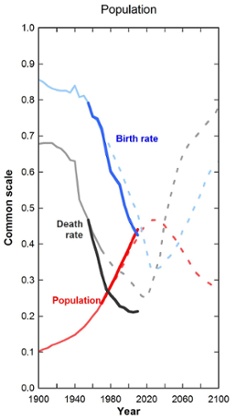
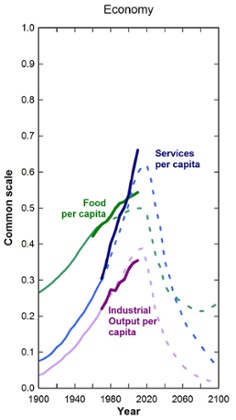
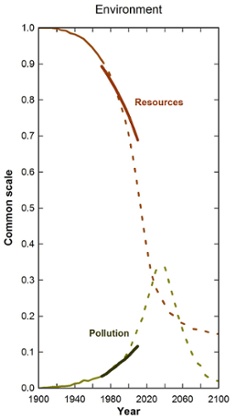
The results show that the world is tracking pretty closely to the Limits to Growth “business-as-usual” scenario. The data doesn’t match up with other scenarios.

These graphs show real-world data (first from the MIT work, then from our research), plotted in a solid line. The dotted line shows the Limits to Growth “business-as-usual” scenario out to 2100. Up to 2010, the data is strikingly similar to the book’s forecasts.

I'd like to think with a bit of determined effort that instead of falling into the "baseline scenario" outlined above that we can instead switch gears to "scenario 9" as outlined in Limits to Growth (shown below).

Remaking the industrial economy  

Posted by Big Gav in , , , ,

KcKinsey Quarterly has a look at closed-loop "cradle to cradle" style industrial manufacturing systems which it calls the "circular economy" - Remaking the industrial economy. MKQ also has a related interview with the CEO of Phillips - Toward a circular economy: Philips CEO Frans van Houten.

Visualize, for a moment, the industrial economy as a massive system of conveyor belts—one that directs materials and energy from resource-rich countries to manufacturing powerhouses, such as China, and then spirits the resulting products onward to the United States, Europe, and other destinations, where they are used, discarded, and replaced. While this image is an exaggeration, it does capture the essence of the linear, one-way production model that has dominated global manufacturing since the onset of the Industrial Revolution.

Increasingly, however, the linear approach to industrialization has come under strain. Some three billion consumers from the developing world will enter the middle class by 2030. The unprecedented size and impact of this shift is squeezing companies between rising and less predictable commodity prices, on the one hand, and blistering competition and unpredictable demand, on the other. The turn of the millennium marked the point when a rise in the real prices of natural resources began erasing a century’s worth of real-price declines. The biggest economic downturn since the Great Depression briefly dampened demand, but since 2009, resource prices have rebounded faster than global economic output. Clearly, the era of largely ignoring resource costs is over.

In light of volatile markets for resources, and even worries about their depletion, the call for a new economic model is getting louder. In response, some companies are questioning the assumptions that underpin how they make and sell products. In an effort to keep control over valuable natural resources, these companies are finding novel ways to reuse products and components. Their success provokes bolder questions. Could economic growth be decoupled from resource constraints? Could an industrial system that is regenerative by design—a “circular economy,” which restores material, energy, and labor inputs—be good for both society and business? If the experience of global automaker Renault is any indicator, the answer appears to be yes.

A circular economy replaces one assumption—disposability—with another: restoration. At the core, it aims to move away from the “take, make, and dispose” system by designing and optimizing products for multiple cycles of disassembly and reuse.2 This effort starts with materials, which are viewed as valuable stock to be used again, not as elements that flow through the economy once. For a sense of the scale involved, consider the fast-moving consumer-goods industry: about 80 percent of the $3.2 trillion worth of materials it uses each year is not recovered.

The circular economy aims to eradicate waste—not just from manufacturing processes, as lean management aspires to do, but systematically, throughout the various life cycles and uses of products and their components. (Often, what might otherwise be called waste becomes valuable feedstock for successive usage steps.) Indeed, tight component and product cycles of use and reuse, aided by product design, help define the concept of a circular economy and distinguish it from recycling, which loses large amounts of embedded energy and labor.

Moreover, a circular system introduces a strict differentiation between a product’s consumable and durable components. Manufacturers in a traditional economy often don’t distinguish between the two. In a circular economy, the goal for consumables is to use nontoxic and pure components, so they can eventually be returned to the biosphere, where they could have a replenishing effect. The goal for durable components (metals and most plastics, for instance) is to reuse or upgrade them for other productive applications through as many cycles as possible. This approach contrasts sharply with the mind-set embedded in most of today’s industrial operations, where even the terminology—value chain, supply chain, end user—expresses a linear view.

Misunderstanding The Limits To Growth  

Posted by Big Gav in ,

I never cease to be amazed by how many people misunderstood (or more likely, never read) The Limits To Growth.

Paddy Manning at Crikey has an article both outlining a recent example and being one itself, as Paddy infuriatingly describes "Limits" as making a forecast rather than what it actually did - which was describe a set of scenarios based on a range of assumptions - Beware Hugh Morgan and the climate sceptic zombie attack!.

If Hugh Morgan is saying it, it must be wrong.

Recall the businessman’s previous campaign against the High Court’s Mabo decision — which extended to a defence of terra nullius and warnings that Australia’s territorial integrity was under threat — or his glowing 2010 endorsement of the young Australian Workers’ Union boss Paul Howes as a future Labor leader, after his starring role unseating a first-term prime minister.

And so it was again yesterday with Morgan’s declaration in an interview with The Australian that the Intergovernmental Panel on Climate Change would be remembered as a “Chicken Little”, like the Club of Rome.

Morgan is a long-time president of the climate sceptic Lavoisier Group and was a member of the Business Advisory Council on Climate Policy, established in May 2011 by then-shadow environment spokesman Greg Hunt. (Did they meet often, I wonder, in their quest for a non-policy to solve a non-problem? Does it matter?)

Morgan told the Oz that the 1972 book The Limits to Growth, based on research by a team of scientists from MIT (not mainly European, as the article states), “illustrates the dangers of academics talking about things they know nothing about”:

“‘The IPCC will be remembered in the same way as the Club of Rome for its “Chicken Little” approach.’ “Mr Morgan said political leaders should reread The Limits of Growth to understand the dangers of modelling and the risk of believing ‘academics who think they can see the future’.

“He said the Club of Rome’s prediction that most major commodities would run out within a few decades had been proven wrong because of the scientists’ failure to consider technological innovation in the resources industry and their inability to understand how companies made decisions. “‘It completely presumed there was a standstill in technology,’ Mr Morgan said.

It is hardly worth attacking Morgan, who is entitled to his opinion, and good luck to him. But it is definitely worth defending the Club of Rome against such repeated misrepresentation, which crops up too often.

Published in 1972, Limits to Growth was the most popular environment book in history, selling 30 million copies in 30 languages.

In 2008 and 2012 CSIRO research scientist Graham Turner looked at how the real world was tracking, using three and then four decades of historical data, against the business-as-usual scenario outlined in Limits to Growth, which forecast the collapse of the environment, the global economy and subsequently the population, in mid-century. The answer is: we’re on track — the data matches “surprisingly closely” (Turner outlines this well in a seven-minute podcast). He takes on the critics of Limits to Growth for misrepresenting the modelling:

“Many asserted, falsely as it turns out, that the Limits to Growth predicted we would have run out of resources by 2000 and the economy would have collapsed by then, so they then say that the Limits to Growth was wrong. This turns out not to be the case. The Limits to Growth never said that at all.”

Here's one of the scenarios from "Limits" - note the absence of doom in this one (and the underlying assumption that technology does indeed progress)...

Peak Coal In China  

Posted by Big Gav in , , , ,

Citibank has released an interesting report on "peak coal" in China - referring to peak demand rather than any supply driven peak of production (something I view as quite far off) - The Unimaginable: Peak Coal in China.

The limit to coal use appears to be how much pollution the Chinese population is willing to tolerate - a reminder that there is more than one "limit to growth.

  • For the last decade, one of the most unassailable assumptions in global energy markets has been the ever-increasing trajectory of Chinese thermal coal demand. The consensus outlook for China’s coal demand, which currently accounts for more than 50% of global demand, has been so strong that the IEA called for coal to surpass oil as the leading global fuel before 2030.
  • Beyond the possibility of peak thermal coal demand in China, a series of transformative forces are increasingly asserting their influence on the global power mix. Disruptive changes in technology costs and fuel markets are now set to ensure that the next ten years look little like the last twenty. US shale gas is just the beginning. Changes in the power mix, especially in Chinese coal demand, have serious ripple effects on three categories: (1) globally traded coal and commodities, (2) countries and companies reliant on coal production and (3) carbon emissions.
  • Significant shifts in China’s economic structure and power sector demand a reassessment of coal’s perpetual climb. Key drivers include: (1) reduction of air pollution; (2) structural downward shifts in China’s GDP growth and energy intensity; (3) robust growth of China’s renewables and nuclear capacity, along with increased availability of natural gas from pipeline/LNG imports and domestic production; (4) efficiency improvements in coal power plants and energy demand.
  • Citi expects this combination of factors to slow the power sector's use of coal, pointing to a possible flattening or peaking before 2020, although many global energy agencies continue to expect high coal demand in the years to come. We arrive at our results based on a detailed, top-down electricity supply-demand model for China, which factors in power demand, efficiencies, coal and non-coal power generation and capacity, among others. The same macro forces driving the economic transition and lowering power demand should also lead to a deceleration in coal’s use in other sectors. Our conclusions are supported by results from bottom-up, economy-wide analyses by the China Energy Group at the Lawrence Berkeley National Laboratory. Senior research staff at China’s National Development and Reform Commission suggested the possibility of peak coal demand by 2015. Further, our work builds on Citi’s extensive research on China’s transition and on the end of the supercycle in commodities and the mining sector

Ironically, a softening and potential drooping of Chinese coal demand is going to hit Australian exports hardest (Mongolia is the only country more exposed to Chinese import demand), which will no doubt be a headache for the newly ascendent coal mining industry which it seems may not get to enjoy it's victory in the recent Australian election.

ReNew Economy notes that the first major development for the mining industry under the regime of Tony "Suppository of Wisdom" Abbott is the cancellation of a $7 billion coal mining project - Tony Abbott gets crash course in carbon bubbles.

It didn’t take long for prime minister-elect Tony Abbott to get a lesson in the harsh realities of international markets. Just days after his election, his repeated promise to repeal the carbon price, the mining tax, roll back green tape and open the country up to business, one of the biggest mining projects in the country – the $7 billion Wandoan coal mine in Queensland – was scrapped.

This was something that was only supposed to happen under a Labor/Green government. But, as Glencore Xstrata CEO Ivan Glasenburg made clear on Tuesday, the world has changed. There is simply not enough demand from other countries, and prices are way too low to justify new projects.

This should have come as no surprise to Abbott’s closest advisors, presuming they are doing their job properly, and not just listening to the overtures of Gina Rinehart. Nearly a third of the world’s thermal coal supplies are losing money because of significant shifts in consumption and economic priorities in China, the world’s biggest coal user, and elsewhere.

Jorgen Randers: what the future will be  

Posted by Big Gav in ,

Ugo at Cassandra's Legacy has a post on a talk by the pessimistic Jorgen Randers (of "Limits To Growth fame) in Rome in April - Jorgen Randers: what the future will be.

Presenting his book, "2052", Jorgen Randers starts with a bold statement: "I will not tell you what the future could be, but what the future will be". You would think that this shows quite a bit of hubris but, if you follow Randers' reasoning, you'll see that he has a point.

Randers is one of the authors of the famous "The Limits to Growth" report to the Club of Rome. Published in 1972, the book caused quite a stir and was widely misinterpreted as a prophecy of doom. It wasn't so and, in his talk, Randers summarizes what he and the others did. They didn't make any prophecy but, rather, they created a 'fan' of 12 different scenarios for the future of the world up to 2100. Some of these scenarios involved decline and collapse of the economy, some involved stabilization and prosperity. Whether one or the other set of scenarios would unfold depended on whether humankind made the right or the wrong choices in dealing with pollution, resource exploitation, and population growth.

One problem with the "The Limits to Growth" was that the authors never specified by what mechanisms humankind could develop the consensus necessary to make the right choices, which all involved some sacrifices in the short term. After 40 years of work, Randers has arrived to a conclusion: there are no such mechanisms. The right choices were not made and never will be.

Today, Randers says, there is no more a fan of good and bad scenarios: there is only one; and it is not pleasant. It can only be the decline of our society, constrained by overpopulation, declining resource availability, and widespread damage caused by pollution and climate change. The start of the decline may come earlier or later; collapse may be faster or slower, but the shape of the future is determined.

Randers maintains that there is a simple way to describe the reasons that are taking us to this unpleasant future: people always make the choice that involves the least costs in the short term. The problem is all there: as long as we always choose the easiest road, we have no control on where we are going.

Imagine you are lost in a forest. Would you think that always choosing the easiest path in front of you could take you home? But this is what we are doing: even though we should know that this is not the way to go where we would like to be. We are unwilling, for instance, to invest in renewable energy as long as fossil fuels are even slightly less expensive and we can neglect their external costs in the form of pollution and climate change. But this choice is based on short term consideration and it will cause us terrible long term damage.

Why are we unable to do better? Here, Randers proposes that "short-termism" is deeply ingrained in people's minds and is reflected in our democratic decisional system. He has been accused to be against democracy, but he maintains that he has nothing against democracy: the problem is that democracy is the result of human short-termism. He makes the example of an enlightened politician who decides to introduce a carbon tax. Soon, voters discover that the carbon tax is making gasoline and electricity more expensive. As a consequence, that politician won't be re-elected. It is simple and it happens all the time.

Of course, you might object that if the public were to be educated about climate change, then people would accept a carbon tax - actually they would clamor for it. Maybe; but Randers is skeptical. He says that he has spent decades of his life training generations of decision-makers in sustainability and ecosystem science. And he has seen those trained generations taking exactly the same wrong decisions that the previous, untrained, generations were taking.

Human nature is difficult to overcome. Randers recounts how he and his colleagues had been discussing about the size of a natural disaster that would wake the public to the reality of ecosystem destruction. Then Hurricane Katrina came and, later on, Sandy. Both where disasters as big as they can be. But they fell flat as wake up calls: the public didn't react. Today, three Americans out of eight still think that global warming is a hoax.

Randers has seen the enemy and the enemy is us.

Randers: What does the world look like in 2052?  

Posted by Big Gav in ,

While I've always argued "The Limits To Growth" was totally misunderstood by most of those who pass comment on it, Jorgen Randers' latest book does seem to have gone more down the path of mildly gloomy prediction than mere scenario planning - Randers: What does the world look like in 2052?.

What will the world look like in 40 years time. In 2052, will we have enough food and water? Will there be too many people? Will our standard of living be higher. Will we have taken decisive action on climate change.

To briefly summarise Jorgen Randers, the renowned Norwegian futurist, the broad answers to those are yes, yes, maybe, no and no. But it’s the way he reaches those conclusions that makes his latest book 2052: A global forecast for the next forty years, so compelling.

Randers made his name as the co-author of the book “The Limits to Growth”, which underpinned the Club of Rome’s work on resource depletion and helped spawn the sustainability movement. Not that he thinks the book and his work had that much impact. “I spent 40 years working on sustainability and failed. The world today is a much less sustainable world,” he lamented during a visit to Australia this week.

Now 67, Randers runs the centre for climate strategy at the Norwegian Business School. And having outlined 12 scenarios for the world running from 1970 to 2100 in his first book, he now feels there is enough information to make more concrete forecasts.

It is not a picture he finds particularly attractive, but one he sees as inevitable because of mankind’s inability to look beyond short-term solutions and the obsession with growth. “I’m not saying what should happen, but this is the sad future that humanity is going to create for itself.”

Here are the base numbers for his predictions. Unlike others that predict a world population of 9 billion in 2050, he sees it peaking at 8 billion in 2040 and then declining, because he says the rich world will choose jobs over children, and the poorer urban families will choose fewer children.

He expects the world economy to grow much slower than most, because it will be harder to increase productivity at the same rate as has occurred in the last four decades. The low hanging fruit in the agricultural, manufacturing and office sectors have been picked. And he does not believe the poor countries will “take off”. He says that by 2050, the world economy will be no more than 2.5 times bigger than it is today, rather than four times bigger as many assume.

The US has a bleak outlook because their average disposable incomes will not grow, because they have already gone further than most in productivity and have a huge debt to China. And, Randers says, because the US is not capable of making simple decisions, it will also be not capable of making difficult decisions. He puts the current debate around climate change, or the lack of it, as an example.

“China is the real winner and they will be 5 times as rich in 40 year time,” Randers says. That’s because of China’s ability to make quick decisions that are in favour of the majority. The rest of the world, he suggests, remains poor,

Still, while the economy and the population will not grow as fast as some predict, and there will be no huge shortage of food, water or energy, it will still grow fast enough to trigger a climate crisis, because the short termism of the political class and business means that greenhouse emissions will not be addressed. He expects emissions will peak between 2030 and 2040, and will have only returned to 2010 levels by 2050 – pushing the world beyond the 2°C scenario and locking in disastrous climate reactions in the second half of the century.

“We will spend more money repairing the damage of climate change after it has occurred instead of spending up front avoiding the climate damage,” he says. “We know what to do. The only reason we do not do it is because it is slightly more expensive than doing nothing, so we don’t do it. It is very frustrating.”

Welcome to Dystopia: the dangerous food and energy crises  

Posted by Big Gav in ,

Renew Economy has an article on Jeremy Grantham's latest musing on resource constraints - Welcome to Dystopia: the dangerous food and energy crises.

Jeremy Grantham, the former chairman and chief investment strategist for the $100 billion funds manager GMO Capital is known as a contrarian. But his quarterly investment newsletters are eagerly awaited, because they usually give some fascinating insight into some of the big themes that affect investments.

His latest, distributed to his investors in July but only recently publicly released, is worth a read in full. It focuses on the impending food crisis, and also how the climate issues and the energy issues are interlinked.

It’s a long document, so here we are just going to excerpt some of the key points he makes about energy. Remember, Grantham has no particular interest in one energy source of another, nor does he belong to any think tank that has a particular ideological bent. He is just responsible for $100 billion of someone else’s money and wants to know the best place to put it. (The answer appears to be farming stocks and other resources, if only for the anticipated price spikes).

One of his key themes is that the shale gas boom may buy some time, mainly for the US, but “seems more likely to create complacency” and continued dependence on hydrocarbons. He says this will have a slip-back effect in the longer term, because it will lead to yet higher prices and shortages that will impact global growth and even the viability of modern, rather fragile, economies.

“On paper… the energy problem can be relatively easily addressed through very large investments in renewables and smart grids,” he writes. “Those countries that do this will, in several decades, eventually emerge with large advantages in lower marginal costs and in energy security. Most countries including the US will not muster the political will to overcome inertia, wishful thinking, and the enormous political power of the energy interests to embark on these expensive programs. They risk being left behind in competitiveness.”

That seems a pretty clear message, and maybe one that Australia’s politicians should absorb. But while the energy problem make seem simple to solve on paper, in reality it is a different prospect.

“All it takes is real leadership from our leaders; common sense from the general public; a willingness of hydrocarbon interests to back off from politics and propaganda and a herd of flying pigs! We need to build a very large, very smart grid, covering the whole of the US and one day perhaps including Canada. Among many tricks, it needs to be able to reach into smart homes and turn off the refrigerators and so on for a few minutes when needed.

“It is, in fact, all state-of-the-art already and in the 10 or 20 years it would take to build, the technology and engineering would no doubt greatly improve, given the great scale, helping to drive down the cost. Behind the grid we would need a truly massive investment in storage technologies and all renewables, especially solar and wind power. Solar costs have unexpectedly crashed in the last three years, down by over two-thirds, and finally today, in ideal conditions (even without coal carrying its full environmental costs), solar is competitive.’

Grantham says that, in a happy variant of Moore’s Law, this fall in solar costs will continue. So will the fall in wind power costs. But the costs of hydrocarbon energy of all kinds will rise. The cost of a new grid would be cheaper as a percentage of GDP than the Manhattan project, and even if it took 20-30 years to build, the marginal costs of operating and maintaining such a system would cross the rising costs of the current grid long before then.

“By 2050,” he says, “cheap hydrocarbon sources will be a distant memory. Electric grids based solely on hydrocarbons would by then, after desperate struggles and brownouts, likely have turned totally black and economies based on such grids would be under very severe stress. If I’m wrong in this assertion for some countries, simply add 10 or 20 years onto the timeframe.”

The danger of complacency driven by the new reserves of natural gas and extra oil from new drilling technology could allow Germany and others, possibly including China, to forge ahead with renewables until they dominate these new, relatively job-intensive industries and eventually end up with much lower marginal costs. “The major disadvantage of all of these extra (oil and gas) reserves, though, is that they will give us more rope with which to hang ourselves by frying the planet.”

He notes recent estimates by Cornell University, which he hopes are preliminary and mis-measured, of almost 8 per cent of fracking gas leaks from drill to stove burner. Anything more than 4 per cent (and it may be as little as 3 per cent) makes natural gas even more dangerous to a warming planet than coal. “Unlike other environmentalists, I worry less about other of the several negative effects of fracking: boiling the planet makes other negatives seem to me relatively inconsequential.”

He says China has been in a “class of its own” in taking seriously this topic of future availability of resources. “It has a long Confucian tradition of thinking very long term and its politicians do not have to worry about being re-elected or about voters and funders as much as ours do. My colleagues worry that the Chinese save and invest too much, approximately half of all their income, a level never before reached in history.

“But for undertaking a completely renewable energy system, what a set-up! If the Chinese feel they must maintain a 50 per cent capital spending ratio (or at least come down gracefully to avoid an outright depression), there are few projects big enough to both absorb the giant quantities of money available and have a good return on investment at the societal level in the long term. Building a renewable energy system achieves both aims.

“As a first mover they would quickly be able to build fewer coal utilities and, eventually, none. In 30 or 40 years they could phase out the last of them and stop slowly poisoning their urban residents while at the same time helping to stop slowly cooking the Earth.

The Chinese are already becoming leaders in wind and solar power construction and research. At much higher scale, their cost advantages would be hard to match, and if a renewable energy system were to be completed, their biggest long-term worry of all – energy security – would be gone. ...

The Limits to Growth Revisited  

Posted by Big Gav in , ,

Ugo Bardi at Cassandra's Legacy has a post on his new book on The Limits To Growth - The Limits to Growth Revisited. You can read the book online here at Springer Link.

In some respects, "The Limits to Growth Revisited" is a rather technical book. It goes in some depth in describing the controversy that flared between critics (mainly economists) and supporters of the system dynamics methods used for the 1972 study "The Limits to Growth" (LTG). But "LTG revisited" is not just a technical book. It also tells the whole story of the LTG study: how it was conceived, what were the political reactions to it, how it was demonized and misunderstood, and what is its relevance - also in its more recent versions of 1992 and 2004 - to the present situation of the world.

Writing this book has been a fascinating work. Re-examining the story of LTG opens up a whole new world that urban legends and propaganda had tried to bury under a layer of lies and misinterpretations. We all have heard of the "mistakes" that the authors of LTG, or their sponsors, the Club of Rome, are said to have made. But LTG was not "wrong": nowhere in the 1972 book you find the mistakes that are commonly attributed to it. LTG never predicted catastrophes to occur soon, never estimated that some specific mineral resources should run out by some specific date, it never contained prophecies of doom. In other words, LTG was not, and never was, "Chicken Little with a computer."

What caused the demonization of the study was, in large part, the fact that it was so new and so advanced for its times that it was widely misunderstood, often by its supporters as well as by its detractors. But the misunderstanding was enhanced by a media campaign very similar to the one that has been recently directed against climate science. The trick of these campaigns is always the same: find a single mistake and use it to demonize the whole concept. It doesn't matter that the mistake is real or an invention, it doesn't count whether it is relevant or not. The trick is to repeat the concept of "mistakes" a large number of times and that is enough to confuse the public and cloud the issue. In recent times, the method has been used to demonize climate science with the alleged mistake found in the "hockey stick" temperature reconstruction of past climate. For LTG, the "mistake" was found in a few numbers taken from just one of the many tables of the 1972 book. There was nothing wrong in these numbers, but the concept of the "mistakes of the Club of Rome" went viral and it is still widespread, and perhaps prevalent, whenever the LTG study is mentioned today.

Understanding the real message that LTG sent to us in 1972, and that it is still sending, takes a certain effort. First, you have to free your mind from the layers of legends that have accumulated around it over four decades, but that is not enough. You have to free yourself also from the common attitude that prevents us from understanding how complex systems behave. There is no fixed future for systems such as the world's economic system, only trends. But these systems still obey physical laws: the limits of natural resources, the finiteness of the world system, the concentration of greenhouse gases in the atmosphere. And there are the constants of human behavior: mainly our tendency of preferring immediate satisfaction to a future one, a phenomenon known as "discounting the future."

All together, these factors push the world system to follow a well defined path. We cannot determine exactly what the future will be, but we can produce a "fan" of trajectories that show to us how where the system is heading to. The original 1972 LTG study had already identified the main factors that have been dominating the behavior of the world's economy. The combined effects of resource depletion and pollution accumulation (seen today mainly in terms of climate change) have been gradually reducing the ability of the industrial system of accumulating capital and of fuelling growth. These factors will, eventually, cause the world's industrial and agricultural systems to start a decline that could be defined as "collapse" which, later on, involves also the world's population.

It is not possible to determine exact dates for these events but, still, the insight that this kind of modelling offers to us is amazing. Just think how, already 40 years ago, the LTG study may have anticipated the worldwide financial crisis that occurred in 2008 and also the present debate on whether climate change or "peak resources" is the most important problem that we face. Dynamic modelling is a flexible tool, something that enhances the capability of the human mind to understand the world that surrounds us. The 1972 LTG study was the first to use this tool, but it is not the only possible way. Simpler dynamic models will tend to produce the same final outcome.

If we use this tool, and we use it wisely, we can discover that nothing of the future is written in stone. The future is something that we create every day with our actions. At the same time, we can also discover that the future has a life of its own, that it resents being forced into what we think it should be on the basis of obsolete ideologies. We will have to adapt to the future and that may not be painless but, if we try to understand the future, we may discover that it doesn't need to be our enemy.

All watched over by machines of loving grace (part 2)  

Posted by Big Gav in , , , , ,

I watched the second episode of "All watched over by machines of loving grace" today and found it interesting but mildly annoying.

I'd noted the parallels in the first episode to Fred Turner's book "From Counterculture To Cyberculture", so I wasn't particularly surprised to see Turner make an appearance in this episode, along with Stewart Brand, and the tracing of these ideas back to Bucky Fuller.

What was new about this episode was the repeating of common misconceptions about "The Limits To Growth" and the strange line of reasoning that seemed to argue that the search for "equilibrium" (ie. a scenario where our overall impact on the environment is trimmed to the point where we don't end up having the population crash as we overwhelm the planet's carrying capacity) that "Limits" undertakes is really arguing for a form of political stasis where no radical change is to be contemplated.

While this may have been a goal of the Technocrats that preceded them, it doesn't ring true for the systems theorists.

Curtis even notes that Jay Forrester and the "Limits" crew explicitly said they weren't considering politics, but discounts this as a form of dishonesty rather than accepting that the book is just outlining scenarios around resource consumption, population and pollution rather than being a political manifesto (which would have been entirely counterproductive).

Where is does veer towards politics (in the section entitled "Transitions to a sustainable system", where it prescribes the changes required to make our global economy sustainable), the practices recommended are both positive and a change from the general status quo today - it doesn't read like a manual for perpetuating elite control and forbidding political change, with the non-technical recommendations including :

* poverty reduction
* nonviolent conflict resolution
* accurate/unbiased media
* “decentralisation of economic power, political influence and scientific expertise”
* “stable populations” and “low birth rates” by “individual choice”

Curtis' main point (like Turner's before him) - that the counterculture / hippie / cyberculture ideal of a world without politics is a fantasy - is valid, but he really goes off the rails trying to blame the systems theorists and ecologists for the problems of the world today.

The section about the colour revolutions in eastern europe, in particular, seemed wildly off base - he assumes that this genuinely was a case of leaderless uprising spontaneously organised via network culture - when instead they were orchestrated from the US to expand western influence at the expense of the Russians - and naturally enough faltered once the population realised that their interests weren't really being advanced at all by the changes (just as we'll most likely see with the current "Arab Spring" equivalent).

Cassandra's Legacy  

Posted by Big Gav in ,

Ugo Bardi from The Oil Drum has set up his own blog, dubbed "Cassandra's Legacy". One of his first posts looks at "The Limits To Growth", which has has written a (soon to be published) book about - The time machine of the 1960s . Also at CL - What punctured the North-African balloon? Crude oil and social unrest and How to drive your elephant: dealing with complex problems .

How about that? You are young and you are all interested in the future. And, a time machine that takes you to the future, wow! that would be something!

Of course, no matter how good a researcher is professor Deriu, I think he hasn't arrived yet to developing a time machine; one that takes you to the future and back. But maybe it could be built. I don't know if there are physical reasons preventing it to exist; but I know that - if it were ever built - it could only take you to "a" future, not to "the" future. The future, after all, is in our hands; it depends on what we do. So, if a time machine takes you to the year 2110, then you come back and you do something based on what you learned in your trip; then the future must change. So, when you go to 2110 again, what you see is completely different. That is, after all, the theme of the movies of the series "Back to the Future," but not just of that movie. Plenty of science fiction has been written on this theme: you go to the future, see how it is, then you come back and you do something to change it. The future can never be exactly predicted, it is not fixed.

Now, as I said, a time machine doesn't exist today; maybe it will never exist. But something like the story I have been asking you to imagine did take place back in the late 1960s - many of you weren't even born at that time. It happened at the Massachussets Institute of Technology, the MIT, in Boston, where someone named Jay Forrester was working.

I think you'll like to hear a little about Jay Forrester. He was born - if I remember correctly - in 1918. He has traveled quite a stretch in time! And, last time I wrote to him, he answered to me via email - though he is in his 90s, his mind is still sharp. We are all time travelers, after all, and if you are lucky you travel in comfort - not forever though, but that's another problem. Anyway, Jay Forrester has been a pioneer of computer science: he led a team who developed a new computer memory that became the standard for computers in the 1950s and 1960s. At that time there was no such thing as a "personal computer." There were those big computers; you know, big cabinets occupying several rooms and with technicians in white coat running around. And these big computers were much less powerful than your laptop, today. Things change as you travel in time.

Anyway, Forrester was interested in many things; one was the future. Of course, he didn't have a real time machine. But he had this idea that he could use the computers he had built as something that could "see" the future, although not really predicting it - that, as I said, is not possible. His idea was to study the future. It is something different. In science, when you study something, you do it as a function of the parameters of the system. Say, when you study a chemical reaction, you do such things as changing things like concentrations, type of reagents, that kind of changes. And then you see what happens. So, when you study the future, you change some of the parameters and you see what happens. You play the game "what would happen if..." And that is what Forrester had developed: a model of the world that could be run in the memory of a computer and generate different futures depending on the parameters in input. Each one is what you call a "scenario." In a way, it is a time machine, although it is a virtual one. But it is still a possible future, a destination you could find yourselves traveling to .

So, imagine you were a PhD student working in Forrester's lab in the 1960s. I guess the atmosphere must have been very exciting. They had these new computers, very powerful for the time, and they were using them to study the future. It would have been great to be there and to work on these models.

The story, at this point, has to do with someone named Aurelio Peccei - you probably never heard of him as well. He was Italian and he was at the head of a group of people who referred to themselves as the "Club of Rome." They had started with the idea that they wanted to do something to help the poor in the world. But they soon discovered that it was not an easy task - of course we all know it is not. One basic question was, "do we have enough resources on this planet to help the poor?" In other words, what are the limits to the resources on earth? Obviously, that was a difficult question to answer. So, what happened was that Peccei met Forrester in Italy, at a meeting on the shores of Lake Como. That was in the late 1960s. Peccei was impressed by Forrester and probably Forrester was impressed by Peccei. They met again in Switzerland, later on, and in the end they decided that the model that Forrester was developing was just what was needed to solve the question that the Club of Rome was asking.

So, one of Forrester's students took up the task of making a big model of the whole world for the Club of Rome. His name was Dennis Meadows. At that time he wasn't a student any more, he was 28 years old, but he was young anyway. And so the research called "The Limits to Growth" was started. Dennis Meadows collected a group of young people and they started modelling the whole world for a future that spanned more than 100 years, up to the end of the 21st century. I am sure that they were absolutely thrilled by the challenge. I am sure that all of you would be thrilled. It was an incredible chance: use the computer as if it were a time machine and explore the future of the world! In the past few years, I have had the chance of meeting some of the people who worked on that project in person. Now, of course, they are in their 60s or 70s; but they maintain a lot of enthusiasm for these studies. The had the chance to see how their scenarios have fared over almost 40 years of comparison with the real world. As I said, we are all time travelers.

So, what did they find with their virtual time machine? The results are described in a book titledcalled "The Limits of Growth" which was published almost 40 years ago. Today, if you heard about that study, you probably heard that it was all wrong. That it was a flawed study based on wrong data and that it had predicted that the world should have ended - maybe - in the 1990s and that, of course, didn't happen. Or, if you never heard about it, you may wonder why - if it was so new and important.

Here, you have to be careful. You probably know the old say about computers: "garbage in, garbage out". It is true and it is a good warning. As I said before, if you are using the computer as a time machine, you must be aware of the limitations of a time machine. If you expect the computer to be able to predict the future, you'll be sorely disappointed. The future depends on what we do and if we decide to do one thing rather than another, then the future will change. That's the basic idea of what people call "scenario planning". You don't try to predict what the future will be. You try to figure out what it may be and act in consequence.

That, believe me, is a lot. You read newspapers and the feeling is that nothing of what happens could be imagined just the previous day - let alone predicted years before. You get the impression that we live in a world where politicians surge every day to meet some challenge that was utterly unexpected, and they gain much press coverage in the process. But it is not like this. Computers give you a tremendously powerful tool to manage the future. Not tomorrow's future, of course. If I could predict what will happen tomorrow, and I could predict it exactly, well, I would be somewhere else, of course. But in the past 10 years or so I have been working with this kind of models and I am impressed at the insight that they can give to you. In the past few years, nothing of what happened has really surprised me - it is almost scary. Of course, I can't predict the exact year when something will happen, or details of what is going to happen, but I can have a general idea of what is in store for us.

As I said, it is a little scary to have tools that can give you some idea of the future. That is because the future is not always bright - of course. And that brings us back to "The Limits to Growth," the study made in 1972. The study was not "wrong" as some people said later on - the problem was that the future it saw for humankind was not bright at all. And people didn't like that. So, rather than thinking "how can I make the future brighter?" they decided that the study was wrong. It happens all the time - it is a tough life for those who chose this job: exploring the future.

Anyway, the authors of "The Limits to Growth" did a good job in exploring many possibilities for the world's future. But most of their scenarios had a "robust" feature, something that didn't change much as a function in changes of the parameters in input or of the model itself. That was collapse of the world economy. And if the economy collapses, a lot of things must collapse with it, including the human population. There was a scenario in the study that was called "base case", or "standard run" - the one which had as parameters data which were the best available and that assumed that the world - meaning the way people behave - wouldn't change too much over time. Well, this scenario produced the start of the collapse of the economy for around 2010 -2020.

Now, I think you start understanding where I am heading to. In practice, I am arriving to the same concepts that I could have shown to you from my power point presentation on crude oil. You see, collapse is the result of a number of things happening right now; in front of your eyes. Less and less crude oil; and that forces people to pay more for it. And, eventually, we'll arrive to a point where we can't afford it any more. And that is not just a problem with crude oil - it happens with all mineral resources. If minerals are what keeps the world's economy running, then you'll see it collapse. And there is another resource which is gradually running out; it is the capability of the atmosphere to absorb the products of combustion of oil and of fossil fuels. As you know, the consequence is we are gradually heating the whole planet - that's no good for the economy, either. And for us all; too.

So, this is what we are seeing around us. Things are starting to collapse - maybe not exactly collapsing - but surely there are all those ominous creaks that you hear when a structure is near collapse. The economy, the prices, all those things that happen. I could give you more data; but I think the general picture should be clear to you. We have been growing at the expense of the natural capital of our planet and now we are being asked to repay it, with the interests. All that was known from a long time ago, with that 1972 study "The Limits to Growth".

Dennis Meadows: "Growth versus Development"  

Posted by Big Gav in ,

Both frogblog and The Oil Drum have pointed to this talk by Dennis Meadows (co-author of the widely misunderstood Limits To Growth) in Davos last year - Dennis Meadows: "Growth versus Development".

Today there is a lot of worry and concern--you see it in the papers, you see it in the speeches of politicians--about climate change, about environmental damage, about falling water tables, about food and oil scarcity, and so forth. These are really not problems, they are symptoms. It is like your friend has cancer, and therefore has also a headache. The headache is a symptom. It is not in itself the problem. You can take care of the headache--you can give pain killers, or something, but if the headache goes away you don't imagine that the problem is solved.

Climate change, energy scarcity, these things are symptoms. Maybe we could solve them, maybe we won't. But even if we do, it doesn't eliminate the problem. The problem is physical growth, continued population expansion, continued increase in material standards of living, in a world that has finite limits.

The Political Ecology of Collapse, Part Two: Weishaupt's Fallacy  

Posted by Big Gav in , , ,

John Michael Greer has an interesting post on the failure of the Illuminati dream (or conspiracy, depending on your viewpoint) and its modern era echo in the failure of the 1970's systems thinkers (and their "Limits To Growth" manifesto) - The Political Ecology of Collapse, Part Two: Weishaupt's Fallacy (via Energy Bulletin).

Nostalgia aside, there's a lot to be learned from the rise and fall of appropriate tech in the 1970s, and one of its lessons bears directly on the theme of this series of posts. For many of the people involved in it back then, appropriate tech was the inevitable wave of the future; nearly everyone assumed that energy costs would continue to rise as the limits to growth clamped down with increasing force, making anything but Ecotopia tantamount to suicide. A formidable body of thought backed those conclusions, and the core of that body of thought was systems theory.

Nowadays, the only people who pay attention to systems theory are specialists in a handful of obscure fields, and it can be hard to remember that forty years ago systems theory had the same cachet that more recently gathered around fractals and chaos theory. Born of a fusion between ecology, cybernetics, and a current in contemporary philosophy best displayed in Jan Smuts' Holism and Evolution, systems theory argued that complex systems -- all complex systems – shared certain distinctive traits and behaviors, so that insights gained in one field of study could be applied to phenomena in completely different fields that shared a common degree of complexity.

It had its weaknesses, to be sure, but on the whole, systems theory did exactly what theories are supposed to do – it provided a useful toolkit for making sense of part of the universe of human experience, posed plenty of fruitful questions for research, and proved useful in a sizable range of practical applications. As popular theories sometimes do, though, it became associated with a position in the cultural struggles of the time, and as some particularly unfortunate theories do, it got turned into a vehicle for a group of intellectuals who craved power. Once that happened, systems theory became another casualty of Weishaupt's Fallacy.

Those of my readers who don't pay attention to conspiracy theory may not recognize the name of Adam Weishaupt; those who do pay attention to conspiracy theory probably "know" a great deal about him that doesn't happen to be true. He was a professor of law at the University of Ingolstadt in Bavaria in the second half of the eighteenth century, and he found himself in an awkward position between the exciting new intellectual adventures coming out of Paris and the less than exciting intellectual climate in conservative, Catholic Bavaria. In 1776, he and four of his grad students founded a private society for enthusiasts of the new Enlightenment thought; they went through several different names for their club before finally settling on one that stuck: the Bavarian Illuminati.

Yes, those Bavarian Illuminati.

There were a fair number of people interested in avant-garde ideas in and around Bavaria just then, and. before too long, the Illuminati had several hundred members. This gave Weishaupt and his inner circle some grandiose notions about where all this might lead. Pretty soon, they hoped,all the movers and shakers in Bavaria – not to mention the other microkingdoms into which Germany was divided at that time – would join the Illuminati and stuff their heads full of Voltaire and Rousseau, and then the whole country would become, well, illuminated.

They were still telling themselves that when the Bavarian government launched a series of police raids that broke the back of the organization. Weishaupt got out of Bavaria in time, but many of his fellow Illuminati were not so lucky, and a great deal of secret paperwork got scooped up by the police and published in lavish tell-all books that quickly became bestsellers all over Europe. That was the end of the Illuminati, but not of their reputation; reactionaries found that blaming the Illuminati for everything made great copy, not least because they weren't around any more and so could be redefined with impunity – liberal, conservative, Marxist, capitalist, evil space lizards, you name it.

The problem with Professor Weishaupt's fantasy of an illuminated Bavaria was a bit of bad logic that has been faithfully repeated by intellectuals seeking power ever since: the belief, as sincere as it is silly, that if you have the right ideas, you are by definition smarter than the system you are trying to control. That's Weishaupt's Fallacy. Because Weishaupt and his fellow Illuminati were convinced that the conservative forces in Bavaria were a bunch of clueless boors, they were totally unprepared for the counterblow that followed once the Bavarian government figured out who the Illuminati were and what they were after.

For a more recent example, consider the rise and fall of the neoconservative movement, which stormed into power in the United States in 2000 boldly proclaiming the arrival of a "new American century," and proceeded to squander what remained of America's wealth and global reputation in a series of foreign and domestic policy blunders that have set impressive new standards for political fecklessness. The neoconservatives were convinced that they understood the world better than anybody else. That conviction was the single most potent factor behind their failure; when mainstream conservatives (not to mention everybody else!) tried to warn them where their fantasies of remaking the Middle East in America's image would inevitably end, the neoconservatives snorted in derision and marched straight on into the disaster they were making for themselves, and of course for the rest of us as well.

Systems theory was a victim of the same fallacy. The systems movement, to coin a label for the heterogeneous group of thinkers and policy wonks that made systems theory its banner, had ambitions no less audacious than the neoconservatives, though aimed in a completely different direction. Their dream was world systems management. Such leading figures in the movement as Jay Forrester of MIT and Aurelio Peccei of the Club of Rome agreed that humanity's impact on the planet had become so great that methods devised for engineering and corporate management – in which, not coincidentally, they were expert – had to be put to work to manage the entire world.

The study that led to the 1973 publication of The Limits to Growth was one product of this movement. Sponsored by Peccei's Club of Rome and carried out by a team led by one of Forrester's former Ph.D. students, it applied systems theory to the task of making sense of the future, and succeeded remarkably well. As Graham Turner's study "A Comparison Of The Limits to Growth With Thirty Years of Reality" (CSIRO, 2008) points out, the original study's baseline "Standard Run" scenario matches the observed reality of the last three and a half decades far more exactly than rival scenarios.

It's not often remembered, though, that the Club of Rome followed up The Limits to Growth with a series of further studies, all basically arguing that the problems outlined in the original study could be solved by planetary management on the part of a systems-savvy elite. The same notions can be found in dozens of similar books from the same era – indeed, it's hard to think of a systems thinker with any public presence in the 1970s who didn't publish at least one book proposing some kind of worldwide systems management as the only alternative to a very messy future.

It's only fair to stress the role that idealism and the best intentions played in all this. Still, the political dimensions shouldn't be ignored. Forrester, Peccei, and their many allies were, among other things, suggesting that a great deal of effective power be given to them, or to people who shared their values and goals. Since the systems movement was by no means politically neutral – quite the contrary, it aligned itself forcefully with specific ideological positions in the fractured politics of the decade – that suggestion was bound to evoke a forceful response from the entire range of opposing interests.

The Reagan revolution of 1980 saw the opposition seize the upper hand, and the systems movement was among the big losers. Hardball politics have always played a significant role in public funding of research in America, so it should have come as no surprise when Reagan's appointees all but shut off the flow of government grants into the entire range of initiatives that had gathered around the systems theory approach. From appropriate tech to alternative medicine to systems theory itself, entire disciplines found themselves squeezed out of the government feed trough, while scholars who pursued research that could be used against the systems agenda reaped the benefits of that stance. Clobbered in its most vulnerable spot – the pocketbook – the systems movement collapsed in short order.

What made this implosion all the more ironic is that a systems analysis of the systems movement itself, and its relationship to the wider society, might have provided a useful warning. Very few of the newborn institutions in the systems movement were self-funding; from prestigious think tanks to neighborhood energy-conservation schemes, most of them subsisted on government grants, and thus were in the awkward position of depending on the social structures they hoped to overturn. That those structures could respond homeostatically to oppose their efforts might, one would think, be obvious to people who were used to the strange loops and unintended consequences that pervade complex systems.

Still, Weishaupt's Fallacy placed a massive barrier in the way of such a realization. Read books by many of the would-be global managers of the 1970s and you can very nearly count on being bowled over by the scent of intellectual arrogance. The possibility that the system they hoped to manage might, in effect, have been more clever than they were probably crossed very few minds. Yet that's how things turned out; at the end of the day, the complex system that was American society had reacted, exactly as systems theory would predict, to neutralize a force that threatened to push it out of its preferred state.

Dennis Meadows Wins Japan Prize  

Posted by Big Gav in

Energy Bulletin reports that Dennis Meadows, one of the authors of The Limits to Growth has won this year's Japan prize - 2009 Japan prize honors lead author of ‘"The Limits to Growth".

Dr. Dennis Meadows, lead scientist and co-author of The Limits to Growth (1972) and its subsequent updates, is the winner of this year’s Japan Prize from the Science and Technology Foundation of Japan for “Transformation towards a sustainable society in harmony with nature.” This prestigious award is given once a year to people from all parts of the world whose original and outstanding achievements in science and technology are recognized as having advanced the frontiers of knowledge and served the cause of peace and prosperity for humankind. It carries a cash award of 50 million yen (about $500,000) and will be awarded during a Japan Prize Awards week in April 2009.

In 1972, three young scientists from MIT used systems dynamic theory to create a computer model (“World3”) that analyzed global resource consumption and production. Their report, funded by the Club of Rome and published as The Limits to Growth, created an international sensation and acquainted millions with the fact that large-scale industrial activities and population growth could destroy their own foundations—confronting global society with the very real prospects of self-inflicted collapse. It was an international bestseller, with over 30 million copies sold worldwide.

Later voted to be one of the 20th century’s ten most-influential environmental books, the text was the object of intense criticism by economists of the time. They dismissed it as Malthusian hyperbole. But events over the past three decades have generally been consistent with the book’s scenarios. The Limits to Growth later served as the foundation for “The Global 2000 Report to the President” as well as UN’s Brundlandt Commission.

Matthew Simmons, economist and founder of the world’s largest private energy investment banking practice, recently wrote, “The most amazing aspect of the book is how accurate many of the basic trend extrapolations . . . still are some 30 years later.”

Since its initial publication, Meadows, along with the late Dr. Donella Meadows and Dr. Jorgen Randers, has twice authored updates published by Chelsea Green: Beyond the Limits in 1992, and Limits to Growth: The 30-Year Update in 2004. In these updates, an improved world model was used to point out that the limiting features of the earth’s physical capacity, about which The Limits to Growth had sounded a warning, have continued to deteriorate, and that the time left for solving the problem is growing short; the authors urged that mankind not delay in taking the measures necessary to address the situation.

At the time of publication of Limits to Growth: The 30-Year Update, Lester Brown, Director of the Earth Policy Institute said, “Reading the 30th-year update reminds me of why the systems approach to thinking about our future is not only valuable, but indispensable. Thirty years ago, it was easy for the critics to dismiss the limits to growth. But in today’s world, with its collapsing fisheries, shrinking forests, falling water tables, dying coral reefs, expanding deserts, eroding soils, rising temperatures, and disappearing species, it is not so easy to do so. We are all indebted to the ‘Limits’ team for reminding us again that time is running out.”

Since the initial publication of The Limits to Growth, Dr. Meadows has continued to study the causes and consequences of physical growth on a finite planet. Among his numerous endeavors, he co-founded the Balaton Group, a famous environmental research network, and he has published many educational games and books about sustainable development that are used around the world.

CSIRO warns of climate change doomsday  

Posted by Big Gav in

The Herald Sun has a report on new CSIRO research into the "limits to growth" (repeating a few of the old fallacies) - CSIRO warns of climate change doomsday.

THE world may be on track to face economic and ecological collapses by the middle of the century, according to CSIRO research. The 1972 bestselling scientific report The Limits to Growth warned of possible doomsday scenarios created by unchecked use of resources.

A study by CSIRO physicist Dr Graham Turner found data projections made in The Limits to Growth were correct.

Dr Turner said projections relating to population, food and industrial production, pollution and consumption of non-renewable natural resources between 1970 and 2000 were broadly accurate. "Unless (The Limits of Growth) is invalidated by other scientific research, the data comparison presented here lends support to the conclusion that the global system is on an unsustainable trajectory," he said.

Massachusetts Institute of Technology researchers commissioned by environment group The Club of Rome used computer modelling to develop The Limits to Growth study. The report has been criticised by many economists and scientists over the years.

Under a "business as usual" scenario modelled in the report, the world population and the use of industrial resources would continue to grow.

Pollution would increase, harming agricultural production and human life and more energy and resources would be required to access declining levels of non-renewable natural resources. "Eventually those pollution effects cause a big decline in the population," Dr Turner said.

The Limits of Growth said disaster could be averted through technological advances and a reduction in consumption of material goods.

Futurists And Peak Oil  

Posted by Big Gav in

I noticed a pair of futurists talking about peak oil today - first Richard Watson in The Daily Telegraph, as part of a grab bag of predictions - Futurologist Richard Watson's 2050 vision: goodbye Belgium, hello brain transplants.

After a week when it's been impossible to predict which financial giant will still be standing at the end of the day, let alone the year, it would seem like a fool's errand to talk about decades down the line. These days, if you raise your gaze to the horizon, you'll find experts warning of a host of problems: melting ice caps, global pandemics, terrorism, the end of oil, meteor strikes, even robot uprisings.

It's all too easy to become paralysed by such possibilities - and yes, there are ideas, discoveries and events over the horizon that we can't possibly comprehend. But while the future is unknown and unwritten, we can begin to trace its outline, and prepare the first drafts. ...

Wherever you look in society, massive changes will be taking place. If my predictions are accurate, by 2050 there won't be DVDs, or national currencies, or a monarchy, or a unified Belgium, but we might well have a ladder into space, robotic policemen and diets based on our individual genome. I've picked out some of the more important or exotic arrivals and departures in the list below. ...

Second, the environment will remain vitally important, but climate change won't be the only game in town - the approach of peak oil, peak coal, peak gas, peak water, peak uranium and even peak people (a severe shortage of workers in many parts of the world) will also have an impact, and require a profound shift towards sustainability.

In political and economic terms, the shift of power to the east, and the rise of countries such as China and India, will continue - the third factor to remember.

We already know that the world is getting smaller, and the fourth idea - greater connectivity - will continue to change how people live, work and think. One billion of us are already online, and this is expected to double within a decade or so. As a result, privacy will be dead or dying - but we may get smarter at making decisions, because our connectivity will allow instant polling of a crowd whose wisdom is nearly always greater than any single member's.

Next up is Peter Schwartz, who doesn't believe in peak oil (presumably he means he doesn't believe we are at peak oil, rather than believing oil supply will never peak) and told a Cleantech conference so - as well as pointing out that most of them didn't have experience in the energy industry (personally I don't view this as a big deal, as an oil industry background is unlikely to be of much benefit to a cleantech entrepreneur) - Peak oil "wrong," says Schwartz.
"The peak oil people simply don't know what they're talking about," said environmental futurist Peter Schwartz today at the Cleantech Forum in Washington, D.C.

Forget everything you've heard about peak oil as a driver of clean technology, said futurist Peter Schwartz today in a provocative closing session at the Cleantech Forum XVIII in Washington D.C.

"The peak oil people simply don't know what they're talking about, they don't know the facts," claimed Schwartz, co-founder and chairman of the Global Business Network and author of five books.

"Peak oil is wrong. We really don't know how much oil there is in most of the oil reservoirs of the world. Oil reservoirs are complex geological structures, and most of the data is in private hands, or in state governments, and they are not particularly forthcoming about how much is there."

The theory of peak oil, credited to M. King Hubbert, theorized that United States oil production would peak between 1965 and 1970. His model, now referenced as Hubbert's peak, is widely touted to suggest that world oil reserves are now declining and that demand now outstrips humanity's ability to deliver the amount of oil required. The peak oil model is cited by many as a fundamental driver of development of non fossil-based sources of energy, such as wind and solar.

From 1982 to 1986, Schwartz headed scenario planning for the Royal Dutch/Shell group of companies.

"We don't know how much is out there," he said today. "And they tend to be very conservative, these estimates. And technology changes, and that opens up new reserves deep offshore. When I was at Shell, we could only drill into a thousand feet of water. Today, they're drilling into 10,000 feet of water, and 20,000 feet below that."

Peak oil proponents point out that no meaningfully-sized new reserves have been discovered in years, that the oil that is known is relatively finite, and believe it will become too expensive and resource-intensive to produce meaningful amounts of petrochemical products from other known sources of oil like the Canadian tar sands.

"We are not going to run out of oil before the issue of climate change drives change. It'll be costly oil. But it'll be climate change catastrophes [such as sudden, unexpected displacement of large numbers of people, and massive property damage], and more expensive oil, not the fact that we're running out of oil, that will drive change," according to Schwartz.

Schwartz wasn't afraid to directly provoke venture capitalists in the crowd. He drew a pointed comparison with Internet investing.

"Before the dot com bust, there was an enormous amount of money chasing good ideas and stupid ideas ... the fear I have is that we're going to have a similar bust here. How many of you have ever worked in the energy industry? [about ten percent of hands were raised.] That's my concern. That means most of you don't know what you're doing."

"If you've never built a power plant, if you've never run a refinery, if you've never installed solar panels yourself, if you've never worked in a lab, these are the things I worry about."

Schwartz is one of the scenario planners I talked about in "The Limits To Scenario Planning", with a background at both Shell's scenario planning division and GBN. He was also the author of Wired's infamous "long boom" article and a strong proponent of the hydrogen economy (we're still waiting for that one Pete).

While I often agree (or at least sympathise) with his point of view, in this case he seems to be misunderstanding the important aspects of "real world" peak oil, which are based on past discoveries, flow rates and EROI - if you aren't finding (and developing) large quantities of oil (fast enough to replace production lost through depletion of existing fields and to meet new demand growth), then it doesn't matter if there could be a lot of oil under the Atlantic ocean which could be extracted at high cost (and with long lead times). For that matter there is a lot of oil sitting under Iraq which would in theory let us peak around 6 million barrels or so a day higher than current production - if it was being extracted - but the fact remains that this isn't happening.

In the "limits" post I noted the Club of Rome (and, to a much lesser extent, the scenario planners) are the subject of more than a few conspiracy theories, which I've adjudged to be baseless based on my reading of "The Limits To Growth" - something almost no one who comments on the CoR seems to have done (and if they did, they obviously didn't understand it).

One example I came across recently is this one from Aftermath News, which has some ominous sounding quotes from another CoR publication - "The First Global Revolution" of the Club of Rome.
“It would seem that men and women need a common motivation, namely a common adversary, to organize and act together in the vacuum such as motivation seemed to have ceased to exist or have yet to be found. The need for enemies seems to be a common historical factor…Bring the divided nation together to face an outside enemy, either a real one or else one INVENTED for the purpose…

Democracy will be made to seem responsible for the lagging economy, the scarcity and uncertainties. The very concept of democracy could then be brought into question and allow for the seizure of power.

In searching for a new enemy to unite us, we came up with the idea that pollution, the threat of global warming, water shortages, famine and the like would fit the bill. The real enemy [of the elites and their minions] then is humanity itself.”

- “The First Global Revolution” (1991) published by the Club of Rome.

The problem with this quote is that it selectively quotes content from the book without putting them in context (and removing large chunks of intervening text that don't fit the theory that the "limits" are just a phantom menace to manipulate people).

Luckily someone (who seems to subscribe to the theory being promoted above) has posted the text of the book to Scribd (an excellent resource if you are on the lookout for various hard to find or out of print books), which allows the quote above to be checked for accuracy.

As the full quote from the book shows (the sentences above were taken from a range of pages), the actual intent of what was being said is rather different to that being claimed - the problems (in the opinion of the authors) are real, not invented, and democracy is the goal, not the enemy.
Generally speaking, informed dlsucssion on the main political, economic and social issues take place on radio and television rather than In Parliament, to the detriment of the latter. The activities of political parties are so Intensely focussed on election deadlines and party rivalries that they end up weakening the democracy they are supposed to serve This confrontational approach gives an impression that party needs come before national interest. Strategies and tacrjes seem more Important than objectives and often a constituency is neglected as soon as It is gained. With the current mode of operation. Western democracies are seeing their formal role decline and public opinion drifting away from elected representatives. However, the crisis in the contemporary democratic system must not be allowed to serve as an excuse for rejecting democracy.

In the countries now opening up to freedom, democracy is being introduced in a situation which demands greatly changed attitudes and patterns of behaviour from citizens. These Inevitable problems of phasing in democracy are difficult to solve. But there is another, still more serious question. Democracy does not necessarily build the bridge between a colonial or nco-colonial economy or a centralized bureaucratic economy, and a market economy based on competition and capable of producing growth. Attitudes, market relations and managerial styles simply do not exist in a country experiencing a transitional situation such as the present, which because of sudden and unforeseen changes has been neither planned nor prepared for the necessary structures. If such a situation is allowed to continue for too long, it is probable that democracy will be made to seem responsible for the lagging economy, the scarcities and uncertainties. The very conceptof democracy could then be questioned and allow for the seizure of power by extremists of one sort or the other.

Winston Churchill was right when he quipped, 'Democracy Is the worstof all systems, except for the rest.' Yet we must be aware of its erosion, its fragility and its limitations. When persons say 'It is obvious what must be done to improve our situation,' they seldom ask 'Why isn't it done dien?' And if they do ask, they will have to answer.' It is because we lack the (political) will or because of our habits, or because of shortsightedness, or politics and so on...' Our inability to indicate how to overcome these sources of inertia and resistance makes it clear that we are not at all sure about what must be done. We overlook (psychologically speaking, we deny) our Ignorance and instead say, that we lack the political will. The cr jcial need is to revitalize democracy and give it a breadth of perspective that will enable it to cope with the evolving global situation. ...

It is not easy to stimulate a universal debate on ideas, but the lack of attempts to do so further deepens the void. There is a pressing need for such a debate, and the frequency of international conferences and meetings, with their cross-cultural discussions, should initiate new and more global thinking.

This period of absence of thought and lack of a common vision - not of what the world of tomorrow will be, but of what we want it to be so that we can shape It - is a source of discouragement and even despair. How simple it was, or should have been, for France. Great Britain and their allies to mobilize against their common Nazi enemy. And was it not obvious during the period of the cold war, that the Western nations should accomplish a diplomatic. economic and technological mobilizaoon against the Soviet Union and its satellite countries? Again, freedom fighters, despite tribal and ideological differences, were able to find unity and strengthened patriotism in the struggle for independence their common enemy, the colonial powers. It would seem that men and women need a common motivation, namely a common adversary against whom they can organize themselves and act together. In the vacuum such motivations seem to have ceased to exist - or have yet to be found.

The need for enemies seems to be a common historical factor. Some states have striven iv overcome domestic failure and internal contradictions by blaming external enemies. The ploy of finding a scapegoat is as old as mankind itself - when things become too difficult at home, divert attention to adventure abroad. Bring the divided nation together to face an outside enemy, either a real one. or else one invented for the purpose. With the disappearance of the tradioonal enemy, the temptation is to use religious or ethnic minorities as scapegoats, especially those whose differences from the majority are disturbing.

Can we live without enemies ? Every irate has been so used to classifying its neighbours as friend or foe. that the sudden absence of traditional adversaries has left governments and public opinion with a great void to fill. New enemies have to be identified, new strategies imagined, and new weapons devised. The new enemies are different in their nature and location, but they are no less real. They threaten the whole human race, and their names are pollution. water shortage, famine, malnutrition, illiteracy, and unemployment. However, it appears that awareness of the new enemies is. as yet, insufficient for bringing about world cohesion and solidarity for the fight. Also the failure of many ideologies has removed some of the necessary points of reference. ...

Whether on the international level, the national level, or the level of the corporation, the problem of governance presents itself in new terms. The growing complexity of the world and of its problems makes it necessary to have a complete grasp on tremendous amounts of information before coming to a decision. This immediately calls into question the quality of information, for it is in constant danger of rapid obsolescence and possible inaccuracy, or of being used lor outright propaganda. A second impediment to governance is caused by the increasing size and inertia of large bureaucracies that spread their tentacles around the centres of power and slow down or paralyze both decision making and implementation. Other crucial impediments consist of the lack oi education for competent citizenship and inadequate intergencrational understanding.

Yet another difficulty arises from die lack of cooperation within the administration and its sectoral structures. If the different power centres do not learn to cooperate, and instead insist on acting in ignorance of or in opposition to one another, the resulting administrative sluggishness can provoke delays that can lead to inefficiency, wrong decisions and confrontation.

So far, governance has operated by treating problems separately and in a vertical mode, I.e. field by field. Today the interaction between problems is monopoly of governments and their departments, working in a vacuum. outside of the framework of the problematique. This in turn demands leaden of a new kind, capable of treating problems :n both a horizontal and vertical mode. In the world that is emerging, decision making can no longer be the monopoly of governments and their departments, working in a vacuum. There is the need to bring many partners into the process —business and industrial organizations, research institutions, scientists, NCOs and private organizations-so that the widest possible experience and skill is made available. And, of course, enlightened public support, where the public is aware of die new needs and die possible consequences of decisions, would be essential. A dynamic world needs an effective nervous system at the grassroots level, not only to ensure the widest range of inputs, but also to make the identification of every citizen with the common process of governance possible.

In the present situation in the world, the lack of identification of the people with the processes of decision-making is expressed in the form of indifference, scepticism, or outright rejection of governments and political parties, which are seen as having little controlover the problems of our times. These attitudes are dearly indicated by a decreasing rate of participation in elections.

The common enemy of humanity is Man

In searching fot a common enemy against whom we can unite, we came up with the idea that pollution, the threat of global warming, water shortages, famine and the like, would fit the bill. In their totality and their interactions these phenomena do constitute a common threat which must be confronted by everyone together. But in designating these dangers as the enemy, we fall into the trap, which we have already warned readers about, namely mistaking symptoms for causes. All these dangers are caused by hman intervention In natural processes, and it is only through changed attitudes and behaviour that they can be overcome. The real enemy then Is humanity itself.


One intriguing piece of tinfoil I came across on Aftermath, some time ago, was this theory about how Mike Ruppert came to be interested in peak oil - Mike Ruppert and the myth of Peak Oil. I've got no idea whether or not to put any credence in it (and based above the example above, the dude's track record isn't good - even if we make some allowances for his obsession with the Illuminati and the New World Order) but it is quite an interesting theory nevertheless.

Ruppert himself also has a new screed out, which is circulating around the peak oil traps. Mike is sounding more like a paranoid conspiracy theorist than ever unfortunately (his work on the Iran-Contra-CIA-drugs stuff with Gary Webb remains an important piece of history, but he's ridden the peak oil meme to the fringes of sanity it seems). He's started down the Rockefellers / Rothschilds line of theorising in this one (one of those areas usually left to the right-wing fringes - which often link them to depopulation conspiracies, an area they'd - ironically - probably point the finger at Mike at as well) , complaining that the Rothschilds have switched sides to back McCain (as usual he's realised this rather belatedly, given the London fundraiser the family did for McCain back in March).

I've never managed to get to grips with the whole RnR line of New World Order conspiracy theories, so I'm not really sure where Ruppert is heading with this one. Presumably the root cause is that (historically at least, I've got no idea if this is still true) the Rothschilds were the richest family in Europe and the Rockefellers were the richest family in America and each were thus believed to be the "power behind the throne" (or White House, as the case may be).

Most conspiracy theories about the Rothschilds tend to veer quickly on to tales about "international bankers" and then towards traditional conspiracy theories about Jews which makes me quickly give up and consign them to the category of racist nonsense.

As far as I'm aware the Rockefellers are WASPs though (albeit also increasingly involved in banking as they moved on from the Standard Oil monopoly days), so the more generalised conspiracy theories seem to have more of a left wing (or at least the crankier type of libertarian) slant - perhaps just agitating against the concentration of power represented by such large concentrations of wealth.

Either way, the fact that both groups are supporting the Republicans seems to be "ho hum" sort of news to me - and I'd recommend voting against McCain regardless of who is (or isn't) backing him.
Let me paraphrase something I once saw George H.W. Bush say: "Everything I am; everything I have accomplished; and everything I hope to accomplish I owe to David Rockefeller." Today I saw some thing I never thought possible. I saw a Rothschild endorse a fundamentally Rockefeller candidate – John McCain. DNC Platform Committee Member Lynn Forester de Rothschild quit her post to endorse McCain as she also ended her longstanding role as a fundraiser for Hillary Clinton. The Clintons also have strong Rockefeller "lineage" so I'm guessing that Hillary understands the move perfectly with a wink and a nod.

I'll give you the punch line now, without making you read further.

If Rothschilds and Rockefellers are taking the same side it is because the entire economic paradigm is threatened. There is good reason to believe it. The Dow has lost almost 10% in just two days. The bailouts are lining up at the door before the Fed goes bankrupt; before our government goes bankrupt. Lehman was ten times bigger than Enron. AIG was much bigger than Lehman. Still to come are Washington Mutual, Goldman, J.P. Morgan, the automakers and the airlines, to name a few. Not all are going to be saved.

There is only one run on the bank taking place. This time it's the Federal Reserve and we know who will get screwed. The Fed and our Treasury are being looted at the one moment in time when we most need them to be full.

All of this has everything to do with Peak Oil. For those of you who have followed my work – and the work of everyone who was FTW – this is exactly what we said would happen, and were trying to prevent. The fact that we are going to have a fast crash now is the best possible outcome because it has given us a unique and perhaps fleeting moment –a window – to change things. There is plenty left to salvage.

There are other signs of a fast crash. For months now the prices of oil and gold have been ruthlessly suppressed. Oil reached $147 a barrel and broke demand so badly there was not even a dead cat bounce in demand at $100 a barrel. Energy is the economy. Money is useless without energy. There is no credit available to finance renewed demand and get some cash circulating. It is interesting to note that narcotics seizures are at all time highs. Cocaine shipments in the thousands of tons are being seized on almost a daily basis. That is taking enormous amounts of cash out of the system. There's just one problem with that cash. It must circulate through many hands to multiply before Wall Street gets it. That takes time and they don'thave time.

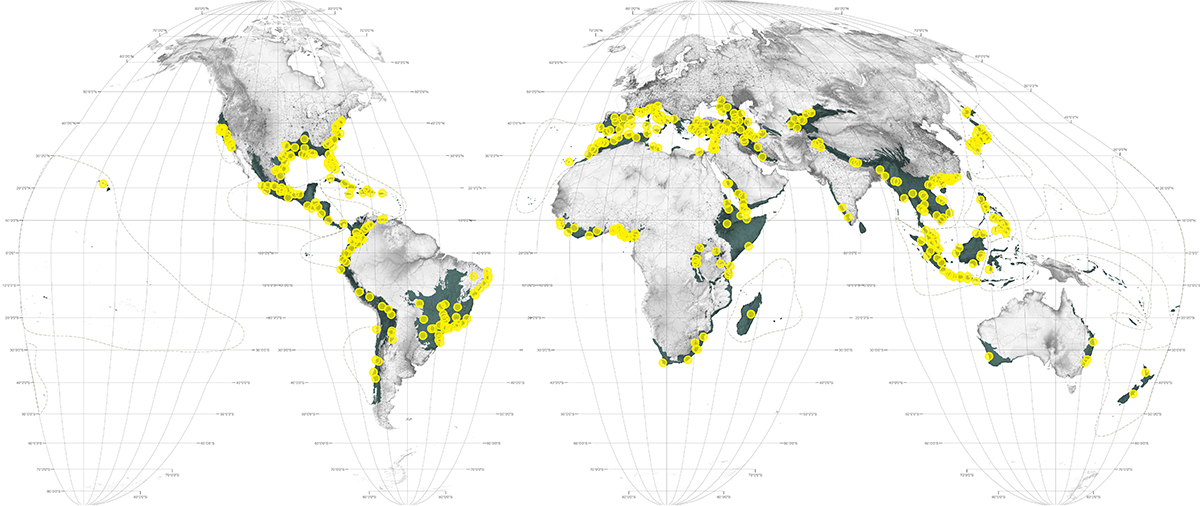
Statistics

Locations of visitors to this page

blogspot visitor
Stat Counter

Total Pageviews

Ads

Books

Followers

Blog Archive

Labels

australia (619) global warming (423) solar power (397) peak oil (355) renewable energy (302) electric vehicles (250) wind power (194) ocean energy (165) csp (159) solar thermal power (145) geothermal energy (144) energy storage (142) smart grids (140) oil (139) solar pv (138) tidal power (137) coal seam gas (131) nuclear power (129) china (120) lng (117) iraq (113) geothermal power (112) green buildings (110) natural gas (110) agriculture (91) oil price (80) biofuel (78) wave power (73) smart meters (72) coal (70) uk (69) electricity grid (67) energy efficiency (64) google (58) internet (50) surveillance (50) bicycle (49) big brother (49) shale gas (49) food prices (48) tesla (46) thin film solar (42) biomimicry (40) canada (40) scotland (38) ocean power (37) politics (37) shale oil (37) new zealand (35) air transport (34) algae (34) water (34) arctic ice (33) concentrating solar power (33) saudi arabia (33) queensland (32) california (31) credit crunch (31) bioplastic (30) offshore wind power (30) population (30) cogeneration (28) geoengineering (28) batteries (26) drought (26) resource wars (26) woodside (26) censorship (25) cleantech (25) bruce sterling (24) ctl (23) limits to growth (23) carbon tax (22) economics (22) exxon (22) lithium (22) buckminster fuller (21) distributed manufacturing (21) iraq oil law (21) coal to liquids (20) indonesia (20) origin energy (20) brightsource (19) rail transport (19) ultracapacitor (19) santos (18) ausra (17) collapse (17) electric bikes (17) michael klare (17) atlantis (16) cellulosic ethanol (16) iceland (16) lithium ion batteries (16) mapping (16) ucg (16) bees (15) concentrating solar thermal power (15) ethanol (15) geodynamics (15) psychology (15) al gore (14) brazil (14) bucky fuller (14) carbon emissions (14) fertiliser (14) matthew simmons (14) ambient energy (13) biodiesel (13) investment (13) kenya (13) public transport (13) big oil (12) biochar (12) chile (12) cities (12) desertec (12) internet of things (12) otec (12) texas (12) victoria (12) antarctica (11) cradle to cradle (11) energy policy (11) hybrid car (11) terra preta (11) tinfoil (11) toyota (11) amory lovins (10) fabber (10) gazprom (10) goldman sachs (10) gtl (10) severn estuary (10) volt (10) afghanistan (9) alaska (9) biomass (9) carbon trading (9) distributed generation (9) esolar (9) four day week (9) fuel cells (9) jeremy leggett (9) methane hydrates (9) pge (9) sweden (9) arrow energy (8) bolivia (8) eroei (8) fish (8) floating offshore wind power (8) guerilla gardening (8) linc energy (8) methane (8) nanosolar (8) natural gas pipelines (8) pentland firth (8) saul griffith (8) stirling engine (8) us elections (8) western australia (8) airborne wind turbines (7) bloom energy (7) boeing (7) chp (7) climategate (7) copenhagen (7) scenario planning (7) vinod khosla (7) apocaphilia (6) ceramic fuel cells (6) cigs (6) futurism (6) jatropha (6) nigeria (6) ocean acidification (6) relocalisation (6) somalia (6) t boone pickens (6) local currencies (5) space based solar power (5) varanus island (5) garbage (4) global energy grid (4) kevin kelly (4) low temperature geothermal power (4) oled (4) tim flannery (4) v2g (4) club of rome (3) norman borlaug (2) peak oil portfolio (1)