Posted
by Big Gav
in
cradle to cradle,
limits to growth,
manufacturing,
recycling,
resource prices
KcKinsey Quarterly has a look at closed-loop "cradle to cradle" style industrial manufacturing systems which it calls the "circular economy" - Remaking the industrial economy. MKQ also has a related interview with the CEO of Phillips - Toward a circular economy: Philips CEO Frans van Houten.
Visualize, for a moment, the industrial economy as a massive system of conveyor belts—one that directs materials and energy from resource-rich countries to manufacturing powerhouses, such as China, and then spirits the resulting products onward to the United States, Europe, and other destinations, where they are used, discarded, and replaced. While this image is an exaggeration, it does capture the essence of the linear, one-way production model that has dominated global manufacturing since the onset of the Industrial Revolution.
Increasingly, however, the linear approach to industrialization has come under strain. Some three billion consumers from the developing world will enter the middle class by 2030. The unprecedented size and impact of this shift is squeezing companies between rising and less predictable commodity prices, on the one hand, and blistering competition and unpredictable demand, on the other. The turn of the millennium marked the point when a rise in the real prices of natural resources began erasing a century’s worth of real-price declines. The biggest economic downturn since the Great Depression briefly dampened demand, but since 2009, resource prices have rebounded faster than global economic output. Clearly, the era of largely ignoring resource costs is over.
In light of volatile markets for resources, and even worries about their depletion, the call for a new economic model is getting louder. In response, some companies are questioning the assumptions that underpin how they make and sell products. In an effort to keep control over valuable natural resources, these companies are finding novel ways to reuse products and components. Their success provokes bolder questions. Could economic growth be decoupled from resource constraints? Could an industrial system that is regenerative by design—a “circular economy,” which restores material, energy, and labor inputs—be good for both society and business? If the experience of global automaker Renault is any indicator, the answer appears to be yes.
A circular economy replaces one assumption—disposability—with another: restoration. At the core, it aims to move away from the “take, make, and dispose” system by designing and optimizing products for multiple cycles of disassembly and reuse.2 This effort starts with materials, which are viewed as valuable stock to be used again, not as elements that flow through the economy once. For a sense of the scale involved, consider the fast-moving consumer-goods industry: about 80 percent of the $3.2 trillion worth of materials it uses each year is not recovered.
The circular economy aims to eradicate waste—not just from manufacturing processes, as lean management aspires to do, but systematically, throughout the various life cycles and uses of products and their components. (Often, what might otherwise be called waste becomes valuable feedstock for successive usage steps.) Indeed, tight component and product cycles of use and reuse, aided by product design, help define the concept of a circular economy and distinguish it from recycling, which loses large amounts of embedded energy and labor.
Moreover, a circular system introduces a strict differentiation between a product’s consumable and durable components. Manufacturers in a traditional economy often don’t distinguish between the two. In a circular economy, the goal for consumables is to use nontoxic and pure components, so they can eventually be returned to the biosphere, where they could have a replenishing effect. The goal for durable components (metals and most plastics, for instance) is to reuse or upgrade them for other productive applications through as many cycles as possible. This approach contrasts sharply with the mind-set embedded in most of today’s industrial operations, where even the terminology—value chain, supply chain, end user—expresses a linear view.

Posted
by Big Gav
in
bicycle,
recycling
The Economist has a post on an innovative form of recycling cardboard - Re-cycling.
THE first bicycles were made of wood. Cycle manufacturers then switched to steel tubes. These days, for high-end bikes where weight is at a premium, they use aluminium alloys or even carbon fibre. But Izhar Gafni, an amateur cyclist who owns a number of such fancy bikes, wonders whether the original inventors had a point. He proposes to go back to using wood—or, rather, a derivative of wood, namely cardboard.
Mr Gafni, who is based in Ahituv, Israel, spent years trying to work out how to make a cardboard bicycle able to support the weight of a human being. The trick is twofold. First, he folds the cardboard—commercial-grade material, made from recycled paper—to increase its strength. (He worked out the exact pattern of folding for each of the machine’s components using the principles of origami.) Then, once it is folded, he treats the result with a proprietary resin that holds it in shape and stiffens it, before cutting it into the form of the component required. A second application of resin renders the component waterproof, and a lick of lacquer makes it look good. The result, Mr Gafni claims, is stronger than carbon fibre.
The bike’s frame, wheels, handlebars and saddle are all made of cardboard in this way, and then fitted together. The tyres—again harking back to the early days of cycling—are composed of solid rubber, which is recycled from old car tyres. That makes the ride a little harder than if the tyres were pneumatic, but means they cannot be punctured.
The chain, based on the timing belt of a car, is also made from car-tyre rubber. The pedals are plastic recycled from bottles and the brakes are recycled too, though Mr Gafni is not yet ready to disclose the details. The finished product weighs 9kg, a bit less than an ordinary bike, and can carry a rider weighing 220kg.
Mr Gafni’s target market is the poorer countries of the world. Because manufacturing the cardboard bike will, he reckons, cost $9-12 a unit, his design is far more affordable than a steel-framed bike.

Posted
by Big Gav
in
plastic,
recycling
Mike Biddle has a TED talk on recycling plastic - We can recycle plastic.
Less than 10% of plastic trash is recycled -- compared to almost 90% of metals -- because of the massively complicated problem of finding and sorting the different kinds. Frustrated by this waste, Mike Biddle has developed a cheap and incredibly energy efficient plant that can, and does, recycle any kind of plastic.
Posted
by Big Gav
in
recycling,
sydney,
water
Clover Moore's Sydney city council seems to be plotting a slow secession from the electricity and water grids. The SMH has a report on an interesting plan for storing recycled water in local aquifers - City of Sydney plans recycled water network.
THE City of Sydney council is finalising plans for a recycled water network to be established throughout much of the city. It will include use of the Botany aquifer which extends from Redfern and Surry Hills, through Centennial Park and on to Botany Bay.
The rethink of the city's water supply comes as the council finalises plans to decouple the electricity network from the statewide supply grid, instead using a new network of power generators throughout the CBD which will provide cheaper and more reliable power to the city. ''If you're digging up the streets to put in the new trigeneration [electricity, heating and cooling] system, that's the golden opportunity to put in a recycled water network,'' the council's chief development officer for energy and climate change, Mr Allan Jones, said.
''Sixty per cent of the cost of the infrastructure is in the trenching and traffic management. That's why we're also looking at automated waste collection.''
The council recently outlined plans for an automated waste collection system, which remains under study. ''Piping water into the city and only drinking 2 per cent of that is just crackers,'' Mr Jones said. Taking into account cooking, and any possible way of ingesting water, no more than 20 per cent of the city's water needed to be of drinking quality, he said.
Central to the plan will use of recycled water and stormwater at new developments such as Barangaroo and Green Square.
Barangaroo will generate a surplus of recycled water which is expected to be used in water cooling towers and similar structures in other parts of the CBD.

Posted
by Big Gav
in
australia,
ge,
recycling,
water
GE's "Imagination Network" has a new video on water recycling from an Australian viewpoint - The Water Recycle".
The video can't be reduced in size and my blogger template isn't really compatible with large width embeds, so you might want to go to the link to watch it...
Posted
by Big Gav
in
bangladesh,
recycling,
shipping
The Economist has a photo essay on recycling of old ships in Bangladesh - Ship-breaking in Bangladesh: Where ships go to die.
IN BANGLADESH, ship-breaking turns a stretch of beach into a vision of hell and a parable of globalisation. Some 700 ocean-going vessels are scrapped each year, and about 100 of them are ripped apart in Bangladesh.

Posted
by Big Gav
in
bioplastic,
green chemistry,
mycellium,
mycobond,
recycling
Mycellium has almost mystical significance to some greens, but as Eben Bayer of ecovative design notes in this TED Talk, it can also be used to make a biodegradable packaging material called "mycobond" from a variety of different types of waste biomass, thus eliminating the need to make materials like styrofoam from fossil fuel inputs - Eben Bayer: Are mushrooms the new plastic ?.
Product designer Eben Bayer reveals his recipe for a new, fungus-based packaging material that protects fragile stuff like furniture, plasma screens -- and the environment.
Eben Bayer is co-inventor of MycoBond, an organic (really -- it's based on mycelium, a living, growing organism) adhesive that turns agri-waste into a foam-like material for packaging and insulation.
I'm not sure if this is truly a form of
bioplastic, but I'm going to count it as a variety of green chemistry. Apparently
Dell is going to use this in some of their packaging, so it is gaining some traction already.

You can view the growth process in
this video - and unlike most plastics used in packaging, it is
fire resistant.
Posted
by Big Gav
in
design for disassembly,
japan,
rare earths,
recycling
The SMH has an article on an increased interest in recycling (and eventually, in "design for disassembly") as a result of restricted availability of rare earths for manufacturing - Japan boosts recycling to ease China squeeze.
It takes two Hitachi workers eight minutes to slice open the metal casing of the used air conditioner compressor. The prize inside: four wafer-thin magnets containing about 30 grams of rare earth metals.
Hitachi, Japan's third-biggest company, uses as much as 600 tons of rare earth metals each year in products such as motors for Toyota's Prius hybrid. Hitachi is one of hundreds of manufacturers depending on rare earth shipments from China, which controls 97 per cent of world supply of the lightweight, malleable metals essential to hybrid cars, cell phones and hard disk drives.
China's decision this year to slash exports of the metals has driven up prices and spurred a drive among Japanese companies, the world's biggest users of rare earths, to find other supplies. While trading houses Sojitz and Sumitomo consider investing in mines outside China, Hitachi said it expects recycling to meet 10 per cent of its needs by 2013 from almost zero now.
“We need to make sure we have a stable supply of these materials and recycling is part of that,” Kenji Baba, general manager of Hitachi's resource recycling office, said this week at a test site north of Tokyo. “Now we have to work on bringing costs down.”
Inside the site in a warehouse in Matsudo City, Hitachi demonstrated the results of the one-year, $US1.5 million ($1.5 million) research project partly funded by Japan's government. Four refrigerator-sized devices use saws to open up compressors without damaging the rare earth magnets inside. A separate conveyor belt feeds disk drives into a machine about the size of a ship container. The drives come out the other end in pieces ready for rare earth harvesting. Hitachi says the machines are the first of their kind.
Rising prices
Last year, China's government clamped down on its rare earth industry, setting production quotas to bolster prices. China said in July this year it would reduce export quotas 72 per cent in the second half to supply its own electronics industry and overhaul a mining sector blamed for causing widespread environmental damage.
The drop in output and exports combined with rising demand caused the price of neodymium used in batteries for Toyota's Prius to surge fourfold to $US80 a kilogram from $US19.12 in 2009, according to Sydney-based rare-earth miner Lynas Corp. Lynas is building a $550 million rare earths mine at Mount Weld in Western Australia.
Sojitz, one of Japan's biggest importers of rare earths, last month agreed with Lynas to buy 8,000 tons to 9,000 tons annually from its Mount Weld mine over the next 10 years. ...
Copper processor Mitsubishi Materials Corp., which has recycling ventures with Panasonic and Sharp, last year started researching the cost of extracting neodymium and dysposium from washing machines and air conditioners.
“We're trying to reduce costs by automating the process,” said Isato Matsubara, a spokesman at the company. “How profitable the business can be depends on the prices of materials and getting our costs down.” ...
For recyclers, extracting components is the first step. Magnets from air conditioning compressors are 25 per cent rare earth metal and a chemical process is needed to refine out the rare earths, Hitachi's Baba said.
“We've succeeded in processing the metals in small quantities without using acids,” Baba said. “Now we're working on methods to increase the scale.”
Even China's supply is not unlimited, some of the heavy rare earths it has will only last about 15 years, Ali Izadi- Najafabadi, a Tokyo-based analyst at Bloomberg New Energy Finance, said.
“So if we're going to have a clean energy revolution and electric vehicles and other things, recycling would have to be part of the infrastructure,” he said.
Posted
by Big Gav
in
desalination,
london,
recycling
MNN has a post on a new desalination plant for London that is to be fuelled with recycled grease from restaurants - Can fish fry oil save London from impending drought?.
Many of you will be surprised to learn that dark and rainy London is in the midst of a serious drought, and now the city is hoping to hedge dwindling water supplies with a new desalination plant.
Initially fought by environmentalists in England, the Thames Gateway Water Treatment Works was officially opened this month in London's Beckton district, along with assurances that it will be the most energy-efficient to date. The plant will use tidal river water with an 85 percent conversion to drinking water and it will run on a cheap and renewable fuel found in abundance in London — fish fry oil.
The plant will capture water at the confluence of the river and the sea. This greatly reduces the amount of energy required to extract salts thus making the water potable. Desalination plants are typically immense energy hogs, which caused climate sensitive Londoners to react negatively when the plant was announced three years ago.
So the city got creative with the plant and created a program to collect fish fry oil from around the city to power the plant. It's unlikely the waste oil will be sufficient to keep the plant running full tilt, but it will help reduce the carbon impact of such a massive water treatment facility.
At its peak the plant would be able to deliver 140 million liters of water — enough to supply 400,000 homes. Record water shortages in the summers of 2005 and 2006, which many attribute to climate change, shocked the city into action. And despite its environmental impact on the city, many Londoners are relieved that clean drinking water is now at the ready.

Posted
by Big Gav
in
agriculture,
ostara,
peak phosphorus,
recycling
Fast Company has an article on phosphorus recycling from municipal waste streams - Ostara Aims to Stave Off Peak Phosphorous.
Forget peak oil. The next big crisis is peak phosphorous--a shortage of mined phosphorous for fertilizer. The problem is so bad that supply won't be able to meet agricultural demand within the next 30 to 40 years. But a Robert F. Kennedy Jr.-backed startup called Ostara thinks it might have the solution: a system that removes nutrients--including phosphorous--from wastewater and turns it into a slow-release commercial fertilizer called Crystal Green. The company's second commercial facility was unveiled this week at the Nansemond Treatment Plant in Suffolk, Virginia.
Ostara's process features a reactor that processes sludge liquid and recovers nutrients that might otherwise have to be disposed of using costly processes. The reactor is so effective that it can extract over 90% of phosphorous from a municipal waste stream. "Our process works very much in complement to existing wastewater treatment technology. There are plants that have advanced processes to remove nutrients from raw sewage, but they need to dispose of them. We can take those concentrated nutrient flows and extract out nutrients," explains Phillip Abrary, the CEO of Ostara, in an interview with FastCompany.com. "The system pays back for itself in five years."
Once nutrients have been extracted, Ostara mixes them with magnesium chloride and caustic to create pellets that can be processed into Crystal Green, the company's slow-release commercial fertilizer. What's unique is that the fertilizer dissolves over a long time," Abrary says. "When you put it in soil, it takes 8 to 9 months to dissolve. Plants are constantly fed using these nutrients."
Municipalities pay for Ostara's technology in one of two ways: a capital-based model that requires municipalities to pay Ostara for construction, with an investment paid back through revenue from Crystal Green sales, reduced operating costs, and increased plant capacity; and a fee-based model where Ostara pays for construction and operating costs while the municipality reimburses Ostara and pays a profit margin from a negotiated fee over a set number of years.
So far, municipalities have embraced the idea. Ostara opened its first commercial plant--a $5 million facility--outside Portland, Oregon last year. It is producing 500,000 pounds of Crystal Green annually. Ostara's second commercial plant, launched this week in Virginia, and the company plans on opening another plant in York, Pennsylvania in September.
Posted
by Big Gav
in
recycling,
waste
The NYT has an article on generating power by incinerating waste - Europe Finds Clean Energy in Trash, but U.S. Lags.
The lawyers and engineers who dwell in an elegant enclave here are at peace with the hulking neighbor just over the back fence: a vast energy plant that burns thousands of tons of household garbage and industrial waste, round the clock.
Far cleaner than conventional incinerators, this new type of plant converts local trash into heat and electricity. Dozens of filters catch pollutants, from mercury to dioxin, that would have emerged from its smokestack only a decade ago.
In that time, such plants have become both the mainstay of garbage disposal and a crucial fuel source across Denmark, from wealthy exurbs like Horsholm to Copenhagen’s downtown area. Their use has not only reduced the country’s energy costs and reliance on oil and gas, but also benefited the environment, diminishing the use of landfills and cutting carbon dioxide emissions. The plants run so cleanly that many times more dioxin is now released from home fireplaces and backyard barbecues than from incineration.
With all these innovations, Denmark now regards garbage as a clean alternative fuel rather than a smelly, unsightly problem. And the incinerators, known as waste-to-energy plants, have acquired considerable cachet as communities like Horsholm vie to have them built.
Denmark now has 29 such plants, serving 98 municipalities in a country of 5.5 million people, and 10 more are planned or under construction. Across Europe, there are about 400 plants, with Denmark, Germany and the Netherlands leading the pack in expanding them and building new ones.
By contrast, no new waste-to-energy plants are being planned or built in the United States, the Environmental Protection Agency says — even though the federal government and 24 states now classify waste that is burned this way for energy as a renewable fuel, in many cases eligible for subsidies. There are only 87 trash-burning power plants in the United States, a country of more than 300 million people, and almost all were built at least 15 years ago. ...
Yet powerful environmental groups have fought the concept passionately. “Incinerators are really the devil,” said Laura Haight, a senior environmental associate with the New York Public Interest Research Group.
Investing in garbage as a green resource is simply perverse when governments should be mandating recycling, she said. “Once you build a waste-to-energy plant, you then have to feed it. Our priority is pushing for zero waste.”
Posted
by Big Gav
in
green buildings,
pacific ocean gyre,
plastic,
recycling
Inhabitat has a post on a rather out-there plan to build an artificial island using the rubbish collecting in the north pacific gyre -
Architects Envision Hawaii-Sized Island Made of Recycled Plastic.
A group of architects from the Netherlands have a crazy idea to take all the plastic floating out there in the Pacific Ocean, and recycle it into a floating island the size of Hawaii. Climate refugees would be able to move there and live in recycled plastic homes, and work on farms or grow seaweed. The entire island would be totally self-sufficient once built, producing its own food and energy, and managing waste. While totally off the wall, this is an intriguing concept that gets our imaginations in motion about what we can do with that ginormous mass of plastic floating around in the ocean!
There are millions of pounds of plastic swirling out in the ocean and the best way to take care of it would be to collect it all and recycle it. Whim Architecture, from the Netherlands, is proposing to do just that with their Recycled Island – collect the plastic, sort it and then recycle it into building blocks to create a whole new floating island as big as Hawaii (approximately 10,000 sq km) depending on how much plastic could be collected. As the climate changes, many people, especially island nations like the Maldives, will be forced from their homes, becoming refugees. The new island, located somewhere between San Francisco and Hawaii would be made available to those refugees.
The island would be totally self-sufficient, capable of producing its own food, managing waste and producing renewable energy. One section of the island would be for urban housing, built from recycled plastic, and would also include all the necessary amenities for recreation, commerce, and living.

Posted
by Big Gav
in
internet of things,
recycling,
spime
The New York Times has an article on a baby step towards the "internet of things" (itself one component of a closed loop manufacturing system that we need to develop to kick our resource extraction habit) - They Don't Talk Trash, They Track It.
"Smart" phones offer the intelligence of a computer, with the convenience of a phone. "Smart" meters let homeowners choose between using cheap and expensive electricity.
A 5-year-old group at the Massachusetts Institute of Technology has spent the last year attaching thousands of tracking devices to pieces of garbage in Seattle and New York City. The devices send out pulses to signal where they are.
The signals go to MIT's SENSEable City Lab for analysis. Last year, they also went to art exhibits in both cities, where live maps revealed the many paths garbage takes.
For example, a plastic soap bottle tossed in a Manhattan recycling bin took several twists and turns around the city before crossing the river to Kearny, N.J.
Carlo Ratti, who directs the City Lab, said each city he's lived in -- Turin, Italy; Paris; Cambridge, England; Boston -- has suffered from congestion, pollution and inefficiency problems.
He believes new technologies, like iPhones, social networking and wireless communication, can inform city dwellers and make cities "smarter." "The only way we can actually solve some of the big problems, like climate change, is if we really coordinate and act together," Ratti said. "What, for the first time, is really bringing us together is the power of networks in general and the Internet." ...
The aim of project "Trash Track": to study where recyclables go. Dietmar Offenhuber, a doctoral student in the lab, said there's plenty of research on how things are made, but little is known about how they degrade and finally disappear. Among the questions here -- especially for cities paying millions for recycling programs -- are how much greenhouse gas is created and how much energy is wasted in the process. Another might be whether recycling really happens.
"Even the people working in waste removal don't really have a clear knowledge or picture of where the stuff goes," he said.
That's partly because trash goes through so many handoffs en route to its final destination, Offenhuber said. Trash companies follow their own haul, for example. But once they separate the aluminum and sell it to a collector, their records end. No single database tracks a soda can through its cycle. ...
But according to Offenhuber, telecom companies are watching Trash Track to see if it can be scaled up. By the end of this year, he said, the SENSEable City Lab wants to deploy thousands more trackers, and it wants to focus on e-waste.
That will help the companies develop a tracker that's cheaper and easier to use. Ultimately, the device may even come in a tracking "kit" that lets someone attach it to an item, then log on to a Web site that tells its whereabouts.
Posted
by Big Gav
in
concrete,
cradle to cradle,
element,
recycling
Transamterial has a post on a cardle-to-cradle compliant waterproofing treatment for concrete - Element.
Hycrete’s Element is an environmentally friendly admixture that integrally waterproofs concrete used in commercial construction. Certified Cradle-to-Cradle by McDonough Braungart Design Chemistry, LLC (MBDC), Element eliminates the need for external membranes typically used to waterproof concrete, thereby making the concrete more-easily recyclable following demolition. This approach can eliminate thousands of pounds of Volatile Organic Compounds (VOCs), CO2 and non-renewable content. Additionally, the admixture enhances structure durability by protecting against corrosion of steel rebar.
Posted
by Big Gav
in
egypt,
garbage,
recycling,
zabaleens
TreeHugger has a post on an Egyptian urban area specialising in lo-tech recycling - Photographers Capture Life in Garbage City.
Outside Egypt's capital, in the shadow of the Pyramids and tucked in the mountains of Mokattam, is an incredible city that literally survives on trash. Garbage City, as it's known, is home to 30,000 Zabaleens - Coptic Christians from southern Egypt - who, each day, enter Cairo and collect its waste. 60 percent of the trash produced in Cairo passes through Garbage City to be recycled. It is an amazing sight, awash in refuse.
Recently, photographers Bas Princen, Klavs Bo Christensen and Alexander Heilner visited Garbage City and returned with some captivating images that depict the close, day-to-day relationship between the Zabaleens and the garbage. Piles of the stuff are virtually everywhere, a fact that these recyclers-by-trade seem none too concerned with.
The garbage collecting process is so organized, Cairo has had no need to create a government sponsored program, relying fully upon the residents of Garbage City to collect their trash. Just a single pair of Zabaleens, working with a horse-drawn carriage, are able to collect the trash from 350 of Cairo's homes and businesses. They are not paid for their labor either, as the profiting from recycling is enough for many to live on.

Posted
by Big Gav
in
cradle to cradle,
recycling
Transmaterial has an article on a concrete made using recycled glass - EcoX.
According to Meld, over seven million tons of glass are sent to landfills each year in the United States alone. EcoX is precast concrete made of about 75 percent postconsumer and postindustrial glass. It may be used for countertops, furniture, fixtures, sculptural objects, and nonstructural applications. With its high volume of recycled glass content, EcoX appears markedly different from conventional precast concrete and diverts useful material from the waste stream.
Posted
by Big Gav
in
garbage,
recycling
Inhabitat has a post on a film from the SXSW Film Festival, looking at low tech garbage recycling in the developing world and how it is slowly being replaced with modern technologies - SXSW FILM: Garbage Dreams.
Garbage Dreams, which premiered earlier this month at the South by Southwest film festival, is a documentary that offers an intimate look at Mokattam, a suburb of Cairo known for its poor residents who live among tall piles of garbage. By following the lives of three young men who live and work as garbage collectors in this community, the documentary reveals how a community has supported itself by recycling discarded materials — and how this way of life will change in the future.
Mokattam is home to the Zabballeen people, a Christian minority of 60,000 who have served as garbage collectors for the city of Cairo for the past 150 years. Though the Cairo government now pays the Zabballeen a nominal fee for their services, many members of the community support themselves entirely by recycling discarded material. Using only rudimentary tools, the Zabballeen run one of the world’s most efficient waste management systems, recycling and reusing between 80-90% of what they pick-up. Since the 1980s the Egyptian government has been working to modernize their waste collection system by replacing the Zabballeen with European waste management companies.
The film is the directorial debut of Egyptian American documentary filmmaker Mai Iskander. Iskander began the project on a volunteer trip to Mokattam: while filming local kids for a short documentary about the creation of a mural, she discovered that “in front of the camera, the students blossomed. They were uninhibited and were extremely pleased that an ‘outsider’ took such interest in them.” Iskander was so inspired by her footage that she decided to focus her project on three specific kids and see what happened.
Filmed over the span of three years, Garbage Dreams looks at how these young men find new modes of survival as the Zabballeen way of life becomes obsolete.

Posted
by Big Gav
in
china,
recycling
The NYT has an article on the collapse in prices for materials to be recycled in China - China’s Big Recycling Market Is Sagging.
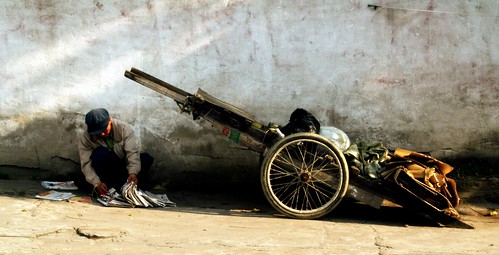
Each morning Tian Wengui emerges from the home he makes under a bridge here, two large sacks slung over his shoulder. Through the day, and well into the night, he scours garbage cans for soda bottles, soy sauce containers and cooking oil jugs. Selling the refuse to one of Beijing’s ubiquitous recycling depots, Mr. Tian can earn $3 on a good day.
But good days are getting harder to come by.
Since Mr. Tian migrated from Sichuan province, the multibillion-dollar recycling industry has gone into a nosedive because of the global economic crisis and a concomitant fall in commodity prices. Bottles now sell for half of what they did in the summer.
“Even trash has become worthless,” Mr. Tian said recently as he made his way to a collection center, his sacks nearly bursting.
The collapse of the recycling business has affected people like Mr. Tian, the middlemen who buy the waste products and the factories that refashion the recyclable waste into products bound for stores and construction sites around the world. American and European waste dealers who sell to China are finding that their shipments are being refused by clients when they arrive in Asia.
The ultimate victim may be the environment, already overrun with enough trash in places to threaten people’s health, now further burdened with refuse that until recently would have been recycled.
The effect is being felt acutely in China, the world’s largest garbage importer. The United States, for example, exported 11.6 million tons of recovered paper and cardboard last year to China, up from 2.1 million tons in 2000, according to the American Forest and Paper Association.
Because Chinese consumption is far less developed than the West’s, more than 70 percent of the materials that feed the country’s recycling industry must come from abroad, said Wang Yonggang, a spokesman for the China National Resources Recycling Association.
“Chinese tradition is all about saving and being thrifty,” he said. “People here would rather have things repaired several times before abandoning them.”
The drop in commodity prices was so rapid that in a matter of weeks last fall container ships carrying used railroad wheels and empty dog food cans arrived in Chinese ports worth far less than they had been when they departed Newark, Rotterdam or Los Angeles.
“Everything was moving along just fine until October and then we fell off a cliff,” said Bruce Savage, a spokesman for the Institute of Scrap Recycling Industries, a trade organization that mostly represents American waste processing companies.
The United States exported $22 billion worth of recycled materials to 152 countries in 2007. Now the organization estimates the value of American recyclables has decreased by 50 to 70 percent. Western dealers say they are grappling with mounting stockpiles whose value in many cases continues to sink. To make matters worse, Chinese importers have been demanding to renegotiate contracts drastically downward. In some cases, they are refusing to accept shipments they already have a contractual obligation to take.
“There are still many containers full of waste sitting at the port in Hong Kong,” Mr. Wang, of China National Resources Recycling Association, said. “It’s hard to say when they’ll be picked up.”
According to the association, a ton of copper scrap now sells for $3,000, down from more than $8,000 in 2007.
Tin is now selling for $5 a pound, down from $300. Paper has sagged by as much as 80 percent.
Posted
by Big Gav
in
recycling
The SMH reports that the recycling industry is wondering what to do with excess material now demand from China has dried up - What a waste - Recycling in the dumps.
AUSTRALIA'S recycling effort is on the brink of collapse, as ripples from the global financial crisis start lapping against kerbside rubbish collection.
Householders who sort bottles and newspapers into coloured bins may not know the waste is likely to go into fast growing stockpiles because prices for used plastic, cardboard, paper and many scrap metals have fallen by up to 75 per cent since October.
This has made it cheaper in some regions to send sorted rubbish to landfill rather than recycling stations, industry sources have told the Herald.
Councils are calling for an overhaul of the recycling system and federal regulations that would ease the load by forcing companies to use less packaging.
"This crisis has highlighted the weakness in the system, with communities already carrying the burden of recycling costs," said the president of the NSW Local Government Association, Genia McCaffery.
China's thirst for recyclable waste, which has helped sustain the industry for years, has dried up. But the chairman of an environment organisation in Sydney, Do Something, said Australia needed to wean itself off dependence on China.
"To do that, we need to boost our local recycling markets as much as possible," said Jon Dee. "It's vital that householders and businesses continue to recycle their waste. From a climate change point of view, we can't afford to start sending recyclable waste to landfill."
Posted
by Big Gav
in
recycling
The Sacramento Bee reports that the economic downturn is destroying demand for recycled materials - As world demand falls, prices for recyclables go in dumper.
A sudden collapse in worldwide demand for re- cyclables, particularly from China, has scrap dealers from Sacramento to San Diego stockpiling curbside collections as never before and charging walk-in customers for their throwaways.
Stacks of baled paper, plastic and metal are mounting at the Sacramento Recycling & Transfer Station plant on Fruitridge Road because market prices are too low to turn a profit or, worse, no buyers can be found, its operators said.
Five miles to the west, Ming's Recycling Corp. recently posted a sign at its entrance on 47th Avenue: "Ask for prices before you unload."
"We got fed up reloading everybody's pickup," said Kevin Luong, the company's marketing director, now in his seventh consecutive week of meager sales. "People are so shocked by the low prices. They think they are being ripped off here, but that's not the case. It's not us. It's the market."
If the scrap market doesn't recover anytime soon, homeowners could see their garbage rates rise. Most recyclers pay for the materials cities and counties collect from residents' blue curbside bins and then sell it for a profit. The proceeds help offset the government's costs of collection.


 Posts
Posts