Posted
by Big Gav
in
pacific ocean gyre
The Guardian has an update on the "great pacific garbage patch" - 'Great Pacific garbage patch' far bigger than imagined, aerial survey shows.
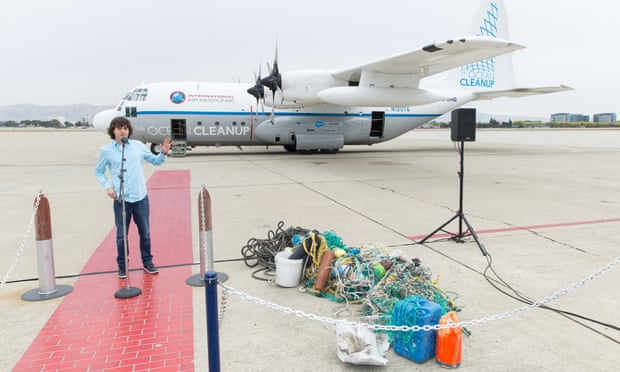
The vast patch of garbage floating in the Pacific Ocean is far worse than previously thought, with an aerial survey finding a much larger mass of fishing nets, plastic containers and other discarded items than imagined.
A reconnaissance flight taken in a modified C-130 Hercules aircraft found a vast clump of mainly plastic waste at the northern edge of what is known as the “great Pacific garbage patch”, located between Hawaii and California. The density of rubbish was several times higher than the Ocean Cleanup, a foundation part-funded by the Dutch government to rid the oceans of plastics, expected to find even at the heart of the patch, where most of the waste is concentrated.
Posted
by Big Gav
in
pacific ocean gyre,
plastic
CBS has a report that the Atlantic ocean may have an equivalent to the pacific ocean gyre - "Plastic Soup" Found in Atlantic Ocean.
Researchers are warning of a new blight on the ocean: a swirl of confetti-like plastic debris stretching over thousands of square miles in a remote expanse of the Atlantic Ocean.
The floating garbage - hard to spot from the surface and spun together by a vortex of currents - was documented by two groups of scientists who trawled the sea between scenic Bermuda and Portugal's mid-Atlantic Azores islands.
The studies describe a soup of micro-particles similar to the so-called Great Pacific Garbage Patch, a phenomenon discovered a decade ago between Hawaii and California that researchers say is likely to exist in other places around the globe.
"We found the great Atlantic garbage patch," said Anna Cummins, who collected plastic samples on a sailing voyage in February.
The debris is harmful for fish, sea mammals - and at the top of the food chain, potentially humans - even though much of the plastic has broken into such tiny pieces they are nearly invisible.
Since there is no realistic way of cleaning the oceans, advocates say the key is to keep more plastic out by raising awareness and, wherever possible, challenging a throwaway culture that uses non-biodegradable materials for disposable products.
Posted
by Big Gav
in
green buildings,
pacific ocean gyre,
plastic,
recycling
Inhabitat has a post on a rather out-there plan to build an artificial island using the rubbish collecting in the north pacific gyre -
Architects Envision Hawaii-Sized Island Made of Recycled Plastic.
A group of architects from the Netherlands have a crazy idea to take all the plastic floating out there in the Pacific Ocean, and recycle it into a floating island the size of Hawaii. Climate refugees would be able to move there and live in recycled plastic homes, and work on farms or grow seaweed. The entire island would be totally self-sufficient once built, producing its own food and energy, and managing waste. While totally off the wall, this is an intriguing concept that gets our imaginations in motion about what we can do with that ginormous mass of plastic floating around in the ocean!
There are millions of pounds of plastic swirling out in the ocean and the best way to take care of it would be to collect it all and recycle it. Whim Architecture, from the Netherlands, is proposing to do just that with their Recycled Island – collect the plastic, sort it and then recycle it into building blocks to create a whole new floating island as big as Hawaii (approximately 10,000 sq km) depending on how much plastic could be collected. As the climate changes, many people, especially island nations like the Maldives, will be forced from their homes, becoming refugees. The new island, located somewhere between San Francisco and Hawaii would be made available to those refugees.
The island would be totally self-sufficient, capable of producing its own food, managing waste and producing renewable energy. One section of the island would be for urban housing, built from recycled plastic, and would also include all the necessary amenities for recreation, commerce, and living.

Posted
by Big Gav
in
pacific ocean gyre
Chris Jordan has a post and series of photos of birdlife in the Pacific Ocean gyre - Message from the Gyre (via Cryptogon).
These photographs of albatross chicks were made just a few weeks ago on Midway Atoll, a tiny stretch of sand and coral near the middle of the North Pacific. The nesting babies are fed bellies-full of plastic by their parents, who soar out over the vast polluted ocean collecting what looks to them like food to bring back to their young. On this diet of human trash, every year tens of thousands of albatross chicks die on Midway from starvation, toxicity, and choking.
To document this phenomenon as faithfully as possible, not a single piece of plastic in any of these photographs was moved, placed, manipulated, arranged, or altered in any way. These images depict the actual stomach contents of baby birds in one of the world's most remote marine sanctuaries, more than 2000 miles from the nearest continent.
Posted
by Big Gav
in
pacific ocean gyre,
rubbish
The Times has an article on a plan to try to clean up the giant collection of rubbish in the Pacific gyre - Mission to break up Pacific island of rubbish twice the size of Texas.
A high-seas mission departs from San Francisco next month to map and explore a sinister and shifting 21st-century continent: one twice the size of Texas and created from six million tonnes of discarded plastic.
Scientists and conservationists on the expedition will begin attempts to retrieve and recycle a monument to throwaway living in the middle of the North Pacific.
The toxic soup of refuse was discovered in 1997 when Charles Moore, an oceanographer, decided to travel through the centre of the North Pacific gyre (a vortex or circular ocean current). Navigators usually avoid oceanic gyres because persistent high-pressure systems — also known as the doldrums — lack the winds and currents to benefit sailors.
Mr Moore found bottle caps, plastic bags and polystyrene floating with tiny plastic chips. Worn down by sunlight and waves, discarded plastic disintegrates into smaller pieces. Suspended under the surface, these tiny fragments are invisible to ships and satellites trying to map the plastic continent, but in subsequent trawls Mr Moore discovered that the chips outnumbered plankton by six to one.
The damage caused by these tiny fragments is more insidious than strangulation, entrapment and choking by larger plastic refuse. The fragments act as sponges for heavy metals and pollutants until mistaken for food by small fish. The toxins then become more concentrated as they move up the food chain through larger fish, birds and marine mammals.
“You can buy certified organic farm produce, but no fishmonger on earth can sell you a certified organic wild-caught fish. This is our legacy,” said Mr Moore.
Because of their tiny size and the scale of the problem, he believes that nothing can be solved at sea. “Trying to clean up the Pacific gyre would bankrupt any country and kill wildlife in the nets as it went.”
In June the 151ft brigantine Kaisei (Japanese for Planet Ocean) will unfurl its sails in San Francisco to try to prove Mr Moore wrong. Project Kaisei’s flagship will be joined by a decommissioned fishing trawler armed with specialised nets.
“The trick is collecting the plastic while minimising the catch of sea life. We can’t catch the tiny pieces. But the net benefit of getting the rest out is very likely to be better than leaving it in,” says Doug Woodring, the leader of the project.
With a crew of 30, the expedition, supported by the Scripps Institution of Oceanography and Brita, the water company, will use unmanned aircraft and robotic surface explorers to map the extent and depth of the plastic continent while collecting 40 tonnes of the refuse for trial recycling.
“We have a few technologies that can turn thin plastics into diesel fuel. Other technologies are much more hardcore, to deal with the hard plastics,” says Mr Woodring, who hopes to run his vessels on the recycled fuel.
Posted
by Big Gav
in
garbage,
pacific ocean gyre,
plastic,
rubbish
Grist points to a US TV series on one of the Pacific Garbage Patches - "Ready, Aim, Gyre".
This is the first episode of 12 from VBS.tv on the vast, Texas-sized stew of plastic and garbage floating in the North Pacific Gyre. They sailed out to see it with their own eyes.


 Posts
Posts