Bruce Schneier has an article in The Atlantic on the power struggle going on for control of the internet and it's increasingly feudal social structure - The Battle for Power on the Internet.
We’re in the middle of an epic battle for power in cyberspace. On one side are the traditional, organized, institutional powers such as governments and large multinational corporations. On the other are the distributed and nimble: grassroots movements, dissident groups, hackers, and criminals. Initially, the Internet empowered the second side. It gave them a place to coordinate and communicate efficiently, and made them seem unbeatable. But now, the more traditional institutional powers are winning, and winning big. How these two sides fare in the long term, and the fate of the rest of us who don’t fall into either group, is an open question—and one vitally important to the future of the Internet.
In the Internet’s early days, there was a lot of talk about its “natural laws”—how it would upend traditional power blocks, empower the masses, and spread freedom throughout the world. The international nature of the Internet circumvented national laws. Anonymity was easy. Censorship was impossible. Police were clueless about cybercrime. And bigger changes seemed inevitable. Digital cash would undermine national sovereignty. Citizen journalism would topple traditional media, corporate PR, and political parties. Easy digital copying would destroy the traditional movie and music industries. Web marketing would allow even the smallest companies to compete against corporate giants. It really would be a new world order.
This was a utopian vision, but some of it did come to pass. Internet marketing has transformed commerce. The entertainment industries have been transformed by things like MySpace and YouTube, and are now more open to outsiders. Mass media has changed dramatically, and some of the most influential people in the media have come from the blogging world. There are new ways to organize politically and run elections. Crowdfunding has made tens of thousands of projects possible to finance, and crowdsourcing made more types of projects possible. Facebook and Twitter really did help topple governments.
But that is just one side of the Internet’s disruptive character. The Internet has emboldened traditional power as well.
On the corporate side, power is consolidating, a result of two current trends in computing. First, the rise of cloud computing means that we no longer have control of our data. Our e-mail, photos, calendars, address books, messages, and documents are on servers belonging to Google, Apple, Microsoft, Facebook, and so on. And second, we are increasingly accessing our data using devices that we have much less control over: iPhones, iPads, Android phones, Kindles, ChromeBooks, and so on. Unlike traditional operating systems, those devices are controlled much more tightly by the vendors, who limit what software can run, what they can do, how they’re updated, and so on. Even Windows 8 and Apple’s Mountain Lion operating system are heading in the direction of more vendor control.
I have previously characterized this model of computing as “feudal.” Users pledge their allegiance to more powerful companies who, in turn, promise to protect them from both sysadmin duties and security threats. It’s a metaphor that’s rich in history and in fiction, and a model that’s increasingly permeating computing today.
The Washington post reports on the latest Snowden NSA revelations, this time about backdoors into big internet companies like Google and Yahoo not be considered sufficient so they've worked out the weak points in the company internal networks as well - SSL Added and Removed Here! :).
The National Security Agency has secretly broken into the main communications links that connect Yahoo and Google data centers around the world, according to documents obtained from former NSA contractor Edward Snowden and interviews with knowledgeable officials.
By tapping those links, the agency has positioned itself to collect at will from hundreds of millions of user accounts, many of them belonging to Americans. The NSA does not keep everything it collects, but it keeps a lot.
According to a top-secret accounting dated Jan. 9, 2013, the NSA’s acquisitions directorate sends millions of records every day from Yahoo and Google internal networks to data warehouses at the agency’s headquarters at Fort Meade, Md. In the preceding 30 days, the report said, field collectors had processed and sent back 181,280,466 new records — including “metadata,” which would indicate who sent or received e-mails and when, as well as content such as text, audio and video.
The NSA’s principal tool to exploit the data links is a project called MUSCULAR, operated jointly with the agency’s British counterpart, the Government Communications Headquarters . From undisclosed interception points, the NSA and the GCHQ are copying entire data flows across fiber-optic cables that carry information between the data centers of the Silicon Valley giants.
The infiltration is especially striking because the NSA, under a separate program known as PRISM, has front-door access to Google and Yahoo user accounts through a court-approved process.
The MUSCULAR project appears to be an unusually aggressive use of NSA tradecraft against flagship American companies. The agency is built for high-tech spying, with a wide range of digital tools, but it has not been known to use them routinely against U.S. companies.
It's interesting (albeit mildly depressing) looking at the site traffic stats nowadays - while "peak oil" itself is just having a rest while the bottom of the barrel gets thoroughly scraped, interest in the topic (and related ones, like global warming) really has plummeted based on the traffic this blog is receiving.
A year ago (after a couple of years of little to no activity) I was still seeing well over 500 visitors a day coming to the site directly and a similar number via RSS. Lately the number is more like 220.
Admittedly its difficult to compare the numbers directly as the long period of inactivity has resulted in a dwindling number of inbound links and the site's Alexa rating dropping rapidly - so traffic from search engines is far lower than it used to be.
Nevertheless, my recent post on "Our Clean Energy Future" gave me some insight into how the other major energy sites are faring based on the volume of inbound traffic resulting from cross-posts.
When The Oil Drum was in its heyday it peaked at over 100,000 visitors in a single day. If I wrote something interesting and topical there I'd expect to see more than 10,000 readers for a single post and around 200 comments - perhaps 300 if the topic was hot.
Lately TOD seems to have dwindled to around 8,500 visitors per day - it still generated some referred traffic - perhaps another 250 visitors all up.
I also posted the article to Resilience (previously Energy Bulletin) and PeakOil.com.
Resilience's traffic isn't clear (I can't see Sitemeter or an equivalent on their pages) but they referred almost as many visitors as TOD - around 180 - so perhaps their daily readership is around 5,000 visitors these days assuming a similar proportion of readers click through.
PO.com only referred around 30 readers, so their traffic appears to have almost vanished (and judging by the comments made there, the remaining readership is still living in some doom-world circa 2005 that allows no new thought to enter - no wonder they drove JD insane during his long years in the wilderness there).
I tried to post to the Energy Collective as well but it didn't make it through moderation.
While the peak oil sites remain afflicted with a doom ridden view of the future one guy did pipe up at Resilience defending my article - weirdly enough from the IWW (I never imagined when I was younger that I'd be popular with the communists, but there you go). He posted a link to an interesting article of his - Capital Blight - Green Illusions or Malthusian Miasma?. Who knows what your PRISM / XKeyScore file will be tagged with if you click the link, but hey - you only live once...
A recent item on truth-out.org, published on April 8, 2013, features an interview by Steve Horn of Ozzie Zehner, author of the book Green Illusions: the Dirty Secrets of Clean Energy and the Future of Environmentalism . Titled, “Power Shift Away from Green Illusions” the interview would have been more appropriately named, “Deep Dive into a Vat of Malthusian Miasma.”
The interviewee, author Ozzie Zehner, argues that the public is being offered a false choice between fossil fuel based civilization and a renewable energy / clean tech based alternative, and that “most environmentalists” have “jumped on board the bandwagon”.
In Zehner’s mind these are not choices at all but, in fact, the same choice, because renewable energy technology production, usage, and maintenance cannot exist without fossil fuels coexisting alongside of it throughout its usage cycle, from manufacturing, to deployment, to maintenance, and so forth.
“There’s no such thing as clean energy, but there’s such a thing as less energy,” he says. “There’s a misconception that once alternative energy technologies are off the ground they can fly on their own. But alternative energy technologies are better understood as a product of fossil fuels,” he continues, also declaring, “Our planet has bounded resources and limited capacity to absorb the impacts of human activities.” Zehner goes on to dismiss electric cars as being no better than conventional fossil fuel vehicle, asserting that electric cars “merely create a different set of side effects (than their fossil fuel counterparts). It’s just that those side effects didn’t come out of a tail pipe, where we are accustomed to looking for them." He finishes up by opining that, “Mainstream environmental groups seem transfixed by technological gadgetry and have succumbed to magical thinking about their pet fetishes.”
These arguments are hardly fresh or groundbreaking. They are, in fact, essentially the same that were made by Richard Heinberg in The Party’s Over: Oil, Water, and the Fate of Industrial Society, in 2003, by William R Catton Jr. in Overshoot: The Ecological Basis of Revolutionary Change, in 1973, and by Paul Erlich in The Population Bomb, in 1968, and Zehner expressly considers Heinberg and Erlich his compatriots (though he doesn’t mention Catton).
In their minds, the source of industrial pollution (and just about all of society’s ills for that matter) can be traced to an excess of human population, which is itself the result of fossil fuel based technology which enables a false increase in the survivability of human beings that would otherwise not be possible in nature. This core assumption (of nature as a rather harsh and unforgiving mistress) itself is a rather twisted reinterpretation of the ideas of reactionary cleric Thomas Malthus.
Malthus is most famous for his essay On Population which essentially argues that human population expands until the available sources of food is scarce enough to induce starvation among its poorest and/or weakest members. Early naturalists, including Charles Darwin expanded this line of reasoning to other species, and it has long been assumed to be an ecological maxim, but in fact, this is not true.
Malthus was not an environmentalist, and were he alive today, he would have likely been vehemently hostile to most environmentalists, primarily because of the latter’s tendency towards antiestablishment beliefs. Malthus was a defender of the status quo, a deeply religious Anglican cleric, whose treatise had been written as a rebuttal to the ideas advocated by William Godwin, the “father” of modern anarchism. Godwin had married the radical feminist, Mary Wollstonecraft, and their daughter, Mary Shelley wrote the original poem that became the story of Frankenstein, an allegory for class struggle based environmentalism if there ever was one.
Such ideas were an anathema to Malthus who defended class stratification as “God’s will” for punishing sin--though he never offered any coherent analysis on how the rich were somehow able to avoid it. If anything, Malthus was as antithetical to environmentalism as one could get, and Shelley much closer to it. Many an environmentalist invokes Frankenstein as a metaphor for the industrial technocracy they so vehemently oppose never grasping the sheer irony in doing so! ...
Grist's David Roberts, who has shown remarkable endurance blogging and tweeting non-stop for around a decade now, has finally burnt out and decided to take a sabbatical away from the internet. Someone should make him a case study - it will be interesting to see how he handles going cold turkey - Goodbye for now.
I began by writing daily news summaries and crafting funny headlines. Then, in late 2004, I started our blog, Gristmill. (Here’s my first post. I was complaining about presidential candidates ignoring climate change. Good thing I never had to write that one again!) Over time I transitioned into 100 percent writing, where I’ve been since.
As long as I’ve been here, Grist has extended me an extraordinary amount of trust and freedom. I have been able to wander from thing to thing, exploring interests in religious environmentalism, great places, social psychology, electric utilities, chilling out, and even the filibuster. I’ve never been told not to write about something, or that any subject is too complicated or wonky, or that I needed to get more clicks.
It has been a dream job. I’ve loved it. I still love it.
But I am burnt the fuck out.
I spend each day responding to an incoming torrent of tweets and emails. I file, I bookmark, I link, I forward, I snark and snark and snark. All day long. Then, at night, after my family’s gone to bed and the torrent has finally slowed to a trickle and I can think for more than 30 seconds at a stretch, I try to write longer, more considered pieces.
I enjoy every part of this: I enjoy sharing zingers with Twitter all day; I enjoy writing long, wonky posts at night. But the lifestyle has its drawbacks. I don’t get enough sleep, ever. I don’t have any hobbies. I’m always at work. Other than hanging out with my family, it’s pretty much all I do — stand at a computer, immersing myself in the news cycle, taking the occasional hour out to read long PDFs. I’m never disconnected.
It’s doing things to my brain.
I think in tweets now. My hands start twitching if I’m away from my phone for more than 30 seconds. I can’t even take a pee now without getting “bored.” I know I’m not the only one tweeting in the bathroom. I’m online so much that I’ve started caring about “memes.” I feel the need to comment on everything, to have a “take,” preferably a “smart take.” The online world, which I struggle to remember represents only a tiny, unrepresentative slice of the American public, has become my world. I spend more time there than in the real world, have more friends there than in meatspace.
And then there’s the grind, the pressure to interpret each day’s development through the lens of which team it will benefit. I spend a lot of my time being angry: angry at Republicans for being crazy assholes, angry at enviros for being so hapless, angry at the media, angry at random people on Twitter. It’s not just that U.S. politics involves daily offenses against decency and good sense, it’s that it just keeps offering the same offenses, over and over — same gridlock, same cranks and ideologues, same arguments, same grind.
I feel like I’ve had every discussion related to climate change or energy at least a million times. The “how to talk about it” discussion, the “is Obama a climate hero or the worst thing since Hitler” discussion, the “should climate scientists be advocates” discussion, the “carbon tax vs. cap-and-whatever vs. innovation” discussion, the “clean energy is intermittent” discussion, on and on and on. I’ve had them all so many times I’ve gotten to the point where I’m irritated and impatient with pretty much everything everybody says about anything.
And I feel bad about that. There are waves of new people coming into the climate and clean energy world, full of verve and ideas. They are going through the same process of discovery I went through. I have tried to provide them with perspective and context, insofar as I’m able, but lately I just feel like yelling at them to get off my lawn. That is unfair to them and unflattering to me. I don’t want to become a bitter person.
I need some time away from all of it: from climate change, the media, blogs, commenters, Twitter, the news cycle, the endless battle for a livable future. I need to clear my head.
So I’m going to. As of Labor Day, I’m uninstalling Twitter and shutting off my email account. No more news or climate doom or memes for me for a while.
It was interesting that Glenn Greenwald's revelations in The Guardian about the NSA's "PRISM" total surveillance program popped up around the same time that the trial of Bradley Manning began (with the firestorm of coverage in the mainstream media prompting Cryptogon to wonder why they've piped up all of a sudden - by some random coincidence the Bilderberg conference is on at the moment - even "Enemy of the State" - one of my favourite movies - was on TV here this weekend).
On December 20, 2002, a Senate Intelligence Committee that included Sen. Ron Wyden, D-Ore., today one of the most vociferous critics of the so-called "surveillance state," came to the following conclusion in its official report on the mistakes that led to 9/11: The National Security Agency had harmed U.S. counterterrorism efforts that might have prevented that terrible day because of the agency's "failure to address modern communications technology aggressively."
The report, a joint effort of the Senate committee and the House Permanent Select Committee on Intelligence, blamed "NSA's cautious approach to any collection of intelligence relating to activities in the United States, and insufficient collaboration between NSA and the FBI regarding the potential for terrorist attacks within the United States."
The Senate-House report said the NSA simply could not keep up with the explosion of information technology. "Only a tiny fraction" of the NSA's 650 million daily intercepts worldwide "are actually ever reviewed by humans, and much of what is collected gets lost in the deluge of data," the report said. In interviews at the time, then-NSA Director Michael Hayden explained why: The NSA, originally authorized to conduct monitoring only overseas, was effectively a Cold War dinosaur that was going "deaf" since its main mission of tracking "signals intelligence," known as Sigint, from the Soviet Union had ended.
"We have gone from chasing the telecommunications structure of a slow-moving, technologically inferior, resource-poor nation-state--and we could do that pretty well - to chasing a communications structure in which an al-Qaida member can go into a storefront in Istanbul and buy for $100 a communications device that is absolutely cutting edge, and for which he has had to make no investment in its development. That's what we've got to deal with," Hayden told me in an interview in mid-2002.
In congressional testimony leading up to that critical Senate-House report, Hayden explained the NSA had gone from tracking a relatively small number of Soviet communications pipelines -- microwave transmissions, for example, from Moscow to various ICBM bases -- to trying to keep up with billions of conversations on phones and emails in a world in which technological borders had been erased, and much of this traffic was now being routed through the United States. This huge new challenge was coming at a time when the super-secret agency had "downsized about a third of its manpower and about the same proportion of its budget in the '90s," the era of the so-called post-Cold War peace dividend, Hayden said in his testimony. "That's the same decade when mobile cell phones increased from 16 million to 741 million--an increase of 50 times. That's the same decade when Internet users went from about four to 361 million."
These perceived deficiencies, and the NSA's aggressive efforts to redress them since then, make up the real backdrop to the latest scandal that has engulfed Washington, this time over what appears to be a massive infringement of American civil liberties. And despite the outrage voiced by senators such as Wyden and other critics, the truth about what the NSA and intelligence and investigative community is doing is far more complex than the rhetoric might lead you to believe.
Most important of all, almost the entire U.S. government has been on board in promoting it.
After many struggles and failures in the last decade, the NSA did finally come up with new approaches to keeping up with the traffic. One such approach was the NSA's "PRISM" program, disclosed Thursday by The Washington Post and the Guardian newspaper. The newspapers revealed that the NSA and FBI have set up a program to tap directly into the central servers of nine leading U.S. Internet companies, "extracting audio and video chats, photographs, e-mails, documents, and connection logs that enable analysts to track one target or trace a whole network of associates," as the Post wrote. The program was reportedly set up in cooperation with the major companies, including Microsoft, Yahoo, Google, Facebook, PalTalk, AOL, Skype, YouTube and Apple.
Like many people around the world, I’ve spent the last 48 hours tracking, reading, watching, refreshing and barely sleeping, as a torrent of stories of total surveillance run by the National Security Agency have come to light through the US journalist Glenn Greenwald, published in The Guardian.
The leaks revealed total blanket phone call metadata (origin, length of calls, networks and connections) by the NSA, followed by the voluntary turning-over of mass amounts of data by private internet service providers and social media corporations — including Microsoft, Google, Skype and Twitter. Then came news that UK’s Government Communications Headquarters may have been illegal cribbing such data for its own ends. Finally, on the weekend, the leaker revealed himself, 29-year-old Edward Snowden, a systems operations operator for Booz Allen Hamilton and Dell, to whom the NSA subcontracted various tasks.
Snowden bobbed up three weeks after leaving Booz Allen Hamilton with 41 carefully chosen pages of dynamite memos. He holed up in Hong Kong, while releasing the memos to people he trusted. He initially approached The Washington Post, but they appear to have been furiously hedging their bets, as have all mainstream US media. He made the decision to reveal his own identity, in order that people could understand that a very ordinary — in the best sense of the word — person was behind it, and to make the intolerable nature of what was revealed to him clear.
The facts are clear enough: while accessing the content of phone calls on old tech lines is protected by limiting laws, no such limit holds on the ISP/social media giants, if they choose to comply with the government. Clients of these services — i.e. everyone — have already signed away their rights, in those huge documents you click “accept” to without reading. The NSA’s mega-data collection centre in Bluffdale Utah has come on stream, and it can collect and store all communicated data for decades. The files are multi-dimensionally searchable by programmes that learn as they go. The idea that the process will be drowned in cat videos is consoling and fanciful.
The PRISM programme represents the most far-reaching extension of power into the very texture and fabric of everyday life in history. Those on the hacker/cypherpunk side of things have realised for some years, many years, that this process was under way. Some of us have been aware of it for a couple of years. Now it has become general knowledge.
The policy and the practice is an extension and expansion by the Obama administration of a process begun in the Bush years, and with various antecedents, from the days when the internet began to vastly expand, carried by the web, in the early 90s. Snowden, who has worked in the NSA purview since 2009, has said that his actions, and the delay in them, arose in part from waiting to see if Barack Obama would take some action on the matter — and then a decisive disappointment when he didn’t.
What appears to have been a passivity on the part of Obama with regard to a practice in place changes the meaning and character of his presidency substantially. In writing about him over the years, I’ve noted that any belief that he would substantially alter the projection of US power was an illusion; any candidate was applying for a dual position of President and emperor; supporting the former did not preclude attacking the latter’s policies.
But of course that has always been, to some degree, a false dichotomy. The empire reaches back into the Republic. With PRISM, that process is totalising; the space of the Republic has been squeezed to near-zero. To the surprise of many, that does not seem to have overly disconcerted the US public, with support for the NSA’s policies polling at 56% to 41%. Not too much should be made of that — the US has become such a news desert in many areas that many people are at this stage, simply not aware of the breadth of PRISM and other programmes.
But the revelation of these programmes has thrown the US state into disarray, and had the same effect on its institutional politics. The state elite’s determination to push into every area of life is driven not merely by a desire to avoid terror attacks of the latter type, but in response to challenges from states such as China, which highlight their vestigial constitutional limits, and the general expansion and extension of technical power and possibility, from standard high-tech to biological engineering.
What this historical process should prompt is a renegotiation of state and social power on a global scale. What it is prompting instead is a paradoxical attempt by states to extend their power further into everyday life than they hitherto been, just as that process becomes one that is unwinnable, save by explicit and visible tyranny. In the meantime, it is stretching state power to the point where its legitimacy cracks in the middle. Since that middle runs through the heart of decent people, loyal to their society and humanity, it produces whistleblowers willing to take the ultimate risk.
The ramifications of this are manifold, to be explored in these pages by many writers in the weeks to come. But for the moment one crucial point needs to be made: this process is ramrodding one of the most serious recombinations of politics in recent decades, or perhaps longer. This is happening most substantially in the imperial centre of the US — now little more than a contradiction with a flag — but it will spread elsewhere.
On the Left it is happening in reasonably orderly fashion, along old faultlines — between a core, statist Left which cleaves ever closer to an unlimited national security state, and a dissident Left which has always resisted it. Such centre-left support for the national security state draws, distortedly, on the communalist core of Leftism — the idea that standing for the nation is standing for the collective, no matter how distorted. Thus California leftists like Senator Dianne Feinstein have no problem finding themselves aligned with John McCain, Bill Kristol and a whole bunch of others, in what is basically a centrist, totalising, national security party. The dissident Left can detach from its partial attachment to that Left, without too much confusion.
Meanwhile on the Right, they’re going f-cking nuts. I say that with no more than a dash of schadenfreude — you take your pleasures where you find them — but more as an analysis of what’s likely to happen. That the Republican Party would split on this issue is unsurprising; that it would split down the middle of its Tea Party/libertarian Right is an extraordinary thing to behold.
Thus Rand Paul is now promoting a Supreme Court challenge to the NSA in such a way that would gain the support of the American Civil Liberties Union, the CounterPunch left, and hundreds of other groupings. The national security Right is now arguing that they will have to marshal a figure like Ted Cruz to challenge Rand Paul in the nominations.
If you’ve been following the saga over the decision by Australia’s financial regulator ASIC to unlilaterally order the block of suspected fraud sites over the past week or so, you’re probably aware by now that the whole deal started when a little-known site named Melbourne Free University was mysteriously taken offline back in April. In a lengthy piece on the ABC’s The Drum website this afternoon, the convenors of the site tell their story and argue that the situation is just not good enough.
One: Some of the Chinese military hackers who were implicated in a broad set of attacks against the U.S. government and corporations were identified because they accessed Facebook from the same network infrastructure they used to carry out their attacks.
Two: Hector Monsegur, one of the leaders of the LulzSac hacker movement, was identified and arrested last year by the FBI. Although he practiced good computer security and used an anonymous relay service to protect his identity, he slipped up.
And three: Paula Broadwell,who had an affair with CIA director David Petraeus, similarly took extensive precautions to hide her identity. She never logged in to her anonymous e-mail service from her home network. Instead, she used hotel and other public networks when she e-mailed him. The FBI correlated hotel registration data from several different hotels -- and hers was the common name.
The Internet is a surveillance state. Whether we admit it to ourselves or not, and whether we like it or not, we're being tracked all the time. Google tracks us, both on its pages and on other pages it has access to. Facebook does the same; it even tracks non-Facebook users. Apple tracks us on our iPhones and iPads. One reporter used a tool called Collusion to track who was tracking him; 105 companies tracked his Internet use during one 36-hour period.
Increasingly, what we do on the Internet is being combined with other data about us. Unmasking Broadwell's identity involved correlating her Internet activity with her hotel stays. Everything we do now involves computers, and computers produce data as a natural by-product. Everything is now being saved and correlated, and many big-data companies make money by building up intimate profiles of our lives from a variety of sources.
Facebook, for example, correlates your online behavior with your purchasing habits offline. And there's more. There's location data from your cell phone, there's a record of your movements from closed-circuit TVs.
This is ubiquitous surveillance: All of us being watched, all the time, and that data being stored forever. This is what a surveillance state looks like, and it's efficient beyond the wildest dreams of George Orwell.
Why might other sectors come to nurse grudges against computers in the way the entertainment business already has? The world we live in today is made of computers. We don't have cars anymore; we have computers we ride in. We don't have airplanes anymore; we have flying Solaris boxes attached to bucketfuls of industrial control systems. A 3D printer is not a device, it's a peripheral, and it only works connected to a computer. A radio is no longer a crystal: it's a general-purpose computer, running software. The grievances that arise from unauthorized copies of Snooki's Confessions of a Guidette are trivial when compared to the calls-to-action that our computer-embroidered reality will soon create.
Consider radio. Radio regulation until today was based on the idea that the properties of a radio are fixed at the time of manufacture, and can't be easily altered. You can't just flip a switch on your baby monitor and interfere with other signals. But powerful software-defined radios (SDRs) can change from baby monitor to emergency services dispatcher or air traffic controller, just by loading and executing different software. This is why the Federal Communications Commission (FCC) considered what would happen when we put SDRs in the field, and asked for comment on whether it should mandate that all software-defined radios should be embedded in “trusted computing" machines. Ultimately, the question is whether every PC should be locked, so that their programs could be strictly regulated by central authorities.
Even this is a shadow of what is to come. After all, this was the year in which we saw the debut of open source shape files for converting AR-15 rifles to full-automatic. This was the year of crowd-funded open-sourced hardware for genetic sequencing. And while 3D printing will give rise to plenty of trivial complaints, there will be judges in the American South and mullahs in Iran who will lose their minds over people in their jurisdictions printing out sex toys. The trajectory of 3D printing will raise real grievances, from solid-state meth labs to ceramic knives.
It doesn't take a science fiction writer to understand why regulators might be nervous about the user-modifiable firmware on self-driving cars, or limiting interoperability for aviation controllers, or the kind of thing you could do with bio-scale assemblers and sequencers. Imagine what will happen the day that Monsanto determines that it's really important to make sure that computers can't execute programs which cause specialized peripherals to output custom organisms which literally eat their lunch.
Regardless of whether you think these are real problems or hysterical fears, they are, nevertheless, the political currency of lobbies and interest groups far more influential than Hollywood and big content. Every one of them will arrive at the same place: “Can't you just make us a general-purpose computer that runs all the programs, except the ones that scare and anger us? Can't you just make us an Internet that transmits any message over any protocol between any two points, unless it upsets us?"
There will be programs that run on general-purpose computers, and peripherals, that will freak even me out. So I can believe that people who advocate for limiting general-purpose computers will find a receptive audience. But just as we saw with the copyright wars, banning certain instructions, protocols or messages will be wholly ineffective as a means of prevention and remedy. As we saw in the copyright wars, all attempts at controlling PCs will converge on rootkits, and all attempts at controlling the Internet will converge on surveillance and censorship. This stuff matters because we've spent the last decade sending our best players out to fight what we thought was the final boss at the end of the game, but it turns out it's just been an end-level guardian. The stakes are only going to get higher.
As a member of the Walkman generation, I have made peace with the fact that I will require a hearing aid long before I die. It won't be a hearing aid, though; it will really be a computer. So when I get into a car—a computer that I put my body into—with my hearing aid—a computer I put inside my body—I want to know that these technologies are not designed to keep secrets from me, or to prevent me from terminating processes on them that work against my interests.
Last year, the Lower Merion School District, in a middle-class, affluent suburb of Philadelphia, found itself in a great deal of trouble. It was caught distributing, to its students, rootkitted laptops that allowed remote covert surveillance through the computer's camera and network connection. They photographed students thousands of times, at home and at school, awake and asleep, dressed and naked. Meanwhile, the latest generation of lawful intercept technology can covertly operate cameras, microphones, and GPS tranceivers on PCs, tablets, and mobile devices.
We haven't lost yet, but we have to win the copyright war first if we want to keep the Internet and the PC free and open. Freedom in the future will require us to have the capacity to monitor our devices and set meaningful policies for them; to examine and terminate the software processes that runs on them; and to maintain them as honest servants to our will, not as traitors and spies working for criminals, thugs, and control freaks.
If geek culture had a class president, Cory Doctorow would be frontrunner for the position. He writes for BoingBoing, uses Ubuntu, played a hero in XKCD, published several rebellious young-adult sci-fi novels (under CC licenses, no less), and has worked on two continents fighting for the rights of internet users. He’s spent the better part of the last couple decades encouraging content-producers to embrace the new models of distribution made possible by the internet and fought them tooth and nail when they seek to hold it back.
His outspokenness doesn’t come from a single statement like “information wants to be free.” Doctorow argues in a recent essay called Lockdown that enforcing Copyright law in the digital era is about more than protecting the rights of intellectual property holders; it has rather become a kind of trojan horse for the surveillance industrial complex and threatens to severely curtail the individual autonomy of the world’s citizens. Computers are infusing everything, he explains. They increasingly extend our embodiment and cognition and can thus be enabling and liberating. Computing’s inherent flexibility therefore offers a form of freedom; commercial or governmental interests that seek to control computing for their own needs or simply out of a fear of the new way must be resisted in order to protect that freedom.
It took a while but Fairfax finally lumbered into action today on the remarkable proposals to dramatically expand government surveillance of Australians that are before the Joint Committee on Intelligence and Security, editorialising that intelligence agencies needed to explain why they want to retain Australians’ internet data, after its security specialist Dylan Welch had covered the proposals yesterday.
Yesterday the ABC also provided some detailed coverage; every specialist IT outlet had already covered the proposals in detail on Tuesday and Wednesday, after Crikey broke the proposals on Monday afternoon. A quick reprise of the proposals: the government wants to undertake some sensible housekeeping amendments relating to ASIO, the establishing legislation for which is showing some definite whiskers. But the government has also put on the table, for consideration, proposals including:
* keeping all Australians’ telecommunications and internet data for 2 years;
* wiretapping Twitter, Facebook and other social media;
* allowing ASIO to plant material on people’s computers, and destroy material, and go through a third party’s computer to do so;
* criminalise refusing to cooperate with government decryption attempts, so you could go to gaol for refusing to surrender your password;
* freeing up ASIO agents to break the law if it helps them stay undercover; and
* enabling non-ASIO intelligence agencies to work with ASIO to spy on Australians.
News Ltd’s papers, apart from recycling a single AAP piece today, have said nothing, a failure that is thoroughly perplexing. Here is a Labor government proposing draconian extensions to surveillance powers. What better opportunity for the bastion of “campaigning journalism” that loves nothing more than monstering Labor? There isn’t even a need to confect a target for a campaign, as News Ltd did with the BER program And yet… silence. It’s all the more bizarre given the company is in the throes of a furious campaign against the alleged threat of government regulation to freedom of speech.
If News Ltd and its dimwit spear-carriers like Janet Albrechtsen are to be believed, the proposals arising from the Convergence Review and the Finkelstein Inquiry are only one step short of Soviet re-education camps. Yet Labor wheels out a real threat to free speech far more sinister than a mere public interest test — our intelligence agencies, after all, have a sterling record of spying on journalists — and… nothing. How about the Institue of Public Affairs, who can normally be relied on to stand up free speech and attack regulatory overreach… or for that matter regulatory reach full stop? Not a squeak.
The issue was considered unworthy of the institute’s weekly round-up of left-wing outrages. How about Andrew Bolt, who if nothing else is hyper-sensitive to parliamentary threats to free speech, having been the victim of an appalling legal assault on his own? Nothing. Why has the Right gone missing on a clear and present threat to basic rights? Where’s the mistrust of government and readiness to go over the top when we actually need it in response to a clear and present danger? Is it because the issue of online freedom is somehow perceived to be one of the Left, despite its strong libertarian dimensions?
You don’t need to be of any particular political orientation to be offended about these proposals, and offended by the reasoning used to justify them. The justification used in the discussion paper, and it was one repeated by Joint Committee member Andrew Wilkie yesterday, is that our surveillance framework needs to be updated to address the move from the telecommunications to the internet era. That reasoning is, to use my favourite Greinerism, a nonsense.
The Telecommunications (Interception and Access) Act hasn’t been left gathering dust on the legislative shelf since before the arrival of the internet. It’s been updated regularly in the last decade - more years than not have seen an amendment to that act or an extension of ASIO’s powers in our parliament. In fact, bizarrely, it’s the very frequency with which the acts have been updated that the discussion paper insists is all the more reason for an overhaul (and expansion) of the whole régime (yes, I’ve thought and re-thought through that and I can’t understand it either). The other reason it’s a nonsense is a more subtle one that intelligence agencies and politicians neither want to understand nor will accept.
The proposals to start wiretapping social media use, store your data, control communications infrastructure and lock you up when you won’t cough up the password to your laptop or phone are classic War On The Internet measures. They seek to re-impose analog-era control structures on a world fundamentally altered by interconnectedness. In the analog world of wiretapping telecommunications (which originally was, literally, sticking an alligator clip onto a wire), citizens had virtually no means of communications except a government-controlled telephone system — recall the grand days of dictatorships shutting down phone lines to the outside world at moments of crisis?
There was no network, no connectedness for citizens, because they could never talk to more than one person at a time, making their interaction easy to monitor. That single, controllable piece of copper linking people one at a time has been replaced with a network that connects everyone to everyone else, globally, simultaneously. But governments want to still employ the copper-era control mechanism, as if nothing has changed except the technology.
The technological change is trivial compared to the social change being wrought across the world, which those who were in control in the analog era don’t understand and want to keep at bay. And the urge to keep control and monitor is coupled with an ever-stronger refusal to share information with citizens; governments want a surveillance state for everyone but themselves; they insist on their own right to operate in secrecy. The luxury of redaction is only for governments, not their citizens.
This is far less about being Left or Right than about being wrong, fundamentally wrong, about how our societies and the way we function in them are changing. It’s that change these measures are aimed at stopping and controlling.
BusinessGreen has some interesting statistics on economic growth as divined by analysing LinkedIn traffic - Renewables LinkedIn to growth surge.
You may know LinkedIn as an excellent way to network/waste time, but those lunch hours spent trawling the business social networking site looking for a new job or connecting with old school friends have also resulted in some fascinating data on the size and shape of the US economy.
By tracking the jobs and job changes of its 150 million members between 2007 and 2011, LinkedIn has been able to calculate which industries are on the up and which are in decline.
And yes, you've guessed it: top of the pile is renewable energy and environmental roles. These grew more than 49 per cent over the four-year period, exactly double those of the second-highest risers, internet and online publishing.
More encouraging still, the sector performed equally impressively when LinkedIn moved beyond percentage terms to examine the volume of jobs gained and lost.
"Our data show that, even through the recession, the industries with the largest volume of employment growth... were internet, hospitals and healthcare, health, wellness and fitness, oil & energy, IT and renewables," wrote Scott Nicholson, a LinkedIn data scientist and economist in a blog post. "On the other side of the story, retail, construction, telecommunications, banking and automotive had the largest volume of job losses between 2007 and 2011."
Of course, it is likely that those working in some of the newer industries are more tech-savvy and utilise networks such as LinkedIn more often, potentially skewing the numbers, though the survey does give a fascinating picture of how the economy is shifting beneath our feet.
But then there is a wealth of evidence suggesting LinkedIn's figures are more than just an interesting snapshot. Research by analyst firm Clean Edge found yesterday that the global market for solar PV, wind energy and biofuels grew 31 per cent during 2011 to almost $250bn (£159bn).
There is plenty of protest on the web about US congress plans to censor the internet (they aren’t the only control freaks who want to do this of course - the Australian government has been every bit as bad on this issue, as have many others, from China to Iran). The Daily Reckoning has but one example of the torrent of complaint about this (pardon the pun) - Blackout Wednesday: The Time Has Come.
The blackout is a choice, and a brilliant one, made by founder Jimmy Wales in consultation with the whole Wikipedia community. It is a protest, a statement, a symbolic warning to the world of what can happen if governments attack the free flow of information.
The online protest is directed, in particular, against two bills roiling around Congress right now, called SOPA in the House and PIPA in the Senate. Early versions have been tabled. The Obama administration has said that it opposes the current versions, but the opposition was weak and suspiciously nuanced.
People who are digitally aware and politically savvy know that this is only round one. The attempt by governments to block information flows on the Web will continue in new and different bills and regulations. No new laws are even necessary; government possesses the power now to crush the information age on a bureaucratic whim.
In fact, this goes on every day. That's because governments everywhere, in all times and places, want to control information and will use all their power to do it. It is also because the legal framework that rules how information is produced and distributed is fundamentally corrupted by the fraudulent notion of "intellectual property," which, if consistently enforced, would put an end to the Internet as we know it...
- Just this past week, a judge ruled that a 23-year-old British college student can be extradited to the US for a 10-year prison sentence, all for linking to other servers that illicitly host copyrighted content;
- Late last year, US officials shut down 150 domains without hearings or trials on grounds that they were suspected of selling goods that violate trademark law. It was done on "Cyber Monday" for a reason: It was an announcement to the digital world that government is in charge;
- In the spring of last year, the FBI arbitrarily shut down every online poker domain they could find and seized the bank accounts of some of the largest and smartest people who play online poker - and all of this happened before the recent announcement that online poker is being re-legalised;
- Earlier in the year, the Department of Homeland Security seized 84,000 domains and put up an announcement that each was trafficking in child porn. Problem: It was all a mistake. Not one was actually guilty. To date, there has been no explanation of how this could have happened
- In 2010, the feds seized some 73,000 domains for the crime of linking to content that was said to be distributed illegally in violation of copyright.
Already, the damage of this sort of thing is enormous. Ten years ago, the Internet represented liberation, a new frontier of innovation, commerce, opinion sharing and spontaneous organising. Today, more and more people are consumed by fear. Bloggers are unclear about what existing law does or does not allow. No one knows for sure how to define "fair use." The deepest pockets are winning case after case. Faced with this uncertainty, many are choosing less over more content - which is exactly what the government and private monopolists want.
The Wikipedia protest is a way of saying: If this kind of thing continues and ends up institutionalised in new legislation, there will be no more Wikipedia, which is the No. 1 content-rich site on the Web and the main way people learn today (how far we've come from the debunking that was common only five years ago).
And this is just one example. Individual blogs would only contain government-approved content. Search engines would only produce only government-approved sites. Digital entrepreneurship would be suffocated by fears of threats, confiscations and jails. It is hard to see how even Facebook and Twitter could survive.
It is just marvellous that Wikipedia has taken this bold direction, and it is only possible because of the unique nature of the media in question. Many large businesses during the 1930s tried their best to protest New Deal price controls. But they could hardly shut down their giant stores. The revenue loss would have been devastating, and the victims would have been the employees. So in the end, the private sector was forced to submit to the controls. It was the same in the 1970s with wage and price controls. How could the merchants resist?
But digital enterprises are in a different position entirely. They can vanish with a few clicks, giving the world a conjectural look at what happens when the state attacks the lifeblood of innovation and progress. Small changes in the law can have a gigantic effect. Just as one click can shut down this site, one law can do the same.
It is not only Wikipedia. Others are doing the same. WordPress, the open-source platform that powers nearly a quarter of new websites and has the most-popular content management system on the Web, has also stepped out in front with a call for action: "Normally, we stay away from... politics here at the official WordPress project...Today, I'm breaking our no-politics rule...How would you feel if the Web stopped being so free and independent? I'm concerned - freaked right the heck out about the bills that threaten to do this, and as a participant in one of the biggest changes in modern history, you should be, too."
There are many such examples. And even if successful, it is not enough. With or without SOPA, digital freedom is under attack. For example, ICANN, the gateway for all domain registration, is now requiring a verified official identity, supplied by government, for domain ownership. This change sets the stage for continuing shutdowns and strangulation.
The struggle is intensifying, and the sides are very clear: It is the government and old-line media companies that depend on the state's laws versus everyone else. Everyone else consists of the independently active, privately owned global society that lives and thrives in the digital age. The astonishing innovations of this age have taught an entire generation about the miraculous power of information generation and delivery, about the capabilities embedded in the spontaneous actions of individuals, about the capacity of people around the world to generate order and progress through cooperation and exchange.
Here are some scenes from the internet in the last decade of the twentieth century and the first of the 21st, in no particular order.
* The internet versus music and movies. The digitisation of audio-visual content and higher internet bandwidth enables mass downloading of music, movies and television programming entirely outside the legal copyright system. In Australia, much of it is driven by the FTA television networks’ refusal to screen foreign programs for many months after they’ve screened in the US. The response of copyright owners and media companies is to prosecute individuals, websites or companies that download illegally, or facilitate downloading, and convince governments to impose new, often draconian, copyright laws. Their efforts are futile. About 25% of global internet traffic is estimated to be file sharing, nearly all of it illegal.
* The internet versus lawyers. Lawyers in jurisdictions across the world become increasingly concerned about jurors using the internet to find out about cases. Judges take to threatening jurors with contempt of court if they breach agreements about using the internet. In 2008, a Victorian judge demands the suppression of an episode of Underbelly. As soon as the banned episode is broadcast elsewhere, it is available online and downloaded thousands of times. In 2009, a judge orders Australian websites to take over 1500 articles offline about an individual on the basis that they will prejudice a trial jury. The material remains easily accessible even after removal by the sites in question.
* The internet versus gambling opponents. Moral panic over gambling and pressure from casinos prompts the Australian Government to ban online gambling in 2001. According to the Productivity Commission, the ban fails to prevent continued growth in online gambling at rates similar to other countries. The ban ensures Australians’ money goes to poorly-regulated foreign sites and not safer local sites and Australian taxpayers.
* The internet versus government secrecy. The website Cryptome began publishing classified and confidential government information in 1996. Similar sites like Cartome, Eyeball Series and Cryptome CN also offer other types of information governments want suppressed. Cryptome’s founders claim FBI harassment, the site has its server capacity removed and companies like PayPal refuse to enable contributions to the site. But as WikiLeaks will demonstrate, the harassment appears to have no noticeable impact on the release of material.
* The internet versus transnationals. In October 2009, the transnational energy company Trafigura, which has successfully used the UK courts to suppress reporting of evidence it released toxic waste in Cote d'Ivoire, obtains a "superinjunction" against the Guardian on the same issue. But "Trafigura" becomes a trending topic on Twitter, and a number of websites and WikiLeaks publish material on the case. The company abandons its attempts to suppress efforts to expose it.
* The internet versus journalists. Some Australian p olitical journalists, angry at criticism of their coverage of the 2010 election, lash out at "parasites", "free riders" and "armchair critics" online. "Just let the professionals do their job" demands one on Twitter. But the editor of The Australian goes further. Angry that online critics are routinely deriding the paper’s partisanship and anti-science stance on climate change, he threatens to sue an academic over tweets made about a presentation at a journalism conference -- though not the presenter herself, a former journalist at his own paper -- and boasts about bringing his lawyers into the matter. His Media Editor then threatens to report another academic to police over a Twitter comment. The result is extensive coverage of the original presentation here and overseas.
* The internet versus the Australian Government. In response to WikiLeaks releasing US diplomatic cables, the Australian Prime Minister labels the act "illegal" and her Attorney-General talks about measures to prevent the release of national security material in the media. He writes to mainstream media editors with the goal of developing a protocol to do so. Later, Australian police advise that WikiLeaks has not broken any Australian laws, and the Prime Minister is forced to carefully parse her claim about illegality.
* The internet versus Big Retail. Australia’s major retailers, used to earning oligopoly profits, are unhappy Australians are using the internet to shop online at overseas sites. They demand the Government take "decisive action" in the form of higher taxes to deter consumers and protect their profits.
The common theme across these examples is that the gatekeepers and the privileged intermediaries of late twentieth century Western economies -- politicians, lawyers, the mainstream media, large corporations -- are threatened by the connectedness that the internet enables.
Humans are, to nick a phrase from David Attenborough, compulsive communicators. The urge to converse, debate, joke, fight, trade, play and form relationships with each other is hard-wired into us. And the internet dramatically expands the community within which we can do that, from one constrained by geography to one only constrained by technology.
And it directly undermines the power of those who want to regulate that interaction, or profit from it. Governments that want to police it. The media that profits by connecting us. The corporations that rely on consumers knowing less than they do. The courts that regard jurors as easily-swayed fools who need to be treated like mushrooms. All now confront interconnectedness on a scale far greater than ever seen before, with far fewer opportunities to regulate or exploit it.
But the gatekeepers and intermediaries are unwilling to let their power go easily, even as it slips away from them. And they reflexively resort to litigation, regulation and prohibition to maintain their power.
The SMH reports that the Australian government is deferring internet censorship legislation to after the election - Conroy backs down on net filters. Remember to vote against Conroy in the upcoming election.
Communications Minister Stephen Conroy has capitulated to widespread concerns over his internet censorship policy and delayed any mandatory filters until at least next year.
Academics, ISP experts, political opponents, the US government and a broad cross-section of community groups have long argued that the plan to block a secret blacklist of "refused classification" web pages for all Australians was fraught with issues, for example, that blocked RC content could include innocuous material.
Having consistently ignored these concerns, Senator Conroy today announced that implementation of his policy would be delayed until a review of RC classification guidelines could be conducted by state and territory censorship ministers.
The SMH reports that crazed American Senator Joe Liebermann (always on the lookout for new ways to control people) is trying to legislate for a formal mechanism for the US to crash the internet - Internet 'kill switch' proposed.
US President Barack Obama would be granted powers to seize control of and even shut down the internet under a new bill that describes the global internet as a US "national asset".
Local lobby groups and academics have rounded on the plan, saying that, rather than combat terrorists, it would actually do them "the biggest favour ever" by terrorising the rest of the world, which is now heavily reliant on cyberspace.
The proposed legislation, introduced into the US Senate by independent senator Joe Lieberman, who is chairman of the US Homeland Security committee, seeks to grant the President broad emergency powers over the internet in times of national emergency.
Titled "Protecting Cyberspace as a National Asset Act", the bill stipulates any internet firms and providers must "immediately comply with any emergency measure or action developed" by a new section of the US Department of Homeland Security, dubbed the "National Centre for Cybersecurity and Communications".
Lobby group TechAmerica told ZDNet it worried that the bill would give the US "absolute power" over the internet and create "unintended consequences".
One of Australia's top communications experts, University of Sydney associate professor Bjorn Landfeldt, railed against the idea, saying shutting down the internet would "inflict an enormous damage on the entire world".
He said it would be like giving a single country "the right to poison the atmosphere, or poison the ocean".
"All our financial systems, all our security systems ... we're so reliant on the internet that if you shut it down there's a question of whether society will continue to operate normally anywhere in the Western world," Landfeldt said in a phone interview.
"By doing this they would do the terrorists the biggest favour ever because they would terrorise the rest of the world".
Landfeldt said the US would be the only country in the world with the ability to shut down the internet. He said such a move would be extremely difficult for the US to justify to other nations.
A leaked instant messenger (IM) transcript from 2003 in which Facebook founder Mark Zuckerberg mocks users who joined his then fledgling social networking site is adding to the sense of outrage over the social networking site's cavalier attitude towards privacy.
The transcript, published by the sober Business Insider website, dates from the days when Zuckerberg was a 19-year-old operating what was then called The Facebook from his Harvard dorm room.
The IM conversation went like this, Business Insider says:
Zuck: Yeah so if you ever need info about anyone at Harvard
Zuck: Just ask.
Zuck: I have over 4,000 emails, pictures, addresses, SNS
[Redacted Friend's Name]: What? How'd you manage that one?
Zuck: People just submitted it.
Zuck: I don't know why.
Zuck: They "trust me"
Zuck: Dumb f--ks.
The authenticity of the transcript was not denied by Facebook, which later issued a statement saying: "The privacy and security of our users' information is of paramount importance to us. We're not going to debate claims from anonymous sources or dated allegations that attempt to characterise Mark's and Facebook's views towards privacy."
The leak and the reaction to it underscores Zuckerberg's current notoriety as internet's favourite whipping boy.
Facebook, which boasts a worldwide membership of more than 400 million, began altering its privacy policy in December. In January, Zuckerberg told an audience that privacy was no longer a "social norm".
A newly leaked CIA report prepared earlier this month (.pdf) analyzes how the U.S. Government can best manipulate public opinion in Germany and France -- in order to ensure that those countries continue to fight in Afghanistan. The Report celebrates the fact that the governments of those two nations continue to fight the war in defiance of overwhelming public opinion which opposes it -- so much for all the recent veneration of "consent of the governed" -- and it notes that this is possible due to lack of interest among their citizenry: "Public Apathy Enables Leaders to Ignore Voters," proclaims the title of one section.
But the Report also cites the "fall of the Dutch Government over its troop commitment to Afghanistan" and worries that -- particularly if the "bloody summer in Afghanistan" that many predict takes place -- what happened to the Dutch will spread as a result of the "fragility of European support" for the war. As the truly creepy Report title puts it, the CIA's concern is: "Why Counting on Apathy May Not Be Enough":
The Report seeks to provide a back-up plan for "counting on apathy," and provides ways that the U.S. Government can manipulate public opinion in these foreign countries. It explains that French sympathy for Afghan refugees means that exploiting Afghan women as pro-war messengers would be effective, while Germans would be more vulnerable to a fear-mongering campaign (failure in Afghanistan means the Terrorists will get you). The Report highlights the unique ability of Barack Obama to sell war to European populations.
It's both interesting and revealing that the CIA sees Obama as a valuable asset in putting a pretty face on our wars in the eyes of foreign populations. It is odious -- though, of course, completely unsurprising -- that the CIA plots ways to manipulate public opinion in foreign countries in order to sustain support for our wars. Now that this is a Democratic administration doing this and a Democratic war at issue, I doubt many people will object to any of this. But what is worth noting is how and why this classified Report was made publicly available: because it was leaked to and then posted by WikiLeaks.org, the site run by the non-profit group Sunshine Press, that is devoted to exposing suppressed government and corporate corruption by publicizing many of their most closely guarded secrets.
I spoke this morning at length with Julian Assange, the Australian citizen who is WikiLeaks' Editor, regarding the increasingly aggressive war being waged against WikiLeaks by numerous government agencies, including the Pentagon. Over the past several years, WikiLeaks -- which aptly calls itself "the intelligence agency of the people" -- has obtained and then published a wide array of secret, incriminating documents (similar to this CIA Report) that expose the activities of numerous governments and corporations. Among many others, they posted the Standard Operating Manual for Guantanamo, documents showing how corrupt offshore loans precipitated the economic collapse in Iceland, the notorious emails between climate scientists, documents showing toxic dumping off the coast of Africa, and many others. They have recently come into possession of classified videos relating to civilian causalities under the command of Gen. David Petraeus, as well as documentation relating to civilian-slaughtering airstrikes in Afghanistan which the U.S. military had agreed to release, only to change their mind.
All of this has made WikiLeaks an increasingly hated target of numerous government and economic elites around the world, including the U.S. Government. As The New York Times put it last week: "To the list of the enemies threatening the security of the United States, the Pentagon has added WikiLeaks.org, a tiny online source of information and documents that governments and corporations around the world would prefer to keep secret." In 2008, the U.S. Army Counterintelligence Center prepared a secret report -- obtained and posted by WikiLeaks -- devoted to this website and detailing, in a section entitled "Is it Free Speech or Illegal Speech?", ways it would seek to destroy the organization. It discusses the possibility that, for some governments, not merely contributing to WikiLeaks, but "even accessing the website itself is a crime," and outlines its proposal for WikiLeaks' destruction as follows ...
The Pentagon report also claims that WikiLeaks has disclosed documents that could expose U.S. military plans in Afghanistan and Iraq and endanger the military mission, though its discussion is purely hypothetical and no specifics are provided. Instead, the bulk of the Pentagon report focuses on documents which embarrass the U.S. Government: information which, as they put it, "could be manipulated to provide biased news reports or be used for conducting propaganda, disinformation, misinformation, perception management, or influence operations against the U.S. Army by a variety of domestic and foreign actors." In other words, the Pentagon is furious that this exposing of its secrets might enable others to engage in exactly the type of "perception management" which the aforementioned CIA Report proposes the U.S. do with regard to the citizenry of our allied countries.
All of this is based in the same rationale invoked by President Obama and the Democratic Congress when they re-wrote the Freedom of Information Act last year in order to suppress America's torture photos. It's the same rationale used by all governments to conceal evidence of their wrongdoing: we need to suppress our activities for your own good. WikiLeaks is devoted to subverting that mentality and, relatively speaking, has been quite successful in doing so.
The Age has a report on the Australian government's outrageous plans to introduce mandatory internet censoring, led by conrol freak communications minister Stephen Conroy - Government goes to war with Google over net censorship
The government intends to introduce legislation within weeks forcing all ISPs to block a blacklist of "refused classification" websites for all Australians ... a large and growing group of academics, technology companies and lobby groups say the scope of the filters is too broad and will not make a meaningful impact on internet safety for children. ..
Google, which has recently been involved in a censorship spat with China, has been one of the filtering policy's harshest critics. It has identified a range of politically sensitive and innocuous material, such as sexual health discussions and discussions on euthanasia, which could be blocked by the filters.
Last week, it said it had held discussions with users and parents around Australia and "the strong view from parents was that the government's proposal goes too far and would take away their freedom of choice around what information they and their children can access".
Google also said implementing mandatory filtering across Australia's millions of internet users could "negatively impact user access speeds", while filtering material from high-volume sites such as Wikipedia, YouTube, Facebook and Twitter "appears not to be technologically possible as it would have such a serious impact on internet access".
"We have a number of other concerns, including that filtering may give a false sense of security to parents, it could damage Australia's international reputation and it can be easily circumvented," Google wrote.
On ABC Radio last night, the majority of callers were opposed to the filters and right before the end of the segment, Senator Conroy attacked Google over its privacy credentials. ...
Senator Conroy also said he was not aware of the US State Department contacting his office or that of the Foreign Minister, Stephen Smith, over the internet filters. This contradicts a statement made by a US State Department spokesman yesterday.
"Our main message of course is that we remain committed to advancing the free flow of information which we view as vital to economic prosperity and preserving open societies globally," a U.S. State Department spokesman Michael Tran told The Associated Press. ...
Senator Conroy argues the he is only attempting to apply the same restrictions placed on the distribution of books, magazines, DVDs and other content to the internet.
But critics say this approach fails to consider that the internet is a vastly different, dynamic medium. They say Senator Conroy's proposal is a heavy-handed measure that is easily bypassed by criminals and could restrict access to legal information.
Senator Conroy has conceded that greater transparency is needed in terms of how content ends up on the blacklist, but last night he again refused to make the blacklist itself public, saying it would provide people instant access to the banned material.
The SMH has an article suggesting we might see the convergence of the telecom, ISP and utilities (power) industries over the coming decade (ie. network companies that deliver more than just bits) - Google could be your next ISP.
Instead of relying on third parties to deliver its services, the search giant has spent billions over the past several years building data centres spanning millions of square feet all over the world.
Its equipment is in place at more than 60 public exchanges and, Labovitz said, over the past year the company has deployed its Google Global Cache servers in more than half of all large consumer networks in North America and Europe.
Google has effectively cut out the middleman and now more than half of its traffic is sent directly from its servers to the world's consumer ISPs, Arbor revealed. Next, it could cut out the ISPs as well by offering internet plans itself.
With a wealth of infrastructure already in place, Google recently announced it was taking the next step by building an experimental fibre-to-the-home network in parts of the US servicing initially between 50,000 and 500,000 homes.
Google plans to connect these homes to the internet at blistering speeds of 1Gbps. By comparison, the upcoming National Broadband Network in Australia is predicted to offer about 100Mbps.
"I think Google is gearing up to be potentially quite a formidable competitor to existing telcos and ISPs, given their moves into the infrastructure level," Warren Chaisatien, research director and principal analyst at Australian firm Telsyte, said.
Indeed, at the recent Mobile World Congress in Barcelona, Google chief executive officer Eric Schmidt was heckled by telco representatives in the audience who feared that Google was increasingly competing with them not only on the infrastructure level, but also by selling its mobile phone, the Nexus One, directly to consumers online, and by releasing apps such as Google Voice, which allows users to bypass the networks to make voice calls.
Schmidt stressed the Google was purely experimenting in an effort to see what was required to bring networks up to 1Gbps, which could pave the way for more exciting applications and convince telcos to upgrade their networks.
Analysts aren't buying it. "I think what we are seeing today is that Google is conquering the world, starting from online content but now they are building infrastructure," Chaisatien said.
Chaisatien believes that, in the next five to 10 years, the ISP, telecoms and utilities industries will merge to form "smart grids". He said this was "one of the key arenas that Google intends to play very strongly in".
Hundreds of websites joined an Australia Day "internet blackout" today to protest against the Government's web censorship agenda, but even the internet industry body believes it will do little to lessen the Government's resolve.
The Greens, Democrats and ISP iiNet are among the organisations that pledged to fade their websites to black today and provide visitors with information about the Government's censorship plans. The blackout is expected to last until Friday.
The Government is determined to implement mandatory internet filtering of a secret blacklist of sites the Government's censors have determined are "refused classification" (RC).
Critics say RC is too broad and that providing the Government with a new censorship power is unnecessary, given that the filters could only ever cover a tiny fraction of the nasty websites on the internet. Child welfare groups have said it might give parents a false sense of security.
There are also fears over the lack of transparency in administering the blacklist and that the scope of what is blocked could drastically increase over time.
"My main problem with the filter proposal is that it won't work and that it sets up a really dangerous mechanism to centralise censorship of the net by the Australian Government," Greens communications spokesman Scott Ludlam said.
Kevein Kelly is one of the people to answer this years Edge question, which asked "How has the internet changed the way you think?" - The 2-Billion-Eyed Intermedia. He actually wrote a response, as opposed to just searching Google and linking to something that sounded cool...
To a first approximation the Internet is words on a screen — Google, papers, blogs. But this first glance ignores the vastly larger underbelly of the Internet — moving images on a screen. People (and not just young kids) no longer go to books and text first. If people have a question they (myself included) head first for YouTube. For fun we go to online massive games, or catch streaming movies, including factual videos (documentaries are in a renaissance). New visual media are stampeding onto the Nets. This is where the Internet's center of attention lies, not in text alone. Because of online fans, and streaming on demand, and rewinding at will, and all the other liquid abilities of the Internet, directors started creating movies that were more than 100 hours long.
These vast epics like Lost and The Wire had multiple interweaving plot lines, multiple protagonists, an incredible depth of characters and demanded sustained attention that was not only beyond previous TV and 90-minute movies, but would have shocked Dickens and other novelists of yore. They would marvel: "You mean they could follow all that, and then want more? Over how many years?" I would never have believed myself capable of enjoying such complicated stories, or caring about them to put in the time. My attention has grown. In a similar way the depth, complexity and demands of games can equal these marathon movies, or any great book.
But the most important way the Internet has changed the direction of my attention, and thus my thinking, is that it has become one thing. It may look like I am spending endless nano-seconds on a series of tweets, and endless microseconds surfing between Web pages, or wandering between channels, and hovering only mere minutes on one book snippet after another; but in reality I am spending 10 hours a day paying attention to the Internet. I return to it after a few minutes, day after day, with essentially my full-time attention. As do you.
We are developing an intense, sustained conversation with this large thing. The fact that it is made up of a million loosely connected pieces is distracting us. The producers of Websites, and the hordes of commenters online, and the movie moguls reluctantly letting us stream their movies, don't believe they are mere pixels in a big global show, but they are. It is one thing now, an intermedia with 2 billion screens peering into it. The whole ball of connections — including all its books, all its pages, all its tweets, all its movies, all its games, all its posts, all its streams — is like one vast global book (or movie, etc.), and we are only beginning to learn how to read it.
Knowing that this large thing is there, and that I am in constant communication with it, has changed how I think.


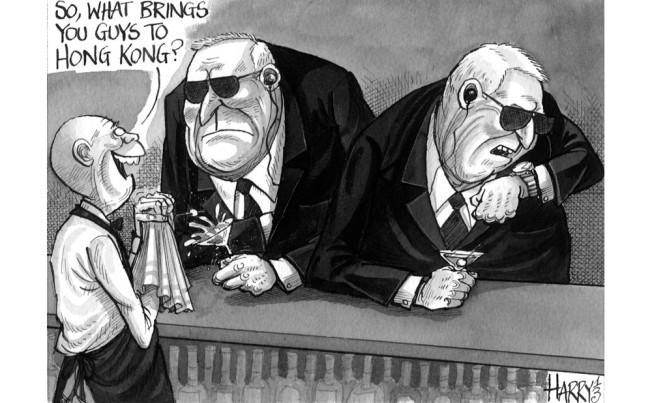





 Posts
Posts