Most geothermal projects harvest energy from hot rocks relatively near the surface, at temperatures of around 200 degrees Celsius. But the Iceland Deep Drilling Project (IDDP) is going much deeper, in search of hot magma reservoirs that generate temperatures between 400 degrees Celsius and 1,000 degrees Celsius. If that energy could be tapped, a single well could generate 10 times as much electricity as a conventional geothermal well.
There’s some precedent for this idea. In 2009, the IDDP was drilling a conventional geothermal well and accidentally struck upon a magma reservoir 1.2 miles below the surface. When they poured water into it, they were able to draw out superheated steam at temperatures higher than 400 degrees Celsius — an extremely potent source of energy. So now they’re trying to see if they can replicate the concept.
Three geothermal power plants with total capacity of 62 megawatts will go on line this year, as Indonesia seeks to tap more of the renewable energy source amid rising fuel costs.
Indonesia, which has the largest geothermal resource in the world, has been tapping only 1.4 percent of its potential due to high costs of development and restrictive regulation that bars geothermal exploration in protected forests.
Rising energy prices in the past decade have made geothermal more competitive in pricing to conventional energy sources such as diesel and coal.
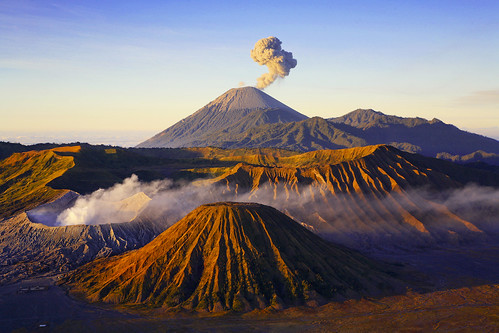
After accidentally drilling into a chamber of molten lava more than a mile underground in 2009, researchers in Iceland have now found a way to use the magma to create geothermal energy.
This new method of producing geothermal energy could be especially valuable in Iceland, where geothermal power already makes up about two-thirds of the energy use and around 90 percent of homes are heated using geothermal.
Researchers from the Iceland Deep Drilling Project (IDDP) used the magma to generate high-pressure steam at temperatures over 450 degrees Celsius, beating the world record for hottest geothermal heat. According to the measured output, the magma generated about 36 megawatts of electricity.
Normal geothermal energy is generated by pumping water into heated ground, boiling it and then using the steam to generate electricity. This experiment in Iceland is the first time molten magma instead of solid rock has been used to create the steam.
“This could lead to a revolution in the energy efficiency of high-temperature geothermal projects in the future,” Wilfred Elders, professor emeritus of geology at the University of California, Riverside, who’s written about the Icelandic innovation, told The Conversation.
Geothermal’s advantage over wind and solar is that it doesn’t stop running. “You get geothermal power 24 hours a day,” says John Carson, CEO of Vancouver-based Alterra Power Corp., which runs geothermal plants in Iceland and the United States. “It’s baseload power, and that’s what makes it extremely valuable.”
But where many other countries have well-developed geothermal industries, Canada has yet to open a commercial plant. One roadblock is that most provinces and territories don’t even allow geothermal projects. Also, because geothermal is relatively expensive to develop and there’s no domestic production, investors remain hesitant to commit. “What we’re up against is getting the first successful project up and running,” says Tim Weis, Edmonton-based director of renewable energy and efficiency policy at the non-profit Pembina Institute.
Alison Thompson, founder and chair of Calgary-based industry group the Canadian Geothermal Energy Association (CanGEA), wants governments to step in and help the industry gather steam. “There’s what we call an artificial border at the 49th parallel,” Ms. Thompson says. “The resource doesn’t end; there’s policies in place in our country that are preventing it from going forward.” CanGEA estimates that Canada could have 5,000 megawatts of installed geothermal power by 2025.
East Africa is undergoing an energy revolution driven by massive offshore natural gas finds in Tanzania and notable oil discoveries in Kenya and Uganda, all in the past three years. Energy from these hydrocarbons is yet to be realised, however. The domestic shortfall is a major hindrance to growth, leaving millions of people literally living in the dark.
About 16% of Kenya's population has access to electricity, according to World Bank data, and demand is outstripping supply. Rationing is a daily reality for many. "The [national grid] service is unreliable and costs business owners large amounts in backup infrastructure and fuel," says Harrison Leaf, managing director of access:energy.
Several private companies like Leaf's are developing off-grid micro-solutions to supplement national supply. But geothermal has become the darling of on-grid solutions for Kenya, and plenty of other countries are keen to benefit.
Kenya's state-owned power producer, Kengen, has been asked to provide consultancy services to Sudan, Rwanda and Tanzania. According to the Geothermal Energy Association, Kenya will become the world leader if its planned projects are completed on time.
The country has set the ambitious target of producing 5,000 megawatts (MW) by 2030, which will power millions of homes: all energy generated is fed into the national grid to increase the percentage of households served. The World Bank estimates that geothermal from east Africa's Rift Valley could power 150m homes.
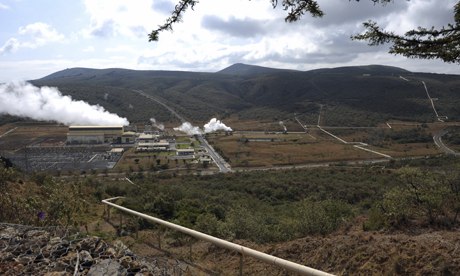
Progress is steaming ahead at the country's largest geothermal site, 80km north-west of Nairobi. Kirimi has lost count of how many wells he has drilled. His eight rigs with giant cylindrical shafts and diamond teeth are drilling wells at a rate of more than 40 a year. One well has the power to produce 18MW annually; by July 2014, Kirimi hopes to be generating 280MW – and working towards the site's next target of 560MW.
Costa Rica hopes that the additional electricity generated by steam from the volcanic area will help the country reach its goal of generating 95 percent of its electricity with renewable resources by 2014. ...
The first of the proposed plants, Pailas II, will have an electrical generation capacity of 55 megawatts and will cost more than $333 million to build, according to a statement from Casa Presidencial. The costa Rican Electricity Institute, or ICE, will construct two other 50-MW power plants, Borinquen I and II, 40 kilometers away from the Pailas geothermal plants. “This is 165 MW of reliable [electricity generation]; that is to say, they will operate 24 hours a day, 365 days a year. This is clean, renewable and reliable energy, as reliable as any conventional thermal electrical power plant,” said ICE Executive President Teofilo de la Torre.
American-Icelandic company Reykjavik Geothermal just invested $4 billion towards a massive new geothermal farm 124 miles south of the Ethiopia’s capital Addis Ababa. The deal signed on Wednesday secures three-quarters of the funding necessary to build the 1000 MW geothermal project, which is the first of its kind in the country, and paves the way to a cleaner energy future for one of Africa’s most populated countries.
Global geothermal power capacity could be on its way toward doubling, according to a new industry report, as projects unfold around the world, with a number of countries closing in on putting their first geothermal power stations to work.
The Geothermal Energy Association, in its 2013 Geothermal Power: International Market Overview, said seventy countries are moving forward with nearly seven hundred projects. The group said that as of August this year, 11,765 megawatts of geothermal capacity were online – and 11,776 MW of new capacity were in the early stages of development or under construction.
Here's another use for fracking: expanding access to hot rocks deep beneath Earth’s surface for energy production. In April Ormat Technologies hooked up the first such project—known in the lingo as an enhanced geothermal system, or EGS—to the nation's electric grid near Reno, Nev.
"The big prize is EGS," enthuses Douglas Hollett, director of the Geothermal Technologies Office at the U.S. Department of Energy (DoE). "The key is learning how to do it in a reliable way, in a responsible way."
By some estimates, the U.S. could tap as much as 2,000 times the nation’s current annual energy use of roughly 100 exajoules (an exajoule equals a quintillion, or 1018 joules) via enhanced geothermal technologies. With respect to electricity, the DoE concludes at least 500 gigawatts of electric capacity could be harvested from such EGS systems. Even better, hot rocks underlie every part of the country and the rest of the world. Australia's first enhanced geothermal system, spicily named Habanero, began producing power in May, and Europe has brought three such power plants online.
Hydropower accounts for more electricity production than solar PV, wind, and geothermal combined. In 2012, hydropower accounted for 16% of the world’s electricity production. However, hydropower gets far less press because it is a mature technology with a much lower annual growth rate than most renewables. While solar PV increased capacity by an average of 60% per year over the past 5 years, new hydropower capacity increased at a much more modest annual rate of 3.3%. ...
Despite hydropower’s current dominant position among renewables, growth in consumption of hydroelectricity will likely continue to be modest, because many of the best sites for hydroelectric dams have already been developed. The exception to this is in the Asia Pacific region, where hydroelectric consumption more than doubled over the past decade. The region currently accounts for 35% of global hydroelectric consumption, and that percentage is likely to increase as countries continue to develop hydroelectric power plants. ...
In 2012, at least 78 countries used geothermal directly for energy. Over two-thirds of the geothermal energy for direct use was through geothermal heat pumps. 24 countries operated geothermal plants for electricity production. Total geothermal electricity capacity was 11.7 GW at the end of 2012. Capacity was led by the U.S. with 3.4 GW of capacity, followed by the Philippines at 1.9 GW, Indonesia at 1.3 GW, Mexico at 1.0 GW, and Italy at 0.9 GW. On a per capita basis, Iceland leads the world with 0.7 GW of capacity, which accounted for 30% of the country’s electricity in 2012.
The SMH reports that geothermal power company GeoDynamics (which has greatly disappointed me over the years) is still working hard to progress their plant at Innamicka in South Australia - Hot rocks power company seeking customers.
Geodynamics, the developer of Australia’s first deep hot rocks energy project, aims to secure customers for its Cooper Basin site within six to 12 months, allowing it to proceed to a larger commercial plant, said chief executive Geoff Ward.
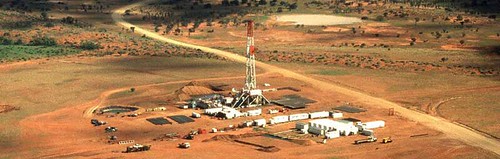
The company has spent more than $400 million since listing in 2002, including buying equipment and drilling. Its 1-megawatt Habanero pilot plant was commissioned on April 30 and has been operating in excess of expectations since, said chief executive Geoff Ward. "We're delighted by how stable and reliable" the operation has been, he said.
The geothermal plant at Innamincka in north-eastern SA taps salty water heated at 210 degrees more than 4.2 kilometres below the surface, extracting the heat to generate electricity. The cooled brine is then pumped back down a separate well where it is reheated by the hot rocks, creating an energy loop. Only two other sites now operate so-called enhanced geothermal systems, at Soulz in France and Landau in Germany.
Geodynamics will only proceed with a 5-10 megawatt commercial plant if it can secure customers. Potential clients include Santos, which operates its own gas and oil hub at Moomba, about 70 kilometres away. Beach Energy and Chevron, meanwhile, are exploring for unconventional shale gas within 5-15 kilometres of Geodynamics's wells.
GeoDynamics' competitor Petratherm seems to be losing confidence in their proposed alternative project, with the company looking to explore for shale oil in Tasmania.
After years of trying to commercialise geothermal energy in the South Australian outback, ASX listed Petratherm announced plans to diversify into shale oil and gas in Tasmania. ''This decision by Petratherm to extend into unconventional shale oil and gas exploration leverages our core areas of expertise that include basin geology and deep drilling,'' the company said.
Petratherm managing director Terry Kallis sought to reassure environmentally conscious investors that the company had not abandoned its geothermal project, which is planned to be about 75 per cent smaller than previous plans. But funding is hard to come by, and a $13 million government grant can be used only if Petratherm can raise millions of its own, a task that will be even more difficult under a lower carbon price.
Geothermal developers from AltaRock Energy, a Washington state-based company, have been working on creating geothermal reservoirs with their own technology. They have recently made three such reservoirs from a single well, which means there is a greater chance a commercial geothermal plant can be built because with more reservoirs there is greater flow and energy output for each well. With human-made reservoirs expanding the energy output, the overall cost of constructing a geothermal plant could be reduced by 50 per cent.
“The purpose of the Newberry EGS project is to demonstrate AltaRock’s tne technology designed to lower the cost of EGS, and thus allow economic extraction of heat from the earth in locations where high temperatures can be reached by conventional drilling techniques,” said Susan Petty, founder and president of AltaRock. (Source: Fort Mill Times)
These reservoirs are also called stimulated zones or enhanced geothermal systems, and located at the Newberry Enhanced Geothermal System (EGS) Demonstration site, which is near an ancient volcano in Oregon. They are created by injecting cold water into hot, low permeability rock to amplify fractures there, which then allows the surface hot water to leak out and fill the human-made reservoirs. (The Department of Energy has contributed over $20 million to their research.)
The potential costs savings results from the ability to create multiple hot water reservoirs from one well or single site. Alta Rock has made Thermally Degradable Zonal Isolation Materials (TZIM) to help create these multiple zones. A biodegradable polymer was used at the Newberry site in a process that was implemented several times. It is possible to do more than three stimulation rounds at one site for reservoir creation.
The UK's nascent geothermal energy industry has today received a major boost after it emerged that one of the UK's largest energy companies is working on plans to develop five new deep geothermal heat and distribution systems.
Ireland-based geothermal technology specialist GT Energy today revealed that it has inked a memorandum of understanding with energy giant E.ON that will see the two companies jointly develop a range of urban geothermal heat power plants.
The UK currently boasts only a handful of deep geothermal power plants, including a pioneering district heat system in Southampton that has been in place since 1986. However, a number of projects are currently under construction, including plans for a new geothermal power plant in Cornwall and a geothermal heat facility in the centre of Newcastle.
E.ON and GT Energy maintain that scientific studies have shown the UK has access to up to 100GW of geothermal energy potential, particularly in the South-West, North-West, and North-East.
They have also argued that deep-geothermal technology is well suited to urban settings where the resulting heat can be easily distributed to a variety of buildings in the area.
The U.S. Navy has teamed up with the Department of Energy’s Sandia National Laboratory to revive decades-old technology for a high performance drill bit, only they don’t have drilling for oil or gas in mind. The drill bit, called a polycrystalline diamond compact bit, is being retested evaluated and improved to help lower the cost of drilling for geothermal energy.
The mashup of the Navy with the development of high efficiency geothermal drilling technology is a natural one, given that the Navy has been investigating geothermal energy for decades, and the Navy’s Air Weapons Station China Lake research facility in California is the site of a major geothermal power plant that has been in operation for 15 years.
As a whole, in recent years the Department of Defense has ramped up its pursuit of geothermal energy and other forms of locally generated energy such as solar power, wind and biogas in order to unchain U.S. national defense facilities from reliance on grid-supplied sources.
Ironically, Sandia originally helped to develop polycrystalline diamond compact (PDC) technology about 30 years ago specifically to help the geothermal industry cut costs. However, given the industry’s small size at the time, there were relatively few opportunities to refine the technology in practice, so the oil and gas industry picked up the ball and ran with it.
PDC technology is based on a process called sintering, which involves fabricating objects from powders. According to Sandia’s press materials:
“Polycrystalline diamond compact cutters on the cutting faces of bits allow more aggressive drilling than bits traditionally used for geothermal drilling. They are created by a sintering process. Graphite powder is applied to the leading face of a cutter made of tungsten carbide. The material assembly is compressed in three directions at pressures of 1 million pounds per square inch. When heated to a transition temperature, the graphite converts a to a 1-millimeter layer of synthetic diamond.” Since oil and gas drilling generally takes place in sedimentary rock, which is relatively softer and cool, commercially available PDC bits still haven’t been fully tested and developed for geothermal drilling.
Geothermal drilling generally involves much more complicated conditions than found in oil and gas fields. Aside from involving higher temperatures and greater depths, geothermal drilling typically occurs in igneous and metamorphic rock, which is much harder and contains abrasive materials such as quartz. Fracturing in these formations also creates sudden changes in conditions that can damage the drill.
Japanese firms are looking at building several geothermal plants in a volcanic zone in the area worst hit by last year's nuclear disaster, a project that could gain momentum after the government eased restrictions on drilling this week.
The head of a group of firms that have studied the potential of a geothermal project in Fukushima said on Friday a consortium of about 10 companies would meet local people by early May to explain their plans to build plants with a total capacity of 270 megawatts, which would be Japan's biggest.
The consortium plans to work with local communities, including those who run hotels and inns at hot springs, to develop geothermal energy, Masaho Adachi, the chairman of Japan Geothermal Developers' Council said.
The council has already held a meeting with local government officials in the central zone of Fukushima, home to the nuclear plant crippled by an earthquake and tsumani last year, he said.
Along with high costs, protests by local communities fearful of the impact of a geothermal plant on hot springs have prevented such projects from taking off in the past.
"We should spend together a period of more than 10 years before having geothermal plants running," he said in an interview with Reuters on Friday, referring to activities such as collecting data, test drilling and environment assessment. Adachi declined to name the companies forming the consortium.
The Nikkei newspaper earlier said that the Fukushima project by a consortium of companies including Idemitsu Kosan Co and Inpex Corp would cost around 100 billion yen ($1.2 billion), with operations set to start in 2020.
Since the crisis, interest in renewable energy has jumped and a government subsidy scheme, similar to those in many countries in Europe, to force utilities to buy renewable electricity is due to start in July. ...
Studies show Japan, a land of volcanoes, ranks as the world's third-richest nation in geothermal power. A government study last year showed it has the potential for business to derive 14,000 MW of energy, but it currently has only 540 MW worth of commercial plants due to restrictions on development in national parks, where most resources lie.
A 49.9MW geothermal plant came on line this month, tapping heat from the Salton Sea field, a proven geothermal resource area that hasn't seen a new generator in more than two decades.
The developer, EnergySource, already has a power purchase agreement for a second plant in the southern California area. "With this team and so much available capacity in this resource, we have a development pipeline of new geothermal projects for the coming decade that will help California and Southwestern utilities meet their state-mandated renewable energy requirements,” says chief executive Dave Watson.
The $400m Hudson Ranch 1, under construction since May 2010, draws on what EnergySource describes as "one of the largest and highest temperature geothermal resources in North America", with an "extremely permeable liquid dominated resource". Two of the plant's three production wells draw enough steam to generate more than 40MW each -- "among the largest producers in the world" -- while a third is capable of more than 15MW.
“The Salton Sea geothermal resource is robust, with 326MW in 10 existing projects currently operating at a capacity factor substantially greater than 90%, with a development potential of 1,400MW or more,” says Dr. Subir Sanyal of GeothermEx, a resource consultant for the project's financiers.
Here’s a sobering sign of the challenges facing the geothermal industry: Even Warren Buffett has spent the better part of a decade trying to build a single geothermal power plant in California.
MidAmerican Energy Holdings Company, which is controlled by Buffett’s Berkshire Hathaway, received the green light from state regulators back in 2003 for its 159-megawatt Black Rock project in the desert east of San Diego. But by 2008, MidAmerican’s CalEnergy subsidiary had yet to break ground on Black Rock as required by its license, and with the economy in free fall as the financial crisis took hold the California Energy Commission granted the company a three-year extension to begin construction.
With that deadline approaching last month, regulators gave CalEnergy another three-year extension after the company cited obstacles ranging from financing and securing a spot on the transmission system to a steam pipe shortage, according to commission records. CalEnergy now has until Dec. 18, 2014 to start putting steel into the ground.
“I’d love to see this industry develop faster,” Karen Douglas, a member of the California Energy Commission, said in something of an understatement at a geothermal industry roundtable discussion in San Francisco on Wednesday.
That’s not just a bureaucratic platitude. Douglas, the former chair of the energy commission, noted that existing geothermal plants currently provide 4.5% of California’s electricity and are crucial to meeting the state’s ambitious renewable energy targets, especially as aging nuclear power plants are mothballed in the years ahead as their licenses expire. ...
After all, geothermal plants, which tap reservoirs of underground hot water to create steam that drives electricity-generating turbines, use decades-old technology that produces power around the clock, unlike solar and wind. And given there’s a potential 7,000 to 8,000 megawatts of geothermal energy to be tapped in California, the opportunity would seem to be boundless.
The short answer is the geothermal industry looks a lot like the oil and gas business but without the outsized profits. There’s the same steep upfront costs of drilling for wells that may come up dry – geothermal prospectors can spend tens of millions on exploratory drilling. And while an oil well can put a petroleum company in the black as soon as the crude starts flowing, a geothermal developer won’t see a dime until a power plant is licensed, built and begins to generate electricity, a process that can take years as Buffett has discovered.
Geothermal energy developers plan to pump 24 million gallons of water into the side of a dormant volcano in Central Oregon this summer to demonstrate new technology they hope will give a boost to a green energy sector that has yet to live up to its promise.
They hope the water comes back to the surface fast enough and hot enough to create cheap, clean electricity that isn’t dependent on sunny skies or stiff breezes — without shaking the earth and rattling the nerves of nearby residents.
Renewable energy has been held back by cheap natural gas, weak demand for power and waning political concern over global warming. Efforts to use the earth’s heat to generate power, known as geothermal energy, have been further hampered by technical problems and worries that tapping it can cause earthquakes.
Even so, the federal government, Google and other investors are interested enough to bet $43 million on the Oregon project. They are helping AltaRock Energy, Inc. of Seattle and Davenport Newberry Holdings LLC of Stamford, Conn., demonstrate whether the next level in geothermal power development can work on the flanks of Newberrry Volcano, located about 20 miles south of Bend, Ore.
“We know the heat is there,’’ said Susan Petty, president of AltaRock. “The big issue is can we circulate enough water through the system to make it economic.’’
DELAYED geothermal projects could make it across the line this year as two SA-focused companies move further toward producing power, the industry association says. Geothermal company Geodynamics plans to drill its Habanero-4 well in the first financial quarter, taking it toward producing power to Innamincka.
Australian Geothermal Energy Association chief executive Susan Jeanes said "this is the year the industry can prove itself"'. She said the Geodynamics project, that suffered a major setback with a well blowout at Habanero 3 well in 2009, would also work toward fracturing rocks to achieve circulation of super hot water for its 1MW plant.
SA geothermal company Petratherm has drilled a deep well at its Paralana project north of the Flinders Ranges and completed a successful fracture. ...
Ms Jeanes was upbeat about the industry saying if the drilling work was successful this year it could help lead the whole sector forward. "We expect, that given (Geodynamics) successfully proved the concept with Habanero one and three that they will be successful with Habanero one and four because they are drilling into the same geological structure," she said. "That success at Innamincka will provide a huge boost of confidence in the sector, then the sector hopes that will be followed by a successful well at Paralana."
Petratherm managing director Terry Kallis said plans to begin drilling on a second deep well in the Paralana project were still on track for later this year despite TRUenergy's exit. "We haven't changed our plans. we're still on track to look to drill later this year," Mr Kallis said.
Ethiopia isn’t a country that comes up often when discussing renewable energy, but the Ethiopian Electric Power Coroporation (EEPCO) this past week announced it’s starting construction of six wind power projects and one geothermal power plant. In total, electricity generation capacity for the renewable energy projects totals more than one gigawatt (1 GW), Ethtiopian news service NewsDire reported.
The renewable energy projects are part of EEPCO’s plans to increase national electricity generation capacity five times by 2015, from a current 2000 megawatts (MW) to about 10,000 MW. Increasing electricity generation, in turn, is key to the government’s broader economic development plans.
Ethiopia’s considers itself a “powerhouse of Africa.” Comprising three climate zones, it ranks second in Africa in terms of hydropower potential, after the Democratic Republic of Congo, and exports significant amounts of electricity to its East African neighbors. Ethiopia’s Water and Energy Minister in March announced a plan to add 5,250 MW of electricity generating capacity by building the Grand Millennium Dam of Ethiopia, which would dam the Nile River near the border with Sudan.
EEPCO views wind power as a clean energy complement to its hydropower generating capacity. Ethiopia has substantial wind power resources. Wind power potential in the East African country totals some 10,000 MW, EEPCO has estimated, which has noted that wind energy is higher in the dry season, when hydropower resources are at their lowest.
The six wind power projects announced this past week include the 300 MW Aysha Wind Farm near the Djibouti border, the 100 MW Debre Birhan Wind Farm north of Addis Ababa, the 100 MW Assela Wind Power Project southeast of the capital, and the 153 MW Adama II Wind Power Project. Also slated to start construction are the 250 MW Galema I Wind Power project 42 MW Mesebo Harena Wind Farm and the 42 MW Mesebo Harena Wind Farm.
Ethiopia’s electric utility also intends to start construction of the 70 MW Aluto Langano Geo Thermal project. Rich in geothermal resources, the East African Rift Zone runs through eastern Ethiopia, though the country has thus far been much less active in exploiting it than has neighboring Kenya, which in September announced its intention to generate 30% of its electricity needs from geothermal resources by 2030.
PETRATHERM wants to differentiate itself from other geothermal explorers as it moves toward becoming a working electricity supplier.
Announcing an upgraded resource statement for the flagship Paralana project, Petratherm managing director Terry Kallis said yesterday the company had the right projects, partners and people to deliver results soonest.
After tests, Paralana's potential has been independently assessed, recording an inaugural "measured" resource and with almost half of the total 38,000 petajoules resource moving into the higher confidence "indicated" bracket from the "inferred" category.
The upgrade was a major step forward for Petratherm and partners Beach Energy and TRUenergy, Mr Kallis said.
"It is estimated we have enough geothermal resource potential for about 1300 megawatts of power generation for 30 years, which equates to more than one-third of South Australia's power use," he said.
A GEOTHERMAL energy project near Geelong has landed a $25 million state government grant to help develop a 12-megawatt pilot power plant. Greenearth Energy, which secured the money yesterday, says its plans for the demonstration plant could power up to 8000 homes.
The grant follows two years of negotiations with both Labor and Coalition governments to secure the funds under the state's Energy Technology Innovation Strategy, first promised in 2009. The first $5 million will go towards drilling a four-kilometre deep well to test the geothermal resource at one of the company's exploration sites. Greenearth holds exploration licences for Gherang, Wensleydale and Anglesea, and a preferred site will be announced in three months.
Giles Parkinson at The Climate Spectator has a look at geothermal energy company Petratherm’s proposal for a renewable energy complex to power BHP’s Olympic Dam mine (the world’s largest if / when the expansion project is completed) - Cheap and green energy for miners.
It may seem somewhat audacious for a company with a market value of $16 million to propose a world-leading energy project nearly one hundred times its value. But, says Petratherm managing director Terry Kallis, if you don’t dream, you don’t get. And he just happens to think he’s sitting on a unique opportunity.
Kallis, on Wednesday, outlined his vision for a $1.5 billion clean energy precinct in the outback of South Australia that would take advantage of the unique combination of geothermal, solar and wind energy resources, the intersection of major gas pipelines, and the proximity of the world’s largest mine and other major developments.
The big opportunity is, of course, to service the massive energy demands of BHP Billiton’s proposed Olympic Dam expansion – which could be more than 700MW at that site alone – as well as other mine proposals or expansions such as Prominent Hill and Carrapateena. Mine managers do not normally think along the lines that Kallis has proposed – they will simply build a new transmission line if a connection is close enough, or build enough gas or diesel to ensure the operations keep going 24/7.
However, BHP Billiton have shown that they are willing to consider all options. As we reported in May, the world’s biggest mining company is effectively hedging its bets around the supply of energy and, after conducting a detailed analysis, is willing to concede that geothermal and solar power have the potential to offer the cheapest form of emissions reductions by the end of the decade, if not earlier, and the cheapest form of energy.
Kallis’ idea is to show BHP the path to get there, and to keep their options open as long as possible, so that they can take advantage of the opportunities when the new technologies are bankable, and can deliver at the costs anticipated. Kallis, of course, has great interest in this, because his company proposes to supply the geothermal energy – and Olympic Dam is too good an opportunity to let slide. "We want to make sure we don’t lose the opportunity to get geothermal into that market," he says.
Kallis proposes to create a clean energy precinct on the Moolawatana cattle station around 50km north of Petratherm’s Paralana geothermal prospect, and just over 200km from Olympic Dam. The plan calls for an initial 300MW of capacity – mostly gas sourcing fuel from the passing Moomba-Adelaide gas pipeline, and wind – and have that ready by 2016, around the time Olympic Dam would need it. The wind resource is not officially documented, but the cattle station’s name comes from the local indigenous word for “windy place", so Kallis expects that should not be a problem.
The idea is then to add another 300MW or so of geothermal and solar energy as those technologies mature by the end of the decade, and around the time Olympic Dam would be contemplating its next stage of expansion. The mixture of those four energy sources should provide the miner with the confidence of a secure supply. Kallis says they will be able to deliver attractive hybrid products that lower electricity costs and improve reliability, while also reducing carbon emissions.
Kallis has aligned himself with some unnamed parties – presumably gas, transmission and technology people – and plans to open formal talks with BHP with the view to obtaining a power purchase agreement. Failing that, they will talk to the local utility. Petratherm is, of course, in no position to fund this project, but as it has done by bringing in TruEnergy and Beach Petroleum to partner in its geothermal development, Kallis anticipates there will be no shortage of potential partners.
Of course, Kallis is not the only one to dream of creating a new energy precinct based around the needs of a large mining operation. The so-called “green grid" proposal to unlock huge wind resources in South Australia’s Eyre Peninsula is still awaiting the opportunity to proceed and will rely mostly on an upgraded connection to the eastern seaboard and the Copperstring project in Queensland, a project that was noisily supported by local member Bob Katter and hoped to link Townsville and Mt Isa and open up a string of renewable energy plays in wind, solar and biomass along the way.
However, such was the length of the transmission line that the fate of Cooperstring rested on the support of a single end user in Mt Isa, in this case Xstrata. Despite support from the Queensland state government, the Swiss-based Xstrata board plumped for the easy, not necessarily cheaper, option of a gas fired power station, and Copperstring is now dead. BHP, at least, is alert to the options, and as the country's biggest company with the world's biggest mine, would be aware of strong signal it would send to the broader economy.

/cdn0.vox-cdn.com/uploads/chorus_asset/file/7335817/iceland-primary-energy-use_1940-20101.png)
/cdn0.vox-cdn.com/uploads/chorus_asset/file/7336233/Screen%20Shot%202016-10-24%20at%201.06.59%20PM.png)





 Posts
Posts