Showing posts with label electricity grid. Show all posts

The Myth Of Renewables Threatening Grid Stability  

Posted by Big Gav in , ,

RNE has a look at the increasing penetration of renewables for power generation, demonstrating they pose no issue for grid stability - The Myth Of Renewables Threatening Grid Stability.

Germany’s power grid outage averaged 12.7 minutes last year, 41% less than in 2006, even though renewables have grown to account for as much as a third of power generation in the country, according to data released by the federal regulator last week.

This put to rest concerns about intermittent sources of power threatening grid stability. The country is weaning itself away from nuclear power and embracing renewables generation, providing a working model of transformation of the energy sector for many other countries. ...

Meanwhile, there are countries that are still stretching their clean energy targets. Morocco wants to increase the proportion of energy consumption from renewables to 42% by 2020 and up to 52% by 2030, by when it aims to have 10.1GW of renewables – 4.6GW of solar, 4.2GW of wind and 1.3GW of hydro power.

A Renewable Supergrid in Russia ?  

Posted by Big Gav in , ,

IEEE Spectrum has an article on a report by the Neo-Carbon Energy Research Project in Finland on how to transition Russia and the Central Asian republics to 100% renewable energy at an acceptable cost - A Renewable Supergrid in Russia. They don't view this as remotely likely given the relative lack of interest in renewables in that part of the world but they wanted to show that 100% renewables was feasible throughout Eurasia.

Striding Towards The Global Energy Grid  

Posted by Big Gav in , , ,

Dave Roberts at Vox has an article on the Plains and Eastern Clean Line, a high-voltage direct-current (HVDC) power line that will extend from western Oklahoma to western Tennessee, enabling abundant wind power to be sent the populated east - This new transmission line will help unleash wind energy in the Great Plains. One down, dozens to go.

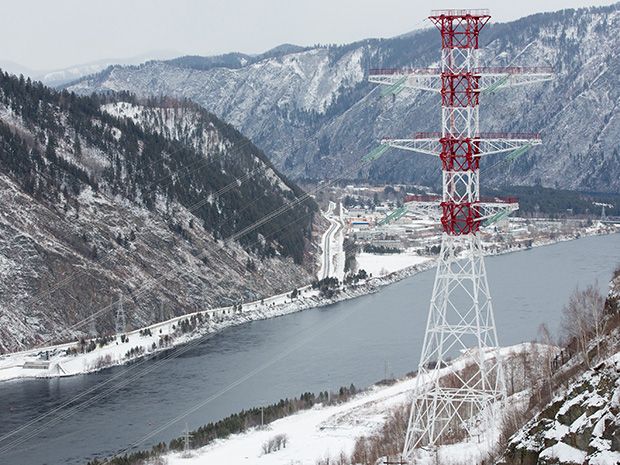
Expanding the grid to better interconnect renewable energy rich producing regions with energy poor consuming regions is the aim of Bucky Fuller's Global Energy Grid proposal, so it's good to see some of these connectors slowly being put in place.

Dave's article includs links to 2 newer global energy grid proposals - one at Renewable Energy World and another at IEEE Spectrum.

Age Pyramid Of Global Installed Power Generation Capacity  

Posted by Big Gav in , ,

Alstom has an interesting graphic in their annual financial report showing an age pyramid of global power generation capacity, segmented by age.

One half of the pyramid shows the breakdown of capacity by region, the other half by type of generation. It's interesting to note just how rapidly renewable energy has become the dominant type of new generation (rising to more than 50% in recent years). If capacity building continues at the current pace and the older plants are retired the switch to renewables could end up occurring quite quickly.

The Utility Shift To Energy Solutions Provision  

Posted by Big Gav in , , , , ,

The Climate Spectator has a pair of articles looking at how Australian utilities are trying to avoid the utility death spiral - partly by resisting change and partly by trying to work out how to adapt to i. The first article looks at AGL, which has been marching backwards lately as it invests heavily in old (but very cheap) coal fired power plants - AGL's tense shift towards energy solutions provider.

Average household customer electricity consumption was down nearly 10 per cent for the year and this comes on top of similar falls in prior years (detailed in the chart below). Part of this year’s fall is attributed to the mild May and June but, nonetheless, “AGL expects average consumer demand to continue to be impacted by energy efficiency, solar and new technologies”.

With less volume AGL finds itself unable to make the kind of margin per customer which it has in the past in the retail end of its business. Earnings per 'customer account' were down 16.7 per cent compared to last year for AGL. At the same time, the reduced energy sales also flow down the line to lower prices and margins in the power generation part of its business as well.

The problem for AGL, and indeed other power companies, is that energy equipment suppliers for buildings – such as solar PV but also other products, such as energy efficient lighting – are cutting their lunch. These equipment suppliers are helping customers to reduce the amount of energy they need from the grid.

AGL’s chief executive Michael Fraser appears acutely aware of this challenge. He suggests that the company needs to transition from a conventional vertically integrated energy supplier which makes money through selling volume of energy, to what they term an integrated energy solutions provider, which they symbolise in the picture below.

Essentially, AGL believes it needs to vertically integrate yet another step beyond the centralised grid and into its customers’ homes. Under such a model the company would make money less by selling electrons from the grid and more by charging for services linked to equipment such as solar PV, batteries and devices which would improve a household’s energy efficiency and shift its electricity demand out of the periods when power is most costly, such as very hot and very cold days.

Boston Consulting Group released a paper recently looking at how this energy solution provision model may arise and the challenges it presents for traditional power utilities. BCG outlines in the diagram below how the revenues available upstream from the customer are likely to erode over time due to solar, cheaper batteries and more efficient and communication-enabled electrical equipment. It shows that while the revenue available to generation and power networks, declines, the available revenue for behind-the-meter equipment and services – as well as metering equipment – rises.

The second article looks at another of the big 3 Australian utility companies - Origin Energy - and how the rapid rise in east coast gas prices (caused by the export of coal seam gas as LNG) is impacting the generation mix - Origin hit by solar and efficiency demand drop.

Origin, like AGL, is also talking up its ability to vertically integrate into the customer-side of the grid to counter the loss of margins through lower grid-based electricity volumes. In its presentation to investors it states it is focusing on development of a “revitalised solar business, smart meter technology, electric vehicles, distributed generation and storage”.

However, Origin does not elaborate on what is meant by its “revitalised strategy in solar”. In its latest results it notes gross profit decreased in its non-energy commodity business dropped by 35 per cent, or $17 million, primarily due to lower demand for rooftop solar PV systems. Origin used to be the largest solar retailer in the country but in the last few years its market share has declined dramatically.

At the same time Origin’s presentation seems to indicate that it is hopeful regulatory changes might alleviate declines in power consumption, such as changes to the Renewable Energy Target and adjusting network charges away from being averaged across energy consumption to more of a fixed nature.

Also, the company notes they’d be looking to limit capital investment in their energy markets division. This seems to suggest they see better opportunities in oil and gas rather than funneling money into provision of innovative energy solution offerings to replace lost grid sales.

Also just like AGL, Origin see prospects for returns to improve in conventional power generation with large price rises possible. They believe that there will be a mass withdrawal of around 15 terrawatt-hours of gas fired generation from the NEM as LNG plants suck in this gas. They also expect some further power plant capacity to be retired.

The utilisation of their mix of power plants (detailed in the table below) underlies the shift we’ll see. Darling Downs and Mortlake are running at quite high capacity factors given their position in the power plant merit order while the coal-fired Eraring operated at less than half its full capacity (45 per cent capacity factor).

One can imagine with gas rising to around $8 per gigajoule these plants will almost drop off the grid while Eraring’s output will increase considerably.

Watts happening? Electricity demand falling as prices continue to rise  

Posted by Big Gav in , , ,

Ross Gittins at the SMH has a look at the strange dynamics being exhibited by the Australian power market - Watts happening? Electricity demand falling as prices continue to rise.

We know the two great certainties in life are death and taxes, but many thought there was a third: the inexorable rise in consumption of electricity. As the population grew and each of us got a little more prosperous each year, we'd use more power. The mighty electricity industry was built on that certainty.

Except that electricity consumption has been falling for the past four years. To say this has taken the industry by surprise is an understatement. For well over a century – even during the Great Depression – the quantity of electricity used in Australia each year was greater than the year before. ...

There are few aspects of the economy – global or national – where change is more significant, more diverse or more interesting than energy supply and demand – where energy covers coal, gas (conventional and unconventional), petroleum, wind, solar and other renewables. Expect to hear more from me on the topic.

But there are few questions more interesting than exactly why the unthinkable, a fall in electricity consumption, has come about. Short answer: a surprisingly large combination of reasons ...

The best attempt to quantify the various factors involved comes from a report prepared by Dr Hugh Saddler, an energy expert with the Pitt and Sherry consultancy, for the Australia Institute. Saddler's modelling covers the years to 2012-13, but we know from reporting this week by Origin Energy and AGL that the fall continued in 2013-14.

Saddler focuses on energy produced and consumed from the National Energy Market, which covers the five eastern states and the ACT, but the decline is occurring also in Western Australia. After peaking in 2008-09, consumption from the national market in 2012-13 was down by almost 8 terawatt hours, or 4.3 per cent.

But that's only half the story. Just as important as why demand has fallen is why it hasn't continued growing, as continued growth in the population and the economy would lead us to expect. Saddler estimates that had demand continued growing from 2004 at its average rate of growth over the previous 20 years (2.5 per cent a year) it would have been 37 terawatt hours more than it actually was in 2012-13. ...

"All of the decline in consumption has been at the expense of coal-fired generators, with the result that many are now barely profitable," Saddler says. ...

So what has caused our power consumption to fall rather than rise? The biggest single reason is the introduction from the late 1990s of regulations to increase the energy efficiency of refrigerators, freezers and many other residential and commercial appliances, and to increase the energy efficiency of new buildings.

Saddler estimates this explains 37 per cent of the 37 terawatt-hour shortfall from what might have been.

The next biggest part of the explanation is structural change in the economy away from electricity-intensive industries. Over the year to September 2012, three major NSW industrial power users – Port Kembla steelworks, Kurri Kurri aluminium smelter and the Clyde oil refinery – were partly or completely shut down. This explains 10 per cent of the 37 terawatt-hour shortfall.

The evidence also suggests that power consumption by other major industrial users has been little changed over the three years to 2012-13. Saddler estimates that this failure to grow explains a further 14 per cent of the shortfall, taking the total contribution from structural change to almost a quarter.

The next most important part of the explanation is the response of electricity users, particularly residential users, to the higher prices they were being charged. Saddler finds that after 2010 there was "an abrupt change in consumer responsiveness to higher prices". ...

He further calculates that the growth in output from rooftop photovoltaic solar and other small, distributed generators accounts for about 13 per cent of the shortfall. This, of course, is a fall in the demand for electricity supplied by the major, mainly coal-fired generators, not a fall in the use of electricity as such.

Saddler notes that for the past three years the annual peak demand has been falling, not increasing, despite the huge investment to cope with ever-rising peaks. When will this additional capacity, which is now built and for which all electricity consumers are paying – and will continue to pay for some years to come – be required, if ever, he asks.

The $500-a-day service charge designed to kill solar in Queensland  

Posted by Big Gav in , , , ,

RNE has a look at moves in Queensland to shift from usage based pricing for electricity to a model with heavy "service charges" for grid connection, punishing on-premise generation - The $500-a-day service charge designed to kill solar.

Queensland businesses are being hit with daily service charges of more than $500 a day on their electricity bills, in a move the solar industry says is designed to kill the roll-out of commercial-scale rooftop solar across the state.

The charges were quietly unveiled by the Queensland Competition Authority and the state government in July. But their implications are only now being absorbed as business operators do the numbers on proposed solar installations. ...

The changes have horrified members of the solar industry, businesses looking to install solar, and those who have invested tens of thousands of dollar in energy efficiency measures such as LEDs or upgraded machinery.

That’s because, according to Steve Madson, director of Country Solar, one of the country’s largest installers of commercial-scale solar, the new tariffs reduce any incentive for businesses to lower consumption from the grid, either by installing solar panels for their own use, or by investing in more efficiency machinery and lighting.

Madson says the charges appear designed to stop the rollout of commercial-scale solar in Queensland. “The changes are clever in their design,” Madson told RenewEconomy. “They do not actually result in an increase in total electricity costs, and in some cases they actually cause a fall. But they kill the possibility of reducing the bills by installing solar. ”How can they charge $500 a day to read the meter, that is what the daily service charge is after all.”

The QCA, and the state government has long been accused of acting only to protect the interests of the network operators and retailers, and to boost the dividends paid to the government. Last year, as RenewEconomy reported, QCA came out in favour of special tariffs on residential solar customers, even though it admitted that they would be more costly, ineffective, unfair and possibly illegal. But they favoured the move because it would protect network revenues.

The raising of fixed charges has been a common response among utilities fearing the impact of rooftop solar and a “death spiral” of falling revenues on a fixed asset base.

Analysts such as Morgan Stanley have ridiculed the practice of imposing high fixed charges, saying it was ultimately self-defeating and could simply accelerate that death spiral, and encourage people to go off-grid, particularly when battery storage became commercially viable. “There may be a ‘tipping point’ that causes customers to seek an off-grid approach — higher fixed charges to distributed generation customers are likely to drive more battery purchases and exits from the grid,” the Morgan Stanley researchers wrote.

Madson agrees: “In three years’ time (when battery storage improves), this will also be enough for a mass exodus from the grid altogether.”

Swanbank shut-down a swan song for gas fired power in Australia  

Posted by Big Gav in , , ,

Tristan Edis at the BS has a look at how LNG exports from Queensland are killing gas fired power generation - Swanbank shut-down a swan song for gas.

Queensland government-owned Stanwell has announced it will be mothballing its gas-fired 385 megawatt Swanbank E power station in October for up to three years. Meanwhile, it will restart one of its two mothballed units at the coal-fired Tarong Power station instead but, critically, is yet to give a firm indication on timing.

This announcement marks a pivotal point in the east coast National Electricity Market – the end of gas’ rise and the beginning of a major fall as a source of power generation. According to Stanwell’s chief executive officer Richard Van Breda, “With subdued market conditions and increasing gas prices expected to continue, Stanwell can earn more revenue from selling our gas rather than using it in electricity generation.” ...

As the chart below, from Pitt & Sherry’s Hugh Saddler, shows gas has experienced a steady rise in output from June 2006 to December 2013 while black coal and, more recently, brown coal have suffered.

Back around 2006 it all looked very bright for gas as the low carbon bridging fuel to renewables. It was thought that gas would steadily increase its share of power generation while coal declined on the back of policies to reduce Australia’s greenhouse gas emissions.

Lots of new gas had been discovered within Queensland coal seams that meant there was little risk of the east coast running short. Gas prices at around $3.50 per gigajoule plus power plant construction that was quicker and lower cost meant that there was only a relatively small difference in the economics of a new coal versus a gas power plant. A relatively moderate carbon price of around $20 to $30 was all that was needed for coal to lose out to gas in baseload operation, not to mention coal’s inferior flexibility and larger minimum size that increased its risk profile.

The Queensland 13% Gas Target and NSW’s Greenhouse Gas Abatement Scheme were already in place, providing a clear precedent for what many saw as an inevitable national emissions trading scheme. A dash for gas, like what had been seen in Europe and the US, seemed to be on the horizon. But then Santos announced it planned to build a plant to liquefy Queensland coal seam gas and export it overseas. It changed everything, although at the time the consequences were not entirely clear.

Now they are. Gas contracts are now being struck at prices of $9 per gigajoule rather than the $3.50 price of the past. There is also talk of gas shortages because of a huge surge in demand from a range of LNG plants coming online within short succession.

This Is What the Utility Death Spiral Looks Like  

Posted by Big Gav in ,

Greentech Media has an article on the impact renewable energy is having on utilities that haven't prepared for it - This Is What the Utility Death Spiral Looks Like.

The German mega-utility RWE provided another dismal reminder today of the painful transition European power companies are undergoing.

According to 2013 financial results, the utility lost more than $3.8 billion last year as it cycled down unprofitable fossil fuel plants due to sliding wholesale prices. The yearly loss is actually quite historic; it's RWE's first since 1949 when the German Republic was formed.

This follows poor earnings news from Vattenfall, a Swedish utility with the second-biggest generation portfolio in Germany, which saw $2.3 billion in losses in 2013 due to this same "fundamental structural change” in the electricity market.

The problem is well documented: high penetrations of renewables with legal priority over fossil fuels are driving down wholesale market prices -- sometimes causing them to go negative -- and quickly eroding the value of coal and natural gas plants. At the same time, Germany's energy consumption continues to fall while renewable energy development rises.

RWE's CEO Peter Terium called it "the worst structural crisis in the history of energy supply."

To make matters worse for utilities, their commercial and industrial customers are increasingly trying to separate themselves from the grid to avoid government fees levied to pay for renewable energy expansion. According to the Wall Street Journal, 16 percent of German companies are now energy self-sufficient -- a 50 percent increase from just a year ago. Another 23 percent of businesses say they plan to become energy self-sufficient in the near future.

It's a real-world example of the "death spiral" that the industry has so far only considered in theory: as grid maintenance costs go up and the capital cost of renewable energy moves down, more customers will be encouraged to leave the grid. In turn, that pushes grid costs even higher for the remainder of customers, who then have even more incentive to become self-sufficient. Meanwhile, utilities are stuck with a growing pile of stranded assets.

When unveiling today's dismal earnings, RWE's Terium admitted the utility had invested too heavily in fossil fuel plants at a time when it should have been thinking about renewables: "I grant we have made mistakes. We were late entering into the renewables market -- possibly too late."

WA grid may become first big victim of “death spiral”  

Posted by Big Gav in , , ,

ReNew Economy has a look at the impact of solar power and fossil fuel prices on the WA electricity grid - WA grid may become first big victim of “death spiral”.

The chances of the West Australian electricity grid becoming the first to fall victim to the so-called “death spiral” for utilities appears to have increased after it was revealed this week that the gap between the cost to generate, transmit and sell electricity and the charge to consumer has widened.

The “death spiral” is a term coined by utilities in an attempt to defend their business models against the rise of the “pro-sumer”, customers who are no longer just buying energy but who are sourcing cheaper electricity from their own generation, usually rooftop solar, and cutting demand from the grid.

The WA grid, however, has helped create its own death spiral because it has never recovered the cost of its largely fossil-fuel fired electricity from the consumer. The costs keep rising, and now it has emerged that electricity demand has fallen so low that the major utilities may be forced to pay for fossil-fuel generation they will never use.

It is hard to imagine a more unsustainable situation, and it is quite possible that the WA grid is the most at risk in the developed world from the emergence of cheaper solar and storage solutions.

Synergy, the WA Government-owned electricity and gas retailer that has just been merged with the government owned generator Verve Energy, revealed this week that the gap between consumer bills and the cost of delivery through the grid had blown out to nearly $500 million in the 2013 fiscal year.

This is despite the fact that residential power prices have risen 70 per cent since the Barnett government came to power in 2008. Synergy told the Upper House financial estimates committee that consumer bills would have needed to increase by another one third in 2012-13 to match the cost of production.

Synergy CFO Karl Matacz told the committee that solar panel installations, which have grown from zero to 130,000 in just five years, continue to grow at a rate of more than 2,000 a month, despite the removal of feed in tariffs. ...

If the WA government was to lift the consumer price to reflect the actual cost of generation and delivery, this would put the retail price at close to 40c/kWh. That compares to around 15c/kWh for rooftop solar PV. The difference provides an awful lot of room for alternatives such as storage, and even micro-grids to fill the gap.

Utilities hail electric cars to cut bills, reduce emissions  

Posted by Big Gav in , , ,

I was talking to a manager from one of the utility companies here at a conference last year and the conversation drifted onto a few topics that I find interesting.

The first item of note was that they have cut back on the amount of data that they are collecting from smart meters, noting that there are a few different customer segments with varying levels of interest in the data that is captured - but even the keenest lose interest in the data once they have optimised their usage patterns. Obviously this would change if pricing was more dynamic but that day seems to be a way off.

I also asked how they were dealing with the problem (from their point of view) of falling demand and his response was that they were looking to increasing uptake of electric vehicles to compensate for this.

This approach is now being promoted by the utilities industry association - Utilities hail electric cars to cut bills, reduce emissions.

A new report has uncovered that the cost of recharging electric cars could be as little as a quarter of the $1.50 a litre it currently costs to fill petrol-run cars.

Analysis by the Energy Supply Association of Australia (ESAA) found that an equivalent litre of electricity, or e-litre, could cost from 37 cents in off peak up to 62 cents in peak prices. It found that electric cars have the equivalent fuel costs of approximately 3 cents per kilometre, compared to 10 cents per kilometre for conventional cars.

The ESAA represents most of the country’s generators and network suppliers. Many of these businesses are being impacted by reduced demand for electricity. Some analysts, and some of its members, suggest that increased electric vehicle ownership could be a solution to those problems.

CEO Matthew Warren says electric cars are not only a “faster, cleaner, quieter and safer driving experience, they are also cheaper to run,” with electric engines being “simpler and far more efficient than the most advanced combustion engines.”

ReNew Economy has a related article on the factors causing the decline in demand - Why is electricity consumption decreasing in Australia?.

All of the decline in consumption has in fact been at the expense of coal fired generators. Many are now barely profitable. Greenhouse gas emissions fell by 9.2 Mt CO2-e, roughly 2% of Australia’s total emissions, in 2012 alone.

To be precise, what the above figures are measuring is not electricity used by final consumers, but electricity supplied to the national grid system by large generators which participate in the (wholesale) National Electricity Market.

It is very difficult to find consolidated data on the quantities of electricity supplied by small distributed generators, such as rooftop photovoltaics and landfill gas plants. But the Australian Energy Market Operator (AEMO) has estimated that in 2012-13. photovoltaics supplied 2.7 TWh and other small generators supplied 3.1 TWh. So, although important and growing, these sources alone do not account for the whole of the 8 TWh reduction from the peak year, let alone the 37 TWh reduction from the long term trend.

Research we have recently completed concludes that the three largest factors contributing to the recent dramatic changes in demand for electricity are:

  • the impact of (mainly regulatory) energy efficiency programs
  • structural change in the economy away from electricity intensive industries
  • since 2010, the response of electricity consumers, especially residential consumers, to higher electricity prices.

Australia’s first mandatory regulatory energy efficiency measures were introduced in the late 1990s. These were Mandatory Energy Performance Standards (MEPS) for refrigerators and freezers.

Since then, these standards have been extended to a very wide range of residential and commercial appliances and equipment. Analogous energy efficiency requirements have been applied to new buildings. We have used data in reviews of the appliance and equipment measures and the building measures to estimate that the increased impact of these measures between 2006 and 2013 has in total reduced annual demand for electricity by 10.5 TWh, or 28% of the total 37 TWh reduction.

Smaller demand reductions have come from increased uptake of solar and heat pump water heaters (supported by various government programs), the Home Insulation Program (the so-called “pink batts scheme”), and the Victorian and NSW retailer energy efficiency obligation schemes. All of these schemes together contribute another 8% of the reduction.

Edison’s revenge: DC Power Distribution Via USB  

Posted by Big Gav in , , ,

The Economist has an article on the increasing popularity for using USB connectors for DC power distribution, declaring "The humble USB cable is part of an electrical revolution. It will make power supplies greener and cheaper" - Edison’s revenge.

Most phones and other small gadgets can charge from a simple USB cable plugged into a computer or an adaptor. Some 10 billion of them are already in use. Hotel rooms, aircraft seats, cars and new buildings increasingly come with USB sockets as a standard electrical fitting.

Now a much bigger change is looming. From 2014, a USB cable will be able to provide power to bigger electronic devices. In the long term this could change the way homes and offices use electricity, cutting costs and improving efficiency. ...

The big change next year will be a new USB PD (Power Delivery) standard, which brings much more flexibility and ten times as much oomph: up to 100 watts. In his London office Simon Daniel, founder of Moixa, a technology company, charges his laptop from a prototype souped-up USB socket. The office lighting, which uses low-voltage LED (light-emitting diode) lamps, runs from the same circuit. So do the monitors, printers and (with some fiddling) desktops. Mains power is only for power-thirsty microwaves, kettles and the like.

That could presage a much bigger shift, reviving the cause of direct current (DC) as the preferred way to power the growing number of low-voltage devices in homes and offices. DC has been something of a poor relation in the electrical world since it lost out to alternating current (AC) in a long-ago battle in which its champion Nikola Tesla (pictured, left) trounced Thomas Edison (right). Tesla won, among other reasons, because it was (in those days) easier to shift AC power between different voltages. It was therefore a better system for transmitting and distributing electricity.

But the tide may be turning. Turning AC into the direct current required to power transistors (the heart of all electronic equipment) is a nuisance. The usual way is through a mains adaptor. These ubiquitous little black boxes are now cheap and light. But they are often inefficient, turning power into heat. And they are dumb: they run night and day, regardless of whether the price of electricity is high or low. It would be better to have a DC network, of the kind Mr Daniel has rigged up, for all electronic devices in a home or office.

This is where USB cables come in. They carry direct current and also data. That means they can help set priorities between devices that are providing power and those that are consuming it: for example, a laptop that is charging a mobile phone. “The computer can say ‘I need to start the hard disk now, so no charging for the next ten seconds’,” says Mr Bhatt. The new standard, with variable voltage and greater power, enlarges the possibilities. So does another new feature: that power can flow in any direction.

This chimes with another advantage. A low-voltage DC network works well with solar panels. These produce DC power at variable times and in variable amounts. They are increasingly cheap, and can fit in windows or on roofs. Though solar power is tricky to feed into the AC mains grid, it is ideally suited to a low-voltage local DC network. When the sun is shining, it can help charge all your laptops, phones and other battery-powered devices.

The great de-electricifation of Australia  

Posted by Big Gav in , ,

The Conversation has a post on dropping electricity demand in Australia - caused by a combination of rising power prices, the demise of large manufacturing users (courtesy of the dutch disease) and the success of the government's roof insulation program and various rooftop solar PV schemes - Electricity demand: The great de-electricifation of Australia’s grid

One of the certainties in the energy business used to be the regular year-in, year-out rise in demand for electricity [1].

Up until about 6 years ago, demand growth could be counted on with metronomic precision. Across our National Electricity Market – the NEM – electricity demand grew at about 2% annually.

That all stopped in 2008. On the basis of the numbers for June and July this year, we are on the verge of our twelfth straight season where demand has reduced on the year before.

Over the last 3 years, the annualised demand reduction has been about 500 megawatts – or about 2.2%. And since the peak in 2008, average demand has reduced by about 2 gigawatts or about 8%.

On these figures, Australia is clearly undergoing a profound de-electrification. If it continues for a few more years then, by analogy with economics, it will be worthy of the appellation the great de-electrification.

Zinc Battery Seen as Way to Cut Heat-Related Power Losses ?  

Posted by Big Gav in , ,

The heatwave in the northeast US seems to be setting new records for power consumption - the NYT has an article on interest in increasing energy storage capacity to help make the grid more reliable - Battery Seen as Way to Cut Heat-Related Power Losses.

As scorching weather envelops the Northeast and the Midwest, electric utilities are scrambling to keep the power on while air-conditioners strain utilities’ capacity. By Tuesday afternoon in New York City and Westchester County, for instance, Consolidated Edison had logged nearly 7,700 interruptions since the heat arrived on Sunday, and it had dispatched crews to restore almost all of the power.

Such disruptions have plagued utilities for years: how do they keep extra electricity on hand and ready to go, avoiding the need to cut the voltage in stressed neighborhoods and lowering the risk of blackouts?

Now, several utilities, including Con Edison, National Grid and the large European utilities Enel and GDF SUEZ, have signed up to fine-tune and test what they hope could lead to an answer — a battery half the size of a refrigerator from Eos Energy Storage, the company said Tuesday. If the testing goes well, the batteries hold the promise of providing storage that until now has been unaffordable on a large scale. “Energy storage is no longer an idea and a theory — it’s actually a practical reality,” said Steve Hellman, Eos’s president. “You’re seeing a lot of commercial activity in the energy storage sector.”

Part of the appeal is economic: utilities could buy power from centralized plants during off-peak hours, when it is cheaper, and use it to feed the grid at peak hours when it is typically more expensive. That could also relieve congestion on some transmission lines, reducing strain and the need to spend money upgrading or repairing them. In addition, batteries could help integrate more renewable sources like solar and wind into the power grid, smoothing out their intermittent production.

“Energy storage in general has been kind of a holy grail for utilities — a lot of the generation and demand is instantaneous,” said Joseph Carbonara, project manager in research and development at Con Edison, who is managing the Eos program. “The utilities have always been looking to buffer that.”

Utilities and institutions across the country, many with grants from federal or state energy departments, are testing energy storage technologies. Con Edison and the City University of New York are using a different zinc-based battery from Urban Electric Power to help reduce the school’s peak energy use as part of a New York State Energy Research and Development Authority program. In California, Pacific Gas and Electric is studying sodium-sulfur batteries that can store more than six hours of energy. And Duke Energy is working with lead acid batteries from Xtreme Power that are linked to a wind farm in Texas.

At the same time, there are a host of start-ups racing to develop different technologies for a wide range of applications, and already there are some large-scale batteries tied to the grid. But the technology has generally proved too expensive for widespread adoption.

Eos says it has gotten around that problem. Its battery relies on zinc, a relatively plentiful and cheap element. The company projects that its cost will be $160 a kilowatt-hour, and that it would provide electricity cheaper than a new gas power plant built to help fulfill periods of high demand, Eos executives said. Other battery technologies can range from $400 to about $1,000 a kilowatt-hour.

The National Grid on Renewables  

Posted by Big Gav in , ,

Technology review has a look at research into how to increase the penetration of renewable energy into national electricity grids - A Sneak Peek of the National Grid on Renewables.

A new $135 million research facility aims to solve a puzzle: how can countries prepare for an energy system that relies heavily on renewable energy? It can also test ways to improve reliability under stress, for example when demand soars in the summer as the air-conditioning load taxes the grid.

Because wind and solar energy supply power intermittently, they create challenges for grid operators. Other new energy technologies are coming online, too, including electric vehicles, energy storage, efficient buildings that cut power use during peak times, and small-scale natural-gas generators and fuel cells. Integrating these technologies on a large scale presents challenges to grid operators.

The National Renewable Energy Laboratory (NREL) in Golden, Colorado, created the Energy Systems Integration Facility (ESIF) to understand how to best operate the pieces of a more diverse energy system. Drawing on a supercomputer and power equipment that can create a megawatt-scale mini-grid within the facility, product engineers and utilities can simulate the impact of new technologies without causing problems to functioning grids.

Regions with a high percentage of wind and solar now rely on daily forecasts and stand-by fossil-fuel power plants to maintain reliable service. But once renewable energy is more than 20 percent of capacity, grid planners need more sophisticated tools, says Benjamin Kroposki, director of energy systems integration at NREL. “We saw this big shift. If we are successful in reaching cost targets for individual technologies, then what? You need to start doing systems integration,” he says.

An NREL analysis published last year found that, with a more flexible system, the U.S. could get 80 percent of its electricity from existing renewable energy technologies by 2050 (see “The U.S. Could Run on 80 Percent Renewable Electricity by 2050”). Germany and Denmark already have about 20 percent renewable electricity and Germany plans to achieve around 80 percent renewable energy, in both electric power and transportation, by 2050.

Summer on the NEM: What the extreme heat didn’t do to demand  

Posted by Big Gav in , , ,

While it's been hot this summer you wouldn't be able to tell from slumping electricity grid demand (courtesy of a pleasingly large takeup of solar PV in recent years) and probably helped along by the government's efforts to push solar hot water and roof insulation a couple of years ago- Summer on the NEM: What the extreme heat didn’t do to demand.

With a run of recent summers of below par temperatures, energy pundits have been eagerly awaiting a good summer heat wave to see just how our electricity system would stand up. The big question was what would happen when all those newly installed air conditioners finally got ramped up, once the the la Nina cycle broke and we got a good roasting? Would a return to hotter conditions finally break the trend of declining energy demand over the last four or five years?

Well it looks like we got the summer that would answer these questions, and the answers are no doubt causing a fair bit of head scratching amongst the pundits.

Since the last hot summer in 2010, our electricity system has seen a lot of changes. For one thing, almost 2 gigawatts of distributed generation has been added in the form of domestic solar PV. To put that in context, 2GW represents a touch under 10 per cent of average summer demand, though of course solar PV only produces at near maximum levels for a few hours in the middle of a sunny summer day. However, when solar PV is producing it takes away from the demand for electricity that otherwise would be dispatched across the poles and wires via our National Electricity Market – or NEM.

So with this summer just past setting new records for extreme heat, it’s a good time to point the summer sun on the NEM and see how it is standing up.

With blistering summer heat, particularly across New South Wales and Queensland, there was an expectation we might see new records in peak demand. But despite the weather and the supposed new air-conditioning load, the NEM doesn’t seem to have been pushed very hard at all during this last summer.

The Empire Strikes Back ? Gross Feed In Tariffs  

Posted by Big Gav in , , , , ,

Giles Parkinson at ReNew Economy has an interesting article on the attempts by some utilities (or at least by the regulator in Queensland, presumably at the prompting of the new conservative government) to retain profit margins in the face of large scale consumer uptake of solar power, proposing "gross feed in tariffs", where consumers are charged retail prices for all their consumption (including the power they generate themselves) while only paying the wholesale price back to the consumer for the power they generated themselves - How solar PV is turning utilities against consumers.

It the solar industry ever harboured any illusions about the challenges it is facing in imposing itself on a sector that has been virtually unchallenged for more than half a century, then they were certainly shattered by a series of attacks on their industry from utilities and pricing regulators over the last few weeks.

It is now clear – if it wasn’t before – that Australian energy utilities are moving decisively against the proliferation of solar PV in an attempt to protect their revenues and business models, as we predicted they would back in June. This is the claim of the solar industry, and they point to numerous examples of tariff changes, network impediments and the lobbying and influence over regulators.

Last week’s revelation that the Queensland pricing regulator was contemplating a tariff that could effectively kill the attraction of solar PV to households struggling under the weight of rising prices from the grid, was proof enough. The attempt by TRUenergy to bring a halt to the deployment of both wind and solar – citing the potential of both to cripple the conventional energy industry – is a further sign of the desperation of those utilities struggling to adapt.

There is no doubt that the debate over clean energy has moved beyond day to day concerns around climate change (even if it should not), and now that technologies such as solar can deliver electricity at equal or lower prices at the socket, the issue of technology cost is also nearly redundant. The battleground has moved to regulation, and policy decisions on the framing of tariffs and how to reflect the true value of producing and consuming energy. And it’s largely played out out of the public eye.

What is required is a new way of looking at the energy system. The hub-and-spoke model, like fixed-line telephony, is creaking under the strain of the so-called “self consumption” market and the ability of customers to produce their own energy.

And the regulation has gotten off to a bad start. The premium tariffs designed to give rooftop solar a kick-start and help reduce its “soft costs” – those for installing, pricing and maintaining the systems – were so badly managed in some key states (NSW, in particular), that utilities seeking to defend their territory and business models were able to gain the moral high ground and win favourable tariff structures under the lofty goal of protecting disadvantaged consumers.

Most tariffs in the country are now structured around a net tariff, which enables a household to use the electrons they produce to offset their consumption and rising retail prices from the main utilities. But any excess production is sold back at a peppercorn rate (under the guise of network and other costs) to the retailers, who then sell it to a nearby customer for between two and four times as much.

However, the utilities have been quietly pushing for an even more draconian measure to be introduced – a gross tariff, which will require households to sell all their output to the retailer and then buy it back at an inflated price.

Giles has a follow up article noting that the gross proposal has been abandoned, for now - Utilities say no to gross tariffs, yes to battery storage.
In a nod to the emerging power of the “pro-sumer”, Australian energy network operators and retailers have rejected a suggestion to move to gross tariffs for rooftop solar, saying it risked turning customers against them. Some suggest tariffs that would encourage homeowners to invest in more battery storage.

Operators of electricity networks in Queensland and the energy retailers have overwhelmingly rejected a proposal by the state’s competition authority to introduce gross tariffs for rooftop solar, saying they would be complex, expensive and unfair to owners of rooftop panels.

The Queensland Competition Authority raised some eyebrows, and a few hackles, last month when it raised the prospect of a gross tariff in an issues paper it prepared for deliberations around a “fair and reasonable” tariff for solar.

The solar industry immediately condemned the proposal, saying the idea of forcing customers to sell all their solar power to retailers and then buy it back at a much higher price was inequitable and would effectively mean the death of the industry, as it would remove the attraction of rooftop systems as a hedge against rising electricity costs. And it seems that the utilities, who were suspected by some, of quietly advocating the move, have recognized the risk of putting consumers offside if such a tariff was introduced.

Most of the submissions put to the QCA by network operators and retailers pointed to the potential complexity and cost of a gross tariff – particularly in having to change metering arrangements.

Interestingly, it was TRUenergy, under fire over its proposal to sharply reduce the development of utility scale wind and solar developments by curtailing the ambition of the renewable energy target, which said most clearly that gross FITs were unfair because they were not equitable to consumers.

It noted that households that invested in rooftop photovoltaic systems do so in the expectation that they will be able to consume less grid energy, and thereby gain a sense of control over their costs.

“Under the proposed changes, households would be required to ‘sell’ energy to the grid at the cost of energy, and then ‘purchase’ energy for their own use, at up to three times the price,” it noted in its submission. It said it would be confusing and “may create the perception that electricity retailers are benefiting at the consumer’s expense.”

620 million without power: India's energy crisis as grids collapse  

Posted by Big Gav in , ,

The SMH has a reports on the impact of poor rains and high temperatures on India's overloaded power grid - 620 million without power: India's energy crisis as grids collapse.

India's energy crisis cascaded over half the country on Tuesday when three of its regional grids collapsed, leaving 620 million people without government-supplied electricity for several hours in, by far, the world's biggest blackout. ...

The new power failure affected 620 million people across 20 of India's 28 states - about double the population of the United States. The blackout was unusual in its reach, stretching from the border with Myanmar in the northeast to the Pakistani border about 3000 kilometres away. Its impact, however, was softened by Indians' familiarity with frequent blackouts and the widespread use of backup generators for major businesses and key facilities such as hospitals and airports. ...

Tuesday's blackout eclipsed Monday's in India, which covered territory including 370 million people. The third largest blackout affected 100 million people in Indonesia in 2005, according to reports by The Associated Press.

India's demand for electricity has soared along with its economy in recent years, but utilities have been unable to meet the growing needs. India's Central Electricity Authority reported power deficits of more than 8 per cent in recent months.

In addition, vast amounts of power are pirated through unauthorized wiring that taps into the electrical system.

The power deficit was worsened by a weak monsoon that lowered hydroelectric generation and kept temperatures higher, further increasing electricity usage as people seek to cool off.

Russia Green Lights $65 Billion Siberia-Alaska Rail and Tunnel to Bridge the Bering Strait  

Posted by Big Gav in , , , , ,

Inhabitat reports (quoting World Architecture News and The Times - the LaRouchies also seem to have an interest in the topic) that Russia has "approved" the long talked about Bering Strait rail tunnel / energy corridor - a critical component in Bucky Fuller's vision of a global energy grid - Russia Green Lights $65 Billion Siberia-Alaska Rail and Tunnel to Bridge the Bering Strait!.

The Register notes "this time its chances of actually being built are strengthened by a 500-mile link from the existing Trans-Siberian line to the Eastern Siberian city of Yakutsk, scheduled for completion in 2013" - however I don't think anyone is holding their breath waiting for tunnel construction to start.

The high speed railway and tunnel will be a private public partnership whose economic impact could be startling. 100 million tons of freight could be moved per year using the most efficient known way of transport. Proposed tidal energy plants could provide 10 gigawatts of energy and a string of wind power fields could churn a constant supply of clean energy, serving as a vital link to a worldwide energy grid. The tunnel alone would take fifteen years to complete — and an energy and railway network would take many more — but the project would significantly change the shipping and energy industry.

In a time of austere measures by governments throughout the world we hear less and less of large-scale projects, but the economic and environmental benefits of developing critical infrastructure links is a key element to 21st century environmentally sound economic growth.

Power consumption makes historic drop  

Posted by Big Gav in , , ,

The ABC has a report on falling power demand on the local grid - its a shame summer peaks aren't dropping as well - as we are in a weird situation of investing heavily in transmission infrastructure to satisfy falling aggregate demand - Power consumption makes historic drop.

One of Australia's largest electricity distributors says it is experiencing a "historic" cut in households' demand for power.

Ausgrid, which provides power to much of New South Wales, has announced demand for its electricity by regular households has fallen 2 per cent each year for the past four years. It is the first time the company has seen a fall in demand since the 1950s.

"If you go right back to the 1950s, residential consumption has continued to rise year on year, and in around 2006, we saw that plateau," Ausgrid energy efficiency specialist Paul Myors said.

Ausgrid says the drop is caused by consumers switching to energy efficient hot water systems and light bulbs after seeing their power bills go through the roof.

"One example where we have seen most strongly is with residential hot water because we often separately meter this in households," Mr Myors said. "We've seen reductions even greater than 2 per cent, even up to 8 per cent per year," he said.

It is expected the Australian Energy Market Operator will also announce a fall in power demand of 5 to 6 per cent in the next decade.

Statistics

Locations of visitors to this page

blogspot visitor
Stat Counter

Total Pageviews

Ads

Books

Followers

Blog Archive

Labels

australia (619) global warming (423) solar power (397) peak oil (355) renewable energy (302) electric vehicles (250) wind power (194) ocean energy (165) csp (159) solar thermal power (145) geothermal energy (144) energy storage (142) smart grids (140) oil (139) solar pv (138) tidal power (137) coal seam gas (131) nuclear power (129) china (120) lng (117) iraq (113) geothermal power (112) green buildings (110) natural gas (110) agriculture (91) oil price (80) biofuel (78) wave power (73) smart meters (72) coal (70) uk (69) electricity grid (67) energy efficiency (64) google (58) internet (50) surveillance (50) bicycle (49) big brother (49) shale gas (49) food prices (48) tesla (46) thin film solar (42) biomimicry (40) canada (40) scotland (38) ocean power (37) politics (37) shale oil (37) new zealand (35) air transport (34) algae (34) water (34) arctic ice (33) concentrating solar power (33) saudi arabia (33) queensland (32) california (31) credit crunch (31) bioplastic (30) offshore wind power (30) population (30) cogeneration (28) geoengineering (28) batteries (26) drought (26) resource wars (26) woodside (26) censorship (25) cleantech (25) bruce sterling (24) ctl (23) limits to growth (23) carbon tax (22) economics (22) exxon (22) lithium (22) buckminster fuller (21) distributed manufacturing (21) iraq oil law (21) coal to liquids (20) indonesia (20) origin energy (20) brightsource (19) rail transport (19) ultracapacitor (19) santos (18) ausra (17) collapse (17) electric bikes (17) michael klare (17) atlantis (16) cellulosic ethanol (16) iceland (16) lithium ion batteries (16) mapping (16) ucg (16) bees (15) concentrating solar thermal power (15) ethanol (15) geodynamics (15) psychology (15) al gore (14) brazil (14) bucky fuller (14) carbon emissions (14) fertiliser (14) matthew simmons (14) ambient energy (13) biodiesel (13) investment (13) kenya (13) public transport (13) big oil (12) biochar (12) chile (12) cities (12) desertec (12) internet of things (12) otec (12) texas (12) victoria (12) antarctica (11) cradle to cradle (11) energy policy (11) hybrid car (11) terra preta (11) tinfoil (11) toyota (11) amory lovins (10) fabber (10) gazprom (10) goldman sachs (10) gtl (10) severn estuary (10) volt (10) afghanistan (9) alaska (9) biomass (9) carbon trading (9) distributed generation (9) esolar (9) four day week (9) fuel cells (9) jeremy leggett (9) methane hydrates (9) pge (9) sweden (9) arrow energy (8) bolivia (8) eroei (8) fish (8) floating offshore wind power (8) guerilla gardening (8) linc energy (8) methane (8) nanosolar (8) natural gas pipelines (8) pentland firth (8) saul griffith (8) stirling engine (8) us elections (8) western australia (8) airborne wind turbines (7) bloom energy (7) boeing (7) chp (7) climategate (7) copenhagen (7) scenario planning (7) vinod khosla (7) apocaphilia (6) ceramic fuel cells (6) cigs (6) futurism (6) jatropha (6) nigeria (6) ocean acidification (6) relocalisation (6) somalia (6) t boone pickens (6) local currencies (5) space based solar power (5) varanus island (5) garbage (4) global energy grid (4) kevin kelly (4) low temperature geothermal power (4) oled (4) tim flannery (4) v2g (4) club of rome (3) norman borlaug (2) peak oil portfolio (1)