Posted
by Big Gav
in
canada,
global warming,
tar sands
I guess nature has a black sense of humour, with Canadian tar sands capital Fort McMurray baking in temperatures 22 degrees above average and its residents having to be evacuated because of forest fires. Climate Central has a report - Here’s the Climate Context For the Fort McMurray Wildfire.
Posted
by Big Gav
in
bay of fundy,
canada,
ocean energy,
renewable energy,
tidal power
The Chronicle Herald has an article on a small-ish tidal power project in Nova Scotia - Fundy Tidal, Ontario firm join for energy project.
A Digby County tidal energy developer is teaming up with an Ontario company to make a 1.95-megawatt tidal project — and possibly more tidal projects — a reality. ... The company’s other COMFIT approvals include 500 kilowatt projects in Grand Passage, between Brier Island and Long Island, and in Petit Passage, between Long Island and Digby Neck. They have two more in Cape Breton, a 500 kilowatt project in Great Bras d’Or Channel and one for 100 kilowatts in Barra Strait.
Canada's CBC also has an article on tidal power testing programs in the Bay of Fundy - Bay of Fundy FORCE study looking at tidal power turbine potential.
Understanding the environmental conditions and strength of the current in the Bay of Fundy is important for four consortia — European companies partnered with local Nova Scotia companies — who have committed to spend $9 million on four berths to test their turbines at the demonstration site.
In 2009, OpenHydro of France tried unsuccessfully to deploy a 10-tonne turbine in the Bay of Fundy, but the ultra-strong tidal flows destroyed the machinery within three weeks. Current speeds have been clocked between 10 and 12 knots.
Instead of waiting months for collected data to be retrieved and processed, the new testing platform is connected to an onshore computer at FORCE in Parrsboro via a three-kilometre-long fibre-optic cable that transmits data in real-time.
Posted
by Big Gav
in
canada,
carbon tax
Grist has a look at the "best tax ever" - British Columbia's carbon tax - Here’s why B.C.’s carbon tax is super popular — and effective.
Suppose that you live in Vancouver and you drive a car to work. Naturally, you have to get gas regularly. When you stop at the pump, you may see a notice like the one above, explaining that part of the price you’re paying is, in effect, due to the cost of carbon. That’s because in 2008, the government of British Columbia decided to impose a tax on greenhouse gas emissions from fossil fuels, enacting what has been called “the most significant carbon tax in the Western Hemisphere by far.”
A carbon tax is just what it sounds like: The B.C. government levies a fee, currently 30 Canadian dollars, for every metric ton of carbon dioxide equivalent emissions resulting from the burning of various fuels, including gasoline, diesel, natural gas, and, of course, coal. That amount is then included in the price you pay at the pump — for gasoline, it’s 6.67 cents per liter (about 25 cents per gallon) — or on your home heating bill, or wherever else the tax applies. (Most monetary amounts in this piece will be in Canadian dollars, which are currently worth about 89 American cents.)
If the goal was to reduce global warming pollution, then the B.C. carbon tax totally works. Since its passage, gasoline use in British Columbia has plummeted, declining seven times as much as might be expected from an equivalent rise in the market price of gas, according to a recent study by two researchers at the University of Ottawa. That’s apparently because the tax hasn’t just had an economic effect: It has also helped change the culture of energy use in B.C. “I think it really increased the awareness about climate change and the need for carbon reduction, just because it was a daily, weekly thing that you saw,” says Merran Smith, the head of Clean Energy Canada. “It made climate action real to people.”
It also saved many of them a lot of money. Sure, the tax may cost you if you drive your car a great deal, or if you have high home gas heating costs. But it also gives you the opportunity to save a lot of money if you change your habits, for instance by driving less or buying a more fuel-efficient vehicle. That’s because the tax is designed to be “revenue neutral” — the money it raises goes right back to citizens in the form of tax breaks. Overall, the tax has brought in some $5 billion in revenue so far, and more than $3 billion has then been returned in the form of business tax cuts, along with over $1 billion in personal tax breaks, and nearly $1 billion in low-income tax credits (to protect those for whom rising fuel costs could mean the greatest economic hardship). According to the B.C. Ministry of Finance, for individuals who earn up to $122,000, income tax rates in the province are now Canada’s lowest.
Posted
by Big Gav
in
canada,
lng,
woodside
The SMH has a report on the Canadian LNG boom - Woodside secures a slice of Canadian LNG boom. It will be interesting to see how many of the 10 proposed projects go ahead.
Woodside's proposal is one of more than 10 LNG export ventures proposed on Canada's Pacific coast, where cargoes are expected to target high-priced markets in Asia.
The government is assuming about five of the projects will get built, creating more than 39,000 annual jobs during a nine-year construction period, and 75,000 jobs once the plans are fully operational. Among the most advanced are the Kitimat LNG project between Apache and Chevron, and Shell's LNG Canada venture which involves LNG import giant Korea Gas Corporation, Mitsubishi and PetroChina.
Posted
by Big Gav
in
australia,
canada,
coal
Cleantechnica has an encouraging report from Canada - Ontario Cleans Its Hands Of Coal.
The Ontario government announced on Friday that it will introduce legislation next week to ban the burning of coal and the building of new coal plants. The Canadian province expects to have completely outgrown coal by 2014, thanks to a combination of efficiency, nuclear, natural gas and an ambitious renewables program – and to save C$4.4 billion per year (US $4.2 billion) in “externalities” like health costs, from having done so.
Read more at http://cleantechnica.com/2013/11/25/ontario-cleans-hands-coal/#d2tMrPePLzIp2Tfg.99
RNE reports that a huge coal mine planned for Central Queensland is continuing to be heckled by doubters - Galilee Basin coal struggles against high debt and falling markets.
Queensland Resources Council chief, Michael Roche – who at a Monday press conference described a “perfect storm of a collapse in coal prices, a stubbornly high Australian dollar and very high costs – has questioned Greenpeace’s motivations, as well as its position “to make a call on whether it’s a good time or not a good time to be investing in a new coal mine.”
But as Greenpeace’s Julien Vincent and Erland Howard noted in RenewEconomy last month, they are not the only ones. “Investment banks and analysts such as Macquarie, who have been close to companies pursuing coal projects in the Galilee Basin have described the chances of the Galilee being opened up to coal mining as ‘increasingly remote’.”
Matthew Trivet, a coal market analyst at stockbrokers Patersons, agrees. “In the thermal market, it’s going to be quite difficult to see a lot of these greenfield or peripheral basins coming on line,” he told ABC’s Lateline. “You are going to need significantly higher prices to justify the huge amount of [capital expenditure] and the long lead times.”

Posted
by Big Gav
in
canada,
east africa,
geothermal energy,
geothermal power,
renewable energy
The Globe and Mail has an article looking at the prospects for geothermal power in Canada - Can geothermal industry gather steam in Canada?.
Geothermal’s advantage over wind and solar is that it doesn’t stop running. “You get geothermal power 24 hours a day,” says John Carson, CEO of Vancouver-based Alterra Power Corp., which runs geothermal plants in Iceland and the United States. “It’s baseload power, and that’s what makes it extremely valuable.”
But where many other countries have well-developed geothermal industries, Canada has yet to open a commercial plant. One roadblock is that most provinces and territories don’t even allow geothermal projects. Also, because geothermal is relatively expensive to develop and there’s no domestic production, investors remain hesitant to commit. “What we’re up against is getting the first successful project up and running,” says Tim Weis, Edmonton-based director of renewable energy and efficiency policy at the non-profit Pembina Institute.
Alison Thompson, founder and chair of Calgary-based industry group the Canadian Geothermal Energy Association (CanGEA), wants governments to step in and help the industry gather steam. “There’s what we call an artificial border at the 49th parallel,” Ms. Thompson says. “The resource doesn’t end; there’s policies in place in our country that are preventing it from going forward.” CanGEA estimates that Canada could have 5,000 megawatts of installed geothermal power by 2025.
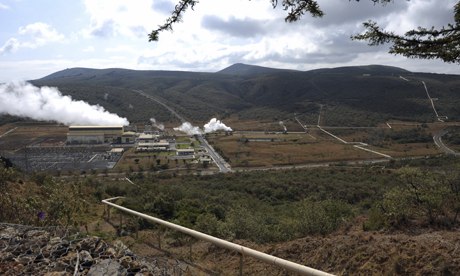
One place geothermal power is thriving is East Africa - The Guardian has an update - Kenya's energy revolution: full steam ahead for geothermal power.
East Africa is undergoing an energy revolution driven by massive offshore natural gas finds in Tanzania and notable oil discoveries in Kenya and Uganda, all in the past three years. Energy from these hydrocarbons is yet to be realised, however. The domestic shortfall is a major hindrance to growth, leaving millions of people literally living in the dark.
About 16% of Kenya's population has access to electricity, according to World Bank data, and demand is outstripping supply. Rationing is a daily reality for many. "The [national grid] service is unreliable and costs business owners large amounts in backup infrastructure and fuel," says Harrison Leaf, managing director of access:energy.
Several private companies like Leaf's are developing off-grid micro-solutions to supplement national supply. But geothermal has become the darling of on-grid solutions for Kenya, and plenty of other countries are keen to benefit.
Kenya's state-owned power producer, Kengen, has been asked to provide consultancy services to Sudan, Rwanda and Tanzania. According to the Geothermal Energy Association, Kenya will become the world leader if its planned projects are completed on time.
The country has set the ambitious target of producing 5,000 megawatts (MW) by 2030, which will power millions of homes: all energy generated is fed into the national grid to increase the percentage of households served. The World Bank estimates that geothermal from east Africa's Rift Valley could power 150m homes.
Progress is steaming ahead at the country's largest geothermal site, 80km north-west of Nairobi. Kirimi has lost count of how many wells he has drilled. His eight rigs with giant cylindrical shafts and diamond teeth are drilling wells at a rate of more than 40 a year. One well has the power to produce 18MW annually; by July 2014, Kirimi hopes to be generating 280MW – and working towards the site's next target of 560MW.
Posted
by Big Gav
in
bay of fundy,
canada,
ocean energy,
renewable energy,
tidal power
The Globe and Mail has an article on the slow progress towards exploiting tidal power in Canada's Bay of Fundy - Nova Scotia bets on economic lift from rising tidal technology.
Nova Scotia, with its record-setting tides, could be a world leader in tidal technology. But work is progressing at a snail’s pace in the province, while more investment is under way on the other side of the ocean, in Scotland and France.
The epicentre of Nova Scotia’s attempts to stay in the tidal game is a stretch of ocean floor near the town of Parrsboro. Here, in the Minas Basin – a huge inlet of the Bay of Fundy – the Fundy Ocean Research Centre for Energy (FORCE) hopes to become a key centre of tidal power research.
FORCE, which is funded by Ottawa, Nova Scotia, Encana Corp. and several tidal technology companies, was established as a place to test in-stream turbines in one of the most powerful tidal currents in the world. Three of the four offshore “berths” are rented, but none of the organizations that have reserved them – French power conglomerate Alstom SA, British-based Atlantis Resources Corp, and local outfit Minas Basin Pulp and Power Co. – have yet to put a turbine in place.
FORCE communications manager Matt Lumley says the strength of the tidal current at the site makes it attractive to companies designing turbine technology, but that is also slowing down their arrival, as they want to make sure their devices are strong enough to survive. “We are sitting on the top of Everest” when it comes to tidal power, he said. “Everyone wants to come here, but everyone is also a bit nervous.”
An early attempt to test a turbine in this spot did not turn out well. In 2009, Nova Scotia Power and a partner, Irish company OpenHydro, deployed a $10-million prototype turbine, but the tidal current ripped the blades off the device. Mr. Lumley insists the test was not a failure, as it successfully demonstrated the incredible power of the tides. It will likely be 2015 before anyone tries again, and by that time underwater power cables will be in place, allowing the test turbines to connect to the power grid.
This part of the Bay of Fundy could eventually support support hundreds of turbines and easily generate 2,500 MW of electricity, enough to power a million homes, says Richard Karsten, a mathematics professor at Acadia University in Wolfville, N.S.

Posted
by Big Gav
in
canada,
tar sands
The Toronto Star has a report on a long running oil spill from the tar sands in Alberta - ‘Nobody understands’ spills at Alberta oil sands operation.
Oil spills at a major oil sands operation in Alberta have been ongoing for at least six weeks and have cast doubts on the safety of underground extraction methods, according to documents obtained by the Star and a government scientist who has been on site.
Canadian Natural Resources Ltd. has been unable to stop an underground oil blowout that has killed numerous animals and contaminated a lake, forest, and muskeg at its operations in Cold Lake, Alta.
The documents indicate that, since cleanup started in May, some 26,000 barrels of bitumen mixed with surface water have been removed, including more than 4,500 barrels of bitumen.
Posted
by Big Gav
in
canada,
lng,
shale gas,
us
The SMH reports that LNG exports from North America are starting to look likely - the gas age is in full swing - US and Canada step on the gas.
JUST hours after the Canadian government approved its third export gas project, another US export gas project, this time in Texas, has moved closer to getting a green light. The approvals come as concern is mounting that a large rise in North American gas reserves on the back of the shale gas boom will undercut much of the optimism of Australia's gas exporters over projects being developed off Western Australia and in Queensland.
Australia is set to be one of the world's largest gas exporters in the next five years, although growth prospects beyond that are being hurt by the increase in export projects vying for approval in North America.
On Tuesday Shell won approval for a project it is promoting in British Columbia, on Canada's west coast, which includes PetroChina, Korean Gas and Mitsubishi Corp as shareholders. Both PetroChina and Mitsubishi are participants in export gas projects in Australia.
As well, the US Department of Energy granted Pangea LNG approval to begin exports from its south Texas project. Pangea has been authorised to export up to 8 million tonnes annually of liquefied natural gas for 25 years.
Shell, also, has joined another consortium planning to export gas from Georgia, in the US south.
The inability of large vessels to use the Panama Canal always meant that gas exports from the US could only be exported to Asia from the west coast and Alaska, but that will change from late 2015 when the canal's capacity rises after a $US5.5 billion ($A5.28 billion) expansion.
Posted
by Big Gav
in
canada,
geothermal energy,
geothermal power
Cleantechnica has a post on a recent report on geothermal power in Canada - Forget Tar Sands: Canada’s Geothermal Resources >1 Million Times Electricity Consumption.
Canada’s sitting on “massive” geothermal resources, according to news reports, more than 1 million times its current electricity consumption. “As few as 100 projects could meet Canada’s energy needs,” notes the Geological Survey of Canada research team whose 322-page report will be presented at a geothermal industry conference in Toronto Thursday, Sept. 15.
Better yet, the 12-scientist team found that geothermal heat reservoirs found across “large swaths of British Columbia, Alberta, the Yukon and Northwest Territories” lie close to the surface, making them easier to reach and tap into.
The research team estimates that there are at least 5 gigawatts (GW) of geothermal power available in British Columbia, Alberta and the Yukon alone. British Columbia has so much that it could produce as much electricity as the controversial $7.9-billion, 1,100 megawatt Site C hydroelectric dam the provincial government has proposed, according to the research team’s findings.
While the geothermal resources in these areas hold the greatest potential to be developed commercially, such opportunities exist across the country, the researchers say.
Posted
by Big Gav
in
alstom,
bay of fundy,
canada,
ocean energy,
tidal power
The Montreal Gazette reports three test tidal power projects are due to go live in the Bay of Fundy next year - Bay of Fundy tidal power to be tested.
Ocean energy is the next big thing, says Jean-François Ally, a senior project manager with Alstom Hydro of France. And generating electricity from the famous Bay of Fundy tides will only be the start, he said.
Alstom, besides being the world's second-biggest trainmaker after Bombardier Inc., holds third place in power generating equipment. It has a turbine plant at Sorel-Tracy, near Montreal.
Ally, speaking at an energy conference in Halifax, said his company has partnered with Vancouver's Clean Current Power Systems to deploy one of three test tidal turbine-generators in the Bay of Fundy in 2012. Lockheed Martin and Irving Shipbuilding are also partners in the test program.
The Maritimes have dreamt of harnessing the Bay of Fundy and its 55-foot tides for 50 years or more. Nova Scotia installed a Swiss-designed tidal pilot plant at the head of Fundy about 30 years ago but a full-scale development never overcame technical and financial obstacles.
Posted
by Big Gav
in
canada,
exxon,
hebron
Ordons News reports that Exxon is going to develop a large oil field offshore from Canada after a long wait - ExxonMobil to develop Hebron oil field off Canada.
ExxonMobil Canada Properties filed a development plan with Newfoundland and Labrador authorities in mid-April to develop Hebron oil field in the Atlantic off eastern Canada.
Forecasted cumulative recovery over 30 years is estimated at 660-1,055 million bbl of oil. Development would be via a gravity base structure with 52 well slots and the capacity to store 1.2 million bbl of oil in multiple compartments. ...
The plan filed with the Canada-Newfoundland and Labrador Offshore Petroleum Board said Hebron will be the fourth stand-alone development on the Grand Banks and, considering the Hibernia and White Rose tieback project, the sixth offshore oil project. ... Hebron was discovered in 1980, but the field area wasn't proved commercial until the mid-1990s, ExxonMobil said.
Posted
by Big Gav
in
canada,
global warming,
heavy oil,
tar sands
Tyler Hamilton at Clean Break has a post noting that relatively cheap shale gas in North America is helping to spur rapid expansion of tar sands projects in Canada - Dirty shale gas = lower gas prices = oilsands boom = double-barrelled emissions increase. This is a classic example of the peak oil driven lurch towards alternative (dirtier and lower EROI) fossil fuel alternatives exacerbates global warming and other forms of environmental damage.
For a generation that’s supposed to start cleaning up its energy mix, I find it disturbing that the big money is flowing toward dirtier and dirtier sources instead. Take the case of shale gas, which is plentiful and now economical to develop in North America. Shale gas, at the point of combustion, is no cleaner or dirtier than conventional natural gas, and a heck of a lot better than coal.
But it’s the way we get the shale gas that’s the problem. The hydraulic fracturing process used to release methane from shale rock formations disrupts and pollutes local water tables by contaminating them with a nasty chemical cocktail. Now, as recently reported in the news (and what you’ll hear more about from me tomorrow), there’s rising concern that the methane leaks that result during shale-gas development are substantial and that this makes shale gas just as bad, or worse, than coal with respect to its climate impacts. But the picture gets a whole lot worse.
Let me explain: Because shale gas is plentiful and an increasing amount of it is filling market demand for natural gas, it has kept natural gas prices low. This is expected to be the case for the foreseeable future. By 2035, shale gas will represent nearly half of all U.S. natural gas production, according to the U.S. Energy Information Administration. The low prices are great if you’re a business or consumer, and wonderful if you’re an oilsands developer. That’s because natural gas is the single-largest operational cost for many oilsands projects, particularly steam-assisted gravity drainage (SAGD) projects and other in situ developments that require enormous amounts of the gas to make steam.
In fact, it’s never been so good for them. Gas is about $4.50 per million BTU and oil is at about $106 a barrel right now on NYMEX — that’s a 24-1 spread! Now think about the spread at the height of the 2008 oilsands boom. Oil peaked at $147 a barrel and gas bounced between $11 and $12 per MBTU, giving a spread of 13-1.
So what am I getting at here? Oilsands developers are more profitable than they’ve ever been, and as a result there has been a burst of development activity likely to lead to a sustained boom. (I get into more detail in this story I wrote for MIT Technology Review). I’m also hearing that things are so good that oil companies are starting to throw more money into shale oil development. We’re going down a dirtier path, folks.
Bottom line: a dirty form of natural gas is helping spur development of a dirty form of oil.

Posted
by Big Gav
in
canada,
ontario,
solar power,
solar pv
Technology Review has a look at the boom in solar power in the unlikely location of Ontario, Canada - Ontario Struggles with Solar Boom.
Where's the largest operational solar photovoltaic facility in the world? Not in California, Spain, Italy, or any other sunny location. Strangely enough, it's in Ontario, a Canadian province known more for its long, snowy winters than its cloudless skies.
The sprawling 97-megawatt facility, located just outside the city of Sarnia and built by thin-film manufacturer First Solar, has been operating since October by Enbridge, a natural gas pipeline company based in Alberta. It's an unusual sight in a region better known for its chemical refineries, but it's also indicative of a solar boom that has made Ontario one of the fastest-growing markets in North America.
The growth comes at a cost. Ontario's capital, Toronto, gets 20 per cent less sunlight per year than Los Angeles, meaning that right from the start projects are one-fifth less economical. So in 2006 the province launched a program that pays 42 cents per kilowatt-hour as part of 20-year power-purchase agreements. First Solar was among a number of developers to jump at the opportunity, seizing more than 300 megawatts worth of projects.
In the fall of 2009 Ontario replaced the program with a much more comprehensive feed-in tariff program, as part of a strategy to lure green manufacturing and investment while helping the province meet its goal of phasing out all coal-fired generation by 2014. The government maintains that the program is on track to create 50,000 green-collar jobs.
The program, modeled after similar programs in Europe but unusual in North America, pays 44.3 cents per kilowatt-hour for multi-megawatt solar projects and up to 80.2 cents for rooftop systems below 10 kilowatts in size. (By comparison, Ontario residents pay about 10 cents per kilowatt-hour during peak times when solar panels are most productive, and when peak demand has typically been met by a mix of coal and natural gas.)
With those prices, it is little surprise that Ontario has been deluged with applications. In less than 18 months, more than 30,000 projects have filed for program approval, and so far, contracts totalling more than 1,400 megawatts have been offered, on top of 300 megawatts to be built under the older program. Not bad for a province that five years ago had less than a megawatt of grid-connected solar.
Posted
by Big Gav
in
biomass,
canada
Renewable Energy World has an article on converting coal fired power plants to biomass in Canada - Ontario: Replacing Coal with Biomass.
As part of an effort to phase out all coal plants in the Canadian province of Ontario by 2014, the Ontario Power Authority (OPA) is working with power-plant owners to close facilities down or transition them to burn biomass.
One such facility, the 211-MW Atikokan Generating Station, will be the first to move entirely to biomass. This week, the government of Ontario directed the OPA to draft a power purchase agreement with the plant's owner, Ontario Power Generation.
Ontario Power Generation owns three other coal plants in the Province, and has said it wants to convert all three by 2014. According to Biomass Magazine, the coal plant will require about 99,000 tons of wood pellets year.
As part of its “Green Energy Act” passed last year, the Ontario government set an ambitious target to phase out coal plants in 5 years. Many people have criticized the target, saying that it's not realistic and will de-stabilize the grid.
However, according to figures from the OPA, generation from Ontario's coal plants is already down more than 70 percent from 2003 – the lowest level in 45 years. Publicly, officials from the OPA and Ontario government have said they think the phase-out target is realistic.
In Europe, the “re-powering” of coal facilities has been underway for some years. In the U.S., a number of other companies are also experimenting with using biomass in place of coal. According to the U.S. Department of Energy, it would take about 1.6 billion tons of biomass to re-power all existing U.S. coal plants. The DOE reported that the U.S. could sustainably grow 1.3 billion tons of feedstock.
Of course, not every coal plant is going to convert to a biomass-burning facility. But theoretically, we have enough resources to transition a large portion of our coal fleet here in the U.S. The Wood Pellet Association of Canada has been trying to make a similar case.

Posted
by Big Gav
in
canada,
nuclear power
The Global Post has an article on problems refurbishing a Canadian nuclear plant - Canadian nuclear plant rehab goes awry.
The guardhouses stand at the end of a tree-lined road in this rural, forested province, and their occupants aren’t welcoming visitors.
Beyond the gates, an effort to refurbish Atlantic Canada’s only nuclear power plant isn’t going well. The 25-year-old reactor at Point Lepreau was supposed to be refreshed, refitted and running full-tilt last September after a $1 billion repair. Atomic Energy of Canada Ltd., the crown corporation that built the reactor, was to have demonstrated the efficacy of refurbishing nuclear reactors that would otherwise have to be retired.
Today, nobody knows when the plant will be back online, except that it won’t be any earlier than 2011. The company's engineers are currently trying to figure out how to restore seals on critical components inside the reactor vessel of the provincially owned plant, 40 miles east of Lubec, Maine. CEO Hugh MacDiarmid has admitted that they had “overly optimistic scheduling assumptions” and “inadequate planning and preparation” at Lepreau.
The fallout has been considerable for New Brunswick, Atomic Energy of Canada and the Canadian nuclear industry generally, raising concerns about the wisdom of refurbishing the Candu-6 reactors, which have been installed at plants in Argentina, Romania and South Korea. Candu-6 units are also being refitted at a plant in Ontario, and are being contemplated at another in Quebec.
Many existing reactors worldwide are near the end of their lifetimes and need extensive rehabilitation to continue operating. The refit at Point Lepreau was supposed to be a shining model of what Atomic Energy of Canada could do for its old plants.
“AECL is terribly behind, terribly over budget, and terribly cash-flow negative on their refurbishment projects,” said Toronto-based energy consultant Tom Adams. “The federal government keeps writing big checks for AECL and they’re not happy about it.”
Posted
by Big Gav
in
canada,
geothermal energy,
geothermal power
Tyler Hamilton has an article in the Toronto Star about a study into the potential of geothermal energy in Canada - Geothermal could meet Canada’s power needs.
Canada could technically meet all its electricity needs and dramatically lower greenhouse-gas emissions if it moved aggressively to develop enhanced geothermal power projects, according to the first comprehensive assessment of the country’s deep geothermal resources.
The study, published online in the Journal of Geophysics and Geoengineering, reports on the potential of using enhanced geothermal systems (EGS) to tap hot temperatures kilometres below the earth’s surface as a way of generating clean electricity.
It found that the most promising Canadian sites are located in parts of British Columbia, Alberta and Saskatchewan at depths ranging from 3.5 to 6.5 kilometres. Drill deeper, however, and the potential extends right across the country – including parts of Ontario.
“At 10 kilometres we can expect EGS temperatures in the 150 to 200 degrees C range across most of Canada, except some areas of the Canadian shield,” wrote Stephen Grasby, a geologist with the Geological Survey of Canada, and co-author Jacek Majorowicz, an Alberta-based geothermal consultant.
“Given the widespread distribution of geothermal energy, and the high energy content, the potential geothermal resource in Canada is significant,” they concluded.
The findings aren’t surprising – I’ve been pounding on this drum for several years now. But it’s encouraging to finally see it expressed in a peer-reviewed journal. Canada, shamefully, is the only country along the so-called Pacific Ring of Fire that has yet to switch on a conventional geothermal power plant.
The irony is that Canada is home to several of the continent’s leading geothermal power developers. Problem is they’re mostly developing in Nevada, California, Nicaragua, Iceland, Chile – everywhere except Canada, where no formal development program exists.
Maybe now the federal and provincial governments will take the issue more seriously.
This new Canadian study comes three years after the release of a groundbreaking U.S. study led by experts at the Massachusetts Institute of Technology. Their research suggested EGS in the United States could realistically supply about 100,000 megawatts of power generation capacity by 2050, assuming the proper policies and R&D investments were committed.
For comparison, 100,000 megawatts – or 100 gigawatts—is roughly 80 per cent of Canada’s current power generation capacity. It’s about one-twelfth of current U.S. capacity. And the MIT-led group predicted it could be built less expensively than building new nuclear plants or investing in carbon capture and storage technologies for coal plants.
Posted
by Big Gav
in
canada,
clean coal,
ctl,
ucg,
uk
It looks like UCG schemes aren't just confined to Australia - Technology review has an article on a venture in Canada - Getting Power From Coal Without Digging It Up.
Converting coal in the ground directly into clean-burning gases could have huge environmental benefits--not the least of which would be the avoidance of destructive mining operations. The problem is, technology for underground coal gasification is still in its early stages.
Now the government of Alberta says it will give C$285 million ($271 million) to a coal gasification project by Calgary-based Swan Hills Synfuels that involves the deepest-ever operation to generate power from coal--without digging it up.
Previous demonstrations of the technology have turned coal seams as deep as 1,000 meters below the surface into clean-burning gas. In contrast, Swan Hills Synfuels' C$1.5 billion project proposes to reach down 1,400 meters. Working at that depth could lessen the threat of groundwater contamination from the smoldering decomposing coal. "We've got 800 meters of rock--a lot of it impermeable--between us and freshwater aquifers," says Swan Hills president Doug Shaigec.
What's more, if the technology can get at deeper layers of coal, it could allow access to much more of the fossil fuel, says Julio Friedmann, who is carbon management project leader for Lawrence Livermore National Laboratory in California.
When the project starts up in 2015, Swan Hills hopes to generate 300 megawatts of power from its coal gas while selling over 1.3 million tons of carbon dioxide per year. The CO2 could be used by oil producers and ultimately stored in oil wells. This could result in the storage of 10 to 20 million tons of carbon dioxide per year by 2020. That would help Alberta meet its 2020 goal for carbon capture of 25 to30 million tons per year, according to a report last month from an alliance of Canadian industrial firms.
The British are also looking to ramp up their carbon dioxide emissions, in their case looking to coal reserves under the North Sea -
North Sea coal to be burnt underground.
Vast coal deposits lying deep beneath the North Sea will be burnt in situ to generate up to 5 per cent of Britain’s energy needs, under new plans approved by the Government last week.
The UK Coal Authority has awarded licences to Clean Coal, an Anglo-American company, to develop five offshore sites for a technology called Underground Coal Gasification (UGC).
The method, which has not been used on a commercial scale in the UK, although it is widely used in Australia [BG: this is a gross exaggeration], taps the high energy content of coal while doing away with the costly and labour-intensive need to mine it first.
Rohan Courtney, a former director of Tullow Oil who is chairman of Clean Coal, said that the potential for the technology was enormous. “There are enormous amounts of coal lying beneath the North Sea which have never been accessed,” he said. “This technology is going to open up the industry again in the UK.”
The sites approved for use stretch up to 10km offshore from Sunderland, Grimsby and Cromer on the shores of the North Sea, Canonbie, near Annan in Dumfries and Galloway on the other side of Scotland, and Swansea Bay, outside the entrance to the Bristol Channel. The combined coal reserves are estimated to be at least one billion tonnes, equivalent to more than one sixth of all the coal consumed in an average year around the world. Global consumption of coal is about 5.8 billion tonnes a year. Total consumption in the UK is about 80 million tonnes a year.
Posted
by Big Gav
in
canada,
david strahan,
peak oil,
tar sands
David Strahan has an article in New Scientist about peak oil and the Canadian tar sands - Extreme oil: Scraping the bottom of Earth's barrel.
EIGHTY-FIVE million barrels. That's how much oil we consume every day. It's a staggering amount - enough to fill over 5400 Olympic swimming pools - and demand is expected to keep on rising, despite the impending supply crunch.
The International Energy Agency forecasts that by 2030 it will rise to about 105 million barrels per day with a commensurate increase in production (see graph), although whistle-blowers recently told The Guardian newspaper in London that insiders at the IEA believe the agency vastly over-estimates our chances of plugging that gap. The agency officially denies this.
Wherever the truth lies, it is widely expected that by 2030 we will have passed the peak of conventional oil production - the moment that output from conventional oil reserves goes into terminal decline. A report from the UK Energy Research Centre (UKERC) published in August said there was a "significant risk" it would happen before 2020. And that means we will soon be staring down the barrel of the ultimate oil crisis.
Some governments and corporations are waking up to the idea and beginning to develop alternatives to keep the world's transport systems moving when cheap oil runs out. These include biofuels, more energy-efficient - or electric - carsMovie Camera, and hydrogen. But none of these is likely to make up the global shortfall in time. The pressure is on to keep the black stuff flowing and so the next two decades will see an unprecedented effort to exploit increasingly exotic and unconventional sources of oil. They include tar sands (a mixture of sand or clay and a viscous, black, sticky petroleum deposit called bitumen), oil shale (a sedimentary rock containing kerogen, a precursor to petroleum) and synthetic liquid fuels made from coal or gas.
Purely in terms of geological abundance, these sources look more than sufficient to meet global demand. According to the IEA, taken together, they raise the remaining global oil resource to about 9 trillion barrels (see map) - almost nine times the amount of oil humanity has consumed to date. The trouble is that the name "non-conventional oil" hides several dirty little secrets and a whole host of huge challenges.
Conventional oil refers to liquid hydrocarbons trapped in deep, highly pressurised reservoirs, which means that when the wells are drilled, the oil usually gushes to the surface of its own accord. Non-conventional oils are not so forthcoming, and need large amounts of energy, water and money to coax them from the ground and turn them into anything useful, like diesel or jet fuel.
As a result, non-conventional oil production to date has been slow to expand - with current output of just 1.5 million barrels per day. Not only that, because they take so much energy to produce, they are responsible for higher carbon emissions per barrel than conventional oil.
Posted
by Big Gav
in
canada,
geothermal energy,
tar sands
Bad idea of the week come from Canada, where there is interest in using geothermal energy to help process tar sands. The Globe and Mail reports - Researchers seek ‘preheater' for oil sands .
A new international research partnership based in Alberta hopes to answer an intriguing question: Could the warm rocks of deep Earth wean the oil sands off their heavy natural gas diet?
The University of Alberta has linked arms with the Helmholtz Association of German Research Centres, Germany's largest scientific organization, in hopes of furthering research into this and other oil-sands-emissions-related questions.
The partnership, signed Tuesday, brings with it the promise of international financing and German expertise in research areas where Canada has not typically excelled. One area is the use of geothermal energy in the oil sands.
Some researchers believe the earth in northeastern Alberta is hot enough to use as a sort of “preheater” for major oil sands mines, which use 40-degree Celsius water to separate oil from sand. Most of that heat comes from natural gas; the industry uses about one billion cubic feet of gas a day, or 7 per cent of Canada's daily production – a tally expected to grow substantially.


 Posts
Posts